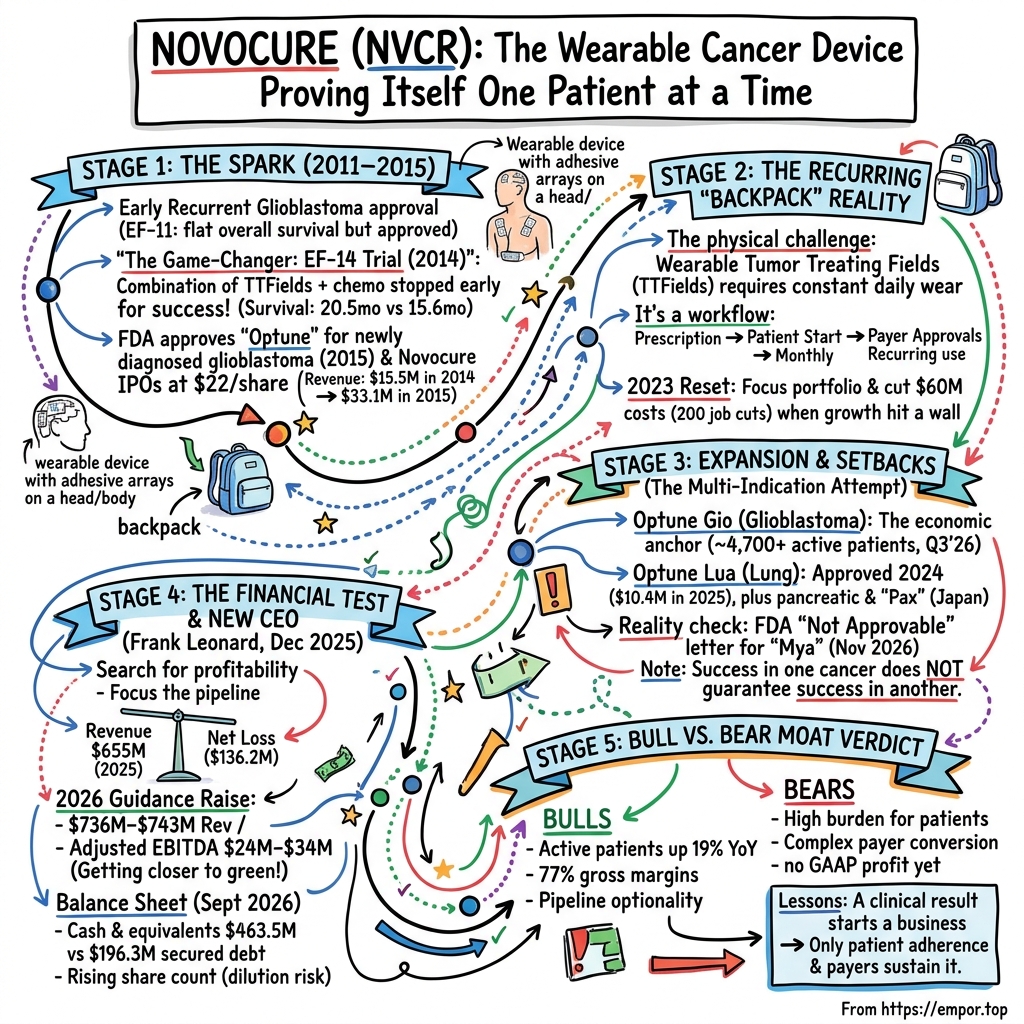
Novocure: The Cancer Device That Has to Prove Itself One Patient at a Time
I. The Backpack in the Cancer Clinic
Picture an ordinary oncology clinic on an ordinary weekday. A patient with glioblastoma, the most common and most lethal primary brain cancer in adults, has finished surgery and is moving through radiation and chemotherapy. Then a different kind of treatment arrives. It is not a vial or a pill bottle.
It is a portable electric field generator about the size of a small bag, a battery, a cable, and a set of adhesive patches called transducer arrays that are placed directly on the shaved scalp. The patient will carry the generator in a shoulder bag or backpack, the cable running up to the head, for most of every day and night, for months.1
That is the strange physical reality of Novocure. Most cancer companies sell a molecule. The molecule goes into the patient in a clinic, in an infusion chair or out of a blister pack, and then the patient goes home. Novocure sells something that goes home with the patient and stays there.
Its therapy, Tumor Treating Fields, or TTFields, works only while it is switched on and touching the skin. The company tells physicians and patients that more hours of use matter, and it tracks how many patients are on therapy in any given month because that number is the business.1
The prescription, in other words, is only the beginning. After the oncologist signs the order, Novocure's own staff have to train the patient and the family, ship the equipment, replace arrays, answer the phone at odd hours, and then chase an insurer or a national health system for payment, sometimes for a year.
The device has to fit a life that is already being torn apart by a cancer diagnosis. Every month, the patient decides again whether to keep wearing it. Every month, a payer decides whether to pay for it.
It sounds like a hard way to build a company. And yet it has built one. Novocure reported revenue of about $655 million in 2025, almost all of it from patients wearing its devices.1
It also reported a net loss of about $136 million that year, which means that two decades after a physiology professor began experimenting with electric fields in a basement in Israel, the company still spends more than it earns.12 The third quarter of 2026 brought the most encouraging sign in years: revenue up 16% from a year earlier and the number of active patients across its therapies up 19%.[^3]
Those three numbers frame the episode. The first says the core product is real; hospitals and patients use it at scale on several continents. The second says the economics are not finished; research, clinical trials and the machinery of launching new indications still consume more than the business generates.
The third says growth has returned after a stumble, and that the number of patients is growing faster than revenue, which is either a sign of new markets coming online or a sign that the newest patients bring in less money each, or both.
So the questions are simple to state and hard to answer. Can a device that asks patients to wear it for much of every day become a durable cancer business? Does the evidence that supports its use in glioblastoma travel to lung cancer, pancreatic cancer and brain metastases, or does each tumor have to be won from scratch?
And can growth finally produce cash without another round of borrowing or a steady drip of new shares that leaves each existing shareholder owning a little less of the result?
The short version of the verdict, which the rest of this story will earn, is that the established business is growing again, but the investment case still depends on whether patient growth and new indications can outpace the cost of proving, launching and getting paid for them.
In November 2026 the FDA reminded everyone how high that bar is, when it declined to approve Novocure's application for brain metastases from lung cancer.3 To understand why one regulator's letter can matter so much, it helps to go back to the single trial that made this company possible.
 Subscribe on LinkedIn
II. The Trial That Changed the Company's Future
The origin story has the texture of a garage startup, except the garage was a basement in Haifa. In 2000, Yoram Palti, a physician and physiologist who had spent his career studying how electric fields interact with living tissue, set up a laboratory at home and began testing an idea from his own doctoral work: that alternating electric fields, tuned to the right frequency, could disrupt cancer cells as they tried to divide.2
Palti was not a software founder chasing a market. He was a scientist with a mechanism, and much later Israel would award him its highest civilian honor for science and entrepreneurship, the Israel Prize, in 2022.2
The mechanism is worth a moment, because everything that follows depends on how far it can be trusted. A dividing cell has to pull its copied chromosomes apart and pinch itself in two. That choreography depends on proteins that carry electrical charge and must line up in precise ways.
Novocure's argument is that a field alternating at an intermediate frequency, too fast to stimulate nerves or muscles and too weak to heat tissue meaningfully, tugs on those charged structures at exactly the wrong moment, so that division fails or produces damaged cells.1
An analogy helps: imagine trying to build a house of cards while someone keeps gently rocking the table. Healthy cells in the adult brain rarely divide, so in theory they are left largely alone, while fast-dividing tumor cells keep trying to build and keep failing.
A theory, however elegant, is not a medicine. The company's first clinical trial began in 2003 with four patients in Switzerland, and that same year William Doyle, a medical-device investor from WFD Ventures, joined the board as executive chairman.2 Doyle's arrival matters to the story because Novocure would be run for many years as a company built by operators and investors who understood medical devices, regulation and reimbursement as much as biology.
The European Union granted a CE certificate for glioblastoma in 2007.2 Then, in 2011, the U.S. Food and Drug Administration approved the device for recurrent glioblastoma, the setting in which the cancer has come back after initial treatment.24
That first U.S. approval opened a door, but it did not build a business. Recurrent glioblastoma is a desperate setting, the evidence behind the approval was contested, as the next part of the story shows, and the revenue that followed was modest. By 2014 Novocure's revenue was only about $15 million.5 The company was a niche therapy for a niche moment in a rare disease. What changed its future was a much larger trial in a much more important setting.
That trial was EF-14. It asked a straightforward question: if you take patients with newly diagnosed glioblastoma who have completed surgery and radiation, and add TTFields to the standard maintenance chemotherapy, temozolomide, do they live longer than patients who get temozolomide alone? Nearly 700 patients enrolled.6
In late 2014, a planned interim analysis of the first patients to reach sufficient follow-up came back so favorable that the trial's independent monitoring committee recommended stopping it early and offering the device to patients in the control group.26 In oncology, a trial stopped early for efficacy is about as close to a fanfare as clinical science gets.
The plain-language result was this: patients who wore the device alongside their chemotherapy lived meaningfully longer. When the final data came in, median overall survival was about 21 months with TTFields plus temozolomide against about 16 months with temozolomide alone, and the share of patients alive at five years was roughly 13% against 5%.6
For a cancer where most patients die within two years, those differences are the stuff careers in neuro-oncology get built around. A five-month gain in median survival, and a more than doubling of the long-term survivor fraction, made the device something a neuro-oncologist had to at least discuss with every eligible patient.
The FDA approved Optune, as the device was then branded, for newly diagnosed glioblastoma in October 2015.24 The same month, Novocure completed its initial public offering on Nasdaq at $22 a share.72 The timing was not an accident.
The S-1 the company had filed in August laid out a story that public investors could understand: a commercial product with a growing base of patients, a large indication about to open, and a technology that might, the company argued, apply to many solid tumors.7 Revenue, which had been about $15 million in 2014, more than doubled to about $33 million in 2015, and it kept climbing to about $83 million in 2016 as the newly diagnosed indication took hold.58
It is worth pausing on what the IPO bought. Before 2015, Novocure was a private company funding expensive trials out of private capital. After it, the company could raise money publicly, borrow against a listed equity, and pay employees in liquid stock.
That flexibility would fund a commercial expansion across the United States, Germany, Japan and other markets, and a clinical program that eventually spanned lung, pancreatic, ovarian, liver, gastric and other cancers. The public market was, in effect, buying a portfolio of options on the idea that EF-14 was not a one-off.
That was the bet, and it is where the caveat belongs. EF-14 proved something specific: that adding this device to temozolomide after surgery and radiation extended survival in newly diagnosed glioblastoma. It did not prove that TTFields works for cancer in general.
Each tumor sits in a different part of the body, with different tissue, different standard therapies, different array placement and different patients. The company's own history before EF-14 already contained a warning that evidence would have to be earned one indication at a time, and that warning was a trial called EF-11.
III. A Positive Result Was Not a Universal Pass
The story most investors tell about Novocure starts in 2015 with EF-14 and treats the device as approved, proven and expanding. The record is more complicated, and the complication starts four years earlier.
When the FDA approved the device for recurrent glioblastoma in 2011, the pivotal evidence came from EF-11, a randomized trial that enrolled 237 patients whose cancer had returned.4 Half received TTFields alone; the other half received whatever chemotherapy their physician chose. The study did not show that patients on the device lived longer than patients on chemotherapy.4
How does a device win approval in a randomized trial that fails to show a survival advantage? The FDA judged that the device offered comparable outcomes with a different and, in some respects, milder side-effect profile than chemotherapy, and approved it on that basis for patients who had run out of good options.4
For a regulator weighing a desperate patient population, that was a defensible judgment. For anyone trying to build a platform thesis on it, it was a much weaker foundation than a clear win. "Not worse than chemotherapy in a setting where chemotherapy does little" is a very different claim from "extends life."
The ambiguity did not stay inside the FDA's files. Payers had to decide whether to cover the device for recurrent disease, and those decisions were contested for years. One Medicare coverage dispute over recurrent glioblastoma reached an administrative law judge at the Department of Health and Human Services' Departmental Appeals Board, which issued a decision in 2021.9
The details of that case matter less than what it represents: an approved device whose clinical value, in one setting, was still being argued over a decade after approval. Approval had settled the safety question and allowed the device onto the market. It had not settled whether the people paying for healthcare believed the benefit justified the price.
Set that against EF-14 and the contrast is stark. In the newly diagnosed setting, the FDA's review of the per-protocol population, the patients who received treatment as the trial intended, found median overall survival of about 20.5 months with TTFields plus temozolomide against about 15.6 months with temozolomide alone.4
The final intent-to-treat results reported a similar gap and the long-term survivor advantage described in the trial's five-year data.6 This was the evidence that oncologists, guidelines and payers could build on, and it is why the newly diagnosed indication, not the recurrent one, became the economic heart of the company.
There are critics of EF-14 too, and fairness requires mentioning the strongest of their points: the trial was open-label, with no sham device, so patients and physicians knew who was receiving the therapy. A sham device that produces no field but still requires shaving and wearing arrays would have been hard to run ethically and practically, and the survival endpoint is about as objective as clinical science gets; a patient is alive or not.
But open-label design leaves room for differences in care and attention between arms, and skeptical clinicians have cited it ever since. The more honest reading is that EF-14 is strong evidence, strong enough to win approval and guidelines and a large business, but not so overwhelming that every neuro-oncologist treats the device as mandatory.
Why does any of this matter to an investor in 2026? Because the two trials define the shape of the problem. A technical mechanism, a device that has been on the market for years, and an FDA approval in one tumor type do not by themselves establish clinical benefit in another tumor type, or even in another stage of the same cancer.
EF-11 showed that the same device, in the same brain cancer, could fail to beat chemotherapy on survival. EF-14 showed it could add months of life when combined with chemotherapy at an earlier point. Biology, in other words, cares about context, and so do regulators and payers.
This is an evidence problem as much as a regulatory one. A drug company with a new mechanism has the same issue, but a drug at least has a dose that can be tuned in early trials and a blood level that can be measured. A TTFields device has a field strength that depends on where the arrays sit, how the electric current moves through bone, fluid and tissue, and how many hours a day the patient tolerates wearing it.
Two trials of the same device in two cancers are almost two different products. Novocure has always argued that its platform is the field, and that the field will apply wherever cells divide rapidly. The record argues that the platform is a hypothesis, and each indication is a separate experiment.
The question the rest of this story carries is whether Novocure can repeat the full EF-14 sequence elsewhere: a convincing trial, an approval based on survival rather than on equivalence, and then the slower work of persuading physicians, patients and payers.
As the company would learn in lung cancer, pancreatic cancer and brain metastases, each step in that sequence can go right while the next goes sideways. But before following the pipeline, it helps to understand the machine that the newly diagnosed approval created, because that machine still pays for everything.
IV. From Approval to a Treatment Routine
Follow the commercial journey from the FDA label to a patient's kitchen table. A neuro-oncologist decides that a patient with newly diagnosed glioblastoma is a candidate, usually after radiation, and writes a prescription. Novocure, not a pharmacy, takes it from there.
A device support specialist meets the patient and caregiver, explains how the arrays are placed, how the battery is charged, what to do when the skin under the arrays becomes irritated, and why the hours matter. The company ships equipment and supplies, keeps patients stocked with replacement arrays, and monitors device usage. Then the reimbursement team bills the insurer or national health system, and waits.1
The revenue model mirrors that routine. Novocure recognizes revenue ratably over each monthly treatment period, which means a patient who is on therapy in a given month contributes a month of revenue, and a patient who stops contributes nothing afterward.1
The contracts are short; the original expected duration is under a year, and payers typically have up to twelve months to pay.1 The two numbers management watches are the count of active patients and the revenue each one generates. Multiply them and you have, roughly, the company.10
That is a recurring revenue base of a peculiar kind. It recurs because glioblastoma treatment lasts months and patients remain on therapy month after month. It is not recurring in the way a software subscription is, because there is no long contractual commitment underneath it.
Every month's revenue rests on a patient continuing to wear a device, a physician continuing to recommend it, and a payer continuing to honor the claim. The filings do not quantify a minimum purchase commitment or a share of revenue that is contractually locked in, because there isn't one.1
Optune Gio, as the glioblastoma product is now called, is the anchor of that base. At the end of September 2026, Gio had about 4,730 active patients worldwide, up 11% from a year earlier.[^3]10 That is a large number for a rare cancer and a sign of real clinical adoption across the United States, Germany, France, Japan and other markets.
The company's total active patient base grew 19% in the same quarter, faster than Gio alone, because the newer products and new countries were adding patients from a small base.[^3] The newer products, Optune Lua for lung cancer and Optune Pax for pancreatic cancer, matter for the future, but they remain much smaller contributors today, a point the next part of the story develops.
The hardest lesson about this engine came in 2023, and it is the best guide to how to read reported growth. After rising almost every year since the IPO, revenue fell from about $538 million in 2022 to about $509 million in 2023.1112 The headline looked like a demand problem. It was mostly something subtler.
In earlier years, Novocure had been collecting cash on claims that payers had previously denied or that the company had fought on appeal, and that catch-up money had flowed into reported revenue. In 2023 those collections fell sharply, and the company explained that the easiest older claims had largely been exhausted.12
That is a revealing moment for anyone trying to understand the quality of the revenue line. Because the company recognizes revenue based on what it expects to collect, and because U.S. reimbursement for a device like this is a grinding process of approvals, denials and appeals, some of the revenue reported in any given period reflects judgments about cash that has not yet arrived, and some reflects resolution of old fights.
When the old fights ran out, the revenue line shrank even though the number of patients had not. The lesson is that revenue per active patient is not a fixed price. It is the net outcome of thousands of payer decisions, and it can move without anything changing at the bedside.
There is a related tell in the balance sheet today. Net trade receivables, the money payers owe Novocure, rose from about $89 million at the end of 2025 to about $108 million at the end of September 2026, faster than revenue.110 The company reports no identified credit losses in recent years and says it has had no material counterparty credit losses.1
It does not publish an aging schedule showing how long those balances have been outstanding, nor a separate figure for revenue that has been recognized but not yet billed.10 Rising receivables in a growing business can be perfectly benign; new patients in new markets generate new bills before they generate cash. But this is a company whose revenue has already once been flattered and then deflated by collection timing, so the trend deserves attention.
What sustains the core business, then? The evidence from EF-14 is the foundation. Treatment guidelines, physician familiarity built over a decade, and an established support organization are the walls. The weakest point is the patient's daily experience. Wearing arrays on a shaved scalp, carrying equipment and managing skin irritation asks far more of a patient than taking temozolomide capsules.
Some patients and physicians decline, and the company's growth depends on the share of eligible patients who start and stay. Meanwhile, the competition for those patients is not another device maker. It is the standard of care itself: surgery, radiation, chemotherapy and whatever new drug combinations emerge from trials in glioblastoma. Any drug that meaningfully extends survival on its own would reset the comparison TTFields has to win.
Geography adds a second layer to the same question. In the first nine months of 2026, international markets contributed about $43 million of the company's revenue growth.10 That is encouraging, because it shows the glioblastoma playbook can be exported to health systems in Europe and Asia.
It also complicates the arithmetic. National health systems usually pay less than American commercial insurers, so a patient added in one European country may bring in noticeably less revenue than a patient added in the United States.
That is the most likely reason the active patient count can grow faster than revenue. Currency adds noise on top: a weaker dollar flattered 2025 revenue by about $11 million and the first nine months of 2026 by about $4 million, and the company hedges only part of its euro exposure.110
None of this is alarming. It is simply a reminder that a patient is not a fixed unit of revenue, and that the mix of where patients live matters as much as how many there are.
So the established business is repeatable, but not automatic. It is a monthly vote by patients, physicians and payers, and for now that vote is going Novocure's way in glioblastoma. The bigger question is whether the company can win the same vote in cancers that are far more common, and that is where the pipeline comes in.
V. The New Indications Arrived Before the Old Economics Disappeared
For years, Novocure's investor pitch carried an implicit clock. Glioblastoma is a rare disease. Sooner or later, the argument went, Gio's growth would slow as penetration rose in the markets where it was reimbursed, and the company would need its next indication to carry the story. The good news, by late 2026, is that the next indications have arrived before Gio's economics faded. The sobering news is how small they still are, and how unevenly they have arrived.
The first arrival was lung cancer. In October 2024, the FDA approved Optune Lua for adults with metastatic non-small cell lung cancer whose disease had progressed on or after platinum-based chemotherapy, used alongside a PD-1 or PD-L1 immune checkpoint inhibitor or the chemotherapy docetaxel.213
Lung cancer is a vastly larger disease than glioblastoma, and on paper the approval multiplied the company's addressable market. In practice, Lua generated about $10 million of revenue in 2025, against about $655 million for the company as a whole.1 That is roughly one and a half cents of every revenue dollar, a full year after approval.
Why so slow? Because an approval is only the first link in a chain.
After the FDA decision come the treatment guidelines, which shape what oncologists consider standard; the payers, who must decide whether and how to cover a device in a setting where many competing drugs already exist; the community oncologists, who see lung cancer patients by the thousands and may never have prescribed TTFields; the patients, who must accept wearing arrays on the chest and back while already dealing with metastatic disease; and then the recurring use that turns a start into revenue.
A failure or a delay at any link slows the whole chain. In glioblastoma, Novocure spent years building relationships with a relatively small community of neuro-oncologists. In lung cancer, the audience is far larger and far busier, and the device is entering a crowded treatment sequence.
The second arrival was pancreatic cancer, a disease with few effective options and grim survival. On February 12, 2026, the FDA approved Optune Pax for adults with locally advanced pancreatic cancer, to be used alongside the chemotherapy combination of gemcitabine and nab-paclitaxel.14 The agency called it a first-of-its-kind device and said that adding TTFields to chemotherapy improved overall survival by approximately two months compared with chemotherapy alone, with localized skin reactions the most common device-related risk.14
Two months sounds modest, but in locally advanced pancreatic cancer, where progress has been painfully incremental, it was enough to earn approval through the FDA's premarket approval pathway after breakthrough designation in December 2024.14 By the end of September 2026, Pax had about 270 active patients in the United States.10 Japan approved Optune Pax as well, giving the product a second major market.[^3]15
Management's 2026 guidance put the combined revenue of Lua and Pax at $30 million to $34 million for the year.[^3] Against total revenue guidance of $736 million to $743 million, the two newer products together represent less than a twentieth of the business.[^3]
This is the honest frame for the pipeline: Lua and Pax are options on future growth, not present-day co-equal businesses. They are growing fast in percentage terms because they began near zero. Whether they become material depends on the conversion chain, not on the approval letters already in hand.
Then came the setback that sharpens every one of these questions. On November 9, 2026, the FDA issued a Not Approvable Letter for Optune Mya, Novocure's application for adults with brain metastases from non-small cell lung cancer following stereotactic radiation.313 The agency cited uncertainty about the degree of clinical benefit and raised no safety concern.3
The evidence behind the application, the METIS trial, had randomized 298 patients and met its primary endpoint, a longer time to progression of cancer inside the brain, with a hazard ratio of 0.72, meaning a roughly 28% lower risk of intracranial progression at any point.13 But the trial showed no significant differences in overall survival, time to neurocognitive failure or radiological response.13
That pattern should sound familiar, because it rhymes with EF-11. A trial technically succeeded on its chosen endpoint, but the endpoints that patients and regulators care about most did not move. In the case of brain metastases, delaying progression inside the brain is valuable only if it translates into longer life or preserved thinking and function, and METIS could not show either.
Novocure said it would meet with the FDA to look for options to support approval without additional clinical studies, while cautioning that there could be no assurance of approval.313 An investor should read that carefully: a company that hopes to avoid another trial is telling you how expensive and slow another trial would be.
The juxtaposition is the point. In the space of a single season, Novocure reported its strongest quarter in years, with Pax approved in the United States and Japan and Lua growing, and it received a letter from the FDA rejecting a third indication on the grounds that the benefit was too uncertain.[^3]3
The pipeline is producing both openings and setbacks. Anyone claiming that TTFields is a proven platform across solid tumors has to explain Mya. Anyone claiming it is a one-product company has to explain Pax.
The live tone of the story is visible in the company's calls. On the Q4 2024 call, held shortly after the Lua approval, management's emphasis was on launch preparation and the long work of securing reimbursement.16 By the second and third quarters of 2026, the conversation had moved to Pax's U.S. launch, Lua's slow build, and raised guidance.1715
What has not changed across those calls is the gap between approval and money. Two years after Lua's approval, its revenue is still a rounding error in the company's results, and the question of when payers broadly cover the newer products remains the one that will settle how fast the options pay out.
The company's longer record supports that caution. In 2019, the FDA approved TTFields for mesothelioma, a rare cancer of the lining around the lungs, under a Humanitarian Device Exemption, a pathway reserved for conditions that affect small numbers of patients and which, by its nature, limits the commercial opportunity.2
In Greater China, regulators approved the glioblastoma product in 2020, two years after the Zai Lab partnership began, but the economics flow to Novocure as royalties and product sales at cost rather than as the full revenue of a direct market.21
And the 2023 portfolio reset, which the next chapters return to, pared back programs that had once been presented as part of the same broad platform.18 Across more than a decade, the pattern is consistent: approvals have come, sometimes impressively, but only one of them, newly diagnosed glioblastoma, has so far produced a business large enough to pay for the rest.
The honest summary is that certification is not commercialization. Approvals for Lua and Pax are genuine achievements; they required large randomized trials that many companies never complete. But the history so far is that Novocure converts approvals into revenue slowly, and that its evidence does not transfer automatically from one indication to the next. Which raises the question every long-term investor eventually asks: what exactly can this company defend?
VI. A Moat Made of Evidence, Access and Patient Routine
Imagine the decision from the clinician's side of the desk. A thoracic oncologist has a patient with metastatic lung cancer whose disease has progressed after platinum chemotherapy. There are several drug options, each with data, side effects and familiar logistics.
Adding Optune Lua means explaining a device the patient has never heard of, describing arrays on the torso and daily wear, and asking the practice's staff to coordinate with a company they may never have worked with, all before anyone knows whether the patient's insurer will pay. The clinician does not compare Novocure with another device company. The clinician compares the device with the hour already saved by sticking with drugs.
That is the first thing to understand about Novocure's competitive field. In glioblastoma and lung cancer, the rivals are not comparable device makers, because no other company has a commercial TTFields system of comparable scale. The rivals are treatment decisions: chemotherapy, radiation, targeted drugs, immunotherapy and the clinical trials that might produce the next standard.
TTFields must earn its place alongside them, and in most cases on top of them, as an add-on rather than a replacement. An add-on is easier to adopt than a substitute, because the physician does not have to abandon a proven drug. But it is also easier to drop, because nothing breaks if the patient declines.
What Novocure can defend is a bundle of advantages, and it is worth naming them once. The first is indication-specific clinical evidence: large randomized trials that a newcomer would have to replicate, at enormous cost and over many years, to win the same labels.
The second is the approvals themselves in the United States, Europe, Japan and, through its partner, China. The third is payer pathways, the hard-won coverage decisions, billing codes and appeals expertise that took the company a decade to build in glioblastoma.
The fourth is physician familiarity, especially among neuro-oncologists, many of whom have prescribed the device for years. The fifth, and the least appreciated, is the support and logistics operation that keeps several thousand patients on therapy every month. More than 4,700 active Gio patients at the end of September 2026 are, in a sense, the moat made visible.[^3]
The economics of that bundle are attractive at the gross level. Gross margin was about 77% in the third quarter of 2026, with cost of revenue flat from a year earlier even as revenue rose.10 That means each additional patient month, once the infrastructure exists, contributes generously toward overhead. It is the strongest argument that the company could eventually earn operating profits if research and commercial spending grew more slowly than revenue.
Now test the moat the way it would actually break. Buyer power is the first stress point. Novocure says its receivables are owed by numerous government agencies and hundreds of health insurers, with no single customer identified as a concentration.1 That diversity limits any one payer's ability to dictate terms.
But each payer still controls coverage, prior authorization and payment timing for its own members, and national health systems in Europe and Japan negotiate prices with a single voice. The 2023 revenue decline was, at bottom, a buyer power event: payers paid less on old claims, and the revenue line followed. A moat that depends on persuading hundreds of payers, each with its own rules, is wide in some places and shallow in others.
Substitution is the second stress point, and it is where the daily-wear burden matters most. A pill or an infusion asks a patient for minutes; TTFields asks for hours of every day, plus array changes and skin care. The company has to show that the survival benefit and the patient experience justify that burden in each indication. In newly diagnosed glioblastoma, where EF-14 showed months of added life, the trade has been persuasive to thousands of patients.
In settings where the measured benefit is smaller or less certain, as METIS showed in brain metastases, the trade becomes harder to sell to regulators, never mind to patients.13 And a new drug that meaningfully extends survival in any of these cancers would not need to beat TTFields directly; it would simply change the baseline against which the add-on is measured.
Supplier power is a quieter consideration but a real one. At the end of 2025, about $42 million of the company's roughly $49 million in purchase obligations was owed to four major suppliers.1 A device company that cannot ship arrays cannot keep patients on therapy, and a patient who stops does not always restart. This is execution risk rather than a structural threat, but it is concentrated where payer risk is diffuse.
What about would-be competitors with their own field devices? The deeper protection is not the patents, which age, but the trial evidence and payer machinery, which a newcomer would have to rebuild indication by indication.
That is the same lesson that cuts against Novocure's platform thesis: if evidence must be earned one cancer at a time, it must be earned one cancer at a time by everyone. First-mover status in TTFields is real, and the company's decade of commercial data is not easy to copy.
So the conclusion has to be proportional. Gio's patient base is proof of adoption in one indication, in specific markets, under specific reimbursement arrangements. It is not proof that the platform will win in every cancer, and the record of EF-11 and Mya argues against assuming it will.
The metrics that would confirm a wider moat are active patients by indication and market, clinical outcomes in each new indication, and net revenue per patient as the mix shifts toward newer products and newer countries. Those numbers will also judge the people now running the company, because the strategy they inherited was itself the product of a hard reset.
VII. The 2023 Reset, the New CEO and the Cash Test
By the autumn of 2023, Novocure was in an uncomfortable position. Revenue was falling for the first time since the IPO, as the collection tailwinds of earlier years dried up.12 Research and clinical-study spending was running above $220 million a year, funding trials in lung, pancreatic, brain metastases and other indications at once.1
Net losses were large, reaching about $207 million for 2023.1 A company that had sold public investors a broad platform now had to decide which parts of that platform it could afford.
In November 2023 it announced a portfolio prioritization and strategic restructuring plan. The company said it would focus resources on the programs closest to commercial and clinical inflection, cut about 200 jobs, and target roughly $60 million in residual cost reductions.18 The logic was defensible.
A company with finite cash and an expensive trial portfolio cannot pursue every tumor type at the same speed, and the most valuable thing management can do in that situation is to choose. The restructuring was, in effect, an admission that the platform would be built in sequence rather than all at once.
Did the reset work? The cost side is mixed. Research and clinical-study spending dipped to about $210 million in 2024 and then rose back to about $225 million in 2025, roughly a third of revenue.1 Headcount rose to about 1,600 at the end of 2025 from about 1,490 a year earlier.1 That is not a company being harvested; it is a company that cut, then resumed investing as approvals for Lua and Pax brought commercial launches.
The revenue side is clearer. Revenue recovered to about $605 million in 2024 and about $655 million in 2025, and net losses narrowed from about $207 million in 2023 to about $136 million in 2025.1 Losses shrinking by a third over two years while the company launched two new products is real progress, even if it is not yet profit.
Into this story stepped a new chief executive. Ashley Cordova, who had led the company for most of 2025, resigned effective November 30, 2025, and Frank Leonard became CEO the next day.1920 Leonard was not an outsider brought in to shake things up.
He had led global operations from 2024 and became president in 2025, so he had run much of the commercial and operating machinery he now leads.20 That background matters. Leonard's mandate, in practice, is less about inventing a new strategy than about executing the one the company already has: launch Pax, grow Lua, keep Gio growing, and turn the gross margin into operating income.
The incentives point in that direction. The 2026 proxy describes executive pay tied to revenue, active patients, adjusted EBITDA, shareholder return and clinical milestones.20 Leonard's reported 2025 compensation was about $7 million, most of it in stock awards, while Cordova's reported package for the year was about $13 million.20
Those are grant-date values, not realized pay. Leonard's disclosed beneficial holdings are below 1% of the shares outstanding.20 Shareholders approved the say-on-pay resolution at the June 2026 annual meeting by a wide margin, with roughly ten votes in favor for every one against.21
The leadership bench around Leonard has also shifted. Christoph Brackmann remained chief financial officer through the transition, which gives investors continuity on the numbers.20 But the chief medical officer, Nicolas Leupin, resigned in February 2026, at a moment when the company was preparing for the Pax launch and awaiting the FDA's review of Mya.20
The board is large, with eleven directors elected at the 2026 annual meeting, eight of whom the company classifies as independent; the executive chairman and the CEO sit among the non-independent directors.2021 An executive chairman alongside a chief executive is a structure that can provide continuity across leadership changes. It can also blur accountability, because a new CEO operating under a long-tenured chairman may have less room to change course than the title suggests.
There is a sharper detail inside the incentive design that a skeptical investor should notice. When the FDA approved Optune Pax, it triggered performance share units tied to that milestone, and the company recorded a non-cash expense of about $43 million in 2026 as a result.10
Paying people for clinical milestones is reasonable in a company whose value depends on approvals. But this story has already shown that approval and commercial success are separate events. Rewarding the first with equity before the second has been demonstrated is generous to employees and dilutive to shareholders, and it shows up directly in the share count discussed below.
The most visible commitment Leonard's team has made is its guidance. After raising it with the third-quarter results, the company now expects 2026 revenue of $736 million to $743 million and adjusted EBITDA of $24 million to $34 million.[^3] Positive adjusted EBITDA would be a meaningful milestone for a company that has long lost money. But it requires careful reading.
Adjusted EBITDA excludes share-based compensation, which ran at about $105 million in 2025 and about $98 million in just the first nine months of 2026.110 Over those nine months, the company's GAAP net loss was about $97 million.10 In other words, much of the gap between "adjusted profit" and "accounting loss" is the cost of paying employees in stock, a real cost that shareholders bear through dilution rather than through cash.
That is why credibility here has to be judged by observable outcomes rather than adjusted targets. Comparing the November 2023 restructuring language with the Q4 2024 call and Leonard's remarks on the Q2 and Q3 2026 calls, the narrative has been broadly consistent: focus spending on near-term programs, launch the approved products, and move toward self-funding.18161715
The test now is whether quarterly revenue, adjusted EBITDA and, crucially, operating cash flow keep moving in the same direction, and whether GAAP operating losses keep shrinking. The guidance raise is a positive signal. It is not yet evidence of sustained operating profitability, and it is certainly not evidence of per-share value creation.
The skeptical investor's question is sharper still. Does management fund the trials most likely to change the economics, or does it keep spending ahead of evidence that new indications can scale? The Mya letter makes that question concrete. If the company now pursues approval through further discussions or more data, how much of its research budget will go to an indication whose pivotal trial did not show a survival benefit?
Leonard's answer to that question, visible in how research spending moves over the next few quarters, will say more about capital discipline than any guidance range. And it will be made against a balance sheet that bought time in 2025 but did not buy certainty.
VIII. The Balance Sheet Bought Time, Not Certainty
Every company that burns cash eventually meets a maturity date. For Novocure, the date that loomed over 2025 was the maturity of a convertible note of about $561 million, a large piece of debt raised in more optimistic years and due in cash if the share price did not justify conversion.1
It did not. A convertible bond is a bet that the stock will rise enough for lenders to swap their debt for shares; when the stock falls, the bond simply becomes a bill.
Novocure paid the bill. The company repaid the convertible note at maturity in 2025, after drawing $100 million in 2024 and another $100 million in 2025 from a senior secured facility with lenders affiliated with BioPharma Credit.1 That move replaced a large unsecured maturity with a smaller secured loan due in 2029.
The cost is meaningful: the facility bears interest at 6.25 percentage points over three-month SOFR, with a 3.25% floor on the benchmark, so the rate can never fall below about 9.5%.10 On $200 million, that is roughly $19 million or more a year in interest, paid in cash. The company did not exercise a later tranche and no longer has the option to draw the remaining amounts.1
At the end of September 2026, the balance sheet showed about $196 million of senior secured facility liabilities, including $25 million due within a year, against cash, cash equivalents and short-term investments of about $464 million.10 Lease liabilities sit separately.10 No covenant breach has been disclosed.10 The simple arithmetic is reassuring: cash and investments exceed borrowings by more than two to one. The company is not facing a solvency crisis.
But solvency is not the same as abundance, and the cash flow statement explains why. Novocure's net losses and its cash outflows are very different numbers. In 2025, the net loss was about $136 million, but operating cash use was only about $49 million.1 The gap is mostly non-cash charges, above all share-based compensation, which reduce accounting profit without consuming cash.
Working capital moved the other way: accounts receivable and inventory grew in 2025 and absorbed cash.1 That shape repeats the earlier warning. The company's cash burn is smaller than its loss partly because it pays employees in stock, and it is larger than it would otherwise be because payers take months to pay.
There is another line that flatters the reported numbers. "Financial income, net," mostly interest earned on cash and investments, was about $18 million in 2025 and about $39 million in 2024.1 It narrowed the pre-tax loss meaningfully, but it has nothing to do with operating performance, and it fell as the company spent cash to retire the convertible note. As cash balances decline, that cushion shrinks, while interest on the secured loan stays.
The cash itself is conservatively held. Cash equivalents are highly liquid instruments, and short-term investments carry maturities of three months to a year; the company reported them at the end of 2025 as held-to-maturity debt securities.101
That is the right posture for a company whose cash is its runway rather than an investment portfolio, and there is no sign of reaching for yield. The balance sheet's risk is not what the cash is invested in. It is how fast it is spent.
So the solvency claim has to stay bounded. The balance sheet gives management room to execute through the launches of Pax and Lua and the remaining clinical program. It does not give unlimited room. Clinical trials, working capital for new markets, debt service and the lease obligations of a global company continue to consume resources.
If operating cash flow turns positive in the next few years, the cash pile will look like a comfortable buffer. If it does not, the company will eventually face a decision about raising money again, and with the secured lenders already holding a senior claim, the next round would more likely involve equity.
Capital allocation in this company has been almost entirely internal, which is worth saying plainly because it narrows the analysis. Novocure's defining deployments have been clinical trials, commercial infrastructure and product development.
The one notable external arrangement is a licensing and distribution partnership in Greater China with 再鼎医药 Zai Lab, signed in 2018, which paid a $15 million upfront fee, offered up to $78 million in milestones, and pays royalties of 10% to the mid-teens on net sales.12 Zai buys product from Novocure at fully burdened manufacturing cost.1 No acquisition is needed to explain the company's trajectory; the record of success and failure lies in its own trials.
That makes the share count the most important capital allocation metric outside the trials themselves. Outstanding shares rose from about 108.5 million at the end of 2024 to about 112.5 million at the end of 2025 and about 116.9 million by September 2026, nearly 8% growth in under two years.110
That growth came largely from employee options, restricted stock and the share purchase plan rather than from a public offering.10 The company has not repurchased shares.1 And in June 2026, shareholders approved adding 9 million shares to the incentive plan, enough to keep the issuance going.21 Even if Novocure grows revenue and narrows losses, each shareholder owns a slightly smaller slice of the result every year.
Who owns those slices? The largest disclosed holders are investment managers: Fidelity's parent FMR with about 14%, BlackRock with about 10%, the healthcare-focused fund Soleus Capital, which reported about 8% in November 2026, and Hansjörg Wyss, the Swiss medical-device entrepreneur, with about 7%.20[^23]
No controlling shareholder exists. That means governance runs through the board and the large institutions, and that per-share progress, not just company-level progress, is what those holders will judge. Which brings the story to the central debate: what would prove that this business can turn into durable per-share returns?
IX. Analysis & Bear vs. Bull Case
Two numbers sit side by side on Novocure's recent results. The first is the record active patient count, growing nearly a fifth year over year. The second is an accounting loss that has narrowed but not disappeared. Third-quarter 2026 revenue reached about $193 million, up 16%.[^3]
The full-year 2025 operating loss was about $154 million.1 Guidance for 2026 calls for revenue of $736 million to $743 million and adjusted EBITDA of $24 million to $34 million.[^3] Both numbers are true at once, and the investment debate is about which one the next three years will validate.
Start with the bull case, because it has real evidence. Gio continues to add patients more than a decade after its newly diagnosed approval, which says the clinical case in glioblastoma has held up in practice. Revenue growth in the third quarter reached 16% and active patient growth 19%, the strongest combination in years.[^3]
Gross margin near 77% means that once the support organization and trial spending stop growing as fast as revenue, a large share of incremental revenue could fall to the operating line.10 Pax adds a pancreatic indication with a survival claim in a disease with few options, approved in two major markets.14[^3] And the company holds more than $460 million in cash and short-term investments while raising guidance for both revenue and adjusted EBITDA.10[^3]
Now the bear case, which has evidence too. The established Gio business still carries the economics. Lua and Pax together are expected to contribute a small fraction of 2026 revenue, and Lua's slow build two years after approval suggests that commercialization in a crowded, high-volume cancer is far harder than in glioblastoma.[^3]1
Mya's FDA setback shows that clinical benefit does not transfer from one indication to another, and that a trial meeting its primary endpoint can still fail to convince regulators.313 The company remains GAAP loss-making, carries secured debt at a high floating rate, issues shares every year, and does not publish the receivables aging that would let an outsider judge whether collections are keeping pace with growth.10
Porter's five forces sharpen the picture. Rivalry among direct device competitors is low, because Novocure is the only scaled commercial TTFields provider; rivalry with the broader standard of care is intense, because every new cancer drug changes the bar the device must clear. The threat of new entrants is limited by the cost and time of running indication-specific trials, but that same cost limits Novocure's own expansion.
The threat of substitutes is the most important force, because a drug that extends survival with less burden can displace an add-on device without ever competing with it directly. Buyer power is fragmented across hundreds of payers but potent in each, as 2023 demonstrated. Supplier power is moderate and concentrated in a handful of manufacturers.1
Hamilton Helmer's seven powers framework gives a similar answer. Novocure has a form of cornered resource in its indication-specific clinical data and approvals, which competitors cannot copy without years of their own trials. It has a modest process power in its patient-support and reimbursement operations, built over a decade and not easily replicated. It has some switching costs within glioblastoma, where physicians and patients are familiar with the device and a patient already on therapy has every reason to continue.
It does not obviously have network effects, scale economies in the classic sense, or brand power that extends across indications; each new cancer requires a new campaign. And it does not have counter-positioning against drug companies, because those companies are not threatened by its success. The powers it holds are real but narrow, and they have to be rebuilt in every new indication.
Weigh it, then conclude. The history does not reject the core claim that Novocure has a durable business in glioblastoma; a decade of patient growth confirms it. It does narrow the platform claim to a smaller, more conditional version: TTFields can work in some cancers, under some trial designs, when combined with standard therapy, and each success has to be proven and then commercialized separately.
And it leaves the profitability claim intact but unproven: the gross margin and recent loss reduction make operating profit plausible, but the company has not delivered it on a sustained GAAP basis.
A skeptical long-short investor, or an activist with a seat at the table, would press on four points. The first is research spending: about a third of revenue goes to R&D and clinical studies, and the question is whether every program in that budget has a realistic path to a reimbursed, recurring patient base, or whether some are kept alive because the platform story requires them.1
The second is equity compensation: share-based pay of roughly $100 million a year, plus milestone-triggered awards such as the Pax PSUs, is a large transfer of ownership for a company that has not yet earned a GAAP profit.110
The third is disclosure: a business whose revenue has already swung on collections should publish receivables aging and unbilled balances, and Novocure does not.10 The fourth is the measure of success itself. Incentives tied to adjusted EBITDA reward a figure that excludes the very stock compensation that dilutes shareholders, and an activist would ask for per-share and GAAP targets alongside it.20 None of these points says the strategy is wrong. Each says the burden of proof sits with management.
Three KPIs will settle the debate. The first is active patients by product and geography: Gio's base was about 4,730 at the end of September 2026, growing 11%, and the newer products are the swing factor.[^3] The second is net revenue per active patient and collection trends, which reveal whether growth is coming from markets and products that pay as well as the U.S. glioblastoma business, and whether receivables, up about a fifth in nine months, are converting to cash.10
The third is GAAP operating income and operating cash flow after working capital; the company used about $49 million of operating cash in 2025, and the direction of that number is the clearest test of whether adjusted EBITDA is translating into real economic profit.1
On valuation, the honest observation is that a company without sustained earnings cannot be anchored on price-to-earnings multiples, and its own history of losses offers no stable earnings-based range to compare against.
Whatever the market price implies, it must be pricing a future in which operating leverage arrives and at least one newer indication becomes material. Peer comparisons are of limited use, because no listed company runs a comparable business; drug developers, device makers and diagnostic companies each share only part of the profile.
The next catalysts are visible. Reimbursement and commercial uptake for Lua and Pax, especially U.S. coverage decisions, will show whether the conversion chain works outside glioblastoma. The FDA's next step on Mya will show whether the company can salvage an indication without a new trial.
And several quarters of revenue, cash flow and GAAP profit delivery against raised guidance will show whether the new CEO's team can make the gross margin pay. Those are the moments when this story's central questions get answered, and they hold lessons that reach beyond one company.
Playbook: Business & Investing Lessons
Go back to late 2014, to the moment the EF-14 monitoring committee looked at the interim data and recommended stopping the trial. That moment created a company. It turned a scientist's basement project into a Nasdaq listing, a global support organization and, eventually, more than $650 million a year in revenue.12
What it did not do is finish the work. Revenue rose about twentyfold from 2015 to 2025, and the company still lost about $136 million in the final year of that span.51 The distance between those two facts is where the lessons live.
The first lesson is that a treatment's mechanism is a hypothesis, and the indication-specific trial is the evidence. Novocure's founding idea, that alternating fields disrupt dividing cells, is elegant and plausible. But EF-11 showed it could fail to extend life in recurrent glioblastoma, EF-14 showed it could add months in newly diagnosed disease, and METIS showed it could slow progression in the brain without convincing the FDA that patients benefited.4613
For founders, the wider lesson is that a platform is a claim the market will believe only one proof at a time. For investors, it is that the value of a platform is the probability-weighted value of each separate experiment, not the elegance of the idea underneath.
The second lesson is that a prescription becomes a business only when a patient can live with the treatment and a payer will pay for it. Novocure does not sell a device once; it earns a month of revenue every time a patient decides to keep wearing arrays and a payer decides to honor the claim.
The 2023 revenue decline, driven by lower collections on old denied claims rather than by fewer patients, showed how much of the business lives in the payer's office rather than the clinic.12 Any company whose revenue depends on someone else's daily behavior and someone else's checkbook should be valued on the durability of both.
The third lesson is that a pipeline milestone is not a revenue line; count the patients who stay on therapy. Optune Lua's approval in October 2024 multiplied the company's theoretical market, and a year later it generated about one and a half percent of revenue.1 Approvals are the necessary condition, not the sufficient one. The sufficient one is a recurring patient who keeps showing up in the active count month after month.
The fourth lesson is that cash buys time to prove the next indication, and it does not prove that indication will work. Novocure's $464 million of cash and investments, and its 2025 refinancing of a large convertible note into a smaller secured loan, gave it room to launch Pax and keep researching.101 But the Mya letter arrived regardless of the balance sheet. Money can fund a trial. It cannot make the trial say yes.
Put together, those lessons describe a particular kind of company: one whose science must be re-proven in every tumor, whose revenue must be re-earned every month, and whose balance sheet is a clock rather than a cushion. That is what makes the next year so revealing.
Epilogue
Tonight, as 2026 draws to a close, Novocure is a larger company than it has ever been. It has more patients on therapy than at any point in its history, a new chief executive approaching the end of his first full year in the role, a pancreatic product launching in the United States and Japan, and an application for brain metastases back in discussion with the FDA after a rejection that the company hopes to reverse without another trial.[^3]193
The company's own forecast for the year is clear: revenue of $736 million to $743 million and adjusted EBITDA of $24 million to $34 million, with Lua and Pax together expected to contribute $30 million to $34 million.[^3] The fourth-quarter results, due in early 2027, will show whether management delivered the raised range.
If it does, the narrative of a company crossing into positive adjusted profitability will be confirmed in its first full year under Leonard. If it misses, the guidance raise will look like the kind of optimism that comes too early in a new CEO's tenure.
But the more important moments come after that. The first is how fast the newer products grow in absolute terms, not percentages. A product growing from a few hundred patients to several hundred more doubles its count without changing the company's economics. The story changes only when Lua and Pax together approach a meaningful fraction of Gio's revenue, and that will require broad U.S. reimbursement and adoption by community oncologists who have never prescribed TTFields.
The second is whether operating cash flow improves after receivables, inventory and debt service. The company used about $49 million of operating cash in 2025, and receivables have kept climbing in 2026.110 If adjusted EBITDA turns positive while operating cash flow stays negative, the difference will be the cost of waiting for payers to pay, and that waiting will be funded by a cash balance that does not grow back on its own.
The third is the FDA's next communication on Mya. If the agency accepts a path to approval without new clinical studies, the company will have converted a near-miss into a fourth product. If it requires new data, the company will face a choice between another expensive trial in an indication whose survival benefit is unproven and walking away from a program it has spent years on. Either decision will say a great deal about how Leonard's team allocates research capital.
And the fourth is the share count. Every year that it grows by several percent, the company has to grow its business by more than that just for each shareholder to stand still. Judging management by adjusted EBITDA alone would miss that arithmetic entirely.
The central questions of this story are still open. Patient growth is real; operating profit is not yet. New indications have arrived; their revenue has not. The balance sheet is sound; its clock is ticking.
The next year will reveal whether operating leverage follows the core business, and whether the new indications move from approvals and launches to repeatable, reimbursed patient growth. Until then, Novocure remains what it has always been: a company that has to prove itself again, one patient at a time.
Outro
Go back to that patient leaving the clinic with a bag over one shoulder and a cable running to the arrays on their head. Most cancer treatments end when the patient walks out the door. This one begins there. It follows the patient to the dinner table, into bed at night, onto the bus and through the long afternoons of a disease that rarely offers good news.
That is what makes Novocure unlike any conventional oncology company. Its product is both a scientific claim and a daily routine, and it has to succeed at both. The science has to hold up in a trial, in front of a regulator and in the eyes of payers. The routine has to hold up in a person's life, hour after hour, month after month.
Novocure's future turns on whether a wearable therapy can earn enough evidence, trust and patient time to become ordinary cancer care. For now, it has done that in one disease. The rest of the story is still being written, one patient and one indication at a time.
References
-
Form 10-K for the year ended December 31, 2025 — NovoCure Limited / SEC, 2026-02-26 ↩↩↩↩↩↩↩↩↩↩↩↩↩↩↩↩↩↩↩↩↩↩↩↩↩↩↩↩↩↩↩↩↩↩↩↩↩↩↩↩↩↩↩↩
-
Not Approvable Letter for Optune Mya, Form 8-K — NovoCure Limited / SEC, 2026-11-09 ↩↩↩↩↩↩↩
-
Devices@FDA: Optune PMA record — U.S. Food and Drug Administration ↩↩↩↩↩↩↩
-
Form 10-K for the year ended December 31, 2015 — NovoCure Limited / SEC, 2016-02-25 ↩↩↩
-
EF-14 trial results and five-year survival data, Form 10-K for 2017 — NovoCure Limited / SEC, 2018-02-22 ↩↩↩↩↩
-
Form 10-K for the year ended December 31, 2016 — NovoCure Limited / SEC, 2017-02-28 ↩
-
NovoCure's Recurrent Glioblastoma Coverage Decision, ALJ Decision CR5902 — HHS Departmental Appeals Board, 2021 ↩
-
Form 10-Q for the quarter ended September 30, 2026 — NovoCure Limited / SEC, 2026-10-29 ↩↩↩↩↩↩↩↩↩↩↩↩↩↩↩↩↩↩↩↩↩↩↩↩↩↩
-
Form 10-K for the year ended December 31, 2022 — NovoCure Limited / SEC, 2023-02-23 ↩
-
Form 10-K for the year ended December 31, 2023 — NovoCure Limited / SEC, 2024-02-22 ↩↩↩↩
-
FDA Rejects Application for TTFields in Brain Metastases From NSCLC — CancerNetwork, 2026-11-10 ↩↩↩↩↩↩↩↩
-
FDA Approves First-of-Its-Kind Device to Treat Pancreatic Cancer — U.S. Food and Drug Administration, 2026-02-12 ↩↩↩↩
-
NovoCure (NVCR) Q3 2026 Earnings Call Transcript — The Motley Fool, 2026-10-29 ↩↩↩
-
NovoCure Q4 2024 Earnings Call Transcript — Stock Analysis, 2025-02-27 ↩↩
-
NovoCure Q2 2026 Earnings Call Transcript — Stock Analysis, 2026-07-23 ↩↩
-
Portfolio Prioritization and Strategic Restructuring Plan — NovoCure Limited / SEC, 2023-11-09 ↩↩↩
-
Form 8-K: CEO transition — NovoCure Limited / SEC, 2025-11-24 ↩↩
-
Definitive Proxy Statement — NovoCure Limited / SEC, 2026-04-20 ↩↩↩↩↩↩↩↩↩↩
-
Form 8-K: Annual Meeting Voting Results — NovoCure Limited, 2026-06-05 ↩↩↩
 LinkedIn
 WhatsApp
 Reddit
 Hacker News
 Email
 Kindle
 RSS Feed
 Spotify
 Apple Podcasts
 Amazon Music
 Audible
 YouTube