Nuvation Bio: The Drug That Bought the Company Time
I. The quarter the market got smaller
Every oncologist who treats lung cancer knows the moment. A biopsy report comes back, a molecular panel runs, and somewhere in the list of genetic findings sits a short code that changes the patient's next decade: ROS1. It turns up in only a small slice of lung cancers, but when it does, the patient no longer needs a generic chemotherapy plan. The patient needs a pill designed for that exact mutation, and the oncologist has to choose which one.
In the third quarter of 2026, fewer American patients faced that choice than three months earlier. New patient starts across the whole market for ROS1 tyrosine kinase inhibitors, the class of targeted pills these patients take, fell by roughly 15% from the second quarter.2 For a young drug launched into a small market, that was precisely the kind of quarter that exposes weakness. A shrinking pool tends to drain the newest entrant first, because established drugs come with habits, familiar dosing and long relationships with prescribers.
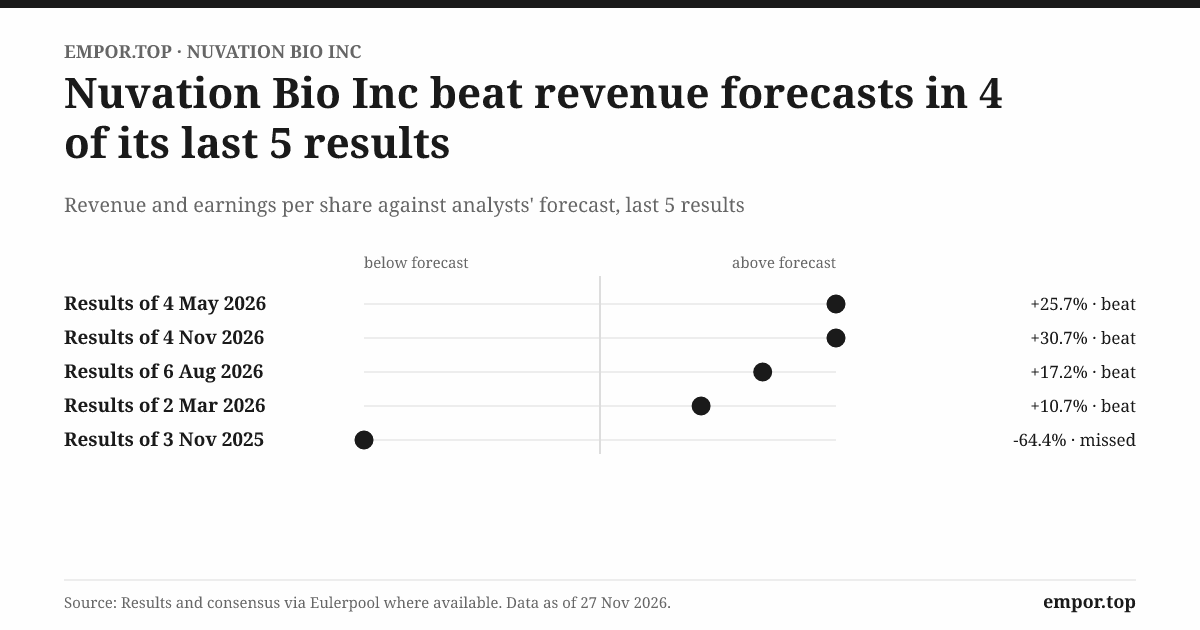
Nuvation Bio's drug, IBTROZI, did not drain. About 160 patients started on it during the quarter, roughly the same number as the quarter before, and management said about 65% of them had never taken a ROS1 drug before, meaning most were starting IBTROZI as their first ROS1-targeted therapy.2 Product revenue rose 18% from the prior quarter to $27.5 million.1 Total revenue for the quarter was $45 million, but $17.5 million of that came not from patients buying the pill but from partners paying collaboration and license fees, milestones and royalties.1
That split is the first clue to this company, and it is worth holding on to. Nuvation Bio is a young oncology business whose revenue has only just begun to scale. In the twelve months to September 2026 it reported about $202 million of revenue, a figure that would make a casual reader think it had arrived as a mid-sized commercial biotech.13 Yet that trailing number carries a lumpy first quarter swollen with licensing income, the latest quarter was $45 million, and the company was still losing money: about $42 million at the operating line in the third quarter alone.3 The trailing revenue is real, but it is not the same thing as a mature product franchise.
What the company does have is time. At the end of September it held $663.4 million in cash, cash equivalents and marketable securities, and it told investors that was enough to fund operations for at least a year from the filing date.13 Time is the one resource a biotech cannot manufacture, and Nuvation had acquired a great deal of it, partly through a drug it bought rather than discovered, and partly through layers of financing that will come up later in this story.
So three questions hang over the company tonight. The first is clinical and commercial: is IBTROZI winning because it offers patients and doctors something meaningfully better than the drugs already on the shelf, or because a new launch always enjoys a burst of curiosity? The second is financial: can sales of one rare-cancer pill carry both the cost of selling it and the cost of a research pipeline that still runs years ahead of any revenue? And the third is about the deal that made all of this possible. In 2024 Nuvation acquired a company called AnHeart Therapeutics, and with it the molecule that became IBTROZI. Did that purchase buy a durable business, or did it buy an expensive chance to build one?
A single steady quarter in a falling market is genuinely encouraging. It is not proof. One quarter of flat patient starts cannot tell investors how long patients stay on therapy, what price the company truly realizes after rebates, or whether doctors who tried the drug once will keep reaching for it. Those answers take years of quarters. To understand why Nuvation's management needed this launch to work, and why the company looks the way it does, the story has to start with the drug that was supposed to come first, and didn't.
 Subscribe on LinkedIn
II. The first lead drug disappeared
David Hung had done this before, and done it spectacularly. Before Nuvation, he founded Medivation and ran it as president and chief executive, steering the company that brought the prostate-cancer drug Xtandi to market. In August 2016 Pfizer agreed to buy Medivation for $81.50 a share in cash, about $14 billion in total.6 Hung, a physician by training, came out of that sale as one of the more celebrated founders in American oncology, with both the money and the reputation to try again.19
He tried again in 2018, founding Nuvation Bio as a drug-discovery company with an ambition to advance several cancer programs at once.47 In early 2021 the company went public by merging with Panacea Acquisition Corp, a special-purpose acquisition company, and the resale registration that followed listed both the shares and warrants that came with the structure.7 It was a classic SPAC-era listing: a well-known founder, a pipeline still in early clinical trials, and a large pile of cash. By the end of 2021 Nuvation reported about $765 million of cash and short-term investments against no revenue at all.4 Investors were paying for Hung's judgment and his scientific choices.
The first of those choices was NUV-422, a pill designed to block a family of enzymes that cancer cells use to keep dividing. It was the company's lead program, the one meant to show that the Medivation founder could do it again with molecules his new team had built. It did not get there. During 2022 the U.S. Food and Drug Administration placed clinical holds on the program after patients developed uveitis, an inflammation inside the eye, and in August 2022 Nuvation announced it was discontinuing NUV-422 entirely.5
The reason matters. NUV-422 did not fail because doctors refused to prescribe it or because a competitor beat it to market. It failed on safety, at the stage where most cancer drugs fail. Eye inflammation is not a side effect that a company can easily market around in a pill meant to be taken for months, and once the FDA had stopped dosing, the program's path forward had become slow, expensive and uncertain. Management chose to stop rather than spend years trying to rescue it.
Stopping had consequences for the people in the building. Nuvation cut about 35% of its workforce and said the restructuring would reduce annual operating costs by about $11.8 million, while extending its expected cash runway through 2028.5 For a company of its size, that was a sharp correction, and it carried an implicit admission: the multi-program ambition that had justified the listing had been built around a lead asset that did not survive contact with patients.
The company then pointed its attention at NUV-868, an inhibitor of a protein called BRD4 that it hoped could work in prostate and other cancers. But that story also stalled. In 2024 Nuvation decided not to start the planned Phase 2 studies of NUV-868 and said it was evaluating next steps.8 By then, it had something else to focus on, which is the subject of the next chapter. But the sequence is important. Two discovery-stage programs that the company once positioned as central had, within about two years, been either discontinued or set aside.
The generous reading of this record is that management showed discipline. Many biotechs keep a doomed program alive for years because killing it means admitting a mistake and shrinking the story. Nuvation stopped its lead drug when the safety evidence changed, cut costs, and preserved capital. Its losses tell the same story: operating losses widened from about $43 million in 2020 to about $120 million in 2022, then narrowed to about $100 million in 2023 after the restructuring.411 That is what a course correction looks like on paper.
The balance sheet, too, showed how much cushion the SPAC-era listing had provided. Even after two years of losses and a failed lead program, Nuvation ended 2023 with about $611 million of cash and short-term investments, down from about $765 million at the end of 2021.11 The company had spent roughly $150 million in two years and still had more money than most small biotechs ever raise. That cushion cut both ways. It meant the failure of NUV-422 was survivable, a setback rather than an extinction event. It also removed any urgency to find the next drug quickly, and a company with a large treasury and no late-stage asset faces a temptation and an opportunity at the same moment: its cash is a weapon, and its shares can serve as currency.
The skeptical reading is equally valid. The point of a broad oncology pipeline is supposed to be optionality: many shots on goal, so that one success pays for the misses. Nuvation's own early record is a warning against treating that optionality as proven. Its in-house discovery engine, at least through 2024, had produced no drug that reached patients commercially. Stopping a failing program saves money, but it does not create value; it only limits the damage. The real proof of scientific judgment has to come from a product that reaches patients and keeps selling.
By the start of 2024, Nuvation had a cash pile, a founder with a famous exit, a smaller workforce, and no late-stage asset of its own. A company in that position has a choice to make: wait years for its own discovery work to mature, or buy something closer to the finish line. Hung chose to buy.
III. AnHeart turned a research company into a commercial wager
On March 25, 2024, Nuvation announced it would acquire AnHeart Therapeutics in an all-stock transaction.9 There was no cash auction, no bidding war played out in the financial press, and very little cash changing hands. Instead, Nuvation paid with its own shares, convertible preferred stock and warrants, which meant the buyer's existing shareholders effectively handed over a slice of their company in exchange for AnHeart's pipeline.9 The merger closed about two weeks later, in April 2024.10
The size of that slice is the heart of the deal. Former AnHeart holders owned about one-third of the combined Nuvation on a fully diluted basis.9 Contemporary coverage put the transaction value at about $544 million.9 For Nuvation's existing investors, the arithmetic was stark: in return for a third of all future upside, they were getting a set of drugs that had never been sold in the United States. They were also keeping their cash, which was the point. Paying in stock preserved roughly half a billion dollars of liquidity for the clinical and commercial work the acquired assets would demand.
What came through the door was primarily two molecules. The first was taletrectinib, a targeted pill for ROS1-positive lung cancer that AnHeart had licensed from the Japanese drugmaker 第一三共 Daiichi Sankyo, and which had already produced strong results in clinical trials.49 This is the drug that became IBTROZI. The second was safusidenib, a pill that targets a mutated enzyme called IDH1 in certain brain tumors known as gliomas, which today sits in a pivotal trial.417 AnHeart also brought relationships: taletrectinib's development in China ran through 信达生物 Innovent Biologics, and its Japanese rights through 日本化薬 Nippon Kayaku, which meant that the deal imported a web of partner agreements along with the molecules.4
The accounts told a different-looking story. In its 2024 financial statements, Nuvation recorded a $425.1 million charge for acquired in-process research and development.11 That single line is why the company's 2024 net loss ballooned to about $567 million, and why the second quarter of 2024 showed an operating loss of roughly $470 million.11
It is tempting to read that charge as a verdict: the company paid more than $400 million and wrote it off immediately, therefore it overpaid. That reading is wrong. Under U.S. accounting rules, when a company buys research projects that have not yet won regulatory approval and have no alternative future use, it generally expenses their value at once instead of carrying them as an asset. The charge reflects the nature of what was bought, not a judgment that the purchase was a mistake, and no cash left the company to pay it. Neither is it an impairment, the accountant's term for admitting an asset is worth less than thought. It is closer to a receipt stamped "research, not yet a product."
So how should an investor judge the price? There is no clean benchmark. Comparable deals for single late-stage oncology assets vary wildly depending on the data, the market and the buyer's desperation, and the roughly $544 million figure is a transaction reference, not an appraisal of each drug. The honest test is what the acquired assets have since done and what they still require.
On the first count, the record is good. The FDA approved taletrectinib, sold as IBTROZI, on June 11, 2025, roughly fourteen months after the deal closed.12 Nuvation went from a company with no product revenue to one booking product sales within the same year. Revenue rose from about $7 million in 2024, mostly partner payments, to about $62 million in 2025.4 In the third quarter of 2026 alone, the drug brought in $27.5 million.1 Whatever else is true, the deal turned a discovery company with a failed lead program into a commercial one.
On the second count, the bill is still running. The acquired pipeline consumes research money: Nuvation's R&D expense rose from about $99 million in 2024 to about $115 million in 2025, and in the first nine months of 2026 R&D rose by about $18 million year on year, mainly because of higher clinical-trial costs.43 Safusidenib's pivotal study will not read out for years. And the dilution remains. Nuvation's share count today is roughly 347 million shares, implied by its market value, and a substantial part of that expansion traces to the AnHeart exchange and the financing that followed.19
Here the record lets the story reach a calibrated verdict. The AnHeart deal secured the assets that underpin everything commercial about Nuvation today, and it did so without spending the cash that has since funded the launch. That part of the thesis is intact. The claim that the deal created value for the shareholders who owned Nuvation before March 2024, after giving away a third of the company, remains unproven. It depends on how large and how durable IBTROZI sales become, and on whether safusidenib succeeds. The deal clearly moved Nuvation into a different and higher-stakes phase. Whether it made existing holders richer per share is a question only the next several years of product revenue can answer.
Which brings the story to the drug itself, and to the question every acquisition ultimately reduces to: does the thing you bought actually win?
IV. From trial results to the first prescription
Start with the biology, because it explains why this tiny market exists at all. Inside a healthy lung cell, genes carry instructions for proteins that tell the cell when to grow and when to stop. Occasionally a chromosome breaks and reattaches in the wrong place, fusing part of a gene called ROS1 to a piece of another gene. The result is a protein stuck in the "on" position, like a car's accelerator jammed to the floor. The cell keeps dividing, and a tumor forms.
A ROS1 inhibitor is a molecule built to fit into that jammed accelerator and switch it off. Because it targets the faulty protein rather than every dividing cell, it can shrink tumors dramatically with fewer of the brutal effects of chemotherapy. The catch is that cancer evolves. Over time, tumors develop new mutations that change the shape of the protein so the drug no longer fits, and ROS1 lung cancers have a nasty habit of spreading to the brain, where many drugs struggle to reach because of the blood-brain barrier, the body's tight filter around the central nervous system. So the competitive questions in ROS1 are unusually specific: how many tumors shrink, for how long, whether the drug works after another ROS1 drug has stopped working, whether it reaches brain metastases, and how patients tolerate it over months and years.
Taletrectinib was built to answer those questions well. The approval rested on two single-arm studies, TRUST-I and TRUST-II, which together enrolled 157 patients who had never received a ROS1 inhibitor and 113 who had already received one.12 Among the treatment-naïve patients, independent reviewers found that tumors shrank meaningfully in about 90% of TRUST-I patients and about 85% of TRUST-II patients.12 Among patients whose cancer had already progressed on another ROS1 drug, the response rates were about 52% and 62%.12 The label covered adults with locally advanced or metastatic ROS1-positive non-small cell lung cancer, in either setting, and the U.S. launch began that month.121
Response rates only say whether tumors shrink. The number oncologists watch more closely is how long that shrinkage lasts, because a drug that works brilliantly for six months and then fails leaves the patient searching for the next option. At approval, the durability data were still young but pointed the right way. Among treatment-naïve patients whose tumors responded, about 72% in TRUST-I and 63% in TRUST-II were still responding at least a year later.12 Among the previously treated patients, about 74% and 83% of responders had kept their response for at least six months.12 In plain terms, the drug worked in most patients seeing it first and in more than half of those whose earlier ROS1 drug had already failed, and those responses were not fleeting. That second group is the harder test, because it means taletrectinib could still fit into the jammed accelerator after the cancer had mutated to escape an earlier drug.
Those numbers deserve context. Single-arm trials do not compare a drug with anything; every patient receives it. That is common for rare cancers, where randomizing a few hundred patients against an older drug would take years, but it means that ranking taletrectinib against its rivals by setting their trial results side by side is unreliable. Different studies enroll different patients at different times with different scans. Nuvation's case is strong on its own terms, but it is not a head-to-head victory, and an investor should be wary of anyone, including the company, who frames it as one.
The clinical story did lengthen. In September 2026 the FDA approved a supplement to the IBTROZI label adding updated response-rate and duration-of-response data.1314 Coverage of the update reported that, in the treatment-naïve TRUST-I group, the median duration of response had reached about 49.7 months after a median follow-up of around 51 months.14 Put plainly: for the typical patient whose tumor shrank on first-line taletrectinib, that response lasted roughly four years. In a disease where resistance is the central enemy, that is the most commercially important number in the label. It is also worth being precise about what the supplement was: new data on the existing use, not a new indication, and not a broader market.13
That distinction, between technical proof and commercial proof, is where the launch story begins. FDA approval says a drug works well enough and safely enough to sell. It does not say oncologists will choose it, insurers will pay for it without friction, patients will stay on it, or the company will realize a profitable price after rebates and patient-support programs. Those things are revealed only in prescriptions, quarter after quarter.
The early prescription record is encouraging, with caveats attached. That quarter's roughly 160 starts included about 65% TKI-naïve patients.2 That mix matters enormously. A drug used mainly after other drugs fail serves a smaller pool of sicker patients for shorter periods. A drug used first can capture patients at the start of a treatment journey that, if the durability data hold, may last years. Each first-line patient is potentially worth many quarters of revenue; each later-line patient, fewer.
Management went further on the third-quarter call. It said IBTROZI's share of first-line new patient starts in the ROS1 market exceeded 60%, citing claims data, the records generated when pharmacies and insurers process prescriptions.2 If accurate, that would mean a drug barely more than a year on the market had become the most common first choice in its niche. But the figure is management's, drawn from a commercial data source the company selected and interpreted, and it is not an independently audited market-share series. Claims data can miss patients, lag, or capture specialty-pharmacy channels unevenly. The share claim is a clue, and a meaningful one, but it should be weighed as a company-reported number.
The more interesting moment on the call came when management tried to explain the market itself. If that pool fell by about 15% in a single quarter, something happened: perhaps seasonality, perhaps testing volumes, perhaps the noise inherent in a market this small, where a few dozen patients swing the percentages.2 Management framed IBTROZI's steady starts as share gains offsetting a softer market, and argued that the prescription trend reflected physician preference rather than a one-time stocking effect.2 What it could not do was fully attribute the market decline to a single cause, and that limitation is itself informative. A company that cannot say why its market shrank in a quarter also cannot promise it will regrow.
Then there is the bridge from patients to dollars. That sequential growth implies roughly $23 million in the second quarter.121 With patient starts flat, that growth came largely from the accumulation of patients already on therapy, which is how an oral cancer drug with durable responses is supposed to grow. Patients who started in earlier quarters keep refilling, so revenue builds even when new starts plateau. That is the encouraging read.
The cautious read is that the company's headline revenue line mixes two very different kinds of money. Collaboration and license revenue included a $5 million sales milestone from Innovent.13 Milestones are real cash, but they arrive when partners hit thresholds, not when patients refill prescriptions. A quarter in which a milestone lands looks better than the underlying business; a quarter without one looks worse. The first quarter of 2026 showed this vividly: total revenue jumped to about $83 million and the company posted a small operating profit, its only profitable quarter on record, but with product sales running nowhere near that level, the bulk of the revenue had to come from licensing income.223 Two quarters later, the operating loss was back above $40 million.
So what does the evidence mean? It supports a credible product case. The clinical data are strong, the label now carries long durability figures, most new patients are starting the drug first, and the patient count held up in a weak quarter. What the evidence does not yet establish is how long patients stay on therapy in the real world, what net price the company realizes, whether payers will tighten access as the drug grows, or whether the unit economics will ever cover the cost of the commercial and research organization behind it. Those are the things that will turn a promising launch into a business.
And there is a further problem, one that no label update can solve. IBTROZI did not enter an empty market. It entered a room already occupied by three of the largest drugmakers in the world.
V. The small market has formidable incumbents
Picture the competitive map as a war-gamer would. The territory is small: ROS1-positive lung cancer is rare, so the total number of new patients each year in the United States is modest, measured in the hundreds per quarter rather than the tens of thousands. Holding that territory already were three armies with vastly more resources than Nuvation. Pfizer's Xalkori, the first drug approved for the mutation, had years of familiarity with oncologists. Roche's Genentech unit sold Rozlytrek. And Bristol Myers Squibb won FDA approval for Augtyro in November 2023, the first ROS1 drug approved for patients who had already received a ROS1 inhibitor as well as for those who had not.1516
Each of those companies has something Nuvation lacks: an established oncology sales force calling on the same physicians every week across dozens of products, long-standing contracts with insurers and pharmacy benefit managers, and the financial capacity to fund big data-generation programs, patient-support services and medical-education efforts. When a regional oncology practice sees a Pfizer or Bristol Myers Squibb representative, the conversation can cover lung, breast, blood and prostate cancers. When it sees a Nuvation representative, the conversation covers one drug for one mutation.416
Run the industry through Michael Porter's lens of competitive forces and the shape becomes clear. Patients are few because the disease is rare. Buyers, meaning the oncologists who choose and the payers who reimburse, have genuine alternatives, because four approved targeted therapies now compete for the same patients. Rivalry is intense because the incumbents have scale. New entrants face high barriers in the form of clinical trials and regulatory approval, which helps Nuvation now that it is inside, but those barriers protect everyone already inside equally. And substitutes are not hypothetical. Xalkori, Rozlytrek and Augtyro are all approved, and the choice among them depends on efficacy, safety, how each drug handles resistance mutations, how well it penetrates the brain, and how patients tolerate it over time.1516
Nuvation's claim is that IBTROZI wins on that combination. The company has emphasized its high response rates, the duration of those responses, and its activity in the central nervous system, which matters in a cancer that so often spreads to the brain.1716 That is a coherent argument for why an oncologist might choose it first. It is not, however, the same thing as a moat.
The distinction matters because investors often blur it. A favorable clinical profile wins prescriptions; it does not lock them in. A moat, in the sense that durable long-term returns require, needs something that stops a customer from switching even when a rival offers something comparable: switching costs, exclusive distribution, network effects, cost advantages, or pricing power that survives competition. Oral cancer drugs have modest switching costs once a patient is stable, because doctors are reluctant to change a working regimen, and that inertia does favor whichever drug is chosen first. But at the decision point for each new patient, the choice is reopened. A rival publishes better data, a payer negotiates a better rebate, a guideline committee changes its language, and the next patient may go elsewhere.
The 2026 launch evidence has to be read through that lens. Management's claim of more than 60% first-line share is the strongest commercial signal Nuvation has produced.2 It suggests that, in this window, oncologists are choosing IBTROZI first more often than any rival. But that share was measured in a quarter when the overall market fell about 15%, and over a history of barely five quarters.2 Share of a shrinking, short-history denominator says something about preference and very little about long-run economics. It cannot yet tell investors whether patients stay on IBTROZI longer than on rivals, whether the company will have to cut net price to defend its position, or how the incumbents respond with their own data and contracts.
The historical record of this very market offers a sobering parallel. Bristol Myers Squibb's Augtyro also arrived with strong data and the backing of a much larger company. Its approval rested on TRIDENT-1, a single-arm, multi-cohort study, the same kind of evidence that later supported taletrectinib, and it was the first ROS1 drug cleared both for patients new to the class and for those who had already received a ROS1 inhibitor.15 On paper, that should have given Bristol Myers Squibb a commanding position for years. Yet within about eighteen months, a much smaller company had arrived with its own single-arm data in both settings, and by its own account was taking most first-line starts. Augtyro's arrival did not end competition; it added to it.152 Nuvation's own success has the same structure: IBTROZI is a newer drug taking share from older ones. The mechanism that lets it win today is exactly the mechanism that could cost it tomorrow, if a future entrant arrives with longer durability or better brain activity. In targeted oncology, a drug's position is defended by data, and data can be overtaken.
Nuvation does have one structural answer to its lack of scale: partners. Rather than build sales forces in every country, it relies on a network of partners, including Daiichi Sankyo, Innovent and Nippon Kayaku; Eisai provides a route to markets outside the United States where Nuvation does not sell directly.417 This lets a small company reach patients worldwide without paying for global infrastructure, and the royalties and milestones that flow back are high-margin when they arrive.
But partners are a route to reach, not a moat. Partner-led revenue is lumpy, because milestones depend on someone else's regulatory calendar and sales thresholds. It is concentrated, because a handful of agreements produce most of the income. And it is dependent on how hard someone else pushes a drug that, for them, may be one product among many. Nuvation's own revenue concentration confirms the point: four customers accounted for about 79% of its gross revenue in 2025, and the company did not name them in its concentration disclosure.4
So the operating test is clear, and it is a test of execution rather than biology. Can Nuvation keep new-patient starts steady or growing as the incumbents fight back? Can it keep patients on therapy long enough for the durability data to show up in revenue? Can it extend label-supported use as more data mature? And can it convert sales into gross profit after the rebates, co-pay assistance and patient-support programs that every specialty drug requires? The answers will determine whether IBTROZI is a franchise or a well-run niche product. They will also determine whether the drug can pay for the rest of the company, which is the next and more uncomfortable question.
VI. One drug is paying for a much larger pipeline
Imagine Nuvation's finances as a household with one new paycheck and a mortgage taken out years ago. The paycheck is IBTROZI: U.S. patients filling prescriptions, quarter after quarter. Alongside it come irregular windfalls, the partner payments: royalties on sales in China and Japan, payments for supplying drug to partners, reimbursements for research work done on their behalf, milestones when partners hit regulatory or sales thresholds, and license fees when a new territory is signed away.4 The mortgage is the research pipeline and the commercial organization, which cost money every month regardless of how the paycheck arrives.
At the end of September 2026, the household's savings account was large: $663.4 million in cash, cash equivalents and marketable securities.1 But the household was still spending far more than it earned. The question for this chapter is whether the paycheck is on track to cover the bills, or whether the savings, and future borrowing, will have to bridge the gap for years.
Start with the headline growth, because it flatters. Revenue went from about $7 million in 2024 to about $62 million in 2025, an increase of nearly nine times.4 Growth rates like that are almost meaningless for judging a mature business. The 2024 base was tiny and made up almost entirely of partner payments; 2025 included only about half a year of IBTROZI sales after the June approval; and the growth rate compares a company before its launch with a company in the middle of one. A better guide is the shape of the latest quarters: product sales of $27.5 million in the third quarter of 2026, up 18% sequentially, alongside $17.5 million of partner revenue that may or may not recur.1
Now the spending. R&D was about $99 million in 2024 and about $115 million in 2025, larger than revenue in both years.4 In the first nine months of 2026 it reached about $98 million, up about $18 million from the year before, driven almost entirely by higher third-party clinical-trial costs, the price of running pivotal studies like the one for safusidenib.3 On top of R&D sit the selling, general and administrative costs of a commercial launch: sales representatives, medical science liaisons, marketing, patient support and the corporate overhead of a public company. At the end of 2025 Nuvation employed 298 full-time staff, about half of them in research and development.4 This is an investment-stage company now carrying the full weight of a commercial organization, not a mature business harvesting a product.
The cleanest way to see the gap is to look at cash, because accounting losses in biotech can mislead in both directions. The 2024 loss of about $567 million was enormous, but most of it was the $425.1 million noncash acquired-research charge from AnHeart.11 Strip that out, and 2024 still showed real operating losses. In 2025 there was no such distortion, and the net loss was $204.6 million.4 Operating cash use was about $173 million, smaller than the loss mainly because about $36 million of stock compensation and about $10 million of noncash interest on the royalty financing reduced earnings without consuming cash, while building inventory for the launch and rising receivables pulled cash the other way.4 Over the eight years from 2018 to 2025, Nuvation's cumulative net loss was about $1.1 billion, while its cumulative operating cash burn was about $594 million; the AnHeart charge explains much of the difference.411
Set that $173 million of annual cash burn against the latest product revenue run-rate, about $110 million a year if the third quarter simply repeated four times, and the gap is plain.1 Product sales would need to grow substantially, and do so while gross margins stay healthy and operating costs stop climbing, before the paycheck covers the household's bills. The latest quarter, with its operating loss of about $42 million, shows the gap narrowing compared with the deep losses of 2024 and early 2025, but it has not closed.3
There is an awkward fact about the 2026 trajectory, too, and it can be worked out with simple subtraction. The company started 2026 with about $529 million of cash and investments, raised about $279 million net from convertible notes in mid-year, and ended September with $663.4 million.431 Ignoring smaller flows, that implies roughly $145 million consumed in nine months, despite a licensing-heavy first quarter. The cash pile grew because Nuvation borrowed, not because the business stopped burning.
The revenue base is also narrow in a second sense. In 2025, four customers each accounted for more than 10% of gross revenue, and together they represented about 79% of it; the largest alone made up about 41%.4 The company anonymizes these customers in its disclosure, so it is not possible to say which are partners and which are the specialty distributors and pharmacies through which U.S. drug sales typically flow. For a specialty oral drug, a high concentration among distributors is common and not, by itself, alarming. For partner income, concentration is more consequential, because it means a few counterparties' calendars shape the revenue line.
One small number tells the story of that shifting mix. The time it took Nuvation to collect from customers, measured as receivables expressed in days of revenue, fell from about 850 days in 2024 to about 114 days in 2025.4 That sounds dramatic, but it mostly reflects the arithmetic of a changing business: in 2024 revenue was tiny and receivables included sizable balances from Innovent, which fell from about $12.6 million to about $1.3 million by the end of 2025, while product sales with ordinary payment terms grew.4 The company carries no allowance for credit losses and does not publish an aging table, so the improvement is consistent with healthier collections but not a substitute for direct evidence of how quickly each customer pays.4
Nor should the company's investment income be mistaken for operating earnings. Interest on that large cash pile brought in about $21 million in 2025, but interest expense on the new financing took about $14 million back, leaving other income of only about $8 million, down from about $25 million in 2024.4 As the balance sheet took on debt, the savings account stopped paying for as much of the household's spending.
Two smaller balance-sheet details reveal how international this young company already is. Among its borrowings at the end of 2025 sat about $5.7 million from Bank of Hangzhou at 3.5%, a reminder that the AnHeart acquisition brought operations in China along with its molecules.4 And the company reports in dollars while its partners and some of its costs sit in China, Japan and other territories, which produced a modest foreign-currency loss of about $1.1 million in 2025; Nuvation does not describe a material hedging program.4 Neither number is large today. Both would grow in importance if partner royalties became a bigger share of the revenue line.
There is also a quieter signal of future partner revenue. At the end of September 2026, Nuvation carried about $15.7 million of contract liabilities, mostly money already received or billed for research services it has yet to perform for partners.3 That balance will turn into reported revenue as the work is done, which helps smooth the collaboration line for a few quarters. It is also a reminder that some of what looks like revenue growth is the delayed recognition of cash collected earlier, not new demand.
The verdict here is clear enough to state without much hedging. The cash balance buys Nuvation genuine development time, and product sales have begun to matter. But the current revenue base is not evidence that the company can fund itself. Operating cash burn in 2025 exceeded total revenue, the latest quarter still leaned materially on collaboration income, and the cash balance rose in 2026 because of borrowing. The KPI that will settle the matter is simple to state and hard to fake: operating cash burn relative to the gross contribution from product sales, measured without the help of milestones. Until that gap closes, the pipeline is being paid for by the balance sheet, and the biggest item in that pipeline is a drug whose decisive evidence is still years away.
VII. The next bet is a slower one
Glioma is a cruel disease with a deceptive name. The lower-grade forms can grow slowly for years, often in young adults, sometimes in people at the height of their careers. Many of these tumors carry a mutation in the gene for an enzyme called IDH1, which causes cells to produce a substance that disrupts how genes are switched on and off, nudging cells toward cancer. Block the mutant enzyme, and in principle the tumor's fuel is cut off. That is the idea behind safusidenib, the second asset that arrived with AnHeart.417
In 2026 Nuvation expanded its pivotal Phase 3 trial of safusidenib, called SIGMA, into six European countries, broadening the pool of sites where patients could enroll.117 The same year, the company described the trial's decisive readout as years away, around 2029, because the study's primary goal is progression-free survival: how long patients live without their tumor growing.117 In a slow-growing brain tumor, that takes a long time to measure. A response-rate study can tell you in months whether tumors shrink; a progression-free survival study in low-grade glioma has to wait for tumors to grow, and the better the drug, the longer the wait.
Why does this asset matter so much to the story? Because a second commercial product is the most direct cure for Nuvation's greatest weakness, which is dependence on one drug for one rare lung cancer. If safusidenib succeeds, the company would sell two targeted therapies into two distinct markets, with different prescribers, different competitors and different patent clocks. It would turn a single-product launch into the beginnings of an oncology franchise.
The evidence so far is encouraging. In the Phase 2 study known as J201, the company has cited a centrally assessed response rate of about 51.9% and a 36-month progression-free survival rate of about 79.1%, meaning that roughly four out of five patients had not seen their disease progress three years in.117 For a disease where the main goal is to delay growth and postpone surgery or radiation, those are meaningful figures.
But Phase 2 data are neither revenue nor a label. They come from smaller studies, often in specific populations, and many drugs that look strong in Phase 2 disappoint in larger randomized trials. More importantly, safusidenib would not be the first drug of its kind. In August 2024 the FDA approved Servier's vorasidenib, sold as Voranigo, for grade 2 astrocytoma and oligodendroglioma with susceptible IDH1 or IDH2 mutations, making it the first targeted systemic therapy for those tumors.18 Vorasidenib's approval rested on a randomized, placebo-controlled Phase 3 trial of 331 patients, which showed a 61% reduction in the risk of progression.18 It also showed something that matters to patients even more than a scan: the median time before patients needed their next intervention, such as surgery or radiation, had not yet been reached on vorasidenib, compared with about 17.8 months on placebo.18 For a young adult with a slow-growing brain tumor, every year without radiation is a year without its effects on memory and thinking. That is the clinical currency in this disease, and the incumbent already holds randomized evidence of it.
Notice the difference in the quality of evidence. Vorasidenib won approval on a placebo-controlled trial that randomly assigned patients and measured how long their disease stayed in check. Safusidenib's case today rests on a single-arm Phase 2 study, which by design has no comparison group. The SIGMA trial exists precisely to close that gap, and that is why it takes so long.
That is the bar. Safusidenib cannot rely on the elegance of its target biology alone, because a competitor has already proven the biology works and has a head start with oncologists, neurologists and payers. To earn a meaningful role, safusidenib will need to show something that matters: a different patient population, better tolerability, better brain penetration, or a clearer benefit in settings vorasidenib does not cover. Nuvation's development plan includes a study in patients who have already received vorasidenib, a sensible hedge that targets patients whose disease progresses on the incumbent, though it is a smaller and later-line opportunity.17
There is also the company's own record to weigh. Nuvation's earlier internally discovered programs did not convert. Safusidenib, like taletrectinib, came from AnHeart, which is a point in its favor, but it faces a randomized trial against a higher competitive bar than taletrectinib faced in ROS1. History neither rejects nor confirms its prospects; it simply argues against pricing it as a near-certainty.
The rest of the pipeline is earlier still. NUV-1511, the lead program from Nuvation's drug-drug conjugate platform, attempts to pair a targeting molecule with a cancer-killing payload, a cousin of the antibody-drug conjugates that have become fashionable in oncology.17 It is a genuine scientific option, but it sits in early clinical development and carries the base-rate risk of every early program. It should not rival IBTROZI or safusidenib for present-day story weight.
Analysts on the third-quarter call pressed on timing and endpoints, and management's answers emphasized the pivotal study's progress and enrollment rather than any near-term readout.2 At the Jefferies healthcare conference in November 2026, the conversation turned to pipeline prioritization: how a company with one launched drug decides how much to spend on a trial that will not report until the end of the decade.23 Those are the right questions, because safusidenib exposes the core tension in Nuvation's model. It is real optionality, in pivotal development, addressing a distinct market with encouraging data. It is also three years or so from its decisive evidence, against an approved competitor, while its trial costs show up in every quarter's R&D line today.
A drug that will not pay until 2029 or later has to be funded by someone between now and then. That makes the people deciding how to fund it, and the shareholders whose capital they are spending, the next part of the story.
VIII. Hung's company, shareholders' capital
At Nuvation's annual meeting in May 2026, about 83.6% of the Class A shares were represented, and every item on the ballot passed: the director nominees, the ratification of KPMG as auditor, and the advisory vote on executive pay.20 It was an uneventful meeting. That is often how corporate control looks when it works the way its designers intended.
The design is worth understanding, because it is unusual. Nuvation has two classes of common stock. Class A shares trade on the NYSE and carry one vote each. Class B shares, of which there are one million, also carry one vote each, but they come with special rights over the election of directors and the approval of certain transactions.419 David Hung owns all of the Class B shares.4 He also beneficially owns about 59.3 million Class A shares plus options exercisable within 60 days, for about 18.8% of the Class A class.19 The next largest holders were FMR-affiliated entities, the Fidelity group, with about 14.6%, and entities affiliated with Decheng, a life-sciences investor, with about 7.5%.19
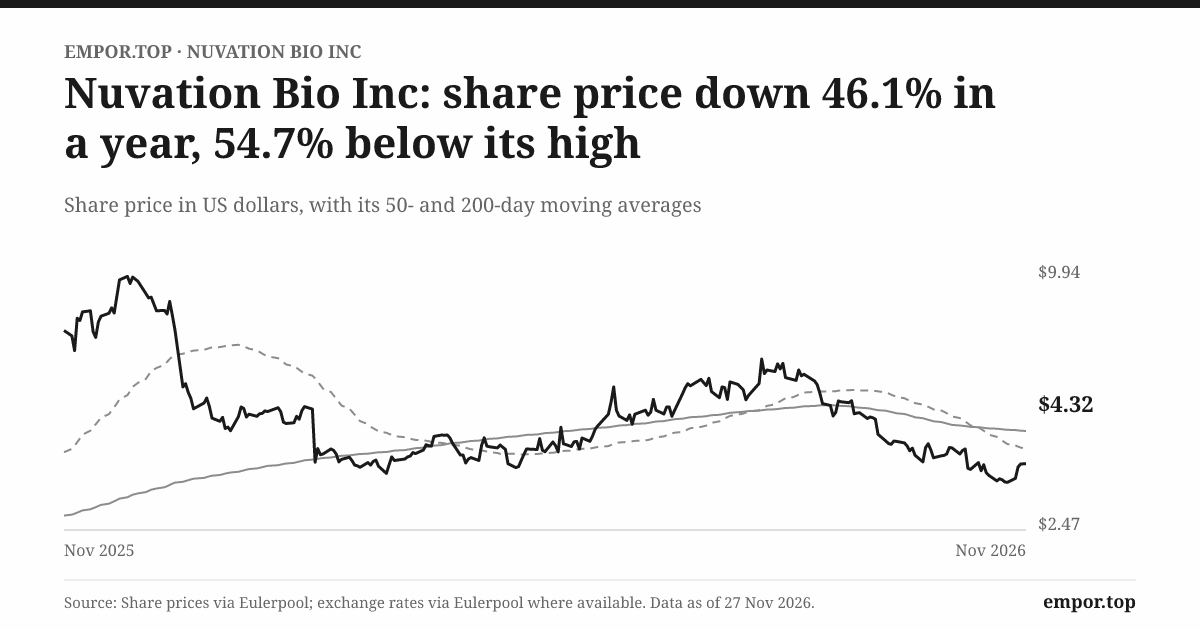
That combination is the governance trade in a sentence. Hung's economic stake is large: at November's share price of $4.32, his Class A holding alone was worth roughly a quarter of a billion dollars.1924 When the shares fall, he loses alongside everyone else, and that aligns his incentives with public holders. But the Class B rights give him influence over the board and major transactions that goes well beyond his economic ownership. Public investors vote, but they cannot easily replace the founder's judgment with their own.
That judgment has a track record now, and it cuts both ways. Hung built Medivation into a $14 billion sale.6 At Nuvation, his first lead program failed on safety and his second was set aside; his biggest decision, the AnHeart acquisition, delivered the drug that defines the company today, at the cost of a third of the equity. A founder with that record has earned the benefit of some doubt on scientific selection through acquisition, and has not yet demonstrated that his team can discover a drug internally and take it to market.
Around him sits a largely stable leadership team. Philippe Sauvage became chief financial officer in October 2024, succeeding Jennifer Fox.194 There has been no chief executive change since the company's founding. The auditor's report for 2025 carried no material-weakness finding and no going-concern qualification, and the company reported no pending legal proceedings it expected to materially harm its finances.4
Pay is modest by biotech standards and heavily equity-based. Hung's total 2025 compensation was about $3.88 million, of which about $2.67 million came from option awards; he received no bonus in either 2024 or 2025.19 Sauvage's 2025 package totalled about $1.48 million, including options and about $252,000 of non-equity incentive pay.19 Options reward share-price gains, which is the right direction. The harder question for any shareholder reading the proxy is whether the annual targets behind incentive pay reward durable product sales and value per share, or simply trial milestones and top-line growth that can be lifted by licensing income. A milestone-heavy quarter and a durable-demand quarter can look identical on the revenue line, and the incentive structure should know the difference.
Then there is the money. Follow the financing sequence and a pattern emerges. The company listed through a SPAC in 2021.7 It bought AnHeart with stock in 2024.9 In 2025, around the IBTROZI approval, it raised $150 million from Sagard through a royalty-interest financing, drew a $50 million term loan, and issued equity.4 And in June and July 2026 it sold $287.5 million of 0.75% convertible senior notes due 2032, netting about $279 million.3
Each instrument works differently, and together they form a financing stack, not a simple low-debt balance sheet. The royalty financing is repaid through tiered royalties on U.S. IBTROZI sales, which means a slice of the company's best revenue stream belongs to someone else until the obligation is satisfied; by the end of 2025 it was carried as a liability of about $155 million.4 The term loan is secured by substantially all of the company's assets, including its intellectual property.4 The convertible notes carry a tiny cash coupon but can convert into shares, adding potential dilution if the share price rises enough, and otherwise leaving principal to be repaid or refinanced in 2032.3 At the end of 2025 the fact that debt was only about 3% of equity on a conventional measure told almost none of this story, because the royalty liability and the later convertibles do not show up neatly in a single borrowing line.4
Here is where a skeptical investor, the kind who writes long letters to boards, would push. Why does a company with $663.4 million of cash and marketable securities need royalty financing, secured term debt and convertible notes all at once?1 The bull answer is optionality: lock in capital while it is available, on terms that do not require issuing stock at depressed prices, so the company never has to raise money from a position of weakness. The bear answer is that each layer has a cost, whether in surrendered royalties, secured claims on intellectual property or future dilution, and that layering them onto a loss-making business narrows flexibility at precisely the moment it might be needed. The test is returns: the capital raised has to fund a product and a pipeline that generate more value per share than the dilution and claims they create. Management said its liquidity covered at least twelve months from the third-quarter filing, a standard disclosure that confirms safety in the near term but says little about the long-term return on the stack.3
The fair conclusion is that Hung's large economic stake partly aligns him with shareholders, while the dual-class rights give him control beyond that stake, and that his record contains both a costly failure and a transformative bet. The next proof of capital discipline will not come from words. It will come from whether the financing stack funds milestones that are actually met and product revenue that actually compounds. That brings the story to the market's own verdict, and to the full case for and against.
IX. Analysis & Bear vs. Bull Case
On November 27, 2026, Nuvation's shares closed at $4.32. That was about 55% below their 52-week high of $9.54 and not far above the 52-week low of $3.80.24 The company was valued at about $1.5 billion, roughly seven times its trailing revenue, while reporting a loss of about 40 cents a share over the past twelve months and using about $173 million of operating cash in its last full year.244 The stock had also, at its worst point over five years, fallen about 90% from a prior peak.24
What does that price assume? A sales multiple around seven is a premium for a company that loses money, and it only makes sense if investors believe today's revenue understates future earnings power. Yet the trailing revenue figure includes a licensing-heavy first quarter, so the multiple on durable product revenue alone is considerably higher. There is no meaningful price-to-earnings ratio, because there are no earnings, and the company has no five-year history as a commercial business against which to compare its current multiple. The price is best understood as a bet that IBTROZI keeps growing and that safusidenib or the broader pipeline eventually adds a second leg. It leaves little room for confusing milestone-heavy revenue with durable product earnings.
The bull case starts with tangible evidence. IBTROZI is approved, with a label that now includes roughly four years of median response duration in first-line patients.14 Product revenue continued to grow through the available 2026 quarters, including when the overall ROS1 market shrank.121 The company says most new patients start IBTROZI first and that its first-line share exceeds 60%.2 Partners, including Eisai, provide a route to markets beyond the United States without the cost of building a global sales force.17 And safusidenib, if its pivotal trial confirms the Phase 2 signal, could diversify the company into an entirely different cancer. Underneath it all sits a substantial cash reserve.
The bear case begins with the market's size: it is small and can contract quickly. Incumbents have commercial platforms Nuvation cannot match. Revenue is concentrated in a handful of customers, the share evidence is short and company-reported, and collaboration milestones can make reported revenue grow faster than recurring product economics, as the first quarter of 2026 showed.4222
Then there is the capital and governance bear case, which is distinct. Nuvation's early pipeline has already narrowed.58 The AnHeart deal diluted existing holders, and the financing stack adds claims on future cash flows.943 The cash reserve is meaningful, but it does not validate the acquisition price or the future pipeline; it only postpones the moment of reckoning.
Put the moat question through Hamilton Helmer's seven powers, the framework that asks what lets a company earn returns above its cost of capital for a long time. Scale economies favor the incumbents, not Nuvation. Network effects do not apply to a cancer pill. Switching costs exist only weakly, in the reluctance to change a working regimen, and they protect each patient's current drug rather than giving any drug a claim on the next patient. Branding matters little in oncology, where data drive choice. Nuvation has no cornered resource beyond its patents and regulatory exclusivity on taletrectinib, which are real but time-limited and do not prevent rivals from selling their own approved drugs. Counter-positioning, where a newcomer adopts a model incumbents cannot copy without damaging themselves, does not obviously apply; the incumbents simply sell different molecules. Process power, the embedded organizational skill that makes a company better at something over time, is unproven, given that Nuvation's own discovery engine has not yet produced a commercial drug.
Porter's forces point the same way: Nuvation has a strong product, not yet a durable moat. IBTROZI currently has a clinical profile that oncologists appear to prefer in the first-line setting. Whether that preference becomes a lasting advantage depends on evidence the company does not yet have, namely real-world persistence, label breadth, and net price held under competitive pressure.
Three measures will settle the argument better than any framework. The first is whether IBTROZI's product revenue, new-patient starts and treatment duration continue to support the launch; the latest readings remain encouraging.12 The second is operating cash burn relative to product gross contribution; cash use exceeded total revenue in 2025, and the operating loss was about $42 million in the third quarter of 2026.43 The third is safusidenib's pivotal-trial enrollment and readout timing, with the decisive SIGMA readout currently expected around 2029.17
The risks that matter connect directly to mechanisms. A shrinking ROS1 market reduces new starts even if share holds, which is exactly what the third quarter tested. Competitive data, price pressure or tighter payer access could slow adoption, because the drug's advantage is clinical, not contractual. A clinical failure in SIGMA would delay diversification by years and leave the company dependent on one drug. The financing stack reduces flexibility, because royalties are diverted, assets are pledged and conversion could dilute holders. And partner exposure in China and Japan creates execution and currency risk; the company does not describe a material hedging program.4
Finally, there is the behavioral test of management credibility, which is more revealing than any single statement. Investors can compare what management said about the launch across the 2026 calls with what patient starts and product revenue actually did. They can compare the 2026 pipeline timelines with enrollment progress over the next several quarters. And they can compare the cash-runway narrative with the actual pace of burn, debt and royalty obligations. So far, the launch has held up and the pipeline timeline has been stated conservatively, with the SIGMA readout years out. The cash narrative is where the gap between story and arithmetic is widest, because the cash pile grew in 2026 only because the company borrowed.
X. Playbook: Business & Investing Lessons
The first lesson is that in biotech, the most valuable pipeline asset may arrive through the acquisition that changes what kind of company you are. Nuvation's AnHeart deal turned a discovery company into a commercial one, at the cost of a third of its equity. For founders, the lesson is that the willingness to buy rather than build can be the most important scientific decision you make. For investors, it is that the price of that transformation is paid in shares, and shares paid away do not come back. A company can be saved by an acquisition and still leave its earlier holders owning a smaller slice of the rescue.
The second lesson is that a clinical hold can turn a broad pipeline into a capital-allocation decision overnight. When the FDA stopped NUV-422, the program's value did not decline gradually; it collapsed, and a third of the workforce went with it. Optionality in drug development is real, but it is lumpy and binary, and it can disappear on a single safety signal. The best management teams are judged not by how many programs they start but by how quickly and cleanly they stop the ones that stop working, and Nuvation did stop. The harder lesson is that stopping protects capital; it does not create it.
The third lesson is that a prescription is progress, but repeat prescriptions and cash contribution are the business. IBTROZI's third quarter showed the gap between product sales and partner income. Only prescriptions refill every month. The investor's job in a launch is to separate the money that comes from patients staying on therapy from milestone payments, because one compounds and the other arrives when a partner hits a threshold.
The fourth lesson is that a large cash balance buys time, not proof. Nuvation's reserve gives it time to run a pivotal glioma trial while competing in a rare lung cancer. But the recent financing shows that runway is not proof of self-funding, and no amount of runway can substitute for the evidence it is buying. Runway is a promise that the clock will keep ticking. It says nothing about what the clock will show.
The fifth lesson is that founder ownership can align incentives and concentrate power at the same time. David Hung's economic stake aligns him with shareholders, while the dual-class structure gives him control beyond that stake. For shareholders, the bet on Nuvation is partly a bet on that one person's judgment, and the dual-class structure means it will stay that way whether they like it or not.
XI. Epilogue
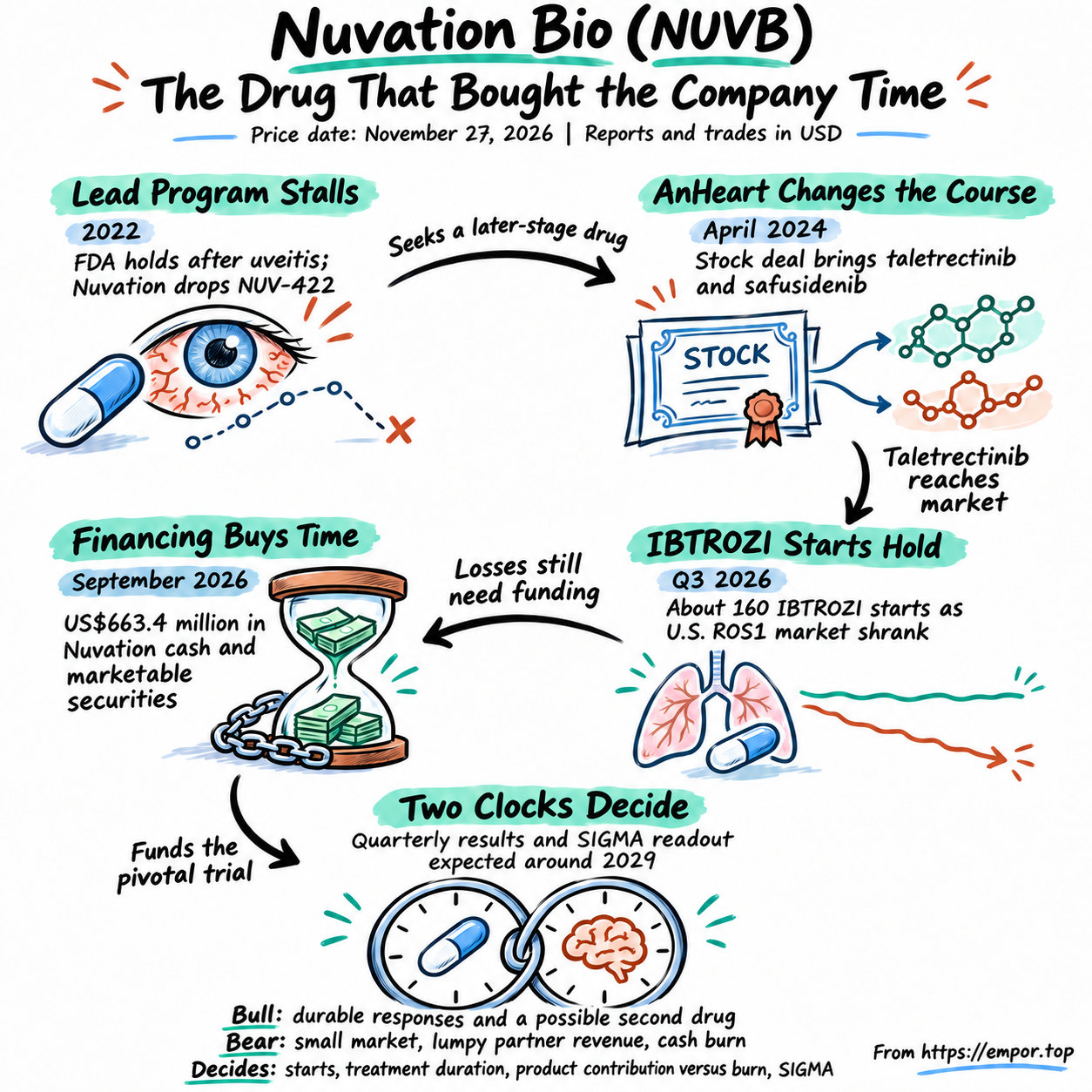
Tonight, Nuvation Bio stands between two clocks. One ticks every quarter, with each set of results revealing whether IBTROZI's patient starts and product revenue keep rising. The other ticks slowly toward the end of the decade, when the SIGMA trial will finally say whether safusidenib can become a second product.
The quarterly clock decides the next chapter. The fourth-quarter results, due in early 2027, will show whether the third quarter's steadiness was the beginning of a trend or a pause before a slide. If ROS1 market volumes stay soft and IBTROZI starts still climb, the case that physicians genuinely prefer the drug will strengthen considerably. If starts slip alongside the market, the first-line share claim will look less like a moat and more like a launch honeymoon.
Beyond the United States, the test is whether the partnerships with Eisai, Innovent, Nippon Kayaku and Daiichi Sankyo produce approvals and royalties that recur, rather than milestone payments that arrive once and vanish from the next year's comparisons.417 Repeating royalty income from overseas sales would make the revenue line more durable; another year of lumpy licensing would keep investors guessing which quarter is the real one.
The slower clock carries the larger stakes. Every quarter between now and the SIGMA readout, safusidenib's enrollment and trial costs will show up in R&D, funded by a cash pile that has grown through borrowing. If the company can lower its operating cash burn while funding that study, it will have shown that IBTROZI can carry a pipeline. If burn stays near 2025 levels, the financing stack will need another layer before the decisive data arrive.
And so the central question stays where it started, but it now has a measurable shape. Does Nuvation turn one acquired drug into a durable franchise and a second product? Or does the launch remain a narrow revenue stream supporting an expensive pipeline, buying time until the next financing? The answer will not come in a single quarter. It will come in the patient starts, the product revenue and the cash burn, read together, for the next several years.
XII. Outro
That steady count came in a shrinking market. For a company whose first drug failed and whose rescue came from a molecule it bought rather than built, it is the most hopeful signal Nuvation has produced.
But hope is not a moat, and a quarter is not a franchise. Nuvation now lives on two timelines at once: the prescription that arrives this week, and the brain-tumor data still years away. Its founder has already sold one cancer company. This time, he is trying to build one that lasts. Nuvation bought itself a place in the market; now it has to prove that place can last.
References
-
Nuvation Bio Reports Third Quarter 2026 Financial Results and Provides Business Update — Nuvation Bio, 2026-11-04 ↩↩↩↩↩↩↩↩↩↩↩↩↩↩↩↩↩↩
-
Nuvation Bio (NUVB) Q3 2026 Earnings Call Transcript — The Motley Fool, 2026-11-05 ↩↩↩↩↩↩↩↩↩↩↩↩↩
-
Form 10-Q for the quarter ended September 30, 2026 — Nuvation Bio, 2026-11-04 ↩↩↩↩↩↩↩↩↩↩↩↩↩↩↩
-
Form 10-K for fiscal year 2025 — Nuvation Bio, 2026-03-02 ↩↩↩↩↩↩↩↩↩↩↩↩↩↩↩↩↩↩↩↩↩↩↩↩↩↩↩↩↩↩↩↩↩↩↩↩↩↩↩↩↩
-
Nuvation Bio Announces Discontinuation of NUV-422 Clinical Development Program — Nuvation Bio, 2022-08-01 ↩↩↩
-
Form S-1 Registration Statement — Nuvation Bio, 2021-03-11 ↩↩↩
-
Nuvation Bio Reports Second Quarter 2024 Financial Results and Provides Business Update — Nuvation Bio, 2024-08-08 ↩↩
-
Nuvation Bio to Acquire AnHeart Therapeutics in All-Stock Transaction — Nuvation Bio, 2024-03-25 ↩↩↩↩↩↩↩
-
Nuvation Bio Completes Acquisition of AnHeart Therapeutics — Nuvation Bio, 2024-04-10 ↩
-
Form 10-K for fiscal year 2024 — Nuvation Bio, 2025-03-13 ↩↩↩↩↩↩
-
FDA Approves Taletrectinib for ROS1-Positive Non-Small Cell Lung Cancer — U.S. Food and Drug Administration, 2025-06-11 ↩↩↩↩↩↩↩
-
Supplement Approval Letter for Ibtrozi (NDA 219713/S-004) — U.S. Food and Drug Administration, 2026 ↩↩
-
FDA Clears sNDA for Taletrectinib With Updated DOR Data in ROS1+ NSCLC — OncLive, 2026-09-17 ↩↩↩
-
FDA Approves Repotrectinib for ROS1-Positive Non-Small Cell Lung Cancer — U.S. Food and Drug Administration, 2023-11-15 ↩↩↩↩
-
Nuvation Bio Bets on Ibtrozi to Carve Out ROS1 Lung Cancer Market — S&P Global Market Intelligence, 2025-09 ↩↩↩↩
-
Corporate Presentation, November 2026 — Nuvation Bio, 2026-11-04 ↩↩↩↩↩↩↩↩↩↩↩↩
-
FDA Approves Vorasidenib for Grade 2 Astrocytoma or Oligodendroglioma with a Susceptible IDH1 or IDH2 Mutation — U.S. Food and Drug Administration, 2024-08-06 ↩↩↩
-
2026 Annual Meeting Voting Results, Form 8-K — Nuvation Bio, 2026-05-27 ↩
-
Nuvation Bio Reports Second Quarter 2026 Financial Results and Provides Business Update — Nuvation Bio, 2026-08-06 ↩↩
-
Nuvation Bio (NUVB) Q1 2026 Earnings Call Transcript — The Motley Fool, 2026-05-04 ↩↩
 LinkedIn
 WhatsApp
 Reddit
 Hacker News
 Email
 Kindle
 RSS Feed
 Spotify
 Apple Podcasts
 Amazon Music
 Audible
 YouTube