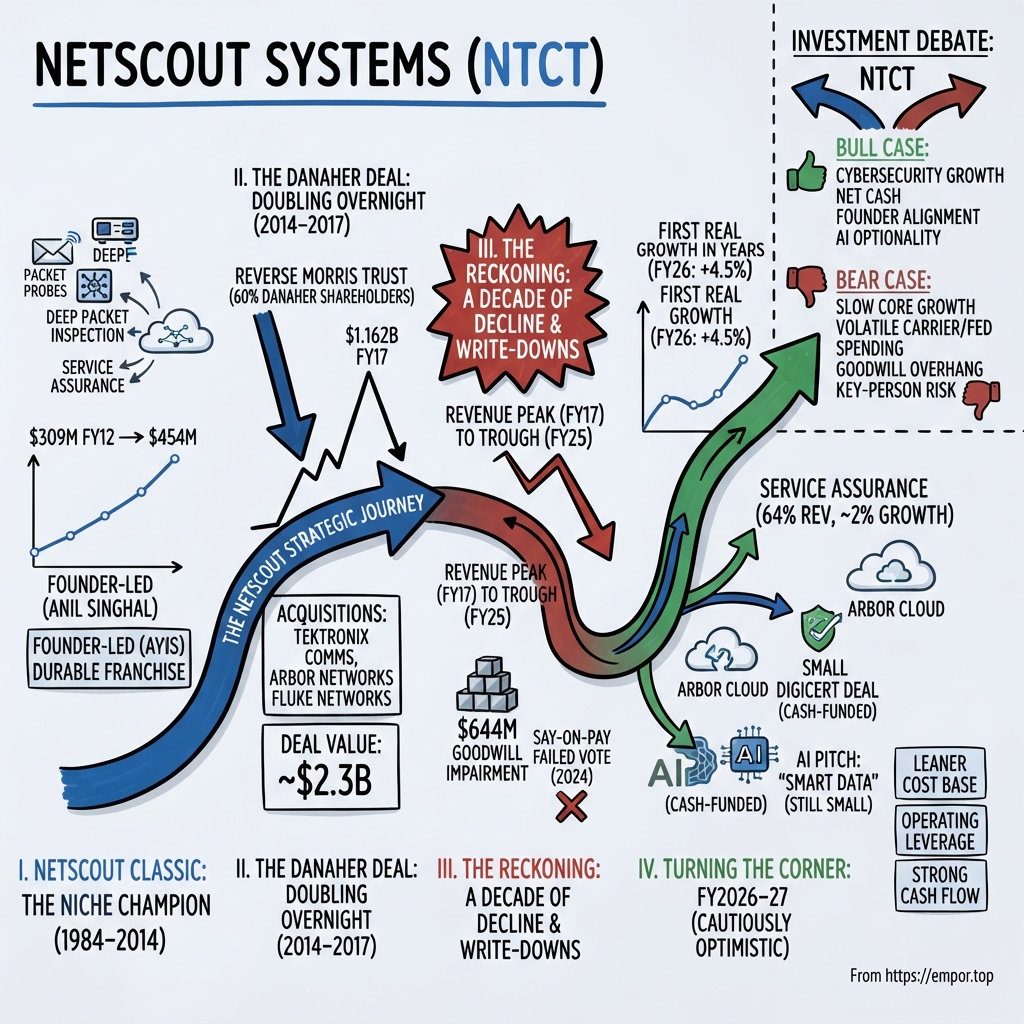
NetScout Systems: The Smart Data Company's Lost Decade
I. Cold Open — The Paradox (0:00–0:07)
Picture a cellular network during a stadium concert. Eighty thousand people are uploading video at the same moment. Somewhere in a carrier's operations center, an engineer watches a dashboard turn amber. Calls are dropping in one sector. Is it the radio? A misconfigured router? A flood of malicious traffic dressed up as fans? The engineer does not have time to guess. The tool that tells them, reading the actual packets flowing across the wire, conversation by conversation, has for decades very often carried one name in its corner: NetScout.
This is the quiet kind of company that never trends on social media and almost never gets a magazine cover. Yet its software and probes sit inside some of the largest telecom carriers, banks and government agencies in the world, watching the plumbing of the internet in real time. It has been run by the same person, co-founder Anil Singhal, since 1984, a tenure of more than four decades that almost nothing else in public-market technology can match.1
And here is the paradox that shapes this episode. The same company that built a genuinely hard-to-replicate technical capability also made one enormous bet in 2014 that doubled its size overnight.2 A decade later, it confessed through the unforgiving language of accounting that the bet was worth far less than it paid: roughly $644 million of goodwill written off across fiscal 2024 and fiscal 2025.34 Revenue peaked in fiscal 2017 and spent most of the following eight years sliding. In 2024, shareholders voted down the company's executive pay plan.5
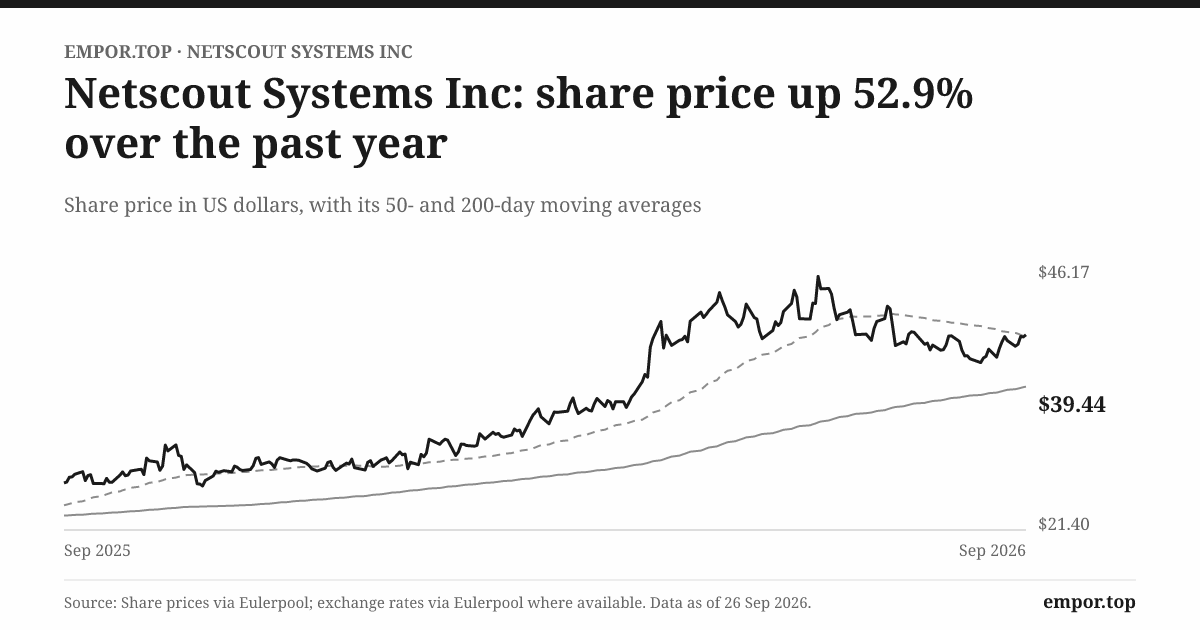
Then, quietly, something changed. Fiscal 2026, which ended March 31, 2026, delivered the first real growth in years, and management has guided to a second consecutive year of it.6 The company now talks about "smart data" feeding artificial intelligence, a pitch that sounds a lot like what every other infrastructure vendor on earth is saying in 2026.
So the central question is not whether NetScout is a good business. It clearly throws off cash. The question is whether it has a credible answer to "why does this company win from here," or whether it is a value trap dressed up in AI vocabulary.
The episode moves in order: first the niche champion NetScout used to be, then the Danaher deal that transformed it, then the long hangover and the $644 million confession. From there it turns to the current recovery, the competitive war map, the founder and his capital allocation record, the risks that actually matter, and finally the bull and bear cases. The through-line is simple: every claim management makes gets tested against what the company's own history says.
To understand why a quiet, profitable niche company would risk handing the majority of itself to someone else, it helps to start in a Massachusetts office park in the mid-1980s.
 Subscribe on LinkedIn
II. NetScout Classic: The Niche Champion (1984–2014) (0:07–0:19)
In 1984, the personal computer was barely three years old as a mainstream product and "the network" meant something most executives did not think about at all. Local area networks were new and fragile. When they broke, nobody could see why. That was the gap Anil Singhal and his co-founder saw when they started NetScout in Westford, Massachusetts, the Route 128 corridor that was then the East Coast's answer to Silicon Valley.1
The core idea was deceptively simple. Every piece of information that moves across a network is chopped into small envelopes called packets. Each packet carries an address label and a piece of the message. If you could capture and read those envelopes as they flew past, you could reconstruct what was actually happening: which application was slow, which server was overwhelmed, which user was affected. Think of it as the difference between a traffic report that says "congestion on the highway" and a camera that can read every license plate and tell you exactly which truck jackknifed in which lane.
That packet-level approach, later known as deep packet inspection, became NetScout's identity. It was technical, unglamorous and extremely sticky. Once a large enterprise or telecom carrier had wired NetScout probes into its network, trained its operations staff on the dashboards and built its troubleshooting workflows around the data, ripping it out was costly and risky. The switching costs were not contractual. They were operational and cultural.
NetScout went public in 1999, at the height of the dot-com boom, and unlike many of its IPO classmates it survived the bust.7 Through the 2000s and early 2010s it built a durable, profitable franchise selling "network and application performance" tools to two groups of customers: large enterprises and governments on one side, and telecom service providers on the other.
The numbers from this era tell the story of a real but modest company. Revenue was around $309 million in fiscal 2012, roughly $397 million in fiscal 2014, and about $454 million in fiscal 2015, the last full year before the transformation.89 It was consistently profitable, carried little debt, and did occasional small acquisitions. Next to Cisco or CA Technologies it was a rounding error, but in its niche of packet-based service assurance it was a leader.
It is worth pausing on how this actually works in practice, because the physical reality explains both the moat and, later, the vulnerability. A NetScout probe is a specialized computer placed at a strategic point in a network, often attached to a "tap" or a mirrored switch port that sends it a copy of every packet flowing past. The probe does not sit in the path of traffic, so it cannot slow anything down. It simply watches, decodes and summarizes. The clever part is not capturing packets, which many tools can do, but compressing billions of them into metadata that humans and software can actually use: which subscriber, which application, what response time, what error. Capturing everything and storing it raw would be like recording every conversation in a city and then trying to find one sentence. NetScout's engineering craft was in deciding what to keep.
Now scale that to a mobile carrier. A modern mobile network has many layers: radio towers, backhaul links, core switching systems, billing systems, and the internet gateways that connect subscribers to the outside world. When a customer complains that video keeps buffering, the fault could sit in any of those layers, or in the handoffs between equipment from different vendors. A carrier with probes at the key interfaces can follow a single subscriber's session across the whole chain. That capability becomes part of how the carrier runs its network, which is why it is so hard to rip out.
Service assurance deserves a plain-English definition because it runs through the rest of the story. For a mobile carrier, "service assurance" means making sure that the service subscribers pay for actually works: calls connect, video streams, data flows. For an enterprise, it means making sure the trading system, the hospital records platform or the airline booking engine stays fast and available. NetScout sold the instruments that told operators whether their service was healthy and, when it was not, where to look.
What kind of leader built this? Singhal's defining traits, as reflected in the company's long public record, are patience and continuity. He remained as Chairman, President and CEO for decades while many peers sold out, were acquired or were pushed aside.1 He ran NetScout as an engineering-led company, comfortable being small and specialized.
The 2000s also taught NetScout a lesson it would relearn later: telecom spending moves in waves. The carriers that were its biggest customers built aggressively when a new network generation arrived and then retrenched for years while they digested the investment. A vendor tied to those waves enjoys feast years and endures famine years, and its revenue line looks more like a staircase with occasional landings than a smooth ramp. Management could manage costs through the cycle, but it could not change the cycle itself.
But niches have ceilings. By 2014 NetScout had a problem common to specialists: its core market was growing slowly and was dominated by a handful of large carriers whose spending ran in cycles. To grow meaningfully, it needed either new markets or much greater scale with the carriers it already served.
For investors looking back, the lesson of NetScout Classic is that the company's original moat was real but narrow. It was built on technical fidelity and embeddedness in customer operations, not on scale or network effects. That distinction matters because the next move was an attempt to buy scale, and scale turned out to be a different animal from depth.
In October 2014, a disciplined, patient, founder-led company was about to make the largest decision in its history.
III. The Danaher Deal: Doubling Overnight (2014–2017) (0:19–0:44)
The phone call from the conglomerate
Danaher Corporation in 2014 was one of the most admired industrial conglomerates in America, famous for its Danaher Business System, a relentless operating discipline borrowed from Toyota. It was also a serial portfolio pruner. Among its holdings was a communications cluster that did not fit its evolving focus on life sciences and diagnostics: Tektronix Communications, which built monitoring tools for mobile carriers; Arbor Networks, a specialist in defending networks against distributed denial-of-service (DDoS) attacks; and parts of Fluke Networks, which made enterprise network test equipment.
On October 13, 2014, Danaher and NetScout announced they would combine that communications business with NetScout.2 For NetScout, it was a chance to roughly double its size in one step and to own several of its most direct competitors in carrier monitoring. For Danaher, it was a tax-efficient exit.
The structure that decided who owned the company
The mechanics matter, because they shaped everything that followed. The transaction was a Reverse Morris Trust, a tax-free structure in which a parent company spins off a business to its own shareholders and that business immediately merges with a smaller public company. The practical effect is that the parent's shareholders end up owning the majority of the combined entity, and nobody pays corporate tax on the gain.
Danaher shareholders received roughly 62.5 million newly issued NetScout shares, about 60% of the combined company.28 Put plainly, legacy NetScout shareholders became a minority in their own company. The headline deal value was about $2.3 billion when the transaction closed in July 2015, and it had been quoted as high as about $2.6 billion depending on NetScout's stock price at signing.102
On the Q3 fiscal 2015 earnings call, in January 2015, Singhal pitched the combination as a leap in scale and breadth, giving NetScout a much bigger footprint with service providers and new capabilities in enterprise and security.11 The logic was coherent on paper: more carrier relationships, more products to sell into them, and a first real foothold in cybersecurity through Arbor.
The immediate effect
Revenue nearly doubled, from about $454 million in fiscal 2015 to about $955 million in fiscal 2016, then peaked at roughly $1.162 billion in fiscal 2017.912 That fiscal 2017 figure is the high-water mark. As of September 2026, NetScout has never returned to it.
The strategic bet can be broken into two pieces. The first was scale in service-provider monitoring: combining NetScout and Tektronix Communications gave the merged company a dominant position with mobile carriers just as the industry anticipated a new investment cycle. The second, and in hindsight the more valuable, was Arbor. DDoS attacks work by flooding a target with so much junk traffic that legitimate users cannot get through, the digital equivalent of a thousand people calling a pizza shop simultaneously so no real customer can place an order. Arbor built systems that carriers and large enterprises used to detect those floods and scrub them away. It was a genuine diversification out of a single niche.
Stitching three companies together
Integration is where large deals quietly succeed or fail, and this one was genuinely hard. NetScout and Tektronix Communications had competed for many of the same carrier accounts, with overlapping product lines built on different architectures. Arbor had its own engineering culture, rooted in security research rather than performance monitoring. Fluke Networks' enterprise tools served yet another kind of buyer. Merging them meant rationalizing product roadmaps, sales territories and support organizations, all while customers watched to see which products would survive.
There is also a subtler problem with buying a competitor in a concentrated customer market. Before the deal, a large carrier could play NetScout against Tektronix in negotiations. After the deal, the carrier had fewer alternatives, which sounds like pricing power for NetScout. In practice, large buyers facing a consolidated vendor often respond by delaying purchases, pushing harder on price, or looking for substitutes outside the category entirely. Consolidation can win market share inside a niche while making the niche itself less attractive to the customers who fund it. That dynamic would matter in the years ahead.
Was the price sensible?
Paying on the order of $2.3–2.6 billion for a business with roughly $500–600 million of annual revenue implied something like four to five times revenue.109 For a lower-growth, telecom-equipment-adjacent asset, that is not obviously cheap. The defense at the time was that NetScout wrote no cash check: the currency was stock, and the structure was tax-free. That is true, but it is also the trap. When you pay in shares, the cost does not disappear. It is transferred to existing shareholders as dilution, and if the acquired business underperforms, it shows up later as write-downs. Both costs arrived.
What the seller knew
There is an old rule in M&A: always ask why the seller is selling. Danaher was, and is, one of the most sophisticated capital allocators in American industry, with a long record of buying businesses it could improve and shedding those it could not. Its decision to exit the communications cluster, and to do so for stock in a smaller company rather than for cash, was itself a signal about how it viewed the long-term growth of carrier monitoring. Danaher's shareholders received the majority of the combined company and could sell at their leisure; NetScout took on the operating challenge. That does not mean the deal was bad for NetScout by definition. It does mean the most informed party in the room chose to become a passive holder rather than the operator.
The buyback tell
What management did next is revealing. In fiscal 2016 the company raised roughly $295 million of debt and spent more than that, about $312 million, repurchasing stock.912 It bought back about $90 million more in fiscal 2017 and a striking roughly $500 million in fiscal 2018.12
The pattern was clear: lever up to shrink the share count that had just been issued to Danaher holders. It is tempting to call that value investing, but the timing argues otherwise. The heaviest buybacks ran years before the stock reached anything like a trough valuation, and they were funded with borrowed money at a time when the core business was about to stall. This was capital allocation as dilution damage control, not as opportunistic purchasing of cheap shares.
For investors, the takeaway from this section is that the deal's structure front-loaded the benefits (revenue scale, a cybersecurity foothold) and back-loaded the costs (dilution, debt-funded buybacks, and whatever the acquired assets would eventually prove to be worth). The next eight years would reveal that final number.
IV. The Reckoning: A Decade of Decline and a $644 Million Confession (0:44–1:14)
The slow leak
There was no single catastrophic quarter. That is what made the decline so insidious. On the Q3 fiscal 2018 earnings call, in early 2018, management was already explaining softer demand from large service-provider customers and the timing of carrier projects.12 Carriers were not abandoning NetScout. They were simply spending less, later and more cautiously than the 2014 deal thesis had implied.
Trace the revenue line and the shape becomes a long, uneven slope: about $987 million in fiscal 2018, $910 million in fiscal 2019, $892 million in fiscal 2020, $831 million in fiscal 2021, a modest $856 million in fiscal 2022, a rebound to $915 million in fiscal 2023, then back down to $829 million in fiscal 2024 and $823 million in fiscal 2025.12134 From peak to trough, that is a decline of roughly 29% over eight years, in a period when enterprise technology spending as a whole grew substantially.
The fiscal 2023 bounce deserves a caution flag. It looked like a turn, and then it reversed. Any investor evaluating the current recovery should keep that false dawn in mind, because it shows how lumpy NetScout's revenue can be and how easily a good year can be mistaken for a new trend.
Why it happened: the niche stopped being where the money was
Management's own framing is instructive. On the Q1 fiscal 2026 earnings call, in August 2025, Singhal said: "Our service assurance market, which was more of a niche market where we had almost 50% market share, is getting expanded into the larger observability market."14 He presented that as an opportunity, arguing that AI was "indirectly increasing our market size, which was one of the challenge in the service assurance area we had."14
Read the quote twice. It is, in effect, an admission that the old niche had a ceiling, and that NetScout held dominant share of a pool that was not growing. The growth in enterprise monitoring budgets over the previous decade went elsewhere: to cloud-native "observability" platforms such as Datadog, Dynatrace and Cisco's ThousandEyes. These tools are typically sold as subscriptions, deployed as software agents or cloud services rather than physical boxes, and priced by consumption. As companies moved workloads to Amazon, Microsoft and Google clouds, the on-premises probe sitting in a data center rack mattered less.
An analogy helps. NetScout was the best maker of traffic cameras for a city's highways. Then the city's traffic moved onto roads that the camera maker did not own and could not easily install hardware on. The cameras stayed excellent. They just watched a shrinking share of the traffic.
Telecom cyclicality compounded the problem. Mobile carriers phased their 5G spending more slowly and more cautiously than the deal thesis implied, and service providers have enormous bargaining power when they are a vendor's largest customers. The combination of a structurally shifting enterprise market and a cyclical, price-sensitive carrier market is a hard place to grow from.
How the story was told along the way
One useful test of management credibility is to line up how the story was told at different moments. In early 2015, the pitch was scale and breadth: a combined company positioned for the next wave of carrier investment and enterprise demand.11 By early 2018, the language had shifted to carrier caution and project timing, with the next investment cycle presented as the path back to growth.12 By mid-2025, the frame had moved again, to observability and AI as forces expanding the addressable market.14 And by May 2026, the tone was "cautiously optimistic."6
None of these explanations is false on its own. Carrier spending really was cyclical, and observability really is a larger market. But taken together they reveal a pattern familiar to long-term investors: for most of a decade, the recovery was always one cycle away, and the cycle changed name each time. The fiscal 2026 results are the first period in which reported numbers, rather than market narratives, supported the turn. That is exactly why an investor should weight the numbers more heavily than the framing, and why the durability test matters so much.
It is also worth noting what management did do well in this period. It cut costs, including through restructuring programs, preserved profitability on a non-GAAP basis, and paid down debt rather than chasing another large deal to paper over the decline.134 A less disciplined team might have tried to buy growth again. That restraint is part of why the balance sheet looks the way it does today.
The confession, in GAAP
Narratives can be argued with. Impairment charges are harder to spin. Under US accounting rules, when a company buys another business for more than the fair value of its identifiable assets, the excess sits on the balance sheet as "goodwill." Every year the company must test whether that goodwill is still supported by the value of the business. If it is not, the company must write it down.
NetScout recorded $217.3 million of goodwill impairment in fiscal 2024, $167.1 million in the third quarter and $50.2 million in the fourth.315 It then recorded a further $427.0 million in the first quarter of fiscal 2025.416 Together that is roughly $644 million. The fiscal 2025 charge drove a GAAP net loss of $366.9 million, or a loss of $5.11 per share, even though the business remained comfortably profitable on the non-GAAP basis management emphasizes and continued to generate cash.174
Weighing the evidence
This is not a stale or tangential data point. It concerns the same asset base (the goodwill created largely by the Danaher combination), the same management regime and the same strategic thesis. The impairment is a direct, quantified admission, produced through the company's own valuation testing and reviewed by its auditors, that the acquired businesses were worth substantially less than the price embedded in the balance sheet.
So the claim that NetScout's M&A has been value-accretive is, for this deal specifically, rejected by the record. The fairer counter-argument is narrower: the impairment reflects overpayment and over-optimistic assumptions about growth and synergies more than product failure. Arbor's DDoS franchise is today the core of a cybersecurity product line generating roughly 36% of company revenue and growing faster than the rest of the business.6 A like-for-like comparison of Arbor's standalone revenue in 2015 versus today is not disclosed, but the direction is favorable. Put differently, NetScout bought at least one good business. It paid too much for the package.
The forward test is concrete. After the write-downs, roughly $1.07 billion of goodwill remained on the balance sheet at the end of fiscal 2026, still more than 45% of total assets.1 Goodwill is tested annually and whenever the stock price or business outlook deteriorates meaningfully. A string of clean impairment tests would begin to rehabilitate the M&A story. Another charge would confirm that the problem was not fully flushed.
Governance consequence
The shareholder reaction did not stay confined to the stock price. At the 2024 annual meeting, NetScout's advisory say-on-pay vote failed, meaning a majority of votes cast opposed the executive compensation program.518 Failed say-on-pay votes are uncommon among US public companies, and they typically signal that shareholders believe pay has become disconnected from performance.
The board and compensation committee responded by revising the pay structure and engaging with shareholders, and at the 2025 meeting approval rebounded to 86.6%, a swing of 43.8 percentage points.519 Governance research firm Boardroom Alpha highlighted NetScout's rebound among the September 2025 proxy results.19
Read together, the two votes narrow rather than reject the "aligned, trustworthy management" claim. Shareholders delivered a real rebuke during the value-destruction years, and management responded. The forward signal is whether support holds above roughly 85% in 2026 and 2027, or slides back when results wobble.
After a decade of shrinkage and two rounds of write-downs, the obvious question was whether anything underneath was still growing. Fiscal 2026 offered the first real answer.
V. Turning the Corner: FY2026–27 (1:14–1:36)
A different kind of earnings call
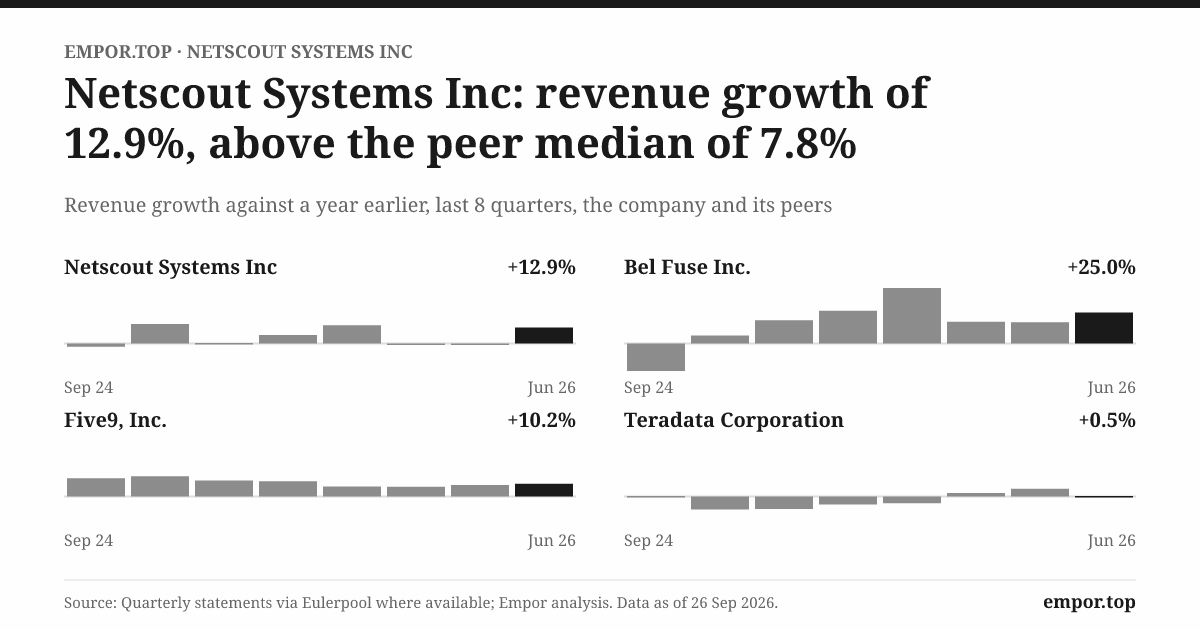
On May 7, 2026, NetScout reported its fiscal fourth quarter, and the tone on the call was noticeably different from the preceding years. Revenue for fiscal 2026 rose 4.5% to $859.5 million.6 Non-GAAP diluted earnings per share grew nearly 12% to $2.48, ahead of the company's own guidance.6 Free cash flow was about $285 million, one of the strongest years in the company's history and roughly a third of revenue.6
Then came guidance. For fiscal 2027, management guided revenue to $885–915 million and non-GAAP EPS to $2.65–2.80.6 If delivered, that would be two consecutive years of growth, the longest such stretch since before the long decline began. Management's own framing was careful: the external environment "could get worse, and that's why we are cautiously optimistic."6
What does a recovery like this say about demand? The answer is more nuanced than the headline. Enterprise and government customers were spending again, and the cybersecurity line was clearly growing on its own merits. But much of the earnings improvement came from a leaner cost base built during the lean years, rather than from accelerating demand. That is healthy, but it is a one-time lever: costs can only be cut so far, and future earnings growth will need to come increasingly from revenue.
Growth of 4–5% is not a breakout. What makes it meaningful is the direction change, and the fact that earnings are growing roughly twice as fast as revenue because the cost base was trimmed during the lean years. That is operating leverage, the effect of spreading a relatively fixed cost base over a larger revenue number.
Two businesses under one roof
NetScout discloses two product lines in its earnings commentary: service assurance and cybersecurity. They are not formal reporting segments, but they tell very different stories.
In fiscal 2026, service assurance made up about 64% of revenue and grew 2.6%, supported by enterprise customers and federal government spending.6 Cybersecurity made up about 36% of revenue and grew 7.8%, and management was explicit that it "continues to grow faster than the company average."6 Management expects cybersecurity's share of the mix to keep rising.
The first quarter of fiscal 2027, reported on August 6, 2026, complicated that neat picture in an instructive way. Total revenue jumped 12.7% to $210.4 million.2021 But the engine was service assurance, up 19.7%, while cybersecurity was up just 0.6% to $69.4 million, or 33% of revenue, against a difficult comparison with a prior-year quarter that had grown in the high teens.20 Quarterly lumpiness can swing either line, which is exactly why the annual numbers matter more than any single print.
A second lens on the first quarter is the split between product and service revenue. Product revenue, which captures hardware probes and software licenses, rose 17.8% to $86.0 million, while service revenue, mostly maintenance and support on the installed base, rose 9.4% to $124.4 million.20 The service line is the steadier annuity: customers keep paying for support as long as the probes stay in their networks, which makes it the clearest financial expression of switching costs. The product line is the swing factor, rising and falling with carrier and government purchase cycles. When product revenue jumps, as it did this quarter, the natural question is whether it reflects new demand or earlier timing, and in this case management has said part of it was timing. Geographically, the United States was 59% of first-quarter revenue and international markets 41%.20
Arbor, DigiCert and a small, disciplined bite
Within cybersecurity, Arbor's DDoS products are the mature, profitable base. On May 1, 2026, NetScout closed the acquisition of DigiCert's DDoS protection assets, a business expected to add about $20 million of annualized revenue and be immediately accretive to earnings.6 The deal brought the back-end infrastructure of Arbor Cloud, NetScout's cloud-based scrubbing service, fully in-house and doubled its mitigation capacity to 33 terabits per second.20
For a sense of scale, 33 terabits per second is the kind of capacity needed to absorb the largest DDoS floods now seen in the wild, which have grown dramatically as attackers harness armies of compromised devices. For a DDoS defender, capacity is a credibility metric: customers want to know the shield will not buckle.
The contrast with 2015 is worth dwelling on. The DigiCert deal was small, bought for cash from a very strong balance sheet (cash and marketable securities were $705.1 million at fiscal year-end and $668.5 million after the deal closed) and aimed at owning infrastructure NetScout already relied on.20 It is the opposite of betting the company. One well-executed tuck-in does not prove a new capital allocation culture, but it is the right shape of deal.
The NDR lesson
Not every product bet has worked. NetScout's Omnis Cyber Intelligence platform was meant to compete in network detection and response, or NDR, a category that watches internal network traffic for signs that attackers are already inside. On the Q1 fiscal 2026 call, Singhal said: "We have some traction on the OCI product, which is basically in the NDR space and but we are repositioning that into what we call post incident response."14
"Repositioning" is corporate language for "the original pitch did not land the way we hoped." NDR is a crowded category with well-funded specialists, and NetScout's packet expertise did not translate automatically into winning that market. That history matters for how to read the next product story.
"Smart data" and the AI pitch
The next product story is the AI one. NetScout's pitch is that its packet-level data, captured by products such as Omnis Sensor and Omnis Streamer and interpreted by an assistant called nGenius Copilot, is the high-fidelity raw material that AI operations tools and AI agents need. The analogy management implicitly draws: AI models are only as good as the data they are fed, and sampled or summarized telemetry is like giving a doctor a blurry X-ray.
The pitch is plausible. The numbers are small. On the Q4 fiscal 2026 call, management said the Omnis Sensor and Streamer products generated $10–15 million in fiscal 2026, their first year, after launching in October.6 That is under 2% of revenue. On the Q1 fiscal 2027 call, CFO Tony Piazza put fiscal 2026 at about $15 million, said the business was growing nicely, and still described it as "still small."20 Singhal disclosed that the customer base for the new Omnis solutions "remains under 10 accounts."20
This is where the certification-versus-commercialization rule applies. Technical capability and marquee-customer pilots at NetScout have not always converted quickly into durable revenue, as the Omnis Cyber Intelligence repositioning shows. The fair framing is that the AI data products are genuine optionality with a plausible mechanism (they deepen the value of NetScout's existing footprint rather than requiring new customer relationships), but they are not yet a material growth driver and should not be valued as one until they are.
The federal tailwind, and its timing
One more ingredient in the recovery is the US federal government. Federal revenue normally runs at mid-to-high single digits as a percentage of sales, and in fiscal 2026 it ran at the high end of that range, with management flagging potential normalization.6 In the first quarter of fiscal 2027, federal revenue spiked to the mid-teens as a share of the quarter, because $10–15 million of orders were "received earlier than anticipated," pulled in from the second quarter.20 Management guided the second quarter to revenue "broadly consistent with prior-year period."20
Government exposure also carries a buyer-power dimension that deserves attention. Federal agencies are large, sophisticated purchasers that run formal procurement processes, often insist on multiple qualified vendors, and can delay or reshape programs when budgets tighten. Being an incumbent supplier to government networks is valuable, but it is not a cornered resource. Specification changes, re-competed contracts or budget freezes can shift demand quickly, and the vendor has little say in the timing.
That candor is a point in management's favor: they labeled timing as timing. It also means that a meaningful part of the most recent quarter's headline growth was borrowed from the next one. The honest reading of the recovery is that it is real, modest and still young.
Whether modest growth can become durable growth depends on who NetScout is fighting, and on which battlefield.
VI. Industry Structure: How NetScout Wins and Loses (1:36–2:01)
Two battlefields
Imagine two war rooms. In the first, generals plan how to defend an old fortress built on a river crossing that used to carry all the trade. In the second, they plan how to hold a busy new port where trade is booming but a dozen rivals have already built docks. NetScout fights on both fronts: service assurance is the fortress, cybersecurity is the port.
Front one: service assurance and network observability
This market is bifurcating. On one side stand the packet-based, hardware-adjacent specialists: NetScout, Riverbed, Viavi, Gigamon, and Keysight (which absorbed Spirent). On the other stand cloud-native observability platforms with far higher growth rates: Cisco via ThousandEyes and Splunk, Dynatrace, Datadog, New Relic, ExtraHop and SolarWinds.
NetScout's edge on this front is packet-level fidelity and multi-decade embeddedness. By Singhal's own account the company held "almost 50%" of its traditional service assurance niche.14 Carriers and government agencies have repeatedly bought upgrades and new generations of NetScout probes rather than switching vendors, and the federal strength in fiscal 2026 is partly an example of that installed base refreshing.6 That is evidence of real switching costs.
The weakness is equally concrete. Packet fidelity matters most where there is a physical network to tap. As IT budgets shift toward consumption-priced, cloud-native tools that need no on-premises appliance, the pool in which NetScout's advantage applies shrinks relative to total spending. This is precisely the mechanism behind the eight-year decline described earlier. Management's pitch that observability and AI are expanding its market is an argument that its fortress sits on a new trade route. That remains a hypothesis, and service assurance growth of 2.6% in fiscal 2026 does not yet confirm it.6
Customer behavior offers the cleanest evidence on the moat, better than any vendor claim. The most telling signal is the service line. Maintenance and support revenue grew 9.4% in the first quarter of fiscal 2027, to $124.4 million, more than half of total revenue.20 Customers do not keep paying for support on equipment they are planning to remove. A growing service line implies that the installed base is at least holding, and probably expanding in places. What that number cannot show is whether new budgets, the ones that determine long-term growth, are flowing to NetScout or to its cloud-native rivals. Retention proves the moat protects what the company has. It says less about what the company can win.
Front two: DDoS and cybersecurity
DDoS protection is a concentrated market. The main competitors are Akamai, Cloudflare, Radware, F5 and Fastly, alongside NetScout's Arbor. NetScout's strength is carrier-grade and on-premises deployment: large service providers and enterprises that want mitigation hardware inside their own networks, plus cloud scrubbing through Arbor Cloud for overflow attacks. That position is defensible because carriers do not casually swap the systems protecting their backbone.
A short technical detour explains why the carrier position is distinctive. There are two broad ways to stop a DDoS flood. The first is to scrub traffic inside your own network, using on-premises appliances that sit near the network edge and drop malicious packets before they reach their target. This is fast and keeps control in-house, but any single appliance has a finite capacity. The second is to reroute traffic through a cloud provider's global network of scrubbing centers, which can absorb enormous floods but adds dependence on a third party. Carriers often want both: local defense for everyday attacks and cloud overflow for the monsters. Arbor's product line, strengthened by the DigiCert infrastructure, is built around exactly that hybrid.620
The vulnerability is the rise of cloud-native, CDN-bundled protection. Cloudflare and Akamai sell DDoS defense as part of a broader package that sits in front of a customer's websites and applications, often bundled with content delivery and web security. For many enterprises that do not run their own backbone, the bundled cloud service is simpler and cheaper. NetScout is strong in the carrier segment and comparatively weaker in the mass enterprise market where bundling wins.
A war game: three moves that could reshape the board
Consider three plausible competitive moves and how NetScout would fare against each.
In the first, a large networking or observability platform decides to bundle deeper network visibility into a suite enterprises already pay for. Cisco, with ThousandEyes and Splunk under one roof, is the obvious candidate. Bundling is the most dangerous weapon against a specialist, because the buyer's question changes from "which tool is best?" to "is the specialist good enough to justify a separate contract?" NetScout's defense is fidelity: for mission-critical networks, a bundled tool's approximations may not satisfy engineers who need exact packet evidence. That defense is strongest in carriers and government, and weakest in mid-sized enterprises.
In the second, carriers increasingly build their own monitoring into cloud-native, software-defined networks, using open-source tools and data from equipment vendors. This is a slower threat, because carriers rarely want to own the engineering burden, but it caps pricing power. NetScout's response has been to make its own probes more software-based and deployable in virtualized environments, an adaptation that keeps it relevant but also exposes it to more software-native competitors.
In the third, AI-driven operations tools become the primary interface through which engineers manage networks. In that world, the valuable position is either owning the AI layer or owning the best data feeding it. NetScout is betting on the second. The bet is coherent, but it depends on AI platforms preferring high-fidelity packet data enough to pay a premium for it, rather than making do with cheaper, lower-fidelity telemetry. As noted earlier, the early commercial evidence is limited to a small number of accounts.20
Porter's Five Forces
Supplier power is low. NetScout is software-heavy and owns its intellectual property, though it does depend on commodity hardware components, a point that returns in the risk section.
Barriers to entry are moderate to high in telecom-grade deep packet inspection. Carrier certification cycles are long, and operational switching costs are real.
The threat of substitutes is high and rising, and this is the force that matters most. The substitute for a packet probe is not a better packet probe. It is an agent-based cloud observability platform or a bundled CDN security service that makes the probe unnecessary for many use cases.
Buyer power is moderate to high. Large carriers are concentrated, sophisticated and cyclical buyers, and eight years of pricing and volume pressure on service assurance revenue is the evidence.
Competitive rivalry is intense on both fronts, with far larger and faster-growing platform companies on the observability side.
Hamilton Helmer's 7 Powers
Helmer's framework asks which durable structural advantages a company has. NetScout has real process power, meaning decades of accumulated packet-engineering know-how that is difficult to replicate quickly. It has switching costs, in the operational sense described above. It has pockets of counter-positioning: competitors built around sampled or agent-based data would have to rebuild their architectures to match full packet fidelity.
What it lacks are scale economies and network effects relative to hyperscale cloud competitors. Datadog's platform gets more valuable as customers add more modules, and Cloudflare's network gets more capable as it serves more traffic. NetScout has no equivalent flywheel. That structural asymmetry, deep but narrow advantages facing broad scale advantages, is exactly what the last decade exposed.
The conclusion is that NetScout's moat is intact but narrower than it was in 2015. It protects the installed base well. It has not, historically, protected growth.
A narrow moat puts even more weight on the people deciding how to spend the cash it generates.
VII. Management and Capital Allocation: Anil Singhal's Fourth Decade (2:01–2:21)
The founder who never left
There is a particular kind of founder who treats the company as a lifelong craft rather than an exit. Singhal co-founded NetScout in 1984 and remains Chairman, President and Chief Executive Officer more than four decades later.15 Born in 1954, he is now in his early seventies.5 In public-market technology, where average CEO tenures are measured in single-digit years, that continuity is extraordinary.
His style, visible across years of earnings calls, is technical and long-horizon. He tends to talk about architecture, data fidelity and product generations rather than quarterly narrative, and he has repeatedly returned to the same core conviction: that the packet is the ultimate source of truth about a network. That consistency is a strength when the thesis is right and a liability when the market moves elsewhere. The "smart data" pitch of 2026 is, in essence, the same conviction dressed for the AI era.
Founder conviction cuts both ways in NetScout's history. It kept the company focused on an engineering discipline that competitors found hard to copy, and it is the reason NetScout still has something distinctive to say about data quality in the AI era. But conviction can also slow adaptation. The shift to cloud-native, consumption-priced observability happened largely outside NetScout's core architecture, and the company responded by extending its packet approach into virtual and cloud environments rather than reinventing its model. Whether that was patience or stubbornness is a judgment the next few years will inform. What is clear is that the strategic direction of NetScout remains closely tied to one person's worldview, which amplifies both the key-person risk and the importance of whoever eventually succeeds him.
Skin in the game
Singhal's beneficial ownership, including family trusts and a charitable foundation, has been reported at roughly 2.75–4.5% of shares outstanding, worth on the order of $100 million or more at recent prices.518 That is meaningful alignment in dollar terms. As a share of a company with a market capitalization around $2.9 billion that he has run for four decades, it is modest, partly a legacy of the Danaher dilution. His reported compensation for 2025 was roughly $1.86 million, restrained for a company of this size.5
Two capital allocation regimes
NetScout has never paid a dividend. Buybacks are its only mechanism for returning capital.1 The record divides cleanly into two regimes.
The first ran from roughly 2016 to 2018: debt-funded, aggressive repurchases of around $900 million combined, executed to reverse the Danaher dilution.12 They ran across a wide range of share prices with no obvious valuation discipline, and they were followed by years of revenue decline and eventually by write-downs. In hindsight, that money bought back shares at prices far above where the stock later traded.
The second regime ran from about 2022 to 2026: full deleveraging, from about $469 million of debt in fiscal 2022 to essentially no drawn debt by fiscal 2026, alongside smaller, steadier buybacks funded from free cash flow.131 In fiscal 2026, NetScout repurchased 2.5 million shares at an average of $24.29, about $61 million in total.6 With free cash flow near $285 million that year, buybacks consumed only about a fifth of the cash generated, and the cash pile grew.6
The net result: diluted share count has fallen from roughly 92–93 million in fiscal 2017 to guidance of 74–75 million for fiscal 2027, a reduction of about 20%.1220 That is a real return of capital. But it took a decade, and against the stock's own round trip the timing does not look well judged. The second regime is clearly more disciplined than the first; whether it is disciplined enough is a fair question.
Guidance discipline
A quieter test of management is how it handles guidance. In fiscal 2026, NetScout finished with non-GAAP EPS of $2.48, above the range it had set, and revenue growth consistent with its outlook.6 It then guided fiscal 2027 conservatively, with the midpoint implying revenue growth of about 4.7% and non-GAAP EPS growth of about 9.9%, and it reaffirmed that guidance after a strong first quarter rather than raising it.20 Leaving guidance unchanged after pulling orders forward is the correct call, and it suggests management would rather beat a modest number than chase a headline.
That behavior should be weighed against the longer record. During the decline years, the company's public narrative repeatedly pointed to a coming carrier cycle that arrived later and smaller than implied. The recent guidance pattern is more credible than the older narrative pattern, but it covers only about two years. Consistent delivery through fiscal 2027 and 2028, including through a federal normalization, would be the stronger evidence.
The activist stress test
What would a skeptical activist challenge here? Several things. First, the cash pile: roughly $668.5 million of cash and securities with no drawn debt on a company worth about $2.9 billion is nearly a quarter of the market capitalization sitting idle, and the buyback pace is modest relative to free cash flow.20 Second, the goodwill: after $644 million of write-downs, management's track record on large acquisitions is poor, so any sizeable new deal should face heavy scrutiny. Third, succession: a founder-CEO in his seventies with no publicly disclosed successor concentrates key-person risk. Fourth, board refreshment, given how long the leadership has been in place.
The say-on-pay episode described in Section IV is the clearest recent test of accountability, and it came out as a dent rather than a break: shareholders objected, and the company changed course. Within the proxy statements and SEC filings reviewed for fiscal 2024 through fiscal 2026, no activist campaign or Schedule 13D filing targeting NetScout was found. That is a bounded finding about those records, not a guarantee that pressure does not exist privately.
The management verdict, then, is mixed but improving: a founder with genuine technical conviction and aligned ownership, a first decade after the Danaher deal that destroyed value, and a second phase that has been more careful. That leads directly to the question of what could go wrong next.
VIII. Risk Radar (2:21–2:34)
This section focuses only on risks with a clear mechanism tied to the business described above.
Service-provider capex cyclicality. Telecom carriers remain a large share of revenue, and their spending is lumpy, driven by network build cycles, regulatory events and their own financial pressure. The fiscal 2017–2025 decline was substantially a story of carrier restraint.12 NetScout cannot control this cycle. It can only ride it.
Cloud-native and AI-observability substitution. This risk has already partly materialized. If more monitoring budgets migrate to consumption-priced, agentless platforms, the on-premises service assurance base could shrink further, and the "AI expands our market" thesis would be falsified.
Federal government lumpiness. The federal tailwind is real but volatile. With federal revenue at the high end of its normal range in fiscal 2026 and a mid-teens spike in the first quarter of fiscal 2027 driven by pulled-forward orders, management itself has flagged normalization.620 Federal budget disruptions, continuing resolutions or agency spending reviews can shift orders between quarters or years.
Goodwill concentration. About $1.07 billion of goodwill plus roughly $214 million of other intangible assets still make up more than half of total assets.1 A sustained drop in the stock price or a weaker outlook could trigger another impairment, as happened twice in fiscal 2024 and 2025. Impairments are non-cash, but they would be a second verdict on the same strategic decision.
Hardware supply chain. NetScout still ships physical probes and appliances. On the Q1 fiscal 2027 call, Piazza said the AI data center build-out was making equipment "more difficult to obtain and prices increase," and inventory rose about $7 million as the company bought components in advance.20 Component inflation could pressure gross margins, or force price increases on price-sensitive carriers.
Accounting judgment: the GAAP versus non-GAAP gap. NetScout, like most technology companies, emphasizes non-GAAP earnings, which exclude items such as amortization of acquired intangibles, stock-based compensation, restructuring charges and impairments. Some of those exclusions are reasonable: amortization of intangibles from a 2015 deal says little about current operations. But stock-based compensation is a real cost to shareholders, and restructuring has recurred across multiple years.134 The fiscal 2025 spread, a large GAAP loss alongside solid non-GAAP profits, is an extreme example driven by the impairment.17 Investors should watch whether the gap narrows as impairment and amortization roll off, or whether new recurring "one-time" items take their place. The goodwill impairment tests themselves rest on management's forecasts and discount-rate assumptions, which are inherently judgmental; the fact that two separate charges were needed within about a year suggests the earlier assumptions had been too optimistic.34
Succession. A founder-CEO of more than four decades, now in his seventies, with no publicly disclosed successor, is a genuine key-person risk.5 The risk is not only operational; much of the company's product vision and customer relationships are associated with one person.
Cybersecurity exposure as a vendor. A company that sells security and network visibility products faces reputational and contractual damage if its own products or cloud services are compromised or fail during a major attack. This is a standard risk for the category but a more acute one for a DDoS provider whose value proposition is staying up when others go down.
With the risks mapped, the investment debate comes down to which forces dominate over the next several years.
IX. Bull vs. Bear — The Investment Case (2:34–2:49)
The bull case
The bull story begins with cybersecurity. It is a real, structurally growing product line, now roughly 36% of revenue and growing faster than the company as a whole in fiscal 2026.6 It is strategically core, not a sideline, and it has a plausible path to becoming the larger of the two businesses over time.
Second, capital allocation behavior has visibly changed. The DigiCert deal was small, cash-funded, infrastructure-focused and immediately accretive, the behavioral opposite of 2015.6 The balance sheet is net cash, with no drawn debt and one of the strongest free cash flow years in company history.16
Third, the founder remains engaged, with meaningful if modest ownership, and responded to shareholder pressure on pay.5 Fourth, the installed base in carriers, government agencies and large enterprises supports genuine switching costs. Fifth, the AI data products offer optionality layered on an already-sticky core, rather than a speculative venture that requires building new customer relationships from scratch.
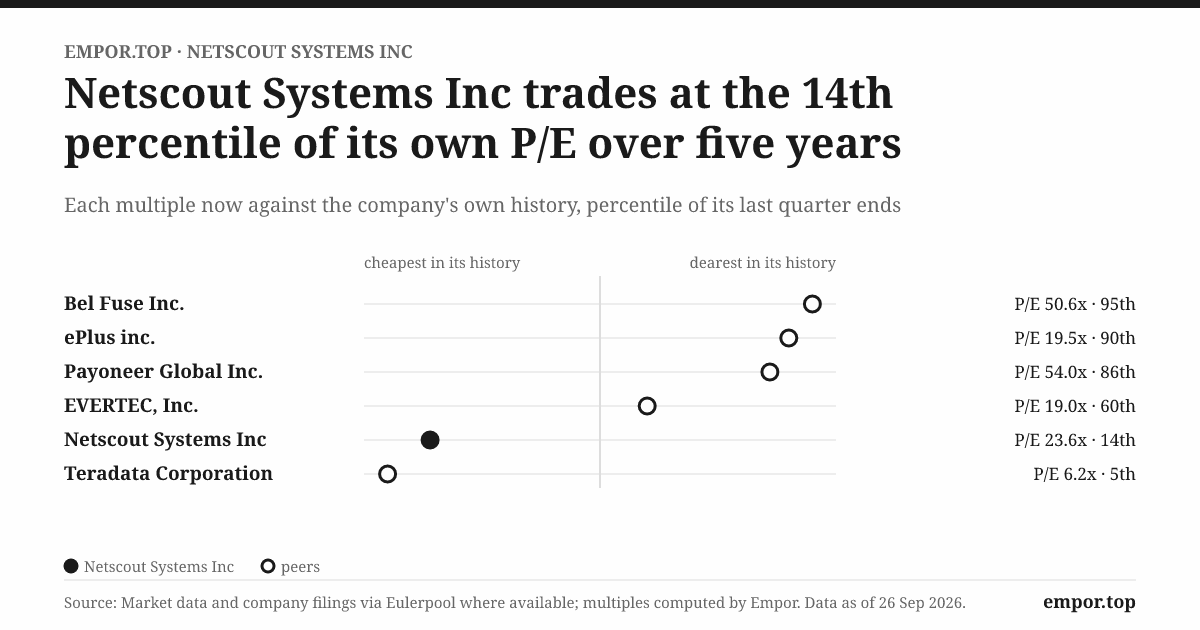
In this view, NetScout is a cash-generative niche leader whose worst period is behind it, trading at a valuation that reflects the decline rather than the recovery.
The bear case
The bear response starts with the calendar. The return to growth is roughly two years old after eight years of decline, and the fiscal 2023 false dawn shows how quickly a good year can reverse. Part of the most recent quarter's growth was explicitly pulled forward from the next quarter.20
The core service assurance market keeps losing relevance as a share of enterprise IT spending, even where NetScout defends its niche. The roughly $644 million goodwill write-off is direct evidence that the company's single largest strategic bet destroyed value. The 2024 say-on-pay rejection is a real governance dent. A founder-CEO in his seventies with no visible successor concentrates risk. And the AI story, despite years of "smart data" framing, remains a rounding error in the P&L with fewer than ten customers for the new Omnis solutions.20
Even the cybersecurity story has limits. Carrier-grade DDoS is a strong but bounded market, and cloud-native, CDN-bundled competitors are winning much of the broader enterprise demand. Cybersecurity growth of 0.6% in the first quarter of fiscal 2027 is a reminder that the segment is not immune to lumpiness.20
Myth versus reality
Myth: NetScout is an AI company now. Reality: the AI-specific products generated roughly $10–15 million in their first year, under 2% of revenue.6 The AI thesis is optionality, not the business.
Myth: the Danaher deal was transformative, so it worked. Reality: it transformed the company's size and gave it Arbor, but the company itself wrote off roughly $644 million of the resulting goodwill.34 Transformative and value-creating are different things.
Myth: buybacks have steadily created value. Reality: the heaviest buybacks were debt-funded and ran before the stock's decline. The more recent, cash-funded regime is more defensible, but it is also more modest.
Myth: switching costs make the service assurance base a safe annuity. Reality: switching costs protected the installed base from direct rivals, but they did not stop customers from shifting new budgets elsewhere. Revenue fell for most of eight years despite those switching costs.134 Stickiness slows erosion; it does not guarantee growth.
Myth: a mature niche business cannot grow. Reality: fiscal 2026 showed growth, and fiscal 2027 guidance calls for more.6 The question is durability, not possibility.
How the peers frame the comparison
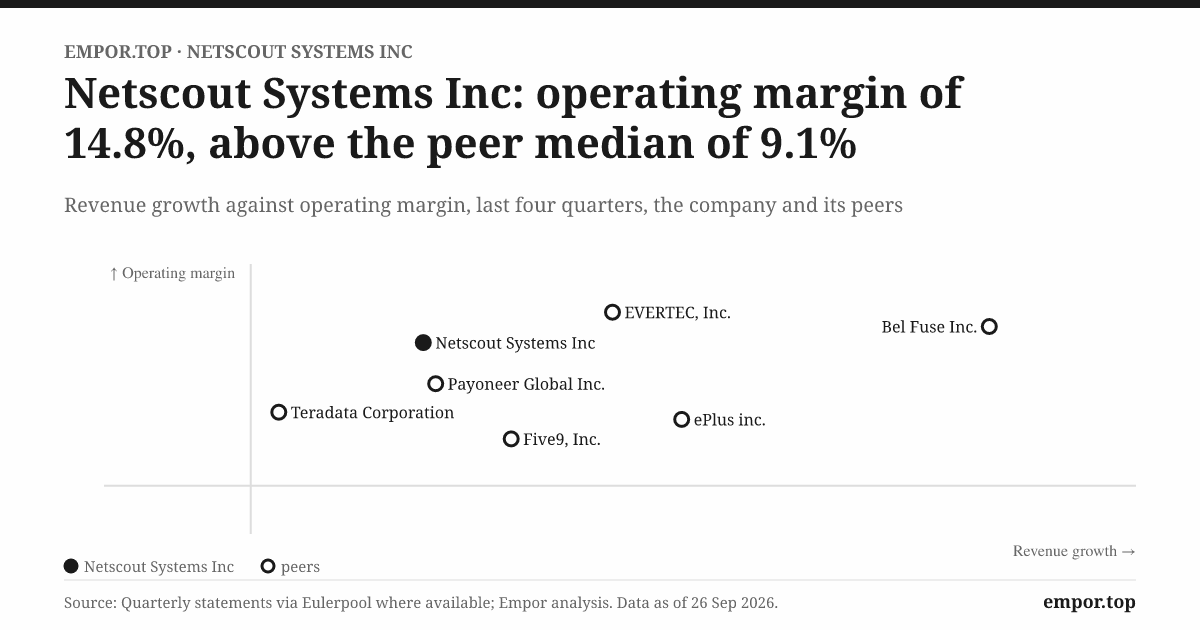
Peer comparison sharpens the picture. Against cloud-native observability leaders such as Datadog and Dynatrace, NetScout is a slower-growing, more hardware-exposed business with a much smaller research budget in absolute terms, and it competes for a shrinking slice of the same wallet. Against the packet and test specialists, such as Viavi, Riverbed, Gigamon and Keysight, it looks more familiar: similar exposure to carrier cycles, similar pressure from cloud migration, and similar efforts to rebrand packet data as AI fuel. In DDoS, Akamai and Cloudflare operate at a network scale NetScout cannot match, while NetScout holds the carrier-grade, on-premises position that the CDN players do not prioritize.
The comparison suggests that NetScout's recent performance is not unusual for its peer group. Many packet-era specialists have spent the last decade working through the same structural transition. The company's differentiators within that group are the Arbor franchise, an unusually clean balance sheet, and founder continuity. Its handicap is the Danaher-era goodwill and the credibility cost that came with writing much of it off.
What an activist would push for
Beyond the cash-and-succession questions raised in Section VII, the sharpest structural argument an activist could make is about portfolio shape. Security businesses typically attract different investors and valuation frameworks than mature monitoring businesses. An activist could argue that bundling a growing DDoS franchise with a low-growth installed base obscures the value of the former, and push for more granular disclosure, such as formal segment reporting with segment profitability, or even a strategic review of whether the two lines belong together. The counter-argument is that they share customers, sales channels and packet-processing technology, and that separation would add cost and dis-synergy. Neither side can be settled from public data alone, because segment-level profitability is not disclosed.
Weighing it together
The competitive analysis from Section VI points to a company with narrow, real advantages (process power and switching costs) against competitors with broad scale advantages. That structure tends to produce businesses that are durable and cash-generative but struggle to grow faster than their installed base. The historical record rejects the claim that the company's large-scale M&A created value, narrows the management-credibility claim to "dented and recovering," and leaves the AI optionality claim intact but unproven.
The KPIs that matter
Three metrics will do most of the work in resolving the debate.
First, cybersecurity revenue growth and its share of total revenue, measured on a full-year basis once federal order timing normalizes. If cybersecurity keeps outgrowing the company and rising in the mix, the bull case strengthens. If it reverts toward service assurance's low growth, the recovery thesis weakens.
Second, the outcome of annual goodwill impairment tests. Several consecutive clean tests would begin to rehabilitate the capital allocation story. Another charge would signal the Danaher-era problem is not fully resolved.
Third, revenue from Omnis Sensor, Streamer and related AI-data products, and the number of customers buying them. A move from roughly $15 million and fewer than ten accounts toward a meaningful share of revenue would convert optionality into evidence.
Those three numbers are the scoreboard. The final section considers where the game stands now.
X. Epilogue (2:49–3:00)
Walk into NetScout's Westford headquarters today and the continuity is striking. The founder is still in the corner office. The company still believes, as it did in 1984, that the truth about a network lives in its packets. And the engineers still build tools for the people who get paged at 3 a.m. when something breaks.
What has changed is everything around that core. The company is roughly twice the size it was before Danaher, but smaller than it was at its 2017 peak. It carries no drawn debt and holds a large cash balance.120 It has absorbed about $644 million of write-downs and a shareholder rebuke. It has a cybersecurity business that is growing, a service assurance business that is stabilizing, and an AI data story that is promising but small.
Entering fiscal 2027, the company has guided to growth on both lines, has a fully deleveraged balance sheet, and has a small but real cybersecurity-led acceleration.6 The second quarter of fiscal 2027, which management has already guided to roughly flat revenue after the first quarter's pulled-forward orders, will be the first test of how much of the recent momentum was timing and how much was demand.20
There is a human dimension to this moment, too. Few founders get to write the second act of their own company's story after a long stumble. Singhal has an opportunity that is rare in public markets: to hand over, at some point, a business that is growing again, debt-free and more focused than the one he inherited from the Danaher years. How and when that handover happens, and who receives it, may shape the company's next decade as much as any product launch. The company has not publicly disclosed a succession plan, and investors have no way to evaluate a successor who has not been named.5
Over the next 12 to 24 months, the things to watch are federal spending normalization, whether cybersecurity's outgrowth of service assurance holds on a full-year basis, the next goodwill test, the pace of AI-data product adoption, and any signal on CEO succession.
NetScout's story is less about disruption than about a durable niche business that made one outsized, dilutive bet to escape its own ceiling. The bet brought a genuinely valuable security franchise and a painful accounting reckoning in the same package. A decade later, the company is still proving whether that bet was strategy or overreach, and the answer will be written not in press releases about smart data, but in the three numbers on the scoreboard.
References
-
NetScout Systems, Inc. Form 10-K, FY2026 — SEC, 2026 ↩↩↩↩↩↩↩↩↩↩
-
Danaher and NetScout Systems Announce Business Combination — Danaher Investor Relations, 2014-10-13 ↩↩↩↩
-
NetScout Systems, Inc. Form 10-K, FY2024 — SEC, 2024-05-16 ↩↩↩↩
-
NetScout Systems, Inc. Form 10-K, FY2025 — SEC, 2025-05-15 ↩↩↩↩↩↩↩↩↩
-
NETSCOUT SYSTEMS INC — Form DEF 14A (proxy statement), FY2025 — SEC, 2025 ↩↩↩↩↩↩↩↩↩↩
-
NetScout (NTCT) Q4 2026 Earnings Transcript — The Motley Fool, 2026-05-07 ↩↩↩↩↩↩↩↩↩↩↩↩↩↩↩↩↩↩↩↩↩↩↩↩↩↩
-
NETSCOUT SYSTEMS INC — Form 425 (Danaher combination materials) — SEC, 2015 ↩↩
-
Case Study: NetScout Systems' Transformative Acquisition — Modern Counsel, 2015 ↩↩↩↩
-
NetScout Systems' (NTCT) CEO Anil Singhal on Q3 2015 Results — Earnings Call Transcript — Seeking Alpha, 2015 ↩↩
-
NetScout Systems' (NTCT) CEO Anil Singhal on Q3 2018 Results — Earnings Call Transcript — Seeking Alpha, 2018 ↩↩↩↩↩↩↩↩↩
-
NETSCOUT SYSTEMS INC — Form ARS (Annual Report to Shareholders), FY2024 — SEC, 2024 ↩↩↩↩↩
-
Earnings call transcript: NetScout beats EPS forecast in Q1 2025 (fiscal Q1 2026 call) — Investing.com, 2025-08 ↩↩↩↩↩
-
NETSCOUT Reports Fourth Quarter and Full Fiscal Year 2024 Financial Results — Nasdaq, 2024-05 ↩
-
NETSCOUT Q4 FY2025 earnings press release — SEC 8-K, 2025 ↩↩
-
NETSCOUT SYSTEMS INC — Form DEF 14A (proxy statement), FY2024 — SEC, 2024 ↩↩
-
September 2025 Proxy Votes: Where Patience Should Be Running Out — Boardroom Alpha, 2025 ↩↩
-
NetScout (NTCT) Q1 2027 Earnings Call Transcript — The Motley Fool, 2026-08-13 ↩↩↩↩↩↩↩↩↩↩↩↩↩↩↩↩↩↩↩↩↩↩↩
-
NetScout Systems Inc., 2027 Q1 Results — Earnings Call Presentation — Seeking Alpha, 2026-08-06 ↩
 LinkedIn
 WhatsApp
 Reddit
 Hacker News
 Email
Email Kindle
 RSS Feed
 Spotify
 Apple Podcasts
 Amazon Music
 Audible
 YouTube