The Bank of N.T. Butterfield & Son: The Island Vault of Front Street
I. The 168-Year-Old Island Vault on Front Street
On the morning of September 16, 2016, a small delegation from Bermuda stood on the balcony above the trading floor of the New York Stock Exchange. Michael Collins, the bank's chief executive, and his fellow directors were there to mark something no Bermudian bank had done before: a listing on the Big Board.2 The shares had been priced at $23.50 the night before.2 To the traders below, it was one more mid-sized financial listing in a busy autumn. To the people on the balcony, it was the end of a long climb back from a near-death experience, because only six years earlier the same bank had needed a private-equity-led rescue to survive losses on American mortgage securities.3
That arc, from a quiet island ledger to a broken balance sheet to a New York listing, is the spine of this story. But the place to start is not Wall Street. It is Front Street in Hamilton, the harbour road of pastel colonial buildings where The Bank of N.T. Butterfield & Son Limited has its head office. The bank was established in Bermuda in 1858 and was incorporated by a special act of the Bermuda legislature in 1904.1 It has no parent company and no controlling shareholder above it; the listed bank is the whole group, with full-service banking in Bermuda, the Cayman Islands and the Channel Islands, and trust and private-client offices stretching from London and Switzerland to Singapore and The Bahamas.1
Here is the puzzle. Over the twelve months to June 2026, this 168-year-old institution earned a return on equity of about 20%, the kind of number most banks in the developed world only reach in their investor-day slide decks.1[^3] It did so with almost no borrowed money of its own beyond customer deposits: after redeeming its last subordinated notes in 2025, the bank's debt amounted to a few tens of millions of dollars, mostly leases.1 And it did so while holding a deposit base that, on paper, looks like the most dangerous kind in banking. Of roughly $12.7bn in deposits at the end of 2025, about 96% sat in accounts not covered by any statutory insurance scheme.1
Anyone who lived through March 2023 knows what that phrase is supposed to mean. Silicon Valley Bank died because its depositors were large, uninsured and fast. Butterfield's depositors are larger, more uninsured and, by every measure the bank has published, much slower. That is the paradox this story has to explain.
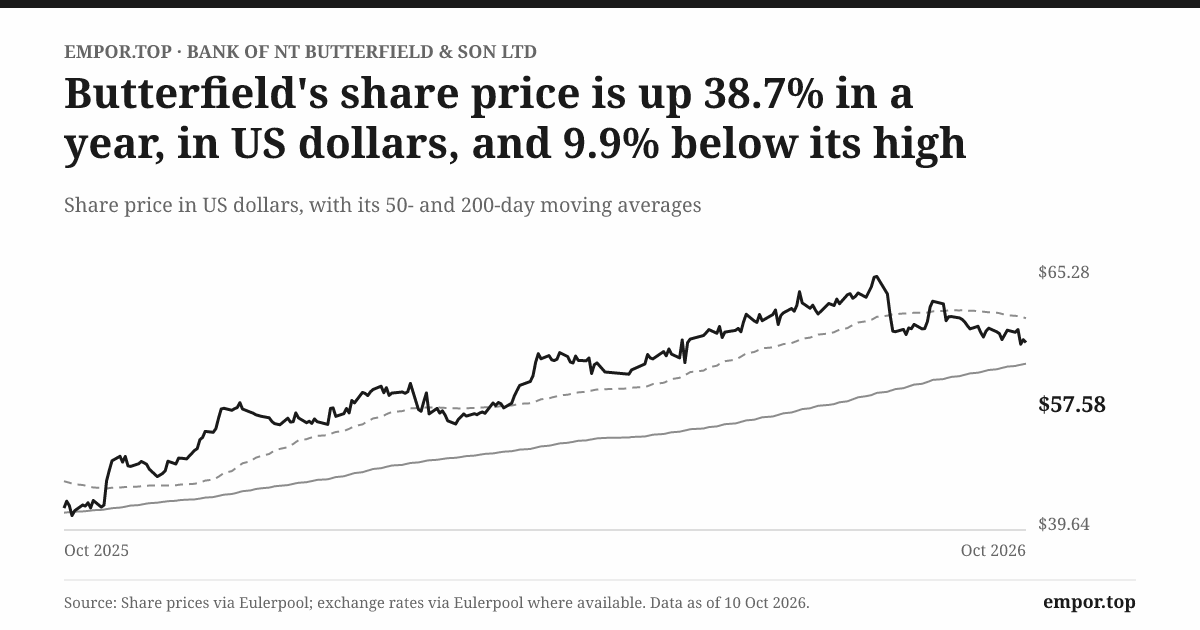
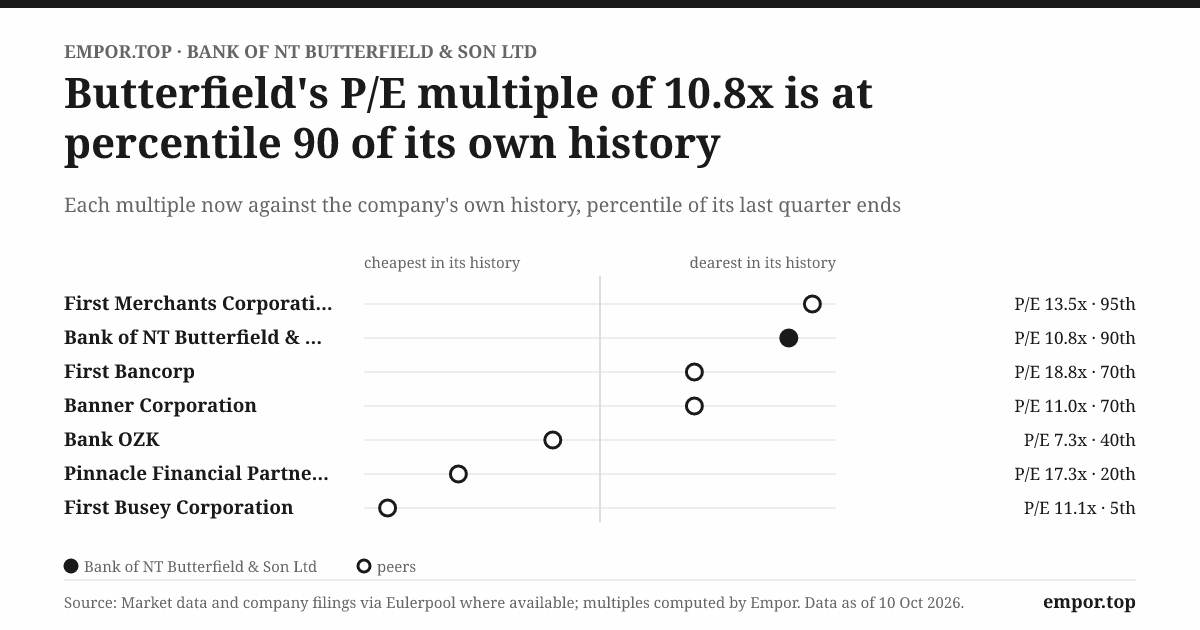
The market has noticed. On October 10, 2026, Butterfield's shares closed at about $57.58, giving the bank a market value of roughly $2.5bn and a price of about 10.8 times trailing earnings.1 That multiple sits well above the bank's own five-year median of about 7.8 times. Investors who once priced Butterfield like a cyclical island lender with a scar are now pricing it more like a durable franchise.
Three questions decide whether that re-rating is earned. The first is whether a return on equity in the high teens can survive the end of the rate cycle. Revenue peaked at about $816m in 2024 when policy rates were above 5%, and by the second quarter of 2026 quarterly revenue was running about a fifth below the year before.1[^3] The second is tax. Bermuda, for a century a zero-tax jurisdiction, passed a 15% corporate income tax in December 2023 for large multinational groups, and Butterfield sits uncomfortably close to the €750m revenue line that decides who pays.51 The third is capital return. The bank has retired roughly 28% of its share count since the IPO while paying a dividend that yields about 3.5% today.1 Can that pace continue now that the windfall is fading?
The short verdict, which the rest of this story will test, is that Butterfield is neither a conventional retail bank nor an offshore shadow lender. It is closer to a utility: the transactional plumbing and fiduciary vault for captive insurers, wealthy family trusts and two small island economies. Utilities are hard to dislodge. But this particular utility's earnings were inflated by the most aggressive monetary tightening in forty years, and the question now is how much of the 20% return belongs to the franchise and how much belonged to the Federal Reserve.
To answer that, the story has to go back to the docks of Hamilton, and to how a merchant's counting house became the place an entire island kept its money.
 Subscribe on LinkedIn
II. Bermuda's Merchant Ledger: From Salt Raking to Captive Capital (1858–2007)
Bermuda in the 1850s was a stopover, not a financial centre. It was a speck of coral nearly 650 miles off the Carolina coast, living on shipping, provisioning and trade between North America, the Caribbean and Britain. Merchants were the bankers by default. A trading house that bought cargo on credit, sold goods on commission and held bills from ships' captains was already doing most of what a bank does; it simply did not call itself one.
Nathaniel T. Butterfield ran such a house, and in 1858 his family formalised the banking side of the business.1 The logic was the logic of every merchant bank of the era. If you already hold other people's promissory notes and shipping credits, you might as well discount them, take deposits against them, and charge for the trouble. What began as a convenience for traders became the island's first formal commercial bank.
The decisive moment came in 1904, when the Bermuda legislature passed The N.T. Butterfield & Son Bank Act, giving the institution a perpetual corporate existence by special statute.1 It is worth pausing on what that means. Most banks are incorporated under a general companies law. Butterfield was written into Bermuda's statute book by name. Long before Bermuda had a modern central bank or a monetary authority, Butterfield was part of the legal furniture of the colony, the kind of institution that government, merchants and families used because there was no real alternative.
For most of the twentieth century, banking in Bermuda was effectively a two-horse race. Butterfield's lifelong rival was The Bank of Bermuda, which later became part of HSBC.1 Between them, the two banks held the island's government accounts, its payrolls, its merchant clearing and its home mortgages. A newcomer would have needed a licence, local deposits, a branch network and the trust of a small, tightly networked community, and the two incumbents had all four. The duopoly was less a conspiracy than a fact of geography: an island of some sixty thousand people does not need, and cannot support, many full-service banks.
What changed Bermuda, and Butterfield with it, was insurance. From the 1960s onward the island turned itself into a domicile for captive insurers, the in-house insurance companies that large corporations set up to insure their own risks, and later into one of the world's great reinsurance centres. A captive insurer is a peculiar customer. It is a legal entity with real money, premiums coming in and claims going out, but very few employees and almost no physical presence. What it needs most is a local bank account: somewhere to hold premiums, post collateral, pay claims and satisfy regulators that the money is really in Bermuda. Every new captive that chose Hamilton was, in effect, a new operating account looking for a home, and there were only two homes to choose from.
Butterfield also looked south. It expanded into the Cayman Islands and replicated the same two-sided model: community banking for a small island population on one side, and trust and fiduciary administration for international clients on the other.1 Cayman's offshore funds industry, like Bermuda's insurance industry, generated enormous volumes of cash that needed a regulated local bank. The pattern repeated decades later when the bank built a presence in Guernsey and Jersey, the British Crown Dependencies in the English Channel, where trust structures for wealthy families from Britain and beyond require local custodians.1
By the early 2000s, the shape of the franchise was clear. Butterfield's competitive advantage was not that it lent cleverly. It was that it sat at the narrow point of a funnel. Offshore business had to pass through a licensed local bank, and in Bermuda and Cayman the list of such banks was short. The cash that flowed through that funnel was cheap, because operating accounts for insurers and trusts are not shopping for yield, and it was abundant.
And that abundance was the problem. A bank that collects far more deposits than its small island economies can borrow has to put the surplus somewhere. Island mortgages and local business loans could absorb only a fraction. The rest went to the treasury desk, and in the mid-2000s treasury desks everywhere were being offered a seductive deal: highly rated American structured securities that paid a little more than Treasuries for what appeared to be very little extra risk.
Butterfield took that deal. The decision would come close to ending the bank's 150-year run, which is where the story turns from a merchant's ledger to a weekend of crisis on Hamilton Harbour.
III. The $550 Million Rescue on Hamilton Harbour (2008–2010)
The danger in a bank like Butterfield never came from the obvious place. Island homeowners kept paying their mortgages. Captive insurers kept their accounts open. The deposit base, the part of the bank that everyone assumed would be fragile, held. What broke was the part that was supposed to be boring: the securities book where the excess liquidity had been parked.
Through the mid-2000s, the bank's treasury had bought US mortgage-backed and other asset-backed securities, instruments that carried investment-grade ratings and paid a modest premium over government bonds.3 The logic sounded conservative at the time. These were not loans to speculative borrowers on Front Street; they were slices of diversified pools, rated by the agencies, bought from the biggest dealers in New York. What the logic missed was correlation. When US house prices fell nationally, the diversification inside those pools disappeared, ratings collapsed and the market for the securities simply stopped functioning. A security you can only sell at a fraction of its face value is a capital problem even if the underlying borrowers have not all defaulted yet.
As 2008 turned into 2009, the marks kept coming. Each quarter the bank recognised further losses and impairments on the portfolio, eating into the common equity that underpinned everything else.3 For an offshore bank, that kind of erosion is doubly dangerous. Its biggest depositors are sophisticated institutions with treasurers who read credit ratings for a living, and there is no deposit insurance fund standing behind most of their balances. The very depositors who are slow when the bank is healthy can become fast if they start to doubt it.
By early 2010 the board faced the choice every damaged bank eventually faces: raise a large amount of new equity quickly, on whatever terms the market will offer, or risk a slow loss of confidence that could become a fast one. In March 2010, the answer arrived. The Carlyle Group led a consortium that agreed to invest $550m of new equity in Butterfield, with Canadian Imperial Bank of Commerce alongside it as a major co-investor.3 The Bermuda Government's support for the bank's earlier preference-share capital, which the government had guaranteed, formed part of the backdrop to the rescue.
The price of survival was steep, and it fell on the people who had owned the bank for generations. New shares were issued at a price far below where Butterfield had traded before the crisis, which meant heavy dilution for the legacy shareholders, many of them Bermudian families and local investors who had treated the bank's stock as a near-riskless heirloom.3 Control passed, in practice, to the new investors, and the board was reshaped around them. The toxic assets were not wished away either. They were ring-fenced and worked down over the following years, so that the operating bank could be judged on its franchise rather than on its legacy portfolio.
It is worth stating plainly what this episode proves. The comfortable story about Butterfield, then and now, is that an island duopoly with sticky deposits is close to bulletproof. The crisis of 2008 to 2010 falsifies the strong version of that claim. A bank with a superb deposit franchise can still be brought to its knees by what it does with the money. The moat protects the liability side of the balance sheet; it does nothing to protect the asset side from bad judgment.
The bank's response is the single most important fact for understanding its modern balance sheet. After the rescue, Butterfield adopted what amounts to a zero-credit-risk doctrine for its treasury. Today, essentially the entire investment portfolio, about 99.8% of it, sits in US government and US federal agency securities, with the rest of the excess liquidity in cash and central bank or interbank placements.1 The treasury still takes interest-rate risk, as the next decade would show painfully, but it no longer takes meaningful credit risk.
That doctrine is a scar, and scars can be useful. The question for investors is whether it is permanent or whether, after enough good years, a future treasury committee will start reaching for yield again. Nothing in the bank's published portfolio since the rescue suggests it has, and the composition at the end of 2025 is about as plain as a bank's investment book can be. But the safeguard is a policy, not a law of nature, and it is the first thing a skeptic should check every year.
The new owners had not bought a bank to hold it forever. Carlyle's model was to clean, professionalise and sell. The next six years were about turning a wounded island institution into something a New York investor would buy.
IV. The Carlyle Cleanse and the Front Street IPO (2010–2016)
Private equity owners of banks tend to do the same three things, and Carlyle did all of them at Butterfield. They shrink the map, they cut the cost base, and they install a management team that can tell a clean story to public investors. The interesting part is not that Carlyle followed the playbook. It is which pieces of the old Butterfield it decided were worth keeping.
The map came first. Over the years after the rescue, Butterfield retreated from outposts that were sub-scale or outside its core, including operations in places such as Barbados and Hong Kong, and concentrated on jurisdictions where it had real market position and where the legal system rested on English common law: Bermuda, Cayman, and the Channel Islands, with supporting trust and private-client offices elsewhere.2 The reasoning was blunt. A small bank in a big market is a price-taker. A big bank in a small, protected market is a price-setter. Butterfield's value was in the second category, and every office in the first was diluting returns and adding compliance risk at a time when regulators were tightening the screws on offshore finance.
The second lever was cost, and here Butterfield made a choice that still shapes its economics. Rather than run middle- and back-office work out of Hamilton, where office space and housing are among the most expensive in the world, the bank built a service centre in Halifax, Nova Scotia.1 Halifax offered an English-speaking, well-educated workforce, a time zone that matches Bermuda's, and costs a fraction of the island's. Transaction processing, operations support and other functions moved north over time, while client-facing work stayed in the islands. That is why, years later, the bank could absorb acquisitions without its headcount ballooning.
The third lever was people. In 2015, Michael Collins took over as chief executive.1 Collins was a career banker with around four decades in the industry, including time at Morgan Guaranty and a stint as chief operating officer of HSBC's Bermuda operation, which means he had spent part of his career on the other side of the island duopoly.1 That background matters. Collins knew precisely what the rival franchise looked like from the inside, and he arrived with a mandate that was unusually clear: make the bank investable, take it public, and give Carlyle its exit. He later added the chairman's role in 2017, a combination that governance purists dislike and that the board has offset with a lead independent director.1
Alongside him, Michael Schrum served as group chief financial officer from 2015 to 2022, before becoming president.1 Schrum was the architect of the numbers that public investors would see, and his career would come full circle in September 2025, when he stepped back into the CFO role after his successor, Craig Bridgewater, left to pursue other opportunities.6 A bank that can call back the man who wrote its IPO prospectus has a certain continuity, though a skeptic would also note that the bench behind the top two is thinner than the length of their tenure suggests.
By 2016 the cleanup was far enough along to test the public market. The bank filed its registration statement in August and priced its offering at $23.50 a share in mid-September, raising about $140m of gross proceeds for the bank while giving its private-equity backers their first large block of liquidity.2 The listing came with a dual home: the New York Stock Exchange for global investors and the Bermuda Stock Exchange for local ones.10
The numbers that investors bought into were modest by today's standards. Revenue in 2016 was about $407m and net profit about $115m, a return on equity in the mid-teens.1 These were the earnings of a bank living in a world of near-zero interest rates, when its huge pile of cheap deposits earned almost nothing on the asset side. Investors were effectively buying an option on two things: that the franchise could grow fees, and that interest rates would one day normalise.
There was one more clean-up task. Butterfield redeemed its outstanding 8% perpetual preference shares in December 2016, removing the last expensive piece of crisis-era capital from the structure.1 From that point, the bank's capital stack was simple: common equity, a modest layer of subordinated debt, and deposits. Carlyle's sell-down continued after the IPO, and its exit was complete within roughly a year.1
What did the Carlyle years prove? They proved that the underlying franchise was worth rescuing, because a public market was willing to pay for it barely six years after the bank nearly failed. They also set the template for what followed: a lean cost base, a narrow geographic focus, and a management team that saw its job as allocating a steady stream of excess capital rather than growing a balance sheet at any price. The question was what to do with that capital. The answer, it turned out, would come from the troubles of Europe's biggest banks.
V. The Offshore Rollup: Buying Deutsche, ABN AMRO, and Credit Suisse Trust (2016–2023)
By the late 2010s the economics of offshore private banking had turned against the giants. American tax rules that forced foreign banks to report on US clients, the global common reporting standard for tax information, and ever-heavier anti-money-laundering obligations had changed the arithmetic of a small branch in Guernsey or Jersey. For a global bank headquartered in Frankfurt or Amsterdam, a Channel Islands operation with a few billion in deposits was a rounding error in revenue and a disproportionate source of compliance cost and headline risk. The sensible thing was to sell. The question was to whom.
Butterfield's pitch was that it was the natural buyer. It already ran regulated banks in the right jurisdictions, it already had trust licences and compliance teams that understood offshore structures, and it could fold acquired clients onto existing platforms and push the processing to Halifax. Unlike a private-equity buyer, it would not need to build a bank from scratch. Unlike a big bank, it actually wanted the business.
The first move came at home. Around the time of the IPO, Butterfield took over HSBC's Bermuda private banking and trust relationships, pulling a block of wealthy-client deposits directly into Hamilton from the rival across the street.1 It was a small deal in the scheme of things, but symbolically important: one half of the old duopoly was handing high-touch clients to the other.
Then came the Channel Islands. In 2018 Butterfield completed the acquisition of Deutsche Bank's banking business in the Channel Islands, giving it scale in Guernsey and Jersey.[^13] A year later, in 2019, it completed the purchase of ABN AMRO's Channel Islands operations, which roughly doubled its presence in the Crown Dependencies.[^12] Both deals followed the same template. Butterfield was buying client relationships and the deposits that came with them, not a pile of risky loans, and it was buying from sellers whose priority was a clean, quick, regulator-approved exit rather than the last dollar of price.
The last of the four came out of one of the great banking collapses of the decade. When Credit Suisse fell into the arms of UBS in 2023, its far-flung trust businesses became orphans. Butterfield completed the purchase of Credit Suisse trust assets across several jurisdictions, including Guernsey, Singapore and The Bahamas, in 2023.[^11] Trust administration is a sleepy, sticky business: families who have set up multi-generational structures rarely move them, because doing so involves lawyers, tax advisers and sometimes court approval. For the buyer, that stickiness is the whole point.
Did the roll-up work? The cleanest test is in two numbers. The first is fees. Non-interest income, which includes trust, banking services, foreign exchange, asset management and custody fees, rose to about $243m in 2025, up from about $212m two years earlier.1 That is now roughly 40% of the bank's net revenue, and it is the part of the business least exposed to the rate cycle. The second is people. The bank ended 2023 with about 1,334 full-time-equivalent staff and ended 2025 with about 1,315.1 Fees went up; headcount went slightly down. Whatever the deals added, they did not add a bloated organisation.
There is a worthwhile skeptical check here, because roll-ups have a long and unhappy history in financial services. Acquirers overpay, book large amounts of goodwill and then write it off when the acquired business turns out to be worth less than hoped. Butterfield's record on that front is clean as far as its annual reports go: the 2025 20-F identifies only one critical audit matter, the measurement of loan-loss allowances, and nothing tied to acquisition accounting or goodwill.1 That is consistent with deals done at modest premiums for deposits and fee books rather than for growth stories. It is not proof that every deal created value, because the bank does not publish deal-by-deal returns, but it rules out the most common way roll-ups destroy capital.
The more honest limitation is scale. Four deals over seven years added meaningful fee income, but the Channel Islands and the trust businesses remain smaller and less dominant than the Bermuda and Cayman franchises. In the islands Butterfield is a price-setter; in Guernsey, Jersey and the wider trust world it is one capable competitor among several. The deals widened the franchise more than they deepened its moat.
And notice what the roll-up did not change: the core of the bank was still its deposits, and the deposit base was still overwhelmingly uninsured. In March 2023, just as the Credit Suisse deal was coming together, that fact suddenly looked like the most important thing about Butterfield. It is time to open the vault and look at why the money does not leave.
VI. Anatomy of a Moat: Why 96% Uninsured Deposits Never Leave (The Operating Model & Moat Analysis)
In the second week of March 2023, the American banking system relearned an old lesson in a new way. Silicon Valley Bank lost tens of billions of dollars of deposits in a day, driven by venture-backed start-ups whose treasurers could move money from their phones and whose balances far exceeded the federal insurance limit. Signature Bank followed. For a few days, any bank with a large share of uninsured deposits was presumed guilty until proven innocent.
By that measure, Butterfield should have been near the top of everyone's worry list. Its deposits were essentially all uninsured. Instead, the bank's deposit base barely moved through the turmoil, and two years later, at the end of 2025, deposits stood at about $12.7bn, almost exactly where they had been a year earlier.14 To understand why, it helps to stop thinking of these deposits as savings and start thinking of them as plumbing.
Start with who the depositors are. Roughly a third of the money sits in Bermuda, about $4.2bn, and a similar amount in Cayman, about $4.1bn.1 Much of this is operating cash for captive insurers, reinsurers, funds, local governments, island businesses and households: premium receipts waiting to be invested or paid out as claims, collateral posted for regulators, payroll accounts, the daily float of two small economies. The remaining $3.9bn or so sits in the Channel Islands and the UK, where a large share is held for trust structures and private clients.1 About 69% of all deposits are demand accounts, money that has to be available immediately because it is being used.1
Now consider why that money does not run. A start-up treasurer in 2023 could move cash from one American bank to another in an afternoon, and there were thousands of banks to choose from. A captive insurer domiciled in Bermuda has very few local banks that can hold its regulated accounts, and moving them is not a click. It means new account documentation, new know-your-customer checks, possibly new regulatory approvals, and new arrangements with every counterparty that pays into or out of the account. A family trust in Guernsey whose trustee is a Butterfield entity cannot simply pull its money; changing trustees is a legal process. The deposits are sticky not because the customers are loyal but because leaving is expensive, slow and, in many cases, legally complex.
There is also a widely held belief that should be corrected. Many investors assume offshore depositors are somehow protected by the system. They are not. Cayman has no statutory deposit insurance scheme at all. Bermuda's scheme covers only small qualifying balances, up to about BMD 25,000. Guernsey and Jersey protect up to £50,000 per depositor, with an aggregate cap on what the scheme can pay out in total.1 A company holding $50m in a Butterfield account knows perfectly well that it is taking the bank's own credit risk. That knowledge disciplines the depositor, but it also disciplines the bank, which is part of why Butterfield runs its balance sheet with such conservatism.
Where the money goes
The other half of the moat is what Butterfield does with those deposits, and the answer is: as little as possible that could go wrong. The loan book was about $4.4bn at the end of 2025, roughly a third of deposits.1 Around 70% of it, about $3.1bn, is residential mortgages in Bermuda, Cayman and prime central London, written at an average loan-to-value below 50%.1 In plain terms, the typical borrower owes less than half of what the home is worth, which means house prices would have to fall by more than half before the bank lost money on an average loan.
The credit record matches the underwriting. Some 95% of loans are graded "pass." Non-accrual loans, the ones where the bank has stopped booking interest, were about $91m, or roughly 2% of the book, a level that has barely moved in two years and that is mostly residential mortgages with ample collateral.1 The provision for credit losses was about $0.2m in 2025, after $1.7m in 2024; for a bank of this size, those numbers are almost a rounding error.1 A fair caveat is that a 2% non-accrual ratio is not trivially low, and the allowance covers only about 28% of those loans; the bank is relying on collateral rather than reserves.1 Island property markets are illiquid, and foreclosing on a family home in a community of sixty thousand people is slow and politically fraught. The losses have stayed small, but the recovery process is not quick.
The rest of the deposits go into cash and the treasury book: about $2.7bn of cash and about $5.7bn of securities at the end of 2025, almost all of it US government and agency paper.1 That brings the story back to the doctrine born in 2010. Butterfield's assets, outside a conservative mortgage book, are essentially the US Treasury market and the overnight money markets.
The fee annuity
Finally there is the fee engine, which is what makes Butterfield more than a deposit-gatherer. Of about $243m in non-interest income in 2025, banking services such as card interchange and account fees contributed about $67m, and trust administration about $66m.1 Foreign exchange, entirely client-driven with no proprietary trading desk, added about $53m, and asset management about $39m.1 These are small cheques, charged repeatedly to clients who are already captive to the bank's plumbing. A family trust pays its trustee every year whether interest rates are at zero or at five percent.
Put the pieces together and the operating model becomes clear. Cheap, sticky operating deposits fund a small, ultra-safe mortgage book and a large pile of government securities, while a recurring fee stream sits on top. Operating profit was about 30% of revenue in 2025.1 The engine is safe, but it has one great weakness: most of its interest income comes from short-term rates that Butterfield does not control. Between 2022 and 2026, that weakness was about to deliver both the bank's greatest boom and its most uncomfortable hangover.
VII. The Rate Spike Windfall, the Bond Loss Trap, and the Rate Cut Squeeze (2022–2026)
Imagine owning a toll road where the toll is set not by you but by a committee in Washington. For a decade the committee sets it at almost nothing. Then, over about eighteen months, it raises the toll to more than five dollars. Traffic on your road does not change at all. Your profits explode. That, in simplified form, is what happened to Butterfield between 2022 and 2024.
The mechanism is called asset sensitivity. Butterfield's liabilities are dominated by operating deposits, and a large slice of them, averaging about $2.6bn, pays no interest whatsoever.1 Even the interest-bearing deposits reprice slowly, because the customers are not shopping for yield. On the asset side, however, cash placements, short-dated securities and floating-rate loans reprice quickly when central banks move. So when the Federal Reserve and the Bank of England lifted rates from near zero to above 5%, Butterfield's asset yields climbed almost one-for-one while its funding costs crept up only partially. The difference dropped straight to profit.
The results were dramatic on the top line. Revenue went from about $521m in 2021 to about $816m in 2024.14 Earnings per share reached about $4.97 in 2024 and about $5.60 in 2025.1 It is worth being precise about what grew, though. The loan book did not boom; in fact it shrank slightly. Deposits did not boom either. The bank's revenue grew because the price of money changed, not because Butterfield sold much more of anything.
The bond trap that never sprang
The same rate shock that inflated revenue had a darker side, and it was the side that killed Silicon Valley Bank. When interest rates rise, the market value of existing fixed-rate bonds falls. Butterfield held a portfolio of roughly $5.7bn in US Treasuries and agency securities, much of it bought when yields were low.1 As yields soared, the paper losses on that portfolio swelled. By the end of 2024, the combined unrealised losses across the available-for-sale and held-to-maturity books were about $733m, a figure in the same neighbourhood as a large share of the bank's entire shareholders' equity.14
A short explanation of the accounting helps here. Securities labelled "available for sale" are marked to market, and the losses flow through a part of shareholders' equity called accumulated other comprehensive income, without hitting the income statement. Securities labelled "held to maturity" are carried at cost, on the theory that the bank will hold them until they repay at face value, so their paper losses mostly do not appear in equity at all, except for a residue from bonds that were moved between the two categories. At the end of 2025, the AFS losses sitting in equity were about $88m and the leftover HTM transfer losses about $66m.1 The rest of the unrealised loss was invisible on the balance sheet but very real economically: if the bank had been forced to sell, it would have crystallised it.
That is exactly what happened to SVB. Its depositors ran, it had to sell bonds at a loss to pay them, and the realised losses wiped out its capital. Why did the same arithmetic not sink Butterfield? Three reasons, in order of importance. Its depositors did not run. It held a very large cash pile, about $2.7bn at the end of 2025 and much more in earlier years, so it would not have had to sell bonds to meet ordinary outflows.1 And its regulatory capital was enormous relative to its risk-weighted assets, with a common equity tier one ratio of about 27.6% at the end of 2025 against a regulatory minimum of about 10.3%.1 A bank with that much cushion and no run can afford to wait for its bonds to mature.
And wait it did. As long-term Treasury yields eased in 2025, the unrealised losses narrowed by about $218m to roughly $515m.1 Book value per share rose to about $26.39.1 This "pull to par" is mechanical: as each bond approaches its maturity date, its price converges on its face value, regardless of what the market does. It is a slow, predictable tailwind to tangible book value that the bank will enjoy for years, which is part of what investors are paying for today.
The hangover arrives
The toll committee, however, eventually cuts the toll. As central banks eased through 2025 and into 2026, the asset sensitivity that had lifted Butterfield began to work in reverse. The loan book's effective yield fell from about 6.3% in 2024 to about 5.8% in 2025, and the yield on cash and short-term placements fell faster.1 Deposit costs fell too, by about a third of a percentage point to roughly 1.5%, but there is a floor: you cannot pay less than zero on a deposit that already pays nothing.1
The full force showed up in 2026. In the second quarter, revenue was about $159m, down nearly 20% from about $198m a year earlier, and net profit fell about 13% to roughly $46m.[^3] The decline in profit was smaller than the decline in revenue because expenses are being held flat and the share count keeps shrinking, but the direction is unmistakable. On a trailing basis, revenue had slipped to about $717m.1
What does this episode say about the business? It says that the leap in Butterfield's revenue from 2021 to 2024 was overwhelmingly a gift of monetary policy, and that a large part of it is being handed back. It does not say the franchise is weakening: deposits, fees and credit quality held steady through both the boom and the reversal. The fair conclusion is narrower than either the bulls or the bears tend to state. The franchise is durable; the peak earnings were not. The single number to watch is net interest income per quarter, and where it bottoms out once central banks stop cutting.
There is, however, an odd twist in the falling-revenue story. The same slowdown that is pinching profits may be shielding the bank from a far more permanent threat, one that arrived not from Washington but from Bermuda's own House of Assembly.
VIII. The €750 Million Threshold and the Bermuda Tax Gamble (2024–2026)
On December 27, 2023, Bermuda did something that would have been unthinkable a generation earlier. Its legislature passed the Corporate Income Tax Act 2023, introducing a 15% tax on the profits of large multinational groups operating on the island, effective from January 1, 2025.5 For a jurisdiction whose entire modern economy had been built on the absence of corporate income tax, this was a historic retreat.
The reason was the OECD's Pillar Two framework, the global agreement to impose a minimum effective tax rate of 15% on large multinationals. Under its rules, if Bermuda did not tax its large resident companies, other countries could collect a "top-up" tax on Bermuda profits instead. Bermuda's choice was not between taxing and not taxing; it was between collecting the money itself or letting London, Washington or Brussels collect it. It chose to collect it.
For Butterfield, the law contained a precise and slightly absurd trigger. The tax applies to multinational groups whose consolidated revenue exceeds €750m in at least two of the four preceding fiscal years.51 Butterfield's revenue, converted into euros, has hovered right around that line. According to the bank's own disclosure, its revenue exceeded €750m in only one fiscal year among those that counted for 2025, namely 2025 itself, and fell short in 2022, 2023 and 2024.1 As a result, the bank was not in scope for the Bermuda tax in 2025, recognised no Bermuda corporate income tax, and reported a group effective tax rate of about 2.5%, generated entirely by its operations in the Channel Islands, the UK and Canada.1
How much is at stake? The Bermuda segment earned about $65m before tax in 2025.1 A 15% tax on that would cost roughly $10m a year. Against group net profit of about $232m, that is a hit of roughly 4% to 5% of earnings, and it would trim return on equity by something like a percentage point.1 The way the law is applied to the bank's Bermuda profits, including any credits or adjustments, could make the actual number differ, and the bank has not published its own estimate of the steady-state burden. But the order of magnitude is clear: meaningful, not existential.
Here is the irony. Butterfield crossed the €750m line in 2025 because its revenue was riding the high-rate wave. With revenue now falling sharply, and trailing twelve-month revenue around $717m, the euro-converted figure is drifting back below the threshold.1 If revenue stays below €750m in 2026, the bank will still have exceeded the line in only one of the relevant four years, and it will remain outside the tax for another year. Falling interest rates, in other words, are cutting Butterfield's profits and simultaneously protecting them.
This is a genuinely unusual position for a bank to be in, and it creates some odd incentives. Revenue growth above a certain point now carries a hidden tax cost. A large acquisition that pushed revenue sustainably above €750m would bring the whole Bermuda franchise into the tax net. Exchange rates matter too: because the threshold is in euros and the bank reports in dollars, a weaker dollar makes the same dollar revenue look bigger in euro terms. None of these dynamics is visible in the headline earnings, but all of them are real.
The honest verdict is that the tax is a postponed risk, not an avoided one. Over a full interest-rate cycle, Butterfield's revenue will probably cross €750m again in some years, and two such years in any four-year window will be enough. Investors should think of today's sub-3% tax rate as a feature of the current point in the cycle rather than a permanent attribute of the business. The settling disclosure will come in the 2026 annual report, which will state whether the group crossed the threshold a second time.
That leaves the largest question of all. Strip away the rate cycle and the tax shield, and what kind of business is left? Is this a fortress with real economic moats, or an over-earning island franchise whose stock price is assuming too much? It is time to put the case on trial.
IX. Frameworks, Moats & The Skeptical Investor Stress Test
Picture the analyst question that comes up on almost every Butterfield earnings call in some form. The bank has just redeemed its subordinated debt; it is buying back stock aggressively; net interest income is falling. How long can it keep sending nearly all of its profits back to shareholders before something has to give? It is the right question, because it forces the bull and bear cases into the same room.
Start with what the bank actually did. In June 2025, Butterfield called and redeemed in full its $100m of 5.25% subordinated notes, which had been issued in 2020.1 Total borrowings fell from about $191m to about $39m, and what remains is mostly lease obligations and some collateralised financing.1 Debt to equity dropped to about 0.03. For a bank, of course, deposits are the real liability, so "debt-free" needs that caveat; but in terms of wholesale funding and capital instruments, Butterfield is about as unlevered as a bank gets. Its common equity tier one ratio of about 27.6% is nearly three times its regulatory minimum.1
The rating agencies have taken notice. Moody's upgraded the bank's long-term issuer rating to A2 from A3 in December 2025.8 KBRA affirmed its A+ senior rating in October 2025, and S&P rates it BBB+.91 The agencies consistently cite the same strengths—dominant local market shares, low-cost deposit funding and very low credit losses—and the same constraints: island concentration, reliance on uninsured deposits and interest-rate sensitivity.1
Powers and forces
Run Butterfield through Hamilton Helmer's 7 Powers, and two stand out. The first is a cornered resource, in the form of banking licences and established positions in Bermuda and Cayman. Regulators in both jurisdictions guard their banking systems tightly, and the economics of a small island do not reward a new full-service entrant. In Bermuda the market is effectively a duopoly with HSBC; in Cayman it is an oligopoly with a handful of competitors including CIBC's Caribbean bank and Cayman National.1 The second power is switching costs: captive insurers and trusts cannot easily move their operational banking. Scale economies are a moderate third, mainly through the Halifax centre spreading compliance and technology costs across jurisdictions. The other powers—network effects, counter-positioning, process power and brand in Helmer's strict sense—are weak or absent. This is a traditional bank running traditional rails very well.
How would one falsify those powers? The cornered resource would erode if a large global bank or a well-capitalised newcomer entered Bermuda or Cayman with a full-service offering, or if regulators deliberately opened the market. There is no sign of that in the bank's disclosures, and the more realistic trend has been the opposite: global banks retreating from small offshore markets. Switching costs would erode if deposits started leaving in calm conditions or if deposit costs had to rise sharply to retain balances. The evidence of 2022 to 2025 points the other way: deposits were stable and the average cost of deposits peaked far below policy rates before falling to about 1.5%.1 So the powers survive the test, but with a precise scope: they are local and transactional. They do not extend to the Channel Islands trust businesses, where Butterfield competes on more ordinary terms.
Porter's five forces tell a consistent story. The threat of new entrants is negligible in the islands for the licensing and scale reasons above. Depositors, the bank's suppliers of funds, have little bargaining power, because their alternatives are few and their cash is operational. Borrowers have limited power, because island mortgage markets have few lenders. Substitutes are a low-to-moderate threat: fintechs can offer payments and cards, but they cannot easily provide regulated custody for an offshore trust or the local clearing an island government relies on. Rivalry is benign, the gentlemanly competition of a duopoly rather than a price war.
The case for and against
The bull case is straightforward. A bank with a fortress capital ratio, almost no wholesale debt and a fee stream worth about 40% of revenue can absorb falling rates better than almost any peer. The bond portfolio will keep pulling to par, steadily lifting tangible book value. And the buybacks are relentless. The bank retired about 3.1m shares in 2023, about 4.5m in 2024 and about 3.5m in 2025, spending roughly $147m in 2025 alone at an average price around $41.59.1 Shares outstanding fell to about 40m by February 2026, from roughly 56m after the IPO.1 On top of that came dividends of about $78m in 2025, and the board has authorised up to 3.0m more shares through the end of 2026.1
The bear case is just as clear. Revenue is falling fast, by nearly a fifth year on year in the second quarter of 2026.[^3] The stock trades at about 10.8 times trailing earnings against a five-year median of about 7.8, and at about twice book value.1 In other words, investors are paying a premium multiple on earnings that are, by the bank's own trajectory, past their peak. The Bermuda tax could clip returns in future years. And the deposit base, however sticky, is exposed to a risk no balance-sheet ratio captures: a global regulatory or political shock to offshore finance itself.
An activist looking at Butterfield would likely press on three points. The first is the payout. Total buybacks and dividends in 2025 added up to more than 95% of net income, which is sustainable only while the capital ratio is far above requirements and the bond losses keep unwinding.1 As the cushion is drawn down, the pace must slow toward organic capital generation, and organic capital generation is falling with net interest income. The second is governance. Collins has combined the chairman and chief executive roles since 2017, and the 2025 leadership reshuffle, with a new chief risk officer, an interim general counsel and the president doubling as CFO, concentrates a lot of authority in a small group.61 Shareholders re-elected all director nominees with strong support at the 2025 meeting, so there is no visible revolt, but concentration is a risk in itself.7 The third is pay: directors and senior management received about $33m in 2025, around 14% of net income, a meaningful share for a bank of this size.1 On the other side of the ledger, related-party lending is tiny and fully performing, and the bank's historical US cross-border tax inquiry ended when a non-prosecution agreement with the Department of Justice concluded in 2024.1
Weighing it all, the verdict is that the moat is real but narrower than the stock price may imply. Butterfield owns a durable, low-cost funding franchise in two small markets and a decent fee business layered on top. What it does not own is control over the price of money, and the current valuation leans on earnings that were partly borrowed from the rate cycle. Two KPIs will tell investors which reading is right. The first is quarterly net interest income, and where it stabilises once easing ends. The second is total deposits, now about $12.7bn, which should stay anchored if the switching-cost thesis holds.1 Those two numbers, more than any narrative, will decide whether the premium survives.
X. Playbook: Business & Investing Lessons
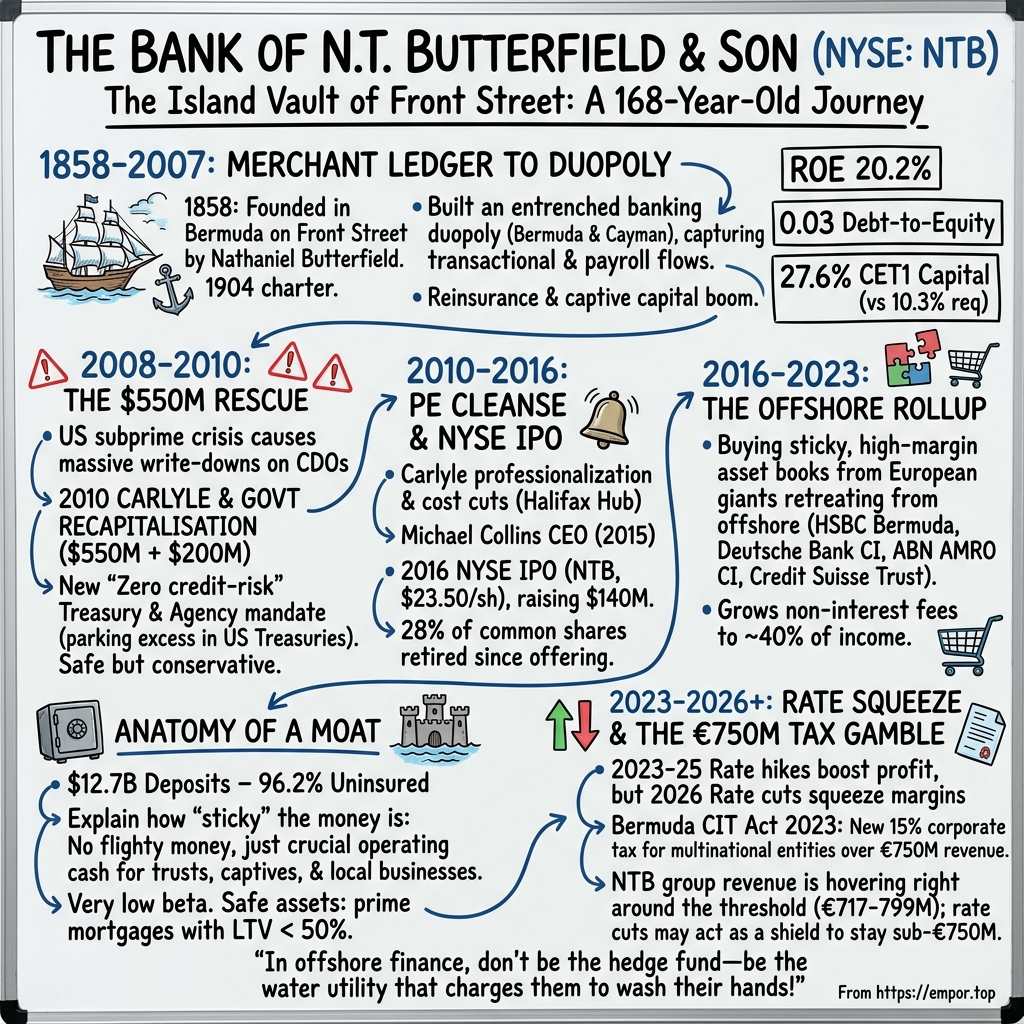
The first lesson is that, in offshore finance, the money is in the plumbing rather than the speculation. Butterfield's roughly 20% return on equity does not come from clever lending or from exotic trading. It comes from clearing an island's payrolls, collecting card interchange and holding operating cash for insurers and trusts that cannot easily go anywhere else. Every founder who dreams of a high-return financial business should study what Butterfield does not do as carefully as what it does. In offshore finance, don't be the hedge fund; be the water utility that charges them to wash their hands.
The second lesson comes from that weekend in 2010 when Carlyle's money arrived. Butterfield's near-death experience was not caused by its deposit franchise or its island borrowers but by a treasury desk that reached for yield. The bank's answer, a portfolio of almost nothing but US government and agency paper, is the reason it could sit through the 2023 panic while banks with similar paper losses failed. The general lesson for investors is that a company's past crises are not just risks; they are often the source of its most durable discipline. A near-death experience in your youth is the cheapest insurance policy against a fatal crisis in your prime, but only for as long as the people who remember it are still in the room.
The third lesson is about the difference between skill and weather. When policy rates went from almost zero to more than 5%, Butterfield's revenue leapt by more than half without any matching growth in its loans or deposits. When rates came down, quarterly revenue fell by nearly a fifth, and no amount of cost discipline in Halifax could stop it. Investors who extrapolated the peak, and managers who claimed credit for it, would both have been wrong. The general lesson is to separate what a business earns from what its environment hands it. You cannot confuse the tide of global monetary policy with your own managerial genius.
The fourth lesson is about geography and the denominator. An island bank cannot grow its home market much faster than its island grows. Butterfield's answer has been to treat capital return as its main compounding engine, retiring more than a quarter of its shares since the IPO. That has worked brilliantly while rates were high and capital was abundant. It will be harder now. But the principle is sound for any business whose natural market is finite: if your geography has natural limits, shrink the denominator, and judge management by the price it pays to do so.
The fifth lesson comes from the European banks that sold out of Guernsey, Jersey and the wider trust world. For Deutsche Bank, ABN AMRO and Credit Suisse, those businesses were compliance headaches attached to small revenue lines. For Butterfield, they were sticky deposits and fee annuities that fitted neatly onto existing platforms. The best acquisitions often come from sellers who need to leave more than they need the price. One mega-bank's compliance headache is an island vault's annuity.
XI. Epilogue: The Next Rate Cut and the Front Street Horizon
Tonight Butterfield stands at an awkward moment. The boom years are clearly over; the trough is not yet in sight. The second quarter of 2026 showed revenue down nearly 20% from a year earlier, yet the bank was still earning a return on equity around 20% over the trailing twelve months, still sitting on a capital ratio almost three times its regulatory floor and still buying back its own shares.[^3]1 The share price, about 10% below its 52-week high, reflects a market that believes in the franchise but is beginning to price in the hangover.1
Over the next twelve to twenty-four months, four moments will decide which way the story turns. The first is the shape of the net interest income trough. If central banks stop cutting soon and Butterfield's quarterly revenue stabilises not far below the $155m to $160m range of early 2026, the bank will have proved that its through-the-cycle earning power is materially higher than before the hiking cycle, thanks to a bigger fee base and a smaller share count. If cuts go deeper and revenue slides well below that, the 20% return will start to look like a period piece.[^3]
The second moment is the 2026 annual report, likely to be filed in early 2027. It will state whether the group's revenue, converted into euros, crossed €750m for a second time. A "no" would keep the Bermuda tax at bay for at least another year; a "yes" would bring a roughly $10m annual tax charge into view and reset the effective tax rate permanently higher.51
The third moment is the end of the current buyback authorisation in December 2026. Whether management uses the full 3.0m shares, and how large a new programme it announces, will show how it balances shrinking earnings against a still-towering capital cushion.1 A smaller programme would be prudent; it would also remove one of the main supports for per-share growth.
The fourth, quieter test is deposits. Every quarter, the Bermuda and Cayman deposit figures are a referendum on the switching-cost thesis. As long as total deposits stay anchored around $12bn or above, the plumbing is intact.1 If they start to drift in calm markets, something deeper is changing in offshore finance.
None of these outcomes is in Butterfield's control alone. That is the tension at the heart of the bank tonight: it owns one of the most protected franchises in banking, and yet the variables that matter most over the next two years, interest rates, a tax threshold denominated in someone else's currency and the mood of global regulators towards offshore centres, are set far from Front Street.
XII. Outro: The Last Sovereign Island Vault
Walk down Front Street on an October afternoon and the picture is almost unchanged from a postcard of decades ago: the pastel facades, the yachts riding at their moorings in Hamilton Harbour, the cashiers inside the Butterfield head office clearing payments for an island that has done its banking in this building, in one form or another, for most of its modern history. Nathaniel Butterfield's merchant house discounted shipping bills here in 1858.1 Its successor nearly drowned in American mortgage securities a century and a half later, was pulled out by a $550m lifeline, and rang the opening bell in New York six years after that.32
What carried it through was never brilliance at lending or trading. It was the simple fact that global commerce, for all its algorithms and trillion-dollar balance sheets, still needs a few small places governed by English common law where money can be held safely, and someone in those places has to keep the keys. For 168 years, on a coral island in the middle of the Atlantic, that someone has been Butterfield. The rate cycle will come and go, and the tax man has finally arrived; the vault, so far, is still the only one on the street that most of the island trusts.
References
-
Form 20-F Annual Report for the Fiscal Year Ended December 31, 2025 — The Bank of N.T. Butterfield & Son Limited, SEC EDGAR, 2026-02-18 ↩↩↩↩↩↩↩↩↩↩↩↩↩↩↩↩↩↩↩↩↩↩↩↩↩↩↩↩↩↩↩↩↩↩↩↩↩↩↩↩↩↩↩↩↩↩↩↩↩↩↩↩↩↩↩↩↩↩↩↩↩↩↩↩↩↩↩↩↩↩↩↩↩↩↩↩↩↩↩↩↩↩
-
Form 424B4 Prospectus for Initial Public Offering — The Bank of N.T. Butterfield & Son Limited, SEC EDGAR, 2016-09-16 ↩↩↩↩↩
-
Carlyle Leads $550 Million Recapitalization of Bank of Butterfield — The Carlyle Group Press Release, 2010-03-02 ↩↩↩↩↩↩
-
Form 20-F Annual Report for the Fiscal Year Ended December 31, 2024 — The Bank of N.T. Butterfield & Son Limited, SEC EDGAR, 2025-02-19 ↩↩↩
-
Bermuda Corporate Income Tax Act 2023 — Government of Bermuda, 2023-12-27 ↩↩↩↩
-
Form 6-K Senior Leadership Appointments Press Release — The Bank of N.T. Butterfield & Son Limited, SEC EDGAR, 2025-09-02 ↩↩
-
Form 6-K 2025 Annual General Meeting Results — The Bank of N.T. Butterfield & Son Limited, SEC EDGAR, 2025-05-09 ↩
-
Moody's Upgrades Bank of N.T. Butterfield & Son Limited to A2 from A3 — Moody's Investors Service, 2025-12-15 ↩
-
KBRA Affirms Senior Ratings of The Bank of N.T. Butterfield & Son Limited at A+ — Kroll Bond Rating Agency, 2025-10-24 ↩
-
The Bank of N.T. Butterfield & Son Limited Profile & Disclosures — Bermuda Stock Exchange (BSX), 2026-10-10 ↩
 LinkedIn
 WhatsApp
 Reddit
 Hacker News
 Email
Email Kindle
 RSS Feed
 Spotify
 Apple Podcasts
 Amazon Music
 Audible
 YouTube