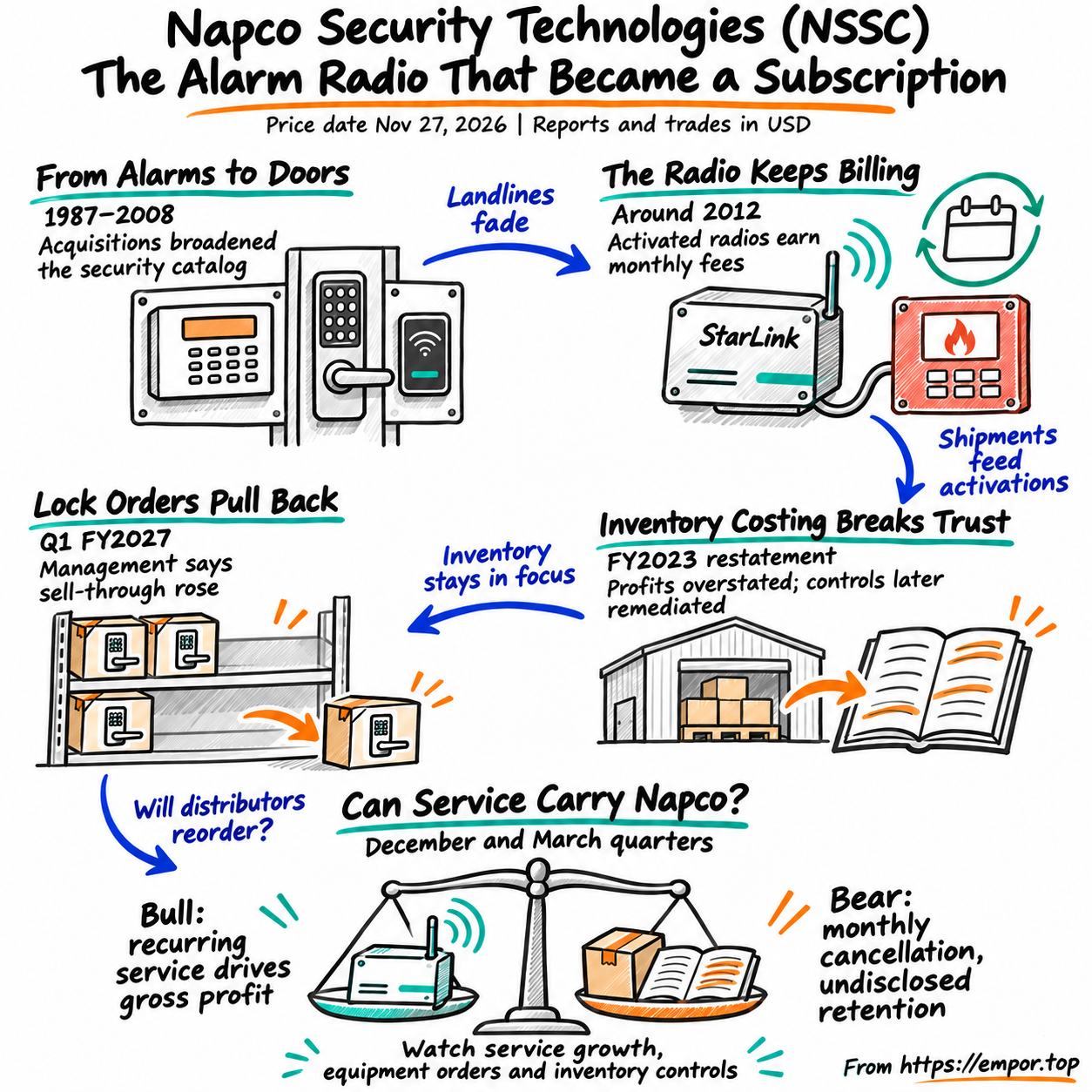
Napco Security Technologies: The Alarm Radio That Became a Subscription
I. One Box, Two Businesses
The orders came in October, a few days too late to count.
On November 2, 2026, Napco Security Technologies reported the first quarter of its 2027 fiscal year, the three months that ended on September 30.1 For most of the quarter, two of the distributors that carry Napco's locks had been buying less than they had a year earlier. Then, just after the books closed, one of them began ordering again.2
On the earnings call that afternoon, management told analysts that the slowdown was not what it looked like: the distributors' sales to their own customers, the installers and contractors who actually put Napco hardware on doors, had gone up year over year, the company said. What had gone down, management said, was the distributors' appetite to hold Napco inventory on their shelves.2
That distinction, between what a distributor buys and what a distributor sells, is the kind of thing that sounds like an excuse when a company says it and sounds like wisdom when it turns out to be true. Napco's investors had heard versions of it before. They would have to decide, again, which this one was.
The headline numbers were unremarkable on their face. Revenue rose 1.7% to about $50 million.1 But inside that small number were two businesses moving in opposite directions. Service revenue, the monthly fees Napco charges for connecting alarm systems to cellular networks and the cloud, rose 11.5% to $26.1 million, a record.1 Equipment revenue, the alarm panels, locks, access-control readers and radios Napco manufactures and ships, fell 7.3%.1 For the quarter, the subscription was bigger than the hardware.
That one quarter is the whole Napco story in miniature. Here is a small manufacturer on Long Island, a company that has been public for more than half a century, which spent most of its life selling boxes.3 Somewhere along the way, one of those boxes, a cellular alarm communicator, started earning money every month after it was installed.
That stream has grown into the most profitable thing the company does. And yet the boxes still matter, because every subscription begins with a sale, and the sales still run through distributors whose ordering habits can swing a quarter.
So the question that hangs over Napco is simple to state and hard to answer. Can recurring service keep carrying the company when hardware orders soften? And how much of the growth investors see is real end demand, rather than inventory moving from Napco's warehouse to someone else's?
Three other questions sit behind that one, and they give this story its tension. The first is trust. Napco restated results after discovering that its inventory accounting had overstated how much its stock was worth, which meant it had overstated its profits.
That episode produced an adverse auditor opinion on its internal controls, a securities class action and a settlement that drained cash in the very quarter that management was celebrating record service revenue.45 A company that asks investors to believe a story about sell-through has to be believed about its inventory first.
The second is leadership. In July 2026, Kevin Buchel, who joined Napco in 1995 and spent three decades in its operations and finance roles, became chief executive.6 Richard Soloway, who had run the company as CEO for 28 years, did not leave. He became Executive Chairman.6 Whether that arrangement is a smooth handoff or a two-key system will shape how the company makes decisions for the next several years.
The third is money. Napco ended its 2026 fiscal year with about $137.5 million in cash and marketable securities and no borrowings.3 That is a cushion, and it is also a decision waiting to be made.
Formally, all of this happens in one company with one reportable segment.3 Napco does not split its profits by product line the way a conglomerate would. But it does report equipment and service revenue separately, and those two lines tell two different stories. One is a manufacturing business, exposed to factory utilization, tariffs and the moods of distributors.
The other looks more like software: a recurring fee, billed monthly, carrying gross margins around 90%.3 Investors are being asked to value the combination. To understand why that combination exists at all, the story has to go back to a much older Napco, one that made alarms and then went shopping for locks.
 Subscribe on LinkedIn
II. From Security Hardware to a Wider Portfolio
Napco was founded in 1969 and listed its shares in 1972, which makes it one of those companies that has been on the Nasdaq for nearly as long as there has been a Nasdaq.73 For most of those decades it was the kind of business that rarely made headlines: a manufacturer of burglar and fire alarm control panels, keypads and sensors, sold to the professional dealers who install security systems in homes and businesses.
That professional channel matters to everything that follows. Napco has never built its business on consumers buying a gadget at a big-box store. Its customers are the dealers, installers, distributors and systems integrators who specify equipment for a job and then stand behind it.
A dealer who installs a Napco panel in a dentist's office is the one who gets the call when the alarm goes off at 3 a.m. for no reason. Reliability, support and compatibility count for more in that world than flashy features, and loyalty, when it exists, is built job by job.
The company's first big move beyond alarms came in 1987, when it acquired Alarm Lock.78 The name tells the story. Alarm Lock made locking hardware with alarms built in, the kind of exit-door devices that shriek when someone pushes the bar on an emergency door.
It was a natural adjacency: the same dealers and locksmiths who cared about intrusion detection also cared about the physical door. Alarm Lock went on to make keypad and proximity-card locks for schools, offices and hospitals, and it remains one of Napco's subsidiaries today.3
In 2000 Napco bought Continental Instruments, which took it into access control, the business of deciding electronically who can open which door and when.78 Card readers, controllers and the software that manages them are the nervous system of a modern commercial building, and Continental gave Napco a seat in that market alongside much larger companies.
Then, in 2008, came Marks USA, a maker of heavy-duty mechanical locks and door hardware.78 With that deal Napco had assembled a portfolio that ran from the alarm panel on the wall to the lock on the door to the card reader beside it. In its 2009 presentation to investors, management pitched exactly that breadth: a single supplier for intrusion, locking and access control.7
Were these good acquisitions? The honest answer is that the record cannot say. The acquired businesses survived and still sit inside Napco, consolidated as wholly owned subsidiaries, which is better than many corporate deals manage.3 But Napco does not disclose in its current filings what it paid for any of them, or what each has earned since.
Without purchase prices, there is no way to compute a return on the capital deployed or to benchmark the deals against what other buyers paid for similar lock or access-control companies. The acquisitions broadened the catalog. Whether they created value per dollar spent is a question the company leaves unanswered.
What they did create was a cost structure. Napco has long manufactured much of its product in the Dominican Republic, where it operates a large factory on land it leases under an agreement that runs all the way to 2092.3 For a mid-sized American manufacturer competing against global giants, that offshore base is the quiet lever that keeps equipment prices competitive. It also creates a modest currency exposure.
Napco sells everything in U.S. dollars, so customers carry the currency risk on sales, but its Dominican labor and overhead are paid partly in pesos. The company estimates that a 10% swing in the dollar against the Dominican peso would move annual operating income by roughly $830,000, small relative to its profits but not nothing.3
It also explains why factory utilization matters so much to equipment margins. A big plant that runs below capacity spreads its fixed costs over fewer units, and every unit becomes less profitable.
For years, Napco grew the way most small industrial companies grow: slowly, with good years and bad ones. In fiscal 2016 it had revenue of about $82.5 million and net income of about $5.8 million, a margin of roughly 7%.9 Ten years later, in fiscal 2026, revenue was about $202.3 million and net income about $43 million.3 Revenue had grown about two and a half times; profit had grown more than sevenfold.
The path between those endpoints is revealing too. In fiscal 2021, Napco reported revenue of about $114 million and net income of about $14.9 million.8 Three years later, in fiscal 2024, revenue was about $188.8 million and net income about $49.8 million.4
Revenue rose by roughly two-thirds over that stretch, while profit more than tripled. Most of the leap in profitability, in other words, came in a short burst of years, not as a slow drift over a decade.
That divergence is the clue. If Napco had simply sold more alarm panels and locks, its margins would have moved with factory utilization and pricing, perhaps improving a few points. A sevenfold increase in profit on two and a half times the revenue means the mix of what Napco sells had changed. The acquisitions made Napco broader. Something else made it more profitable.
That something started around 2012, when Napco began earning monthly service revenue from its communicators.8 Its alarm panels had always needed a way to tell a central monitoring station that something was wrong. For decades, that meant a telephone line.
As copper landlines faded from homes and businesses, the alarm industry needed a different path, and cellular radios became the answer. Napco built its own, and then it did something that turned out to matter more than the radio itself: it put itself in the middle of the connection and charged for it.
That recurring model began around 2012. The next part of the story is about how that worked, how big it became, and how much of it investors can actually count on.
III. The Radio That Kept Billing After Installation
Picture an installer on a ladder in the back room of a small commercial building. The fire alarm panel on the wall needs a way to reach the monitoring center, and the phone line that used to do the job is gone or about to go. The installer fits a StarLink communicator, a compact cellular radio, wires it to the panel and powers it up.3
When the installer drives away, Napco has been paid for the hardware. But the radio is now quietly checking in over a cellular network, ready to relay an alarm signal, and for every month it stays activated, Napco sends a bill.3
That is the two-step sale at the heart of Napco's transformation, and the company's accounting makes the two steps unusually clear. Equipment revenue is recognized when control of the product transfers, generally at shipment or delivery, with payment typically due somewhere between 30 and 180 days later.3
Service revenue works differently. Cellular and cloud access is priced as a monthly fee for each activated communicator or device, billed monthly, and the customer, typically the security dealer who installed it, can cancel at any time.3
It helps to see the arrangement from the dealer's side. The dealer sells an end customer a monitoring contract, collects a monthly fee for watching the alarm, and pays Napco a smaller monthly fee for the radio's connection.
Napco's charge is a cost the dealer passes through inside a bigger bill. That structure is why the fee rarely becomes the subject of a hard negotiation, and it is also why Napco's service revenue depends on the health of thousands of small dealers whose own customers keep paying them.
Think of it like a phone carrier that also manufactures handsets. The handset sale is lumpy and competitive. The monthly plan is where the economics live. Napco is a small company that happens to have built both halves.
By fiscal 2026, the plan had become huge relative to the handsets. Service revenue reached $97.5 million, about 48% of Napco's total revenue, and grew 13% during the year.3 The company attributed that growth to new device activations, meaning more radios connected rather than a big price increase on existing ones.3
The margins are where this stops being a nice side business and becomes the core of the company. Napco's service revenue carried a gross margin of 90.3% in fiscal 2026.3 Equipment, by comparison, earned a gross margin of roughly 30%.3 Put those together and the result is striking.
On slightly less than half the revenue, service produced roughly $88 million of gross profit, while equipment, on slightly more than half the revenue, produced roughly $32 million. Service, in other words, generated about three-quarters of Napco's gross profit.
That is the mechanism behind the sevenfold profit increase. Every activated radio adds a sliver of near-pure margin, and those slivers accumulate. A manufacturer whose profit is mostly hardware has to sell more every year just to stand still. A company with a large installed base of paying devices starts each year with most of its gross profit already in place, as long as those devices stay connected.
That last clause is where an independent investor has to slow down, because the subscription's strength and its weakness come from the same fact. The service is month to month. Napco discloses no long-term minimum commitment, no multi-year contract and no early-termination fee that would lock the revenue in.3 A dealer who wanted to swap Napco's radio for a competitor's, or whose end customer closed the building, could stop paying next month.
In practice, there are reasons to think customers stay. A communicator is physically installed and wired into an alarm system. Replacing it means a truck roll, labor and a new device, which costs the dealer money for no new revenue.
The fee is small relative to what the end customer pays the dealer for monitoring, so the incentive to shop around is limited. Those are plausible switching costs, and they are the reason subscription businesses built on installed hardware often show low churn.
But plausible is not proven. Napco does not disclose its churn rate, the number of active communicators, the average monthly fee per device or how long a typical cohort of radios stays connected.3 Without those figures, an investor cannot separate two very different stories that would produce the same reported revenue growth.
In one, almost every radio ever installed is still paying, and growth comes from new activations stacking on top. In the other, a meaningful share of old radios drop off each year, and Napco has to activate more and more new ones just to keep growing. The first is a compounding annuity. The second is a treadmill with a toll booth. The reported 13% growth is consistent with both.
There is a second complication, which management itself has described: timing. Service revenue lags radio sales. On the fourth-quarter fiscal 2026 call in August, management discussed stronger shipments of radios and explained that it can take several months for a shipped communicator to become an activated, billing device.10
Radios ship to distributors, sit on shelves, go out to dealers, get installed and only then start generating fees. So a strong quarter of radio sales should show up as service growth later, and a weak one should leave a gap later too.
That lag is both a comfort and a test. It means today's service growth reflects devices sold in earlier periods, which gives the stream some forward visibility. It also means investors should watch whether the radio shipments management highlighted in the summer actually convert into service revenue over the following quarters.
If they do, the conversion engine is working. If radio sales rise and service does not follow, it would suggest radios are piling up in the channel or being activated less often than expected.
The first-quarter fiscal 2027 numbers offered one data point. Service revenue of $26.1 million implies an annual run rate of a little over $104 million, and growth of 11.5% was slightly slower than the full-year 2026 pace.1 That is still healthy growth for a stream with 90% margins. It is also a reminder that the subscription is not immune to deceleration.
Napco has tried to build a second recurring stream. Its MVP platform is a hosted, cloud-based access-control system, letting a building manager control doors and credentials through a web service rather than a server in a closet.3
Management hopes MVP can become another subscription. So far, Napco has not shown it to be a meaningful contributor to revenue, and investors would be wise to treat it as an option rather than a second engine until the numbers say otherwise.
So the verdict on this chapter is mixed but clear in its shape. Napco has built a real, financially material recurring business; that is not in doubt. Service now produces most of the company's gross profit despite accounting for less than half of its sales.
What remains unproven is durability. Monthly cancellation rights, a multi-month lag between shipment and billing, and the absence of any disclosed retention data mean the strength of the moat is inferred from margins and growth rather than demonstrated directly.
And every one of those radios has to be chosen first. Somewhere, a dealer decides whether the next job gets Napco hardware or someone else's. That choice is where the competitive question begins.
IV. A Small Supplier Between the Alarm Panel and the Door
Imagine a systems integrator bidding on a security upgrade for a mid-sized school district. The job needs intrusion alarms, cellular communicators to replace failing phone lines, keypad locks for classroom doors and an access-control system for the main entrances.
The integrator can assemble that job from four suppliers, each of them a global brand. Or the integrator can buy much of it from one company in Amityville, New York, that makes alarm panels, radios, locks and access-control gear and sells them through the same distributor relationships.3
That is Napco's pitch in a sentence: breadth, sold through professional channels, to people who value fewer vendors and compatible products. Whether the pitch wins often enough, and at good enough prices, is the question this chapter tries to answer.
Start with what Napco is up against. In intrusion alarms and connectivity, its competitors include Honeywell, Resideo, Bosch and Alarm.com, among others.3 In locks, it competes with ASSA ABLOY, Allegion and Stanley.3 In access control, it faces Honeywell, Siemens and Johnson Controls.3 Napco names these rivals itself, and the list reads like a roster of industrial heavyweights.
The scale gap is not subtle. ASSA ABLOY, the Swedish lock giant, reported 2025 sales of about SEK 152 billion, which is roughly $15 billion or more depending on the exchange rate.11 Allegion, the maker of Schlage locks, reported about $4.1 billion of revenue for 2025.12
Alarm.com, which sells a cloud platform for security and smart-home dealers and competes most directly with Napco's connectivity business, reported about $1 billion.13 Napco's entire company, at about $202 million, is smaller than a rounding error in ASSA ABLOY's results.3
Those comparisons have to be handled carefully. They are whole-company figures, spanning products and countries where Napco does not compete at all. They do not tell anyone Napco's share of the U.S. market for cellular alarm communicators, or for keypad locks in schools.
Napco does not publish product-level market share, and none of its rivals do in a way that isolates its segments. What the figures do establish is that each of Napco's markets contains at least one competitor with far more money to spend on research, sales and price.
So why does Napco win at all? The company says it competes on product features, reliability, price, innovation and support.3 That list is accurate and almost universal; every manufacturer says the same. The more specific advantages are three.
The first is breadth. Because Napco spans alarms, communicators, locks and access control, a professional installer can source more of a job from one supplier. That may help in exactly the kind of bid described above, and it gives Napco's sales force more reasons to call on the same distributors and dealers.
The second is the service model itself. A dealer who has installed hundreds of StarLink radios and manages them through Napco's systems has a working relationship, a billing relationship and a technical familiarity with the product. That does not lock the dealer in, but it creates a default.
The third is the channel. Napco reported about 2,200 active direct customers in fiscal 2026, and no single customer exceeded 10% of revenue in any of the past three fiscal years.3 That spread means no single distributor can dictate terms, and it reflects a real route to market built over decades.
Now apply the tests that would actually break those claims. A moat built on switching costs should show up as high retention; Napco does not disclose retention. A moat built on breadth should show up as rising share of wallet with dealers or winning bids against single-category specialists; Napco does not disclose win rates, lost-bid trends or share data.
A moat built on brand or pricing power should show up as the ability to raise prices without losing volume; Napco discusses pricing actions in the context of tariffs, but gives no data on price realization over time.10
The distribution network is real, but a route to market is not the same as a barrier. Distributors that sell Napco locks also sell other brands, and the fiscal 2025 downturn showed that when distributors want to reduce inventory, they do it regardless of brand loyalty.14
There is a more specific risk hiding inside the customer data. Revenue is diversified, but money owed to Napco is not. At June 30, 2026, three customers accounted for 34% of Napco's accounts receivable.3
By September, two customers alone represented 10% and 16% of receivables, even though neither exceeded 10% of revenue in the quarter.5 That gap usually means large distributors buy on longer payment terms than smaller customers, so they carry bigger unpaid balances relative to their purchases.
That matters because Napco's payment terms can stretch as long as 180 days.3 Napco's allowance for credit losses is tiny, about $129,000 at the end of September, against trade receivables of about $29.2 million.5 A low allowance can mean customers pay reliably. It can also mean the company has not yet had to recognize a problem.
Napco does not disclose an aging schedule showing how much of its receivables are current versus overdue, which is the one table that would distinguish between those possibilities.5 For a company whose equipment sales depend on a handful of large distributors, that is a specific credit question rather than a generic one.
The comparison with Alarm.com is the most instructive, because it is the rival whose model most resembles Napco's service business. Alarm.com also sells through professional dealers and earns recurring fees for connecting security systems to the cloud, but it does so at roughly five times Napco's total revenue.13
A dealer choosing a connectivity platform is therefore not choosing between Napco and nothing; it is choosing between Napco's radios and a much larger ecosystem with its own apps, devices and integrations. Napco's answer has been to make its communicators work with many manufacturers' alarm panels, not just its own, which widens its addressable market but also means it competes on each installation rather than owning the whole system.3
So what is the honest answer to "why does Napco win?" It wins because it has a credible collection of established product lines, a professional channel built over decades, and a service business that gives dealers a reason to keep using its radios. Those are real advantages for a company its size.
What the evidence does not support is the stronger claim that Napco has a durable moat in the sense of protected market share or pricing power. The rivals are much larger, the channel is shared, and the data that would prove customer stickiness is not disclosed.
That leaves Napco's hardware business exposed to a force that no amount of breadth can neutralize: the distributor who decides, for reasons of its own, to stop reordering.
V. When Distributors Stop Reordering
The phone call every hardware company dreads does not usually say "we've switched to your competitor." It says something quieter: "we have enough for now."
In fiscal 2025, Napco got a lot of those calls. Equipment revenue fell by $17.8 million during the year.14 Three locking customers and a larger distributor bought less, project timing slipped, and the security channel went through a round of destocking, as distributors who had built inventory during the supply-chain scramble of earlier years decided to work it down.14
Service revenue grew by $10.6 million in the same year, which softened the blow but did not prevent total revenue from falling from about $188.8 million to about $181.6 million.14
The revenue decline was only half the damage. The other half was in the factory. Equipment gross margin fell from 29.4% in fiscal 2024 to 23.6% in fiscal 2025.14 Napco attributed the drop to lower absorption of fixed manufacturing costs and to tariffs.14
Absorption is accountant-speak for a simple idea: the Dominican plant has costs, from rent to supervisors to machinery, that do not shrink when orders do. When the plant produces fewer units, each unit carries a larger share of those fixed costs. A manufacturer running below capacity sees its margins compress faster than its sales.
Service margin, meanwhile, ticked up from 90.5% to 91.0%.14 That contrast is the clearest demonstration in Napco's history of what the subscription does. In a year when the hardware business shrank and became less profitable, the service business kept growing at near-identical margins. Net income fell from $49.8 million to $43.4 million, a meaningful decline but far gentler than it would have been for an equipment-only company facing the same destocking.14
Fiscal 2026 brought a partial recovery. Equipment revenue grew about 10% to $104.8 million, service kept growing, and total gross margin rose to 59.2%.3 Revenue climbed 11.4% to about $202.3 million.3 That was faster growth than Napco had generally posted before 2022.
And yet operating income still fell 1.3%, because the year absorbed a $16 million litigation charge tied to the inventory restatement.3 Net income came in at about $43 million, essentially flat with the prior year and still below the fiscal 2024 peak.3
Then came the first quarter of fiscal 2027, and the equipment line turned down again. This time the explanation was narrower. Two locking distributors had reduced their purchases.2 Part of the problem was the comparison: a year earlier, distributors had pulled orders forward to beat expected tariff increases, inflating that quarter's equipment sales.2 Against that elevated base, a return to normal ordering looked like a decline.
On the call, management offered the explanation that opened this story. The distributors' sell-through, their sales to installers, had risen year over year. They were simply running down the inventory they had accumulated. And one of the two had begun ordering again in October, after the quarter closed.2
How should an independent investor weigh that? Start by comparing the sequence of explanations. In August, on the fourth-quarter call, management's emphasis was on strength: stronger radio shipments, tariff-driven pricing actions, and a reminder that service would follow radio sales with a lag of several months.10 By November, the emphasis had shifted to the locking side, where two distributors were holding back.
These are not contradictory. Radios and locks are different product families, sold in some cases to different distributors, and both stories can be true at once. But they do show how much of Napco's equipment trajectory depends on the purchasing decisions of a small number of channel partners whose inventory levels the company does not publish.
The more important distinction is between shipments and sell-through. When Napco reports equipment revenue, it is reporting what it shipped to its customers, many of whom are distributors. That is not the same as what end customers installed.
Sell-through, the number management cited to reassure analysts, is not an audited figure. It is not in the 10-Q.5 It is management's reading of data shared by distributors. That does not make it wrong. It does mean it is a claim to be tested rather than a fact to be banked.
The test is not complicated. If sell-through really rose while distributors destocked, then their inventories are getting leaner, and at some point they will need to reorder at a rate that matches their sales.
That should show up as a recovery in Napco's equipment revenue over the next two quarters, starting with the December quarter. If equipment revenue stays weak despite management's sell-through comments, the explanation starts to look less like timing and more like softer end demand or lost share.
There is history here that sharpens the test. Napco has now had at least two meaningful rounds of distributor-driven weakness in under two years: the broad destocking of fiscal 2025 and the locking-specific pullback of the latest quarter.142 Each came with a credible explanation, from destocking to pre-tariff pull-forward.
Repeated credible explanations are still evidence of something: that Napco's hardware revenue is structurally exposed to channel inventory cycles in a way that makes quarterly results noisy and hard to forecast. The claim that this is "temporary" may be correct each time and still describe a business whose equipment line will keep having temporary problems.
There is also a small twist in the tariff story. At June 30, 2026, Napco carried a $2.9 million tariff refund receivable, which it had collected by September.35 Tariffs had first hurt equipment margins, then prompted pre-buying that inflated sales, then created a refund. A business whose equipment results swing on trade policy in three directions within two years is not a business with fully predictable hardware economics.
What service does in this picture is cushion, not cure. Service growth of 11.5% kept total revenue positive in a quarter when equipment fell.1 Because service carries 90% margins, it also protects gross profit far more than its revenue share alone would suggest. But service cannot replace hardware demand forever, because new subscriptions come from new radios, and radios are equipment sales. A prolonged hardware slump would eventually slow the activation engine.
The verdict on this chapter is that the cushion works and the cycle remains. Napco's mix has changed enough that a hardware downturn no longer threatens the company's profitability the way it would have a decade ago. Whether the latest downturn is an inventory reset or something worse will be visible in shipments soon enough.
Investors who want to believe management's explanation, though, run into a problem that predates every one of these quarters. The last time Napco's numbers needed to be trusted most, they turned out to be wrong.
VI. The Inventory Error That Changed the Story
Every manufacturer keeps two inventories. There is the physical one: boxes of circuit boards, lock cylinders and finished alarm panels sitting on shelves in a warehouse. And there is the accounting one: a dollar figure on the balance sheet that says what all of that stuff cost to make. Most of the time, investors never think about the gap between them. Napco's investors learned to think about it the hard way.
The problem surfaced in the restatement that Napco disclosed in its fiscal 2023 annual report. The company had been costing its inventory incorrectly, and the errors overstated the value of inventory on its balance sheet.15 The mechanics are worth spelling out in plain terms, because they explain why the episode mattered so much.
When a company sells a product, it moves that product's cost from inventory on the balance sheet into cost of goods sold on the income statement. If the company assigns too much cost to the goods still sitting in the warehouse, it necessarily assigns too little to the goods it sold.
Cost of goods sold comes out too low, so gross profit comes out too high, and so does net income. Napco's errors did exactly that: overstated inventory, understated cost of goods sold, overstated profit.15
It is worth pausing on why inventory is such fertile ground for this kind of error. A manufacturer like Napco typically assigns costs to products using standard costs, labor rates and overhead allocations from its factory, then adjusts those figures as actual costs come in.
When a plant is offshore, products are numerous and a company is growing quickly, the gap between standard and actual cost can drift without anyone noticing if the controls that reconcile them are not working. Nothing about the error required a dramatic act. It required a process that did not catch what it was supposed to catch.
For any company, a restatement that lowers past profits is a blow to credibility. For Napco, it struck at a particularly sensitive point. The company's entire investment story was about improving margins as service grew. When some of the margin improvement turned out to be an accounting artifact, investors had to wonder how much of the rest was real.
The consequences arrived in sequence. Napco's auditors had already identified weaknesses in internal controls. In the fiscal 2024 annual report, the auditor issued an adverse opinion on the effectiveness of Napco's internal control over financial reporting, a formal finding that the company's controls were not good enough to provide reasonable assurance that its financial statements were free of material error.4
Shareholders filed a securities class action in the Eastern District of New York, known as Zornberg, which alleged that investors had been misled. In April 2025, the court issued a detailed decision in the case.16 The Securities and Exchange Commission opened an investigation into the restatement.17
Then came the repair work. Napco remediated its controls, and the fiscal 2025 and fiscal 2026 audits produced clean internal-control opinions, meaning the auditors found the controls effective.143 In January 2026, the SEC closed its investigation without taking further action.17
Those are meaningful pieces of evidence. An adverse control opinion followed by two clean ones means outside auditors tested the specific processes that had failed and concluded they now work. A regulator closing an inquiry without action means the SEC found no reason to pursue the company further.
But clean opinions do not erase history; they bound it. Napco's auditor, Deloitte, still flagged inventory as a critical audit matter in the fiscal 2026 report.3 Specifically, it pointed to the $5.1 million reserve for excess or slow-moving inventory.3 A critical audit matter is not a finding of error. It is the auditor's way of telling investors where the hardest judgments sit.
In this case, the reserve depends on forecasts of how much of each product Napco will eventually sell and how long products will remain current before they become obsolete. Those are exactly the kinds of estimates that management controls and investors cannot easily check, in exactly the area where Napco's numbers previously went wrong.
The litigation also produced a bill. In fiscal 2026, Napco recorded a $16 million accrual for the Zornberg settlement.3 In the first quarter of fiscal 2027, it paid $15 million of it.5 The court granted preliminary approval of the settlement, and a hearing on final approval was scheduled for December 17, 2026.5
That settlement did something subtle to Napco's cash flow, and investors who look only at annual figures can miss it. In fiscal 2026, operating cash flow was $61.1 million against net income of $43 million, a conversion rate that looks excellent.3 Part of the reason was that the $16 million charge reduced net income but had not yet been paid in cash; it sat in accrued liabilities.
Then, in the first quarter of fiscal 2027, the cash went out. Operating cash flow for the quarter was just $2.8 million against net income of $13 million.5 Neither number on its own tells the truth. Fiscal 2026 cash looked unusually strong because of the accrual, and the first quarter looked unusually weak because of its reversal. Over the two periods combined, the settlement comes out in the wash, but only if investors look at both.
None of this is the end of Napco's legal exposure. A separate derivative lawsuit, brought on behalf of the company against its directors and officers over internal controls and insider stock sales, is stayed while a special litigation committee of the board investigates.5
And a second securities class action, Patel, targets statements made in fiscal 2024 and 2025; the company is seeking to have it dismissed.5 Those cases relate to a later period than the original restatement, which means the trust question is not confined to one historical episode.
How should an investor weigh the whole sequence? The accounting failure was real and consequential: it misstated profits on the metric investors cared about most. The remediation is also real: two consecutive clean control opinions and a closed SEC inquiry are about as strong as external evidence of repair gets for a company of Napco's size.
The right conclusion is that the specific failure appears fixed, but the broader credibility account has not been fully rebuilt. Inventory valuation remains a high-judgment area, litigation remains unresolved, and management is again asking investors to accept a narrative about channel inventory, this time distributors' rather than its own.
The next evidence will arrive on a timetable. Final approval of the Zornberg settlement on December 17 would close the oldest chapter. The special committee's findings will shape the derivative suit. And through fiscal 2027, investors will be watching whether Napco's inventory reserves move in ways that match the business, and whether its control opinions stay clean.
All of that lands on the desk of a new chief executive, who has been at the company long enough to have been present for every chapter of this story.
VII. A New CEO, an Executive Chairman, and a Cash Pile
When Kevin Buchel became chief executive in July 2026, he was not a newcomer handed the keys. He had been at Napco since 1995, longer than most of its employees.6 Over three decades he served as the company's chief financial officer, then moved into operations, rising to President and Chief Operating Officer.6
He knew where the Dominican factory's bottlenecks were, which distributors paid slowly and how the StarLink service had been built, because he had been in the room for all of it.
The finance chair Buchel once occupied had itself changed hands not long before. Andrew Vuono became chief financial officer in May 2025, so by the time of the CEO transition, Napco's two most important numbers jobs, the CEO who signs the certifications and the CFO who prepares them, were both relatively new in their roles, even if the CEO was not new to the company.6
That kind of tenure has obvious virtues. Buchel did not need a year to learn the business, and his background in both finance and operations fits a company whose problems in recent years have sat precisely at the intersection of the two: inventory costing, factory absorption, distributor ordering and cash conversion. It also has a less obvious cost.
An insider who served as CFO and then COO during the years when inventory controls failed cannot present himself as a clean break from that period. Continuity is reassuring when the old system worked. Napco's investors have reason to want some of both: continuity on the service model, change on controls and disclosure.
The other half of the leadership arrangement is Richard Soloway. Soloway served as Napco's chief executive for 28 years and remains on the board as Executive Chairman.6 An executive chairman is not a ceremonial role.
It typically means the former CEO stays involved in strategy, major decisions and the board's agenda. For a company that has long been identified with its founder, that arrangement may provide stability. It also means influence did not move as neatly as the CEO title did.
The governance structure around them reinforces that reading. Napco's board has seven directors, of whom four are deemed independent.6 It has no lead independent director, the role many companies create precisely when the chairman is not independent, so that outside directors have a designated leader who can set agendas and run sessions without management present.6
With a former CEO as executive chairman, a longtime insider as CEO and no lead independent director, the formal checks on management are thinner than at many companies of its size.
Shareholders have shown occasional signs of noticing. At the December 2025 annual meeting, about 6.66 million shares were withheld from the re-election of director David Paterson, more than for any other nominee.18
That is not a revolt, but it is a measurable signal of dissent directed at a specific board member. At the time of writing, the December 10, 2026 annual meeting had not yet taken place, so shareholder votes on executive compensation and a new incentive plan were still pending.6
Ownership shapes this dynamic too. Soloway's beneficial stake fell from 4.06% in the October 2024 proxy to 1.75% in the October 2026 proxy.196 The biggest single step was a secondary offering in March 2024, in which he sold 2 million shares plus another 50,000 through the underwriters' option.203
Napco itself sold no shares and received no proceeds; this was the founder taking money off the table, not the company raising capital.3 Officers and directors as a group held 2.96% in the latest proxy.6 The largest outside holders were BlackRock, at about 14%, and Copeland Capital Management, at about 5.6%.6 No one controls Napco. But the founder's influence as executive chairman now far exceeds what his shareholding alone would confer.
Does pay track performance? On the evidence available, it moved in the right direction. Soloway's total reported compensation fell from about $1.82 million in fiscal 2024 to about $1.46 million in fiscal 2026, with his bonus cut roughly in half, as net income declined from $49.8 million to $43 million.6
For a company of Napco's size, those are modest pay levels, and the downward adjustment as profits fell is what investors would want to see. A cynic might add that a bonus cut in a year of restatement litigation is the minimum, not a gold star.
Then there is the money. At June 30, 2026, Napco had about $126.9 million in cash and cash equivalents and $10.6 million in marketable securities, mostly money-market funds and U.S. Treasuries, for a total of roughly $137.5 million.3 It had no borrowings.3 That cash earned its keep: interest income was about $3.6 million in fiscal 2026, a useful contribution to profit but one that depends on interest rates staying elevated.3
How has Napco used its capital? In fiscal 2025, it repurchased about 1.22 million shares for $36.8 million, an average of roughly $30 a share.14 In fiscal 2026, it made no treasury purchases but paid about $20.3 million in dividends.3
Reinvestment in the business has been steady but modest: research and development rose from about $10.8 million to $13.8 million over three years, about 6% to 7% of revenue, while capital spending stayed around $2 million a year.3 Engineering headcount grew even as total headcount held near 1,050.143 That is the profile of a company investing in its product line without building new capacity.
An activist looking at this picture would ask a pointed question: what is the cash for? With no debt, a business that generates cash in most years and modest capital needs, $137.5 million is a large reserve relative to a market value around $1.1 billion.
The options are familiar. Napco could return more of it through buybacks or dividends. It could make acquisitions to broaden the product line or accelerate recurring revenue. Or it could keep holding it as insurance against litigation, tariffs and channel shocks.
Each option has a test. Buybacks are only as good as the price paid; the fiscal 2025 repurchases at around $30 a share look roughly break-even against today's price near $31, which neither vindicates nor condemns them.21 Acquisitions are harder to judge because Napco's acquisition record is so remote.
Its three major deals came in 1987, 2000 and 2008, and the company does not disclose what it paid for any of them.7 There is simply no recent deal record against which to measure management's discipline. Holding the cash is defensible while litigation remains open, but holding cash indefinitely is also a choice, and one shareholders pay for in returns.
Buchel's first full year will be judged on a short list of things that are mostly visible from outside. Investors will look for equipment revenue to recover as distributors finish destocking, for service activations to keep converting radio sales into recurring revenue, for legal and professional costs to fall as litigation concludes, and for inventory controls to stay clean. And they will watch whether the cash pile gets a clearer purpose under a new CEO.
All of which leaves the market with a question it has to answer every day: what is a company like this worth?
VIII. Analysis & Bear vs. Bull Case
At the close on November 27, 2026, Napco's stock traded at about $30.84, giving the company a market value of roughly $1.1 billion.21 Against fiscal 2026 GAAP earnings of $1.22 per share, that is about 25 times earnings.213
For a $200 million manufacturer, that is a demanding multiple. For a company whose gross profit comes about three-quarters from a 90%-margin recurring service, it might look reasonable. The valuation is, in effect, a vote on which of those two descriptions is closer to the truth.
There is a wrinkle in the arithmetic. Fiscal 2026 earnings were burdened by the $16 million litigation charge. Add that charge back, even after an assumed tax effect, and the multiple falls into the high teens to roughly 20 times. That adjustment is tempting, and it is partly fair: a one-time settlement of an old class action is not a recurring cost of doing business.
But it is not proof that earnings have normalized. Napco still faces a derivative suit and a second securities case, its profits remain below the fiscal 2024 peak, and its equipment business is in a soft patch.53 An investor who adds back the charge should also ask whether legal and compliance costs are really behind the company.
The case for the subscription
The bull case starts with service. Its high margins and double-digit growth give the company a recurring profit engine inside a small-cap manufacturer.31
Bulls would argue the installed base of communicators acts like an annuity, and that its value is underappreciated by investors who still think of Napco as an alarm-panel company.
The bull case continues with the balance sheet. No funded debt, a substantial cash cushion and an unused $20 million revolving credit line give Napco room to absorb channel shocks, litigation costs and tariff swings without stress.3
Fiscal 2026's growth in both lines and roughly 59% gross margin support this view.3 On this view, the latest equipment dip is a channel reset, the litigation is nearly over, and the market is paying a modest premium for a business whose profit mix keeps improving.
The case against the story
The bear case starts in the same place: the subscription. Its month-to-month terms and undisclosed retention leave its durability uncertain, while activations depend on hardware sales and distributor orders that have twice in under two years produced meaningful revenue declines.3142
Bears would point next to collections. Napco's receivables are concentrated among a few large customers, and the company does not publish an aging schedule; that leaves the exposure hard to assess.35
And bears would point to trust. The restatement and remaining litigation leave trust unsettled; the auditor still flags inventory as a critical judgment area.435 A skeptic can wait for shipments to confirm management's explanation of the latest hardware dip.
A structured look at Napco's industry helps sort out which of these arguments carries more weight. Start with buyer power. Revenue is spread across customers, limiting any single buyer's leverage.3
But distributors collectively have real power over timing: they can delay orders, destock and switch purchasing between brands they already carry. Receivables concentration adds to that exposure.3 Buyer power is moderate, and higher in locking than in service.
Supplier power appears low. Napco says most purchased components come from the U.S. and alternatives are generally available for custom parts.3 Tariffs, not supplier leverage, have been the main input-cost shock. The less visible dependency is on cellular carriers, whose networks carry StarLink signals; Napco does not disclose terms with them, so the risk of a carrier squeezing its wholesale costs or retiring a network technology is not something investors can quantify.
The threat of new entrants differs by business. In locks and alarm panels, entry is not technically difficult, but building a professional dealer channel takes decades, and that channel is a genuine barrier. In cellular communicators and cloud connectivity, entry is easier for well-funded platform companies, and Alarm.com, with about five times Napco's revenue, already operates in adjacent territory.13
The threat of substitutes is real in the long run: integrated communicators built into panels by rivals, broadband or other network paths replacing dedicated cellular radios, or monitoring architectures that make standalone communicators less necessary. Napco discloses no product-specific substitution risk, but the speed of change in connected security is the general reason to be cautious about projecting today's service economics far forward.
Rivalry is intense across every product line, against competitors with far more resources.31112 Napco's counter is breadth and focus, not scale.
Hamilton Helmer's framework for durable advantage, which he calls the seven powers, offers a sharper lens. Scale economies favor Napco's rivals, not Napco. Network economies are absent; one dealer's StarLink radio does not make the product better for another. Counter-positioning is weak; incumbents could and do sell communicators and cloud services. Cornered resources are not evident beyond the company's own product engineering.
Process power, meaning embedded operational know-how that is hard to copy, may exist in the Dominican manufacturing base, but its benefit shows up as cost competitiveness rather than a demonstrated margin edge, and equipment margins of roughly 24% to 30% do not suggest an unusual one.143 Branding has some value in a professional channel that cares about reliability, though Napco's brand is not a premium consumer name.
That leaves switching costs as the one power that could plausibly explain the service economics. Installed, wired-in radios are inconvenient to replace, and dealers who manage fleets of them through Napco's systems have practical reasons to stay. The power is plausible and consistent with the 90% margins and steady service growth.
It is also unproven in the data that would confirm it, because Napco publishes no retention figures. The fair conclusion is that Napco has one probable power, switching costs in service, and a set of real but ordinary advantages in hardware. That is a narrower moat than a 25-times multiple might imply, but a wider one than a typical small manufacturer's.
At this price, the market is not pricing Napco as a cyclical hardware maker, which would typically command a lower multiple. Nor is it pricing it as a pure subscription company, which investors often value on revenue rather than earnings.
The price seems to assume that service keeps growing at something like its recent double-digit pace, that equipment recovers rather than erodes, and that the trust problems are largely behind the company. Each of those is a reasonable expectation. None is guaranteed.
Three signals will do most of the work of testing those assumptions. The first is service revenue growth, the best available proxy for activations and retention combined; it remained in double digits in the latest quarter.13
The second is equipment revenue measured against management's sell-through claims; it fell in the latest quarter, and the next two quarters should show whether distributor reordering follows.1 The third is the inventory reserve and control outcomes, the place where Napco's numbers once went wrong; the reserve remains a key judgment area and the control opinion was clean.3
On capital, the picture supports resilience. Napco's debt-free balance sheet and cash cushion are supported by its $20 million revolver with HSBC, which runs to February 2029, is secured by domestic assets and subsidiary guarantees, and carries a fixed-charge coverage covenant, so it is a backstop rather than a source of unconditional liquidity.3
Lease obligations are long-dated, about $30.7 million in future minimum payments, most of them after fiscal 2031 and largely tied to the Dominican land lease.3 None of that is threatening. The capital test for Napco is not whether it can survive a bad year, which it clearly can, but whether its cash pile earns a return under a new CEO.
Taken together, the evidence suggests a company that has genuinely changed: from a hardware maker with modest margins into a business with a recurring profit engine that now does most of the work. The open question is not whether that engine exists, but how much the market should pay for it when its durability is undisclosed, its hardware feedstock is cyclical and its record of reporting has already failed once. The lessons from that combination reach beyond Napco.
IX. Business & Investing Lessons
Go back to the radio leaving the Dominican factory. It is shrink-wrapped, boxed and shipped to a distributor's warehouse. It may sit there for a few weeks or a few months. Eventually an installer buys it, carries it into a building, wires it to an alarm panel and switches it on. From that moment, the radio becomes a small, steady stream of revenue. Every lesson in Napco's story lives somewhere along that path.
The first lesson is about what a product can become. For most of its history, Napco's products were finished the moment they shipped. The sale was the end of the relationship, and the next sale had to be won from scratch. StarLink changed that by putting Napco in the middle of a connection that the customer needed every month.
The service business now produces most of the company's gross profit.3 The lesson for founders is that the most valuable thing a hardware company sells may not be the hardware but the ongoing need it creates. The box can be the beginning of the sale, not the end of it.
The second lesson is about where demand actually lives. Napco's equipment revenue has swung repeatedly not because buildings stopped needing locks and alarms, but because distributors changed how much inventory they wanted to hold. A destocking year can look like a demand collapse; a pre-tariff buying spree can look like a boom.
Management's sell-through explanations may be correct, but they describe a number the company does not audit or publish. For investors, the discipline is to separate what a manufacturer ships from what end customers install, and to remember that a channel can absorb or release inventory faster than any end market can change. A shipment is not demand until someone downstream installs it.
The third lesson is the one Napco paid for in cash and credibility. A subscription business is valued on the belief that its numbers compound reliably. That belief depends on the accounting being right not just once but every quarter.
Napco's inventory costing errors overstated profits, and the subsequent settlement charge damaged cash and credibility.3 The remediation and closed SEC inquiry are real repair, but the market's memory is longer than an audit cycle. A recurring business needs recurring trust in the numbers.
The fourth lesson is about what comes next. Napco's cash pile is the residue of the service model's success.3 It can fund buybacks, dividends, acquisitions or simply sit as insurance.
Each choice says something about how management sees the business's future: as a cash machine to be harvested, a platform to be extended or a fortress to be defended. Under a new CEO and a founder who remains executive chairman, that choice has not yet been made in any decisive way. A cash balance is a choice still waiting to be made.
X. Epilogue
Tonight, at the end of November 2026, Napco stands in an interesting place. Its service business is growing at double digits and producing most of its profit. Its equipment business is in a soft patch that management attributes to two distributors working down inventory. Its new CEO is five months into the job, with the founder still beside him as Executive Chairman. And its legal history is close to closing one chapter while others remain open.
The next moment on the calendar is December 10, when shareholders will vote at the annual meeting on executive compensation and a new incentive plan.6 A strong vote would signal that investors accept the leadership arrangement and pay structure. Significant dissent, especially if it builds on the withheld votes against David Paterson a year earlier, would suggest shareholders want more independence on the board.18
A week later, on December 17, the court will hold its hearing on final approval of the Zornberg settlement.5 Approval would close the litigation that grew directly out of the inventory restatement, with most of the money already paid. It would not touch the derivative suit, whose fate hangs on the special litigation committee's findings, or the Patel case, which concerns a later period.5
Then comes the December quarter, which Napco will report early in 2027. That report will be the first real test of management's channel explanation. If the distributor that resumed ordering in October keeps buying, and the other follows, equipment revenue should stabilize or grow, and the November call will look prescient. If equipment stays weak, investors will have to consider whether the problem is end demand or competitive position rather than inventory timing.
Service will face its own test in the same report. Management highlighted strong radio shipments in the summer and said service follows with a lag of several months.10 By the December and March quarters, those radios should be generating fees.
If service growth holds near or above its recent pace, the conversion engine is working. If radio shipments rose and service growth slows, the gap would raise questions about activations, channel inventory of radios or retention, and Napco discloses too little to rule out any of them.
There is also a quieter variable in the background: interest rates. About $3.6 million of Napco's fiscal 2026 pre-tax income came from interest on its cash pile.3 If rates fall, that contribution shrinks, and reported earnings will have to grow through the operating business alone.
If management deploys the cash, through a larger buyback, a bigger dividend or an acquisition, the interest line will shrink for a different reason, and investors will judge whether the use of the money earns more than Treasury bills did.
Through the rest of fiscal 2027, investors will watch the inventory reserve, the next control opinion and whether legal, tariff and other one-off costs fade or keep recurring. A company that needs a new adjustment every year is not one whose earnings have normalized.
Each of these outcomes maps back to the questions that opened this story. Can service carry Napco when hardware softens? So far, yes, but at a slightly slowing pace. Is equipment weakness temporary? Management says so, and the next two quarters will either prove it or not.
Has trust been restored? The evidence of repair is meaningful, yet the bar remains higher than for a company without Napco's history. Can Buchel lead while Soloway remains? That answer will take longer than any single quarter.
The tension that remains is the one that has defined Napco for a decade. The next year will reveal which of these facts matters most.
XI. Outro
Somewhere tonight, in a back room of a school or a dentist's office or a warehouse, a small cellular radio is wired to an alarm panel. The installer who mounted it left long ago. The distributor that sold it has forgotten the order.
The building's owner probably does not know it exists. And yet every few minutes it checks in, quietly confirming that the line is open.
That is the strange and promising thing Napco has built: a connection that lasts longer than the sale. The radio is still calling home. The question for investors is whether they can trust both the call and the books that count it.
References
-
Napco Security Technologies Fiscal Q1 2027 Results (Exhibit 99.1) — SEC, 2026-11-02 ↩↩↩↩↩↩↩↩↩
-
Napco Security Technologies Q1 FY2027 Earnings Call Transcript — Stock Analysis, 2026-11-02 ↩↩↩↩↩↩↩
-
Napco Security Technologies FY2026 Form 10-K — SEC, 2026-08-24 ↩↩↩↩↩↩↩↩↩↩↩↩↩↩↩↩↩↩↩↩↩↩↩↩↩↩↩↩↩↩↩↩↩↩↩↩↩↩↩↩↩↩↩↩↩↩↩↩↩↩↩↩↩↩↩↩↩↩↩↩↩↩↩↩↩↩↩↩↩↩
-
Napco Security Technologies FY2024 Form 10-K — SEC, 2024-08-29 ↩↩↩↩
-
Napco Security Technologies Q1 FY2027 Form 10-Q — SEC, 2026-11-02 ↩↩↩↩↩↩↩↩↩↩↩↩↩↩↩↩
-
Napco Security Technologies FY2026 Definitive Proxy Statement — SEC, 2026-10-28 ↩↩↩↩↩↩↩↩↩↩↩↩↩↩
-
Napco Security Technologies Company Presentation — Rodman & Renshaw Conference, 2009-03-06 ↩↩↩↩↩↩
-
Napco Security Technologies FY2021 Form 10-K — SEC, 2021-09-13 ↩↩↩↩↩
-
Napco Security Technologies Q4 FY2026 Earnings Call Transcript — The Motley Fool, 2026-08-31 ↩↩↩↩
-
Alarm.com Reports Fourth Quarter and Full Year 2025 Results — Alarm.com, 2026 ↩↩↩
-
Napco Security Technologies FY2025 Form 10-K — SEC, 2025-08-25 ↩↩↩↩↩↩↩↩↩↩↩↩↩↩
-
Napco Security Technologies FY2023 Form 10-K — SEC, 2023-09-08 ↩↩
-
Zornberg v. NAPCO Security Technologies, Inc., Memorandum Decision and Order — U.S. District Court for the Eastern District of New York, 2025-04-11 ↩
-
Napco Security Technologies Form 10-Q, Note 13 — SEC, 2026-02-02 ↩↩
-
Napco Security Technologies Form 8-K, 2025 Annual Meeting Results — SEC, 2025-12-08 ↩↩
-
Napco Security Technologies Definitive Proxy Statement — Napco Investor Relations, 2024-10-25 ↩
-
NSSC Statistics and Valuation — Stock Analysis, 2026-11-27 ↩↩↩
 LinkedIn
 WhatsApp
 Reddit
 Hacker News
 Email
 Kindle
 RSS Feed
 Spotify
 Apple Podcasts
 Amazon Music
 Audible
 YouTube