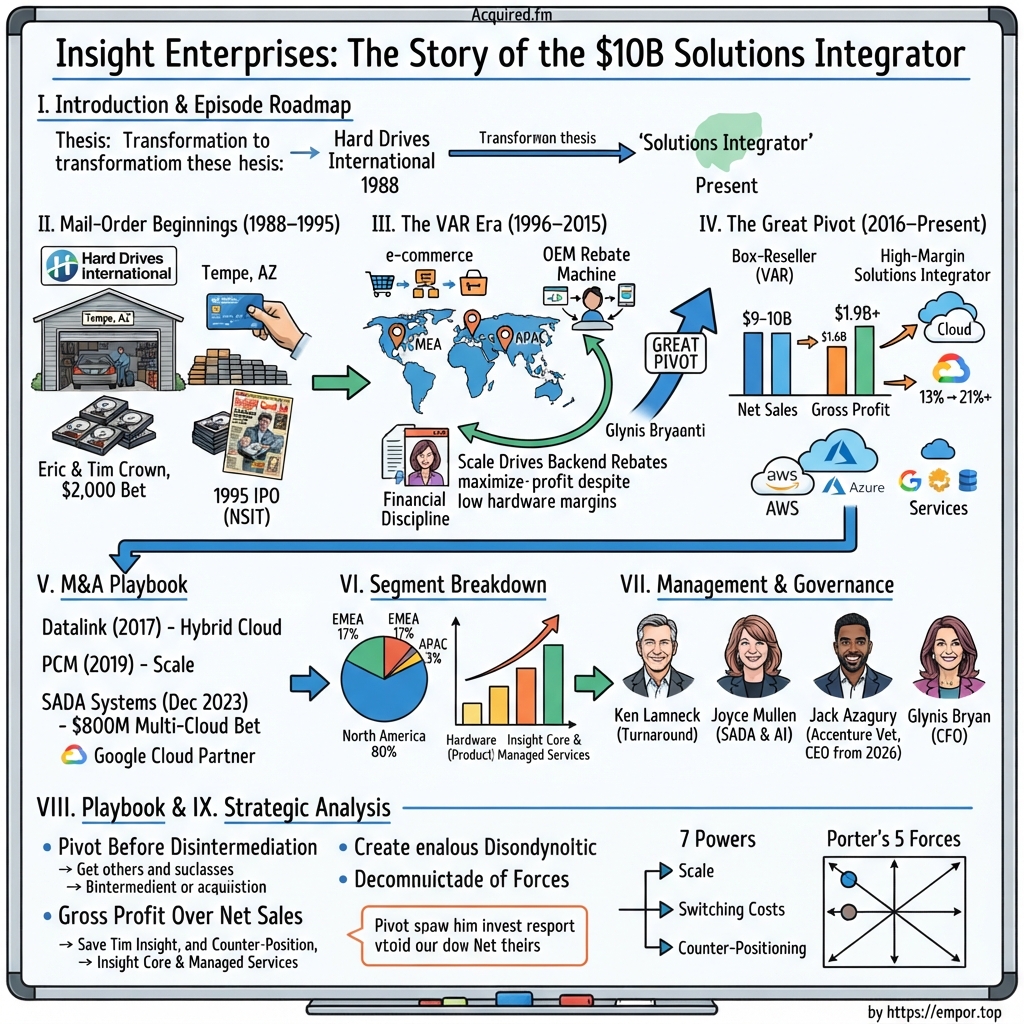
Insight Enterprises: The Story of the $10B Solutions Integrator
I. Introduction & Episode Roadmap
In February 2026, on a conference call from Chandler, Arizona, Insight Enterprises reported the highest quarterly gross margin in company history alongside a contracting top line.
Both outcomes occurred simultaneously. Fourth-quarter net sales fell 1% year over year to roughly $2.0 billion, while gross profit climbed 9% to $478.4 million and gross margin expanded 220 basis points to 23.4%.1 For full-year 2025, revenue dropped 5% to $8.2 billion, gross profit remained essentially flat, and adjusted earnings per share rose 2%.1 Joyce Mullen, in her final quarterly call as chief executive, summarized the period by noting: "We are pleased with our fourth quarter results and the momentum in our business after a challenging year."1 Chief Financial Officer James Morgado offered a similar assessment on the call, stating that 2025 "was a challenging year that fell short of our gross profit growth expectations."2
Six months later, the trajectory had shifted. For the quarter ended June 30, 2026, under a new chief executive recruited from Accenture, Insight reported net sales up 15% to $2.4 billion, gross profit up 18% to $521.6 million, and adjusted diluted earnings per share up 44%.3 The company raised its full-year outlook twice in six months, forecasting gross profit growth of 8% to 10%.3
This turnaround stemmed from a combination of the artificial intelligence infrastructure cycle, new executive leadership, and long-standing structural dynamics. The core strategic question surrounding the business has persisted for a decade.
The hook
Insight began as a two-person mail-order operation in a 100-square-foot rented office in Tempe, Arizona, funded by a $2,000 credit-card advance and an advertisement in Computer Shopper offering hard drives at prices below the founders' wholesale cost.4 Today, the company employs more than 14,000 people across 21 countries and defines its strategy in annual filings as an aspiring "AI-first, leading solutions integrator."5 Insight holds a position in the Fortune 500, operating within an estimated $1.3 trillion addressable IT market in 2026, where its $8.2 billion in net sales represents under 1% market share.5
The $10 billion figure in this title marks Insight's peak net sales of $10.43 billion achieved in 2022.6 Although reported revenue has declined since that peak, this top-line contraction reflects structural accounting shifts toward cloud services rather than simple operational decay.
The core tension
At its core, Insight operates as an IT intermediary. It purchases hardware, software, and cloud capacity from a concentrated group of technology vendors and delivers them, along with integration services, to enterprise clients. In 2025, purchases from Microsoft represented approximately 32% of Insight's total supplier spend, while its top five partners — Microsoft, TD Synnex, Google, Cisco Systems, and Ingram Micro — accounted for roughly 63%.5
Intermediaries face two key vulnerabilities: supplier disintermediation and customer bypass. Historically, IT resellers maintained a secure position because enterprise technology procurement involved complex logistics and procurement compliance. The expansion of hyperscale cloud services challenged that model by enabling direct digital purchasing and automated provisioning.
The strategic paradox
Evaluating Insight's financial health requires understanding the distinction between gross revenue and net accounting rules.
When Insight sells a physical server, it records the full purchase price as revenue and earns a thin margin. Conversely, when it sells cloud capacity under certain agent arrangements, standard accounting rules dictate that Insight record only its net margin as revenue, passing the underlying customer spend through off-balance-sheet. Consequently, two economically similar transactions produce starkly different top-line figures. A shift toward cloud services reduces reported revenue while raising reported gross margin, even if the underlying customer relationship remains unchanged.
The breakdown demonstrates this dynamic. In 2025, Insight's product division generated $6.53 billion in net sales and $714.7 million in gross profit, yielding an 11% gross margin. Its services division generated $1.72 billion in net sales and $1.05 billion in gross profit, delivering a gross margin above 60% because so much of that recorded revenue is already net.6 Consolidated gross margin reached 21.4%, representing a 110-basis-point expansion year over year and an increase from 14.7% back in 2019.67
Because top-line revenue fluctuates with product mix, gross profit dollars serve as the primary metric of underlying growth. On this basis, expansion stalled in recent years: gross profit was $1.67 billion in 2023, $1.77 billion in 2024, and $1.76 billion in 2025.6
Roadmap
This story examines Insight's evolution across seven distinct phases: its origins in mail-order arbitrage and 1995 initial public offering; the growth of its value-added reseller operations and vendor rebate incentives; its repositioning as a solutions integrator alongside hyperscale cloud adoption; the acquisition strategy that drove this pivot — spanning Datalink, PCM, and the $800 million purchase of Google Cloud partner SADA; the organizational leadership and compensation structures supporting the model; a competitive evaluation against CDW, World Wide Technology, and global IT consultancies; and an analysis of the bull and bear investment cases.
The central analytical question is whether Insight is transitioning into a technology services provider backed by a distribution network, or whether it remains primarily a distributor operating under a services model. Existing financial data offers support for both interpretations.
 Subscribe on LinkedIn
II. Mail-Order Beginnings: The $2,000 Credit Card Bet (1988–1995)
Consider the mechanics of the initial trade.
When brothers Eric and Tim Crown established Hard Drives International in 1986 with a $2,000 credit-card advance, operating out of a 100-square-foot office, they placed an advertisement in Computer Shopper magazine offering hard drives at prices below their own wholesale acquisition cost.4 This was a deliberate strategy rather than an oversight. Storage component prices in the late 1980s were falling predictably, while print advertising required a lead time of several weeks between ad submission and newsstand publication. By the time customers read the ad and placed orders, wholesale prices had dropped enough for the Crowns to purchase the drives at a discount and pocket the difference — essentially taking a free short position on magnetic storage prices.
That first advertisement generated roughly $20,000 in sales at margins higher than anticipated, as wholesale costs declined even faster than the publication delay required.4
This initial move established a pattern that would define the company for decades. The Crowns did not invent a proprietary product; instead, they identified a structural inefficiency in commodity distribution and inserted themselves into the supply chain with minimal capital. Subsequent evolutions of Insight's model — scaling print catalogs, building corporate e-procurement platforms, optimizing vendor rebate programs, and administering cloud licenses — represent variations on that core approach: identifying friction between manufacturers and end users and capturing value by streamlining the transaction.
From arbitrage to a business
Print publication arbitrage, however, could not support long-term enterprise scale. In 1988, the business shifted from opportunistic storage trading into direct sales under the name Insight Direct — the date the company recognizes as its founding, which serves as the basis for the "37 years of broad IT expertise" cited in its 2025 annual report.45
Volume and customer relationship management replaced print arbitrage. By 1991, the catalog had expanded beyond mass storage to include personal computers, software, and peripherals.4 By 1992, the company was investing roughly $1.5 million per month in print advertising, treating marketing as a core acquisition engine rather than a discretionary expense.4 By 1993, the catalog featured more than 20,000 products, and Insight began handling outsourced fulfillment for major hardware manufacturers, including Toshiba.4 To accelerate order velocity, the company launched a same-day shipping service in 1994.4
The company's key operational innovation was organizational rather than logistical. Instead of competing solely on price against anonymous catalog order-takers, Insight assigned individual account executives dedicated toll-free telephone lines, enabling sales reps to build direct, ongoing relationships with corporate buyers.4 This dedicated-account model established the foundation for Insight's modern enterprise sales structure, where client account managers maintain deep familiarity with customer IT environments. However, it also introduced a persistent structural challenge: a high-touch sales force carries significant overhead that does not scale as efficiently as digital self-service.
The 1995 listing
Insight completed an initial public offering on NASDAQ in January 1995, issuing 1.5 million shares at $9.00 each, with the stock closing its first trading day at $10.37.4 At the time of its listing, the company generated approximately $245 million in annual revenue and $6.1 million in operating income.4
Two key characteristics defined that initial public offering. First, the capital raise was relatively modest; the float of 1.5 million shares was designed to fund sales centers and fulfillment infrastructure for a profitable, cash-generative business, rather than cover operating losses. Second, the company's profitability reflected the tight margins of product distribution: $6.1 million in operating income on $245 million in sales yields an operating margin of roughly 2.5%. Escaping those low-margin distribution economics would become the central objective of Insight's corporate strategy over the next three decades.
The mail-order era provided Insight with three foundational capabilities: a direct-marketing discipline, a relationship-oriented sales culture, and strict balance sheet management required when handling depreciating inventory on thin margins. However, it offered little barrier to entry against competitors operating similar distribution networks. Over the subsequent two decades, Insight focused on building structural defensibility by expanding its enterprise customer base, broadening its geographic footprint, and securing high-tier vendor certifications.
III. The VAR Era: Scale, E-Commerce, & The OEM Rebate Machine (1996–2015)
The consumer catalog business had a structural weakness that became glaring as Dell refined build-to-order manufacturing and the internet enabled instant price comparisons: an individual purchasing a single hard drive has no brand loyalty and zero switching costs. A corporate IT department buying five thousand laptops across forty regional offices, however, faces significant operational complexity. The difficulty lies not in selecting the hardware, but in managing asset tagging, custom image deployment, warranty administration, software license true-ups, and audit-compliant approval workflows.
Insight's primary strategic move during this era was abandoning low-margin consumer sales to target corporate procurement departments navigating this operational complexity.
Building the plumbing
The core mechanism of this shift was e-procurement: customized web storefronts integrated directly into corporate purchasing systems, enforcing negotiated pricing, maintaining configuration standards, and automating approval routing. For corporate clients, this transformed technology purchasing from ad hoc negotiations into a standardized catalog with built-in compliance guardrails. For Insight, it established a position far more valuable than a single transactional margin: it created a default purchasing path. Once a customer's procurement infrastructure is wired to Insight, switching to a competitor requires an enterprise project rather than a simple purchasing decision.
This operational integration created one of the most durable moats in the IT reseller industry, explaining why large value-added resellers (VARs) have proven far more resilient than early predictions of disintermediation suggested.
Geographic expansion followed enterprise client growth. Insight expanded across the United States, entered Canada in 1997, established operations in the United Kingdom in 1998, and subsequently broadened its footprint through organic growth and targeted acquisitions.5 Multinational clients required unified contracts and standardized procurement across all operational regions, meaning single-region resellers risked losing global accounts to broader competitors.
The rebate machine, explained plainly
Understanding the reseller business model requires examining original equipment manufacturer (OEM) partner incentives, an economic driver frequently understated by external observers.
When Insight sells a server, the explicit upfront margin — the spread between vendor wholesale costs and client pricing — is thin, often in the mid-single digits. The broader economics, however, depend on backend partner incentive programs. Manufacturers and software publishers pay resellers post-sale based on total volume, product mix, technical certifications, client acquisition, and operational consumption. Insight discloses this dynamic in its financial reporting, noting that it receives incentives from manufacturers, publishers, and distributors based primarily on sales and purchase volumes.5
These incentive structures function like tiered enterprise loyalty programs, paying cash rebates on transactions worth millions of dollars. Because backend incentives are steeply tiered, a reseller generating $2 billion in vendor volume earns a disproportionately higher rebate percentage per dollar than a competitor generating $100 million.
This structural dynamic establishes three core industry characteristics:
- Scale serves as the primary profit engine. Below specific volume thresholds with major vendors, a reseller operates at a structural margin disadvantage against larger peers on identical transactions.
- Vendor policies dictate reseller margins. Incentive programs are established annually and unilaterally modified by manufacturers. Consequently, a reseller's primary profit driver is governed by external vendor rules.
- Industry consolidation is mathematically driven. Because volume yields superlinear rebate returns, channel economics favor larger, consolidated players. This economic reality drove Insight's multi-decade acquisition strategy.
Insight's risk disclosures explicitly highlight this operational vulnerability, citing reliance on vendor partners for "marketing funds and purchasing incentives, which can and do change significantly in the amounts made available and in the requirements year over year" as a primary risk factor.5 As subsequent events demonstrated, shifting vendor incentive structures directly impacted operating performance in 2025.
Crisis, discipline, and the arrival of a CFO
Insight navigated the 2001 dot-com contraction and the 2008 financial crisis without structural failure, though both downturns highlighted balance-sheet exposure. Operating an intermediary model that finances inventory and extends credit to corporate clients creates acute working-capital risks when credit markets tighten and enterprise IT spending contracts.
The structural response was appointing Glynis Bryan as chief financial officer in December 2007, immediately preceding the global financial crisis.8 Bryan served as CFO for seventeen years, establishing an unusually long tenure for a public technology company. Her focus centered on working-capital discipline, cash conversion cycles, and debt management, maintaining liquidity so the company could navigate market downturns and pursue opportunistic acquisitions. In a business where balance-sheet commitments fluctuate by hundreds of millions of dollars around large enterprise transactions, working-capital discipline represents a fundamental operational input.
The leadership team guiding Insight's strategic repositioning took shape in 2010 when Ken Lamneck was appointed president and chief executive officer, effective January 1.9 Lamneck brought extensive distribution experience: following five years in the U.S. Army and an early career as an IBM engineer, he managed Arrow Electronics' industrial computer products division and subsequently served as president of the Americas at Tech Data from 2004 to 2009.9 Having managed distribution from the supplier side, Lamneck recognized both the mechanics of vendor rebate incentives and the structural risks facing transactional resellers if hardware purchasing shifted.
By the mid-2010s, that shift was accelerating. The rapid expansion of Amazon Web Services and Microsoft's strategic pivot to Azure prompted industry-wide questions regarding the long-term role of traditional hardware intermediaries as enterprise software and infrastructure migrated to the cloud.
IV. The Great Pivot: From VAR to "Solutions Integrator" (2016–Present)
The disintermediation thesis was elegant, widely held, and mostly wrong — but not for the reasons its critics expected.
The bear argument in 2016 went like this. Enterprise software is moving from perpetual licences shipped on media to subscriptions billed monthly. Servers are moving from customer data centres to hyperscaler data centres. In that world, why does a customer need a reseller? Microsoft can bill them directly. AWS already does. The reseller's role — purchasing, logistics, licence administration — evaporates into a web console. Resellers were, in this telling, the travel agents of enterprise IT, and the year was 1998.
What actually happened was stranger and more instructive. The transaction did partly move. But the complexity exploded.
Why the middleman survived
A company running one on-premise email server had a simple problem. A company running Microsoft 365 across twelve subsidiaries, Azure in three regions, Google Workspace inherited from an acquisition, AWS for a data-science team that stood it up without telling anyone, plus a residual data centre it cannot decommission for regulatory reasons — that company has an extremely hard problem. It is spending more, in more places, with less visibility, under more security and compliance obligation than at any point in its history.
The hyperscalers are structurally poor at solving that problem, for the obvious reason: each of them wants more of the workload. Nobody at Microsoft is incentivised to tell a customer their Azure spend is 30% wasted and some of it belongs on Google Cloud. That is the gap Insight moved into, and the reason the company began describing itself as a "Solutions Integrator" rather than a value-added reseller.
The current annual report frames the ambition explicitly: Insight aspires "to be an AI-first, leading solutions integrator, setting the pace and defining a new category in our industry," organised around four strategic objectives — put clients first, empower teammates, deliver impact with excellence, and drive profitable growth.5 Category creation is a strong claim, and readers should treat it as a claim. The evidence for and against it runs through the rest of this story.
The gross-profit lens, worked through
Understanding what happened next requires internalising the accounting point introduced earlier, because it is the single most common source of confusion about this company.
Consider Insight's 2025 North America segment. Hardware was 62% of segment revenue, software 19%, and services 19%.6 Now consider that software revenue fell 27% year over year in that segment.6 A casual reader sees collapse. The filing explains the actual causes: a large multiyear transaction in the first quarter of 2024 that did not repeat, changes in certain vendor relationships that shifted Insight from a principal to an agent role, and the continued migration of on-premise software to cloud solutions, which is reported net inside services.6
That middle item deserves emphasis. "Principal to agent" is an accounting reclassification with no cash consequence whatsoever. The same business, restated, simply stops appearing in the revenue line. An investor tracking Insight on revenue would have concluded the software business was disintegrating; an investor tracking gross profit dollars would have seen something much closer to the truth.
This is why the market's preferred metrics for this company are gross profit and gross margin, and why management's own incentive plan is built on gross profit categories rather than revenue — a design choice examined in Section VII.
What actually drove the margin expansion
Consolidated gross margin has moved from 14.7% in 2019 to 21.4% in 2025.76 That is a genuine transformation, and it is worth being precise about what caused it, because the causes have different durability.
In North America in 2025, margin expanded roughly 60 basis points. The filing attributes about 45 basis points to services margin — driven by cloud solution offerings and by services delivered by recently acquired businesses — and about 20 basis points to product margin, which improved largely because low-margin software revenue declined, mechanically lifting the average.6 EMEA expanded a striking 320 basis points to 23.9%, but a meaningful part of that came from Insight acting as a paid pass-through agent for certain clients expanding into the Middle East, which is reported net.6
Read carefully, this is a mixed report. Some of the margin expansion reflects real value migration into services. Some reflects accounting geography. An investor should discount the headline accordingly, and watch gross profit dollars — which, again, were flat.
The partner-incentive shock
Then there is the risk that stopped being theoretical.
Throughout 2025, Insight's segment discussions repeatedly cite "a net decrease in fees from cloud solution offerings primarily as a result of partner program changes" — in North America, in EMEA, and in APAC.6 On the February 2026 call, Morgado quantified it: the anticipated gross profit hit from partner programme changes "landed very, very close to" $70 million, and while the internal pivot was complete, the financial tail extended into 2026.2
Seventy million dollars is roughly 4% of total company gross profit, erased by decisions taken in someone else's boardroom. This is the clearest available evidence on the supplier-power question, and it should temper enthusiasm about the moat. Insight's scale gives it privileged access to vendor economics. It does not give it control over them.
Where the cloud business actually stands
The counterweight is that the cloud business is now large and, in the most recent quarters, growing quickly. Insight's proxy discloses that consolidated cloud gross profit reached $494.9 million in 2025 — against an internal budget of $466.7 million, a beat of about 6%.10 In the second quarter of 2026, cloud gross profit was approximately $171 million, up 39% year over year, driven by software-as-a-service and infrastructure-as-a-service; Insight Core services gross profit was roughly $95 million, up 21%.311
Together those two categories now represent a substantial share of company gross profit and are growing far faster than the whole. That is the strongest single piece of evidence that the pivot is producing economics and not just vocabulary.
Whether Insight can hold that position depends on something the company cannot control alone: how the largest software vendor on earth decides to pay its partners next year. And it depends on how well Insight has bought the capabilities it did not have. Which brings us to the acquisitions.
V. M&A Playbook & Capital Deployment: Benchmarking the Big Deals
There are two honest ways to describe Insight's acquisition programme since 2017. The generous version: the company recognised that consulting talent, cloud engineering depth and mid-market density could not be hired fast enough organically, so it bought them, financed by its own cash generation and a revolving credit facility. The sceptical version: a distribution business with structurally low returns kept buying higher-multiple services businesses to change its own optics, and the returns on that capital have not yet shown up in shareholder value.
Both descriptions are supported by the record. Here is the record.
Datalink (2017): buying an engineering bench
Insight closed its acquisition of Datalink Corporation on January 6, 2017 for a cash purchase price of $257.5 million, which included $76.6 million of cash and equivalents acquired — so roughly $181 million net.712 Datalink, based in Eden Prairie, Minnesota, was a data-centre and enterprise storage specialist: an engineering-led firm that designed, installed and supported the physical infrastructure large companies ran their applications on.
Strategically, this was the first serious statement that Insight intended to compete on architecture rather than fulfilment. Datalink brought certified engineers, deep relationships with enterprise infrastructure vendors, and — critically — credibility in conversations Insight had historically been excluded from. It also brought a customer base that bought complex projects rather than commodity units.
The deal was funded with cash on hand and borrowings, and was digested without drama.7 It is the least controversial acquisition in the set, and the template for everything that followed: buy a capability, attach it to a much larger distribution relationship, sell it back through the existing account base.
PCM (2019): buying scale, and the limits of that idea
Two and a half years later, Insight did something categorically different. On August 30, 2019 it acquired PCM, Inc. for a cash purchase price of approximately $745.6 million, a figure that included $84.6 million of cash acquired and the repayment of PCM's outstanding debt.7 The transaction was widely reported at an announced value of $581 million on an equity basis, and the gap between the two numbers is entirely PCM's balance sheet — a useful reminder to always check what a headline deal value includes.13
PCM was not a capability purchase. It was a scale purchase. Based in El Segundo, California, it operated 40 offices across North America and the United Kingdom with more than 4,000 employees, serving small, mid-sized and corporate clients plus state, local and federal government and education.7 In the four months it was owned during 2019, PCM contributed $716.1 million of net sales — annualising to well over $2 billion.7
The strategic logic connects directly to the rebate mathematics of Section III. If vendor incentive tiers reward volume superlinearly, then buying $2 billion of purchasing volume is worth more than $2 billion of revenue suggests, because it lifts Insight's entire book into better tiers. That is the honest case for the deal.
The costs were also real. Insight recognised $11.3 million of direct third-party acquisition expenses in 2019 alone, recorded $248.9 million of goodwill, and booked a $175.5 million customer-relationship intangible — an asset whose valuation KPMG flagged as a critical audit matter given the subjectivity of the customer-attrition and margin assumptions inside the discounted cash flow model.7 Management excluded PCM's contribution when discussing the "core" business for the following year, and integration of IT systems and back-office operations ran through 2020.7
The deeper analytical point: PCM added revenue at below Insight's gross margin, and added a great deal of operational complexity. Insight's gross margin in 2019 was 14.7%.7 Six years later, the company's new CEO would describe the business as "too decentralized" and make integration one of three pillars of a turnaround plan.11 It is difficult to look at that sequence and conclude the PCM integration was ever fully finished.
SADA (December 2023): the big swing
Then came the deal that will define the current era.
Effective December 1, 2023, Insight acquired SADA Systems, LLC for a total purchase price of $425.3 million net of cash acquired — comprising an initial cash payment of $423.3 million, a $450,000 contractual adjustment and a $5 million seller retention fund — funded with cash on hand and borrowings under the revolving credit facility.14 SADA was one of the most decorated partners in the Google Cloud ecosystem: a six-time Google Cloud Partner of the Year with more than 800 people across offices in North America, India and Armenia.1415
The strategic rationale was straightforward and, in the abstract, compelling. Insight was heavily indexed to Microsoft. Roughly a third of its purchasing ran through one vendor, and its cloud practice was overwhelmingly Azure-shaped. A customer that had standardised on Google Cloud had little reason to call Insight. Buying SADA changed that in a single transaction and gave Insight a credible claim to genuine multi-cloud neutrality — plus a Google-native generative-AI engineering bench at exactly the moment enterprise AI budgets began to open.
Now the part that deserves scrutiny.
Layered on top of the cash was an earnout providing an incentive opportunity for the sellers of up to $390 million, based on the SADA business achieving EBITDA and revenue growth performance through 2026 — with payouts running from 2024 into 2027.14 That is the number that generated the widely quoted "$800 million" total deal value, and the reason the acquisition was framed at the time as aggressively de-risked: the sellers would only collect if the business performed.
Here is what the filings show about whether it did.
At the acquisition date, Insight's own estimate of the fair value of that earnout was approximately $21.3 million — against a $390 million maximum.14 Fair-value estimates of contingent consideration are probability-weighted, so this was Insight's accountants and their valuation specialists saying, at signing, that they assigned a low probability to the sellers hitting the aggressive tiers.
By the end of 2025, the FY2025 annual report disclosed that the remaining contingent consideration associated with SADA was up to a maximum of $120 million, payable if defined contingencies are met for 2026 and paid in 2027.5 Total earnout liabilities across all of Insight's acquisitions carried a fair value of $80.7 million at December 31, 2025 — a figure that also includes obligations for Amdaris, Infocenter, Inspire11 and Sekuro.516
Read those two disclosures together and a clear inference follows: the great majority of SADA's $390 million earnout opportunity has not been earned, and the remaining exposure is a fraction of the original headline. Insight has never disclosed period-by-period SADA earnout attainment, so this remains inference rather than confirmed fact — but the direction is not ambiguous.
What does that mean for investors? It means two things at once, and they pull in opposite directions. First, the earnout structure worked exactly as designed — Insight did not pay for performance it did not receive, and that is a genuine capital-allocation win worth crediting. Second, SADA has substantially underperformed the growth trajectory both parties modelled in late 2023. On the February 2026 call, Morgado explained that SADA's transition from an enterprise-focused Google practice toward the mid-market has taken longer than the equivalent Microsoft motion, because building a mid-market installed base takes time.2 That is a reasonable explanation. It is also, unmistakably, an explanation for a shortfall.
The tuck-ins, and the pattern they reveal
Around the headline deals, Insight has run a steady programme of smaller purchases: Hanu in June 2022 for approximately $68.2 million net of cash; Amdaris in August 2023 for approximately $82.9 million net plus an earnout of up to $54.4 million; Infocenter, a ServiceNow specialist, effective May 1, 2024; New World Tech in 2024; Inspire11, a Chicago-based data and AI delivery firm, on October 1, 2025 with earnouts up to $66 million; and Sekuro, an APAC cybersecurity provider, on October 31, 2025.1451718
The pattern is consistent and, on its face, coherent: every acquisition since 2022 has been a services or engineering capability, not distribution scale. Insight paid $39.6 million for Infocenter's first earnout period on July 1, 2025 — evidence that at least one of these businesses has performed well against plan.5
But earnouts are not free. Because they are remeasured to fair value each period, they inject volatility straight into operating expenses. In 2025 Insight recorded a net loss on revaluation of earnout liabilities of $25.3 million, versus a $7.8 million gain in 2024 — a $33 million swing that was the primary driver of GAAP earnings from operations falling 14% to $334.9 million even as adjusted earnings from operations were flat at $504.0 million.61 The revaluation loss also drove Insight's effective tax rate to 30.3% in 2025 from 25.0%, because such losses are largely non-deductible.6
That is the accounting judgment investors should keep an eye on: a Level 3 fair-value measurement, derived from Monte Carlo simulation using unobservable inputs, that materially moves reported operating income.5 It is properly disclosed and unremarkable in isolation. It is also, structurally, the kind of line item where optimism and pessimism about acquired businesses gets expressed in earnings before it gets expressed in cash.
Capital allocation: the balance sheet story
Insight's 2025 financing year was unusually busy and worth walking through, because it explains why the company's leverage rose while its acquisitions were modest.
The company generated $303.8 million of operating cash flow — less than half the $632.8 million of 2024, reflecting a very large increase in accounts receivable.6 It repaid $333.1 million of principal on convertible notes at maturity, and paid $222.0 million in cash to settle a portion of the warrants associated with the call-spread transactions entered into when those notes were issued — plus recognised a $25.1 million net loss on revaluation of the warrant settlement liabilities.6 It repurchased $151.1 million of stock, down from $200.0 million in 2024 and $217.1 million in 2023.6 It spent $285.3 million net on acquisitions.6 Net borrowings under the revolving facility were $818.8 million, and the company ended the year with $358.0 million of cash and $1,361.3 million of long-term debt.6
By the second quarter of 2026, total debt stood at approximately $1.5 billion with a net leverage ratio of 1.7 times and roughly $1 billion of available liquidity under a $2 billion asset-based facility, which was amended in May 2026 to add a $100 million swingline sub-facility.1119 Insight repurchased $75 million of stock in the quarter with $149 million of authorisation remaining, which management expects to exhaust by year end.11
The most notable capital-allocation development, though, is what the new CEO said he would not do. On his first call in May 2026, Jack Azagury announced a pause on M&A for at least the remainder of 2026 in order to focus on organic growth and complete the buyback.20 By August he was blunter, telling analysts he had "spent no brain cycles on M&A" in his first four months.11
For a company that has completed roughly a deal a year for a decade, that is a meaningful signal. Read charitably, it is discipline: stop buying until you have integrated what you own. Read sceptically, it is an admission that the acquired assets are not yet delivering, and that the honest use of the next two years is cleanup rather than expansion. The evidence for the sceptical reading is his own diagnosis of the business as "too decentralized."11
VI. Segment Breakdown, Industry Structure, & Economics
To understand where Insight actually makes money, it helps to stop thinking about it as one company and start thinking about it as three businesses with very different characters, plus one shared purchasing engine.
North America: the engine, and the problem
North America generated $6.65 billion of net sales in 2025 — down 6% — and $1.37 billion of gross profit at a 20.5% margin, representing roughly 78% of company gross profit.6 This is the core: US and Canadian enterprise, mid-market, government and education clients, sold through the relationship model inherited from the catalog days and the e-procurement plumbing built in the 2000s.
It is also where the strain has been. North American gross profit declined 3% in 2025.6 Adjusted earnings from operations in the segment slipped 1% to $418.6 million.6 The pressures were the ones already described — vendor programme changes, a non-repeating large software transaction, and a decline in organically delivered services.6
Then came the reversal. In the second quarter of 2026, North American gross profit rose 16% to $397.7 million and segment earnings from operations rose 64% to $112.6 million.3 Hardware revenue across the company grew 21%, with infrastructure hardware up more than 20%.11 That is an AI infrastructure cycle showing up in a distributor's numbers.
EMEA: high margin, low profitability
EMEA is the segment most likely to confuse a reader glancing at margins. It generated $1.36 billion of net sales in 2025 and $323.3 million of gross profit at a 23.9% gross margin — higher than North America.6 Yet its adjusted operating margin was only 4.5% of net sales, versus 6.3% in North America.6
The explanation is mix and cost structure. Much of EMEA's business is software and cloud licensing, which is reported net and therefore carries a high apparent gross margin on a small revenue base — while the cost of serving fragmented national markets, each with its own language, regulation and public-sector procurement rules, is stubbornly high. A high gross margin on a structurally sub-scale operation is not the same thing as a good business.
The most recent data reinforce the concern. In the second quarter of 2026, EMEA gross profit grew 13% but segment earnings from operations fell 15% to $9.5 million, and adjusted earnings from operations declined 2%.3 EMEA was also where the 2025 compensation plan produced a zero payout on the regional core services gross profit objective — actual attainment of $66.5 million against a $79.3 million target.10 Something in the European services business is not converting growth into profit, and it has not been fully explained on any recent call.
APAC: small, sharp, and suddenly growing
APAC is the smallest segment — $237.5 million of net sales in 2025 and $71.8 million of gross profit — but at a 30.2% gross margin and a 10.0% adjusted operating margin, it is the most profitable per dollar of revenue in the group.6 It serves Australia, New Zealand and other regional markets with a services-weighted mix; services were 46% of APAC revenue in 2025 versus 19% in North America.6
The Sekuro acquisition transformed its trajectory. In the second quarter of 2026, APAC net sales grew 46% and gross profit grew 67% to $30.5 million at a 35.6% margin.3 On a small base, this is the clearest available proof-of-concept that Insight can buy a specialist services firm and immediately improve segment economics. Whether that replicates at scale is the open question.
The product-versus-services economics, in plain terms
Strip the segments away and the company runs three economic engines with very different characteristics.
Hardware is high-volume and low-margin, tied to corporate device and server refresh cycles. It is the most cyclical part of the business and the most exposed to component costs — a point Morgado has raised repeatedly through 2026, warning that memory prices "have not settled" and that component costs are affecting demand.20 On the February 2026 call he offered a specific elasticity rule of thumb: as device prices rise above roughly 15%, "elasticity kicks in and the volume is impacted."2 For 2026, management guided hardware gross profit to only low-single-digit growth despite strong unit demand, precisely because component inflation compresses the margin on each transaction.11
Software and cloud is the recurring layer. On-premise software is in structural decline — down 6% in the second quarter of 2026 — as customers migrate to subscription and consumption models.11 The cloud portion is growing fast, but its economics are set by partner programmes rather than negotiated pricing.
Insight Core services — consulting, cloud migration, managed infrastructure, security operations, AI deployment — carries the highest margin and the greatest strategic weight. It is also the hardest to scale, because it is delivered by people. Azagury's stated response is to productise: on the August 2026 call he described productising the company's top ten service offerings so they can be delivered repeatably rather than bespoke each time.11 That is the correct instinct. It is also the single hardest thing any consultancy has ever tried to do, and the reason services businesses trade at lower multiples than software.
The competitive war-game
Now place Insight on the board.
CDW is the reference point, and the comparison is more interesting than the consensus allows. CDW reported full-year 2025 net sales of $22.4 billion, up 6.8%, with gross profit of $4.87 billion at a 21.7% gross margin.21 Insight's gross margin in the same period was 21.4%.6
Sit with that. The standard narrative holds that CDW is the scaled, disciplined, higher-quality operator while Insight is the lower-margin challenger pivoting toward services. On gross margin, the two are now essentially indistinguishable — and CDW grew while Insight shrank. Whatever differentiation Insight's services pivot has produced, it has not produced a gross margin premium over the industry leader. That is an inconvenient fact for the bull case and it deserves to be stated plainly.
Where Insight does differ is scale asymmetry in the other direction: CDW is nearly three times larger by revenue, which under the tiered-rebate logic means CDW's purchasing economics are structurally at least as good and probably better.
World Wide Technology is the privately held titan of large-enterprise infrastructure, distinguished by an Advanced Technology Center that lets customers test complex architectures before buying. Because it is private, it can invest in capability without quarterly scrutiny — a genuine advantage in a talent-driven business, and a competitor Insight cannot see clearly.
SHI International, also private, competes hard in software licensing and large-account procurement. Connection and Computacenter occupy adjacent mid-market and European positions. Softchoice was acquired by World Wide Technology, removing an independent competitor and further concentrating the field.
The global consultancies — Accenture, Deloitte, Avanade — are the competitor set Insight has explicitly decided to walk toward by hiring Azagury. They win the strategy conversation and the largest transformation programmes. They do not, generally, want to run a client's licence renewals or ship laptops to forty branch offices. Insight's bet is that owning the unglamorous execution layer earns it the right to move upstream. The counter-bet is that consultancies simply subcontract execution and keep the margin.
Which is exactly the debate a new CEO from Accenture was hired to settle.
VII. Management, Governance, & Incentive Alignment
On April 13, 2026, a 53-year-old Frenchman who had spent twenty-nine years at Accenture walked into a company headquartered in a Phoenix suburb and inherited a business with flat gross profit, a diluted acquisition story, and a five-year total shareholder return of approximately zero.2210
That last number deserves stating up front, because it frames everything else in this section. Insight's own proxy discloses that $100 invested in its common stock on December 31, 2020 would have grown to $107 by December 31, 2025. Over the identical period, $100 in the NASDAQ US Benchmark index would have grown to $187, and $100 in the NASDAQ US Benchmark Computer Hardware index to $214.10
Seven percent over five years, against a market that nearly doubled. Whatever else is true about the Solutions Integrator strategy, the equity market has not paid for it.
Ken Lamneck: the architect of the pivot
Lamneck ran Insight from January 2010 through the end of 2021, and announced his planned retirement in May 2021.9 His legacy is the intellectual framing that still governs the company: that a reseller which stays a reseller eventually becomes a commodity, and that the escape route runs through services and solutions rather than through more volume.
He also began the acquisition programme that Datalink opened and PCM accelerated. Judged on the operating metric he most emphasised — gross margin — his tenure was a clear success. Judged on whether the resulting company achieved durable growth, the verdict is less settled, and much of the difficulty his successors inherited traces to integration debt accumulated on his watch.
Joyce Mullen: execution under a hostile tape
Mullen became president and CEO effective January 1, 2022, arriving from a twenty-one-year career at Dell Technologies where she had run the global channel and partner organisation.[^23] She was, in other words, a supply-side executive taking over a demand-side company — someone who knew from the inside exactly how vendor partner programmes are designed, which is a genuinely unusual and valuable background for this seat.
Her tenure delivered real things. Gross margin reached record levels. The services organisation was unified. SADA, Amdaris, Infocenter, Inspire11 and Sekuro were all acquired under her leadership, decisively repositioning the capability base toward cloud, data and security. Her framing on the AI opportunity was consistently more grounded than the industry norm — on her final call she described the mission as helping clients "move from hype to how," which is closer to consulting realism than vendor marketing.2
Her tenure also coincided with revenue declining from a $10.4 billion peak to $8.2 billion, gross profit going nowhere for two years, and the share price going nowhere for four.610 Some of that was macro: corporate and enterprise IT spending was subdued through 2024 and 2025, and the $70 million partner-programme hit was not of her making. Some of it was execution.
Insight announced her retirement on October 30, 2025, with the transition expected in the first quarter of 2026 and a search already underway that had begun earlier that year.23 Rather than departing outright, she moved to executive vice president, strategic development, responsible for priorities set by the incoming CEO through March 31, 2028.23 Retaining an outgoing CEO in an advisory capacity for two years is a governance choice with arguments on both sides: it preserves institutional knowledge and relationships, and it can also blur accountability during precisely the period when a new CEO needs unambiguous authority.
Glynis Bryan and the CFO handover
The outline for this story described Bryan as the current CFO. She is not, and the correction matters for understanding the current management team. Bryan announced her retirement as chief financial officer in May 2024, effective December 31, 2024, closing a seventeen-year run in the role; she then moved to executive vice president with responsibility for M&A, operational improvements and financing matters.8
Her successor is James Morgado, appointed effective January 1, 2025 after serving as senior vice president and chief financial officer for North America.24 Morgado's public performance has been notable for its specificity — quantifying the partner-programme headwind rather than gesturing at it, offering a numerical elasticity threshold on device pricing, and stating flatly that 2025 fell short of expectations.2 For investors assessing management credibility, that kind of precision under pressure is worth more than polish.
Jack Azagury: the Accenture signal
Azagury spent over twenty-nine years at Accenture, serving as group chief executive for consulting from June 2022 to September 2025 — leading the firm's global consulting services line — and sitting on its global management committee from 2020 and its executive committee from 2022.10 Between Accenture and Insight he was a senior advisor at TowerBrook Capital Partners, and he chairs the board of EisnerAmper and serves on the board of Berkeley Research Group.10 He holds a master's degree in software engineering from Imperial College London and an MBA from INSEAD.10
The hire is a strategic statement that requires no interpretation. Insight did not recruit another distribution executive. It recruited a consultancy operator, and in doing so declared that the destination is the consulting margin pool rather than the procurement one.
His early actions have been consistent with that. He paused M&A, took direct oversight of the North America business himself in the near term, and in August 2026 laid out a three-year "One Insight Plan" built on three pillars: investment in high-priority growth areas including AI infrastructure and AI services; operational excellence through integrating acquisitions, standardising global processes and reducing organisational layers; and a talent strategy aligning incentives and certifications for AI skills.2011 His summary claim — "our pivot to become the leading solution integrator for the age of AI is working" — is exactly the kind of assertion this analysis is obliged to treat as unproven until the gross profit dollars sustain it beyond a hardware upcycle.11
Tim Crown and the board
Timothy Crown, co-founder, has served as a director since 1994 and as chair of the board since November 2004; he was president from January 2000 and CEO from October 2003 until stepping down in November 2004, and has been a non-employee director since.10 Founder continuity at the board level is a real asset in a company that has now changed CEO three times in sixteen years.
The board has also been refreshed toward the strategy. Janet Foutty, the retired chief executive of Deloitte Consulting, joined in 2024; Catherine Courage, a Google vice president, has served since 2016; Thomas Reichert, CEO of Environmental Resources Management, joined in 2024.10 A board with a former Deloitte Consulting CEO on it is a board that has decided consulting is the destination.
Incentives: what management is actually paid to do
The compensation design is where Insight's strategic priorities become falsifiable, and the 2026 proxy is unusually informative.
The annual cash incentive is weighted 50% to non-GAAP adjusted earnings from operations, 25% to core services gross profit, and 25% to cloud gross profit.10 Long-term performance share units are earned on non-GAAP adjusted return on invested capital and relative total shareholder return.10 Note what is absent: revenue appears nowhere. For an intermediary business where revenue is the most easily manipulated and least meaningful metric, that is a genuinely good design.
Note also that the outline's premise of "Adjusted EAT" is not what the plan uses; the operative measure is adjusted earnings from operations. The distinction matters because EFO excludes interest expense — which, given rising leverage, is an increasingly large real cost that management's bonus does not feel.
Now the outcomes, which are where credibility is tested. For 2025:
- Consolidated adjusted earnings from operations came in at $504.0 million against a $527.7 million target — a 95.5% attainment producing an 85% payout.10
- Consolidated core services gross profit was $332.8 million against a $380.0 million target — a substantial miss, paying out 58.7%.10
- EMEA core services gross profit was $66.5 million against $79.3 million — paying out nothing at all.10
- Consolidated cloud gross profit beat, at $494.9 million against $466.7 million, paying out 140%.10
Blended, Mullen earned 92.2% of her $1.5 million target, or $1.383 million.10 On the long-term side, adjusted ROIC came in at 15.15% against a target range of 16.00% to 16.25%, earning 50% of the ROIC-linked award.10
This is a coherent and, importantly, honest set of outcomes. The plan discriminated: it paid well where the company performed, paid poorly where it did not, and paid zero where it failed outright. Thresholds were set at 85% of budget with no payout below, and maximums at 115%.10 There is no evidence here of goalpost-moving or discretionary rescue.
Two governance details round out the picture. Say-on-pay passed with approximately 23.8 million shares for and 3.65 million against — around 87% support, which is passing but not resounding, and several long-tenured directors drew 12% to 14% against votes at the May 13, 2026 annual meeting.19 Separately, shareholders approved eliminating supermajority voting requirements from the certificate of incorporation, a modest but real governance improvement.19
Finally, Azagury's inducement award, granted April 15, 2026, is worth flagging because of how it is structured. The roughly $10 million grant consists entirely of performance share units tied to absolute total shareholder return, with tiers keyed to share-price growth of 118%, 160% and 200% over the three-year period ending April 15, 2029, earning 50%, 100% and 200% of target respectively, capped at 266,170 shares.25
There is no time-vesting component and no participation-trophy tier. If the stock does not roughly double, the award is worth nothing. That is an aggressive alignment structure, and a reasonable inference is that the board wanted to signal — to Azagury and to the market — that the status quo of a flat five-year share price is unacceptable.
VIII. Playbook: Key Business & Investing Lessons
Four transferable lessons emerge from this history, each accompanied by a caveat that tempers the headline logic.
1. Pivot before disintermediation arrives, but do not expect immediate market applause. Insight began shifting toward services and cloud solutions years before hardware distribution margins faced severe pressure. That transition demonstrably altered its economics, raising gross margin from under 15% in 2019 to over 21% by 2025.76 The caveat is that early strategic pivots carry substantial upfront costs while the equity market rewards them late, if ever. Insight's stock price remained flat over five years while management rebuilt the operating model.10 For investors, "correct but unrewarded" can persist far longer than an investment horizon allows.
2. In intermediary businesses, gross profit serves as the true top line. This principle applies across technology distributors, brokers, agencies, payment processors, and digital marketplaces. In any model where accounting rules periodically shift transactions between gross and net reporting, top-line revenue figures become uninformative. Reclassifying certain vendor relationships from principal to agent reduced Insight's reported software revenue significantly without impacting underlying earnings.6 The caveat is that gross profit margin is an incomplete metric when evaluated in isolation. Insight expanded its gross margin percentage while total gross profit dollars remained flat — and cash dollars, not gross margins, fund payroll and operations.
3. Multi-cloud neutrality provides a distinct position, but a narrower moat than claimed. Offering independent guidance across Microsoft, Google Cloud, and Amazon Web Services creates real client value because hyperscalers cannot offer neutral advice. However, neutrality generates revenue only if enterprise clients prioritize multi-cloud optimization over single-vendor depth, and if major suppliers continue funding partner incentives. The $70 million reduction in vendor incentive fees in 2025 demonstrated that this channel moat is ultimately rented from vendors rather than owned.2 Multi-cloud positioning must be viewed as an advantage that requires annual re-earning.
4. Structure earnouts to protect downside risk, and audit contingent liabilities closely. The SADA transaction illustrates both sides of structured M&A. Contractual earnouts protected capital by reducing maximum contingent payouts from $390 million to $120 million after performance targets were missed.145 Yet those same financial disclosures confirm that the $425 million acquisition underperformed its initial growth expectations.14 For financial analysts, footnote disclosures covering contractual obligations and Level 3 fair-value measurements offer critical detail on transaction health, even though they are frequently overlooked in quarterly reporting summaries.
A fifth lesson, supported by the historical record: serial acquisitions create cumulative integration debt that eventually hampers operations. Insight executed roughly one deal per year across a decade. By 2026, incoming leadership characterized the organization as overly decentralized, establishing global process standardization and structural streamlining as key operating priorities.11 While acquiring capabilities can accelerate strategic shifts, each transaction introduces legacy systems, distinct cultures, and operational redundancies whose costs accrue over time.
IX. Strategic Analysis: 7 Powers & Porter's 5 Forces
Frameworks are useful only when applied adversarially. Evaluating Insight through Hamilton Helmer's 7 Powers and Michael Porter's Five Forces tests how well the underlying business economics support the company's strategic narrative.
Hamilton Helmer's 7 Powers
Scale Economies — present, but shared and capped. Insight's purchasing volume clears higher vendor incentive tiers than smaller resellers can reach, delivering a genuine and durable cost advantage over regional competitors. The limitation is that Insight is not the largest player in its industry. CDW is roughly three times its size by revenue and achieved a marginally higher gross margin in 2025.216 Scale economies protect Insight from smaller rivals far better than they differentiate it at the top of the market.
Switching Costs — the strongest power in the portfolio, and underdiscussed. This is where the company's enterprise e-procurement integration proves its value. When Insight's purchasing portal is embedded in a client's enterprise resource planning system, its managed services team runs the client's infrastructure, and its licensing specialists hold the institutional memory of a decade of Microsoft enterprise agreements, switching vendors becomes a multi-quarter project fraught with audit and compliance risk. Insight's annual report highlights more than 6,000 partner relationships and deep procurement integration as central to its market position.5 The key constraint is that switching costs are strongest in thin-margin transactional procurement and weakest in high-margin consulting, where projects can easily be awarded to competing firms on a case-by-case basis.
Counter-Positioning — genuine, but structurally limited. Insight can advise a client to migrate workloads from Azure to Google Cloud, whereas Microsoft cannot offer that neutral guidance. Major consultancies can offer independent advice, but they rarely want to manage the underlying procurement execution, license administration, and hardware logistics. This creates a distinct position between two incumbent models. However, counter-positioning requires that incumbents cannot match the offering without harming their core business model. Nothing prevents major consultancies from expanding procurement capabilities, nor does anything stop hyperscalers from adjusting partner compensation to preserve vendor loyalty. The position is defensible, but it is not structurally protected.
Process Power — modest. Decades of accumulated experience in vendor rebate administration, global logistics, multi-country contracting, and client portal integration represent specialized know-how that a new entrant cannot quickly replicate. Yet management's own diagnosis tempers this claim: an organization described as overly decentralized, where standardizing global processes is a primary turnaround priority, has not yet fully realized process power.11
Branding, Cornered Resource, Network Economies — largely absent. Insight holds high-level vendor certifications and accolades, including SADA's recognition as a Google Cloud global partner of the year, but corporate technology buyers procure based on capability and pricing rather than brand premium.26 Additionally, there is no meaningful network effect, as serving one client does not enhance the service delivered to another.
The overall assessment yields two-and-a-half powers, anchored by switching costs and scale, with counter-positioning serving as the active strategic bet. This framework supports a durable, cash-generative business, but it does not guarantee compounding growth.
Porter's Five Forces
Supplier power — high, and demonstrated. Supplier concentration represents the primary structural constraint in the business, as demonstrated during 2025. When Microsoft and other vendor partners altered their incentive structures, approximately $70 million of Insight's gross profit was eliminated without any operational misstep by Insight.2 With Microsoft accounting for roughly 32% of total purchases and the top five partners representing 63%, vendor leverage is substantial.5 Insight's diversification efforts—adding Google Cloud expertise via SADA, cybersecurity through Sekuro, and ServiceNow capabilities via Infocenter—reduce single-vendor exposure, but supplier dominance remains clear.
Buyer power — moderate, and rising with transparency. Enterprise technology buyers are sophisticated, conduct competitive procurement tenders, and rely on transparent public pricing benchmarks for cloud consumption. Their bargaining power is checked primarily by the switching costs detailed above and by reliance on Insight for supply chain access during hardware shortages—a critical function when memory prices remain volatile and component lead times are extended.20
Threat of substitutes — moderate and evolving. Hyperscaler marketplaces represent the primary substitute, allowing clients to purchase software directly through Azure Marketplace or Google Cloud Marketplace while counting transactions against their committed spending allocations. While this direct channel poses a structural risk to licensing intermediaries, marketplaces sell standardized transactions rather than architectural guidance. They cannot evaluate complex multi-cloud tradeoffs for an enterprise client.
Competitive rivalry — high and consolidating. Insight competes directly with CDW, World Wide Technology, SHI International, Computacenter, Connection, and regional managed service providers. Continued industry consolidation—such as World Wide Technology's acquisition of Softchoice—further concentrates the market. High rivalry creates persistent pricing pressure, which Insight explicitly identifies as an ongoing industry condition in its regulatory filings.5
Threat of new entrants — low at scale, high at the edges. Replicating a global IT distribution footprint presents nearly insurmountable barriers to entry. However, boutique Google Cloud consultancies and specialized AI integration firms can launch with minimal capital, competing directly for the high-margin services engagements Insight is seeking to expand. Barriers to entry protect the core distribution business while remaining porous around new services.
Synthesis: Insight operates in an industry characterized by high supplier power, intense competitive rivalry, and moderate forces elsewhere—a structural profile that typically yields average economic returns. Success depends primarily on operational execution and scale rather than defensible structural moats. Its five-year return on invested capital in the mid-teens, falling just short of its 16% internal target, aligns directly with this industry structure.10
X. Earnings Call Transcripts & Analyst Q&A Stress Test
Reading three consecutive Insight calls in sequence — February, May and August 2026 — is the fastest way to understand both the business and the change in management posture. The prepared remarks tell you what the company wants believed. The Q&A tells you what the analysts do not yet believe.
February 5, 2026: the exit interview
Mullen's final call carried the tone of someone closing a difficult chapter honestly. The prepared remarks emphasised record gross margin, cloud execution, and core services growth from recent acquisitions.1 But the numerical guidance was sober: for 2026, adjusted diluted EPS of $11.00 to $11.50 excluding stock-based compensation — about 5% growth at the midpoint against $10.75 in 2025 — with gross profit growth in the low single digits and gross margin of approximately 21%.1 Management also changed the definition of its adjusted guidance beginning in 2026 to exclude stock-based compensation, and disclosed the comparison both ways, which is the right way to make a presentational change.1
The Q&A went straight at the weak points. On Google, analysts pressed on why SADA's transition to the mid-market was slower than the equivalent Microsoft motion; Morgado's answer — that building a mid-market installed base takes longer than serving enterprise accounts, with the effect concentrated in the second through fourth quarters of 2026 — was specific and plausible, and also confirmed a delay.2 On cloud, Canaccord probed whether guidance of low-double-digit growth represented acceleration or moderation against mid-teens underlying trends.2 JPMorgan pressed on memory-cost pass-through and whether increases above 15% would dampen PC volumes.2
Notably, management did not blame the macro environment for everything. Morgado's characterisation of the partner-programme impact landing "very, very close to" the $70 million anticipated is a management team saying, in effect, we told you the number and the number was right.2 Guidance accuracy on a bad outcome is still guidance accuracy.
May 7, 2026: a new CEO defines the problem
Azagury's first call was less a strategy presentation than a diagnosis. He described Insight as "the leading solution integrator with a focus on the mid-market," pursuing AI-driven transformation across cloud, data, security and hybrid infrastructure — and then made two announcements that mattered more than the framing.20
First, the M&A pause and the commitment to complete the then-remaining $224 million of buyback authorisation.20 Second, that he would personally oversee the North America business in the near term to ensure alignment between strategy and operational delivery.20 A newly arrived CEO taking direct operational control of the segment representing roughly three-quarters of gross profit is not a routine organisational tweak. It is a statement that the segment's performance was the problem he was hired to fix.
Analysts responded appropriately. JPMorgan's Cardoso asked directly where the low-hanging fruit was; the answer centred on organic services growth, operating leverage from AI-driven automation, and capital returns.20 Raymond James's Tindle probed the services growth outlook and hardware demand timing, drawing out that backlog was at COVID-era levels but that extended lead times and unsettled memory costs created revenue-recognition uncertainty.20 Morgado guided hardware gross profit to approximately flat for the year.20
Quarterly results themselves were unspectacular: net sales up 1% to $2.1 billion, hardware up 7%, core services up 11%.20 The market was being asked to buy a plan, not a print.
August 6 and 13, 2026: the plan meets a cycle
Then the numbers arrived. The August release showed the strongest quarter in years: net sales up 15%, gross profit up 18% to $521.6 million, adjusted EBITDA up 29% to $190.4 million, GAAP diluted EPS up 76% and adjusted diluted EPS up 44%.3 Guidance was raised to 8% to 10% gross profit growth and adjusted diluted EPS of $12.20 to $12.70 — roughly 16% growth at the midpoint, against an initial February guide of about 5%.31
On the call, Azagury laid out the "One Insight Plan," reported that the company had become a global launch partner for Microsoft 365 E7, launched a managed security offering called Insight Managed Exposure Defense, and cited a healthcare client AI deployment delivering roughly $400,000 in annual productivity savings.11 He also confirmed he had spent no time on M&A.11
The analyst pressure focused on the right question: how much of this is Insight, and how much is the cycle? Pressed on whether hardware strength was durable or a supply-driven pull-forward, Azagury argued it reflected genuine workload repatriation to on-premises infrastructure for AI, with server demand expected to remain strong.11 That is a substantive answer, and it is testable — if it is right, hardware strength persists into 2027; if it is a pull-forward, it reverses.
Morgado, meanwhile, kept the caution: he flagged prudence on the fourth-quarter outlook given memory price increases, supply chain disruption and macroeconomic factors, and reiterated that hardware gross profit growth would remain in the low single digits despite the revenue surge.11 That last point is the one investors should hold onto. Insight is selling more hardware at compressed unit economics. The revenue growth is real; the profit conversion on that portion is not proportional.
What the sequence reveals
Three observations for assessing management credibility.
First, the narrative has been consistent across three CEOs and multiple years: solutions integrator, gross profit over revenue, cloud and services as the growth engine. There has been no unexplained strategy reversal, which is more than can be said for many companies in this industry.
Second, this management team explains its misses with numbers rather than adjectives. The $70 million partner impact, the specific EFO and core services attainment percentages disclosed in the proxy, the elasticity threshold on device pricing — these are the disclosures of a team that expects to be checked.
Third, and least comfortable: the strongest quarter of the transformation arrived four months into a new CEO's tenure and coincided precisely with an industry-wide AI infrastructure surge that lifted hardware revenue 21%.11 Attributing that to the "One Insight Plan" would be premature. Azagury's own claim that the pivot "is working" rests, at this point, on two quarters and a cycle.
XI. Risk Radar & Bull vs. Bear Stress Test
The risk radar, ranked by materiality
Vendor incentive redesign — the top risk, and not hypothetical. Everything about Insight's profitability sits downstream of programme decisions made by Microsoft, Google, Cisco, Dell and their peers. The 2025 experience quantified the exposure at roughly $70 million of gross profit.2 The structural direction of these programmes is also unfavourable in a specific way: vendors are shifting incentives away from transaction volume toward consumption, adoption and outcome milestones. That rewards partners with genuine delivery capability — arguably favouring Insight over pure resellers — but it also makes the revenue stream harder to forecast and easier for the vendor to reprice.
Hardware cyclicality, now with component inflation. The current upcycle is real, but the profit conversion is impaired. Management has guided hardware gross profit to low-single-digit growth even amid 21% revenue growth, because memory and component costs are rising faster than they can be passed through.11 Morgado's 15% elasticity threshold implies a specific and near-term danger: if device prices keep climbing, volumes break.2 A distributor facing simultaneous input inflation and demand elasticity is squeezed from both sides.
Acquisition integration and earnout exposure. SADA's underperformance against its original earnout construct, the $25.3 million earnout revaluation loss in 2025, and the new CEO's "too decentralized" diagnosis are three independent signals pointing at the same issue.145611 There is also residual contingent exposure across Infocenter, Inspire11 and Sekuro, with maximum obligations disclosed in the annual report's contractual obligations note.5
Leverage and cost of capital. Total debt around $1.5 billion against 1.7 times net leverage is manageable, and liquidity of roughly $1 billion is ample.11 But interest expense grew materially — guidance for 2026 rose from approximately $85 million in February to approximately $95 million in August — and the compensation plan's headline metric excludes it.13 A business with mid-teens ROIC and rising interest costs has a narrowing spread.
Working capital volatility. Operating cash flow of $303.8 million in 2025 was less than half the prior year, driven by an accounts receivable increase exceeding $1.1 billion, partly offset by a comparable increase in payables.6 The second quarter of 2026 saw $12.2 million of operating cash outflow.3 These swings are normal for the model — large enterprise transactions distort quarterly cash — but they mean free cash flow must be assessed annually, never quarterly.
Concentration and geography. Microsoft products represented roughly 17% of consolidated net sales in 2025, and the top five manufacturers about 50%.5 Insight has also flagged expansion into the Middle East as an international risk in its own filings.5 EMEA's inability to convert gross profit growth into operating profit remains unexplained and is worth monitoring.
Accounting judgments to watch. Two stand out and both are properly disclosed: the Level 3 Monte Carlo fair-value estimation of earnout liabilities, which moves reported operating income materially; and goodwill of $1.17 billion against total stockholders' equity of $1.65 billion at year-end 2025 — meaning a meaningful impairment would consume a large share of book equity.5 Insight also recorded a $12.6 million impairment on a real estate asset reclassified to held for sale in April 2025, and $37.1 million of severance and restructuring expenses during the year.6 KPMG issued a clean audit opinion; there are no going-concern or restatement issues.
The bull case, tested
The argument: Insight is completing a genuine transformation from distributor to services-led integrator. Cloud and core services gross profit compound in the high teens to twenties. Consolidated gross margin pushes above 22%. The AI infrastructure cycle provides a multi-year tailwind across both hardware and the architecture services that surround it. Operational discipline under a consultancy-trained CEO unlocks the operating leverage that a decentralised organisation has been leaking. Buybacks against a shrinking share count amplify earnings per share.
The supporting evidence: Cloud gross profit up 39% and core services up 21% in the most recent quarter.3 Gross margin guidance raised to 21.5%–22.0%.3 Adjusted EPS guidance lifted from roughly 5% growth to roughly 16% in six months.13 APAC demonstrating that a services acquisition can lift segment margin to 35.6%.3 Share count guided down to approximately 30.0 million for 2026 from 31.5 million average basic shares in 2025.36 A compensation structure that pays for exactly the metrics the thesis requires.10
What would falsify it: If hardware growth reverses in 2027 and cloud growth decelerates simultaneously, gross profit growth returns to zero and the entire case rests on cost cutting. If the next partner-programme cycle takes another $70 million, margin expansion stalls regardless of execution. If services gross profit continues missing internal budgets — as core services did by a wide margin in 2025 — then the productisation strategy is not working.10
The bear case, tested
The argument: Insight is a structurally average-return intermediary that has spent a decade and well over $1.5 billion of acquisition capital to move its gross margin to roughly where its larger competitor already sits, while producing a five-year total return of 7%.21610 Revenue is 21% below its 2022 peak.6 Gross profit has not grown in two years.6 The most economically important variable in the business is set annually by Microsoft. The current quarter's strength is a cyclical hardware surge, not a strategic victory.
The supporting evidence: The TSR comparison in the company's own proxy.10 Gross margin parity with CDW despite CDW's far larger scale and simpler model.216 The 2025 compensation scorecard, which shows misses on EFO, on core services gross profit, and on ROIC.10 SADA's earnout trajectory.145 The new CEO's characterisation of his own company as too decentralised, seven years after the PCM integration was supposed to conclude.11 Hardware gross profit growing in low single digits while hardware revenue grows 21% — meaning the visible growth is the least profitable kind.11
What would falsify it: Two or three consecutive quarters of double-digit gross profit growth in which cloud and core services, not hardware, are the primary drivers. Evidence that productised service offerings are scaling with improving delivery margins. ROIC recovering above the 16% internal threshold.
The activist stress test
What would a skeptical concentrated holder actually push for?
Prove the services strategy or divest the pieces that are not working. EMEA is the obvious target: high gross margin, poor operating margin, a zero payout on its regional services objective, and declining segment profit in a strong quarter.103 An activist would demand either a specific margin recovery plan with dates or a structural review.
Question the acquisition record with return disclosure. Insight has never published post-acquisition returns on invested capital by deal. For a company that has deployed over $1.5 billion into acquisitions since 2017, that absence is conspicuous. An activist would demand it — particularly for SADA.
Challenge the adjusted metric architecture. Insight's adjusted earnings from operations excludes amortisation of acquired intangibles ($76.8 million in 2025), earnout revaluations, transformation costs, severance and restructuring ($37.1 million), and real estate impairment.6 For a serial acquirer, severance and restructuring appearing every single year, and transformation costs described as "not expected to recur in the longer term" recurring in both 2024 and 2025, are recurring costs of the business model.6 The gap between $334.9 million GAAP and $504.0 million adjusted earnings from operations is not a rounding difference.
Press on the retained-executive arrangement and board tenure. The outgoing CEO's two-year advisory role through March 2028, and directors with fifteen-plus year tenures drawing double-digit against votes, are the sort of items governance-focused holders raise.2319
Applaud the CEO award structure, and ask for it more widely. The absolute-TSR-only inducement grant is exactly what an activist would design. The obvious follow-up: why does the broader executive team's long-term plan use a 55th-percentile relative TSR target when the absolute record is 7% over five years?1025
The three KPIs that matter
Reduced to the essentials, three metrics tell an outside investor almost everything about whether the Insight thesis is working. Readers should track these from the company's quarterly releases rather than relying on any calculation here.
1. Combined cloud and core services gross profit growth. This is the transformation, expressed in a single number. Insight discloses both quarterly, and management is compensated on both.10 If this pair compounds in the high teens while total gross profit grows, the pivot is real. If cloud slows toward single digits — as it did in 2025, growing just 2% for the full year — the thesis is in trouble regardless of what hardware is doing.1
2. Consolidated gross margin, read alongside gross profit dollars. Never one without the other. Margin can rise on declining volume, on accounting reclassification, or on a weak-software mix — all three happened in 2025.6 The combination of expanding margin and growing dollars is the only configuration that indicates genuine value creation.
3. Adjusted return on invested capital. For a business that has funded its strategy with acquisitions and revolver borrowings, ROIC is the discipline metric. It sits in the compensation plan, it is disclosed annually in the proxy, and 2025's 15.15% fell short of the 16.00%–16.25% target.10 Sustained ROIC above the internal threshold would be the clearest evidence that the acquisition programme created value rather than merely purchasing revenue.
XII. Epilogue & Outro
There is a symmetry worth appreciating in this story.
In 1986, two brothers with a $2,000 credit-card advance sold hard drives they did not yet own at prices below their current wholesale cost, betting that market prices would decline before the invoices came due.4 Forty years later, Insight Enterprises is making a structurally identical bet: that enterprise technology will continue becoming more complex faster than corporate clients can manage internally, and that the intermediary standing in that gap will capture significant value.
The underlying medium shifted from magnetic storage drives to multi-cloud architecture and artificial intelligence deployments, but the core economic trade remained unchanged.
As of August 2026, the financial record reveals a company that has rebuilt its operating economics without yet translating that margin expansion into sustained top-line growth or market-outperforming shareholder returns. Expanding gross margin from under 15% seven years ago to 21.4% for full-year 2025 and 21.7% in the second quarter of 2026 represents a substantive operational change.637 The company has built a services and cloud practice that did not exist a decade ago, supported by an executive compensation structure that measures operational metrics and adjusts payouts down when targets are missed—including a 58.7% payout on core services and zero on regional goals.10
Set against those achievements are clear operational counterweights: two flat years in gross profit dollars, a top-line revenue base roughly one-fifth below its 2022 peak, an acquisition program where the flagship SADA transaction has missed most of its performance earnouts, a five-year total shareholder return of just 7% while broader market indices nearly doubled, and an incoming chief executive who publicly characterized the organization as overly decentralized.61451011
Insight's corporate transformation remains unresolved. Jack Azagury takes leadership with a three-year turnaround plan, an aggressive inducement package requiring the stock price to roughly double before performance units vest, direct oversight of the primary North American operating segment, and an industry-wide artificial intelligence hardware cycle providing top-line tailwinds.252011 Offsetting those tailwinds are high supplier concentration where top vendors can unilaterally adjust incentive structures, a direct rival operating at three times Insight's revenue with identical gross margins, and an ongoing integration workload inherited from a decade of serial acquisitions.
The central question facing technology intermediaries persists: what happens when the friction an intermediary is paid to remove is eliminated by software or direct purchasing? Insight's historical response has been to seek out higher-level operational friction. Whether enterprise artificial intelligence deployment provides sufficient complexity—and whether Insight can capture that margin ahead of IT consultancies like Accenture, scaled peers like CDW, or hyperscale cloud providers themselves—remains the key test for the years ahead.
References
-
Insight Enterprises, Inc. Reports Fourth Quarter and Full Year Results (Form 8-K, Exhibit 99.1) — U.S. Securities and Exchange Commission, 2026-02-05 ↩↩↩↩↩↩↩↩↩↩↩
-
Insight (NSIT) Q4 2025 Earnings Call Transcript — The Motley Fool, 2026-02-06 ↩↩↩↩↩↩↩↩↩↩↩↩↩↩
-
Insight Enterprises, Inc. Reports Second Quarter Results (Form 8-K, Exhibit 99.1) — U.S. Securities and Exchange Commission, 2026-08-06 ↩↩↩↩↩↩↩↩↩↩↩↩↩↩↩↩↩
-
History of Insight Enterprises, Inc. — FundingUniverse (International Directory of Company Histories) ↩↩↩↩↩↩↩↩↩↩↩↩
-
Insight Enterprises, Inc. Annual Report on Form 10-K for the fiscal year ended December 31, 2025 — U.S. Securities and Exchange Commission, 2026-02-12 ↩↩↩↩↩↩↩↩↩↩↩↩↩↩↩↩↩↩↩↩↩↩↩↩
-
Insight Enterprises, Inc. Form 10-K, Management's Discussion and Analysis and Consolidated Financial Statements, FY2025 — U.S. Securities and Exchange Commission, 2026-02-12 ↩↩↩↩↩↩↩↩↩↩↩↩↩↩↩↩↩↩↩↩↩↩↩↩↩↩↩↩↩↩↩↩↩↩↩↩↩↩↩↩↩↩↩↩
-
Insight Enterprises, Inc. Annual Report on Form 10-K for the fiscal year ended December 31, 2019 — U.S. Securities and Exchange Commission, 2020-02-21 ↩↩↩↩↩↩↩↩↩↩↩↩
-
CFO of Insight Glynis Bryan Announces Retirement — Business Wire, 2024-05-02 ↩↩
-
President and CEO of Insight, Ken Lamneck, Announces Planned Retirement — Business Wire, 2021-05-06 ↩↩↩
-
Insight Enterprises, Inc. Definitive Proxy Statement (Form DEF 14A) — U.S. Securities and Exchange Commission, 2026-04-02 ↩↩↩↩↩↩↩↩↩↩↩↩↩↩↩↩↩↩↩↩↩↩↩↩↩↩↩↩↩↩↩↩
-
Insight Enterprises (NSIT) Q2 2026 Earnings Call Transcript — The Motley Fool, 2026-08-13 ↩↩↩↩↩↩↩↩↩↩↩↩↩↩↩↩↩↩↩↩↩↩↩↩↩↩
-
Insight Closes Acquisition of Datalink — GlobeNewswire, 2017-01-06 ↩
-
Insight to Acquire PCM, Inc. to Expand Scale and Footprint — Business Wire, 2019-06-24 ↩
-
Insight Enterprises, Inc. Annual Report on Form 10-K for the fiscal year ended December 31, 2023 — U.S. Securities and Exchange Commission, 2024-02-22 ↩↩↩↩↩↩↩↩↩↩
-
Insight Acquires SADA, 6-time Google Cloud Partner of the Year — Insight Enterprises, Inc., 2023-12-01 ↩
-
Insight Acquires SADA, Accelerates Growth Strategy as a Leading Solutions Integrator — Business Wire, 2023-12-01 ↩
-
Insight Enterprises Acquires Inspire11 to Expand AI and Business Transformation Capabilities — Business Wire, 2025-10-01 ↩
-
Insight Signs Definitive Agreement to Acquire Sekuro — Business Wire, 2025-10-20 ↩
-
Insight Enterprises, Inc. Current Report on Form 8-K (Annual Meeting Results and Certificate of Incorporation Amendment) — U.S. Securities and Exchange Commission, 2026-05-14 ↩↩↩↩
-
Insight (NSIT) Q1 2026 Earnings Call Transcript — The Motley Fool, 2026-05-12 ↩↩↩↩↩↩↩↩↩↩↩↩
-
CDW Reports Fourth Quarter and Full Year 2025 Earnings — Business Wire, 2026-02-04 ↩↩↩↩
-
Insight Announces Jack Azagury, Former Accenture Chief Group Executive, as President and Chief Executive Officer — Insight Enterprises, Inc., 2026 ↩
-
Insight Enterprises, Inc. Current Report on Form 8-K (CEO Retirement and Transition) — U.S. Securities and Exchange Commission, 2025-10-30 ↩↩↩
-
Insight Bolsters Leadership Team with New Executive Appointment and Two Board Members — Business Wire, 2024-09-03 ↩
-
Insight Enterprises Grants New CEO Jack Azagury Inducement Award Under Nasdaq Listing Rule 5635(c)(4) — Insight Enterprises, Inc., 2026 ↩↩↩
-
SADA Wins 2025 Google Cloud Global Partner of the Year Award for Google Workspace — Insight Enterprises, Inc., 2025-04-08 ↩
 LinkedIn
 WhatsApp
 Reddit
 Hacker News
 Email
Email Kindle
 RSS Feed
 Spotify
 Apple Podcasts
 Amazon Music
 Audible
 YouTube