Enpro Inc.: The Great Portfolio Alchemy
I. Introduction & Episode Roadmap
There is a particular kind of company that Wall Street decides, collectively and for years at a time, that it simply will not own.
In the mid-2000s, EnPro Industries was one of them. It was a Charlotte, North Carolina industrial conglomerate with perfectly respectable products — gaskets, seals, diesel engines, bearings — and one catastrophic problem attached to its balance sheet like a tumor. Its oldest and best-known subsidiary, Garlock Sealing Technologies, had spent the better part of a century selling industrial gaskets that contained asbestos. By the time EnPro existed as a standalone public company, the American asbestos tort system had metabolized nearly every other defendant into bankruptcy, and Garlock was among the last solvent targets still standing.
The analytical problem this created was not that the liability was large. It was that the liability was unknowable. You could not model it. You could not bound it. Every quarter brought a new tranche of mesothelioma claims, each one settled on terms set less by the science of causation than by the leverage of a plaintiffs' bar that had learned exactly how to squeeze a public company with a stock price to protect. A discounted cash flow model requires a terminal value. Garlock's terminal value was a lawsuit with no floor.
Fast forward to the summer of 2026. The company is now called Enpro Inc. — lowercase "p," a deliberate act of self-erasure we will come back to. It carries a market capitalization of roughly $6.8 billion, with shares trading around $322 in mid-July 2026 against a 52-week range of roughly $200 to $390.1 It generated $1.14 billion of revenue in fiscal 2025, up 9.0%, with organic growth of 7.6% — a genuinely strong number for an industrial business in a year when large swaths of global manufacturing were flat.2 Its adjusted EBITDA reached $277.6 million.2 Its net leverage sits at 1.9 times trailing adjusted EBITDA.3 Its largest segment throws off adjusted EBITDA margins above 32% — a level that puts it not among industrial distributors or fabricators but in the neighborhood of specialty chemicals and medical device companies.2
The asbestos liability is gone. Not reduced. Not reserved for. Channeled — a term of art in bankruptcy law that means every present and future claim now belongs to a trust rather than to shareholders, permanently and irrevocably.
So this is a story about how a company escaped. But it would be a thin story if that were all it was, because plenty of companies have used Chapter 11 to solve a legacy problem and then gone on to do nothing interesting with the freedom. What makes Enpro worth two hours of your attention is the second act: what management did with a balance sheet that had suddenly, after fifteen years, become usable.
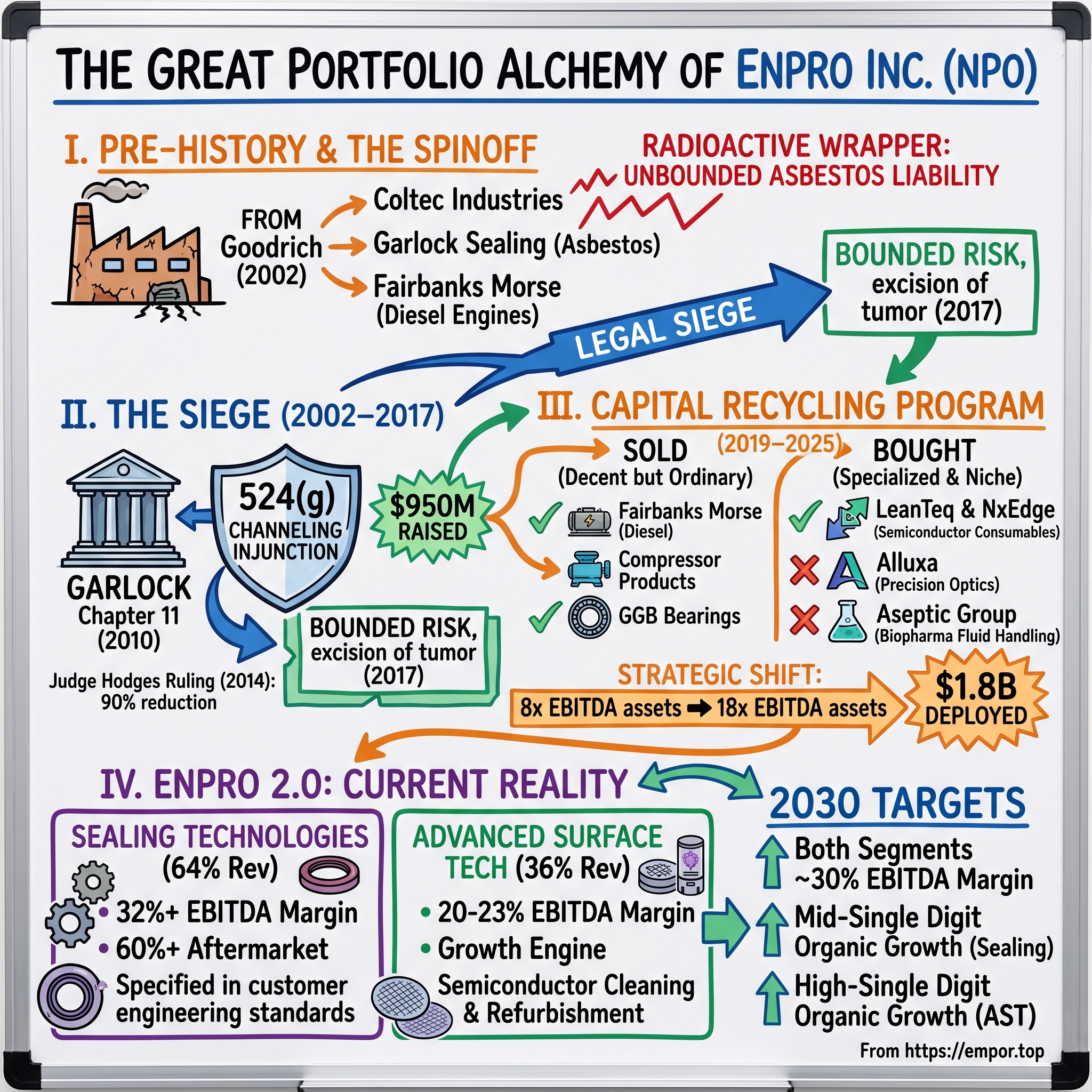
Between 2019 and 2025, Enpro sold roughly $950 million of businesses and bought roughly $1.8 billion of different ones. It exited diesel engines, compressor components, and plain bearings — all decent, cash-generative, deeply cyclical, capital-hungry industrial franchises. It bought semiconductor chamber-part cleaning, thin-film optical coatings, aseptic biopharma fluid handling, and liquid-analytical sensing. The stated logic was to trade assets that trade at eight times earnings for assets that trade at eighteen. That is either a brilliant reallocation of capital or an expensive exercise in multiple-chasing, depending entirely on whether the acquired businesses actually possess the durability management assigned to them. That question is not yet fully settled, and we are going to spend real time on it.
Here is the roadmap. First, the pre-history: how a 19th-century gasket maker and a diesel engine company ended up inside a Goodrich aerospace conglomerate, and why Goodrich threw them overboard in 2002. Second, the fifteen-year siege — Garlock's decision to file for bankruptcy in 2010, a decision that looked at the time like surrender and turned out to be the most aggressive legal move in the company's history, and the extraordinary January 2014 courtroom ruling that broke the plaintiffs' bar's leverage. Third, the capital recycling program that transformed the portfolio. Fourth, the business as it exists today: two segments, two very different economic characters, and a set of 2030 targets that management has now been repeating consistently for two years. Fifth, an honest interrogation of the moat — where it is real and mechanical, and where it is mostly assertion. Sixth, management, incentives, and the governance questions a skeptical investor would raise. And finally, the bull and bear cases, stress-tested rather than recited.
The through-line is a question that applies well beyond this one company: what is a legal liability actually worth, and what happens to equity value when an unbounded risk becomes a bounded one? Enpro is one of the cleanest natural experiments in the modern market. Let's start with how it got poisoned in the first place.
 Subscribe on LinkedIn
II. Pre-History: Coltec Industries and the Goodrich Spinoff
In 1887, in Palmyra, New York, a man named Olin J. Garlock patented a better way to keep steam engines from leaking.
The problem he was solving is worth understanding, because in a real sense Enpro is still solving it 139 years later. A steam engine has a piston rod that moves in and out of a pressurized cylinder. Where that rod passes through the cylinder wall, there must be a hole. That hole must be simultaneously open enough to let the rod move and tight enough to keep several hundred pounds per square inch of superheated steam from escaping. The material that accomplishes this contradiction is called packing, and in the 1880s it was mostly hemp soaked in tallow, which failed constantly and violently.
Garlock's innovation was a mechanical packing that lasted. The company he founded grew into one of the great American industrial names in sealing — the unglamorous, invisible, absolutely non-optional business of keeping fluids and gases where they belong. Along the way, like essentially every high-temperature materials company of the 20th century, Garlock reached for asbestos. Asbestos is a naturally occurring mineral fiber that is cheap, chemically inert, and effectively fireproof. For a company whose entire product line involved sealing hot things, it was close to a miracle material. It was used in Garlock gaskets and packing for decades.
Fairbanks Morse, the other pillar of what became Enpro's original industrial base, came from a different lineage — scales, windmills, and eventually large diesel engines for ships and power generation, including engines for the U.S. Navy. By the late 20th century both businesses had been rolled into Coltec Industries, an acquisitive industrial conglomerate of the sort that the 1980s and 1990s produced in abundance.
Then, in 1999, B.F. Goodrich bought Coltec.
Goodrich at the time was in the middle of a strategic transformation of its own, shedding its tire and chemicals heritage to become a pure-play aerospace supplier — a strategy that ultimately worked spectacularly and ended with United Technologies acquiring the company in 2012. Coltec brought Goodrich some genuinely attractive aerospace content. It also brought Garlock, and with Garlock came several decades of accumulated asbestos exposure claims.
By 2002, Goodrich had seen enough. On May 31, 2002, it completed a tax-free spin-off of its Engineered Industrial Products segment, distributing to shareholders all the stock of a newly created entity called EnPro Industries, Inc.4 Goodrich holders received one EnPro share for every five Goodrich shares they owned as of the record date of May 28, 2002.4 At the time of separation, EnPro's only material asset was the stock and certain indebtedness of Coltec, which held substantially all of the assets and liabilities of the segment — explicitly including the asbestos liabilities and the related insurance recoveries.4
Read that structure carefully, because it tells you exactly what the transaction was for. Goodrich did not sell the industrial business. Nobody would have paid a sensible price for it. Instead it distributed the business to its own shareholders, with the liabilities firmly attached, and walked away clean into a pure aerospace future. Existing Goodrich holders were handed a lottery ticket with unbounded downside and told to make their own arrangements.
The market's response was rational and brutal. Institutional investors with fiduciary mandates generally cannot own a company whose liability tail is unquantifiable, because there is no responsible way to write it into a model. Garlock and its affiliate Anchor Packing were named among the defendants in asbestos exposure actions across multiple states, with the claims centering on industrial sealing products — predominantly gaskets — that the companies had manufactured or sold.4 EnPro spent its first years as a public company trading at a persistent, structural discount to the sum of its operating businesses. The businesses themselves were fine. The wrapper was radioactive.
This is the setup that matters for everything that follows. Enpro did not begin life as a compounder with a strategy. It began life as an orphan — a collection of decent industrial assets handed to public shareholders precisely because a smarter, better-capitalized parent wanted the liability off its own books. Whatever the company has become since, it started from a position of profound structural disadvantage, and its management team spent more than a decade with its strategic hands tied behind its back.
The question, from 2002 onward, was whether anyone could untie them.
III. Enpro 1.0 (2002–2017): The Asbestos Overhang & The Judge Hodges Revelation
To understand what happened to Garlock, you first have to understand a peculiar feature of how American asbestos litigation actually worked — one that operated in near-total darkness for roughly thirty years.
The mechanics of the squeeze
Asbestos causes mesothelioma, a rare and invariably fatal cancer of the lining of the lungs. The disease has a latency period measured in decades, which means a worker exposed in 1965 might not become ill until 2005. It also means that by the time a plaintiff sues, reconstructing precisely which asbestos-containing products caused the exposure is a matter of testimony and inference rather than documentary proof.
Here is the crucial technical point, and it is worth slowing down on because the entire legal battle turned on it. Not all asbestos products are equally dangerous. The most hazardous were friable thermal insulation products — pipe covering, block insulation, spray-applied fireproofing — which crumbled easily and released enormous quantities of respirable fiber into the air. Garlock's products were different in kind: gaskets and packing in which asbestos fibers were encapsulated in rubber or other binders, tightly bound into a solid sheet. A pipefitter tearing out old insulation created a visible cloud. A mechanic scraping a used gasket off a flange created far less.
Garlock's long-standing position was therefore that its products were a comparatively minor contributor to any given plaintiff's disease. For thirty years, that argument lost — not because the science was rejected, but because of who was left in the courtroom.
By the 2000s, essentially every manufacturer of raw thermal insulation had been driven into Chapter 11. Those bankrupt companies did not disappear; they were reorganized into asbestos trusts, which paid claims administratively and — critically — confidentially. And so a two-track system emerged. A plaintiff's lawyer could file a tort suit in state court against the remaining solvent defendants, and separately file claims against the trusts of the bankrupt insulation makers. The two tracks did not talk to each other.
Garlock, as one of the last solvent defendants, found itself in an impossible position. In the tort case, plaintiffs would testify that they could not recall exposure to any other manufacturer's products — leaving Garlock's gaskets as the identified cause. Garlock would be forced to settle, because the alternative was a jury trial in a sympathetic venue with a dying plaintiff and a nine-figure verdict risk. Enpro described its own participation in this system in terms that were, by the standards of SEC filings, unusually blunt.
The bet: filing Chapter 11 in 2010
In June 2010, Garlock Sealing Technologies filed voluntary petitions for reorganization under Chapter 11.
It is hard to overstate how counterintuitive this looked at the time. Garlock was solvent. It was profitable. It was operating normally. Companies in that condition do not file for bankruptcy protection — bankruptcy is what happens to you when you have run out of options.
Except that Garlock's management was not using Chapter 11 defensively. They were using it as a discovery weapon.
In the tort system, Garlock had never been able to see the trust claims. Settlements were confidential, discovery was limited, and the game was structurally rigged toward volume settlement. In bankruptcy court, however, the judge is required to estimate the aggregate liability — to put an actual number on the total of all present and future claims. And to do that, the court has the power to order the kind of full-scope discovery that state tort courts had never permitted.
This was the bet: that if a federal judge ever got to look inside the black box, the number that came out would be dramatically smaller than what Garlock had been paying.
The estimation trial ran in 2013 before U.S. Bankruptcy Judge George Hodges in the Western District of North Carolina. The gap between the two sides was enormous. Claimant representatives argued for a figure in the range of $1 billion and above; Garlock's own estimate was $125 million.
January 2014: the black box opens
In January 2014, Judge Hodges issued his ruling, and it detonated across the asbestos bar.
He set Garlock's liability for present and future mesothelioma claims at $125 million — roughly a 90% reduction from the claimants' position.5 But the reasoning was more consequential than the number. Hodges found that Garlock's "participation in the tort system was infected by the manipulation of exposure evidence by plaintiffs and their lawyers."5
The evidentiary basis was the part that made the ruling impossible to dismiss as a sympathetic judge helping a corporate defendant. The court had permitted Garlock full discovery into fifteen settled cases — a small sample, but chosen and then examined exhaustively. In every single one of the fifteen, the court found that exposure evidence had been withheld.5 The pattern was numerically stark: on average, plaintiffs in those cases disclosed roughly two exposures to bankrupt companies' products during the tort litigation, and then, after settling with Garlock, filed claims against approximately nineteen such trusts.5 Garlock further identified 205 additional cases in which plaintiffs' discovery responses conflicted with trust claim filings or bankruptcy balloting.5
The mechanism, in plain terms: sue the solvent defendant while claiming you cannot remember being exposed to anything else, extract a settlement, then turn around and tell nineteen trusts that you were extensively exposed to their products.
The ruling landed in the middle of a national policy debate about asbestos trust transparency, and it was covered as such — as evidence that the compensation system had been systematically gamed.67 Garlock subsequently filed civil RICO actions against several plaintiffs' firms.8 Later in 2014, the court moved to unseal the underlying evidentiary files over the objections of the plaintiffs' bar, a fight over disclosure that itself became a significant news story.9
An investor should be careful here about what was and was not established. Hodges made findings in a bankruptcy estimation proceeding — a specific legal exercise with a specific evidentiary standard — and his conclusions were vigorously contested. What is not contestable is the practical outcome: the ruling collapsed the negotiating leverage that had governed Garlock's settlements for three decades.
The settlement and the permanent shield
With the estimation ruling in hand, the arithmetic of negotiation inverted, and the parties moved toward a consensual resolution. In March 2016, Enpro announced a comprehensive settlement to resolve current and future asbestos claims, contemplating a joint plan of reorganization. The bankruptcy court confirmed that plan in 2017.[^10]
The resulting structure was funded with approximately $480 million and became effective on July 31, 2017, covering claims arising from products manufactured or supplied by Garlock and certain affiliated entities, including Coltec-related claims. The trust began accepting claims in September 2018.
Note that Enpro ultimately paid materially more than the $125 million the court had estimated. That is not a contradiction — it is how these settlements work. The estimation established the leverage; the negotiated figure bought something the estimation could not, which was finality and consent. And finality was the entire point.
The legal instrument that did the work is Section 524(g) of the Bankruptcy Code, a provision written specifically for asbestos cases. It permits a court to issue a channeling injunction: all present and future asbestos claims against the reorganized company must be brought against the trust, and only against the trust. The operating company becomes legally unreachable.
For fifteen years, Enpro had been a company with an operating business attached to an unquantifiable liability. On July 31, 2017, it became a company with an operating business. The tumor was excised, and the cost was known, paid, and closed.
What management did next is the reason this story is interesting rather than merely dramatic.
IV. Enpro 2.0 (2017–2024): The Great Capital Recycling Program
Imagine you are running an industrial company in late 2017 and someone has just handed you back your balance sheet after fifteen years.
You have a portfolio you did not choose. It was assembled by a conglomerate in the 1990s and then frozen in place by litigation. You have sealing products, which are excellent. You have Fairbanks Morse, which builds large diesel engines for the Navy — a fine business with real defense content, but one that ties up enormous capital in long-cycle programs. You have Compressor Products International, which sells consumables into oil and gas compression. You have GGB, which makes plain bearings, a competent commodity-adjacent business in a market with global competitors and structurally mid-teens margins.
Every one of those businesses is defensible. None of them is special. And a company that has just spent fifteen years being valued as a liability has a very particular incentive to become something the market is willing to pay a premium for.
Selling the good-but-ordinary
The divestiture program was executed with unusual discipline over three years.
In December 2019, Enpro announced the sale of Fairbanks Morse to private equity firm Arcline Investment Management for $450 million in cash, closing in January 2020.[^11] The timing looks better in hindsight than it could possibly have looked at the time — the company exited a heavy, capital-intensive engine business weeks before a global pandemic disrupted every long-cycle industrial supply chain on earth.
In December 2021, Enpro completed the sale of Compressor Products International to Howden for $195 million.10 CPI was a genuinely decent aftermarket business, but its end market was oil and gas compression — a sector facing both cyclical volatility and a long-term energy transition question that no industrial buyer wanted to underwrite.
In November 2022, Enpro completed the sale of GGB Bearing Technology to Timken for $305 million.11 Timken is a specialist in exactly that space and could extract synergies Enpro could not. This is what a rational portfolio sale looks like: selling an asset to the owner for whom it is worth the most.
Roughly $950 million raised from three businesses over three years. The strategic logic was consistent throughout, and — this matters for assessing management credibility — it was articulated in advance rather than reverse-engineered afterward.
Buying the specialized
The redeployment was larger than the harvest, and it was concentrated in two themes: semiconductor manufacturing consumables, and hygienic fluid handling for food and biopharma.
In 2019, Enpro made its decisive move into semiconductors. It agreed to acquire LeanTeq, a Taiwan-based provider of cleaning and refurbishment services for the critical components inside semiconductor fabrication equipment, for $271.2 million in cash net of cash acquired, plus rollover equity from two selling executives.12 Separately, in July 2019, it acquired The Aseptic Group — a designer and manufacturer of aseptic fluid transfer products for pharmaceutical and biopharmaceutical customers — for $39.3 million net of cash acquired.12 Together, roughly $345 million into two entirely new franchises.
Let's slow down on what LeanTeq actually does, because it is the single most important thing to understand about Enpro's growth engine and it is genuinely non-obvious.
A modern semiconductor is built inside a vacuum chamber, where gases are energized into plasma to deposit or etch away layers of material a few atoms thick. That plasma is chemically violent. It does not only attack the silicon wafer — it attacks the chamber itself: the showerheads that distribute gas, the rings that surround the wafer, the electrostatic chucks that hold it in place. Over hundreds of runs, these parts erode, accumulate residue, and begin shedding microscopic particles.
And a single particle landing in the wrong place on a wafer destroys the chips around it.
So the parts must be removed on a schedule and either replaced — expensive — or stripped, cleaned to near-atomic cleanliness, recoated, and requalified. That last process is the business. It is not manufacturing; it is a recurring service tied to how much the fab is running, not to how much new equipment the fab is buying. That distinction is the entire investment case for the segment, and we will test it shortly, because it is also the claim most vulnerable to being overstated.
In September 2020, Enpro agreed to acquire Alluxa for approximately $255 million.[^15] Alluxa makes thin-film optical filters — coatings built from dozens or hundreds of alternating layers, each a fraction of a wavelength thick, engineered so that specific colors of light pass through and others reflect. Think of it as an extraordinarily precise color filter, used in fiber-optic communications, medical instruments, and defense optics, where "close enough" is not an available option.
Then, in November 2021, came the big one. Enpro agreed to acquire NxEdge for $850 million in cash — a business providing advanced coatings, cleaning, and refurbishment for semiconductor components, substantially expanding the LeanTeq model into the United States.[^16]
The NxEdge deal deserves a clear-eyed assessment rather than a charitable one. It was announced in November 2021, which is to say at or very near the top of the most extreme semiconductor capital equipment upcycle in modern history, at a moment when every asset with the word "semiconductor" attached to it was being bid to a full price. Enpro paid a substantial multiple for an asset whose near-term earnings were being flattered by cycle conditions. Predictably, semiconductor capital equipment spending then went into a multi-year downturn, and AST segment margins spent several years well below where the acquisition case implied.
Management's defense — offered consistently across earnings calls — is that the recurring cleaning and refurbishment component held up considerably better than pure capital-equipment exposure would have. The available evidence broadly supports that: the segment stayed solidly profitable through the trough rather than collapsing. But an investor should hold both facts at once. The business proved more resilient than a pure equipment supplier, and the price paid at the cycle peak meant that returns on that $850 million took years longer to materialize than the deal announcement implied. Both things are true.
In January 2024, Enpro acquired AMI, moving into what the company calls compositional analysis — instrumentation that measures what a fluid or gas is actually made of.3
What the recycling actually accomplished
Set the two ledgers side by side. Out went diesel engines, compressor consumables, and plain bearings — businesses whose revenue is tied to industrial capital spending and whose margins topped out in the mid-teens. In came semiconductor consumable services, precision optics, aseptic biopharma componentry, and analytical instrumentation — businesses with higher gross margins, more recurring revenue, and exposure to secular rather than merely cyclical demand.
The obvious skeptical objection: this is multiple arbitrage dressed up as strategy. Sell things at 8x, buy things at 15-18x, and claim the difference as value creation.
That objection has force, and the honest answer is that the strategy is only defensible if the acquired businesses have genuinely superior economics — not merely a more fashionable end market. The evidence on that is now partially in, and it is mixed by segment. The Sealing side acquisitions and organic improvements have produced sustained margin expansion that has held through a full cycle. The AST side has produced growth, but the margin structure has consistently run below both the Sealing segment and management's own long-term target. That gap is the central unresolved question in the Enpro story, and it is where we turn next.
V. Enpro 3.0: Current Strategy, Segments, and Financial Reality
On December 1, 2023, EnPro Industries, Inc. became Enpro Inc.
The change looks cosmetic and is not. Dropping "Industries" from the name was a deliberate repudiation of the conglomerate identity — a signal to investors that the company no longer wished to be screened, valued, or compared as a diversified industrial. Whether the market grants that reframing is a separate question from whether management asserts it, and for the first several years the market was skeptical. In 2025 and into 2026 the skepticism has visibly eased, with the shares re-rating substantially.1
The two-legged stool
The company today runs two segments with genuinely different economic characters.
Sealing Technologies — the Garlock lineage, plus STEMCO in commercial vehicle components and Technetics Group in extreme-environment sealing, now joined by the recent hygienic and analytical acquisitions — generated $732.4 million of revenue in fiscal 2025, about 64% of the total, with adjusted segment EBITDA of $240.7 million, a 32.9% margin.2
Sit with that margin for a moment, because it is the single most impressive number in this business. A gasket is, physically, a piece of shaped material that costs very little to produce. Historically, Enpro's sealing business ran margins around 20%. Roughly one-third of every revenue dollar now converting to segment EBITDA is not a normal industrial outcome — it is what happens when a component is specified into a customer's process, qualified by regulation or engineering practice, and priced against the cost of failure rather than the cost of production.
The durability underneath it is what makes it interesting. Management has said aftermarket sales represented roughly 65% of Sealing segment revenue in the fourth quarter of 2025 and about 60% in the first quarter of 2026.313 Aftermarket revenue is replacement revenue: it tracks the installed base and the maintenance cycle, not new capital projects. That is why the segment held above 30% adjusted EBITDA margin for nine consecutive quarters through the first quarter of 2026 — a period that included a severe downturn in commercial vehicle OEM demand.3
Advanced Surface Technologies — LeanTeq, NxEdge, and Alluxa — generated $411.6 million of revenue in fiscal 2025, about 36% of the total, with adjusted segment EBITDA of $83.9 million, a 20.4% margin.2
AST is the growth engine and the margin problem simultaneously. Revenue grew nearly 14% in 2025, but at roughly 20% margins it earns about twelve percentage points less on every dollar than Sealing does.2 Management's long-term goal is for both segments to reach 30% adjusted segment EBITDA margins, plus or minus 250 basis points, through 2030.3 For Sealing, that target is already met and then some. For AST, it requires closing a gap of roughly ten points.
What the recent calls actually reveal
Reading the fourth quarter 2025 and first quarter 2026 calls back to back is instructive, because they capture an inflection in real time.
In February 2026, CFO Joe Bruderek guided 2026 revenue growth of 8% to 12%, adjusted EBITDA of $305 million to $320 million, and adjusted diluted EPS of $8.50 to $9.20.3 The AST framing was cautious and specifically shaped: low-to-mid single digit growth in the first half, something like "$100 million-ish" of first quarter sales, with margins similar to recent quarters and the recovery weighted to the back half.3 Bruderek also flagged a real headwind honestly — $12 million of safety stock inventory shipped in 2025 to support customer supply chain transitions that would not repeat in 2026.3 That is the kind of disclosure that costs nothing to omit and something to include.
By the May 5, 2026 call, the picture had changed materially. First quarter sales came in at $303 million, up nearly 11%.13 Adjusted EBITDA rose almost 13% to $76.4 million, a 25.2% margin, up 40 basis points.13 Adjusted diluted EPS was $2.14, up 13%.13 Sealing grew 10.8% to $199 million at a 32.5% margin.13 AST grew over 11%, with adjusted segment EBITDA up 18.5% and margin expanding 140 basis points to 23.3%.13
Management raised guidance across the board: revenue growth to 10-14%, adjusted EBITDA to $315-330 million, adjusted EPS to $8.85-9.50.13 Asked what changed, Bruderek was specific rather than promotional: demand was "inflecting significantly sooner and higher than we expected coming into the year," driven by both precision cleaning and semiconductor capital equipment across all geographies, and "our increased guidance is pretty much all driven by AST."13
That last clause is the honest version of the story, and it cuts both ways. The raise was not broad-based operational outperformance. It was one segment's end market turning faster than anticipated.
Myth versus reality
Three consensus narratives about this company deserve fact-checking.
Myth: AST is a recurring-revenue consumables business insulated from the semiconductor equipment cycle. Reality: partially true, and the qualifier matters. The precision cleaning solutions business genuinely is tied to fab utilization and advanced-node production, which is why it stayed strong through the downturn. But AST also contains meaningful exposure to semiconductor capital equipment — critical in-chamber tools and precision components sold to equipment makers — and that portion is straightforwardly cyclical. Management itself framed the 2026 guidance raise as driven by improved capital equipment spending, not by cleaning volumes alone.13 An investor who models AST as pure recurring revenue will be surprised in both directions.
Myth: the margin improvement in Sealing is a mix effect from acquisitions. Reality: the acquisitions helped, but the timeline does not support mix as the primary driver. Sealing held above 30% adjusted segment EBITDA margin for nine consecutive quarters — a run beginning well before AlpHa and Overlook closed in late 2025.313 Management has consistently attributed the improvement to strategic pricing, operational discipline, and portfolio pruning within the segment. The margin structure appears genuinely re-based rather than optically flattered.
Myth: the asbestos issue could return. Reality: this one is simply resolved. A 524(g) channeling injunction is about as durable a legal shield as American law provides. The residual disclosure risk in Enpro's filings relates to ordinary environmental and product matters, not to a revival of the Garlock tail.
Cash, leverage, and the pension footnote
Free cash flow exceeded $150 million in 2025, net of $48 million of capital expenditure and capitalized software — up 18% from $130 million in 2024 on $33 million of capex.3 First quarter 2026 free cash flow more than doubled year over year to $26.5 million even as capex rose nearly 40% to $13.1 million.13
There is one accounting item that requires explanation, because the GAAP numbers for 2025 look worse than the operations were. In the fourth quarter, Enpro substantially completed the termination of its U.S. defined benefit pension plan, incurring a non-cash settlement loss of $67.2 million recorded in other non-operating expense.3 This was the recognition of life-to-date actuarial losses previously deferred in accumulated other comprehensive income — an accounting event, not a cash event. Existing plan assets more than fully satisfied the cash settlement obligations.3 This is why Enpro reported a GAAP net loss of $32.0 million in the fourth quarter of 2025 against adjusted EBITDA of $69.4 million, and full-year GAAP net income of $40.5 million versus $72.9 million in 2024, despite operations improving.214
The economic substance is favorable: terminating a defined benefit plan removes a long-duration, market-sensitive obligation from the balance sheet permanently. It is, in miniature, the same move as the asbestos trust — converting an open-ended liability into a closed one.
Leverage stood at 2.0 times adjusted EBITDA at the end of 2025 after the $280 million of acquisitions, improving to 1.9 times by the end of the first quarter of 2026 following a $50 million revolver repayment.313 The revolving credit facility was expanded to $800 million from $400 million during 2025, with more than $580 million of capacity available at year end.3 The quarterly dividend was raised to $0.32 per share in February 2026 — the eleventh consecutive annual increase since the dividend was initiated in 2015 — and a $50 million share repurchase authorization remains outstanding and, notably, largely unused.313
A balance sheet at under 2x leverage with $580 million of undrawn revolver and $250-300 million of stated annual M&A capacity is genuine optionality.3 It is also, for a skeptic, genuine temptation. Which brings us to the question of whether the moat justifies the capital being deployed into it.
VI. The Moat: Materials Science, High Switching Costs, and Helmer's 7 Powers
Here is a thought experiment that explains Enpro's pricing power better than any margin analysis.
You are the plant manager of a chemical refinery. Inside your facility, thousands of flanged pipe joints carry hot, corrosive, pressurized fluid. Each joint is sealed by a gasket. Each gasket costs somewhere between $50 and a few hundred dollars.
A supplier approaches you offering functionally equivalent gaskets at 30% less. Annual savings: perhaps $200,000.
Now consider the other side. If one gasket fails on a high-consequence line, the range of outcomes runs from an unplanned shutdown costing millions per day, through a regulatory reportable release, to a fire that kills someone. The gasket you currently use is specified in your engineering standards, has decades of field history, and — critically — nobody ever got fired for using it.
You do not switch. Not because you are irrational, but because you are extremely rational. The expected value of the savings is trivially small against the tail risk of the failure.
Applying Helmer's framework honestly
Hamilton Helmer's 7 Powers is a useful discipline precisely because it forces you to distinguish real structural advantage from things that merely sound like advantages. Let's apply it without grading on a curve.
Switching Costs — genuinely strong, and the primary power. This is the mechanism described above, and it is real, mechanical, and observable in the financials. The evidence is the combination of high aftermarket revenue share with sustained 32%+ margins through a cyclical downturn.23 If Enpro lacked pricing power, that combination could not persist. Management noted "strategic pricing actions" as a margin contributor in consecutive quarters — pricing that sticks in a competitive commodity market does not exist.313
The same logic operates, more intensely, in semiconductors. A leading-edge fab may produce wafers worth well over $100,000 each. A chamber component that sheds particles can compromise an entire lot. Worse, changing a qualified supplier of a chamber-facing part requires requalification — a process that consumes tool time, engineering resources, and scheduling risk. Vaillancourt described qualification as effectively perpetual on the Q1 2026 call: Arizona being qualified, new investments starting in Taiwan, 2-nanometer beginning to ramp while 1.4-nanometer qualification is already underway. "I don't think it ever stops."13 Every qualification cycle is a barrier the incumbent has already cleared and a challenger has not.
Cornered Resource — partially supported, frequently overstated. Enpro holds a substantial patent portfolio in materials science, including branded proprietary formulations such as GYLON restructured PTFE.15 Patents and know-how in high-performance polymer and composite formulation are real assets. But patents expire, and in industrial sealing the more durable asset is usually the specification position and process know-how rather than the intellectual property itself. Treat this as a supporting power, not a primary one.
Scale Economies — real but strictly local. AST operates cleaning and refurbishment facilities positioned near major semiconductor manufacturing centers, with capacity expansion underway in Taiwan, California, and Arizona.13 The geography is not incidental. Chamber components are heavy, fragile, contamination-sensitive, and — most importantly — the fab needs them back fast. Shipping a used showerhead across an ocean for cleaning and waiting weeks for its return is operationally unacceptable. So proximity is a genuine competitive requirement, which means each fab cluster is effectively its own market with its own scale dynamics. This is a strong local moat and a weak global one. It also means the moat must be rebuilt, with capital, at every new fab cluster — which is exactly why AST's capital intensity runs higher than Sealing's.
Process Power — plausible, hard to verify externally. Vaillancourt has repeatedly emphasized vertical integration as a differentiator, arguing that customers increasingly buy multiple Enpro solutions together and that this enhances the company's specified position in critical in-chamber tools including gas dispersion and wafer handling.13 This is a credible claim, but it is management's characterization of its own capability and is not independently observable from outside. File it as a hypothesis with supporting anecdote rather than a proven power.
Branding, Network Economies, Counter-Positioning — largely absent. Garlock carries genuine reputational weight among plant engineers, but that is better understood as an input to switching costs than as brand power in Helmer's sense. There are no network effects here. There is no counter-positioning — Enpro's competitors could adopt its model if they chose; the barrier is capability and qualification, not incumbent unwillingness.
The honest scorecard
Enpro has one very strong power operating clearly in one segment, and a weaker, more capital-intensive, more geographically fragmented version of it operating in the other.
The Sealing moat is proven. It survived a commercial vehicle OEM downturn, soft international industrial demand, and choppy European nuclear ordering while holding above 30% margins.313 That is a real-world stress test, and it passed.
The AST moat is plausible but not yet demonstrated at the level management claims. The relevant proof is margin. If AST's advantages were as structural as Sealing's, the segment would already earn more than 20-23% in a strong demand environment. Management argues that the gap reflects growth investment ahead of revenue — roughly $2 million per quarter, more than $8 million across 2025 — and under-utilization during the semiconductor trough.3 That explanation is coherent and consistent across multiple calls. It is also, conveniently, unfalsifiable until the cycle turns.
Well — the cycle is now turning. Which makes the next several quarters the single most informative period in this company's recent history.
VII. Current Management & Corporate Governance Analysis
Eric Vaillancourt did not arrive at Enpro from a consulting firm or a private equity portfolio company. He arrived in 2009, in the middle of the asbestos siege, and spent more than a decade running the operating businesses before ever being considered for the top job.
That path matters. He ran Garlock. He ran STEMCO. He was inside the company during the bankruptcy years, when strategy was largely hostage to litigation and the job was operational improvement within severe constraints. He became CEO in 2022. The executives who lived through a company's worst period and then get to run it afterward tend to have unusually concrete views about balance sheet risk — and Enpro's persistent sub-2x leverage and pension termination are consistent with a leadership team that has a visceral, earned aversion to unbounded obligations.
His public style is distinctive and, depending on temperament, either endearing or mildly alarming. He closes calls with "Life is good at Enpro." He interrupted his own prepared remarks in February 2026 to apologize for skipping the safety statistics — "I got so excited to talk about our results in the future" — and then spent a full paragraph on a total recordable incident rate of 0.64 and a lost time case rate of 0.09.3 He talks about a "dual bottom line" culture and reports that every colleague completed at least sixteen hours of training and personal development.3
An investor can read this two ways. The charitable reading: safety and training metrics in industrial manufacturing are leading indicators of operational discipline, and plants that run safely generally run well. The skeptical reading: extensive discussion of culture and personal development can function as a substitute for accountability on returns. In Enpro's case, the operating numbers have broadly supported the charitable reading — but the tension is worth holding.
CFO Joe Bruderek handles the financial narrative, and his disclosure style is notably specific. He quantifies things that could be left vague: the $12 million of non-recurring safety stock, the roughly 150 basis points of AST first quarter margin attributable to inventory build, the $2 million per quarter run rate of growth investment ahead of revenue, the exact drivers of higher corporate expense.313 When Steve Ferazani of Sidoti asked in February why fourth quarter margins looked slightly soft against the November guide, Bruderek answered directly: rising medical claims costs, plus higher short-term incentive accruals driven by outperformance on the company's cash flow and returns metric.3 That is a real answer to a pointed question.
Testing credibility against the record
The more useful exercise than characterizing style is checking whether the narrative has held up across time.
Consistency. The Enpro 3.0 targets — mid-single-digit organic growth in Sealing, at least high-single-digit organic growth in AST, both segments capable of 30% adjusted segment EBITDA margins plus or minus 250 basis points, running through 2030 — were stated in essentially identical language on both the February 2026 and May 2026 calls.313 Consistency of framework across periods is meaningful. Targets that quietly mutate quarter to quarter are the classic tell of a management team managing perception rather than a business.
Willingness to disclose inconvenient facts. Management has repeatedly volunteered negatives: commercial vehicle OEM demand running below expectations, nuclear solutions revenue choppy in Europe, international general industrial soft, the non-recurring inventory shipment, growth spending running ahead of revenue in AST. In May 2026, Vaillancourt explicitly stated that no commercial vehicle recovery was built into the raised guidance, despite being cautiously optimistic about one — and offered the actual industry math, noting roughly 170,000-180,000 units against a twenty-year average around 250,000.13 Guiding conservatively on a market you privately expect to improve is the correct direction of conservatism.
The uncomfortable part. The AST margin trajectory has been pushed out repeatedly. The 30% target for AST remains a 2030 goal; the near-term commitment is a roughly 25% run rate exiting 2026.13 The gap between what NxEdge was expected to deliver when Enpro paid $850 million in November 2021 and what the segment has actually delivered is the largest unaddressed accountability question in this story. Management has explained it — cycle, investment timing, qualification costs — but has not, in the calls reviewed here, been pressed hard by analysts on the return on that specific capital. An activist would press exactly there.
Compensation and incentives
Vaillancourt's total compensation for fiscal 2025 was $7,457,747, on a base salary of $934,616 — meaning roughly 87% of his pay was variable, tied to performance-based cash and equity.16 The trajectory has been steady: $5,866,992 in 2022, $6,192,009 in 2023, $6,671,257 in 2024.16
Two observations. First, the structure is appropriately weighted toward variable pay, which is what you want. Second, total compensation has risen roughly 27% over three years — a period during which the shares performed strongly, so pay and shareholder outcomes moved in the same direction. Compensation is tied to metrics including adjusted EBITDA growth, revenue growth, and return on invested capital.16
The ROIC linkage is the governance detail that matters most for a company whose entire strategy is buying businesses. A management team compensated purely on EBITDA growth can create the appearance of success indefinitely by issuing debt and acquiring earnings, regardless of price paid. Including ROIC imposes a discipline: an acquisition that adds EBITDA but destroys returns damages the compensation outcome. Bruderek referenced an internal cash-flow-and-returns metric as a driver of 2025 incentive outcomes, tied to working capital management and free cash flow.3
This is a well-constructed incentive system. But note the limitation — ROIC as typically calculated in incentive plans can be improved by simply not deploying capital, and it can lag badly on recent acquisitions where the invested capital is fully in the denominator before the returns arrive. It is a constraint, not a guarantee.
The activist stress test
What would a skeptical concentrated investor actually attack?
Not the balance sheet — leverage under 2x with $580 million of revolver capacity is conservatively managed.313 Not disclosure quality, which is better than industrial-sector norm.
They would attack three things. First, capital allocation asymmetry. Management describes $250-300 million or more of annual M&A capacity and an active pipeline — Bruderek noted the team looks at an asset "once or twice a week" — while a $50 million buyback authorization sits substantially unused.313 Given that the shares have re-rated significantly, the company's revealed preference is emphatically for acquisition over repurchase. That is defensible when the pipeline is genuinely superior, but it is also the classic pattern that precedes an overpriced deal. The NxEdge precedent is directly relevant.
Second, portfolio coherence. Enpro now spans industrial gaskets, commercial vehicle wheel-end components, aerospace and space sealing, nuclear sealing, aseptic biopharma fluid paths, liquid-analytical sensors, compositional analysis instrumentation, semiconductor chamber refurbishment, and optical filters. Management frames this as capability adjacency. A skeptic would call it a specialty conglomerate with a better-dressed narrative than the last one, and would ask what the corporate center genuinely adds beyond sourcing leverage and a shared balance sheet.
Third, the returns on the semiconductor build-out. Capital expenditure is guided to roughly $50 million for 2026, about 4% of sales, with two-thirds directed to growth and efficiency projects.313 AST is absorbing a disproportionate share of that, on top of the $850 million already committed. The question is not whether AST will grow — it clearly is. The question is whether the cumulative capital deployed into semiconductors ever earns a return commensurate with the price paid at the top of the last cycle.
Those questions do not have settled answers today. They have testable ones. Which is a considerably better position than this company occupied for its first fifteen years — and the lessons from that journey are worth extracting explicitly.
VIII. Playbook: Key Business & Investing Lessons
Strip away the specifics and there are four transferable ideas here, each of which shows up repeatedly in businesses that quietly compound.
1. Own the component whose failure costs a thousand times its price
This is the most durable pricing power mechanism in industrial economics, and it is systematically underappreciated because the products themselves look boring.
The formal condition is simple: find components where the ratio of consequence-of-failure to cost-of-component is enormous, and where the buyer bears the consequence. Under those conditions, price competition largely stops functioning. The buyer is not purchasing a gasket; they are purchasing the absence of a shutdown.
Enpro's two best businesses both satisfy this test — a sealing element on a high-consequence line, and a chamber component whose particle shedding can destroy a lot of wafers. The generalizable insight for investors: when screening industrials, the question is not "what does this part cost?" but "what happens if it fails, and who pays?" Businesses where the answer is "catastrophe, and the customer pays" tend to carry margins that look anomalous until you understand the mechanism.
The corollary is a warning. This power exists only where failure is genuinely catastrophic. Enpro's commercial vehicle OEM business — real, useful, but selling into a price-sensitive assembly process — carries considerably less of it, which is precisely why that portion of the portfolio has been the drag during the downturn.
2. A bounded liability is worth vastly more than an unbounded one, even at a higher cost
The Garlock resolution is the cleanest illustration in modern markets of a principle that investors routinely misprice.
Enpro paid approximately $480 million to fund the trust — far above the $125 million the court had estimated.5 On a narrow cash basis, the company overpaid relative to the judicial finding. On any sensible valuation basis, it was one of the best uses of capital in the company's history, because what it purchased was not a lower number. It was a knowable number.
The market cannot value an unbounded liability. It can only discount the entire enterprise until the risk is theoretically compensated, which in practice means a persistent structural discount that no amount of operational excellence can overcome. The moment the liability became finite and channeled, the discount had no reason to exist.
This generalizes well beyond asbestos: pending litigation with uncapped exposure, environmental remediation of undetermined scope, regulatory investigations without defined scope. In each case, the resolution event — even an expensive one — can be worth far more than the cash it costs. Investors who focus on the settlement amount and miss the removal of variance consistently misread these situations.
The second lesson embedded here concerns legal courage. Filing a solvent subsidiary into Chapter 11 in 2010 was genuinely risky and looked, to many observers, like capitulation. It was the opposite: it moved the fight to the only forum where the underlying evidence could be compelled into daylight. Sometimes the correct response to an unwinnable game is not to play harder but to change the venue.
3. Recycle capital ruthlessly — but the arbitrage must be economic, not cosmetic
Enpro's divestiture-and-redeployment program is genuinely instructive, and it is instructive in both directions.
What was done well: selling businesses to the natural owner who could extract the most from them, executing over a multi-year window rather than in a fire sale, and never taking leverage to a level that would force a bad decision.
What deserves scrutiny: the assumption that a higher-multiple end market equals a better business. It sometimes does and sometimes does not, and the difference is entirely in the unit economics rather than the sector label. The NxEdge purchase at the top of the semiconductor cycle is a live case study in the risk — a good asset can still be a mediocre investment if the entry price capitalizes peak conditions.
The disciplined version of this playbook requires asking, for every redeployment: is the acquired business's superior multiple justified by superior returns on tangible capital, or merely by superior narrative? A useful test is what happened during the last downturn. AST's revenue held up considerably better than a pure equipment supplier's would have, which is real evidence of quality. Its margins compressed well below target, which is real evidence of limits. Both belong in the assessment.
4. Reinvestment ahead of revenue is a real strategy — and a real place to hide
Management has been transparent that AST margins are being suppressed by growth investment running ahead of the revenue it will eventually support, quantified at roughly $2 million per quarter.3 Qualification costs for new nodes, new geographies, and new customers are genuinely front-loaded — you spend for quarters before you ship anything.
This is a legitimate and often correct strategy. It is also the single most common place where structurally sub-par economics get parked and relabelled as investment. The distinguishing test is falsifiability. Management has now committed to a specific, dated, checkable outcome: AST profitability improving to a run rate close to 25% by the end of 2026.13 That is a claim that will be either met or missed within a few quarters, in public.
Which brings the entire analysis to a point. Enpro has spent four years asking investors to accept that one segment's disappointing margins were a function of cycle and timing rather than structure. That proposition is now, finally, testable.
IX. Analysis: Bull vs. Bear Case & Key Risk Radar
The bull and bear cases for Enpro are unusually well-defined, because they converge on a single measurable question. Let's build both properly.
The bull case
The bull case begins with an observation about portfolio construction that is easy to state and hard to engineer: Enpro has assembled two businesses whose cycles do not correlate.
Sealing Technologies is late-cycle, aftermarket-driven, and tied to the maintenance of an enormous installed base of industrial infrastructure. Advanced Surface Technologies is tied to semiconductor manufacturing — a cycle driven by entirely different forces. In 2023 and 2024, Sealing carried the company while semiconductors were in a downturn. In 2026, AST is driving the guidance raise while commercial vehicle demand remains weak.13 A company where the weak segment is always offset by a strong one produces the steady compounding that earns a premium multiple.
The secular demand drivers underneath both segments are substantial. On the AST side, capacity expansion for leading-edge chip production supporting advanced computing and artificial intelligence is driving both fab utilization — which drives cleaning volumes — and equipment spending.13 Critically, the qualification treadmill Vaillancourt described works in the incumbent's favor: each new node generation means new qualifications, and the company already qualified at the prior node has an enormous head start.13
On the Sealing side, the growth vectors are aerospace and space, food and biopharma, compositional analysis, and — a small but genuinely interesting new one — communications and data center infrastructure, which management flagged as an improving pocket of earned growth in May 2026.13 Single-use biopharma componentry is a particularly attractive niche: the industry's shift from stainless steel systems that are cleaned and revalidated to disposable single-use assemblies converts what was capital equipment into a recurring consumable. That is exactly the transformation that creates durable revenue.
The financial evidence supporting the bull case is concrete rather than aspirational. Organic growth of 7.6% in 2025 against a soft industrial backdrop indicates genuine share gain or superior end market selection.2 Free cash flow above $150 million growing 18%.3 Nine consecutive quarters of Sealing margins above 30%, spanning a downturn.313 Leverage under 2x with substantial undrawn capacity.13 Guidance raised within three months of being issued, driven by order inflection rather than accounting.13
The bear case
The bear case has four distinct legs, and they are not equally strong.
The strongest: AST has not proven it deserves its multiple. Enpro is valued as a specialty industrial technology franchise, and roughly 36% of revenue comes from a segment earning 20-23% margins in a business requiring heavy, recurring, geographically fragmented capital investment.213 The 30% target has been a 2030 goal for two years running while the near-term commitment sits at 25%. If AST settles structurally in the low-to-mid twenties rather than approaching thirty, the consolidated margin story caps out well below what the current valuation implies. This is not a hypothetical — it is the base case if management's "investment ahead of revenue" explanation turns out to be a description of the segment's permanent cost structure.
Semiconductor cyclicality is real and understated in the narrative. The last cycle inflicted several years of margin pain on AST. The current upcycle is being driven substantially by AI-related capacity expansion, which is currently the most crowded capital spending theme in global industry. Order patterns "accelerating" and demand "inflecting significantly sooner and higher than expected" is what the top of a cycle sounds like as well as the middle of one.13 Enpro is currently building inventory into that demand — a decision that adds margin when volumes materialize and destroys it if they do not.13
Technology transition risk is genuine but slower-moving. The AST business depends on chamber components requiring periodic removal, cleaning, and recoating. Anything that structurally reduces that frequency — more durable coatings developed by equipment OEMs, chamber designs requiring less frequent servicing, or a decision by a major equipment maker to bring refurbishment in-house — attacks the volume base directly. This is not an imminent threat, but it is the mechanism by which a currently attractive business could erode without any obvious warning.
The weakest leg, but still worth stating: acquisition risk. With $250-300 million or more of annual capacity, an active pipeline, and a management team looking at assets weekly, the probability of a large deal in the next twenty-four months is high.3 The NxEdge precedent demonstrates that this team will pay a full price at a cycle peak for an asset it wants strategically. With semiconductor and biopharma assets currently bid up, the risk of repeating that pattern is elevated.
Porter's Five Forces
Buyer power: high and rising, particularly in AST. Leading-edge semiconductor manufacturing is concentrated among a handful of firms — 台積電 TSMC, 삼성전자 Samsung Electronics, and Intel dominate advanced-node production, and the equipment layer is similarly concentrated across Applied Materials, Lam Research, 東京エレクトロン Tokyo Electron, KLA, and ASML. Selling into that structure means facing sophisticated, concentrated, price-aware customers. Enpro does not disclose customer concentration granularly, but structurally this is a segment with far fewer, far more powerful buyers than Sealing, where the customer base is thousands of refineries, plants, and fleets. This is a meaningful and under-discussed reason why AST margins may structurally trail Sealing's regardless of execution.
Barriers to entry: high, and mechanically so. Qualification is the barrier. A new entrant must not only match technical performance but survive a qualification process measured in quarters, at a customer with no incentive to run the risk. This protects incumbents genuinely.
Substitutes: low in the near term. There is no alternative to sealing a flange or cleaning a chamber component. The substitution risk is not product-level but process-level, as described above.
Supplier power: modest. Bruderek stated plainly in May 2026 that nothing meaningful was expected from the supply or cost side.13 Enpro's input base is specialty polymers, metals, and chemicals — real inflation exposure, but nothing structurally coercive.
Competitive rivalry: moderate, and segment-dependent. In sealing, Enpro competes against a fragmented field where specification positions rather than price contests determine outcomes. In AST, rivalry is more intense, with both independent refurbishment specialists and the equipment OEMs themselves as potential competitors — the OEMs being the most dangerous category, since they design the parts.
The risk radar
Beyond the segment-level cases, four risks are material enough to name.
Execution risk on capacity. Enpro is expanding in Taiwan, California, and Arizona simultaneously while demand accelerates.13 Vaillancourt flagged managing "potential capacity, supply chain and labor constraints" as a priority.13 Ramping capacity into a steep demand curve is where industrial companies most commonly stumble — service failures during a customer's ramp cause exactly the kind of qualification damage that switching costs otherwise prevent.
Geographic concentration in Taiwan. A meaningful portion of AST's leading-edge precision cleaning operations sit in Taiwan.13 The geopolitical exposure requires no elaboration, and it is not hedgeable through operational means.
Commercial vehicle exposure as a persistent drag. Class 8 volumes running at 170,000-180,000 units against a twenty-year average near 250,000 represent a genuine trough.13 Management has excluded any recovery from guidance, which is conservative — but it also means this portion of Sealing has been a headwind for multiple consecutive years with no committed timeline for reversal.
Interest expense and the cost of the M&A model. Bruderek noted 2026 interest expense would rise because the revolver will be materially drawn for most of the year following the late-2025 acquisitions.13 A strategy built on serial acquisition is structurally exposed to the cost of capital in a way an organic compounder is not.
The KPIs that actually matter
Most companies generate dozens of trackable metrics. For Enpro, three carry nearly all the information, and they map directly onto the debates above.
One: AST adjusted segment EBITDA margin. This is the central question in the entire investment case. Management has committed to a run rate close to 25% exiting 2026, against 23.3% in the first quarter, en route to a 30% target by 2030.13 If this metric marches steadily upward through the semiconductor upcycle, the bull case is validated and the multiple is defensible. If it stalls in the low twenties while revenue grows strongly, the "investment ahead of revenue" explanation has been falsified, and the margin structure is what it is. Nothing else the company reports is as diagnostic.
Two: Sealing Technologies organic revenue growth, excluding acquisition contributions. Sealing's margins are proven; its growth is the open question. Management targets mid-single-digit organic growth, and reported revenue growth will be flattered for several quarters by AlpHa and Overlook.13 Watching the organic figure separately is the only way to distinguish genuine share gain and pricing power from acquisitive revenue. If organic Sealing growth persistently undershoots mid-single-digits, the "above-market growth" claim is rhetoric rather than performance.
Three: acquisition price discipline, measured deal by deal. This is less a metric than a standing test, but it is the one that will determine long-run returns. Given the stated capacity and active pipeline, capital will be deployed. The relevant evidence is the multiple paid relative to the target's through-cycle earnings — not its peak earnings — and whether management's own ROIC-linked compensation actually constrains behavior when an asset it strategically covets becomes available at a full price. The NxEdge deal is the benchmark against which the next one should be judged.
X. Epilogue & Outro
There is a moment in every corporate turnaround where the question shifts from "can they survive?" to "what are they actually worth?" — and it is usually less dramatic than it should be.
For Enpro, that moment came on July 31, 2017, when a bankruptcy trust took legal ownership of a liability that had defined the company for its entire independent existence. There was no press conference of consequence, no ceremonial moment. A channeling injunction took effect, and a company that had been valued as a lawsuit with a factory attached became, simply, a company.
What makes the story worth telling is that management did not treat that as an ending. The obvious move for a newly unburdened industrial conglomerate in 2017 would have been to keep the portfolio, harvest the multiple re-rating that came from removing the overhang, and call it a career. Instead the team dismantled the portfolio it had inherited — selling the diesel engines, the compressor components, the bearings — and rebuilt around businesses defined by a single common characteristic: components whose failure is catastrophic and whose price is trivial.
The results to date support most, though not all, of that thesis. Sealing Technologies has demonstrated something close to structural pricing power, holding margins above 30% for nine consecutive quarters through genuinely adverse conditions in several of its end markets. The company generates free cash flow well in excess of $150 million annually, carries leverage under two turns, and has raised its dividend for eleven consecutive years. Those are not the characteristics of a promotional story.
But the second half of the transformation remains, in the most literal sense, unproven. Enpro spent $850 million on a semiconductor business at the peak of a historic cycle, and the segment built around it has yet to earn margins that justify the strategic premium assigned to it. Management's explanation — that the shortfall reflects cyclical trough conditions and deliberate investment running ahead of revenue — is coherent, has been stated consistently for years, and is now, for the first time, entering a period where it can be checked against a strong demand environment rather than a weak one.
That is the honest state of this company in the summer of 2026. One segment has proven its moat under stress. The other has an inflecting order book, a specific dated margin commitment, and several years of unmet expectations behind it. The management team has been consistent in its framework, specific in its disclosure, and conservative in what it embeds in guidance — while also having made one very expensive acquisition at precisely the wrong point in a cycle, and while sitting on capital allocation capacity that will almost certainly be deployed into a similar decision before long.
Enpro broke its legal chains through a piece of genuine strategic courage, liquidated a heavy-industry heritage it never chose, and rebuilt itself around materials science. Whether that rebuild produces the compounding that the current valuation anticipates is not a question of narrative. It is a question of whether a specific margin line, in a specific segment, moves in the direction management has promised.
The next few quarters will say a great deal.
References
-
Enpro Inc. (NPO) Stock Quote — Financial Modeling Prep, 2026-07-17 ↩↩
-
Enpro Reports Fourth Quarter and Full-Year 2025 Results, Introduces 2026 Guidance — Business Wire, 2026-02-18 ↩↩↩↩↩↩↩↩↩↩
-
Enpro Inc. Q4 2025 Earnings Conference Call Transcript — Enpro Inc., 2026-02-18 ↩↩↩↩↩↩↩↩↩↩↩↩↩↩↩↩↩↩↩↩↩↩↩↩↩↩↩↩↩↩↩↩↩
-
Goodrich Corporation Form 10-Q, Fiscal 2002 (spin-off of EnPro Industries, Inc.) — U.S. Securities and Exchange Commission, 2002 ↩↩↩↩
-
EnPro's Garlock Wins Trial on Asbestos Liability; Judge Hits Claimants' Lawyers — Insurance Journal, 2014-01-13 ↩↩↩↩↩↩
-
Garlock Ruling Could Shift Asbestos Litigation in Manufacturers' Favor — Insurance Journal, 2014-02-12 ↩
-
The Garlock Fraud Case and the Asbestos Bankruptcy Reform Debate — Wall Street Journal, 2014-01-20 ↩
-
Garlock Files Civil RICO Lawsuits Against Asbestos Plaintiffs' Law Firms — Legal Newsline, 2014-01-15 ↩
-
Judge To Open Files Supporting Garlock Asbestos Fraud Claims Next Week — Forbes, 2014-11-14 ↩
-
Enpro Completes Sale of Compressor Products International (CPI) to Howden — Business Wire, 2021-12-22 ↩
-
Enpro Completes Sale of GGB Bearing Technology to Timken — Business Wire, 2022-11-04 ↩
-
EnPro Industries, Inc. Form 10-K for Fiscal Year 2019 — U.S. Securities and Exchange Commission, 2020 ↩↩
-
Enpro Inc. Q1 2026 Earnings Conference Call Transcript — Enpro Inc., 2026-05-05 ↩↩↩↩↩↩↩↩↩↩↩↩↩↩↩↩↩↩↩↩↩↩↩↩↩↩↩↩↩↩↩↩↩↩↩↩↩↩↩↩↩↩↩↩
-
Enpro Inc. Form 8-K, Fourth Quarter 2025 Earnings Release — U.S. Securities and Exchange Commission, 2026-02-18 ↩
-
Garlock Sealing Technologies — High-Performance Sealing Systems ↩
-
Enpro Inc. Executive Compensation Disclosures (SEC filings, CIK 0001164863) — U.S. Securities and Exchange Commission ↩↩↩
 LinkedIn
 WhatsApp
 Reddit
 Hacker News
 Email
Email Kindle
 RSS Feed
 Spotify
 Apple Podcasts
 Amazon Music
 Audible
 YouTube