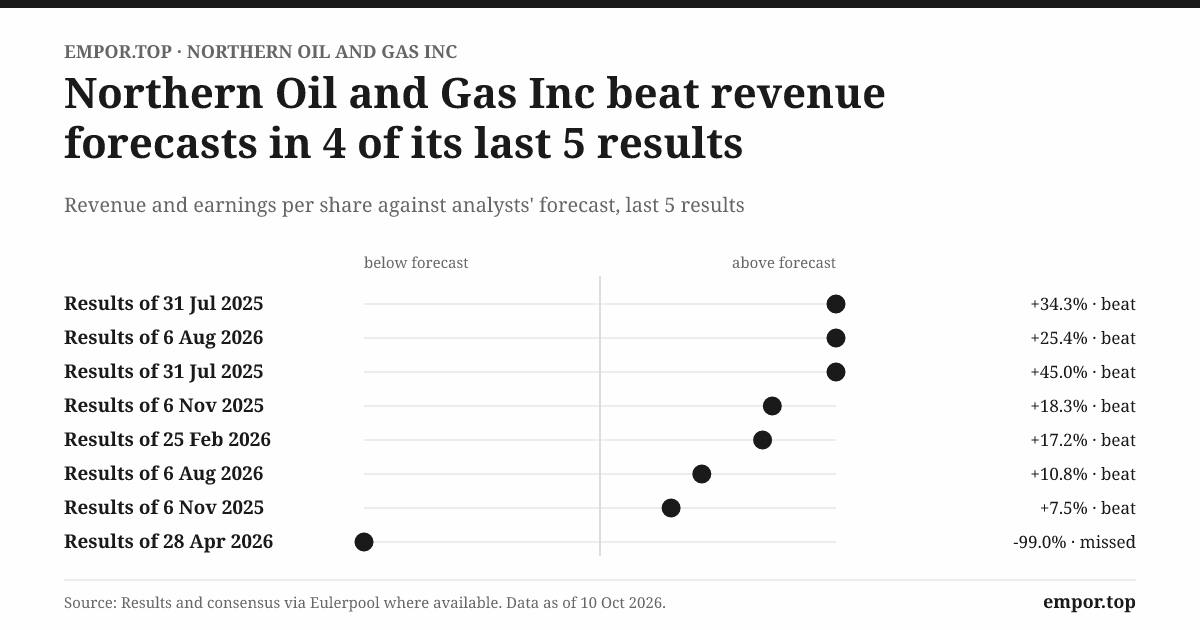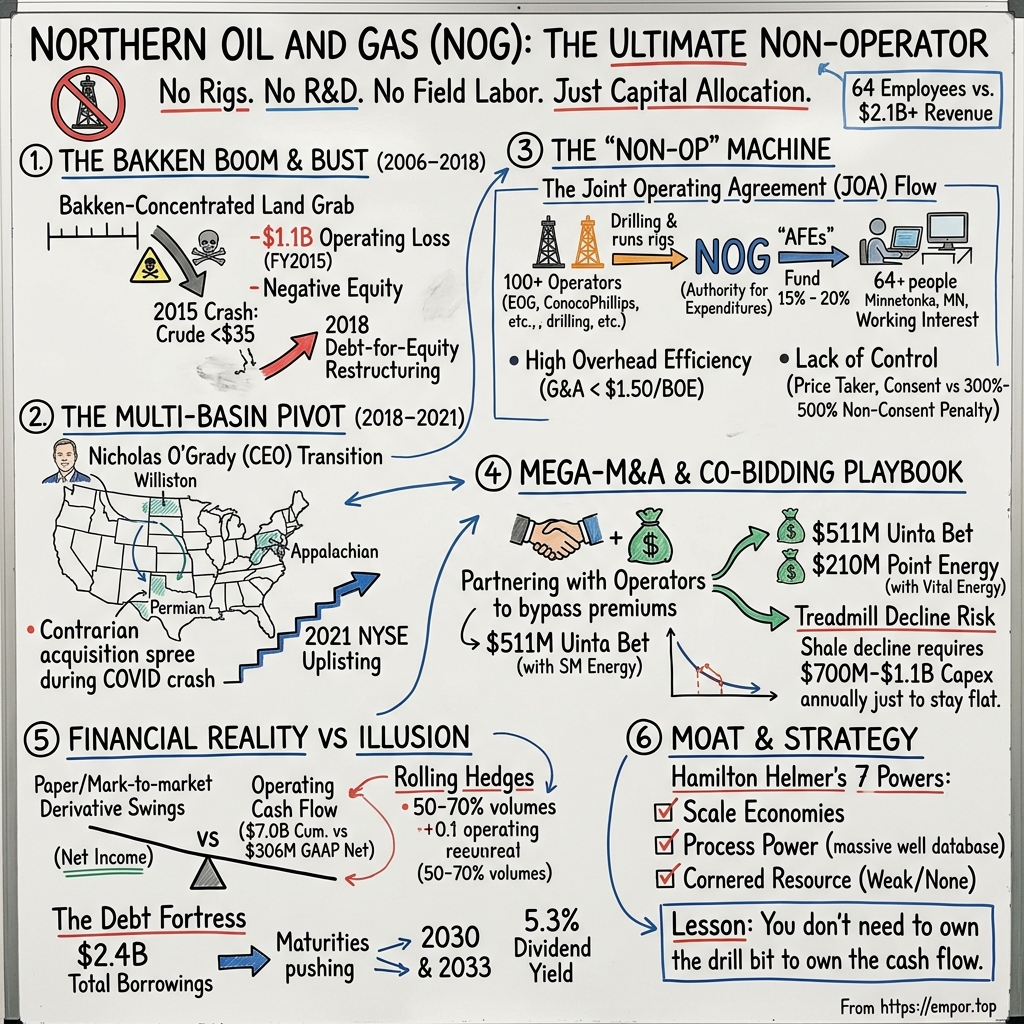
Northern Oil and Gas: The Ultimate Non-Operator
I. The $33 Million Employee
Picture a suburban office park in Minnetonka, Minnesota, the kind of low-slung building where you might expect to find a regional insurance broker or a medical-device startup. There are no derricks on the lawn, no pipe stacked in the yard, no fleet of white pickups with company logos idling outside. Inside, a few dozen people sit in front of screens covered in production curves, cost estimates and hedge schedules. From that room they direct a business with an enterprise value of about $5.2 billion, spread across four of the most important shale basins in the United States.1 They do not own a drilling rig. They never have.
That is Northern Oil and Gas, ticker NOG on the New York Stock Exchange, and on paper it looks like a typo. At the end of 2025 the company employed 64 people.17 In the same year it booked roughly $2.1 billion of revenue from oil, natural gas and natural gas liquids.2 Divide one by the other and each employee is responsible for more than $33 million of sales, a figure that would embarrass most software companies, let alone an oil producer. A supermarket in an American suburb has more staff. Yet NOG owns a slice of more than 10,000 gross producing wells, from the wheat country of North Dakota to the deserts of West Texas and the high plateaus of Utah.2
The trick is a business model that most people outside the oil patch have never heard of. NOG is a non-operator. It buys minority working interests in oil and gas wells that other companies drill and run. When an operator such as EOG Resources or ConocoPhillips plans a new well, NOG pays its share of the cost, often somewhere between a few percent and a quarter of the bill, and in return it receives the same share of the oil and gas that comes out of the ground.2 The operator hires the crews, rents the rigs, fights with the weather and answers to the regulators. NOG writes cheques and collects barrels.
Seen from one angle, this is the cleanest way ever devised to own American shale. No field labour, no rig contracts, no fleet, no yards, and a team that can look across more than a hundred operators and pick which wells to fund.2 Seen from another, it is a company that has outsourced its destiny. NOG cannot decide when a well gets drilled, how fast it is completed, which service company pumps the frac, or whether a field gets shut in when prices fall. It is a passenger in someone else's car, albeit one with an unusually good map.
That tension is the spine of this story. Is NOG an asset-light capital allocation machine that cherry-picks the best returns in shale, or a financial syndicate that carries about $2.4 billion of debt while having no control over the pace of the drilling that pays for it?2 The answer matters because the company has grown into one of the more widely held mid-cap energy names, with big index managers such as BlackRock and Vanguard among its largest holders.4
There is a second puzzle buried in the accounts, and it is even stranger. Add up every year of reported net profit from 2014 to 2025 and NOG earned about $306 million in total.23 Over the same twelve years, cash generated by its operations came to roughly $7.0 billion. Operating cash flow was more than twenty times net income. Part of that gap is the ordinary arithmetic of an oil producer, whose largest expense, the depletion of wells already paid for, never touches the bank account. Part of it is a decade of brutal accounting write-downs. And part of it is a hedging book whose paper gains and losses swing the income statement so violently that reported earnings have become close to useless as a guide to the business.
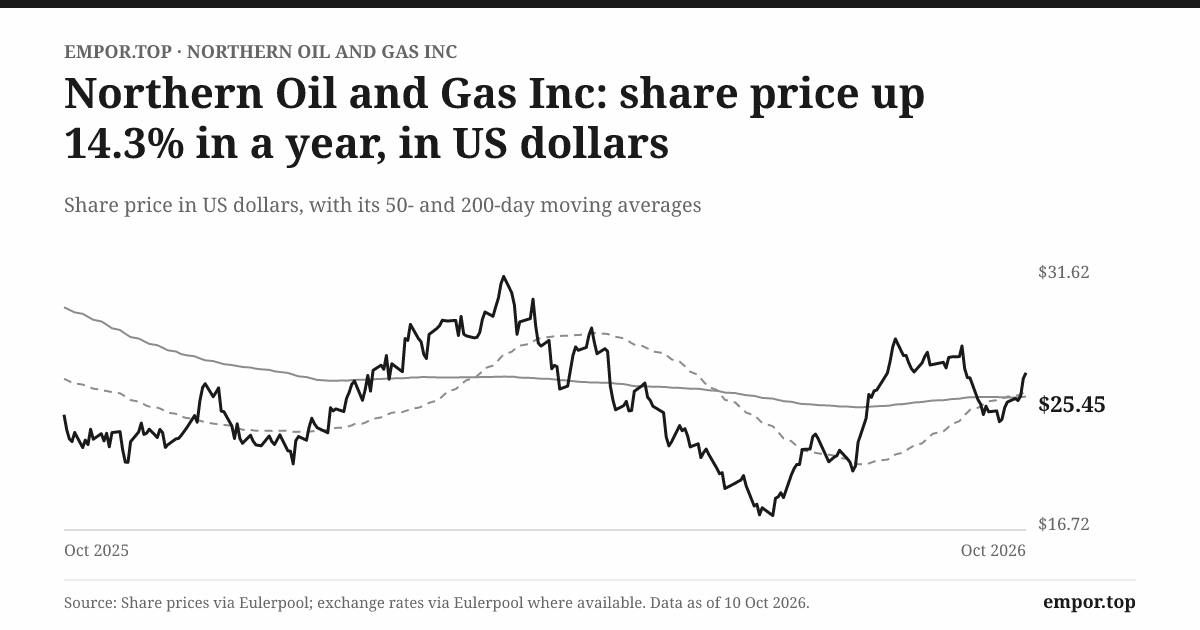
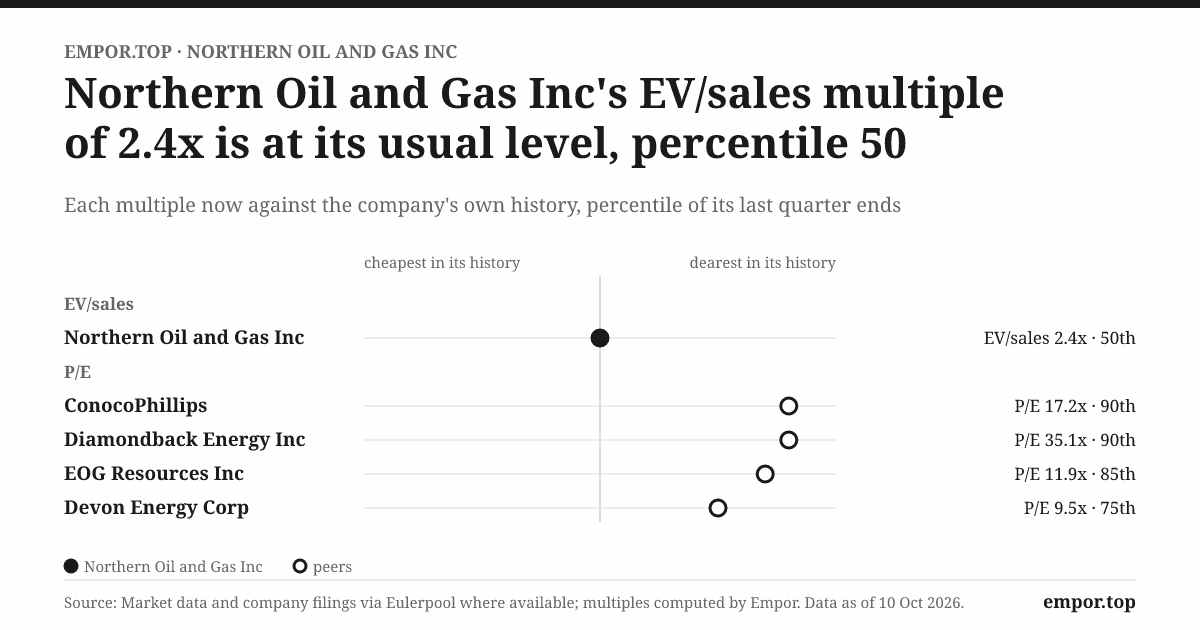
So the market looks at NOG and sees two different companies. On a trailing earnings basis the stock looked expensive at the end of 2025, trading on 55 times earnings against a five-year median of about 5 times.2 On an enterprise-value-to-operating-profit basis, it trades on a little over 7 times. As of October 10, 2026, the shares sit at about $25, roughly 17% below their 52-week high, and pay a dividend yielding around 5.3%.1 Which of those numbers tells the truth is the question an investor has to answer.
To answer it, the story has to start where NOG started: as a land-grabbing wildcatter in North Dakota that nearly drowned in its own debt.
 Subscribe on LinkedIn
II. Boom, Bust, and the Full-Cost Graveyard (2006–2018)
In December 2015 the price of a barrel of West Texas Intermediate crude slipped below $35. In the Bakken, the oil field that had turned North Dakota into a boomtown, rigs were being stacked in yards and man camps were emptying. For Northern Oil and Gas, the year's accounts read like a casualty report. The company recorded an operating loss of about $1.1 billion and a net loss of roughly $975 million, on revenue that had fallen by more than half to about $200 million.3 Against that collapsing income stood about $850 million of borrowings.3
To understand how a small Minnesota company got into that position, rewind to the mid-2000s. Horizontal drilling combined with hydraulic fracturing had just begun to unlock the Bakken shale, a thin layer of oil-soaked rock two miles beneath the plains of western North Dakota. A young entrepreneur named Michael Reger, whose family had dealt in oil leases for generations, co-founded Northern Oil and Gas around a simple and rather clever idea.1 Instead of competing with the big operators to run wells, Northern would buy scraps of leasehold acreage inside the areas the operators were about to develop.
The cleverness lay in how North Dakota organises drilling. Wells are drilled in spacing units, blocks of land that may contain dozens of separate leaseholders. When an operator wants to drill a unit, every owner of a working interest inside it is invited to participate and pay their share. If a small owner refuses, state rules and the joint operating agreements that govern each unit let the operator proceed and recover a multiple of the owner's share from future production before the owner sees a cent. So a company that owned the right fragments could effectively ride along with the best drillers in the basin, without ever hiring a roughneck.2
For a few years it worked beautifully. Northern grew as fast as the Bakken itself, and by 2014 it was earning over $160 million a year in net profit on revenue of about $430 million.3 But the model contained two hidden flaws that the boom concealed. The first was concentration: every acre the company owned sat in one basin, priced off one set of pipelines, exposed to one set of regional discounts. The second was leverage. The company had funded its land banking with fixed-coupon senior notes and a bank revolver, so its interest bill did not care what oil was worth.
When oil crashed from over $100 in mid-2014 to the $30s by the end of 2015, both flaws went off at once. Revenue halved. And then a quirk of oil-industry accounting turned a painful downturn into a balance-sheet catastrophe.
The ceiling falls in
Northern used what is called full-cost accounting. Under that method, a company capitalises all of its exploration and development spending into one big pool on the balance sheet. Each quarter, the SEC requires it to run a ceiling test: compare that pool with the discounted value of its proved reserves, priced using the average of the previous twelve months' oil prices. If the pool is bigger than the ceiling, the excess must be written off immediately, and it can never be written back.
Think of it as being forced to revalue your house every quarter based on what similar houses sold for over the past year, and to record any shortfall as a permanent loss, even if prices recover next spring. When oil fell by more than half, Northern's ceiling collapsed, and the write-downs followed: the billion-dollar operating loss of 2015, followed by another loss of more than $220 million in 2016.3 Book equity, about $770 million at the end of 2014, had swung to a deficit of roughly $490 million by the end of 2017.3 On paper, the company owed more than it owned.
Here is the important twist. Through all of this, the business kept generating cash. Cash from operations was about $250 million in 2015 and still around $100 million in 2016.3 The wells kept flowing; the problem was that the company's capital structure had been built for $90 oil, and the ceiling test had erased the accounting cushion that lenders relied on. Ceiling tests did not kill Northern. The calendar of its debt maturities very nearly could have.
The rescue took the shape of a recapitalisation in 2017 and 2018, in which a group of noteholders swapped part of the company's unsecured debt for new secured notes and common stock, and fresh equity came in.3 Reger had stepped away in 2017, and a new board took control, chaired by Bahram Akradi, the founder of the Life Time fitness chain and a major personal investor in the company.3 The effect was visible in the 2018 accounts: shareholders' equity was positive again at about $430 million, and the company reported a net profit of roughly $140 million.3
What did this decade teach? The tempting story is that Northern was simply unlucky with commodity prices. The record says something more specific. Other Bakken players suffered the same price crash; the companies that came closest to the edge were those with concentrated acreage and heavy fixed debt. Northern had both. The non-operated model itself survived the bust with its cash generation intact. It was the combination of a single basin and a balance sheet built for boom times that broke. That lesson would shape every strategic decision the next management team made, and it would be tested almost immediately, because the next crash was only two years away.
III. Nicholas O'Grady and the Multi-Basin Pivot (2018–2021)
In January 2020, Nicholas O'Grady became chief executive of Northern Oil and Gas.4 He had joined the company as chief financial officer only the previous year, and he did not look like a typical oil boss. O'Grady came from Wall Street, where he had spent years as an energy analyst and investor at hedge funds and an investment bank, studying the very kind of upstream credit and equity situations he now had to manage.15 He spoke the language of returns on capital, discount rates and distressed debt more fluently than the language of drilling rigs. Alongside him, Adam Dirlam, a long-time Northern land and operations executive who would later become president, ran the business of evaluating wells.4
Weeks after O'Grady took the job, the world shut down. In April 2020 the May WTI futures contract briefly traded at negative prices, as storage tanks filled and traders paid people to take oil off their hands. For a company whose revenue is barrels multiplied by price, it was the purest form of nightmare. Northern's revenue fell by nearly half in 2020 to about $324 million.3 Another round of ceiling-test write-downs drove a net loss of roughly $906 million, and shareholders' equity again went negative.3
And yet, once again, the cash told a different story. Cash from operations in that terrible year was about $330 million, almost the same as the year before.3 Part of the reason was hedging: the company had locked in prices for much of its production before the crash, so the derivatives paid out as the market collapsed. Part of the reason was the model itself. With no rigs to idle and no field crews to lay off, Northern's costs simply shrank alongside activity. The pandemic year showed the non-operated structure at its most resilient, even as the accounts showed it at its most battered.
Buying the panic
O'Grady's central insight was that remaining a pure Bakken company was a slow death sentence. The basin was maturing, its best locations were being drilled out, and its oil sold at a discount because of distance from the coastal refineries. If Northern wanted a future, it needed to own wells where the rock and the economics were better, which meant the Permian Basin in Texas and New Mexico, and the natural gas fields of Appalachia.15
The timing turned out to be the opportunity. In 2020 and 2021, operators and private equity sponsors across shale were desperate for cash. Many owned non-operated interests they had picked up as part of larger deals, minority stakes in wells run by someone else, which tied up capital without giving them control. Selling those stakes to Northern let them fund their own drilling programmes or repair their balance sheets. Northern, with a team built to underwrite exactly these packages, became a natural buyer.15 The company began stringing together acquisitions of Permian and Marcellus non-operated interests, funded through a combination of new equity, convertible notes and debt.2
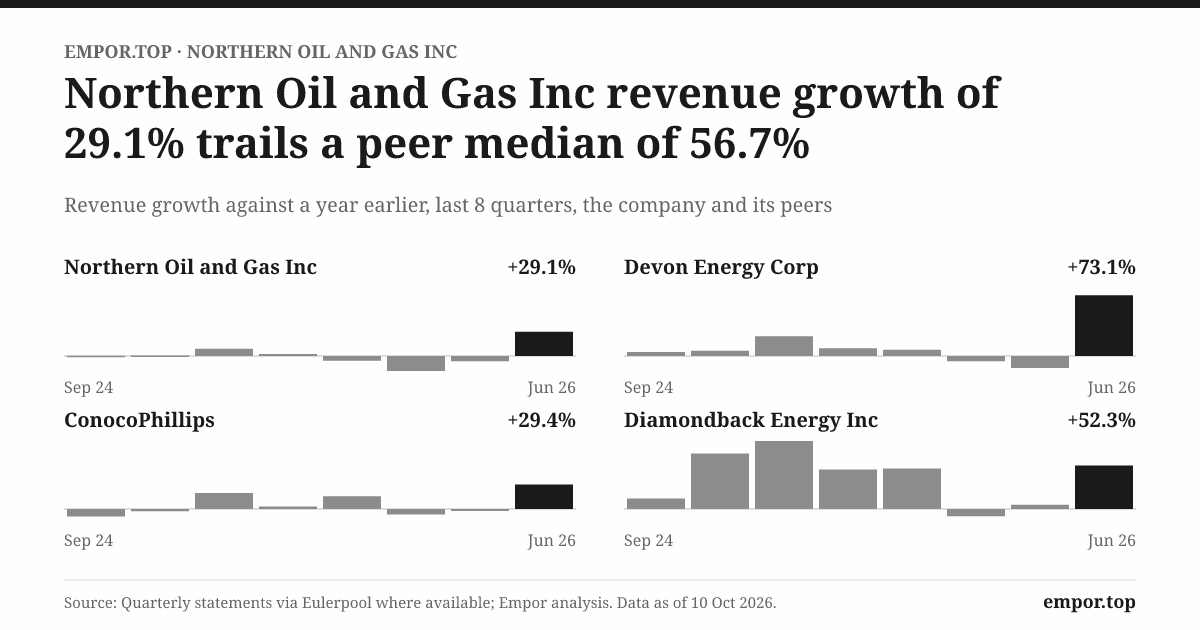
The numbers that followed were dramatic. Revenue tripled in 2021 to almost $1 billion and then roughly doubled again in 2022 to about $2.0 billion, helped enormously by the post-pandemic price spike and Russia's invasion of Ukraine.3 Net profit in 2022 was about $770 million.3 Over the five years from 2020 to 2025, revenue grew at about 45% a year.2
It is worth being careful about what those numbers prove. A large part of the growth came from buying production and from a once-in-a-decade price surge, not from organic improvement. The test of O'Grady's strategy is not that revenue went up from a pandemic trough; any oil company's revenue did that. The test is whether the acquired assets earned more than they cost. That question runs through every later chapter of this story.
Along the way, the company also tidied its corporate presentation. A 1-for-10 reverse stock split in 2020 consolidated a share count swollen by the restructuring, which is why historical per-share losses look so enormous in today's data, and in 2021 Northern moved its listing from the NYSE American to the main board of the New York Stock Exchange.1 The move was symbolic but useful: the main board brought the company onto the radar of larger mutual funds and index providers, which is how BlackRock and Vanguard ended up as two of its largest holders.4 The company also began paying a dividend in 2021 for the first time.2
By 2022, Northern was no longer a Bakken land banker. It was a multi-basin capital provider with a Wall Street mindset. To see whether that mindset could actually make money without controlling the drill bit, it helps to walk through what happens on an ordinary Tuesday in Minnetonka.
IV. Anatomy of the Non-Op Machine: Economics, Joint Operating Agreements, and JIBs
An envelope, these days usually an email, arrives at Northern's office. It is an Authority for Expenditure, the oil industry's equivalent of a formal invoice-in-advance. An operator, perhaps a large Permian producer, is proposing to drill a pad of new horizontal wells. The document sets out the planned depth, the length of the horizontal sections, the completion design and the estimated cost, and it tells Northern what its share of that cost will be. Northern then has a fixed window, typically about a month under most joint operating agreements, to decide: pay in and take its share of the wells, or decline.2
That decision is the beating heart of the company. Everything else is administration.
How the money comes in
Start with revenue, because it is refreshingly simple. NOG has no subscription contracts, no long-term customers to win and no products to design. Its revenue equals the volume of oil, gas and natural gas liquids its share of the wells produces, multiplied by the price those barrels and cubic feet fetch.2 That price is set by the market: the benchmark WTI price for crude, the Henry Hub price for gas, published indices for natural gas liquids, each adjusted for the cost of moving the product from the wellhead to the market hub.2 NOG is a price-taker in the purest sense. It cannot raise prices, cannot discount to win share, and cannot differentiate its barrel from anyone else's.
The buyers are midstream companies, pipeline operators and commodity marketers, usually chosen by the operator of each well.2 The company states that no single purchaser is so important that losing it would materially harm the business, because substitute buyers are readily available for a fungible commodity.2 Cash arrives quickly. Debtor days, the measure of how long receivables sit before being collected, were about 64 in 2025, which is long by the standards of a retailer but normal in an industry where production is paid for a month or two in arrears.2 There is no inventory to speak of, because oil is sold the moment it enters the pipe.
The choice inside the AFE
Now return to that Authority for Expenditure. If Northern consents, it pays its share of drilling and completion, and later receives monthly Joint Interest Billings, the bills operators send to each partner for ongoing costs such as lease operating expenses, maintenance and workovers.2 If it declines, the joint operating agreement generally lets the operator drill anyway and recover a penalty multiple of Northern's share out of production before Northern participates again. The exact penalty depends on the agreement and the state, but it is designed to be punitive enough that declining is a real economic choice rather than a free option.
This is where the analysts in Minnetonka earn their keep. Because Northern sits in thousands of wells operated by more than a hundred companies, it has an unusual dataset: what wells of a given design, in a given area, by a given operator, have actually cost and produced.15 When a new AFE arrives, the team can compare the operator's estimate with history and decide whether this particular well clears its return hurdle. Management describes this as its core competence, the ability to say yes to the best proposals and no to the rest.15 That is a management claim, and later chapters will test it.
The overhead asymmetry
The other half of the economics is what Northern does not spend. Operating producers carry engineers, field supervisors, technicians, regulatory staff and safety teams, and many carry rig and equipment commitments. Northern carries a few dozen employees and an office lease.2 It spends nothing on research and development. Its general and administrative cost per barrel of oil equivalent is among the lowest of any public producer, a point the rating agencies explicitly praise.12 The cash consequence showed up clearly in 2025, when cash from operations was about 143% of EBITDA: the company turned more than every dollar of accounting earnings before interest and depreciation into operating cash, helped by working-capital movements and the timing of hedge settlements.2
What Northern cannot do
The flip side is just as stark. Northern cannot pick the completion crew. It cannot negotiate directly with the frac-sand supplier or the rig contractor, so when service costs inflate, it pays whatever the operator pays. It cannot audit every line of a Joint Interest Billing in real time. And it cannot force an operator to complete a well that has been drilled but left uncompleted, a so-called DUC, if the operator decides to wait for better prices or redirect its rigs elsewhere.12 Its production profile is, in a very real sense, the aggregated whim of a hundred other companies' capital budgets.
So the verdict on the machine is two-sided. The structure captures commodity upside with almost none of the fixed costs that sink operators in downturns, and it can choose among many proposals rather than being stuck with one company's inventory. But it is legally and economically a follower. Whether that following produces superior returns depends entirely on two things: how well the team chooses, and how much it pays for the right to choose. The second question became the defining debate of the company's recent history, because from 2022 onward, Northern went on a shopping spree.
V. The M&A Playbook: The $511 Million Uinta Bet and Co-Bidding Partnerships
In the summer of 2024, a deal came together that captured the new Northern perfectly. XCL Resources, a private producer in Utah's Uinta Basin, was for sale. The Uinta is an unusual oil province: its waxy crude solidifies at room temperature and must travel by heated rail or truck to refineries, which has kept many large buyers away and prices for acreage lower. SM Energy, a mid-sized Denver operator, wanted the assets but did not want to swallow the whole price alone. So it brought a partner. In June 2024 the two companies announced a joint acquisition valued at about $2.55 billion, in which SM Energy would take 80% and become operator, while Northern took an undivided 20% stake for about $511 million.1610 The deal closed in October 2024.6
A few months earlier, Northern had run the same play in the Delaware Basin of West Texas, joining Vital Energy to buy Point Energy Partners, with Northern paying about $210 million for its share.5 In both cases, an operator got the asset it wanted at a size its balance sheet could carry, and Northern got a slice of a large, coherent package without having to compete as an operator in an auction.
Why operators invite a silent partner
This is the newest and arguably most interesting chapter of the non-operated model. Northern is not only buying scraps of acreage; it is acting as a co-underwriter for corporate-scale deals. For a mid-cap operator, the attraction is obvious. Issuing shares to fund a large purchase dilutes existing holders; borrowing heavily worries the rating agencies. Bringing in Northern as an equity-like partner solves both problems, because Northern pays cash for its share and asks for nothing in return except a fair slice of the production and the right to participate in future wells.9 Management has argued on earnings calls that this lets the company buy at what it calls wholesale prices, avoiding the premiums paid in contested auctions.9
Is the claim true? Management has described its purchase prices in these joint deals as low multiples of expected near-term cash flow, typically around three times next-year EBITDA for assets weighted toward already-producing wells.8 Publicly traded operators have often changed hands at materially higher multiples, though comparisons are slippery because corporate deals include undeveloped inventory, staff and infrastructure that Northern does not buy. The fair reading is that Northern appears to buy cheaply relative to the market for whole companies, but this is a comparison management chooses and frames.
The money trail
The cleaner test is cash. From 2022 through 2025, Northern spent between roughly $1.3 billion and $1.9 billion a year on investing activities, peaking in 2023.23 Over the full twelve years from 2014 to 2025, free cash flow, operating cash minus capital spending, came to about minus $2 billion in total. In that same span, the company paid out about $560 million in dividends.2 Combine the negative free cash flow with the dividends and you arrive at roughly $2.6 billion that had to come from somewhere other than the business's own cash generation. It came from debt and new shares. Borrowings rose from about $800 million at the end of 2021 to about $2.4 billion at the end of 2024.2
That does not mean the acquisitions destroyed value. Production and operating cash flow rose substantially; operating cash flow went from about $400 million in 2021 to about $1.5 billion in 2025.2 But it does mean that the growth was bought, not earned from internal cash. Free cash flow only turned positive in 2025, at about $250 million, when acquisition spending slowed.2
The treadmill underneath
There is also a structural reason for the cash drain, and it is the most important fact about shale. A new horizontal shale well produces most of its oil in its first couple of years; output commonly falls by well over half in the first year. That means a shale producer, operated or not, must keep drilling just to stand still. Northern's capital spending on drilling and completion has run in a range of roughly $700 million to $1.1 billion a year in recent years, and a large part of that simply replaces depleting production.2 Acquisitions are another way to refill the bucket.
So the verdict on the M&A playbook is narrower than either bulls or bears would like. The co-bidding model is a genuine innovation, and the record of the past few years suggests operators value Northern as a partner. But the history does not yet prove per-share value creation, because the company has needed outside capital to fund nearly every expansion, and the payoff depends on whether assets like the Uinta perform as underwritten. That record will be written in the next two years of production reports. In the meantime, the income statement has been throwing up numbers so strange that they deserve their own explanation.
VI. The Mirage of Net Income: Derivatives, Cash Reality, and the 2,297% Ratio
Imagine reading the first-quarter 2026 results in a hurry. Northern reported revenue of about $544 million and a net loss of roughly $520 million, a net margin of minus 96%.2 A screen built on reported earnings would conclude that the company was burning money at an alarming rate. Over the twelve months to June 2026, the company reported a cumulative net loss of about $485 million.2 Yet over the full year 2025, cash from operations had come in at about $1.5 billion, the highest in the company's history.2
How can a company lose half a billion dollars in a quarter while generating more cash than ever? The answer lies in the hedging book, and in one accounting rule.
The paper storm
Northern, like most leveraged producers, hedges a large share of its expected future production. It enters into swaps, collars and similar contracts that lock in a price for barrels and gas it has not yet produced. Management's practice has been to hedge a substantial portion of its expected production from existing wells, typically in the range of half or more, over the following one to two years.2 If oil falls, the hedges pay; if oil rises, the hedges cost money, but the physical barrels are worth more.
Under the US accounting standard for derivatives, Northern does not use hedge accounting, so every open contract is marked to its current market value at the end of every quarter, and the change in that value runs straight through the income statement.2 When oil prices jump, the open hedges, which promise to sell oil at the old lower price, lose value on paper, and the company books a large loss. The barrels those hedges cover have not even been produced yet, and no cash has changed hands. When prices fall, the reverse happens and the company books a large paper gain.
That is what happened in early 2026. A rise in the forward price of oil inflated the value of the oil Northern had yet to produce, which does not appear on the income statement at all, while deflating the value of the hedges, which does. The company reported a big loss on paper while its underlying position barely changed. In 2023, by contrast, net margins of nearly half of revenue were flattered by the opposite effect.3 Unrealised derivative movements of a couple of hundred million dollars in a single year have been routine.2
The cash underneath
Strip out the paper marks, and the accounting fog thins. Over the twelve years to 2025, cumulative cash from operations of about $7.0 billion was roughly 23 times cumulative net income of about $300 million.2 Three things explain that gap. The first is depletion: the cost of wells already paid for is charged against earnings over their lives but never leaves the bank account a second time. The second is the ceiling-test write-downs of 2015, 2016 and 2020, which together erased well over $2 billion of book value without costing a dollar of cash.3 The third is the derivative marks just described.
That does not make reported earnings irrelevant in every sense. The cash hedge settlements are real. In periods of weak prices, such as the soft patch in late 2025, settled hedges paid cash into the company even as unhedged revenue fell, which is exactly what they are for.9 And when prices rise above strike prices, settled hedges become a genuine cash drain, which is the price of protection. Operating profit itself, which excludes the derivative marks, fell substantially from its 2023 peak as prices for natural gas and oil softened, so the decline in underlying profitability is not purely an accounting fiction.2
What the screens get wrong
This explains why valuation screens disagree so violently about the company. At the end of 2025, the trailing price-to-earnings ratio was about 55, against a five-year median of about 5.2 Enterprise value to operating profit was a little over 7. EV to EBITDA showed about 16 times on the latest data, distorted by the same derivative losses that pass through EBITDA as calculated by data providers; historically the company has traded on something closer to four to five times normalised cash earnings.2 None of these is the true number. An investor who wants to value Northern has to rebuild the cash picture: production, realised prices including settled hedges, operating costs, capital spending.
The verdict here is about as firm as anything in the story: reported net income is a poor guide to Northern's economics, and anyone using it to value the company is mostly measuring the oil futures curve. But that very conclusion pushes the analysis somewhere less comfortable. If the business is really about cash, the next question is whose claim on that cash comes first. And the answer is the lenders.
VII. The $2.4 Billion Debt Fortress vs. High-Yield Speculation
In October 2025, Northern's treasury team executed the kind of transaction that keeps chief financial officers awake for weeks. The company sold $725 million of new senior notes paying 7.875% and due in 2033, and used the money to buy back most of its 8.125% notes due in 2028.11 The remaining 2028 notes were redeemed in early 2026.7 A month later, it extended its revolving bank facility to 2030, and in February 2026 the banks set the borrowing base at about $1.975 billion, with $1.8 billion of commitments the company chose to take.7
The architect of these moves was chief financial officer Chad Allen, a former investment banker who had joined O'Grady's team and taken over the finance chair after O'Grady moved up.4 The point of the exercise was simple. The 2028 maturity had been the nearest large wall the company faced. By moving it to 2033, at a slightly lower coupon, and pushing the bank line to the end of the decade, Northern bought itself years of breathing room.
How the debt got here
Recall where the company stood after the pandemic: borrowings of about $800 million at the end of 2021.2 By the end of 2024, after the Permian, Appalachian, Point and Uinta deals, that figure had tripled to about $2.4 billion, where it stayed through 2025.2 Equity grew faster over the same period, helped by share issuance and retained earnings, so debt-to-equity actually improved from about 2 at the end of 2022 to about 1.1 at the end of 2025.2 Leverage relative to cash earnings, the measure lenders care about most, has been held in a range management describes as comfortably within its target.9
For a company that nearly drowned in 2015 with less than $1 billion of debt, $2.4 billion sounds terrifying. The difference is the asset base and the cash flow behind it. In 2015, revenue was about $200 million against $850 million of borrowings. In 2025, revenue was about $2.1 billion and operating cash flow about $1.5 billion against $2.4 billion of borrowings.2 Debt has grown to roughly three times its 2015 level; operating cash flow has grown about six times. The ratio is far healthier.
What the rating agencies see
The three rating agencies all place Northern in speculative grade, but at the upper end. Moody's upgraded its rating to Ba3 in March 2025.13 Fitch upgraded the company to BB- in 2025 and affirmed that rating in July 2026 with a stable outlook.12 S&P has it a notch lower at B+.14 Read side by side, their reasoning is remarkably consistent. They praise the low overhead, the diversification across four basins, the disciplined hedging and the steady free cash flow. They mark the company down for exactly the things this story has been circling: lack of operational control over well timing, an acquisitive strategy, and the absolute size of the debt.1214
Those ratings matter in practice. A step up into the BB band lowers the cost of every future refinancing, which, for a company that relies on debt to fund growth, flows straight to shareholders. A step down would do the opposite.
Can the dividend survive a slump?
Then there is the dividend. Northern paid nothing to shareholders before 2021. By 2025, it paid about $173 million a year.2 At today's share price, the yield is around 5.3%.1 Against 2025's reported net profit of about $38 million, the payout ratio looks absurd, over 450% of earnings.2 Against free cash flow of about $250 million, it is covered, but not by much.2
The real stress test is a long period of low oil prices after the current hedges roll off. Hedges protect one to two years of cash flow, not a decade. If prices stayed weak beyond that horizon, the company would have to choose between capital spending to hold production, debt reduction and the dividend. History suggests the debt comes first: the 2015 crisis was a debt crisis, not a dividend crisis, and the new management team has built its reputation on not repeating it. The maturity extensions have largely removed the near-term refinancing risk. They have not removed the commodity risk, which is precisely why the agencies stop short of investment grade.
Debt and dividends describe how Northern distributes its cash. They do not explain whether the cash will keep coming. For that, the question is whether the company has anything resembling a moat.
VIII. Moat, Power, and the Operator Asymmetry
An AFE arrives from a top-tier operator proposing a multi-well pad in Lea County, New Mexico, in the heart of the Delaware Basin, with horizontal sections stretching three miles underground. The operator's cost estimate runs into the tens of millions of dollars for the pad. Northern's analysts pull up their own records of similar wells drilled by the same operator and by its neighbours, compare the proposed cost per foot with what comparable wells actually cost, and estimate how much oil similar laterals have actually recovered.15 Within hours, the team has a view. Most of the time, management says, it consents; sometimes it does not.8
Is that capability a moat? It is worth testing the claim properly, using the two frameworks investors most often reach for: Hamilton Helmer's seven powers, which ask what lets a business earn persistently above-average returns, and Michael Porter's five forces, which ask who in an industry captures the profits.
Seven powers, tested
Start with scale economies. Northern is the largest publicly traded pure non-operator, and its size lets it write cheques of a few hundred million dollars for joint acquisitions that small private non-operators cannot touch.56 That scale also spreads its fixed corporate costs very thinly. This is a real power, but a partial one: large private equity funds and family offices can and do write cheques of similar size, and nothing stops them from doing so.
Process power is the claim management leans on hardest: the data from thousands of wells and the institutional skill to underwrite AFEs and acquisitions better than rivals.15 There is evidence for it. The company's cost per barrel is very low, and operators keep inviting it into deals. The disconfirming evidence is that the returns record is short and heavily influenced by commodity prices. Return on capital employed was about 34% in 2022 and fell to about 5% in 2025 on the company's reported figures, a slide driven mostly by prices and derivative accounting rather than underwriting.2 On a trailing twelve-month basis to June 2026, it stood at about 14%.2 Process power is plausible, but unproven across a full cycle.
Counter-positioning is present. A large operator cannot easily adopt Northern's model, because its whole identity and cost base are built around running rigs and field operations; selling minority stakes to Northern is often more attractive for it than copying Northern. That is a genuine structural reason why the niche exists.
The other powers are weak or absent. Northern holds no cornered resource: the rock belongs to mineral owners and leaseholders, and the operators control the licences, crews and schedules. There are no switching costs: pipeline buyers purchase fungible barrels on standard terms.2 There are no network effects and no brand in any meaningful sense.
Five forces, tested
Porter's lens sharpens the picture. Buyers have little power over Northern because they buy a global commodity with plenty of alternative sellers, but that is cold comfort, because the commodity price itself is set by the world, not by Northern. The threat of new entrants is moderate: building a four-basin portfolio takes billions, but private non-op funds compete aggressively for smaller packages. The threat of substitutes, in the form of the energy transition, is real over decades but limited over a five-year horizon.
The force that matters most is supplier power, and here Northern's suppliers are its operators. They decide timing, choose service providers, set completion designs and send the bills. Northern has contractual audit rights under the joint operating agreements, but in practice it accepts most billings and disputes only at the margin.2 When an operator decides to slow down, Northern's production slows with it. That is severe supplier power in any framework.
On rivalry, Northern sits between two kinds of competitor. Mineral and royalty companies such as Viper Energy own interests that bear no drilling costs at all and trade at higher multiples. Operated peers such as Chord Energy in the Bakken or SM Energy control their own destiny but carry far heavier overhead.2 Northern's place between them is distinctive, but it is not protected.
The calibrated verdict: Northern has a narrow moat built from scale in its niche, underwriting process, and a structure that operators cannot easily copy, but it lacks the deep powers that let a business earn high returns through the cycle regardless of conditions. Its advantage is renewed one deal and one AFE at a time. That makes the quality of its managers, and how they are paid, unusually important.
IX. Executive Credibility, Remuneration, and the Skeptical Investor Stress Test
In April 2026, Northern's shareholders received the company's definitive proxy statement, the annual document in which a board explains how and why it paid its executives.4 The headline figure was a decline. Nicholas O'Grady's total compensation for 2025 came to about $5.6 million, down roughly 31% from about $8.1 million the year before.4 His package included a base salary of $925,000, about $2.8 million in stock awards and about $1.6 million in cash incentive pay.4 President Adam Dirlam received about $3.0 million and CFO Chad Allen about $2.0 million.4
The board's stated design ties a large share of executive pay to returns on capital and to shareholder returns relative to peers, rather than to production growth.4 That choice matters in an industry where many companies spent the 2010s paying executives for volume, which rewarded drilling more wells at worse returns. A pay plan built on returns is the right shape for a capital allocator. Whether it binds tightly is a separate matter: return-based metrics in oil swing heavily with commodity prices, which no executive controls.
Shareholders have consistently approved the pay plans, with say-on-pay votes passing at the annual meetings by large majorities.18 The governance record is otherwise clean. There is no controlling shareholder, no sponsor collecting monitoring fees, and the company has disclosed no material related-party transactions in recent years.4 Deloitte has issued unqualified audit opinions.2 Insiders own a small slice of the company, about 2.5% according to ownership data, which is meaningful in dollar terms for the individuals but far from control.4
What a skeptic would push on
A skeptical long-short investor would not dwell on governance. The challenge would come on three fronts.
The first is dilution. The multi-basin expansion was paid for partly with new shares and convertible securities.2 The share count today is many times what it was before the restructuring, and a share issued at a low price in the post-pandemic years transferred value from older holders to new ones. The skeptic would ask management to show that production, reserves and cash flow per share, not in aggregate, have grown since 2020. That is the measure that matters, and it is the one management's own pay scheme should be judged against.
The second is the free cash flow gap. A single positive year, 2025's roughly $250 million, follows more than a decade in which the company consumed about $2 billion more than it generated.2 Management argues that the heavy spending years were investments that are now paying off. The skeptic replies that the company has said similar things before, and that the turn to positive cash came largely because acquisitions slowed. If deal activity resumes, the cash could vanish again.
The third is capital discipline. On recent earnings calls, management has repeatedly described itself as disciplined and opportunistic, willing to buy when prices are attractive and to step back when they are not.9 The record is consistent with that in part: the company did slow its acquisitions in 2025. But the history of the past four years is also a record of near-continuous deal-making. The real test of the claim is whether management chooses to use the next strong year to pay down debt rather than to buy another basin.
The verdict on management is that it is competent, transparent and has handled the balance sheet with notably more care than the company's previous era. The claim of superior per-share capital allocation is plausible but not yet proven by the long record, and it depends heavily on what comes next. Which brings the story to the argument investors are actually having about the stock.
X. Bull vs. Bear Case & What to Watch
Imagine a breakout room at an energy investment conference, the coffee going cold, two camps facing each other across a table. On one side, income investors point to a dividend yield of about 5.3% and operating cash flow of about $1.5 billion a year.12 On the other, short sellers point to $2.4 billion of high-yield debt and a trailing twelve-month net loss of nearly half a billion dollars.2 Both camps are reading the same company. They are just reading different lines.
The case for
The bull argument starts with cost. No other public producer runs a footprint this size with this few people, and the low overhead means that, in a downturn, Northern's cash costs fall with activity rather than staying fixed.2 The bull case continues with partners. Northern's wells are drilled by many of the best operators in American shale, which means it rides on their engineering and their scale of purchasing without paying for their staff.2 Then comes hedging: by locking in prices on a large share of expected production, the company makes its debt service and dividend predictable over the next year or two.2 And finally, flexibility. Because Northern is not tied to rigs or field offices, it can shift capital among the Williston, the Permian, Appalachia and the Uinta depending on where proposals offer the best returns. A bull would argue that the market values this company on depressed and distorted numbers, and that once acquisitions slow and derivatives settle, the free cash flow will be obvious.
The case against
The bear argument starts with control. If operators decide collectively to slow drilling to prioritise their own free cash flow, as many did after 2020, Northern's production will decline and there is nothing it can do except buy more. The bear continues with debt: $2.4 billion leaves little room for a long price slump after the hedges roll off.2 Then comes billing: operators pass through service-cost inflation and lease operating expenses that Northern cannot easily contest. And finally, the treadmill: the steep decline of shale wells means hundreds of millions of dollars a year are needed just to stay level, so the company must keep reinvesting even when it would prefer to deleverage.
Weighing them
Both sides are right about something. The bull is right that reported earnings understate the business and that the cost structure is genuinely unusual. The bear is right that the long-run free cash flow record is negative and that the company has never had to prove its model through a prolonged slump while carrying this much debt. The 2015 and 2020 crises tested the old company and the transitional company; the current one, larger and more diversified, has not yet faced a multi-year downturn.
The market's verdict is visible in the valuation. Northern trades on lower multiples of cash earnings than royalty companies such as Viper, and broadly in line with or below operated peers, with a price around 1.3 times book value.2 That discount appears to price in both the leverage and the lack of control. What it seems to assume is that free cash flow will stay modest and that the company will keep spending to replace production.
Three measures will tell investors which side is winning. The first is lease operating expense per barrel of oil equivalent, the cost of keeping wells running, billed by operators. If it rises faster than peers' costs, the bear's billing argument is winning. The second is free cash flow after capital spending and dividends; the latest full-year reading was about $250 million of free cash flow before the roughly $173 million dividend, leaving a thin positive margin.2 The third is the proportion of operator drilling proposals that Northern elects to fund, together with the returns it reports on them, the clearest window into whether the underwriting edge is real. Management discusses this qualitatively on calls but does not publish a consistent consent-rate figure.
XI. Business & Investing Lessons
The first lesson belongs to the pandemic spring of 2020, when O'Grady's team, freshly in charge of a company with negative equity, chose to buy rather than retreat. Because Northern owned no rigs and employed no field crews, it could redirect capital from one basin to another faster than an operator could move a single drilling crew. The broader point for founders and investors is that separating the ownership of cash flows from the operation of assets can make a business more agile than its scale suggests, but only if the owner has the discipline to decide where to point the money. You don't need to own the drill bit to own the cash flow, but you do need to know which drill bit to back.
The second lesson comes from the billion-dollar write-down of 2015. Northern's book equity was wiped out, yet the wells kept producing cash and the company survived. In capital-intensive resource businesses, accounting rules built on trailing prices can declare a company insolvent while its operations remain alive, and the reverse can happen in a boom. Investors who read only the income statement would have fled at the bottom and bought at the top. Ceiling tests kill balance sheets; only cash deficits kill companies.
The third lesson is written in the 2025 refinancing. Northern carried more debt than ever but had pushed its maturities to 2030 and 2033 and hedged a large share of its expected production. For a price-taker, leverage is survivable only if the cash flows that service it are protected before the debt is drawn. Hedges are not there to make trading profits. They buy time for the assets to pay down the debt.
The fourth lesson is the Uinta deal. SM Energy wanted an asset it could not comfortably buy alone; Northern supplied a fifth of the price as a silent partner and took a fifth of the barrels. Northern built a multi-basin empire not by outbidding operators but by becoming the partner that made their deals affordable. The best way to buy an empire is to be the silent partner the emperor needs to afford it, but silent partners still have to show the empire was bought at the right price.
XII. Epilogue
Tonight, Northern Oil and Gas stands in a stronger position than at any earlier moment in its history. It owns interests in thousands of producing wells across four of the most important oil and gas regions in the United States.2 Its nearest note maturity is years away, its revolver runs to 2030, and its rating agencies have moved it up rather than down.71213 Its shares pay a dividend yielding over 5%.1 It has also just reported a trailing twelve-month net loss of nearly half a billion dollars, a reminder that the accounts will keep throwing up alarming headlines whenever oil prices move sharply.2
The next chapter will be decided by a handful of moments. The first is the performance of the Uinta and Point Energy assets, which will show up in production and oil-mix data in the 2026 and 2027 annual reports. If those assets produce as underwritten, the co-bidding model will have its proof point. If they disappoint, the market will remember that Northern paid cash for minority stakes in assets it does not control.
The second moment is what management does with the cash generated in 2026. If the company reduces its $2.4 billion of borrowings meaningfully while holding its dividend, the skeptics' case about capital addiction loses force. If another large joint acquisition arrives instead, the debate about per-share returns will start again.
The third moment belongs to someone else entirely. How operators across the Permian and the other basins respond to softer commodity prices in late 2026 will determine how many AFEs arrive in Minnetonka, and how many barrels Northern produces in 2027. That is the paradox of the non-operator: its most important strategic decisions are made in other companies' boardrooms.
The central questions remain open. The model clearly works as a low-cost way to own oil and gas. Whether it creates superior per-share wealth over a full cycle, while carrying this much debt and this little control, is still being tested.
XIII. Outro
Go back to that quiet office in Minnetonka. A few dozen people at their screens, looking at production curves from North Dakota, cost estimates from New Mexico, gas prices from Pennsylvania and rail schedules for waxy crude from Utah. No hard hats, no mud on the boots, no roar of a rig. Just spreadsheets, contracts and a constant stream of decisions about other people's wells.
Michael Reger built a land-banking wildcatter that nearly drowned in the Bakken. Nicholas O'Grady and his team turned what survived into Wall Street's most efficient upstream syndicate, a company that makes money by deciding rather than drilling. Whether that decision-making is a durable edge or a well-timed ride on a commodity cycle is a question only the next downturn can answer. But in an industry obsessed with running the biggest iron and drilling the deepest holes, Northern Oil and Gas has shown that the most profitable tool in the oilfield might just be an underwriting model.
References
-
Northern Oil and Gas, Inc. Investor Relations Landing Page — Northern Oil and Gas, Inc. ↩↩↩↩↩↩↩
-
Form 10-K for the Fiscal Year Ended December 31, 2024 — U.S. Securities and Exchange Commission, 2025-02-20 ↩↩↩↩↩↩↩↩↩↩↩↩↩↩↩↩↩↩↩↩↩↩↩↩↩↩↩↩↩↩↩↩↩↩↩↩↩↩↩↩↩↩↩↩↩↩↩↩↩↩↩↩↩↩↩↩↩↩↩↩↩
-
Form 10-K for the Fiscal Year Ended December 31, 2023 — U.S. Securities and Exchange Commission, 2024-02-23 ↩↩↩↩↩↩↩↩↩↩↩↩↩↩↩↩↩↩
-
Schedule 14A Definitive Proxy Statement — U.S. Securities and Exchange Commission, 2026-04-10 ↩↩↩↩↩↩↩↩↩↩↩↩
-
Form 8-K Joint Acquisition of Point Energy Partners — U.S. Securities and Exchange Commission, 2024-09-20 ↩↩
-
Form 8-K Joint Acquisition of Uinta Basin Assets with SM Energy — U.S. Securities and Exchange Commission, 2024-10-01 ↩↩
-
Form 8-K Credit Facility Amendment and Senior Notes Refinancing — U.S. Securities and Exchange Commission, 2026-02-26 ↩↩↩
-
Northern Oil and Gas Fourth Quarter and Full Year 2024 Earnings Call Transcript — The Motley Fool, 2025-02-21 ↩↩
-
Northern Oil and Gas Second Quarter 2025 Earnings Call Transcript — The Motley Fool, 2025-08-01 ↩↩↩↩↩
-
Northern Oil and Gas Enters Uinta Basin with $511 Million Acquisition Alongside SM Energy — Business Wire, 2024-06-27 ↩
-
Northern Oil and Gas Closes Senior Notes Refinancing and Extends Maturity to 2033 — Business Wire, 2025-10-01 ↩
-
Fitch Affirms Northern Oil and Gas at 'BB-'; Outlook Stable — Fitch Ratings, 2026-07-01 ↩↩↩↩↩
-
Moody's Upgrades Northern Oil and Gas to Ba3 with Stable Outlook — Moody's Investors Service, 2025-03-25 ↩↩
-
Research Update: Northern Oil and Gas Inc. Credit Rating Profile — S&P Global Ratings, 2026-08-15 ↩↩
-
CEO Nicholas O'Grady on Non-Operated Shale Strategy and Capital Allocation — Hart Energy, 2024-04-15 ↩↩↩↩↩↩↩
-
SM Energy and Northern Oil and Gas Partner to Buy XCL Resources for $2.55 Billion — Reuters, 2024-06-27 ↩
-
Northern Oil and Gas Company Profile and Operating Metrics — StockAnalysis, 2026-03-01 ↩
-
Form 8-K Results of 2025 Annual Meeting of Stockholders (Voting Results) — U.S. Securities and Exchange Commission, 2025-05-28 ↩
 LinkedIn
 WhatsApp
 Reddit
 Hacker News
 Email
Email Kindle
 RSS Feed
 Spotify
 Apple Podcasts
 Amazon Music
 Audible
 YouTube