Noble Corporation Plc (NOBLE.CO / NE): The Ultimate Offshore Consolidation Playbook
I. Introduction & Episode Roadmap
Picture a vessel the length of two and a half football fields, holding station in four thousand feet of water off the coast of Guyana. There is no anchor. Six azimuthing thrusters, fed by satellite positioning and inertial sensors, fire hundreds of times a minute to keep the ship inside a watch circle a few meters wide while a steel drill string — assembled joint by joint, thirty thousand feet of it — turns a bit through salt and sandstone toward a reservoir that has been sealed underground since before mammals existed. On deck, a crew of roughly 180 works twelve-hour tours. On the seabed sits a blowout preventer the size of a small house, a last-resort stack of hydraulic rams whose only job is to shear the pipe and seal the well if everything else fails.
That machine costs somewhere north of $700 million to build new. It burns roughly $200,000 a day just to exist in operating condition. And for most of the last decade, the companies that owned these machines could not give them away.
This is the paradox at the center of the Noble Corporation story. In 2013 and 2014, at the peak of the deepwater boom, the newest drillships commanded day rates that made them look like premier assets in energy. Six years later, essentially every major offshore driller on earth — Seadrill, Valaris, Pacific Drilling, Diamond Offshore, and Noble itself — had passed through bankruptcy court. The capital that built the fleet was destroyed. The steel survived.
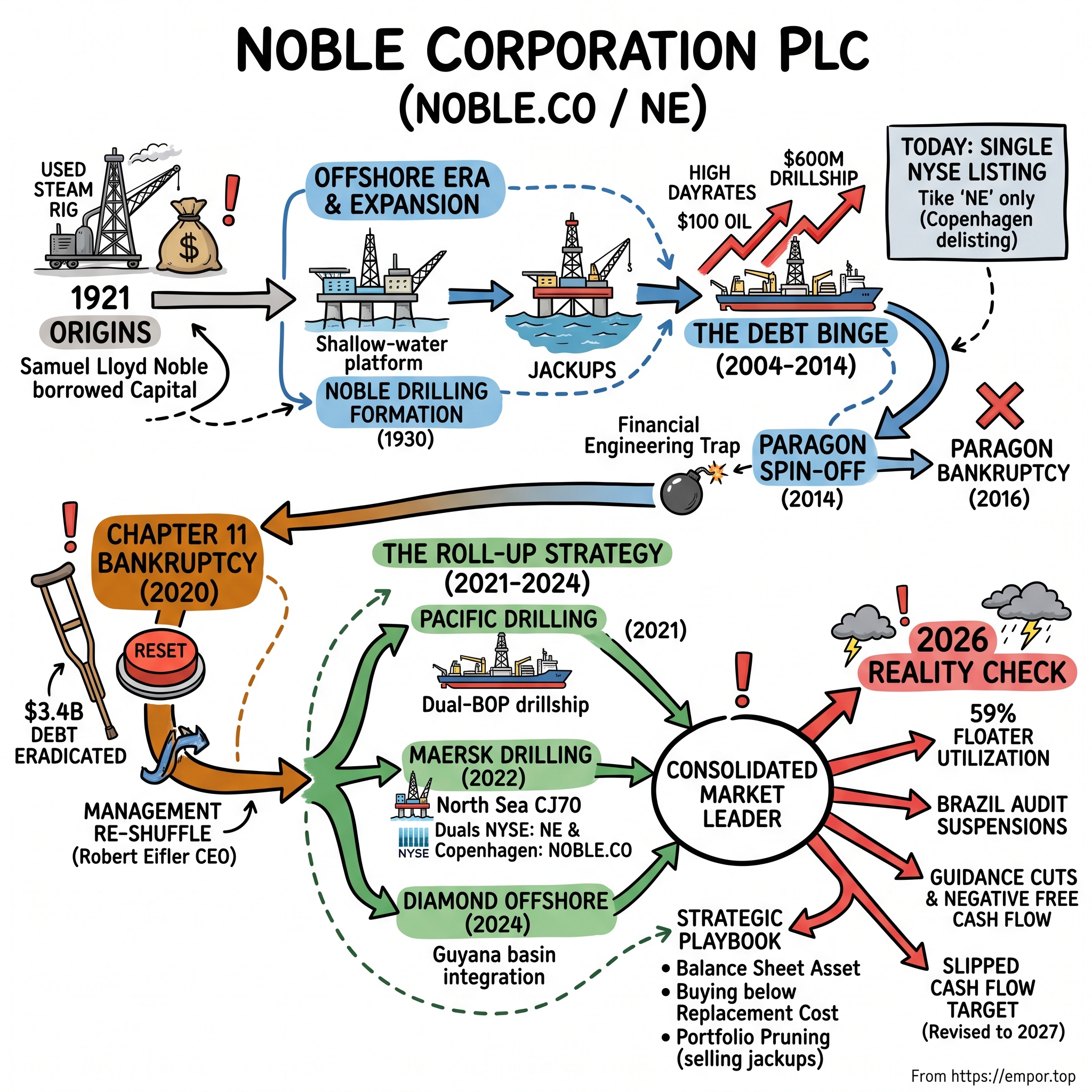
What Noble did next is the actual subject of this story. A company founded in 1921 by a 25-year-old Oklahoman with a borrowed rig1 used Chapter 11 to erase $3.4 billion of debt2, then spent the following three years acquiring the wreckage of its competitors: Pacific Drilling in 2021, Denmark's Maersk Drilling in 2022, and Diamond Offshore in 2024. It emerged as one of three companies that now dominate the high-specification floating rig market, carrying a $6.8 billion backlog3 and paying a $2.00 annualized dividend.
That is the story management tells. The version worth telling is more complicated, and considerably more instructive.
By the second quarter of 2026, Noble reported a net loss of $37 million, cut its full-year guidance for the second time in a year, generated negative free cash flow, and watched two of its rigs in Brazil sit suspended for the better part of two months after a regulatory audit3. Its floater utilization ran at 59%. It bought back no stock in the first half of the year. Consolidation, it turns out, does not repeal the cycle. It changes who survives it and on what terms — a genuinely valuable shift, but not a perpetual motion machine.
There is also a housekeeping matter that goes to the heart of one of this story's most-cited chapters. Noble's Copenhagen listing — the NOBLE.CO ticker that gave Danish institutions a way to own the merged Noble-Maersk entity — no longer exists. Noble announced its intention to delist in July 2024, citing the fact that roughly 99% of trading volume had migrated to the NYSE while less than 1% remained in Copenhagen4. The last day of trading on Nasdaq Copenhagen was December 16, 2024[^5]. Today there is one listing: NE on the New York Stock Exchange, where the shares recently traded around $42 against a 52-week range of roughly $25 to $55 — a band wide enough to show how sharply the market is handicapping this business.
The core questions remain: How much of Noble's transformation represents a durable structural advantage, and how much is a levered bet on an oil price it does not control? Did the roll-up create value, or merely aggregate it? Is management's capital allocation as disciplined as its rhetoric suggests? And what does it mean that the company's own free cash flow target has slipped by a full year?
The story begins in Carter County, Oklahoma.
 Subscribe on LinkedIn
II. Origins & Century-Old Foundations (1921–2000)
Samuel Lloyd Noble was born in November 1896 in Ardmore, in what was then Indian Territory — not a state, not quite a country, but a jurisdiction improvised on top of the Chickasaw Nation. He taught briefly in rural schools, enrolled at the University of Oklahoma in 1916, and in 1921 went into business with a man named Arthur O. Olson1.
The founding capital came from his mother. Hattie Noble co-signed a $20,000 loan, and the two partners spent $14,000 of it on a used steam-powered drilling rig. Their first well, drilled that same year for the Carter Oil Company on leased land in Carter County, was the entirety of the business plan5. There was no fleet, no strategy deck, and no addressable market. There was one rig and a debt.
This origin is worth dwelling on, because the structural DNA of the offshore drilling industry was set in that transaction and has never changed. A drilling contractor does not own the oil. It does not take reservoir risk. It owns a depreciating machine and rents it out by the day, financed with borrowed money, to customers whose willingness to pay swings with a commodity price neither party controls. Every subsequent chapter of this story — the debt binge, the bankruptcy, the roll-up — is a variation on the problem Lloyd Noble took on when he mortgaged a used steam rig against a single well.
By 1930 the partnership had dissolved and Noble formed his own company. Two years later he added Samedan Oil Corporation to hold accumulated production interests — the seed of what eventually became a separate exploration business — establishing early the distinction between owning rigs and owning barrels1. He served a term in the Oklahoma legislature as a Republican from a Democratic county, sat on the University of Oklahoma Board of Regents for fifteen years, and in 1945 founded the Samuel Roberts Noble Foundation to help farmers and ranchers restore land ruined by the Dust Bowl. He died of a heart attack in Houston in February 19501.
The offshore era began long after the founder's death. Noble's first offshore work started in 1968 in the Gulf of Mexico near Galveston, Texas, and expanded through the following decade along the coast from Louisiana to Corpus Christi. The progression was incremental and unglamorous: barges in swamps, then shallow-water platforms, then jackups — self-elevating rigs that motor to location, lower three enormous legs to the seabed, and jack their hull clear of the waves. Jackups work in water measured in hundreds of feet. They are the pickup trucks of offshore drilling: standardized, numerous, and priced accordingly.
The rest of the twentieth century took Noble from the Gulf into the North Sea, West Africa, and Latin America. The corporate entity moved through a sequence of redomiciliations — the Cayman Islands, then Switzerland, then the United Kingdom — the standard toolkit for a company that earns revenue across a dozen tax jurisdictions and moves its assets between them on barges. None of this was unusual for the industry, and none of it changed the underlying economics.
What matters for the modern story is a cultural pattern rather than a corporate one. For roughly eighty years, Noble operated as a conservative, engineering-led company that survived cycles by not over-committing at their peak. That reputation was real, and it was also precisely what made the next chapter so damaging. Institutions that have survived by exercising caution can become vulnerable to a boom that lasts long enough to make caution look like incompetence.
The boom that did it began around 2004.
III. The $100 Oil Binge & The Debt Trap (2004–2014)
There is a particular kind of madness that afflicts capital-intensive industries when demand outruns supply for long enough that everyone forgets supply can be built.
The setup was genuine. Chinese industrialization pushed crude demand up year after year. Onshore conventional fields were maturing. Then, in 2006 and 2007, Petrobras announced the pre-salt discoveries off Brazil — vast reservoirs sealed beneath a two-kilometer layer of salt, in water so deep that no equipment built before that decade could reach them. The Gulf of Mexico's Lower Tertiary play demanded similar capability. West Africa opened up. Suddenly the world needed drilling machines that did not yet exist.
The response was a construction cycle of remarkable scale. South Korean yards — Samsung Heavy Industries, Hyundai Heavy Industries, Daewoo Shipbuilding — took orders for a generation of ultra-deepwater drillships. Dayrates for the newest units climbed from roughly $250,000 per day into a range that, at the 2013–2014 peak, approached and in isolated fixtures exceeded $600,000. On those economics a $600 million drillship paid for itself in a handful of years, which meant every driller with access to credit ordered more.
How a Drilling Contract Actually Works
Before the boom becomes comprehensible, the product needs explaining, because "dayrate" hides most of the economics.
A drilling contract is a time charter, not a fixed-price job. The operator — Shell, Petrobras, ExxonMobil — pays a rate for every day the rig is on location and available, whether or not the bit is turning. The contractor supplies the vessel, the crew, and the drilling equipment. The customer supplies the well plan, the casing, the mud, and the risk that the hole is dry. If the reservoir disappoints, the contractor still gets paid; if the rig breaks, it does not. That last clause is the mechanism through which uptime becomes money: contracts specify a reduced or zero rate during non-productive time attributable to the contractor's equipment.
Terms run from a single well — perhaps sixty days — to multi-year campaigns. Longer contracts trade rate for certainty in both directions: the customer locks in capacity ahead of a rising market, and the contractor locks in cash flow ahead of a falling one. Which side that trade favors is knowable only afterward, which is why drilling contractors that signed long in 2013 looked brilliant for two years and drilling contractors that signed long in 2019 looked ruined.
Backlog — the sum of contracted future dayrate revenue — is therefore the industry's core disclosure. It is more reliable than a software company's bookings, because a rig contract is difficult for a customer to cancel without paying, and less reliable than it appears, because it says nothing about the days between contracts.
Credit was abundant. Shipyards offered aggressive installment structures that deferred most of the payment until delivery. High-yield bond markets, starved for yield after the financial crisis, absorbed offshore driller paper enthusiastically. Private equity backed newbuild-only startups whose entire business plan was to order rigs and contract them before delivery. Noble participated — building out ultra-deepwater floaters and high-specification jackups and carrying billions in net debt into the peak.
The critical thing to understand about this order book is that it was not a response to contracted demand. It was a response to a price. Drillships take three to four years to build. Orders placed in 2012 and 2013 on the strength of $600,000 rates arrived at the quayside in 2015 and 2016, into a market that no longer existed. The industry built its own flood.
The Paragon Maneuver
Noble's management saw part of the problem before most. By 2013 it was obvious that the company's older, lower-specification rigs — standard jackups and aging floaters — would be structurally disadvantaged as customers moved toward newer, higher-capability units. The response was financial rather than operational.
On August 1, 2014, Noble completed the spin-off of Paragon Offshore plc: 34 jackups and 8 floaters, distributed to Noble shareholders at a ratio of one Paragon share for every three Noble shares, listed on the NYSE under the ticker PGN6. Paragon was loaded with $1.73 billion of debt raised against those assets, with the proceeds transferred back to the parent7. Paragon's own management framed the spin as inheriting Noble's ninety-three-year heritage while pursuing independent growth6.
Strip away the language and the structure was straightforward: Noble converted a portfolio of assets it expected to decline in value into $1.73 billion of cash and a clean, high-specification story, while handing the debt and the assets to a separately traded entity owned by its own shareholders.
The market took eighteen months to render its verdict. In February 2016, Paragon announced a restructuring agreement that would eliminate more than $1.1 billion of debt, with bondholders exchanging $984 million of senior unsecured notes for cash plus equity — the framework for what became a Chapter 11 filing8. Paragon subsequently sued Noble, alleging the spin-off had been a fraudulent transfer designed to offload liabilities onto a company that was insolvent from birth9. The dispute was eventually settled.
The lesson here is not that the Paragon spin was uniquely cynical — versions of this transaction were and remain routine across industrials. The lesson is about what financial engineering can and cannot do. Separating good assets from bad assets does not create demand for either. Noble successfully transferred the jackup problem off its balance sheet and then discovered, over the following four years, that the high-specification floaters it kept were about to face a downturn every bit as severe. The engineering solved the symptom and left the disease.
For investors reading this story today, Paragon is the single most useful calibration point on management's history. It demonstrates that this company will use aggressive structural solutions when it believes assets are impaired — and it demonstrates that when the cycle turns hard enough, structure does not save you. Four years after the spin-off, Noble filed for bankruptcy anyway.
IV. The Great Offshore Bust & The Chapter 11 Reset (2014–2021)
Two structural forces collapsed the offshore market simultaneously, though only one of them would eventually reverse.
The first was the North American shale revolution. Onshore producers demonstrated that they could bring wells online in weeks rather than years, committing single-digit millions instead of billions per project. For exploration and production companies allocating capital, shale offered a fundamentally different product: short-cycle, flexible, and easily cancelled. When crude prices collapsed in late 2014, operators did not reduce shale and deepwater spending proportionally. They cut deepwater first, choosing to protect short-cycle flexibility over multi-year commitments.
The second force was the arrival of newbuild rigs ordered during the boom. Shipyards in South Korea delivered a steady stream of advanced units into a rapidly shrinking market. Supply climbed just as demand evaporated—the classic arithmetic that destroys capital in cyclical industries.
Dayrates for high-specification floaters plunged from more than $600,000 a day toward $200,000 or lower. That drop sounds survivable until measured against operating costs. A working drillship required $180,000 to $200,000 a day just for crew, maintenance, insurance, catering, and shore support. Fixed at $150,000 a day, a rig lost cash on every tour, and idling the asset offered little relief.
The Stacking Trap
Without a contract, a rig operator faced a difficult choice between two costly options. Warm stacking kept a reduced crew aboard, systems powered, and certifications active—generating daily cash drain without revenue, but keeping the vessel ready to return to work in weeks. Cold stacking meant shutting down the vessel entirely, lowering daily cash burn to a minimum while accepting that eventual reactivation could cost tens of millions of dollars and require nearly a year. Idle machinery degrades quickly in marine environments: class certifications lapse, subsea equipment requires recertification, and experienced crews scatter.
Cold stacking was a bet that the downturn would endure; warm stacking was a bet that recovery was near. In 2015, most of the industry bet on a swift recovery. That assumption proved wrong, and capital bled out over the next five years.
By 2020, severe demand destruction from the COVID-19 pandemic compounded six years of oversupply, leaving the sector with no remaining buffer. Competitors including Seadrill, Valaris, Pacific Drilling, and Diamond Offshore sought court protection. Noble filed for Chapter 11 reorganization in July 2020.
The Restructuring
Noble executed a swift, pre-arranged Chapter 11 reorganization negotiated directly with key creditors. When the company emerged on February 5, 2021, it had eliminated roughly $3.4 billion of debt by cancelling its existing debt instruments and issuing new equity to bondholders2.
The post-emergence balance sheet set a lean starting point for the company's next phase. Noble exited bankruptcy carrying less than $400 million in debt and holding approximately $600 million in liquidity, backed by a new $675 million revolving credit facility—with $178 million drawn—and $216 million in second lien notes2. Its fleet comprised 19 active rigs, including seven drillships and semisubmersibles alongside twelve jackups, with an average asset age of seven years and a firm backlog exceeding $1.5 billion2. Pre-bankruptcy equity was cancelled, transferring ownership to former bondholders, while select warrants were issued to legacy bondholders and equity holders.
This ownership exchange carries crucial financial implications. Pre-filing shareholders lost their entire investment. Any value created after 2021 accrued to a different set of equity holders—the former creditors who took ownership of the business. Evaluating management's post-restructuring capital allocation requires recognizing that this fresh start began only after legacy investors absorbed the full loss.
Robert Eifler was appointed President and Chief Executive Officer in May 2020, two months prior to the bankruptcy filing10. Rather than an outside restructuring executive, Eifler was an internal operator who had spent eight years at Noble in operational and marketing roles across multiple regions before leaving in 2013 for Hercules Offshore. He later rejoined Noble, rising through senior commercial positions. He earned an engineering degree from the University of Virginia and an MBA from the Acton School of Business10. His background was grounded in the commercial dynamics of the offshore sector: negotiating dayrates, evaluating customer demand, and positioning rigs for competitive tenders.
That commercial background shaped Noble's post-bankruptcy strategy. While a traditional restructuring manager might have focused solely on defending the balance sheet, an executive trained in commercial rig markets recognized an unprecedented dislocation. Floater assets were trading at a small fraction of their replacement cost, giving a freshly deleveraged contractor the balance sheet capacity to lead a consolidation wave.
V. The Roll-Up Strategy Part 1: Pacific Drilling & The Maersk Mega-Merger (2021–2022)
Noble had been out of bankruptcy for just six weeks when it announced its first acquisition.
Step 1: Pacific Drilling
Pacific Drilling was the purest expression of the boom-era mistake. Founded with private backing, the contractor existed to own a small fleet of high-specification drillships—seventh-generation units equipped with dual blowout preventer stacks. Major operators increasingly required dual stacks because a redundant unit ensured that a well-control incident did not automatically abort a campaign. Lacking a legacy business to soften downturns, Pacific Drilling passed through Chapter 11 twice.
On March 25, 2021, Noble announced an all-stock acquisition of Pacific Drilling, closing the transaction on April 15, 202111. Pacific's equity holders received 16.6 million Noble shares—roughly 24.9% of the combined equity—in exchange for a debt-free business holding approximately $30 million in cash12. The deal brought the combined fleet to 24 units: twelve floaters and twelve jackups11. Noble targeted at least $30 million in annual pre-tax cost synergies, projecting full realization within the year12.
The implied arithmetic makes the rationale clear. Noble issued roughly a quarter of its equity at a distressed, post-bankruptcy valuation to acquire drillships that had cost between $500 million and $700 million each to build. A replacement seventh-generation drillship—if a shipyard agreed to quote one—would have required a multiple of Noble's effective purchase price.
Yet that discount was not a market oversight; it reflected contemporary cash flows. The acquired rigs were not generating enough cash to justify their original build cost. Noble was not discovering hidden value so much as making a directional bet that deepwater demand would recover sufficiently to re-value the steel above market pricing. While that bet ultimately proved successful, Pacific Drilling's former equity holders had already learned twice how easily such bets could fail.
Step 2: Maersk Drilling
Where the Pacific Drilling deal was opportunistic, Noble's next transaction was strategic and far more complex.
The Drilling Company of 1972 A/S, operating as Maersk Drilling, had spun off from A.P. Møller - Mærsk in 2019 and listed in Copenhagen. Recognized for operational efficiency, its fleet included CJ70-class jackups—ultra-harsh-environment units purpose-built for the North Sea. Extreme weather, water depth, and rigorous Norwegian and British regulatory standards excluded standard rigs from those waters, leaving Maersk in control of most of the world's CJ70 inventory.
Noble and Maersk announced a combination in November 2021 and closed the transaction on October 3, 2022. Noble issued 60,137,000 shares—about 60.1 million—to Maersk Drilling shareholders, expanding total shares outstanding to 130,490,759 alongside roughly 14.5 million warrants, creating an approximately even split between the two shareholder bases13. A compulsory buyout of remaining minority holders, representing 9.97% of Maersk equity, closed the following month. Management targeted at least $125 million in annual cost synergies within two years and pointed to a combined order backlog exceeding $4 billion13.
Structured as a merger of equals, governance was split accordingly. Robert Eifler remained President and CEO alongside Chairman Charles Sledge, while the board added former Maersk directors Claus V. Hemmingsen, Kristin H. Holth, and Alastair Maxwell13.
The combined entity listed on Nasdaq Copenhagen under the ticker NOBLE on October 3, 2022, trading alongside its primary New York Stock Exchange listing under NE, while Maersk Drilling delisted from Copenhagen the following day13. The secondary listing served as an accommodation for Danish institutional funds and retail investors accustomed to holding the domestic Maersk entity.
What the Copenhagen Listing Actually Became
That dual structure proved short-lived. On July 18, 2024—less than two years after the merger closed—Noble announced plans to delist from Copenhagen. The company disclosed that roughly 99% of trading volume had consolidated on the NYSE, leaving less than 1% in Denmark and rendering the administrative costs of a secondary listing unjustifiable4. Danish shareholders were given two options: transfer their positions to the NYSE line through their broker at their own cost, or sell before the effective date4. Noble formally requested removal in November 2024, and the final day of trading on Nasdaq Copenhagen took place on December 16, 2024[^5].
Consequently, NOBLE.CO is now a historical ticker. Anyone evaluating Noble as a Danish-listed security is reviewing a structure that ceased to exist in December 2024.
The brief life of the Copenhagen listing illustrates how post-merger concessions to secondary shareholder bases tend to evolve. The dual listing fulfilled its immediate purpose by easing the combination for Maersk investors. Once trading volume predictably gravitated to the deeper US market, the European listing turned into an unnecessary expense, and management wound it down promptly. While the direct financial cost of delisting was minimal, the episode highlights how quickly transactional goodwill yields to administrative rationalization.
By the end of 2022, Noble had assembled a fleet spanning ultra-deepwater drillships and premier harsh-environment jackups. Yet its consolidation playbook was not yet complete.
VI. The Roll-Up Strategy Part 2: Acquiring Diamond Offshore & Cementing Scale (2024)
Diamond Offshore was, for most of its history, a subsidiary of Loews Corporation and a long-established contractor in offshore drilling. Like its peers, the company went through Chapter 11 reorganization during the downturn. Unlike Noble, Diamond emerged smaller and without a clear path to scale—a mid-sized operator with high-specification assets but insufficient critical mass in an industry where high fixed costs make subscale operations difficult to sustain over time.
Its flagship assets were the Ocean BlackHawk, BlackHornet, BlackRhino, and BlackLion—four seventh-generation, dual-blowout-preventer drillships matching the asset tier Noble had been accumulating since its Pacific Drilling acquisition.
On June 10, 2024, Noble announced an agreement to acquire Diamond in a transaction valued at approximately $1.6 billion. Under the terms, Diamond shareholders received 0.2316 Noble shares and $5.65 in cash per share, representing an 11.4% premium over Diamond's closing price on June 7 and giving Diamond investors roughly 14.5% equity ownership in the combined business. The cash portion was funded through a $600 million bridge loan14. Concurrently, Noble raised its quarterly dividend by 25% to $0.50 per share and agreed to add one Diamond representative to its board of directors14.
The transaction cleared antitrust review and closed ahead of schedule in early September 2024. The combined fleet totaled 41 rigs—28 floaters and 13 jackups—supported by an order backlog of approximately $6.7 billion. That backlog included roughly $2 billion from Diamond and 4.8 rig-years under ExxonMobil's Commercial Enabling Agreement for Guyana operations15. Management targeted approximately $100 million in annual cost synergies16.
Three distinct structural aspects defined this transaction:
First, the acquisition was priced at market value rather than at a distress discount. Pacific Drilling was acquired out of restructuring at a fraction of vessel construction cost. Diamond, by contrast, was purchased at an 11.4% premium to an unaffected share price in a recovered market. This valuation shift illustrates how the economics of offshore consolidation changed as the cycle progressed and distressed entry points closed.
Second, Noble introduced debt-financed cash into its deal structure. The Pacific and Maersk transactions relied entirely on stock, utilizing equity during a period when sector valuations were low. Diamond required $600 million in borrowed cash, ending the low-leverage balance sheet structure Noble had established upon exiting bankruptcy.
Third, the transaction secured deep integration in the Guyana basin. ExxonMobil's Stabroek block represents a central deepwater development project, and the Commercial Enabling Agreement tied to Diamond's fleet embedded Noble directly into that multi-year program. In an industry with a concentrated customer base where changing rigs mid-campaign creates costly downtime, long-term positioning inside a major development program provided strategic value beyond the physical rig assets themselves.
Did the Synergies Actually Show Up?
Evaluating synergy realization is central to assessing whether consolidation creates structural value, though verifying these savings presents analytical challenges.
Across its three acquisitions, Noble outlined target annual cost reductions totaling approximately $255 million: at least $30 million from Pacific Drilling, at least $125 million from Maersk Drilling, and roughly $100 million from Diamond Offshore121316. Set against the company's 2025 adjusted EBITDA of $1.107 billion, those combined synergies represented nearly a quarter of total operating earnings20—a material portion of its profit profile.
Confirming whether those savings fully materialized is difficult from external disclosures alone. Synergy gains in offshore drilling typically stem from consolidating corporate overhead, streamlining shorebase logistics, integrating procurement, and combining spare-part inventories. None of these savings appear as distinct financial line items; instead, they manifest as general and administrative expenses that are lower than the combined standalone run-rate of the predecessor companies. While management reported meeting or exceeding its synergy targets, public financial filings do not provide granular detail to independently verify the exact net capture.
What can be evaluated is aggregate financial performance. Noble reported $3.29 billion in revenue for 2025 compared with $3.06 billion in 2024, while adjusted EBITDA rose modestly to $1.11 billion from $1.06 billion ($1,106.6 million versus $1,064.6 million)20. A full year of operating the combined Diamond fleet generated higher top-line revenue but only incremental EBITDA growth, leaving profit margins flat. That outcome aligns with two plausible scenarios: operational cost synergies were achieved but offset by softer rig utilization and uncompensated idle time, or net realized savings were smaller than projected. The financial disclosures leave room for both factors.
Operational execution provides a clearer measure of integration performance: the transaction closed ahead of schedule, cleared antitrust review without required remedies, and maintained continuous operations across the acquired fleet. In offshore drilling, executing an integration without operational disruption is significant, as combining disparate safety management systems on active wells carries operational and safety risks.
The Consolidation Map
The cumulative result of consolidation across Noble and its peers was a significant compression of a previously fragmented industry. Where a dozen contractors once competed for deepwater tenders, the market for high-specification floating rigs is now concentrated among Transocean, Noble, and Valaris, along with Seadrill operating in targeted basins and China Oilfield Services Limited (COSL) holding a strong position in Chinese and neighboring waters. Together, these five contractors account for the largest shares of contracted backlog across the industry17.
The economic thesis behind consolidation assumes that reducing the number of market participants tempers aggressive price discounting during downturns. While industry consolidation eliminates the most distressed competitors—operators with idle equipment and pressing debt covenants willing to contract below cash breakeven—it does not grant contractors absolute pricing power. Because offshore contracts are awarded through competitive bidding, a field with even two capable contractors can sustain price competition. In offshore drilling, pricing leverage is driven primarily by fleet utilization rather than market concentration alone—making operational metrics the critical test of Noble's strategy.
VII. Deep Dive: Core Business, Fleet Economics, & Segment Breakdown
Understanding Noble as a business requires examining two core numbers and the distance between them.
The first is the dayrate — the daily fee a customer pays for the rig, its crew, and its operating equipment. The second is the operating cost per day — what Noble spends to run the vessel on location. The difference between those two figures, multiplied by the total days the rig operates, drives the core economics of the business. Everything below that line comes down to depreciation, corporate overhead, financing costs, and taxes.
What "Seventh Generation" Actually Means
The industry categorizes rig capability by generation, a shorthand essential to understanding Noble's fleet positioning.
The progression resembles aircraft development over decades. A third-generation semisubmersible represents a 1970s design: anchored in place, working in a few thousand feet of water, with limited deck load and single-string drilling capability. A sixth-generation drillship — built during the mid-2000s boom — introduced dynamic positioning, water depth reach beyond 10,000 feet, and dual-activity derricks that allow crews to assemble pipe strings while actively drilling. A seventh-generation unit, constructed from roughly 2013 onward, adds higher hook loads, higher-pressure mud systems, expanded riser storage, and the critical commercial differentiator: two complete blowout preventer stacks.
The dual-BOP capability provides crucial operational insurance. A blowout preventer is the seabed safety assembly designed to seal a well during pressure surges. Regulations require periodic pulling, inspection, and recertification. A single BOP failure mid-campaign forces a rig to cease earning revenue while the multi-hundred-ton unit is hauled to the surface, repaired, and relowered — a delay that can stretch into weeks. A vessel with a second BOP simply swaps stacks and continues drilling. For an operator running a multi-billion-dollar offshore campaign, that redundancy justifies a premium dayrate, and major oil companies routinely mandate dual BOPs in tender requirements.
Consequently, seventh-generation dual-BOP drillships constitute a distinct asset tier rather than general floating supply. While older floaters remain capable of drilling standard wells in benign waters, they do not qualify for high-tier deepwater programs. That specification gap is directly reflected in pricing: management noted on the fourth-quarter 2025 call that tier-one drillships commanded roughly $400,000 per day compared to the $300,000s for lower-specification units23. A $100,000 daily spread represents a $36 million annual revenue differential between two vessels that appear similar from the outside.
A parallel dynamic exists among jackups. The CJ70 design is engineered specifically for the extreme water depths, wave loads, and harsh winter conditions of the Norwegian and UK North Sea, operating under strict environmental and safety regulations. Standard premium jackups cannot legally or operationally perform this work, explaining why Noble retained its CJ70 inventory while exiting commodity jackup markets.
What Noble Owns Today
Noble's fleet structure evolved significantly following the Diamond acquisition.
In December 2025, Noble announced the divestment of six jackups: five units sold to Borr Drilling for $360 million — the Noble Tom Prosser, Mick O'Brien, Regina Allen, Resilient, and Resolute, structured as $210 million in cash plus $150 million in seller notes with a one-year bareboat charter on two rigs — and the Noble Resolve to Ocean Oilfield Drilling for $64 million18. Chief Executive Robert Eifler framed the sales as sharpening Noble's focus as a pure-play deepwater and ultra-harsh environment contractor, projecting the transactions would be immediately accretive to both trailing 2025 and anticipated 2026 EBITDA and free cash flow18. The Borr transaction closed in the first quarter of 2026, generating $206 million in proceeds19, while the Resolve sale was scheduled to complete in the third quarter of 202620.
Following these transactions, Noble's fleet as of mid-2026 stands at 29 marketed rigs: 24 floaters and 5 ultra-harsh environment jackups320. The company deliberately exited commodity jackup markets in the Middle East and Southeast Asia — where intense competition from regional and Chinese contractors pressures margins — while preserving its high-barrier CJ70 North Sea footprint.
This shift reflects a deliberate strategic narrowing rather than simple expansion. After three years of consolidation, Noble trimmed a quarter of its rig count to focus exclusively on high-specification segments with defensible competitive moats.
The Unit Economics
In the second quarter of 2026, Noble's floating fleet earned an average dayrate of $412,650 and its jackup fleet averaged $197,380, across 1,986 total operating days3. Fleet utilization stood at 59% for floaters and 83% for jackups, resulting in an aggregate utilization rate of 65%3.
The underlying math illustrates the economics of the business. A tier-one drillship operating at $410,000 per day against $200,000 in direct daily operating costs generates a gross cash margin of approximately $210,000 per day. Over a full 365-day operating year, that yields about $77 million in rig-level cash contribution against an asset that required $600 million or more to build — representing a low-teens return on replacement cost at full utilization and current dayrates.
Applying actual utilization rates reveals the underlying volatility. At 59% utilization, annual revenue per rig falls from $150 million to roughly $88 million, while fixed holding costs persist because idle vessels continue to burn cash. The operating leverage runs in both directions, violently. Noble reported an adjusted EBITDA margin of 30% in the second quarter of 20263. In a fully utilized market, margins expand rapidly, but when utilization weakens, profitability erodes sharply.
The Reactivation Question
Noble's capital discipline is evident in its approach to stacked vessels, where the company has consistently refused to fund cold-stacked reactivations without long-term contract coverage. Industry-wide adherence to this practice has kept effective rig supply constrained during the market recovery, as contractors avoid spending $75 million and waiting a year to reactivate idle hulls speculatively.
A recent exception highlights how this policy operates in practice. Management announced during the second-quarter 2026 earnings call that the Noble Interceptor jackup would reactivate in the summer of 2026 for a five-to-eight-month accommodation contract, positioning the rig for prospective 2027 drilling programs21. The structure demonstrates the strategy: contract revenue from the lower-risk accommodation assignment funds the reactivation costs, preserving optionality for subsequent drilling contracts.
The Brazil Problem
Operational developments in the second quarter of 2026 highlighted regulatory and jurisdictional risks that corporate consolidation cannot mitigate.
Two Noble vessels operating under contract with Petrobras in Brazil — the drillship Noble Faye Kozack and the semisubmersible Noble Courage — experienced operational suspensions in May and June following a regulatory audit by the Brazilian National Petroleum Agency (ANP)22. The suspensions reduced second-quarter revenue by approximately $43 million3, with management lowering financial guidance by at least an additional $15 million through January 2027 to reflect ongoing administrative proceedings21.
During the earnings call, Eifler confirmed that both rigs had resumed operations but noted that ongoing regulatory reviews limited further public detail21. The episode underscores key operational vulnerabilities: regulatory suspensions can immediately halt cash flow on high-margin contracts while daily operating expenses continue. The Courage remains contracted through December 2030 and the Faye Kozack through January 202722.
Peer Position
Noble's competitive position relative to its major peers reveals clear distinctions alongside shared cyclical exposure.
Transocean operates a larger floater fleet featuring specialized capabilities, including 20,000-psi pressure-rated drillships designed for ultra-deep Gulf of Mexico Lower Tertiary reservoirs and harsh-environment semisubmersibles in Norway. This technical specialization has yielded industry-leading backlog coverage17, though it carries higher balance-sheet debt that increases equity volatility relative to the underlying market.
Valaris emerged from restructuring with a balanced portfolio of floaters and jackups and a clean capital structure, retaining exposure to Middle East and Southeast Asian jackup markets that Noble elected to exit. Seadrill maintains a smaller fleet focused on key deepwater basins, while China Oilfield Services Limited (COSL) operates primarily in Chinese state-backed markets under a distinct state-capital structure.
Noble occupies a middle position between Transocean and Valaris, characterized by a focused deepwater fleet, a defensible North Sea jackup niche, and moderate leverage. Across the sector, contractors compete for similar tenders and customers with comparable high-specification equipment, making balance-sheet health, cost structure, and contract timing the primary drivers of relative performance.
This turns the focus to the executives making these decisions, and whether their execution has matched their public commitments.
VIII. Management Credibility, Capital Allocation & Compensation
Evaluating a management team requires comparing current execution against past commitments rather than relying on strategic presentations.
The People
Robert W. Eifler has served as chief executive officer since May 2020. His career path—spanning eight years in Noble operations and marketing, a tenure at Hercules Offshore as director of international marketing, a return to Noble, and advancement through senior vice president roles in marketing, contracts, and commercial operations—reflects a background grounded in rig sales and commercial negotiation10. That commercial orientation aligns with Noble's post-2021 strategy, which has hinged on market timing, vessel valuation, and contracting terms. On earnings calls, his register is measured and specific rather than promotional.
Richard B. Barker has served as chief financial officer since March 2020 and executive vice president since January 2024. He joined the company after an investment banking career at Moelis & Company and JPMorgan, where he specialized in oilfield services and equipment following studies in mathematical economic analysis at Rice University10. Combining an investment banking CFO with a commercially focused CEO supported a corporate strategy centered largely on consolidation and capital restructuring.
(Financial disclosures clarify that Noble's CFO is Richard Barker, correcting errors in some secondary market summaries.)
The Promise That Slipped
During the fourth-quarter 2025 earnings call in February 2026, Eifler acknowledged that Noble's previous target of $400 million to $500 million in run-rate free cash flow by 2026 had slipped, with management revising its expectation to approximately $600 million by 202723. Management framed 2026 as a transitional year, noting that contracted backlog for 2027 already exceeded current-year backlog23.
This revision presents two distinct interpretations. The constructive view holds that the target was expanded rather than abandoned, with timing deferred because offshore contract start dates shifted—a common occurrence given multi-year project lead times. The critical view notes that the original timeline was missed and replaced with a higher target deferred by another year, a familiar pattern in cyclical capital-goods markets.
Both perspectives reflect elements of the operational reality, placing the ultimate test of management credibility on 2027 performance. On the same call, Eifler addressed the schedule revision directly and offered a cautious outlook on dayrates, describing the likelihood of achieving mid-$400,000 dayrates in 2027 as "maybe 50/50"23.
First-quarter 2026 operational performance opened on firm footing. Noble reported $786 million in revenue, $121 million in net income, $277 million in adjusted EBITDA, and $169 million in free cash flow, alongside approximately $565 million in new contract awards. Key awards included a $339 million, three-year Petrobras extension for the Noble Courage and a $121 million Woodside contract for the Noble Deliverer19. Contract backlog reached $7.5 billion, and full-year guidance was reaffirmed at $2.8 billion to $3.0 billion in revenue and $940 million to $1.02 billion in adjusted EBITDA19.
Second-quarter results diverged from that baseline. Revenue declined to $720 million, net loss stood at $37 million, adjusted diluted earnings per share fell to $0.01, and free cash flow dropped to negative $59 million amid $205 million in capital expenditures3. Management reduced full-year guidance, lowering revenue expectations to $2.8–2.9 billion and adjusted EBITDA to $850–925 million, while keeping capital expenditure projections unchanged at $615–665 million3. Contract backlog decreased to $6.8 billion as equity prices declined.
Management attributed the guidance reduction primarily to regulatory suspensions in Brazil and re-sequenced schedule timing for the Noble Viking, Noble Innovator, and Noble Intrepid3. While this provided a specific operational explanation for the shortfall, it marked the second consecutive year in which cash flow projections shifted outward.
Capital Allocation in Practice
The execution of Noble's capital return program reveals a distinct prioritization between dividends and share repurchases.
During 2025, Noble paid $320.4 million in dividends and repurchased $20.0 million in stock, bringing total capital returned since late 2022 to approximately $1.3 billion20. Through the first half of 2026, the company executed no share repurchases3, while maintaining its $0.50 quarterly dividend—representing roughly $80 million per quarter—with the third-quarter distribution scheduled for September 24, 20263.
With shares trading between $25 and $55 over the preceding twelve months and sitting near $42 in mid-2026—implying a market capitalization of $6.8 billion—the absence of buybacks contrasts with management's replacement-cost thesis. If rig assets trade at a discount to replacement cost, repurchasing equity represents a direct mechanism to capture that value. Instead, management emphasized fleet reinvestment and balance-sheet liquidity over share repurchases during the fourth-quarter 2025 conference call23.
Maintaining balance-sheet flexibility offers a practical rationale: second-quarter free cash flow was negative, annual capital expenditures exceed $600 million, and net debt stands near $1.4 billion3. Preserving liquidity prevents leveraging the business during cyclical dips, though it demonstrates how balance-sheet constraints limit countercyclical share repurchases regardless of asset valuation discounts.
The Leverage Reality
Financial disclosures also clarify the company's leverage trajectory relative to simplified market commentary.
As of June 30, 2026, Noble carried $1.9 billion in total debt against $456 million in cash, resulting in net debt of approximately $1.4 billion and shareholders' equity of $4.48 billion3. Evaluated against the $890 million midpoint of revised 2026 adjusted EBITDA guidance, leverage stands at approximately 1.6x net debt to EBITDA, rather than below 1.0x. By comparison, net debt at year-end 2025 stood at roughly 1.4x EBITDA, based on $2.0 billion in debt, $471 million in cash, and $1.107 billion in adjusted EBITDA20.
While modest for a capital-intensive contractor and far below pre-bankruptcy levels, leverage has expanded from post-emergence lows. This increase reflects the cash funded for the Diamond Offshore acquisition and elevated capital expenditures, moderately narrowing financial flexibility during market soft patches.
Management took steps to optimize debt servicing costs during the second quarter by refinancing $800 million in legacy Diamond notes at 6.250% due 2034, an action expected to yield approximately $35 million in annual cash savings3. This transaction extended debt maturities while reducing interest expense.
Noble's executive compensation framework, detailed in its annual proxy filings (DEF 14A), links incentive awards to financial, operational, and safety metrics. In practice, operational capital allocation demonstrates that management has prioritized fleet quality, balance-sheet maintenance, and dividend stability over share repurchases or uncontracted fleet expansion.
IX. Strategic Playbook: Business & Investing Lessons
Strip the Noble story down to its transferable elements, and four broader strategic lessons emerge — each carrying a critical caveat that corporate presentations often omit.
Lesson 1: A balance sheet reset is a real competitive advantage, and it is not free.
Emerging from Chapter 11 with less than $400 million in debt while rivals carried billions gave Noble a temporary window to bid aggressively, absorb idle gap time, and acquire assets that competitors could not touch. That balance-sheet reset was a genuine structural edge, enabling the precise sequencing of its roll-up strategy — acquiring Pacific Drilling in 2021 was possible only because Noble had cleared its balance sheet first.
The limitation: That advantage was purchased through the complete wipeout of prior equity. Treating bankruptcy as a strategic weapon makes sense only from the vantage point of the creditors who took control of the reorganized business. For the legacy equity holders who originally funded the fleet, the restructuring was not a weapon — it was a total loss.
Lesson 2: Buying assets below replacement cost works when replacement cost is a binding constraint — and only then.
Noble's discounted steel holds value because competitors cannot easily construct new supply. Shipyard slots for ultra-deepwater drillships remain constrained, speculative newbuild financing is virtually nonexistent, and the cost of capital for a $700 million uncontracted rig is prohibitive. Under those conditions, active hulls become genuinely scarce, making a discount to replacement cost a meaningful margin of safety.
The limitation: Replacement cost matters only when end-user demand actually requires that capacity. Between 2015 and 2020, drillships traded well below replacement value for six consecutive years, making opportunistic purchases value-destructive. The deep market discount was not an anomaly; it was a rational reflection of zero pricing power. What ultimately restored asset value was not the discount itself, but a resurgence in deepwater drilling demand.
Lesson 3: Consolidation removes desperation, not competition.
Consolidating the market from more than a dozen credible offshore contractors down to a concentrated handful eliminated distressed operators forced to bid below daily operating costs just to service near-term debt. That structural shift raised baseline dayrates. Yet oil companies conducting tenders still receive multiple bids, pit contractors against one another, and retain the option to defer exploration projects altogether. The industry's structural improvement reflects the removal of desperate bidders rather than the creation of absolute pricing power.
Lesson 4: In a cyclical business, portfolio pruning beats portfolio growth.
Noble's most instructive move following its consolidation spree was also its least publicized: agreeing in December 2025 to sell six jackups in order to focus exclusively on ultra-deepwater floaters and CJ70 harsh-environment units18. After three years of aggressive roll-ups, management divested assets in the commodity market segment where its competitive moat was thinnest. Pruning underperforming assets requires greater discipline than orchestrating acquisitions, as it offers little promotional appeal and reduces top-line revenue.
Whether this portfolio rationalization ultimately creates lasting value depends on whether its retained floaters and niche North Sea jackups can maintain their defensible position — a question that depends directly on the competitive landscape that follows.
X. Investment Story Spine, Competitive Frameworks & Risk Radar
Seven Powers, Honestly Applied
Hamilton Helmer's competitive framework asks what specifically prevents a rival from replicating a company's economics. Applied to Noble:
Cornered Resource — the strongest claim, real but time-limited. Noble controls a large share of the world's seventh-generation dual-BOP drillships and a meaningful footprint of CJ70-class harsh-environment jackups. These assets cannot currently be duplicated. Shipyard capacity remains uncommitted to speculative drillship construction, and financing a $700 million-plus uncontracted asset is unviable at any reasonable cost of capital. That establishes a high entry barrier. Its eventual expiry date will arrive when dayrates rise high enough to justify ordering new hulls — repeating the historical cycle of the offshore industry.
Scale Economies — moderate rather than transformative. Spreading shore-based engineering, spare parts inventory, and subsea expertise across an expanded fleet reduces per-rig costs, as quantified by the $125 million Maersk and $100 million Diamond synergy targets. However, offshore drilling is not a fixed-cost business like software or semiconductors. Most expenses stem from crew operations and maintenance on individual rigs, which scale largely linearly. Corporate overhead represents real savings, but only a modest fraction of total operational spending.
Process Power — genuine and underrated. Sustaining operating uptime above 95% is more than a marketing metric. When a rig experiences downtime mid-well, an operator loses days on a campaign costing well over a million dollars daily, with non-productive time carrying contractual penalties. Major oil companies pre-qualify contractors on safety and reliability track records through an extensive, costly process that creates operational stickiness. This pre-qualification process represents the closest equivalent to a switching cost in offshore drilling.
Branding, Network Effects, Counter-Positioning, Switching Costs — largely absent. Rig charters are awarded through competitive tenders based on price and technical specifications. There are no network effects, consumer brand premiums, or structural counter-positioning. Switching costs exist during an active campaign but evaporate once the contract expires.
Porter, Applied
Threat of new entrants: Low, given capital constraints and shipyard lead times. However, the primary entry route is purchasing existing hulls rather than building new ones — a path accessible to any capitalized competitor, as demonstrated by Borr Drilling acquiring five jackups from Noble in early 2026.
Buyer power: Moderate. The customer base remains concentrated among major oil companies, including ExxonMobil, Petrobras, Shell, TotalEnergies, BP, Equinor, and Woodside, alongside select national oil companies. Each customer accounts for a substantial share of industry revenue, and buyers with the flexibility to defer multi-year capital projects hold significant negotiating leverage.
Supplier power: Moderate. Subsea equipment manufacturers such as SLB and TechnipFMC control the aftermarket for blowout preventers and control systems. Noble's second-quarter 2026 buyout of Blackships BOP system leases for $18 million, with an additional $18 million buyout expected in the fourth quarter3, illustrates this vendor dependency.
Substitutes: Low in the medium term, but relevant over longer horizons. Deepwater projects compete against onshore shale, state-backed onshore expansion, and long-term demand shifts from electrification. The fundamental substitute for deepwater offshore drilling is not an alternative drilling method, but a different barrel of oil.
Rivalry: Tempered but active. Industry consolidation eliminated distressed operators bidding below cash break-even, but bidding for major tenders remains competitive.
Risk Radar
Oil price and the capital-cycle mechanism. The transmission chain runs predictably: falling crude prices prompt operators to cut discretionary exploration, delay final investment decisions, allow expiring rig contracts to lapse, and push down fleet utilization and dayrates. Because offshore drillers operate with a 12-to-24-month lag in both directions, the sector remains fundamentally late-cycle during both expansions and downturns.
Regulatory and jurisdictional risk. Operational suspensions in Brazil provide a clear example of non-financial model risk. A national regulator exercising authority over operating permits can suddenly idle an asset generating more than $400,000 daily, leaving the contractor with ongoing operating expenses while administrative reviews limit public disclosures.
Contract rollover and white space. A floater utilization rate of 59% in the second quarter of 20263 highlights the sector's main vulnerability. Even with a $6.8 billion order backlog, uncontracted gaps between campaigns erode earnings rapidly. Management's characterization of 2026 as a transitional year, with the operational inflection deferred to the second half of 202721, acknowledges this timing gap.
Capital intensity. Special periodic surveys, class certifications, and subsea equipment recertifications represent mandatory, capital-intensive outlays. Full-year capital expenditure guidance of $615 million to $665 million against adjusted EBITDA guidance of $850 million to $925 million indicates that roughly seventy cents of every dollar in operating earnings is currently redirected back into fleet maintenance3. In quarters with lower operating income, like the second quarter of 2026, free cash flow turns negative.
Well control. Well-control incidents represent an ongoing tail risk. The 2010 Macondo incident cost BP tens of billions of dollars and restructured the regulatory framework for a decade. A major well-control failure would simultaneously threaten operating licenses, insurance coverage, and key customer relationships.
Energy transition and cost of capital. Structural capital constraints affect valuation multiples rather than immediate earnings. Institutional investment mandates that restrict fossil fuel service companies narrow the equity buyer base regardless of underlying cash generation, keeping market multiples suppressed relative to historical cycles.
The Activist Question
A skeptical institutional investor would focus on three primary operational decisions:
First, the repurchase gap. Management's core thesis centers on rig assets trading at a deep discount to replacement cost, yet the company executed no share buybacks through a period when the stock traded as low as $25. While management cites balance-sheet prudence, that liquidity cushion was narrowed by funding a cash acquisition at an 11.4% premium in 2024.
Second, disclosure depth. Operational suspensions in Brazil represent a material headwind that remains thinly detailed in public filings. While regulatory constraints may limit public commentary, the lack of granularity forces investors to model broad earnings ranges rather than defined operational outcomes.
Third, asset transaction sequencing. Noble acquired jackup fleets through its combinations with Maersk and Diamond, then sold six jackups in 2025 to Borr Drilling and Ocean Oilfield18. If a focused deepwater and ultra-harsh environment strategy represents the optimal asset mix today, it raises valid questions about whether earlier acquisitions included secondary assets that required subsequent divestment.
These decisions do not signal structural governance failures, but they highlight the practical friction between an overarching consolidation thesis and the complex sequencing required to execute it.
XI. Bull vs. Bear Case & Key KPIs
Why Noble Wins From Here
The bull case rests on three pillars, led by supply constraints.
Supply is verifiably constrained. No speculative drillship newbuilds are under construction, capping global rig additions for years. Management stated on the second-quarter 2026 call that global ultra-deepwater floaters were running at approximately 95% contracted utilization, with the potential to reach effectively full utilization by late 202721. The distinction between contracted utilization across the global fleet and Noble's own operating utilization of 59% is critical: the former measures how much of the world's capable fleet is spoken for, while the latter reflects what portion of Noble's fleet actually earned revenue in a quarter affected by regulatory suspensions and contract gaps.
Demand has multi-year visibility. Guyana's Stabroek block, Brazil's pre-salt, and West African offshore developments represent long-term programs with breakeven economics competitive with most onshore shale. Contracting activity reflects this demand: management cited 77 rig-years contracted industry-wide in the first half of 2026, comfortably the highest level in well over a decade21. Open demand stood at 42 rig-years in Asia-Pacific and 22 rig-years in West Africa, with Eifler noting that additional floating units could relocate to those regions21.
Backlog converts into future revenue. Noble entered 2026 with 2027 backlog exceeding 2026 backlog23 — an inversion that mechanically implies rising utilization next year without requiring immediate new contracts. Recent awards support that trajectory: approximately $200 million added since April 2026, including the Noble Claus Bachmann's three-well North Sea contract with BP at a $320,000 dayrate commencing March 2027, and a six-well Asia-Pacific program for the Noble Viking running roughly 300 days from early 20283.
Leading-edge dayrates for tier-one drillships have moved into the mid-$400,000s per day3. Eifler characterized this trajectory with restraint, describing the rate expansion as organic rather than the sharp spike seen in 2005 and 2006, with short-term gap-filler contracts and multi-year commitments pricing at a slight discount to headline leading-edge rates21.
Why It May Not
Second-quarter 2026 results reflect the bear case in real time. A $37 million net loss, lowered full-year guidance, negative free cash flow, 59% floater utilization, a $700 million quarterly drop in backlog, and zero share repurchases represent reported facts rather than hypothetical risks.
The cash flow inflection timeline keeps shifting. An initial target of $400 million to $500 million in free cash flow by 2026 was revised to roughly $600 million by 202723. Meanwhile, 2026 adjusted EBITDA guidance was lowered from $940 million to $1.02 billion down to $850 million to $925 million within a single quarter319. An investment thesis that depends on a future operational turn weakens each time that milestone is deferred.
The cost structure leaves narrow margin for error. Daily operating expenses of roughly $200,000 per rig alongside $615 million to $665 million in annual capital expenditures mean that even modest drops in fleet utilization or dayrates can quickly push free cash flow into negative territory, as demonstrated in the second quarter of 2026.
Exploration and production companies retain capital flexibility. Oil company budgets are set annually and can be curtailed if commodity prices soften. Crude oil prices falling into the low $60s per barrel or lower would prompt operators to defer final investment decisions, creating uncontracted schedule gaps directly inside Noble's projected 2027 recovery window.
Industry consolidation does not eliminate secondary fleet competition. Offshore drilling has repeatedly consolidated during downturns only to re-fragment as capital returned. Nothing prevents well-capitalized rivals from acquiring idle hulls at a discount and re-entering tenders, as demonstrated by Borr Drilling's acquisition of five jackups from Noble in early 2026.
Valuation appears balanced against near-term earnings. With shares trading near $42—representing a $6.8 billion market capitalization and an enterprise value above $8 billion when including $1.4 billion in net debt—Noble trades at approximately nine times the $887.5 million midpoint of its revised 2026 adjusted EBITDA guidance. While that multiple would compress substantially against management's 2027 cash flow projections, that valuation discount depends entirely on operational execution next year. The stock's 52-week trading range of $25 to $55 reflects persistent market uncertainty over that timing.
The Three KPIs That Matter
The investment case ultimately turns on three key performance indicators disclosed in Noble's quarterly fleet status reports and financial releases.
1. Marketed floater utilization. Utilization is the primary operational variable driving earnings. While headline dayrates draw market attention, fleet utilization determines how much revenue reaches the income statement. Closing the gap between the 59% floater utilization reported in the second quarter of 2026 and the 85% to 90% rates characteristic of a tight floater market represents the core distinction between the bull and bear thesis.
2. Backlog direction and duration. Beyond total backlog figures, investors must monitor whether contracted revenue is expanding or eroding, and how far into the future coverage extends. Backlog declined from $7.5 billion to $6.8 billion between the first and second quarters of 2026. Detailed contract terms clarify pricing power: for example, securing the Noble Claus Bachmann at $320,000 per day for a 2027 start against headline leading-edge quotes in the mid-$400,000s illustrates the difference between spot pricing and executed long-term contracts.
3. Free cash flow after capital expenditures relative to guidance. Management has committed to achieving approximately $600 million in run-rate free cash flow by 2027. Tracking reported free cash flow after capital expenditures provides a direct metric to evaluate whether consolidation and fleet reinvestment translate into tangible cash generation and whether management guidance remains reliable.
XII. Epilogue & Outro
A hundred and five years after Hattie Noble co-signed a $20,000 loan so her son could buy a used steam rig, the company that grew out of that transaction operates 29 marketed drilling units across the Gulf of Mexico, the North Sea, Brazil, West Africa, and the Asia-Pacific, and has returned approximately $1.3 billion to shareholders since 202220.
The intervening century contains a full catalogue of what happens to an industry built on renting expensive machines into a commodity cycle. Noble survived eight decades by avoiding over-extension, then over-extended anyway during the 2000s boom, tried to engineer its way out with the Paragon spin-off, failed, and lost ownership to its creditors in 2020. The equity holders today are, in the main, the former bondholders who inherited the business in bankruptcy.
What those owners built afterward is the defining chapter of the modern company. Three acquisitions in three years assembled a fleet of high-specification assets that competitors cannot easily replicate, followed by the sale of commodity jackups where Noble held no distinct advantage. The result is a focused, well-capitalized deepwater contractor with a deep forward backlog and a real, if bounded, structural position.
It is also a business that recently reported a quarterly net loss, cut full-year guidance twice in twelve months, saw two rigs suspended by Brazilian regulators, ran its floater fleet at 59% utilization, and bought back no shares in the first half of 2026 despite trading well below its 52-week peak.
Both realities exist simultaneously. The reconciliation is that Noble has changed how it experiences the cycle — maintaining a lean balance sheet, scarce assets, and the flexibility to avoid destructive bidding — without escaping the cycle itself. Consolidation did not eliminate operating leverage or commodity exposure; it made the downturns survivable.
Looking ahead, key operational metrics will determine whether the thesis holds: whether floater utilization expands through the second half of 2027 as backlog commitments begin, whether regulatory suspensions in Brazil resolve without further revenue drag, whether leading-edge dayrates in the mid-$400,000s hold when long-duration contracts are executed, and whether management delivers on its $600 million free cash flow target. Noble has laid out its targets; execution against them is the benchmark from here.
References
-
Noble, Samuel Lloyd — The Encyclopedia of Oklahoma History and Culture, Oklahoma Historical Society ↩↩↩↩
-
Noble Holding Corporation plc Successfully Completes Balance Sheet Restructuring And Emerges From Chapter 11 — PR Newswire / Noble Corporation, 2021-02-05 ↩↩↩↩
-
Noble Corporation plc Announces Second Quarter 2026 Results — PR Newswire / Noble Corporation, 2026-07-28 ↩↩↩↩↩↩↩↩↩↩↩↩↩↩↩↩↩↩↩↩↩
-
Noble Corporation plc announces its intention to delist from NASDAQ Copenhagen — PR Newswire / Noble Corporation, 2024-07-18 ↩↩↩
-
Lloyd Noble: Oklahoma Oilman & Philanthropist — Voices of Oklahoma ↩
-
Paragon Offshore Completes Spin-Off From Noble Corporation — PR Newswire / Paragon Offshore plc, 2014-08-01 ↩↩
-
Paragon sues Noble over 'fraudulent corporate spin-off' — Offshore Energy ↩
-
Paragon Offshore Announces Agreement With Bondholders And Revolver Banks To Restructure Its Balance Sheet — PR Newswire / Paragon Offshore plc, 2016-02 ↩
-
Paragon Offshore reaches agreement with creditors, settles dispute with Noble — Offshore Energy ↩
-
Noble Corporation Completes Combination With Pacific Drilling — PR Newswire / Noble Corporation, 2021-04-15 ↩↩
-
Noble Corp to acquire Pacific Drilling in all-stock deal — World Oil, 2021-03-25 ↩↩↩
-
Noble and Maersk Drilling Close Business Combination, Creating a New and Dynamic Leader in Offshore Drilling — PR Newswire / Noble Corporation, 2022-10-03 ↩↩↩↩↩
-
Noble Corp. to acquire Diamond Offshore Drilling in $1.6 billion deal — World Oil, 2024-06-10 ↩↩
-
Noble Corporation Completes $1.6 Billion Acquisition of Diamond Offshore Drilling — gCaptain, 2024-09 ↩
-
Noble's $1.6 billion acquisition of Diamond Offshore clears key antitrust hurdle — World Oil, 2024-07-26 ↩↩
-
Transocean, Noble, COSL, Seadrill and Valaris pinpointed as rig backlog powerhouses — Offshore Energy ↩↩
-
Noble Corporation plc Announces Planned Divestment of Six Jackups — PR Newswire / Noble Corporation, 2025-12-08 ↩↩↩↩
-
Noble Corporation plc Announces First Quarter 2026 Results — Noble Corporation, 2026-04 ↩↩↩↩
-
Noble Corporation plc Announces Fourth Quarter and Full Year 2025 Results — PR Newswire / Noble Corporation, 2026-02-11 ↩↩↩↩↩↩↩
-
Earnings call transcript: Noble Corp. Q2 2026 — Investing.com, 2026-07-28 ↩↩↩↩↩↩↩↩
-
Noble reveals regulator audit link to Brazil rig suspensions — Upstream, 2026-07 ↩↩
-
Noble (NE) Q4 2025 Earnings Call Transcript — The Motley Fool, 2026-02-12 ↩↩↩↩↩↩↩
 LinkedIn
 WhatsApp
 Reddit
 Hacker News
 Email
Email Kindle
 RSS Feed
 Spotify
 Apple Podcasts
 Amazon Music
 Audible
 YouTube