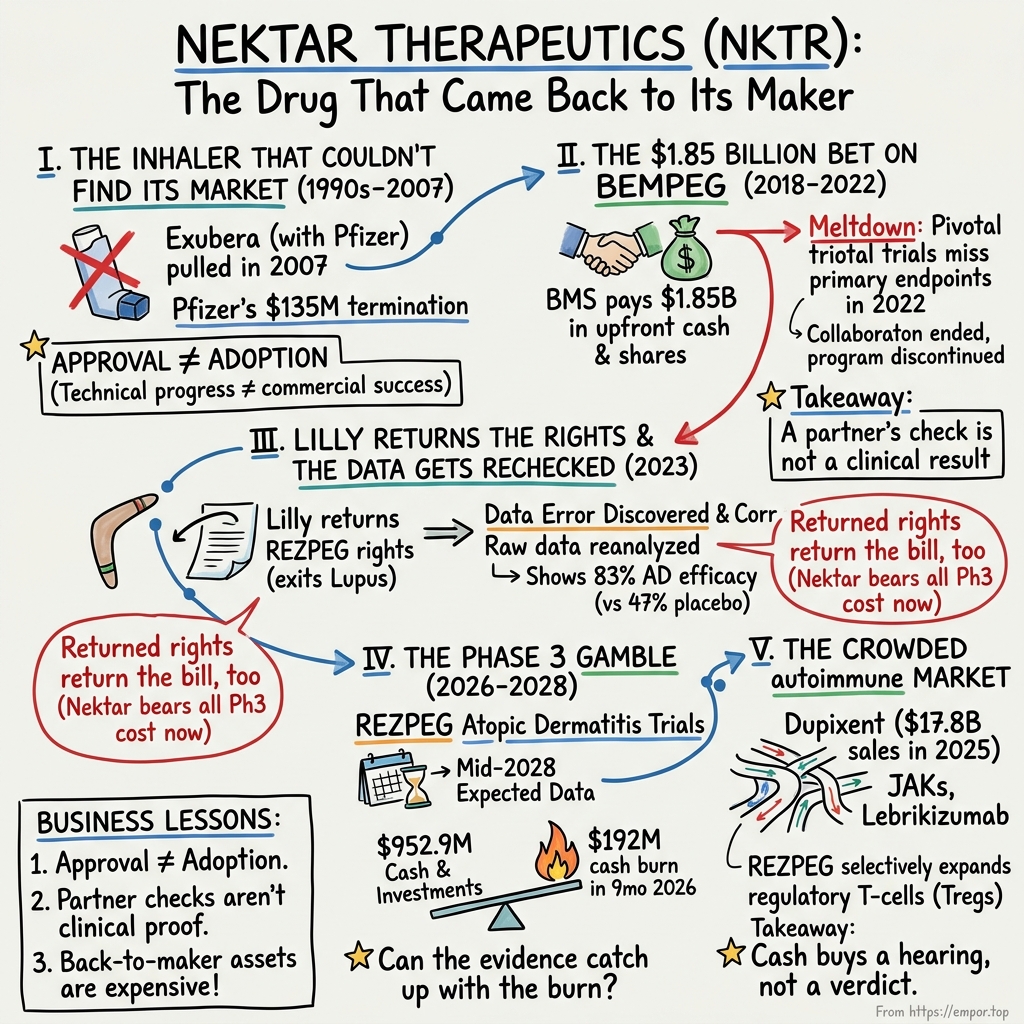
Nektar Therapeutics: The Drug That Came Back to Its Maker
I. The Phase 3 Gamble
In the second week of November 2026, a small biotechnology company in San Francisco told its shareholders that something it had been building toward for years was finally under way. All three Phase 3 trials of rezpegaldesleukin, the drug everyone at the company calls REZPEG, were now open and enrolling patients with moderate-to-severe atopic dermatitis, the chronic, itching, sleep-wrecking skin disease most people know as eczema.1 In the same breath, the company said it had $952.9 million in cash and investments, and that this money should carry it into the third quarter of 2028.2 The first answer that really matters, whether REZPEG works in a large, controlled, registrational test, is not expected until the middle of 2028.3
Hold those numbers side by side and the shape of the bet comes into focus. Nektar Therapeutics reported about $55 million of revenue in all of 2025, and almost none of it was cash coming through the door.4 It had 63 employees at the end of 2025, 39 of them in research and development.4 Yet it is now running three global Phase 3 trials of roughly 510 patients each, the kind of program that large pharmaceutical companies run with thousands of staff and decades of commercial infrastructure behind them.[^5] In the first nine months of 2026, Nektar used $192 million in its operations.1 It is a company whose revenue line could not pay for its research bill twice over, betting nearly a billion dollars of shareholders' money that a single molecule can find a place in one of the most crowded and lucrative corners of medicine.
The stock market's verdict, at least for now, is cautious to the point of indifference. On November 20, 2026, Nektar shares closed at about $30, down from a 52-week high of $109, giving the company a market value of roughly $1.03 billion.5 That is barely more than the cash on the balance sheet. Put plainly, investors are paying very little for the drug itself. Either the market is missing something, or it has watched this company before and is waiting for proof.
It is worth pausing on what a Phase 3 program actually is, because the phrase gets used so casually. Phase 1 trials test whether a drug is safe enough to give to people. Phase 2 trials, usually a few hundred patients, test whether it seems to work and at what dose. Phase 3 is the exam that counts: large, randomized trials designed to convince regulators that the benefit is real, reproducible and worth the risks. It is where most of the money in drug development goes, and where many promising drugs quietly die. A company can survive a failed Phase 2. A small company betting most of its cash on one Phase 3 program has much less room to fail.
And Nektar is not running one trial. It is running three at once, across many countries, each needing hundreds of patients who fit tight eligibility criteria, while competing for those same patients with larger companies testing their own eczema drugs. Every month of slower enrollment pushes the finish line further away, and every month costs money. That is the quiet tension inside the November announcement: the trials have started, but the clock has started too.
That history is why the story matters. Nektar is not a fresh startup with one idea and a clean slate. It is a company more than three decades old that has already lived through several full cycles of hope and disappointment. It helped bring the world's first inhaled insulin to market, only to watch its partner pull the product within two years. It signed one of the largest biotech partnership deals of its era with Bristol Myers Squibb, only to see the drug fail in pivotal trials. And REZPEG itself came back to Nektar after Eli Lilly, its previous partner, chose not to take it forward, after which Nektar discovered that some of the earlier data presented about the drug had been calculated incorrectly.[^7]
So three questions frame everything that follows. The first is scientific and commercial: can REZPEG stand out in an immunology market dominated by blockbuster drugs, where doctors already have good options? The second is financial: can Nektar reach decisive data without another major round of dilution, having just sold a very large number of new shares to get this far? The third is about trust: after Exubera, after the Bristol Myers collapse, after a dataset that had to be corrected, how much weight should investors put on what this company says about its own science?
It helps to be precise about what Nektar is today. It sells no products of its own. Its reported revenue comes overwhelmingly from royalties on drugs that partners sell, using technology Nektar developed years ago, and in many cases Nektar has already sold the future rights to those royalties to investors in exchange for upfront cash.4 That means the revenue on the income statement is largely an accounting echo of money received in the past. The company has also sold its manufacturing plant in Huntsville, Alabama, and now buys the specialized chemical building blocks for its drugs from the plant's new owner.4 What remains is a clinical pipeline, led by REZPEG, and a pile of cash raised from public shareholders to fund it.
That makes Nektar unusually easy to describe and unusually hard to judge. The value of the company today sits almost entirely in a question that will not be answered for another year and a half: whether the clinical evidence can catch up with the cash burn. The cash has bought time. It has not yet bought proof. And the best way to understand why investors are hesitant to pay for that proof in advance is to go back to the moment when Nektar first learned that getting a drug approved and getting patients to use it are two very different things.
 Subscribe on LinkedIn
II. The Inhaler That Couldn’t Find Its Market
Picture an insulin-dependent diabetic in the early 2000s. Several times a day, every day, for life, a needle. The promise that a company in the San Francisco Bay Area was working on seemed almost magical: what if you could breathe your insulin instead? No injections at mealtimes. Just a puff from an inhaler, the powder drifting down into the deep lung, where an enormous surface area of tissue could pass the hormone straight into the bloodstream.
That company began life in 1990 as Inhale Therapeutic Systems, and its whole identity was built around that idea of pulmonary drug delivery: turning medicines that normally had to be injected into fine dry powders that could be inhaled.6 Inhale was not trying to discover new molecules. It was trying to change how existing molecules reached the body, and then license that capability to big drug companies that had the molecules, the regulatory teams and the sales forces. In the language of the era, it was a platform company. Its customers were pharmaceutical partners, and its success depended on whether those partners turned its technology into products that sold.
The company soon broadened that platform. It acquired Shearwater Corporation, a specialist in PEGylation, and in 2003 changed its name to Nektar Therapeutics.6 PEGylation sounds forbidding, but the idea is simple. Many protein drugs are cleared from the body very quickly, so patients need frequent doses. Attaching long, flexible chains of a polymer called polyethylene glycol, or PEG, to a drug molecule is a bit like giving it a bulky winter coat: the kidneys and the immune system have a harder time grabbing it, so it lingers in the bloodstream longer and can be dosed less often. Nektar's chemists became very good at designing those coats, and partners paid to use them. That technology, not the inhaler, is the one that still generates nearly all the royalties on Nektar's income statement today, and it is the chemistry inside REZPEG.4
The fingerprints of that PEG business are still visible in who pays Nektar. In 2025, Baxalta, now part of Takeda, accounted for about 45% of revenue, AstraZeneca about 37% and UCB about 14%, so three counterparties made up 96% of the total.4 Each of those relationships traces back to Nektar's role as a chemistry supplier and licensor to larger drugmakers. One of them still carries a sliver of retained upside: UCB is developing dapirolizumab pegol, and Nektar is entitled to a potential approval milestone and low-single-digit royalties if it reaches the market.4 It is a reminder that the old platform model never fully went away. It simply shrank into a set of residual claims on other companies' products.
But in the mid-2000s, the spotlight belonged to the inhaler. Nektar had partnered with Pfizer on Exubera, an inhaled form of insulin. Nektar contributed the powder and the delivery device; Pfizer, then the world's largest drugmaker, handled clinical development, regulatory approval, and above all commercialization. In January 2006, Exubera won approval in the United States, becoming the first inhaled insulin on the market.7 On paper, it was the culmination of the original Inhale dream.
Then came the market. The device was large and awkward compared with the slim insulin pens patients were used to. Doctors had to learn new dosing conventions, patients needed lung-function testing, and insurers were not eager to pay a premium for a product whose main advantage was convenience. Uptake was weak. In October 2007, less than two years after approval, Pfizer announced it would stop marketing Exubera, and in November 2007 the two companies reached an agreement under which Pfizer paid Nektar $135 million to wind down their relationship.7
It is tempting to see that $135 million as a consolation prize, and in a sense it was. It gave Nektar cash at a moment when its flagship product had collapsed. But the payment closed the chapter rather than opening a new one. It did not turn Exubera into a durable franchise, and it did not turn Nektar into a commercial drug company. Nektar never built the sales force, payer relationships or patient-support machinery that a launch requires; it had relied on Pfizer for all of that, and when Pfizer walked away, the market for the product walked away with it.
The lesson that sits in that episode is uncomfortable, because it is not about science. Exubera worked well enough to be approved. The technology did what it was supposed to do. What failed was adoption: the combination of convenience, price, physician habits and reimbursement that determines whether patients actually use a medicine. A mechanism, a patent, even a regulatory approval, is not the same thing as a repeatable market.
Over the following decade, Nektar's business looked like a platform whose fortunes rose and fell with its partners. Revenue drifted in a band of roughly $165 million to $310 million between 2014 and 2017, then spiked to $1.19 billion in 2018, before falling back to about $115 million in 2019.8 That 2018 peak looks like a triumph on a chart, but almost all of it, about $1.1 billion, was a single collaboration payment rather than recurring sales.8 The company was profitable that year, reporting net income of about $681 million, and lost money in every other year from 2017 through 2025.84 A business with a real recurring base does not look like that. A business that occasionally sells a big piece of its future to a partner does.
The way Nektar chose to fund itself in the quieter years tells the same story. Rather than build products of its own, it repeatedly sold slices of its future: royalty streams sold to financial investors for upfront cash, collaboration rights sold to partners, and eventually its manufacturing plant sold to a private-equity firm.4 Each sale was rational in isolation. Together they turned a technology company into something closer to a holding company of residual claims, with the upside on many of its best inventions already owned by someone else.
That pattern deserves emphasis because it will come back. In Nektar's history, the headline moments, approvals, deal signings, giant upfront payments, have repeatedly been better signals of partner enthusiasm than of lasting commercial value. Exubera showed that approval does not guarantee adoption. The next chapter would test a different proposition: whether the largest check in the company's history could buy a working cancer drug.
III. The $1.85 Billion Bet on BEMPEG
In early 2018, cancer immunotherapy was the most exciting field in medicine, and Bristol Myers Squibb was one of its kings. Its drug Opdivo, a so-called checkpoint inhibitor, works by releasing a brake that tumors use to switch off the immune system's T cells. For some patients with melanoma, lung cancer and kidney cancer, the results had been extraordinary. But many patients did not respond, and the industry was hunting for a partner drug that could turn non-responders into responders. The phrase everyone used was turning "cold" tumors "hot."
Nektar thought it had that drug. It was called NKTR-214, later named bempegaldesleukin, or BEMPEG. It was built on a natural immune signaling molecule called interleukin-2, or IL-2, which acts like an accelerator pedal for certain immune cells. IL-2 had been used as a cancer treatment for decades, but in its raw form it was brutally toxic and had to be given in hospital. Nektar applied its PEG chemistry to IL-2 in a way designed to bias it toward the cancer-killing T cells and natural killer cells, and away from the regulatory cells that dampen immune responses, while letting it be dosed more conveniently.9 The pitch was elegant: Opdivo takes the brake off, BEMPEG presses the gas.
Early data in small studies looked encouraging enough that Bristol Myers decided to make one of the biggest bets the biotech industry had seen on a drug that had not yet completed a pivotal trial. Under the collaboration, which became effective in April 2018, Bristol Myers paid Nektar $1 billion in cash upfront and bought $850 million of newly issued Nektar shares.[^12] The companies agreed to jointly develop BEMPEG with Opdivo across a long list of tumor types, sharing costs, with further milestones possible if the program succeeded.[^12]
It is worth separating what that deal was from what it was often taken to be. It was not an acquisition. Bristol Myers did not buy Nektar, and there is no takeover price to benchmark against. The $1 billion upfront payment was a license and collaboration fee, not recurring revenue.8 The $850 million share purchase was an equity investment that put cash on Nektar's balance sheet and gave Bristol Myers a stake in the outcome. Together they financed Nektar's development work for years. The milestone payments, the part of these deals that makes headline values look enormous, depended entirely on clinical success that had not yet happened.
For investors, the deal served as a powerful signal. If one of the world's most sophisticated immuno-oncology companies was willing to write a check of that size, surely it had seen something compelling in the data. That logic is common and, in moderation, reasonable: big pharma partners do diligence that outside investors cannot. But a partner's conviction is still a judgment made on early evidence, and early evidence in oncology has a long record of failing to replicate in larger, randomized trials. The partner buys the option. It does not change the biology.
For a few years, the program ran at full speed. Nektar's research spending ballooned, reaching about $400 million in 2021, nearly four times its revenue that year.10 Bristol Myers became Nektar's largest single source of revenue, accounting for more than a third of it in 2021.10 Phase 3 trials enrolled patients in melanoma, kidney cancer and bladder cancer. The company that had been a drug-delivery platform was now, in effect, an oncology drug developer with a giant partner and a single, enormous bet.
The bet came due on March 14, 2022. That morning, Bristol Myers and Nektar announced that PIVOT IO-001, the Phase 3 trial in previously untreated advanced melanoma, had failed. Adding BEMPEG to Opdivo did not improve the response rate or progression-free survival versus Opdivo alone, and overall survival at an interim analysis was not better either.9 Melanoma was supposed to be the easiest test, the disease where immunotherapy worked best and where early BEMPEG data had looked most promising.
The rest of the program fell quickly after that. Within weeks, the companies reported that the Phase 3 trial in kidney cancer and a Phase 2 study in bladder cancer had also failed to meet their primary endpoints, and the collaboration effectively ended.10 Nektar discontinued BEMPEG and launched a restructuring that cut staff deeply and refocused the company on its earlier-stage immunology work.10 Losses had already been running above $400 million a year from 2019 through 2021 as the company spent heavily on the oncology program; they remained large in 2022 and 2023 as it absorbed the costs of winding it down.10
What did the $1.85 billion headline buy, in the end? It bought Nektar years of funding and access to a partner with global trial-running capacity. It bought investors a narrative. What it did not buy was a proven product. Every dollar of that headline was real money, and yet the drug it was meant to bring to patients does not exist as a medicine today.
The coda to the equity side of the deal is almost poetic. Bristol Myers had paid $850 million for its Nektar shares in 2018. In 2024, Nektar repurchased 552,307 shares held by Bristol Myers, adjusted for the later reverse split, for about $3 million, and then resold them in a 2025 offering.4 The stake that once symbolized big pharma's conviction in Nektar's science came home for a rounding error. Few numbers in the company's history capture the arc of a single program so brutally.
The collapse also reshaped Nektar's customer base overnight. A partner that had been the largest source of revenue disappeared, and with it the collaboration income that had made the company look like a much larger business. That is the hidden risk in any business that depends on a handful of partners: revenue that looks stable can vanish not because customers grow unhappy, but because a single trial result removes the reason for the relationship. It is also a reason to view today's royalty-led revenue, concentrated among three counterparties, as something less than a foundation.
It is important not to over-learn this lesson. BEMPEG and REZPEG are both PEGylated versions of IL-2, but they were designed to push the immune system in opposite directions. BEMPEG was built to rev up the attacking T cells to fight cancer. REZPEG is built to stimulate regulatory T cells, the immune system's peacekeepers, to calm inflammation.[^7] The failure of one does not falsify the biology of the other, any more than a car that failed to accelerate proves another model cannot brake. But the BEMPEG story does reveal something about how far early signals and partner conviction can sit from registrational success, and about how a company's spending, staffing and identity can become wrapped around a single program. Nektar emerged from 2022 smaller, chastened, and holding a second IL-2 drug that it had partnered with a different giant. That partner was about to make a decision of its own.
IV. Lilly Returns the Rights—and the Data Gets Rechecked
In April 2023, Nektar disclosed that its collaboration with Eli Lilly on rezpegaldesleukin was ending.11 On the surface, it was the kind of news that usually marks the end of a drug's life. Lilly, one of the most successful drug developers in the world, had co-developed REZPEG for years and had been running a Phase 2 study in systemic lupus erythematosus, a serious autoimmune disease. It decided not to take the drug forward into Phase 3 for lupus, and the partnership ended.11
The partnership had started with considerable promise. In 2017, Lilly agreed to pay Nektar $150 million upfront, with up to $250 million more in possible development and regulatory milestones, to co-develop the molecule.11 Lilly ran much of the clinical work, including the early studies in atopic dermatitis and psoriasis, and the lupus program. Nektar described the termination as one it had requested after Lilly chose not to advance the lupus work, so that it could regain full rights and decide the drug's future itself.11 That framing matters to Nektar's narrative: the company presents the return of rights as its own choice to keep a promising asset, rather than as a partner abandoning a weak one. Both things can be true at once. Lilly evidently did not see enough in lupus to justify the next step, and Nektar evidently believed the drug deserved another chance in other diseases. But taking the rights back meant taking the bill back too. Nektar now pays for every trial itself.
Then came the twist that makes REZPEG's story unlike most comeback narratives in biotech. After the rights returned, Nektar went back through the clinical data from the earlier Phase 1b study in atopic dermatitis that Lilly had run. In August 2023, Nektar announced that it had found that Lilly had incorrectly calculated previously presented efficacy endpoints from that study.[^7] Nektar said it had engaged an independent statistical firm to reanalyze the raw data, and that Lilly had confirmed the errors in written communications.[^7]
The corrected numbers were, if anything, more striking than the originals. At the highest dose, patients' eczema severity scores, measured on a standard scale called EASI, improved by a mean of 83% after treatment, compared with 47% for those on placebo.[^7] Nektar used the reanalysis as the springboard for its own larger study in atopic dermatitis.
This is the point at which investors have to keep two thoughts in their heads at once. The first is that the corrected data were a genuine reason for interest. An 83% mean improvement in a small, early study is the kind of number that gets a drug developer to commit to a bigger trial. The second is that the episode was a credibility problem, regardless of who made the error. Data that had been presented to doctors and investors as fact turned out to be wrong. The fix came from Nektar's own reanalysis, which is to its credit, but small Phase 1b studies are noisy even when calculated correctly, and an investor cannot simply swap the old number for the new one and carry on as if the uncertainty had disappeared. There is also a structural lesson about collaborations hidden in the episode. When a big partner runs the trials, the smaller company often sees the analyses rather than the raw data, and investors see whatever the two decide to present. The errors surfaced only because the rights came back and Nektar went looking. That raises a fair question about every partnered dataset in biotech, but it also raises a specific one for Nektar: now that the company runs its own trials, its own analytical discipline is the only safeguard. There is no partner to blame next time, and no partner to catch a mistake.
The correct lesson is narrower: the historical Phase 1b numbers were unreliable, the corrected ones are a better guide, and neither is a substitute for larger controlled trials.
Those larger trials came next, and they are the more important evidence. Nektar ran REZOLVE-AD, a Phase 2b study in moderate-to-severe atopic dermatitis, and reported in 2025 that REZPEG met its primary endpoint.1 In September 2026, the results were published in The Lancet, one of the most prestigious medical journals in the world.[^15] Peer review in a top journal is not proof of commercial value, and it does not replicate a result, but it does mean independent experts examined the trial's design and analysis before publication. For a company whose earlier dataset had to be corrected, that independent scrutiny is worth something.
The Lilly story did not end with the termination. Nektar sued Lilly over its conduct of the collaboration, and in September 2026 a jury found that Lilly had breached the implied covenant of good faith and fair dealing in the REZPEG license and awarded Nektar $90 million plus interest, with the interest amount still to be determined.1 For a company with Nektar's burn rate, $90 million is meaningful: roughly a third of what it used in operations in the first nine months of 2026. But Nektar had not recognized the award as an asset at the end of September, and post-trial motions and an appeal remain possible.1 A jury verdict is not a check. Until the proceedings end and cash actually arrives, the award belongs in the column of contingent upside, not in the runway.
So the Lilly chapter leaves REZPEG in a peculiar position. The partner's exit and the lupus decision narrow what can be claimed: REZPEG is not broadly validated across autoimmune diseases, and a sophisticated developer looked at the lupus data and chose not to proceed. The atopic dermatitis evidence, by contrast, has grown stronger since the rights came home, culminating in a positive Phase 2b trial and a top-journal publication. What remains unanswered is the question every early signal eventually faces: can a carefully run Phase 3 program, three of them in fact, turn that evidence into a treatment effect that reproduces across thousands of patients? And even if it does, will that effect be good enough in a market where patients already have some of the best-selling drugs in the world?
V. The Immune System Is a Crowded Market
Imagine a 30-year-old with moderate-to-severe atopic dermatitis walking into a dermatologist's office in late 2026. A decade ago, the options would have been grim: steroid creams that thin the skin, systemic immunosuppressants with long lists of side effects, and the hope that it would get better on its own. Today, that patient's doctor can reach for a menu of targeted treatments, several of them backed by years of real-world use. That is the market Nektar is walking into with REZPEG, and it is the single most important fact about the drug's commercial prospects.
Start with what REZPEG is trying to do differently, because the mechanism is the core of Nektar's case. REZPEG's Treg-based mechanism is designed to strengthen the body's own off-switch and restore balance.[^7] Rather than cutting one wire in the inflammatory circuit, the idea is to help the immune system stand down.
If that works, the theoretical advantages are appealing. A drug that resets immune balance might produce durable responses that persist after dosing stops, or allow patients to be maintained on less frequent injections. Nektar has pointed to exactly those features, durability and less frequent maintenance dosing, as potential differentiators.1 And because Tregs are relevant across many autoimmune conditions, a drug that boosts them could in principle work in several diseases, which is why Nektar is also testing REZPEG in alopecia areata and type 1 diabetes.1
Now set that theory against the actual competition. The incumbent is Dupixent, developed by Regeneron and Sanofi. Dupixent blocks signaling through two inflammatory molecules central to allergic-type inflammation, and it has become one of the best-selling drugs in the world. In 2025, its global sales reached $17.8 billion.[^16] That figure spans several indications beyond eczema, including asthma and other allergic diseases, so it is a measure of the incumbent's scale and the commercial machine behind it, not its share of the atopic dermatitis market specifically. But it tells a newcomer what it is up against: a drug that dermatologists know well, that insurers have long since added to formularies, and that comes with years of safety data in children and adults.
Dupixent is not alone. Lilly's own lebrikizumab targets a related inflammatory signal. Galderma's nemolizumab blocks a pathway closely tied to itch. Oral JAK inhibitors such as AbbVie's upadacitinib offer pills instead of injections, although they carry safety warnings that limit some doctors' willingness to use them first. And for milder disease, a range of topical treatments has improved. A dermatologist choosing a therapy for that 30-year-old patient is not short of options. Every one of those options has a sales force, a payer contract, and a body of real-world experience that REZPEG does not.
So what is the affirmative evidence that REZPEG can carve out a place? The core evidence is REZOLVE-AD, whose positive Phase 2b results were published in The Lancet.[^15] That is a genuine milestone. It is also a familiar kind of milestone in this story. Phase 2 results that beat placebo are the entry ticket to Phase 3, not the winning hand. The question for REZPEG is not whether it beats placebo; it is whether it beats placebo by enough, safely enough, and conveniently enough that doctors would choose it over the drugs already on the shelf.
It helps to understand how the scorecard works. Eczema trials typically measure success by how many patients reach a large improvement in their EASI score, a composite measure of how much skin is affected and how inflamed it is, along with a physician's global assessment of whether the skin is clear or almost clear, and patients' own reports of itch. Regulators look at these against placebo. Doctors, though, compare across trials, informally, against the numbers they remember from Dupixent and its successors. A new drug does not need to beat Dupixent head to head to be approved. It does need a profile that gives a doctor a reason to pick it, whether that is a higher response rate, faster itch relief, a cleaner safety record, or a dosing schedule that lets patients forget about their disease for months at a time.
That is where the claimed edge has to be tested against the risks that could break it. Phase 3 could show a smaller effect than Phase 2b, which is common as trials grow larger and more diverse. It could reveal safety signals that did not appear in smaller studies; IL-2-based drugs have historically carried concerns about stimulating the wrong immune cells at higher doses, and the whole point of REZPEG's design is to avoid that. It could show a dosing schedule that is less convenient than competitors' rather than more. Or it could produce a perfectly respectable result that simply offers no practical benefit over existing therapies. In that case, physicians and payers would have little reason to switch.
There is also a deeper limit to the bull case. Nektar has no product sales, no pricing record, no retention data and no prescription history. That means none of the usual evidence for a commercial advantage exists yet: switching costs, brand, payer leverage. The mechanism is a potential source of differentiation. It is not, on its own, a moat. A new mechanism matters to patients and payers only if it produces a meaningful advantage in efficacy, safety, durability, dosing or patient selection. If REZPEG's durability claim holds, for example, and patients could be maintained on infrequent dosing or even come off treatment for long stretches, that would be a real reason to choose it. If not, it becomes another option on a crowded menu.
Nektar has designed its Phase 3 program, which it calls ZENITH AD, to answer those questions at scale. The company announced the program's start in July 2026.[^5] Replication across independent studies is partly a regulatory strategy: it is what regulators want to see, and it gives the company more data on different dosing regimens and patient populations. It is also expensive, and it is the main reason Nektar's research spending jumped by more than a third in the first nine months of 2026 compared with a year earlier.1 The readout is still expected in the middle of 2028.3
The rest of the pipeline deserves attention in proportion to its stage. Alopecia areata, an autoimmune condition that causes patchy or total hair loss, is the second major test. Nektar ran a Phase 2b study, REZOLVE-AA, and plans to start a Phase 3 program in 2027.1 That program has its own complication: Nektar faces a securities class action concerning statements it made about REZOLVE-AA, which the company denies and has moved to dismiss.1 In type 1 diabetes, REZPEG is being studied through TrialNet, a research network, with Phase 2 data expected in 2027.1 That is early-stage optionality. If Tregs could slow the immune attack that destroys insulin-producing cells, it would be a remarkable outcome, but it is a hypothesis being tested, not a business. Neither alopecia nor diabetes is revenue, and neither proves that REZPEG is a broad platform.
So what would change the assessment? Three things stand out. The first is Phase 3 efficacy and safety against control in atopic dermatitis, the single decisive event. The second is consistency: whether the effect holds across all three ZENITH trials, because a drug that wins one trial and stumbles in another faces a harder regulatory and commercial path. The third is the design and timing of the alopecia areata program, which will show whether REZPEG can stand on more than one leg. Until those events arrive, the honest verdict is that REZPEG has a plausible scientific distinction and positive Phase 2b evidence, but no demonstrated commercial advantage. The science has earned a hearing. Whether it can win the market depends on data that does not yet exist, and on whether Nektar can afford to keep the trials running until it does.
VI. The Balance Sheet Buys Time, but the Pipeline Spends It
At the end of 2025, Nektar had $245.8 million in cash and investments.1 For a company about to launch three large Phase 3 trials, that was not enough. Nine months later, at the end of September 2026, it had nearly quadrupled.1 The company had not discovered a new revenue stream or sold a product. It had sold itself, in pieces, to public investors.
Here is how that happened. In June 2025, Nektar completed a 1-for-15 reverse stock split, consolidating its shares so that each new share represented fifteen old ones.4 Reverse splits are often a sign of a company whose share price has fallen far, and they are usually a prelude to raising money, because they lift the per-share price to a level more institutional investors are allowed to buy. From July 2025 through September 2026, Nektar issued approximately 19.4 million new shares and a small number of pre-funded warrants through registered offerings and at-the-market sales, raising about $1.07 billion net of costs.14 The offerings in February and April 2026 were particularly large, landing after the Phase 2b data had energized investors and the share price had risen.1
The scale of that dilution is worth sitting with. On November 6, 2026, Nektar had about 34.2 million shares outstanding.1 That means more than half the company's shares today were sold within roughly fifteen months. Shareholders who owned Nektar before mid-2025 now own a much smaller slice of a much richer company. That is not necessarily bad: raising money when the share price is high and the data are fresh is exactly what a clinical-stage company should try to do, and it is far better than raising money in a panic. But it means the runway was financed by shareholders, not by the business.
Where does the money go? Overwhelmingly into research and development. In 2025, Nektar spent $117.3 million on R&D; in just the first nine months of 2026, it spent $118.9 million, up from $87.6 million in the same period a year earlier.14 Capital expenditure, by contrast, is almost nothing, about half a million dollars in the first nine months of 2026, because Nektar no longer owns a factory.1 This is a company that rents its offices, outsources its trials to contract research organizations, buys its raw materials from a supplier, and spends its money on patients enrolled in studies.
There is a subtle point about Nektar's income statement that investors need to understand, because it makes the business look less cash-hungry than it is. In 2025, Nektar reported $54.9 million of royalty revenue.4 In the first nine months of 2026, it reported total revenue of $30.4 million.[^17] Most of that revenue was non-cash because Nektar had sold many future royalty rights for upfront payments, while the royalties continued to appear as revenue.4 As a result, Nektar's operating cash outflow was larger than its accounting loss in both 2025 and the first nine months of 2026. In 2025, the net loss was $164.1 million but operating cash use was $208.5 million; in the first nine months of 2026, the loss was $141.2 million while cash use was $192 million.41 Part of the 2026 gap came from paying trial vendors in advance: prepaid R&D rose sharply as the Phase 3 program ramped.1
The royalty sales also left a liability behind. At September 30, 2026, Nektar carried $54.8 million of liability related to the sale of future royalties, accounted for as debt.1 The remaining arrangement, from 2020 with Healthcare Royalty, carries an imputed interest rate of 44%, which generated $21.9 million of non-cash interest expense in the first nine months of 2026.1 That rate is not a coupon Nektar pays in cash; it reflects how much more the royalties have been worth to the buyer than the price it originally paid. But it is a vivid measure of how expensive that past financing was. Nektar disclosed no conventional bank or bond borrowings at the end of September.1 Its other major fixed obligation is its office lease, with operating lease liabilities of about $86 million at the end of 2025.4
Then there is the supply commitment. When Nektar sold its Huntsville manufacturing facility to Ampersand Capital Partners, the plant became Gannet BioChem, and Nektar kept a minority stake, now 19%.1 Gannet supplies the specialized PEG reagent used to make REZPEG.1 Nektar has agreed to buy at least $50 million of product from Gannet from January 2028 through December 2031.4 That commitment is modest relative to the cash on hand, but it starts precisely as the Phase 3 trials approach their readouts and as Nektar would need to prepare for commercial manufacturing if the data are positive. It also concentrates a supply risk in one affiliate the company does not control. If Gannet cannot deliver at Phase 3 and then commercial scale on schedule, Nektar's options for switching suppliers of a specialized reagent are limited.
So how long will the money last? Management says the cash runway extends into the third quarter of 2028.2 A little arithmetic shows what that implies. Nektar burned about $64 million a quarter in the first nine months of 2026. If the $952.9 million had to last from the end of September 2026 into the third quarter of 2028, roughly seven to eight quarters, the implied average spend would be roughly double the recent quarterly rate. That is consistent with a Phase 3 program ramping up toward full enrollment, but it also means the runway estimate already assumes spending accelerates sharply. The runway ends almost exactly where the first decisive data are expected, in mid-2028. There is little margin. A delay in enrollment, an extra trial cost, or a slip in the readout could push the decisive data past the point where the money runs out.
How the money is held matters less than how it is spent, but it is worth a sentence. Nektar keeps its cash in short-dated, U.S.-dollar fixed-income securities, mostly corporate notes and commercial paper, with a policy limiting maturities to two years and the portfolio's weighted-average maturity to one year.1 That is a sensible, conservative posture for money that has to be on hand to pay trial bills. It also earns interest, about $10 million in 2025 when the cash pile was far smaller, which offsets a sliver of the burn.4 With nearly four times as much cash now, interest income will be larger, but it is a cushion, not an engine.
And then the most important caveat: the runway covers the trials, not the launch. Even if the atopic dermatitis data are positive in mid-2028, Nektar would need to file for approval, scale manufacturing, and either build a commercial organization or sign a partnership to sell the drug. All of that costs money that is not in the current plan. A positive readout would likely make raising that money easier, either from investors or from a partner. A disappointing one would make it much harder.
The verdict on the balance sheet is therefore two-sided. Near-term liquidity is materially stronger than it was a year ago, and Nektar can now fund its key trials without immediate distress. But that strength was purchased through dilution, it comes with a costly residual royalty liability and a supply commitment, and the stated runway only reaches the readout window. The most informative measures are not runway language but quarterly operating cash use and the share count, tracked through full enrollment and the 2028 readouts. And the person ultimately responsible for spending that money well is a chief executive who has been at the helm for nearly two decades.
VII. The CEO Has Been Here for Every Turn
Howard Robin became Nektar's chief executive in January 2007.12 He arrived from Sirna Therapeutics, an RNA-interference company he had led as CEO, and before that he had spent years at Berlex Laboratories, the U.S. arm of the German drugmaker Schering, rising to senior commercial and operating roles.12 His background was in running pharmaceutical businesses, not in lab science, and that experience shaped how he ran Nektar: as a company built around big partnerships and big bets on lead programs.
Think about everything that has happened on his watch. His tenure has spanned every major turn in Nektar's story, from Exubera through BEMPEG and Lilly to REZPEG. It is a long list of strategic resets for one chief executive at one company.
That tenure cuts both ways. On one side, continuity is real. Robin knows the molecules, the partners, the history of every decision. He has led the company through crises without letting it disappear, and the recent financing shows that he and his team could persuade investors to back the REZPEG program when it mattered. On the other side, the operating record over his tenure includes repeated cycles in which promising science and large partnerships failed to produce a durable commercial product. Investors are entitled to ask whether the same leadership that oversaw those cycles should be trusted with this one, and whether anything about the way the company operates has changed.
Pay is one place to look for an answer. Robin's reported compensation in 2025 was $6.26 million, up from $3.76 million in 2024 and $3.14 million in 2023.12 The 2025 package included a salary of about $1.11 million, an annual incentive of $1.11 million paid at 100% of target, and about $3 million in stock awards and options.12 It rose in a year when Nektar reported a net loss of $164.1 million.4 To be fair, a loss is not the right measure of success for a clinical-stage company; what matters is progress toward data, and 2025 did bring positive Phase 2b results. The proxy also shows that part of management's performance-based equity is tied to Phase 3 enrollment goals, which aligns incentives with the milestones that matter most now.12 Still, a sharp rise in pay during a year of large losses and heavy dilution is a fair subject for skepticism.
Shareholders sent a mixed signal at the June 2026 annual meeting. The advisory vote on executive pay passed with about 99% support among votes cast for and against.13 Robin's own reelection to the board, however, drew about 4.98 million votes against, roughly 27% of votes cast for and against.13 That is a meaningful level of dissent for a sitting chief executive in an uncontested election. The likely reading is that shareholders accept the pay structure but have reservations about the leader, which is an unusual combination and a signal worth watching at the next meeting.
Robin owned about 1.4% of Nektar's shares as of April 2026.12 The largest holders were institutions: Fidelity's FMR with about 10%, Two Seas Capital with 6.6% and BVF Partners, a biotech specialist fund, with 5.3%.12 Later filings show Two Seas at 9.8% in September 2026 and State Street at 5.2% at the end of September.14[^21] Two Seas raising its stake is a noteworthy vote of confidence from a concentrated investor, although no single holder controls the company. The board is majority independent, with Robin the only non-independent director.12
The finance function is the one area where governance looks unusual. Nektar has not had a permanent chief financial officer since 2023. Sandra Gardiner served as interim CFO from April 2023, provided through FLG Partners, a firm that supplies outsourced finance executives.12 In May 2026, Linda Rubinstein, another FLG consultant, replaced her as interim CFO, with FLG paid $650 per hour for her services.15 This is not a scandal; interim CFOs from firms like FLG are common at small biotechs, and the arrangement is fully disclosed. But for a company now managing nearly $1 billion of cash and a Phase 3 program, three years without a permanent finance chief is a gap that a skeptical investor would note. The auditor's 2025 opinion was clean, and the critical audit matter it highlighted, the estimation of accrued clinical trial costs, is a standard judgment area for a company of this kind.4 As a smaller reporting company, Nektar did not need its auditor to opine on internal controls; management reported them effective.4
The communication record is where the past weighs heaviest. During the BEMPEG years, Nektar's public story was one of broad promise across many tumor types, and the pivotal results did not support it. During the Lilly years, data were presented that later proved to be miscalculated, even if the miscalculation was the partner's. And the securities class action over statements about the alopecia study, which Nektar denies, shows that some investors believe the company's communications have overreached again.1 None of that proves bad faith. It does mean the company starts each new disclosure with a discount that only a run of accurate, unembellished updates can erase.
What must management demonstrate now? The test is not eloquence. It is transparent, consistent communication about enrollment and spending, guidance that holds from one quarter to the next, and clear explanations when plans change. After the data errors from the Lilly era and the overoptimism of the BEMPEG years, the burden of proof sits with the company. The leadership team has a narrow but well-defined path: run three large trials on time and on budget, report the results accurately, and avoid surprises in the cash line. Whether that path leads anywhere depends, in the end, on the competitive arithmetic of the market REZPEG hopes to enter, and on whether investors are right to price the company the way they do.
VIII. Analysis & Bear vs. Bull Case
Lay two timelines next to each other. On one, the clinical calendar: three ZENITH AD trials enrolling through 2026 and 2027, alopecia areata moving to Phase 3 in 2027, type 1 diabetes data the same year, and atopic dermatitis topline results in mid-2028.1 On the other, the financing calendar: a reverse split in June 2025, about $1.07 billion raised in fifteen months, a runway stated into the third quarter of 2028.42 The two timelines end at almost the same point. Everything about Nektar's valuation comes down to what happens where they meet.
Start with the price. At roughly $30 a share in late November 2026, Nektar's market value was about $1.03 billion, down from a peak share price of $109 within the past year.5 Against $952.9 million of cash and investments at the end of September, that leaves the market paying something like $80 million for everything else: REZPEG, the alopecia and diabetes programs, the remaining royalties, and the potential Lilly award.1 Some of that cash has already been spent since September, and the royalty liability sits on the other side of the ledger, so the gap may be even narrower. In effect, the market is valuing REZPEG near zero, or more precisely, treating the probability-weighted value of the drug as roughly offset by the cash that will be burned getting to the answer. That is not unusual for a clinical-stage biotech carrying binary risk, but it is a stark judgment for a drug with positive Phase 2b data published in The Lancet. The price assumes either that Phase 3 is likely to disappoint, or that even a positive result will require so much more capital that today's shareholders will capture little of it.
The framework of Michael Porter's five forces helps explain why biology alone is not a moat. Rivalry among existing competitors is intense: Regeneron and Sanofi, Lilly, Galderma, AbbVie and others already sell effective drugs and have the development budgets to defend their franchises. Buyer power is strong, because physicians choose among many alternatives and payers decide which drugs appear on formularies and at what price; a newcomer without a clear advantage gets little leverage. The threat of substitutes is high, since every approved therapy is a substitute. Supplier power is unusually concentrated, because Nektar depends on Gannet, an affiliate it does not control, for a specialized reagent. And barriers to entry are real but cut both ways: they protect incumbents as much as they would protect Nektar if it succeeded. Nektar today has no product customers, no pricing record and no switching costs.
Hamilton Helmer's 7 Powers framework sharpens the point. Of the seven sources of durable advantage, only counter-positioning and cornered resource are even plausible for Nektar, and both are speculative. Patents and a differentiated mechanism could, if Phase 3 succeeds, give REZPEG a cornered resource: an approach to immune balance that competitors cannot simply copy. If REZPEG's durability and infrequent dosing hold up, that could counter-position it against the incumbents, whose business models depend on continuous dosing. But there is no evidence yet of scale economies, network effects, switching costs, brand power or process power. The moat, in other words, is a hypothesis.
The bull case, stated fairly, runs like this. Nektar now has the cash to reach its decisive data without immediate distress. REZPEG has a mechanism that is genuinely different from the drugs already approved, aimed at restoring immune balance rather than blocking a single pathway. The Phase 2b study met its primary endpoint and survived peer review at a top journal. If the three Phase 3 trials confirm a durable benefit with good tolerability and convenient maintenance dosing, REZPEG could earn a place in a market so large that even a modest share would dwarf Nektar's current valuation. The alopecia and type 1 diabetes programs offer additional shots on goal, and the Lilly verdict is a potential source of non-dilutive cash. At a market value barely above cash, investors are getting those options for very little.
The bear case deserves equal force. Nektar has no marketed products, and its revenue is small, concentrated among three counterparties that accounted for 96% of 2025 revenue, and mostly non-cash.4 The company's history includes a commercial flop in Exubera and a pivotal failure in BEMPEG, the two moments when it came closest to transforming itself. The REZPEG program's previous partner looked at the data in lupus and walked away, and early data had to be corrected. The incumbent, Dupixent, has a $17.8 billion sales base and a long safety record.[^16] Phase 3 trials frequently show smaller effects than Phase 2, and even a positive result may not be compelling enough to change prescribing habits. The runway ends at the readout, and launch costs are not funded. If timelines slip, the company could be back in the market for capital at a weak moment.
How should those cases be weighed? The history rejects the broad claim that Nektar's science reliably translates into commercial products. It narrows the REZPEG claim to a smaller, testable version: a drug with a plausible distinct mechanism and positive mid-stage evidence in one disease, whose commercial value depends entirely on Phase 3 differentiation. That claim is intact but unproven. It will be confirmed or falsified by the ZENITH AD results.
A skeptical activist, looking at the company from the outside, would press on a few specific points rather than on the science. Why does a company with 63 employees still carry roughly $86 million of operating lease liabilities, a legacy of the larger organization Nektar used to be?4 Why, three years after the last permanent CFO left, is a company managing nearly a billion dollars still relying on an hourly-billed interim finance chief?15 Why did chief executive pay rise sharply in a year of heavy losses and dilution? And, most consequentially, is running three global Phase 3 trials alone the best use of shareholders' money, or would a partnership signed on the strength of the Phase 2b data have shared the risk, at the cost of sharing the upside? Management's implicit answer to the last question is that going alone preserves more value for shareholders if the drug works. That is a legitimate strategy, but it is also a choice to concentrate risk, and the market's valuation suggests investors are not yet convinced it was the right one.
The risks specific to this company are concentrated. Clinical failure and enrollment delays are the largest. Reliance on Gannet for supply is a quieter one. Continued dilution and rising trial spending sit underneath both. And the unresolved litigation proceeds, from the Lilly verdict, should not be counted as cash until they arrive.
Three measures will tell investors most about Nektar's progress. The first is quarterly operating cash use, which ran at about $64 million a quarter in the first nine months of 2026 and is set to rise as the trials ramp.1 The second is Phase 3 enrollment and timeline: all three ZENITH AD trials were open by November 2026, with topline data guided to mid-2028.13 The third, when it arrives, is efficacy and safety against the benchmark of approved treatments.
There is no transformational acquisition in this story, and no takeover price to benchmark. The capital-allocation test is simpler and starker: whether the R&D spending and the equity raised produce a registrational product. Nektar's prior royalty monetizations and the sale of its manufacturing facility bought time but did not replace that test. Every previous chapter of this company has ended with a promise that money was buying something durable. The next one will reveal whether this time the money buys the product, and the lessons from the past chapters suggest how to read the result.
IX. Business & Investing Lessons
Put three objects on a table. The first is an Exubera inhaler, a bulky device that represented years of engineering and won regulatory approval, and that Pfizer stopped selling less than two years later. The second is the press release from April 2018 announcing that Bristol Myers Squibb was paying $1 billion upfront and buying $850 million of Nektar shares.[^12] The third is a vial of REZPEG, the drug now being injected into patients in three Phase 3 trials, paid for by nearly a billion dollars of public shareholders' money. Each object stood for a moment when Nektar seemed on the edge of becoming something bigger. Each teaches something different about the distance between scientific excitement and an investable business.
The first lesson comes from the inhaler: approval is not adoption. Exubera was the first inhaled insulin, a real technical achievement, and it passed every regulatory test. What it never passed was the test of the market: patients, doctors and payers deciding the convenience was worth the cost and complexity. Founders and investors in drug development often treat approval as the finish line. For Nektar it was the starting gun for a race the product lost. For any company with a breakthrough technology, the harder question is not "will it work?" but "who will choose it over what they already use, and why?"
The second lesson comes from the press release: a partner's check is not a clinical result. Bristol Myers was one of the most sophisticated cancer drug developers in the world, and its willingness to commit $1.85 billion in cash and equity looked like the ultimate validation. But BEMPEG still failed its pivotal trials. Partnerships bring money and expertise; they do not change biology. When a deal headline becomes the evidence, investors have stopped looking at the evidence.
The third lesson comes from Lilly: returned rights return the bill, too. When Lilly exited and Nektar took REZPEG back, the company gained full control of a drug it believed in. It also gained every cost of developing that drug, which is why it needed to raise more than a billion dollars in about fifteen months. A returned asset can have a second life, but it comes back without the partner's balance sheet. And, as the corrected data showed, it can come back with surprises about what the earlier work really showed.
The fourth lesson is the one that applies right now: cash buys a hearing, not a verdict. Nektar's $952.9 million gives the company the chance to run its trials, but the market's valuation, barely above cash, shows that investors see the money as runway rather than value. Only trial results can change the business model. Public financing can carry a company to its moment of truth; it cannot decide what the truth will be.
Each lesson ties to a measurable proof point today. Adoption will eventually be tested by prescriptions, but before that, by whether Phase 3 data show a clear advantage over existing drugs. Partnership will be tested by whether Nektar, if successful, can sign a commercial deal on terms that do not give away most of the value. And cash will be tested quarter by quarter, in operating cash use and the share count. For Nektar, the lessons are not a history lecture. They are the checklist for the next eighteen months.
X. Epilogue
Tonight, Nektar stands at a familiar crossroads for the third time in its history, with the decisive moment still well over a year away. All three ZENITH AD trials are open and enrolling.1 The cash is in the bank. The alopecia areata program is preparing for its own Phase 3 start in 2027, and the type 1 diabetes study is moving toward its Phase 2 readout the same year.1 The Lilly verdict sits in the courts. The share price sits near the value of the cash.
The first events to watch are operational, and they will arrive long before the data. Will the three atopic dermatitis trials stay on schedule? Every quarterly update will reveal whether enrollment is tracking the plan, and whether management changes protocols, adds sites, or revises enrollment assumptions. A company that keeps its timelines builds credibility; one that quietly shifts them invites the question of whether the runway still reaches the readout.
The quarterly cash line will tell a parallel story. Nektar has told investors what the money should buy; each 10-Q will show what it is actually costing. If operating cash use climbs in step with enrollment, the plan is on track. If it climbs faster, or if prepaid trial costs keep swelling without matching progress, the runway into the third quarter of 2028 will start to look like a best case rather than a base case. The share count is the other half of that ledger: any new issuance before the readout would be a sign that the financing window has reopened early.
Then come the 2027 events. The alopecia areata Phase 3 start will show whether REZPEG can become a two-disease program, and the shareholder lawsuit over REZOLVE-AA statements will test how the company's earlier communications hold up. The type 1 diabetes data will be the first look at REZPEG in a disease where the stakes, and the uncertainty, are even higher. Positive results would support the idea of a broader Treg platform. Weak ones would not sink the atopic dermatitis program, but they would narrow the company to a single bet. Neither should be mistaken for the main event.
Underneath all of it runs the financing question. Burn will rise. If the trials stay on schedule, the runway should reach the mid-2028 readout, just barely. If they slip, Nektar could face a choice between raising more money before the data, at whatever price the market offers, or signing a partnership that would trade away part of REZPEG's future. The Lilly award, if it survives appeal and is paid, could ease that pressure, but until the cash arrives it is contingent.
And then, in mid-2028, the readout. A clear win, with consistent efficacy across the trials, clean safety and a dosing advantage, would transform Nektar from a financing story into a product story, and would likely put a commercialization partnership or a large-pharma suitor on the table. A modest win would leave REZPEG approvable but commercially uncertain, facing the same adoption problem that sank Exubera. A failure would leave Nektar with royalties, a cash balance smaller than today's, and a long list of lessons. Three outcomes, one date. The cash bought Nektar the right to find out.
XI. Outro
Nearly two decades ago, Nektar watched Exubera disappear from pharmacy shelves. Today, a new molecule from the same company is entering trials that will take until 2028 to answer a similar question in a different language: not just whether it works, but whether it works well enough that doctors and patients will choose it over drugs they already trust.
That is what makes Nektar unlike almost any other company in biotech. Its history is a reminder that the last mile is often the hardest. The next trial result will show whether the company can finally clear it.
References
-
Form 10-Q for the quarter ended September 30, 2026 — Nektar Therapeutics, 2026-11-12 ↩↩↩↩↩↩↩↩↩↩↩↩↩↩↩↩↩↩↩↩↩↩↩↩↩↩↩↩↩↩↩↩↩
-
Form 8-K, cash runway update — Nektar Therapeutics, 2026-11-13 ↩↩↩
-
Nektar (NKTR) Q3 2026 Earnings Call Transcript — The Motley Fool, 2026-11-13 ↩↩↩
-
Form 10-K for 2025 — Nektar Therapeutics, 2026-03-13 ↩↩↩↩↩↩↩↩↩↩↩↩↩↩↩↩↩↩↩↩↩↩↩↩↩
-
Nektar Therapeutics (NKTR) Stock Price and Overview — Stock Analysis, 2026-11-20 ↩↩
-
Pfizer and Nektar Reach Agreement on Exubera — Pfizer, 2007-11-12 ↩↩
-
Bristol Myers Squibb and Nektar Announce Update on Phase 3 PIVOT IO-001 Trial — Bristol Myers Squibb, 2022-03-14 ↩↩
-
Form 8-K, Lilly collaboration termination — Nektar Therapeutics, 2023-04-27 ↩↩↩↩
-
2026 Definitive Proxy Statement — Nektar Therapeutics, 2026-04-24 ↩↩↩↩↩↩↩↩↩
-
Form 8-K, 2026 annual meeting voting results — Nektar Therapeutics, 2026-06-05 ↩↩
-
Form 8-K, interim CFO appointment — Nektar Therapeutics, 2026-05-08 ↩↩
 LinkedIn
 WhatsApp
 Reddit
 Hacker News
 Email
 Kindle
 RSS Feed
 Spotify
 Apple Podcasts
 Amazon Music
 Audible
 YouTube