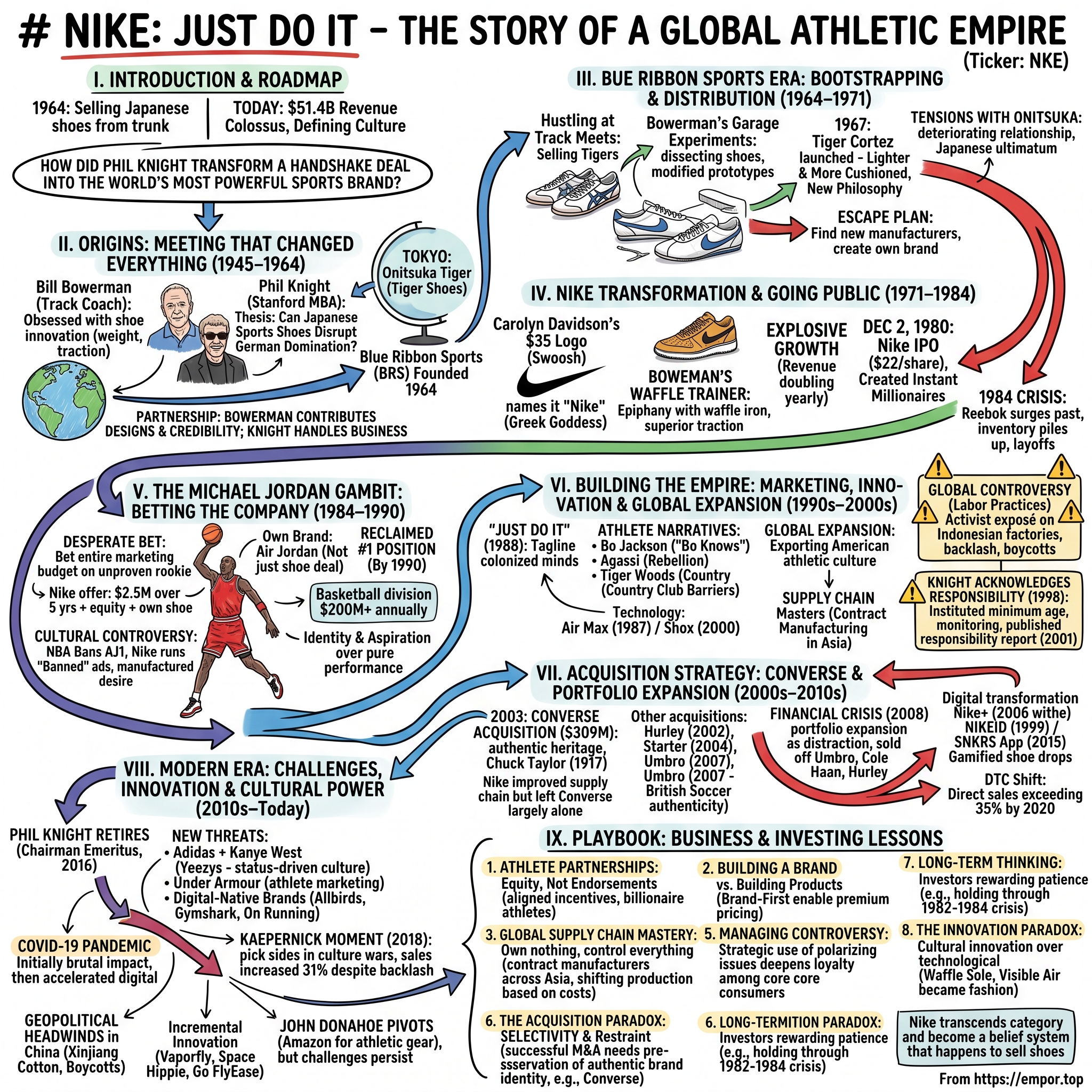
NIKE: Can the Operator Fix What the Strategist Broke?
I. Introduction & Episode Roadmap
On the afternoon of June 30, 2026, the most valuable name in the history of sport stepped up to a microphone and, in effect, told Wall Street that the pain was not over yet. NIKE, Inc. — the swoosh, the company that taught the world that a pair of sneakers could be an identity — reported that fiscal fourth-quarter revenue had slipped 1% to roughly $11.0 billion, and that Greater China, once its richest growth engine, had shrunk again.1 Then came the sentence that framed everything. "Our consumer is under pressure," CFO Matthew Friend told analysts, "around the world."2
Sit with that for a moment. This is a company that finished fiscal 2026 with $46.4 billion in revenue and $3.1 billion in net income — flat on the top line, profitable by any normal standard.13 And yet its own management guided that sales would keep falling through the November quarter, revising the outlook from a low-single-digit decline to a low-to-mid-single-digit decline.2 By the time you read this, Nike will be closing in on its third consecutive year of shrinking sales. The stock trades far below its 2021 peak. And the person running the turnaround is a 32-year company lifer who had already retired once — pulled back into the building to dismantle the signature strategy of the man who replaced him.
To feel the strangeness of this, rewind five years. In late 2021, Nike was a pandemic-era darling, its stock near an all-time high, its digital business booming while rivals' stores sat shuttered, its management telling investors that the future — a direct, app-driven, data-rich relationship with every consumer — had arrived early and Nike would own it. The narrative was clean and the multiple was rich. What followed was not a demand shock or a recession or a competitor's masterstroke. It was, in large part, a story of a company that talked itself out of a position of strength. That is what makes Nike such an unusual case study: the damage was authored in Beaverton, Oregon, not imposed from outside.
That is the tension at the heart of this story. Nike's competitive advantages — the deepest marketing and distribution machine in sportswear, six decades of athlete relationships, a brand recognized on every continent — are real and, in places, still dominant. But moats are not monuments. They can be drained from the inside. Over the four years to 2024, Nike's own leadership eroded a wholesale-retail network it had spent decades building, chasing a direct-to-consumer future that arrived more slowly and more expensively than promised. The current chapter is a repair job.
So the question this piece keeps returning to is not "is Nike a great brand?" — it plainly is — but a harder one: can disciplined execution rebuild what strategic ambition broke, faster than focused competitors take the ground Nike has ceded? We will test that claim, not assume it.
Here is the road ahead: the origin of the athlete-endorsement flywheel; the scale machine Nike built through 2019; the John Donahoe direct-to-consumer bet and how it broke the wholesale channel; Elliott Hill's "Win Now" reset; where the money actually comes from; the competitive war-game; the structural problem in China; the collapse of Converse; the tariff and IEEPA-refund saga now distorting the numbers; capital allocation and the Knight family's iron grip on the vote; and, finally, the bull and bear cases stress-tested against the evidence.
 Subscribe on LinkedIn
II. Origins: From Waffle Irons to the Swoosh (1964–1990s)
The founding image is almost too good to be true: a University of Oregon track coach pouring rubber into his wife's waffle iron to mold a better running sole. But before the waffle, there was a car trunk. In 1964, Phil Knight — a middle-distance runner with a Stanford MBA — and his old coach Bill Bowerman put up $500 each to start Blue Ribbon Sports, importing Japanese running shoes made by オニツカタイガー Onitsuka Tiger and selling them out of the back of Knight's Plymouth Valiant at track meets across the Pacific Northwest.4 The company renamed itself NIKE, Inc. in 1971, after the Greek goddess of victory, and paid a design student named Carolyn Davidson $35 for the checkmark logo that would become one of the most valuable symbols on earth.4
Buried in that scrappy origin is the single decision that still defines Nike's economics today: it never wanted to own a factory. Knight's insight — half strategy, half temperament — was that manufacturing was a low-margin commodity to be outsourced to contract producers in Asia, while the real value lived in what Nike owned outright: the brand, the design, and above all the relationship with the athlete. Nike has, in a literal sense, never made a shoe. It sells performance and identity, and lets someone else handle the rubber.
The moment that idea detonated was 1985. Nike signed a rookie guard from the University of North Carolina named Michael Jordan and built a shoe around him — the Air Jordan.4 What followed was the invention of a new financial category. Athlete endorsement stopped being a line-item advertising cost and became a standalone, royalty-generating business with its own logo, its own release calendar, and its own cultural gravity. The Jordan Brand that grew from that partnership would eventually become a multi-billion-dollar franchise inside Nike, and the direct ancestor of the "sneakerhead" economy.
The genius of the Jordan deal was less the shoe than the structure. Nike gave Jordan a royalty on Air Jordan sales — an arrangement almost unheard of at the time — which aligned the athlete's incentives with the brand's in a way a flat appearance fee never could. It turned an endorser into something closer to a business partner, and it created the template Nike would run for four decades: find the athlete who is about to define a generation, tie the brand to them early, and let their performance and their fame compound into the product. The scarce input in this model is not rubber or factory capacity — it is the finite supply of genuinely transcendent athletes, and Nike's willingness to pay more than anyone else to lock them up. That is the demand-generation flywheel in its purest form, and every rival has spent the years since trying to build a version of it.
Three years later, in 1988, an ad agency handed Nike three words — "Just Do It" — and the company completed its metamorphosis from a running-shoe maker into a culture company that happened to sell footwear.4 The same decades also planted a thornier seed: as production concentrated in low-cost Asian contract factories, Nike became the poster child for 1990s sweatshop-labor controversies, an early lesson in the reputational cost of an outsourced supply chain. That thread runs, unbroken, straight into today's arguments over tariffs and sourcing.
Why does any of this matter for an investor in 2026? Because the two bets Nike made in its first decades — asset-light manufacturing and athlete-driven brand equity — are precisely the two things now being stress-tested. The first is being taxed by trade policy; the second is being contested by rivals who have learned to build brands of their own.
III. Building the Athletic-Industrial Complex: Scale, Endorsement, and the First DTC Turn (1990s–2019)
By the 2010s, Nike had become something no competitor could easily replicate: an athletic-industrial complex. It didn't just sponsor athletes; it sponsored the pipeline that produces them — national federations, professional leagues, university programs, the Olympic movement, and the individual superstars at the top of the pyramid. This is the closest thing Nike has to what strategist Hamilton Helmer would call a combination of scale economies and brand power: the sheer size of Nike's demand-generation budget meant that its cost of reaching the next customer, or signing the next generational talent, was structurally lower than any smaller rival could match. When you can outbid everyone for the athletes who define what "cool" and "fast" look like, you shape demand itself.
For most of this era, the man steering was Mark Parker, a designer by training who became CEO in 2006 and ran the company until 2020. Parker's Nike was a product-innovation machine: the Flyknit woven upper, the Vaporfly racing plate that rewrote marathon record books, a cadence of releases that kept the brand at the front of performance credibility. Parker had spent his career inside Nike's design studios and understood, viscerally, that the product was the marketing — that a shoe good enough to break a world record was worth more than any advertising campaign. The Vaporfly is the emblem of that instinct: a carbon-plated racing shoe so effective that governing bodies debated whether it constituted an unfair advantage, which is about the best free publicity a running brand can buy. Under Parker, in other words, product innovation and brand power reinforced each other. The tension that would later define the company — between the people who obsess over the shoe and the people who obsess over the channel and the spreadsheet — was, for now, resolved in favor of the shoe. Under Parker, Nike also made its first serious move toward selling directly to consumers rather than through retailers — the 2017 "Consumer Direct Offense," which reorganized the company around a smaller set of "key cities" and pushed more sales through Nike's own stores and apps.
Here is the crucial nuance, and the hinge on which this whole story turns. Parker's Consumer Direct Offense was measured — a multi-year evolution, not a revolution, that treated wholesale partners as allies to be managed rather than obstacles to be removed. It was a sound reading of where retail was heading. What happened next was not a reversal of that logic but an acceleration of it: the same idea, taken much further and much faster, by a CEO who saw wholesale not as a channel to optimize but as a middleman to bypass. The distinction between evolution and acceleration is the difference between the Nike of 2019 and the Nike of 2023. To understand how a company this dominant talked itself into shrinking, you have to meet the man who arrived just as the world shut down.
IV. The Donahoe Bet: Consumer Direct Acceleration and the Broken Wholesale Channel (2020–2024)
John Donahoe walked into the CEO office in January 2020 with a résumé that read like a Silicon Valley victory lap — he had run eBay and then ServiceNow, the enterprise-software company — and one conspicuous gap: he had never worked in the athletic industry. Weeks later, COVID-19 shut down physical retail across the planet. For most retailers, that was a catastrophe. For a CEO whose entire thesis was that the future belonged to digital and direct sales, it looked like validation delivered by fate. The pandemic became rocket fuel.
Donahoe's strategy, branded "Consumer Direct Acceleration," was exactly what the name promised. Nike began culling its wholesale partners aggressively — pruning relationships with more than half of its roughly 30,000 retail accounts — and pouring resources into Nike.com and a suite of apps: SNKRS for hyped releases, the Nike app, Nike Training Club. The logic was seductive. Selling directly captured the retailer's margin, generated first-party data on every customer, and let Nike control the brand experience end to end. NIKE Direct's share of Nike Brand revenue climbed from roughly a quarter in 2020 toward nearly 44% by fiscal 2023 as the company leaned into the bet.
But there was a category-specific flaw the strategy underweighted, and it is the kind of thing an industry insider might have flagged. Running — Nike's single most important performance category — is structurally wholesale-dependent, because runners want to walk into a specialty store, try shoes on, and get fitted. As Nike pulled product and attention out of those doors, it starved running of newness and shelf space at the exact moment two upstarts, Hoka and On, were exploding onto the scene in precisely those specialty channels. Nike handed its challengers open real estate. Friend, the CFO, would later concede that the direct push had "added complexity and inefficiency" to the business.
There is a subtler trap in the DTC thesis worth dwelling on, because it explains why smart people believed it. Direct sales genuinely do carry higher gross margins — Nike keeps the retailer's cut — so in the early innings, shifting mix toward Nike.com made the margin line look terrific. What that headline margin masked was the cost of demand. A wholesale partner doesn't just take a markup; it also carries inventory risk, provides physical shelf space, and generates its own foot traffic. Strip that away and Nike had to manufacture all of its own demand through marketing and its apps — a far more expensive proposition than it appears until sell-through slows and unsold inventory piles up in Nike's own warehouses rather than a partner's. The DTC model looks capital-light and margin-rich right up until the moment demand softens, at which point the company that owns all the inventory owns all the pain. That is roughly the story of 2022–2024.
The reckoning arrived in December 2023. Reporting fiscal second-quarter results, Nike slashed its full-year sales outlook, and the stock fell about 12% in a single session — its worst day in years.6 Management unveiled a three-year, roughly $2 billion cost-cutting plan, and by February 2024 confirmed layoffs affecting more than 1,500 employees.6 For a company that had spent a decade compounding, this was the sound of the machine grinding gears. The cuts landed hardest on exactly the kind of people a turnaround later needs — merchandising and product talent — and the episode raised a question that still hangs over Nike: how much institutional knowledge about the running consumer, the sneaker consumer, the specific customer, walked out the door during the DTC years and the cuts that followed?
Then came a rare moment of executive candor. In an April 2024 CNBC interview, Donahoe acknowledged that Nike had "gone too far" in the direct push and had over-rotated away from its wholesale partners, saying the company needed to re-embrace the retailers it had spent years pushing away.7 It was an unusually direct admission — but note the timing. It arrived after the damage had surfaced in the numbers, not before. Good management explains a miss before the market forces the confession; this was the reverse.
That sequencing matters because trust is the currency at stake. In June 2024, shareholders filed a class-action lawsuit alleging that Donahoe and Friend had misled investors about DTC's ability to generate sustainable, profitable growth — pointing to upbeat statements on earlier calls that, the complaint argues, were contradicted by what actually happened to the wholesale channel and to demand.8 This piece treats that suit as a live characterization of the credibility question, not a settled verdict; the legal merits are unresolved. But the existence of the complaint is itself evidence of how far the gap between narrative and outcome had widened.
By the time Donahoe stepped aside in late 2024, Nike's market value had roughly halved from its peak, and the company had visibly ceded ground in its two most important battlegrounds — running, to Hoka and On, and China, to domestic brands. Both wounds are deep enough to warrant their own sections later. The board's response was to reach back into its own past.
V. The Return of the Operator: Elliott Hill and "Win Now" (October 2024–Present)
Elliott Hill's Nike story is the kind of thing the company's own marketing department would script. He joined in 1988 as an intern, worked his way up over 32 years through sales and marketing to become President of Consumer and Marketplace — the executive who owned exactly the wholesale-and-retail relationships that would later be torn up — and then retired in 2020. In October 2024, the board asked him to come back and run the whole company.11 The choice was itself a message. After an era defined by an outsider-strategist reinventing the model, Nike explicitly chose an insider whose expertise was marketplace craft: knowing which shoe belongs in which door, and how to keep a retail partner loyal.
Hill's plan, "Win Now," rests on five pillars — culture, product, marketing, marketplace, and in-person experience — and reads as a point-by-point rebuke of the previous regime's emphasis on channel economics over sport-specific product. His public framing has been notably un-triumphant. "We know we're not living up to our full potential," he told analysts, and even on the fiscal 2026 fourth-quarter call, with a year of work behind him, he conceded plainly: "the results are not there yet."2 That restraint is, in its own way, a credibility signal — a contrast to the confident forward-guidance culture that preceded him.
The structural centerpiece is a reorganization Hill calls the "sport offense." Where Donahoe organized Nike around consumer categories and channels, Hill has moved roughly 8,000 teammates into vertical, cross-functional teams built around individual sports — running, basketball, football, training — each obsessing over one athlete and one consumer, and each owning product, brand, marketplace, and operations end to end.2 The theory is that when those dimensions "connect," they create what Hill calls the "Nike multiplier": authenticity in sport generates a halo that pulls demand across the brand, including into the lifestyle "sportswear" products that carry no performance function but ride the credibility of the ones that do. On the Q4 call, when an analyst pressed him on how struggling sportswear could be fixed if full-price selling was already hard, Hill's answer was revealing: he refused to name a target mix of performance versus sportswear, insisting "the consumer's going to decide" and that predetermining it would force teams "to do unnatural things to get to that number."2 It is a philosophy of pull, not push — and a direct repudiation of a top-down financial-planning culture.
The rebuild is most concrete in wholesale. Nike has clawed back shelf space and "pole position" placement at the big retailers it had alienated — including Foot Locker, which Dick's Sporting Goods agreed to acquire for about $2.4 billion in a deal announced in May 2025 and completed that September, with Dick's leadership explicitly tying the logic to Nike's renewed wholesale push.19 The payoff is showing up in the numbers: on the Q4 FY2026 call, Friend noted that Nike's revenue and retail-sales comps at Foot Locker turned positive for the first time in four years, and North America wholesale revenue grew 10% in the quarter — though he was careful to add that much of that growth came from lower returns, cancellations, and discounts rather than raw sell-in, i.e. a healthier book, not just a bigger one.2
Promotional discipline is the other visible lever. Nike has sharply cut markdowns on its digital properties — in EMEA, off-price volume fell more than 50% year over year in Q4, lifting full-price realization by roughly 15%.2 The strategic bet is that refusing to discount protects the brand's premium positioning even at the cost of near-term volume. Analysts have pressed on the obvious risk: is that discipline sustainable when sell-through is already weak? Hill's answer is that a "halo" from performance sport pulls full-price demand — and he pointed to Nike running, which he said delivered five straight quarters of double-digit growth and added roughly $1 billion to the business, gaining five points of share in "statement" running footwear across Western Europe and North America.2
The clearest live demonstration of Hill's marketing philosophy is the 2026 World Cup. Rather than treat the tournament as a single advertising moment, Nike built what it called a "football universe" — a connected narrative that began with a teaser image of 31 Polaroids, spun out into a film, athlete stories, product drops, and 5,000-plus elevated football retail doors worldwide, and by the first week of the tournament had racked up 1.5 billion views across its various stories.2 The commercial proof point Hill leaned on: the new Mercurial boot became the fastest-selling 24-hour launch for cleated footwear in Nike Direct history, and national-team kits sold 2.5 times the volume of the same period at the 2022 World Cup.2 Whether a marketing spectacle converts into durable full-price demand — rather than a sugar-high spike — is precisely the kind of claim investors should hold management to over the following quarters, not accept on the strength of a view count.
Hill has called fiscal 2026 a "transition year," and the evidence partly supports and partly complicates that label. Full-year revenue was essentially flat — $46.4 billion versus $46.3 billion — but that is still nearly 10% below the roughly $51 billion peak of fiscal 2023–24, and China deteriorated throughout the year.1 "Transition" is accurate; "recovery" would be premature.
Two personnel facts sharpen the accountability picture. First, the finance seat is changing hands. Matthew Friend, an 18-year Nike veteran, will depart on August 17, 2026, replaced by David Denton, currently CFO of Pfizer — a rare external hire into Nike's traditionally promote-from-within finance leadership, announced June 23, 2026.910 Reading it neutrally: management is importing outside financial discipline mid-turnaround, which can be read as healthy self-awareness or as an admission that internal rigor was lacking.
Second, and this cuts against a convenient narrative: Hill's pay is not modest. His fiscal 2025 total compensation was roughly $26.0 million — base salary under $1 million, but the balance in large stock and option awards — a figure fully in line with mega-cap CEO norms, not a symbolic "credibility rebuild" discount.22 Any framing that leans on Hill taking a humble paycheck to signal shared sacrifice does not survive contact with the proxy. Executive Chairman Mark Parker, the pre-Donahoe CEO, remains on the board — a thread of continuity linking today's Nike to the last era in which it was clearly winning.11 Whether that continuity is reassuring or a sign that the same institutional instincts are still in charge is a fair question, and one that leads naturally into where the money actually comes from.
VI. Inside the Business: Segments, Brands, and Where the Money Actually Comes From
Strip away the mythology and Nike is, at its core, two product lines and four regions. In fiscal 2025, footwear generated $30.97 billion and apparel $15.27 billion of the roughly $46.3 billion total — about two-thirds of the company is shoes.4 That matters because footwear is where the pricing power lives and where the share wars are actually fought: a runner or a hooper chooses a shoe first, and the apparel often follows the logo on the feet. If Nike is losing, it will show up in footwear before anywhere else.
Geographically, the "China crisis" narrative needs a reality check. In fiscal 2025, North America produced $19.57 billion — about 42% of revenue and, crucially, the one region still growing — followed by EMEA at $12.26 billion, Greater China at $6.59 billion, and Asia Pacific & Latin America at $6.25 billion.4 North America and EMEA together are more than 65% of the business. China's decline is real and structural, but it is not where most of Nike's money sits; the company's fate will be decided in its two largest, more stable regions first.
The regions are, however, running on different clocks, and the Q4 detail shows it. North America grew 3% and its wholesale channel jumped 10%, with EBIT up sharply.2 EMEA fell 6% — the region carries a heavier mix of the struggling sportswear category and is still working through elevated inventory and Middle East disruption — but it made the "right" trade, slashing off-price volume more than 50% to lift full-price realization, accepting lower revenue for a healthier margin.2 APLA was roughly flat, a mixed bag of strong performance sport and weak lifestyle. The pattern across all four regions is consistent and telling: wherever Nike leads with performance sport — running, football, tennis all grew double digits in multiple geographies — it grows; wherever it depends on lifestyle "sportswear," it shrinks.2 That is the sport-offense thesis showing up in the geographic data, for better and worse.
The single cleanest piece of evidence that "Win Now" is more than rhetoric is the channel reversal, now visible across a full year. In fiscal 2026, NIKE Direct revenue was $17.7 billion, down 6% reported (down 8% currency-neutral, dragged by a 12% fall in Nike Brand digital), while wholesale revenue rose to $27.5 billion, up 6% reported.1 This is the exact mirror image of the Donahoe-era shift — the channel mix moving back toward wholesale in real time, in the P&L, not just on a slide. The strategy the company said it would pursue is the strategy the numbers now show it pursuing. That is worth crediting.
Then there is Jordan Brand — Nike's second business in all but name, and a genuine worry. Jordan generated about $7.3 billion in fiscal 2025, roughly 16% of company revenue, but fell 16% for the year.14 The brand most synonymous with premium streetwear and basketball culture is shrinking faster than core Nike. Management frames this as deliberate: on the Q4 call, Hill said Nike had pulled more than $2 billion of "classic" retro footwear out of the market to clean up oversupply, and that sportswear and Jordan streetwear — together roughly half of total revenue — would stay negative into fiscal 2027 before improving.2 The honest read is that it is both discipline and demand erosion: you don't yank $2 billion of product unless the sell-through was already deteriorating. Deliberate supply cuts and genuine demand softness are not mutually exclusive; here they are compounding.
Converse, at roughly 2.5% of revenue, is now a rounding error but a revealing one — a leading indicator of what happens to a brand starved of specific investment, covered in depth shortly.
On margins, investors must perform surgery. Reported fourth-quarter gross margin jumped 890 basis points to 49.2% — but roughly 900 of those points came from a one-time tariff-refund benefit (Section X). Strip it out, and Q4 gross margin was 40.2%, actually down 10 basis points year over year, though better than Nike's own guidance of down 25–75 basis points.2 Friend attributed the underlying improvement to less discounting, fewer cancellations, and lower sales reserves in North America, with more structural gross-margin actions — fewer distribution facilities, changes to how product flows from factory to shelf — targeted at fiscal 2027.2 The takeaway: the reported margin is flattered; the underlying trend is stabilizing but not yet expanding.
The fair overall verdict is neither collapse nor recovery. Net income of $3.1 billion in fiscal 2026 is down from a $6.05 billion peak in fiscal 2022 — a multi-year erosion from self-inflicted channel damage, now being repaired at the cost of continued revenue and margin pressure.15 Nike is a large, profitable company nursing a self-inflicted wound. The question is who is circling while it heals.
VII. Industry Structure & the Competitive Landscape
Run Nike through Michael Porter's five forces and a paradox emerges: the fortress walls are high, but the defenders left the gates open. The threat of new entrants at Nike's scale is low — the marketing spend, athlete contracts, and retail relationships are fixed costs measured in billions that no startup can front. Supplier power is low, because Nike is the largest customer of most of its contract manufacturers and dictates terms. But buyer power is the interesting one: it is concentrated in a handful of giant wholesale accounts — Dick's, the newly enlarged Foot Locker, JD Sports — the very partners Nike alienated and is now courting back, which hands those retailers leverage in the renegotiation.19 And rivalry is intensifying from focused challengers, while substitutes blur in from athleisure brands like Lululemon that have redefined what people wear to the gym and the coffee shop alike.
Through Helmer's 7 Powers lens, Nike's durable advantages are brand (six decades of athlete association) and scale economies in marketing and distribution. But here is the essential point a skeptical investor must hold onto: neither is a cornered resource. Nike does not own an irreplaceable asset the way an aluminum smelter owns a bauxite deposit. Brand equity is powerful but perishable — it erodes when product and marketing execution slip. That is not a hypothetical; it is the literal mechanism behind the last five years. A moat made of brand and scale requires constant reinvestment to stay full, and Nike's own missteps proved it can be drained.
The competitive field, ranked by what the data actually shows rather than vibes, breaks into two tiers. Tier one is Adidas — the clear global number two, which by 2025–26 was gaining apparel-market share and posting double-digit revenue growth even as Nike's share slipped; one analysis pegged Nike at roughly 2.9% of the global apparel market with Adidas closing the gap.18 Adidas is not a niche threat; it is a comparably scaled rival that has found its footing while Nike stumbled.
Tier two — the specialists — is where the most instructive damage is. Deckers Brands, parent of Hoka, has posted full-year net sales growth north of 20%, and On Holding has become the standout in premium running; together Hoka and On hold roughly 19% of the U.S. premium-running market.16 Nike remains the largest single player in running overall, but it is bleeding share to multiple focused challengers at once — and as one industry observer put it, Nike's very size hampers its ability to push out great product quickly.16 This is the crux of the war-game: Nike is not losing to one giant, it is being nibbled by faster, more focused specialists in exactly the category (running) where it can least afford it.
Why did Hoka and On break through against the most powerful brand in the sport? Two mechanisms, both instructive. First, distribution: they went deep in the specialty-running channel — the local run stores with knowledgeable staff and fitting expertise — at precisely the moment Nike was retreating from wholesale to chase DTC, so they colonized shelf space and salesperson mindshare that Nike had abandoned. Second, distinctiveness: On's "CloudTec" sole and Hoka's exaggerated maximalist cushioning gave each a visually unmistakable signature, whereas Nike's running line had grown sprawling and, in places, undifferentiated. A challenger brand's greatest asset is that it is about one thing; a $46 billion incumbent, spread across every sport and price point, cannot be about one thing. Hill's five-quarter running resurgence — up double digits, five points of statement-footwear share regained — is Nike's answer, and it is a real one.2 But regaining share in a category you once owned outright is a lower bar than the leadership position it started from, and the challengers are not standing still.
The substitute threat deserves a word because it is easy to underweight. Lululemon did not beat Nike at making running shoes; it redefined the occasion. When "athleisure" became acceptable office, travel, and everyday wear, a growing share of the apparel dollar that might once have gone to a Nike hoodie went instead to a yoga-adjacent brand that never competed with Nike on a track. That is how substitutes work — not by winning the head-to-head contest, but by changing the category boundaries so the contest becomes irrelevant. Nike's lifestyle "sportswear" line sits squarely in this crossfire, which is part of why it has been the weakest part of the portfolio.
Round out the board: Lululemon dominates athleisure apparel as an adjacent pressure rather than a direct footwear rival; Skechers, the value-and-comfort footwear player, was taken private by investment firm 3G Capital in 2024; and Under Armour and Puma are both diminished, with market values around $2.7 billion and $4.5 billion respectively.18 That last fact carries a lesson for Nike bulls and bears alike: "being a big sportswear brand" is no longer sufficient. Under Armour was a scaled brand too. Execution now matters more than heritage — which is precisely why the China story is so dangerous, because there the execution gap is compounded by a shift in what consumers want.
VIII. The China Problem: Structural, Not Just Cyclical
For two decades, Greater China was Nike's dream market — high growth, high margin, a rising middle class buying aspirational Western brands. That dream has curdled. Greater China revenue fell to $6.59 billion in fiscal 2025 from $7.25 billion in fiscal 2023, and in the fiscal 2026 fourth quarter it declined again — down 7% currency-neutral, with the region's Nike Direct business off 14% and digital down a stark 25%.42 Two straight years of decline in what was once the company's most profitable growth engine is not noise.
The reason is not primarily macroeconomic, and this is the part investors most often get wrong. It is competitive and cultural. 安踏 Anta first overtook Nike in Chinese sportswear revenue in 2022 and has held the domestic sales lead since; alongside 李宁 Li-Ning, homegrown brands now command a materially larger share of the market than they did earlier in the decade.17 These are no longer cheap knock-offs — they have closed the product-quality gap, built genuine design and R&D credibility, and signed their own athletes.
Underneath the market-share numbers is the 国潮 guochao — the "national wave," a genuine shift in consumer preference toward domestic brands as an expression of cultural confidence. This is the crucial analytical distinction: guochao is not a discount phenomenon that a promotion can reverse, nor a cyclical dip that a stronger economy will cure. It is a change in what young Chinese consumers want to be seen wearing. A foreign brand cannot out-localize a local brand on national identity. That makes China a structural headwind, not a timing problem — and it is why the bear case treats it as the single most dangerous item on the list.
There is also a marketplace dimension to the China problem that mirrors, in miniature, the mistake Nike made globally. Years of aggressive discounting and oversupply — much of it through digital channels and Chinese e-commerce platforms — trained the Chinese consumer to wait for the markdown and hollowed out the brand's premium positioning in the exact market where premium perception matters most. Nike's own diagnosis, per management, is that it must be "more premium, more culturally connected, and move at the speed of the Chinese consumer."2 The problem is that all three of those are things Anta and Li-Ning, as native brands with native supply chains and native cultural fluency, do more naturally. Nike is trying to out-local the locals on their own turf.
Nike's response under "Win Now" is a "comprehensive reset": China-specific product creation, culturally localized marketing, and a "top-door" strategy of investing in the best physical retail. On the Q4 call, Hill said the company is "fully committed to winning" China and pointed to proof points — running up mid-single digits, the Shanghai House of Innovation flagship growing double digits, and high-single-digit sales lifts in the doors Nike has reset — while conceding the region's overall results "are not there yet."2 Notably, Nike is building a local product-creation team to deliver "local for local" product designed, developed, and manufactured in China by holiday 2027, and Friend argued that in China "profitability will bottom before sales."2
Here is the tell to watch over the next two to three quarters: does China commentary get more specific — concrete sell-through rates, inventory levels, share data — or does it stay in the register of vague reassurance? Specific, falsifiable metrics would suggest management has a real plan; recycled "fully committed" language quarter after quarter would suggest it is hoping for a rebound it cannot engineer. So far, the disclosure is a mix of both. The same "is there actually a plan?" test applies, in miniature, to a brand Nike has owned for two decades and appears to have forgotten.
IX. Converse: The Orphan Brand
Converse is a cautionary tale about what happens when a brand becomes an afterthought. The Chuck Taylor All Star is one of the most recognizable silhouettes in footwear history — and its parent company inside Nike has been in something close to freefall. Converse revenue fell from $2.4 billion in fiscal 2023 to $1.7 billion in fiscal 2025, a 19% annual drop, and then cratered in the fiscal 2026 second quarter to roughly $300 million, down about 30% year over year — its worst stretch in roughly 15 years, with declines in every territory.1115 A brand that iconic does not collapse because of fashion cycles alone; it collapses when nobody is investing in keeping it relevant.
The profit picture is worse than the revenue picture. Converse swung to an operating loss in the fiscal 2026 second quarter — from a $53 million profit a year earlier to a roughly $4 million loss — and Nike began cutting jobs and restructuring the Converse team in early 2026.111215 For a brand this small, an operating loss is a flashing warning light: it is now consuming cash and management attention out of proportion to its size.
Hill has said publicly that Converse's turnaround will take longer than the core Nike recovery, and on the Q4 call he described the brand as having "sharpened its strategy," refocusing on its heritage franchises — the Chuck Taylor and Jack Purcell — and on serving "creators" through lifestyle rather than performance.2 The proper way to size this: at roughly 2.5% of total revenue, Converse cannot move Nike's consolidated numbers in either direction. Its significance is as a test of capital-allocation discipline. Will management fix it, sell it, or wind it down — or let it drift?
One structural move already hints at the direction. On the Q4 call, Nike announced that Shai Gilgeous-Alexander — a marquee basketball talent — had joined the Nike basketball family, a move Hill framed as freeing Converse to "fully focus on serving creators through its lifestyle business."2 Read between the lines: Converse is being narrowed to its heritage lifestyle franchises rather than being asked to compete in performance, which is a rational triage but also a quiet admission that the brand's growth ambitions have been shelved. A narrower Converse is a more defensible Converse — but "defensible and shrinking" is a holding pattern, not a strategy.
That is not an idle question. Several Wall Street analysts have begun openly asking whether Nike should simply sell Converse.15 A divestiture would signal a management willing to make unsentimental portfolio decisions; continued subsidization of a money-losing orphan brand would signal the opposite — sentimentality, or the absence of a plan. For a company asking investors to trust its judgment on a much larger turnaround, how it resolves the small, clear case of Converse is a useful preview of how it will handle the hard ones. And the single largest external force on Nike's near-term numbers is not a brand decision at all — it is a tariff.
X. Tariffs, Trade Policy, and the IEEPA Refund Saga
Because Nike makes almost nothing itself and imports almost everything, it sits directly in the blast radius of U.S. trade policy — a modern echo of the outsourced-supply-chain bet made in the 1970s. The hit started large and grew. In June 2025, Nike guided to a roughly $1 billion gross tariff cost in fiscal 2026, about 0.75 percentage points of gross margin.13 By the September 2025 first-quarter call, as reciprocal tariff rates climbed, that estimate had ballooned to $1.5 billion and 1.2 points of margin.13 For a company already fighting a revenue decline, this was salt in the wound.
Then the courtroom intervened. In Learning Resources, Inc. v. Trump, decided February 20, 2026, the U.S. Supreme Court ruled that the International Emergency Economic Powers Act (IEEPA) — the statute the administration had used to impose the duties — did not actually authorize that tariff regime. The tariffs, in other words, had been collected under a law that did not permit them. Nike now expects to recover approximately $986 million in refunds, of which about $965 million ties to its North America business and $21 million to Converse; roughly $300 million in cash had already been collected by fiscal year-end, with the remainder booked to accounts receivable.202
The accounting effect is dramatic and must be quarantined. Recognizing that $986 million recovery added roughly 900 basis points to reported fourth-quarter gross margin and contributed about $0.52 to the quarter's earnings per share — meaning that of the $0.72 in reported Q4 EPS, only $0.20 came from the underlying business.2 Any assessment of whether Nike's margins are truly healing must strip this out entirely. It is a one-time, litigation-driven windfall that landed in precisely the quarter investors were trying to judge whether the turnaround is real. That is a coincidence of timing worth naming, because it flatters exactly the metric under scrutiny.
The windfall comes with a twist that could bite. Nike now faces a consumer class-action lawsuit alleging "double recovery" — the claim that Nike raised prices on customers during the window the IEEPA tariffs were in effect (roughly June 2025 to February 2026) to pass through the cost, and is now also collecting a government refund for that same cost, effectively getting paid twice.21 Whatever its legal merits, it is a live, checkable risk with both reputational and potential financial exposure, and it deserves flagging rather than glossing.
Step back and the tariff saga is really a delayed bill for a 50-year-old decision. Nike's asset-light model — the choice never to own factories, to source almost everything from contract manufacturers concentrated in Vietnam, China, and Indonesia — was a source of enormous margin and flexibility for decades. But it also means Nike is structurally long "imports into the United States" in a way a domestic manufacturer is not. When trade policy turns hostile, a company that makes its product an ocean away and sells it to American consumers is directly exposed, and there is no quick way to re-shore a supply chain built over half a century. The IEEPA refund is a reprieve, not a resolution; the underlying vulnerability — that the single most important input to Nike's cost structure is set in Washington, not in Beaverton — remains. Management can offset some of it with "surgical" price increases, but every price increase in a weak-demand environment is a bet that the brand is strong enough to make the consumer pay, and that bet gets harder the more the consumer is "under pressure."
Nor is the trade story over. Friend told analysts in July 2026 that the environment "continues to be volatile," that Nike is not expecting it to improve meaningfully over the next six months, and that tariff policy, Middle East conflict, and oil prices could all drive up costs or weigh on consumers.2 Nike's own working assumption bakes in incremental tariff rates of 10% through late July, rising to 15% thereafter.2 Read plainly: the company itself does not expect policy stability, and the favorable IEEPA tailwind could reverse if new tariffs land. Which raises the question of what Nike is doing with its cash while all this plays out — and who actually controls that decision.
XI. Capital Allocation & Governance
Here is a fact that every Nike shareholder should understand and few fully internalize: they do not control the company they own. Nike's dual-class structure splits the vote so that Class A shares — controlled by the Knight family through Phil Knight, his son Travis Knight, and entities including Swoosh LLC — hold roughly 97% of Class A voting power and the right to elect 9 of the 12 board seats, while the publicly traded Class B shares that ordinary investors buy elect only 3.23 The family's economic stake is a minority of total shares, but its voting control is close to absolute. This is not a footnote; it is the governing reality that shapes how much influence public shareholders can ever have over strategy.
Why does a control structure like this exist, and why should an ordinary investor care? Founder-control arrangements are usually defended on the grounds that they insulate long-term thinking from short-term market pressure — that a family with a multi-generational horizon will resist the quarterly-earnings treadmill. There is something to that; Nike's willingness to absorb two-plus years of declining sales to rebuild the brand "the right way," in Hill's phrase, is easier for a controlled company than for one facing an imminent proxy season. But the same structure that enables patience also removes the safety valve. If the family and the board are wrong — if "Win Now" turns out to be a slower version of the same drift — there is no external mechanism to force a change of course. The Class B investor is, in effect, trusting the Knight family's judgment and the board it elects, with limited recourse if that trust proves misplaced. That is the bargain every public shareholder makes here, whether they realize it or not.
Capital allocation in the downturn has turned conservative, and it tells a story. Nike carries an $18 billion, four-year buyback authorization — but in fiscal 2026 it actually repurchased just $123 million of stock, a fraction of its historical pace, while paying $2.4 billion in dividends (up 5%, extending a streak of 24 consecutive years of dividend increases) for roughly $2.5 billion in total shareholder returns.1 The buyback pullback is the interesting signal.
Read it two ways. The charitable interpretation: this is prudent discipline — conserving cash while earnings and free cash flow are depressed, rather than plowing money into buybacks at a moment of weak fundamentals, which would be the credibility-destroying move (buying high). The skeptical interpretation: management itself does not see near-term upside compelling enough to lean into its own stock aggressively. On the Q4 call, the tone favored the first reading — Friend emphasized preserving "substantial liquidity and flexibility" and improving cash flow from operations.2 But the sheer size of the pullback, from billions to $123 million, is a loud statement of caution from the people with the best information.
Now the activist stress test. There is no confirmed activist campaign at Nike as of mid-2026 — and the dual-class structure likely makes a successful one nearly impossible, because you cannot win a proxy fight when the founding family elects three-quarters of the board regardless of how the public votes.23 So pose the uncomfortable question directly: after a strategist-CEO era that shareholders allege was misrepresented to them, does bringing back a 32-year insider and hiring an outside CFO represent genuine accountability — or is it the path of least resistance for a controlled company that never has to answer to the external forcing mechanisms (activism, takeover threat) that discipline an ordinary public company? An honest answer is: probably some of both. The moves look sensible on their merits, but Nike faces less pressure to prove it than an uncontrolled peer would.
The cleanest ongoing test of management credibility is guidance discipline, and the recent record is unflattering. Across fiscal 2025–26, the outlook was cut repeatedly and incrementally — most recently, on July 1, 2026, the revenue guidance for the March–November 2026 window moved from a low-single-digit decline to a low-to-mid-single-digit decline.2 A single clean reset can rebuild trust; a series of small downward revisions, quarter after quarter, is a classic trust-eroding pattern, because it suggests management still cannot see the bottom. Whether "Win Now" ends that pattern or extends it is the question the bull and bear cases turn on.
XII. Bull vs. Bear: The Investment Case
The bull case starts from an asset that has not gone away: this is still the largest, most recognized brand in global sportswear, with athlete and league relationships no competitor can match. Crucially, the wholesale reversal is now visible in hard numbers rather than management talk — Direct down 6% and wholesale up 6% in fiscal 2026 — evidence that the strategy is executing.1 The CEO is a career marketplace operator with earned credibility in the exact discipline that broke, and the incoming CFO brings outside financial rigor. The tariff overhang is resolving favorably via the IEEPA ruling. And North America — the largest region by far — is already growing again, with running up double digits and Foot Locker comps positive for the first time in four years.2 The bull says: the wound was self-inflicted, and self-inflicted wounds are the ones a competent operator can heal.
The bear case starts from the places where the ground has permanently shifted. China is structural, not cyclical — Anta and Li-Ning have led the domestic market for years, and the guochao preference shift is a headwind localization has not reversed.17 Running, the most important performance category, has ceded real share to Hoka and On even as Nike remains the largest single player, and Nike's scale may be part of why it can't move fast enough.16 Jordan Brand, the second-biggest P&L line, is shrinking faster than the core.14 Converse is in freefall.15 Guidance has been cut repeatedly. And the dual-class structure means that if "Win Now" underdelivers, public shareholders have almost no lever to force a faster or different course.23 The bear says: some of this erosion is permanent category-narrowing to focused rivals, and a reset only slows the decline.
Layer on Porter and Helmer and the synthesis is this: Nike's brand and scale powers are real but non-cornered and reinvestment-dependent; its buyer power has weakened as it re-courts retailers from a position of need; and the substitute and rivalry forces have both intensified. The structural moat is intact in shape but thinner than it was.
The most honest way to hold the two cases together is to notice that they are not really about the same time horizon. The bull case is largely a statement about the next few years — a cyclical-plus-self-help recovery in which a competent operator repairs a repairable wound, laps the tariff and inventory drags, and gets North America and running back to growth. The bear case is largely a statement about the next decade — a structural argument that Nike's category leadership is narrowing permanently as consumers fragment toward focused specialists in running and toward national champions in China, and that no amount of marketplace craft reverses a change in what consumers want. Both can be true in sequence: Nike could stage a genuine two-year recovery that nonetheless masks a slower, longer erosion of its dominance. An investor's real question is therefore not "bull or bear" but "which horizon am I underwriting, and does the price I'd pay reflect the right one?" The reported numbers, flattered by a one-time refund and distorted by a wholesale-timing bounce, make that judgment harder, not easier — which is exactly why the underlying KPIs matter more than the headlines.
The "why win / why not" test, stated plainly. Nike wins from here if brand equity and athlete relationships prove durable enough that a wholesale-and-product reset under a credible operator restores growth once the tariff and China drags lap — and the fiscal 2026 channel-mix data is early evidence this is happening. Nike does not win if the erosion in running and China reflects a permanent narrowing of its leadership to faster, more focused competitors — in which case "Win Now" only slows the decline rather than reversing it. The evidence today is genuinely mixed: North America and running say "healing"; China and Jordan say "still bleeding." The next several quarters will adjudicate. To watch that adjudication, you need to know where to look.
XIII. KPIs and Risk Radar
If an investor tracks only a handful of numbers on Nike from here, make them these three.
First, the NIKE Direct versus wholesale revenue mix. The entire "Win Now" thesis rests on rebuilding wholesale as a healthy, full-price channel; wholesale-led growth continuing into fiscal 2027 — not just a one-quarter shipment timing bump — is the single clearest proof the strategy is working.1 Watch whether wholesale grows for the right reason (real sell-through) rather than channel-stuffing.
Second, Greater China revenue trend. This is the cleanest read on whether the guochao share loss is stabilizing or continuing. Management has told investors to expect near-term China revenue "in line with recent performance" — i.e. still declining — so the tell is when the rate of decline inflects, and whether the specific proof points (reset doors, House of Innovation, local product in holiday 2027) scale beyond anecdotes.2
Third, underlying gross margin ex-tariff-refund. Because the $986 million IEEPA benefit so badly distorts reported margin, the number that matters is the underlying trend — was 40.2% in Q4, down just 10 basis points and better than guidance — and whether the fiscal 2027 structural actions (fewer facilities, changed product flow) actually deliver the promised expansion.2
It is worth being concrete about what "confirmation" would look like on each, because a thesis you cannot falsify is not a thesis. For the channel mix, confirmation is wholesale growth and rising full-price realization sustained across two or three quarters — not a single quarter goosed by shipment timing, which management itself flagged will create tough year-over-year comparisons in the second quarter of fiscal 2027.2 For China, confirmation is the rate of decline narrowing toward flat, with the "reset door" and local-product initiatives visibly scaling rather than remaining showcase anecdotes. For margin, confirmation is underlying (ex-refund) gross margin turning positive year over year and staying there. Disconfirmation on any of the three — renewed wholesale weakness, a China decline that re-accelerates, or underlying margin that keeps slipping — would be the signal that "Win Now" is slowing the decline rather than reversing it.
On the risk radar, the material items each have a concrete mechanism. Continued China share loss directly compresses the highest-margin growth region. A reversal of the favorable IEEPA ruling — or fresh tariffs at the 15% rate Nike is modeling — would flip the current margin tailwind into a headwind.2 The "double recovery" class action carries reputational and potential financial exposure.21 Execution risk runs through the entire wholesale reset, which depends on rebuilding relationships Nike itself damaged. Continued Jordan and Converse deterioration eats into once-reliable profit pools.1415 And the softest risk, but the one this piece has flagged throughout: that "Win Now" repeats the earlier pattern of guidance overconfidence if demand does not stabilize on management's timeline. The Investor Day scheduled for November 16–17, 2026 is where management has promised to lay out the next phase — and where these KPIs and this credibility question will be put to the test.2
XIV. Durable Business & Investing Lessons
Nike's last six years offer a set of lessons that travel well beyond sportswear.
Lesson one: a brand-and-distribution moat is not static. Nike's own leadership drained a decades-old wholesale network in under four years, and rebuilding it is proving far slower than breaking it. The asymmetry is the lesson — channel trust, like reputation, is destroyed quickly and restored slowly. An investor who assumed Nike's distribution moat was permanent got a hard education in how quickly a self-inflicted wound can open.
Lesson two: strategic pivots led by executives without deep category expertise carry specific, underappreciated risk. Donahoe's technology-and-services background made the DTC thesis intellectually elegant, but it collided with a category dynamic an insider would have weighted more heavily — that running shoppers want to try shoes in a store. The elegance was real; the blind spot was fatal. Financial logic that ignores how the customer actually behaves is not a strategy, it is a spreadsheet.
Lesson three: bringing back an internal operator after an outsider-strategist era is itself a data point about what the board concluded went wrong. It suggests the board decided the problem was not the idea of direct-to-consumer but the execution and the loss of category instinct. Investors should judge Nike's coming moves on that axis — "did they understand the customer and the category?" — rather than on financial elegance alone.
Lesson four: one-time tailwinds can flatter reported numbers in exactly the quarter you are trying to read the truth. The $986 million IEEPA refund arrived in the very quarter investors were assessing whether the turnaround is real, adding 900 basis points to reported margin.2 Always isolate the recurring trend from the legal or policy windfall before drawing conclusions — a discipline that applies to far more companies than Nike.
Lesson five: dual-class, founder-controlled structures weaken the market's normal disciplining tools. When activism and takeover pressure are structurally off the table, the burden shifts entirely onto management's own credibility and capacity for self-correction.23 For long-term investors in a controlled company, the usual question — "will the market force a fix if management is wrong?" — has an uncomfortable answer: probably not. That makes management quality matter more, not less.
XV. Epilogue & What to Watch
The near-term calendar is unusually dense with checkpoints. David Denton's move into the CFO seat completes on August 17, 2026 — and his first public commentary will be worth parsing closely for tone on capital allocation and margin targets, since he arrives with no Nike history and every incentive to reset expectations honestly rather than defend past guidance.9 The Investor Day on November 16–17 is where Hill has promised to unveil "the next phase" beyond the "Win Now" actions he says will sunset by year-end.2 And the next two to three quarterly calls will show whether the wholesale-led mix shift and North America growth persist, and whether Greater China stabilizes or keeps sliding.
Two specific resolutions are worth watching for — resolutions, not just commentary. First, Converse: does management fix it, sell it, or wind it down, and thereby show its capital-allocation spine? Second, Jordan Brand: is its decline confirmed as the deliberate inventory discipline management describes, or does it prove to be a genuine demand problem dressed up as strategy? The difference matters, because one is a choice and the other is a symptom.
The final framing is this. Nike's story over the next few years is not about inventing something new. It is about whether disciplined, unglamorous execution — rebuilding what was broken, category by category and market by market — can out-run structural share loss in the two places where the ground has genuinely shifted beneath it: running and China. The brand is not in question. The relationships are not in question. What is in question is whether a company that spent decades teaching the world to just do it can, under a returning insider and against faster rivals, simply do the harder, quieter work of winning back what it gave away. The evidence so far says the healing has begun in the places Nike controls, and the bleeding continues in the places it doesn't. Which force wins is the whole story — and it has not yet been written.
References
-
NIKE, Inc. Reports Fiscal 2026 Fourth Quarter and Full Year Results — Nike Newsroom, 2026-06-30 ↩↩↩↩↩↩↩↩
-
NIKE, Inc. Q4 Fiscal 2026 Earnings Conference Call (prepared remarks and Q&A), 2026-06-30 — NIKE Investor Relations ↩↩↩↩↩↩↩↩↩↩↩↩↩↩↩↩↩↩↩↩↩↩↩↩↩↩↩↩↩↩↩↩↩↩↩↩↩
-
NIKE, Inc. — Form 8-K, Q4 FY2026 earnings exhibit (SEC EDGAR), 2026-06-30 ↩
-
Nike sinks 12% after it slashes sales outlook, unveils $2 billion in cost cuts — CNBC, 2023-12-21 ↩↩
-
Nike CEO says focus on its own website and stores went too far as it embraces wholesale retailers again — CNBC, 2024-04-12 ↩
-
Lawsuit claims Nike CEO John Donahoe misled investors about the success of its DTC strategy — Retail Dive ↩
-
NIKE, Inc. Announces Planned CFO Transition — Nike Newsroom, 2026-06-23 ↩↩
-
Nike Hires Pfizer's David Denton as CFO to Lead Turnaround Effort — Bloomberg, 2026-06-25 ↩
-
NIKE, Inc. — Form 8-K, Q2 FY2026 earnings exhibit (SEC EDGAR), 2025-12-18 ↩
-
Nike's Jordan Brand Revenue Declines 16% During Fiscal Year — Sportico, 2025 ↩↩↩
-
On and Hoka are gaining market share, as Nike reports sales declines — Glossy ↩↩↩
-
How Anta Overtook Nike in Chinese Sportswear Brands — CKGSB Knowledge ↩↩
-
Adidas Is Winning The Hearts And Minds Of Consumers Globally As Nike Falls — Forbes, 2026-04-08 ↩↩
-
Dick's Sporting Goods to acquire Foot Locker for $2.4 billion in effort to corner Nike market — CNBC, 2025-05-15 ↩↩
-
Nike says it expects $986 million in IEEPA tariff refunds — Modern Retail, 2026 ↩
-
Nike Trump Tariffs Class Action Lawsuit Consumer Demands Refund — Sportico, 2026 ↩↩
-
NIKE, Inc. — Elliott Hill fiscal 2025 total compensation ($26.0M), per DEF 14A proxy — CEO Pay Watch ↩
-
Who Owns Nike: The Largest Shareholders Overview (dual-class structure, Class A elects 9 of 12 directors) — Kamil Franek Business Analytics ↩↩↩↩
 LinkedIn
 WhatsApp
 Reddit
 Hacker News
 Email
Email Kindle
 RSS Feed
 Spotify
 Apple Podcasts
 Amazon Music
 Audible
 YouTube