New Jersey Resources Corporation: The Story of a Suburban Utility's Green Transformation
I. Introduction & Episode Roadmap
In late January 2026, the jet stream buckled and cold air poured down the eastern seaboard. Across central New Jersey, in towns with names like Toms River, Wall, Freehold and Brick, thermostats clicked on and stayed on. Underneath those towns, in a lattice of plastic and coated-steel pipe buried a few feet below the frost line, natural gas moved faster than it ever had in the company's seventy-four-year history. New Jersey Natural Gas recorded the highest send-out days it had ever seen.1
Something else was happening simultaneously, several hundred miles away and largely invisible to the households pushing that record. Wholesale gas prices at northeastern city gates spiked past $135 per dekatherm on the worst days — the sort of number that bankrupts unhedged marketers and generates emergency filings at state commissions.1 New Jersey Natural Gas had bought roughly 87% of its winter supply in advance, months earlier, at a small fraction of that price.1 Its customers received about $93 million in gross savings through the state-supervised gas-cost incentive program.1 And a floor away in the same building, a wholesale trading desk that most equity investors barely think about was booking the best quarter in the parent company's history.
The result: New Jersey Resources Corporation reported fiscal 2026 second-quarter net financial earnings of $221.5 million, or $2.20 per share, against $178.3 million a year earlier, on revenue of roughly $939 million.2 It raised full-year guidance for the second time in four months, to a range of $3.48 to $3.63 per share — a level it had not even contemplated when the fiscal year began the previous October.2
That single winter is a fair compression of what New Jersey Resources actually is, and why it is a genuinely unusual object in the utility universe.
The high-yield hybrid
On paper, NJR is a mid-cap energy infrastructure company listed on the NYSE, with a market capitalization of roughly $6.1 billion in late July 2026 and shares trading near $60, close to a fifty-two-week high after a strong run.3 But "gas utility" undersells what sits inside the holding company. There are four businesses of real consequence.
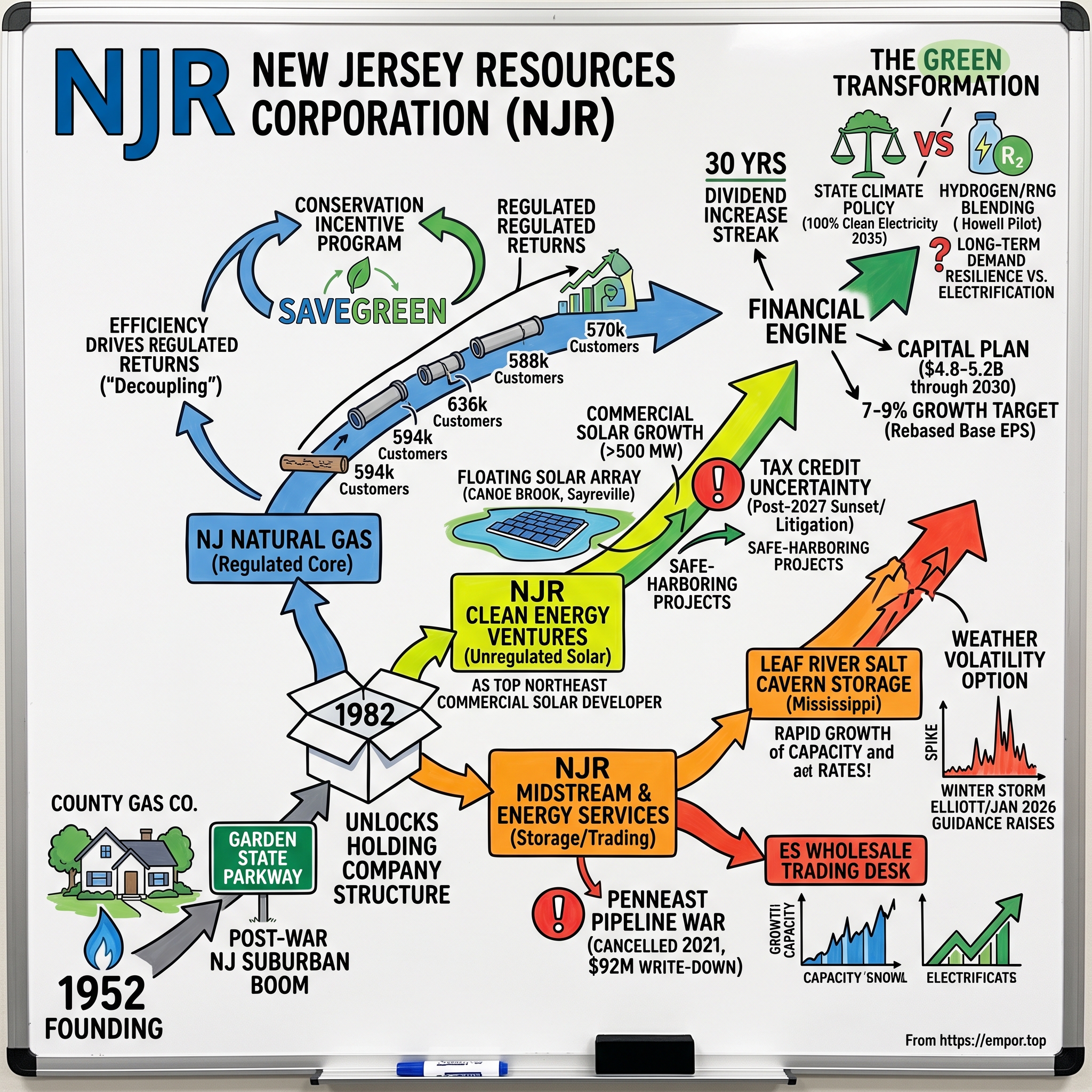
The first is New Jersey Natural Gas, the regulated distribution utility, serving roughly 594,000 customers across Monmouth, Ocean, Morris, Middlesex, Sussex and Burlington counties.24 It is the ballast: a franchise monopoly with state-blessed returns, and the source of about 65% of fiscal 2025 net financial earnings.5
The second is NJR Clean Energy Ventures, a commercial solar developer and owner that crossed 500 megawatts of installed capacity in early 2026 — 512.7 MW as of May 1 — making it one of the larger non-utility commercial solar portfolios in the Northeast.2
The third is NJR Midstream, reported as Storage and Transportation: the Adelphia Gateway pipeline in southeastern Pennsylvania, the Leaf River salt-dome storage facility in Mississippi, and a half-interest in the Steckman Ridge storage field in Pennsylvania.4
The fourth is NJR Energy Services, the wholesale gas marketing desk — the business that turned a cold January into a guidance raise.
The central question
How does a regional Jersey Shore gas distributor end up owning one of the Northeast's largest commercial solar fleets, fight a natural gas pipeline case all the way to the Supreme Court of the United States, win it, lose the project anyway, and still extend a dividend increase streak to thirty consecutive years — all inside a state whose formal energy policy calls for 100% clean electricity by 2035?67
The honest answer is not a single brilliant strategy. It is a sequence of choices, some of them expensive mistakes, made by a management team that has been unusually willing to abandon a thesis when the political facts changed.
The themes
Four threads run through this story, and each contains its own tension.
The moat is real, and it is granted, not earned. NJNG's advantage is a franchise territory awarded by the New Jersey Board of Public Utilities, defended by the sheer capital cost of duplicating buried pipe. That is a durable structure. It is also entirely dependent on the continued goodwill of a state government that has other priorities.
The state's climate policy is the central strategic variable. New Jersey's 2024 Energy Master Plan, released in November 2025, targets an 80% economy-wide greenhouse gas reduction by 2050 and 100% clean electricity sales by 2035.6 Every pathway modeled in that plan involves electrifying building heat — which is to say, shrinking the volume business NJNG exists to serve.
Capital discipline was learned the hard way. NJR wrote down $92.0 million on its 20% stake in the PennEast pipeline before the project was abandoned.8 The subsequent five-year capital plan of $4.8 billion to $5.2 billion through fiscal 2030 puts more than 60% into the regulated utility — assets that cannot be cancelled by a permit denial.5
The financial engine runs on a non-GAAP metric. Net financial earnings, or NFE, strips out unrealized mark-to-market swings on derivatives that NJR holds against physical gas positions. It is the number management guides to, is paid on, and asks investors to use. It is also, by construction, a number that flatters a business with a large derivatives book. Understanding NJR requires understanding both why NFE is defensible and where it can mislead.
The story begins, as most utility stories do, with a demographic accident.
 Subscribe on LinkedIn
II. Founding Roots & The New Jersey Suburban Boom (1952–1990s)
Picture the Jersey Shore in the early 1950s. Not the boardwalk-and-neon version of later decades — this was farmland, pine barrens, cranberry bogs, and a scatter of summer bungalows that emptied after Labor Day. Ocean County, which would become one of the fastest-growing counties in the northeastern United States, had fewer residents than a mid-sized city. Heating a house meant a fuel-oil truck, a coal bin, or a propane tank.
Into that market stepped County Gas Company, which acquired gas assets from Jersey Central Power & Light and, in 1952, took the name New Jersey Natural Gas Company.9 The founding logic was not complicated. Somebody was going to have to lay pipe under all the farmland that was about to become subdivisions.
The tailwind that did the heavy lifting
What followed was one of the great demographic bets in American utility history, and it was mostly a matter of standing in the right place. The Garden State Parkway opened along the coast in the mid-1950s, and the New Jersey Turnpike ran up the spine of the state. Suddenly a family could live in Monmouth or Ocean County and commute to Newark, Jersey City or Manhattan. Potato fields became cul-de-sacs. Summer colonies became year-round towns.
Every new house was a customer for life, and — critically — every existing house heated by oil or propane was a conversion opportunity. Gas was cheaper, cleaner, required no delivery truck, and needed no tank in the basement. NJNG spent decades doing the least glamorous and most reliable thing in energy: signing up households one at a time and putting steel and plastic in the ground to reach them.
This is worth pausing on, because it explains the company's temperament. NJNG did not grow by acquiring other utilities, the standard playbook of the American gas sector. It grew organically, house by house, in a territory that kept adding houses. That habit — grinding organic growth in a defined geography — became the cultural default, and it still shapes how the company allocates capital seventy years later.
1982: the holding company
By the early 1980s, the utility had matured and its management wanted room to do things a regulated utility legally cannot. The answer was structural. New Jersey Resources Corporation was incorporated as a holding company and became the publicly traded parent of New Jersey Natural Gas, listing on the New York Stock Exchange under the ticker NJR.9
The move looks like paperwork. It was not. A regulated utility operates inside a rigid box: its capital structure, its returns, its rates, and to a large degree its business activities are all supervised. A holding company sits above that box. It can own the utility and simultaneously own businesses that take real commercial risk for real commercial returns — trading desks, project developers, contracting businesses — funded partly by the utility's stable cash flows and credit.
Every unregulated business NJR has built since, from the solar fleet to the wholesale trading desk to the Mississippi salt caverns, exists because of a corporate reorganization completed in the early 1980s. The holding company was the option, and the following four decades were the company exercising it.
What the regulator actually granted
The other half of the foundation is regulatory. The New Jersey Board of Public Utilities grants gas distribution utilities exclusive franchise territories. Within NJNG's six counties, no competitor may build a competing distribution system and sell gas to households.4
It is tempting to describe this as a legal monopoly and move on. The more useful framing is economic. Even if the BPU tore up the franchise rules tomorrow, no rational investor would fund a second set of gas mains under the same streets. The infrastructure is a sunk, buried, single-purpose asset serving a territory whose total gas demand is at best flat. A duplicate network would face the same fixed costs against half the volume. The legal exclusivity mostly formalizes what the economics already guarantee.
The corollary is the part investors should internalize: because the monopoly is unassailable, the regulator sets the return. NJNG cannot raise prices to what the market will bear. It earns what the BPU allows it to earn on the capital the BPU agrees was prudently invested. That is the fundamental bargain, and it means the utility's growth rate is not a market-share question. It is a question of how much capital the state will let the company put in the ground, and at what allowed return.
Which is a comfortable position — and, by the late 1990s, a boring one. Rate base grows at the pace of pipe replacement and new hookups. Somewhere in the mid-single digits. Management wanted more.
III. The Unregulated Pivot: Building Solar & Wholesale Trading (2000s–2010s)
There is a moment in the life of every well-run regulated utility when the CEO looks at the growth algebra and realizes it does not add up to an interesting stock. Rate base compounds at five or six percent. The allowed return does not move. Add the dividend, and shareholders get high single digits in a good decade. Fine for a bond substitute. Not a business story.
New Jersey Resources reached that moment around the turn of the millennium, and the holding company structure sitting unused above the utility suddenly looked like the most valuable thing on the balance sheet.
Reading the subsidy before the subsidy arrived
New Jersey did something in the 2000s that most Americans have forgotten: it became, briefly, one of the largest solar markets on Earth. The state's Renewable Portfolio Standard required electricity suppliers to source a rising share of power from solar, and — this is the important design choice — it enforced the mandate through a tradable instrument. Every megawatt-hour a solar array produced minted a Solar Renewable Energy Certificate, an SREC. Suppliers who fell short had to buy SRECs or pay a penalty. The penalty set the ceiling. Scarcity set the price.
The practical effect was that a solar project in New Jersey earned two revenue streams: the electricity itself, and a certificate whose value came from a legal obligation someone else had. In the program's tighter years, the certificate was worth considerably more than the power.
NJR Clean Energy Ventures was built to harvest that. And here the holding company structure paid for itself, because CEV could do something the utility could not: take development risk. It sited, financed, built and owned solar arrays — on commercial rooftops, on landfills and brownfields, on ground-mount sites — and monetized them through power sales, certificate sales, and federal Investment Tax Credits.
The tax credit deserves a plain-English explanation, because it is central to the economics and to a risk we will return to. The federal ITC gives the owner of a new solar project a credit against federal income tax worth a large percentage of the project's cost. For a company that does not owe enough tax to absorb the credit, it is worthless — which historically forced developers into "tax equity" partnerships, byzantine structures where a bank effectively rents out its tax bill in exchange for most of the project's early economics. Those structures are expensive, slow, and dilutive to returns. A developer that can use the credits itself, or sell them cleanly, keeps far more of the project.
The reservoir
If one project captures the character of the solar business, it is Canoe Brook.
In Millburn and Short Hills, New Jersey American Water operates the Canoe Brook Water Treatment Plant, and next to it sits a reservoir. Reservoirs are, from a solar developer's perspective, maddening: acres of flat, unshaded, perfectly oriented surface that cannot hold a solar panel because it is water.
CEV built on it anyway. Construction began in May 2022 on a floating array — panels mounted on a racking system that floats — and the finished project came in at 8.9 megawatts across 16,510 panels covering roughly 17 acres of reservoir surface.10 It was the largest floating solar installation in North America, it generates enough power for about 1,400 homes annually, and it supplies roughly 95% of the treatment plant's electricity needs.10 It was CEV's second floating project, following a 4.4 MW array at Sayreville that entered commercial operation in 2020.10
Floating solar is not a gimmick, though it is easy to file it as one. In a dense, expensive state where land suitable for utility-scale solar is scarce and contested, a developer who can build on surfaces nobody else can use has a genuine sourcing advantage. The water also cools the panels, which modestly improves output. The honest caveat: floating installations cost more per watt than ground-mount, and the technique remains a niche within CEV's portfolio rather than its core. It is best read as evidence of a development team willing to solve site-acquisition problems creatively — useful, but not by itself an economic moat.
The trading desk nobody models correctly
The second unregulated business is stranger and, for most investors, harder to underwrite.
NJR Energy Services is a wholesale natural gas marketing operation providing physical gas services across North America.4 Strip away the language and it does something specific: it controls physical rights — capacity on pipelines, space in storage caverns — and it uses those rights to capture the difference between what gas is worth in one place or time and what it is worth in another.
Think of it as owning warehouse space and truck slots in a market where the price of the commodity swings wildly by geography and season. Appalachian shale gas from the Marcellus and Utica basins is abundant and cheap at the wellhead. Boston and New York in January are gas-starved and expensive. The molecules are identical. The difference is entirely a function of whether you have the pipeline capacity to move them and the storage to hold them until the price is right. ES holds those rights and monetizes the spread.
A large part of this activity runs through Asset Management Agreements, in which a utility or industrial customer hands its unused pipeline and storage capacity to ES to optimize, splitting the proceeds. The customer gets guaranteed value from an asset it was going to underuse; ES gets a portfolio of physical positions without buying them outright.
The critical structural point for investors: ES is not a speculative trading book in the hedge-fund sense. Its positions are anchored to physical assets it controls. But it is also not a stable annuity. Its earnings are a direct function of volatility, and volatility does not arrive on schedule. In a mild winter with placid basis spreads, the desk earns very little. In a January like 2026, it earns a great deal.
Sizing the machine
By the 2010s, the shape of the holding company was set, and management articulated a mix it has stuck to since: anchor roughly two-thirds of earnings in the regulated utility, and let the unregulated businesses supply the upside.
In fiscal 2025, that mix held. Of total net financial earnings of $329.6 million, NJNG contributed $213.5 million, Clean Energy Ventures $61.2 million, Energy Services $34.9 million, and Storage and Transportation $18.5 million, with the small Home Services and other line slightly negative.5
There is a wrinkle in that CEV number worth flagging early, and management flagged it too: the utility accounted for roughly 65% of fiscal 2025 earnings per share, but more than 70% once a one-time gain on a solar portfolio sale is excluded.11 The underlying regulated share of recurring earnings is therefore higher than the headline segment split suggests — a detail that matters when assessing how much of NJR's profit is genuinely annuity-like.
The unregulated businesses gave NJR growth the utility alone could never produce. They also gave management an appetite for building things outside the franchise. In the mid-2010s, that appetite pointed at pipelines.
IV. Midstream Ambitions & The PennEast Pipeline War (2014–2021)
The map on the wall in the mid-2010s told a story that seemed obvious to everyone in the industry. Two hundred miles west of New Jersey, Pennsylvania shale was producing gas so abundantly that producers occasionally paid to have it taken away. Two hundred miles east, New Jersey and New York households and power plants paid some of the highest winter gas prices in the country. Between them: not enough pipe.
To a midstream investor, that is not a problem. That is a business plan with a spread attached. NJR, along with a group of partners, decided to go build the pipe.
Buying instead of building
Before the greenfield fight, NJR made two acquisitions that turned out to be far better decisions than the one that got the headlines.
The first was Adelphia Gateway. In November 2017, NJR made a $10 million initial payment toward the purchase of an existing 84-mile pipeline in southeastern Pennsylvania from Talen, and on January 13, 2020, it closed the acquisition for a base purchase price of $166 million.12 The elegance of the deal was in what it avoided: the line already existed, carrying petroleum products, with rights-of-way already secured across a densely populated corridor. Converting it to interstate natural gas service required federal approvals and physical work, but it did not require assembling a new route through hundreds of unwilling landowners in one of the most litigious regions in the country.
The second was Leaf River. In September 2019, NJR Midstream agreed to acquire Leaf River Energy Center from Macquarie Infrastructure Partners for $367.5 million.13 Leaf River is a salt-dome storage facility in Mississippi — enormous caverns hollowed out of a salt formation that hold natural gas and, crucially, allow it to be injected and withdrawn very quickly. Salt storage is the difference between a warehouse and a loading dock: the value is not just capacity but deliverability, the ability to dump large volumes into the market on the day prices spike.
NJR also holds a 50% equity interest in Steckman Ridge, an underground storage facility in Pennsylvania.4
The common thread across all three: buy existing, permitted, contracted infrastructure rather than build new. Hold that thought.
PennEast
PennEast was the opposite bet. It was a proposed 116-mile greenfield interstate pipeline running from northeastern Pennsylvania across the Delaware River into New Jersey, budgeted at roughly $1 billion, and NJR held a 20% equity interest accounted for under the equity method.8
The project ran into New Jersey. Not the state's gas demand, which was real, but the state's institutions. The route crossed preserved farmland and state-held conservation easements. The New Jersey Department of Environmental Protection controlled the water quality certifications required under the Clean Water Act. The state attorney general litigated. Environmental groups organized. Municipalities passed resolutions.
The central legal question became genuinely constitutional. Under the Natural Gas Act, a company holding a federal certificate of public convenience and necessity may use eminent domain to condemn the land it needs. But New Jersey argued that its own sovereign immunity — the Eleventh Amendment principle that a state cannot be hauled into federal court by a private party — protected state-owned property interests from condemnation by a private pipeline company.
If that argument held, any state could veto any federally approved interstate pipeline simply by acquiring a strip of land along the route. On June 29, 2021, the Supreme Court ruled for PennEast, holding that the federal government's eminent domain power delegated through the Natural Gas Act extends to state-held property interests.7
It was a landmark win for the interstate pipeline industry. It was also, for PennEast, almost entirely beside the point.
Winning the case and losing the war
The Supreme Court decided who could condemn land. It did not decide whether New Jersey had to issue the water quality certifications, and the state had already made its position clear.
NJR's own disclosure captured the moment with unusual candor. During the third quarter of fiscal 2021 — the same quarter as the Supreme Court victory — the PennEast partnership determined the project was no longer supported and all further development ceased.8 NJR recognized an other-than-temporary impairment of $92.0 million on its equity investment, a Level 3 fair value determination that explicitly weighed "the evaluation of the current environmental and political climate as it relates to interstate pipeline development."8 The sponsors formally cancelled the project on September 27, 2021.14
Read that impairment disclosure again. The company did not blame a court, a cost overrun, or a counterparty. It wrote down the asset because it concluded the political environment for building new interstate pipelines in the Northeast had changed permanently. That is an unusually direct admission, and it is the most analytically important sentence NJR has published in the last decade.
What the episode actually proves
It is worth being precise about the lesson, because the company's preferred framing — disciplined capital allocation, knowing when to fold — is only half of it.
The first half is fair. Ninety-two million dollars is real money, but it is a fraction of what a sponsor loses by pushing a doomed greenfield project through to a construction decision. The partnership stopped spending when the evidence was clear rather than throwing capital at a sunk-cost narrative. Contrast that with several multi-billion-dollar northeastern pipeline projects of the same era that absorbed vastly more before collapsing.
The second half is less flattering: NJR should have seen it sooner. New Jersey's political trajectory on fossil infrastructure was not a secret in 2015. The company committed equity to a greenfield interstate pipeline through preserved land in a state actively legislating toward decarbonization. The write-down was a consequence of an underwriting error, not merely of bad luck.
What management did with that lesson is the more encouraging part. Since PennEast, essentially no capital has gone toward new greenfield interstate pipe. It has gone instead into two categories: regulated utility investment that the BPU has approved in advance, and expansions of midstream assets NJR already owns and has already contracted.
Leaf River is the clearest example of the new doctrine. NJR filed an application with the Federal Energy Regulatory Commission to increase working gas capacity there by more than 70%, targeting 43 Bcf by 2028, with a fourth cavern planned to take it to 55 Bcf, backed by long-term contracts.11 On the November 2025 earnings call, when Morningstar's Travis Miller pressed on whether the projected earnings step-up rested on assumptions or on signed business, CEO Steve Westhoven answered that these are "contracts that we've got signed in our hands."11 By the May 2026 call, capital was flowing, the FERC environmental assessment had been received, and service was expected in fiscal 2027 or 2028 — with management stating the expansion required no additional external financing.15
The economics of the existing asset have also improved sharply. Westhoven disclosed that average storage rates at Leaf River have risen from roughly nine cents per dekatherm per month when NJR bought it to nearly twenty cents currently.11 That is a doubling of the price of the same physical service, and it reflects something structural: in a region where new pipelines cannot be built, the scarcity value of storage and existing transportation rises. NJR's failure at PennEast and the appreciation of Leaf River are, in a real sense, the same phenomenon viewed from opposite ends.
Management now guides that Storage and Transportation net financial earnings will more than double by 2027.11 It is the highest-confidence growth claim in the portfolio because it rests on executed contracts rather than forecasts — though investors should note it starts from the smallest earnings base of the four segments.
With greenfield midstream closed off, the growth burden shifted back to where it started: the pipe under the Jersey Shore.
V. The Core Utility Engine: New Jersey Natural Gas (NJNG) & Regulatory Economics
On June 1, 2026, New Jersey Natural Gas did something that looks contradictory and is in fact the whole game. It filed with the New Jersey Board of Public Utilities to cut customer bills — and to raise them.
The cut came first: an 8.9% reduction ahead of the 2026-27 winter, worth roughly $158 a year to a typical residential customer, delivered through the Basic Gas Supply Service and Conservation Incentive Program filings.16 The increase came in the accompanying base rate case: a request for approximately $157.6 million in additional delivery revenues, seeking recovery of roughly $950 million of system investment made since the prior rate case, on a claimed rate base of $4.05 billion, with a requested return on equity of 10.10% and a common equity ratio of 55.5%.17 If granted as filed, the delivery component would raise the average residential heating bill by 12.7%; combined with the commodity reduction, management projects bills roughly flat versus today.1617
That is the regulated utility business in one filing. The commodity is passed through at cost — when gas gets cheaper, customers get the benefit and NJNG earns nothing on it. The delivery charge is where the utility earns, and it earns by investing capital the regulator agrees was prudent.
How the money actually works
The mechanics deserve a plain explanation, because they determine everything about how this company compounds.
The utility spends money on physical assets — mains, services, meters, regulator stations, control systems. The approved total of that investment, less accumulated depreciation, is the rate base. The regulator sets an allowed return on that rate base, built from an assumed mix of debt and equity and an allowed return on the equity portion. Rates are then set at a level designed to let the utility recover its operating costs, its depreciation, and that allowed return.
The consequence: the utility's earnings power grows when rate base grows. Not when volumes grow. Not when gas prices rise. When the asset base gets bigger and the regulator lets the company earn on it.
The most recent completed settlement shows the numbers. On November 21, 2024, the BPU adopted a stipulation approving a $157.0 million annual increase to base rates effective the same day, reflecting a rate base of $3.25 billion, an overall rate of return of 7.08%, a return on common equity of 9.60%, and a common equity ratio of 54.0%.18
Compare that to the June 2026 filing and the trajectory is visible: rate base moved from $3.25 billion to a claimed $4.05 billion in about eighteen months.1718 That is the compounding engine, and it is why NJR targets rate base growth of 7% to 9% annually through 2030.19
One caution on the current filing. The requested 10.10% ROE and 55.5% equity ratio are opening positions, not outcomes. New Jersey base rate cases are settled, not litigated to judgment, and the Division of Rate Counsel exists to argue the other side. The prior case settled at 9.60% on 54.0% equity against an initial ask above that. Management itself has noted that New Jersey rate cases typically take nine to twelve months, with new rates unlikely before 2027.17 Investors should assume the settled numbers land below the ask.
Decoupling: the mechanism that makes a shrinking business investable
Here is the puzzle at the heart of every gas utility in a decarbonizing state. If policy succeeds in making homes more efficient and pushing some customers to electric heat, gas volumes fall. If the utility earns per unit sold, falling volumes destroy earnings — and the utility therefore has a financial incentive to fight efficiency.
New Jersey solved this with a decoupling mechanism, implemented at NJNG through the Conservation Incentive Program. In simple terms, the regulator sets a revenue level the utility is entitled to collect, and if actual usage comes in below that level — because of a warm winter, or because customers installed better insulation — the shortfall is trued up through a rate adjustment. If usage runs above, customers get money back.
The effect is to sever earnings from weather and from conservation. A mild December no longer breaks the utility's year. And, more subtly, it removes the utility's structural reason to oppose energy efficiency programs — which is precisely why the same company that sells natural gas also runs a large program to help customers use less of it.
That program is SAVEGREEN, offering rebates and financing for high-efficiency equipment, and by the second quarter of fiscal 2026 it served more than 115,000 customers.1 Westhoven has framed it as capable of reducing residential usage by up to 30%, with savings in the hundreds of dollars per customer per year.11 The commercially relevant fact is that SAVEGREEN spending earns a regulated return. NJNG invests in reducing its own product's consumption, and gets paid a utility return for doing it. That is not altruism; it is a regulatory structure that has made the two aligned.
The pipe replacement machine
The other capital engine is safety-driven replacement. Older American gas systems contain cast iron and unprotected bare steel — materials that corrode, crack under ground movement, and account for a disproportionate share of leaks. Replacing them with modern plastic and coated steel improves safety and cuts methane emissions, and regulators approve accelerated recovery for it.
NJNG has run this through its Infrastructure Investment Program. It filed in February 2019 to invest $507 million over five years across 24 transmission and distribution replacement and enhancement projects, plus the installation of 47,500 protective devices on regulator vents in flood-prone areas and approximately 8,000 excess flow valves; the BPU approved an initial $150 million tranche in October 2020.20
The June 2026 filing extends the same logic to a new generation of work: pipeline looping and reinforcement, trunkline replacements, a customer-facing technology system replacement, cybersecurity enhancements, and the Jamesburg Replacement Project — a six-mile transmission line eliminating a single point of failure for more than 230,000 customers.16
Two things are true about this simultaneously. The work is genuinely necessary; a single-point-of-failure line serving 230,000 customers in winter is a real risk. And every dollar of it enlarges rate base. Investors should not treat those as in conflict — that alignment is the deliberate design of utility regulation — but they should recognize that a utility always has an incentive to define more work as necessary.
Customers still arriving
Amid all of this, NJNG keeps doing the thing it has done since 1952. Customer count grew from about 583,000 to 589,000 during fiscal 2025, and reached roughly 594,000 by the second quarter of fiscal 2026 — an addition of about 5,000 in six months.25
Roughly one percent annual customer growth sounds trivial. In the context of American gas distribution it is not. Most utilities in mature northeastern territories are flat or losing customers. NJNG's growth comes from genuine new construction in Ocean and Monmouth counties, plus continued conversions from oil and propane. It is the only large gas utility franchise in the region with this characteristic, and it is the single most underappreciated element of the investment case — because it means rate base can grow through additions, not only through replacement of existing assets.
The evidence that this endures, however, is demographic and therefore vulnerable. Shore-county construction depends on housing affordability, mortgage rates, and municipal zoning, none of which NJR controls.
The electrification question
Which brings us to the risk that hangs over everything.
New Jersey's 2024 Energy Master Plan, released in November 2025, lays out pathways to an 80% economy-wide emissions reduction by 2050 and 100% clean electricity sales by 2035 — an acceleration from the 2019 plan's 2050 clean energy target.6 Every modeled pathway to those goals involves electrifying building heat.
The plan is, however, more nuanced than a simple ban, and the nuance is commercially significant. It explicitly acknowledges that electrifying heating shifts New Jersey's peak electricity demand into winter, creating reliability challenges on the coldest days, and it identifies "managed electrification" strategies — including hybrid heating systems and targeted demand management — as important tools for mitigating that "peak heat" problem.6 A hybrid system keeps the gas furnace for the coldest hours while a heat pump handles milder weather. It is decarbonization that does not require removing the gas connection.
Then the politics shifted again. Governor Mikie Sherrill took office in January 2026 with energy affordability as the defining issue of the administration, signed an executive order declaring a state of emergency on energy costs and freezing utility rate increases, and in July 2026 signed legislation the administration says will save New Jersey ratepayers about $1 billion annually.2122 The approach has been characterized as "all-of-the-above" — emphasizing renewables while explicitly leaving room for continued reliance on natural gas.22
For a gas utility, an affordability-first governor is a genuinely mixed development. The upside: a political environment focused on bills is far less likely to mandate expensive forced conversions to heat pumps. The downside: rate freezes and heightened scrutiny of utility increases are precisely the mechanism that produces regulatory lag, where a utility's costs rise faster than its approved rates. NJNG's June 2026 filing — pairing a bill cut with a rate increase request — reads as a company that understands exactly which political weather it is filing into.
The molecule strategy, and its limits
NJR's own answer to decarbonization is to change what flows through the pipe rather than abandon it.
In 2021, NJNG built a 175-kilowatt electrolyzer in Howell, New Jersey, producing roughly 65 kilograms of hydrogen per day from renewable power and blending it into an eight-inch distribution line — the East Coast's first green hydrogen blending project for residential and commercial use, with an initial blend below 1%.23 The company has also pursued renewable natural gas, interconnecting methane captured from landfills and agricultural digesters into the distribution system.
An investor should hold this at arm's length. The Howell facility is a pilot at pilot scale — 65 kilograms a day is a rounding error against a system serving nearly 600,000 customers. Hydrogen is also a smaller, leakier molecule with roughly a third the volumetric energy content of methane, which limits how much can be blended before appliances and pipe materials become a problem. Environmental Defense Fund published a direct critique in October 2025 arguing that blending hydrogen into New Jersey's gas pipelines is not a viable decarbonization strategy.24 The reasonable reading is that hydrogen blending is currently a demonstration and a regulatory positioning exercise, not a proven path to decarbonizing a distribution system at scale. It may become more; it is not there.
The stronger argument for gas demand resilience is simply cost. Converting an older northeastern home to electric heat means a heat pump, likely an electrical service upgrade, sometimes new ductwork, and in the coldest weeks either backup resistance heat or a retained fossil system. That is a large upfront customer expense against uncertain operating savings in a state with high electricity prices. NJR does not need hydrogen to work. It needs that math to remain unattractive to homeowners — and, so far, it largely has.
The utility, then, is a slow, defended, regulator-paced compounder facing a long-dated policy threat. The parts of NJR that move fast sit elsewhere.
VI. Unregulated Powerhouses: Clean Energy Ventures & Energy Services
If NJNG is the metronome, the unregulated businesses are the drum fills — and in the last two fiscal years they have been loud enough to change the tempo of the whole company.
Clean Energy Ventures: what got sold, and why
The most revealing thing CEV did recently was shrink.
In November 2024, NJR Clean Energy Ventures agreed to sell its 91-megawatt residential solar portfolio to Spruce Power Holding Corporation for $132.5 million, transferring lease agreements covering roughly 9,800 homeowners.25 The portfolio operated under The Sunlight Advantage brand and represented years of accumulated retail solar effort.
Residential solar and commercial solar look similar and are entirely different businesses. Residential means thousands of individual homeowner relationships, thousands of separate lease contracts, thousands of roofs to service, and a customer-acquisition cost per megawatt that is brutal. Commercial means a handful of large counterparties, one interconnection per site, and megawatts measured in tens rather than tens of kilowatts.
Selling the residential book was an admission that scale in that segment was not achievable and the operational overhead was not worth it. That is a defensible portfolio decision. It also produced a one-time gain that inflated fiscal 2025 earnings — the gain was recognized in the first quarter of fiscal 2025, which is precisely why fiscal 2026's first quarter showed net financial earnings of $118.2 million, or $1.17 per share, down from $128.9 million and $1.29 a year earlier despite higher underlying contributions from the utility, storage and transportation, and energy services.26 Investors reading the fiscal 2025 CEV segment result should mentally separate the recurring solar earnings from the disposal gain.
The build rate
What remained is a commercial and community solar development machine that has accelerated. CEV placed 93.6 megawatts of commercial solar into service during fiscal 2025 — its highest annual total ever — and crossed 500 MW of installed capacity in early 2026, reaching 512.7 MW as of May 1.25 Management has guided to expanding installed capacity by more than 50% through fiscal 2027, drawing on a development pipeline exceeding 1.2 gigawatts.1115
Westhoven's argument for why this works now is worth quoting because it is a market observation rather than a climate one: "solar offers the most expedient path to add new supply to the grid."1 The context is PJM Interconnection, the regional grid operator, where capacity prices have surged and new generation is scarce. Asked on the May 2026 call by Mizuho's Dylan Lipner about the solar opportunity against PJM capacity needs, management confirmed active pipeline development and noted the state has been encouraging.15 CEV has also been exploring adding batteries, fuel cells and linear generators at existing solar sites — using interconnection rights it already holds, which are among the scarcest assets in the PJM queue.15
That last point is the most interesting strategic detail in the segment. An approved grid interconnection in a congested region is a genuinely scarce, valuable, and transferable right. A developer sitting on 500 megawatts of already-interconnected sites can add storage or other technologies without re-entering a queue that now takes years. Whether CEV converts that optionality into earnings is unproven — no capacity has been announced in service — but the underlying asset is real.
The tax credit problem
Here is where the bull case gets complicated, and where investors need to pay close attention.
CEV's returns depend materially on federal tax credits. The Inflation Reduction Act made those credits transferable under Section 6418 — meaning a developer could simply sell them for cash to any taxpayer, without the tax-equity partnership machinery described earlier. That was a large, quiet improvement to solar project economics.
Then Washington reversed course. The reconciliation legislation enacted in July 2025 eliminated the wind and solar credits under Sections 45Y and 48E for projects placed in service after December 31, 2027 — while preserving eligibility for projects that begin construction on or before July 4, 2026 and are placed in service by roughly the end of 2030.27 That created a scramble across the industry to establish "beginning of construction" before the deadline. In August 2025, the IRS issued Notice 2025-42, eliminating the long-standing five percent cost safe harbor for wind and for solar projects above 1.5 megawatts, tightening the path further.27 Then on June 6, 2026, a federal district court vacated that notice in full and remanded it, restoring the five percent safe harbor for large solar projects.28
That is three material rule changes in under a year, with litigation still live. It is the single largest source of uncertainty in CEV's forward economics.
NJR's response was to safe harbor aggressively. On the November 2025 call, Jefferies analyst Jamieson Ward asked directly about the strategy, and Westhoven said the company holds "safe harbor projects that are far in excess of what we need," framing it as optionality to accelerate deployment beyond the base capital plan.11 CFO Roberto Bel described the plan to grow capacity more than 50% over two years as resting on that safe-harbored inventory.11
The claim is credible in structure — NJR is a taxpayer with a large regulated business, which makes it better positioned than a pure-play developer to use credits directly. But two caveats belong in any honest assessment. First, "far in excess of what we need" is a management characterization; the specific quantum of safe-harbored capacity, and the legal robustness of each position under rules that a court has just reshuffled, are not disclosed in detail. Second, the credits sunset for projects in service after 2030 regardless. CEV's current growth runway has a visible end date, and what replaces it after 2030 — unsubsidized solar economics, storage, or something else — has not been laid out.
Energy Services: the volatility option
The trading desk demands a different analytical posture entirely, because its defining characteristic is that it is not supposed to be predictable.
Recent history illustrates the range. In the first quarter of fiscal 2023, extreme cold from Winter Storm Elliott drove NJR to consolidated net financial earnings of $110.3 million, or $1.14 per share, and prompted a guidance increase.29 Then came fiscal 2026: gas price volatility beginning in the fiscal second quarter exceeded original projections, driving a $0.25 guidance raise in February 2026, followed by a further $0.20 raise in May after the desk's exceptional results extended from January through March.226
Note the pattern. Both of NJR's fiscal 2026 guidance increases came from Energy Services, not from the utility.
Westhoven's framing of the segment on the May 2026 call was notably modest, describing it as a business that "performs just good things for us long term" and that "lowers our debt and equity needs by the cash that they are able to bring in."15 That is a deliberately unglamorous description of the segment that just drove two guidance raises, and it reflects a real institutional discipline: management does not want investors capitalizing volatile trading earnings at a utility multiple.
The clearest evidence of that discipline is buried in the guidance architecture. NJR's 7% to 9% long-term growth target is measured off a fiscal 2025 base of $2.83 per share — not the $3.29 the company actually earned.25 Management explicitly rebases downward, stripping out the portion of results it does not consider repeatable.
This is genuinely good practice and deserves credit. It also creates an interpretive trap for investors. If NJR earns $3.55 in fiscal 2026 and then earns $3.10 in a mild fiscal 2027, the headline will read as a large decline while the underlying regulated business compounds normally. Anyone valuing this company off a single year's earnings per share will be wrong in both directions across a cycle. The right approach is to track the regulated engine separately and treat Energy Services as what it is: a call option on weather and basis volatility, attached to a utility.
The counter-risk deserves equal weight. Winter Storm Uri in February 2021 demonstrated that extreme gas market dislocation destroys some participants even as it enriches others; NJR's desk profits precisely because it holds physical assets and hedged positions rather than naked exposure, but a physical-positions business is not risk-free. NJR discloses risk limits on the activity, and the segment's modest share of earnings is itself the primary control. The signal investors should watch is whether that share creeps upward over time — because a trading desk growing into a larger portion of a utility holding company's earnings is a governance question, not just a results question.
Which raises the obvious next question: who is making these allocation decisions, and what is their record?
VII. Management, Governance, & Capital Allocation under Steve Westhoven
In November 1990, a young engineer named Stephen Westhoven joined New Jersey Natural Gas.30 He would spend the next twenty-nine years inside the company before running it.
That is an increasingly rare career shape in American utilities, where CEOs are frequently recruited from outside, often from finance or from larger peers. Westhoven's path ran through the parts of NJR that were least like a utility: he moved from engineering into NJR Energy Services, becoming a director and then senior vice president of the trading business, then senior vice president and chief operating officer of the unregulated businesses collectively — Energy Services, Clean Energy Ventures and Home Services — before being named president and chief operating officer of the parent.30 Following a previously announced succession plan, the board appointed him president and chief executive officer of NJR and its principal subsidiaries effective October 1, 2019, succeeding Laurence M. Downes, who had led the company for more than two decades.31
Westhoven holds a bachelor of science in mechanical engineering from The Catholic University of America, where he serves on the Board of Visitors, and is an alumnus of Harvard Business School's Advanced Management Program.30
Why the résumé matters
Utility CEOs typically come up through the regulated side: operations, engineering, regulatory affairs. Their instinct is to file rate cases, build rate base, and manage the political relationship. That is a valuable skill set and it is not Westhoven's origin.
He came up trading gas. That background shows in how the company talks about itself. The May 2026 discussion of the winter emphasized supply procurement and hedging performance — 87% of winter supply secured in advance, customer savings quantified — rather than the more usual utility framing of heroic storm response. It shows in the comfort with commodity optionality, and in a management team that appears genuinely unbothered by earnings volatility as long as the regulated core compounds.
It also creates a fair question that a skeptical investor should keep asking: does a CEO from the trading side systematically overweight the businesses he built? The evidence so far argues no. The capital plan is overwhelmingly weighted to the utility, and the growth-target rebasing described earlier is the opposite of a trading-desk CEO talking his own book. But the question is worth revisiting if the earnings mix drifts.
The executive team around him has evolved. Roberto Bel was promoted to senior vice president and chief financial officer effective January 1, 2022, after joining NJR in 2019 as vice president of treasury and investor relations with more than twenty years of finance experience; the same reshuffle moved Patrick Migliaccio, previously CFO, to senior vice president and chief operating officer of New Jersey Natural Gas.32 Moving a sitting CFO into utility operations is an unusual, and arguably shrewd, use of a finance executive in a business where regulatory economics and operations are inseparable.
The capital plan
The five-year plan announced with fiscal 2025 results is the clearest statement of strategy the company has made since PennEast: $4.8 billion to $5.2 billion of capital investment through fiscal 2030, approximately 60% directed to New Jersey Natural Gas, representing roughly a 40% increase over the prior five-year period.1119 Fiscal 2025 capital expenditures were $752.5 million, and the plan contemplates $775 million to $930 million in fiscal 2026 and $870 million to $1 billion in fiscal 2027.519
The composition tells the story. The largest share goes into assets whose returns are set by a regulator before the money is spent. A meaningful second tranche goes to CEV's solar pipeline, where returns depend on tax credits and power contracts. A smaller allocation goes to storage and transportation, concentrated in the contracted Leaf River expansion.
Almost nothing is allocated to the category that produced the $92 million write-down.
The financing claim, and why it matters most
The most consequential statement management has made about this plan is not about where the money goes. It is about where it comes from.
Westhoven stated plainly that NJR requires no block equity issuance to execute the capital plan, and Bel reiterated on the May 2026 call that the company sees "no need for block equity in the foreseeable future."111 Supporting metrics: adjusted funds from operations to adjusted debt reached 21.2% in fiscal 2025, above the 19% to 20% target range, and is projected to remain around 20% across the planning period, with credit ratings of A1 stable from Moody's and A+ stable from Fitch.1911
For a utility investor, this is the number that determines whether growth is worth anything. A company can grow rate base at 8% and deliver nothing per share if it funds the growth by continuously issuing stock. Avoiding equity issuance while spending 40% more than the prior period requires strong operating cash flow — which is exactly what the volatile Energy Services business supplies, and precisely what Westhoven meant when he described the segment as lowering debt and equity needs.
There is a circularity here that investors should sit with. The no-equity promise is partly underwritten by a business whose cash generation is weather-dependent. Cash from operations was $466 million in fiscal 2025; in the first six months of fiscal 2026 alone it was $589.3 million, against $414.1 million in the comparable prior period, helped by higher base rates.192 A sequence of mild winters would compress that cash flow at the same time the capital plan continues. Management has not been asked to spell out the contingency in detail, and it is the most useful question an analyst could pose on an upcoming call.
The record
Assessing credibility means looking at behavior over time, not at the latest slide deck.
On dividends: in September 2025, the board raised the quarterly rate from $0.45 to $0.475 per share, an increase of about 5.6%, taking the annual rate to $1.90 and marking the thirtieth consecutive year of dividend growth.33 Thirty years spans the dot-com bust, the financial crisis, the shale revolution, a pandemic, and the PennEast write-down. Streaks of that length are not accidents; they reflect a board that treats the dividend as a constraint on other decisions.
On guidance: fiscal 2025 marked the fifth consecutive year NJR outperformed its initial annual guidance, finishing at the high end of a range that had itself been raised during the year.5 Fiscal 2026 has followed the same pattern, with two upward revisions by May.226
That consistency is a genuine positive and also deserves a skeptical footnote. A company that beats its initial guidance five years running is either executing exceptionally or setting initial guidance conservatively. Both can be true. The fiscal 2026 initial range of $3.03 to $3.18 has already been revised to $3.48 to $3.63 — a roughly 15% increase driven principally by a trading business management explicitly excludes from its long-term growth base.219 The pattern is not deceptive, because the rebasing is disclosed. But investors should recognize that "beat guidance five years in a row" and "grew the durable earnings base by 7% to 9%" are different claims, and only the second one should command a utility multiple.
On explaining misses: the PennEast disclosure remains the strongest available evidence of candor, and the fiscal 2025 fourth quarter provided a smaller test — consolidated net income fell to $15.1 million, or $0.15 per share, from $91.1 million a year earlier, with the shortfall attributed to higher operating revenue in the prior-year period.534 Fiscal fourth quarters are seasonally weak for a heating utility, and the explanation is unremarkable, but the company did not bury it.
On the analyst relationship: the recent calls read as substantive. Analysts from Mizuho, Morningstar and Jefferies have pressed on contract backing at Leaf River, safe harbor positions at CEV, and the sustainability of Energy Services earnings, and management's answers have been specific — signed contracts, named rate levels, quantified savings.1115 What has been less prominent in recent calls is direct engagement with New Jersey's shifting political environment; the May 2026 call contained no substantive discussion of the new administration's energy agenda.15 Given that state policy is the largest long-term variable in the story, that is a gap worth watching.
VIII. Playbook: Business & Investing Lessons
Strip away the specifics of gas mains and salt caverns, and NJR offers four transferable lessons — each with a limit attached.
The utility-plus model
The core structural insight is that a holding company can own a regulated monopoly and use its balance sheet, credit rating and cash flow to fund businesses that earn returns a regulator would never permit.
Done well, this produces something better than a pure-play utility: the regulated core supplies predictability and cheap capital, while the unregulated arms supply growth and optionality. NJR's version has worked, with the utility's roughly two-thirds earnings share providing the stability that lets the other third be genuinely opportunistic.
The limit is that "utility-plus" has an ugly cousin called diworsification, and the graveyard of American utility holding companies is full of examples — telecom ventures, merchant power fleets, international water businesses, and unregulated retail energy marketers that destroyed more value than decades of regulated returns created. The distinction between NJR's model and those failures is not conceptual. It is that NJR's unregulated businesses are adjacent to what the utility already knows: moving and storing gas molecules, and building energy infrastructure in the states where it already operates. The PennEast write-down is what happens at the edge of that adjacency. An investor's ongoing test should be whether new unregulated commitments stay close to the core competence or drift away from it.
Regulatory judo
The second lesson is the most counterintuitive: when the state sets out to reduce demand for your product, the highest-return response may be to volunteer to help.
NJNG runs an efficiency program that reduces gas consumption and earns a regulated return for doing it. Decoupling makes that possible by removing the utility's financial stake in volume. The result is a company whose formal incentives are aligned with a policy that, in its maximal form, would eliminate the company.
That alignment is real and it is also bounded. Decoupling protects against gradual volume decline. It does not protect against customer loss — a household that removes its gas service entirely stops paying the fixed charge as well. And it does not protect against affordability politics, where a shrinking volume base spreads fixed network costs across fewer therms, raising per-unit bills and inviting exactly the regulatory scrutiny New Jersey's current administration is applying. The judo works until the policy stops being about efficiency and starts being about disconnection.
Knowing when to fold
The PennEast episode is the cleanest capital allocation lesson in the story, and its value lies in the specificity of the trigger.
NJR did not stop because the project got expensive. It stopped because it concluded that the political and permitting environment for a specific asset class in a specific region had changed structurally, and no amount of additional spending would change that. The write-down explicitly named the environmental and political climate as the reason.8
The generalizable principle: when a project's failure mode is political rather than economic, standard project-finance logic breaks down. A cost overrun can be engineered around. A state government that does not want your asset built cannot be. Recognizing which kind of problem you have — and doing so before rather than after the next capital call — is the discipline that separates a $92 million lesson from a billion-dollar one.
Reading NFE honestly
The fourth lesson is about a metric, and it cuts both ways.
Net financial earnings exists because of an accounting mismatch. NJR's gas businesses hold physical inventory and forward positions, hedged with derivatives. Accounting rules require the derivatives to be marked to market through the income statement each quarter, while the physical positions they hedge are generally not. The result is GAAP earnings that swing on paper gains and losses which reverse when the physical transaction settles. NFE removes those unrealized swings.
That is a legitimate adjustment, and it is why fiscal 2026's second quarter showed GAAP net income of $218.9 million against net financial earnings of $221.5 million — close enough to indicate the adjustment was modest that quarter.2 In other periods the gap has been wider.
The discipline required is to remember what NFE does not do. It does not remove genuine business volatility — the trading gains that drove fiscal 2026's guidance raises are real cash, not accounting artifacts, and NFE includes them in full. It does not remove one-time gains like the residential solar sale. It is a mismatch correction, not a normalization. Investors who treat NFE as a clean recurring-earnings number will overestimate the durability of a good year. The company's own practice of rebasing its growth target to a lower figure is the tell that management knows this.
Together these four habits explain how NJR has compounded. Whether they continue to work depends on forces largely outside the company's control.
IX. Strategic Stress Test: Bull vs. Bear Case & Current Risk Radar
Imagine two investors reading the same NJR filings in the summer of 2026 and reaching opposite conclusions. Both would be defensible. Here is the war game.
The structural position
Start with Porter's framework, because a gas distribution utility is close to a textbook case.
Barriers to entry are effectively absolute. The BPU grants exclusive franchise rights, and the sunk-cost economics of buried distribution networks make duplication irrational even without the legal exclusivity.
Buyer power is low but not zero, and it is shifting. Individual households cannot negotiate. But buyers acting collectively through the political system are powerful, and New Jersey's ratepayers have just elected an administration that declared an emergency over energy costs.21 Buyer power in a regulated utility does not appear as price negotiation; it appears as rate case outcomes and legislation.
Supplier power is largely neutralized by pass-through. The commodity moves through to customers at cost. Labor and construction costs are a genuine input-cost exposure — and notably, NJNG's June 2026 filing explicitly cites labor and healthcare cost increases among the items driving its request.16 That is a real margin pressure, mitigated but not eliminated by the ability to file for recovery.
Substitution is the entire long-term risk. Electric heat pumps are the substitute. Today the barriers are cost and cold-weather performance. Both improve over time, and both can be altered by subsidy. This is the force that matters.
Rivalry within the franchise is nil. Rivalry in the unregulated businesses is intense — CEV competes for solar sites and interconnection against national developers with lower costs of capital, and Energy Services competes against every marketer and merchant desk in North America.
Now Helmer's 7 Powers, applied honestly rather than generously.
Cornered resource is the strongest fit. The franchise plus the physical network is a resource competitors cannot obtain at any price. A second, less obvious cornered resource is emerging in CEV's portfolio of existing PJM interconnections, which have become scarce as the queue has lengthened.15
Switching costs are real but frequently overstated in bullish framings. Converting from gas to electric heat requires a large upfront outlay and, in the Northeast, accepting either backup heat or worse performance on the coldest days. That is meaningful friction. It is not a lock-in in the software sense — it is a cost barrier, and cost barriers erode when equipment prices fall or subsidies arrive.
Scale economies are modest, not decisive. NJR spreads corporate overhead across four businesses, but at roughly $6 billion of market capitalization it is a fraction of the size of Atmos Energy, and it does not enjoy the procurement or financing advantages of the largest gas utilities.3
Process power has a plausible case in Energy Services, where consistently monetizing basis and seasonal spreads across decades suggests accumulated capability rather than luck — though the evidence is a track record, not a measurable mechanism.
Powers NJR does not have: no network effects, no counter-positioning, no branding power. This is an asset-heavy regulated business with adjacent commercial operations, and it should be underwritten as one.
The bull case
One: the rate base engine is running faster than the historical utility average. Rate base moved from $3.25 billion in the November 2024 settlement to a claimed $4.05 billion in the June 2026 filing, and management targets 7% to 9% annual growth through 2030 backed by a capital plan 40% larger than the prior period.171819 Unusually for a northeastern gas utility, part of that growth comes from genuine customer additions rather than pure replacement.
Two: contracted midstream earnings are set to step up. The projected doubling of Storage and Transportation earnings by 2027 rests on signed contracts and a FERC-filed expansion already under construction, with storage rates that have roughly doubled since acquisition.1115 In a region where new pipe cannot be built, incumbent storage is scarce.
Three: CEV has a runway and the tax capacity to use it. A 1.2 gigawatt development pipeline, a safe-harbored inventory management describes as well in excess of requirements, and PJM capacity scarcity that makes solar the fastest incremental supply.1115
Four: the balance sheet supports the plan without dilution. Investment-grade ratings, credit metrics above target, and an explicit no-block-equity commitment mean rate base growth should convert to per-share growth.1911
Five: thirty years of dividend increases at a payout the company can fund.33
The bear case
One: this is a gas utility in a state committed to eliminating fossil combustion. The 2035 clean electricity target and 2050 emissions target are formal state policy, and every modeled pathway involves electrifying heat.6 Timelines can accelerate. A future administration could restrict new gas hookups — which would attack the customer-growth engine that distinguishes NJNG from its peers, without touching a single existing customer.
Two: affordability politics cut against utility returns. A governor who has declared an energy cost emergency, frozen rate increases, and signed legislation targeting $1 billion of annual ratepayer savings is not an environment in which regulators generously grant 10.10% ROEs.2122 The mechanism to watch is regulatory lag: capital spending is accelerating while rate relief is politically constrained, and the gap between allowed and earned returns is where utility value quietly leaks.
Three: federal tax policy has already turned against CEV. Credits sunset for projects in service after 2027 absent construction start by July 2026, safe harbor rules were tightened and then judicially vacated within ten months, and the whole framework expires around 2030.2728 A meaningful slice of CEV's forward economics depends on rules currently in litigation.
Four: Energy Services earnings are not repeatable and the market may be extrapolating them. Two guidance raises in fiscal 2026 came from a business explicitly excluded from the long-term growth base.226 With shares near a fifty-two-week high after a strong twelve-month run, the risk is that a cyclical peak in trading earnings is being valued as structural.3
Five: the no-equity promise depends on that same cash flow. Fund a 40%-larger capital program without issuing stock, and the arithmetic requires strong operating cash generation. Several mild winters would test it.
The activist stress test
What would a skeptical long-short investor challenge?
Portfolio complexity and the conglomerate question. NJR is a regulated utility, a solar independent power producer, a midstream storage owner, and a commodity trading desk. Each has a different risk profile, different natural owner, and different appropriate multiple. A pure-play regulated gas utility of comparable quality would likely trade at a premium to a four-business hybrid, and an activist could argue for separating the midstream assets — which infrastructure funds would price aggressively — or CEV, which would attract renewable yield buyers. Management's rebuttal is the cash flow synergy described earlier: the unregulated businesses fund the utility's growth without dilution. That is a real argument, not a deflection. But it is an argument that must be re-won every year.
Disclosure asymmetry on Energy Services. The segment drives guidance revisions, and investors receive limited visibility into position sizing, risk limits, or how much of the result came from which strategy. A skeptic would push for more granular disclosure of the risk framework governing a business capable of swinging consolidated earnings by 15%.
Precedent on unregulated capital. PennEast is a documented case of committing meaningful equity to a project that failed on foreseeable political grounds. An activist would ask what governance changes followed — and the public record does not detail a specific change to the investment approval process beyond a stated shift in capital allocation priorities.
The gap between the headline number and the durable number. Reporting $3.29 in fiscal 2025 while setting the growth base at $2.83 is honest, but it means roughly 14% of reported earnings is management-designated as non-durable.25 A skeptic would argue the market is paying a utility multiple on the full number.
Peers and relative position
Context matters. South Jersey Industries, the other New Jersey gas utility holding company, was taken private by J.P. Morgan's Infrastructure Investments Fund in a roughly $8.1 billion transaction at $36.00 per share in cash, approved by the BPU on January 25, 2023 and closed February 1, 2023.35 That transaction is a useful datapoint in two directions: it demonstrates that private infrastructure capital values New Jersey gas distribution highly even amid decarbonization policy, and it removed the most directly comparable public company from the market.
Against the broader listed gas utility group — Atmos Energy, ONE Gas, Northwest Natural, Spire, Chesapeake Utilities, Southwest Gas — NJR is distinguished by two things: a materially larger unregulated earnings contribution, and genuine customer growth in a mature region. The first is a source of both higher potential returns and lower earnings quality. The second is a scarce and real advantage.
The current risk radar
Policy and regulatory risk is the dominant, first-order exposure. The transmission mechanism is specific: rate case outcomes, potential restrictions on new gas connections, and the pace at which building electrification incentives are funded.
Cost of capital and refinancing risk is real but currently well-managed. A utility with a $5 billion capital plan is structurally sensitive to interest rates, both in refinancing cost and in the allowed ROE that regulators benchmark to bond yields. Credit metrics above target and an A1/A+ rating profile provide meaningful cushion today.19
Execution risk in solar is the most active near-term operational exposure: interconnection queue timing, equipment supply chains, module pricing, and the legal durability of safe harbor positions all bear directly on whether the 50% capacity growth target through fiscal 2027 is achieved.11
Weather risk is bidirectional and structurally asymmetric in disclosure terms — the upside gets celebrated in guidance raises, and the downside shows up as an unremarkable year.
Cybersecurity appears explicitly as a cost driver in the current rate filing, which is itself a signal that the utility regards operational technology protection as a rising capital requirement rather than an IT line item.16
The bull and bear cases are not really in conflict. They describe the same company on different time horizons: a regulated compounder with contracted growth over five years, facing a policy-driven demand question over twenty-five.
X. Epilogue & The 1-3 KPIs That Matter Most
The floating solar array at Canoe Brook is a strange thing to look at. Sixteen thousand panels resting on the surface of a reservoir in one of the wealthiest suburbs in America, generating power for the water treatment plant next door — built and owned by a company whose primary business is delivering the fossil fuel that same state has committed to phasing out.
That contradiction is not hypocrisy so much as it is a business model. New Jersey Resources has spent two decades constructing a company that earns from the incumbent system and from the system meant to replace it, and has been rewarded by the market for doing so.
Whether that continues depends on a small number of things an investor can actually track. Most of what NJR reports each quarter is noise. Three metrics are signal.
One: NJNG rate base growth
This is the metric that determines the durable earnings power of two-thirds of the company. Rate base is the approved capital on which the regulator permits a return; when it grows, so does the utility's earnings capacity, largely independent of weather, gas prices or trading results.
Management targets 7% to 9% annual growth through 2030.19 Watch it as reported in rate case filings and investor materials, and watch two things alongside it: whether the growth is being driven by replacement work or by genuine customer additions, and whether the allowed ROE and equity ratio in settled cases hold up against the pressure of an affordability-focused administration. Rate base growing at 8% while allowed ROE compresses is a materially worse outcome than the headline suggests.
Two: net financial earnings per share, measured against the rebased growth target
Not the headline figure. The comparison that matters is NFEPS growth measured off management's own durable base — the $2.83 per share reference for fiscal 2025 rather than the $3.29 reported.25
This is the honest test of whether the company is compounding or simply enjoying a good weather cycle. If reported NFEPS runs well ahead of the rebased trajectory for several years, the durable base is being understated. If it falls short once trading conditions normalize, the growth algorithm is weaker than advertised. Either way, the gap between the two numbers is the most informative single figure NJR publishes.
Three: CEV installed solar capacity, and the capital required per megawatt
Installed capacity — 512.7 MW as of May 2026, with a stated goal of more than 50% growth through fiscal 2027 — measures whether the development pipeline is converting into operating assets.211 But megawatts alone are vanity. The critical companion question is what each megawatt costs NJR in net capital after tax credit monetization.
That is the number that reveals whether federal policy changes have impaired the economics. If installed capacity grows on schedule while net capital per megawatt rises materially, CEV is buying growth at a worse return. If capacity growth stalls, the safe harbor strategy did not work as described. Both outcomes would be visible well before they show up in segment earnings.
The closing frame
It is tempting to conclude that New Jersey Resources has solved the energy transition for legacy gas infrastructure — pairing a defended monopoly with a growing renewable portfolio and a trading desk that pays for both.
The more accurate conclusion is narrower and more interesting. NJR has bought itself a long runway, not a permanent answer. Its regulated growth is contracted and visible through roughly 2030. Its midstream expansion is signed. Its solar economics are underwritten by federal credits that currently expire around the same date. Every element of the visible growth story converges on the end of this decade.
What lies beyond depends on questions nobody can answer today: whether New Jersey households find heat pump conversion worth the cost, whether the state's climate targets survive its affordability politics, whether renewable natural gas or hydrogen ever scale past pilot, and whether a company that has been very good at reading political weather can keep doing so.
The Jersey Shore suburbs that made this company are still adding houses. The pipe is still going in the ground. And somewhere in Wall, New Jersey, a trading desk is watching the forward curve, waiting for the next cold January.
References
-
NJR (NJR) Q2 2026 Earnings Call Transcript — The Motley Fool, 2026-05-05 ↩↩↩↩↩↩↩
-
New Jersey Resources Reports Fiscal 2026 Second-Quarter Results — StockTitan, 2026-05-04 ↩↩↩↩↩↩↩↩↩↩↩↩↩↩↩↩
-
New Jersey Resources Financial Analysis & Stock Quote — New York Stock Exchange, 2026-07-24 ↩↩↩
-
New Jersey Resources Business Overview — NJR Investor Relations ↩↩↩↩↩
-
New Jersey Resources Reports Fiscal 2025 Fourth-Quarter and Year-End Results — New Jersey Resources, 2025-11-18 ↩↩↩↩↩↩↩↩↩↩↩
-
New Jersey 2024 Energy Master Plan — State of New Jersey Board of Public Utilities, 2025-11-24 ↩↩↩↩↩
-
PennEast Pipeline Co. v. New Jersey, 594 U.S. ___ (2021) — Supreme Court of the United States, 2021-06-29 ↩↩
-
New Jersey Resources Corp Form 10-K for Fiscal Year 2021 — U.S. Securities and Exchange Commission, 2021-11-18 ↩↩↩↩↩
-
History of New Jersey Resources Corporation — International Directory of Company Histories / FundingUniverse ↩↩
-
NJR Clean Energy Ventures and New Jersey American Water Highlight Innovative Solutions With North America's Largest Floating Solar Array — New Jersey Resources, 2023-06-05 ↩↩↩
-
NJR Q4 2025 Earnings Call Transcript — The Motley Fool via AOL, 2025-11-20 ↩↩↩↩↩↩↩↩↩↩↩↩↩↩↩↩↩↩
-
New Jersey Resources Corp Form 10-Q for the Quarter Ended March 31, 2020 — U.S. Securities and Exchange Commission, 2020-05-06 ↩
-
NJR Midstream Announces Acquisition of Leaf River Energy Center — Business Wire, 2019-09-05 ↩
-
Developers Officially Cancel $1B PennEast Natural Gas Pipeline — Engineering News-Record, 2021-09-27 ↩
-
New Jersey Resources Corporation (NYSE:NJR) Q2 2026 Earnings Call Transcript — Insider Monkey, 2026-05-05 ↩↩↩↩↩↩↩↩↩↩
-
New Jersey Natural Gas Submits Filings to NJBPU for Customer Savings and Future Recovery of Reliability Investments — New Jersey Resources, 2026-06-01 ↩↩↩↩↩
-
Form 8-K: New Jersey Resources Corp Reports Material Event (NJNG Base Rate Case Filing) — StockTitan, 2026-06-01 ↩↩↩↩↩
-
New Jersey Board of Public Utilities Approves New Rates for New Jersey Natural Gas — Business Wire, 2024-11-21 ↩↩↩
-
New Jersey Resources Q4 2025 Slides: 11.5% Annual Earnings Growth Despite Quarterly Miss — Investing.com, 2025-11-20 ↩↩↩↩↩↩↩↩↩↩
-
New Jersey Natural Gas Receives Approval for its Infrastructure Investment Program — Business Wire, 2020-10-28 ↩
-
Governor Sherrill Announces Ratepayer Relief, Signs Major Legislation on Energy, Saving New Jerseyans $1B Annually — State of New Jersey, Office of the Governor, 2026-07-07 ↩↩↩
-
NJ Gov. Sherrill Has a Plan to Boost Renewables and Natural Gas — WHYY, 2026 ↩↩↩
-
U.S. Natural Gas Utilities Paving Long Road to Hydrogen Blending — Natural Gas Intelligence ↩
-
Blending Hydrogen into New Jersey Gas Pipelines is Not a Viable Decarbonization Strategy — Environmental Defense Fund Energy Exchange, 2025-10-07 ↩
-
NJR Clean Energy Ventures Announces Sale of Residential Solar Business — New Jersey Resources, 2024-11-25 ↩
-
New Jersey Resources Reports Fiscal 2026 First-Quarter Results; Increases Net Financial Earnings Guidance for Fiscal 2026 — New Jersey Resources, 2026-01-31 ↩↩↩↩
-
IRS Generally Eliminates 5% Safe Harbor for Determining Beginning of Construction for Wind and Solar Projects — The Tax Adviser, 2026-01 ↩↩↩
-
Safe Harbor Restored: Federal Court Strikes Down IRS Attempt to Narrow Clean Energy Tax Credit Eligibility — Snell & Wilmer, 2026-06 ↩↩
-
New Jersey Resources Reports Fiscal 2023 First Quarter Results and Increases Net Financial Earnings Guidance for Fiscal 2023 — Business Wire, 2023-02-01 ↩
-
Westhoven Named President & CEO; DeGraffenreidt Joins Board — New Jersey Resources, 2019 ↩
-
New Jersey Resources Announces Executive Promotions and Key Leadership Changes — Business Wire, 2021-12-08 ↩
-
New Jersey Resources Raises Dividend for the 30th Consecutive Year — New Jersey Resources, 2025-09-16 ↩↩
-
New Jersey Resources Fiscal 2025 Fourth Quarter and Year End Financial Results — MarketScreener, 2025-11-18 ↩
-
Infrastructure Investments Fund Completes Acquisition of South Jersey Industries, Inc. — GlobeNewswire, 2023-02-01 ↩
 LinkedIn
 WhatsApp
 Reddit
 Hacker News
 Email
Email Kindle
 RSS Feed
 Spotify
 Apple Podcasts
 Amazon Music
 Audible
 YouTube