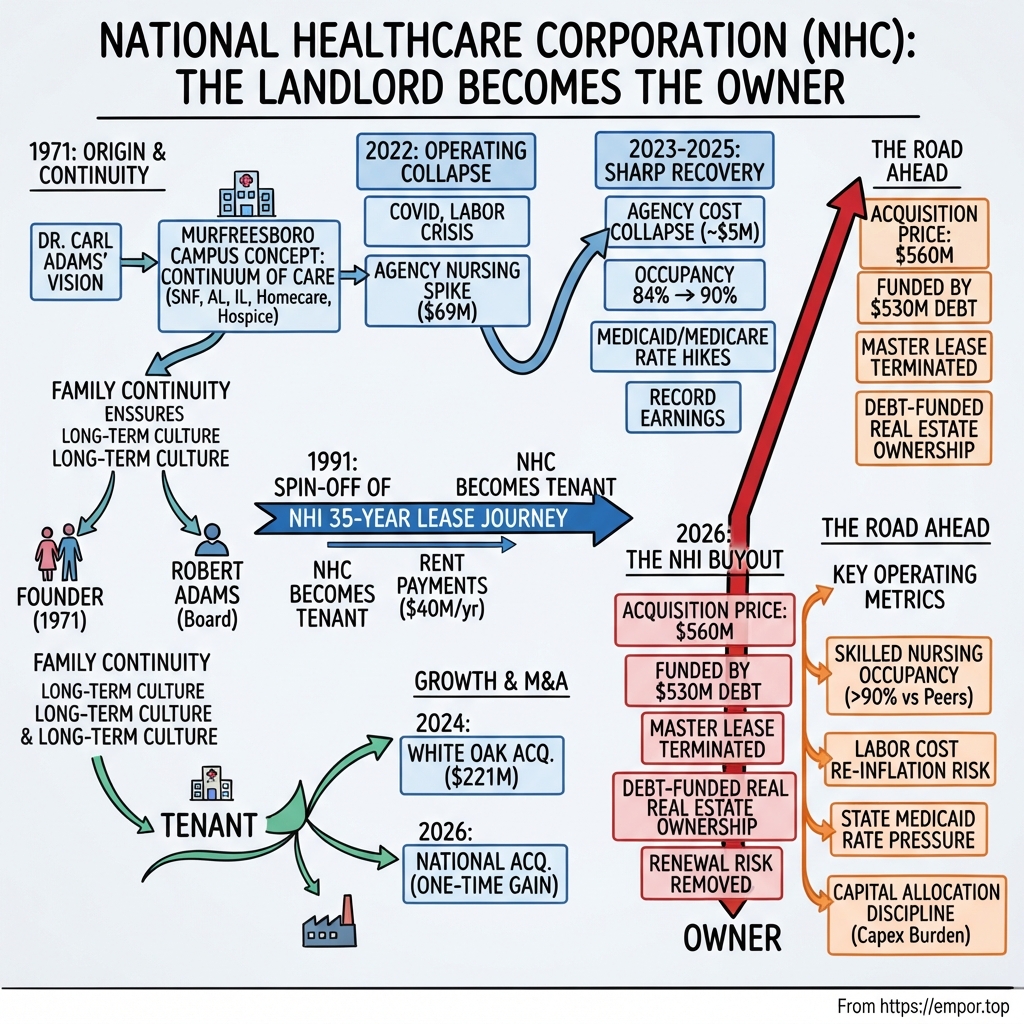
National HealthCare Corporation: The Landlord Becomes the Owner
I. Cold Open & Roadmap — (0:00–8:00)
On the morning of July 1, 2026, nothing visibly changed inside thirty-five buildings scattered across Alabama, Florida, Kentucky, Missouri, South Carolina, Tennessee, and Virginia. The nurses' aides still started the day with vitals and breakfast trays. The physical therapists still walked hip-replacement patients down the same linoleum corridors. The same "NHC HealthCare" signs stood out front. But on paper, something that had been true since George H. W. Bush was president stopped being true. National HealthCare Corporation, the Murfreesboro, Tennessee nursing home operator, stopped being a tenant in its own buildings. It had just paid $560 million to buy the real estate of thirty-two skilled nursing facilities and three independent living communities from National Health Investors, the real estate investment trust that NHC itself had created and spun off in 1991.1
That is a strange sentence, and it deserves a second read. A company carved out its own real estate, handed it to shareholders as a separate company, rented it back for thirty-five years, fought with that landlord in public, got declared in default by it, watched an activist hedge fund attack the landlord's board for being too cozy with the tenant, and then bought the buildings back. If a screenwriter pitched that as a family drama, a studio would say it was too on-the-nose. In Murfreesboro, it was simply how business got done.
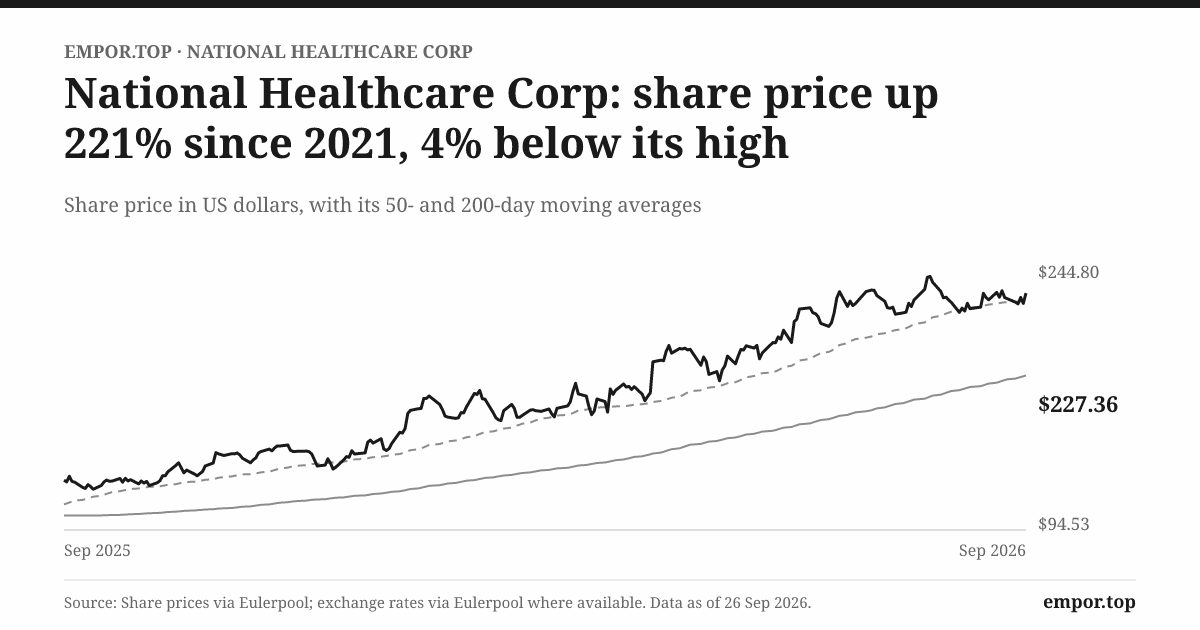
The company at the center of this story is not well known outside of senior care circles. NHC trades on the NYSE American exchange (still colloquially "the AMEX") under the ticker NHC, and at the close on September 25, 2026 its shares sat at $227.36, for a market value of roughly $3.56 billion.2 It operated eighty skilled nursing facilities with about 10,300 licensed beds, twenty-six assisted living communities, nine independent living communities, three behavioral health hospitals, thirty-four homecare agencies and thirty-three hospice agencies across nine states as of mid-2026.3 In the first half of 2026, the average occupancy of its owned and leased nursing homes was 90.0%.3 In an industry where many operators struggle to keep four of every five beds filled, that number is the first clue that something unusual is going on here.
The second clue is the income statement. In 2022, NHC earned $22.4 million of GAAP net income on about $1.09 billion of revenue.4 In 2025, it earned $120.0 million on $1.52 billion.5 That is a more than fivefold profit increase in three years for a company that runs nursing homes, a business most investors associate with thin margins, political risk, and litigation. It is the kind of chart that makes growth investors look twice and value investors get suspicious.
Both reactions are warranted, and this story will try to honor both. The framing questions are straightforward. How did a Tennessee nursing home company, founded in 1971, survive Medicaid budget cycles, a pandemic that turned nursing homes into the deadliest places in America, and a labor-cost shock that sent contract nurses' hourly pay through the roof, and come out the other side with record profits? What does it mean that the same founding family's fingerprints are still all over the boardroom more than fifty years later? And is the skilled nursing recovery a durable structural improvement, or a cyclical high riding temporary tailwinds that are already beginning to fade?
The map for the journey runs like this. First, a brief origin story that establishes the 1991 real estate spinoff and the family continuity that everything later hinges on. Then a primer on how nursing homes actually make money, because the economics are weirder than most people think. Then a look at the competitive landscape, especially against The Ensign Group, the industry's great consolidator. Then the heart of the operating story: the collapse of 2022 and the recovery through 2025. Then the capital deployment record, including the White Oak acquisition in the Carolinas and a necessary correction to a common misattribution. Then the big one: the NHI buyout, what NHC paid, and whether it was a fair price. After that, management, incentives, and credibility; the risks that actually matter; lessons; and finally the bull and bear case.
For long-term investors, the core tension is simple to state and hard to resolve. NHC looks like a best-in-class operator in a structurally advantaged position, with occupancy above its biggest peer and a demographic wave approaching. But much of its recent profit surge came from things that do not repeat: the collapse of an agency-nursing bubble, one-off state supplemental payments, and a one-time recovery of management fees from a related party. Separating the durable from the transitory is the entire game, and it begins with a doctor in Murfreesboro in 1971.
 Subscribe on LinkedIn
II. Founding to the 1991 Split: Building the Murfreesboro Machine — (8:00–16:00)
A doctor, a campus, and a very Tennessee idea
Murfreesboro sits about thirty-five miles southeast of Nashville, a courthouse-square town in Rutherford County that has since been swallowed by the Nashville sprawl. On July 23, 1971, a local physician named Dr. Carl Adams founded National HealthCare Corporation there, with what a later Tennessee legislative resolution described as a vision "to provide higher quality healthcare services for seniors" and a dream of "a campus concept that offered in-house services for patients as they aged with different needs."6
That campus idea matters, because it is still the strategic spine of the company. Adams was not trying to build a chain of warehouses for the elderly. He was trying to build a continuum, where a person could move from independent living to assisted living to skilled nursing to hospice without leaving the orbit of a single provider and, ideally, a single physical campus. The early record shows an operator obsessed with process and clinical quality at a time when much of the industry was not. NHC began employing full-time registered nurses as Directors of Nursing in 1973, and a year later developed what the resolution calls "the first computerized patient assessment system in the United States."6 It started homecare in 1976 and launched an Administrator-in-Training program the same year, an internal academy for the facility managers who would run its buildings.6
NHC became a publicly traded company on the American Stock Exchange in 1983, which is why it can credibly call itself the nation's oldest publicly traded senior healthcare company.6 For much of the 1980s and 1990s, it was not structured as a normal corporation. It operated as a publicly traded limited partnership, National HealthCorp L.P., a vehicle that allowed it to avoid entity-level taxation. When Congress ended that tax treatment for most publicly traded partnerships, NHC's unitholders approved a restructuring, and on December 31, 1997, the partnership converted into the corporation that exists today.7
The defining decision: 1991
The single most consequential structural choice in NHC's history came in 1991. NHC formed National Health Investors as a wholly-owned subsidiary, transferred a large set of its healthcare facilities into it, and then distributed NHI's shares to NHC's own investors, creating two independent public companies.7 NHI became a real estate investment trust, a landlord. NHC became its tenant. The two signed a Master Agreement to Lease dated October 17, 1991, under which NHC would keep operating the buildings and pay rent.8 For years afterward, NHC even provided advisory and administrative services to NHI, meaning the tenant was helping run the landlord.7
To understand why this mattered, picture a family that owns both a restaurant and the building it sits in. One day, the family decides to put the building in a separate company, sell shares in that company to outside investors who want steady rent checks, and keep running the restaurant. The restaurant gets lighter: it no longer has millions tied up in bricks, and it can use its capital for operations. The building company gets a reliable tenant. Everyone is happy, as long as the rent is fair and nobody worries about who is negotiating for whom.
That is exactly the model that healthcare real estate would popularize decades later under the label "OpCo/PropCo," the separation of operating companies from property companies. NHC did it in 1991. It gave the operator an asset-light profile long before that became fashionable, and it gave NHI a single anchor tenant with decades of operating history.
But the arrangement also welded the two companies together. They shared a hometown, a founding family's network, and a set of overlapping directors and executives. NHC's own 2026 proxy statement discloses that its chairman, Robert G. Adams, joined NHI's board in May 2020, and that another NHC director, former general counsel Richard LaRoche, served on NHI's board from 1991 through 2008.9 The lease was extended repeatedly, including a 2012 purchase-and-extension agreement that pushed the term to the end of 2026.8 Those details will come back with force in Section VII, when an activist investor decided the family ties had become a liability.
Family continuity
The Adams family has never really left. Robert G. Adams, the founder's son, has served NHC for fifty-two years, including twelve as chief executive, and retired from the CEO role at the end of 2016 while remaining non-executive chairman.9 His brother, W. Andrew Adams, is a retired director who still owned roughly 4.8% of the shares as of March 2026; the founder's grandson, William A. Adams, sits on the board today.9
The operating baton passed to Stephen F. Flatt, who became CEO effective January 1, 2017.9 Flatt is an unusual healthcare executive. Before joining NHC in June 2005 as senior vice president of development, he spent eight years as president of Lipscomb University, a private Christian university in Nashville, and before that led a Nashville Christian school.9 He became NHC's president in 2009, and then, when longtime president and COO R. Michael Ussery retired at the end of 2025, Flatt again took on the president title alongside CEO.9 A university president running a nursing home company might sound odd, but the job has more overlap than it appears: both involve running a people-intensive institution with regulated revenue, demanding stakeholders, and a reputation that is built slowly and lost quickly.
One correction is worth making early. It is sometimes suggested that the Flatt family plays an Adams-like dynastic role at NHC. The proxy does not support that. B. Anderson Flatt, NHC's senior vice president and chief information officer, joined in 2017 after senior technology roles at Corizon Health and Cigna-HealthSpring, and the proxy's related-persons section does not list him as a relative of the CEO.9 The related-party employees the proxy does disclose are Adams sons-in-law and the son of the retired COO.9 The family-influence story here is an Adams story.
So the stage is set: a founder-built, family-influenced operator whose real estate had been held by a sister company since 1991. To understand why that real estate eventually became worth fighting over, one first has to understand how a nursing home actually makes money.
III. The Industry NHC Operates In: Skilled Nursing Economics 101 — (16:00–26:00)
Two patients, one building
Walk into any NHC skilled nursing facility and you will find, roughly speaking, two different businesses sharing a roof.
In one wing, a 78-year-old woman is three days out of the hospital after a knee replacement. She will be here for two or three weeks, doing physical therapy twice a day, and then she will go home. She is a short-stay, post-acute patient, and her stay is most likely paid by traditional Medicare or a Medicare Advantage plan. In another wing, an 88-year-old man with advanced dementia has lived here for three years and probably will for the rest of his life. He is a long-stay custodial patient, and once his savings ran out, Medicaid, the joint federal-state program for low-income Americans, began paying for his care.
These two patients generate wildly different economics. NHC's own numbers make the gap vivid. In 2025, NHC's average Medicare rate per patient per day was $616.75, while its average Medicaid rate was $285.46.5 The Medicare patient brings in more than twice as much per day for a bed that costs roughly the same to heat, clean, and staff at a baseline level. Managed care (mostly Medicare Advantage) sat in between at $486.56 a day, and private pay and other at $338.28.5
Yet the volume runs the other way. Of NHC's roughly 2.93 million skilled nursing patient days in 2025, about 1.47 million were Medicaid days, around half of the total, while traditional Medicare accounted for only about 336,000.5 Measured by revenue, NHC's 2025 net patient revenue split roughly 31% Medicare, 30% Medicaid, 12% managed care, and 27% private pay and other.8 In other words, Medicaid supplies the census and Medicare supplies the margin. Every operator in this industry lives in that tension.
Why the buyer is the government
In most businesses, the customer and the payer are the same person. In skilled nursing, they usually are not. The patient chooses the facility (or, more often, the patient's daughter does, guided by a hospital discharge planner), but the price is largely set by the federal government for Medicare and by state governments for Medicaid. Medicare rates for nursing homes are updated annually by the Centers for Medicare & Medicaid Services (CMS); for its fiscal year beginning October 1, 2026, CMS finalized a net 2.4% increase.3 Medicaid rates are set state by state, often through cost-based formulas that lag actual costs by a year or more, and they depend directly on the health of state budgets.
A Porter's Five Forces lens makes this unusual structure clear.
Buyer power is extraordinarily high, and it is unusual in kind. The buyers with real pricing power are not patients; they are Washington and fifty state capitals. An operator cannot raise its Medicaid rate by improving service. It can lobby, it can document costs, and it can wait.
Supplier power sits mostly with labor. The biggest input is nurses and certified nursing assistants, and the labor market for them is chronically tight. In the second quarter of 2026, salaries, wages, and benefits consumed 59.3% of NHC's net operating revenues.3 When nurses are scarce, operators either pay up or rent them from staffing agencies at a premium, and that single line can swing profits more than any other.
The threat of new entrants is structurally low. Many states, including Tennessee, require a certificate of need to add nursing home beds, meaning a would-be competitor must prove to regulators that the community needs more capacity. Building a new facility is expensive, licensing and certification take time, and running one well requires operating know-how that cannot be bought off a shelf. But the existing bed base is an aging, wasting asset that demands constant capital spending.
The threat of substitutes is real and growing. Home health, hospice, and assisted living all pull patients who might once have gone to a nursing home. The lowest-acuity, most independent patients are the most likely to leave for these settings, and technology-enabled care at home may accelerate the trend over the long run. NHC's own response is telling: it owns homecare, hospice, and assisted living businesses, a hedge that lets it capture some of the patients who leave the nursing home wing.
Rivalry among existing competitors is intense but local. NHC's 10-K notes that "there are hundreds of operators of post-acute healthcare services in each of these states and no single operator, including us, dominates any of the markets, except for some small rural markets."8 Competition happens one hospital referral at a time.
Occupancy is destiny
If there is one number that explains a nursing home's profitability, it is occupancy. The reason is operating leverage. A nursing home has a large block of costs that barely move with census: the building (either rent or depreciation and interest), the administrator, the director of nursing, the kitchen, the maintenance crew, the minimum floor staffing required by regulation. Those costs are there whether the building is 80% full or 95% full.
Think of it like an airline flight. The plane, the pilots, and the fuel for the trip cost the same whether the last ten seats are empty or full. The first 80% of passengers pay for the flight; the last 15% are almost pure profit. A nursing home works the same way. Once a facility covers its fixed costs, each additional occupied bed carries a much higher incremental margin, because the only added costs are the direct care hours, food, and supplies for that patient.
This mechanism is behind almost everything in NHC's 2022 to 2025 turnaround, and it is worth holding onto. A few points of occupancy in a fixed-cost business produce a disproportionate change in profit. The same mechanism works viciously in reverse.
The demographic wave
The industry's most-cited tailwind is demographic, and it is genuine. The oldest members of the Baby Boom generation, born in 1946, turned 80 in 2026. The 80-plus cohort is the one that drives skilled nursing demand, because that is where frailty, chronic disease, and dementia concentrate. The number of Americans in that age bracket is set to rise steadily for roughly the next two decades.
For investors, the important distinction is between a rising tide and a better boat. The Boomer wave lifts every operator's census; it says nothing about whether NHC is better than its rivals. The question of NHC-specific advantage has to be answered by comparing it to the competition, which is where the story turns next.
IV. Peers and Competitive Position — (26:00–34:00)
The giant in the room
Every conversation about skilled nursing operators eventually arrives at The Ensign Group. Ensign has become the industry's most successful consolidator by buying underperforming nursing homes, installing its own local leadership, and turning them around under a decentralized "cluster" model in which facility leaders operate with unusual autonomy. By the second quarter of 2026, Ensign ran 398 healthcare operations across 17 states and had added 102 new operations since the start of 2024, including 20 in that quarter alone.10 Its quarterly revenue of $1.44 billion was nearly four times NHC's, and it raised its 2026 guidance to $7.75 to $7.85 of earnings per diluted share, which it described as 18.7% growth over 2025.10 It also owns a large share of its real estate through Standard Bearer, an in-house REIT subsidiary that held 177 properties.10
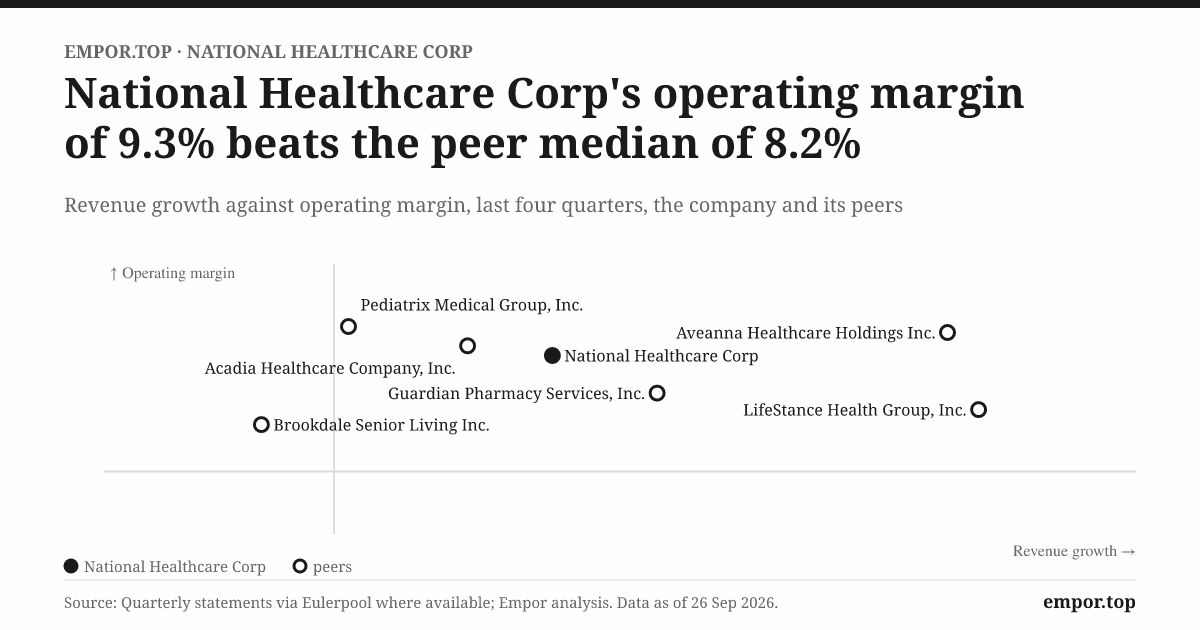
Against that backdrop, NHC looks almost sleepy: roughly one-fifth the number of skilled nursing facilities, one-quarter the revenue, and a handful of acquisitions in a decade versus Ensign's torrent. The other names sometimes offered as comparables fit less well. Brookdale Senior Living is primarily a private-pay senior housing operator with a very different payer mix. Aveanna Healthcare is a home-based care company focused on pediatric and adult home nursing. Addus HomeCare is the most relevant comparable for NHC's homecare and hospice arm, which is a supporting business rather than the core. The only true head-to-head operating comparison is Ensign.
The occupancy edge, tested
Here is where NHC has a verifiable operating edge rather than a talking point. NHC's owned and leased skilled nursing facilities averaged 90.1% occupancy in the second quarter of 2026.3 Ensign's same-facility occupancy in the same quarter was 84.1%.10 That six-point gap, sustained across multiple periods, is meaningful. Given the operating-leverage mechanism described above, a six-point occupancy advantage over a peer with similar cost structure is worth a great deal of margin.
Quality metrics point the same way. As of December 31, 2025, 62.5% of NHC's skilled nursing facilities held four- or five-star ratings in CMS's Five-Star Quality Rating System, versus 38.6% for the industry, and NHC's average rating was 3.83 stars against an industry average of 2.95.8 The star rating is imperfect, but it is what hospital discharge planners and families actually look at on Medicare's Care Compare website.
So why does NHC run fuller? There are two competing explanations, and the honest answer is that both likely contribute.
The bullish explanation is franchise strength. NHC has operated in Tennessee since 1971 and describes itself as the largest skilled nursing provider in the state.6 Its facilities sit disproportionately in secondary Southeastern markets such as Tennessee, South Carolina, Missouri, Alabama, Kentucky, and Georgia, where it has spent decades building relationships with hospital discharge planners, physicians, and churches. NHC's 10-K notes that it depends on "referrals from acute care hospitals, physicians, residential care facilities, church groups and other community service organizations" and that "the reputation in the community and the physical appearance of our facilities are important."8 In a business where a hospital case manager with fifteen minutes to place a patient reaches for the phone number she trusts, local tenure is a real advantage.
The skeptical explanation is portfolio composition. NHC's footprint is smaller, older, more curated, and less exposed to turnaround assets. Ensign deliberately buys struggling buildings with low occupancy, which drags down its averages until they are fixed. Comparing a mature, stable portfolio to one constantly absorbing turnarounds flatters the former. Ensign's 2.7-point year-over-year occupancy gain in the second quarter of 2026 is evidence that its buildings are improving quickly from a lower base.10
What kind of moat is this?
The fair conclusion is that NHC's local density and tenure constitute a moderate, geography-bound advantage, not a structural moat. It is the kind of edge that supports premium occupancy in markets where NHC has operated for decades. It is not the kind that would stop a well-capitalized competitor, Ensign included, from buying a nearby facility and competing for the same referrals. And it does not travel well, which is something NHC has already learned the hard way.
In September 2022, NHC ceased operations at seven skilled nursing facilities in Massachusetts and New Hampshire.11 Those buildings sat far outside the Southeastern core. Their exit is the most direct evidence in NHC's own record against the idea that its operating model is a portable competitive advantage. The advantage appears to be tied to place, relationships, and history, which means it narrows to "strong in its home markets" rather than "better everywhere."
That is not a trivial asset. It is simply a smaller claim than the headline occupancy gap implies. The KPI that would confirm or erode it is straightforward: NHC's skilled nursing occupancy relative to Ensign's same-facility occupancy. If Ensign's turnarounds close the gap while NHC's number stagnates, the "stickier franchise" story weakens; if the gap holds as Ensign matures its acquisitions, the franchise story strengthens.
Where the money actually comes from
A quick word on proportions, because it keeps the rest of the story honest. In the second quarter of 2026, NHC's inpatient services segment, mostly skilled nursing plus assisted and independent living and behavioral health, generated $337.7 million of revenue. Homecare and hospice generated $41.1 million, and the "all other" bucket of rental income, management fees, and insurance services generated $29.3 million.3 NHC's hospice business runs through Caris Healthcare, which it wholly owns and which served more than 1,647 patients a day from 33 locations at the end of 2025.8 These are real businesses that matter for the continuum-of-care strategy. But when NHC's profits move, it is almost always because of what happened inside the nursing homes. And nothing moved those profits more violently than the pandemic years.
V. The Inflection: COVID Trough to Record Earnings (2020–2025) — (34:00–48:00)
The year that looked fine
If an investor had looked only at NHC's headline net income for 2021, they might have concluded that the company sailed through COVID-19 without a scratch. Reported GAAP net income was $138.6 million.4 For a company whose industry had just become the epicenter of the pandemic's death toll, that looked miraculous.
It was not. Two items did most of the lifting. First, NHC recorded a $95.2 million gain in 2021 related to its acquisition of Caris, the hospice partnership it had been involved with since 2003, when it took full ownership.46 Accounting rules required NHC to revalue its existing stake at fair value on the acquisition, and that revaluation created a non-cash gain. Second, government stimulus income, the federal relief grants that flowed to healthcare providers during the pandemic, totaled $63.4 million in 2021.4 Strip those away, and NHC's own adjusted net income for 2021 was $62.6 million, less than half the headline.4
This matters because it establishes the right baseline. The pandemic did not spare NHC; federal money temporarily masked the damage.
The real trough: 2022
The bill came due in 2022. The relief money largely dried up: stimulus income fell to $11.5 million.4 Revenue barely moved, rising 1.1% to $1.09 billion, while salaries, wages, and benefits climbed to $686.2 million.4 GAAP net income collapsed to $22.4 million, and adjusted net income fell to $37.3 million.4 Average occupancy in NHC's owned and leased skilled nursing facilities was just 83.8%.12
The villain of 2022 was agency nursing. When staff quit, burned out, or got sick, nursing homes had no choice but to fill shifts with temporary nurses supplied by staffing agencies, which charged dramatically higher hourly rates. NHC's agency nurse staffing expense nearly doubled, from $36.4 million in 2021 to $68.9 million in 2022.4 NHC's own filings describe these firms as charging "inflated hourly rates."12
Here is the double squeeze in plain English. Without enough staff, a facility cannot safely admit new patients, so occupancy stays depressed. The staff it does have cost far more because many of them are agency temps. Revenue stalls while costs balloon. And because of operating leverage, a few points of lost occupancy combined with a spike in the largest cost line crushes margins.
This is the year that tests any claim that NHC's operating model is "resilient" or insulated. The honest verdict is that it was not insulated. NHC's economics were badly exposed to an industry-wide labor shock. It remained profitable, which is more than many operators could say, and its conservative balance sheet meant it never faced an existential crisis. But the premise that NHC's quality reputation or local franchise protected it from labor-market forces is rejected by its own 2022 results. Its advantages are real, but they operate inside the industry's economics, not above them.
The climb back
What happened next is one of the sharpest recoveries in the sector. Revenue grew from $1.09 billion in 2022 to $1.14 billion in 2023, to $1.31 billion in 2024, and to $1.52 billion in 2025, a 16.1% jump in the final year that reflected both organic growth and a major acquisition discussed in the next section.115 GAAP net income went from $22.4 million to $66.8 million in 2023 and then $120.0 million in 2025; adjusted net income, which strips out unrealized gains on NHC's stock portfolio and other items, went from $37.3 million to $54.9 million to $104.1 million.115
Three forces drove that climb, and each deserves scrutiny.
The first was occupancy. Owned and leased skilled nursing census rose from 83.8% in 2022 to 87.9% in 2023, 88.6% in 2024, and 89.7% in 2025.128 By the first half of 2026 it had reached 90.0%.3 Given the airline-seat economics described earlier, that six-point swing is worth a great deal.
The second was the collapse of agency costs. This is the most dramatic number in the entire story. NHC's filings show agency nurse staffing expense falling by about 34% in the first quarter of 2023, about 51% in the first quarter of 2024, by $20.0 million or 66.2% for full-year 2024, and by another $9.3 million or 66.6% in 2025.138 Working through the math on those disclosures, agency spending went from nearly $69 million in 2022 to roughly $5 million in 2025. At that level, agency labor is a rounding error on a $1.5 billion revenue base.
The third was reimbursement. NHC's composite skilled nursing per diem rose 6.8% in 2024 and 4.0% in 2025, with Medicaid per diems up 8.6% and 3.5% in those years.8 Specific state actions helped. Tennessee implemented facility-level increases effective July 1, 2024 that NHC estimated at roughly $11 million annually, plus non-recurring stabilization payments of about $8.2 million annually, and Missouri proposed increases worth about $6.6 million a year.12 On top of that, many states paid supplemental Medicaid payments to help nursing homes survive the workforce crisis.
Reversion is not transformation
Now for the historical falsification test, because this is where a lot of optimistic narratives about NHC go wrong. It is tempting to read the 2022 to 2025 curve as evidence of a structural transformation, a company that has become permanently more profitable. The evidence supports a narrower conclusion: most of the recovery was a reversion from an extreme, industry-wide, temporary shock, and several of the tailwinds that powered it are already fading.
Consider each driver in turn.
Agency cost reduction cannot repeat. Going from $69 million to about $5 million was a genuine achievement, but it is a one-way trip. There is no further $60 million to harvest. From here, agency costs can only stay flat or rise.
Supplemental Medicaid payments are shrinking. NHC recorded $20.2 million of these payments in 2023, $12.7 million in 2024, and $7.2 million in 2025.8 In the second quarter of 2026, it received $1.8 million.3 That is a tailwind visibly turning into a headwind in year-over-year comparisons.
State rate increases are getting smaller. Tennessee's increase effective July 1, 2025 was estimated at about $3 million annually, roughly a quarter of the prior year's step-up, and South Carolina's proposed increase for fiscal 2026 was estimated at about $4.2 million annually.8 In the second quarter of 2026, NHC's Medicare per diem rose just 2.1% year over year and its Medicaid per diem 1.3%, both well below 2025's pace.14
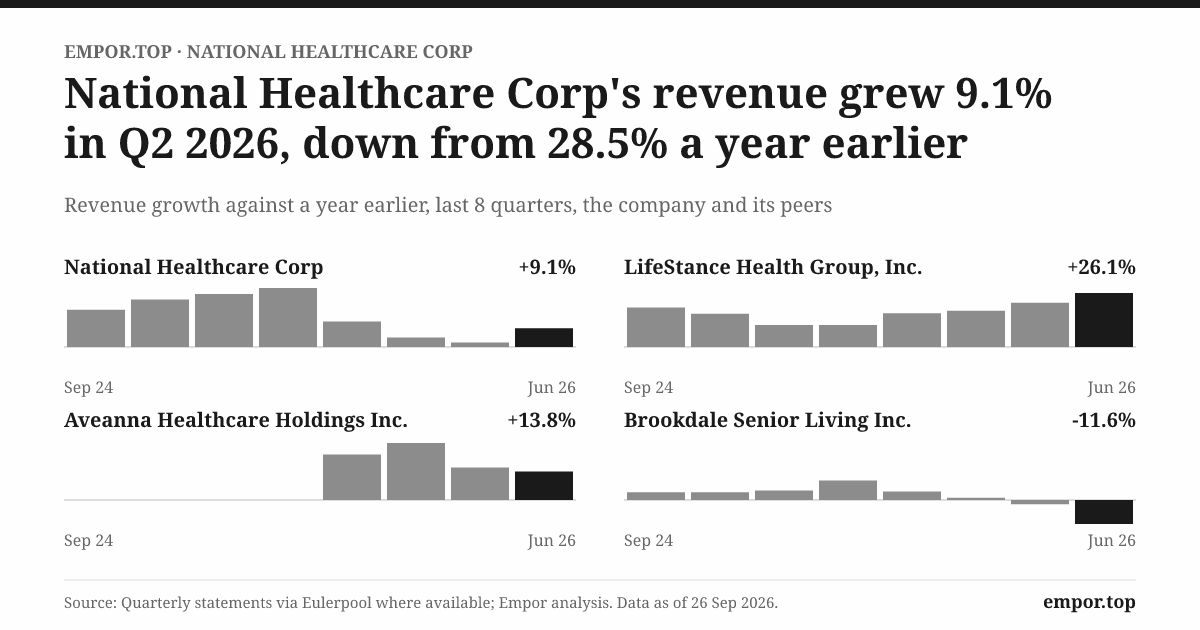
Organic growth has slowed. In the first quarter of 2026, once the White Oak acquisition had fully lapped, NHC's net operating revenues grew just 2.2%.15 Second-quarter revenue growth of 8.8% was attributed primarily to the June 2026 purchase of five facilities, discussed below.14
None of this means the recovery is fake. Occupancy of 90% in a fixed-cost business is genuine earnings power, and adjusted earnings per share still rose from $1.59 to $1.91 in the first quarter of 2026.15 But the evidence narrows the thesis. The revised, defensible claim is that NHC has restored its pre-pandemic earnings power at a higher revenue base and is running near the practical ceiling of occupancy. The claim that margins will keep expanding on the same drivers is not supported. The two things that would falsify even the narrower claim are a renewed spike in agency or overtime labor costs as Boomer demand strains staffing, and a round of state Medicaid rate freezes or cuts as budgets tighten.
The staffing mandate that came and went
One regulatory episode belongs squarely in this section, because it targeted the exact cost line that drove the 2022 collapse. On April 22, 2024, CMS finalized a national minimum staffing rule for nursing homes.8 It required a registered nurse on site 24 hours a day, seven days a week, and a total nurse staffing level of 3.48 hours per resident per day.16 For an industry still clawing out of a labor crisis, it was a direct threat to margins, and NHC's 10-K flagged it as a risk that "may adversely affect our labor costs, ability to maintain desired levels of patient census and profitability."8
The mandate did not survive. On April 7, 2025, the U.S. District Court for the Northern District of Texas struck down key provisions, finding that CMS had exceeded its statutory authority.16 The One Big Beautiful Bill Act, signed July 4, 2025, barred the Department of Health and Human Services from implementing the rule until October 1, 2034.8 The Department of Justice withdrew its appeals in September 2025, and on December 2, 2025, CMS issued an interim final rule rescinding the 24/7 RN requirement and the hours-per-resident-day minimums.17
For NHC, this was a real regulatory risk that resolved in the industry's favor. But investors should treat it as defused, not eliminated. The political appetite for minimum staffing rules has not disappeared, several states already impose their own requirements, and a future Congress could revisit the moratorium. The largest cost line in the business remains one election cycle away from renewed pressure.
With the operating engine restored, NHC had something it had not had in years: excess cash and management bandwidth. What it did with them is the next chapter.
VI. Growth and Capital Deployment: White Oak, Ignite, and the M&A Discipline Question — (48:00–58:00)
A careful company takes a big swing
For most of its modern history, NHC was not an acquirer in any aggressive sense. Its growth came from building assisted living communities, opening homecare and hospice agencies, and picking up the occasional building. The 2023 development log in its 10-K reads like a small-town hardware store's inventory list: a new hospice agency in Cedar Bluff, Virginia; a 66-bed skilled nursing facility acquired in Nashville; a homecare agency in Tallahassee; three new assisted living operations in Florida.8 Nothing about that record suggests a management team hungry for empire.
Then, on May 31, 2024, NHC signed an agreement to acquire the White Oak Management portfolio in the Carolinas.18 The deal closed on August 1, 2024, for a purchase price of $221.4 million, subject to adjustments.19 It brought fifteen skilled nursing facilities with 1,928 beds, two assisted living facilities, four independent living facilities, and a long-term care pharmacy across North and South Carolina, representing NHC's first real foothold in North Carolina.818 Flatt said at signing that the company expected the deal to be "accretive to NHC's earnings and create several long-term operational efficiencies and synergies."18
White Oak was a logical fit. South Carolina was already NHC territory, and the portfolio's continuing care retirement communities matched Dr. Adams's original campus vision. NHC financed it with a new $200 million unsecured bank facility from Bank of America, including a $150 million term loan.19
Did it work?
The evidence so far is encouraging, with appropriate caveats. In the third quarter of 2025, NHC's revenue rose 12.5% year over year, of which same-facility growth accounted for 8.7% and the White Oak contribution the rest.20 For 2025 as a whole, same-facility revenue grew 8.4%, and NHC's 10-K attributes part of the increase in adjusted earnings in both 2024 and 2025 to "the White Oak operations being accretive to earnings."58 Management has not disclosed standalone White Oak margins, so outside investors must take the accretion claim partly on trust. But one hard number supports it: NHC's debt went from $137.0 million at the end of 2024 to $40.0 million at the end of 2025 and to zero by June 30, 2026.53 A company that can pay off most of an acquisition loan within two years from operating cash flow did not overpay badly for what it bought.
Myth versus reality: the Ignite question
Here a correction is necessary, because a persistent misunderstanding has attached itself to NHC. Ignite Medical Resorts, a luxury short-stay rehabilitation brand that markets its facilities as upscale "medical resorts," is sometimes described as NHC's premium growth vector. It is not an NHC business. Ignite is a separate company with its own operations across Illinois, Missouri, Kansas, Oklahoma, Texas, and Indiana, and it reached twenty-two resort locations after acquiring a facility in Chesterton, Indiana in mid-2024.18 The confusion probably stems from the fact that a single Skilled Nursing News roundup in June 2024 reported both NHC's White Oak deal and Ignite's Indiana expansion under one headline.18 NHC's own filings list no Ignite ownership, and NHC's facility roster and segment disclosures contain no such brand.8
The correction matters for the investment case. Ignite's concept, capturing higher-acuity, better-reimbursed short-stay Medicare patients through a premium experience, is a real competitive trend in the industry and a competitive pressure on operators like NHC in overlapping markets such as Missouri. It is not a hidden NHC growth option. NHC's actual differentiation on the short-stay side rests on its quality ratings and its referral relationships, not on a luxury brand.
The quieter related-party deal
A second, smaller transaction in 2026 deserves more attention than it received. On June 1, 2026, NHC bought five skilled nursing facilities with 639 licensed beds in South Carolina and Tennessee from National Health Corporation for $50.5 million.3 National Health Corporation, usually called "National," is not a random seller. It is wholly owned by an employee stock ownership plan, was formed in 1986, and is NHC's administrative services contractor. According to the 10-K, "all of the personnel conducting our business, including our executive management team, are employees of National," which also handles payroll and benefits.8 NHC had been managing these five facilities for National under a management contract.8
The acquisition triggered an accounting event with a large effect on reported profits. NHC had earned management fees from National for years that it had not recognized as revenue, because collection was uncertain; under the accounting standard for revenue, the consideration was "constrained." When NHC bought the facilities, those fees were paid, and NHC recognized $18.3 million of previously unrecognized management fee revenue in the second quarter of 2026.3 That single item is why second-quarter GAAP diluted EPS jumped to $2.54 while adjusted diluted EPS, which excludes it, rose more modestly to $1.74 from $1.65.14
NHC was transparent about the item and excluded it from its adjusted figures, which is to its credit. But the transaction illustrates a point that recurs throughout this story: NHC operates inside a dense web of related parties. Its landlord was a company it created. Its employer of record is an ESOP-owned affiliate. It bought buildings from that affiliate at a price determined through internal valuation, and the purchase unlocked a large one-time gain. Investors should read the headline numbers from 2026 with that web in mind.
The capital allocation verdict so far
On the record through mid-2026, the claim that NHC is a disciplined capital allocator holds up better than most such claims. Its pre-2024 acquisition history was modest, White Oak appears to be performing, and the company deleveraged quickly after it. Against that stands the 2022 exit from Massachusetts and New Hampshire, which shows that NHC's past expansions outside its core did not always work. The sample of large deals is small, and the evidence leaves the discipline claim intact but unproven at scale.
The balance sheet NHC carried into 2026 made the next move possible. At June 30, 2026, it had zero debt and held $39.2 million of cash plus marketable securities of $170.9 million in equities and $119.4 million in debt securities, a portfolio that partly backs its insurance reserves.3 That conservative, self-funded posture stood in stark contrast to leveraged peers. And then, one day later, NHC took on more than half a billion dollars of debt to buy its buildings back.
VII. The Big One: Buying Out NHI and Ending the 35-Year Landlord Relationship — (58:00–72:00)
The letter
On July 29, 2025, a letter arrived at NHC/OP, L.P., the NHC subsidiary that served as tenant under the 1991 master lease. It came from National Health Investors. NHI alleged that NHC was not in compliance with four non-monetary provisions of the lease covering thirty-two skilled nursing facilities and three independent living centers, and it demanded compliance by August 29.8 (Contemporary reporting described the covered portfolio as thirty-two skilled nursing facilities and three assisted living facilities.21)
NHC's lawyers replied on August 15, stating that NHC believed it was in compliance and asking for clarification. NHI's first substantive response came on September 8, 2025, when it formally alleged that NHC was in default, started a thirty-day cure period, and warned that failure to cure would create an "Event of Default" entitling the landlord "to pursue any and all remedies under the Master Lease."8 NHC disputed the allegations.8 The specific provisions at issue were not publicly detailed.21
After thirty-four years, the landlord and tenant who were once the same company were communicating through counsel.
Why would a landlord pick a fight with a tenant that had paid rent for three decades, on a lease that was due to expire anyway? Timing is the answer. The lease ran through December 31, 2026, and NHC had the option to renew for an additional five-year term beginning January 1, 2027, which it exercised by sending an extension notice in October 2025.8 Crucially, under the lease the base rent for any renewal term was to be "the fair rental value of the leased property as negotiated between the parties."8 The rent was about to be reset, and the two sides had every incentive to posture. NHI's CEO, D. Eric Mendelsohn, told Skilled Nursing News that NHC's "ability to pay whatever the negotiated new rent is should not be an issue."21 The default notice gave NHI leverage: if an Event of Default occurred, NHI could contest the renewal altogether. NHC's 10-K acknowledged that failure to resolve the dispute "could result in facility loss or increased lease costs."8
The activist in the background
To understand why NHI suddenly sounded so tough, rewind to February 2025. Land & Buildings, the real estate-focused activist fund led by Jonathan Litt, launched a proxy fight at NHI, nominating two directors: former Wellington Management REIT portfolio manager Jim Hoffmann and self-storage executive Adam Troso.22 Its central argument was about conflicts. Land & Buildings singled out three NHI directors, Robert Adams, Jimmy Jobe, and Charlotte Swafford, citing their "prior employment at NHC and/or significant holdings of NHC" and describing "numerous corporate governance issues, interlocking relationships and excessive director tenure."22 It called the NHC master lease negotiation "the single-greatest source of upside for NHI cash flows and shareholder value."22
In an April 9, 2025 letter, the activist sharpened the point. It claimed NHI's base rents had actually declined over the life of the lease, including in a 2022 amendment, and projected "potentially 60% or more upside to the current rent NHC is paying NHI."23 It estimated facility-level EBITDAR coverage, a measure of how many times the tenant's operating cash flow before rent covers the rent, at "well over 2x," suggesting NHC could afford to pay far more.23 The letter also catalogued the social ties between board members: shared schooling at Middle Tennessee State, histories at NHC, financial relationships, and common residency in Murfreesboro.23 Contemporary reporting captured the activist's broader characterization of the lease as "egregiously one-sided" in the tenant's favor.21
At NHI's May 2025 annual meeting, the incumbents won. All four of NHI's nominees, including Robert G. Adams, were elected, and Land & Buildings fell short by roughly one percent of outstanding shares.24 Land & Buildings said its nominees won at least 60% support among unaffiliated shareholders who voted, a claim that, if accurate, meant the outcome turned on shares held by insiders and parties connected to the two companies.24 Board control did not change. But the message was unmistakable: outside capital no longer trusted the interlocking structure. Within months, NHI was sending default notices to NHC.
The resolution
On April 21, 2026, NHC announced it would buy the real estate of all thirty-five facilities from NHI for $560 million.25 The deal closed on July 1, 2026, and the 1991 master lease was terminated at closing.13 NHC continues to operate all of the facilities except four in Florida, which remain leased to a third-party operator, meaning NHC is now itself a landlord for those buildings.1
Flatt's framing was about control. "Owning these healthcare centers – versus leasing – will yield strong, long-term returns," he said at closing, adding that "acquiring this real estate ensures we have the operational control to achieve that objective."1 At announcement, he said the deal would "provide maximum flexibility to execute our long-term vision" and that NHC expected it "to be accretive to both earnings and cash flow."25
NHI's framing was about portfolio strategy. Its CEO said the transaction "accelerates our capital recycling strategy" and increases its concentration in private-pay senior housing.26 For NHI, selling its oldest and most politically complicated asset solved an activist problem and a strategy problem at once.
How NHC paid for it
Here is a fact that complicates the image of NHC as a company that never touches leverage. On May 26, 2026, NHC signed a new credit agreement with Bank of America as administrative agent, with BofA Securities and Wells Fargo Securities as joint lead arrangers, consisting of a $475 million senior unsecured term loan and a revolving credit facility later increased from $50 million to $75 million.2728 The loans mature five years after funding, carry interest at the Secured Overnight Financing Rate (SOFR) plus an initial margin of 1.50%, and the term loan amortizes by about $5.9 million per quarter.27 On July 1, NHC drew the entire $475 million term loan and $55 million of the revolver, $530 million in total, and funded the remainder with cash on hand, including $20 million it had previously paid into escrow.283
In one day, NHC went from zero debt to about $530 million. Against its cash and securities of roughly $330 million at the end of June, that is a meaningful but manageable net debt position; against 2025 pre-tax earnings of $137.5 million, gross debt is roughly four times, and the multiple is lower once depreciation is added back to measure cash operating earnings.9 The balance sheet is no longer fortress-like, but it is far from stretched. The claim that NHC completed this deal "without straining the balance sheet" is only partly right: it relied overwhelmingly on borrowed money.
Did NHC overpay? The cap rate question
This is the most important quantitative question in the story, precisely because the deal was struck between two companies with deep historical ties.
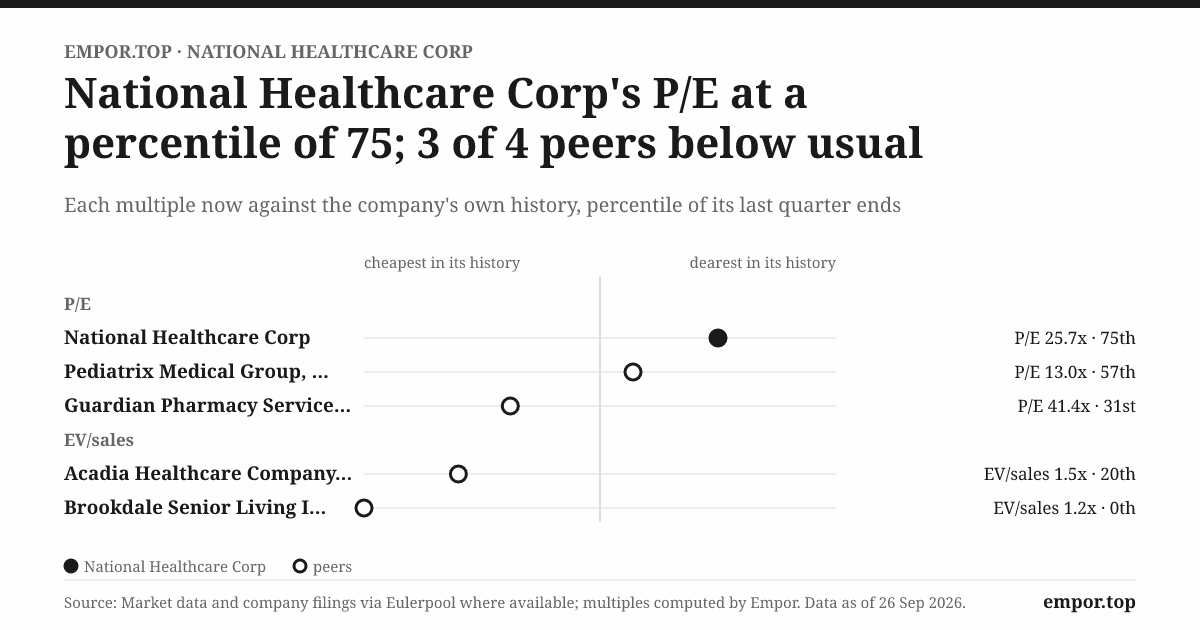
The key disclosure comes from the seller. NHI reported that the portfolio generated $39.7 million of annual cash rent in 2025, including percentage rent.26 NHC's 10-K shows its side of the ledger: base rent of $32.2 million in 2025 plus percentage rent of $8.2 million.8 Dividing $39.7 million by the $560 million price gives an implied capitalization rate, the property's annual income as a percentage of its price, of about 7.1%.26
Think of the cap rate as the yield a buyer earns on the purchase price, like the interest rate on a bond. A lower cap rate means a higher price relative to income.
By the standards of skilled nursing real estate, 7.1% is a rich price. Specialized healthcare REITs that buy nursing home real estate typically seek higher yields. CareTrust REIT, one of the most active buyers, reported first-quarter 2025 investments at an estimated stabilized yield of 10.0%, and follow-on investments in April 2025 also at about 10%.29 Measured against the rent NHC was actually paying, NHC paid a price that a typical third-party SNF landlord would likely not have paid.
But that is the wrong comparison, or at least an incomplete one, for two reasons.
First, the existing rent was about to reset. Under the lease, renewal rent was to be negotiated at fair rental value, and the activist that pressured NHI estimated 60% or more upside to the current rent.238 If a renewed lease had come in at, say, $60 million to $65 million a year, the $560 million price would equate to a yield of roughly 11% on the rent NHC avoided paying. On that counterfactual, NHC bought at a price in line with, or better than, the market yields healthcare REITs earn. The true answer lies somewhere between these two framings, and NHC has not disclosed its own facility-level EBITDAR or a fair-value analysis that would settle it.
Second, these buildings were irreplaceable to NHC in a way they would not be to a financial buyer. They included facilities NHC had operated since the early 1970s. Losing them, which the default dispute made at least conceivable, would have amputated a large part of NHC's operating franchise in its core markets. A buyer paying to protect its own business will rationally pay more than a buyer seeking a financial return.
The cash math is favorable in the near term. The old rent was roughly $40 million a year. Interest on $530 million at SOFR plus 1.5% will cost less than that as long as SOFR stays below roughly 6%. But the full accounting is more complex. NHC must now pay about $23.6 million a year in scheduled principal, record depreciation on the buildings, fund all future capital expenditures on aging properties as owner, and forgo the flexibility of simply walking away from an underperforming building at lease end.
The calibrated verdict: NHC paid a full price relative to in-place rent, a plausibly fair price relative to the renewal rent it likely faced, and a strategic premium for certainty. The related-party history does not appear to have produced a sweetheart discount for NHC; if anything, the activist pressure on NHI pushed the price the other way. The KPI that will reveal whether it was a good deal is NHC's operating margin in the acquired buildings, now reported without rent, relative to the interest and capital expenditure burden that replaced it, which will start to show up in results from the third quarter of 2026 onward.
Why this is the central inflection
The NHI buyout changed NHC's risk profile in three ways. It removed the renewal risk, the single largest threat to the business in 2025. It ended the governance ambiguity that activists had spent a year attacking. And it turned NHC from an asset-light operator into an owner-operator, heavier in real estate and debt, lighter in lease expense.
The bull reading is that NHC now controls its own destiny and captures the spread it used to pay a landlord. The bear reading is that NHC tied up more than half a billion dollars in aging buildings it already operated, capital that could have funded new operations, while giving up the flexibility that made the 1991 structure attractive in the first place. Both readings are coherent. Which one proves right depends largely on the people making the decisions, which is where the story turns next.
VIII. Current Management: Incentives, Ownership, and Credibility — (72:00–82:00)
The pay package
Stephen Flatt's total compensation for 2025 was $2.69 million.9 His base salary was $577,000, and the largest single component was a $1.28 million cash incentive bonus.9 For the chief executive of a healthcare operator that generated $1.5 billion of revenue, that is modest by public-company standards, and it is dwarfed by executive compensation at Ensign.
The structure of the compensation matters more than the headline number. NHC's executive bonus pool for 2025 was set at 5% of pre-tax earnings, excluding unrealized gains and losses on securities, which produced a pool of about $6.9 million on pre-tax earnings of $137.5 million.9 At least 40% of each executive's bonus was tied to overall corporate financial performance, with the remainder based on individual operational goals.9 Shareholders endorsed the arrangement, approving the say-on-pay proposal with more than 96% of votes cast at the 2025 annual meeting.9
A profit-sharing pool has obvious virtues. It is simple, it moves directly with reported results, and it strips out paper gains from the investment portfolio. But for long-term investors, it contains an important blind spot: it rewards absolute pre-tax earnings rather than returns on invested capital. A formula that distributes 5% of pre-tax profit makes no distinction between earnings generated through operating discipline and earnings generated simply by deploying large sums of borrowed money. Following a $560 million debt-funded real estate buyout, that distinction matters. If the acquired NHI facilities lift pre-tax earnings modestly while tying up more than half a billion dollars in capital, the executive bonus pool expands even if return on invested capital declines. A disciplined compensation committee would look to balance the profit-sharing pool with a return-on-capital metric.
Ownership and related-party density
Inside ownership aligns leadership with shareholders on paper, but the composition of that insider block is nuanced. Directors and executive officers as a group beneficially owned about 13.9% of NHC's common stock as of March 2026, though that figure includes the holdings of retired director W. Andrew Adams (about 4.8%) and retired COO Michael Ussery.9 Chairman Robert Adams owned about 3.1%.9 Flatt himself held roughly 79,000 shares, representing less than 1% of the company.9 Institutional investors hold the largest stakes: BlackRock with about 11.6%, Vanguard with about 9.1%, Morgan Stanley entities with about 13.8%, and Dimensional with about 6.2%, while the National Health Corporation ESOP held about 6.6%.9
That ESOP ownership highlights how deeply interconnected NHC's corporate circle remains. The employee stock ownership plan owns National, the affiliate that employs NHC's operating workforce and executive suite. The proxy also discloses that NHC employs three immediate family members of directors or executives at compensation above $120,000: two sons-in-law of Chairman Robert Adams, one of whom runs AdamsPlace in Murfreesboro and one of whom leads an NHC affiliate, and the son of the retired COO.9 Each is disclosed as compensated on the same standards as peers in similar roles.9
None of these relationships is concealed; each is properly disclosed, and family-influenced governance is familiar in regional healthcare businesses. But in aggregate, they describe an insular enterprise. The chairman is the founder's son and sat on the landlord's board; another director is the founder's grandson; family members occupy operating posts; the formal employer of record is an affiliated employee trust; and the company bought facilities from that same affiliate in 2026. This density of overlapping relationships gave Land & Buildings its sharpest arguments during the proxy fight at NHI.
NHC's board has taken formal governance steps to establish independence. The chairman and CEO roles have been separate since the end of 2016, and all directors except Flatt are classified as independent.9 Still, classifying a chairman who spent 52 years running the company and whose family members remain on the payroll as independent is a legal classification rather than an economic reality, and public shareholders have to weigh it accordingly.
Insider behavior
For outside investors, insider trading activity often speaks louder than proxy disclosures. SEC Form 4 filings indicate that NHC insiders have been consistent net sellers of the stock. Across the four quarters from October 2025 through September 2026, insiders reported roughly two dozen open-market sales against a single open-market purchase, with selling clustered heavily in the third quarter of 2026 as the share price traded near its 52-week high.30 Routine share sales by tenured executives often reflect portfolio diversification or tax planning around vesting equity. Nevertheless, the pronounced imbalance means public investors receive no affirmative buying signal from leadership to validate the stock's run.
Narrative consistency
NHC's public communication style is famously sparse. The company holds no regular quarterly earnings calls. Its quarterly earnings releases, including those for the first and second quarters of 2026, contain almost no executive commentary: just the headline tables, a non-GAAP reconciliation, and a contact email for Chief Financial Officer Brian Kidd.1514 Investors must evaluate management's perspective almost entirely through the text of its periodic SEC filings.
Judged by those filings, management's narrative has been steady and grounded. Across its 2023, 2024, and 2025 annual reports, NHC attributed its earnings improvement to the same three drivers: rising census, per diem increases from government payers, and falling agency nurse costs, with White Oak added from 2024 onward.11128 Management did not reframe the narrative to chase market fads, and the company consistently removed non-cash paper gains and one-off windfalls from its adjusted earnings metrics, including the $18.3 million National management fee recovery in 2026.14 That restraint reflects accounting transparency and reporting discipline.
The unresolved test is how candid management will be as those historic recovery drivers top out. Agency nurse staffing costs have already fallen from nearly $69 million to roughly $5 million, and pandemic-era supplemental state payments have sharply diminished. A leadership team that quietly lets past tailwinds drop from disclosure without detailing what will sustain earnings growth would raise legitimate credibility questions. The upcoming quarterly reports—the first to reflect the acquired NHI facilities as owned real estate encumbered by debt rather than leased property—will test whether NHC explains the new operating model with equal clarity. Understanding those executive incentives sets the stage for examining the concrete operational risks ahead.
IX. Risks That Actually Matter — (82:00–90:00)
The phone call from the state capital
Imagine a state Medicaid director in Nashville or Columbia in the spring of a recession year. Revenue is falling, federal matching funds are in doubt, and the governor wants the budget balanced. Nursing home rates are one of the largest line items, and they are easy to freeze: the operators cannot leave overnight, the residents cannot move, and the political cost of a rate freeze is lower than the cost of cutting school budgets. That imagined phone call is the single most important risk to NHC.
Reimbursement and payer risk
Medicaid accounted for roughly half of NHC's skilled nursing patient days and about 30% of net patient revenue in 2025.58 Medicare and managed care together provided another 43%.8 That makes NHC overwhelmingly dependent on government-set prices. State Medicaid increases have been a tailwind for three years, but they are budget-dependent and, as Section V showed, already shrinking. On the Medicare side, the fiscal 2027 net increase of 2.4% roughly tracks inflation but leaves little room for margin expansion.3 A downturn that pressures state budgets could flip Medicaid from tailwind to headwind within a single legislative session. This is the largest swing factor in NHC's profit and loss statement, mechanically, not a generic macro worry.
Labor cost re-inflation
The same mechanism that broke NHC's margins in 2022 could return. If Boomer-driven demand outpaces the supply of nurses and aides, operators will be forced back into overtime, wage premiums, and eventually agency staffing. NHC's own 10-K warns that "we continue to face workforce and labor shortages within all of our operations."8 With agency spending already near its floor, any renewed labor stress shows up directly as margin compression. This risk is not hypothetical; it is the one that has already materialized once in the recent past.
Integration and execution on the NHI portfolio
Becoming the owner of thirty-five buildings is not the same as operating them. NHC now bears the full capital expenditure burden of an aging portfolio, some of it built in the 1970s and 1980s. It must manage $530 million of floating-rate debt, with interest costs that will rise if short-term rates climb. It now acts as landlord to a third-party operator in four Florida facilities.1 And it must do all of this after a relationship with the seller that, less than a year earlier, had been adversarial enough to involve default notices. None of these tasks is exotic, but each is new for a company that ran an asset-light model for three decades.
Regulatory risk, defused but not gone
The national minimum staffing rule is rescinded and statutorily paused until 2034, but a future administration or Congress could revive it, and state-level staffing requirements remain in force in some of NHC's markets.178 Separately, CMS continues to raise the thresholds in its Five-Star Quality Rating System roughly every six months, making it harder to maintain top ratings, which NHC relies on to win referrals.8
Concentration and substitution
Skilled nursing and inpatient services generate the large majority of NHC's revenue and profit. Over the long run, low-acuity patients will continue migrating toward home health, hospice, and assisted living. NHC owns businesses in each of those substitutes, which partly offsets the risk, but its economics remain concentrated in the facility-based model.
Accounting judgments worth watching
Three accounting judgments deserve attention. First, NHC's GAAP net income swings with unrealized gains and losses on its equity portfolio, which is why its adjusted figures differ materially from reported results. Second, the $18.3 million management fee recognition in 2026 arose from a related-party transaction and involved judgment about when constrained revenue became recognizable.3 Third, the purchase price allocations for the June 2026 National acquisition and the July 2026 NHI acquisition were preliminary at the time of the second-quarter filing, and final allocations will determine future depreciation charges.3 NHC also carries professional liability and workers' compensation reserves, which its 10-K flags as exposed to rising industry-wide claims.8
Risks deliberately excluded
Some risks that dominate other stories do not matter much here. NHC has little exposure to artificial intelligence or technology disruption in its core business; nobody is automating the bedside care of a dementia patient soon. It has minimal geopolitical or supply-chain exposure. And refinancing risk, while higher after the NHI deal, remains modest given the five-year maturity of the new loans and NHC's cash and securities holdings. These risks are real in the abstract but not material to this company's investment case. What the risks do illuminate is a set of broader lessons.
X. Playbook: What This Company Teaches About Investing and Operating — (90:00–98:00)
Lesson one: asset-light is not a one-way door
For thirty-five years, NHC ran what would later become a textbook OpCo/PropCo structure. Then it deliberately reversed it. The lesson is that a sale-leaseback is a financing choice, not a permanent structural truth. The right structure depends on the relationship between the parties, the price of capital, and the terms of the lease. When a lease was below market and friendly, leasing was obviously right for NHC. When the lease was about to reset to fair value and the landlord had turned adversarial, owning became more attractive. Investors who treat "asset-light" as an automatic virtue miss that the virtue depends entirely on who holds the other side of the contract.
Lesson two: occupancy is destiny, in both directions
NHC's swing from $22.4 million of net income in 2022 to $120.0 million in 2025 is a case study in operating leverage. A six-point gain in occupancy and the collapse of a temporary cost premium produced a fivefold profit increase. The same arithmetic implies that a modest decline in occupancy, or a modest reappearance of labor premiums, would compress profits far more than proportionally. Straight-line extrapolation of the recovery is the classic error in fixed-cost service businesses.
Lesson three: related-party structures compound quietly until someone forces the issue
The interlocking relationship between NHC and NHI existed for decades without drawing serious outside challenge. It took a determined activist, a narrow proxy vote, and a default dispute to make the conflict costly enough to resolve. The pattern is recognizable in other founder-controlled companies with spun-off REITs or affiliated service companies: the structure feels normal to insiders until an outsider prices it as a discount, and then it tends to be resolved suddenly. Notably, NHC's related-party web has not fully unwound; its employees still work for an affiliated ESOP-owned company, and the 2026 purchase of buildings from that affiliate shows the web remains active.
Lesson four: family continuity cuts both ways
The Adams family's long stewardship likely helps explain NHC's non-promotional culture, conservative balance sheet, and unaggressive acquisition history before 2024. Patient, local, reputation-conscious ownership suits a business where trust is built one family and one hospital referral at a time. But the same continuity produces the related-party density that outside investors eventually discount. The two traits are inseparable; investors buying the culture are also buying the web.
With those lessons in hand, the final question is the one every long-term investor ultimately has to answer.
XI. Bull vs. Bear: The Investment Case — (98:00–104:00)
The bull case
The optimistic view starts with operations. NHC runs its nursing homes at roughly 90% occupancy, about six points above Ensign's same-facility level, with quality ratings well above industry averages.3108 Its long tenure and density in Tennessee and the Southeast support referral relationships that are hard to replicate quickly. The NHI buyout eliminated the largest overhang on the business, the lease renewal and default dispute, and removed the governance ambiguity that activists attacked. The balance sheet, even after $530 million of new debt, remains moderate, and the company has shown that it can pay down acquisition debt quickly, as it did after White Oak. Management is incentivized through profit-sharing and has communicated consistently. And the demographic wave of Boomers entering their eighties will lift demand across the sector for at least a decade, with NHC's full buildings positioned to benefit through pricing and payer mix rather than occupancy alone.
The bear case
The skeptical view starts with the same numbers and reads them differently. The earnings surge from 2022 to 2025 was largely a reversion from an extraordinary labor shock, and its main drivers, agency cost reduction and supplemental state payments, are exhausted. Organic revenue growth slowed to 2.2% in the first quarter of 2026.15 Government payers set most of NHC's prices and can turn against the industry as easily as they turned in its favor. The NHI deal was struck at a 7.1% cap rate on in-place rent, a full price by SNF real estate standards, funded almost entirely with floating-rate debt.2628 Insiders have sold far more than they have bought.30 And the related-party web, from the NHI board overlap to the ESOP-owned employer and the 2026 affiliate purchase, remains thicker than most investors would accept elsewhere.
Holistic analysis: 7 Powers
Hamilton Helmer's 7 Powers framework asks which durable advantages allow a company to earn persistent returns above its cost of capital. Applied to NHC, the picture is modest.
Scale economies: weak. NHC is a fraction of Ensign's size, and nursing home economics are fundamentally local. Density within a region helps with management overhead and staffing flexibility, but national scale offers limited advantage.
Network economies: absent. One patient's presence does not make the facility more valuable to the next patient.
Counter-positioning: absent. NHC's model is traditional; no incumbent is structurally prevented from copying it.
Switching costs: moderate for long-stay residents, since moving a frail patient is disruptive, but low for the high-margin short-stay patients who choose a facility for each hospital discharge.
Branding: moderate and local. NHC's name carries weight in Tennessee and nearby markets, supported by star ratings, but it commands no national premium.
Cornered resource: partly, in a specific sense. Certificate-of-need laws limit new beds in several of NHC's states, and NHC now owns, rather than leases, a large block of licensed beds in its core markets. That ownership is the closest NHC comes to a cornered resource, and the NHI deal strengthened it.
Process power: plausible but unproven. NHC's consistently higher quality ratings and occupancy suggest embedded operating practices built over fifty years, from its early nursing leadership model to its administrator training program. But the 2022 collapse and the exit from the Northeast show those processes neither insulated NHC from industry shocks nor transferred well outside its home region.
The net assessment is that NHC possesses a combination of local branding, regulatory scarcity, and possible process power that supports above-average operations in its core markets. It does not possess the kind of Power that would guarantee returns through a hostile reimbursement or labor cycle.
Competitive war-game
Against Ensign, NHC's advantage is occupancy and quality in its home markets; Ensign's is scale, acquisition velocity, and a proven turnaround machine. If Ensign continues expanding in the Southeast, the key battleground will be hospital referrals in overlapping markets. Against luxury short-stay operators like Ignite, NHC competes on reputation and clinical outcomes rather than amenities. Against home health and hospice substitutes, NHC's own homecare and Caris hospice businesses act as a hedge.
What would change the picture
Evidence that would support the bull case includes stable or rising occupancy above 90% combined with contained labor costs as Boomer demand builds, and a clear demonstration that the owned NHI buildings produce operating income comfortably above the interest and capital spending that replaced the rent. Evidence that would support the bear case includes a return of agency or overtime cost inflation, Medicaid rate freezes or cuts in NHC's core states, or signs that the NHI buildings need heavy reinvestment that erodes the expected accretion.
The KPIs to track
Three numbers capture most of what matters for NHC from here. First, skilled nursing occupancy in owned and leased facilities, ideally tracked against Ensign's same-facility occupancy, because it measures both the strength of NHC's local franchise and the operating leverage that drives its earnings. Second, agency and contract nursing expense relative to revenue, which is the early-warning signal for a return of the labor shock that broke margins in 2022. Third, state Medicaid rate-setting outcomes in NHC's core states, particularly Tennessee, South Carolina, and Missouri, since Medicaid supplies half of NHC's patient days and its rates are the most volatile price in the business.
NHC spent fifty-five years building a reputation in Murfreesboro and thirty-five years renting its own buildings from a company it created. It now owns those buildings, carries debt for the first time in a long while, and faces the next demand wave without the tailwinds that powered its recovery. The next chapter of the story will be written in those three numbers.
References
-
NHC Completes Acquisition of Thirty-Five NHI Facilities (Form 8-K Exhibit 99.1) — National HealthCare Corporation / SEC, 2026-07-01 ↩↩↩↩↩
-
National HealthCare (NHC) Stock Price & Overview — StockAnalysis, 2026-09-25 ↩
-
National HealthCare Corp — Form 10-Q for the quarter ended June 30, 2026 — SEC, 2026 ↩↩↩↩↩↩↩↩↩↩↩↩↩↩↩↩↩↩
-
NHC Reports 2022 Year End Earnings (Form 8-K Exhibit 99.1) — National HealthCare Corporation / SEC, 2023-02-17 ↩↩↩↩↩↩↩↩↩
-
NHC Reports 2025 Year End Earnings (Form 8-K Exhibit 99.1) — National HealthCare Corporation / SEC, 2026-02-26 ↩↩↩↩↩↩↩↩↩
-
Senate Joint Resolution 729: A resolution to honor National HealthCare Corporation on the occasion of its fiftieth anniversary — Tennessee General Assembly, 2021 ↩↩↩↩↩↩
-
National HealthCare Corp — Form 10-K405 for fiscal year 1997 — SEC, 1998 ↩↩↩
-
National HealthCare Corp — Form 10-K for fiscal year 2025 — SEC, 2026-02-26 ↩↩↩↩↩↩↩↩↩↩↩↩↩↩↩↩↩↩↩↩↩↩↩↩↩↩↩↩↩↩↩↩↩↩↩↩↩
-
National HealthCare Corp — Form DEF 14A (2026 Proxy Statement) — SEC, 2026 ↩↩↩↩↩↩↩↩↩↩↩↩↩↩↩↩↩↩↩↩↩
-
The Ensign Group Reports Second Quarter 2026 Results — GlobeNewswire, 2026-07-27 ↩↩↩↩↩↩
-
NHC Reports 2023 Year End Earnings — National HealthCare Corporation, 2024-02-16 ↩↩↩↩
-
National HealthCare Corp — Form 10-K for fiscal year 2024 — SEC, 2025 ↩↩↩↩↩
-
National HealthCare Corp — Form 10-Q for the quarter ended March 31, 2024 — SEC, 2024 ↩
-
NHC Reports Second Quarter 2026 Earnings (Form 8-K Exhibit 99.1) — National HealthCare Corporation / SEC, 2026-08-07 ↩↩↩↩↩
-
NHC Reports First Quarter 2026 Earnings (Form 8-K Exhibit 99.1) — National HealthCare Corporation / SEC, 2026 ↩↩↩↩
-
Federal Court Strikes Down CMS Nursing Home Staffing Mandate — Faegre Drinker, 2025-04 ↩↩
-
CMS Issues Rule Repealing Minimum Staffing Mandate — AHCA/NCAL, 2025-12-02 ↩↩
-
NHC Acquires 15 Skilled Nursing Facilities; Ignite Medical Resorts Expands in Indiana — Skilled Nursing News, 2024-06 ↩↩↩↩↩
-
National HealthCare Corp — Form 8-K (completion of White Oak acquisition and credit facility) — SEC, 2024-08-06 ↩↩
-
NHC Reports Third Quarter 2025 Earnings (Form 8-K Exhibit 99.1) — National HealthCare Corporation / SEC, 2025-11-06 ↩
-
Skilled Nursing Operator National HealthCare Corp. In Default With NHI — Skilled Nursing News, 2025-09-08 ↩↩↩↩
-
Activist Investor Land & Buildings Starts New Proxy Fight, This Time With NHI — Senior Housing News, 2025-02-19 ↩↩↩
-
Land & Buildings Sends Letter to National Health Investors Stockholders and Files Definitive Proxy Materials — StockTitan, 2025-04-09 ↩↩↩↩
-
NHI-backed candidates win board posts as REIT is victor in proxy fight with activist investor — McKnight's Senior Living, 2025-05 ↩↩
-
NHC to Acquire Thirty-Five NHI Facilities (Form 8-K Exhibit 99.1) — National HealthCare Corporation / SEC, 2026-04-21 ↩↩
-
NHI Announces Sale of NHC Portfolio for $560 Million — National Health Investors, 2026-04-21 ↩↩↩↩
-
National HealthCare Corp — Form 8-K (Credit Agreement with Bank of America) — SEC, 2026-05-27 ↩↩
-
National HealthCare Corp — Form 8-K (First Amendment to Credit Agreement and completion of NHI acquisition) — SEC, 2026-07-01 ↩↩↩
-
CareTrust REIT Reports First Quarter 2025 Results (Form 8-K Exhibit 99.1) — CareTrust REIT / SEC, 2025 ↩
-
National Healthcare Corp — Form 4 insider filings index — SEC EDGAR, 2026 ↩↩
 LinkedIn
 WhatsApp
 Reddit
 Hacker News
 Email
Email Kindle
 RSS Feed
 Spotify
 Apple Podcasts
 Amazon Music
 Audible
 YouTube