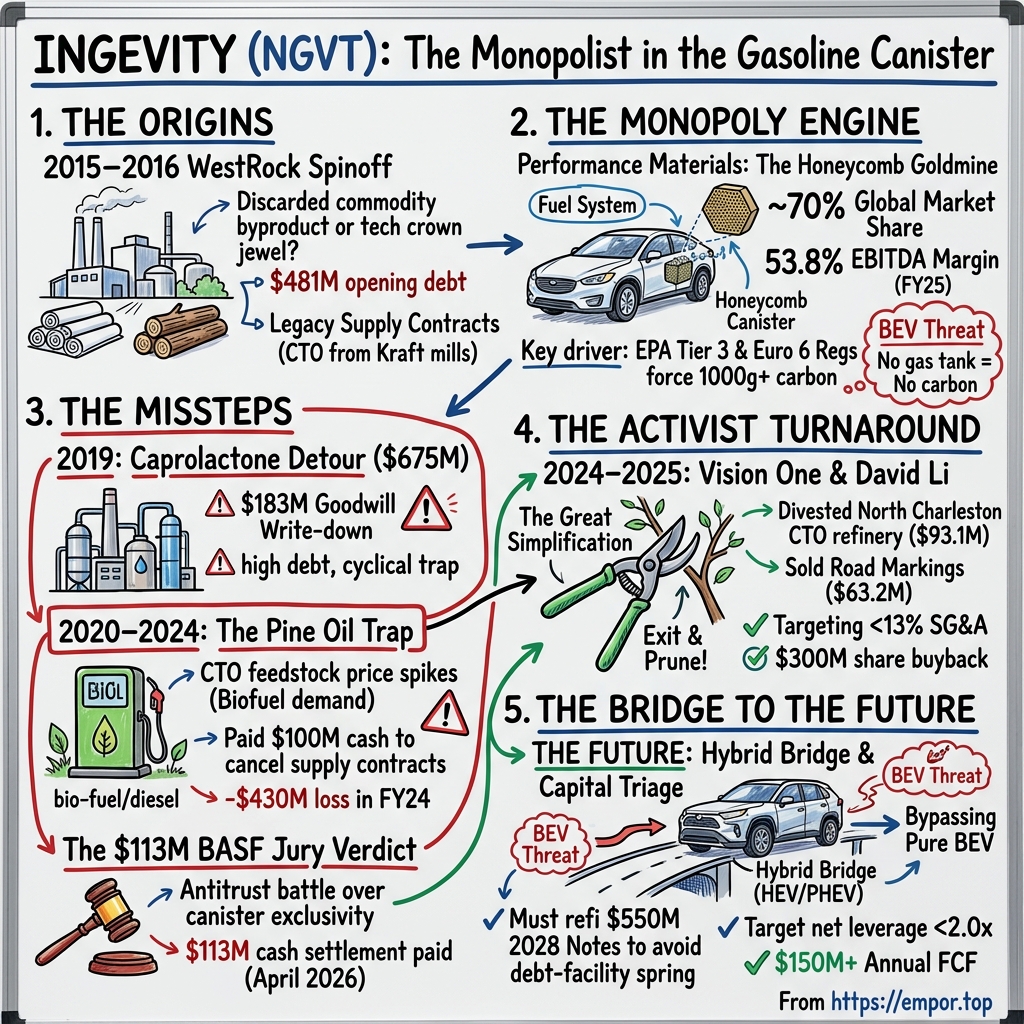
Ingevity: The Monopolist in the Gasoline Canister
I. The Trap in the Tailpipe
In the spring of 2026, the man running a small chemical company in North Charleston, South Carolina, spent several weeks moving large sums of money around. On April 1, David H. Li's company wired $113.2 million to BASF, ending a legal fight that had lasted longer than his tenure, or his predecessor's, or the one before that.2 By then the company had collected about $156 million from selling businesses that had defined it for decades: a pine chemicals refinery on the Charleston waterfront, and a road-striping business bought by PPG.2 And it had promised shareholders at least $300 million of share buybacks across 2026 and 2027.3 Anyone who glanced at the balance sheet that spring would have seen a company with roughly 42 dollars of debt for every dollar of shareholders' equity.1 On paper that looks like a business on the edge. Ingevity was buying back its own stock anyway.
To see why, open the hood of almost any gasoline car on Earth, or crawl underneath it. Somewhere between the fuel tank and the engine sits a plastic canister about the size of a coffee thermos. Inside is carbon: pellets, and in many modern cars a ceramic-looking honeycomb, cooked from wood sawdust until its surface is riddled with microscopic pores. When a car sits in a hot driveway, the gasoline in its tank warms, evaporates and tries to escape. The carbon catches those vapors the way a sponge catches spilled water. When the driver starts the engine, air is drawn back through the canister, the vapors are pulled out, and the engine burns them. No one who owns the car ever thinks about it. Ingevity has built one of the most profitable niches in American industry by making sure they never have to.
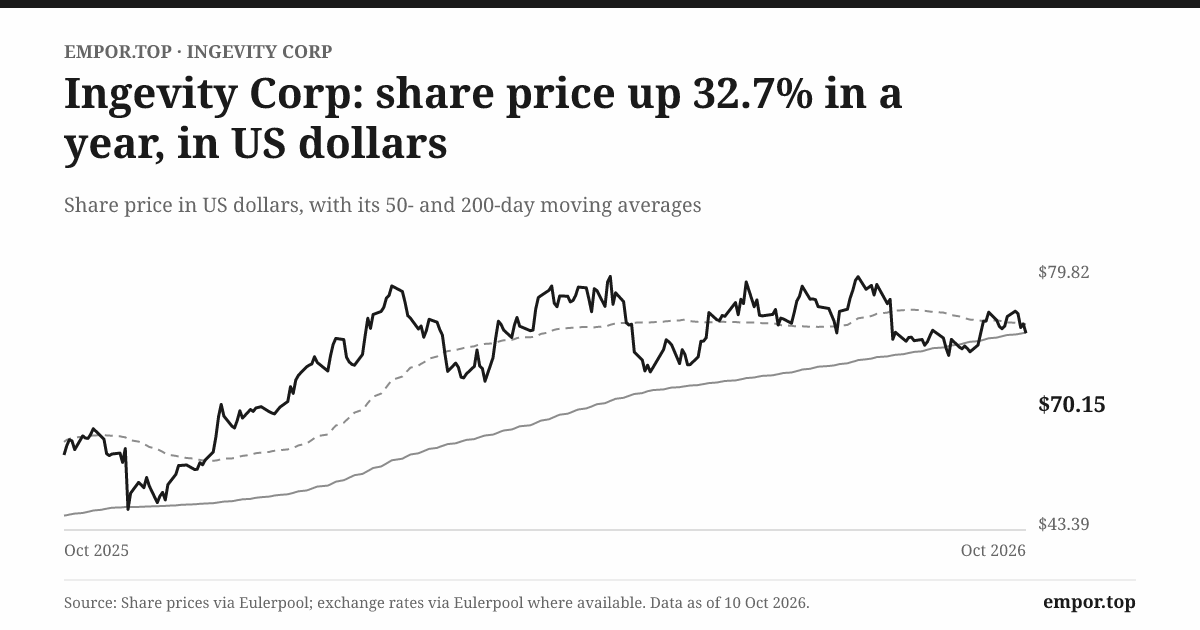
Ingevity says it supplies roughly 70% of the world's market for this automotive evaporative-emissions carbon.1 Its Performance Materials segment, which is mostly this business, earned about $326 million of segment EBITDA on about $607 million of sales in 2025, a margin above 50%.1 Few chemical businesses anywhere earn margins like that. And yet the company that owns it has reported GAAP losses in each of the last three years, trades on a trailing price-to-earnings multiple of about 48 times, and carries a book value of about $1.29 a share against a share price of about $70.12
That is the optical illusion at the heart of this story. The losses were real accounting events: write-downs of goodwill, refinery assets and a European acquisition, plus a $100 million cheque just to escape supply contracts.19 But they were not the cash the business threw off. Over twelve years from 2014 to 2025, Ingevity reported a cumulative net profit of about $630 million while generating about $2.7 billion of operating cash flow, more than four times as much.1 In 2025, a year with a $167 million net loss, free cash flow was $274 million.1 At today's market value of about $2.5 billion, that is a free-cash-flow yield of roughly 6%.
So the puzzle is not whether Ingevity makes money. It plainly does. The puzzle is whether what it makes money from will still exist in the shape investors need. Four questions frame the investigation. First, can a slimmed-down "New Ingevity," stripped of a third of its old revenue, keep operating margins in the low twenties, or will the corporate overhead built for a bigger company sit stranded on a smaller one? Second, will the global shift toward hybrid vehicles, which still have gas tanks and therefore still need canisters, buy enough time against battery-electric cars, which need none? Third, can management refinance $550 million of bonds due in November 2028 before a clause in its bank facility pulls that facility's maturity forward to August 2028, all while spending $300 million on buybacks?2 And fourth, will the strategic review of a struggling polymer business bought in 2019 end in a clean sale or another write-down?[^8]
The cast is new. Li, a specialty-materials veteran, took over as chief executive in April 2025.3 The board has a new independent chair and a new director, F. David Segal, who arrived through a settlement with his activist fund, Vision One Management Partners.3 The company that remains is smaller, simpler and concentrated in its highest-return asset. Ingevity is not, on the evidence, a distressed chemical mill. It is a high-margin emissions-technology franchise hiding behind a distorted balance sheet. Whether that franchise is worth what the market now pays depends almost entirely on how long the gasoline engine lives, and on whether the people now running it spend its cash better than the people before them. To understand why they had so much to fix, the story has to start in a paper mill.
 Subscribe on LinkedIn
II. Carve-Out from the Paper Mill: The WestRock Spinoff (2015–2016)
Papermaking is a messy business, and for most of the twentieth century the people who ran it got rich partly by selling the mess. When a kraft pulp mill cooks wood chips to free the fibers for paper, it leaves behind a dark, oily liquid called crude tall oil, and the chemistry of turning wood into pulp also lends itself to making activated carbon. Westvaco, one of the old American paper companies, learned to refine that tall oil into fatty acids and rosins for asphalt, inks and adhesives, and to make carbon from wood for filters. Through its 2002 merger with Mead, those side-streams became the specialty chemicals division of MeadWestvaco, and when MeadWestvaco combined with RockTenn in 2015 to form WestRock, the division landed inside one of the largest containerboard companies in the world.4
That was an awkward home. WestRock was a company of corrugated boxes and paperboard, valued on the multiples investors give to cyclical commodity packaging. Inside it sat a chemicals business with a jewel nobody priced: the automotive carbon that had quietly become a near-standard component in American cars. So WestRock did what conglomerates under shareholder pressure do. It spun the chemicals division out. Ingevity was incorporated in Delaware on March 27, 2015, and on May 15, 2016, WestRock distributed it to its own shareholders, one Ingevity share for every six WestRock shares held.4
The mechanics shaped everything that followed. A tax-free spin-off creates a company with no founder, no family and no controlling shareholder: Ingevity began life entirely publicly owned, and remains so.1 It also lets the parent hand the child some debt on the way out. Ingevity's borrowings jumped from under $100 million on the carve-out books to about $481 million by the end of 2016, while its shareholders' equity fell to about $135 million, a debt-to-equity ratio of roughly 3.6 times on day one.14 The new company started life leveraged, which is common in spin-offs, because the parent pockets the debt proceeds and the child services the debt.
What it got in exchange for that debt was a business with about $908 million of sales in 2016 and an operating margin near 18%.1 That margin was fine for chemicals, unremarkable for what turned out to be inside it. The first chief executive, Michael Wilson, came from the specialty chemicals world, and his task was essentially an argument: that this was a specialty materials franchise deserving a specialty valuation, not a by-product of box-making.4
The company had two halves. Performance Materials made the engineered activated carbon: pellets and honeycombs for automotive canisters, plus carbon for water and process filtration. Performance Chemicals took crude tall oil and refined it at a large plant in North Charleston into products for road paving, printing inks, adhesives and oilfield chemicals.4 One half was high-margin and protected by regulation. The other was a refinery whose economics depended on the price of a by-product it did not control.
And here was the hidden liability. A refinery needs feedstock, and the feedstock came from paper mills, many of them WestRock's. At separation, Ingevity signed a ten-year crude tall oil supply agreement with WestRock alongside the usual separation, transition-services and tax agreements.4 It looked like security: guaranteed supply for a decade. It would turn out to be a decade-long commitment to buy a raw material whose price was about to be set by a completely different industry.
From the very beginning, then, the cash generated by carbon was partly spent keeping a capital-hungry pine chemicals refinery alive. That arrangement did not look dangerous in 2016, because tall oil was cheap and the refinery made money. But it meant Ingevity was really two businesses with very different futures sharing one balance sheet. The one that mattered most to investors was the one almost nobody understood. It is worth stopping to understand it properly.
III. The Honeycomb Goldmine: Cornering the Clean Air Act
Picture a car parked on a July afternoon in Phoenix. The fuel tank warms. Gasoline, a cocktail of volatile hydrocarbons, starts to boil off into the space above the liquid, and pressure builds. In the 1960s those vapors simply vented into the air, where sunlight turned them into smog. American regulators decided that was no longer acceptable, and over five decades they kept tightening the rule until the target became, in practical terms, almost nothing. Under the most demanding modern standards, a parked car is permitted to leak only a vanishingly small amount of fuel vapor over a day of heating and cooling.
The engineering answer is the carbon canister. Activated carbon works because of its surface. Heating wood-based material with activating chemicals carves out an enormous internal network of pores, so a single gram can have the surface area of a large room. Gasoline vapor molecules stick to those surfaces, a process called adsorption. The trick is that they must also let go. When the engine runs, it pulls fresh air backwards through the canister, a "purge," and the trapped hydrocarbons are drawn off and burned. A good canister holds a lot, releases cleanly and does not choke the airflow.
That last point is where Ingevity's honeycomb matters. Pellets packed in a can hold vapor well but resist airflow, like trying to breathe through a bag of gravel. A honeycomb, an extruded carbon block threaded with thin parallel channels, lets air pass easily while still exposing lots of surface. As standards tightened, the last few molecules that seep out of a canister when a car sits for days, the "bleed emissions," became the hard problem. Ingevity's honeycomb scrubbers, placed after the main pellet bed, became its signature answer.1 To an automotive engineer, it is the difference between passing and failing certification.
The result is a business with a very unusual shape. Ingevity sells this carbon per pound or per unit under platform contracts, typically lasting three to seven years, to the Tier-1 suppliers who build fuel systems, companies such as Plastic Omnium and TI Fluid Systems.1 Those suppliers sell canisters to carmakers. Automotive customers as a group accounted for about 48% of Ingevity's consolidated sales in 2025, though no single customer exceeded 10%; the largest, in Performance Materials, was about 7%.1
In the language of Hamilton Helmer, whose framework this story returns to later, the question is which source of power explains a margin above 50%. The obvious candidate is switching costs. A carmaker certifies a vehicle's evaporative system with specific components, and changing the carbon means re-testing the system against regulators' standards. Qualification takes years. Once Ingevity's carbon is designed into a high-volume platform, the Tier-1 supplier has little reason, and real risk, in swapping it out mid-life. A second candidate is process power: decades of accumulated know-how in turning hardwood into carbon with precisely the right pore structure, and extruding it into honeycombs that do not crack. A third is what lawyers would recognize as patents, on the low-bleed system designs that made the honeycomb indispensable.
The test of any claimed monopoly is price. A true monopolist with 70% share should be able to raise prices at will. Ingevity's own record suggests it cannot, at least not freely. Its automotive business runs on long-term platform agreements negotiated with large, sophisticated Tier-1 buyers who also supply carmakers known for squeezing every supplier every year. What the company has instead is something narrower and still valuable: it earns very high margins on the volume it is designed into, and its content per vehicle grows mainly when regulations tighten, not when it decides to charge more. The power is real, but it is a regulatory ratchet more than a pricing lever. The biggest step-ups in carbon content came from the successive rounds of rules, the American Tier 3 and California's LEV III standards, Europe's Euro 6 and China's 国六 China 6, each demanding more capture per car.15
The evidence that the moat holds is the segment's resilience. Global vehicle production has been roughly flat, and Ingevity's automotive revenue has not collapsed, while segment EBITDA stayed above $300 million in 2025.1 Fitch, which rates Ingevity 'BB' with a stable outlook, names its technological leadership and high barriers to entry in automotive carbon as the main strengths behind the rating.5
The evidence that the moat is bounded is the next section of this story and the one after that. Ingevity's grip on the honeycomb market became so tight that a federal jury in Delaware found it had crossed the line into illegal tying, which says something about both the size of the moat and the ways it was defended. And above it all hangs the one substitution no patent can stop. A battery-electric car has no gas tank. It needs no canister and no carbon at all.1 Every BEV sold in place of a gasoline car erases Ingevity's content from that vehicle, and nearly half its sales come from the automobile.
So the verdict on the goldmine is clear but conditional. Performance Materials has a cornered position inside the architecture of the gasoline engine, defended by qualification cycles and process know-how, and the regulatory ratchet has done the work that pricing power usually does. But it has no defense against a change of architecture. Ingevity's management in 2019 understood that risk as well as anyone. Their answer was to go shopping.
IV. The Caprolactone Detour: Buying Growth at the Peak (2019)
In February 2019, Ingevity was at the top of its game. Revenue was heading for about $1.3 billion, operating profit for about $328 million, the highest it would ever report.1 The stock market rewarded it, the emissions rules kept tightening, and the company had a strategic itch to scratch. If the automotive franchise might one day shrink, then the time to diversify was while its cash was flowing.
On February 13, 2019, Ingevity completed its purchase of the Capa caprolactone business from Perstorp Holding, a Swedish specialty chemicals group, for about $675 million.7 The business centered on a plant in Warrington, in the north of England, making caprolactone monomers and the polymers built from them, materials that end up in polyurethane coatings, elastomers, adhesives, biodegradable plastics and medical devices.7 Ingevity renamed it Engineered Polymers and later Advanced Polymer Technologies. The cash out of the door that year, about $658 million of investing outflows, was funded largely with debt, and borrowings climbed to about $1.2 billion by the end of 2019.1
The pitch, as management told it, was that caprolactones were a specialty business: technically differentiated, sold in small quantities into many niches, less cyclical than pine chemicals and unrelated to the car. That was the logic of diversification, and it was not unreasonable on its face. The problem was what the business actually turned out to be when the cycle turned.
Caprolactone-based polyols compete in many uses with ordinary polyester and polyether polyols, which are cheaper and widely made, including by large Asian producers. The Warrington plant also runs on European energy, and after 2022 European energy became among the most expensive in the developed world. By 2025 the segment's sales had fallen about 15% to roughly $160 million, from about $189 million the year before, and its segment EBITDA slid about 18% to roughly $32 million.1 A business bought for $675 million was earning around $32 million of EBITDA. Whatever the original multiple, the multiple on what it actually earned in 2025 was more than twenty times.
The accountants caught up before management announced a retreat. In 2025 Ingevity recorded a $183.8 million goodwill impairment on the APT reporting unit, wiping out its goodwill, and the auditor, PricewaterhouseCoopers, flagged that interim impairment test as the critical audit matter in its opinion on the year's accounts.1 Another $109.3 million of long-lived asset impairments followed in 2025 across the portfolio.1 Goodwill is an accounting record of what a company paid above the book value of what it bought. Writing all of it off is an admission that the premium paid for the future did not survive contact with it.
Management's claim in 2019 was that this was specialty, defensive and growing. The record answers that claim as plainly as records ever do: the business shrank, the margin compressed, and the price paid was written down. The history does not just narrow the thesis; it rejects it. In November 2025, the company announced that it was exploring strategic alternatives for APT, including a sale.[^8] The difficulty is timing. Chemical buyers in 2026 face weak industrial demand of their own, and the segment needed price surcharges in 2026 to offset higher raw material costs.2 A seller in that market rarely gets the price it hopes for.
For an investor, the lasting significance of Capa is not the size of the loss, though $675 million was a large bet for a company of Ingevity's size. It is what the deal says about the company's judgment at its peak. With cash flowing and the stock high, management bought diversification at full price into a business whose customers could choose cheaper substitutes. The money that bought it was borrowed, and the debt outlived the thesis. That would have been hard enough to absorb on its own. But at the same moment, the other half of the original company was walking into a much bigger trap.
V. The Pine Oil Trap: When Renewable Diesel Broke the Supply Chain (2020–2024)
For a century, crude tall oil was the kind of commodity only a chemist could love. Every kraft paper mill produced it as a by-product of cooking pine chips, and the mills had two options: burn it as boiler fuel, or sell it to a refiner who would distill it into fatty acids and rosin. Ingevity's North Charleston refinery was one of the largest such buyers in the world. It turned tall oil into products for asphalt emulsifiers, adhesives, printing inks and oilfield chemicals.4 The economics depended on a simple premise: that tall oil was cheap because hardly anyone else wanted it.
Then governments decided they wanted it very much. Policies to cut carbon emissions from transport, among them California's Low Carbon Fuel Standard, rewarded fuel producers for making renewable diesel from biological fats and oils. Renewable diesel made from waste and residue earns especially valuable credits, and crude tall oil, a forestry residue, qualified as an attractive feedstock. Within a few years, Ingevity's raw material had a new class of bidders, refiners of transport fuel with policy credits in their pockets and little sensitivity to what fatty acids sold for.
Ingevity felt this from both directions. Its tall oil supply was tied up in long-term contracts with paper mills, including the ten-year agreement struck with WestRock at the spin-off, under pricing arrangements that reflected the new, higher market.49 Meanwhile, the prices of the products it made from that tall oil were set by industrial customers who could buy competing petroleum-based or Asian-sourced alternatives, and by oilfield and adhesive markets that weakened in 2023. The refinery's input cost was set by the fuel market. Its selling price was set by the chemical market. When the first rose faster than the second, every barrel processed lost money.
The financial record shows how quickly a squeeze became a crisis. Revenue had peaked at about $1.7 billion in 2022, flattered by chemical price inflation, with net profit of about $211 million.1 In 2023, Ingevity reported a small net loss, and in the fourth quarter of 2023 a pre-tax loss of about $154 million.110 Management's response through 2023 was to try to push prices up and wait for tall oil markets to normalize, which is the response one would expect if one believed the shock was cyclical. The customers' response was to buy less. The pine chemical industrial specialties business shrank, and the losses widened.
The capitulation came in 2024. Ingevity paid $100 million to terminate crude tall oil supply contracts, recorded about $53 million of losses reselling tall oil it was committed to buy but could not profitably use, and impaired goodwill and refinery assets on a large scale: about $349 million of goodwill alone that year.19 The company reported a net loss of about $430 million for 2024.1 By this time the chief executive who had led the company through the squeeze, John Fortson, had left; the company recorded about $4.8 million of severance in connection with his departure in early 2024, and a director, Luis Fernandez-Moreno, became interim chief executive.13
The most generous reading of management's record is that nobody predicted how much policy-driven fuel demand would reshape a niche by-product market. The less generous one, and the record supports it more closely, is that the company treated a structural shift as a cyclical one for too long. Ten-year supply contracts lock in exposure, and the first signs that renewable fuel producers would compete for tall oil were visible well before 2024. A company that sees its raw material becoming another industry's prized feedstock has two choices: lock in long-term protection, or exit early. Ingevity eventually did the second, but only after paying for not doing it sooner.
The deeper lesson is about what the carbon business was being asked to carry. The emissions franchise did not falter through all of this; its margins held. But its cash flowed into a combined company whose net debt kept rising toward $1.5 billion and whose losses came almost entirely from the chemistry next door.1 The full exit from the refinery would take until January 2026. Before that, the company had another bill coming due, this time from its own success in carbon.
VI. The $113 Million Jury Verdict: The Patent Fight with BASF
In a federal courtroom in Wilmington, Delaware, a jury was asked to decide whether the company that had cornered the market for automotive carbon honeycombs had done so fairly. The plaintiff was BASF, the German chemical giant, which had tried to sell its own honeycomb product into the American canister market as emissions standards tightened.6 BASF had a large technical organization, deep relationships with carmakers and every incentive to win a share of a business with margins above 50%. Ingevity had patents, long contracts and a dominant position. What happened next showed that a moat can be defended too aggressively.
The dispute began as a patent fight. Ingevity accused BASF of infringing patents covering its low-bleed canister system, the architecture that combines a main carbon bed with a honeycomb scrubber to meet the toughest emission standards. BASF counterclaimed that Ingevity had used those patents and its supply contracts to block competition, in particular by structuring arrangements so that canister makers who wanted Ingevity's widely used pellet carbon effectively had to take Ingevity's honeycombs too.6 In antitrust law, conditioning the sale of one product on buying another can be illegal tying when the seller has market power. Ingevity, with roughly 70% share, had it.
The jury found against Ingevity in 2021, concluding that its conduct amounted to illegal tying and patent misuse, and the damages were trebled under antitrust law to about $85 million.16 Ingevity appealed. For nearly five years the judgment sat on its balance sheet as a liability accruing post-judgment interest while legal fees mounted. The appeal was a gamble, and arguably a rational one: reversing the antitrust finding would have protected the commercial practices that kept competitors at bay.
The gamble failed. On February 11, 2026, the U.S. Court of Appeals for the Federal Circuit affirmed the verdict.2 A month later, on March 13, 2026, new management settled. Ingevity paid BASF $97.0 million covering the judgment and post-judgment interest, plus $16.2 million for BASF's legal fees, a total of about $113 million in cash on April 1, 2026, and the litigation ended.2 The company's accrued liabilities for the case fell by about $95 million between the end of 2025 and the end of June 2026.2
What does this fight say about the moat? Two things that pull in opposite directions. The first is that Ingevity's grip on canister carbon was strong enough that a federal jury decided it amounted to market power capable of being abused. That is about as clear an outside confirmation of dominance as a company can receive. The second is that part of what preserved the dominance was conduct that a court found unlawful. Once the tying practices are off the table, competitors such as BASF can compete on product alone, and Tier-1 buyers can source honeycombs and pellets separately. The moat that remains is the one built on process know-how, certification and switching costs, not the one built on contracts. That is probably still a wide moat. It is narrower than the one the company was defending in court.
The settlement also mattered for a simpler reason: cash. The $113 million was money that could otherwise have retired debt or bought back stock in the year management promised $300 million of buybacks. Alongside the environmental indemnity agreement signed with the buyer of the North Charleston refinery, which apportioned historical site liabilities, the BASF settlement removed the two largest legal clouds over the equity.1 It also closed a chapter that had begun under one leadership team and ended under another. That change of leadership did not happen by itself. It took an activist.
VII. The Activist in the Boardroom: Vision One and the Great Simplification
By late 2024, Ingevity's shareholders had watched a stock that once traded well above $100 fall by roughly two-thirds from its peak.1 The company had a profitable crown jewel, a money-losing refinery, an impaired European acquisition, an antitrust judgment under appeal and an interim chief executive. To an activist investor, that is not a broken business. It is a good business wrapped in bad decisions, and those can be unwrapped.
Vision One Management Partners, founded by F. David Segal, built a position and pressed for change, threatening a proxy fight. Ingevity spent about $8.2 million defending itself before the two sides reached a cooperation agreement that put Segal on the board.13 The thesis Vision One pushed was easy to state: separate the emissions franchise from the businesses that were consuming its cash, cut the costs that came with complexity, and return the proceeds to shareholders.
The board changed shape quickly. Bruce D. Hoechner, an independent director with a background running Rogers Corporation, a specialty materials company, became chair on April 30, 2025.3 A few weeks earlier, on April 7, David H. Li had taken over as president and chief executive.3 Li came from the specialty materials sector, from the sort of company that sells engineered products into demanding industrial customers, which is exactly how Ingevity now wanted to be seen. His 2025 pay package totaled about $12.8 million, most of it in one-time inducement stock and option awards whose value depends on the share price and performance conditions.3 At the 2026 annual meeting, shareholders re-elected every director by wide margins, and the advisory vote on executive pay passed with about 89% support, a solid but not unanimous endorsement given the size of the new CEO's package.11
Then came the pruning, which happened at a pace unusual for a company that had spent years defending its old shape. In November 2025, Ingevity announced a repositioning: it would sell its pine chemical industrial specialties business, including the North Charleston refinery, and explore options for the polymer business.[^8] The refinery and related operations went to Mainstream Pine Products on January 1, 2026, for about $93 million in cash, taking the tall oil contracts, and their exposure, off Ingevity's hands.12 On April 15, 2026, PPG Industries completed its purchase of Ingevity's Road Markings business for about $63 million in cash.28 What remained of Performance Chemicals was renamed Pavement Technologies, centered on Evotherm warm-mix asphalt additives that let paving crews lay asphalt at lower temperatures, and on pavement-preservation chemicals.2 It is a seasonal business, with most of its revenue earned between April and September.1
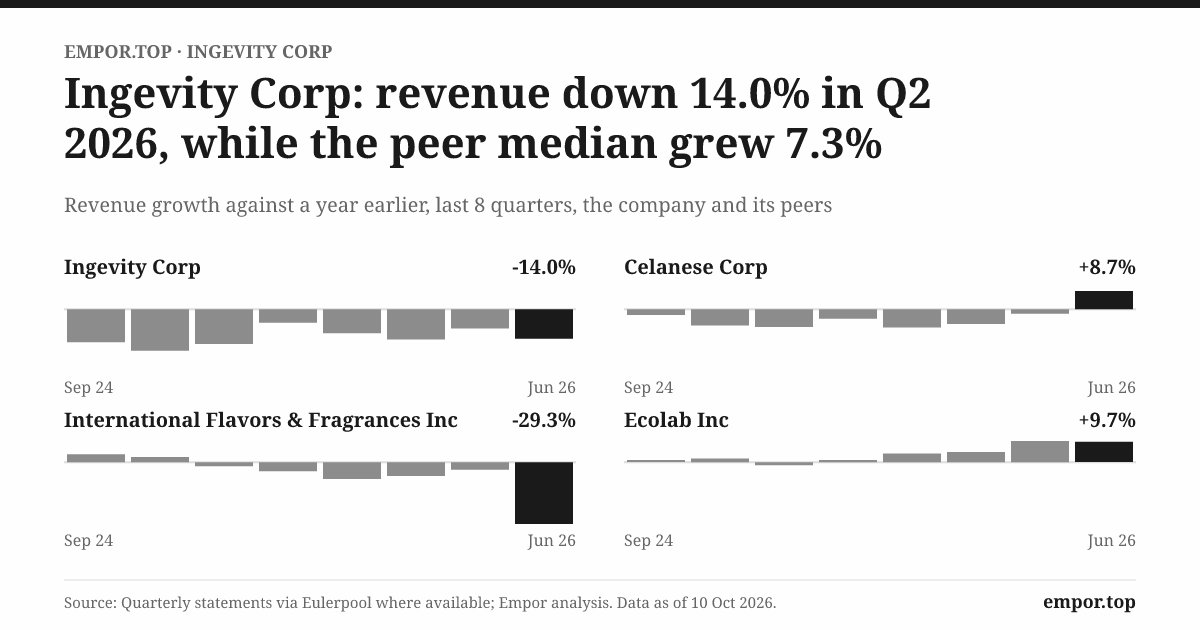
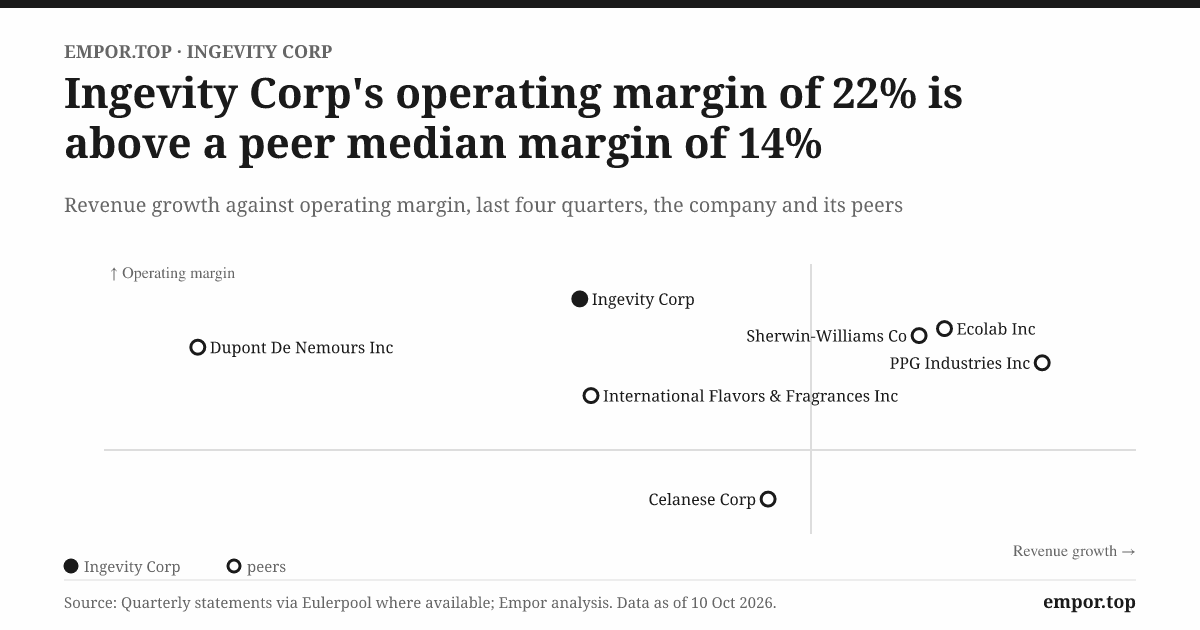
The question for New Ingevity is what happens to costs that used to be spread across more revenue. When a company sells off a large chunk of its sales, the businesses leave but the head office, the finance team, the IT systems and the executive suite often stay. Those indirect corporate costs that had been allocated to discontinued operations fell from about $38 million in 2023 to about $14.5 million in 2025.1 That decline suggests the company has been cutting, but it also shows how much overhead used to be carried by businesses that are now gone. Quarterly revenue fell 14% year on year in the second quarter of 2026, to about $314 million, and the operating margin in that quarter was about 19%, down from about 24% a year earlier.112 Part of that drop reflects the timing of divestitures and seasonal patterns. Part of it is exactly the stranded-cost risk an investor should worry about.
The settling number is easy to name. For New Ingevity's operating margin to stay in the low twenties on a revenue base of roughly $1.1 billion, selling, general and administrative costs need to fall to around 13% of sales or below. That is the figure to watch quarter by quarter through 2026 and 2027.
The activist campaign did what activist campaigns are supposed to do: it broke inertia. In about eighteen months, Ingevity sold the businesses that had been draining it, settled its largest lawsuit and committed its surplus cash to buybacks. Whether it simplified into a better business or merely a smaller one depends on whether the costs follow the revenue out of the door, and on the long-run fate of the asset that remains. That asset deserves a fuller test.
VIII. Analysis: Moat, Hamilton Helmer's 7 Powers, and the Bear vs. Bull Case
Imagine a fuel-systems engineer at a Tier-1 supplier sketching the emissions layout for a new plug-in hybrid SUV. The hybrid's gasoline engine runs only part of the time. When it is off, there is no airflow to purge the canister, yet the tank still breathes as the vehicle sits and heats. Plug-in hybrids can also run for days on electricity without the engine starting, and some use sealed, pressurized fuel tanks. The engineer needs a canister that captures vapors more efficiently and releases them in shorter purge windows. In Ingevity's description, hybrids require equal or larger, more sophisticated carbon systems than conventional cars.1 For Ingevity, that is the difference between the end of the gasoline engine being a cliff and being a long slope.
Start with the powers, in Helmer's sense, and be strict about which are real. Ingevity's strongest is a cornered resource combined with process power: proprietary know-how in activating wood-based carbon and extruding honeycombs that meet the toughest evaporative standards, refined over decades at its plants in Covington, Virginia, and Wickliffe, Kentucky.1 Competitors can make activated carbon; making automotive honeycomb at the needed quality and scale is harder, as BASF's slow entry suggests. Its second power is switching costs: once qualified on a platform, a supplier is rarely displaced during the vehicle's production life. Scale economies are moderate: as the dominant producer, Ingevity spreads its kilns and engineering across far more volume than any rival. Network effects, brand and counter-positioning do not apply to an industrial component sold on specification.
Porter's five forces frame the limits of those powers. The threat of substitution is the defining force: inside a gasoline or hybrid vehicle there is no practical chemical alternative to activated carbon for evaporative control, but battery-electric vehicles eliminate the need entirely. Buyer power is real: Tier-1 fuel-system makers are large and concentrated, and they negotiate hard, which is why Ingevity's pricing improves with regulation rather than on demand. Supplier power in Performance Materials is low: the wood and activating chemicals are widely available, which is the opposite of the tall oil trap.1 The threat of new entrants is low given qualification times and the BASF experience, though the end of tying practices raises it slightly. Rivalry is limited.
That combination produces what the financials show: a segment with margins above 50% whose biggest risk is not a competitor but an engine.
Now the market's view. At about $70 a share, Ingevity is valued at about $2.5 billion, and with net debt its enterprise value is about $3.7 billion.1 Headline multiples look absurd: a price-to-book of about 52 times and a trailing price-to-earnings of about 48 times, against a five-year median of about 15 times. Both are artifacts. Book equity has been shrunk to almost nothing by about $640 million of write-downs in two years and about $664 million of shares held in treasury after buybacks.12 Measured on what the business actually produces, the picture is ordinary: about 15 times enterprise value to operating profit and a free-cash-flow yield of about 6%.1 Peers in specialty materials and chemicals such as Cabot, Ashland, Avient and Innospec trade at roughly 8 to 12 times EBITDA on most measures; Ingevity's EBITDA-based multiple of about 19 times is inflated by depressed reported EBITDA after impairments, so the cash-flow measures are the better guide. The price appears to assume that the core cash engine holds roughly steady for years, not that it grows quickly or collapses.
The bear case runs through three mechanisms. The first is substitution: if battery-electric vehicles take share in North America, Europe and China faster than hybrids grow, global canister volume shrinks, and with it most of Ingevity's profit. The second is the debt calendar. Ingevity carried about $1.2 billion of debt at the end of June 2026, including $550 million of 3.88% senior notes due in November 2028 and about $492 million drawn on its revolving credit facility.2 In March 2026 it amended that facility, cutting commitments from $1 billion to $750 million and extending its maturity to 2031, but with a springing clause: if more than $250 million of the 2028 notes remain outstanding 91 days before they mature, the revolver itself matures in August 2028.2 A company with about $46.9 million of book equity, committed to $300 million of buybacks, has to refinance $550 million of bonds into a market that will price its 'BB' credit.25 The third is portfolio drag: if Pavement Technologies suffers from tighter road budgets and APT cannot find a buyer at book value, more write-downs follow.
The bull case runs through the same mechanisms in reverse. Carmakers including many of the largest in the United States, Japan and Europe have slowed battery-electric programs and leaned harder into hybrids, which keep the canister and may enlarge it. If that "hybrid bridge" holds through 2030, Performance Materials keeps throwing off cash for longer than the pessimists assume. Rating agencies already see the business generating more than $150 million of free cash flow a year even after the divestitures, and Fitch expects leverage to trend around 3 times EBITDA in 2026.5 With that cash, Ingevity could pay down its revolver, refinance its notes and still buy back stock, gradually rebuilding book equity as impairments stop and earnings accumulate. In that version, the absurd multiples normalize because the denominator recovers, not because the price falls.
Weighing them, the evidence supports a narrower bull case than the most optimistic version. The moat inside gasoline and hybrid vehicles is intact; the history of qualification, BASF's struggle to enter and the segment's resilient margins all confirm it. But the moat has a terminal date set by vehicle technology, not by competition, and the company has no proven second engine; its last attempt at one was Capa. Three numbers will tell the story from here: Performance Materials revenue against global light-vehicle production, which shows whether hybrids are offsetting electric losses; SG&A as a share of sales, which shows whether simplification is real; and the progress on refinancing the 2028 notes, which shows whether the balance sheet can carry the buyback promise. Each has a lesson behind it.
IX. Playbook: Business & Investing Lessons
Lay twelve years of Ingevity's audited statements side by side and one gap jumps out. The company reported about $630 million of cumulative net profit, and about $2.7 billion of operating cash.1 It paid no dividends in that time, so the cash went elsewhere: to capital spending, to Capa, to buybacks, to a refinery that kept losing money, to lawyers, and to a $100 million fee for the right to stop buying tall oil.1 Read that way, the company's history is a lesson in how a magnificent business can be surrounded by expensive decisions.
The first lesson belongs to the refinery: a crown jewel's cash is not a subsidy budget. The carbon business made Ingevity rich enough to keep its pine chemicals refinery running long after the tall oil market had turned against it. The cost of that patience, contract terminations, resale losses, impaired assets and lost years, ran into hundreds of millions. Founders and investors alike should recognize the pattern: when the profitable business lets you avoid hard decisions about the unprofitable one, the profitable business is not protecting you. It is financing the delay.
The second lesson is about the kind of moat Ingevity owns: a regulatory moat is a fence around a field, and the field can disappear. Clean-air rules turned an obscure wood-carbon product into a near-monopoly with margins above 50%. No competitor has seriously dented it, and a federal jury found Ingevity had market power to spare. But that protection exists only inside the architecture regulators wrote rules for. A battery-electric car does not lose to Ingevity's competitors. It simply has nowhere to put the canister.
The third lesson is for anyone running a stock screen. A debt-to-equity ratio of 42 and a price-to-book of 52 would flag almost any company as near insolvency. In Ingevity's case, the tiny equity is mostly the residue of buybacks and non-cash write-downs, not operating losses, and the business still generates hundreds of millions in cash a year. The equity line is the scar tissue of old decisions. Cash flow is the pulse. Look through the denominator before you judge the ratio, and then ask the harder question the ratio hides: whether the cash will keep coming.
The fourth lesson is about spin-offs. Independence from WestRock freed Ingevity to be valued on its own merits, and for three years the market did exactly that. Then it borrowed heavily to buy a European polymer business at the peak of the cycle, and the debt outlived the logic. A spin-off's first years are its best chance to prove its capital discipline, and Ingevity spent its flexibility on diversification that did not diversify. Freedom from a parent is only valuable if the child knows what not to buy.
X. Epilogue
Tonight, Ingevity is smaller, cleaner and still carrying the debt of its old ambitions. The refinery is gone, the road-striping business is gone, BASF has been paid, and a new chief executive and finance chief, Phillip J. Platt, who took over from long-time CFO Mary Dean Hall on May 1, 2026, are running a business built around carbon, pavement additives and an unwanted polymer plant.3 The share price sits near $70, about 10% below its 52-week high, after a rally that more than recovered the year's lows.1 The market has begun to believe the simplification story. The next two years will decide whether it was right.
The first decisive moment is the polymer review. If Ingevity sells APT for cash at or above its written-down book value, the company sheds its last legacy distraction and proves the impairments were the end of the bad news. If no buyer will pay that, Ingevity faces another write-down or the work of running a cyclical European chemicals plant it no longer wants.
The second is the refinancing. Sometime before August 2028, management must reduce the 2028 notes outstanding below $250 million, through a new bond issue, a tender offer or repayment, or watch its revolving facility mature early.2 The easier that refinancing goes, the more of the $300 million buyback promise will be credible. A hard refinancing would force the company to choose between its bondholders and its buyback.
The third is the quarterly overhead number. If SG&A falls toward or below 13% of sales on a roughly $1.1 billion revenue base, the margin target holds and New Ingevity looks like a focused materials business. If it stays stubbornly higher, the divestitures will have made the company smaller without making it better.
The fourth is the one no management can control: the mix of vehicles rolling off assembly lines in Detroit, Toyota City, Wolfsburg and Shanghai. Every hybrid is a vote for the canister's survival; every pure electric car is a vote against it. Ingevity's turnaround is halfway home. The cash drains are gone, but the balance sheet must still be refinanced and the hybrid thesis must still be proven, and the window for both is closing on a timetable set by the auto industry rather than the boardroom.
XI. Outro
Stand on an overpass at dusk and watch the traffic. Thousands of cars and trucks pass underneath, their engines burning gasoline, their tires rolling across asphalt that may have been laid warm with a bio-based additive, and under each of them, invisible, a small honeycomb of carbon cooked from wood shavings, holding the fuel vapors that would otherwise drift into the evening air. Hardly anyone on that highway knows Ingevity exists. Almost all of them are its customers.
The company began as the clever use of paper-mill leftovers and became, through regulation, one of the most profitable niches in industrial America. It survived a spin-off's debt, a peak-cycle acquisition, a refinery that turned into a trap, an antitrust jury and an activist, and emerged stripped down to the essential thing it does better than anyone. Ingevity is the company that learned to monetize clean air for the gasoline engine. Its last chapter will be written by how wisely it spends the cash from an engine that is slowly being retired.
References
-
Ingevity Corporation Form 10-K for the Fiscal Year Ended December 31, 2025 — U.S. Securities and Exchange Commission, 2026-02-26 ↩↩↩↩↩↩↩↩↩↩↩↩↩↩↩↩↩↩↩↩↩↩↩↩↩↩↩↩↩↩↩↩↩↩↩↩↩↩↩↩↩↩↩↩
-
Ingevity Corporation Form 10-Q for the Period Ended June 30, 2026 — U.S. Securities and Exchange Commission, 2026-07-30 ↩↩↩↩↩↩↩↩↩↩↩↩↩↩↩↩
-
Ingevity Corporation Definitive Proxy Statement on Schedule 14A — U.S. Securities and Exchange Commission, 2026-03-17 ↩↩↩↩↩↩↩↩↩
-
Ingevity Corporation Registration Statement on Form 10-12B/A (Information Statement) — U.S. Securities and Exchange Commission, 2016-04-25 ↩↩↩↩↩↩↩↩
-
Fitch Affirms Ingevity Corporation at 'BB'; Outlook Stable — Fitch Ratings, 2026-01-27 ↩↩↩↩
-
BASF Corp. v. Ingevity Corp. et al., Case No. 1:18-cv-01422 (D. Del.) — PACER / CourtListener, 2021-09-24 ↩↩↩
-
Ingevity Completes Acquisition of Perstorp Capa Business — Business Wire, 2019-02-13 ↩↩
-
PPG to Acquire Ingevity's Road Markings Business — PPG Industries Investor Relations, 2026-02-18 ↩
-
Ingevity Corporation Form 10-K for the Fiscal Year Ended December 31, 2024 — U.S. Securities and Exchange Commission, 2025-02-19 ↩↩↩
-
Ingevity Corporation Form 10-K for the Fiscal Year Ended December 31, 2023 — U.S. Securities and Exchange Commission, 2024-02-22 ↩
-
Ingevity Corporation Current Report on Form 8-K (Item 5.07 Voting Results) — U.S. Securities and Exchange Commission, 2026-05-04 ↩
-
Ingevity Corporation Current Report on Form 8-K (Q2 2026 Financial Results) — U.S. Securities and Exchange Commission, 2026-07-29 ↩
 LinkedIn
 WhatsApp
 Reddit
 Hacker News
 Email
Email Kindle
 RSS Feed
 Spotify
 Apple Podcasts
 Amazon Music
 Audible
 YouTube