NovaGold Resources Inc.: The Mine That Has Never Mined
I. A $2.3 Billion Company With No Revenue
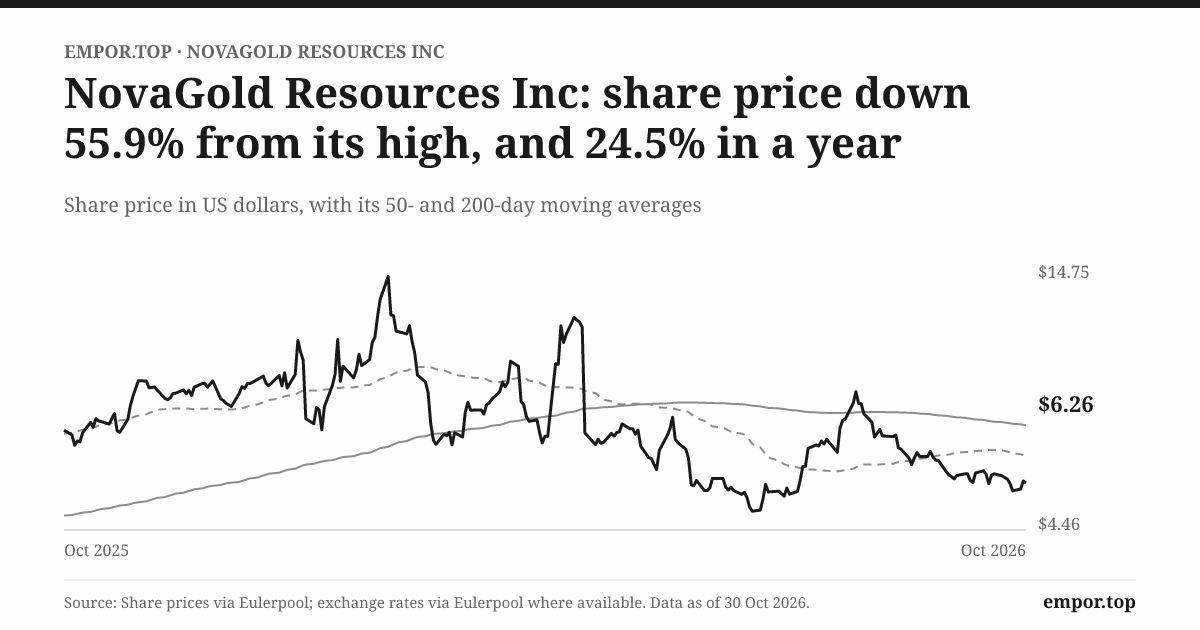
On the last Friday of October 2026, a share of NovaGold Resources changed hands for about $6.26. A year earlier the same share had briefly touched $14.20, which meant that anyone who bought near the top had watched more than half of their money disappear in twelve months. Even after that fall, the stock market valued the whole company at roughly $2.3 billion. That is the price of a respectable mid-sized industrial business, the sort of company that runs factories, pays thousands of people and reports earnings every quarter.
NovaGold does none of those things. In every quarter going back more than a decade, the line on its income statement where revenue should appear reads zero.1 The company had twelve full-time employees at the end of its 2025 fiscal year, four in Canada and eight in the United States.1 It does not dig ore, run a mill, pour gold bars or sell anything to anyone. Its accumulated deficit, the running total of every loss it has booked since it was formed, stood at about $2.28 billion at the end of August 2026, against about $2.55 billion that shareholders have paid in for its shares over the years.2 Put plainly, investors have handed this company roughly two and a half billion dollars across its history, and almost all of it has been spent getting ready to do something that has not yet happened.
What they own instead is a claim on a hole in the ground that has not been dug. Donlin Gold sits in the hills of southwestern Alaska, roughly in the Yukon-Kuskokwim region, on land owned by two Alaska Native corporations: Calista, which owns the minerals, and The Kuskokwim Corporation, which owns the surface.3 The deposit is enormous. The latest engineering model, completed in 2025, imagines a vast open pit that would move almost four billion tonnes of rock over its life, feed about half a billion tonnes of ore through a processing plant at 53,500 tonnes a day, and recover about 29.5 million ounces of gold across 27 years.4 In its first decade, the model has the mine producing about 1.3 million ounces a year.4 At those volumes, its owners say, Donlin would be the largest single gold mine in the United States.3
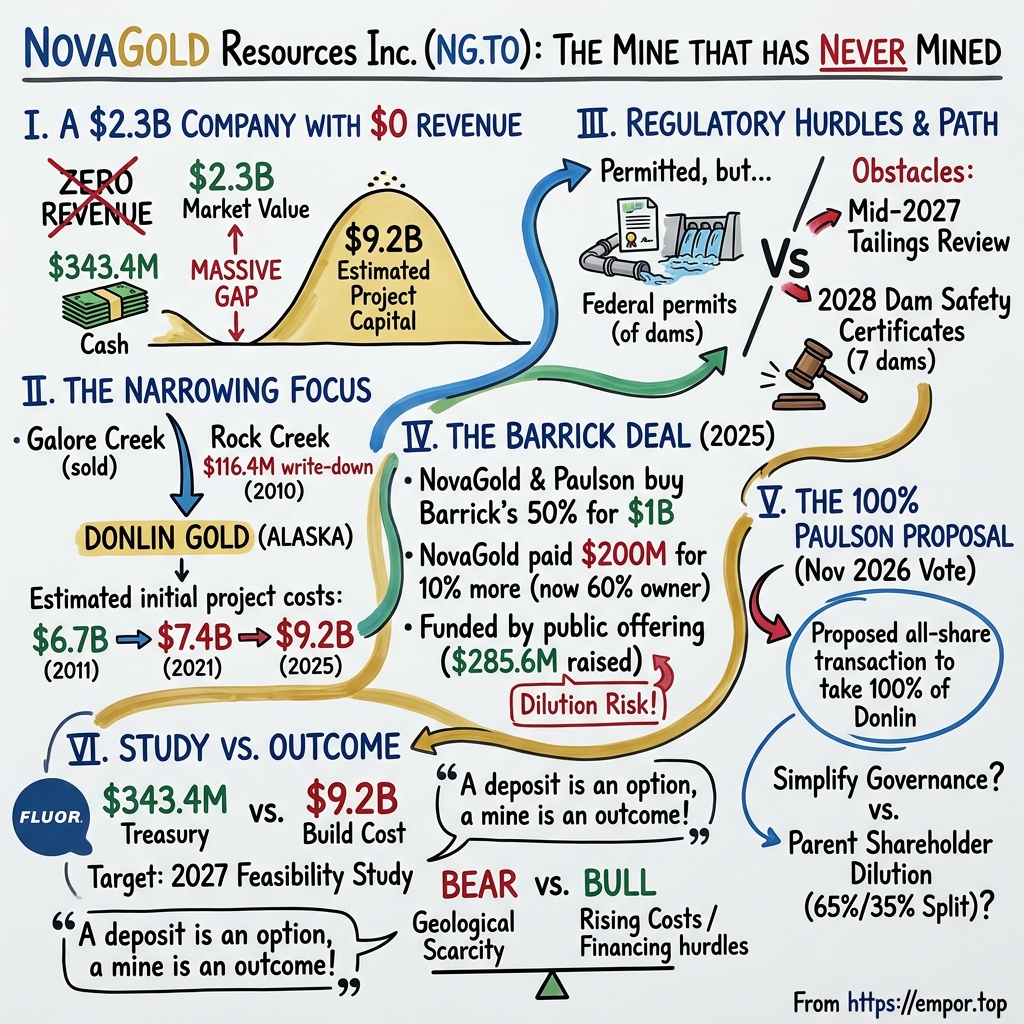
The catch is in the same model. Building the mine, its power supply and a natural gas pipeline of roughly 500 kilometres to fuel it5 would cost an estimated $9.2 billion before the first ounce is sold.1 NovaGold's treasury at the end of August held $146.4 million in cash and $197.0 million in term deposits, a total of $343.4 million.2 That is a large sum for a company of twelve people. It is about one twenty-seventh of the construction bill.
That is the central image of this story. On one side of the table sits a treasury that can comfortably pay for the next study. On the other sits a project whose initial capital estimate is many times larger than the entire company's market value. Everything NovaGold does, and everything a shareholder is betting on, lives in the space between those two numbers.
There is a second boundary worth fixing before the story begins, because it is easy to blur. Donlin Gold is held through a limited liability company, Donlin Gold LLC, which NovaGold owns 60% of at the end of October 2026, with funds run by the hedge-fund manager John Paulson owning the other 40%.2 NovaGold accounts for that stake using the equity method, which means Donlin's spending and staff do not appear line by line in NovaGold's own results. When this story talks about Donlin's 77 employees, its contractors or its modelled 1.3 million ounces, those belong to the project, not to the listed company.2 NovaGold's own economics are simpler and starker: a corporate office, a treasury that earns interest, and a share of the bills for advancing a mine.
The timing makes this a particularly charged moment to look at the company. On November 3, 2026, four days after this story's cutoff, NovaGold shareholders are scheduled to vote on a deal that would fold Paulson's 40% into a new American parent company in exchange for shares, taking ownership of Donlin to 100%.6 Meanwhile, the engineering firm Fluor is leading a bankable feasibility study, the detailed, lender-grade blueprint that is supposed to tell everyone what Donlin will really cost and how it will be built, with completion targeted for 2027.2
So the story turns on three questions, and they will follow the story all the way to the end. First, is Donlin's scale, its sheer quantity of gold in a stable American jurisdiction, worth the decades of waiting and the billions of capital it demands? Second, does owning more of Donlin actually make each NovaGold share worth more, or does the dilution needed to buy it eat the gain? And third, can the people running this company convert a long sequence of studies and permits into something they have never delivered at Donlin: a construction plan that someone is willing to finance?
To answer them, the story has to go back to how a company with several projects ended up with only one, and to the long, uncomfortable record of how that one project's price tag has moved.
 Subscribe on LinkedIn
II. The Donlin Bet Outlasts the Portfolio
NovaGold began life in the most unglamorous way possible. It was incorporated in Nova Scotia in December 1984 under the name 1562756 Nova Scotia Limited, a numbered company with no assets to speak of, and took the NovaGold name in March 1987.5 For years it was one of hundreds of small Canadian exploration companies looking for something worth finding. By its own description, it was only from 1998 onwards that it assembled the portfolio that would define it.7
That portfolio, at its peak around 2010, was the kind that makes a junior miner's investor presentation glow. NovaGold held 50% interests in two of what it called the world's largest undeveloped gold and copper-gold projects, Donlin Creek in Alaska and Galore Creek in British Columbia, alongside 100% of the Ambler copper-zinc deposit in Alaska and a cluster of gold properties around Nome, including a small mine called Rock Creek.7 Its partners were heavyweights: Barrick Gold at Donlin and Teck Resources at Galore.7 The company explicitly sold its approach as using those partners' "construction and operating expertise" to reduce development risk, and it stated a crisp objective: to become "a low-cost million-ounce-a-year gold producer."7
Hold on to that phrase, because it will come back. In 2010, NovaGold's stated ambition was to produce a million ounces of gold a year. In 2026, sixteen years later, that remains the ambition, and the company has still produced none.
Donlin itself has a longer history than NovaGold's stake in it. The ground had been worked by several companies before; the big step came between 1995 and 2000, when Placer Dome drilled more than 87,000 metres of core and discovered the ACMA deposit, one of the two main ore bodies.5 NovaGold took up the drilling from 2001.5 Then, on December 1, 2007, NovaGold and a Barrick subsidiary formed Donlin Creek LLC, later renamed Donlin Gold LLC, as a 50-50 venture.5 The governance was strictly equal: a four-person board, two seats each, with every significant decision requiring both owners to agree.5 That design looked like prudent partnership in 2007. Over the following eighteen years it would also become a recipe for a project that could only move as fast as its slower owner wanted.
The rest of the portfolio did not survive. Rock Creek, the one property built as a mine, ran into trouble and was written off in 2010. Galore Creek's construction was suspended in 2007, and the stake was eventually sold. Ambler was spun out to shareholders in April 2012 as a separate company, NovaCopper, with one new share for every six NovaGold shares held.5 The Nome assets, Rock Creek included, were sold in November 2012 to the Bering Straits Native Corporation for about $6 million.5 By the end of 2012, NovaGold had gone from a multi-asset developer to something much narrower: a company built around one gold project in Alaska and one stalled copper-gold project in British Columbia. A new chief executive, Gregory Lang, arrived in January 2012 to run what was left.1
Lang was a natural fit for what NovaGold had become. A mining engineer from the University of Missouri-Rolla, he had spent about ten years at Barrick, rising to president of Barrick Gold North America, after earlier roles at Homestake Mining and International Corona.8 In other words, NovaGold hired an operator from inside its own partner's house to steer a project that the partner co-controlled. That background matters for how to read the next fourteen years. Lang's career had been in building and running mines. At NovaGold he would spend his tenure running studies, permits and courtroom defences, because a mine was never authorised to begin.
The price tag that keeps moving
The most important document in Donlin's history is not a permit or a deal. It is the cost estimate, and it has been rewritten more than once.
In December 2011, the owners released a revised feasibility study, the second full study for the project.5 It estimated initial capital of about $6.7 billion, including a contingency of almost $1 billion and the natural gas pipeline that would replace diesel as the mine's power source.5 At a gold price assumption of $1,200 an ounce, the study showed an after-tax net present value, discounted at 5%, of about $547 million and an internal rate of return of 6%.5 An IRR of 6% on a nearly $7 billion construction project in a remote, roadless corner of Alaska is not the kind of figure that makes a mining board reach for its pen. It was, in effect, a study that proved the gold was there and that the project would barely pay at the prices of the day.
Fourteen years later, the 2025 technical report updated the economics. Initial capital rose to about $9.2 billion in fourth-quarter 2025 dollars, with another $2.3 billion of sustaining capital over the mine's life.1 The gold price assumption for reserves rose to $2,100 an ounce. At that price, the model's after-tax NPV at 5% was about $5.1 billion and its IRR 10.3%.4 The report's authors noted something revealing: compared with the 2021 version of the study, there was no material change to the mineral reserves, because "the increase in costs were generally offset by the increased gold prices."1
Read that sentence again, because it is the whole Donlin story in miniature. The ore body in the 2025 model is about 505 million tonnes, essentially the same 504.8 million tonnes at about 2.09 grams per tonne that the 2011 study counted as reserves.54 The rock has not changed. What changed was the price of building a mine to dig it, which rose by close to 40% in nominal terms, and the price of gold assumed to be dug out, which rose by 75%. The economics improved because gold outran costs, not because the project became cheaper or better engineered.
These estimates were built at different times, in different dollars, on different study bases, so it would be wrong to call the move from $6.7 billion to $9.2 billion a like-for-like overrun. Some of it is general inflation in mining equipment, labour and energy since 2011. But for a shareholder, the distinction offers limited comfort. The pattern of the record is that each time the study is refreshed, the bill gets larger, and the economics hold together only because the gold price assumption has climbed alongside it.
That pattern is the strongest piece of historical evidence against the most common bullish claim about Donlin, which is that a resource this large makes a mine more or less inevitable. The deposit has been known since the late 1990s. It has had a feasibility study since 2009, a revised one since 2011, federal permits since 2018 and two blue-chip partners at different points. It has not had a construction decision. Scale has bought Donlin attention, partners and capital. It has not, on its own, bought a mine.
The narrower and more defensible claim is this: Donlin is a scarce deposit whose economics are highly sensitive to the gold price, and whose construction case has never been tested by a lender-grade study under owners who were both committed to building it. That is exactly what the bankable feasibility study now under way at Fluor is supposed to settle. For it to mean more than another refreshed promise, it will have to show what has changed in engineering certainty, cost confidence, schedule and financing, not merely that a higher gold price makes the spreadsheet look better.
Before anyone accepts that NovaGold can carry Donlin across that line, though, it is worth looking at what happened to the projects that tried and failed to cross it first.
III. The Projects That Did Not Become Mines
In Nome, on Alaska's Seward Peninsula, gold has been part of the landscape since the stampede at the turn of the twentieth century. It was there, at a property called Rock Creek, that NovaGold came closest to being what it said it wanted to be: a company that actually produced gold. Rock Creek was built as a mine, and then went quiet. By 2010 it sat in care and maintenance, costing NovaGold about C$18 million that year just to keep it intact, after about C$25 million the year before.7 It had also been the site of a tragedy: in 2007, two contractors were killed in an accident at the mine, which later became the subject of a lawsuit against the company.7
In the third quarter of 2010, NovaGold's board accepted that Rock Creek was not going to become the durable operating asset it had been built to be. The company assessed whether it could ever recover the money it had sunk into the project, weighing scenarios in which it sold the mine or closed it permanently, and wrote its value down to zero. The impairment was C$116.4 million, plus a further C$7.5 million write-down of inventory.97 Those charges helped push NovaGold's loss for the year to about C$203.5 million.9
It is worth being precise about what a write-down is and is not. The C$116.4 million was not cash leaving the bank in 2010; that money had already been spent building the mine in earlier years. The impairment was the accounting admission that the spending would not come back. Two years later, NovaGold sold Rock Creek, along with its other Nome assets, for about $6 million.5 For a long-term shareholder, that is the real arithmetic: a nine-figure investment converted into a single-digit-million sale price and a permanent hole in the balance sheet.
Galore Creek was a bigger ambition and a slower retreat. The copper-gold deposit in northwestern British Columbia was, along with Donlin, one of the two crown jewels of the 2010 portfolio. In August 2007, NovaGold and Teck formed a 50-50 partnership to build it, with Teck agreeing to fund a large share of construction to earn its half.5 Three months later, on November 26, 2007, the partners announced they were suspending construction.5 The terms were renegotiated: Teck's earn-in was cut and restructured, and the money it put in was redirected to reassessing the project and studying other ways to develop it.5 Teck finished earning its 50% in 2011, after contributing about C$373 million, and from then on the partners split the bills.5
What followed was a long wait for a buyer. NovaGold began evaluating a sale of its Galore stake in November 2011. By the end of 2014, three years later, it disclosed that no offer had been received.5 At that point its stake was carried on the balance sheet at about $283 million.5 That number is the useful benchmark for what came next.
Up to $275 million, and what "up to" means
In July 2018, NovaGold agreed to sell its 50% of Galore Creek to a subsidiary of Newmont for what the headline called "up to $275 million."1011 The structure of the deal tells a more nuanced story than the headline. NovaGold received $100 million in cash at closing. It received a $75 million note payable on the earlier of a Galore pre-feasibility study or July 2021, and a $25 million note payable on the earlier of a feasibility study or July 2023. The final $75 million would be paid only if the project's owners approved a construction plan.1
Newmont paid the first two notes on their outside dates, in July 2021 and July 2023.1 Those payments arrived because the calendar ran out, not because Galore had reached its study milestones first, and they demonstrate a meaningful recovery of value. NovaGold collected $200 million in total. The last $75 million is another matter. NovaGold has assigned it no value at all, because management judged that approval of a Galore construction plan was not probable at closing or at any point since; its auditor flagged that judgment as a critical audit matter.1 In other words, the one piece of the consideration that depended on Galore actually becoming a mine is the one piece the company itself does not count on.
So the honest scorecard on Galore reads like this. NovaGold put years and money into a project that it once intended to build, saw construction suspended within months of forming the partnership, held the asset for another decade, and sold it for $200 million in collected cash against a carrying value that had been about $283 million four years earlier. The year of the sale, NovaGold's reported net loss jumped to about $112 million from about $39 million the year before, as the value of its investments fell sharply.12 Galore returned cash. It did not become a NovaGold mine.
Taken together, Rock Creek and Galore Creek reject any broad claim that NovaGold has a consistent record of turning projects into operating businesses. That does not settle the question of the current management team, and fairness requires saying so. Both projects predate Lang: Galore's suspension was in 2007, and the Rock Creek impairment was in 2010. Lang's own record is mostly the decisions made after he arrived, which were to shed the non-core assets, defend Donlin's permits and wait for a partner arrangement that would let Donlin move. Those were defensible choices. But they are choices about what not to do, and a record of avoiding bad projects is not the same as a record of building good ones.
The question the older history leaves for today's team is specific. Has NovaGold improved its ability to cost a project, finance it and sequence its development so that the cost estimate survives contact with reality? The company's own words in 2010 described leaning on its senior partners' expertise to reduce development risk. At Donlin, the senior partner has now left, and NovaGold and Paulson are the ones who will have to do the building.
Selling Galore had one more consequence, and it is the pivot of everything that follows. The sale made Donlin the company's only asset of consequence. It removed a distraction and freed up cash. It also removed any fallback. If Donlin did not advance, there was nothing else in the portfolio to carry NovaGold. And in 2018, the first big obstacle in Donlin's way was not money. It was permission.
IV. Permits in Hand, With a Tailings Review Still Ahead
On April 27, 2018, a notice appeared in the Federal Register announcing that the final environmental impact statement for the Donlin Gold project was available.1 It was the end of a process that had begun years earlier, when the U.S. Army Corps of Engineers took the lead on the federal review. Back in early 2015, NovaGold was still describing the draft statement as "on schedule to be issued for public comment in 2015," with a final version targeted for 2016.5 The final statement arrived about two years later than that early timetable suggested.
Then, on August 13, 2018, the Corps and the Bureau of Land Management issued a joint federal record of decision for Donlin.1 Along with it came the combined permit the Corps controls under the Clean Water Act and the Rivers and Harbors Act, and the BLM's offer to lease the right of way for the stretches of the gas pipeline that cross federal land.1 For a project in a region crossed by rivers and home to many Alaska Native communities, that was a significant hurdle cleared.
Why had it taken so long? Because the review had to bring together federal agencies, state agencies, the regional and village Alaska Native corporations that own the land, tribal governments and the communities of the Yukon-Kuskokwim region.2 The Corps received comments from all of them, as well as from businesses and environmental groups.1 That breadth is both Donlin's strength and its exposure. The project's landowners, Calista and TKC, have life-of-mine agreements with Donlin and an economic stake in its success, and management describes them as steadfast advocates.3 Other parts of the region have not been convinced, and they have used the courts.
The court that left the permits standing
On April 5, 2023, the environmental law firm Earthjustice, representing the Orutsararmiut Traditional Native Council and six villages from the Yukon-Kuskokwim region, sued the federal government in the U.S. District Court for Alaska, asking it to invalidate the 2018 record of decision.2 On June 10, 2025, the court ruled. It sent the matter back to the federal agencies to supplement the environmental review with an analysis of a larger hypothetical tailings release, but it did not vacate the permits.1
To understand why that matters, it helps to know what tailings are. When a gold mine crushes rock and extracts the gold, what is left behind is a vast slurry of finely ground waste, which is stored behind engineered dams, often for ever. The nightmare scenario for any mine near a river system is a dam failure that sends that slurry downstream. The court's view was that the original review had not considered a large enough version of that nightmare. Its remedy was to require more analysis, not to tear up the approvals.
That distinction is the difference between a setback and a disaster. A vacated permit would have sent Donlin back years. A remand for supplemental analysis adds work and time but leaves the project legally permitted while the work is done. NovaGold's response was to accelerate the process where it could: in October 2025, Donlin was formally accepted into FAST-41, a federal programme intended to make the timing of major permitting reviews more transparent and predictable.2 A notice of intent to prepare the supplemental statement followed in January 2026, the draft was published on September 23, 2026, public hearings were scheduled through October, and the final supplemental statement is anticipated in April 2027.2
The state side of the ledger has largely gone Donlin's way, with one exception. Earthjustice also appealed the state's grant of a pipeline right of way and certain water-rights permits, and the Alaska Supreme Court upheld the right of way in November 2025 and affirmed the water-rights permits.1 The remaining fight is over the state's Clean Water Act Section 401 water-quality certification, the state's confirmation that the project will meet water-quality standards. A state superior court upheld the certification in May 2025; Earthjustice appealed again, and the Alaska Supreme Court heard oral argument on June 3, 2026. At the end of October, its decision was still pending.2
Then there are the dams themselves. Donlin's design includes seven dams, and each needs a state dam-safety certificate before it can be built. Detailed design packages are expected to be submitted at the end of 2026 or early 2027, and the certificates are expected in 2028.2
Here, a gap opens between how management talks about permitting and what the filings describe. At the annual meeting in May 2026, Lang told shareholders that the federal permits were "in good standing," that the state permit was "substantially completed" and that "there's only one remaining permit, and that is for the tailings dam," which he expected to be approved "in the normal course."3 Every word of that can be defended. But a listener could easily come away believing that permitting was essentially finished. The quarterly filing five months later paints a busier picture: a supplemental federal environmental statement not due in final form until April 2027, a state Supreme Court decision still pending on the water-quality certification, and seven dam certificates not expected until 2028.2 "Permitted" is accurate. "Done" is not.
That matters for a specific reason. The bankable feasibility study is scheduled to finish in 2027, which puts it in the same window as the final supplemental environmental statement and before the dam certificates. A lender considering several billion dollars of project finance will want to know not only what Donlin costs but whether any of its approvals could still be reopened. The real question is not whether the permits exist. It is whether NovaGold and its partner can finish engineering and line up money while these processes are still running, or whether unresolved permitting keeps the people with the money on the sidelines until 2028.
Permits were never Donlin's only constraint, though. Even with approvals in hand after 2018, the project still needed owners willing to pay for the next stage. And for NovaGold, which had just sold its other big asset, paying for it became the story.
V. The 2018 Sale Buys Time for Donlin
The Galore Creek sale in July 2018 was presented as a portfolio decision, and in a sense it was one: NovaGold stepped away from a large copper-gold project in British Columbia to concentrate on a large gold project in Alaska, and it said it expected to apply the proceeds to Donlin.10 But viewed from the treasury, it looks more like a bridge. It was the way a company with no revenue paid for its next few years.
Consider what the company needed. NovaGold's operating losses, made up of its own corporate costs plus its share of Donlin's losses, ran at roughly $27 million to $33 million a year through the late 2010s.12 On top of that came its half of Donlin's spending on permitting, community relations and engineering. In fiscal 2014, for example, NovaGold's share of Donlin funding was about $12 million.5 None of that was offset by sales, because there were none. Cash and short-term investments at the end of fiscal 2017 had fallen to about $84 million.12 The Galore sale took them back up to about $167 million a year later.12
The money arrived in instalments. The $100 million at closing came first. The two notes followed in 2021 and 2023.1 Each time, the cash landed in a treasury that was otherwise drifting downward. Over the twelve years from fiscal 2014 through fiscal 2025, NovaGold's cumulative operating cash outflow came to about $116 million, and its cumulative free cash flow to about minus $121 million. Its cash and short-term investments fell from about $191 million at the end of fiscal 2013 to about $115 million at the end of fiscal 2025.12 That gentle decline over twelve years, without a large equity raise until 2025, is the most impressive thing in NovaGold's financial record. It shows a company that kept its own costs low and lived off its asset sales and interest income.
But it also shows the limit of what asset sales could do. The Galore proceeds covered corporate costs and NovaGold's share of a project in permitting mode. They did not and could not touch the multibillion-dollar construction bill. Even after the sale, the business model was unchanged: no revenue, continuing corporate losses, and a treasury drawn down to fund work that would only pay off if someone eventually committed to building.
There is a reasonable case that the sale was disciplined. NovaGold could not fund two mega-projects, Teck was a capable partner at Galore, and the company had tried for years to find a buyer. Selling for $200 million in collected cash was better than holding an asset nobody wanted to build. There is an equally reasonable case that it concentrated risk. Focus reduces distraction, but it also means every dollar of NovaGold's value now depended on one project, one permit record and one partnership. If Donlin stalled, there was no Galore to fall back on.
And Donlin did stall, in a particular way. Through the early 2020s, the project was permitted, studied and defended in court, but no construction decision was in sight. NovaGold's chairman later described the problem with unusual frankness. At the 2026 annual meeting, Thomas Kaplan said that 95% of the property remained unexplored, and that "there were historical reasons for it, dealing with the partnership issues that we had before."3 The partner in question was Barrick, whose 50% and equal board seats gave it effective veto power over the pace of the project. Breaking that deadlock would take a far bigger cheque than anything Galore had paid.
VI. The $1 Billion Barrick Deal: More Donlin, More Dilution
On April 22, 2025, NovaGold and Paulson Advisers announced that they were buying Barrick's 50% of Donlin Gold for $1 billion.13 NovaGold took an extra 10%, raising its stake to 60%, for $200 million. Paulson took 40% for the remaining $800 million.113 The deal closed on June 3, 2025.14 For the first time since 2007, Donlin was controlled by owners whose main reason for existing in the deal was to build it.
The irony of the moment is hard to miss. NovaGold's chief executive had spent a decade of his career at Barrick, rising to run its North American business. Now he was helping buy Barrick out. And the man writing the larger cheque was John Paulson, whose firm Paulson & Co. had been one of NovaGold's largest shareholders since 2010.3 Alongside him sat Kaplan, whose Electrum Group had been NovaGold's largest shareholder since 2008.3
Kaplan himself is a distinctive figure in mining finance. He holds a doctorate in history from Oxford, and made his first fortune in natural gas: Leor Exploration & Production, which he founded in 2003, sold its gas assets to EnCana in 2007 for $2.55 billion.8 He has been a NovaGold director since 2011, now serves as its chairman, and runs The Electrum Group, the private firm that manages the investment vehicle holding his stake.8 He is also, as his annual-meeting remarks make clear, a gold evangelist of rare conviction. He told shareholders in 2026 that he had been making the case for gold "since gold was $500 an ounce," that he regarded paper currencies as "toilet tissue, but the dollar can be double ply," and that he expected the gold bull market to run much further.3 That conviction is part of why Donlin has survived as a project. It is also a reason to be careful about whose voice is setting the tone for the company's economics.
How NovaGold paid
NovaGold did not have $200 million lying around for the purchase while still funding its share of Donlin and its corporate costs. So it raised equity. In May 2025 it sold shares to the public at $3.75 each, raising about $195 million, and placed another 17.2 million shares privately for about $64 million.21 All told, it issued roughly 72 million new shares for about $260 million, and ended the year with net proceeds of around $271 million after issuance costs.1 Electrum was one of the two buyers in the private placement, purchasing about 13.3 million shares for $50 million.1
To guarantee that the money would be there even if the public offering stumbled, NovaGold arranged a backstop. Electrum, Paulson and the investment firm Kopernik committed up to $170 million between them. In return, NovaGold issued them 25.5 million warrants, each allowing the holder to buy a share at $3.00 until April 2030.21 The public offering succeeded, so the backstop was never drawn. But the warrants had been issued, and accounting rules required NovaGold to record their estimated value of $39.6 million as an expense.1 Electrum alone received 6.375 million of them, worth about $9.9 million at issue.1
This $39.6 million is worth separating carefully from the cost of advancing Donlin. It was not cash paid to anyone. It was the accounting value of a right handed to three large shareholders, including the one whose chief executive chairs NovaGold's board, in exchange for a commitment that turned out not to be needed. It drove most of the increase in NovaGold's fiscal 2025 net loss to about $95 million from about $46 million the year before.1 For other shareholders, it represents a real if non-cash transfer: the warrants were struck at $3.00, and NovaGold shares have traded well above that since.15
The rest of the price was paid with borrowed time. NovaGold already owed Barrick a promissory note, dating back to the 2007 partnership, for its share of Barrick's earlier spending on Donlin.5 As part of the 2025 deal, the note was amended and restated with a principal of $158.9 million, secured against NovaGold's share of Donlin: until it is repaid, Barrick is entitled to 85% of what Donlin distributes to NovaGold and 5% of certain other proceeds.1 It accrues interest at the U.S. prime rate plus two percentage points, compounded twice a year, which put the rate at about 8.75% and the expected interest cost for fiscal 2026 at about $14.9 million.1 By the end of August 2026, the balance with accrued interest had grown to $177.5 million.2
The note came with a valuable door. NovaGold can extinguish the whole obligation for $100 million if it pays on or before December 3, 2026.2 Management has said it intends to exercise that option in the current quarter.26 Paying $100 million to retire a debt worth $177.5 million on paper is a good trade, and it frees NovaGold's future share of Donlin cash flows from Barrick's claim. But it also consumes almost a third of the treasury, and it does nothing to fund construction.
Was the price sensible?
At $1 billion for 50%, the 2025 deal valued the whole of Donlin at roughly $2 billion. Set beside the 2025 technical report's after-tax NPV of about $5.1 billion at $2,100 gold, that can look like a bargain.4 It is not that simple, and it is worth explaining why.
An NPV in a technical report is the present value of a mine's future cash flows if it is built as designed, on schedule and on budget, and if gold sells at the assumed price for 27 years. It also assumes, in this case, that the entire $9.2 billion of initial capital is paid in equity with no financing costs, and it excludes inflation.1 It is a model of what a finished mine would be worth, not a price at which anyone would buy an unbuilt one. The gap between $2 billion and $5.1 billion is, in large part, the market's charge for the risks that the model assumes away: the risk that construction costs more, takes longer or gets stuck in court, the risk that gold falls, and the sheer difficulty of raising $9.2 billion for a single project.
The sensitivity table in the same report makes the point vivid. At $1,470 gold, the model's NPV is negative, at about minus $787 million. At $2,730 gold, it is over $10 billion.4 A swing of about $1,260 an ounce in the gold price moves the project's modelled value by around $11 billion. That is what a high-capital, long-life mine looks like on paper: enormous leverage to the gold price in both directions. Kaplan, at the annual meeting, quoted an NPV of "somewhere around $70 billion using a 0% discount rate" at the gold prices of May 2026.3 A zero discount rate treats a dollar earned in 2055 as worth the same as a dollar today, which no lender or acquirer would accept. It is a figure for inspiration, not valuation.
So whether the Barrick deal was cheap depends on what one believes about gold and about execution, which is exactly where a neutral observer should leave it. What can be said with confidence is what the deal did. It raised NovaGold's economic exposure to Donlin from 50% to 60%. It removed an owner that had shown little urgency and replaced it with one that was eager to proceed. It cost existing shareholders a meaningful dilution: about 72 million new shares, roughly a fifth more than were outstanding before the raise, plus 25.5 million warrants. And it left behind a secured debt that NovaGold is about to pay $100 million to clear.
The test of whether it was worth it is still ahead. The deal bought control and momentum. Whether management turns that into better cost, schedule and per-share economics is what the next feasibility study will reveal. And while that study runs, it is worth asking a more basic question: what exactly is NovaGold selling in the meantime?
VII. What Does a Gold Developer Sell Before It Has Gold?
In February 2026, NovaGold and Paulson announced that Fluor, one of the largest engineering and construction firms in the world, would lead Donlin's bankable feasibility study.16 By the autumn, Fluor was coordinating the work of three specialist firms, WSP, Worley and Hatch, each handling a narrow slice of the design.2 Geotechnical crews were finishing a season of drilling holes and digging test pits at the site of a port on the Kuskokwim River, along the route of an access road, at the sites where construction material would be quarried and at the plant site itself.2 Engineers were working on the mine plan, the resource model and what the industry calls front-end engineering design, the stage where a concept becomes a set of drawings precise enough to price.2 Donlin's own team had grown from about 35 people at the start of the year to 77, based in Anchorage and Vancouver.2
Lang told shareholders that the choice of Fluor was deliberate: "A lot of firms could have conducted the feasibility study, but we wanted to engage one that had the capacity to take this project through the feasibility study, into engineering and ultimately into construction."3 He pointed to a personal link. Richard Williams, NovaGold's chief operating officer, had been Barrick's project director at Pueblo Viejo in the Dominican Republic, a large gold mine that uses the same kind of pressure-oxidation autoclave technology planned for Donlin, and had worked with Fluor there.83 For a project whose biggest open question is whether it can be built for the price on the page, a team that has built something comparable before is a real asset. It is also, for now, a credential rather than a result.
All of that activity is happening at the project. NovaGold's own role is to pay its share. In the first nine months of fiscal 2026, its share of Donlin funding came to $56.7 million, and it expected its share of the full calendar year's budget to come in around $78.8 million.2 On top of that it pays its corporate costs, which in 2026 were inflated by the legal and advisory fees of the Paulson transaction: on the third-quarter call, the company raised its full-year corporate general and administrative guidance from about $11.5 million to about $31.2 million and said the elevated level would continue into early 2027.6
Against those outflows, the only real income is interest. In the first nine months of fiscal 2026, NovaGold earned about $11.4 million of interest on its cash and deposits.2 It also earns a small fee for providing management and administrative services to Donlin, about $1.4 million in the same nine months, which is too small to matter economically and, with no sales, impossible to express as a share of revenue.2
So what does NovaGold actually sell today? The most honest answer is that it sells time and progress. Each quarter, it converts some of its treasury into a more advanced project: a defended permit, a completed drill programme, a refined engineering package. The value of that progress depends entirely on whether it ends in a mine. If it does, the investment in studies will look cheap. If it does not, the money is gone, as it was at Rock Creek.
The future business, if it happens
If Donlin is built, its product would be the simplest commodity in the world to describe: gold, sold at whatever the global benchmark price happens to be. No one would negotiate a premium for Donlin gold, and no one would buy it out of loyalty. Its economics would come down to how much gold sits in each tonne, how much of that the plant recovers, how much it costs to dig and process, and what gold sells for. On the 2025 model, the plant would recover about 90% of the gold, and the average grade, at around two grams a tonne, is high for an open-pit mine.43 Lang told shareholders the grade was "better than twice the industry average," giving Donlin what he called "extremely low cash costs, among the lowest in the industry."3 Those are management's characterisations of a modelled mine, and they may well be right, but they describe what Donlin would be, not what it is.
NovaGold's accounting follows the same logic. The company reports no line for research and development, because exploration spending is expensed as it is incurred.1 Mine-development costs can be capitalised, meaning recorded as an asset rather than an expense, only once a project meets defined tests of commercial mineability, economic analysis and permitting.1 Ratios that investors use for operating companies, such as capital spending as a percentage of sales, are meaningless when sales are zero.
There is one accounting distinction that matters for anyone reading NovaGold's statements, and it explains a puzzle in the twelve-year record. From fiscal 2014 through fiscal 2025, NovaGold reported cumulative net losses of about $593 million, but its operating activities consumed only about $116 million of cash. How can a company lose almost $600 million while burning little more than a sixth of that in its operations? Two things account for most of the gap. First, Donlin funding does not run through operating cash flow at all. NovaGold records the money it sends to Donlin as an investment, in its investing cash flows, while recording its share of Donlin's losses as an expense on its income statement. Second, some large charges, such as the Rock Creek-era write-downs, the Galore sale and the $39.6 million warrant expense in 2025, hit reported losses without moving cash in that year.1
The 2025 numbers show both effects at once. NovaGold's net cash outflow from investing activities was about $177 million that year. Underneath that net figure, it paid $210.1 million to complete the Barrick transaction and sent additional funding to Donlin, partly offset by cash it released from maturing term deposits.1 The gross cash committed to the project and the net investing outflow are therefore different numbers, and neither should be mistaken for the other. The practical lesson for a reader is that operating cash burn understates what Donlin really costs NovaGold, while reported net losses can overstate what the company spends in any single year.
Put all of this together and the present business is clear. NovaGold is a study-and-permitting company funded by its treasury, with a single product in development and no customers. If Donlin is built, it will become a gold producer with commodity economics. Until then, its economic output is not gold. It is the path to being financeable.
Whether that path leads somewhere depends on a question that no amount of engineering can answer by itself: does Donlin have something that protects its economics once it is built, or is it simply one more expensive hole competing for the same capital?
VIII. Porter's Five Forces & Hamilton's Seven Powers
Picture the Donlin site plan laid flat on a table. In the middle sits the deposit, two linked ore bodies, ACMA and Lewis, inside an eight-kilometre gold-bearing system.3 Around it are the things that would have to be built from scratch before any of that gold could leave Alaska: a processing plant with pressure-oxidation autoclaves, seven dams to contain tailings and water, a port on the Kuskokwim River, an access road, and a gas pipeline running hundreds of kilometres to bring fuel for power generation.25 The deposit is the jewel. The rest is an entire industrial system, and every piece of it carries a price.
Running classic competitive frameworks over a company like this requires adapting them, because NovaGold does not yet compete in any market. It has no customers, no market share and no cost record. The frameworks are still useful, but they have to be pointed at the right battles.
Start with the industry itself. NovaGold is a pre-production developer, not a diversified producer with several mines smoothing out each other's problems. Its closest comparisons are other large, capital-intensive gold projects waiting for financing around the world. The company does not publish a peer comparison of development projects, acquisition multiples or market share, and there is no reliable public table that would let an investor rank Donlin against its peers on a like-for-like basis. That absence is itself informative: Donlin's value has to be argued from its own economics, not borrowed from a peer group.
The threat of substitutes, in the normal sense, barely applies to the product. Gold is gold. A buyer cannot choose a different metal that does the same job as a store of value, and no technology is likely to make gold obsolete. But that same fact cuts the other way at the level of the mine: one ounce of Donlin gold is perfectly interchangeable with one ounce from any other mine. Donlin would compete only on cost, through its grade, its recovery, its mine life and its reliability. Each of those is, today, a modelled number.
Buyer power is similar. There are no current customers to negotiate with, and once built, Donlin could sell into a deep global market with no single buyer able to squeeze it. The counterparties with real power before production are not gold buyers at all. They are lenders, contractors, governments and co-owners, and they matter far more to Donlin's economics than any refinery ever will.
Supplier power is where the frameworks bite hardest. A remote Alaskan mega-project needs specialised engineering firms, large mining fleets, autoclaves, pipeline contractors and construction labour, all of which are scarce and expensive, and all of which will be bid on by other large projects at the same time. Donlin's rising capital estimate is in part a record of what those suppliers can charge.51 Even the power supply is a negotiation: NovaGold has signed a non-binding letter of intent with Glenfarne, a company proposing to bring gas from Alaska's North Slope to Cook Inlet, to explore delivering cheaper, local gas to Donlin rather than relying on imports.3 When so much of the cost sits in infrastructure and outside contractors, supplier power is not an abstraction. It is the line item that decides whether the mine is worth building.
New entrants and rivalry look different through this lens too. Nobody can create another deposit of Donlin's size by wanting one; discoveries of this scale are rare, and Kaplan made the point at the annual meeting when he said the industry's discovery rates had "never been lower."3 In that sense the deposit is genuinely scarce. But Donlin's rivals are not rival mines selling gold. They are rival projects competing for the same capital, the same contractors and the same investor attention. In a world where many gold projects need financing at once, being big is not enough to win that competition.
Hamilton Helmer's seven powers framework asks a sharper question: what lets a business earn returns above its cost of capital for a long time? Of the seven, two are plausibly relevant to Donlin. The first is what Helmer calls a cornered resource: preferential access to a valuable asset that others cannot get. A large, high-grade, permitted deposit on private land designated for mining in a stable American state fits that description well.3 The second is scale economies: a mine processing 53,500 tonnes a day spreads its fixed costs across a large volume of gold.4 The other five, network effects, switching costs, brand, counter-positioning and process power, have no evidence behind them at all. A gold mine has no network, its buyers have no switching costs, and no one pays more for a branded ounce.
The cornered-resource claim deserves the hardest test, and the company's own history provides it. A scarce deposit is only valuable to shareholders if the cost of turning it into a mine leaves something over. The record of Donlin's reserves, capital costs and modelled economics514 shows how much the scarcity thesis depends on gold prices outrunning construction costs. The mechanism that could break the scarcity thesis is therefore not a competitor discovering a better deposit. It is the cost and schedule of construction absorbing the upside, so that the scarce resource ends up mostly rewarding contractors and financiers rather than equity holders.
That leaves a calibrated conclusion. Donlin's strongest potential advantage is a scarce, large, high-grade deposit in a jurisdiction where most major permits have been issued. That is real, but it is a potential asset advantage, not a demonstrated corporate moat. There is no production, no cost record and no realised return on which to judge it. What would confirm the stronger version of the claim are specific, measurable things: a 2027 bankable feasibility study whose cost estimate holds up to scrutiny, permitting milestones met on schedule, firm capital commitments and, eventually, actual operating costs that look like the model. What would falsify it is just as specific: another round of capital escalation, or economics that only work at gold prices well above the long-term assumption.
That question of who gets the upside leads directly to the deal that the shareholders will vote on next week.
IX. The Paulson Deal: Does 100% Ownership Mean More Value Per Share?
On July 22, 2026, NovaGold announced it had signed agreements the day before to take Donlin from 60% to 100%.15 There would be no cash. Instead, a new Delaware corporation, to be called NovaGold Corporation and listed on the New York Stock Exchange, would become the parent of everything. Existing NovaGold shareholders would swap each of their shares for one share of the new company. Paulson would contribute its 40% of Donlin in exchange for new voting and non-voting shares.15 The company would, in John Paulson's words, be "redomiciled to the U.S., the home of Donlin Gold."15
The rhetoric around the deal was, even by mining standards, exuberant. Kaplan called Donlin a "holy grail" for gold investors and the combination "a dream come true." Lang called it "the ultimate 'smart' consolidation transaction in the gold industry."15 It is worth looking past the adjectives to the mechanics, because the mechanics decide whether existing shareholders come out ahead.
The arithmetic of 65 versus 60
Here is the core of the trade. Paulson's 40% would be valued at the equity value implied by NovaGold's own share price, using a ten-day volume-weighted average up to July 21, 2026, and then discounted by 10%.4 Because Paulson accepts that discount, existing NovaGold holders would end up with about 65% of the new company on a fully diluted basis, even though NovaGold is contributing 60% of Donlin.415 Paulson's affiliates would receive about 35% for their Donlin stake; including the NovaGold shares they already own, Paulson's total economic interest would be around 40%, but its voting power would be capped at 19.99%, with the balance held in non-voting shares.15
NovaGold's board says this produces about 8.2% accretion to existing shareholders on a net asset value per share basis and about 8.4% on resources per share.4 The deal, it argues, would add about 16 million ounces of measured and indicated resources, including about 13 million ounces of reserves, and more than half a million ounces a year of attributable production in the mine's first decade.4 Citi provided an opinion that the consideration is fair, from a financial point of view, to shareholders other than Paulson.15
Those are management's numbers, and they deserve a skeptic's reading. The accretion comes from one source: the 10% discount Paulson accepts. It is real, and it is the clearest reason the deal could benefit existing holders. But it is measured in net asset value and ounces per share, which depend on the same technical model the bankable feasibility study is about to replace. If the 2027 study raises the capital estimate again, the NAV on which the accretion was calculated moves with it. And ounces owned are not dollars earned. Owning 100% of Donlin means owning 100% of the $9.2 billion bill, not just the gold.
It is also important to compare like with like. The headline figure in the announcement, about $4.2 billion, was the equity value of the new company at NovaGold's closing price of $5.63 on July 21, 2026.15 It was not the price paid for Paulson's stake, not a cash amount and not an enterprise value for Donlin. Its meaning moved with the share price: by August 31, at $8.60 a share, the company was describing an expected post-arrangement market value of about $5.9 billion.4 Two months later the shares were trading below that August level again. Any per-share comparison has to be made on the post-deal share count, not on a headline that moved by billions with the stock.
Who controls the company afterwards
The governance would change too. The new company's board would expand from ten to eleven directors, co-chaired by Kaplan and Paulson.15 Paulson would have the right to nominate two directors while it owns more than 15%, one while it owns between 10% and 15%, and none below 10%; it intends to nominate John Paulson himself and Marcelo Kim.15 In exchange, Paulson accepts a lock-up on its shares that lasts until the earliest of three events: the completion of Donlin's project financing, its stake falling below 10%, or the third anniversary of closing.15 It also accepts standstill provisions and an obligation to vote with the board on director nominations.15
Those protections are meaningful, and the 19.99% voting cap prevents Paulson from controlling the company outright. But the combined picture is a company in which two longtime gold bulls, Electrum and Paulson, would hold the largest blocs, co-chair the board, and be locked in together until the project is financed. The special-meeting circular projects Paulson at 19.99% of the voting shares and Electrum at about 18.2% after the arrangement.4 Holders of about 28% of NovaGold's shares, including Electrum, Paulson, the directors and senior officers, had already agreed to vote in favour, against a required approval threshold of two-thirds of votes cast.15 Canadian shareholders face one more practical consideration: the exchange is intended to be tax-free for U.S. federal purposes but would be a taxable disposition for Canadian tax purposes.15
The strategic case, as the company presents it, is simple: one owner can make decisions faster than two, a single parent offers one point of contact for Calista and TKC, and a larger U.S.-listed company may have easier access to capital, including governmental agencies and sovereign wealth funds.4 There is genuine logic here. The previous partnership, by Kaplan's own account, was a source of headwinds.3 Even a friendly 60-40 partnership has two sets of lawyers, two boards and two sets of interests.
But it is worth being clear about what the deal does not do. It does not reduce the construction bill by a dollar. It does not raise any cash for construction. It concentrates 100% of the project's execution risk, and 100% of its capital requirement, on one listed company's shareholders. And at the October 30 cutoff, it had not happened: the special meeting is scheduled for November 3, 2026, and court, regulatory and stock-exchange approvals still lie ahead.615
The measure that would settle the debate is not ownership percentage. It is the post-deal share count, a share-count-adjusted net asset value disclosed after closing, and then a bankable feasibility study that lets shareholders judge value per share rather than ounces owned. Until then, the question underneath the deal is about trust: whether the people asking shareholders to approve it have earned the benefit of the doubt.
X. The Treasury, the Incentives and the People Paying for the Wait
Every quarter, NovaGold's chief financial officer, Peter Adamek, delivers the same reassurance in slightly different words. On the third-quarter call in October 2026, he said the company's cash and term deposits would fund the bankable feasibility study, the Barrick note prepayment and corporate costs "for at least the next 12 months."6 The quarterly filing says the same thing, and adds the sentence that matters just as much: future operations depend on raising capital, and additional funds will be needed for detailed engineering and eventual development of Donlin.2
Both statements are true together. NovaGold's cash and term deposits are held mostly with investment-grade Canadian banks and one large U.S. bank, in deposits maturing within a year.2 It is earning meaningful interest. The company says its funds will cover the study and near-term costs, but it is not a construction balance sheet, and no one at the company claims it is.26
To prepare for the next step, Donlin has hired Endeavour Financial and Macquarie Capital as financial advisers to evaluate options ranging from conventional project finance to infrastructure financing and potential support from governmental agencies or sovereign wealth funds.2 That is a sensible process. It is also an acknowledgement that the money for Donlin will have to come from somewhere well beyond NovaGold's own resources, and that the terms on which it arrives will decide how much of the project's upside current shareholders keep.
Pay, ownership and the shareholders who said no
Gregory Lang's total compensation for fiscal 2025 was about $5.2 million.8 Less than $900,000 of that was base salary. About $3.2 million came from stock and option awards, valued at the date they were granted, and about $1 million was an annual cash bonus.8 His total had been at a similar level in the two years before, from about $5.0 million in 2023 to $5.2 million in 2025.8 Over the same three years, NovaGold's reported net losses rose from about $46 million to about $95 million.1
Comparing pay with losses is imperfect for a pre-production developer, because losses are the expected state of the business, not a measure of failure. A better test is how the compensation committee decided the bonus. The committee rated the company's 2025 performance at 115% of target.8 The weights are revealing. Advancing Donlin toward a feasibility study or construction decision carried 20% of the scorecard and scored 113%. "Maintain Favorable Reputation of the Company and its Project Among Shareholders" also carried 20% and scored 120%. Community outreach and sustainability carried 15% and scored 140%. Managing the treasury carried just 5%.8 A scorecard that gives the company's reputation among its own shareholders the same weight as moving the project forward is an unusual design for a company whose only product is progress. Lang's individual performance was rated at about 121%.
Shareholders noticed. At the 2025 annual meeting, the advisory vote on executive pay drew support from about 71% of votes cast, down from about 84% the year before.8 For a company in which the chairman's own vehicle controls more than a fifth of the shares, that is a meaningful show of dissent from the remaining holders. The company responded with outreach, contacting or trying to contact every shareholder holding at least 15,000 shares, representing about 93% of the shares entitled to vote.8 At the 2026 meeting, the pay resolution carried by a majority, but the company did not announce the percentage at the meeting itself.3 Notably, no shareholder submitted a question during the virtual meeting.3
Alignment through ownership is real but uneven. Lang beneficially owned about 0.9% of NovaGold as of March 2026, a position, counting awards included under beneficial-ownership rules, on the order of $20 million at current prices and therefore a significant personal exposure.8 Kaplan's disclosed beneficial ownership was about 24%, essentially Electrum's stake; Electrum was the largest disclosed shareholder at about 22.4%, followed by Paulson & Co. at about 9.2%, Lingotto at about 8.0% and FMR at about 5.5%.8
Kaplan sits on both sides of several relationships: he chairs NovaGold and runs The Electrum Group, which manages Electrum. When Electrum bought shares in the 2025 placement and received backstop warrants for a commitment that was never drawn, it did so with the chairman of the issuing company as its own chief executive.1 The transaction was disclosed and approved, and Electrum put real money into the company at the same price as others. But for outside shareholders it is the kind of financing arrangement that deserves the closest scrutiny, because the people who benefited from its terms were also the people with the most influence over setting them.
What management says, and what it delivers
The fairest way to judge management credibility is to compare what it promises with what follows. Over the past year, NovaGold has been more specific than many developers. On the third-quarter call, management gave dates for the feasibility study (2027), the final supplemental environmental statement (April 2027) and the dam certificates (2028), a twelve-month funding horizon and a revised G&A guidance figure.6 It also declined to take questions on the Paulson transaction during the call's Q&A, citing the pending vote.6 That is legally defensible, but it means the single most consequential capital decision of the company's recent history was not tested by analysts on the company's own earnings call.
The more promotional language tends to come from the top. On the same call, Lang offered a line that many shareholders apparently embrace: "Many of our shareholders view NovaGold as an unexpiring warrant on an ounce of gold."6 He also cited a post-tax NPV of above $50 billion at a 0% discount rate and about $20 billion at 5%, at gold prices above $4,000 an ounce.6 At the annual meeting, Kaplan said there had "never been a better time to build the largest gold mine in the United States."3 An unexpiring warrant is a revealing analogy. A warrant is valuable precisely because it never forces the holder to do anything. A mine is valuable only once someone commits billions to building it. For fourteen years under the current management, NovaGold has been excellent at preserving the warrant. Whether it can exercise it is the question still waiting for an answer.
That record cuts both ways. NovaGold has raised and deployed substantial capital to advance Donlin, it has kept its corporate spending lean for most of the past decade, and it has delivered the specific permitting and partnership milestones it promised in the past two years. But the project's long duration, the steady growth in its capital estimate and the shareholder pushback on pay make guidance discipline, not salesmanship, the measure that matters now.
XI. Analysis & Bear vs. Bull Case
Lay three documents side by side. In one, the 2025 technical model shows Donlin generating an after-tax NPV of about $5.1 billion at $2,100 gold, after spending $9.2 billion to build.4 In the second, NovaGold's market value stands at about $2.3 billion and its enterprise value, after subtracting net cash, at about $2.2 billion. In the third, the company's income statement shows revenue of exactly zero. Every investor in NovaGold is, in effect, deciding how to reconcile those three pages.
Start with what the market appears to assume. If one strips out NovaGold's net cash and treats nearly all of its $2.2 billion enterprise value as the value of its 60% of Donlin, the market is implicitly valuing the whole project at roughly $3.5 billion to $3.7 billion. That is well above the $2 billion implied by the Barrick deal in 2025, and well below the $5.1 billion modelled NPV at $2,100 gold, let alone the far larger figures management cites at today's higher gold prices. The market, in other words, is giving Donlin substantial credit, but is also discounting heavily for the risks of cost, financing and time. The share price's 91.7% annualised volatility over the past year, and a largest fall of about 72% at some point over the past five years, show how violently that discount moves with the gold price and investor mood.
Conventional multiples are unhelpful here, and it is worth saying why. Price to book is about 7.0 times, but NovaGold's book value of about $1.03 a share reflects mostly cash and an equity-method investment carried at historical cost, not anything resembling Donlin's economic value. EV to sales shows as 0.0 times, which does not mean the stock is cheap; it means there are no sales. Earnings-based measures do not exist.
Why the believers stay
The bull case begins with the asset. Donlin is a large, high-grade, open-pit gold deposit, with about 29.5 million recoverable ounces in its reserve model and production of about 1.3 million ounces a year in its first decade.4 It sits on private land designated for mining, owned by Alaska Native corporations that have signed life-of-mine agreements and support the project.3 Its major federal permits have been issued and survived a court challenge without being vacated, and the Alaska Supreme Court has upheld two of the three state permits that were challenged.21 A capable engineering firm is leading a lender-grade study due in 2027, and the treasury can fund that work and near-term corporate needs. The 2025 transaction removed a reluctant partner, and the pending Paulson transaction, if approved, removes the remaining partnership friction entirely. With gold prices well above the $2,100 model assumption for much of 2026, the leverage in the sensitivity table works in the bull's favour.
Why the doubters stay away
The bear case begins with the record. NovaGold has no revenue and has accumulated about $593 million of net losses over the twelve years to fiscal 2025 alone, on top of the losses of the decade before. Rock Creek was written off; Galore Creek was suspended and sold. Donlin has been a feasibility-stage project since 2009, and the cost of building it has risen from $6.7 billion to $9.2 billion between studies, with the economics rescued by the gold price rather than by engineering.51 The 2025 model assumes all-equity financing and excludes inflation, so the real cost of building Donlin with borrowed money, over several years of construction, will be higher than the headline.1 The permitting story still has a federal supplemental review, a pending state Supreme Court decision and seven dam certificates to go.2
And the share count has risen from about 233 million in early 2011 to about 439 million by October 2026, before the Paulson arrangement adds its own new shares.72 The next step, financing construction, could dwarf all previous dilution put together.
An activist looking at NovaGold would ask a pointed set of questions. Why should public shareholders own 100% of a $9.2 billion construction risk rather than demand a well-capitalised partner, a staged development plan or a sale of part of the asset to a major producer? What evidence shows that 100% ownership creates more value per share than it creates in dilution, financing cost and governance complexity? Why does the bonus scorecard weight the company's reputation among shareholders as heavily as progress on the mine? And why should a board co-chaired by two gold bulls, each holding one of the two largest blocs and locked in together until financing, be expected to choose the financing structure that is best for minority holders rather than the one that keeps control in the same hands? None of these questions has a disqualifying answer. All of them deserve better answers than the company has yet published.
Three measures will tell investors most about whether the case is strengthening or weakening. The first is the bankable feasibility study: its delivery date, which management currently puts in 2027, and, above all, its estimated initial capital, against the $9.2 billion in the 2025 model.21 The second is the permitting and litigation calendar: the final supplemental environmental statement anticipated in April 2027, the pending Alaska Supreme Court decision on the water-quality certification, and the dam-safety certificates expected in 2028.2 The third is treasury burn against financing commitments: $343.4 million at the end of August, falling by about $27 million in the most recent quarter and set to drop by $100 million more with the Barrick payment, measured against whatever firm commitments the financial advisers can secure.26
What would change the view is equally clear. A cost estimate that stabilises, a transparent per-share valuation after the Paulson transaction and credible funding commitments on reasonable terms would strengthen the case materially. Further delay, another substantial capital increase or construction financing on heavily dilutive terms would weaken it. Until one of those arrives, NovaGold remains what its record says it is: a company with a scarce asset and an unproven path to turning it into a business.
Business & Investing Lessons
In 2010, NovaGold wrote off Rock Creek. In 2018, it sold Galore Creek. In 2025, it raised its Donlin stake to 60% by paying Barrick to leave. Three moments, fifteen years apart, and each one teaches something that reaches beyond this company.
The first lesson is that a deposit is an option, and a mine is an outcome. Donlin's gold has been mapped, drilled and modelled since the late 1990s, and its reserve tonnage has barely moved since 2011. What has moved is everything around it: the cost estimate, the gold price, the owners, the court cases. NovaGold's shareholders have spent decades paying to keep that option alive. Founders and investors in any long-dated venture should remember that proving something exists is the first half of the job, and often the cheaper half.
The second is that the project you sell can still teach you what the next one must prove. Galore's sale showed that guaranteed proceeds can arrive on calendar dates while contingent proceeds depend on someone else's future. Donlin's next study has to prove what Galore never did, that the costed plan is one somebody will actually fund.
The third is that more ownership creates value only when value per share grows. NovaGold issued more than 70 million shares and 25.5 million warrants to go from 50% to 60%, and it is now proposing to issue enough new shares to go to 100%. Each step can be defended. The test remains whether each share ends up with more of the eventual cash. In NovaGold's case, the gold stays the same and the share count is what changes.
The fourth is that an unexpiring warrant is a comfortable thing to own and an uncomfortable thing to run. That analogy captures why NovaGold has endured, but keeping the option alive costs money and dilutes shareholders. The discipline of this story is to keep three things separate at all times: technical milestones and commercialization, project value and listed-company value, and paper economics and funded construction.
Epilogue
Tonight, NovaGold is a company of a dozen people, holding a treasury of a few hundred million dollars and a 60% interest in a mine that exists in drawings and core samples. In four days, on November 3, 2026, its shareholders are scheduled to vote on whether to swap their shares into a new American company that would own all of Donlin.6 With about 28% of the shares already committed to vote in favour and two-thirds of the votes cast needed to pass, the vote is not a formality, but the most influential holders have already declared themselves.15 If it passes, court and regulatory approvals and an NYSE listing still have to follow before closing, which the company has targeted for the fourth quarter of 2026.15 If it fails, NovaGold remains a 60% partner, the Paulson relationship has to be renegotiated, and the narrative of streamlined control loses its centrepiece. Either way, this story's description of the arrangement will need updating once the result is known.
Within weeks of that vote comes the next deadline. NovaGold has said it will pay Barrick $100 million to retire a note carried at about $177.5 million before the December 3 option date expires.2 That payment would clean up the balance sheet and leave NovaGold's future Donlin cash flows unencumbered. It would also leave the treasury about a third smaller.
Then comes 2027, the year that has been circled on Donlin's calendar for most of this decade. In spring, the federal agencies expect to publish their final supplemental environmental statement on the larger hypothetical tailings release.2 At some point, the Alaska Supreme Court will rule on the water-quality certification. And Fluor and its partners are expected to deliver the bankable feasibility study, the first lender-grade costing of Donlin under owners committed to building it.2 When it arrives, readers should look past the headline NPV to four things: the capital cost range compared with $9.2 billion, the construction schedule, the gold price used, and the per-share economics on the post-transaction share count. Those numbers will reveal whether the long wait has produced a better project or simply a more expensive one.
None of these events is independent of the others. A study that lands before the permitting record is settled may struggle to attract firm financing. A favourable court ruling with an unchanged cost estimate may not be enough on its own. And whatever financing eventually arrives, from banks, governments, sovereign wealth funds or new shareholders, its terms will decide how much of Donlin's upside is left for the people who have paid for the wait. The tension that remains is the one that has always been there: whether Donlin is moving toward construction, or merely toward another study.
Outro
Return to the opening image: NovaGold is valued like a business, but Donlin still needs billions before it can sell its first ounce. Most gold companies are judged by how much they produce and what it costs them. NovaGold is judged by something rarer and harder to measure: whether a deposit that has outlasted three partners, two portfolios and more than one cost estimate can finally be turned into a business.
For nearly two decades, NovaGold's shareholders have owned that promise. Over the next eighteen months, the study, the courts and the financiers will start to say whether it can be kept. NovaGold owns a piece of the answer, but Donlin still has to become one.
References
-
2025 Annual Report on Form 10-K — NOVAGOLD Resources Inc., 2026-01-22 ↩↩↩↩↩↩↩↩↩↩↩↩↩↩↩↩↩↩↩↩↩↩↩↩↩↩↩↩↩↩↩↩↩↩↩↩↩↩↩
-
Third Quarter Report on Form 10-Q — NOVAGOLD Resources Inc., 2026-10-08 ↩↩↩↩↩↩↩↩↩↩↩↩↩↩↩↩↩↩↩↩↩↩↩↩↩↩↩↩↩↩↩↩↩↩↩↩↩↩
-
Annual Meeting Transcript — NOVAGOLD Resources Inc., 2026-05-15 ↩↩↩↩↩↩↩↩↩↩↩↩↩↩↩↩↩↩↩↩↩↩
-
Special Meeting Circular and Proxy Statement — NOVAGOLD Resources Inc., 2026-10-05 ↩↩↩↩↩↩↩↩↩↩↩↩↩↩↩↩↩↩
-
Annual Report on Form 10-K for fiscal 2014 — NOVAGOLD Resources Inc., 2015-02-18 ↩↩↩↩↩↩↩↩↩↩↩↩↩↩↩↩↩↩↩↩↩↩↩↩↩↩
-
Q3 2026 Earnings Call Transcript — NOVAGOLD Resources Inc., 2026-10-08 ↩↩↩↩↩↩↩↩↩↩↩↩
-
Management's Discussion & Analysis for the year ended November 30, 2010 — NovaGold Resources Inc. via SEC, 2011-02-22 ↩↩↩↩↩↩↩↩
-
2026 Management Information Circular — NOVAGOLD Resources Inc., 2026-03-24 ↩↩↩↩↩↩↩↩↩↩↩↩↩
-
NovaGold Year-end Financial Results and Projects Update — NovaGold Resources Inc. via SEC, 2011-02-22 ↩↩
-
NOVAGOLD Announces Agreement to Sell Its 50% Stake in Galore Creek to Newmont — NOVAGOLD, 2018-07-26 ↩↩
-
NOVAGOLD Announces Closing of Galore Creek Transaction — NOVAGOLD, 2018-07-27 ↩
-
NOVAGOLD and Paulson Advisers Announce $1 Billion Transaction to Acquire 50% of Donlin Gold — NOVAGOLD, 2025-04-22 ↩↩
-
NOVAGOLD and Paulson Advisers Complete $1 Billion Acquisition of Barrick's Donlin Gold Interest — NOVAGOLD, 2025-06-03 ↩
-
NOVAGOLD Enters Into Definitive Agreements to Acquire 100% of Donlin Gold — NOVAGOLD Resources Inc. via SEC, 2026-07-22 ↩↩↩↩↩↩↩↩↩↩↩↩↩↩↩↩↩↩
-
NOVAGOLD Selects Fluor to Lead Donlin Gold Bankable Feasibility Study — NOVAGOLD, 2026-02-09 ↩
 LinkedIn
 WhatsApp
 Reddit
 Hacker News
 Email
 Kindle
 RSS Feed
 Spotify
 Apple Podcasts
 Amazon Music
 Audible
 YouTube