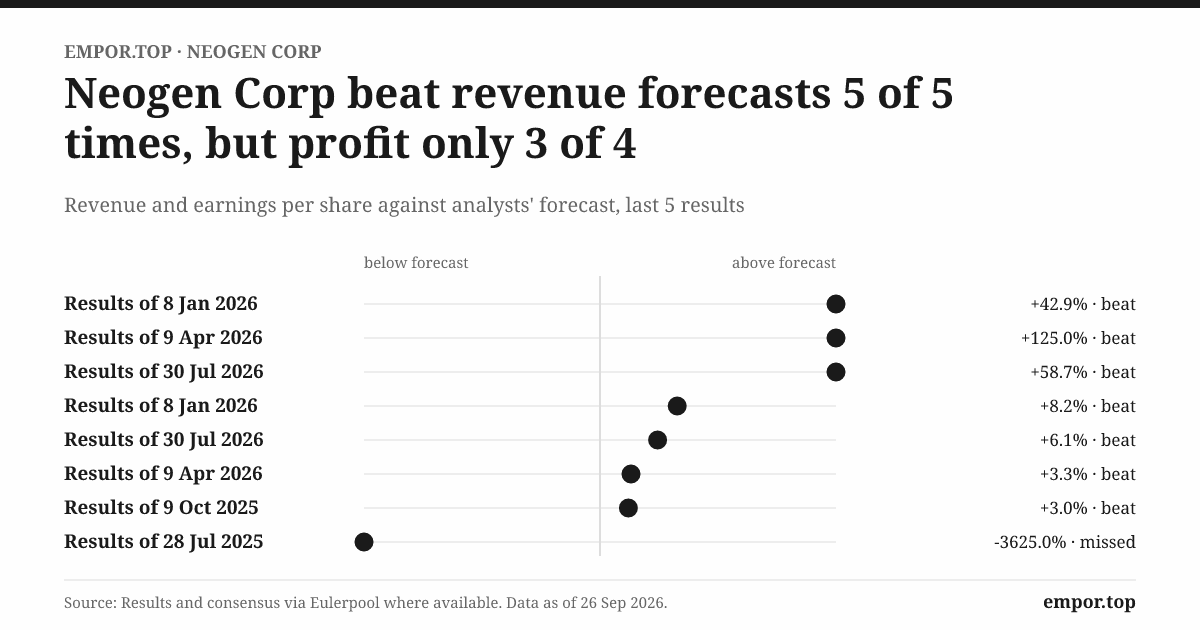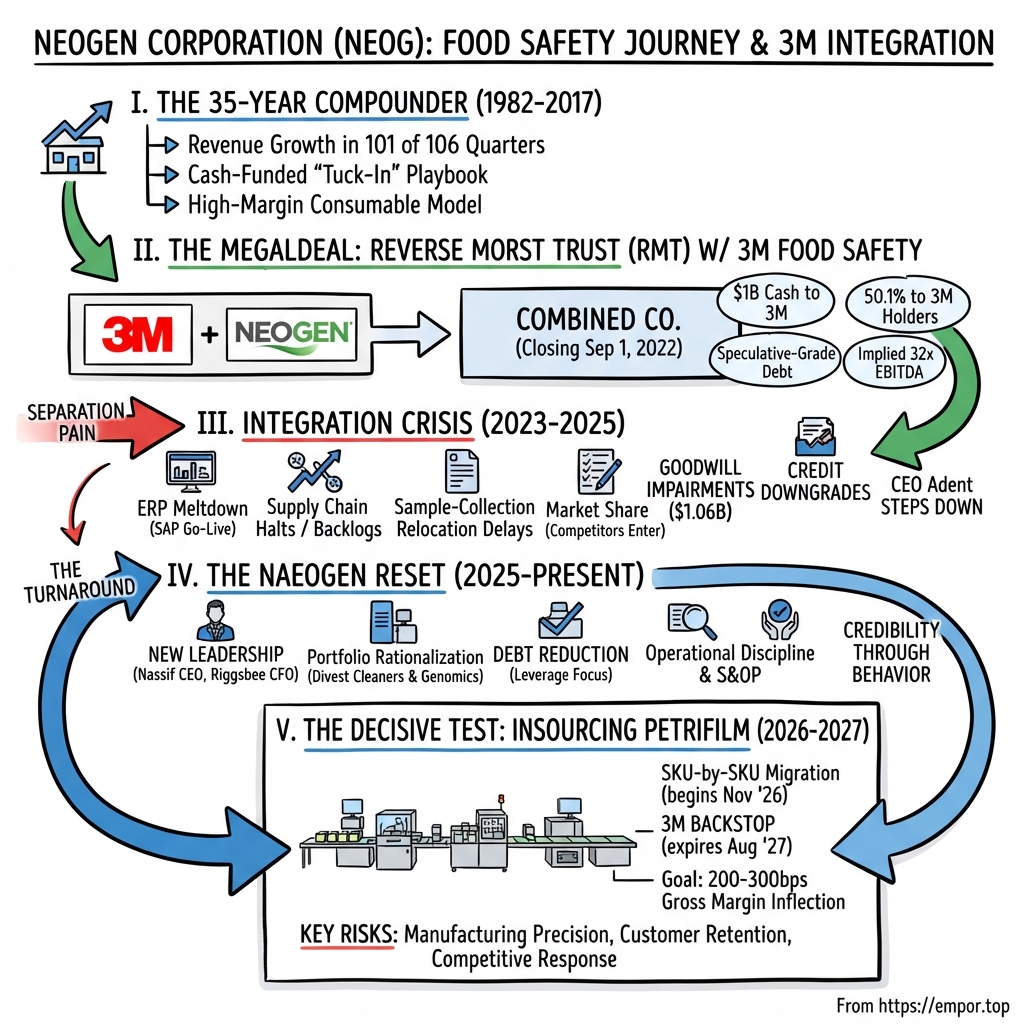
Neogen Corporation: The Food Safety Monopoly That Swallowed an Elephant
I. Prologue: The Silent Guardian of the Global Plate & The Reverse Morris Catastrophe
It is 5:40 a.m. in a Georgia poultry processing plant, and the first shift has not started yet. A quality technician in a hairnet and lab coat swabs a stainless-steel conveyor belt sanitized overnight. She inserts the swab into a small handheld device and gets a reading in seconds. Then she walks to a workbench where a stack of thin, card-sized plastic films sits beside an incubator. She lifts the top film, pipettes a single milliliter of diluted chicken rinse onto the nutrient gel underneath, and presses it flat. By tomorrow morning, she will count the red and blue dots that have grown across the grid. If the counts stay low, the chicken ships. If they spike, the processing line halts, the lot is quarantined, and somebody's very bad day begins.
Few consumers who eat that poultry will ever know this ritual exists. Yet it takes place millions of times every day across dairies, meatpacking facilities, infant-formula plants, breweries, and spice importers worldwide. Every batch of ground beef, pasteurized milk, and bagged salad passes through an invisible biological checkpoint before reaching a supermarket shelf. The small plastic film on that bench is called Petrifilm. For decades, the company that owned it was not Neogen, but 3M.
The commercial logic behind this checkpoint is exceptionally durable. The test is a pure consumable: used once and discarded. Food processors cannot easily curb these purchases, because regulatory agencies, independent auditors, and retail buyers all require documented microbiological verification—and because the consequences of contamination are catastrophic. On Neogen's April 2026 earnings call, CFO Bryan Riggsbee cited Nestlé's own estimate that a single infant-formula recall would cost roughly $350 million in lost sales across 2025 and 2026, before counting the direct expenses of managing the recall itself.1 Against a liability of that magnitude, spending a few dollars on a disposable test plate is a rounding error. It is a textbook razor-and-blade model, where recurring demand is locked in by food safety regulations, legal liability, and ingrained plant routine.
For roughly 35 years, Neogen, based in Lansing, Michigan, thrived on that exact playbook. Under founder and longtime CEO James Herbert, the company reported revenue increases in 101 of 106 quarters through fiscal 2017, including every quarter across the preceding 12 years.2 Neogen methodically acquired small, specialized testing businesses, funding them largely with cash generated from operations, and equity markets rewarded that steady compounding with valuation multiples typically reserved for high-margin software firms.
Then, in December 2021, Neogen agreed to merge with 3M's Food Safety division, the business that owned Petrifilm. The transaction was structured as a Reverse Morris Trust that valued 3M's unit at approximately $5.3 billion and handed 3M shareholders 50.1% of the combined company.3 The transaction closed on September 1, 2022.4 What followed was one of the most painful corporate integrations in recent mid-cap history: an order-fulfillment breakdown after a new enterprise resource planning system went live, a botched relocation of a sample-collection manufacturing line, goodwill impairments totaling about $1.06 billion in fiscal 2025,5 the April 2025 announcement that CEO John Adent would step down,6 credit downgrades into single-B territory, and a share price that fell to roughly $5 on the day Adent's departure was announced.7
The strategic irony was stark. Neogen had spent four decades demonstrating that it could buy and integrate small businesses with precision. Yet when management finally attempted a transformational acquisition, the business it bought was not a standalone enterprise. It was a product line deeply entangled within another conglomerate's factories, computer systems, and distribution hubs. Separating it took longer, cost more, and disrupted customers far more severely than executives had publicly projected.
That fallout frames the central question facing the company today. Is Neogen a temporarily mismanaged business that still controls one of the world's most resilient consumable food-safety franchises? Or did the 3M transaction permanently damage customer trust, strain the balance sheet, and invite competitors into a moat that had held for decades? To answer that, the story must start where Neogen did: in a Rust Belt state searching for a new economic identity.
 Subscribe on LinkedIn
II. Origins: Herbert, Doan, & The Michigan Biotechnology Experiment (1982–2000)
Michigan in the early 1980s was not an obvious place to launch a biotechnology startup. It was an industrial state shedding manufacturing jobs amid severe recessions, and public officials were searching for any initiative that could turn university research into private-sector payrolls. At Michigan State University, the historic land-grant institution in East Lansing, agricultural science was abundant, but the commercial infrastructure required to carry innovations out of academic laboratories was virtually nonexistent.
Neogen was incorporated as a Michigan corporation in June 1981 and began operating in 1982.8 Secondary accounts describe the venture as an investment project linked to Michigan State, backed by an early MSU Foundation stake and co-founded by Herbert D. "Ted" Doan and James Herbert.9 Neogen's own regulatory filings were more understated about those academic origins and far more specific about the executive who ran the business. Herbert joined in June 1982 as president and chief executive officer, having previously served as a corporate vice president of DeKalb Ag Research, an agricultural genetics company.10 He had grown up on a commercial fruit farm in southwest Michigan,11 and graduated from the University of Tennessee in 1962.12 That background shaped Neogen's commercial orientation. Herbert was not an academic researcher pursuing theoretical breakthroughs; he was an agribusiness executive who understood the immediate, practical testing needs that farmers, grain elevators, and food processors would actually pay to solve.
The Strategic Realization: Skip the Pharma Lottery
The early biotechnology boom of the 1980s centered primarily on human medicine, led by pioneers like Genentech developing recombinant insulin and interferon. Therapeutics offered immense windfalls, but they also demanded a decade of clinical trials, binary regulatory approvals, and years of heavy operating losses. Agriculture and food testing presented an entirely different commercial equation. Development cycles were measured in months rather than years, regulatory clearance hurdles were lower, and commercial buyers paid upon delivery. A diagnostic kit that alerted a grain elevator manager to a contaminated truckload of corn could generate revenue in the same year it was invented.
That practical focus formed Neogen's foundational franchise. Its Veratox and Agri-Screen immunoassay kits screened for mycotoxins—including aflatoxin, vomitoxin, zearalenone, and fumonisin—which are dangerous poisons produced by molds on stressed crops. By the mid-1990s, the company held an exclusive agreement to supply aflatoxin test kits to the Federal Grain Inspection Service.13 Functionally, an immunoassay operates like a molecular lock and key: an antibody binds to a specific target molecule, triggering a visible color change. The format was rapid, inexpensive, and sturdy enough to run on an open receiving dock rather than inside a sterile laboratory. That point-of-need utility became Neogen's defining commercial signature.
The 1989 Listing and a Culture of Frugality
Neogen went public through a modest registered offering, with a prospectus dated August 23, 1989.14 That unpretentious stock market debut established an operating discipline that soon hardened into corporate culture: expanding through cash-generative products rather than raising speculative capital against distant promises. That financial conservatism proved remarkably durable. By September 2010, the company had reported its 70th consecutive quarter of profitability.15 During these formative years, Neogen established two operating segments that endured into the 2020s.8 Food Safety sold diagnostics for natural toxins, foodborne allergens, and bacterial pathogens. Animal Safety provided veterinary instruments, wound care, biosecurity products, and, later, genomic testing.
These origins remain essential for understanding the company's modern trajectory. The operating philosophy Herbert established—profitable, cautious, attentive to plant-floor customers, and incremental—was precisely the model that the massive 3M transaction would later strain. To understand what was ultimately placed at risk, one must examine how that disciplined approach compounded over the subsequent two decades.
III. The Quality Compounder Era: 100 Quarters of Growth & The Tuck-In Playbook (2000–2017)
In November 2003, Neogen bought two agricultural chemical businesses, Hacco and Hess & Clark, from United Agri Products—then a ConAgra subsidiary—for $10 million in cash including costs.16 Hacco manufactured rodenticides; Hess & Clark produced disinfectants and biosecurity products. Neither represented a high-profile corporate transaction. Yet rodents and pathogens routinely spread disease through poultry houses and hog barns, and the agricultural distributors already carrying Neogen's animal-safety diagnostics could easily distribute pest-control and sanitation supplies alongside them. That straightforward logic formed the foundation of Herbert's tuck-in playbook: acquire a niche product line at a modest price, push it through an established sales channel, eliminate duplicate administrative overhead, and repeat.
The Playbook, Deal by Deal
Over the next two decades, Neogen repeated that pattern dozens of times. The most consequential tuck-in was GeneSeek, a Lincoln, Nebraska, genomics laboratory acquired on April 1, 2010, for about $13.8 million plus contingent payments, after generating roughly $12.5 million in 2009 revenue.17 The deal gave Neogen an early foothold in agricultural DNA testing for cattle and other livestock—a franchise that eventually grew to roughly $90 million in annual revenue before the company agreed to sell it in 2026. Late in this compounding era came Megazyme, an Irish developer of analytical assays for food quality, acquired in December 202018 for about $55.8 million in total consideration.19
That financial discipline produced tangible results. By the time Herbert handed over the CEO role, he had expanded Neogen to more than $400 million in annual revenue and a market capitalization above $4 billion.20 Yet that tuck-in formula concealed a structural limitation that would become critical years later: every deal was small enough that an integration misstep could be absorbed without threatening the enterprise. Neogen's operational reputation was built on transactions where failure was never existential—a vastly different operational test than absorbing a carve-out larger than the company itself.
The Regulatory Wind at Neogen's Back
A second force behind this steady compounding came from Washington. The Food Safety Modernization Act of 2011 fundamentally shifted federal policy from reacting to foodborne outbreaks to actively preventing them. Rather than recalling tainted food after consumers fell ill, processing plants were required to design preventive controls, monitor their facility environments, and maintain exhaustive documentation. The FDA's subsequent Food Traceability Rule, published in November 2022, increased that record-keeping burden. Its compliance deadline, originally set for January 20, 2026, was later pushed back to July 20, 2028.21 That delay offered an instructive reminder for investors who treat regulation as an automatic tailwind: federal mandates reliably expand testing demand over time, but their implementation timetables remain vulnerable to political and administrative delays.
Regulation also reinforced customer retention through steep switching costs. Testing methodologies require formal validation from independent standards organizations like AOAC International, and on Neogen's third-quarter fiscal 2024 earnings call, management cited a newly approved Salmonella assay whose AOAC validation cleared the path for commercial rollout.22 Once a major food processor writes a validated test into its standard operating procedures and food-safety plans, switching suppliers requires running parallel verification studies, re-documenting processes, and justifying the change to external auditors. For a consumable test priced at just a few dollars, quality managers have little incentive to risk plant disruptions to capture marginal unit savings. It was the quintessential low-cost, high-friction switching barrier.
For public shareholders throughout this era, the model delivered a rare corporate profile: steady compounding, minimal downside surprises, and self-funded growth that required virtually no dilutive equity or debt. The vulnerability, apparent only in retrospect, was that Neogen's commercial moat rested on distribution reach and product breadth rather than proprietary technology or an undisputed industry standard. The company sold an extensive catalog of reliable tests, but it did not own the category-defining product in ambient microbial testing. That strategic gap was precisely what made 3M's Food Safety division so tempting.
Handing Over the Keys
On July 17, 2017, Neogen named John Adent chief executive officer, effective immediately, with Herbert becoming executive chairman.11 Adent brought an entirely different executive background. After 13 years at Purina, he became CEO of Animal Health International in 2004, quadrupling its revenue before Patterson Companies acquired the distributor in 2015; he subsequently ran Patterson's $3.3 billion animal-health division.11 He was an operational scaler and commercial distributor—the type of leader a board recruits when it wants its next phase to be larger and more aggressive. Herbert completed the leadership transition in January 2019, shifting to chairman and strategic growth director.23 Herbert died in early 2024,12 while the company he built was in the middle of its most severe integration crisis. Before examining that transaction, it is worth opening up the operating segments to see where the company's cash actually originates.
IV. Segments, Products, & Economics: Dissecting the Cash Flow Engines
A glance at Neogen's product catalog resembles an inventory list for an industrial microbiology supply depot: test plates, swabs, culture broths, lateral-flow strips, diagnostic readers, detectable needles, rodent bait, and livestock genomic assays. That sprawling breadth has long served as both a commercial strength and an analytical puzzle. In fiscal 2026, which ended May 31, 2026, Neogen reported $870.4 million in revenue, with Food Safety contributing $641.1 million and Animal Safety generating $229.3 million.24 Food Safety now accounts for nearly three-quarters of the business, a share positioned to approach four-fifths once the pending genomics divestiture closes.
Segment 1: Food Safety, the Economic Engine
Petrifilm, the crown jewel. The traditional method for counting microbial colonies relies on the agar petri dish: a technician melts nutrient-rich seaweed extract, blends in additives, sterilizes the batch, pours individual dishes, waits for them to solidify, and only then inoculates the sample. Petrifilm condenses that labor-intensive workflow into a flat, ready-to-use card coated with dehydrated nutrients and a cold-water-soluble gelling agent. The technician adds a single milliliter of sample, applies light pressure, incubates the plate, and counts the resulting colonies. By eliminating dish preparation, Petrifilm significantly reduces laboratory bench space, technician hours, and solid waste. Plates are manufactured for specific microbial targets, including aerobic bacteria, coliforms, E. coli, yeast, mold, and Staphylococcus. In April 2026, chief executive Mike Nassif argued that the manufacturing precision and technical complexity required to produce these coatings created "an almost insurmountable barrier to entry."1 Whether that competitive moat remains unbreachable, however, is an assertion that subsequent operational disruptions have put to the test.
Pathogen detection. While Petrifilm monitors general indicator organisms to confirm overall plant sanitation, pathogen assays test for specific lethal contaminants: Salmonella, Listeria, and Shiga toxin-producing E. coli. Neogen's Molecular Detection System uses isothermal DNA amplification to replicate target genetic sequences until they can be detected, functioning much like repeatedly photocopying a single line of text from an entire library until it is impossible to overlook. Management informed investors in October 2025 that the company was growing roughly in line with the broader market in pathogen detection.25
Allergens and natural toxins. This line encompasses modern iterations of Neogen's original mycotoxin kits alongside rapid lateral-flow test strips—similar in design and function to an over-the-counter pregnancy test—engineered to detect trace residues of gluten, peanuts, tree nuts, and dairy. Here, manufacturing and distribution bottlenecks have taken a toll: Nassif acknowledged in October 2025 that supply disruptions had caused Neogen to lose market share across both allergens and natural toxins.25
Environmental hygiene and sample collection. Adenosine triphosphate (ATP) hygiene monitoring verifies surface cleanliness by detecting the universal energy molecule present in living cells and organic matter. Down the hall from the test readers are the sample-collection products: basic swabs, sponges, and sterile bags used to gather specimen material. While ostensibly mundane, these collection supplies, as Section VI details, became one of the costliest operational missteps in the company's history.
Segment 2: Animal Safety, the Slower Engine
Animal Safety sells veterinary instruments—such as detectable metal needles designed to trigger packing-plant metal detectors if one shears off during livestock vaccination—alongside topical care supplies, rodenticides, insecticides, and, until its divestiture, genomics. The segment distributes primarily in the United States through large wholesale networks, leaving quarterly revenue exposed to distributor restocking and destocking cycles. It is also tied to livestock demographic swings: in July 2026, CFO Bryan Riggsbee observed that U.S. production-animal herds remained near record lows, even as elevated beef prices supported rancher profitability.26
The genomics unit highlights the segment's underlying economic limitations. In April 2025, management sized the global genomics business at roughly $90 million in annual revenue, noting that more differentiated bovine profiling represented sales "in the 50s," while lower-margin commodity lines were being wound down.27 By April 2026, management disclosed that the genomics business produced adjusted operating margins only "in the mid-teens," falling well below the corporate average.1 The franchise offered genuine technical capability, but it lacked the cash-flow economics of the consumable diagnostic portfolio.
How Neogen Reaches Customers
Neogen sells to an expansive, highly fragmented customer base that management has historically struggled to service efficiently. In July 2026, commercial leadership under Freels characterized the account roster as "a long tail of thousands of ordering customers globally" with "limited strategic prioritization."26 Digital ordering already commands meaningful volume, with approximately 40% of Food Safety sales flowing through e-commerce platforms, mostly from high-volume accounts.26 Historically, Neogen sold plant by plant, meaning a plant-level quality manager might rely on Neogen daily while corporate food-safety executives at headquarters had never met a company representative. Neogen's revised go-to-market structure directs dedicated sales teams toward 14 priority national markets and large enterprise accounts, while shifting smaller buyers toward self-service digital portals and transferring secondary geographic territories to third-party distributors.26 Geographic balance has followed: in the fourth quarter of fiscal 2026, the United States accounted for 49% of revenue and international markets contributed 51%,26 with emerging regions such as Latin America providing steady organic gains.
Why the Divergence Matters
Executive leadership has consistently acknowledged that Food Safety generates higher profit margins and that a rising proportion of Food Safety sales expands consolidated gross margin.1 While Neogen did not disclose standalone segment gross margins in the financial reports and conference calls reviewed for this article, the strategic direction is unambiguous: it underpins the portfolio rationalization carried out across 2025 and 2026. Every non-core Animal Safety dollar divested raises the average profitability of the remaining business. Yet that discipline also sharpens enterprise concentration. The more Neogen divests peripheral units to operate as a focused Petrifilm franchise, the more entirely its fortunes depend on producing, shipping, and protecting Petrifilm itself. That critical dependency was created by the very transaction that triggered Neogen's crisis.
V. The Megadeal: Swallowing 3M Food Safety & The Petrifilm Prize (2021–2022)
In late 2021, Neogen was generating roughly $500 million in annual revenue when an extraordinary asset became available. 3M's Food Safety division, anchored by the Petrifilm franchise, had generated $368.4 million in 2021 sales.28 It operated inside a multi-industry conglomerate seeking to simplify its corporate structure and shed non-core units. Merging the two businesses offered Neogen an immediate path to becoming the dominant global scale player in food-safety diagnostics. For John Adent, recruited to accelerate Neogen's growth, it was the defining transaction of a career.
The Anatomy of a Reverse Morris Trust
The transaction agreements were signed on December 13, 2021, and announced the following morning.3 Structurally, a Reverse Morris Trust is an intricate piece of tax engineering designed to execute a corporate divestiture without incurring capital gains taxes. The transaction unfolded in three coordinated steps: first, 3M carved out its food-safety assets into a newly formed subsidiary named Garden SpinCo; second, 3M distributed the shares of that subsidiary to participating 3M stockholders; and third, that subsidiary merged directly into Neogen. Because 3M's shareholders emerged holding a majority of the combined entity's equity, the transfer qualified as tax-free to 3M. The financial architecture reflected that structural design:
- 3M shareholders would own 50.1% of the combined company, leaving legacy Neogen shareholders with 49.9%.3
- 3M would receive approximately $1 billion in cash, funded entirely by new debt raised by the spun-off subsidiary.3
- The implied enterprise value of 3M Food Safety reached approximately $5.3 billion. Relative to 3M's projected calendar-2022 adjusted EBITDA, that implied a valuation multiple of roughly 32 times, or 27 times after factoring in anticipated cost and revenue synergies.3
A valuation multiple of 32 times EBITDA demands scrutiny. That level of valuation is typically reserved for high-growth software platforms or life-science tools franchises perceived to carry negligible operational risk. Negotiated at the height of the post-pandemic enthusiasm for testing and diagnostic assets, the valuation left virtually no room for operational missteps. While legacy Neogen shareholders did not write a cash check, they paid in an even dearer currency: control. To acquire a business generating less annual revenue than their own, Neogen's owners surrendered majority ownership, roughly doubled their share count, and saddled the combined enterprise with $1 billion in third-party debt.
That debt package comprised three distinct facilities: $350 million of 8.625% senior notes due 2030, a $650 million senior secured term loan, and an undrawn $150 million revolving credit line.29 The transaction formally closed on September 1, 2022, after 3M completed a split-off exchange offer through which its shareholders swapped 3M stock for equity in the spin-off entity.4 For an enterprise whose founders had spent four decades prioritizing cash-funded tuck-ins and pristine leverage ratios, issuing bonds carrying an 8.625% coupon represented an abrupt departure into unfamiliar territory.
The mechanics of the exchange offer illustrate how operational and balance-sheet risk shifted between the parties. In the split-off, 3M accepted 15,989,536 shares of its own common stock in exchange for 108,269,946 shares of Garden SpinCo, which were converted upon closing into Neogen common shares.4 The 3M shareholders who participated traded equity in a diversified conglomerate for shares in a specialized, newly leveraged food-safety player. 3M walked away with $1 billion in cash and a reduced share count, transferring both the debt burden and the separation risk to Neogen. In terms of physical manufacturing infrastructure, Neogen took ownership of an existing 3M food-safety production facility in Bridgend, Wales, in the United Kingdom.4 But nearly everything else required to manufacture, package, warehouse, and fulfill the remainder of 3M's product lines remained embedded within 3M facilities—assets Neogen would either have to transition, reconstruct from scratch, or rent indefinitely.
The Industrial Thesis
On paper, the strategic logic held considerable appeal. At announcement, executives projected that the merged company would generate approximately $1 billion in annual revenue and adjusted EBITDA margins of roughly 30%, bolstered by an estimated $30 million in annual run-rate EBITDA synergies by the end of year three.3 The commercial portfolios appeared genuinely complementary. Neogen brought established positions in pathogen assays, natural mycotoxin testing, allergen strips, and agricultural distribution. 3M contributed the industry standard in indicator testing with Petrifilm, alongside established environmental hygiene systems. Together, the combined sales force could theoretically pitch commercial food processors on a comprehensive testing catalog from a single vendor, simplifying procurement and locking out smaller specialty competitors.
The Hidden Trap: Buying a Business That Did Not Exist on Its Own
The fatal assumption embedded in the deal was that 3M Food Safety was an autonomous commercial operating unit. In reality, it was not an independent business at all; it was a portfolio of high-margin branded products interwoven into 3M's shared corporate manufacturing plants, enterprise IT systems, global distribution hubs, and order-to-cash architecture. The regulatory filings acknowledged this operational dependence directly: Neogen disclosed that it would "rely for a period" on 3M under a Transition Contract Manufacturing Agreement and a Transition Distribution Services Agreement, alongside a master Transition Services Agreement.28 In functional terms, Neogen purchased the intellectual property, recipes, and customer relationships, but was forced to rent the factories, logistical infrastructure, and billing systems from the seller. Every transition contract carried an expiration date and substantial recurring fees. Constructing independent replacements for that operational backbone—all while attempting to integrate an organization twice Neogen's historical size—represented the true operational challenge. The $5.3 billion headline price was merely the admission ticket.
Executing those separations required flawless project management across factories, supply chains, and software systems. When those transitions faltered, the breakdown played out in full view of customers and public markets.
VI. Operational Agony: The ERP Meltdown, Supply Halts, & The $461M Write-Down (2023–2025)
On September 1, 2023—the first day of Neogen's second fiscal quarter—a new SAP enterprise resource planning system went live for the U.S. and Canadian Food Safety business and corporate functions.30 On paper, this was a routine milestone in any corporate carve-out: migrate off the seller's legacy architecture and operate on your own infrastructure. In practice, order fulfillment seized up almost immediately. By January 2024, management acknowledged that the order backlog caused by the ERP launch had shaved roughly 300 to 400 basis points off core organic growth during the quarter.31
The Warehouse That Could Not Ship
On Neogen's April 2024 earnings call, the operational breakdown was laid bare. Adent explained that the central technical bottleneck was getting sales orders to "drop" from the core SAP system into its warehouse-management module. During the second fiscal quarter, only about 40% of customer shipments cleared the warehouse in under five days. While fulfillment improved to 80% in the third quarter, it still lagged far behind the company's historical benchmark of shipping the day after an order was placed.22 Compounding the software friction, the physical volume coursing through Neogen's distribution hubs had surged as legacy 3M inventory transitioned into company-managed facilities. Adent reported that third-quarter shipments had surged to 152% of second-quarter volume.22 Crucially, Neogen had fully exited its transition services and distribution agreements with 3M during that same quarter,22 removing the contractual safety net before internal distribution channels had stabilized.
In addressing analysts, Adent articulated the foundational vulnerability of consumable diagnostics. Because food-processing plants run around the clock, "when we can't supply them, they can't just stop. So that's allowed some competitors to get qualified and come in."22 It was an unvarnished admission of a commercial hazard: switching barriers defend a high-margin franchise only so long as the incumbent reliably ships.
The Guidance Staircase
The progression of Neogen's fiscal 2024 guidance reveals how management absorbed the operational damage in cascading increments:
- July 2023: Initial revenue guidance of $955 million to $985 million and adjusted EBITDA of $235 million to $255 million.32
- January 2024: Guidance lowered to $935 million to $955 million in revenue and $230 million to $240 million in adjusted EBITDA, attributed primarily to softer macro end markets.33
- April 2024: Guidance reduced again to $910 million to $920 million in revenue and $210 million to $215 million in adjusted EBITDA, citing a protracted recovery in order fulfillment.34
- Actual Results: Full-year revenue came in at $924.2 million, representing core growth of just 1.8%, with adjusted EBITDA reaching $213.2 million.35
From the original midpoint, revenue had fallen by roughly $33 million and adjusted EBITDA by approximately $32 million. Free cash flow deteriorated even more sharply. In April 2024, Chief Financial Officer David Naemura warned analysts to anticipate negative free cash flow of approximately $75 million for the fiscal year, weighed down by roughly $100 million in integration-related capital expenditures alongside required purchases of legacy 3M inventory.22 Throughout this descent, executive commentary consistently framed the disruption as transient ("we believe these challenges are temporary"22), even as each lowered forecast relied on operational recoveries that repeatedly slipped past internal deadlines.
The Sample-Collection Relocation
The next operational disruption emerged from what had appeared to be a straightforward manufacturing transfer. As part of the carve-out integration, Neogen undertook the physical relocation of 3M's sample-collection product lines to its own facility in Lexington, Kentucky. The move had been structured across four planned phases and scheduled for completion in the first quarter of fiscal 2025.22 Instead, the transition stalled. Equipment re-qualification and production ramp-ups lagged severely, forcing Neogen in January 2025 to trim its full-year fiscal 2025 revenue outlook to $905 million to $925 million, citing the relocation bottlenecks as a primary driver.36 By April 2025, Adent reported that the Lexington lines had finally matched legacy production rates, while conceding that the ramp "took longer than we had originally anticipated." Management estimated that the sample-collection disruptions cost the company roughly $25 million in lost revenue for the year.27
Yet even after physical volume rebounded, unit economics collapsed. In October 2025, Naemura detailed a cascade of elevated scrap rates, internal quality holds, inflated manufacturing overhead, and commercial concessions paid to appease frustrated buyers, disclosing that the product line was "selling the product at a loss currently."25 By April 2026, sample collection continued to generate negative gross margins, exacerbated by quality defects originating at an external supplier.1 Notably, regulatory filings and conference-call disclosures confirm that these operational issues remained isolated to sample collection and supplier components; the record shows no evidence of product-stability recalls within the core Petrifilm franchise.
The Financial Reckoning
The mounting operational friction culminated in a severe balance-sheet correction. In January 2025, Neogen took a $461.4 million goodwill impairment charge for its second fiscal quarter ended November 30, 2024.36 In accounting terms, writing down goodwill marks an explicit recognition that the acquired assets cannot generate the economic returns assumed at closing. The bleeding continued in the fourth quarter with an additional impairment charge of $597.9 million, bringing total fiscal 2025 goodwill write-downs to $1.06 billion and driving an annual net loss of $1.09 billion.5 Both non-cash charges were concentrated squarely in the Food Safety reporting unit,37 the corporate home of the acquired 3M business—delivering formal balance-sheet validation that a substantial portion of the enterprise value created in the 2022 combination had been wiped out.
Compounding the write-downs was a persistent inventory mismatch. After inheriting 3M's raw materials and finished goods while accumulating buffer stock during system cutovers, Neogen discovered that substantial batches were misallocated across regional warehouses or nearing their expiration dates. By the fourth quarter of fiscal 2025, consolidated gross margin plunged to 41.2%, dragged down by inventory write-offs and charges linked to the Lexington sample-collection relocation.5 As Naemura later acknowledged, Neogen had failed to position "the right products, frankly, that have shelf life to the right places in the right amounts."25 For a business built on perishable biological reagents with rigid expiration dates, mismanaged inventory converts directly into margin dilution.
Neogen concluded fiscal 2025 with $894.7 million in revenue, representing a core revenue contraction of 0.2%, adjusted EBITDA of $184.2 million, and negative free cash flow of approximately $46 million.5 In the span of two fiscal years, annual adjusted EBITDA had dropped by roughly a quarter relative to initial fiscal 2024 projections.
Rating agencies reacted swiftly. On May 2, 2025, Moody's maintained its Ba3 credit rating but shifted the outlook to negative.38 On May 13, S&P downgraded Neogen from BB+ to BB- with a negative outlook.39 The deterioration deepened in the autumn of 2025: Moody's dropped its rating to B1 in October, projecting gross debt leverage above 5.0 times,40 while S&P downgraded the company to B+ in November, citing adjusted leverage of 6.6 times.41 Within twelve months, Neogen's credit profile had descended from investment-grade adjacency to deep speculative grade.
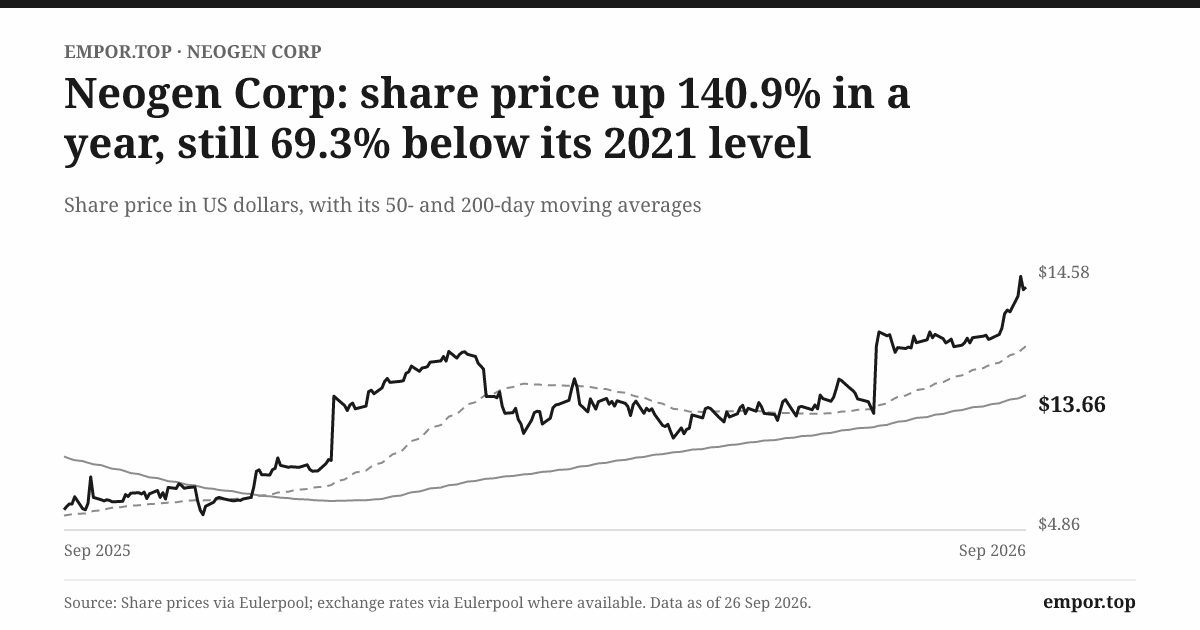
Public equity markets absorbed the hit just as harshly. On April 9, 2025, following the release of disappointing third-quarter earnings and the announcement that John Adent would step down as chief executive, Neogen's shares cratered 28.7% to close at $5.02.7 In July 2025, plaintiffs filed a federal securities class action in the U.S. District Court for the Western District of Michigan, alleging disclosure violations between January 5, 2023, and June 3, 2025. A motion to dismiss remained pending as of March 2026.7 That litigation remains an unresolved overhang, with the ultimate financial liability still unknown.
With the full scope of operational and balance-sheet damage now documented, the critical task is no longer cataloging missteps. It is putting the investment thesis to the test.
VII. The Historical Falsification Layer: Testing Neogen's Three Core Theses
Every investment thesis for Neogen has historically rested on several assumptions that sounded intuitively sound. The analytical discipline required here is to test each claim against the company's actual operating record, identifying what broke down and what genuinely survived.
Claim 1: "Petrifilm enjoys an unassailable consumable moat with near-permanent switching costs."
How the claim breaks. A switching-cost moat breaks whenever customers are forced to qualify a second supplier. Once a food processing plant validates an alternative testing method, the procedural barrier to switching has already been breached.
What the record shows. The clearest evidence of vulnerability came directly from executive disclosures. In April 2024, Adent acknowledged that fulfillment failures had allowed competitors to "get qualified and come in." He noted that Neogen had previously lost Petrifilm accounts in Japan and China due to product availability constraints, though those regional markets returned to growth once inventory stabilized.22 In October 2025, Nassif disclosed that Neogen had surrendered market share across sample collection, allergens, and natural toxins, explaining that Food Safety core revenue had grown only modestly because the company "had not maintained our market share in certain product lines."25 On that same call, Wall Street analysts noted that rival suppliers had become aggressive in claiming market-share gains from Neogen.25
Yet the evidence specific to Petrifilm demonstrated meaningful resilience. Management noted that displaced customers returned once supply was restored.22 Indicator testing and culture media—the product category built around Petrifilm—expanded 11% in the third quarter of fiscal 2026 and 9% in the fourth.126 Those figures do not reflect a franchise in structural collapse. Instead, market share eroded in adjacent categories where Neogen's competitive differentiation was far weaker.
Conclusion. The claim is narrowed, not rejected. Petrifilm's standalone commercial position remains durable, supported by customer recapture once distribution bottlenecks cleared. However, the broader Food Safety portfolio proved vulnerable to dual-sourcing, losing ground where products faced commodity alternatives. The word "unassailable" does not survive the record; "sticky when reliably delivered" does. The defining confirmation test is whether indicator-testing growth holds steady through the physical Petrifilm manufacturing relocation, when supply-chain risks will reach their peak.
Claim 2: "Neogen's 40-year M&A playbook translates to mega-carve-out integration."
How the claim breaks. Folding a $10 million niche product line into an established sales force requires a fundamentally different capability than rebuilding enterprise software, factory operations, and an order-to-cash architecture for a carve-out larger than the buyer itself.
What the record shows. The operating record after the 3M transaction offered an unambiguous verdict. Fiscal 2024 brought two consecutive guidance cuts, with core revenue expanding just 1.8% against an original forecast premised on far stronger momentum. The four-phase relocation of sample-collection manufacturing to Lexington slipped well past its planned early fiscal 2025 completion, generating persistent scrap expenses and negative gross margins. Balance-sheet write-downs followed, with goodwill impairments totaling $1.06 billion in fiscal 2025. Furthermore, both senior executives who executed the merger departed: Adent stepped down in April 2025, and Neogen announced Naemura's planned departure as chief financial officer in September 2025.42 Meanwhile, the original target of $30 million in annual run-rate EBITDA synergies ceased to provide a meaningful benchmark as the acquired earnings base contracted.
Conclusion. The claim is rejected. The tuck-in acquisition playbook failed to translate to a massive corporate separation. The critical question for the company today is whether the successor management team possesses the carve-out execution skills that the prior leadership lacked. The measurable milestone is the upcoming Petrifilm production transfer: whether it finishes on schedule and without disrupting customer orders.
Claim 3: "Agrigenomics is a scalable, proprietary technology driver for Animal Safety."
How the claim breaks. An agricultural genomics testing laboratory running third-party assay chips operates essentially as a contract service bureau. Its revenue fluctuates with livestock herd cycles, while its operating margins remain constrained by raw-material input costs.
What the record shows. By April 2025, the genomics unit had served as a quarterly drag on segment performance for seven consecutive quarters, leading management to wind down non-bovine testing lines.27 Neogen then agreed to divest the entire business to Zoetis for $160 million in cash, announced on March 2, 2026.43 That purchase price represented roughly 1.8 times the unit's approximately $90 million in annual sales, for an asset producing adjusted operating margins in the mid-teens—well below the corporate average.1 Whatever strategic value Zoetis sees within its wider livestock pharmaceutical operations, Neogen's divestiture signaled an explicit capital-allocation judgment: the business was worth more to another owner.
Conclusion. The claim is rejected as a Neogen thesis. Agrigenomics may deliver value inside a scaled global animal-health company, but Neogen's own capital allocation confirmed that the unit was neither a high-margin cash engine nor a core strategic growth driver. The only unresolved issue is transaction closing: as of July 2026, competition regulators in Australia and New Zealand had escalated their reviews into a second phase.24
With the historical investment theses tested, attention shifts to the executive team now responsible for executing the turnaround.
VIII. The C-Suite Overhaul: Enter Mike Nassif & The Turnaround Playbook (2025–Present)
On April 9, 2025, John Adent opened his final earnings call having already surrendered his mandate. "You may have seen the press release issued earlier today announcing that I will be stepping down as CEO," he told analysts, before walking through tariffs, softening market demand, and sample-collection delays.27 The board's official statement offered little detail, characterizing the move simply as "the right time to begin a leadership transition."6 Adent agreed to remain in the post until a successor was installed.
The New Leadership
On July 24, 2025, Neogen named Mike Nassif as president and chief executive officer, effective August 11.44 Nassif arrived from Siemens Healthineers, where he had served as global president of point-of-care diagnostics, following earlier executive stints at Baxter International, Anheuser-Busch InBev, and Johnson & Johnson.44 On his first quarterly call with investors, Nassif framed his appointment around operational turnaround experience: "Having led the turnaround of the point-of-care diagnostics business at Siemens Healthineers over three years, I drove step changes in performance."25 The background was directly relevant. Diagnostics manufacturing, regulated quality management, and distributor-heavy commercial channels all mapped cleanly onto Neogen's core operational challenges. Yet the governance scope differed fundamentally: turning around a corporate operating unit inside a global conglomerate requires a different operational posture than steering an independent, heavily indebted public company.
The executive housecleaning accelerated that autumn. Neogen announced Naemura's planned departure on September 15, 2025.42 On October 30, the company appointed Bryan Riggsbee as chief financial officer, effective November 3. Riggsbee brought deep sector familiarity, having served as North American CFO at bioMérieux—Neogen's primary European rival in food-safety diagnostics—and as CFO of Myriad Genetics for nearly a decade, alongside earlier finance roles at Laboratory Corporation of America, General Electric, and KPMG.45 Hiring a finance chief who had analyzed Neogen's competitive moat from inside its most formidable competitor sent a deliberate strategic signal. Commercial leadership turned over as well: Joe Freels joined as chief commercial officer, while Tammi Ranalli took charge as general manager of global Food Safety.1 Within twelve months of Adent's departure, virtually every senior operating seat across the enterprise had changed hands.
The Operating Reset
Nassif acted quickly to trim overhead. In late September 2025, Neogen eliminated approximately 10% of existing and planned positions, excising roughly $20 million in annualized operating expenses.25 The corporate portfolio narrowed in parallel. The company divested its cleaners and disinfectants business, which generated approximately $60 million in annual sales, to the Kersia Group for $130 million in cash alongside a potential performance-based earnout; the transaction was announced in April 202546 and completed on July 18, 2025.47 Management directed approximately $115 million in net proceeds toward retiring $100 million of outstanding term debt.25 The pending divestiture of the genomics franchise to Zoetis followed that same debt-reduction playbook.
Then came the central operational imperative: insourcing Petrifilm manufacturing. Because that transfer represents the single largest operational risk facing the company, tracking the progression of management's target milestones provides an essential gauge of execution:
- April 2024: The initial term of the transition contract manufacturing agreement with 3M extended through August 2026, and Adent stated that management's objective was "clearly" to exit the arrangement ahead of schedule.22
- April 2025: Neogen's "Petrifilm at Neogen" investor presentation outlined initial test production in the autumn of 2025, followed by a phased, SKU-by-SKU commercial migration spanning multiple quarters.48
- October 2025: Nassif indicated that Neogen remained on schedule to complete the production transfer during the second quarter of fiscal 2027, which spans September through November 2026.25
- April 2026: Management reported that all manufacturing equipment had achieved technical validation and that qualification of the 17 commercial SKUs was underway. Nassif also disclosed that the 3M manufacturing agreement had been extended through August 2027 to serve as an operational "insurance policy."1
- July 2026: Executive guidance shifted from completion to inception, indicating that Neogen would "begin our planned multi-quarter manufacturing transition beginning in November of 2026," with the first fully validated SKU anticipated in August. Nassif maintained that "to date, we haven't encountered any major problems in the validation process."26 The annual report on Form 10-K for fiscal 2026 reaffirmed that substantial operational completion was projected within fiscal 2027.49
The linguistic evolution tells an important operational story. What leadership initially characterized as completing the transfer by late calendar 2026 became beginning a multi-quarter migration in November 2026, backstopped by 3M manufacturing capacity through August 2027. That deliberate pacing reflects sound engineering discipline; after the chaotic cutovers in enterprise software and sample collection, attempting an abrupt transition with the company's flagship cash generator would have courted disaster. Yet that extended runway also delays the anticipated financial upside. Riggsbee clarified to Wall Street analysts that the 200 to 300 basis points of gross-margin expansion expected from insourced manufacturing would not materialize until fiscal 2028, pushing the margin inflection past fiscal 2027.26
Credibility Through Behavior
For public market investors, the early benchmark for evaluating the new C-suite is the gap between executive promises and reported results. Initial guidance for fiscal 2026 projected revenue between $820 million and $840 million,5 an outlook management raised in January and again in April 2026.50 Full-year results ultimately closed at $870.4 million in revenue and $177.8 million in adjusted EBITDA.24 Where prior leadership consistently revised forecasts downward, the successor team adopted an under-promise and outperform cadence. As Riggsbee stated in July 2026: "Our guidance reflects our philosophy of setting targets as we focus on restoring investor credibility."26 While an encouraging behavioral shift, that track record spans only four fiscal quarters, and the most hazardous operational hurdle—relocating the core Petrifilm production lines—remains ahead.
The rhetorical tone on investor calls shifted in tandem. Prior executives frequently attributed operational shortfalls to external headwinds, from distributor inventory adjustments and agricultural commodity cycles to import tariffs. In contrast, Nassif's inaugural presentation in October 2025 laid the blame squarely on internal execution, while asserting that he did not believe "a major strategic overhaul is needed."25 By April 2026, his operational diagnosis was even more pointed. Nassif told analysts that Neogen had historically functioned "in a siloed manner with limited process standardization," pointing out that compensation and benefits accounted for approximately 56% of operating expenses—a cost concentration he characterized as direct evidence of chronic underinvestment in workflow automation.1 That candor contrasted sharply with the defensive messaging of 2024. Clear problem identification does not guarantee successful execution, but diagnosing internal operational deficits is an indispensable prerequisite for resolving them.
The transition has not been entirely frictionless. During the third quarter of fiscal 2026, Animal Safety core revenue dropped 8.7% due to procurement bottlenecks at contract manufacturers, prompting Nassif to acknowledge that "we were surprised by some of these supplier challenges."1 Management responded by instituting rigorous supplier-qualification protocols; by the fourth quarter, component availability improved and Animal Safety returned to modest organic growth.26 The episode underscored that Neogen's operational vulnerabilities extended beyond the 3M transaction: an enterprise dependent on third-party contract manufacturers across a broad product catalog remains vulnerable to inventory shocks until internal forecasting and procurement systems fully mature.
That operational discipline represents the unglamorous core of the restructuring. Nassif instituted a formal sales and operations planning (S&OP) rhythm, establishing monthly cross-functional checkpoints to synchronize sales forecasts with factory production schedules and supplier orders. By July 2026, Nassif reported that inventory had fallen by more than $36 million year-over-year, even as the company's on-time, in-full delivery rate surged 40% from baseline levels.26 Simultaneously reducing working capital while improving delivery reliability is the classic hallmark of a supply chain transitioning from crisis management to systematic control. Yet stabilizing internal logistics represents only half the challenge; the ultimate viability of Neogen's turnaround will be tested in the arena where commercial franchises are preserved or surrendered: the competitive landscape.
IX. Competitive Arena & Strategic Moats: 7 Powers & Porter's Five Forces
Think of the global food-safety testing market as an expansive industry convention floor in Chicago. Neogen operates the broadest booth in the hall: diagnostic test plates, sample-collection swabs, pathogen instruments, allergen strips, and cloud analytics software. A few aisles away stands bioMérieux, the French diagnostic powerhouse whose industrial-applications division expanded 10% organically in the first half of 2025.51 Nearby is Hygiena, the ATP hygiene and PCR detection specialist that built its pathogen-testing portfolio by acquiring DuPont's food-safety diagnostics unit, Qualicon, in 2017,52 and has been controlled since 2021 by EW Group, the German holding company whose diagnostics umbrella spans food and veterinary testing.53 Thermo Fisher Scientific, armed with a multi-billion-dollar balance sheet and deep institutional laboratory relationships, commands an equally formidable presence. Neogen's commercial pitch has long been breadth: one vendor for every testing protocol across the plant. For three years, however, its rivals delivered a simpler counter-pitch to frustrated quality directors: they could reliably ship.
Porter's Five Forces
Threat of new entrants: low. Rigorous formal validations from AOAC International and equivalent regulatory bodies, multi-month qualification cycles inside customer processing facilities, and the extreme technical complexity of manufacturing dry-film plates like Petrifilm present formidable barriers to outsiders. Neogen's own multi-year struggle to replicate 3M's production lines provides vivid evidence that these entry hurdles are genuine, even for an established industry player employing 3M's former engineering specialists.25
Supplier power: high today, falling tomorrow. Until the Petrifilm manufacturing transition is fully executed, 3M continues to manufacture Neogen's most lucrative product line—an extraordinary single-supplier vulnerability for a publicly traded company. The procurement disruptions that hit Animal Safety in fiscal 2026—triggered when an instrument supplier relocated its factory, a global shortage constrained vitamin A, and a sodium-bicarbonate partner altered its production specifications—demonstrated that third-party supplier dependencies threaten margins across the catalog.1 Once the Lansing facility becomes fully operational, the primary supplier-power risk will shift from an external conglomerate to Neogen's internal factory execution.
Buyer power: moderate and rising. A single disposable test plate is too inexpensive to prompt aggressive procurement bargaining, but large food processors purchase across dozens of regional facilities and now maintain alternative validated vendors qualified during Neogen's distribution crises between 2023 and 2025. Neogen's revised commercial strategy, which redirects resources toward enterprise procurement officers rather than plant-level managers, represents a deliberate effort to defend corporate relationships at the executive level where multi-plant switching decisions occur.26
Threat of substitutes: moderate. Traditional agar petri dishes remain cheaper on an upfront material basis but demand significantly higher laboratory labor and preparation time. Automated diagnostic platforms reduce manual handling but require substantial capital outlays for benchtop hardware. Petrifilm occupies an enduring middle ground between those extremes, delivering rapid, disposable testing convenience without requiring expensive capital equipment.
Rivalry: moderate to high. The competitive landscape is concentrated among a small cluster of well-capitalized global providers, and recent market competition has centered on delivery reliability and fulfillment execution rather than price cutting. In an industry where plant uptime depends on daily consumable deliveries, operational reliability dictates market share—and Neogen spent three consecutive fiscal years ceding ground in that operational contest.
Hamilton Helmer's 7 Powers
Switching costs: high, but tested. As the operating record demonstrated, procedural switching costs remained robust where Neogen supplied functionally differentiated products like Petrifilm, but quickly dissolved where products faced off-the-shelf alternatives, including sample collection, allergens, and natural toxins. The switching moat is genuine, but its protective barrier holds only so long as the incumbent fulfills orders on time.
Process power: strong, and now Neogen's to prove. Replicating Petrifilm manufacturing represents the central operational test of the turnaround. Coating a multi-layer polymer film with dehydrated culture media and a cold-water-soluble gelling agent that rehydrates uniformly across every test card requires rare manufacturing precision. Nassif highlighted that the primary manufacturing engineers who constructed 3M's Petrifilm production lines in Poland joined Neogen, and that Neogen technical staff completed extensive training in Poland to master the process.25 If the Lansing factory ramps without disruption, Neogen will control that proprietary process power outright for the first time. If the transfer falters, that capability will prove to have resided in 3M's institutional memory all along.
Scale economies: moderate, with a twist. Executive leadership disclosed that the Lansing facility is engineered to produce multiples of current Petrifilm demand, creating an incremental contribution margin on additional production volume that Nassif described as "exceptionally high."1 That operational leverage provides substantial theoretical upside, but it represents an advance bet on demand that has yet to arrive. An underutilized manufacturing plant generates fixed operating drag rather than genuine scale economies.
Pricing power: selective. A durable competitive moat invariably translates into pricing power, and Neogen's operational disclosures reveal a sharply divided reality. In October 2025, Nassif announced "targeted price increases where we are under-indexed," signaling selective room to raise prices across certain specialized lines.25 On that same call, however, Naemura disclosed that Neogen had granted commercial price concessions on sample-collection items to defend core accounts, explaining that processors purchasing basic swabs and sponges also purchase high-margin diagnostic kits.25 By July 2026, management explicitly listed "pricing execution" among its primary areas of margin leakage.26 In short, Neogen commands pricing power on its proprietary diagnostic assays but possesses virtually none on commoditized supplies—and has periodically surrendered margin on the former to protect volume on the latter.
Cornered resource: weak. Public regulatory filings and commercial disclosures provide no evidence that Petrifilm is protected by meaningful active composition-of-matter patents. Instead, its competitive defense rests on proprietary manufacturing know-how, formal regulatory validations, and deeply ingrained brand equity on quality-control lab benches.
Counter-positioning, network economies and branding: Brand equity offers meaningful defensive value; among quality-assurance technicians, "Petrifilm" remains the generic shorthand for the entire dry-film category. In contrast, counter-positioning is nonexistent against scaled peers, while network effects remain largely theoretical. Although management suggested that its diagnostic analytics software could foster network effects across processing networks over time,26 that concept remains an unproven aspiration unsupported by disclosed operational data.
Why Neogen Wins, and Why It Might Not
The affirmative case for Neogen rests on three concrete pillars: the broadest diagnostic portfolio in the food-safety sector, a flagship consumable whose organic growth rebounded to high single digits once distribution stabilized, and complete ownership of its most critical manufacturing asset starting in late 2026. The counter-thesis is that none of these strategic advantages has yet survived a complete operational cycle of independent, self-contained manufacturing. Well-funded rivals capitalized on three years of integration missteps to secure multi-facility validations inside accounts that were historically off-limits. Neogen's turnaround team is now working to win back that volume through an enterprise sales model that has only recently taken shape. That competitive reality directs attention squarely toward the balance sheet, where the margin for error is ultimately defined.
X. The Skeptical Investor & Activist Stress Test: Balance Sheet, Covenants, & De-leveraging
For an activist investor assembling a presentation on what went wrong at Neogen, the opening slide would require little embellishment: an enterprise that spent four decades operating virtually debt-free now carries hundreds of millions of dollars in net obligations. As of May 31, 2026, Neogen held $793.7 million in total debt against $185.5 million in cash, leaving net debt at $608.2 million—a burden the company reported at approximately 3.4 times adjusted EBITDA.24 That debt package consists of the $350 million in 8.625% senior notes due 2030 and a bank term loan. In April 2025, Neogen refinanced its existing credit facility into a new $450 million term loan due 2030 priced at SOFR plus 175 basis points, alongside an undrawn $250 million revolving credit line.54
How Much Progress Has Been Made
Balance-sheet repair has been real, but deliberate. Gross debt dropped from approximately $900 million during fiscal 2025 to roughly $800 million after directing net proceeds from the Kersia cleaners-and-disinfectants sale toward debt retirement,25 followed by an additional $20 million term-loan paydown in June 2026.26 Executive leadership projected that approximately $140 million in net proceeds from the pending Zoetis genomics transaction would be allocated toward debt reduction and internal investments, aiming to bring net leverage below 3.0 times by the end of calendar 2026 and "close to our target net leverage range of 2.5x" by the end of fiscal 2027.26 Neogen also reported that it remained fully compliant with all debt covenants.26 Free cash flow rebounded into positive territory in fiscal 2026 at approximately $32 million,24 ending a two-year cash bleed that generated substantial deficits across fiscal 2024 and 2025.
The Activist's Three Demands
Demand one: complete the portfolio cleanup. A fund manager testing the turnaround would argue that Neogen has already validated the logic of divestitures by shedding cleaners and disinfectants and selling genomics. The remaining Animal Safety catalog—veterinary instruments, topical care supplies, rodenticides, and insect control—flows through wholesale agricultural distributors, delivers lower gross margins, and diverts managerial focus from manufacturing Petrifilm. Divesting those remaining product lines would leave Neogen as the public market's sole pure-play food-safety consumables franchise. Management has taken a more measured stance. In October 2025, Nassif maintained that Neogen possessed "a very strong, healthy animal safety portfolio" and was focused on operational optimization rather than immediate disposal,25 particularly with production-animal herds hovering near cyclical lows. Divesting assets at the bottom of the cattle cycle would risk locking in depressed valuation multiples. The disagreement reflects two coherent viewpoints: an activist's desire for immediate structural focus versus management's reluctance to sell into a cyclical trough.
Demand two: halt the routine exclusion of recurring expenses from adjusted earnings. This represents the sharpest analytical critique of Neogen's reporting. The company excluded approximately $22 million in "transformation" costs from its adjusted operating results in fiscal 2026, and projected excluding another $25 million in fiscal 2027.26 While categorized as temporary adjustments in investor presentations, these are recurring cash outlays required to integrate factories, stabilize distribution, and re-engineer software. For investors assessing Neogen's roughly 20% adjusted EBITDA margin against diagnostic industry peers, treating multi-year transformation spending as an ongoing operating expense provides a much sterner, and more accurate, gauge of underlying cash generation.
Demand three: tie executive compensation directly to free cash flow and invested capital. After several fiscal years characterized by downward guidance revisions, adjusted EBITDA targets that masked cash depletion, and persistent negative free cash flow, a shareholder campaign would inevitably focus on executive incentives. Aligning annual bonuses and long-term equity grants with cumulative free cash flow generation and return on invested capital—rather than non-GAAP EBITDA metrics that scrub out integration expenses—would directly tie executive remuneration to balance-sheet repair. While Neogen's comprehensive executive proxy disclosures were not reviewed for this article, leaving the exact current weighting of performance metrics unverified, the governance logic is straightforward: when leverage is high, management incentives belong on cash.
Who Owns the Stock
No activist investor had filed a Schedule 13D indicating an intent to influence corporate strategy in the regulatory filings reviewed for this article. The most prominent institutional shareholder is Neuberger Berman, which reported a passive 7.6% equity stake as of June 30, 2026.55 Large passive institutions typically grant newly installed management teams room to execute an operational turnaround. However, that institutional patience is contingent. If the upcoming Petrifilm manufacturing relocation encounters serious delays or fulfillment stumbles, the absence of a vocal activist in late 2026 should not be mistaken for permanent forbearance.
Risk Radar
Beyond the execution risks inside its own factories, three macroeconomic and financial pressures weigh directly on Neogen's turnaround trajectory:
First, volatile input and freight costs. In April 2026, executive leadership reported that geopolitical conflict involving Iran had pushed ocean and air freight rates up by high single to low double digits, adding approximately $1.5 million per quarter in incremental distribution expenses.1
Second, persistent import tariffs. In April 2025, management calculated that gross tariffs across its international supply chain would run close to $30 million annually before factoring in mitigation measures, with roughly two-thirds of that exposure tied to Chinese imports, predominantly within the Animal Safety segment.27 For a division already generating lower operating margins, unmitigated cross-border duties represent a substantial drag on segment profitability.
Third, the impending refinancing test. The $350 million in senior notes carrying an 8.625% coupon represent an onerous cost of capital for a mid-cap manufacturer. Replacing those bonds with more favorable credit facilities before their 2030 maturity depends entirely on whether Nassif and Riggsbee hit their de-leveraging targets and restore the company's credit rating toward upper speculative or investment-grade territory. If debt markets demand elevated yields due to sluggish cash conversion or operational delays, the interest burden will continue to siphon off cash that could otherwise fund capital investments or share repurchases. The lessons of this operational and balance-sheet stress extend far beyond Neogen's quarterly numbers; they offer a cautionary study in the limits of corporate carve-outs.
XI. Playbook: Durable Business & Investing Lessons
There is an old line in corporate carve-out circles that the seller always knows what it is selling and the buyer only thinks it does. Neogen's experience adds an operational corollary: the buyer must also understand how the seller actually built and ran it.
Lesson 1: The Reverse Morris Trap
In a Reverse Morris Trust, the tax efficiency accrues almost entirely to the seller. 3M received approximately $1 billion in tax-advantaged cash3 and shed a non-core division. Neogen received high-margin branded products and an established customer roster—alongside a heavy debt burden and every hidden operational dependency of an asset that had never functioned as a standalone enterprise. Legacy Neogen shareholders surrendered majority equity control and accepted speculative-grade leverage for the first time in the company's public history. The investing takeaway is not that Reverse Morris Trust structures inevitably falter, but that their tax elegance benefits the seller while the operational separation risk falls squarely on the buyer.
Lesson 2: A Consumable Moat Only Protects You If You Ship
Steep procedural switching costs insulate an incumbent against price competition, but they offer no defense against a distribution center that cannot fulfill orders. Neogen's executive leadership—first Adent and later Nassif—conceded that extended order backlogs forced food-processing plants to qualify rival suppliers to keep processing lines moving. A consumable testing moat endures only so long as daily logistics function seamlessly. It is telling that Nassif highlighted a 40% improvement in Neogen's on-time, in-full delivery metric as a primary operational milestone in fiscal 2026.26
Lesson 3: Adjusted EBITDA Can Tell a Very Different Story from Cash
In fiscal 2024, Neogen reported $213.2 million in adjusted EBITDA,35 even as management projected negative free cash flow of approximately $75 million.22 The divide did not reflect accounting manipulation; it stemmed from capital expenditures required to duplicate 3M's manufacturing infrastructure, purchases of inherited inventory, and recurring carve-out expenses. Yet so-called one-time integration adjustments persisted across multiple fiscal years under evolving labels. Investors who anchored their valuation models on adjusted EBITDA and its theoretical 30% margin target were repeatedly caught off guard, while those tracking statutory free cash flow saw the liquidity strain unfold in real time.
Lesson 4: Founder Succession and the Bet-the-Company Deal
James Herbert expanded Neogen over 35 years through a sequence of small, cash-funded, easily absorbed tuck-in acquisitions. His successor executed a single transformational transaction larger than the enterprise itself. Corporate boards routinely recruit outside executives specifically to accelerate growth and scale operations. However, Neogen's integration crisis illustrates how rapidly the risk profile of a four-decade corporate culture can pivot in a single strategic transaction—and how little an organization's historical tuck-in capabilities prepare it for the operational complexity of a mega-carve-out. In evaluating founder-to-professional leadership transitions, the essential analytical question is not whether the incoming chief executive is capable, but whether the new strategy aligns with what the organization has ever demonstrated it can execute.
Lesson 5: Watch How Guidance Is Set, Not Just Whether It Is Met
Across fiscal 2024 and fiscal 2025, Neogen revised its financial guidance downward in four successive adjustments: twice during fiscal 2024, and again in January 2025 and April 2025.33343656 Each revision arrived with plausible operational rationale—softer macroeconomic end markets, tariff exposure, or factory relocation delays—and each factor played a genuine role. Yet the recurring pattern was the real signal. A management cadence that consistently projects that an operational inflection will arrive in the subsequent quarter reveals systemic forecasting deficiencies, regardless of the individual explanations offered. The contrasting pattern established under Nassif and Riggsbee—setting conservative targets and exceeding them—provides early evidence of restored forecasting discipline, though that record spans only four quarters and was established against a substantially reset financial baseline.
These operational and capital-allocation lessons frame the final question for investors: what paths lie ahead for Neogen, and what specific operational milestones will determine which trajectory the company follows?
XII. Bull vs. Bear Case & Key Forward KPIs
Picture two analysts leaving the Lansing plant tour Neogen offered investors in 2026.1 One saw highly automated coating lines engineered to handle multiples of current demand and viewed the facility as the company's most lucrative engine of future margin expansion. The other looked at the exact same equipment and saw a massive block of fixed overhead that must operate flawlessly before the 3M manufacturing backstop expires in August 2027. Both were describing the same factory floor.
The Bull Case: The Unencumbered Cash Cow
The bull case rests on tangible operational momentum. Food Safety core revenue growth accelerated from negative 1.7% in the first quarter of fiscal 202625 to positive 5.8% in the fourth quarter, marking its strongest organic performance since 2023.26 Adjusted gross margin expanded to 49.7% in the fourth quarter, up 330 basis points year-over-year.26 Under Nassif and Riggsbee, the executive team exceeded its financial guidance across its first full fiscal year. If executed without disruption, insourcing Petrifilm manufacturing eliminates 3M's contractual markup and duplicate operating overhead, delivering a management-estimated 200 to 300 basis points of gross margin expansion beginning in fiscal 2028.26 Directing the cash proceeds from the Zoetis divestiture toward debt retirement brings net leverage close to 2.5 times adjusted EBITDA. Meanwhile, management plans to increase research and development spending by approximately 50% in fiscal 2027—targeting an R&D allocation near 5% of revenue over the long term—backed by a dedicated pilot production line designed to launch two new Petrifilm products each year.26 Regulatory and industry tailwinds provide additional support: management cited calendar 2025 as an eight-year peak in food recalls.26 In this favorable trajectory, Neogen emerges across 2027 and 2028 as an unencumbered food-safety consumables pure play whose margins steadily climb toward management's stated long-term goal of roughly 30% adjusted EBITDA.26
Myth vs. Reality
Myth: "The 3M deal was a mistake because Petrifilm was an overrated asset."
Reality: The commercial evidence indicates the opposite. Indicator testing and culture media anchored by Petrifilm represent Neogen's fastest-growing major category whenever supply stabilizes.1 The transaction's fatal flaw was valuation and execution rather than the underlying technology. Paying approximately 32 times projected EBITDA3 priced the acquisition for flawless execution, leaving zero margin for error when the carve-out ran into operational friction.
Myth: "The 3M integration is complete."
Reality: While enterprise software cutovers and transition distribution agreements are in the past, the single most critical operational hurdle—in-house Petrifilm manufacturing—begins only in November 2026 and will span multiple quarters.26 Duplicate manufacturing expenses, which management estimated at roughly $15 million in cash in fiscal 2026,25 will continue to weigh on cash generation until that production transfer is fully finished.
Myth: "Food-safety testing is immune to economic cycles."
Reality: The sector is resilient, but not recession-proof. In April 2025, when Neogen's internal indicators for global food production declined and agricultural distributors destocked inventory, the company cut guidance.27 Testing volumes fundamentally track physical production volumes, and commercial food processors navigated much of the 2023–2025 period with flat or contracting unit volumes.26
Myth: "The balance sheet represents Neogen's primary risk."
Reality: Debt leverage remains elevated but is trending downward, debt covenants are satisfied, and the earliest debt maturities do not arrive until 2030.5429 The fundamental threat to the enterprise is operational. A second manufacturing or fulfillment disruption would simultaneously alienate customers, erode free cash flow, and prompt credit rating downgrades. The balance sheet amplifies operational vulnerability; it does not generate it.
The Bear Case: The Compromised Value Trap
The bear case centers on that exact same manufacturing transfer. Management's public timetable has already shifted from completing the transition by late calendar 2026 to commencing a multi-quarter migration across 17 distinct SKUs in November 2026.26 Every preceding carve-out milestone—from the SAP rollout and the distribution-services exit to the Lexington sample-collection relocation—exceeded its original budget and missed internal deadlines. Furthermore, executive guidance for fiscal 2027 projects core revenue growth of only about 3% and an adjusted EBITDA margin roughly flat at approximately 20.5%, as planned investments in R&D and commercial expansion absorb near-term efficiency gains.26 Ongoing "transformation" adjustments continue to present reported earnings in a more favorable light than statutory cash flow. Meanwhile, debt leverage remains high enough that another operational misstep could constrain liquidity or force expensive refinancing. Outstanding securities class action litigation remains an unresolved financial overhang. Most critically, rival diagnostic suppliers that secured customer qualifications across food-processing facilities between 2023 and 2025 have no commercial incentive to relinquish those hard-won accounts.
The Holistic View
Assessed across the full operating record, Neogen's competitive moat has been compromised, but not broken. The commercial franchise in its flagship dry-film testing plates remains intact, evidenced by the return of key customer volume once fulfillment bottlenecks cleared. Conversely, adjacent product lines surrendered market share, and a portion of those losses may prove permanent. The accounting fallout of the 3M combination has largely been recognized through more than $1 billion in goodwill impairments. The operational machinery is being methodically rebuilt, yet the most hazardous operational transition—insourcing Petrifilm—remains underway. Compared with bioMérieux's steady compounding in industrial microbiology, Neogen is an enterprise working to establish basic operational capabilities it should have maintained from the outset, as Riggsbee acknowledged.26 Closing that operational deficit can either serve as an engine for sustained multi-year earnings improvement or stand as a symptom of lasting competitive disadvantage. The coming four quarters should reveal which reality prevails.
The Three KPIs That Decide Neogen's Fate
- Food Safety core revenue growth, specifically within indicator testing. This metric provides the cleanest gauge of whether alienated customers are returning and whether Petrifilm's competitive moat holds throughout the Lansing manufacturing transfer. Sustained organic expansion above general market growth confirms that the core franchise has weathered the disruption; a deceleration during the SKU migrations would signal renewed commercial leakage.
- Adjusted gross margin, evaluated against manufacturing migration milestones. This is the line item where the financial benefits of internal production must ultimately materialize—initially through the elimination of duplicate transition fees and subsequently via the anticipated 200 to 300 basis points of gross-margin expansion in fiscal 2028. It also serves as the real-time indicator of whether manufacturing scrap in sample collection has normalized and whether inventory obsolescence write-downs have ceased.
- Free cash flow and net leverage, measured without adjustment exclusions. This metric represents the ultimate test of underlying cash generation once recurring transformation expenses finally subside. It will confirm whether executive leadership can drive net leverage down toward its 2.5-times target through organic cash generation rather than dilutive equity financing or distressed asset sales.
XIII. Epilogue
Somewhere tonight, in a processing plant in Wisconsin, Brazil, or Poland, a technician will press a sample onto a thin plastic film and slide it into an incubator. Tomorrow morning, she will count the colonies. The microbes she is monitoring do not care who owns the brand, which ERP system processed the order, or what corporate finance excluded from adjusted EBITDA. Pathogens like Salmonella, Listeria, and toxic E. coli keep evolving, consumer tolerance for foodborne illness keeps falling, and regulators on several continents keep raising preventive standards. As Riggsbee noted, China introduced broad food-safety reforms in 2025 resembling FSMA's end-to-end approach.26 The commercial demand for that checkpoint is not in question.
The question has always been whether Neogen can operate what it bought. The 2021 transaction demonstrated that acquiring a premium product line and running it as an independent enterprise require fundamentally different skills. Neogen absorbed that lesson at the cost of more than a billion dollars in written-off goodwill, the departures of its chief executive and chief financial officer, and credit ratings that sank into deep speculative grade. The successor leadership team has stabilized the business, outperformed its initial fiscal-year targets, and divested non-core units to accelerate balance-sheet repair.
The decisive test is now scheduled. Starting in November 2026, Neogen embarks on manufacturing Petrifilm entirely on its own, with 3M's production backstop extending only through August 2027. If the transition succeeds, Neogen will control its most lucrative franchise from raw material to finished product for the first time, transforming the narrative into one of gross-margin expansion and steady de-leveraging. If it stumbles, an enterprise holding irreplaceable regulatory validations, an iconic brand, and an encumbered balance sheet will attract the attention of well-capitalized diagnostics conglomerates that can afford to wait. Either way, that disposable film on the quality-control bench will keep getting used. The only open question is whose factory will be making it.
References
-
Neogen Corporation Q3 fiscal 2026 earnings call transcript — Insider Monkey, 2026-04-09 ↩↩↩↩↩↩↩↩↩↩↩↩↩↩↩↩
-
Neogen fourth-quarter fiscal 2017 results (Form 8-K, Exhibit 99.1) — Neogen Corporation / SEC EDGAR, 2017-07-18 ↩
-
Neogen and 3M Food Safety to combine (Form 8-K, Exhibit 99.1) — Neogen Corporation / SEC EDGAR, 2021-12-14 ↩↩↩↩↩↩↩↩
-
3M finalizes separation of its Food Safety business and merger of the business with Neogen — 3M News Center, 2022-09-01 ↩↩↩↩
-
Neogen fourth-quarter and fiscal 2025 results (Form 8-K, Exhibit 99.1) — Neogen Corporation / SEC EDGAR, 2025-07-29 ↩↩↩↩↩
-
Neogen announces CEO transition — Neogen Investor Relations, 2025-04-09 ↩↩
-
Neogen Corporation securities litigation case page — Saxena White ↩↩↩
-
Neogen Form 10-K for fiscal year ended May 31, 2017 — SEC EDGAR, 2017 ↩↩
-
Jim Herbert, donor and namesake of UT's College of Agriculture, dies at 83 — The Daily Beacon, 2024-03-19 ↩↩
-
Neogen Form S-2/A registration statement — SEC EDGAR, 1996 ↩
-
Neogen first-quarter fiscal 2011 results (Form 8-K, Exhibit 99.1) — Neogen Corporation / SEC EDGAR, 2010-09-23 ↩
-
Neogen acquires GeneSeek (Form 8-K, Exhibit 99.1) — Neogen Corporation / SEC EDGAR, 2010-04-01 ↩
-
Neogen Form 10-K for fiscal year ended May 31, 2021 — SEC EDGAR, 2021 ↩
-
Neogen Corporation acquired Megazyme u.c. for $55.8 million — MarketScreener ↩
-
Ag industry mourns loss of Neogen founder James Herbert — The Poultry Site, 2024-04-02 ↩
-
FSMA Final Rule on Requirements for Additional Traceability Records for Certain Foods — U.S. Food & Drug Administration ↩
-
Neogen Corporation Q3 fiscal 2024 earnings call transcript — Insider Monkey, 2024-04-09 ↩↩↩↩↩↩↩↩↩↩↩↩
-
Adent completes transition as Neogen's CEO — PR Newswire, 2019-01-29 ↩
-
Neogen fourth-quarter and full fiscal year 2026 results (Form 8-K, Exhibit 99.1) — Neogen Corporation / SEC EDGAR, 2026-07-30 ↩↩↩↩↩
-
Neogen (NEOG) Q1 2026 earnings call transcript — The Motley Fool, 2025-10-09 ↩↩↩↩↩↩↩↩↩↩↩↩↩↩↩↩↩↩↩
-
Neogen (NEOG) Q4 2026 earnings call transcript — The Motley Fool, 2026-07-30 ↩↩↩↩↩↩↩↩↩↩↩↩↩↩↩↩↩↩↩↩↩↩↩↩↩↩↩↩↩↩↩
-
Earnings call transcript: Neogen Q3 2025 — Investing.com, 2025-04-09 ↩↩↩↩↩↩
-
Garden SpinCo Corporation Form S-4 registration statement — SEC EDGAR, 2022 ↩↩
-
Garden SpinCo senior notes and credit agreement (Form 8-K, Exhibit 99.1) — Neogen Corporation / SEC EDGAR, 2022-07 ↩↩
-
Neogen Corporation Q1 fiscal 2024 earnings call transcript — Yahoo Finance, 2023-10-10 ↩
-
Neogen Corporation Q2 fiscal 2024 earnings call transcript — Yahoo Finance, 2024-01-09 ↩
-
Neogen fourth-quarter fiscal 2023 results and fiscal 2024 guidance (Form 8-K, Exhibit 99.1) — Neogen Corporation / SEC EDGAR, 2023-07-27 ↩
-
Neogen second-quarter fiscal 2024 results (Form 8-K, Exhibit 99.1) — Neogen Corporation / SEC EDGAR, 2024-01-09 ↩↩
-
Neogen third-quarter fiscal 2024 results (Form 8-K, Exhibit 99.1) — Neogen Corporation / SEC EDGAR, 2024-04-09 ↩↩
-
Neogen fourth-quarter and fiscal 2024 results (Form 8-K, Exhibit 99.1) — Neogen Corporation / SEC EDGAR, 2024-07-30 ↩↩
-
Neogen second-quarter fiscal 2025 results (Form 8-K, Exhibit 99.1) — Neogen Corporation / SEC EDGAR, 2025-01-10 ↩↩↩
-
Neogen Form 10-K for fiscal year ended May 31, 2025 — SEC EDGAR, 2025-07 ↩
-
Neogen Food Safety gets Ba3 CFR affirmation from Moody's, outlook revised to negative — Investing.com, 2025-05-02 ↩
-
S&P downgrades Neogen's rating due to increased leverage and negative outlook — Investing.com, 2025-05-13 ↩
-
Moody's downgrades Neogen Food Safety to B1, outlook stable — Investing.com, 2025-10-24 ↩
-
Neogen Corp rating lowered to B+ from BB- by S&P Global — Investing.com, 2025-11-14 ↩
-
Neogen announces CFO transition plan — Neogen Investor Relations, 2025-09-15 ↩↩
-
Neogen announces sale of Genomics business to Zoetis — Neogen Investor Relations, 2026-03-02 ↩
-
Neogen Corporation announces appointment of Mike Nassif as CEO and President — Neogen Investor Relations, 2025-07-24 ↩↩
-
Neogen Corporation announces appointment of Bryan Riggsbee as Chief Financial Officer — Neogen Investor Relations, 2025-10-30 ↩
-
Neogen announces sale of Cleaners & Disinfectants business — Neogen Investor Relations, 2025-04-21 ↩
-
Neogen completes sale of Cleaners & Disinfectants business to Kersia Group — Neogen Investor Relations, 2025-07-18 ↩
-
Petrifilm at Neogen investor presentation (Form 8-K, Exhibit 99.1) — Neogen Corporation / SEC EDGAR, 2025-04-22 ↩
-
Neogen Form 10-K for fiscal year ended May 31, 2026 — SEC EDGAR, 2026-07 ↩
-
Neogen third-quarter fiscal 2026 results (Form 8-K, Exhibit 99.1) — Neogen Corporation / SEC EDGAR, 2026-04-09 ↩
-
bioMérieux first-half 2025 financial results — bioMérieux, 2025 ↩
-
EW GROUP announces the acquisition of Hygiena from Warburg Pincus — PR Newswire, 2021-02-16 ↩
-
Neogen completes refinancing of Term Loan A (Form 8-K, Exhibit 99.1) — Neogen Corporation / SEC EDGAR, 2025-04-07 ↩↩
-
Schedule 13G: Neuberger Berman passive stake in Neogen — StockTitan, 2026 ↩
-
Neogen third-quarter fiscal 2025 results (Form 8-K, Exhibit 99.1) — Neogen Corporation / SEC EDGAR, 2025-04-09 ↩
 LinkedIn
 WhatsApp
 Reddit
 Hacker News
 Email
Email Kindle
 RSS Feed
 Spotify
 Apple Podcasts
 Amazon Music
 Audible
 YouTube