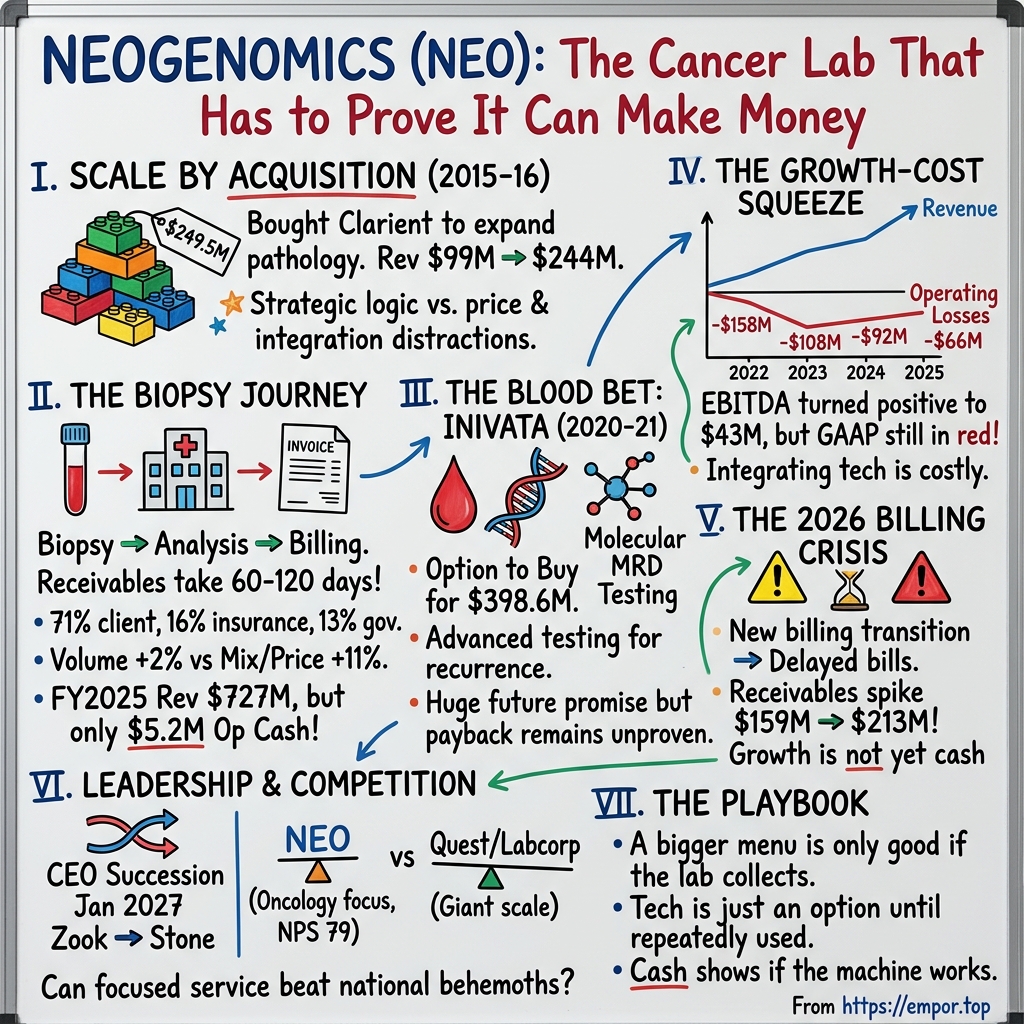
NeoGenomics: The Cancer Lab That Has to Prove It Can Make Money
I. The Lab Network at the Inflection Point
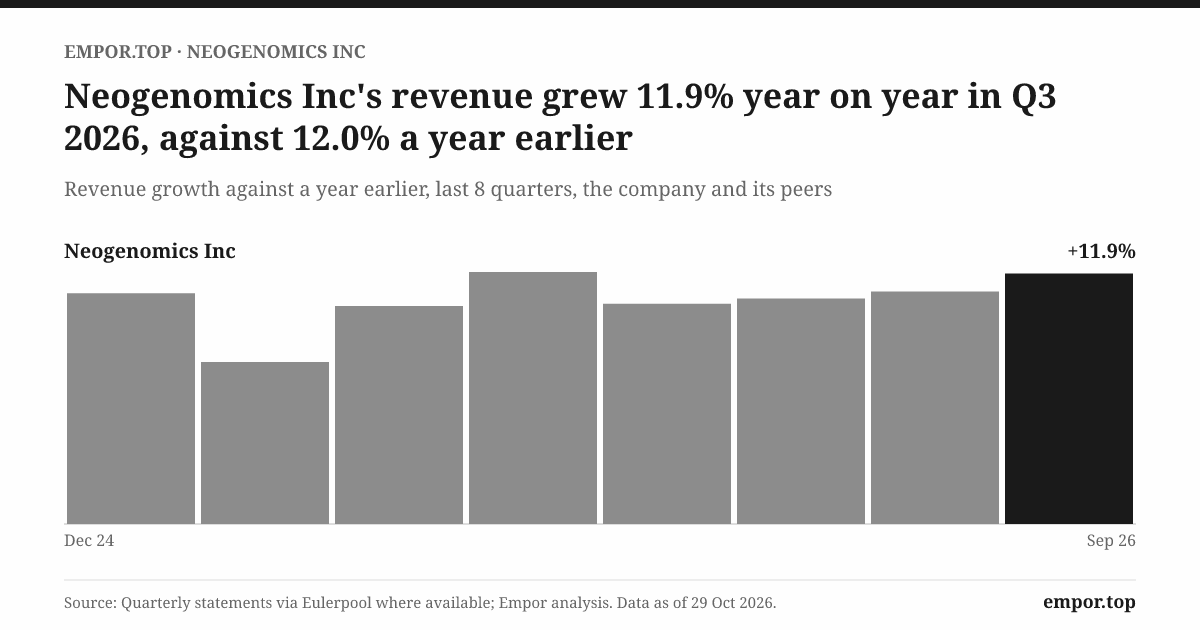
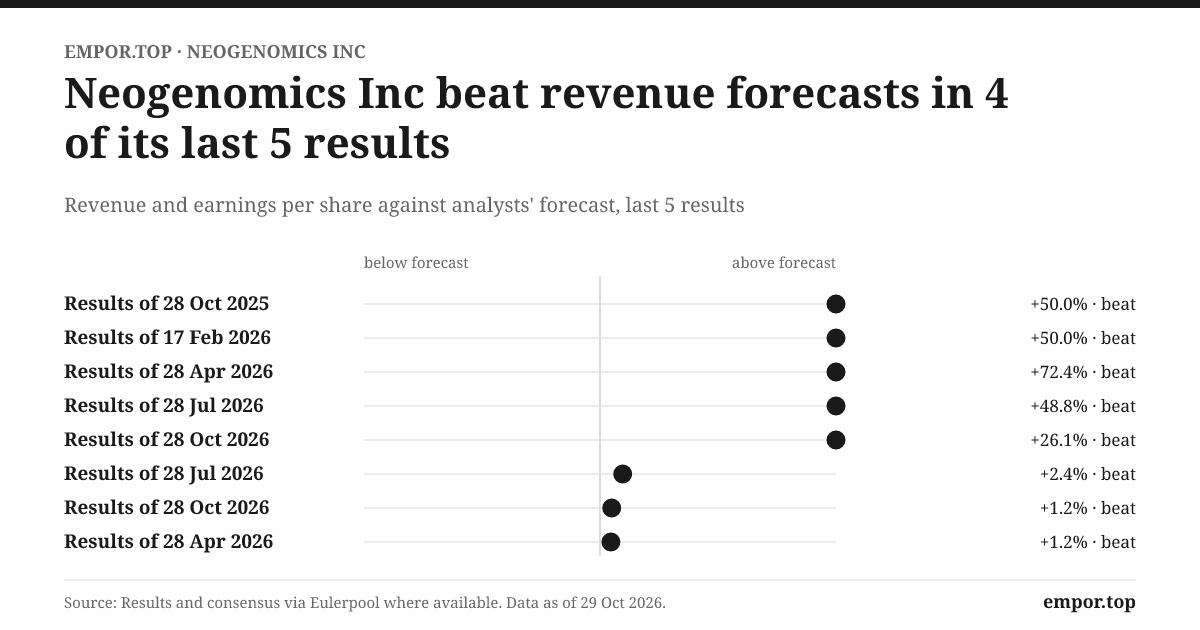
On the evening of October 28, 2026, NeoGenomics told investors that its business had just had one of its best quarters in years. Revenue for the three months to September came in at about $209 million, up 11% on the year before.1 Clinical testing, the core of the company, grew 13%, and the most sophisticated slice of that work, next-generation sequencing, grew 29%.1 The gross margin on a reported basis rose by 3.4 percentage points to about 46%, and adjusted EBITDA reached roughly $19 million, more than half again what it had been a year earlier.1 Management raised its full-year forecast for the second quarter running.1
Turn a few pages deeper into the quarterly filing, though, and a second number was moving the other way. Accounts receivable, the money NeoGenomics had earned but not yet collected, had climbed from about $159 million at the end of 2025 to about $213 million by the end of September.2 That is roughly $54 million of revenue that had been booked, tested, reported to doctors and then left sitting on the balance sheet while the company switched to a new billing platform.2 Management said the delay came from invoices that had not yet gone out during the transition, not from customers paying more slowly, and that it expected the balance to normalize in the fourth quarter and early 2027.3
Those two numbers, one rising because the business is getting better and one rising because cash has not yet arrived, are the whole story of NeoGenomics in miniature. This is a company that has spent more than a decade building one of the largest cancer-only testing networks in the United States. It takes biopsies, bone-marrow samples and blood drawn from cancer patients, mostly patients treated in community oncology practices rather than big academic hospitals, and tells their doctors what kind of cancer they have, which mutations drive it and, increasingly, whether it is coming back.4 Alongside that clinical business sits a smaller unit that runs tests for pharmaceutical companies in clinical trials and licenses de-identified data.4
It is a business with obvious social value and a stubbornly unclear economic one. In 2025 NeoGenomics generated about $727 million of revenue.4 It also lost about $108 million, and its operations produced only about $5 million of cash for the entire year.4 For a company that had been public for many years and had raised money repeatedly from shareholders and bondholders, that was not a start-up's loss. It was the loss of a mature-looking enterprise that had not yet found the formula for turning scale into profit.
So the story that follows turns on four questions. The first is whether the recent growth is durable, or whether it rests too heavily on a richer test mix and better prices while the number of tests barely moves. The second is whether NeoGenomics' two defining acquisitions, Clarient in 2015 and Inivata in 2021, bought a real advantage or simply bought revenue and promise at a high price. The third is whether the margin recovery can finally become free cash flow, the money left over after a lab pays for its sequencers, software and buildings. The fourth is the competitive one: why a $727 million specialist should win against national laboratory networks more than ten times its size and against molecular specialists with deeper pockets for science.
None of those questions is answered by a single good quarter. But the third-quarter print is a useful place to start, because it shows both the engine improving and the gap between earnings and cash that has followed this company for years. To see how that gap opened, the story has to go back to a Florida lab that decided, in 2015, to buy a company bigger than itself.
 Subscribe on LinkedIn
II. A Specialist Builds Scale by Taking on Clarient
When Doug VanOort took over a small cancer-testing company in Fort Myers, Florida, in 2009, it had 114 employees, about $20 million of revenue and a market value of about $26 million.5 It was a hematology-heavy lab, strong at analyzing blood and bone-marrow cancers through techniques such as cytogenetics, which looks at chromosomes under a microscope, and flow cytometry, which counts and sorts cells by the markers on their surface. The American laboratory business at the time was dominated by two giants that did everything from cholesterol panels to drug screens, with a long tail of hospital labs and regional specialists beneath them. Cancer testing was becoming more complicated every year, and the community oncologist in Ohio or Arizona had nobody local who could run the full battery of tests a modern diagnosis required. VanOort's bet was that a lab doing only cancer, and doing all of it, could become that somebody.
By 2015 NeoGenomics had grown to about $99 million of revenue.6 It was profitable in some years and slightly loss-making in others, but it was still a regional specialist with gaps in its menu, particularly in solid tumors such as breast, lung and colon cancer. Then, on October 21, 2015, VanOort announced a deal that more than doubled the company overnight.7 NeoGenomics would buy Clarient, a diagnostics business based in Aliso Viejo, California, owned by GE Healthcare.7 Clarient had about 415 employees, a presence in Houston and 2014 revenue of about $127 million, roughly a third more than NeoGenomics itself.7 VanOort framed it as the step toward his ambition "to become America's premier cancer testing laboratory," and said that of all the candidates the company had reviewed, Clarient was "by far the best fit."7
The logic was easy to see. Clarient brought solid-tumor pathology strength, especially in immunohistochemistry, the staining technique pathologists use to see which proteins a tumor cell carries, and it brought relationships with pharmaceutical companies running clinical trials.7 NeoGenomics brought hematology depth and a lower-cost operating culture. Put them together and a community oncologist could send almost any cancer sample to one lab. GE, which wanted out of a business that did not fit its portfolio, would take its payment largely in NeoGenomics paper.
The deal closed on December 30, 2015, for consideration the company valued at about $249.5 million.6 Only about $74 million of it was cash.6 The rest came as 15 million new common shares and about 14.7 million shares of convertible preferred stock, which left GE with roughly 32% of the enlarged company on a fully diluted basis and a seat on the board.76 That structure tells you something about the company's position in 2015. NeoGenomics could not afford Clarient in cash, so it paid with ownership, and a former seller became its largest shareholder.
The price of doubling
The first-year numbers looked spectacular. Revenue jumped from about $99 million in 2015 to about $244 million in 2016, a rise of almost 150%.8 Tests performed rose from about 221,000 to about 563,000.8 But almost all of that was the arithmetic of addition, not a sudden surge in demand. Management had told investors at announcement that, if reimbursement held steady, the combined company should produce $240 million to $250 million of revenue in 2016, and that is almost exactly what arrived.78 The deal delivered the scale it promised. It did not deliver an acceleration on top of it.
Under the surface, the merged company was also learning how hard it is to combine two labs. Average revenue per test fell about 7% in 2016, to $381 from $409, as Clarient's mix and reimbursement pressure diluted the per-test economics.8 The 2016 annual report described teams working "through every part of the business" to combine the two menus, and listed among the risks the challenge of consolidating onto a single laboratory information system and a single billing system.8 Sales representatives had to move clients onto a new combined menu and new ordering processes, which is the kind of internal work that pulls attention away from winning new accounts. In 2017 revenue slipped about 2%, to roughly $240 million, the only year-on-year decline in the modern record.4 Growth returned in 2018, and by 2019 revenue had reached about $408 million.4
Hold onto that phrase about one billing system. A decade later, the same company would be in the middle of migrating eight legacy laboratory systems onto one and moving its billing to a new platform, with $54 million of receivables waiting on the outcome.92
Was the price right? A rough clue is to set the $249.5 million against Clarient's disclosed adjusted EBITDA of about $13 million for 2014.7 That is roughly 19 times earnings before interest, tax, depreciation and amortization, before any savings. Management promised synergies of $4 million to $6 million in 2016, rising to $20 million to $30 million a year by the end of the third year.7 If those had arrived in full on top of Clarient's own earnings, the effective multiple would have fallen to something closer to seven or eight times. The company never published a clean accounting of what the synergies actually delivered, and there is no reliable comparable-deal benchmark to say whether 19 times was rich for a laboratory business in 2015. What can be said is that the deal required a lot to go right, and that NeoGenomics' consolidated operating margin stayed in the low single digits for the four years that followed.4
The verdict on Clarient is therefore a qualified one. It was transformative. It turned a Florida hematology lab into a national oncology network with a broad menu, a pharma-services business and a West Coast footprint, and the Aliso Viejo and Houston labs remain part of the network today.4 Shareholders who held through the 2010s did well; by early 2021, when VanOort stepped back, the market value had grown to more than $6 billion.5 But the deal also set a template that would recur: buy capability, pay heavily in equity, promise synergies, and then spend years integrating systems. The second time the company reached for a transformative acquisition, it would be buying not a lab full of revenue but a technology full of promise.
III. The Business Behind the Specimen
Picture a sample leaving a community oncology practice on a Tuesday afternoon. It might be a sliver of tissue from a lung biopsy, embedded in paraffin, or a vial of bone marrow from a patient with suspected leukemia. A courier carries it overnight to one of NeoGenomics' laboratories in Fort Myers, Aliso Viejo, Carlsbad, Durham, Ramsey or Houston.4 There, technicians stain it, sequence it, count its cells or look at its chromosomes. A pathologist or PhD scientist interprets what the machines find, a report goes back to the ordering physician, and the physician decides which drug, which trial or which surgery comes next.
That is the product. What makes it a business is everything that happens after the report goes out. NeoGenomics recognizes clinical revenue when the test is complete and the results are delivered, one unit of service at a time.4 Then someone has to pay. In 2025 about 71% of revenue was billed directly to clients, typically hospitals and physician practices, which then handle reimbursement on their side; about 16% came from commercial insurers; and about 13% from Medicare and other government programs.4 The company says client-payers typically settle in 60 to 90 days, while insurers, government programs and self-paying patients take 90 to 120 days.4 Every test, in other words, is a small loan to a customer until it is collected.
This is an order-driven business, not a subscription. Nobody signs a ten-year contract to send NeoGenomics every biopsy. An oncologist or pathologist decides, case by case, where the sample goes, and the company has to earn that decision repeatedly through turnaround time, test breadth, report quality and service. The company does not disclose a recurring-revenue share, typical contract length or minimum commitments.4 What it does disclose is reassuring on one dimension: no single client accounted for more than 10% of revenue in any of the last three years.4 It does not publish how much its top five or top ten clients represent, so concentration below that threshold is unknown.
The smaller nonclinical business works differently. Pharmaceutical companies hire NeoGenomics to run tests on patients in their clinical trials, paying by unit or by milestone, and the company also licenses de-identified oncology data.4 Those contracts can usually be terminated by the client on notice, and in 2025 this business shrank sharply as clinical-trial activity weakened.4 By the third quarter of 2026 nonclinical revenue was about $15 million a quarter, down about 10% on the year, partly because management chose to exit low-margin legacy pharma contracts.3 It is now a supporting act, not the main show.
Three ways to grow, and which one is doing the work
A testing lab can grow in three ways. It can run more tests. It can run more complex, higher-value tests. Or it can get paid more for the same test. The third quarter of 2026 is a vivid illustration of how unevenly those levers can move.
Clinical revenue in the quarter was about $195 million, up 13%.1 Yet clinical test volume grew less than 2%, to about 367,000 tests.1 The difference came from average revenue per clinical test, which rose 11% to about $530.1 On the earnings call, finance chief Abhishek Jain split that increase roughly two-thirds from the mix shift toward next-generation sequencing and one-third from better pricing with managed-care payers.3
Next-generation sequencing, or NGS, explains the mix effect. Older cancer tests look for one thing at a time: one chromosome rearrangement, one protein, one gene. An NGS panel reads dozens or hundreds of genes in a single run, the difference between checking whether one light bulb in a house works and inspecting the whole wiring diagram. Those panels are more expensive to run and much more valuable to bill. Management said NGS now accounts for about a third of clinical revenue but only about a tenth of clinical volume, and that NGS volume grew 17% in the quarter, with large-panel volume up more than 25%.3
The weak overall volume number has a specific explanation that management has been open about. Early in 2026 the company exited a high-volume contract with one customer whose tests brought in an average in the low $200s, roughly 40% of the company's current average.9 Dropping it depressed reported volume while lifting the average price per test, and Jain said that once the exit is fully lapped, growth in revenue per test should settle back to the mid-single digits.3 That is a candid answer, and it cuts both ways. It means part of the 11% jump in revenue per test is a one-off effect of losing cheap volume, not a permanent pricing gain. It also means that, excluding the exited contract, underlying volume is somewhat better than 2%.
The company does not provide the series an investor would most like to see: test volume and realized price, by test category and payer, over many years. Without it, it is impossible to say with confidence how much of NeoGenomics' growth comes from doctors sending more patients and how much comes from each patient's sample being run through a more expensive panel or reimbursed at a better rate. The working answer from the latest quarter is that mix and price are carrying most of the load, and that this is a sensible strategy as long as payers keep paying for complex panels and doctors keep ordering them.
The company is paying to keep that mix shift going, and the bill is rising. Research and development spending climbed from about $27 million in 2023 to about $37 million in 2025, a little over 5% of revenue, and it ran at about the same rate through the first nine months of 2026.42 Capital spending, mostly on lab equipment and systems, has moved between roughly 4% and 6% of revenue over the same years, and management forecast $30 million to $35 million for 2026.42 The workforce that does all this numbered about 2,500 full-time equivalents, including contracted pathologists, at the end of 2025, compared with about 940 a year after the Clarient deal closed.48 On the third-quarter call, management said volume within its NGS business was approaching an even split between large panels and smaller targeted ones, which it presented as further room for revenue per test to climb as doctors shift toward the bigger panels.3 That is the arithmetic of the strategy: every sample moved from a targeted panel to a large one lifts revenue without requiring a single new patient.
The risk in that arithmetic is that it depends on payers. A large panel is only worth more if insurers and Medicare agree to reimburse it at a higher rate, and if doctors judge that the extra information changes treatment. Mix-driven growth can run for years, but it is a narrower engine than growth from new patients, because it eventually runs out of samples left to upgrade.
That raises the obvious next question. If the future of NeoGenomics is more complex molecular testing, what happened to the biggest bet it ever made on the most complex molecular test of all?
IV. Inivata: The Big Bet on Blood
In May 2020, in the first months of the pandemic, NeoGenomics put $25 million into a small British company called Inivata.10 The investment came with a fixed-price option to buy the rest of Inivata for $390 million at any time before the end of 2021.10 Inivata had been spun out of the Cancer Research UK Cambridge Institute, had research labs in Cambridge, England, and ran a certified clinical laboratory in Research Triangle Park, North Carolina.10 Its flagship test was called RaDaR.
On May 5, 2021, NeoGenomics announced it would exercise the option about eight months early.10 Mark Mallon, who had become chief executive only weeks before, called the price attractive for liquid biopsy acquisitions.10 To fund it, the company sold about 4.4 million shares in a private placement at $45 each, raising $200 million, and used cash on hand for the rest.10 The deal closed in June 2021, with cash paid at closing of about $398.6 million.11
Why a blood test could be worth that much
To understand the bet, imagine a patient whose colon tumor has just been removed. The surgeon believes she got it all. But cancers shed tiny fragments of their DNA into the bloodstream, and if even a few cancer cells remain, those fragments are still there, invisible on a scan. A molecular residual disease test, often called MRD, sequences the original tumor, builds a personalized fingerprint of its mutations, and then hunts for that fingerprint in later blood draws.4 Finding it can mean the cancer is coming back months before a scan would show it. Not finding it might, one day, let a doctor spare a patient unnecessary chemotherapy.
RaDaR was designed to do exactly that for solid tumors, and it had received breakthrough device designation from the U.S. Food and Drug Administration.10 For NeoGenomics the strategic fit was elegant. Its business had always been about the moment of diagnosis. MRD would extend it across the entire cancer journey, from the first biopsy through therapy selection to years of monitoring, with the same oncologist ordering at every stage. A patient who needs a blood draw every few months for years is worth far more to a lab than one who needs a single biopsy analyzed once.
What the purchase price actually bought
The accounting tells a sobering story about what was being paid for. NeoGenomics valued the developed technology it acquired at about $291 million and recorded about $271 million of goodwill, the accounting residue that represents whatever a buyer pays above identifiable assets.11 In the second half of 2021, from closing through year-end, Inivata contributed about $1.5 million of revenue.11 The company was paying for the future, not the present.
That is normal for a technology acquisition. The question five years later is whether the future arrived. Set the record out plainly. In early 2022, management was already telling analysts that RaDaR's launch, then targeted for mid-2022, depended on discussions with MolDX, the Medicare program that decides whether many molecular tests get paid.12 Inivata's other product, a lung-cancer liquid biopsy called InVisionFirst-Lung, never became a durable business; in 2025 NeoGenomics wrote off about $11.4 million of its intangible assets and its inventory as the product was wound down.4 Natera, a much larger MRD competitor, sued over RaDaR and InVisionFirst-Lung, and although NeoGenomics eventually prevailed in 2025 after the asserted patents were invalidated and Natera dropped its appeal, the litigation hung over the product for years.4
By the time of the February 2026 call, the product had been rebuilt as RaDaR ST, with a bridging study showing 97% agreement with the original assay, Medicare coverage for HPV-negative head and neck cancer and a subset of breast cancer, and a full clinical launch planned for the end of that month.9 Management's guidance for RaDaR revenue in 2026 was in the mid-single-digit millions.9 In August 2026 Medicare added coverage for monitoring patients on immunotherapy in late-stage solid tumors, the test's third covered indication.1 Management sized that U.S. immunotherapy-monitoring opportunity at just under $4 billion, and said monthly orders had grown since the decision, that about 30% of RaDaR ST orders arrive alongside other NeoGenomics tests, and that a regional commercial insurer would cover the test for all Medicare-covered indications from mid-December.3
Then came the candid caveat. President Warren Stone told analysts that "we are running a lot of MRD where we are not likely to get reimbursed," which would weigh on gross margin in the near term, and management said clinical MRD revenue would ramp slowly, becoming more meaningful in 2028.3 When analysts asked for MRD and liquid biopsy revenue for the quarter, management declined to give it, saying only that both were tracking to guidance.3
There is one more pattern worth noticing in how RaDaR has earned money so far. Its first revenue came mainly through pharmaceutical customers rather than oncologists: in 2022, the company credited RaDaR testing as part of the reason pharma-services revenue grew.13 In February 2026 management again said pharma clients would likely contribute to RaDaR ST revenue earlier, with clinical volume building later.9 Drug companies running trials will pay for an experimental readout because it helps them measure whether a therapy works; doctors treating patients mostly need a payer to agree first. That sequence is sensible, but it means the clinical business that justified the purchase price has been the slowest part to arrive.
Capability is not commercialization
Here is where the story needs a firm line between technical progress and commercial proof. NeoGenomics' NGS revenue grew about 22% in 2025 and 29% in the third quarter of 2026, and management expects NGS to approach $250 million for 2026.93 It is tempting to read that as Inivata paying off. It is not, or at least not yet demonstrably. NGS is a broad category dominated by tissue-based panels for therapy selection, the large panels launched since 2023, which management says now make up about a quarter of revenue and grow far faster than the company.3 MRD is a small part of that number and the company does not disclose it separately.
So the verdict on Inivata is that the strategic logic holds, the technology has been validated and reimbursed in a growing list of indications, and the commercial payback remains unproven. Five years after paying roughly $424 million in total for the company, counting the original stake, NeoGenomics expects RaDaR revenue measured in single-digit millions for 2026 and meaningful clinical contribution only in 2028.101193 Even a generous outcome in which MRD becomes a $100 million revenue line by the end of the decade would need healthy margins for years to earn back that capital at any reasonable cost of money. The proof point to watch is simple to name and hard to deliver: disclosed MRD volume and revenue, rising quarter after quarter, with reimbursement catching up to the tests already being run for free.
Meanwhile, the cost of building that future landed on the income statement long before the revenue did. And in 2022, it arrived at the worst possible moment.
V. The Growth Story Meets the Cost Structure
On April 27, 2022, NeoGenomics held a first-quarter earnings call with no chief executive. Mark Mallon's departure had been announced a month earlier, and the board chair, Lynn Tetrault, led the call while a search firm hunted for a successor.12 The numbers she and finance chief Bill Bonello presented were grim. Revenue for the quarter was about $117 million, essentially flat on the year.12 The net loss was about $49 million, and adjusted EBITDA, the company's preferred measure, was negative $19 million.12 The adjusted gross margin had fallen almost four percentage points.12 The company declined to reaffirm the guidance it had issued only weeks earlier and called 2022 a "rebuilding year."12
What makes that call valuable, four and a half years later, is that the analyst questions forced management to explain the problem in specific, measurable terms rather than blaming the pandemic. Their answers amounted to a confession in four parts. First, the two 2021 acquisitions, Inivata and a data-software business called Trapelo, were adding about $13 million of quarterly operating costs with almost no matching revenue.12 Second, labor and supply costs were up roughly 6% on the year.12 Third, the company had hired laboratory staff for a post-COVID rebound in test volume that never came, and was now scaling back hiring.12 Fourth, lab productivity had fallen as tests grew more complex and as clients requested customized work.12 Management also admitted that customers were demanding larger NGS panels and that NeoGenomics' offering skewed toward smaller targeted panels, with a broader panel of more than 500 genes still about six months away.12
Read that list again and notice how little of it is bad luck. Two of the four causes, hiring ahead of demand and acquiring cost without revenue, were choices. A third, falling productivity, was an execution problem inside the lab. Only inflation was truly external. The company that had built its reputation as a lean, efficient operator under VanOort had, within about a year, turned into a high-cost operator with a menu that was falling behind in the most important category.
The repair plan offered that day was equally concrete. Management estimated that cost actions and pricing together could add at least $15 million of annualized gross profit, with the full run rate reached as 2022 ended.12 It said menu cuts would target lower-margin, low-volume tests rather than high-end assays, that the company was paying to run two facilities in Fort Myers until a move finished around mid-year, and that its international and La Jolla pharma laboratories were underused.12 Analysts also pressed on the competitive front: when asked whether newer molecular methods were eating into older ones, management identified solid-tumor FISH, a chromosome-staining technique, as the modality most exposed to substitution by NGS.12 It was an unusually honest inventory of a business that had grown its footprint faster than its utilization.
The full-year numbers show the depth of the hole. Revenue grew only about 5% in 2022, to about $509 million.13 The operating loss was about $158 million, a margin of roughly minus 31%.4 Operating cash flow was negative by about $65 million and free cash flow negative by almost $97 million.4 The company launched a restructuring that year and promised a more significant cost-reduction effort in 2023.13
The long climb back
What followed was a genuine recovery, though a partial one. Revenue grew from about $509 million in 2022 to about $727 million in 2025, a compound rate of about 12.6% a year.4 The operating loss narrowed every year, from about $158 million in 2022 to about $66 million in 2025, taking the operating margin from about minus 31% to about minus 9%.4 Adjusted EBITDA turned positive and reached about $43 million in 2025.9 Management had promised on that bleak 2022 call that adjusted EBITDA would be positive by the end of 2023; by February 2026 it could point to ten consecutive quarters of positive adjusted EBITDA, which places the turn in the middle of 2023, ahead of the target.129 That is a promise kept, and it deserves weight in any assessment of the company's credibility.
But the recovery has two important limits. The first is that adjusted EBITDA excludes a great deal. In 2025 NeoGenomics recorded about $36 million of depreciation, about $32 million of amortization on acquired intangible assets, about $28 million of impairments, and millions more in acquisition and integration costs, none of which appear in the adjusted figure.4 Some of those, such as the amortization of what was paid for Inivata, are genuinely non-cash echoes of past decisions. Others, such as depreciation on sequencers that must eventually be replaced, are real costs of staying in business. The company's own reported net loss of about $108 million in 2025 was actually wider than 2024's, because of the impairments.4
The second limit is that the gross margin, the cleanest test of whether the lab itself makes money on each test, went backwards in 2025. Cost of revenue rose about 11.5%, faster than revenue, and the reported gross margin slipped from about 43.9% to about 43.2%.4 The company attributed the decline mainly to the April 2025 acquisition of Pathline, a New Jersey laboratory that expanded its Northeast footprint, and to higher compensation, benefits and supply costs.49 Only in 2026 did the gross margin break decisively upward, reaching about 46% on a reported basis in the third quarter.1
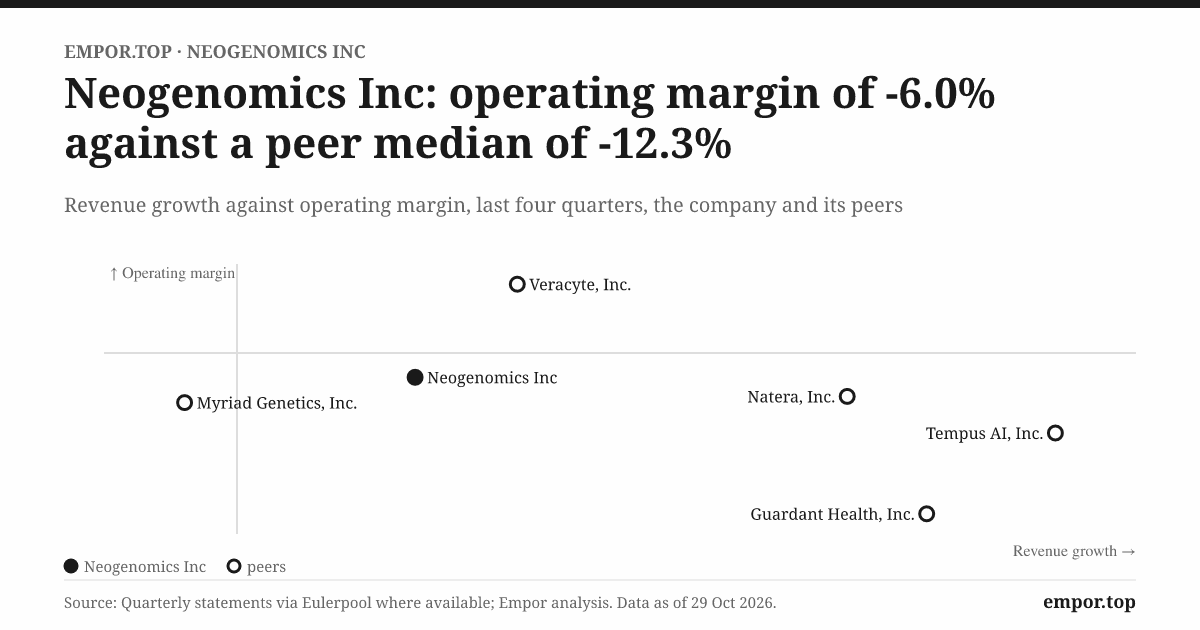
Decompose what has happened since 2022 and the improvement comes from two places. Revenue has grown faster than general and administrative cost, which fell from about 39% of revenue in 2024 to about 38% in 2025 and fell in absolute terms in the third quarter of 2026.43 And the mix has moved toward higher-value tests. What has not yet happened is the thing that would prove the lab model scales: a sustained GAAP operating profit. The fourth quarter of 2025 came close, with an operating margin of about minus 6%, and the third quarter of 2026 was better still at about minus 4%.42 Management's raised guidance for 2026 implies a full-year GAAP net loss of $30 million to $32 million.1
So the verdict is that the losses were partly a transition cost and partly a cost-structure problem, and the record since 2022 narrows the second rather than eliminating it. The proof would be several consecutive quarters of positive operating income without excluding impairment, transition or acquisition costs. The people charged with delivering that proof have changed almost as often as the strategy has been restated.
VI. The New Team Inherits the Turnaround
On September 30, 2026, NeoGenomics' board approved yet another change at the top.14 Tony Zook, chief executive for barely eighteen months, would step aside on January 4, 2027, and become executive chairman.14 Warren Stone, the president and chief operating officer, would become chief executive and join the board.14 The announcement framed it as a planned handoff from a position of strength. On the October call, Zook said Stone "has earned this promotion," and Stone described himself as one of the architects of the current strategy.3
To understand why the handoff matters, count the chief executives. Doug VanOort ran the company from 2009 until April 2021, a twelve-year tenure that built the national network.5 Mark Mallon, a former AstraZeneca executive who had led Ironwood Pharmaceuticals, succeeded him in April 2021 and was gone within a year, after the Inivata and Trapelo deals.512 Lynn Tetrault served as interim chief executive while the board searched.15 Chris Smith, who had run Ortho Clinical Diagnostics through its 2021 IPO and its merger with Quidel, and before that led the hearing-implant maker Cochlear, took over in August 2022 and led the cost-cutting recovery.15 In January 2025 the board and Smith agreed he would retire, and Zook, a board member since 2023, became chief executive on April 1, 2025.1617 Stone will be the fifth permanent chief executive in under six years.
Who these leaders are
Zook arrived with a big-pharma commercial résumé. He had been executive vice president of global commercial operations at AstraZeneca, with responsibility for more than $30 billion of revenue, then chief executive of Innocoll Pharmaceuticals and a partner at a healthcare consultancy.16 His tenure coincided with the strongest stretch of the recovery, including two raised guidance ranges in 2026.1 Stone has a diagnostics operator's background. Before joining NeoGenomics in November 2022 as president of clinical services, he ran commercial operations in the Americas for Ortho Clinical Diagnostics, overlapping with Smith there.14 He became chief commercial officer in April 2024 and president and COO in April 2025.14 He has, in other words, been close to every major operating decision of the recovery, which is the strongest argument for continuity. The finance seat has also turned over: Jeffrey Sherman retired as chief financial officer in March 2026, succeeded by Abhishek Jain, and the general counsel left in September 2026.1819
What they are paid, and what they own
The pay package is generous for a company that still reports losses. Zook's 2025 compensation totaled about $9.1 million, including roughly $4 million each in restricted stock and stock options and about $0.5 million of cash incentive.20 His contract set a base salary of $850,000, a target bonus equal to salary and annual equity with a target value of about $8 million, split between restricted stock and options priced above the market.1620 Stone's 2025 compensation was about $5.1 million.20 As incoming chief executive he will receive exactly the package Zook had: $850,000 of salary, a 100% target bonus and about $8 million of annual equity from 2027.14 Zook, as executive chairman, will receive $400,000 in salary, a 50% target bonus and about $3 million a year in restricted stock.14 For a period, then, the company will pay two senior executives meaningful equity packages at the top.
Ownership is modest. As of March 2026, Zook held about 441,000 shares and Stone about 240,000; executives and directors together held about 1.1% of the company.20 The largest holders are institutions, led by BlackRock at about 14.5%, with Brown Advisory, First Light, Greenhouse Funds and Millennium each between 5% and roughly 7%.20 There is no controlling shareholder. At the May 2026 annual meeting, about 16.8% of votes cast opposed the executive pay resolution.21 That is not a revolt, but it is a meaningful minority signal against a backdrop of losses and departure payments; the company recorded about $2.9 million of accelerated stock compensation in 2025 tied to executive exits.4 The two directors who drew the most opposition were Michael Kelly and Lynn Tetrault.21 In the October succession, Tetrault agreed to step down as chair and not stand for re-election in 2027, while Kelly will become lead independent director.14
Do their words match their numbers?
The fairest way to judge this management team is to set its calls side by side. In April 2022, under an interim leader, the explanations were specific and self-critical: overhiring, falling productivity, acquired cost without revenue.12 The promise attached, positive adjusted EBITDA by the end of 2023, was met early. In February 2026, Zook's team guided to revenue of $793 million to $801 million, adjusted EBITDA of $55 million to $57 million, and stated a goal of turning free cash flow positive in 2026.9 By October, revenue guidance had been raised to $807 million to $809 million and adjusted EBITDA to about $60 million.1 On the metrics management chose, it has under-promised and over-delivered this year.
The free-cash-flow goal is a different matter, and it is where the next part of the story begins. Asked about 2027, Zook said research spending would step up to about 7% of revenue from 4% to 5%, alongside disciplined sales expansion and lower administrative cost, and he declined to forecast the year.3 Stone promised an investor day in the first half of 2027.3 That sequence, a new chief executive, higher R&D and a long-range plan still to come, is reasonable. It also means the operating narrative is about to be restated once more, and the one number management promised that is not adjusted, free cash flow, is the one now in doubt.
VII. The Billing Platform Turns Growth into a Cash Test
Somewhere in NeoGenomics' finance department in 2026, a queue of completed tests was waiting for invoices. The science had been done. The reports had gone to doctors. Patients had, in many cases, already started treatment on the strength of those reports. But the company was moving its revenue-cycle management, the machinery that turns a completed test into a claim and then into cash, onto a new platform from the billing-software specialist XiFin, and bills went out late during the switch.3 On the third-quarter call, Jain described the transition as having "a compelling impact on our receivables," and said he expected normalization toward the fourth quarter and early 2027.3
The balance sheet shows what that meant. Receivables rose sharply during the transition.2 Set against the third quarter's annualized revenue, that is a jump from roughly 80 days of sales outstanding at year-end to something like 93 days, at a company whose debtor days had hovered in the low-to-mid 80s for most of the past decade.42 That increase absorbed cash.2 Operating cash flow for the nine months was only about $2.9 million, while capital spending was about $25 million, which leaves free cash flow of roughly minus $22 million for the period.2
The paradox of a $418 million loss
To read that properly, it helps to step back to the long record, because it contains an apparent paradox. Across the twelve years from 2014 through 2025, NeoGenomics reported cumulative net losses of about $418 million.4 Over the same years, its operations generated about $42 million of positive cash.4 How can a company lose $418 million and still produce cash from operations?
The answer is that a large share of those losses never involved cash leaving the building. Depreciation spreads the cost of sequencers and lab buildings over many years after the cash was spent. Amortization of acquired intangibles, much of it from Clarient and Inivata, writes down the price already paid for those companies. Stock compensation pays employees in shares rather than dollars, at the cost of dilution rather than cash. Impairments, like 2025's charges on InVisionFirst-Lung and on the disposal of Trapelo's assets, are admissions that earlier investments are worth less than recorded.4 In 2025 alone, those non-cash items roughly bridged a $108 million net loss to about $5 million of operating cash.4
So the long-run losses should not be read as equivalent cash burn. But that is a reprieve, not an acquittal, because the cash that operations did produce never covered what the lab needed to reinvest. Over the same twelve years free cash flow, operating cash minus capital spending, was cumulatively about minus $240 million.4 In 2025, operations produced about $5 million against about $27 million of capital spending.4 That gap was funded the way NeoGenomics has always funded its gaps: with shareholders' and bondholders' money. Cash and short-term investments fell from about $387 million at the end of 2024 to about $160 million at the end of 2025, largely because the company repaid about $201 million of convertible notes that matured in May 2025.4
Why this particular delay matters more than usual
Receivables delays during a systems migration are common, and management's explanation is plausible. It is also exactly the kind of explanation that cannot be verified from public numbers until it either comes true or does not. The company does not publish an aging schedule showing how much of the $213 million is current and how much is overdue, nor a history of write-offs and bad-debt provisions.24 Receivables are recorded net of anticipated payer denials and negotiated discounts, which means they already embed management's estimates of what will be collected.4 If the new platform reveals that some of those older claims are less collectible than assumed, the correction would show up later as lower revenue or higher write-offs.
There is a second reason for care. Roughly 29% of revenue comes from insurers and government payers, who typically take 90 to 120 days to pay, and that share could rise if more complex molecular tests and MRD are billed directly to payers rather than to hospitals.4 Management argues the opposite risk: that XiFin will improve collections, reduce bad debt and support higher realized revenue per test over time.3 Both effects could be true. The new system might collect more of each dollar billed while the transition delays when the dollars arrive.
The cushion for that delay is thinner than it used to be. When NeoGenomics held hundreds of millions in cash and securities, interest income softened the blow of operating losses: about $18 million in 2024. With the cash pile cut by the 2025 debt repayment, interest income fell to about $9 million in 2025.4 By September 2026 the company held about $139 million of cash, which management says, together with collections, will fund operations for at least the next twelve months.2 That is a reasonable statement about liquidity, not a sign of distress, and it sits alongside about $68 million of operating lease liabilities on labs and offices that are a real, if often overlooked, fixed commitment.4 But it means the company no longer has a deep reserve to absorb a long slip in collections. The billing transition has to work on roughly the timetable management has given.
The test is precise. Watch receivables and days outstanding over the next two or three quarters as the platform stabilizes. Watch whether operating cash flow exceeds capital spending, not once but quarter after quarter. Management's own stated goal from February was positive free cash flow for 2026.9 With about minus $22 million through nine months, meeting that goal would require more than $22 million of free cash flow in the fourth quarter alone, a level the company has not come close to in any recent quarter.2 If the receivables unwind as promised, a strong fourth quarter is possible. If they do not, the miss on the one unadjusted promise will be more revealing than any beat on adjusted EBITDA.
The cash test is about execution. The deeper question is whether, once the billing is fixed, NeoGenomics has a business that competitors cannot take away.
VIII. Can a Focused Menu Beat the Bigger Labs?
Return to that community oncologist with a biopsy on the desk. She has choices. She can send the sample to Quest Diagnostics or Labcorp, which already handle the practice's routine blood work, have couriers in every town and contracts with nearly every insurer. She can send it to a molecular specialist such as Guardant Health, Natera, Exact Sciences, Caris, Tempus or Myriad, each with a particular test that may be the reference standard for a specific question.4 Or she can send it to NeoGenomics. Often she uses more than one, and nothing stops her from switching next week.
The scale gap is stark. Quest alone reported about $11 billion of revenue for 2025, roughly fifteen times NeoGenomics' $727 million.224 That comparison is not about oncology market share, since most of Quest's revenue comes from routine testing NeoGenomics does not do, and the company publishes no market-share estimate of its own. But it explains the competitive problem. A national network can spread courier routes, billing staff, payer contracting and IT across vastly more volume, and can bundle cancer tests into a relationship the practice already has.
The case for focus
NeoGenomics' answer is specialization. It does only cancer, it offers almost every modality a cancer workup requires, from chromosomes and cell sorting to immunohistochemistry, NGS and MRD, and it has spent years building relationships with pathologists and community practices outside the big academic centers.4 The idea is that a pathologist who can send one sample to one lab and receive an integrated answer, with a NeoGenomics expert available to talk through a confusing result, will not want to split the case across three vendors.
There is evidence for this. The company reported a net promoter score, a common measure of customer willingness to recommend, of 79 for 2025, up from 74.23 About 40% of its active pathologists and oncologists ordered five or more different NeoGenomics tests in 2025, and the number of clinicians doing so grew 14%.923 On the third-quarter call, Stone pointed to repeat ordering of RaDaR ST and to new bidirectional electronic-medical-record interfaces, which let a practice order and receive results inside its own software, as signs that customers are embedding the company in their workflow.3 Client concentration remains limited.4
The company is also buying distribution to press that advantage. In February 2026 management described a new team of oncology sales specialists, starting with one focused on ear, nose and throat cancers, with more than 25 planned by the third quarter, each selling a bundle of roughly 12 to 14 tests across therapy selection and MRD.9 Warren Stone said the existing sales force was fully productive and attrition was low.9 The cost is visible: sales and marketing expense rose about 27% in the third quarter, to about $28 million, more than twice the rate of revenue growth.3 That is a deliberate investment in the community channel, and it will pay only if the new specialists bring in doctors who would otherwise have sent their samples elsewhere.
Testing the moat against what the record shows
But the claims need testing against the mechanism that would break them. Switching costs in cancer testing are modest. An interface can be built to a second lab, and a pathologist can send the next case elsewhere at no cost to herself. A satisfaction score of 79 shows that customers who use NeoGenomics like it; it does not show how many leave, and the company does not publish a customer retention series. The 40% figure also reads the other way: most active clinicians in the base do not yet order five or more tests, which management itself framed as headroom.9
Pricing power is also limited. Physicians choose the lab but rarely pay. Payers set the price, and Medicare's fee schedule, revised under a law known as PAMA, can cut rates; management estimated its exposure to coming PAMA changes at low-to-mid single-digit millions of dollars a year.3 Recent revenue-per-test growth has depended more on mix than pricing, with some lift from the exit of a cheap contract.3 Most revenue is billed directly to hospitals and practices, which negotiate their own rates and can play labs against one another.4
And history shows the menu can fall behind. In 2022, management acknowledged that customers wanted larger NGS panels while NeoGenomics' offering skewed toward smaller ones.12 The company caught up with large panels launched in 2023, which is evidence it can respond, but the episode proves that specialization alone does not guarantee a leading product. In MRD, Natera and Guardant are larger, better-funded and further ahead commercially.424
The calibrated conclusion is that focus, breadth and service in community oncology are a plausible advantage with real supporting evidence in satisfaction and multi-test ordering, narrowed by low switching costs, payer-set pricing and a history of menu gaps. It is a credible but unproven moat. What would confirm it is a disclosed retention or same-customer growth series and volume growth that broadens beyond mix. What would falsify it is volume stagnation once the exited contract is lapped, with growth depending on price alone. Those are the things the market is implicitly betting on, at a valuation that now assumes a good deal.
IX. Analysis & Bear vs. Bull Case
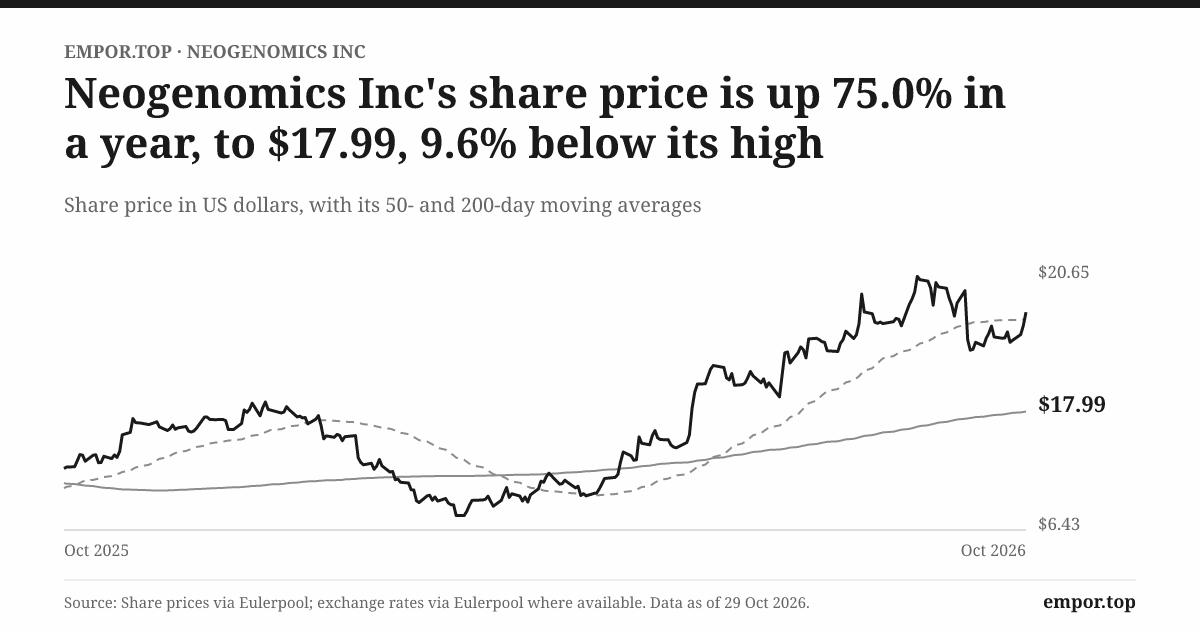
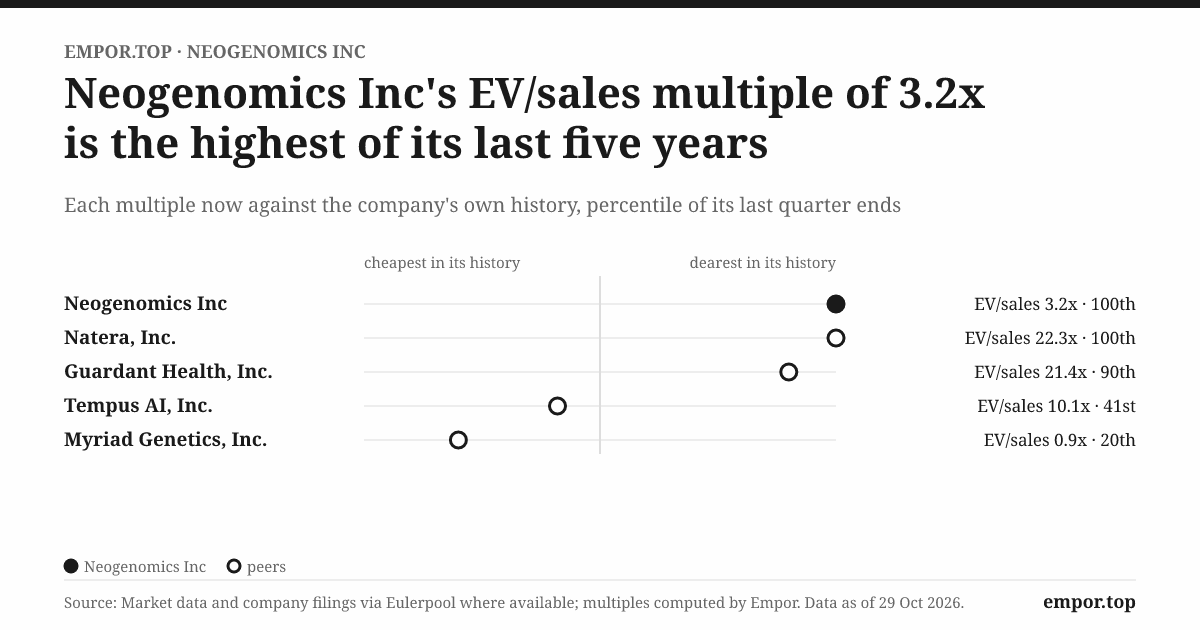
On October 29, 2026, NeoGenomics shares closed at about $17.99, within 10% of their 52-week high of $19.89 and roughly two and a half times their 52-week low of $7.19. The company had a market value of about $2.3 billion and an enterprise value of about $2.6 billion, including debt and after subtracting cash. That is about 2.9 times trailing sales and about 3.2 times on an enterprise-value basis.2 At the end of 2025, the stock had traded at about 2.1 times sales, after about 3.3 times at the end of 2024 and 3.5 times at the end of 2023.25 So the market has re-rated the company sharply in ten months, back toward where it sat before the worst of the 2025 losses. Against the guided adjusted EBITDA of about $60 million for 2026, enterprise value is roughly 43 times; against the smaller EBITDA that conventional reporting produces, the multiple is about 80 times.1 Either way, the earnings base is small enough that a few million dollars of change swings the valuation multiple wildly.
For context, at the end of 2025 one advisory firm's diagnostics peer survey showed NeoGenomics at about 2.4 times enterprise value to revenue, close to Quest at about 2.3 times and above Labcorp at about 1.9 times, but far below Exact Sciences at about 6.4 times, Natera at about 13.4 times and Guardant at about 14.2 times.24 The market priced it then like a lab network, not a molecular growth story. The rally since suggests investors have started to pay for a little of both.
The $45 Inivata placement and a market value above $6 billion marked the peak of that optimism.105 The shares lost close to 90% of their value from peak to trough in the five years that followed. The current price is a recovery from that collapse, not a return to the old optimism.
The bull case, stated without the brochure
The optimistic reading starts with demand. Cancer testing is growing in complexity, and every new targeted therapy creates a new reason to sequence a tumor. NeoGenomics' NGS revenue is growing far faster than the company and is on track for about $250 million this year.3 Its large-panel menu is now competitive, its gross margin is expanding, its administrative cost is falling, and the company says its cost of sequencing should fall further as it moves to Illumina's NovaSeq X instruments, with hematology NGS shifting in the first half of 2027 and the rest of the portfolio by 2028.3 Management describes the lab automation program as "inning 3" of a longer journey, which, if true, implies more productivity gains ahead.3 The company says RaDaR ST's third Medicare-covered indication gives it access to a large immunotherapy-monitoring market.13 And the balance sheet was re-engineered in June 2026, when the company issued $315 million of 0.75% convertible notes due 2032 and used most of the proceeds to repurchase $276 million of the 2028 notes, pushing its main maturity out six years at a very low coupon.2
The bear case, with the history attached
The skeptical reading begins with the record. Revenue has grown for most of the past decade, yet the company has posted operating losses every year since 2020.4 The advanced-testing bets that were supposed to change the economics have a mixed history. Trapelo, acquired in 2021, was disposed of in 2025 with a $15.9 million impairment.4 InVisionFirst-Lung was wound down with an $11.4 million write-off.4 RaDaR, the centerpiece of a deal costing about $424 million, is expected to generate single-digit millions of revenue this year and is being run partly unreimbursed.93 Even the most recent acquisition, Pathline, contributed about $13 million of revenue in 2025 along with a net loss of about $6 million and about $5 million of acquisition and integration expense, and diluted the gross margin.4 An activist would ask a pointed question: after three major acquisitions and several smaller ones, which has demonstrably earned its cost of capital?
The capital structure adds a second layer. The 2032 notes convert at $14.16 a share, below the current price, into about 22 million shares, which would be roughly a sixth of the shares outstanding.2 The company paid $28.7 million for capped calls that offset dilution, but only up to $20.98 a share.2 Above that level, conversion dilutes shareholders. The company also spent $25 million buying back about 2.4 million shares in June 2026, at roughly $10.50 apiece, which looks shrewd at today's price, but it was still a $25 million cash outlay by a company that did not cover its capital spending with operating cash.2 About $69 million of the 2028 notes remain outstanding.2
Then there are the risks that run through specific mechanisms. Reimbursement changes, including PAMA rate revisions and the timing of Medicare coverage decisions, directly set test economics. Laboratory-developed-test regulation matters because most of NeoGenomics' tests are developed in-house; a federal rule that would have treated them as medical devices was vacated by a Texas court, but the company warns the FDA could still change its approach.4 Billing execution affects cash, as the receivables build shows. Pharma clinical-trial activity drives the nonclinical business, which fell about 24% in 2025.9 And there was a governance event worth bounding: a federal investigation into consulting arrangements under a program called the Laboratory Collaboration Initiative, for which the company accrued about $11.2 million at the end of 2025 and which it settled with the Justice Department and the Office of Inspector General in July 2026 for $10 million, without a corporate integrity agreement and without admitting liability.42 That matter is now closed, but it is part of the record a new chief executive inherits.
The industry, force by force
Weigh the industry structure and the picture sharpens. Buyer power is high on two levels: physicians choose freely among labs, and payers, from Medicare to commercial insurers to the hospitals that pay NeoGenomics directly, set or negotiate the price. Supplier power is meaningful because the sequencing instruments and reagents that power NGS come from a concentrated set of vendors; NeoGenomics discloses reagent purchase commitments of about $11.6 million through 2028 but no single-supplier concentration, and its planned move to NovaSeq X deepens its reliance on one instrument platform.43 The threat of substitutes is real in both directions: NGS is replacing older single-gene methods, a shift NeoGenomics is riding but which erodes its legacy cytogenetics and FISH business, and digital pathology and AI could change how interpretation work is done, which is why the company is partnering with the AI pathology firm Indica Labs.123 New entrants such as Tempus and Caris are well funded. Rivalry is intense and multi-front.
On Hamilton Helmer's framework of durable competitive powers, NeoGenomics can claim a partial version of two. It has some scale economies within oncology, because a dedicated network can run specialized assays at higher utilization than a hospital lab. It has some process power in the making, if its automation and single-information-system program delivers the productivity management describes. Its switching costs are modest and rising slowly through interfaces and multi-test bundles. Its brand among community pathologists, reflected in the satisfaction score, is real but not exclusive. It has no network effect, no cornered resource beyond its validated assays, and its counter-positioning against national labs, focus versus breadth, is a strategy competitors could copy if oncology became attractive enough. The moat, in short, is a set of operational advantages, not a structural lock.
What the price assumes, and how to keep score
At about 3 times sales and with GAAP losses still on the books, the market is not paying for a speculative molecular story, but it is paying for a recovery that continues. The valuation leaves little room for growth to slip back toward mid-single digits or for margins to stall, and the EV-to-EBITDA multiple is acutely sensitive to the small earnings base.
Three numbers will tell investors whether the recovery is real. The first is clinical test volume set against revenue per test, especially as the exited contract laps and revenue-per-test growth settles toward the mid-single digits management expects.13 The second is whether gross and operating margins keep improving.12 The third is cash: receivables and days outstanding, and operating cash flow minus capital spending.2 Two of those three are moving in the right direction. The third is the one the company has never consistently won.
X. Playbook: Business & Investing Lessons
Lay two deals side by side. Clarient bought a working lab with customers, couriers and a pharma book; Inivata bought a vision of where cancer care was going.671110 A decade and five chief executives later, NeoGenomics generated about $727 million of revenue and about $43 million of adjusted EBITDA in 2025, yet still lost about $108 million on a GAAP basis.49 There are lessons here that belong to NeoGenomics and no one else.
The first is about breadth. As the 40% multi-test figure suggests, NeoGenomics' advantage still depends on doctors using its menu.9 But the Clarient integration also showed that a bigger menu creates its own work: the company is still migrating its systems and billing platform. A bigger menu is valuable only when the ordering doctor uses it, and the lab collects for it. Founders who imagine that adding products is the same as adding customer value should remember how long it took NeoGenomics to make the menu pay.
The second is about technology bets. RaDaR's technical and regulatory progress has not yet become commercial proof: the company expected single-digit millions in revenue for 2026, five years after purchase, while running many tests without payment.104193 Every one of those milestones was real. None of them was revenue. A technology platform is an option until customers pay for it repeatedly, and an option priced at $400 million needs a very large payoff to be worth exercising early.
The third is about measurement. Adjusted EBITDA showed the turn to positive in 2023.9 But cash generation still fell short of capital spending, and the 2026 receivables build put the gap to the test.42 Adjusted earnings can show the direction; cash shows whether the machine works. Investors in any business that reports a cleaned-up profit figure should insist on the reconciliation to cash before they believe the turnaround.
The fourth is about how specialists win. NeoGenomics' advantage remains plausible but unproven. A specialist can beat scale with focus, but it has to prove the advantage in retention, price and throughput. Satisfaction is a leading indicator; it becomes a moat only when it shows up in customers who cannot easily leave.
Put together, the lesson is simple to say and hard to live: strategic fit and growing revenue are not the same as returns on capital. The next chapter of NeoGenomics will be written in exactly the place where it has struggled most.
XI. Epilogue
Tonight NeoGenomics sits in an unusual position for a company that has disappointed investors so often. Its guidance has been raised twice this year.1 And yet almost every one of the four questions that opened this story will be decided in the next few quarters, not by a long-range market forecast, but by a short list of dated, observable events.
The first is the fourth-quarter report, due in February 2027 and led by Warren Stone rather than Tony Zook.3 It will show whether the delayed invoices went out and came back as cash. If receivables fall back toward their year-end 2025 level and operating cash exceeds capital spending, the billing transition will look like the temporary disruption management described, and the long-promised free cash flow will finally be within reach. If receivables stay elevated into 2027, investors will start asking what the new platform found in the old claims.
The second is the volume line. With the exited low-value contract fully lapped in 2027, clinical test volume should reveal whether doctors are sending more patients or whether growth depends on extracting more from each sample. Management expects non-NGS volume to normalize in the second half of 2027 and revenue per test to settle into mid-single-digit growth.3 Volume that accelerates would answer the durability question in the bulls' favor; volume that stays near flat would confirm that mix and price have been doing most of the work.
The third is the MRD ramp. The company says two more RaDaR ST indications are under Medicare review, one possibly by the end of 2026 and another by mid-2027, and that a regional commercial insurer would begin coverage in mid-December.3 Each decision converts some of the free testing into paid testing. Investors should listen for whether management finally discloses MRD volume or revenue, because until it does, the Inivata bet cannot be judged.
The fourth is the handoff itself. On January 4, 2027, Stone becomes chief executive, Zook becomes executive chairman, and a new lead independent director takes over board oversight.14 The investor day promised for the first half of 2027 will reveal whether the new team restates targets or simply extends the path it has been on.3 Continuity of guidance and priorities will matter more than the announcement.
Behind all four sits the question that no single quarter can settle: whether this stronger oncology network can earn more than its cost of capital. The evidence that the business is improving is now hard to dispute. The evidence that it is a good business, one that turns its growth into cash year after year, is still on the way.
XII. Outro
Go back one last time to the sample from the community oncology practice: a curl of tissue in paraffin, a vial of marrow, a tube of blood. For the patient, it carries the most important question of their life. For the doctor, it carries a decision about which treatment to try. NeoGenomics has spent fifteen years building a network that can answer more of those questions, more precisely, for doctors far from the big cancer centers, and that work matters whatever the stock does.
For the company, though, every one of those samples carries a third question, the one this story has followed from Clarient to RaDaR to a billing queue in 2026. Can the lab turn the work into cash, test after test, year after year, at a profit that justifies the capital poured into it? The science is already proven many times a day. In cancer testing, the sample is small; the proof the business needs is much larger.
References
-
NeoGenomics Reports Third Quarter 2026 Results — NeoGenomics, 2026-10-28 ↩↩↩↩↩↩↩↩↩↩↩↩↩↩↩↩↩↩
-
Q3 2026 Form 10-Q — NeoGenomics, 2026-10-28 ↩↩↩↩↩↩↩↩↩↩↩↩↩↩↩↩↩↩↩↩↩↩↩
-
NeoGenomics (NEO) Q3 2026 Earnings Call Transcript — The Motley Fool, 2026-10-28 ↩↩↩↩↩↩↩↩↩↩↩↩↩↩↩↩↩↩↩↩↩↩↩↩↩↩↩↩↩↩↩↩↩↩↩↩
-
2025 Form 10-K — NeoGenomics, 2026-02-17 ↩↩↩↩↩↩↩↩↩↩↩↩↩↩↩↩↩↩↩↩↩↩↩↩↩↩↩↩↩↩↩↩↩↩↩↩↩↩↩↩↩↩↩↩↩↩↩↩↩↩↩↩↩↩↩↩↩↩↩↩↩↩
-
Lab firm CEO retires, to be replaced by former AstraZeneca exec — Business Observer, 2021-02-26 ↩↩↩↩↩
-
NeoGenomics to Acquire Clarient from GE Healthcare — NeoGenomics, 2015-10-21 ↩↩↩↩↩↩↩↩↩↩
-
NeoGenomics (NEO) Q4 2025 Earnings Call Transcript — The Motley Fool, 2026-02-17 ↩↩↩↩↩↩↩↩↩↩↩↩↩↩↩↩↩↩↩↩↩↩
-
NeoGenomics to Acquire Inivata — NeoGenomics, 2021-05-05 ↩↩↩↩↩↩↩↩↩↩↩
-
NeoGenomics Q1 2022 Earnings Call — Equibles, 2022-04-27 ↩↩↩↩↩↩↩↩↩↩↩↩↩↩↩↩↩↩↩
-
NeoGenomics Announces Chief Executive Officer Appointment — BioSpace, 2022-07-21 ↩↩
-
Tony Zook Assumes Role as Chief Executive Officer of NeoGenomics — NeoGenomics, 2025-04-01 ↩
-
2026 Annual Meeting Voting Results — NeoGenomics, 2026-05-21 ↩↩
-
Q4 2025 Public Comparable Companies: Tools & Diagnostics — Mirus Capital Advisors, 2026-04 ↩↩
 LinkedIn
 WhatsApp
 Reddit
 Hacker News
 Email
 Kindle
 RSS Feed
 Spotify
 Apple Podcasts
 Amazon Music
 Audible
 YouTube