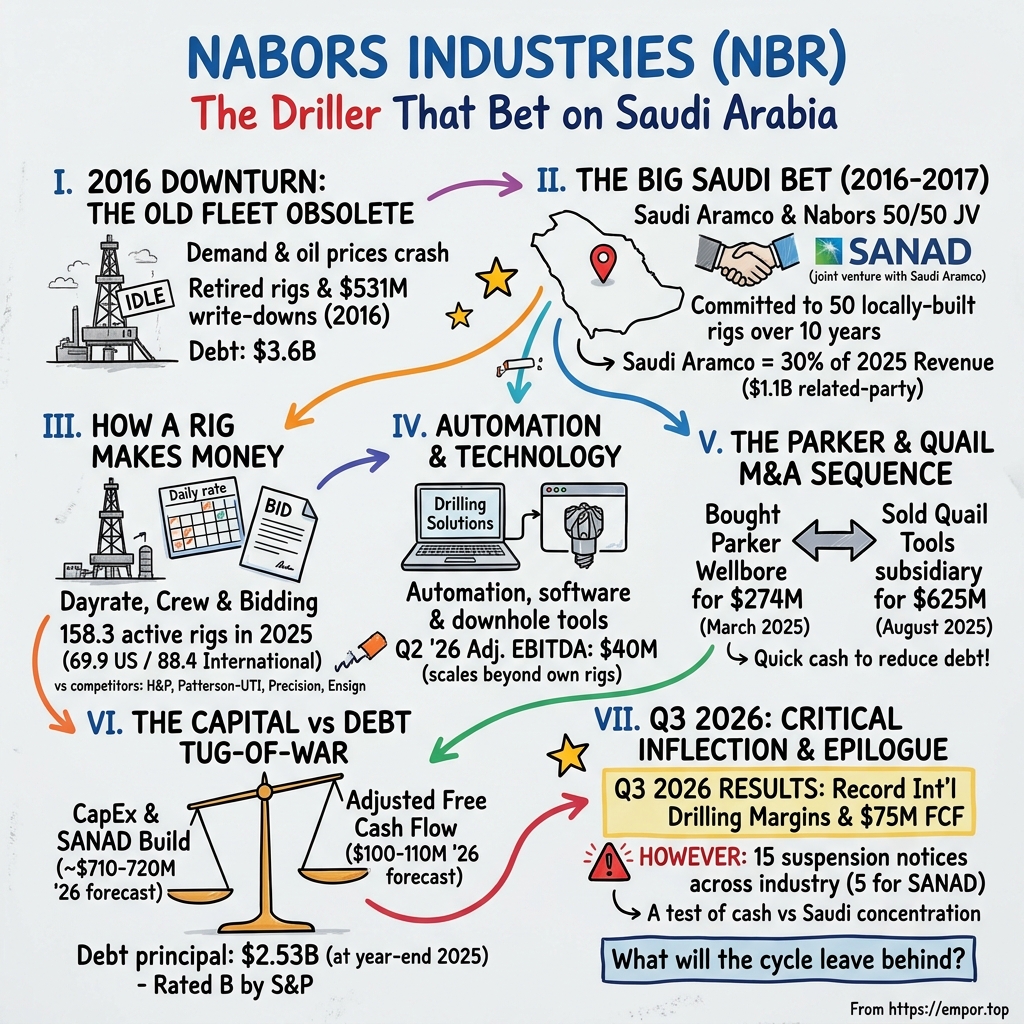
Nabors Industries: The Driller That Bet on Saudi Arabia
I. Fifty-three Rigs, Fifteen Suspension Notices
On the morning of October 28, 2026, Tony Petrello had the kind of quarter a drilling contractor waits years to report. Nabors Industries' international rigs had just earned a record daily margin of about $19,060, up almost 9% in three months.1 Revenue had climbed 7% from the prior quarter to about $872 million, adjusted EBITDA had risen nearly 11% to about $245 million, and adjusted free cash flow had come in at roughly $75 million, against barely $12 million the quarter before.1 The press release put the record margin and the cash in its headline. For a company that has spent most of the past decade explaining losses, write-downs and refinancing, it was a rare clean scoreboard.
Then the conversation turned to Saudi Arabia. SANAD, the land-drilling joint venture Nabors owns with Saudi Aramco, had ended September with 56 rigs at work. Since then, three had been suspended, leaving 53, and two more suspensions were scheduled before the year was out.2 Petrello told analysts that suspension notices across the Saudi industry covered as many as 15 land rigs, five of them SANAD's.2 When an analyst asked what that would cost, CFO Miguel Rodriguez put the fourth-quarter hit at $5 million to $6 million of free cash flow, net of lower operating costs and capital spending, and suggested the suspensions could be short-lived.2
Five million dollars is not a crisis for a company with nearly a billion dollars of annual EBITDA. The number is small. The relationship behind it is not. Saudi Aramco accounted for 30% of Nabors' consolidated revenue in 2025, and it was the only customer above the 10% disclosure line.3 It is also Nabors' partner in SANAD, owning half the venture, and the decision-maker on how many rigs the kingdom needs and when. A record international margin and a handful of suspension notices are not two different stories. They are the same story told from opposite ends: the market that lifted Nabors' best segment is controlled by the one customer with enough power to change the plan.
The full-year outlook frames the stakes. Management raised its 2026 adjusted EBITDA guidance to about $930 million, the top of its earlier range, and guided to $100 million to $110 million of adjusted free cash flow, a figure that includes about $20 million of cash consumed by SANAD.1 Capital spending was expected at $710 million to $720 million for the year, with $295 million to $305 million of that going into SANAD's newbuild rigs.1 Put those numbers side by side and the shape of the business appears. Roughly nine of every ten dollars of EBITDA disappear before they reach the free-cash-flow line, absorbed by rigs, interest and taxes. In the third quarter, despite the record margin, Nabors still reported a net loss attributable to shareholders of about $11 million.1
There is a second detail worth noticing in that guidance, because it shows how much of the improvement is timing. Three months earlier, Nabors had guided to only $20 million to $30 million of 2026 adjusted free cash flow, including $60 million to $80 million of cash consumption at SANAD, and SANAD capital spending of $325 million to $335 million.4 By October, the SANAD drain had shrunk to about $20 million and the SANAD capital budget had fallen by about $30 million at the midpoint.1 Rodriguez explained on the call that SANAD newbuild spending had come in below forecast because payment milestones moved into later periods, and that one newbuild had slipped from the fourth quarter into early 2027 because of conflict-related equipment delivery delays.2 Some of the free-cash-flow upgrade was earned through better margins. Some of it was spending that has been postponed, not cancelled.
That distinction matters because of the third element in the story: debt. Nabors told investors its net leverage had fallen to 1.7 times EBITDA in the third quarter, against a target of about one times.2 It redeemed $100 million of its 9.125% notes during the quarter, which Rodriguez said would cut annual interest by more than $9 million.12 The plan, then, is a three-way balancing act. Nabors must turn rig activity into cash, fund a fleet-building program in Saudi Arabia whose pace it does not fully control, and keep shrinking a debt load that has shaped every strategic decision for a decade.
Can Nabors grow cash flow and reduce debt while its largest market and most consequential customer changes course? The headline quarter cannot answer that. The answer lies in how Nabors became a company so exposed to both Saudi Arabia's opportunity and Saudi Arabia's bargaining power, and that story starts in the wreckage of the last great drilling bust.
 Subscribe on LinkedIn
II. The 2016 Downturn Made the Old Fleet Obsolete
In 2016, a land rig that had been a valuable asset in 2014 could become, within two years, an expensive pile of steel waiting in a yard. Oil prices had collapsed, and drilling budgets followed, with customers releasing rigs and paying early-termination and demobilization fees to get out of contracts they no longer wanted.5 Nabors' operating revenue fell from about $3.9 billion in 2015 to about $2.2 billion in 2016, a drop of 42%.5 The company reported a loss of just over $1 billion attributable to shareholders that year, after a loss of about $373 million the year before.5 Impairments and other charges ran to more than half a billion dollars as Nabors wrote down rigs, equipment and investments, after it had already begun retiring legacy rigs late in 2015.5 At year-end, it carried roughly $3.6 billion of long-term debt.5
To understand why the bust bit so hard, it helps to understand what Nabors had become. Under Eugene Isenberg, who was chairman from 1987 and chief executive until October 2011, Nabors grew from a struggling contractor into one of the largest land drillers in the world, assembling fleets across the United States, Canada, the Middle East, Latin America and beyond.6 Isenberg's long-time deputy was Anthony Petrello, a Yale-trained mathematician and Harvard-trained lawyer who joined Nabors as president and chief operating officer in 1991, became chief executive in 2011 and chairman in 2012.7 Isenberg's departure was itself a governance episode: the promotion of Petrello triggered a potential $100 million constructive-termination payment to Isenberg, which he ultimately waived, and in 2011 a majority of shares voted against the company's executive pay in an advisory vote.6 Shareholder skepticism about pay at Nabors, in other words, has a long memory. It will return later in this story.
By the mid-2010s, the company Petrello inherited was a portfolio. Nabors had merged its completion and production services business into C&J Energy Services in March 2015, taking a large stake in the combined company; C&J filed for Chapter 11 in July 2016, a painful reminder that the downturn punished every corner of oilfield services.5 Two months after the C&J deal, Nabors bought the remaining 49% of Nabors Arabia for about $106 million, giving it full ownership of its Saudi operation just as the kingdom was becoming far more important to the company.5 At the end of 2016, Nabors had about 400 land rigs, 35 offshore platform rigs and six jackup units actively marketed.5
The operational lesson of the bust was harsh and simple. When customers cut rig counts, they kept the best rigs and released the rest. Shale drilling had changed what a rig needed to do: long horizontal wells, pad drilling that walks the rig from one well to the next, and precise control of the drill bit two miles underground. Older mechanical and lower-horsepower rigs could not compete for that work at any price that covered their crews. So the downturn did not just reduce the number of rigs working. It sorted the fleet into rigs that customers wanted and rigs that were never coming back, and the second group became write-downs.
One statistic from 2016 captures how the bust reshaped the company's geography. Saudi Aramco, which had represented about 12% of Nabors' revenue in 2015, accounted for about 33% in 2016.5 Aramco had not tripled its spending with Nabors. The rest of the business had shrunk around it. The North American market evaporated, while Saudi Arabia, with low production costs and a national strategy of steady drilling, kept rigs working. That moment of dependency, born of a collapse elsewhere, is where the Saudi bet began.
The consensus account says the 2016 bust forced Nabors to modernize, and the company emerged stronger. The record supports half of that. The pruning was rational; carrying obsolete rigs on the balance sheet would have been worse. But the next test came four years later, and it showed that a better fleet did not solve the industry's exposure to the cycle. In 2020, as the pandemic crushed oil demand, Nabors' average rigs working fell from about 215 in 2019 to about 153, it recorded impairment charges of about $390 million, and it lost about $820 million.8 Debt was still about $3.0 billion at year-end.8 The company carried out a one-for-fifty reverse share split that year and used debt exchanges and repurchases to push maturities out and shrink principal.8 Saudi Aramco, once again, was the steadying hand, at 29% of 2020 revenue.8
The fleet kept shrinking through both busts, and the shape of that shrinkage tells its own story. From about 400 actively marketed land rigs at the end of 2016, Nabors went to about 354 at the end of 2020, of which roughly 200 were in the United States, 35 in Canada and 116 in its international markets.58 By the end of 2025, after further retirements and portfolio changes, the marketed land fleet was down to 242.3 In nine years Nabors cut its fleet by roughly two-fifths, while the number of rigs it actually works today is higher than in 2020. The company that remains is leaner, more international and more concentrated in high-specification equipment. It is also more concentrated in one customer.
Two busts in five years taught a lesson that the current story still turns on. Fleet quality determines which rigs survive a downturn. It does not determine whether the company survives it. That depends on the balance sheet, and in both busts Nabors entered the trough with debt that was large relative to the cash its rigs could generate. Each time, it had to manage creditors as carefully as customers.
So the obvious strategic question after 2016 was how a land driller could find work that did not vanish whenever West Texas did. Nabors' answer was to bind itself more tightly to the one market that had held up, and to the national oil company that ran it.
III. Saudi Aramco Became Partner, Customer and Counterparty
On December 14, 2016, Saudi Aramco announced two joint ventures that it described as new national champions: an offshore drilling venture with Rowan, and an onshore venture with Nabors.9 The onshore company would combine the two partners' existing land-drilling operations in the kingdom. It would begin by owning 15 contributed rigs, five from Aramco and ten from Nabors, and would manage Nabors' remaining Saudi rigs, for a total fleet of 41.9 Most important, the venture committed to a substantial order of newbuild rigs over a ten-year period, and Aramco said the two ventures together would invest $6 billion to $7 billion.9 Nabors' own filing described the venture as equally owned by Saudi Aramco and Nabors, with operations expected to begin in the second half of 2017.5 It became SANAD.
The logic came from Riyadh as much as from Houston. Saudi Arabia's economic program aimed to build domestic industry and employ Saudi workers, rather than import equipment and services indefinitely. A drilling joint venture with a commitment to buy locally built rigs served that goal directly: factories in the kingdom would assemble rigs, Saudi crews would run them, and Aramco would secure a long-term domestic drilling supplier. For Nabors, the trade was access. Instead of bidding rig by rig against international contractors, it would sit inside a venture with a committed newbuild program and the national oil company as partner.
That program has since taken a defined shape. SANAD is committed to purchase and operate 50 locally built rigs over ten years.3 By the end of 2025, 14 of those had been delivered, according to the company's 2026 proxy letter.7 The 16th deployed in the second quarter of 2026 and the 17th in the third, with the 18th planned for the fourth quarter.41 On the October call, Petrello told analysts that a fifth tranche of newbuilds had been signed just moments before, which would bring total committed builds to 25; the press release issued the day before still described a newbuild fleet totaling 20, so the fifth tranche was news delivered live.21 Petrello also said SANAD expected to finish 2026 with 52 working rigs, which he described as a market-leading 27% share of Saudi land drilling, and that more than 80% of SANAD's exposure was to gas drilling, including the giant Jafurah unconventional gas development.2
Here the accounting matters as much as the strategy. Nabors consolidates SANAD's revenue in its own results because it directs the venture's key activities, but Aramco owns half, and Aramco's share sits outside Nabors shareholders' equity as a noncontrolling interest.3 So when an investor reads that Nabors earned about $1.0 billion of revenue in Saudi Arabia in 2025, that is not a billion dollars of business belonging entirely to Nabors shareholders.3 A useful mental model is a restaurant run by one partner and co-owned with the landlord, who is also its biggest diner. The restaurant's full sales appear on the operator's books. Half the profit belongs to the landlord.
The related-party disclosures show how deep the relationship runs. Revenue from related parties, largely Aramco and SANAD-related rig leases, transportation and oilfield services, was about $1.1 billion in 2025, up from about $0.8 billion in 2023, or roughly one-third of consolidated revenue.3 At year-end, about $121 million of related-party balances sat in accounts receivable.3 Nabors describes these dealings as ordinary-course transactions. The note does not give a pricing benchmark against comparable third-party work, so investors cannot see how SANAD's rates compare with what Aramco pays other contractors. That limit is worth keeping in view, without implying that anything is improper; it is simply what a counterparty this powerful can choose not to make public.
There is also a commitment that looks small on the page and large in a downturn. Nabors has agreed to backstop its share of SANAD's obligation to purchase the first 25 newbuild rigs if the venture lacks cash or third-party financing.3 In normal times, SANAD funds the rigs from its own cash flow, which is why its spending appears in consolidated capital expenditure and its cash consumption shows up in Nabors' free-cash-flow guidance. In a stressed scenario, the obligation could reach back to the parent.
The quarterly numbers show how sensitive Nabors' cash flow is to SANAD's build schedule. In the third quarter of 2025, SANAD's newbuild capital spending was about $81 million.10 A year later, it was about $37 million, because milestones had moved into later periods, and SANAD generated about $6 million of positive free cash flow in the quarter.2 The venture's cash swings from drain to contributor depending on when rig-builders hit their payment milestones, not on how well the rigs drill. For a Nabors shareholder, that means SANAD's contribution to free cash flow in any single quarter says more about the construction calendar than about the venture's underlying economics.
The case for SANAD as a durable platform is real. It gave Nabors scale in the most stable onshore market in the world, contracted newbuilds with defined economics, and a seat inside a national localization program that foreign competitors cannot easily replicate. The case against is that every one of those advantages depends on a single counterparty that is simultaneously customer, co-owner and the authority deciding the kingdom's rig count.
The recent record tests that structure directly. In 2024 and 2025, Aramco scaled back its drilling plans, and the Saudi land rig count fell from about 220 at the second-quarter 2024 peak to about 160 at the third-quarter 2025 trough, according to Petrello.2 On the third-quarter 2025 call, management said up to 80 land rigs had been suspended across the industry, and it believed as many as half could return by the second half of 2026.10 At that point SANAD itself had three suspended rigs, and management noted that the venture had bid its suspended units into new Aramco tenders, a reminder that even a joint venture with the customer competes for the customer's work.10 Some rigs did return: SANAD reactivated a previously suspended rig in the second quarter of 2026.4 Then, in the autumn of 2026, a new round of notices arrived covering up to 15 more rigs, five of them SANAD's.2 The history does not reject the SANAD thesis. It narrows it. The newbuild program has proved durable, with the venture continuing to receive and deploy rigs through Aramco's retrenchment. The operating fleet around those newbuilds has proved exposed to exactly the demand swings the venture was meant to dampen. A long-term contract moved risk; it did not remove the customer's power to change the plan.
That leaves the question SANAD cannot answer on its own: whether Nabors' drilling capabilities can earn attractive margins in markets where Aramco is not holding the pen. To see that, the story has to step down from the boardroom in Dhahran and onto the rig floor.
IV. A Rig Is a Dayrate, a Crew and a Bid
Picture a rig parked on a pad in the Permian Basin. Its derrick is up, its crew is on site, and it is on standby, earning a reduced rate while it waits for the operator to finish permits on the next well. The day the customer gives the word, the rig flips to its full operating rate. If the operator releases it, the rig may earn a demobilization fee to pack up and move, then nothing until someone else hires it. That is the land-drilling business in miniature. Revenue is earned per rig, per day, and almost everything else follows from how many days each rig works and at what price.
Nabors' contracts set operating and standby rates tied to each rig's status, and they add reimbursable supplies and services on top.3 Fees for mobilization, demobilization and rig modifications are recognized over the initial term of a contract.3 Contracts can run for a fixed term or on a spot, well-by-well basis. What Nabors does not publish is the typical duration of its contracts, the amount of take-or-pay protection inside them, or the share of revenue that is effectively locked in.3 For an investor, that silence matters, because it means the durability of revenue has to be inferred from rig counts and margins rather than read off a backlog.
The scale is large. Nabors averaged about 158 rigs working in 2025, about 70 in U.S. Drilling and about 88 in International Drilling, and at year-end it had 242 actively marketed land rigs and 27 offshore platform rigs.3 By the third quarter of 2026, average rigs working had risen to about 177, with roughly 95 international and 73 in the Lower 48.1 Compare that with the end of 2016, when Nabors actively marketed about 400 land rigs.5 The company is smaller in fleet terms than it was a decade ago and works a similar number of rigs. That is the 2016 pruning seen from the other side: fewer idle assets, higher utilization of the ones that remain.
The economics show up in two numbers Nabors reports every quarter: daily rig revenue and daily adjusted gross margin, the cash a rig earns each day after direct operating costs. In the third quarter of 2026, a Lower 48 rig brought in roughly $34,800 a day and kept just over $14,000 of it, while an international rig earned about $52,500 a day and kept about $19,060.12 International rigs are bigger, work longer contracts, and operate in markets where fewer contractors can mobilize, which is why each one is worth more to Nabors.
Why did international margins jump by about $1,500 a day in a single quarter? When an analyst asked how sustainable the gain was, Petrello pointed to tight rig capacity, the maturity and efficiency of established operations, and Drilling Solutions services added in Argentina.2 That answer mixes a cyclical factor with two structural ones. Tight capacity can loosen. Operating maturity and add-on services are more durable, because they reflect Nabors' learning curve in specific countries. Nabors also signed a multi-year contract in Venezuela to deploy a rig in early 2027, and Petrello said nine rigs were already working in the country.12 Working in Venezuela, Argentina and Algeria is not for every contractor. It requires tolerance for political risk, local partners and currency controls, and that tolerance is itself a kind of competitive barrier, although one that comes with its own collection and currency problems.
At home, the recovery has been steadier than spectacular. Nabors said in July 2026 that it had added 15 Lower 48 rigs since November 2025, including two of its PACE-X Ultra rigs, its top-specification design, and the third quarter brought the Lower 48 average to about 73 rigs from about 59 a year earlier.41 That is a meaningful gain in a U.S. market that has not been growing quickly, and it suggests Nabors' best rigs are winning work from competitors' lesser ones.
Who does Nabors compete against? Its own filing names Helmerich & Payne, Patterson-UTI, Precision Drilling and Ensign among its U.S. competitors, and describes a market with excess rig capacity, price-sensitive customers and contracts often awarded through competitive bidding.3 International markets add regional and national contractors. They also add KCA Deutag, which Helmerich & Payne acquired in early 2025, turning Nabors' largest U.S. rival into a bigger international rival as well.11 Helmerich & Payne reported 208 active rigs under contract at the end of September 2025, including activity in overlapping international markets.11 The comparison is about relative scale, not market share; the two companies count rigs differently and operate in different mixes. But it shows that Nabors is one of a handful of land drillers large enough to serve the biggest operators across continents, and that its closest rival just got bigger abroad.
Michael Porter's five forces explain why that position earns respectable but not spectacular returns. Buyer power is high: large oil companies run tenders, compare dayrates and can switch contractors between wells or programs, a dynamic amplified by Nabors' exposure to Saudi Arabia.3 Rivalry is intense because rigs are long-lived assets that stay in the market even when demand falls, and an idle rig owner will cut price to cover crew costs. The threat of new entrants is modest, since building a high-specification fleet takes hundreds of millions of dollars and years of safety records. Supplier power shows up in labor and specialized equipment, where shortages can raise costs and delay delivery, as SANAD's postponed newbuild demonstrated in 2026.2 Substitutes are limited in the short run, because oil and gas wells still need rigs, but customers can substitute efficiency for rigs, drilling the same number of wells with fewer of them.
That last point appeared in the October call. Petrello described the U.S. market as tight, with utilization of high-specification rigs effectively above 90%.2 Yet when an analyst asked about bringing more idle Lower 48 rigs back, Rodriguez said the next group would need $4 million to $8 million of investment per rig and at least three years of contract term to justify it.2 That answer is revealing. In a genuinely tight market with pricing power, a contractor would reactivate rigs on the strength of rising dayrates. Nabors wants customers to commit for three years before it spends. It is a disciplined stance, and it is also an admission that spot pricing alone does not yet pay for reactivations.
So what makes Nabors win a contract when rigs are plentiful? The evidence points to scale, high-specification equipment, safety performance, long operating experience in difficult countries, and the technology integrated into its rigs. The filings support operational reach and local relationships as real advantages, especially in Saudi Arabia, Latin America and the Middle East. They do not establish durable pricing power or high customer switching costs. A customer that releases a Nabors rig can hire a rival's rig with similar specifications, and in bid-driven markets they often do. The strongest moat evidence is where Nabors can operate, not what it can charge.
Management's answer to that problem has been to make the rig smarter, and to sell the smartness separately.
V. Automation Has to Earn Its Way Onto the Rig
On a modern rig floor, the most dangerous and repetitive job used to be handling pipe: connecting and disconnecting 90-foot stands of drill pipe dozens of times a day, with crew members working inches from tons of moving steel. Nabors' pitch is that software and robotics can take over much of that work, steer the bit more precisely, and spot problems before they become expensive downtime. Its third-quarter 2026 release counted four more commitments for its RZR floor automation system, bringing deployments to six, and four deliveries of its Canrig TITAN wrench, with a backlog of more than 20 units.1
Think of it as the difference between a car and a car with a navigation and driver-assistance package. The car is the rig, the steel, engine and crew, and it earns the dayrate. The package is what Nabors calls Nabors Drilling Solutions: performance software that automates drilling decisions, managed-pressure drilling equipment that controls the pressure inside the wellbore, downhole tools and measurement services, RigCLOUD data systems, and casing and tubular services.14 Those products can ride on Nabors' own rigs, adding revenue per rig day, or be sold to operators using a competitor's fleet.
The spending behind this is modest compared with the iron. Research and engineering expense was about $55 million in 2025, barely changed from 2023, while capital expenditures were about $716 million.3 Most of Nabors' reinvestment goes into rigs, not code.
Drilling Solutions has nonetheless become a meaningful earner. In the second quarter of 2026, it reported about $40 million of adjusted EBITDA, against about $131 million from International Drilling and $94 million from U.S. Drilling.4 By the third quarter, it had risen to about $44 million, with a margin near 38%, and management said it converted about 72% of its incremental revenue into EBITDA and roughly 90% of its year-to-date EBITDA into cash after capital spending.12 That cash conversion is the real attraction. A drilling rig might need tens of millions of dollars of capital over its life to earn its dayrate. A software license or a managed-pressure system rides on someone else's steel.
The question is whose steel. In the third quarter of 2026, management attributed the segment's gains primarily to greater adoption of its Performance Software and Downhole Services on Nabors rigs in the Lower 48, with international growth in surface and tubular services.1 Revenue on Nabors' own Lower 48 rigs rose 10%, led by managed-pressure drilling and RigCLOUD.2 The second-quarter release had mentioned contributions on third-party rigs as well.4 There are wins outside the home fleet: a multi-well program in Argentina for its FracView and DrillView measurement-while-drilling services, and a more than one-third sequential jump in Drilling Solutions EBITDA in the United Arab Emirates.2 But Nabors does not break out how much of the segment's revenue comes from third-party rigs, and that is the number that would tell investors whether this is an independent growth engine or mostly a way to earn more from rigs Nabors already operates.
That distinction has a historical edge. Technology firsts are not revenue. An automation deployment, a patent or an industry-leading claim is a proof of capability; the commercial proof is sustained adoption by customers who pay for it on rigs Nabors does not own. Six RZR deployments across a fleet of more than 170 working rigs is a beginning, not a market.
The equipment side of the technology story makes the point even more sharply. Nabors' Rig Technologies segment, which builds and sells rig equipment under the Canrig name to Nabors and to outside customers, earned about $5 million of adjusted EBITDA in the third quarter of 2026, with about $8 million guided for the fourth.1 That is a rounding error beside the drilling segments. A TITAN wrench backlog of more than 20 units is real commercial demand from paying customers, but at this scale it is evidence that the products work and sell, not evidence of a second engine large enough to change the company's cyclical profile.1 Investors who want to see technology become a durable earnings stream should watch Drilling Solutions' fourth-quarter guidance of about $46 million of EBITDA, and whether management ever begins to report how much of it comes from rigs Nabors does not own.1 The proper reading of Drilling Solutions today is a meaningful, high-margin business that clearly improves the economics of Nabors' own rigs, with promising but not yet quantified traction elsewhere.
And there is a twist in the segment's own numbers. Drilling Solutions EBITDA was about $77 million in the second quarter of 2025 and about $40 million a year later.4 The segment that management wants to grow as a share of the company shrank by almost half in a year. The cause was not a technology failure. It was a decision Nabors made itself, in the biggest deal of Petrello's recent tenure, which began with an acquisition meant to expand exactly this business.
VI. Parker Looked Cheap; Quail Made the Deal Unusual
On October 15, 2024, Nabors announced that it would acquire Parker Wellbore, a drilling and rental-tools company, in an all-stock deal.12 Nabors would issue 4.8 million shares, subject to a share-price collar, and assume about $100 million of net debt.12 Parker expected to earn about $180 million of EBITDA in 2024, and Nabors projected up to $35 million of annual cost synergies.12 The pitch was precise: the deal would materially strengthen Nabors Drilling Solutions, be immediately additive to free cash flow, improve leverage metrics, and make the combined company the industry's third-largest provider of casing and tubular services.12
Inside Parker was the asset that made the deal unusual. Quail Tools rented drill pipe, tubulars and pressure-control equipment to operators, a capital-light rental business with high margins and steady demand. It generated the overwhelming majority of Parker's earnings: on the third-quarter 2025 call, management said Parker's full-year 2025 EBITDA was estimated at about $150 million, of which Quail contributed about $143 million.10
The deal closed on March 11, 2025.10 Five months later, on August 20, Nabors sold Quail Tools for $625 million, including a working-capital adjustment.10 It received $375 million in cash at closing and a $250 million seller note, which the buyer prepaid in October 2025.10 On paper, Nabors had bought a company, sold its crown jewel for more than twice the price it paid for the whole, and kept the rest.
Management walked analysts through the math. It put Parker's total consideration at $274 million, consisting of about $180 million of Nabors shares and about $93 million of net debt.10 Against Parker's estimated EBITDA plus synergies of about $190 million, that was about 1.4 times.10 Quail sold for about 4.2 times its estimated 2025 EBITDA.10 The businesses Nabors retained, it said, had effectively cost about $94 million and were expected to produce about $70 million of EBITDA in 2026.10 Management even described the combined transactions as equivalent to selling Nabors shares at about $130 each, a 350% premium to the market price.10
The accounting confirmed that Nabors had bought cheaply. Acquisition accounting recorded a bargain-purchase gain of about $114 million, which arises when the fair value of acquired net assets exceeds the price paid.3 The sale of Quail produced a further gain of about $416 million.3 That raises the question the bull case usually skips: why was Parker so cheap? Part of the answer is that Nabors paid in its own shares at a time when the market valued those shares cheaply, and the sellers accepted stock rather than cash. Paying in undervalued currency is normally a cost to existing shareholders. Here, the arbitrage ran the other way, because Quail's buyer paid cash at a higher multiple than the public market assigned to Nabors as a whole.
So did Nabors overpay? The disclosed multiples do not suggest it. Buying at roughly one and a half times earnings and selling the core at more than four times is a good trade on its face. But those are the company's own estimated multiples, built on its own EBITDA forecasts including synergies, and they are not a comparison with industry transaction multiples. The real test is what the retained businesses deliver.
There, the promises have grown and the reporting has thinned. The October 2024 announcement targeted up to $35 million of annual synergies.12 By the 2025 earnings materials, Nabors said it was on track for $40 million of cost synergies in 2025 and more than $60 million in 2026.13 On the third-quarter 2025 call, the only commentary on progress was that lower corporate expenses reflected additional cost synergies; there was no quantified tally against the target.10 The third-quarter 2026 release, a year later, did not quantify Parker synergy delivery at all.1 That does not mean the synergies failed. It means investors are being asked to take a larger promise on less specific evidence, which is the opposite of the pattern that builds credibility.
The third-quarter 2025 call also showed how outlook and cash can diverge. Management explained that full-year 2025 free cash flow would be about breakeven, citing the loss of Quail's cash flow after the sale and delays in collections from PEMEX, Mexico's state oil company, whose collections in the quarter had fallen more than $13 million short of expectations, with 2024 balances still unresolved.10 It also warned that two of its three active offshore rigs in Mexico were likely to be suspended as PEMEX tried to conserve cash.10 Those answers were concrete about what had happened. The outlook for when PEMEX would pay remained dependent on PEMEX.
The same call showed what the Quail cash was for. Nabors repaid more than $330 million of debt in that quarter alone and said its pro forma net debt, at about $1.7 billion, was its lowest in more than ten years.10 Third-quarter 2025 adjusted free cash flow was only about $6 million, after about $18 million of negative impact tied to the Quail divestiture.10 Read together, those figures tell investors something important about the deal. The cash from selling Quail went to creditors almost immediately, which reduced interest costs and risk, but it also removed a business that had been producing tens of millions of dollars of cash flow every quarter. The trade swapped a stream of rental income for a smaller debt bill. Whether that was a good trade depends on whether the interest saved exceeds the EBITDA given up, and at Quail's sale multiple and Nabors' borrowing rates of around 9%, the arithmetic roughly balances: $625 million retiring 9% debt saves about $56 million a year, against Quail's roughly $150 million of EBITDA before its own capital needs.102 The trade improved resilience more than it improved earnings.
The strategic irony is plain. Nabors acquired Parker to enlarge Drilling Solutions and lift that segment's share of consolidated EBITDA. Then it sold the part of Parker that generated nearly all the EBITDA, helping explain the segment's roughly halved EBITDA in mid-2026.4 The deal was really two deals. The first was a capital-light growth story; the second was a balance-sheet repair story. The second won, which tells investors where management's priorities sat when the two competed. The proceeds helped pay down debt. But Nabors still entered 2026 with heavy investment needs and high interest costs, and that is where the cash test begins.
VII. The Fleet Still Has to Pay for Itself
Here is the 2025 cash story in one sentence: Nabors generated about $693 million of cash from operations and spent about $716 million on capital projects.3 Before paying a dollar of debt, the company was slightly short. It ended the year with about $2.53 billion of debt principal.3
That is the clearest view of the business, because the income statement told a very different story. Nabors swung from a net loss of about $176 million in 2024 to a net profit of about $287 million in 2025.3 A reader who stopped there would conclude the company had turned decisively profitable. But that profit included the roughly $416 million gain on the Quail sale and the roughly $114 million Parker bargain-purchase gain, partly offset by impairments, severance and transaction costs.3 Take out the two transaction gains and 2025 was still a loss year. The profit was real in an accounting sense and non-recurring in an economic one.
Operating cash flow tells a steadier, better story: about $638 million in 2023, about $581 million in 2024 and about $693 million in 2025, with working capital contributing about $73 million in 2025 after consuming about $101 million the year before.3 Drilling rigs depreciate heavily, which is why cash flow far exceeds reported earnings in normal years. The problem is that those rigs must be replaced, and the replacement bill has been rising. Capital spending climbed from about $541 million in 2023 to about $716 million in 2025, much of the increase going into SANAD's newbuild rigs.3 For 2026, management guided to a similar $710 million to $720 million.1
The cash balance needs a careful reading too. Nabors reported about $628 million of cash and equivalents at the end of 2025, but about $342 million of that was held in trust for Nabors Energy Transition Corp. II, a special-purpose acquisition company the group sponsored, and was not available for general operations.3 Freely available cash was less than half the headline. There is also a receivables facility: at year-end 2025, Nabors had sold about $137 million of eligible receivables to third-party purchasers.3 Selling receivables is a normal financing tool. It also pulls cash forward, which flatters reported cash at any given date and should be remembered when judging working-capital improvements. Nabors does not publish an ageing schedule for its receivables, so outsiders cannot see which customers pay slowly, beyond management's comments about PEMEX.
The debt story in 2025 was one of meaningful repair. Nabors issued $700 million of new notes and repaid about $900 million of debt during the year, recording about $16 million of losses on debt buybacks.3 In November 2025, S&P raised its issuer rating to B from B-minus, Fitch did the same, and Moody's assigned a Ba3 rating to new senior guaranteed notes; Nabors tied the actions to debt reduction and an improved capital structure.14 A B rating is still well within high-yield territory. Rating agencies were acknowledging improvement, not declaring safety.
The repair continued into 2026. Nabors redeemed its 7.5% notes due 2028 in January, and by the end of September gross debt had fallen to about $2.02 billion, with about $475 million of cash and short-term investments.31 Rodriguez told analysts that 2027 cash interest would be at least $50 million lower than in 2025, with about $30 million of that reduction already achieved in 2026.2 That is real progress, and it compounds. Each dollar of debt retired at 9% interest frees nine cents of cash every year thereafter.
The maturity ladder explains why management keeps attacking it. At the end of 2025, the debt note listed about $379 million due in 2028, $250 million in 2029, $650 million in 2030, $550 million in 2031 and $700 million in 2032.3 With the 2028 notes redeemed in January 2026 and part of the 2030 notes retired in the third quarter, the nearest large wall moved out to the end of the decade.31 That removes the most immediate refinancing risk. It does not change the fact that Nabors will need to refinance or repay around $2 billion over the following six years, at whatever rates the high-yield market charges a B-rated driller at the time.
Meanwhile, the business has been growing its costs along with its rigs. Nabors employed about 13,900 people at the end of 2025, up from about 12,400 a year earlier, partly because of Parker and partly because more rigs need more crews.3 Labor is a large share of a rig's daily operating cost, so the daily margin numbers already reflect it, but a larger workforce is harder to shrink quickly when the next slowdown comes.
But measure the cushion. If Nabors delivers the midpoint of its 2026 guidance, it will generate around $105 million of adjusted free cash flow after investing more than $700 million. Against roughly $1.5 billion of net debt at the end of September, that is about seven years of free cash flow to reach zero net debt, and that assumes no downturn, no SANAD acceleration and no Saudi surprises.1 The record of the past decade suggests that a downturn arrives more often than once every seven years. The debt reduction in 2025 came mostly from the Quail sale, a one-time source that cannot be repeated.
The nine months of 2026 also showed how uneven quarterly cash can be. Adjusted free cash flow was negative about $48 million in the first quarter, positive about $12 million in the second and positive about $75 million in the third, as earnings rose and SANAD milestone payments slipped.41 Nine-month revenue was about $2.47 billion, modestly above the comparable 2025 period, even though Quail's revenue had gone with the sale.15
Three measures will tell investors whether the fleet is paying for itself. The first is daily rig margin by segment, most recently about $19,060 internationally and just over $14,000 in the Lower 48, both rising.1 The second is free cash flow after all capital spending, guided to $100 million to $110 million for 2026 and improving from near breakeven in 2025.110 The third is gross debt, about $2.02 billion at the end of September 2026 and falling.1 If margins rise while capital spending stays flat and debt keeps shrinking, the repair is working. If margins stall while SANAD spending catches up, free cash flow will shrink back toward zero.
Cash is the financial test. Whether management will keep choosing debt reduction when growth beckons is a test of the people in charge, and of the incentives that pay them.
VIII. Petrello's Pay Meets the Debt-Reduction Promise
Anthony Petrello has been at the center of Nabors for 35 years. He came from an unusual direction for an oil-patch executive. Before Nabors, he studied mathematics at Yale, earning bachelor's and master's degrees, then took a law degree at Harvard.7 He joined Nabors' board and its executive suite in 1991 as president and chief operating officer, spent two decades as the operating and financial partner to Isenberg, served as deputy chairman from 2003, and became chief executive in 2011 and chairman in 2012.7 That background shows in how he runs the company. Petrello is a lawyer-mathematician in an industry of petroleum engineers, and his instinct is to frame strategy as a set of trades: what an asset is worth to Nabors versus what it is worth to a buyer, what a share of stock is worth in the market versus inside a deal. The Parker and Quail sequence, with its arithmetic about selling stock at an implied $130 a share, was a Petrello transaction in its purest form.10
He also holds every senior title at once. Petrello is chairman, chief executive and president, which concentrates authority in a single person and makes the lead independent director and the compensation committee the board's main checks on him.7 That structure is not unusual among founder-era energy companies, but it means the governance test at Nabors is less about strategy than about whether the board pays the chief executive for outcomes it could not have bought more cheaply.
His finance chief is newer. Miguel Rodriguez became CFO in October 2025, succeeding William Restrepo, who retired.7 Rodriguez spent 26 years at SLB, most recently as group vice president of finance for its drilling and production businesses, before joining Nabors in 2019 to run operations finance.7 His tone on calls has been crisp and quantitative, giving specific numbers for suspension costs and interest savings rather than broad assurances.2
In 2025, Petrello's reported compensation rose to about $29.6 million, from about $12.1 million in 2024 and about $10.3 million in 2023.7 The jump was driven by a $19 million bonus, alongside about $5.35 million of stock awards and about $2.05 million of incentive compensation.7 That bonus came in the year when Nabors' net income swung to a profit, but as the cash story showed, that swing was driven by the Quail and Parker transaction gains rather than recurring operations.3 The proxy describes performance-share awards tied in part to debt reduction and growth in Drilling Solutions EBITDA, alongside a three-year return-on-invested-capital measure.7 So the incentive design does point toward the outcomes shareholders care about. The question is whether a $19 million bonus for a year of transaction gains is a reward for performance or for financial engineering that happened to succeed.
Shareholders registered their view. About 24% of votes were cast against the 2025 say-on-pay proposal.7 By most standards that is a significant protest, though not a rejection. At Nabors it has historical context: in 2011, a majority voted against the company's executive pay, and the board then cut senior pay and dismantled Isenberg's termination benefits.6 A governance signal of this kind is not evidence of misconduct. It is a measure of how much the shareholders who own the company trust the board's judgment about the people who run it, and the board's response, and next year's vote, are the follow-through to watch.
Petrello's ownership gives him reason to care about the stock. He beneficially owned about 4.04% of the shares as of April 2026, including warrants, or about 2.97% excluding them.7 The largest outside holders were Adage Capital at about 7.89% and BlackRock at about 6.52%.7 No controlling shareholder exists. For a company of Nabors' size, an executive stake of several percent is meaningful alignment: when the shares fall, Petrello loses real money.
The decisive evidence on credibility comes from comparing promises with outcomes. In October 2024, management said the Parker deal would be immediately additive to free cash flow and would improve leverage metrics.12 The leverage promise was kept, though by a route not described at announcement: the Quail sale, not Parker's operations, delivered the deleveraging. Nabors said gross debt fell by about $389 million on a pro forma basis during 2025, and in the third-quarter 2025 call management called its net debt the lowest in more than a decade.1310 The free-cash-flow promise is harder to judge, since 2025 free cash flow ended around breakeven after Quail's departure.10 In 2026, debt kept falling, and management has been specific about interest savings.2
Management's track record on Saudi forecasting is more mixed. The prediction in late 2025 that as many as half of the 80 suspended Saudi rigs could return by the second half of 2026 was followed instead by a fresh round of suspensions.102 That is not a failure of honesty; Aramco's decisions are outside Nabors' control. It is a reminder that management's Saudi outlook carries the uncertainty of its customer's plans.
The verdict on management is therefore a narrow one. The record supports a team that will sell good assets to fix the balance sheet and that has delivered real debt reduction. It does not yet show that the team will choose balance-sheet repair over growth when the cycle turns favorable and Aramco asks for more rigs. That decision is arriving now, as SANAD's capital program accelerates into 2027.
IX. The Case for Nabors Depends on What the Cycle Leaves Behind
Consider the third quarter of 2026 one more time, but from the point of view of two investors who read the same release and reach opposite conclusions. One sees revenue up 7%, adjusted EBITDA of about $245 million, average rigs working rising to about 177, a record international margin and an annualized EBITDA run rate approaching $1 billion going into 2027.12 The other sees a company that still lost money that quarter, expects only about $100 million of free cash flow for the year, still carried about $2.53 billion of debt principal at the end of 2025, and just received suspension notices from its biggest customer.13 Both are reading correctly. The case for Nabors depends on which of those facts the next cycle leaves behind.
The bull case has four legs. The first is international scale. Nabors works about 95 rigs outside the United States, earning higher margins than in the Lower 48, in markets from Saudi Arabia to Argentina, Venezuela and Algeria, where operating history, local crews and government relationships matter.1 The second is Saudi localization: SANAD sits inside a national program with committed newbuilds, a market-leading share and a gas-focused fleet aligned with the kingdom's long-term strategy.2 The third is technology: a Drilling Solutions business with margins near 38% and cash conversion around 90%, growing on Nabors' rigs and starting to win work elsewhere.2 The fourth is balance-sheet momentum: falling debt, lower interest costs and upgraded credit ratings that, if sustained, gradually shift value from bondholders to shareholders.142
The bear case has four legs too. Customer concentration gives Aramco leverage over SANAD's rig count, pricing and timing. Broad rig supply and competitive bidding constrain dayrates everywhere else. Heavy capital spending can outrun cash generation, especially when SANAD's postponed milestones come due. And leverage magnifies every downturn, as 2016 and 2020 demonstrated.58
Hamilton Helmer's seven powers framework sharpens the question of whether Nabors has a moat. Scale economies exist but are limited: a larger fleet spreads overhead and supports a global footprint, but rig economics are largely set rig by rig, and Nabors' scale has not prevented bid-driven pricing. Network economies do not apply. Counter-positioning is weak; competitors can and do offer similar automation and high-specification rigs. Switching costs are modest, since customers can move between contractors at the end of a well or program. Brand matters in safety and reliability but does not command premium pricing in the filings. Process power, the accumulated know-how of running rigs in difficult jurisdictions, is probably Nabors' strongest operational asset, and the record of record margins internationally lends it some support. The closest thing to a cornered resource is SANAD itself, a privileged position inside Saudi localization. But that resource is co-owned and controlled by the customer, and a cornered resource whose owner can suspend it is a privilege, not a moat.
The October call added a telling piece of evidence about how management itself sees the U.S. market. When an analyst pressed on whether Nabors might build new rigs for the Lower 48, the exchange ended with the analyst concluding that newbuilds were out of the question, and Petrello did not clearly contradict him.2 A contractor confident of lasting pricing power would at least consider building. Nabors' reluctance, alongside its three-year-term requirement for reactivations, signals a management that believes U.S. tightness is real but not yet durable enough to justify fresh steel. That is the right instinct for a leveraged company, and it is also the most candid statement available about the limits of pricing power.
The conclusion is that Nabors has real capabilities and opportunities, but the evidence does not establish a durable moat or a through-cycle return profile. Its advantages are strongest where its relationships are deepest, which is also where its counterparty risk is highest.
A skeptical investor, the kind who writes letters to boards, would push on three questions. The first is the return on each new SANAD rig after financing and Aramco's share. Nabors consolidates the full revenue of every newbuild but owns half its profits, while the consolidated capital-spending line shows the full cost of building it and Nabors backstops its share of the first 25 rig purchases.3 What cash does Nabors itself retain from each new rig after supporting the joint venture? Nabors does not publish SANAD's cash distributions or a per-rig return, which is exactly the disclosure that would settle the question. The second is cash quality: about $121 million of related-party receivables and about $137 million of receivables sold under the facility at the end of 2025.3 Neither number signals late payment, and Nabors provides no ageing table, so none should be inferred, but both deserve monitoring as collections from state-owned customers such as PEMEX have already proved slow.10 The third is the structure itself: a Bermuda holding company with significant noncontrolling interests, a sponsored SPAC with cash held in trust, transactions with companies related to independent director James Crane amounting to about $15 million of services in 2025, and an Algerian foreign-exchange judgment of about $22 million under appeal.3 None of these is large relative to the business. Together, they make Nabors harder to model than a simple driller.
There is also a currency thread. Nabors' largest foreign-currency exposures are in Argentina and Russia, usually substantially unhedged, and foreign-currency losses fell from about $37 million in 2023 to about $6 million in 2025.3 The improvement is welcome. The exposures remain, and Argentina in particular has a long record of sudden devaluations.
The auditor's opinion offers some reassurance. The 2025 audit carried an unqualified opinion on both the financial statements and internal controls.3 The more relevant concern for investors is not accounting reliability but earnings quality: how much of the reported profit was recurring, and how much of the cash flow will survive after the next round of SANAD spending.
That makes valuation a discipline question. Trailing GAAP earnings are a poor anchor after a year of large transaction gains and a history of large losses. The more useful comparison is between the market value of the equity and the cash the business generates after investment and debt service, through a cycle. With net debt of around $1.5 billion and free cash flow guided around $100 million, a meaningful share of the enterprise value belongs to lenders, and Aramco's half of SANAD sits outside the equity altogether.1 Any valuation that capitalizes consolidated EBITDA without subtracting both the debt and the noncontrolling interest is overstating what shareholders own. What the market price assumes, ultimately, is whether the improving margin trend and falling debt persist after the build cycle peaks.
The verdict depends not on whether a quarter sets a record, but on whether the cash survives the cycle. The story offers lessons about how to tell the difference.
X. Playbook: Business & Investing Lessons
Picture the two rigs that bookend this story. The first is one of the legacy rigs retired after the 2016 bust, as customers stopped hiring machines built for a vanished kind of drilling.5 The second is a new rig assembled in Saudi Arabia, delivered into SANAD with a contract and a localization mandate, and a capital commitment that Nabors partly backstops.3 Between them lie most of the lessons Nabors has to teach.
The first lesson is that a rig that cannot win work is not an asset because it used to be one. The 2016 bust made that plain: Nabors wrote off equipment and investments customers no longer wanted.5 The lesson for any capital-intensive business is that the balance sheet records what an asset cost, while the market decides what it is worth. The companies that survive downturns are the ones willing to recognize that difference early, before the bank forces them to.
The second lesson is that a long contract can move risk, but it cannot make the customer powerless. SANAD gave Nabors a committed newbuild program and a privileged place in Saudi localization.93 It did not insulate Nabors from Aramco's rig cuts and suspension notices.2 For founders who sign anchor-customer partnerships, the lesson is that access and dependency are the same contract read from different sides. The partner that guarantees your growth also decides its pace.
The third lesson is that a clever acquisition earns its value in the cash it leaves behind. The Parker and Quail sequence was striking deal-making: Nabors bought Parker and sold Quail months later.10 Yet the cleverness is measured not by those numbers but by what follows them: the debt repaid, the synergies realized and reported, and the returns earned by the retained businesses. Investors should be wary of judging a deal by the transaction gains it books. Gains on paper become value only when they turn into lower interest bills and higher free cash flow, year after year.
The fourth lesson is the one that ties the others together. Nabors has not escaped cyclicality, and no driller can. What separates the companies that survive the next low-price stretch from the ones that do not is how much debt they carry into it. The Saudi venture, 2020's balance-sheet actions and the Quail sale were all shaped by that constraint.810 Capital discipline in a cyclical business is not a virtue to be practiced when convenient. It is the price of admission to the next cycle.
There is a quieter fifth lesson hidden in the free-cash-flow guidance that opened this story. The improvement in Nabors' 2026 free-cash-flow outlook also reflected SANAD milestone payments sliding into later periods.41 A deferred bill is not a saved bill. For investors in any business with a large build program, the discipline is to ask of every cash-flow beat whether it came from earning more or paying later, because the second kind returns, usually at the worst possible moment.
XI. Epilogue
Tonight, Nabors stands at the most favorable point in its operating cycle in years and at one of the most delicate points in its Saudi relationship. On the October call, management paired five SANAD suspensions and delayed newbuild milestones with a raised outlook.12 It guided to a fourth quarter with 75 Lower 48 rigs, 92 to 93 international rigs, an international daily margin of about $19,500 and $60 million to $70 million of adjusted free cash flow.1 The next few months will test every one of those numbers.
The first moment to watch is Saudi Arabia. Will the suspended rigs return, as Rodriguez suggested they might, or will they stay idle while newbuilds take their place? If newbuilds simply replace suspended legacy rigs, SANAD's fleet modernizes but its cash flow does not grow, and Nabors bears the capital cost of the swap. Investors should distinguish carefully between SANAD's consolidated revenue and Nabors' share of the economics, because a newbuild that replaces a suspended rig adds to capital spending before it adds to shareholders' earnings.
There is a reason for cautious optimism inside the kingdom. Petrello told analysts that drilling at Jafurah, the giant unconventional gas field at the heart of Saudi Arabia's gas ambitions, was running ahead of completions, and that more than 80% of SANAD's exposure is to gas rather than oil.2 Gas drilling in Saudi Arabia is tied to domestic power generation and to replacing oil burned at home, which makes it less sensitive to the oil-price and production-quota decisions that drove the 2024 and 2025 suspensions. If that thesis holds, SANAD's fleet is pointed at the more resilient half of Aramco's program. If gas drilling, too, is paced down because completions catch up, the fifth newbuild tranche Petrello announced on the call will arrive into a market that does not need it as quickly as the contract assumed.2 Either outcome will be visible in SANAD's working-rig count, which management expected to end 2026 at about 52.2
The second moment is the cash. The fourth-quarter results, due in early 2027, will show whether Nabors hit its free-cash-flow guidance and how much SANAD spending slipped into 2027. Rodriguez has already said 2027 capital spending will be higher.2 If the deferred SANAD milestones come due at the same time as the next newbuild tranche, 2027 free cash flow could look very different from 2026's.
The third is pricing. Daily margins are rising, but Lower 48 reactivations still require three-year commitments from customers.12 If those commitments arrive, pricing power is real. If they do not, the margin gains are a function of tight capacity that the next slowdown will loosen.
The fourth is Parker. Investors should look for a quantified update on the more than $60 million of 2026 cost synergies management promised.13 A company that explained the Saudi suspension cost to the million dollars can explain the synergies with the same precision.
And the fifth is debt. Net leverage remains above management's target, leaving the company exposed to the next downturn while its balance sheet is still healing.12 Every quarter that closes the gap shifts value toward shareholders. Every quarter that does not leaves the company exposed to the next downturn with a balance sheet that has not finished healing.
The open question is the one this story began with. Can cash generation survive after growth capital and customer changes? On the next call, the most revealing thing will not be the margin record. It will be whether management explains the cash outcome with the same specificity it used to describe the rig suspensions.
XII. Outro
Somewhere in Saudi Arabia, a newly built rig is rolling into service under a partnership designed to last a decade. Its parts were assembled in the kingdom, its crew is local, and its contract was signed with a partner that owns half the venture.93 Thousands of miles away, Nabors' rigs in Texas and New Mexico are still competing for work one bid at a time, their dayrates set by how many idle rigs their rivals have parked in the yard.3
That is the image that captures Nabors' wager: the Saudi partnership and newbuild program set against a heavily indebted balance sheet.3 Nabors is betting that technology, local presence and operating execution can turn a cyclical fleet into a stronger international platform.
The record margin and the suspension notice belong to the same story. Each new rig is part of a long-term program, partly backstopped by a leveraged driller, and still waits on the customer's next decision.
References
-
Record International Drilling Margin, $75 Million in Adjusted Free Cash Flow: Nabors Reports Third Quarter 2026 Results — Nabors Industries, 2026-10-27 ↩↩↩↩↩↩↩↩↩↩↩↩↩↩↩↩↩↩↩↩↩↩↩↩↩↩↩↩↩↩↩↩↩↩↩↩↩↩
-
Nabors Industries Q3 2026 Earnings Call Transcript — EarningsAPI, 2026-10-28 ↩↩↩↩↩↩↩↩↩↩↩↩↩↩↩↩↩↩↩↩↩↩↩↩↩↩↩↩↩↩↩↩↩↩↩↩↩↩
-
Nabors Industries Ltd. 2025 Form 10-K — SEC, 2026-02-13 ↩↩↩↩↩↩↩↩↩↩↩↩↩↩↩↩↩↩↩↩↩↩↩↩↩↩↩↩↩↩↩↩↩↩↩↩↩↩↩↩↩↩
-
Momentum Accelerates, Cash Flow Improves: Nabors 2Q 2026 Results — Nabors Industries, 2026-07-28 ↩↩↩↩↩↩↩↩↩↩↩
-
Nabors Industries Ltd. 2016 Form 10-K — SEC, 2017 ↩↩↩↩↩↩↩↩↩↩↩↩↩↩↩
-
Nabors Industries Ltd. 2012 Proxy Statement (DEF 14A) — SEC, 2012 ↩↩↩
-
Nabors Industries Ltd. 2026 Proxy Statement — SEC, 2026 ↩↩↩↩↩↩↩↩↩↩↩↩↩
-
Saudi Aramco and Nabors Joint Venture Announcement — Saudi Aramco, 2016-12-14 ↩↩↩↩↩
-
Nabors (NBR) Q3 2025 Earnings Call Transcript — The Motley Fool, 2025 ↩↩↩↩↩↩↩↩↩↩↩↩↩↩↩↩↩↩↩↩↩↩↩↩↩↩
-
Nabors to Acquire Parker Wellbore: Announcement — SEC, 2024-10-15 ↩↩↩↩↩↩
-
Nabors 4Q 2025 Earnings Presentation — Nabors Industries, 2026 ↩↩↩
-
Nabors Comments on Upgrades to Credit Ratings — Nabors Industries, 2025-11-04 ↩↩
-
Nabors Industries Ltd. Q3 2026 Form 10-Q — SEC, 2026-10-28 ↩
 LinkedIn
 WhatsApp
 Reddit
 Hacker News
 Email
 Kindle
 RSS Feed
 Spotify
 Apple Podcasts
 Amazon Music
 Audible
 YouTube