The Marzetti Company: A Sauce Maker’s Bet on What Comes Next
I. A Record Year Built on More Than Volume
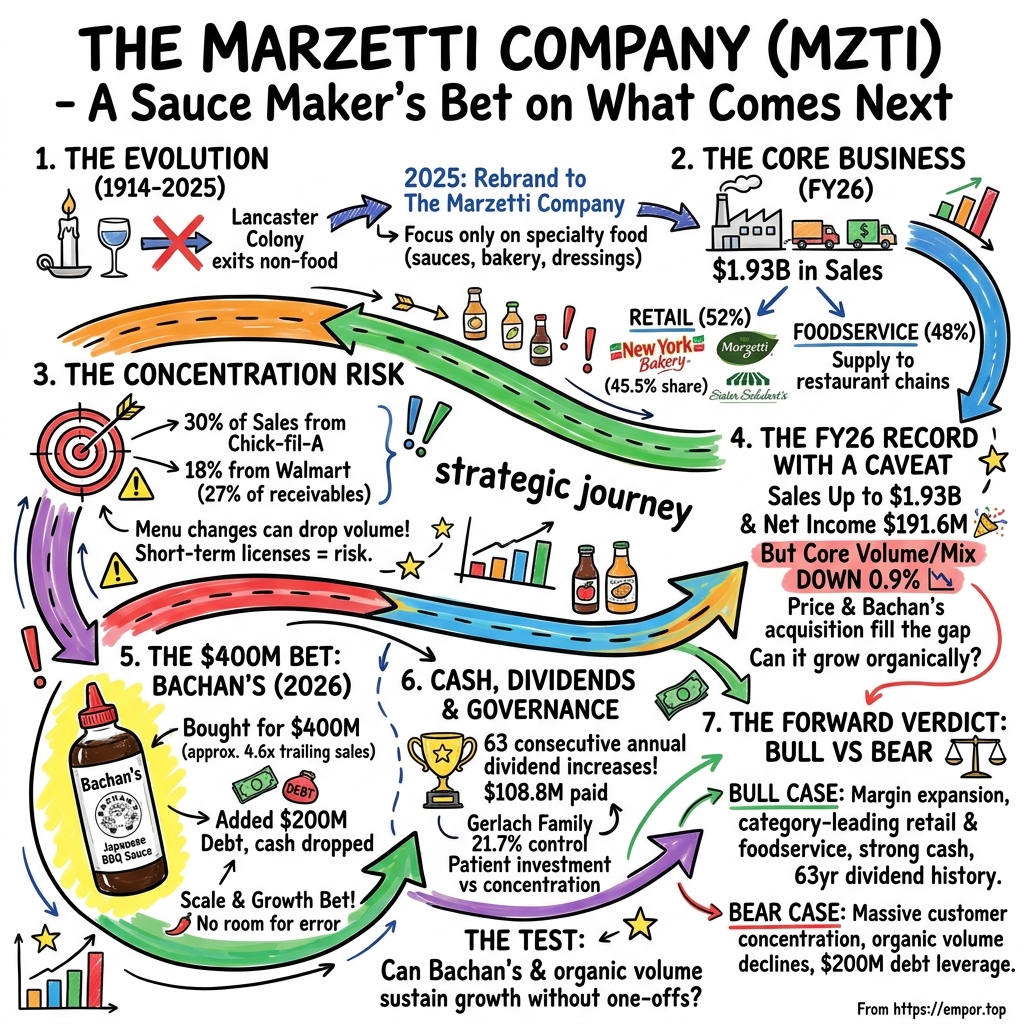
On the morning of August 25, 2026, David Ciesinski opened The Marzetti Company's fourth-quarter call with a sentence chief executives love to say. The fiscal year that ended on June 30 had closed, he told analysts, "with record highs in net sales, gross profit and operating income".1 It was the fourth straight year of record sales and gross profit, and the third straight year of record operating income.1 Net income reached $191.6 million on sales of about $1.93 billion.2 For a company that makes salad dressing, frozen garlic bread and dinner rolls, those are quietly impressive numbers.
Then the chief financial officer, Tom Pigott, walked through where the growth had come from, and the record began to look different. For the full year, reported sales rose 1.1%.2 Strip that increase into its parts and the picture inverts. The underlying business, which Marzetti measures as "core volume and mix", the pounds of product it actually shipped and the blend of what was in those pounds, shrank by 0.9%.2 Price increases added 0.9 percentage points. Two months of a newly acquired Japanese barbecue sauce brand, Bachan's, added 0.8 points. And a temporary supply agreement, under which Marzetti made sauces for the seller of a factory it had bought, added another 0.3 points before it expired.2
Put plainly, every dollar of reported growth came from something other than customers buying more of the same Marzetti products. Pricing is earned, but it is also the first lever any food company pulls in an inflationary year. Bachan's was bought, not grown. And the temporary agreement was, by name and by design, temporary. The fourth quarter made the point even more sharply. Reported sales in that quarter fell 2.2% to $465 million; core volume and mix, excluding Bachan's, fell 3.3 points, while the end of the temporary supply sales cut another 2.6 points.1
None of this makes the record fake. Marzetti really did earn more money in fiscal 2026 than in any prior year, and it did so in a year when soybean oil, its most important single ingredient, was surging.1 But a record built on price, an acquisition and a one-time contract is a different animal from a record built on rising demand. It tells an investor that management can protect profit. It does not yet tell them the engine underneath is accelerating.
That distinction frames the three questions this story keeps returning to. The first is whether Marzetti's branded products and the restaurant brands it licenses can keep earning space on grocery shelves and restaurant menus, when two customers already account for nearly half of the company's sales. The second is whether years of factory investment can be turned into returns that last, rather than margin gains that fade once the easy savings are gone. The third is whether the roughly $400 million purchase of Bachan's can earn its price without squeezing a balance sheet that, until this spring, carried no debt, and a dividend that has risen every year for 63 years.31
It helps to know what kind of company is being asked these questions. The Marzetti Company is a listed specialty food manufacturer, based in Westerville, Ohio, that until June 2025 was called Lancaster Colony Corporation.2 It reports two segments. Retail, which sells branded and licensed products to grocers, mass merchants and club stores, produced about $1.0 billion of sales in fiscal 2026. Foodservice, which supplies restaurant chains with custom sauces, dressings, breads and frozen pasta, produced about $927 million.2 The portfolio mixes brands Marzetti owns, such as Marzetti dressings, New York Bakery garlic bread and Sister Schubert's rolls, with brands it licenses from restaurants, such as Chick-fil-A, Olive Garden and Texas Roadhouse, and with products made to a single customer's recipe.2 That mix is the company's strength and its vulnerability at the same time.
By late October 2026, the stock market had already reached its own provisional verdict. The shares closed at about $109 on October 23, roughly 38% below their 52-week high of about $176.4 At that price the company was valued at about $3 billion, or roughly 16 times trailing earnings.4 The market was no longer paying for a steady compounder. It was asking for proof. To see why the bar moved, the story has to go back to the decision that turned a maker of candles and glassware into a company whose fortunes rest on a squeeze bottle.
 Subscribe on LinkedIn
II. From Candles and Glass to the Dinner Table
On January 30, 2014, Lancaster Colony sold effectively all of the operating assets of its candle business.5 It was not a dramatic transaction by Wall Street standards, but it closed a chapter that had lasted half a century. The sale, the company said, "marked the divestiture of our last remaining non-food business".5 What had started in 1961 as a diversified Ohio holding company, with glassware, candles and a scattering of industrial operations, was now a food company and nothing else.5
The old businesses matter today only because of what they reveal about how the company thinks. Lancaster Colony had owned the T. Marzetti dressing business for decades alongside its other operations, and over time the food side simply grew into the most valuable thing the company owned. Management's response was not to keep juggling, but to narrow. In its 2016 annual report, the company described a strategy that had shifted from operating businesses "in a variety of industries" toward emphasizing its specialty foods business.5 Focus was a deliberate choice, made by a family-influenced company with the patience to unwind its own history one sale at a time.
The food-only company that emerged had a recognizable pantry. In fiscal 2016 it sold Marzetti refrigerated dressings in the produce aisle, New York Bakery garlic toast and Sister Schubert's dinner rolls in the freezer case, egg noodles under the Inn Maid and Amish Kitchen names, croutons, and a recent purchase, Flatout flatbread wraps.5 It already made Olive Garden dressing under license, a seed of what would later become one of its most important growth engines.5 That year, net sales were about $1.19 billion and net income was $121.8 million.5
Ten years later, sales had reached about $1.93 billion.2 That is a long-run climb of roughly 5% a year, steady enough to look almost inevitable on a chart. Management likes to frame the history even longer: a slide in its March 2026 investor presentation showed net sales compounding at about 11% a year from fiscal 1972 through fiscal 2025, counting only the food businesses.6 The smoothness of that line is part of the company's appeal. Dressing, bread and dipping sauce do not go out of fashion in a recession.
Earnings tell a bumpier story. Net income fell to $111.3 million in fiscal 2023, below where it had been in fiscal 2016, then recovered to $191.6 million in fiscal 2026.27 The dip was not an accident of the economy alone. In fiscal 2022 the company recorded $35.2 million of restructuring and impairment charges, much of it tied to exiting Bantam Bagels, a stuffed-bagel brand it had acquired, and to lowered forecasts for Angelic Bakehouse, a sprouted-grain bread brand.8 In fiscal 2023 it wrote down the Flatout brand by $25.0 million because projected sales and profitability had fallen short.8 At the same time it was swapping out its core computer systems for a new SAP enterprise platform under a multi-year program called Project Ascent, and completing a 225,000-square-foot expansion of its flagship dressing plant in Horse Cave, Kentucky.8 Those were investments in the future, but they cost money and attention in the present.
The man steering through that stretch was David Ciesinski. He arrived in April 2016 as president, after a career in big-company packaged food: more than a decade at H.J. Heinz, where he rose to lead global business development, followed by a role running Kraft's meals and desserts business.7 He became chief executive in July 2017, succeeding John Gerlach Jr., who had run the company as CEO since 1997 and who stayed on as executive chairman until December 2023.7 The contrast between the two men says a lot about the company's evolution. Gerlach was the family steward, a long-serving owner-operator whose family controlled roughly 30% of the stock in 2016.5 Ciesinski was a professional manager from the world of national brands, hired to modernize a business that had grown comfortable.
His fingerprints are on almost every decision in this story. He oversaw the ERP replacement, the plant expansions, the exits from Bantam, Angelic and Flatout, the push into restaurant licensing, the purchase of an Atlanta factory and, in 2026, the Bachan's deal.82 He also oversaw the most symbolic move of all. In June 2025, Lancaster Colony took the name of its best-known food brand, The Marzetti Company.2 The rename was the final step in a process that began with the candle sale: a company that had once been defined by what it owned was now defined by what it sold.
That history supports one claim and narrows another. It supports the idea that this company can make long, patient strategic moves; the exit from non-food businesses took years and was completed. It narrows the idea that focus alone produces growth, because the food-only era also includes several acquired brands that had to be written down and sold. Focus put Marzetti on the right shelves. Whether it keeps winning there depends on something more granular: what actually happens when a purchase order arrives.
III. The Product Leaves the Factory One Purchase Order at a Time
Picture the moment a Marzetti sale actually happens. A distributor serving Chick-fil-A restaurants sends a purchase order for cases of sauce. A Walmart buyer orders pallets of frozen garlic bread for the holiday season. A regional grocer restocks Marzetti slaw dressing. Each order is its own small contract. Marzetti makes the product, ships it, and books the revenue when control passes to the customer. Performance obligations generally settle within 30 days, and most payment terms run under 60 days.2
That mechanic matters more than it looks, because it tells an investor what kind of revenue this is. Marzetti does not disclose any minimum purchase commitments from customers, and it does not report a recurring-revenue share.2 There is no subscription, no take-or-pay contract and no backlog that guarantees next year's shipments. What it has instead is repeat purchasing: households that buy the same dressing month after month, and restaurant chains that serve the same sauce in every location. Repeat purchasing can be remarkably durable. But it is earned again with every order, and it responds to everything from restaurant traffic to grocery promotions to a customer's decision to change its menu.
The two segments split the business almost in half. Retail produced 52% of fiscal 2026 sales and Foodservice 48%.2 Inside Retail, shelf-stable dressings, sauces and croutons made up about 22% of total company sales, frozen breads about 20%, and refrigerated dressings and dips about 10%.2 That is where the familiar brands live: Marzetti in the produce aisle, New York Bakery and Sister Schubert's in the freezer, and the licensed restaurant names, from Chick-fil-A sauces to Olive Garden dressing to Texas Roadhouse rolls.2 Foodservice is a different business wearing the same apron. About 35% of company sales come from dressings and sauces sold to restaurants, and another 13% from frozen breads and pasta.2 Most Foodservice products are custom-formulated for a specific chain, and most are delivered through distributors rather than directly.2
Who buys all of this? The honest answer is: a remarkably small number of very large customers. Chick-fil-A accounted for 30% of Marzetti's consolidated sales in fiscal 2026, counting both the sauces it buys for its restaurants and the Chick-fil-A-branded products Marzetti sells into grocery stores under license.2 Walmart accounted for 18%, and that figure overlaps with Chick-fil-A because Walmart sells some of the licensed Chick-fil-A bottles.2 Within the segments, the top five Retail customers took 62% of Retail sales, and the top five direct Foodservice customers, mostly distributors, took 57% of Foodservice sales.2 The company does not publish a consolidated top-five or top-ten customer share. But two customers alone sit at or near half of revenue, so the shape is not in doubt.
The money owed tells the same story. Walmart represented 27% of Marzetti's receivables at June 30, 2026, and no other customer exceeded 10%.2 Net receivables were about $106 million, up from about $96 million a year earlier, a modest increase for a company that had just added Bachan's.2 The allowance for doubtful accounts was immaterial in every year presented.2 Marzetti says it considers aging and write-off history in setting that allowance, but it does not publish an aging table or a history of overdue balances.2 For a supplier whose largest debtor is the world's biggest retailer, the credit risk is less about default and more about leverage: a customer that large sets the terms.
There is one question investors in family-influenced companies often ask, and here it has a clean answer. The 10-K states that there were no related-party transactions that materially affected the company's results, cash flows or financial condition.2 The proxy discloses family ownership and board relationships but no material company transactions with the family.7 Marzetti does not publish a separate percentage of sales or costs involving related parties, because, on its own account, there is nothing material to report.
That leaves the licensing model, which is both Marzetti's cleverest distribution idea and its most obvious dependency. A restaurant name on a grocery bottle does a lot of work. Shoppers already know what Chick-fil-A sauce tastes like; they do not need to be persuaded to try it. But those names belong to the restaurants. Marzetti's brand license agreements are typically for a fixed term with no automatic renewal, and the company warns that they may not be renewed or could be terminated, in some cases on short notice.2 The same partnership that puts Marzetti on the shelf also gives the partner a say in whether it stays there.
So Marzetti is a repeat-purchase food business, not a recurring-revenue contract business. The distinction is the right lens for the next question, which is whether those restaurant logos amount to a competitive advantage or simply a borrowed one.
IV. The Restaurant Logos That Put Marzetti on the Shelf
Walk down the condiment aisle of a large American supermarket and there it is: a bottle of Chick-fil-A sauce, the same honey-mustard-barbecue blend that customers dip their nuggets into at the drive-through, now sitting beside ketchup and ranch. The label says Chick-fil-A. The bottle was made and distributed by Marzetti, under an exclusive license.2 It is one of the most interesting supply relationships in American packaged food, and it captures both sides of the Marzetti moat argument in a single product.
To judge that argument, start with the battlefield. Packaged sauces, dressings and frozen bakery products are crowded categories. Marzetti competes against national food giants with far larger marketing budgets, against store brands that undercut on price, and against smaller brands with loyal followings.2 The company itself describes all of its markets as "highly competitive in the areas of price, quality and customer service".2 In grocery, its neighbors on the shelf include products from Kraft Heinz, Conagra and McCormick, along with private-label alternatives. In restaurants, the big distributors such as Sysco and US Foods control the trucks, while manufacturers compete to be the chain's chosen supplier for a given sauce or bread. Comparable market-share figures across these companies are not published in a like-for-like way, so any ranking would be guesswork.
What Marzetti can show is leadership in particular niches. In the frozen garlic bread category, its New York Bakery brand held about 45.5% of scanner sales in the quarter to June 2026, after gaining 2.2 percentage points of share.1 In frozen dinner rolls, Sister Schubert's and the licensed Texas Roadhouse rolls together held about 61.7%.1 In croutons, Marzetti's brands held 28.4%, and in produce-aisle dips the Marzetti brand held roughly three-quarters of the category.13 Those are real positions. In each case the company is not a challenger fighting for a toehold. It is the default choice on the shelf.
The most dramatic recent proof point is the Texas Roadhouse dinner roll. Marzetti began expanding national grocery distribution for the licensed rolls in August 2025.6 In the 52 weeks to June 2026, the product delivered $58 million in retail sales, up 76%, and fourth-quarter sales were up 28.1%.1 Ciesinski told analysts that sales per distribution point were nearly twice the category average, and that household penetration was still only about 2.5%.1 That is the dream scenario for a licensing model: a beloved restaurant item, a manufacturer with the bakery capacity to produce it at scale, and a consumer who already knows the product before seeing it in the freezer.
Across the licensed portfolio, Marzetti said retail scanner sales of its licensed brands reached nearly $560 million in calendar 2025, up 6.7%.6 The company also said it supplies 17 of the top 30 national restaurant chains.6 Its pitch is that the two sides reinforce each other. Restaurants trust Marzetti with their recipes because it already makes their sauces at scale; grocers stock the licensed products because the restaurant brands bring shoppers.
Now apply the test that matters: what would break this advantage? The mechanism is not a rival with a better ranch. It is customer power. Chick-fil-A's share of Marzetti's total sales rose from 28% in fiscal 2024 to 29% in fiscal 2025 and 30% in fiscal 2026.2 Walmart held near 18% to 19% throughout.2 The fastest-growing relationships were concentrating the business, not diversifying it. And when big customers change course, Marzetti feels it immediately. In the back half of fiscal 2025, two national chain restaurant customers changed their menus to focus on value offerings, and Marzetti's Foodservice sales took the hit.9 The supplier did nothing wrong. The customer simply decided to sell something different.
Switching costs are the other test, and here the evidence is thinner than the bull case would like. In restaurants, a custom-formulated sauce produced at food-safety standards across thousands of locations is not trivial to move. Reformulation, testing and supply-chain qualification all take time, which is a real source of stickiness. But Marzetti does not disclose customer retention rates, contract lengths or bid outcomes, and its revenue arrives through purchase orders rather than long-term commitments.2 On the retail side, a license that ends takes the brand with it. The products Marzetti makes for Chick-fil-A, Olive Garden or Texas Roadhouse are only Marzetti's to sell for as long as the restaurant agrees.
Run the industry through Michael Porter's five forces, once, and the picture is consistent. Buyer power is high, because a handful of chains and retailers control access to the end consumer. Rivalry is real, and private label caps how far prices can climb. Supplier power shows up as commodity inflation in soybean oil, flour and dairy that Marzetti must pass on or absorb. Substitutes are everywhere, from a different dressing brand to a homemade vinaigrette. The threat of new entrants is moderated by food-safety, capacity and quality hurdles, but a well-funded competitor or a restaurant's alternative co-packer can clear them.
That leaves a narrower moat than the record-year headlines imply. Category leadership in garlic bread and dinner rolls, a proven ability to commercialize restaurant brands, and trusted relationships with large chains are real assets. They are not proof of pricing power or permanent customer lock-in. The evidence that would confirm or weaken the moat is observable: category share in the frozen and dressing aisles, renewals of the major license agreements, and organic pounds shipped. And on that last measure, the record of fiscal 2026 was mixed enough to need its own chapter.
V. The Growth Story Runs Through a Mixed Pantry
By the end of fiscal 2026, Marzetti's pantry looked like a store where some shelves were being restocked daily and others were gathering dust. On one side, Texas Roadhouse rolls were a bright spot. On the other, the refrigerated salad dressing case, the business the company was literally founded on, had become what Ciesinski called "a bit of a drag for the last few quarters".1
Start with the winners, because they are real. The Texas Roadhouse rolls are the obvious headline. New York Bakery's share of frozen garlic bread rose from about 44.6% in the December quarter to 46.7% in the March quarter, before easing to 45.5% in June.3101 Chick-fil-A sauces benefited from new distribution in club stores, which began in the spring of 2025, and grew sales by 6.7% in the December quarter.3 In Foodservice, Marzetti's large national accounts, Chick-fil-A, Domino's and Taco Bell among them, kept winning customers in a tough restaurant market, and Marzetti won with them.1 Foodservice pounds shipped rose 0.9% for the year, though only 0.3% excluding the temporary supply sales.2
Now set the losers beside them. Consolidated pounds shipped fell 0.2% for the year; excluding the temporary supply sales, they fell 0.6%.2 Retail volume fell 1.9%, and excluding Bachan's it fell 3.2%, hurt by lower sales into the club channel.2 Retail segment operating income declined 3.8% to about $204 million.2 The pattern is clear enough: the company's newest licensed and frozen products were growing, but the larger base of its retail business, particularly dressings, was shrinking.
Three forces explain much of the gap. The first is customers changing what they sell, as the two restaurant chains did in fiscal 2025. The second is the hangover from pipeline fills. When a product like Chick-fil-A sauce first enters club stores, or Texas Roadhouse rolls enter grocery chains, the initial orders fill warehouses and shelves. The next year, Marzetti has to lap those one-time orders, which makes ordinary growth look like decline. In the third quarter, management blamed a 5.6% drop in Retail volume on three things: harsh winter weather in the Northeast, a roughly 5% decline in produce and refrigerated dressing categories, and lapping the club-channel and Texas Roadhouse pipeline builds.10 The third force is the temporary supply agreement, which had flattered fiscal 2025 and early fiscal 2026 and then disappeared, leaving a hole in the year-over-year comparison.1
The earnings calls show how the story evolved, and they offer a useful test of management's forecasting. On the February 2026 call, Ciesinski said Marzetti was "set up to deliver low single-digit volume growth" in Retail after a weak December quarter.3 He also said there was "most certainly a case" that Texas Roadhouse rolls could be working toward a $100 million retail run rate by the end of the fiscal year.3 Neither happened on that timetable. Retail volume fell in each of the following two quarters, and the Texas Roadhouse rolls finished the year well short of that mark.101 By August, the $100 million figure had become a potential rather than a destination, conditioned on doubling household penetration from about 2.5% toward 5%.1
The analyst questions on the August call were revealing because they pushed on exactly these soft spots. Jefferies' Scott Marks asked why core Retail volume, excluding Bachan's, was down roughly 7% in the quarter. Ciesinski answered by pointing to strength in bakery and Foodservice, then acknowledged that dressings and licensing were "an area where we continue to need to focus".1 Benchmark's Todd Brooks asked how fast the licensed portfolio would grow in fiscal 2027. Ciesinski said that, excluding the noise from the Chick-fil-A pipeline build, licensed sauces would be "closer to flat", with room to grow in licensed dough products.1 That is a candid answer, and an important one. For several years, licensing was the growth engine. Management now describes it as an engine idling in sauces and revving only in bread.
There is also a structural target to measure against. Marzetti's own strategy defines winning as growing organic sales volumes, measured in pounds shipped, by a low- to mid-single-digit rate.6 In fiscal 2026, consolidated volume fell slightly. And management's fiscal 2027 outlook, given in August, calls for mid-single-digit revenue growth overall but a "modest decline on the base" in Retail, with growth carried by Bachan's.1 The July 2026 Cyclospora outbreak linked to produce added a fresh headwind: lettuce sales fell as much as 30% at the low point, dragging produce-aisle dressings down with them, and management had expected a net sales hit of about 2.5 percentage points in the September quarter.1
The fair verdict is that Marzetti has genuine growth pockets, but company-wide organic demand is not yet broad enough to make the growth case self-evident. The cleanest way to settle the question is not another quarter of scanner highlights. It is the fiscal 2027 report of organic sales and pounds shipped by segment, excluding Bachan's and the expired supply agreement, alongside retailer category share and licensed-product growth once the pipeline fills have washed through. If those numbers turn positive, the record year will look like the start of something. If not, the profit growth will have to come from somewhere else, which is where Marzetti's factories come in.
VI. The Margin Record Meets the Cost of Staying Competitive
In August 2025, production stopped at Marzetti's sauce and dressing plant in Milpitas, California.2 The decision had been made the year before, part of what management called an ongoing effort to optimize its manufacturing network.2 Work moved to the expanded plant in Horse Cave, Kentucky, and to the newly purchased factory near Atlanta.1 Then, in the fourth quarter of fiscal 2026, Marzetti sold the Milpitas property for more than $20 million and booked an $18.5 million gain.1 It was a tidy ending to a factory closure. It also happened to land in the same year as the company's record operating income.
That coincidence is the right place to start a test of Marzetti's margin story, because the margin story is the strongest part of the bull case. In the fourth quarter, Pigott noted that gross margin had expanded for the twelfth consecutive quarter.1 He credited productivity programs across procurement, manufacturing, value engineering and distribution, along with revenue management and pricing that offset commodity costs.1 Gross profit grew from about $432 million in fiscal 2024 to about $477 million in fiscal 2026.2 Three years of uninterrupted improvement in a period of volatile ingredient prices is not luck. It reflects real operating work.
Now look at what happened below gross profit. In fiscal 2026, gross profit rose by about $21.6 million. Selling, general and administrative expenses rose by about $24.4 million, more than the entire gross-profit gain.2 Some of that increase was one-off: acquisition costs for Bachan's, including investment-banking fees, integration expenses and amortization of newly acquired intangible assets.1 Some was structural: higher IT and personnel costs, and the added overhead of running Bachan's.2 Either way, the operating income line only reached a record because of help from the line called restructuring, impairment and other. That line swung favorably by about $23.1 million in the fourth quarter alone, driven mainly by the Milpitas gain and lower restructuring costs.1
Strip out those moving parts and the picture is more modest. Management's own adjusted operating income, which excludes acquisition costs and restructuring items, grew 4.2% for the year, against 8.3% on a reported basis.1 Reported fourth-quarter earnings per share rose 49.2% to $1.76; adjusted earnings per share rose about 9% to $1.46.1 Neither figure is wrong. But the reported numbers overstate how much recurring profit the business added in fiscal 2026.
The segment split shows where the operating gains actually landed. Foodservice operating income rose 17.7% to about $131 million, driven by cost savings, pricing, a better product mix and the benefits of IT investments.2 Retail operating income fell 3.8%.2 Pigott explained that the network moves, exiting Milpitas, shifting work to Horse Cave and ramping up the Atlanta-area plant at College Park, had benefited Foodservice first.1 In other words, the factory work is paying off, but mostly on the side of the business that sells to Chick-fil-A and other chains, while the branded Retail side was absorbing weaker volumes and inflation.
The investment behind those gains is substantial, but not exotic. Research and development stayed below 1% of sales in each of the last three years, which is normal for a food company whose innovation is mostly recipe and packaging work rather than laboratory science.2 Capital spending is the bigger commitment. Property additions rose from about $68 million in fiscal 2024 to $78 million in fiscal 2026, and management expects about $90 million in fiscal 2027.21 The largest single piece of next year's budget is the College Park facility, where Marzetti is adding manufacturing capacity primarily to support growth with Chick-fil-A.1 That detail is worth pausing on. The company's biggest capital project is, in effect, a bet on its biggest customer.
Headcount moved in the opposite direction from sales. Marzetti reported 3,500 employees at June 30, 2026, down from 3,700 a year earlier, while sales rose about 1%.29 That looks like productivity, and some of it surely is, since closing a plant and consolidating production should require fewer people. But headcount alone does not prove sustainable efficiency. A smaller workforce running harder to cover volume gaps would look the same on a cover page. The better evidence is the gross-margin trend itself, which has now held for three years.
Then there is the ingredient that keeps procurement teams awake: soybean oil, the base of most dressings and many sauces. On the August call, Stephens analyst Jim Salera noted that soybean oil prices were up nearly 40% year to date.1 Ciesinski said Marzetti had protected itself through earlier purchases and new pricing. In the 10-K's precise language, Marzetti does not use derivative contracts to hedge commodity prices. Instead, it uses a structured forward-purchasing program for key materials such as soybean oil, dairy and flour, plus short-term fixed-price arrangements on other inputs.2 Many Foodservice contracts let Marzetti pass cost changes through to customers, while Retail must take pricing in the market.10 The consequence is simple: when commodity inflation hits, the company's margin depends on how fast it can raise prices and how much it can save elsewhere. For fiscal 2027, management expects about 5% commodity inflation, with pricing and cost savings offsetting it and gross margin expanding by about 100 basis points, roughly half from Bachan's richer margins and half from the base business.1
Two small items round out the profit picture. First, fiscal 2026 operating cash flow benefited from tax timing under the One Big Beautiful Bill Act, the federal tax law enacted in July 2025.2 That boost is real cash, but it is not a repeatable improvement in the business. Second, the line labeled "Other, net" contributed about $5.0 million of income in fiscal 2026, down from $7.1 million a year earlier, mainly because interest income fell.2 It is treasury income on cash balances, not foreign-exchange gains; Marzetti's sales are predominantly domestic, and the company reports no currency-hedging program.2 With most of that cash now spent, the line is likely to shrink further.
The verdict on margins is therefore split. Productivity, procurement and pricing have genuinely improved Marzetti's gross margin, and the company has delivered that improvement consistently. But fiscal 2026's reported earnings overstate the recurring contribution, thanks to a property gain, favorable restructuring comparisons and tax timing. The next proof is gross-margin progress that continues alongside positive organic volume and normalized operating income. And the biggest variable in that equation, for fiscal 2027 and beyond, is the brand Marzetti bought for $400 million.
VII. Bachan’s: A $400 Million Test of the Playbook
Justin Gill's grandmother had a barbecue sauce recipe. In Japanese, a grandmother is a ばあちゃん bachan, and when Gill launched a brand built on her multigenerational recipe in 2019, from Sebastopol, California, he named it for her.116 The sauce was a Japanese-American twist on barbecue: soy-based, sweet and savory, cold-filled rather than cooked, made with non-GMO ingredients and minimal processing.116 It found its first big audience at Costco and then spread into mass merchants such as Walmart and traditional grocery stores.3 By calendar 2025, Bachan's had net sales of about $87 million, and its revenue had compounded at about 48% a year from 2022 to 2025.113
On February 3, 2026, Marzetti announced that it had agreed to buy Bachan's for $400 million in cash.11 The timing was almost theatrical. Ciesinski told analysts on that morning's call that the deal had been signed the night before, after Marzetti had tracked the brand for about four years and participated in a sale process advised by Centerview Partners on the seller's side and Goldman Sachs on Marzetti's.311 The deal closed on May 1, 2026.10 After customary adjustments, Marzetti paid about $399.3 million, net of cash acquired.2
Management's rationale was straightforward. Marzetti believes it has "best-in-industry culinary and product development capabilities" in sauces and dips, plus deep retail relationships and a Foodservice business that serves large chains.3 Bachan's had a premium brand, strong appeal with Millennials and Gen Z, and room to extend from barbecue sauce into marinades, glazes, dips and other categories.3 By the May call, Ciesinski framed the deal as more than one brand. He called Bachan's the first of what Marzetti hoped would be more acquisitions in an area it calls "authentic flavors", a third growth leg beside its legacy brands and its restaurant licenses.10 That framing matters. It means Bachan's is not just an acquisition. It is the test case for a new strategy.
What the price asks Bachan's to become
Start with the arithmetic. $400 million for a business with about $87 million of trailing sales is roughly 4.6 times revenue.11 For a packaged-food business, that is a premium multiple, the kind paid for brands that are growing fast and have room to keep growing. Marzetti did not disclose Bachan's standalone EBITDA, so the earnings multiple is not published. But the company did give one clue. In May, it guided that Bachan's would run at a sales rate "moderately above" $87 million, with an operating margin similar to Marzetti's.10 Marzetti's own fiscal 2026 operating margin was about 12%.2 If Bachan's generates something like $90 million to $95 million of sales at that kind of margin, its operating profit before synergies is in the region of $11 million to $12 million a year. On that rough estimate, Marzetti paid on the order of 35 times pre-tax operating profit. Put another way, the immediate pre-tax return on the purchase price is around 3%, less than the roughly 4.8% interest rate on the term loan that funded half of it.1
That calculation does not prove Marzetti overpaid. Broad packaged-food deal comparisons cover businesses too different in growth, scale and margin to settle the question, and acquirers of fast-growing brands always pay for the future rather than the present. But it shows how much the future has to deliver. For the deal to earn a return comfortably above the company's cost of capital, Bachan's needs to grow substantially, expand its margins through procurement and manufacturing synergies, or both.
Management says both are underway. In August, Pigott said Marzetti was already realizing procurement synergies and that the synergy case was "pretty much in line" with expectations.1 The company is launching Bachan's Wing Sauce, developed with Marzetti's culinary team and produced at Horse Cave, and a Bachan's Japanese mayonnaise, entering a category Ciesinski described as about $3.4 billion in size, compared with about $1 billion for barbecue sauce.1 When Salera estimated fiscal 2027 Bachan's sales at about $100 million, Ciesinski said he expected it to be "stronger than that".1
Early evidence, read carefully
The first numbers are encouraging but small. Bachan's contributed $15.4 million of sales in its first two months under Marzetti ownership, less than 1% of fiscal 2026 revenue.1 It was accretive to gross margin.1 In the March quarter, before closing, scanner data showed Bachan's retail sales up more than 25% with total distribution points up more than 50%, making it the second-largest barbecue sauce brand at retail in that period, behind Sweet Baby Ray's.10
But the June quarter showed something worth watching. Bachan's scanner sales rose 8.7%, and distribution points rose 16.6%.1 That is still growth, but it is a sharp deceleration from the 25%-plus pace of three months earlier and from the 48% compound rate that justified the price. Management's answer is that new products and refined marketing will accelerate growth in the second half of fiscal 2027.1 Ciesinski also offered a revealing number: trial, the share of households that have ever bought the brand, was only about 5% when Marzetti bought it and about 6% by August.1 That is either a huge runway or a sign that the brand is harder to scale beyond its loyal base than the Costco-era growth suggested. Marzetti's distribution access can put more bottles on more shelves. It cannot, on its own, make shoppers who have never heard of Bachan's become repeat buyers.
The financing changed the balance sheet in one stroke. Cash fell from about $161.5 million to about $25.1 million.2 Marzetti borrowed $200 million under a floating-rate term loan, ending a long stretch in which the company carried no debt.210 Goodwill, the accounting residue of paying more than the identifiable assets are worth, rose from about $223 million to about $500 million, and the company recorded about $125 million of new intangible assets.2 Goodwill is tested for impairment each year. If Bachan's disappoints, that is where the reckoning will show up.
It is useful to compare Bachan's with Marzetti's other recent large deployment, the Atlanta factory. In November 2024, the company agreed to buy a 300,000-square-foot sauce and dressing plant from Winland Foods for about $75 million, closing in February 2025.1213 That purchase was capacity: equipment, floor space and proximity to key customers, with a temporary supply agreement attached to help the seller transition.1213 Its returns depend on Marzetti's own volumes and productivity. Bachan's is a different kind of bet. It pays a brand multiple for consumer demand that Marzetti did not create and must now sustain.
And Marzetti's history with acquired brands gives reason to temper the playbook claim. In March 2015, the company bought Flatout, a Michigan-based maker of flatbread wraps, for $92.2 million.5 In fiscal 2023, it wrote Flatout's intangible assets down by $25.0 million because of lowered sales and profit expectations.8 In fiscal 2024, it exited both Flatout and Angelic Bakehouse, recording further impairments on equipment and intangibles.2 Bantam Bagels was exited in fiscal 2022.8 These were smaller deals than Bachan's, and they sat in perimeter bakery categories rather than sauces, Marzetti's home turf. That distinction is fair. But the record narrows the claim that Marzetti can reliably buy a niche brand and scale it. It has done that with licensed restaurant brands. With acquired consumer brands, its recent history is mostly write-downs and exits.
So the Bachan's verdict, for now, is that the strategic fit is plausible and the price is full. The deal at roughly 4.6 times prior-year sales is a sizeable bet on growth, margin expansion and debt paydown. The confirmation evidence will be full-year Bachan's sales, its operating profit and cash generation, and whether distribution gains turn into repeat purchases. Until that evidence arrives, Bachan's is a promise with a $400 million price tag, funded partly by borrowed money. Which raises the question of how the rest of Marzetti's cash commitments fit around it.
VIII. The Dividend Keeps Rising as Cash Takes the Long Way Around
On June 30, 2026, the last day of the fiscal year, Marzetti paid a quarterly dividend of $1 per share, 5% higher than the year before.1 The payment extended a streak of annual dividend increases to 63 years.1 The company says it is one of only 12 U.S. companies with a record that long.6 Two months earlier, it had borrowed $200 million to buy Bachan's. Both facts sit comfortably side by side in management's telling. An investor's job is to check whether they sit comfortably in the cash-flow statement.
Start with how profit turned into cash. Net income was $191.6 million in fiscal 2026, and cash from operations was about $283.8 million, a record.2 The gap is mostly the ordinary math of a manufacturing company. Depreciation and amortization, which reduce profit without using cash, added about $71 million. Stock compensation added about $10 million. Deferred taxes and other items added about $31 million.2 Working capital pulled in both directions: higher inventories absorbed about $27 million, while higher payables and accrued liabilities supplied about $30 million.2 Over three years, operating cash flow has consistently exceeded net income, from about $252 million in fiscal 2024 to about $284 million in fiscal 2026.2 That is a healthy pattern, but the fiscal 2026 high point owes some of its height to taxes deferred rather than avoided.
Now follow the cash out the door. Capital spending used about $78 million.2 That leaves roughly $206 million of free cash flow before acquisitions. From that, Marzetti paid about $109 million in dividends and repurchased about $36 million of stock, a $28 million increase in buybacks from the year before.1 Together, those shareholder returns totaled about $145 million. The Bachan's purchase, at about $399 million, was funded by roughly $224 million of net borrowing proceeds and by drawing down the cash pile.2
The dividend looks well covered by current earnings. The $3.95 per share paid in fiscal 2026, against about 27.3 million shares outstanding, comes to a payout of roughly 57% of net income.2 It is also covered by free cash flow, with room to spare. But the cushion narrows when the one-off items are removed. If the tax-timing benefit and the deferred-tax line are set aside, free cash flow falls closer to $175 million. Subtract the dividend at its new $4.00 annual rate, which costs about $109 million, and roughly $65 million is left over each year for debt paydown, buybacks and any further acquisitions.4 That is still positive. It is also a much tighter budget than a company used to sitting on cash is accustomed to. And it rests on capital spending holding near $90 million while the College Park expansion continues.1
The obligations themselves are manageable. At June 30, 2026, Marzetti owed $200 million of term-loan principal, $10 million of it due within a year.2 It had about $25 million of cash, so net debt was roughly $175 million, less than one year of operating cash flow. In its March presentation, management promised pro forma net leverage below 1.0 times and "no change to dividend policy".6 Separately, the company carries about $44 million of operating lease obligations and about $10 million of finance lease obligations, plus a not-yet-started lease for a Columbus warehouse with about $159 million of fixed payments over 15 years.2 That warehouse commitment does not appear as debt, but it is a long-dated fixed obligation that a careful analyst would include.
The credit terms leave plenty of headroom. The bank facility caps leverage at 3.5 times and requires interest coverage of at least 2.5 times; Marzetti met both by substantial margins.2 It had no revolver borrowings at year-end.2 The term loan is floating-rate, with an effective interest rate of about 4.8% at June 30, so it moves with short-term rates.1 The loan also has a springing maturity: if the revolving credit facility is not extended or refinanced, the term loan becomes due in March 2029.2 That is a watch point rather than a warning, but it puts a date on the calendar. Marzetti has no public credit rating reported in its 10-K, so the bank facility itself is the main external signal on credit.
The dividend record is a genuine achievement, earned across decades that included inflation spikes, recessions and the transformation of the company itself. But a streak is not a funding source. It is a promise, and it is paid from free cash after capital spending and debt service, not from tradition. The test from here is simple to state. Watch operating cash flow without the favorable tax timing, dividend coverage after capital expenditures, and the term-loan balance as Bachan's is integrated. If all three move in the right direction, the dividend's long streak is safely backed by the business. If one weakens, the family that has always set this company's long horizon will face harder choices, which is the governance question the next chapter takes up.
IX. The Family Company’s Long View Has a Governance Test
On November 11, 2026, Marzetti's shareholders will log into a virtual meeting to elect three directors, cast an advisory vote on executive pay and ratify Deloitte & Touche as auditor.7 It will be, by any normal standard, an uneventful meeting. Yet it is the one moment each year when the company's unusual ownership structure becomes visible, because a large share of the votes cast will trace back to a single Ohio family.
The Gerlach family has shaped this company for generations. John Gerlach Jr., the former CEO and executive chairman, remains the company's longest-serving director.7 According to the 2026 proxy, he beneficially owns about 27.5% of the shares, while Dareth Gerlach reports about 21.7%.7 Those figures overlap heavily through family trusts, so they should not be added together; the largest single trust alone holds about 21%.7 Among outside investors, BlackRock reports about 9.5% and Vanguard Portfolio Management about 5.1%.7 The practical result is that the family bloc is large enough to influence any vote, while the rest of the register is dominated by index-style holders.
Family influence cuts both ways. It is one reason Marzetti could spend years unwinding its non-food businesses, invest through an ERP replacement and keep a dividend streak alive through every cycle. Long-horizon owners can tolerate a few lean years to get the long game right. But concentrated ownership also concentrates power. Independent shareholders have less leverage to force change if strategy drifts, and the board's independence becomes more important precisely because the shareholder base cannot easily act as a check. The proxy says the board and its key committees meet Nasdaq independence standards, and the board is chaired by Alan Harris, a director since 2008, rather than by the CEO.7
The management team is compact and stable. Ciesinski remains chief executive.7 Pigott has been CFO since 2019, after four years in the same role at MGP Ingredients, a distiller and ingredients company.7 Their tenure covers nearly every major decision in this story, which makes accountability unusually clear: the factory strategy, the licensing push, the brand exits and the Bachan's bet all belong to the same team.
Ciesinski's reported compensation was about $5.7 million in fiscal 2026, including about $3.5 million of stock awards and an annual incentive of about $1.2 million.7 That was up from about $5.4 million the year before.7 The board says it keeps a majority of executive pay at risk and tied to corporate performance, through the annual cash incentive and equity grants.7 Pigott's reported compensation was about $2.1 million in fiscal 2026.7 The CEO's pay was about 102 times that of the median employee.7
Set against operating results, the pay looks restrained rather than excessive. Net income rose from about $167 million to about $192 million over the same year.2 But the proxy's pay-versus-performance table offers a sharper lens. It shows that $100 invested in Marzetti stock at the end of fiscal 2021 was worth about $66 by June 2026, against about $87 for the company's peer group.7 The compensation actually realized by Ciesinski, which adjusts for changes in the value of equity awards, was about $2.2 million in fiscal 2026, well below his reported pay.7 In other words, the equity-heavy structure did what it is supposed to do: when shareholders lost money, so did the CEO's equity. That does not prove pay is tied to the right drivers. It does show the alignment is real in both directions. The question for the November vote is whether the incentive metrics keep tracking volume, normalized profit and returns, rather than reported earnings flattered by one-offs.
Shareholders have been comfortable so far. At the 2025 annual meeting, the say-on-pay proposal passed with about 24.6 million votes in favor and only about 225,000 against.14 Given the family's holdings, that margin is unsurprising, but it also shows no visible revolt among outside holders. The fiscal 2026 vote is still ahead as of October 24, 2026.
One leadership change deserves a sentence of attention rather than a paragraph of speculation. Tanya Berman, who joined from Mondelez in April 2025 to run the Retail division, ceased serving in that role effective October 6, 2026.7 She is expected to stay on as an employee through December 31, and the terms of her severance had not been determined when the proxy was filed.7 Her departure after about 18 months comes from the segment where volume and operating income were weakest. It is a transition worth tracking, not a thesis on its own.
The wider risk picture is quiet. The company was party to ordinary-course claims and litigation that it did not expect to materially affect its financial statements.2 Deloitte issued an unqualified opinion on both the financial statements and internal controls, with no emphasis-of-matter paragraph reported.2 Deloitte has been the auditor since 1961, a very long tenure that is common among old-line industrial companies and that some governance investors would flag as a reason for fresh eyes.2 And because sales are predominantly domestic, currency is not a meaningful earnings driver.2
The governance verdict is that continuity supports credibility, while family control concentrates influence. The record shows no material related-party drain, sensible pay design and a board structure that meets independence standards. The next signal is the November vote, followed by the severance disclosure and whatever leadership choice the company makes for its Retail division. With that context in place, the investment case can be assembled in full.
X. Analysis & Bear vs. Bull Case
On October 23, 2026, Marzetti's shares closed at about $109.4 A year earlier, investors had been willing to pay as much as $176.4 At the October price, the market valued the company at about $3 billion, about 16 times trailing earnings, with a dividend yield near 3.7%.4 Those figures are a dated snapshot, not a conclusion, but they say something important. The market has moved from paying for Marzetti as a steady, premium-quality compounder to asking whether its recent profit growth can survive without pricing, acquisitions and one-off gains.
The case for the bull
The optimist's version starts with category leadership. Marzetti leads frozen garlic bread with New York Bakery, leads frozen dinner rolls with Sister Schubert's and the licensed Texas Roadhouse rolls, and holds strong positions in produce-aisle dressings, dips and croutons. These are not glamorous categories, but they are durable ones, and leadership in them means shelf space, promotional power and a consumer habit that renews every grocery trip.
The bull case adds manufacturing discipline. Twelve straight quarters of gross-margin expansion, achieved during commodity inflation, a plant closure and a factory acquisition, suggest an operating team that knows how to run plants. The Atlanta purchase, the Horse Cave expansion and the Milpitas exit form a coherent network strategy, and the Foodservice segment's 17.7% operating-income growth is evidence that it is working.
It then adds cash. Operating cash flow has exceeded net income for three straight years. The balance sheet, even after Bachan's, carries net debt of less than one year's operating cash flow. And the dividend record, 63 years of increases, reflects a culture of returning capital that few companies can match. Finally, Bachan's offers a new growth leg with premium margins, a young customer base and early evidence of rising distribution.
The case for the bear
The skeptic's version starts with concentration. Chick-fil-A is 30% of sales and Walmart 18%, with overlap between them.2 Chick-fil-A's share has risen for three straight years, and the company's largest capital project is expanding capacity for that same customer.1 Licenses can end, menus can change and large customers can multi-source. Marzetti's fiscal 2025 menu-change hit shows that this is not a hypothetical risk.
The bear then points to volume. Core volume and mix fell in fiscal 2026, Retail volume fell even excluding Bachan's, and management itself guided to a modest decline in the Retail base for fiscal 2027.1 The company's stated goal of low- to mid-single-digit organic volume growth was not met. Licensed sauces, once the growth engine, are now expected to be roughly flat. And fiscal 2026's reported income included a property gain and favorable restructuring comparisons, while cash flow benefited from tax timing.
Finally, the bear focuses on Bachan's. On a rough calculation from management's own margin guidance, Marzetti paid on the order of 35 times the brand's pre-tax operating profit, financed partly with debt that costs more than the immediate return. Bachan's scanner growth slowed sharply in the June quarter. And Marzetti's history with acquired consumer brands, Flatout, Angelic and Bantam, is mostly a story of write-downs and exits.
Hamilton Helmer's 7 Powers framework helps organize the moat question without repeating the industry analysis already done. Marzetti has some branding power in its owned categories and in the licensed products, where restaurant names carry consumer trust. It has a form of process power in food safety, formulation and large-scale production that chains rely on. It has meaningful scale in specific niches, though not a cost advantage it discloses or that is clearly superior to larger rivals. It does not have network effects. Its switching costs are real in Foodservice but undisclosed in magnitude and limited by short-term purchase orders. It does not hold a cornered resource; the licenses are borrowed, and the most valuable customers can take their business elsewhere. Counter-positioning does not apply. The honest conclusion is that Marzetti has niche strengths, not a broad moat.
The skeptical investor's sharpest question is about capital allocation. Why should shareholders accept an expensive brand acquisition while the company also increases buybacks and its dividend? The fair answer is that the dividend appears covered and the balance sheet can carry the debt. But the answer that will actually settle the question has to come from Bachan's margins, organic volume trends and debt repayment, not from the acquisition story itself.
Three measures will tell investors whether the bull or the bear is closer to the truth. The first is organic pounds shipped and sales excluding the expired supply agreement and Bachan's; in fiscal 2026, consolidated pounds fell 0.2% and core volume and mix fell 0.9%, with Retail weaker than Foodservice.2 The second is category share and licensed-brand growth after pipeline fills normalize; New York Bakery and the frozen-roll franchise gained share, while licensed sauces are guided to roughly flat.1 The third is free cash flow after capital spending, set against term-loan paydown; the starting point is about $206 million of free cash flow in fiscal 2026, flattered by tax timing, against $200 million of debt.2
On valuation, the cited price and multiple are a snapshot. A like-for-like comparison would require peers with similar size, mix and growth, and the market's own judgment can change quickly. What the current multiple suggests is that investors are no longer paying a premium for steadiness. They are pricing a company that must now prove its earnings can grow without the help of pricing and one-off items. That puts the burden of proof where it belongs: on the next year's numbers. Before turning to them, it is worth asking what Marzetti's story teaches beyond Marzetti itself.
XI. Playbook: Business & Investing Lessons
A company that once made glass tumblers and scented candles now spends its days worrying about soybean oil and the shelf life of garlic bread. Along the way, it has bought, scaled, written down, closed and renamed. Its lessons are not the generic kind printed on conference lanyards. They belong to a particular company that learned them on particular shelves.
"A brand can open the door; the repeat order is the business." The Texas Roadhouse roll shows what restaurant licensing can do. But the dependency is real: licenses can end, and one customer accounts for a large share of sales. Founders and investors in any business built on someone else's brand should remember that borrowed equity is still borrowed. The true asset is the repeat order, and the true risk is the renewal.
"A clean strategic story does not make every acquisition work." Lancaster Colony's patient move to a food-only business was a model of focus. Yet the earlier brand exits showed that focus cannot guarantee an acquisition will work. Strategy is a filter, not a guarantee. Bachan's sits squarely in Marzetti's sauce expertise, which is a better fit than flatbread or bagels ever were. But the lesson from the earlier deals is that fit is necessary, not sufficient. Each acquisition must prove its own economics, one shelf and one quarter at a time.
"A rising dividend is a promise made from cash, not from tradition." Sixty-three consecutive increases is a remarkable record. It is also a commitment that now shares free cash flow with a term loan. The lesson for investors is to admire the streak, then test it against tax-adjusted free cash flow and debt repayment. A long record lowers the probability of a cut, but it does not finance the next increase.
"The factory is part of the product." Marzetti's factory moves have improved margins, especially in Foodservice. In food manufacturing, reliability, cost and capacity are not back-office details. They are what keep a restaurant chain from looking for another supplier.
For founders and investors outside food, those four lessons add up to one idea. Every strategic claim eventually meets a shelf, a menu, a factory line and a cash return. Marzetti's story is useful precisely because all four are visible, and because each of its bets can be checked against them.
XII. Epilogue
Tonight, Marzetti stands at the start of the first fiscal year with Bachan's fully inside the company. The temporary supply agreement is gone. The Milpitas plant is sold. The College Park expansion is underway, with about $90 million of capital spending planned for the year.1 The $200 million term loan is on the books. The September quarter, already behind the company but not yet reported, carried a known headwind: management warned that the Cyclospora outbreak would cut operating income by roughly 15% in that quarter.1
The next moments that will decide the story are already scheduled or easily foreseen. The first-quarter results will show whether the Cyclospora estimate held and whether the produce-aisle dressings recovered on the path management modeled from a 2018 outbreak, roughly halving the damage each month.1 The November 11 annual meeting will deliver the say-on-pay vote and director elections, and the severance filing for the departing Retail president will follow.7 Then, over the rest of fiscal 2027, the quarterly reports will answer the questions this story has been asking.
Organic volume is the first. If Retail volume, excluding Bachan's, stabilizes and Foodservice keeps growing, management's description of fiscal 2026 as a year of noise will look accurate. If Retail declines more than modestly, the base business will look structurally weaker than the record year implied.
Bachan's is the second. Management expects stronger growth in the second half of the fiscal year as new products reach shelves in the spring reset and refreshed marketing reaches new households.1 A full year above $100 million of sales, with margins accretive to the company, would support the price Marzetti paid. Growth that stays near the June quarter's single digits would make the purchase harder to justify, and would test the "authentic flavors" strategy before it has a second deal to its name.
Customer concentration is the third. Chick-fil-A's growth is good news as long as it lasts, and the College Park investment is a vote of confidence in that relationship. But each additional percentage point of sales from one customer raises the stakes of every renewal and menu change. Investors should watch whether Retail category share and license renewals hold steady while Chick-fil-A's share rises.
Cash is the fourth. Normalized operating income, after the property gain and tax timing are removed, must cover capital spending, the dividend and steady term-loan repayment. If it does, the 64th dividend increase will be funded from recurring cash. If it does not, the record dividend and the family's long-term patience will both be tested in ways they have not been for decades.
The tension that remains is simple. Marzetti has bet that its next chapter will be written by acquired brands as much as by its own. The coming year will show whether that bet adds a new growth leg or simply covers up a slowing core.
XIII. Outro
Go back to the grocery aisle one last time. On one shelf, a Chick-fil-A sauce bottle, made by Marzetti under someone else's name. In the freezer, New York Bakery garlic bread and Texas Roadhouse rolls, one owned and one licensed, both leading their categories. Nearby, a bottle of Bachan's, a California grandmother's recipe now owned by an Ohio company that used to make candles.
That shelf captures what makes Marzetti a distinctive food supplier. It sits between branded grocery products and the restaurant chains that lend those products their names, with real scale in selected niches and a future still negotiated one order and renewal at a time. Its record year came with a familiar caveat: shipped pounds slipped. The question was always what came next.
At Marzetti, the brand may be on the bottle, but the next order is the proof.
References
-
FY2026 Q4 Earnings Call Transcript — The Marzetti Company, 2026-08-25 ↩↩↩↩↩↩↩↩↩↩↩↩↩↩↩↩↩↩↩↩↩↩↩↩↩↩↩↩↩↩↩↩↩↩↩↩↩↩↩↩↩↩↩↩↩↩↩↩↩↩↩↩↩↩
-
The Marzetti Company Fiscal 2026 Form 10-K — SEC, 2026-08-25 ↩↩↩↩↩↩↩↩↩↩↩↩↩↩↩↩↩↩↩↩↩↩↩↩↩↩↩↩↩↩↩↩↩↩↩↩↩↩↩↩↩↩↩↩↩↩↩↩↩↩↩↩↩↩↩↩↩↩↩↩↩↩↩↩↩↩↩↩↩↩↩↩↩↩↩↩↩
-
FY2026 Q2 Earnings Call Transcript — The Marzetti Company, 2026-02-03 ↩↩↩↩↩↩↩↩↩↩↩
-
The Marzetti Company (MZTI) Stock Quote and Statistics — Stock Analysis, 2026-10-23 ↩↩↩↩↩↩
-
Lancaster Colony Corporation Fiscal 2016 Form 10-K — SEC, 2016-08-24 ↩↩↩↩↩↩↩↩↩
-
Planned Acquisition of Bachan’s Investor Presentation — The Marzetti Company, 2026-03-06 ↩↩↩↩↩↩↩↩↩
-
2026 Proxy Statement — The Marzetti Company, SEC, 2026-10-13 ↩↩↩↩↩↩↩↩↩↩↩↩↩↩↩↩↩↩↩↩↩↩
-
Fiscal 2023 Annual Report — Lancaster Colony Corporation, 2023 ↩↩↩↩↩↩
-
The Marzetti Company Fiscal 2025 Form 10-K — SEC, 2025-08-21 ↩↩
-
FY2026 Q3 Earnings Call Transcript — The Marzetti Company, 2026-05-04 ↩↩↩↩↩↩↩↩↩
-
The Marzetti Company Announces Agreement to Acquire Bachan’s, Inc. — The Marzetti Company, 2026-02-03 ↩↩↩↩↩↩
-
Lancaster Colony to Acquire Sauce and Dressing Production Facility — SEC, 2024-11-18 ↩↩
-
2025 Annual Meeting Voting Results, Form 8-K — SEC, 2025-11-19 ↩
 LinkedIn
 WhatsApp
 Reddit
 Hacker News
 Email
 Kindle
 RSS Feed
 Spotify
 Apple Podcasts
 Amazon Music
 Audible
 YouTube