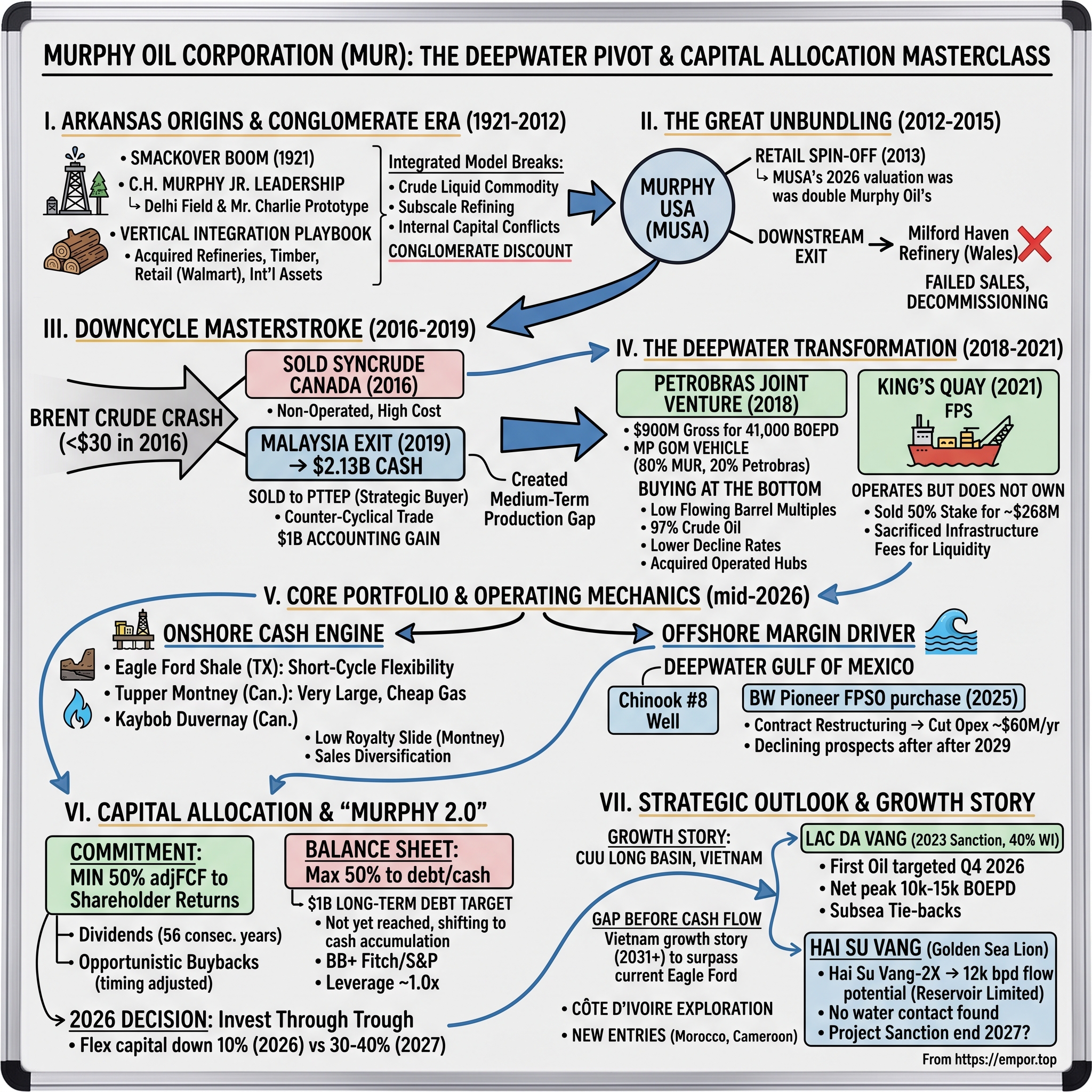
Murphy Oil Corporation: The Deepwater Pivot and the Capital Allocation Masterclass
I. Introduction & Episode Roadmap
On the morning of May 7, 2026, Chief Executive Officer Eric Hambly closed Murphy Oil's first-quarter earnings call with a rare gesture for an executive conference call: a personal tribute to a retiring analyst. Paul Cheng, who covered Murphy for more than thirty years, retired from Scotiabank in March 2026, and Hambly noted that the management team had half-expected his voice to pop up on the line anyway.8 It was a small moment, but a revealing one. Thirty years is long enough to have watched a complete corporate transformation unfold: covering a conglomerate that once owned timberlands, a refinery in Wales, a chain of gas stations attached to Walmart parking lots, a stake in a Canadian oil sands mine, and deepwater fields off Borneo—only to watch every single one of those businesses get sold, spun off, or closed.
What remains today is an exploration and production company valued at roughly $5.7 billion. Headquartered in Houston with historical roots in El Dorado, Arkansas, Murphy produces approximately 174,000 barrels of oil equivalent per day across four primary operational centers: the deepwater U.S. Gulf of Mexico, the Eagle Ford Shale in South Texas, natural gas assets in Western Canada, and its newest focus area, the Cuu Long Basin offshore Vietnam.208
The conventional narrative surrounding Murphy Oil centers on capital allocation. In this version, the company sold its Malaysian assets to Thailand's PTT Exploration and Production (PTTEP) for $2.127 billion in cash near a cyclical peak in asset valuations.3 It then acquired a controlling interest in deepwater Gulf of Mexico assets from Petrobras America during a period of depressed industry appetite for offshore acreage.4 It spun off its retail station network, Murphy USA, allowing public markets to independently value the retail fuel business. Since 2020, management has directed cash flow toward debt reduction and share repurchases under its "Murphy 3.0" framework—committing at least 50% of adjusted free cash flow to shareholder returns while allocating the remainder toward a $1.0 billion long-term debt target.6
While that narrative is largely accurate, it overlooks critical operational and financial nuances that investors must evaluate. Three key friction points stand out:
First, the company has yet to achieve its long-term debt target. Murphy closed the first quarter of 2026 with $1.55 billion in total debt and $1.17 billion in net debt. On the May 2026 call, Hambly acknowledged that existing bond maturity schedules make near-term gross debt reduction difficult, forcing the company to accumulate cash to lower net leverage instead.8 Second, Murphy remains below investment grade despite common market perceptions. Fitch affirmed the credit at BB+ in October 2025 while revising its outlook from positive to stable, citing an accelerated shift toward shareholder returns over debt repayment; S&P maintains a BB+ rating with a negative outlook assigned in 2025; and Moody's rates the debt at Ba2.111213 Third, the company's promoted infrastructure advantage is less absolute than presented: Murphy sold its 50% equity stake in the King's Quay floating production system to ArcLight Capital Partners in March 2021 for approximately $268 million, recouping development capital but relinquishing long-term midstream fee ownership.17
These caveats do not diminish the company's significance; rather, they present a more realistic case study. Murphy is a mid-cap independent producer that successfully carried out a multi-decade portfolio transformation. Today, it is placing a substantial, unhedged exploration bet on Vietnam as its base assets in the U.S. Gulf face natural decline and its capital return framework adapts to operational constraints.
Here is how the story unfolds. Part 1 covers the Arkansas origins and the integrated conglomerate era, kept brief because what matters is why the model broke. Part 2 is the great unbundling: the Murphy USA spin-off and the messy, expensive exit from refining. Part 3 is the downcycle: selling Syncrude and Malaysia. Part 4 is the deepwater pivot and the Petrobras transaction. Part 5 walks the current asset base and how offshore oil actually works. Part 6 dissects the capital allocation framework and where it is bending. Part 7 examines management and governance. Part 8 war-games the competitive position through Helmer and Porter. Part 9 lays out the bull case, the bear case, an activist stress test, the playbook lessons, and the two or three metrics that actually matter from here.
 Subscribe on LinkedIn
II. Origins & The Arkansas Conglomerate Era (1921–2012)
In January 1921, the Busey No. 1 well blew in near Smackover, Arkansas, turning a quiet logging region into a chaotic oil boomtown almost overnight. Charles Haywood Murphy Sr. had arrived in El Dorado around 1905 and spent the intervening years assembling timberland along the Arkansas–Louisiana border—buying acreage before anyone understood what lay beneath it.1 When Smackover erupted, Murphy held a 22% stake, transforming a lumber family into an oil family.1
The foundation of Murphy Oil was not a laboratory or a garage; it was a land position. That origin shaped the company's long-term orientation, establishing asset selection rather than product manufacturing as its core capability.
The company's expansion accelerated under Charles H. Murphy Jr., who assumed leadership after returning from the Second World War. In 1944, a joint venture with Sun Oil discovered the Delhi field in northeast Louisiana, elevating the family enterprise into the ranks of major independent producers.1 The scattered partnerships were consolidated, and in 1950 the business incorporated as Murphy Corporation.1 Three years later, in 1953, Murphy backed the development of a submersible drilling barge called Mr. Charlie, a prototype that helped demonstrate the commercial viability of offshore drilling.1
Murphy Oil's involvement in offshore production thus spans more than seven decades. When modern management highlights offshore execution as a key differentiator, the claim reflects a long corporate pedigree—though historical pedigree and current competitive advantage are distinct concepts, evaluated later in this analysis.
The company listed publicly in 1956, moved to the New York Stock Exchange in 1961, and reincorporated in Delaware in 1964 under the name Murphy Oil Corporation.1 Over the next three decades, Murphy followed the standard playbook for ambitious independents: vertical integration. The company acquired refineries, established farm and timber operations, and built a retail fuel network anchored by a strategy of placing small-format gas stations in Walmart parking lots to capture existing customer traffic. Internationally, it expanded into Canada, the UK North Sea, and, in 1999, three offshore blocks in Malaysia.1
That Malaysian entry delivered the most significant exploration success in modern Murphy history. In 2002, Murphy Sabah Oil discovered the Kikeh field in deep water off Borneo—the first deepwater development offshore Malaysia, brought onstream in 2007. It was a transformational discovery for a mid-cap producer.
Yet by the late 2000s, public markets were discounting the value generated by these deepwater discoveries.
Why the integrated model broke
The strategic rationale for vertical integration had eroded. Mid-twentieth-century producers integrated because selling unrefined crude was difficult, refining margins hedged commodity price swings, and end-to-end ownership protected producers from midstream bottlenecks. By the 2000s, crude oil had become a deeply liquid, globally traded commodity. Refining had shifted into a capital-intensive, scale-driven industry where Murphy's 135,000-barrel-per-day refinery in Wales was subscale compared to massive Gulf Coast and Asian complexes. Meanwhile, retail fuel operated as a convenience store and real estate business with economics detached from upstream oil exploration.
This disconnect created a severe conglomerate discount. When a single company combines high-return, high-volatility exploration with capital-intensive refining and low-margin retail, public markets rarely award each segment an appropriate valuation. Instead, analysts apply a blended multiple dragged down by the lowest-performing assets—specifically those consuming unpredictable maintenance capital and carrying long-term environmental liabilities.
Consequently, major exploration discoveries like Kikeh failed to re-rate the stock, as deepwater asset creation remained buried inside a conglomerate structure burdened by subscale refining assets.
Integration also created internal capital misallocation. Maintenance capital required to keep refining facilities compliant with evolving fuel specifications directly competed with exploration drilling budgets. Because corporate boards often hesitate to starve underperforming business units due to closure costs and write-downs, capital flowed to weaker divisions by default rather than strategic intent.
In July 2010, the board approved plans to exit refining, and in 2011 the company repositioned itself as an independent exploration and production firm, divesting non-core assets including the refining business.1 Initiated at the board level prior to activist intervention, this decision marked a fundamental pivot toward owning only those assets where the company held a clear operational advantage.
Executing that strategy, however, proved far more complex than adopting it.
III. The Great Unbundling: Spinning Off Murphy USA & The Downstream Exit (2012–2015)
The theory of a corporate spin-off is elegant; the execution is a grueling two-year process of tax rulings, carve-out audits, transition services agreements, credit facilities, and the granular organizational task of dividing workforce and assets. Murphy spent 2012 and 2013 navigating that transition while institutional shareholders pressed management to unlock the underlying value of its individual business units.
On August 30, 2013, the separation was complete. Murphy Oil distributed one share of Murphy USA common stock for every four Murphy Oil shares held as of the August 21 record date, and Murphy USA began regular-way trading on the New York Stock Exchange under the ticker MUSA on September 3.2 Steve Cossé, then Murphy Oil's chief executive, framed the transaction in standard corporate language of long-term shareholder value creation.2
What followed offers a revealing commentary on capital allocation, though it diverged sharply from conventional market expectations.
Nearly thirteen years later, on July 31, 2026, Murphy USA—the retail fuel business that Wall Street once viewed as a low-margin drag—carried a market value of roughly $11.2 billion, trading near $608 per share across 18.5 million shares outstanding.21 Meanwhile, Murphy Oil Corporation—the pure-play exploration and production company that retained the upstream oil assets—was valued at about $5.7 billion.20
The spun-off convenience-store business eventually achieved a market valuation roughly double that of the parent company that created it. That outcome challenges the traditional corporate spin-off narrative.
The conventional view held that equity markets were discounting Murphy's exploration business because it was tied to low-margin retail operations. Subsequent performance suggested a different dynamic: the retail franchise was a compounding business—characterized by high-frequency customer traffic, disciplined small-format capital requirements, prime location placement adjacent to Walmart stores, and later expanded through food service via the QuickChek acquisition—that had been constrained within an integrated oil company where it consistently lost internal capital allocation battles to deepwater exploration projects. Granted an independent board, its own equity currency, and a disciplined share repurchase strategy that systematically reduced share count, the retail business compounded value rapidly.
The takeaway extends beyond the standard observation that conglomerates trade at a valuation discount: the business most damaged by conglomeration is often the one that looks boring, because non-commodity or lower-margin businesses frequently lose internal capital battles to high-risk exploration projects, which in volatile commodity markets can prove value-destructive. Investors analyzing corporate separations must evaluate which entity gains operational and strategic independence, not merely how assets are partitioned.
The refinery exit was not clean
The second component of the unbundling proved far more difficult, illustrating the operational friction of exiting mature industrial assets.
Murphy sold its refinery in Superior, Wisconsin, to Calumet Specialty Products Partners in 2011. The more complex challenge involved Milford Haven—a 135,000-barrel-per-day refinery in Pembrokeshire, Wales, operated by UK subsidiary Murco Petroleum.15 Murphy attempted to sell the plant twice. A deal with California-based Greybull Stewardship collapsed in April 2014, and a subsequent agreement with Geneva-based Klesch Refining failed to close prior to its October 31, 2014 deadline.15 Lacking a viable buyer, Murphy announced that the facility would be decommissioned and operated solely as a petroleum storage and distribution terminal, while seeking a buyer for the terminal asset alongside three inland distribution facilities.15
This operational shutdown illustrates the actual mechanics of divesting underperforming industrial infrastructure: rather than a clean exit at book value, the process entailed failed negotiations, facility decommissioning, conversion to lower-margin storage, and persistent environmental obligations. Fitch was still flagging environmental remediation costs among Murphy's credit rating considerations more than a decade later.11
For investors, the divestiture provides a clear valuation benchmark. When a company announces plans to exit a capital-intensive, environmentally exposed business, the baseline expectation should account for a multi-year process marked by potential asset write-downs, operational delays, and long-tail liabilities. Murphy successfully exited downstream refining, but the transition required substantial time and capital.
By 2015, the structural realignment was complete: Murphy operated as a pure-play upstream exploration and production company without refining, retail, or timber exposure. However, that operational milestone coincided with a sharp downturn in global crude prices.
IV. The Downcycle Masterstroke: Selling Syncrude & The $2.13B Malaysia Exit (2016–2019)
Brent crude traded above $110 a barrel in June 2014. By January 2016, it had fallen below $30. For an upstream company that had just reorganized itself into a pure-play commodity producer, the downturn proved severe.
The 2014–2016 crash differed from a routine cyclical correction. Driven by OPEC's decision to defend market share against U.S. shale production rather than support prices, the slump lasted long enough to break balance sheets across the sector. Dozens of North American producers filed for bankruptcy. Most surviving operators followed a standard playbook: cutting capital budgets, reducing dividends, and selling assets into a depressed market where every seller was perceived as distressed.
Murphy's actions during those years provide the clearest historical evidence supporting its reputation for disciplined capital allocation.
Syncrude: selling the asset you cannot fix
In April 2016—near the bottom of the cycle—Murphy's Canadian subsidiary agreed to sell its 5% non-operated working interest in Syncrude Canada to Suncor Energy for approximately C$937 million. The deal closed in June and lifted Suncor's stake in the oil sands joint venture past 53%.14
The decision turned on asset structure and operational control. Syncrude is a large-scale mining and upgrading operation in northern Alberta characterized by high fixed capital requirements, elevated operating costs per barrel, and high carbon intensity. Holding a 5% non-operated stake left Murphy with no ability to influence operating budgets, project pacing, or cost structures, obligating the company to fund capital calls dictated by the operator.
In a severe downcycle, a minority non-operated interest in a capital-intensive asset leaves an owner exposed to downside risk without operational levers. Suncor, which already operated the facility, was the logical owner positioned to capture scale benefits, while Murphy was the logical seller seeking liquidity.
The generalizable principle: in a portfolio review, the first assets to go should be those where an owner has no operating control and no path to securing it, regardless of commodity prices, because those positions leave capital commitments dictated by another company's balance sheet.
Malaysia: the trade that defines the reputation
Three years later, Murphy executed the transaction that anchors its market reputation as a counter-cyclical asset trader.
On March 21, 2019, Murphy announced the sale of the entities conducting its Malaysian operations to a subsidiary of PTTEP for $2,127 million in cash, with an economic effective date of January 1, 2019 and additional bonus consideration tied to future exploration results.3[^4] The transaction closed on July 10, 2019, with Murphy expecting to record an accounting gain of approximately $1.0 billion.
The assets acquired by PTTEP were substantial: five projects across shallow and deep water off Sarawak and Sabah, including producing fields and the Sabah H development, adding roughly 48,000 barrels of oil equivalent per day immediately with a path toward 140,000 boepd gross from three projects within four years.3 The Thai state-linked buyer framed the deal as central to a strategy of building Southeast Asian scale alongside its existing Thai portfolio and its relationship with PETRONAS.3
The valuation achieved reflected market positioning rather than prevailing crude prices in 2019.
Murphy sold into a strategic buyer with a regional mandate. PTTEP did not underwrite the assets strictly on a discounted cash flow model at strip pricing, as a financial buyer or U.S. independent would. Instead, it underwrote them on the strategic value of expanding its operating footprint in Southeast Asia, deepening its partnership with Malaysia's national oil company, and securing gas supplies for a floating LNG facility. Strategic buyers backed by state balance sheets pay for regional optionality that financial models often omit.
The lesson extends beyond energy markets: the optimal time to sell an asset is when a buyer's structural rationale for owning it differs fundamentally from the seller's. Murphy valued Kikeh and the Sarawak blocks as standalone cash flows. PTTEP valued them as core components of a national energy strategy. That valuation gap created Murphy's $1.0 billion accounting gain.
The transaction also carried structural trade-offs. Kikeh and the Malaysian portfolio provided long-life, oil-weighted production in a basin Murphy had operated for two decades. Selling them left Murphy smaller, more concentrated in North America, and dependent on securing a new long-term growth engine. Seven years later, in 2026, that replacement relies on a set of appraisal wells in Vietnam that will not produce meaningful volumes until the 2030s.10 While the Malaysia exit represented effective capital allocation, it created a medium-term production gap that Murphy has since worked to fill.
That re-investment challenge defined the company's next major strategic move.
V. The Deepwater Transformation: MP Gulf of Mexico & Buying at the Bottom (2018–2021)
Understanding why Murphy's Petrobras transaction succeeded requires examining a counterintuitive dynamic in the Gulf of Mexico in 2018: the region was inexpensive primarily because it was out of favor with capital markets.
That market bias favored shale. From roughly 2016 through 2019, institutional investors prioritized short-cycle, onshore, repeatable development. Permian Basin acreage commanded premium valuations that priced in decades of undrilled inventory. Deepwater offshore represented the inverse: long-cycle, capital-intensive projects carrying higher execution risk and the lingering psychological weight of the 2010 Macondo spill. Meanwhile, Brazil's state-controlled Petrobras was executing a major balance sheet restructuring following a domestic corruption scandal, creating pressure to divest non-core international holdings.
Murphy positioned itself as the buyer on the opposite side of that trade.
The transaction
On October 10, 2018, Murphy announced a joint venture with Petrobras America Inc. combining the two companies' Gulf of Mexico assets into a vehicle owned 80% by Murphy and 20% by Petrobras America.4 Murphy paid $900 million gross, with additional contingent consideration of up to $150 million payable if specified price and production thresholds were met between 2019 and 2025, alongside a commitment to fund $50 million of enhanced oil recovery costs at the St. Malo field if undertaken.4 The transaction closed on December 3, 2018, with net cash consideration of approximately $795 million after adjustments—funded through $470 million in cash on hand and $325 million drawn from a new senior credit facility.5
The acquired portfolio spanned prominent deepwater producing assets, including Cascade, Chinook, St. Malo, Lucius, Hadrian North and South, Cottonwood, Dalmatian, Front Runner, Clipper, Habanero, Kodiak, Medusa, and Thunder Hawk, along with select shallow-water fields.4 The transaction added approximately 41,000 net barrels of oil equivalent per day—97% of which was crude oil—and added roughly 60 million barrels of oil equivalent in proved reserves, or 86 million on a proved-plus-probable basis.4
What made it a good trade
Beyond the asset names, the underlying financial metrics stood out. Paying $900 million gross for approximately 41,000 barrels per day of high-quality liquids implied an acquisition metric in the low-$20,000s per flowing barrel of oil equivalent. Because the production was 97% crude oil rather than a gas-heavy stream, the effective valuation compared favorably to shale transactions of that era. Permian Basin acquisitions in 2017 and 2018 routinely closed at significantly higher multiples per flowing barrel, with a substantial portion of the purchase price allocated to undrilled inventory whose economics depended on sustained commodity prices and ongoing service cost reductions.
However, three underlying operational features provided strategic value beyond the headline price:
First, oil cut. Deepwater Gulf production consists primarily of crude oil, which commands pricing aligned with premium light sweet benchmarks and benefits from short transport routes to U.S. Gulf Coast refineries. An asset stream that is 97% liquids generates higher cash margins per barrel of oil equivalent than a gas-weighted production stream, providing higher revenue quality per unit of volume.
Second, decline profile. Unlike onshore shale wells—which often experience first-year decline rates of 60% to 70% and require continuous reinvestment just to maintain baseline output—deepwater fields exhibit far lower base decline rates. On Murphy's fourth-quarter 2025 earnings call, Chief Executive Officer Eric Hambly noted that without any reinvestment, the company's deepwater Gulf assets decline at roughly 18% annually, with mature fields such as St. Malo declining even more slowly.10 This lower baseline decline reduces the capital required simply to hold production steady, freeing up cash flow for debt reduction, dividends, and share buybacks.
Third, operatorship and infrastructure. The transaction included operated production hubs. In deepwater offshore development, drilling an exploration well in 5,000 feet of water can exceed $100 million. A new discovery far from existing infrastructure requires a dedicated production platform, demanding billions of dollars in upfront capital and years of lead time. By contrast, a discovery near an existing hub with spare processing capacity can be connected via a seabed pipeline—a subsea tie-back—transforming a marginal resource into a capital-efficient project with a rapid capital recovery timeline.
King's Quay — and the part the marketing skips
The development of King's Quay is frequently cited as evidence of Murphy's deepwater execution capability, though a complete assessment requires distinguishing operatorship from asset ownership.
King's Quay is a semisubmersible floating production system located in roughly 1,100 meters of water at Green Canyon Block 433, engineered to process up to 85,000 barrels of oil per day and 100 million cubic feet of natural gas per day.16 The facility was constructed to handle production from three Murphy-operated fields—Khaleesi in Green Canyon 389, Mormont in Green Canyon 478, and Samurai in Green Canyon 432—located within distance for subsea tie-back connections.16 First oil occurred on April 12, 2022, initiating flow from two initial wells while completion operations proceeded on the remaining five wells of the seven-well program.16
Executing a project of this scale—contracting fabrication at Hyundai Heavy Industries, managing installation, and achieving operational startup—demonstrated technical capability rare for a mid-cap independent producer.
However, corporate presentations often gloss over the ownership structure. In March 2021, with construction over 90% complete, Murphy sold its entire 50% equity stake in the King's Quay facility and associated export lateral pipelines to an ArcLight Capital Partners fund in partnership with Ridgewood Energy entities, including ILX Holdings III, for approximately $268 million.17 Management applied the proceeds to reimburse construction outlays and pay down credit facility debt.17
The divestiture offered crucial liquidity at a challenging juncture: Murphy had generated a net loss of nearly $1.15 billion in 2020 amid the pandemic oil crash, making balance sheet protection a priority.20 Nonetheless, the transaction created an important operational distinction: Murphy operates King's Quay, but it does not own the infrastructure. Consequently, third-party processing fee income accrues to the midstream owners rather than to Murphy. That midstream ownership model applies instead to facilities like the BW Pioneer, which Murphy acquired later.
Ultimately, the deepwater transformation achieved its core objective on the asset side by acquiring low-cost, oil-weighted, low-decline production at an advantageous point in the commodity cycle. However, maintaining financial flexibility during the downturn required selling equity ownership in the midstream platform itself.
VI. Core Portfolio & Operating Mechanics
Walk the portfolio as it stood in mid-2026 and you find a company deliberately built in two halves that behave nothing alike.
In the third quarter of 2025, Murphy's onshore assets — Eagle Ford Shale, Tupper Montney, and Kaybob Duvernay — produced about 132,000 barrels of oil equivalent per day, of which 65% was natural gas and only 29% oil. Offshore, the Gulf of America and offshore Canada produced about 68,000 boepd, of which 82% was oil.6 Roughly two-thirds of the volume is onshore; the large majority of the value is offshore, because oil sells for multiples of what gas does per unit of energy.
That asymmetry is the central design of the company: use onshore gas and shale for low-decline volume, reserve life, and short-cycle flexibility; use offshore oil for margin. Full-year 2025 production landed at 182,294 boepd against guidance, with oil at 87,321 barrels per day, generating $1,247.8 million of operating cash flow and $1,362.4 million of adjusted EBITDA on $1,157.0 million of capital expenditure.7
Deepwater Gulf of America
The offshore business is where Murphy's identity lives. In the fourth quarter of 2025 it produced 64,000 boepd excluding the Petrobras non-controlling interest, and it carries the 82% oil weighting that drives realized pricing.76
Two projects define the near term. The first is the Chinook #8 development well, which Hambly has described in unusually specific terms. It targets two Wilcox sands already producing from another well in the same fault compartment. A well in that reservoir produced until 2019, when a mechanical failure took it offline permanently. Management characterizes the reservoir as having large volumes in place and a low current recovery factor — underdeveloped, in plain terms — and expects the new well to contribute roughly 15,000 boepd gross, coming online in the second half of 2026.910 Hambly called the subsurface risk "relatively low uncertainty and nearly zero risk," with the main uncertainty being timing and a plus-or-minus 25% band around initial rate.10
Investors should weigh that carefully in both directions. A development well into a known, producing reservoir genuinely is a different risk proposition from a wildcat. But "nearly zero risk" is a strong phrase from a chief executive, and the concentration is real: a single well is expected to move a meaningful share of the company's second-half offshore production.
The second project is the BW Pioneer FPSO, and this is where infrastructure ownership actually became a Murphy story. In March 2025 the company agreed to buy the vessel — in service since 2009, the first FPSO approved for Gulf of America operations, with roughly 600,000 barrels of storage and 80,000 barrels per day of processing capacity — for a gross price of $125 million, with BW Offshore retained as operator under a new five-year reimbursable contract.18 Hambly quantified the rationale directly: restructuring away from the inherited lease agreement would cut operating costs by nearly $60 million annually, a roughly two-year payback that is independent of the oil price, while adding about 8 million barrels of equivalent proved reserves.18
That deal deserves attention because it is the cleanest capital allocation decision in the recent record. It required no geological luck, no commodity view, and no new reservoir. It was a contract restructuring dressed as an asset purchase — and on the Q1 2026 call Hambly explained that the poor lease terms inherited from the Petrobras joint venture were precisely why Murphy had deferred the Chinook development for years.9 Buying the vessel unlocked the well.
The longer-term picture offshore is more sober. Management's own framing is that the identified Gulf development projects largely get executed by the end of this decade, supporting flat-to-slightly-growing volumes through 2029, followed by significant decline thereafter as the company runs out of things to do in already-discovered fields.10 Exploration is explicitly the tool meant to extend that runway — and Hambly has been candid that the Gulf's remaining prospects skew smaller: expensive wells, sub-salt complexity, and shrinking resource sizes, with most opportunities being higher-probability but modest near-infrastructure targets.8
The company has been adding acreage anyway. It acquired seven new Gulf blocks and was apparent high bidder on seven more from the December 2025 lease sale, including positions in Alaminos Canyon selected on newly reprocessed seismic, with potential wells in the 2027–2028 programs.108 Two 2025 exploration wells, Cello #1 and Banjo #1, both found oil — 30 feet and 50 feet of net pay respectively — and are expected to contribute about 4,000 barrels per day net in 2028 after coming online late in 2027.78
Eagle Ford Shale
The South Texas position is the short-cycle cash engine, and in 2025 it did something unusual: it outperformed to the point of embarrassing its own guidance range.
Murphy has guided the Eagle Ford to a mid-term plateau of 30,000 to 35,000 boepd net. It exceeded that in 2025 and guided 2026 to roughly 38,000 boepd, while reducing Eagle Ford capital by about 25% year over year — and still expecting flat production.108 In the first quarter of 2026 the asset beat guidance by nearly 3,000 boepd on the strength of 15 new wells.8
Operations chief Chris Lorino attributed the improvement to a straightforward mechanism: longer lateral lengths, falling cost per lateral foot — completion cost per foot down 9% year to date in 2025 versus 2024 — and location-by-location tailoring of designs.86 Three wells brought online in the third quarter of 2025 were the top-performing wells ever drilled in Dimmit County by cumulative oil per 1,000 feet.6
The honest reading is that this is real operational improvement, of a kind visible across the US shale industry as drilling and completion techniques matured. It is not obviously a proprietary Murphy advantage. What it does buy is optionality, and Hambly has been transparent that he has not decided how to use it: whether to let the asset decline back toward the guided range or hold it near 38,000 boepd is, in his words, a choice still to be made in the 2027 budget.8
Tupper Montney and Kaybob Duvernay
The Canadian gas business is the least glamorous and, on management's own telling, the most strategically defensible piece of the portfolio.
Tupper Montney in British Columbia is a very large, very cheap gas resource with roughly 50 years of inventory at current activity levels.6 The 2026 program allocated $100 million to it, with eight wells planned in the third quarter.7 Realized pricing has been meaningfully better than the local Alberta benchmark: in the third quarter of 2025 Murphy realized natural gas prices 94% higher than AECO through sales diversification and fixed-price contracts, and the Tupper West plant achieved five months of full plant capacity.6
A wrinkle worth understanding, because it explains a confusing production guidance move: British Columbia royalties on this acreage slide with realized gas price. Murphy's blended royalty rate was 4.6% in 2025 and is projected at roughly 8.4% in 2026 — essentially doubling — because gas prices rose.10 Since production is reported net of royalty, higher gas prices mechanically reduce reported net volumes. Hambly noted that most of Murphy's 2026 production decline, from 182,000 to about 171,000 boepd, comes from this effect, and that the cash flow impact is therefore muted.10 Investors reading the headline volume decline without this context would draw the wrong conclusion.
Asked on the fourth-quarter call whether the strong Montney M&A market made this a good moment to sell, Hambly gave one of the more revealing answers of the year. He described weekly business development meetings reviewing both purchases and sales, said Murphy is "very aware" of what its assets are worth to others, and then declined: the Montney's resource length is so long that its net asset value calculated today is essentially the same number a decade from now, it generates strong cash in high-price periods and roughly breaks even in low-price periods, and he did not see a redeployment that was clearly better.10
That is a substantive answer rather than a deflection, and it is testable. If Montney valuations continue to re-rate and Murphy still does nothing, the answer becomes less convincing over time.
Vietnam
The growth story sits in the Cuu Long Basin, and management's ambition for it is now explicit.
The Lac Da Vang (Golden Camel) development is operated by Murphy with a 40% working interest, alongside PetroVietnam Exploration Production at 35% and Korea's SK어스온 SK Earthon at 25%.6 It was sanctioned in 2023.[^22] Estimated gross recoverable resource is about 100 million barrels of oil equivalent, with net peak production of 10,000 to 15,000 boepd.6 The LDV-A platform jacket was installed in the fourth quarter of 2025, the first development well was spudded on schedule, and first oil was targeted for the fourth quarter of 2026, with a second platform jacket in 2028 and topsides in 2029.610 Hambly expects peak production in late 2027 or early 2028.10
The bigger prize is Hai Su Vang (Golden Sea Lion). The 2025 discovery well found 370 feet of net oil pay and flowed at a facility-constrained 10,000 barrels per day. The Hai Su Vang-2X appraisal, announced in January 2026, found 429 feet of net oil pay across two reservoirs, deepened the known oil column by 413 feet without hitting water, and extended the total hydrocarbon column to roughly 1,600 feet.6 Two sequential flow tests of the primary reservoir each delivered around 6,000 barrels per day, which Hambly said were reservoir-limited rather than facility-limited, implying a combined producing capability near 12,000 barrels per day — against a historical basin norm closer to 2,000 barrels per day per well.10
Management's stated view is that Lac Da Vang and Hai Su Vang together should produce 30,000 to 50,000 net boepd in the early 2030s, which Hambly framed as surpassing the current scale of the Eagle Ford business.10 The timeline he laid out is specific: complete appraisal by mid-2026, roughly a year of field development planning and government approval, project sanction likely by the end of 2027, then a three-to-four-year execution cycle, implying first oil in 2031 with 2030 possible and peak production perhaps 2033.10
Two things follow for investors. First, this is a genuinely large organic value creation event if it works — and the appraisal results so far support the geology. Second, it is at least five years away from contributing meaningful cash flow, and Murphy is a 40% working interest holder, which caps how much of it accrues to shareholders. In the meantime, the Gulf plateaus and then declines. The gap between those two facts is the central question in the equity.
VII. The "Murphy 2.0" Framework: Capital Allocation & Shareholder Returns
Every commodity company eventually writes a capital allocation framework. Most of them are marketing. The test is not whether the framework exists but what happens to it when prices move — and in 2026 Murphy's framework got tested in public, on a call, by an analyst who had clearly been keeping score.
Start with what the framework actually says. Murphy allocates a minimum of 50% of adjusted free cash flow to shareholder returns, primarily buybacks, with up to 50% to the balance sheet while working toward a $1.0 billion long-term debt goal.6 Adjusted free cash flow is defined narrowly and conservatively: operating cash flow before working capital changes, less property additions and dry hole costs, acquisitions, distributions to the non-controlling interest, dividends, withholding tax on stock awards, and items such as debt tender and issuance costs.6
The deleveraging record
The balance sheet work is the genuinely impressive part, and it should be credited plainly.
Murphy entered the 2020 collapse carrying substantial debt and posted a net loss of roughly $1.15 billion that year.20 Since adopting the framework in the third quarter of 2022, the company has repaid approximately 35% of long-term debt, and in 2025 recorded its lowest net debt in more than a decade at approximately $850 million.7 Leverage sat at about 1.0 times as of the third quarter of 2025.6
The refinancing work in early 2026 was competent liability management: Murphy upsized its revolving credit facility from $1.35 billion to $2.0 billion and extended it from 2029 to 2031, issued $500 million of 6.500% senior notes due 2034, redeemed $227 million of 2027 and 2028 notes, and paid down $100 million of revolver borrowings.7 The result was $1.4 billion of total debt at year-end 2025 with a weighted average maturity of 8.3 years, $1.6 billion of liquidity, and roughly $2.3 billion of liquidity as of January 2, 2026.76
For a company whose entire strategic thesis depends on being a buyer rather than a seller during downturns, that is the point. Optionality in a commodity business is purchased with balance sheet capacity, and Murphy has bought a reasonable amount of it.
Where the framework is bending
Now the harder part.
The $1.0 billion debt target has not been reached and, on management's own account, is not currently reachable through repayment. Total debt stood at $1.55 billion at the end of the first quarter of 2026 with net debt of $1.17 billion.8 Hambly's explanation on that call was that with the current maturity towers it is "very difficult" to reduce long-term debt, so the company will instead build cash to affect net debt.8
This is a subtle but meaningful shift. A gross debt ceiling is a hard constraint — you either owe less than $1.0 billion or you do not. A net debt target achieved by accumulating cash is softer, because cash can be spent. Investors should track which number management emphasizes over time.
The buyback discipline has also loosened, and this one was challenged directly. Analyst Leo Mariani of ROTH Capital put it bluntly, asking whether the "rigorous framework" laid out a handful of years ago should now be considered "somewhat abandoned" in favor of opportunism.8 Hambly's answer was that there is "no change to our framework," but that the company will be "a little more opportunistic around timing of executing what we desire to do."8
His stated reasoning was specific and, in its way, admirably candid. Murphy's share price trades in tight correlation with oil. Most forecasters expected oil to fall after resolution of the Middle East conflict that had driven prices up roughly 50% from January to March 2026. Therefore, buying stock at elevated oil prices might be buying at elevated share prices, and waiting could be better.8
There are two ways to read this. The charitable reading is that a management team refusing to buy its own stock at a cyclical high is exercising exactly the counter-cyclical discipline the company's reputation is built on — buying low is the same skill whether the asset is a Gulf of Mexico field or Murphy's own equity. The skeptical reading is that "opportunistic" is what every framework becomes when it stops being convenient, and that a company which commits to a percentage payout and then times the market has replaced a rule with a judgment call. Fitch's outlook revision in October 2025 explicitly flagged the accelerated shift toward shareholder returns and away from debt repayment as the rationale for moving from positive to stable — the rating agency was reading the same signal.11
The scoreboard is mixed. In 2025 Murphy distributed $186 million of dividends and repurchased $100 million of stock, or 3.6 million shares, leaving $550 million remaining under the board authorization.7 Weighted average diluted shares outstanding fell from about 157.5 million in 2022 to about 144.0 million in 2025 — roughly an 8.5% reduction over three years.20 That is real, and it is meaningfully less than "double-digit" reductions sometimes attributed to the company. The dividend was raised 8% for 2026 to $0.35 per share quarterly, and Murphy has paid a dividend every year since 1961 — 56 consecutive years, a fact Hambly cites often and one of the genuinely durable elements of the corporate culture.78
The 2026 decision: invest through the trough
The most consequential capital allocation choice of the current period is not about buybacks at all. It is that Murphy chose to spend $1.2–1.3 billion of capital in 2026 — with roughly 68% of it in the first half — into a softening commodity environment, in order to fund Vietnam development, Vietnam appraisal, Côte d'Ivoire exploration, and the Chinook well.7108
Hambly framed this openly on the fourth-quarter call: 2026 would not be without challenges, but Murphy had spent years positioning to withstand a downturn, and this year was about intentional investment for growth beyond the next few quarters, "something that differentiates us from our peers."10
That is an explicit choice to prioritize the medium term over near-term free cash flow, and investors deserve to see it stated as such rather than buried. It also carries the classic front-loaded-capex risk that KeyBanc's Tim Rezvan raised — companies with 68% first-half spending historically struggle to hold the line.8 Hambly expressed confidence, pointing to 2025 when capital came in below guidance, but flagged one specific escape valve: a discovery at the Bubale exploration well in Côte d'Ivoire would trigger an immediate appraisal well, potentially pushing spending to or beyond the top of the range.8
The flexibility question got a genuinely useful answer on the earlier call. Hambly quantified it: in 2026, because so much is committed and front-loaded, Murphy could flex capital down perhaps 10%. In 2027, without the current one-time commitments repeating, a reduction of 30% to 40% would be achievable.10 That is the kind of concrete, falsifiable disclosure that makes a management team easier to underwrite — and it is the honest counterweight to the "we invest through cycles" rhetoric.
VIII. Management, Governance, & Executive Alignment
Leadership transitions at commodity companies are usually low-drama affairs, and Murphy's was no exception—a continuity that serves as a story in itself.
Roger Jenkins: the architect
Roger W. Jenkins joined Murphy in 2001 and became chief executive in 2013, taking leadership in the same year the retail business was spun off.19 His eleven-year tenure spanned the major portfolio transformations that redefined the company: the exit from downstream refining, the Syncrude sale, the Malaysia divestment, the Petrobras deepwater joint venture, the King's Quay buildout, surviving the 2020 commodity collapse, and the subsequent balance sheet deleveraging.
Jenkins's operating signature was portfolio restructuring. He demonstrated a willingness to divest assets held for decades, acquire deepwater acreage when market sentiment was depressed, and shrink the company's asset footprint to improve capital efficiency. This willingness to reduce corporate scale is relatively uncommon among exploration and production executives, who frequently face structural incentives to pursue volume growth regardless of market conditions.
That strategy carried distinct trade-offs. The sale of the King's Quay facility sacrificed long-term infrastructure economics to secure near-term liquidity, while the Malaysia divestment—despite its attractive price—created a medium-term production gap that Murphy continues to work through. Jenkins retired from the board on December 31, 2024, and served as a non-executive advisor through the end of 2025.19
Eric Hambly: the operator
Eric M. Hambly became president and chief executive on January 1, 2025, joining the board simultaneously.19 He joined Murphy in 2006, rose to executive vice president of operations in 2020, and became president and chief operating officer in February 2024, bringing over 26 years of industry experience across Malaysia, Singapore, and the U.S. Gulf.19
The internal succession was telegraphed and orderly—a deliberate stability that suits a company reliant on long-cycle offshore execution. Hambly's background in operations shapes his public communications. On conference calls, he provides reservoir-level detail, distinguishes between facility-constrained and reservoir-constrained flow tests, and lays out decline curves and royalty mechanics. When information is incomplete, he refrains from guessing: pressed repeatedly on the progress of the Bubale exploration well, he acknowledged that drilling through hard rock in the Turonian section was proceeding slower than expected and declined to offer preliminary estimates before reaching the primary target.8
Hambly has also demonstrated a direct approach to reporting disappointing results. When the Civette-1X well offshore Côte d'Ivoire proved non-commercial, he described the outcome candidly, noting that while the geological model confirmed the presence of sands and oil pay, the volumes were insufficient for commercial development and remained under study.107 Consequently, Murphy recognized a $67 million exploration expense in the first quarter of 2026 tied to two unsuccessful Côte d'Ivoire wells.8
Conversely, Hambly has resisted promoting favorable discovery news ahead of complete data. He declined to raise resource estimates for the Hai Su Vang field prematurely, telling analyst Carlos Escalante of Wolfe Research—who asked if Murphy was being overly conservative—that the company was "not attempting to be overly aggressive in what we think may happen from the field" and would await the conclusion of the appraisal program.10 For a chief executive managing a story-driven stock, this refusal to front-run appraisal data provides a clear indicator of management discipline.
Chief Financial Officer Thomas J. "Tom" Mireles joined Murphy in 2005 as a senior analyst, held leadership roles across international operations and technical services, and assumed the CFO role in 2022. Holding engineering degrees from Texas A&M and an MBA from London Business School, Mireles also oversees marketing. His call commentary focuses on commercial mechanics, such as explaining the roughly one-month lag before improving Gulf Coast crude price differentials filter into realized pricing.8 Senior Vice President of Operations Chris Lorino completes the executive team featured on earnings calls.
Credibility, measured by behavior
The useful way to assess a management team is not to evaluate its promises but to check its prior ones.
Guidance discipline: Net production surpassed company guidance in the fourth quarter of 2025, across full-year 2025, and in the first quarter of 2026.78 Meanwhile, capital expenditures finished below guidance for 2025.8 Full-year 2025 production averaged 182,294 barrels of oil equivalent per day, reaching the top end of the company's guided range of 174,500 to 182,500 barrels per day.76
Cost control: Lease operating expenses decreased 20% year over year in 2025, with management projecting unit costs to remain within its previously stated target of $10 to $12 per barrel.10
Explaining misses: Management has addressed operational setbacks without obfuscation. When KeyBanc analyst Tim Rezvan noted that proved developed reserves fell approximately 7% and oil reserves dropped nearly 13% year over year, Hambly highlighted Murphy's 103% overall reserve replacement rate, a ten-year record of maintaining reserves near 700 million barrels of oil equivalent, and the inherently lumpy booking schedule of offshore projects—explaining that the Chinook #8 well currently sits in proved undeveloped inventory and will convert to proved developed status in 2026.10 At year-end 2025, total proved reserves stood at 715 million barrels of oil equivalent—36% crude oil—representing an 11-year reserve life with 57% categorized as proved developed.7
Narrative consistency: Strategic priorities have remained steady across recent earnings calls: investing through commodity troughs, allocating 10% to 15% of annual capital to exploration, targeting low-single-digit medium-term volume growth, and developing Vietnam as the long-term organic growth hub. The primary area of tactical adjustment was the timing of share repurchases, a pivot management acknowledged directly.8
Compensation: Executive incentive programs tie long-term equity compensation to return on capital and relative shareholder return metrics, alongside operational safety and environmental targets.
A key area requiring ongoing investor monitoring is the company's expanding exploration footprint. Murphy secured acreage in Morocco and Cameroon within months of each other in 2026, building upon its existing holdings in Côte d'Ivoire and Vietnam.108 Hambly articulated a structured framework for these entries: conducting regional technical evaluation prior to low-cost entry into emerging basins where sizable prospective resources can be tested efficiently, characterizing Morocco as a frontier play representing the portfolio's highest-risk asset with expenditure capped at approximately $5 million over three years.108 While financial commitments appear controlled, entering multiple new jurisdictions within an eighteen-month window introduces potential operational distraction and capital scope creep for a mid-cap producer.
IX. Strategic Frameworks: Porter's 5 Forces & Helmer's 7 Powers
Stripping an exploration and production company down to first principles reveals a basic economic reality: it possesses no pricing power. Because crude oil and natural gas clear at global and regional benchmark prices, a producer cannot charge a premium for its commodities. Every dollar of durable competitive advantage must originate from operating costs, asset quality, or capital allocation. Applied to oil and gas, formal strategy frameworks serve to separate genuine competitive moats from executive narrative.
Helmer's 7 Powers, tested
Scale economies — partially real, weaker than advertised. In deepwater offshore operations, scale theory holds that running additional production across a floating platform spreads fixed operating expenses, while third-party subsea tie-backs convert infrastructure into fee-generating assets. Murphy's actual position is more nuanced. The company sold its ownership stake in the King's Quay facility.17 While acquiring the BW Pioneer floating production vessel generates roughly $60 million in annual operating cost savings, those savings stem from eliminating unfavorable lease terms inherited from Petrobras rather than spreading fixed costs across third-party throughput.18 Furthermore, at approximately 174,000 barrels of oil equivalent per day, Murphy remains subscale compared to major international producers. Fitch Ratings specifically highlighted that Murphy's 2024 production of roughly 184,000 barrels per day sat at the lower end of the threshold for investment-grade corporate issuers.118 Ultimately, scale provides field-specific cost efficiencies rather than a corporate-wide competitive moat.
Cornered resource — time-limited in the Gulf of Mexico, prospective in Vietnam. Deepwater lease blocks located near existing production hubs represent scarce real estate that cannot be replicated. However, company disclosures limit the long-term durability of this advantage in the Gulf of Mexico, where management expects to exhaust its identified field development inventory by roughly 2029 while describing remaining exploration prospects as smaller targets requiring costly wells.108 The more compelling opportunity sits offshore Vietnam in the Cuu Long Basin, where Murphy operates a contiguous acreage position encompassing multiple discoveries—Lac Da Vang, Lac Da Trang, Lac Da Nau, Lac Da Hong, and Hai Su Vang—with test flow rates significantly exceeding historical basin averages.10 Should ongoing appraisal work confirm commercial scale, the Vietnamese asset position would represent a true cornered resource.
Process power — credible in execution, requiring multi-year verification. Murphy maintains a consistent track record of executing complex offshore developments, including Kikeh as Malaysia's initial deepwater field, the King's Quay system from shipyard construction to first oil, and the Lac Da Vang project reaching its 2025 installation milestones on schedule.6 Management also reported an 80% success rate across its 2025 exploration drilling program.10 Operational process power manifests over extended multi-year cycles; the targeted fourth-quarter 2026 first oil at Lac Da Vang and the subsequent field development plan approvals in Vietnam serve as the immediate operational benchmarks.
Counter-positioning, switching costs, branding, and network economies — absent. As a producer of fungible physical commodities, Murphy possesses no customer switching costs, brand premium, or network effects. Refiners purchase crude oil based strictly on quality specifications and delivered price.
Evaluating Murphy through Helmer's framework indicates that the company's advantage is narrower than strategic jargon suggests: it rests on execution capability and capital allocation discipline rather than structural economic moats. Operational and financial discipline creates tangible value, but it is inherently perishable—dependent on leadership continuity and vulnerable to capital missteps or poor acquisition pricing.
Porter's Five Forces
Threat of new entrants — low for deepwater exploration, moderate for asset acquisition. Entry barriers in deepwater offshore are defined less by capital availability than by specialized subsea engineering capability, strict regulatory qualifications required to operate offshore facilities, and decade-long lead times from lease acquisition to initial production. While greenfield exploration remains restricted to established operators, the growth of private equity-backed entities purchasing mature producing assets from major oil companies has intensified competition for existing offshore transactions without expanding global exploration capacity.
Buyer power — low for crude oil, elevated for regional natural gas. Crude oil trades in liquid global markets at benchmark-adjusted prices. Murphy's Gulf Coast production benchmarks against West Texas Intermediate, with Chief Financial Officer Tom Mireles noting that improving regional price differentials in 2026 flow through to realizations with roughly a one-month lag.8 Offshore Vietnam, production is projected to realize a $2 to $3 per barrel premium over Dated Brent over the long term; while physical market disruptions in Asia drove the premium to approximately $12 per barrel in March 2026, Chief Executive Officer Eric Hambly explicitly cautioned that such elevated spot premiums are unsustainable.8 Conversely, Western Canadian natural gas faces localized buyer power due to regional pipeline takeaway constraints, an exposure Murphy partially mitigates through physical sales diversification and fixed-price hedging contracts.6
Supplier power — cyclically high. Dayrates for deepwater rigs and subsea equipment fluctuate sharply alongside global offshore activity. Murphy mitigates supply chain pressure partly by securing rig capacity in advance—retaining equipment to support potential appraisal drilling at the Bubale discovery in Côte d'Ivoire—and partly by flexing onshore capital allocations when offshore service costs rise.8 However, operational delays associated with hard rock formations in the Turonian section at Bubale demonstrate how contracted rig time converts into budget inflation when subsurface conditions diverge from geological models.8
Threat of substitutes — long-term energy transition risk, short-term inter-hydrocarbon competition. While transport electrification gradually reduces long-term refined product demand, petrochemical feedstock and aviation fuel consumption remain resistant to rapid substitution. The more immediate competitive threat arises within the hydrocarbon sector: if onshore shale operators generate lower-cost supply, institutional capital shifts away from deepwater projects. Hambly counters that industry-wide Tier 1 shale inventory is depleting against an average conventional reserve life of 12 years, increasing the necessity of offshore exploration.10 Because this argument aligns directly with Murphy's corporate positioning, investors should evaluate the claim as an executive hypothesis rather than a settled market dynamic.
Competitive rivalry — intense and structurally asymmetric. In the deepwater Gulf of Mexico, Murphy competes against integrated majors including Chevron, Shell, BP, and Occidental Petroleum—competitors possessing balance sheets capable of absorbing unsuccessful exploration wells without material financial impact. By contrast, Murphy recognized a $67 million exploration write-off for two unsuccessful wells offshore Côte d'Ivoire in the first quarter of 2026, an expense that noticeably affected its quarterly financial results.8 In international basins, the company competes against focused independents such as Kosmos Energy for prospective license blocks, while in Western Canada, its gas assets compete alongside Montney pure-play operators holding superior infrastructure positions.
The broader strategic lesson is straightforward: Murphy operates as a mid-sized independent in an industry where balance-sheet scale and capital resilience constitute primary competitive advantages. The company seeks to offset this asymmetry through tight geographic focus, operational control, and technical selectivity. While this strategy manages downside risk, a major exploration failure or project delay carries disproportionate consequences for a firm of Murphy's size compared to its capitalized supermajor peers.
X. The Investment-Story Spine: Bull vs. Bear Case & Activist Stress Test
Myth versus reality
Before the cases, three widely repeated claims deserve correction, because the bull and bear arguments are only useful if they start from accurate premises.
Myth: Murphy is investment grade. Reality: it is rated BB+ by Fitch with a stable outlook as of October 2025, BB+ by S&P with a negative outlook, and Ba2 by Moody's with a stable outlook set in March 2025.111213 S&P's negative outlook cited expectations of weaker credit measures and outspending internally generated cash flow.12 Moody's has indicated an upgrade path requiring production consistently above 200,000 boepd and debt reduced to $1 billion.13 The company targets investment-grade metrics; it has not achieved investment-grade ratings.
Myth: Murphy hit its $1.0 billion debt target. Reality: total debt was $1.55 billion at the end of the first quarter of 2026, and management has said further long-term debt reduction is difficult given the maturity structure.8
Myth: Murphy owns its deepwater hubs. Reality: it operates King's Quay but sold the facility ownership in 2021.17 It owns the BW Pioneer.18
The bull case
One: the asset mix is genuinely well-constructed for a cyclical business. Long-life, low-decline Canadian gas provides reserve depth and a floor. Short-cycle Eagle Ford provides capital flexibility that can be dialed up or down within a single year. Deepwater oil provides margin. The 18% offshore base decline means a smaller share of cash flow must be reinvested to hold production than a shale pure-play requires.10 The demonstrated 30–40% capital flexibility in a year without one-time commitments is a real defensive asset.10
Two: the Vietnam position looks like genuine organic value creation. The appraisal data — 429 feet of net oil pay, no water contact encountered, roughly 12,000 barrels per day of reservoir-limited flow capability against a basin norm near 2,000 — is the kind of result that changes a mid-cap's trajectory.610 If management's 30,000–50,000 net boepd estimate for the early 2030s proves out, it would exceed the current Eagle Ford business at a fraction of the reinvestment intensity.
Three: the balance sheet and cost work is done and verifiable. Roughly 35% of long-term debt repaid since 2022, leverage near 1.0x, over $2 billion of liquidity, lease operating expenses down 20% in a single year, and a maturity profile with weighted average life over eight years.7610 This company will not be a forced seller in the next downturn, which is precisely the condition under which its historical capital allocation edge has shown up.
Four: the capital allocation track record has independent verification. Selling Syncrude to the natural owner, selling Malaysia to a strategic buyer with a different valuation basis, buying the Petrobras package when offshore was unfashionable, and buying the BW Pioneer to unlock a deferred development — these were four distinct decisions with four distinct logics, and all four have held up. Cumulative shareholder returns since 2013 total $4.4 billion against a current market capitalization under $6 billion.620
The bear case
One: the core cash-generating asset base is scheduled to decline. This is not speculation; it is management's own guidance. Identified Gulf projects are largely executed by the end of this decade, followed by significant decline, and remaining Gulf exploration trends toward smaller prospects with expensive wells.108 Vietnam does not fill that hole until 2031 at the earliest, and only at a 40% working interest.10 There is a multi-year window where Murphy must either find something, buy something, or shrink.
Two: unhedged is a strategy until it isn't. Murphy remains deliberately unhedged, and Hambly has argued this reflects balance sheet strength and lets the company fully capture upside — which it did in the first quarter of 2026, realizing $72 per barrel for the quarter with March prices exceeding $90.8 The symmetry is the problem. A sustained move below $50 WTI would compress free cash flow at exactly the moment the company is spending $1.2–1.3 billion on multi-year projects it has said it will complete in nearly any price environment.10 The 10% flex available in 2026 would not close that gap.10
Three: earnings quality has deteriorated with the investment cycle. Full-year 2025 net income attributable to Murphy was $104.2 million on revenue of about $2.69 billion, against $407.2 million in 2024 and $965.0 million in 2022.720 Depreciation and amortization rose to roughly $1.05 billion in 2025.20 Some of the decline is price; some is a deliberate choice to expense exploration. But an investor should note that a company with a $5.7 billion market value earned about $104 million last year, and that the multi-year story requires believing in cash flows that begin arriving in 2027 and 2031.
Four: concentration risk in a small number of wells. The Chinook #8 well is expected to add roughly 15,000 boepd gross in the second half of 2026.10 Bubale could swing the capital budget beyond guidance.8 Lac Da Vang first oil in the fourth quarter of 2026 is a single project milestone with a phased development stretching to 2029.10 For a company producing 174,000 boepd, this is a lot of narrative resting on a handful of specific operational events.
Five: Canadian gas price and royalty drag. Local benchmark weakness compresses Montney margins, and the sliding royalty scale means better gas prices mechanically reduce reported net volumes.10 Both effects are manageable but neither is going away, and the LNG Canada thesis — that Pacific coast export capacity will structurally lift Western Canadian gas realizations — is a market-structure bet, not something Murphy controls.
Six: offshore single-event risk. Hurricane downtime, subsea equipment failure, and unplanned facility outages are permanent features of Gulf operations. Murphy had no weather downtime in 2025 and provisioned roughly 1,500 barrels per day of weather downtime for 2026.10 The 2019 Chinook mechanical failure that took a producing well offline permanently is a reminder that these events are not always recoverable.9
The activist stress test
Put a skeptical concentrated investor in the room and four challenges follow.
"Sell the Canadian gas business into a hot Montney market." This is the sharpest challenge, and BMO's Phillip Jungwirth raised a version of it directly.10 The argument: Montney valuations have re-rated, Murphy's asset has 50 years of inventory it will never drill at current pace, and proceeds could retire debt or fund Vietnam. Management's answer — that the resource is so long-lived its net asset value barely changes over a decade, and that no clearly better redeployment exists — is coherent but relies on management's own view of relative value.10 An activist would counter that "we couldn't find anything better to do with a billion dollars" is precisely the reasoning that leads to asset hoarding.
"You are diworsifying into frontier exploration." Morocco, Cameroon, Côte d'Ivoire, and Vietnam appraisal in an eighteen-month span, from a company that spent a decade telling investors it was simplifying. Management's defense is that total exploration is capped at 10–15% of capital, that entries are cheap, and that Morocco costs at most $5 million over three years.810 That is a real constraint and it is verifiable. But the 2026 exploration budget is elevated — $150 million of drilling plus $75 million of Vietnam appraisal against a $1.2–1.3 billion program — and the $67 million first-quarter dry hole expense shows how quickly exploration converts to reported losses.78
"Your capital returns framework is now discretionary." The strongest governance challenge. A framework that yields to management judgment on timing is not a framework; it is a preference. An activist would push for a formulaic quarterly minimum.
"Why is the non-controlling interest still there?" Petrobras America retains 20% of MP Gulf of Mexico, which complicates reporting — every production and financial figure Murphy publishes requires an "excluding non-controlling interest" qualifier. Asked about this, Hambly said Murphy would "love to acquire it at the right price," that Petrobras is not actively marketing it, and that Murphy holds a preferential right if a deal were struck.8 That is a clean answer and a genuine piece of embedded optionality.
The synthesis: Murphy's bull case rests on execution and asset quality, both of which have evidence behind them. Its bear case rests on timing — a declining core, a distant growth engine, and an unhedged commodity exposure spanning the gap between them. Neither case is settled by the current data.
XI. Playbook: Business & Investing Lessons
Four transferable lessons emerge from Murphy's corporate transformation, each clearer when measured against operational outcomes rather than sanitized narratives.
Lesson 1: Portfolio simplification unlocks value — but often for the piece being shed. Conventional wisdom holds that conglomerates suffer multiple compression because lower-margin divisions drag down higher-value assets. Murphy's history demonstrates a different dynamic. The retail business, granted an independent board and dedicated capital allocation, compounded into an $11.2 billion equity value, while the parent upstream company retaining the oil assets remained valued at $5.7 billion.2120 The deeper hazard of conglomeration is not mispricing by public markets; it is that stable, high-return businesses lose internal capital allocation battles to capital-intensive exploration projects. When evaluating a spin-off, investors should analyze which entity gains operational autonomy, rather than assuming value accrues to the entity holding the core upstream assets.
Lesson 2: Counter-cyclical asset recycling requires a buyer with a distinct valuation framework. Achieving premium pricing in asset sales depends on identifying counterparties operating under non-overlapping strategic imperatives. The divestment of Malaysian holdings succeeded because PTTEP underwrote a regional strategic mandate rather than standard discounted cash flow pricing models.3 Similarly, selling the Syncrude interest succeeded because Suncor could capture operational synergies from consolidation.14 Conversely, acquiring deepwater Gulf assets from Petrobras proved effective because the seller faced severe balance sheet constraints during an industry downturn. The pattern remains consistent: transact when a counterparty's structural rationale differs fundamentally from your own. Value creation follows the alignment of motives.
Lesson 3: The subsea tie-back advantage is real — but hub ownership dictates margin capture. Developing processing infrastructure near prospective acreage transforms high-cost standalone developments into capital-efficient subsea tie-backs. This economic model underpins the strategy in Vietnam, where initial infrastructure at Lac Da Vang is designed to accommodate future tie-backs from surrounding discoveries such as Lac Da Trang North.8 However, divesting the King's Quay facility to secure near-term liquidity preserved operating control while relinquishing midstream fee economics.17 The subsequent acquisition of the BW Pioneer vessel served as a structural correction, generating financial returns by eliminating burdened contract terms rather than relying on rising crude prices.18 The broader principle: long-term offshore returns concentrate in infrastructure ownership, and monetizing hubs for short-term liquidity trades away permanent margin.
Lesson 4: Absolute debt ceilings beat procyclical leverage ratios — but remain subject to management discretion. Financial covenants tied to debt-to-EBITDA ratios deteriorate during commodity downturns: as cash flows contract, leverage multiples expand, restricting liquidity precisely when balance sheet strength is required. Absolute debt targets do not fluctuate with market pricing. Murphy's adoption of a $1.0 billion net debt target established meaningful capital discipline, driving a 35% reduction in long-term debt after 2022.7 Yet because total debt remains above that threshold, management shifted its execution strategy from direct gross debt paydown toward cash accumulation.8 The takeaway is not that absolute balance sheet targets fail, but that capital allocation rules must be evaluated by how management responds when structural constraints bind, an assessment that requires tracking actions across complete commodity cycles.
Underpinning these lessons is a broader operational reality. Murphy's primary differentiator is not an unassailable economic moat, but an institutional decision-making culture: a willingness to exit decades-old assets, deploy capital when market sentiment is depressed, report exploration failures transparently, and defer promoting discoveries until appraisal data is verified. Such a cultural edge is real, but it remains tied to executive execution and requires continuous re-evaluation across leadership transitions.
XII. Epilogue, Key KPIs to Watch, & Strategic Outlook
Murphy Oil turned 75 in 2026, and the anniversary presentation the company brought to the Goldman Sachs energy conference in January carried the tagline "75 Years of Inspired Energy Solutions" over a collage featuring an offshore platform, a drilling rig, a timber stand, and a Spur-branded gas station.6 It was a fitting summary of corporate evolution: four distinct businesses, three of them since divested or closed.
What remains is a focused mid-cap producer navigating a strategic inflection point. Near term, 2026 represents a year of heavy, front-loaded capital deployment amid commodity price uncertainty, with full-year production guided at 167,000 to 175,000 barrels of oil equivalent per day against $1.2 billion to $1.3 billion in capital expenditures.7 Medium term, performance hinges on two key projects arriving on schedule—the Chinook development well in the second half of 2026 and Lac Da Vang first oil in the fourth quarter—while long term, growth depends on Vietnam expanding into a business larger than the current Eagle Ford asset by the early 2030s, as projected by Chief Executive Officer Eric Hambly.10
The metrics that actually matter
While energy producers are routinely evaluated on broad scorecards, three specific metrics provide the clearest view of Murphy's operational and financial trajectory:
First: net oil production, rather than total barrels of oil equivalent. Murphy's margin profile is driven by liquids. Reporting total barrels of oil equivalent creates a distorted headline because it blends premium-priced Gulf crude with Canadian natural gas, where reported net volumes fluctuate alongside a sliding royalty scale. Net oil production—which averaged 87,321 barrels per day in 2025 and 87,200 barrels per day in the first quarter of 2026—is the metric that directly drives cash flow.78 Key indicators to monitor include whether Chinook and Lac Da Vang expand oil volumes in late 2026 and 2027, and whether deepwater Gulf oil maintains its guided plateau through 2029.
Second: net share count reduction relative to free cash flow. Rather than tracking gross share repurchases or dividend payout ratios, comparing net shares retired against free cash flow generated offers the cleanest test of capital return execution. Diluted weighted average shares fell from about 157.5 million in 2022 to about 144.0 million in 2025, while 2025 free cash flow reached $301.3 million.207 Given management's shift toward opportunistic repurchase timing, this ratio serves as the primary accountability mechanism—if net share count reduction halts while cash accumulates, the capital framework has effectively changed regardless of formal guidance.8
Third: total debt and cash, evaluated on a net basis. The $1.0 billion debt goal remains management's stated target.6 Because balance sheet strategy has shifted from direct gross debt paydowns to accumulating cash, total leverage must be evaluated as a net figure—$1.55 billion in total debt against $1.17 billion in net debt at the end of the first quarter of 2026.8 An investment-grade credit upgrade from Moody's would require sustained production above 200,000 barrels of oil equivalent per day alongside total debt reduced to $1.0 billion.13 Neither threshold is near term.
What to watch over the next 12 to 36 months
The Vietnam appraisal program was scheduled to conclude by mid-2026, with the Hai Su Vang-3X and 4X wells evaluating shallow and primary reservoirs while probing for a deeper oil-water contact.10 A field development planning process lasting roughly twelve months follows, targeting project sanction by year-end 2027 and initial production around 2031.10 These milestones establish clear operational benchmarks against which execution can be measured.
The Côte d'Ivoire exploration campaign presents an immediate near-term catalyst. The Bubale well was still drilling as of the May 2026 earnings call, progressing slower than anticipated through hard Turonian rock before reaching its primary Cenomanian target.8 A commercial discovery would trigger an immediate appraisal well and likely push capital expenditures above guidance. Management noted that success at Bubale would also lower the commercial threshold for the stalled Paon development, which remains blocked because Murphy and the Ivorian government have not agreed on a gas price that makes a reservoir that is roughly two-thirds gas by volume economic.8 That pricing impasse represents an active commercial-regulatory overhang, unresolved since the development plan was submitted in 2025.8
Leadership continuity under Hambly, nineteen months into his tenure, appears stable. Strategic questions regarding the Montney natural gas portfolio remain open, where Western Canadian LNG export expansion will determine whether the asset's long-term pricing potential converts into realized cash flow.6 Additionally, Petrobras America's 20% non-controlling interest in MP Gulf of Mexico remains an unexercised piece of embedded optionality.
The final reflection
The conventional narrative surrounding Murphy Oil presents a case study in disciplined capital allocation—selling mature assets near market peaks, acquiring deepwater acreage during industry downturns, retiring shares, and reducing debt. Historical evidence largely supports that framing.
A closer look reveals a mid-cap producer navigating a complex operational bridge. Murphy has successfully monetized legacy holdings and is now directing substantial capital toward long-cycle offshore projects that will not generate cash flow for several years. Management has been transparent regarding base decline across mature Gulf fields while maintaining a measured posture on Vietnam appraisal results. Furthermore, while the balance sheet provides resilience against commodity price swings, credit ratings remain below investment grade, and the capital return framework has adapted to operational constraints by becoming more discretionary.
Murphy's long-term compounding thesis ultimately depends on executive execution across a leadership transition, a volatile commodity market, and a multi-year gap between its current producing base and its next generation of offshore developments. Historical execution provides a credible track record, but final validation remains ahead.
References
-
Industry Leadership: A Vision Realized — Murphy Oil Corporation ↩↩↩↩↩↩↩↩
-
Murphy Oil Corporation Completes Spin-off of Murphy USA Inc. — Murphy USA Investor Relations, 2013-08-30 ↩↩
-
PTTEP acquires Murphy Oil Corporation's business in Malaysia, strengthening long-term growth in Southeast Asia — PTTEP, 2019-03-21 ↩↩↩↩↩
-
Petrobras, Murphy to form GoM joint venture — Offshore Magazine, 2018-10-10 ↩↩↩↩↩
-
Murphy Oil, Petrobras Close $900M Gulf of Mexico Joint Venture — Rigzone, 2018-12-03 ↩
-
Murphy Oil Corporation January 2026 Investor Presentation, Goldman Sachs Energy, CleanTech & Utilities Conference — Murphy Oil Corporation, 2026-01-07 ↩↩↩↩↩↩↩↩↩↩↩↩↩↩↩↩↩↩↩↩↩↩↩↩
-
Murphy Oil Corporation Announces Fourth Quarter and Full Year 2025 Results, Preliminary Year-End 2025 Reserves, 2026 Capital Expenditure and Production Guidance — StockTitan, 2026-01-27 ↩↩↩↩↩↩↩↩↩↩↩↩↩↩↩↩↩↩↩↩↩
-
Earnings call transcript: Murphy Oil Q1 2026 — Investing.com, 2026-05-07 ↩↩↩↩↩↩↩↩↩↩↩↩↩↩↩↩↩↩↩↩↩↩↩↩↩↩↩↩↩↩↩↩↩↩↩↩↩↩↩↩↩↩↩↩↩↩↩↩↩
-
Murphy Oil Corporation (NYSE:MUR) Q1 2026 Earnings Call Transcript — Insider Monkey, 2026-05-07 ↩↩↩
-
Murphy Oil Corporation Earnings Call Transcripts — Seeking Alpha ↩↩↩↩↩↩↩↩↩↩↩↩↩↩↩↩↩↩↩↩↩↩↩↩↩↩↩↩↩↩↩↩↩↩↩↩↩↩↩↩↩↩↩↩↩↩
-
Murphy Oil's outlook revised to stable by Fitch; ratings affirmed at 'BB+' — Investing.com, 2025-10-04 ↩↩↩↩↩
-
Murphy Oil outlook downgraded to negative by S&P Global Ratings — Investing.com, 2025 ↩↩↩
-
Murphy Oil Corporation outlook revised to stable by Moody's Ratings — Investing.com, 2025-03 ↩↩↩↩
-
Oil Sands: Suncor to buy out Murphy Oil's Syncrude share for $937M — Canadian Mining Journal, 2016-04 ↩↩
-
Failed sale leads to closure of Welsh refinery — Oil & Gas Journal, 2014-11 ↩↩↩
-
Murphy Oil starts production through King's Quay FPS — Oil & Gas Journal, 2022-04-12 ↩↩↩
-
Murphy Sells Its Stake in King's Quay FPS — Journal of Petroleum Technology / SPE, 2021-03-18 ↩↩↩↩↩↩
-
Murphy Oil to acquire BW Pioneer FPSO in Gulf of America for $125 million — World Oil, 2025-03-13 ↩↩↩↩↩
-
Murphy Oil names Hambly to succeed Jenkins as CEO — Oil & Gas Journal, 2024-10 ↩↩↩↩
-
Murphy Oil (MUR) Stock Price & Overview — StockAnalysis.com, 2026-07-31 ↩↩↩↩↩↩↩↩↩↩
-
Murphy USA (MUSA) Stock Price & Overview — StockAnalysis.com, 2026-07-31 ↩↩
 LinkedIn
 WhatsApp
 Reddit
 Hacker News
 Email
Email Kindle
 RSS Feed
 Spotify
 Apple Podcasts
 Amazon Music
 Audible
 YouTube