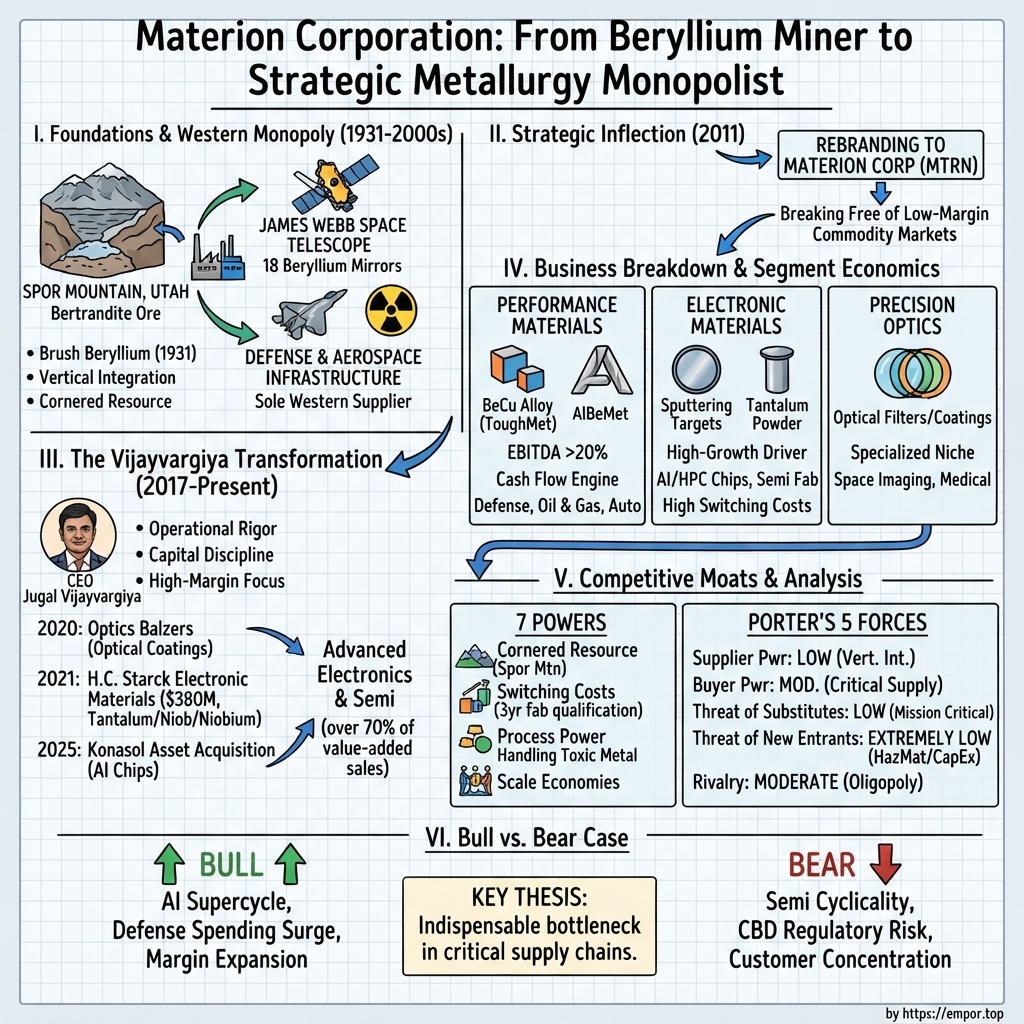
Materion Corporation: The Strategic Metallurgy Monopolist Powering Defense, Space, and AI
I. Introduction & Episode Roadmap
On the morning of Friday, August 7, 2026, a company unfamiliar to most investors held an earnings call that lasted barely forty-five minutes. Only four analysts joined the line. The CEO, an engineer named Jugal Vijayvargiya, opened with a statement that would sound like routine corporate commentary from almost anyone else: "Q2 was truly a milestone quarter for Materion."1
Then came the performance figures. Value-added sales reached $308.2 million, up 15%. Adjusted EBITDA came in at $71.8 million — representing 23.3% of value-added sales, marking the first time in the company's ninety-five-year history that this margin crossed 23%. Adjusted earnings grew 39% to $1.90 per share. Backlog hit a record high, rising roughly 30% year over year. Management raised full-year guidance for the second consecutive quarter to $6.80–$7.20 per share, up from the initial $6.00–$6.50 target provided in February.1
The equity had already experienced significant momentum. Over the preceding twelve months, Materion Corporation (NYSE: MTRN) traded between roughly $105 and $301 per share. By early August 2026, its market capitalization stood at approximately $6 billion — a dramatic re-rating for a small-cap Ohio metals company whose two-hundred-day moving average sat near $170.2 The market, which spent most of a decade valuing the business like a cyclical alloy mill, shifted to pricing it as a critical technology supplier.
What defines the company today?
At its core, Materion mines, refines, and engineers specialized materials essential to high-spec end products. It controls the only fully integrated beryllium supply chain in the Western world, anchored by a bertrandite ore body in the Utah desert. It manufactures ultra-high-purity tantalum and niobium sputtering targets that are vaporized inside semiconductor fabrication plants to form atomic-scale barrier layers in advanced logic and memory chips. It coats optical filters for earth-observation satellites and laser communication terminals. It also fabricated the eighteen hexagonal beryllium mirror blanks operating a million miles from Earth on the James Webb Space Telescope.3
The core strategic question is straightforward: how did a Depression-era Cleveland beryllium extractor — a business historically valued like a mining operation burdened by environmental liabilities — become a strategic supplier receiving $65 million in direct capital funding from defense primes to expand production capacity?4
Bulls cite two distinct structural advantages. First, a cornered resource: the Spor Mountain deposit in Juab County, Utah, which the company has mined since 1968. The site contains proven and probable reserves of roughly 40.9 million pounds of contained beryllium, representing at least seventy-five years of supply at current production rates.5 Second, a high switching-cost barrier in electronic materials, where semiconductor fabs typically spend twelve to twenty-four months qualifying a new deposition supplier and rarely switch once a process is established.6
This investment thesis requires objective evaluation against operational realities.
First, the term "monopolist" overstates the company's market dominance. While Materion is the sole fully integrated beryllium producer in Western nations — owning the raw ore, processing mill, reduction chemistry, and downstream alloy manufacturing — the market for beryllium-copper alloy remains competitive. Industry peers such as NGK Insulators in Japan, Ulba Metallurgical in Kazakhstan, and multiple European and Japanese strip mills compete directly in tonnage.7 In semiconductor deposition materials, which drove much of the recent equity valuation expansion, Materion is not the market leader. That position is held by JX Advanced Metals, the Japanese company that listed on the Tokyo Stock Exchange in March 2025 and controls roughly 60% of the global sputtering target market.8 Materion operates as a strong second or third player within a concentrated oligopoly rather than an absolute monopoly.
Second, top-line revenue metrics require adjustment for pass-through precious metals. Materion purchases gold, silver, platinum, palladium, and copper on behalf of customers, passing raw metal costs directly through to the final price. In 2025, the company reported total net sales of $1.787 billion, but value-added sales — net sales excluding pass-through metal costs — totaled $1.046 billion.9 In the second quarter of 2026, reported net sales rose 42% year over year, though approximately two-thirds of that increase reflected higher underlying precious metal prices rather than volume growth.1 Assessing performance requires evaluating value-added sales rather than gross revenue.
Third, operational execution has shown vulnerabilities alongside financial gains. The same leadership team posting record quarterly metrics oversaw a $56.1 million goodwill impairment in the Precision Optics segment in late 2024, as well as a quality control failure in the fourth quarter of 2025 that temporarily idled two facilities and resulted in $25.7 million in charges.10 While the operational repositioning is evident, execution challenges persist, making sustained valuation expansion contingent on consistent operational discipline.
This analysis traces Materion's development across distinct eras. The narrative begins in a 1920s Cleveland laboratory with the discovery of beryllium — a metal lighter than aluminum, stiffer than steel, and toxic to pulmonary health upon inhalation. It follows the company's expansion into Utah and its role during the Cold War, through a 2011 corporate rebranding that altered its name prior to transforming its underlying economics. It examines the 2017 leadership transition under a former automotive electronics executive, detailing key strategic initiatives alongside missteps. It breaks down the three operating segments, clarifying the mechanics and commercial importance of sputtering targets. Finally, it evaluates competitive dynamics using strategic frameworks, stress-tests the long-term investment thesis, and outlines the critical operational metrics that will determine the company's trajectory.
 Subscribe on LinkedIn
II. Origins & The Western Beryllium Monopoly (1931–2000s)
Start with the metal, because the metal explains the company.
Beryllium is element four on the periodic table. It is about a third lighter than aluminum yet significantly stiffer than steel — an almost absurd combination that makes it the material of choice when an engineer needs a structure that will not flex, will not warp, and must not weigh anything. It is nearly transparent to X-rays, which is why it lines mammography windows. It barely shrinks as it approaches absolute zero, which is why it went to space. And when it is machined, ground, or melted, it produces a respirable dust that a meaningful minority of exposed humans react to with an immune response that can scar their lungs permanently. Beryllium is a wonder material with a body count. Both facts made the company.
The story begins in 1921, when Charles Brush, Jr. and Dr. Charles Baldwin Sawyer set up Brush Laboratories in Cleveland, funded by Brush's father — Charles F. Brush, the inventor of the arc dynamo and one of the men who electrified American cities.11 The laboratory was an early venture-research operation: hire good chemists, poke at hard problems, spin out what works. Sawyer, working with a Swedish metallurgist named Bengt Kjellgren, spent the decade on the maddening problem of getting beryllium out of beryl ore, a task that requires heat, pressure, and a tolerance for failure. On January 9, 1931 — a spectacularly poor moment to incorporate anything — the Brush Beryllium Company was formally chartered in Cleveland.12
The early years were what you would expect. In 1933, total beryllium oxide sales came to $12,241.12 Not thousands of dollars per unit; twelve thousand dollars, total, for the year.
What rescued it was war. During World War II, Brush supplied more than half of the United States' copper-beryllium requirements for aircraft and naval applications — the metal's fatigue resistance and non-sparking properties made it ideal for springs, bushings, and instrument components.12 Then came something bigger. Beryllium is an exceptional neutron reflector, which is precisely what you want if you are trying to sustain a nuclear chain reaction in a small package. Products from the Perkins Avenue plant contributed to the Manhattan Project, and by 1950 the Atomic Energy Commission had contracted with Brush to build a dedicated pure-beryllium plant at Luckey, Ohio.1112
This is the founding pattern, and it never really breaks: the U.S. government identifies a capability it cannot do without, discovers that essentially one company in the country can supply it, and then pays to make sure that company keeps existing. Seventy-five years later, that is still how the beryllium business works — only now the check comes from a defense prime rather than the AEC.
The company went public in 1956, and the Space Age arrived on schedule.12 In 1961, Brush materials flew on Alan Shepard's Mercury capsule heat shield.12 But the decisive strategic event of the century happened not in a laboratory but in the Utah desert.
Beryl ore — the traditional feedstock, the same mineral family as emerald — is scarce, hand-sorted, and geopolitically inconvenient. Bertrandite is a different beryllium mineral, disseminated in volcanic tuff at very low grade, and until the 1960s nobody had figured out how to make money from it. Brush did. By 1969 the company had developed the bertrandite deposits at Spor Mountain in Juab County, Utah, and in doing so became the only fully integrated beryllium producer in the world: ore in one end, finished engineered components out the other.12 The mine has been in continuous production since 1968.5
The numbers on that ore body are worth sitting with, because they explain the durability of the franchise better than any strategy deck. Materion holds mineral rights on 7,443.5 acres at Spor Mountain and mines by open pit. As of December 31, 2025, proven and probable reserves stood at 8.3 million tonnes at a grade of 0.246% beryllium — 40.9 million pounds of contained metal. The company mined 506,000 pounds of unyielded beryllium in domestic ore in 2025 and produced 391,000 pounds after a 77% mill yield, running the mill at 61% of capacity.5 Development drilling across the site was completed in 2000; no further exploration is planned, because there is no need.5
Read that again. The mill runs at roughly 60% utilization on a reserve base with a seventy-five-year life. This is not a resource company managing depletion anxiety. It is a company that solved its raw-material problem in 1969 and has spent the fifty-seven years since deciding what to make with it.
In 1971 the company acquired S.K. Wellman and became Brush Wellman; it listed on the New York Stock Exchange in 1972.12 And through the Cold War it became something close to infrastructure — the sole trusted domestic source of high-purity beryllium metal and beryllium-copper alloy for nuclear deterrence hardware, missile guidance systems, and fighter avionics.
The showcase, though, was optical. When NASA designed the James Webb Space Telescope, it needed a primary mirror that would hold its figure at roughly 30 Kelvin — about −406°F — because any thermal distortion at that scale would smear the infrared images the entire $10 billion mission existed to capture. Almost every candidate material keeps contracting as it cools. Beryllium, below about −300°F, essentially stops.3 Materion gas-atomized beryllium into spherical powder, then used hot isostatic pressing to consolidate it into mirror blanks weighing nearly 600 pounds each at its Elmore, Ohio facility. Downstream contractors then machined each blank down to roughly 46 pounds — removing more than nine-tenths of the mass — before coating them in gold.313 Eighteen hexagonal segments, each one a piece of Ohio.
It is a genuinely great story. It also, for decades, did almost nothing for the stock.
Here is the legacy trap. A company whose defining assets were a mine and a smelter, whose largest end markets were lumpy government procurement programs and cyclical industrial alloys, and whose product could give people an incurable lung disease, got valued exactly as you would expect: as a low-multiple cyclical with a litigation tail. Chronic beryllium disease — CBD — generated product-liability suits, employee claims, and third-party actions for decades, and periodic tightening of occupational exposure limits by OSHA meant every plant carried a regulatory overhang.14 The company's own risk factors still note that some scientists claim evidence of an association between beryllium exposure and lung cancer, and that certain standard-setting bodies classify beryllium compounds as human carcinogens.14
For an investor, this is the crux of the pre-2011 story: Materion's ancestors owned one of the best cornered resources in American industry and could not convert it into a premium multiple, because the asset was structurally entangled with cyclicality and liability. The mine was never the problem. The mix was. Which is what the next chapter was supposed to fix.
III. The Strategic Rebrand & Inflection Points (2011–2016)
On March 8, 2011, holding company Brush Engineered Materials Inc. changed its name to Materion Corporation.12
Corporate renamings often signal an attempt to escape an outdated image. In this case, the shift reflected a genuine structural reality: the enterprise had become a federation of businesses with disjointed brand identities—Brush Wellman in beryllium and alloys, Technical Materials Inc. in precision clad strip, and Williams Advanced Materials in thin-film deposition. The "Brush Beryllium" name signaled a pure-play beryllium producer, but management intended for future growth to come from electronic materials, optical coatings, and engineered strip.
Management retired the founder's name, consolidated the subsidiaries under a single brand and NYSE ticker, and presented the business to public markets as an advanced materials engineer rather than a conventional miner.
Investors remained skeptical.
The financials explained the market's reluctance. Consolidated revenue fell from $1.13 billion in 2014 to $969 million by 2016. Across that span, annual EBITDA hovered between roughly $70 million and $85 million, while operating margins remained in the low single digits as a percentage of net sales.15 Net income in 2016 stood at just $25.7 million on nearly a billion dollars in top-line revenue. Despite the new corporate identity, the financial profile continued to resemble that of a cyclical commodity processor.
Underneath the rebrand lay a structural asset-allocation problem. Materion's largest business by volume—copper-beryllium and related alloy strip—served connector, automotive, oil and gas, and general industrial customers. These price-referenced markets gave buyers significant leverage, as purchasing managers routinely benchmarked Materion against peers like NGK Insulators and European strip mills. In contrast, the company's differentiated higher-margin units, such as high-purity deposition materials and precision optics, remained small and undercapitalized relative to the legacy alloy operations.
Management attempted to rebalance the portfolio through targeted acquisitions. The company acquired Aerospace Metal Composites in 2012, adding aluminum metal-matrix composite capabilities that formed the basis for its SupremEX aerospace line. In 2017, Materion purchased Heraeus's target materials business to gain scale in thin-film deposition. Later, in July 2020, it acquired Optics Balzers—a Liechtenstein-based optical coating specialist founded in 1946 with approximately $67 million in trailing revenue—for about $160 million in enterprise value, representing roughly 12 times trailing EBITDA or 8 times pro forma for synergies.16
Yet prior to 2017, bolt-on acquisitions failed to deliver meaningful operating leverage. The deals expanded product offerings but left the underlying cost structure, pricing power, and business mix largely unchanged. EBITDA margins remained stuck in the mid-teens as a percentage of value-added sales—respectable for a metals processor, but well below the standard of a specialized advanced materials firm.
The experience illustrates a core principle of corporate turnarounds: a portfolio transition cannot be achieved by acquisition alone. Absorbing niche technology assets into an organization whose culture, incentives, and capital allocation routines prioritize high-volume alloy production yields a conglomerate discount rather than a growth multiple. Driving structural expansion requires leadership to systematically reallocate capital, enforce disciplined pricing, and align executive compensation with margin quality rather than volume.
By late 2016, Materion's board recognized that the corporate rebrand had reshaped the company's narrative without altering its economic engine. To lead a deeper operational transformation, the directors turned outside the traditional metallurgy sector, recruiting executive leadership from the automotive electronics industry.
IV. The Vijayvargiya Transformation: High-Margin Playbook (2017–Present)
Jugal Vijayvargiya became chief executive officer of Materion in March 2017 after a career spent outside traditional metallurgy.17 He had logged twenty-six years at Delphi Automotive, ultimately serving on its executive committee and directing its Electronics & Safety segment—a $3 billion global business managed from Wuppertal, Germany, with operations spanning more than twelve countries. Vijayvargiya earned bachelor's and master's degrees in electrical engineering from The Ohio State University.17 His background contained no prior exposure to mining ore bodies, hydrometallurgical processing, or the specialized safety protocols of handling beryllium.
Instead, his automotive background brought an operating discipline shaped by tier-one supply chains. In that sector, component suppliers face mandatory annual price reductions from automakers, quality failures risk costly product recalls, and contract awards precede revenue by years. Operating in that environment required strict cost control, rigorous launch execution, and a clear distinction between contracted orders and realized cash flow—a management approach tailored for a specialty materials business seeking to improve execution across high-spec product lines.
What he actually changed
The primary operational shift focused on financial disclosure and performance tracking. Vijayvargiya refocused investor evaluation on value-added sales rather than total net revenue. Because gross revenue fluctuates with pass-through prices for precious metals like gold and silver, total sales obscure underlying operational leverage. By setting internal targets and reporting metrics around value-added sales and adjusted EBITDA margins as a percentage of value-added revenue, management established a benchmark tied directly to product mix and manufacturing execution rather than raw metal price movements.
Portfolio optimization followed through incremental restructuring. In 2024, Materion divested an unprofitable architectural-glass target business in Albuquerque that generated approximately $10 million in annual sales, closed the associated facility, shut a manufacturing plant in Suzhou, China, consolidated production into other Asian and North American operations, and streamlined two additional Asian facilities.18 Across roughly twelve months, the company eliminated about 150 positions and reduced annual costs by $15 million to $20 million. Chief Financial Officer Shelly Chadwick noted to analysts that slightly more than half of those savings represented permanent structural reductions, while the remainder reflected variable incentive compensation expected to normalize as performance rebounded.18 This distinction provided a realistic assessment of the company's sustainable margin baseline.
Management also adjusted its commercial pricing strategy. When asked in mid-2026 about the contribution of pricing to growth in the Performance Materials segment, Vijayvargiya emphasized cost pass-through discipline, stating, "We want to make sure that we're not the sponge"—meaning input and energy cost increases are systematically passed along to customers.1 For a manufacturer supplying critical, single-source materials, enforcing cost-reflective pricing captured margin that had previously been absorbed by legacy commercial terms.
Management credibility: the receipt
Executive compensation governance aligns closely with reported metrics. Materion's 2025 executive annual incentive plan allocated 70% of targets to adjusted earnings before interest and taxes (EBIT), 15% to value-added sales growth, and 15% to simplified free cash flow. Minimum performance thresholds required $130 million in adjusted EBIT, $1.05 billion in value-added sales, and $80 million in free cash flow. Actual results for 2025 fell short across all three metrics, reaching $115.9 million in adjusted EBIT, $1.0462 billion in value-added sales, and $73.6 million in free cash flow.19
Consequently, named executive officers received no annual cash bonuses for 2025. Vijayvargiya forewent a target payout of 110% of salary, equal to $1.1 million, while Chadwick and the general counsel also received zero payout. Although the board's compensation committee maintained discretion to grant adjustments for safety or sustainability metrics, it declined to make discretionary payouts.19 The zero payout occurred despite value-added sales missing the payout threshold by less than four-tenths of one percent—a shortfall of under $4 million on a $1.05 billion benchmark. Long-term incentives remain divided among stock appreciation rights, relative total shareholder return units, and return on invested capital metrics, while executive share ownership guidelines required the CEO to hold shares equal to six times base salary starting in 2025.19
The M&A record, benchmarked
Three acquisitions shaped the updated product portfolio under Vijayvargiya's tenure.
Optics Balzers (July 2020) expanded thin-film optical coating production and provided manufacturing footprints in Europe and Asia, though integration challenges subsequently surfaced.
H.C. Starck Electronic Materials (November 1, 2021) represented a larger strategic expansion. Materion acquired the Newton, Massachusetts-based producer of premium tantalum and niobium products for $380 million in cash on a debt-free basis. At acquisition, H.C. Starck was projected to generate approximately $145 million in annual revenue and $29 million in adjusted EBITDA, representing a 20% operating margin, while increasing Materion's value-added sales by roughly 19%.20 The purchase price equaled approximately 13 times 2021 EBITDA, or below 10 times accounting for projected synergy run-rates—a valuation below prevailing multiples of mid-to-high teens for specialty semiconductor material peers. The transaction secured a major position in high-purity refractory metals used for barrier and liner layers in advanced semiconductor logic and memory fabrication.
Konasol (announced May 29, 2025; closed July 9, 2025) added localized manufacturing capacity through a $19 million purchase of a facility in Dangjin City, South Korea, equipped to produce finished tantalum sputtering targets.21 The acquisition established a local supply source near major South Korean fabrication plants producing high-bandwidth memory. Commercial adoption requires extensive qualification; on the first-quarter 2026 earnings call, Vijayvargiya noted that customer qualifications would extend through late 2026, with meaningful revenue contributions expected in 2027 and 2028.6 This timeline highlights the multi-year lag between capital deployment and commercial revenue realization typical of semiconductor materials.
The failures, stated plainly
Two major operational setbacks tempered this expansion record.
First, performance in Precision Optics deteriorated following the Optics Balzers acquisition. On September 25, 2024, Materion appointed Jason Moore as segment president. An internal business review, combined with weak operational results, led management to adopt more conservative forecasts for key customer contracts. In the fourth quarter of 2024, Materion recorded a $56.1 million goodwill impairment and a $17.1 million long-lived asset impairment for the unit, driving segment EBITDA to negative $73.3 million for full-year 2024.10 Cumulative goodwill write-downs for the business reached $76.7 million.10
A turnaround followed the restructuring. In the second quarter of 2026, Precision Optics generated $30.8 million in value-added sales—a 26% year-over-year increase—and achieved an adjusted EBITDA margin of 21.4%, marking its highest profitability in over five years and its sixth consecutive quarter of margin expansion.1 Nevertheless, the segment required four years, a leadership change, and substantial write-downs to reach target operating metrics.
Second, a major precision clad strip quality failure occurred in late 2025. During the fourth quarter of 2025, Materion's largest customer—a medical device manufacturer expanding a key product line—identified material nonconformities during assembly. Manufacturing control errors at one processing step bypassed internal detection. Materion temporarily shut down both precision clad strip plants, conducted a root-cause investigation, overhauled quality protocols, and resumed shipments in December 2025.22 The incident resulted in $25.7 million in gross margin charges within Performance Materials and reduced annual segment sales by $23.1 million compared to 2024, with volume recovery extending through the first half of 2026.922
On the February 2026 earnings call, Vijayvargiya addressed the breakdown directly, acknowledging: "we had a control failure. We were not able to detect the control failure through our quality system that we have. So the nonconformity that was produced as a result of that reached the customer."22 The event demonstrated that high customer switching costs do not protect against internal execution lapses that risk customer relationships.
Where that leaves the record
Through mid-2026, Materion's financial performance showed clear margin progress alongside ongoing cyclicality. Adjusted EBITDA margin on value-added sales expanded from historical mid-teen averages to 20.7% for full-year 2025, marking five consecutive years of margin growth and a second straight year above 20%.22 The company reached its 23% mid-term adjusted EBITDA margin benchmark in the second quarter of 2026.1 Meanwhile, defense market revenues exceeded $100 million for a second consecutive year in 2025, reflecting a 10% compound annual growth rate since 2020.22
However, full-year 2025 demonstrated the business's underlying volatility. Value-added sales declined 4% year-over-year, adjusted EBITDA decreased 2% to $217 million, and GAAP net income reached $74.8 million on total net sales of $1.787 billion.922 Executive compensation metrics missed all internal target thresholds for the year, yet performance rebounded sharply two quarters later to set quarterly profitability records. This operational variance highlights how rapid shifts in customer demand cycles and plant utilization can swing short-term earnings despite long-term strategic positioning.
V. Business Breakdown & Segment Economics
Understanding Materion's three operating segments requires navigating the dual-revenue reporting structure that governs the company's financial statements.
Net sales includes the cost of gold, silver, platinum, palladium, and copper purchased on behalf of customers and passed through without markup. Value-added sales excludes these metal costs to reflect core manufacturing revenues. In 2025, net sales of $1.787 billion yielded value-added sales of $1.046 billion, meaning roughly $740 million of reported top-line revenue represented pass-through metal.9 In the second quarter of 2026, net sales reached $613.9 million while value-added sales totaled $308.2 million—a gap where the pass-through metal component nearly doubled year over year due strictly to rising commodity prices.1
This accounting structure directly influences reported profitability. The company's 23.3% adjusted EBITDA margin for the second quarter of 2026 is measured against value-added sales. Measured against total net sales, that same quarterly margin sits under 12%. While both calculations are valid, evaluating Materion against broader industrial peers requires accounting for how the value-added denominator amplifies percentage margin figures during periods of high metal prices.
1. Performance Materials — the cash engine
Performance Materials represents Materion's legacy metallurgy business, restructured for higher-margin applications. The segment generated $675.9 million in net sales and $127.2 million in segment EBITDA in 2025.10 Powered by the bertrandite mine and refinery in Utah, it produces three core product lines: upstream beryllium products including pure metal, hydroxide, and ceramics; engineered alloy strip, rod, and wire; and finished precision components.7
Each product family serves targeted engineering requirements. ToughMet, a spinodal copper-nickel-tin alloy, provides galling resistance for heavy-duty bearings and bushings in oil and gas equipment. AlBeMet combines beryllium and aluminum to deliver high structural rigidity at low density. SupremEX, an aluminum-silicon-carbide composite, was selected for the prototype design of the U.S. Army's future long-range assault aircraft.18 Precision clad strip selectively bonds precious metal ribbons to specific contact points on base metal strip, reducing customer material costs while maintaining electrical performance.7
According to management, approximately half of segment sales involve beryllium in some form, representing higher-margin products with multi-year qualification cycles.6 In the second quarter of 2026, Performance Materials generated $190 million in value-added sales, up 13% year over year, with an adjusted EBITDA margin of 25.4%.1 The segment has maintained adjusted EBITDA margins above 25% for three consecutive years.22
Demand drivers have broadened across defense, aerospace, and digital infrastructure. In defense, Materion booked $60 million in orders during the first quarter of 2026—a record first-quarter figure—and reached $90 million in orders during the first half of the year, while its request-for-quote pipeline expanded from approximately $100 million in 2024 to over $500 million by mid-2026.16 Space applications now represent about a quarter of aerospace and defense sales, having expanded sixfold over the preceding three to four years.1 Meanwhile, data center construction has driven demand for beryllium-nickel spring alloys used in commercial building fire protection systems.1
Longer-term commercial applications include nuclear fusion energy. In October 2025, Materion secured a supply agreement with Commonwealth Fusion Systems to deliver beryllium fluoride from its Elmore, Ohio facility for use in FLiBE molten salt at the ARC power plant in Chesterfield County, Virginia.23 While commercial fusion technology remains unproven, potential adoption of molten-salt reactor designs would require beryllium volumes significantly larger than current commercial demand, establishing long-term optionality for the sole Western producer.
What this means: Performance Materials converts Materion's integrated mining position into consistent cash flow, demonstrating pricing power through sustained 25% margins during broader industrial slowdowns. However, the segment remains vulnerable to program-specific customer concentration and operational risks, as demonstrated by the precision clad strip outage.
2. Electronic Materials — the growth engine
Electronic Materials provides thin-film deposition products critical to advanced semiconductor manufacturing. Modern semiconductor fabrication requires depositing dozens of precise metallic layers onto silicon wafers. A primary deposition method, sputtering, uses high-purity metal plates—known as sputtering targets—inside vacuum chambers. Bombarded by gas ions, target atoms dislodge and deposit across the wafer to form microscopic films. Because sputtering targets erode during fabrication, semiconductor fabs purchase them as recurring consumable inventory tied directly to wafer production volumes. High-purity specifications (often exceeding 99.999% purity) are necessary to prevent microscopic defects in high-density logic and memory chips.
Tantalum plays a critical role in preventing copper electromigration. Since copper became the industry standard for chip interconnects in the late 1990s, chipmakers have lined copper wiring channels with thin barrier layers of tantalum and tantalum nitride to prevent copper atoms from diffusing into surrounding silicon. As semiconductor nodes advance to 3-nanometer and 2-nanometer architectures, barrier layers must become thinner and more uniform. This requirement has accelerated adoption of atomic layer deposition (ALD), which constructs films one atomic layer at a time and places strict microstructural demands on source materials. Materion expanded its Milwaukee facility specifically to target ALD applications while adding a second tantalum furnace at its Newton, Massachusetts facility.18
This technical demand underpins the commercial rationale for the 2021 H.C. Starck acquisition. In the second quarter of 2026, Electronic Materials produced $87.4 million in value-added sales, up 15% year over year, with a record 32% adjusted EBITDA margin—marking five consecutive quarters of margin expansion and nearly doubling segment profitability compared to 2022–2023 levels.1 While reported 2025 net sales for the segment reached $1.01 billion, pass-through precious metals accounted for roughly two-thirds of that total, leaving value-added sales at approximately one-third of reported gross revenue.10
During the August 2026 earnings call, Seaport Research analyst Mike Harrison questioned whether a 32% margin was sustainable for a unit that historically operated in the mid-to-high teens. Chief Financial Officer Shelly Chadwick acknowledged that product mix in the quarter was "probably a richer mix than we'll see all year," explicitly cautioning that "this is not a new floor."1 Chief Executive Officer Jugal Vijayvargiya countered that mid-teens margins were structurally inadequate for specialized electronic materials and stated the company does not intend to return to those historical levels.1
While cost reductions, facility consolidations, and commercial pricing discipline have permanently elevated baseline profitability, peak-mix quarters like Q2 2026 likely represent upper-bound performance rather than an average operating floor.
What this means: Electronic Materials has served as the primary catalyst for Materion's equity re-rating. However, quarterly performance remains sensitive to product mix. Evaluating segment health requires distinguishing temporary high-margin product mix from permanent baseline margin expansion across full semiconductor cycles.
3. Precision Optics — the turnaround
Precision Optics remains Materion's smallest reporting unit, recording $100.7 million in net sales in 2025, alongside a volatile operating history.10 The segment manufactures custom thin-film optical coatings, optical filters, infrared components for defense and space payloads, and optical components for life sciences and semiconductor metrology equipment.
The underlying technology relies on multi-layer thin-film interference. By depositing dozens of dielectric or metallic coatings at precise microscopic thicknesses, optics engineers create custom filters that isolate specific wavelengths of light while reflecting others. These optical assemblies enable earth-observation satellites to gather hyperspectral imaging data and allow semiconductor inspection tools to detect sub-micron defects on silicon wafers.
Following the $56.1 million goodwill write-down and segment leadership change in late 2024, Precision Optics experienced a rapid operational recovery. Value-added sales increased 43% year over year in the first quarter of 2026 and 26% in the second quarter, pushing adjusted EBITDA margins above 20% for the first time since 2021.16 Management attributed the margin expansion to new customer contracts across defense, space, semiconductor metrology, and industrial markets, combined with yield improvements and capacity rationalization.1
What this means: Precision Optics has demonstrated operational recovery following substantial asset write-downs, validating management's restructuring playbook. However, current margin performance reflects operational rightsizing rather than proof of long-term strategic synergies from prior acquisitions.
Together, Materion's three segments form a unique industrial profile: a mining-anchored metallurgy business, a semiconductor consumables supplier, and a specialized optics producer—all selling single-source materials into high-switching-cost applications. Evaluating the durability of this structure requires examining the competitive barriers that shield each business.
VI. Competitive Landscape & Industry Structure
Evaluating Materion's competitive position requires analyzing where rivals could challenge its primary businesses.
Front one: beryllium and specialty alloys
A direct competitor faces massive entry barriers in raw beryllium. Replicating Materion's upstream position would require discovering an ore body, permitting a refining mill, developing reduction chemistry, establishing decades of safety protocols, and operating a facility whose primary material is a regulated human sensitizer subject to continuously tightening exposure standards. As a result, greenfield capital deployment in upstream beryllium extraction remains highly improbable.
Instead, competitors bypass the mine entirely. Japan's NGK Insulators operates as Materion's primary global rival in beryllium-copper strip and wire without owning a beryllium deposit.7 NGK purchases master alloy and processes it into finished mill products, competing on conversion costs, service, and product quality rather than raw material integration. In high-volume, commodity-grade beryllium-copper alloys, this model effectively caps Materion's pricing power.
The broader competitive landscape in Performance Materials extends well beyond a single-supplier dynamic. Competitors include IBC Advanced Alloys, Ningxia Orient Tantalum, Le Bronze Alloys, KME, Aurubis, AMPCO Metal, Chuetsu Metal Works, American Beryllia, CoorsTek, and Kazakhstan's Ulba Metallurgical—which serves as the primary non-Western beryllium supplier.7 In precision clad strip and plated systems, Materion competes against Wieland, Aurubis Stolberg, Diehl Metall, Proterial, Heraeus, and AMI Doduco.7
Materion's vertical integration becomes decisive in high-purity and high-specification applications, including pure beryllium metal, AlBeMet, radiographic beryllium foil, beryllium oxide ceramics, and defense components subject to U.S. domestic-sourcing mandates. Federal regulations such as the Berry Amendment restrict defense contractors from procuring beryllium components from foreign producers like Kazakhstan. Within this high-value segment, Materion operates effectively as a sole-source supplier. Across lower-specification commercial markets, however, it functions as a cost-advantaged competitor rather than a monopolist.
The commercial value of this domestic position was demonstrated in early 2026, when a major U.S. defense contractor committed $65 million in customer-funded capital to expand Materion's beryllium production across two facilities, with the added capacity expected online by 2028.422 Defense primes rarely fund a supplier's facility expansion when viable market alternatives exist, reflecting their operational dependence on Materion's domestic production base.
Front two: semiconductor deposition materials
The semiconductor deposition materials market presents a more crowded and competitive environment. JX Advanced Metals—formerly JX Nippon Mining & Metals, which listed on the Tokyo Stock Exchange in March 2025—leads the sector, controlling roughly 60% of the global sputtering target market and supplying major chipmakers including TSMC, Samsung, Intel, SK Hynix, and Micron from its plant in Ibaraki Prefecture, Japan.8 In SEC filings, Materion identifies additional primary competitors, including Honeywell International, Praxair, Solar Applied Materials Technology, Grikin, Solaris, Ametek Electronic Components and Packaging, Tanaka Holdings, and Tosoh, alongside regional suppliers.7
Although Materion trails JX Advanced Metals in market share, Electronic Materials reached a 32% adjusted EBITDA margin in the second quarter of 2026. Management attributes its positioning in this market to three core factors.
Qualification lock-in. Chief Executive Officer Jugal Vijayvargiya has noted that semiconductor customers require roughly twelve months to qualify minor material modifications and up to twenty-four months to qualify entirely new products.6 Fabs absorb the cost of running test wafers, characterizing film properties, and validating manufacturing yields during qualification. Once a material is written into a fab's process recipe, changing suppliers requires re-qualifying the process—a costly and risky step for a component that represents a fraction of total wafer cost but directly affects production yield.
The lag between qualification and revenue realization was evident during the recent semiconductor cycle. Management focused on customer qualifications during the 2023–2024 industry downturn, with those design wins converting into volume revenue as demand recovered in 2025 and 2026.6
Breadth across node categories. Materion supplies deposition materials across power semiconductors, communications devices, data storage, logic, legacy memory, and high-bandwidth memory.6 This broad product footprint mitigates exposure to demand swings in any single chip architecture, contributing to broad-based revenue growth across sub-segments in the first quarter of 2026.6 Conversely, operating across multiple categories means Materion lacks the single-focus specialization of niche peers.
Geographic diversification and supply resilience. Chipmakers increasingly prioritize supply chain redundancy. Materion's combination of domestic tantalum refining in Massachusetts and finished-target production in South Korea offers Western and Asian fabs geographic diversification relative to Japanese suppliers.
These advantages are offset by two structural headwinds. First, trade restrictions and tariffs in China continue to weigh on results. In the first quarter of 2026, Materion's semiconductor sales rose 16% overall, but grew approximately 40% when excluding China.6 In response, management has removed projected Chinese expansion from its forward growth assumptions. Second, Materion faces scale constraints compared to JX Advanced Metals' 60% market share. Lower total volume limits Materion's internal research and development budget relative to the market leader, driving management's reliance on customer- and government-funded capital expenditures to expand process capabilities.
What this means: Materion's competitive position remains strong but asymmetric. In high-purity beryllium for defense and aerospace, the company maintains a near-sole-source position in Western markets supported by resource ownership and regulatory mandates. In semiconductor deposition materials, it occupies a defensible secondary market position protected by high switching costs and qualification timelines rather than raw material scarcity.
VII. Playbook: Business & Investing Lessons
Four broader strategic and investing lessons emerge from Materion's transformation, each carrying an operational test to verify its validity.
1. Cornered resources compound only when paired with a downstream that can price
Spor Mountain remains a textbook cornered resource—geologically unique, fully permitted, and effectively impossible to replicate in a modern Western regulatory environment. Yet Materion owned the ore body throughout the 1990s and 2000s while earning ordinary commodity-processor returns. The upstream resource generated structural economic rent only after the company developed downstream product lines capable of capturing value: ultra-high-purity metal for defense systems, precision components for space payloads, and specialized beryllium chemistry for next-generation energy applications.
The test: When evaluating a company claiming an irreplaceable raw material asset, determine what proportion of revenue is priced on genuine scarcity versus basic conversion economics. For Materion, roughly half of Performance Materials revenue involves beryllium, and only a specialized tier represents sole-sourced, high-margin products. Owning a strategic deposit is an advantage, but long-term value creation depends on downstream pricing power.
2. Non-founder management can execute portfolio transitions — but the evidence is in the incentive structure, not the strategy deck
Materion's operational turnaround was led by an executive joining from an unrelated industry. What established credibility was not strategic messaging, but operational governance and compensation design: annual incentives tied directly to adjusted EBIT, value-added sales growth, and free cash flow with strict payout thresholds; long-term awards anchored to return on invested capital and relative total shareholder return; and a board willing to enforce zero annual executive payouts when financial performance fell just short of target thresholds.19
The test: Review executive compensation in years when performance falls short of targets. If management receives near-target payouts adjusted for one-time charges, governance alignment is decorative rather than operational.
3. Long qualification cycles create genuine stickiness — and equally genuine lag
The eighteen-to-twenty-four-month fab qualification process creates substantial switching costs for incumbents. However, it also dictates that new customer programs require multi-year capital deployment and qualification expenditures before generating commercial revenue. A supplier winning designs during an industry slowdown sees the financial return only years later. Materion's financial performance in 2026 reflects customer qualifications and capital investments undertaken during the semiconductor downturn of 2023 and 2024.
The test: A business citing qualification barriers should demonstrate specific design wins that took up to two years to convert into volume shipments. Rapid customer adoption indicates lower switching costs and weaker long-term competitive protection.
4. Acquisition discipline is measured on the losers, not the winners
Materion acquired H.C. Starck at approximately 13 times EBITDA—below 10 times pro forma for synergies—and successfully integrated the high-margin tantalum business into its Electronic Materials segment.20 By contrast, it purchased Optics Balzers at roughly 12 times trailing EBITDA, or 8 times pro forma for synergies, but subsequently recognized a $56.1 million goodwill impairment four years later after end-market projections failed to materialize.1610 Identical valuation frameworks produced starkly different operating results.
The key lesson is that an acquisition multiple is merely an entry valuation attached to a forecast, and deals fail when underlying end-market assumptions break down. Evaluating acquisitive management teams requires analyzing whether leadership acknowledges missteps and corrects course. In Materion's case, management restructured segment leadership and absorbed the asset write-down rather than obscuring performance through non-GAAP reporting adjustments.
These four lessons feed directly into how the competitive position should be scored.
VIII. Analysis: 7 Powers & Porter's 5 Forces
Strategic frameworks help distinguish durable competitive advantages from temporary operational momentum. Applied rigorously, they indicate that Materion possesses fewer structural sources of power than enthusiastic market commentary suggests, but the barriers it does hold remain exceptionally difficult for competitors to replicate.
Hamilton Helmer's 7 Powers
Cornered Resource — strong, but narrower than advertised. Spor Mountain provides Materion with structural control over Western beryllium feedstock, backed by a seventy-five-year reserve life and a refining mill running at roughly 61% of capacity.5 This control creates genuine power in high-purity metal, defense components, and specialized beryllium compounds. However, the advantage is largely absent in standard copper-beryllium alloy strip, where rivals such as NGK Insulators compete effectively without owning upstream deposits.7 As a result, this cornered resource underpins a powerful moat across roughly a quarter to a third of total corporate revenue rather than the entire business.
Switching Costs — the strongest and most broadly applicable power. High switching costs protect multiple product lines. In semiconductor materials, fab qualification requires a twelve-to-twenty-four-month testing window.6 In aerospace and defense, custom beryllium components specified into missile guidance systems or satellite payloads remain embedded for the duration of a program's multi-year operational life. In precision clad strip, materials are co-developed for specific customer hardware. The late-2025 clad strip quality failure illustrated this lock-in: despite material nonconformities that temporarily halted production, the affected customer audited facility corrective actions and resumed orders, reflecting the lack of immediate qualified alternatives.22
Process Power — real but under-evidenced. Decades of accumulated expertise in processing and machining toxic beryllium safely, along with refining reactive refractory metals to 99.999% purity, represent real operational barriers. Materion explicitly discloses that its business does not rely materially on any single patent, indicating that its protection stems from tacit operational know-how rather than intellectual property filings.7 While tacit knowledge provides durable protection, it remains difficult for external investors to measure, and operational control failures demonstrate that manufacturing discipline requires constant maintenance.
Scale Economies — weak at the corporate level, real at the asset level. With approximately 2,880 global employees and just over $1 billion in annual value-added sales, Materion remains sub-scale compared to industrial conglomerates like Honeywell, Heraeus, or JX Advanced Metals.78 Its scale advantage is instead concentrated at the asset level: the Spor Mountain bertrandite mine and integrated processing mill represent capital commitments that competitors cannot justify building for a niche market. This corporate scale constraint also explains management's reliance on customer-funded capital projects, such as the $65 million beryllium facility expansion and co-funded research programs, which allow the company to leverage partner balance sheets.14
Branding, Network Economies, and Counter-Positioning — absent. Industrial buyers do not pay price premiums for the Materion brand, sputtering targets generate no network effects, and the business model contains no structural elements that incumbents are reluctant to copy. Investment theses built on these three powers lack structural foundation.
Porter's Five Forces
Supplier power — low in beryllium, moderate in secondary inputs. Full vertical integration eliminates supplier pricing leverage across upstream beryllium operations. For external inputs like tantalum, copper, and precious metals, contractual pass-through provisions shift raw material price risk directly to buyers. When asked whether sudden metal price spikes could disrupt commercial agreements, Chief Executive Officer Jugal Vijayvargiya stated that customers maintain visibility into underlying metal costs and will not undertake lengthy requalification processes over temporary commodity swings.22 The primary supply risk involves material availability rather than price, particularly regarding tantalum ore sourced through complex international supply chains.
Buyer power — moderate, but declining. Customer concentration has diminished over time. In 2025, no single customer accounted for more than 10% of net sales across an 800-customer base, whereas one Performance Materials customer exceeded that threshold in 2023 and 2024.7 This broader customer distribution reflects a structural improvement in business stability. While defense primes and semiconductor manufacturers hold substantial commercial leverage, their near-term choices remain constrained by high qualification costs and limited alternative suppliers.
Threat of substitutes — low in core applications, moderate over longer horizons. No commercial alternative matches beryllium's stiffness-to-weight ratio at cryogenic temperatures, and tantalum's diffusion barrier properties in copper interconnects remain industry standard. Nevertheless, management has acknowledged that "there's always a substitution risk," noting that beryllium's high cost prompts customers to periodically evaluate alternative materials.6 Material substitution represents a long-term risk over five-to-ten-year product cycles rather than an immediate threat.
Threat of new entrants — extremely low. High capital requirements, complex environmental permitting, multi-year qualification timelines, and stringent regulatory oversight for handling toxic materials render greenfield market entry in Western nations nearly unfeasible. Any potential competitive threat is more likely to arise from well-capitalized Asian incumbents expanding adjacent product offerings.
Industry rivalry — moderate, representing the primary structural constraint. Materion competes across three specialized oligopolies, holding defensible market share in specific sub-applications without commanding overall market leadership in any single segment. While pricing discipline among peers prevents destructive price wars, active competition caps the extent to which operating margins can permanently expand.
Summary Assessment: Materion's strategic strength centers on high customer switching costs and a specialized cornered resource. Both advantages are durable, yet neither provides unconstrained pricing power. Standard strategic frameworks do not account for the sharp inflection in margins and order backlog observed in mid-2026, which stems primarily from cyclical semiconductor recovery and defense spending trends rather than a fundamental shift in industry structure.
IX. Bear vs Bull Case & Skeptical Stress Test
Two investors can look at the August 2026 results and reach opposite conclusions. Both are reasoning correctly from the same facts. The disagreement is entirely about how much of what just happened is permanent.
The bull case: why Materion wins from here
The order book is not a forecast — it is signed business. Materion exited the second quarter of 2026 with record backlog, up roughly 30% year over year and 20% since January. First-half incoming orders grew nearly 30%. Defense bookings were $90 million in the half against a pipeline of more than $500 million in open RFQs, up from roughly $300 million a quarter earlier and roughly $100 million two years ago. Space orders doubled. Semiconductor orders rose 20%.1 Backlog at year-end 2025 stood at $579.0 million, and the company expects substantially all of it to ship within eighteen months.7 These are contracted commitments, not management enthusiasm.
The demand drivers are structurally, not cyclically, larger. Three of Materion's end markets are experiencing simultaneous, secular expansion. AI infrastructure drives both semiconductor deposition materials and — less obviously — telecom and data centre products, which grew almost 50% in the second quarter.1 Global defense budgets are rising across the U.S. and allied nations, and replenishment plus modernization is a multi-year, not multi-quarter, phenomenon. And space has gone from a niche line item to roughly a quarter of aerospace and defense revenue, having grown sixfold in three to four years.1 It is rare for a single supplier to be levered to three independent secular trends at once.
The margin improvement has a mechanical explanation. The step-change in Electronic Materials profitability came from plant closures in Suzhou and Albuquerque, the removal of about 150 positions, footprint consolidation in Asia, and pricing — actions taken deliberately during the downcycle.18 When volume returned, it dropped onto a materially lower cost base. That is why incremental margins have been so high, and it is a repeatable, verifiable mechanism rather than a mix accident.
Customers are funding the growth. The $65 million customer-funded beryllium expansion, jointly funded R&D programs, and the AFRL's $5 million beryllium additive-manufacturing contract mean Materion is expanding capacity and capability without proportionally expanding its own capital base.1424 For a sub-scale company competing against larger incumbents, this is the single most important capital allocation innovation of the current era — and it directly supports return on invested capital, which is the metric long-term incentives are written against.19
The bear case: why it may not
You are buying a peak-cycle multiple on peak-cycle margins. The share price roughly tripled from its twelve-month low, and the 200-day moving average sits far below the current price — the entire re-rating is recent.2 Meanwhile the CFO has stated plainly that Electronic Materials' 32% margin reflected an unusually rich mix, "probably a richer mix than we'll see all year," and that it is "not a new floor."1 Consensus enthusiasm has a way of hearing the first half of that sentence.
Semiconductor cyclicality is not a hypothetical here — it is documented history. In October 2024, this same CEO told analysts that forecasting the semiconductor market had been "extremely challenging" for four to six quarters, that expected recovery "has not transpired at all," and that the company had moved to essentially monthly monitoring.18 Beryllium-nickel spring sales for commercial construction went to "practically zero" in the first half of 2024 on an inventory correction.18 Precision clad strip suffered a customer destocking cycle in 2024 that management could not size.18 Nothing structural prevents a repeat.
The most valuable exchange on the August 2026 call came from David Silver of Freedom Capital Markets, who noted that during the pandemic era a wave of over-ordering and safety-stock building looked exactly like real demand — until it did not.1 Vijayvargiya's answer was reasonable: the order book is broad-based across defense, space, commercial aerospace, new energy, and multiple semiconductor sub-segments, and reflects builds happening now rather than inventory. But it is an assertion, and the honest position is that neither management nor investors can distinguish genuine demand from bullwhip in real time. That is the nature of a bullwhip.
Execution risk is proven, not theoretical. A quality control failure at a single process step cost this company $25.7 million in charges and a wrecked quarter, in a product line serving its largest customer.922 A goodwill impairment of $56.1 million followed a leadership change in a segment acquired four years earlier.10 Both were disclosed well and both were fixed. Neither should be forgotten when underwriting a company now running near full stretch across three businesses simultaneously.
Capacity may become the binding constraint. Management insists it is "well positioned" to support 2026 and 2027 growth from existing assets, and has deliberately not raised the capital expenditure forecast despite record backlog.1 Capital discipline is admirable; capital inadequacy is not. If demand runs above plan, the beryllium capacity from the customer-funded expansion does not arrive until 2028, and Korean tantalum capacity is not meaningfully qualified until 2027–2028.622 A supplier that cannot deliver during a shortage is a supplier that invites a competitor into the account.
The activist's stress test
If a sceptical long-short investor built the short thesis, or an activist wrote the letter, these are the pressure points:
On disclosure and metric selection. The company markets itself almost exclusively on value-added sales and on adjusted EBITDA as a percentage of value-added sales — a denominator that structurally flatters versus net sales, and an earnings measure that excludes restructuring, start-up scrap, business transformation costs, and inventory adjustments.19 The company has taken restructuring charges in 2023, 2024, and 2025 — three consecutive years — which raises the reasonable question of when recurring restructuring stops being "special." GAAP net income in 2024 was $5.9 million; adjusted EPS that year was well over five dollars. The gap deserves scrutiny even where each individual adjustment is defensible.
On the R&D line. David Silver pressed this directly in August 2026: revenue is growing at a mid-teens rate while R&D expense is roughly flat — $25.9 million in 2025 versus $29.0 million in 2024 and $27.5 million in 2023, and only about 2% of value-added sales.9 Vijayvargiya's answer was that much R&D is customer- and government-funded and therefore does not appear in the line.1 That is a real and legitimate model. But a materials company whose entire moat rests on know-how, running R&D at 2% of value-added sales and declining in absolute terms during a growth surge, is running an experiment on its own future differentiation.
On the flip side of customer funding. Every dollar a customer contributes to Materion's capital expenditure is a dollar of leverage that customer acquires. A defense prime that funded a $65 million capacity expansion has a legitimate claim on how that capacity is priced and allocated. The model is capital-efficient; it is not free.
On leverage and capital returns. Net debt of roughly $421 million and leverage of 1.8 times at mid-2026 is comfortable, improved from 2.1 times at the start of the year.16 But shareholder returns have been modest — $11.5 million of dividends in 2025 at $0.555 per share, with the quarterly rate raised from $0.135 to $0.14 in May 2025, and $50 million remaining under the buyback authorization.9 An activist would note that a company generating record free cash flow, with 150% conversion in a single quarter, has not yet articulated what it will do with the money if the M&A pipeline stays quiet.1
On the 2027 information vacuum. Asked directly for any 2027 modelling framework, Vijayvargiya declined, promising a January-ish update.1 Entirely normal practice. But when a stock has tripled on a two-quarter inflection, the absence of a forward framework means the market is filling the gap with extrapolation.
Material risk radar
Three mechanisms matter, and each has a specific transmission channel worth understanding.
Semiconductor fab utilization and capital expenditure cycles. Sputtering targets are consumables tied to wafer starts, not to fab construction. When utilization falls, target consumption falls immediately and inventory in the channel amplifies the swing. This is the fastest-acting risk in the portfolio, and Electronic Materials is now the segment carrying the highest margin — meaning a volume downturn de-levers profits disproportionately.
Beryllium health, regulatory, and environmental liability. Here the data is genuinely encouraging and deserves to be stated as a myth versus reality correction: as of December 31, 2025, there were no pending beryllium cases against the company, and the undiscounted environmental reserve had fallen to $2.5 million from $4.6 million a year earlier.149 The toxic-tort overhang that suppressed this company's multiple for decades has, for now, essentially evaporated. That said, the mechanism has not disappeared. A single adverse ruling, a tightening of OSHA permissible exposure limits, or adverse media coverage could — in the company's own language — encourage new litigation, and the risk factor remains live.14
Raw material and supply-chain concentration. Tantalum sourcing runs through international markets with genuine geopolitical exposure, and the Chinese portion of the semiconductor business has already demonstrated how quickly a market can partially close.6 Pass-through pricing protects the margin; it does not protect the volume.
Two risks that appear on generic checklists are worth explicitly de-emphasizing here. Refinancing risk is modest at 1.8 times leverage with $233 million of undrawn revolver capacity.1 And AI is a demand driver for this company, not a disruption threat — nobody is going to replace a tantalum sputtering target with a language model.
X. Epilogue, Guidance for Writers & Key KPIs
Specialty industrial suppliers rarely feature consumer branding, founder mythology, or viral public visibility. Materion operates through an ore deposit in Juab County, Utah, a furnace facility in Massachusetts, a thin-film coating plant in Liechtenstein, and a global workforce of roughly 2,880 employees, with more than 1,800 in manufacturing roles.7 Yet an interruption in its production would stall critical high-technology hardware across defense, aerospace, and computing—including earth-observation satellites, missile guidance systems, advanced semiconductor wafer lines, fusion energy prototypes, and the James Webb Space Telescope.
The core investment question centers not on the company's operational relevance, but on whether its strategic importance generates durable returns on capital at prevailing equity valuations. The evidence presents a balanced picture. High customer switching costs remain demonstrable, while the cornered beryllium resource provides a defensible advantage across specific high-purity product lines. Operational margin expansion is evident, though management has explicitly cautioned that peak profitability reflects favorable product mix during cyclical recoveries. Executive leadership has maintained credibility by enforcing strict pay-for-performance governance, foregoing annual cash bonuses when targets were missed. However, following a significant equity re-rating over the preceding twelve months, market pricing increasingly reflects an optimistic base case rather than unpriced potential.
Reading the company going forward
For analysts and observers evaluating the company over time, several disclosure dynamics warrant attention.
Compare historical earnings calls over time. Evaluating corporate disclosures requires reviewing quarterly commentary across full market cycles. On the October 2024 earnings call, management characterized semiconductor demand forecasting as exceptionally difficult and noted a shift to monthly operational tracking, whereas subsequent communications in April and August 2026 outlined broad-based demand acceleration.1816 This shift in commentary tracked underlying operational developments, providing a clear benchmark for management credibility.
Monitor disclosure focus during segment downturns. During quarterly presentations, corporate communications naturally emphasize outperforming divisions. In the first quarter of 2026, when Performance Materials value-added sales contracted 13% during the precision clad strip operational recovery, prepared remarks focused primarily on growth in Electronic Materials, Precision Optics, and artificial intelligence applications.6 Tracking sub-segments that receive less emphasis provides essential context on broader operational health.
Distinguish prepared statements from executive Q&A responses. Prepared commentary offers structured management framing, whereas analyst question-and-answer exchanges frequently yield critical detail. In August 2026, prepared remarks highlighted record quarterly financial metrics, while subsequent analyst questioning disclosed that non-recurring items—including a tax refund, legal settlement, and royalty income—contributed favorably to the quarter's results.1 While Chief Financial Officer Shelly Chadwick addressed the items directly upon inquiry, the detail emerged only during analyst cross-examination.
The three KPIs that matter
Evaluating Materion's ongoing trajectory requires monitoring three key operational metrics over full business cycles.
1. Segment-level adjusted EBITDA margin on value-added sales. Consolidated margins mask sub-segment performance trends. The key operational metric is whether Electronic Materials maintains adjusted EBITDA margins in the mid-to-high 20% range during normal product-mix quarters, or reverts toward historical high-teen levels as product mix shifts. Chadwick explicitly cautioned investors that the 32% margin achieved in the second quarter of 2026 does not represent an operational floor.1 Assessing whether structural re-rating has occurred requires evaluating profitability during cyclical troughs rather than peak periods.
2. Order backlog conversion and defense request-for-quote (RFQ) volume. Backlog reached $579.0 million at year-end 2025 and expanded approximately 30% year over year by mid-2026.71 Concurrently, the defense request-for-quote pipeline expanded from approximately $100 million to over $500 million over a two-year period, generating $90 million in first-half 2026 bookings.16 The critical metric is conversion efficiency: the rate and timeline at which open RFQs convert into firm orders. Commercial conversion validates sole-source positioning, whereas lagging bookings relative to pipeline growth would indicate operational or procurement friction.
3. Free cash flow conversion and return on invested capital (ROIC). Management targets approximately 75% free cash flow conversion for full-year 2026 following a 150% conversion rate in the second quarter.1 Working capital requirements have historically constrained cash generation due to extended beryllium processing cycles, integration costs, and operational scaling, resulting in 2025 free cash flow of $73.6 million that missed the internal $80 million performance threshold.19 As Materion expands capacity using customer-funded capital, ROIC serves as the primary benchmark for capital efficiency, directly influencing executive long-term incentive compensation.19
Tracking segment margins through cyclical troughs, RFQ conversion rates, and cash returns on capital provides a clear framework for evaluating Materion's ongoing performance. Sustained progress across these three metrics will determine whether the ninety-five-year-old materials manufacturer maintains its elevated valuation or remains bound to the cyclical dynamics of its end markets.
References
-
Materion Corporation Reports Record Second-Quarter 2026 Financial Results and Raises Full-Year Outlook — Materion Corporation, 2026-08-07 ↩↩↩↩↩↩↩↩↩↩↩↩↩↩↩↩↩↩↩↩↩↩↩↩↩↩↩↩↩↩↩↩↩↩↩
-
Beryllium Blazes New Trail for Telescopes — NASA Spinoff, 2019 ↩↩↩
-
Materion Corporation Earnings Call Transcripts — The Motley Fool ↩↩↩↩
-
MATERION Corp Form 10-K for fiscal year 2025, Mine Property and Ore Reserves — U.S. Securities and Exchange Commission, 2026-02-12 ↩↩↩↩↩
-
Materion Corporation First Quarter 2026 Earnings Conference Call — via The Motley Fool, 2026-04-29 ↩↩↩↩↩↩↩↩↩↩↩↩↩↩↩↩↩↩
-
MATERION Corp Form 10-K for fiscal year 2025, Item 1 Business — U.S. Securities and Exchange Commission, 2026-02-12 ↩↩↩↩↩↩↩↩↩↩↩↩↩↩
-
Fresh from IPO, Japan's JX Advanced Metals aims for new start as chip sector stock — Nikkei Asia, 2025 ↩↩↩
-
MATERION Corp Form 10-K for fiscal year 2025, Management's Discussion and Analysis — U.S. Securities and Exchange Commission, 2026-02-12 ↩↩↩↩↩↩↩↩
-
MATERION Corp Form 10-K for fiscal year 2025, Segment Reporting and Goodwill Notes — U.S. Securities and Exchange Commission, 2026-02-12 ↩↩↩↩↩↩↩↩
-
Brush-Wellman, Inc. — Encyclopedia of Cleveland History, Case Western Reserve University ↩↩
-
The history of Materion's advanced materials innovation — Materion Corporation ↩↩↩↩↩↩↩↩↩
-
Beryllium Statistics and Information — U.S. Geological Survey, National Minerals Information Center ↩
-
MATERION Corp Form 10-K for fiscal year 2025, Risk Factors and Legal Proceedings — U.S. Securities and Exchange Commission, 2026-02-12 ↩↩↩↩
-
MATERION Corp Form 10-K for fiscal year 2016 — U.S. Securities and Exchange Commission, 2017-02-17 ↩
-
Materion Corporation to Acquire Optics Balzers — Materion Corporation, 2020-06-08 ↩↩
-
Materion Leadership: Jugal Vijayvargiya, CEO and President — Materion Corporation ↩↩
-
Materion Corporation Third Quarter 2024 Earnings Conference Call — via The Motley Fool, 2024-10-30 ↩↩↩↩↩↩↩↩↩
-
MATERION Corp Definitive Proxy Statement (Form DEF 14A) — U.S. Securities and Exchange Commission, 2026-03-26 ↩↩↩↩↩↩↩↩
-
Materion Completes Acquisition of H.C. Starck's Electronic Materials Portfolio — Materion Corporation, 2021-11-01 ↩↩
-
Materion Expands Semiconductor Footprint and Capabilities in Asia Through Key Acquisition — Materion Corporation, 2025-05-29 ↩
-
Materion Corporation Fourth Quarter and Full Year 2025 Earnings Conference Call — via The Motley Fool, 2026-02-12 ↩↩↩↩↩↩↩↩↩↩↩↩
-
Materion Signs Supply Agreement with Commonwealth Fusion Systems to Provide Beryllium Fluoride for Fusion Energy Technology — Materion Corporation, 2025-10-28 ↩
-
Materion Awarded $5 Million Contract from the Air Force Research Laboratory for Groundbreaking Beryllium Additive Manufacturing Project — Materion Corporation, 2023-10-30 ↩
 LinkedIn
 WhatsApp
 Reddit
 Hacker News
 Email
Email Kindle
 RSS Feed
 Spotify
 Apple Podcasts
 Amazon Music
 Audible
 YouTube