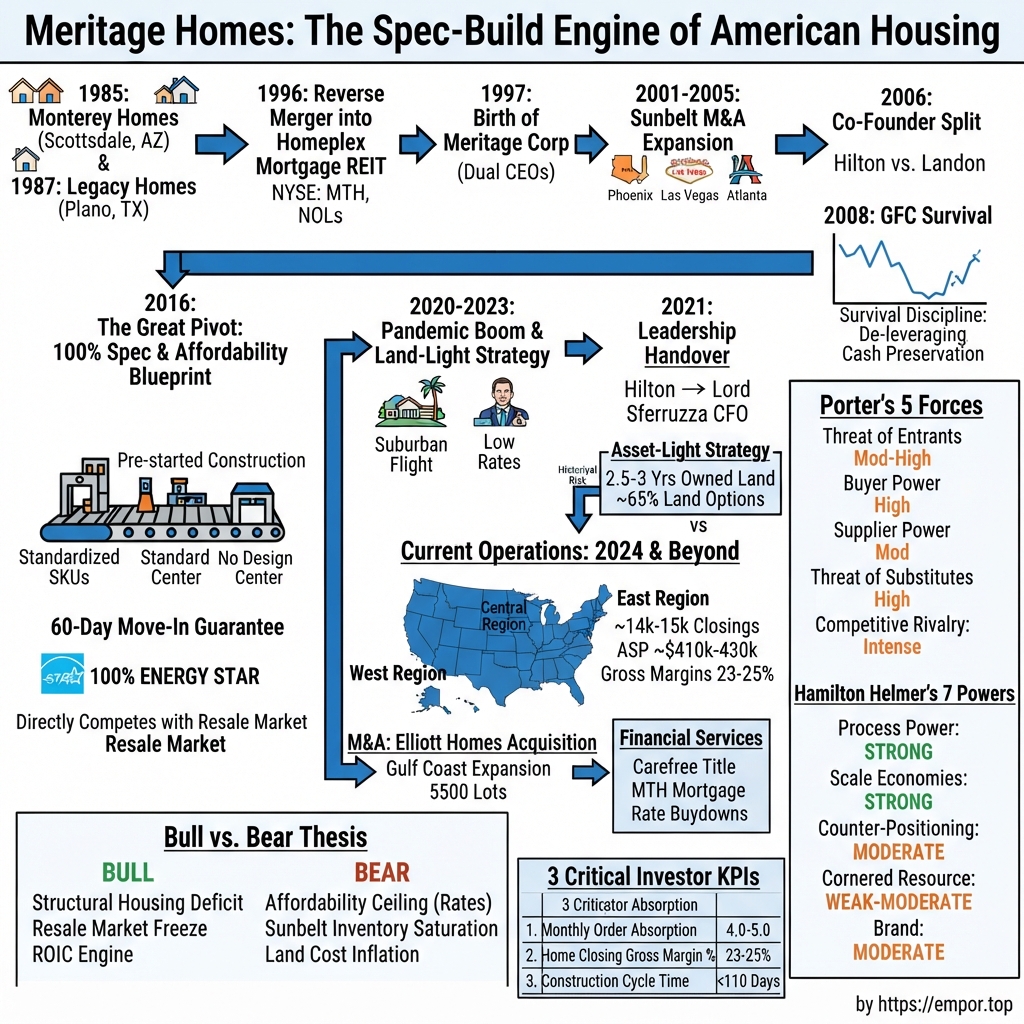
Meritage Homes: The Spec-Build Engine of American Housing
I. Introduction & Episode Roadmap
On a Meritage Homes jobsite, the defining characteristic is routine efficiency. No architect on site debating a bump-out. No buyer standing in a half-framed great room asking whether to move an island eighteen inches to the left. No superintendent on the phone chasing a special-order faucet from a boutique supplier in Italy. Just framers who have built the same floorplan forty times, working from a bill of materials unchanged for months, on a house no one has purchased yet.
That speculative approach is central to the business model. Meritage Homes Corporation starts every single home it builds before securing a buyer. It operates as a 100% speculative builder by design and by written policy, as stated in its annual report.1 The company finishes those homes, targets the resale market, and offers a guarantee rare among homebuilders: if a home is not ready to close within sixty days, Meritage will reimburse the buyer up to $5,000 for the delay.1
The scale of the operation is substantial. In 2025, Meritage closed 15,026 homes and generated $5.8 billion of home closing revenue across twelve states, making it the fifth-largest homebuilder in the United States.1 Its average selling price was roughly $384,000 — positioned deliberately below the U.S. median for new homes, reflecting a strategy focused not on selling premium upgrades, but on delivering houses buyers can readily finance.1
Yet as of mid-2026, operational results have tested that volume thesis. Home closing gross margin in the second quarter of 2026 fell to 18.3%, down 280 basis points year over year and roughly five percentage points below management's baseline for a normal market.2 Diluted earnings per share fell 33% to $1.37.2 The stock spent much of the past year trading near or below tangible book value, while management repurchased shares at what it described as a discount to intrinsic value.3
The central question is not whether the spec model worked; over the past decade, it clearly did. The question is whether full-spec homebuilding represents a durable structural advantage or a cyclical one — an engine that compounds across market cycles, or an efficient operation highly exposed to the most rate-sensitive buyer segment in the United States.
A note on terminology. Homebuilders operate in one of two primary modes. In "to-be-built," a buyer signs a contract first, selects a lot, chooses customized cabinets, counters, flooring, and fixtures at a design center, and waits six to twelve months for construction to finish while carrying mortgage-rate floating risk. In "spec" — short for speculative — the builder selects all specifications, starts construction before securing a buyer, and sells the completed house. Traditionally, spec homes were an unintended byproduct for to-be-built builders: cancellations, model homes, or unsold inventory. Meritage inverted that model, turning speculative construction into its primary operating strategy. Every house it starts is a spec house built from a pre-selected plan, allowing the buyer to choose the finished home rather than the custom components inside it.1
That inversion involves clear trade-offs. The builder forfeits lucrative option revenue, loses the ability to match production directly to signed contracts, and carries inventory risk that to-be-built competitors avoid. In exchange, the builder gains operational repetition — the primary driver of manufacturing efficiency. The investment thesis hinges on whether cost savings from standardized production exceed the holding costs of misjudging buyer demand. From 2020 through 2022, high demand validated the strategy. In 2025 and 2026, higher interest rates and softer demand have made that trade-off far more complex.
The core strategic premise. Meritage operated on a counterintuitive premise: that a new home's main competitor is not another homebuilder, but existing resale homes down the street. Existing homes represent the overwhelming majority of U.S. residential transactions — new construction has historically accounted for less than 20% of the market — and existing homes close in thirty to sixty days without design center choices, custom option lists, or construction risk.1 Meritage chose to stop competing on customization and focus instead on delivery speed, eliminating plan variations, pre-starting homes, shortening cycle times, and competing directly against resale inventory.
Key inflection points in the company's trajectory:
- The December 1996 reverse merger of two small Arizona homebuilders into Homeplex Mortgage Investments Corporation, a struggling public mortgage REIT — an $11 million transaction that delivered a New York Stock Exchange listing without an IPO.4
- The Great Financial Crisis, when Meritage lost $292 million in 2008 alone and saw its fourth-quarter cancellation rate hit 56%.5
- The 2016 decision to pivot away from move-up buyers and rebuild the company around entry-level housing.6
- The January 2021 leadership transition from co-founder Steven J. Hilton to Phillippe Lord, an insider who had joined in 2008 to build the company's market research function.7
- The October 2024 acquisition of Elliott Homes, Meritage's first transaction in a decade, opening the Gulf Coast.8
- The July 2026 strategic shift, when management announced it was steering roughly one-third of the business back toward first-move-up buyers.3
Roadmap. This story traces the company's origins and reverse-merger foundation; the financial crisis and the operating discipline it produced; the transition to a 100% spec strategy and its effect on unit economics; the pandemic housing boom, leadership handover, and land-acquisition strategy; current market dynamics and rate-buydown competition; management capital allocation; competitive positioning using strategic frameworks; bull and bear investment cases; and the key operational metrics that signal whether the model is performing.
The narrative begins where many Sunbelt homebuilder stories start: with affordable land, a rapidly growing metropolitan market, and two founders determined to build a higher-volume business.
 Subscribe on LinkedIn
II. Strategic Origins & The Reverse-Merger Foundation (1985–2006)
In the mid-1980s, Scottsdale, Arizona, was a market where the desert still met the edge of town. William W. Cleverly and Steven J. Hilton, both graduates of Arizona State University, founded Monterey Homes there in 1985 to build semi-custom luxury residences — houses with courtyards, view lots, and buyers who cared deeply about individual design details.9 That focus on tailored customization was the exact opposite of the standardized, high-volume model Meritage would later adopt, making its origins a striking contrast to its ultimate strategy.
Monterey’s early breakthrough followed a familiar path for small homebuilders: a design award at a 1988 home show led to a project at Scottsdale Country Club, attracting country club owner Alan Mishkin, who provided equity capital to fund its initial expansion.9 By the mid-1990s, the company was profitable and well-regarded, yet constrained by the capital limits typical of private builders. Land development demands heavy working capital, growth rapidly absorbs cash, and bank credit lines impose strict ceilings.
The 1996 maneuver
The conventional path to capital was an initial public offering, but Hilton and Cleverly pursued an alternative route. On December 31, 1996, two related private Monterey entities merged into Homeplex Mortgage Investments Corporation, a public real estate investment trust incorporated in Maryland in 1988 as Emerald Mortgage Investments that held residual mortgage assets with limited future utility.1 The transaction valued Monterey at roughly $11 million, and Homeplex subsequently changed its corporate name to Monterey Homes Corporation.10
The reverse merger immediately secured a New York Stock Exchange listing, public stock to use in acquisition deals, and direct access to public debt markets — bypassing underwriting fees, IPO roadshows, and execution risk in an indifferent market.9 For a company that would spend the next three decades financing land acquisition, permanent access to public capital markets proved to be its most critical strategic asset.
Myth versus reality. A common narrative surrounding the transaction suggests the primary prize was Homeplex’s accumulated net operating loss carryforwards, intended as a tax shield for future homebuilding profits. While compelling, this explanation is unsupported by official filings; the corporate history in the company's current annual report describes the transaction strictly in structural terms, while contemporaneous accounts emphasize the exchange listing and low transaction costs rather than tax attributes.110 The loss-carryforward explanation is best understood as unverified commentary rather than documented strategy. The verifiable rationale — an efficient path to an NYSE listing — was sufficient on its own.
Two builders, two cultures, one ticker
Seven months later, in July 1997, the company merged with Legacy Homes, a Dallas-based production builder founded in 1987 by John R. Landon.1011 Structured for roughly $1.5 million in cash plus 667,000 shares, the transaction nearly doubled revenue and established an immediate presence across Dallas-Fort Worth, Austin, and Houston.10 Company disclosures confirm these Texas market entry dates: Dallas-Fort Worth in 1987 via Legacy, Austin in 1994, and Houston in 1997.1
Landon joined Hilton as co-chief executive officer, establishing a dual management structure: Hilton managed Western operations from Scottsdale, while Landon oversaw Central division operations from Texas. In September 1998, the combined business adopted the name Meritage Corporation while retaining the MTH ticker symbol, prior to later adopting Meritage Homes Corporation.10 In June 1998, the company also acquired Sterling Communities for approximately $15 million, expanding into the San Francisco Bay Area and Sacramento.9
This combination brought together two distinct operating philosophies. Monterey constructed semi-custom luxury homes focused on personalization, whereas Legacy produced high-volume homes structured around buyer affordability. The merged organization operated with both models for nearly two decades without fully integrating them, creating operational tension that ultimately prompted its strategic pivot in 2016.
The bolt-on decade
Over the next several years, Meritage executed a steady series of regional acquisitions. The company acquired Hancock Communities in May 2001, Hammonds Homes in July 2002, Perma-Bilt Homes in October 2002, and Citation Homes in January 2004.12 These transactions provided rapid entry into key geographic markets: Perma-Bilt expanded operations into Las Vegas, Hammonds increased density in Texas, and Hancock strengthened its position in Phoenix. Meritage continued to enter new regions, expanding into San Antonio in 2003, followed by Denver, Orlando, and California's Inland Empire in 2004.1
Financial growth during this expansion was rapid. Total closing revenue increased from $520 million in 2000 to $2.04 billion in 2004, while net earnings rose from $35.8 million to $139.0 million over the same period.12 From 2000 through 2005, revenue expanded at a compound annual rate of 45% and net earnings grew at 48%, lifting the company's market capitalization to approximately $1.6 billion and establishing Meritage as the thirteenth-largest U.S. homebuilder.11
This performance was closely tied to broader industry tailwinds. Operating as a leveraged Sunbelt builder acquiring regional land positions during an unprecedented expansion in U.S. housing credit generated strong compounding returns. Meritage paid no common dividends during this period, reinvesting all generated cash flow into land acquisition.12 While effective during an expansionary cycle, this capital allocation strategy exposed the balance sheet to significant risk when market conditions reversed.
The split, at exactly the wrong moment
On May 18, 2006, John Landon resigned as co-chairman and co-chief executive officer after nine years with the company, leaving Steven Hilton as sole chairman and CEO.11 On June 15, 2006, Meritage repurchased one million common shares from Landon at $52.19 per share — matching the June 9 closing price plus a 4% premium — and Landon stepped down from the board.13
Although executive statements remained professional, the timing of the transition coincided with a major industry turning point as U.S. residential housing activity peaked in 2005–2006. Hilton assumed single leadership over an extensive land portfolio acquired near the peak of the market, where land costs incurred years earlier directly governed future operating margins. Within eighteen months, the sharp downturn in housing demand severely strained the company's financial position.
Meritage’s early history yields a clear strategic insight alongside an unresolved question. The core strategic asset established during this era was not a specific home design, but rather permanent access to public capital markets, secured efficiently in 1996 and deployed to fund growth. However, because expansion was driven primarily by acquiring land portfolios, Meritage had not yet demonstrated superior operational efficiency in home construction. That operational capability was about to be tested.
III. Surviving the Great Financial Crisis & The M&A Playbook (2007–2015)
By late 2008, as the U.S. housing market collapsed, homebuilders faced a wave of contract defaults. Meritage's fourth-quarter cancellation rate that year reached 56%.5 More than half of the homes the company had contracted to sell during that quarter came back into inventory. Buyers walked away from contracts signed months earlier while homes were still under construction — driven by falling appraisals, vanishing mortgage originators, or steep price cuts on neighboring properties.
For Meritage, high cancellation rates illustrated the structural vulnerability of the traditional "to-be-built" model. When a buyer defaults under that framework, a builder is left holding a partially finished home tailored to specific customer choices that may not appeal to broader market demand during a severe downturn.
The reckoning
The financial damage was swift. Full-year 2008 total closing revenue fell 36% to $1.52 billion as home closings dropped 27% to 5,627 units and orders declined 27% to 4,620. Meritage reported a net loss of $292 million for 2008, which included $263 million of pre-tax real estate and joint venture impairment charges alongside a deferred tax valuation allowance.5 That followed a $289 million net loss in 2007 driven by $398 million in pre-tax real estate and joint venture charges, as well as a $130 million goodwill impairment.5
Across those two years, Meritage absorbed roughly $580 million in cumulative losses and nearly $800 million in asset write-downs. The goodwill impairment effectively eliminated the accounting value assigned to its prior decade of regional acquisitions, reflecting the sudden deflation in Sunbelt land values.
What survival actually looked like
Management responded by prioritizing liquidity and balance-sheet preservation over unit volume. General and administrative expenses fell by $38 million, or 36%, in 2008.5 The company eliminated its bank debt, built cash reserves from $28 million at year-end 2007 to $206 million by year-end 2008, and reduced its net debt-to-capital ratio from 49% to 45%. By halting land purchases and liquidating existing inventory, Meritage generated approximately $200 million in positive operating cash flow during 2008.5
Operational scale contracted sharply. Controlled lot supply was reduced by 39% to 15,802 lots, representing a 2.8-year supply, while unsold speculative inventory fell 31% to 768 homes and active community count shrank from 207 to 178.5 Chief Executive Steven Hilton also reported reducing base home construction costs by 30% or more in key communities, introducing cost-engineering practices that would become central to Meritage's long-term strategy.5
The crisis reframed how management evaluated operational risk. The central problem was not merely overall construction volume, but the mechanics of custom housing. Under the to-be-built model, buyers select options at design centers and wait six to twelve months for completion, extending cycle times and leaving the builder exposed to market shifts. While design options generated attractive gross margins during expansions, they introduced severe cancellation risks and cash flow unpredictability during downturns.
The 2014 benchmark: Legendary Communities
Meritage paused major acquisitions during the early recovery, resuming M&A only after stabilizing its core balance sheet. On July 10, 2014, the company announced an agreement to acquire the homebuilding assets and operations of Legendary Communities for approximately $130 million, effective August 1.14
Founded in 2009, Legendary had accumulated land at post-crisis valuations and grown into a prominent private builder along the Southeastern I-85 corridor. In 2013, Legendary closed approximately 500 homes and generated $156 million in revenue, catering primarily to first- and second-time move-up buyers with base prices ranging from $120,000 to $550,000. As of June 30, 2014, the business owned or controlled roughly 4,000 home sites.14
The transaction expanded Meritage’s footprint into two new markets — Atlanta and Greenville, South Carolina, both marked in company disclosures with a 2014 entry date — while consolidating Legendary’s Charlotte operations into Meritage’s existing division.114
While external commentary often cited a transaction multiple of roughly 1.2 times book value, Meritage did not disclose book multiples in its official announcement. The strategic value lay in acquiring an active homebuilding platform with turning inventory and 4,000 home sites for $130 million, rather than unentitled land reserves.
Between 2007 and 2015, the lessons of the downturn reshaped Meritage's operational philosophy: sustained profitability depended on rapid asset turnover and strict limits on product customization. In 2016, management moved to apply those lessons across its entire operational model.
IV. The Great Pivot: 100% Spec & The Affordability Blueprint (2016–2020)
In 2016, executive leadership at Meritage faced a fundamental strategic choice: voluntarily eliminating the company's most profitable revenue line item.
Design center options had long carried high incremental gross margins, move-up buyers paid premium prices, and semi-custom luxury homebuilding was rooted in the firm's founding DNA. Yet Chief Executive Steven Hilton and then-Chief Operating Officer Phillippe Lord proposed walking away from customization to rebuild the enterprise around entry-level buyers — a demographic with tighter budgets, less financial flexibility, and heightened sensitivity to interest rate movements.
Why the entry level, and why then
Demographic trends presented a clear opportunity: millennials, the nation's largest age cohort, were entering peak homebuying years. The supply dynamics were even more compelling. Following the 2008 housing collapse, homebuilders had largely retreated from entry-level housing due to elevated land costs, lengthy entitlement timelines, and lower per-unit margins. With competitors focused on move-up buyers, entry-level demand faced surprisingly limited new construction supply.
The first public artifact of this shift arrived on October 6, 2016, when Meritage introduced LiVE.NOW., a line of entry-level homes priced starting in the low $200,000s across most markets, spanning 1,800 to 2,500 square feet, and targeted directly at first-time buyers seeking relief from rising rents.6 Hilton framed the concept as "entry-level plus" — avoiding stripped-down designs in favor of standard energy-efficient features and functional amenities at accessible price points.6 The homes featured kitchen islands, granite countertops, upgraded cabinetry and appliances, and spray-foam insulation, debuting first in Phoenix and Houston.6
That positioning reflected management's underlying hypothesis: rather than competing strictly as the lowest-cost provider, Meritage sought to deliver the highest-value standardized home at an entry-level price point.
Deconstructing the machine
The operational mechanics of the model relied on radical industrial simplification.
A traditional custom or semi-custom homebuilder functions much like a restaurant with an extensive menu where every order requires bespoke preparation, diverse ingredient inventory, and varied cooking routines. Meritage restructured its operations around a standardized selection of core plans executed at high volume. Under this approach, the company pre-started all homes using preselected floorplans and finishes, requiring buyers to choose among completed or in-progress houses rather than individual custom components.1
This operational alignment yielded distinct cost and efficiency advantages:
Trade partner predictability. Construction crews assembling identical floorplans repeatedly achieved higher productivity and lower defect rates. Subcontractors gained scheduling predictability, reducing the financial burden of idle labor. Lord noted that pre-started construction and reduced stock-keeping unit counts enabled purchasing teams to secure cost savings that benefited both the builder and its trade partners, trading volume certainty for lower vendor pricing.3
Purchasing leverage. Standardized bills of materials allowed Meritage to consolidate procurement across key inputs, including hardware, cabinetry, and roofing materials. The company negotiated volume discounts directly with major manufacturers on behalf of its trade partners.1
Accelerated cycle times. By 2025, standardized production reduced construction cycle times to under 110 calendar days, compared to a historical baseline of approximately 120 days.1 Eliminating ten days of construction significantly lowered carried capital costs per home.
Standardized energy efficiency. Except in select markets with unique regulatory constraints, every new Meritage home was built to meet or exceed ENERGY STAR Version 3.1 standards. Company disclosures indicate these homes consumed roughly half the energy of a typical existing U.S. residence.1 For entry-level buyers managing strict debt-to-income ratios, lower utility expenses functioned as an offset to monthly mortgage obligations. Each home was also equipped with the M.Connected Home Automation Suite.1
What it did to the numbers
The financial signature of a volume-driven, standardized strategy is that top-line growth outpaces gross margin expansion, with overall returns driven by asset turnover. From 2016 through 2019, annual revenue expanded from $3.04 billion to $3.67 billion, while net earnings rose from $149.5 million to $249.7 million.15 Return on equity held steady from approximately 13.0% in 2018 to 12.6% in 2019 before climbing to 18.0% in 2020 as demand accelerated.16
Clarifying the strategic timeline. Market commentary frequently attributes Meritage's 60-day closing guarantee to the 2016 strategic pivot. Corporate disclosures clarify that the practice of selling homes later in the construction cycle was introduced in mid-2024, while the formal 60-day guarantee debuted in 2025 alongside move-in-ready inventory and expanded external broker engagement.1 The 2016 pivot established what the company built and whom it targeted; the 2024–2025 adjustments refined when inventory was brought to market.
The honest counter-argument
Between 2016 and 2020, Meritage executed its strategic transition during favorable macroeconomic conditions characterized by low mortgage rates, constrained resale inventory, and expanding entry-level demographic demand. Consequently, revenue growth and expanding returns during this period reflected both operating efficiency and favorable market timing.
The true test of a full-spec homebuilding model lies in its performance during market downturns or elevated interest rate environments. Those operational challenges emerged in full force in subsequent years.
V. The Pandemic Housing Boom, Leadership Handover, & Land-Light Shift (2020–2023)
In early 2020, the U.S. homebuilding industry initially anticipated a severe housing contraction, but instead encountered an unprecedented demand surge.
The macroeconomic shift proved uniquely aligned with Meritage's operational model. As mortgage rates fell below 3%, remote work expanded rapidly, driving demand for single-family housing. Meanwhile, existing homeowners hesitated to list their properties, sharply restricting resale supply — the primary inventory Meritage had designed its strategy to compete against.
For buyers in mid-2020 seeking a home in markets like Phoenix or Dallas with sixty- to ninety-day closing timelines, pre-started spec inventory was often the only option available. Meritage, operating a 100% speculative model by policy, held that exact inventory.
Financial performance scaled rapidly. Annual home closing revenue expanded from $3.67 billion in 2019 to $4.50 billion in 2020, $5.14 billion in 2021, and $6.29 billion in 2022. Net earnings followed a similar trajectory, rising from $249.7 million in 2019 to $423.5 million in 2020, $737.4 million in 2021, and $992.2 million in 2022.15 Return on equity climbed to 24.2% in 2021 and peaked at 25.1% in 2022.16 The 2022 results marked a record period for the company, delivering nearly $1 billion in net earnings on $6.3 billion of revenue.
The handover
On September 17, 2020, Meritage announced that co-founder Steven J. Hilton would step down as chief executive officer effective January 1, 2021, ending a 35-year tenure while remaining executive chairman of the board.7 Chief Operating Officer Phillippe Lord was named CEO, while Clint Szubinski, president of the East Region, succeeded Lord as COO.7
Upon his departure, Hilton cited key milestones of his leadership: expanding operations across nine states and more than twenty metropolitan markets, delivering over 130,000 homes, growing market capitalization beyond $3.5 billion, and navigating the company through the 2008 financial crisis.7
Lord brought a background distinct from his predecessor. Where Hilton was a founder who began in semi-custom luxury building, Lord joined Meritage in 2008 to establish the firm’s strategic operations and market research division — the unit responsible for evaluating land acquisitions, product design, and submarket pricing. Lord subsequently led the West Region from 2012 to 2015 before serving as COO from 2015 through 2020. Prior to Meritage, he held management roles at Acacia Capital, Centex Homes, and Pinnacle West Capital, and holds a degree in economics and business from Colorado State University.17
Lord’s promotion represented a natural progression of the analytical framework he helped design. Having developed the market research apparatus that informed land selection and product design, his elevation to CEO formalized the operational shift initiated in 2016.
Chief Financial Officer Hilla Sferruzza, who had served in her role since 2016, remained alongside Lord, providing financial leadership continuity through the transition.7
Why spec won the supply-chain war
The industry-wide supply chain disruptions of 2021 and 2022 highlighted additional operational advantages of the speculative model. As lead times for appliances, windows, and garage doors extended significantly, traditional to-be-built homebuilders struggled with customized customer contracts that mandated specific fixtures and finishes. Resolving component shortages required individual buyer renegotiations, delaying completion dates and escalating overhead.
By contrast, standardized speculative construction allowed for broader operational flexibility. If a specific cabinet line became unavailable, procurement teams could substitute an equivalent option across an entire production run without altering individual buyer agreements. Combined with procurement scale from a simplified bill of materials, Meritage maintained shorter construction cycle times than many custom competitors. Lord emphasized that long-term relationships with strategic trade partners depended on this model, as pre-started homes and restricted stock-keeping unit counts provided suppliers with predictable volume, securing priority allocation for Meritage jobsites.3
The land question — and where the popular story is wrong
A common misconception regarding Meritage's strategy is that the company operates as a fully land-light builder, controlling most lots through option contracts and off-balance-sheet land banking to limit owned supply to a two- to three-year reserve. SEC filings reveal a different reality.
As of December 31, 2025, approximately 72% of Meritage's controlled lots were owned outright, compared to 62% at year-end 2024.1 The company owned 55,861 lots and controlled an additional 21,764 lots through purchase or option contracts totaling approximately $1.3 billion in purchase price, backed by $161.5 million in cash deposits.1 Total controlled supply stood at 77,625 lots, representing a 5.2-year inventory.1 By June 30, 2026, the portfolio shifted slightly to 69% owned and 31% optioned across approximately 73,200 lots — remaining at a 5.2-year supply, above management's long-term target of four to five years.3
Management maintains a target of controlling roughly 40% of its lot portfolio through options.3 Lord explained during the second-quarter 2026 earnings call why the company had not reached that benchmark, noting that land-banking capital was relatively expensive compared to Meritage’s own borrowing costs and existing cash reserves.3 Sferruzza echoed that view, stating that off-balance-sheet options are evaluated on a deal-by-deal basis because not every land parcel justifies the additional capital cost required by third-party land bankers.3
Consequently, Meritage maintains a substantial, owned-heavy land book funded by equity and corporate debt. This structure provides higher margin potential per community during housing expansions, but increases balance-sheet exposure and holding costs if market demand softens.
Accounting disclosures also reflect the evolving structure of these land commitments. Meritage's June 30, 2026 balance sheet recorded $78.1 million in consolidated real estate not owned, alongside $59.9 million in related financing proceeds for the first half of 2026 — items that were absent from the year-end 2025 financial statements.2 Under variable interest entity consolidation rules, off-balance-sheet land arrangements can re-enter primary financial statements, demonstrating that contractual land options do not entirely eliminate balance-sheet liabilities.
As land acquired between 2022 and 2025 flows into active production, the carrying costs and valuation of this inventory directly influence current gross margins.
VI. Current Operations, Segment Data, & The Rate-Buydown Playbook (2024–Present)
On July 30, 2026, Executive Chairman Steven Hilton opened Meritage's second-quarter earnings call with an observation that has become familiar across the homebuilding sector: the spring selling season was slower than historical norms.3
Beneath that customary phrasing lies an operational paradox: Meritage maintained factory-like efficiency even as its financial performance slipped. During the second quarter of 2026, home orders fell 9% to 3,575 units, while closings dropped 11% to 3,725 units. Home closing revenue contracted 14% to $1.39 billion, driving net earnings down 38% to $90.6 million.2 For the first six months of 2026, home closings slipped 12%, revenue dropped 16% to $2.50 billion, and net earnings fell 46% to $145.9 million.2
Yet key operational metrics remained strong. Backlog conversion reached 200%, construction cycle times stayed below 110 days for a fifth straight quarter, direct construction costs per square foot fell nearly 6% year over year, completed speculative inventory dropped 42%, and active community count expanded 9%.3 Operationally, the standardized manufacturing engine continues to execute efficiently; macroeconomically, market headwinds persist.
The homebuilding segment: three regions, three different businesses
Homebuilding represents virtually the entirety of the enterprise, structured across three reporting segments.2
West — comprising Arizona, California, Colorado, and Utah — operates as the company's highest-priced, supply-constrained geographic footprint. In 2025, the region delivered 3,821 homes at an average sales price of roughly $478,800, generating $1.83 billion in revenue.1 However, it also faced severe headwinds: unit closings declined 15.6% in 2025, while monthly order velocity slowed from 4.2 to 3.5 homes per community.1 Chief Executive Phillippe Lord candidly outlined the region's challenges — intense buyer affordability constraints, heightened competition, rigid land costs, and a strict regulatory environment — explaining that Meritage is intentionally reallocating capital toward the East region while operating the West at a slower pace to preserve the long-term value of a land book that "took a long time to put together."18
Central — encompassing Texas and Tennessee — functions as the primary volume driver. The region closed 5,264 homes in 2025 at an average price of $348,700, generating the company's highest order pace at 4.7 homes per community per month.1 It also recorded the highest regional home closing gross margin at 20.9%.1 Executive disclosures frequently cite Dallas and Houston as highly price-elastic markets where modest promotional incentives reliably generate incremental sales volume.18
East — spanning Alabama, Florida, Georgia, Mississippi, North Carolina, and South Carolina — represents the primary expansion area alongside significant margin contraction. The region closed 5,941 homes in 2025, up 6.9%, generating $2.10 billion in closing revenue.1 However, volume growth was driven entirely by a 27.9% expansion in average community count, as monthly sales velocity per community actually slipped from 4.2 to 3.6 units.1 Simultaneously, home closing gross margin in the East fell 780 basis points to 18.3% — the lowest among the three regions — while accounting for approximately two-thirds of the company's fourth-quarter land option abandonment charges.119
This regional divergence highlights an important structural reality: Meritage's volume growth is currently being sustained through community expansion rather than higher sales velocity, with expansion concentrated in its lowest-margin region. This trend poses a clear challenge to overall return on invested capital.
Financial services: small, but not decorative
The financial services segment generated $18.6 million in earnings in 2025, up from $14.4 million in the prior year.1 The division includes Carefree Title Agency, the company's wholly owned title and escrow business; Meritage Homes Insurance Agency; and MTH Mortgage, an unconsolidated joint venture operated with an established mortgage broker.1
Representing approximately 3% of pre-tax earnings, the segment does not serve primarily as an independent earnings driver. Instead, its strategic value lies in providing the operational infrastructure for the company's sales incentives. Controlling title and escrow services enables Meritage to manage closing timelines and maintain its 60-day delivery guarantee, while the mortgage joint venture provides the platform to structure and originate tailored rate-buydown financing for buyers.1
The Gulf Coast: Elliott Homes
On October 30, 2024, Meritage expanded into the Gulf Coast region by acquiring the assets of Elliott Homes, a leading builder in Mississippi, Alabama, and the Florida Panhandle. The transaction added more than 5,500 controlled lots, with initial production integrated into existing entry-level communities prior to year-end 2024 and full operational contribution anticipated in 2025.8 Terms of the transaction were not disclosed.8
Marking Meritage's first corporate acquisition since Legendary in 2014, the transaction served a strategic geographic objective by bridging the Interstate 10 corridor between New Orleans and the Florida Panhandle. In a single year, the transaction added market positions in Coastal Alabama, Coastal Mississippi, the Florida Panhandle, and Huntsville.18 Founder Brandon Elliott noted that joining Meritage provided the regional operation with access to the procurement scale and capital resources of a top-five national builder.8
Subsequent performance provided an initial assessment of the acquisition. Management explicitly attributed East region volume growth in 2025 to acquisitions and new market entries in Alabama and Mississippi.1 However, while unit volume increased, profitability lagged: the East region recorded the lowest gross margin in the company in 2025, while integration and start-up expenses for the new Gulf Coast divisions increased general and administrative overhead.1 Although evaluating a land acquisition after eighteen months remains preliminary, early execution indicates that geographic expansion has initially come at the expense of regional operating margins.
The rate-buydown war
The primary factor currently influencing Meritage's gross margin is the cost of interest rate buydowns.
In entry-level homebuilding, purchase decisions depend heavily on monthly mortgage payments rather than base purchase prices. When market interest rates rise, monthly debt service increases, reducing buyer purchasing power. Builders typically restore affordability through two mechanisms: lowering base home prices or funding mortgage rate buydowns. Rate buydowns involve paying upfront fee concessions to lenders to reduce the buyer's mortgage interest rate — either permanently or temporarily — with the cost recorded directly against home closing gross margins.
Meritage's operational model creates a distinct timing advantage in structuring these concessions. Securing a mortgage rate lock requires a predictable closing window. While to-be-built builders selling homes nine months before completion face expiring rate locks, Meritage's 60-day closing timeline enables buyers to secure actionable financing terms. Furthermore, individual homeowners selling existing resale properties generally cannot offer structured institutional rate buydowns.1
While structurally effective, financing concessions remain costly. Chief Financial Officer Hilla Sferruzza has detailed how incentive costs vary across interest rate tranches: when benchmark rates decline, financing incentives become less expensive to deliver because the spread between market rates and targeted buyer rates narrows, whereas broader rate drops encourage buyers to shift from rate buydowns toward price discounts.3 Consequently, incentive expenses remain inversely tied to prevailing interest rates, which Sferruzza noted "remain highly volatile."3
The financial impact was evident in the second quarter of 2026, when adjusted home closing gross margin fell to 18.6% — approximately four to five percentage points below management's long-term target range of 22.5% to 23.5%.23 Lord attributed the margin compression directly to market conditions, stating that the shortfall "is 100% interest rate and incentive related" because underwriting models assume a standardized incentive environment.3
This framing clarifies that recent margin compression reflects broad macroeconomic interest rate pressure rather than internal operational missteps. However, it also indicates that margin recovery depends largely on external rate adjustments beyond management's direct control.
The higher-cost land is the other half of the problem
In addition to financing incentives, elevated land acquisition costs continue to pressure gross margins. Sferruzza noted that inventory currently moving through cost of goods sold reflects land acquired between 2022 and 2025 at peak valuations. She indicated that these higher acquisition costs will remain a margin headwind until lower-basis land reaches active production, a timeline she currently projects for "the tail end of 2027 or early into 2028."3
Management's projected timeline for land cost relief has gradually shifted across recent earnings calls. In late 2025, guidance anticipated margin relief starting "in late 2027."19 By the first quarter of 2026, management revised the projection to "the tail end of 2027,"18 and by the second quarter of 2026 further extended the horizon to the "tail end of 2027 or early into 2028," citing additional variables such as energy price trends.3 While incremental, this step-by-step extension highlights how lingering land inflation continues to delay margin recovery.
The strategic reversal
The most significant strategic development from the second-quarter 2026 earnings call was management's announced intention to reallocate product mix, shifting a portion of production back toward first-time move-up buyers. Meritage targets a long-term operational balance of approximately one-third first-time move-up homes and two-thirds entry-level homes.3 With move-up homes currently accounting for roughly 10% of overall volume, Lord noted that the financial impact of this product shift will not meaningfully affect financial disclosures until 2029 and beyond.3
Equity analysts questioned whether the transition represented a deliberate strategic evolution or a reaction to entry-level market pressures. Stephen Kim of Evercore asked whether the move reflected a long-standing blueprint or a change in strategy. Lord maintained that broader demographic expansion was always the long-term objective, noting that shifts in land market dynamics drove the timing: entry-level land had offer-and-pricing advantages for five years, but "that bifurcation is starting to close" as move-up parcels meet return thresholds.3 Sferruzza framed the adjustment around customer demographics, explaining that Meritage engaged millennial buyers a decade ago as first-time owners and now aims to serve that cohort as their housing requirements expand.3
When questioned further regarding strategic consistency, Lord acknowledged the operational flexibility of the approach, stating: "Can that change? Certainly, it can change. We are always going to balance out the business between entry level and first move up based on the inputs in the business."3
This pivot presents both operational rationale and strategic questions. Following a maturing demographic cohort across its housing life cycle aligns with long-term demand trends. However, expanding into move-up housing represents a shift for an enterprise that spent the past decade attributing its efficiency gains to a single-minded focus on entry-level buyers. Lord stated that product specifications will adapt only "on the margin," maintaining standardized floorplans without design centers while offering upgraded finishes on larger lots.3 Yet move-up buyers frequently need to sell an existing home before closing, leading Lord to note that inventory will need to be released earlier in the construction cycle.3 Adjusting sales timing to accommodate buyer contingency sales introduces operational complexity, potentially dampening the cycle-time advantages central to the speculative model.
VII. Management & Capital Allocation Audit
The most revealing document Meritage published in 2026 was not an earnings release, but a single performance table within its proxy statement.
In 2025, executive compensation for Meritage’s named officers was evaluated across three annual cash incentive metrics: adjusted EBITDA weighted at 60%, home closings at 30%, and customer satisfaction at 10%. Adjusted EBITDA reached $708.8 million against a $1.0 billion target, yielding zero payout. Home closings totaled 15,026 against a 16,500 target, paying out at 55.3%. Customer satisfaction reached 95.9% against a 90% target, triggering the maximum 250% payout. Consequently, the aggregate cash bonus paid out at 42% of target.17
This payout distribution offers a clear view of both operational performance and executive incentive design. While core financial metrics missed targets, customer satisfaction maxed out. Because the customer satisfaction metric carried a modest 10% weighting, overall executive cash compensation still tracked the broader decline in shareholder returns.
The people
Phillippe Lord, 52, has served as chief executive officer for five and a half years and has been with Meritage for eighteen years.17 His public communication style remains analytical and measured compared to industry peers. On the first-quarter 2026 call, when asked to address his cautious outlook relative to more optimistic competitors, Lord acknowledged that Meritage's buyer demographic lacked the confidence seen in other buyer segments, noting that the company competes directly with entry-level builders across Sunbelt markets where home prices experienced the steepest appreciation, stating, "for all those reasons, I think when you look at our buyer profile and our geographical footprint, we feel cautious right now."18
Lord’s long-term compensation structure is performance-based. For 2025, he received 37,067 performance share awards at target, tied to adjusted return on assets and relative total shareholder return, alongside an equal number of time-based units scheduled to cliff-vest in 2028.17 He beneficially owns 260,389 shares through family limited partnerships, representing less than 1% of total outstanding stock.17
Hilla Sferruzza has served as chief financial officer since 2016, overseeing the financial execution of the spec strategy. Her financial disclosures provide detailed visibility into operational mechanics. She regularly details the math behind company guidance, noting that a sequential shift in closings alters gross margin by roughly 20 to 30 basis points due to fixed-cost leverage, that first-quarter SG&A expenses reflect seasonal retirement compensation triggers, and that quarterly share repurchases were executed at specific discounts to book value.318 On the second-quarter 2026 call, Sferruzza also noted that customer credit profiles — including FICO scores, debt-to-income ratios, and loan-to-value ratios — remained consistent with historical averages, presenting empirical evidence that softer demand stems from buyer sentiment rather than credit deterioration.3
Sferruzza holds 124,961 shares.17
Steven J. Hilton serves as executive chairman, holding 841,603 shares, or 1.3% of common stock — below some third-party estimates.17 Directors and executive officers as a group hold 2.5% of total shares.17 Hilton's employment agreement caps his annual cash incentive payout at 100% of target, meaning his payout on customer satisfaction was limited to 100% while other executives received 250%.17 Hilton maintains governance oversight, with all land acquisitions exceeding a specified dollar threshold requiring his approval before submission to the board's Asset Management Committee.1
While founder oversight on land commitments provides strategic continuity, it concentrates capital authority in an executive chairman holding 1.3% of equity who no longer manages daily operations.
Executive transitions. Clint Szubinski, who assumed the COO role during the 2021 leadership transition, voluntarily departed the company on May 16, 2025.17 Meritage opted not to fill the COO position directly. Instead, effective January 1, 2026, nineteen-year company veteran Austin Woffinden — who joined as regional counsel in 2007 and led the Dallas-Fort Worth division from 2018 to 2025 — was appointed executive vice president of corporate operations and strategy.17 Board member Dennis Arriola resigned effective March 31, 2026, in a departure the company stated was not due to any disagreement.17
Capital allocation: the record
Meritage’s capital allocation strategy over the past two years has been aggressive across share repurchases and dividends.
Share repurchases. In 2025, the company repurchased 4,289,984 shares — representing 6.0% of outstanding shares at the beginning of the year — for a record $295.0 million.1 It continued this activity into 2026, deploying $130 million in the first quarter at an average 6% discount to book value, and $100 million in the second quarter at an average 16% discount to book value, reducing the year-end 2025 share count by nearly 5% within six months.183 Since initiating the buyback program in mid-2018, Meritage has repurchased approximately $836 million of common stock, retiring 22% of shares outstanding.19
Dividends. The board raised the quarterly dividend from $0.375 per share in 2024 to $0.43 in 2025, and further to $0.48 in 2026 — a 12% increase during a period when net earnings fell sharply.13
Capital returned to shareholders. In 2025, Meritage returned $416 million to shareholders via repurchases and dividends, representing 92% of net earnings.19 In the first half of 2026, total capital returned reached $292 million, or 201% of first-half net earnings.3
Returning capital in excess of current earnings reflects working capital monetization. Operating cash flow reached $290.8 million in the first half of 2026, compared to a negative $28.9 million in the prior-year period, driven primarily by a $132.3 million decrease in real estate inventory.2 Capital returns were effectively funded by liquidating inventory reserves — a counter-cyclical adjustment of buying equity below book value while housing demand remains soft. Recognizing that inventory monetization is temporary, Sferruzza adjusted the share repurchase target on the second-quarter call, setting a baseline of "a minimum of $55 million per quarter" for the remainder of 2026, supplemented by opportunistic purchases.3
Balance sheet strength. As of June 30, 2026, net debt-to-capital stood at 17.1%, well below management’s self-imposed ceiling in the mid-20% range, backed by $807 million in cash and no outstanding borrowings under its revolving credit facility.2 In June 2026, Meritage amended its credit agreement, expanding the facility to $980 million, extending maturity from 2030 to 2031, and increasing the accordion feature to $1.47 billion.203 The company maintained investment-grade credit ratings from all three major rating agencies through 2025.1 Financial covenant headroom remains substantial, with a leverage ratio of 15.1% against a 60% maximum threshold and tangible net worth of $5.15 billion against a $3.77 billion covenant minimum.1
The credibility scorecard
Operational discipline. Management maintained strategic focus despite cyclical pressure. Throughout 2025 and early 2026, Meritage prioritized gross margin preservation over volume, choosing not to chase an absorption pace of four sales per community per month when market conditions softened. The company accepted lower absorption rates of 3.2 units per community in the fourth quarter of 2025 and 3.5 units in the second quarter of 2026 rather than layering excessive incentives.193 Management retained its four-unit monthly target rather than lowering guidance benchmarks, with Sferruzza stating: "We've not reset a different target."19 Furthermore, financial disclosures remain transparent regarding land option abandonment charges, share buyback discounts relative to book value, and the factors behind missing first-quarter guidance.18
Capital deployment and sales velocity. Community count expansion plays a central role in full-year guidance, requiring ongoing capital commitment during a soft market. Meritage opened over 160 communities in 2025 and projected community count growth of 5% to 10% for 2026, making full-year delivery guidance dependent on store expansion.193 Lord confirmed that expected fourth-quarter delivery increases are "100% tied to the community count growth."3 Expanding community count while sales velocity per community fell 19% year over year demonstrates that top-line volume is being supported through capital deployment.2
Compensation adjustments. In February 2026, following a fiscal year in which net earnings declined 42% and EBITDA missed target by nearly 30% — resulting in an overall executive bonus payout of 42% — the compensation committee raised Lord's target annual cash incentive from $3.25 million to $4.0 million and his target equity grant to $6.0 million, with corresponding target increases for Sferruzza, Clinton, and Feliciano.17 Hilton's compensation targets remained unchanged.17 The board justified the adjustments based on executive compensation benchmarking against a thirteen-company homebuilder peer group.17 Raising target compensation following a year of declining earnings highlights a tension between market-based executive retention standards and short-term shareholder alignment.
VIII. Strategic Frameworks: Porter's 5 Forces & Hamilton Helmer's 7 Powers
Homebuilding is one of the least structurally attractive industries in the S&P universe, and any analysis concluding otherwise is likely confusing a cyclical peak with structural advantage. The analytical task is not asking whether Meritage operates in an attractive industry — it does not — but evaluating precisely where, within a tough industry, it has built a genuine operational edge.
Porter's Five Forces
Threat of new entrants: moderate. The barriers are localized rather than structural. Land entitlement is slow, jurisdiction-specific, and relationship-driven; capital requirements are substantial, with Meritage carrying roughly $5.9 billion of real estate on its balance sheet;2 and trade labor is scarce and committed to established builders. Yet these hurdles do not prevent a regional private builder from competing effectively within a single metro area, nor do they block large national builders from expanding into new territory — as Meritage demonstrated by entering Salt Lake City and Jacksonville in 2023 and four Gulf Coast markets in 2024.1 Entry barriers protect operational scale, not exclusive market position.
Bargaining power of buyers: high, and macro-driven. Individual buyers have minimal negotiating leverage, but the broader buyer pool exercises immense influence through the mortgage market. When interest rates shift, demand adjusts immediately, leaving no individual builder with pricing power. Meritage's second-quarter 2026 commentary underscored this reality: management declined to push sales absorption higher because demand proved relatively inelastic, meaning additional promotional incentives failed to generate proportional sales volume.3 Inelastic demand presents a severe challenge for any volume-driven operator.
Bargaining power of suppliers: moderate, and currently favorable. Meritage achieved a nearly 6% year-over-year reduction in direct construction costs per square foot in the second quarter of 2026 across labor and materials, along with a 2% sequential improvement.3 While this demonstrates meaningful purchasing leverage, it also reflects broader slack in trade labor that typically emerges when industry-wide volume softens. Management has remained cautious about projecting further cost relief, citing potential lumber price pressure and declining to model additional savings.3 Supplier leverage is currently weak because overall homebuilding activity has slowed — representing cyclical relief rather than a permanent competitive moat.
Threat of substitutes: high, and this is the defining force. The primary substitute for a new home is an existing resale home. Historically, new construction has accounted for less than 20% of total U.S. residential transactions.1 The widely cited "golden handcuffs" dynamic — where homeowners refuse to sell and forfeit sub-5% mortgage rates — temporarily restricted resale supply and channeled buyers toward new construction. However, this dynamic represents a temporary macroeconomic tailwind created by historical rate movements rather than a durable structural shift. As rate lock-in effects gradually diminish over time, resale inventory will return and strengthen the substitute threat. Executive Chairman Steven Hilton acknowledged this dynamic, expressing hope that lower rates would eventually unwind some of the lock-in effect.19 That unwinding, however, carries reciprocal pressure by restoring resale competition.
Rivalry: intense. Meritage's compensation peer group underscores the crowded competitive landscape, including D.R. Horton, Lennar, PulteGroup, NVR, KB Home, Toll Brothers, Taylor Morrison, Century Communities, LGI Homes, M/I Homes, TRI Pointe, Beazer, and Hovnanian.17 Several of these peers operate at significantly larger scale, and as Meritage acknowledges in its filings, "some of our homebuilder competitors have greater financial resources and may have lower costs than we do."1 In the entry-level Sunbelt market, Meritage competes directly with D.R. Horton and Lennar, both of which build speculative inventory at greater scale. Chief Executive Phillippe Lord's description of going "head-to-head with a line of other entry-level builders that do similar things to us" reflects an environment of direct, undifferentiated rivalry.18
Hamilton Helmer's Seven Powers
Process Power — the strongest claim, and partially proven. Helmer defines process power as an operational advantage embedded within organizational routines that competitors cannot quickly copy, even if fully understood. Meritage presents several operational proof points: construction cycle times under 110 days, sustained for five consecutive quarters and below its historical baseline of roughly 120 days;13 a backlog conversion rate of 200%, with nearly 60% of closings sold intra-quarter;2 a cancellation rate of 13%, compared to an industry norm management describes as mid-to-high teens;3 and direct construction cost reductions secured through pre-started homes and restricted stock-keeping units.3 Replicating these capabilities requires a competitor to simultaneously redesign floorplan libraries, realign trade partner networks, and retrain sales organizations. However, the primary counter-evidence appears in Meritage's financial margin: an adjusted home closing gross margin of 18.6% is not demonstrably superior to peers operating under alternative construction models.2 Operational process power that does not translate into superior relative gross margins suggests that efficiency gains are largely being passed to buyers through competitive pricing.
Scale Economies — real but second-tier. As the fifth-largest U.S. homebuilder, Meritage commands genuine national purchasing leverage.1 However, it remains smaller than market leaders that possess even greater purchasing scale. Local and regional density provides a more defensible advantage: operating 152 active communities in the East region alone as of June 30, 2026, grants meaningful negotiating leverage with local trade contractors.2
Counter-Positioning — historical, and now expiring. When Meritage committed to its spec model in 2016, traditional build-to-order incumbents resisted copying the approach because design centers generated lucrative option margins that they were reluctant to cannibalize. That dynamic represented classic counter-positioning. However, that initial strategic advantage has largely run its course. Management noted on recent earnings calls that build-to-order competitors are "pivoting back strongly to BTO and out of spec," while separately observing a broader industry pivot away from carrying finished inventory.318 As the broader industry has adapted to distinct spec and build-to-order segments, the initial element of strategic surprise has faded.
Cornered Resource — weak. While local land relationships and entitlement expertise accumulate over time, land positions remain neither exclusive nor permanently protected. Meritage's decision to walk away from more than 3,400 lots in a single quarter at a cost of $27.9 million demonstrates that land holdings are contestable and subject to market repricing rather than cornered assets.19
Brand — modest, but not zero. Meritage's most substantive brand attribute has been its energy-efficiency positioning, highlighted by eleven consecutive years as an EPA ENERGY STAR Partner of the Year for Sustained Excellence through 2024 and a 95.9% customer satisfaction rating in 2025.117 However, current EPA guidance indicates that the energy certification framework is scheduled to phase out by June 2026, while the related Section 45L federal tax credit expired on June 30, 2026.13 Meritage noted that the credit's expiration was largely immaterial because stricter construction thresholds had already disqualified most of its homes from 2025 onward.19 While transparent, this acknowledgment underscores that a key external market differentiator is losing its underlying regulatory scaffolding.
Switching Costs — none. Homebuyers typically transact once every several years, facing no structural switching costs between builders.
Network Effects — none. A partial and notable exception exists within distribution channels: the external real estate broker network. Meritage maintains a co-broke participation rate in the low 90% range — which management believes ranks near the top of its peer group — driving recurring business from repeat real estate agents.193 While not a classic network effect, this high broker engagement represents a valuable distribution asset, as agents who complete smooth 60-day transactions are more likely to bring subsequent buyers. Nevertheless, broker incentive programs remain relatively straightforward for competitors to imitate.
Net assessment: Meritage possesses one credible power in process efficiency, one secondary power in regional scale, an expiring advantage in counter-positioning, and a valuable but imitable distribution asset in broker relationships. This represents a stronger competitive hand than many regional homebuilders hold, but it does not constitute an unassailable economic moat — a reality reflected in current gross margin performance.
IX. The Investment-Story Spine: Bull vs. Bear & Key KPIs
Every homebuilding investment thesis eventually reduces to a single question: is the business a self-sustaining operational machine or a leveraged bet on interest rates? For Meritage Homes, the empirical record suggests a disciplined manufacturing engine tethered directly to mortgage rate dynamics. The central analytical challenge for investors is determining which force dominates across changing market cycles.
The three KPIs that actually matter
While top-line revenue and quarterly earnings per share capture headline performance, three specific operating metrics provide a far clearer view of underlying business health. Meritage discloses each of these quarterly.
1. Monthly net orders per community (absorption pace). This metric serves as the company's primary demand gauge and the key operational lever management uses to run the business. The stated long-term target is four net sales per community per month, the threshold at which Meritage best leverages fixed costs at both the community and division levels.1918 The company achieved an average sales pace of 3.9 for full-year 2025, but saw velocity slow to 3.6 in the first quarter of 2026 and 3.5 in the second quarter — down from 4.3 a year earlier.13 Tracking absorption pace separates unit volume generated by genuine organic demand from volume driven by community expansion. When Meritage expands active community count by 9% while overall home orders decline by 9%, store count growth is effectively masking underlying demand softness.2
2. Home closing gross margin, net of incentives. This figure measures the true cost of generating demand. Management's long-term baseline target ranges from 22.5% to 23.5% in a normalized incentive environment; actual figures were 20.8% adjusted for 2025 and 18.6% adjusted in the second quarter of 2026.123 The spread between those targets and recent performance reflects the direct cost of mortgage rate-buydown concessions alongside margin drag from high-basis land acquired between 2022 and 2025. This metric provides the cleanest measure of whether Meritage holds genuine pricing power or is simply subsidizing demand.
3. Construction cycle time. This metric measures capital velocity and represents the operational variable most directly within management's control. Meritage maintained construction cycle times under 110 calendar days for five consecutive quarters through mid-2026, compared to a historical baseline of roughly 120 days.13 Every day removed from the build cycle eliminates carried inventory expense and recycles capital faster. Crucially, rapid cycle times serve as the operational foundation for the company's 60-day delivery guarantee. If cycle times stretch, that go-to-market promise becomes economically unviable. This metric remains the clearest proxy for whether operational efficiency gains are holding or eroding.
The skeptical investor's stress test
On capital allocation. An activist investor would question why Meritage is guiding to $1.7 billion to $2.0 billion in land acquisition and development spend for 2026 while targeting 5% to 10% community count growth at a time when absorption per store is falling and the stock trades near or below book value.3 Management's rationale — that land development requires multi-year lead times and cutting commitments now sacrifices unit growth in 2028 and 2029 — represents a standard long-cycle perspective. However, the counter-argument is persuasive: with a 5.2-year lot supply already exceeding management's four- to five-year long-term target, why deploy marginal capital into raw land rather than repurchasing shares at a 16% discount to book value?3 Chief Financial Officer Hilla Sferruzza's decision to establish a $55 million quarterly minimum for share buybacks while maintaining full land acquisition guidance represents a deliberate capital allocation choice that prioritizes store count expansion over equity retirement.
On margin durability. If benchmark mortgage rates remain above 7% over an extended horizon, financing incentive costs will remain elevated. Chief Executive Phillippe Lord noted that the primary demand inflection point occurs when mortgage rates reach 6% or below, the level at which management sees "buyer psychology change."18 That observation frames a clear reality: the current business model requires a lower interest rate environment to restore historical gross margin benchmarks.
On spec inventory shock. Unsold inventory represents the model's structural tail risk. While an option contract on raw land can be abandoned by forfeiting a deposit, a partially completed home represents committed capital. Meritage held approximately 5,100 spec homes as of June 30, 2026 — averaging roughly 15 homes per community, or four months of supply — of which 1,500 were fully completed.3 In a severe housing downturn, speculative inventory must be liquidated at market-clearing prices. Mitigating factors exist: total spec inventory declined 27% year over year, completed specs fell 42% to represent 30% of total inventory against a one-third target, and sub-110-day cycle times allow management to adjust housing starts rapidly.3 Indeed, Meritage reduced housing starts by 30% year over year in the first quarter of 2026 to manage inventory levels.18 Nevertheless, carrying pre-started inventory retains inherent balance-sheet exposure during cyclical turns.
On the land book. With 69% of lots owned outright and a 5.2-year total supply, Meritage carries greater land liability than an asset-light narrative suggests. The fourth quarter of 2025 provided an empirical preview of land risk, when terminating over 3,400 controlled lots resulted in $27.9 million in walk-away option charges alongside $7.8 million in real estate impairments in a single quarter.19 Because those terminations involved off-balance-sheet option contracts, exit costs were capped; owned land parcels do not offer an equivalent contractual exit.
The bull case
Structural housing undersupply. Over a decade of underbuilding following the 2008 financial crisis created a persistent deficit of affordable single-family housing, while underlying demographic demand from millennials, Gen Z, and downsizing baby boomers remains intact — a structural dynamic cited in company disclosures and supported by broader housing market data.1
Resale market constraints. Existing homeowners holding sub-4% mortgage rates remain reluctant to list their properties, restricting resale inventory and channeling prospective buyers toward homebuilders capable of offering structured financing incentives that individual sellers cannot match.1
Proven operational execution in a soft market. Despite a 14% drop in closing revenue in the second quarter of 2026, Meritage reduced direct construction costs per square foot by nearly 6%, maintained cycle times below 110 days, reduced completed spec inventory by 42%, and kept cancellation rates at 13%, below broader industry averages.32 These operational metrics indicate that recent financial contraction stems primarily from macroeconomic interest rate pressures rather than internal operational failure.
Balance sheet strength and liquidity. With a net debt-to-capital ratio of 17.1%, $807 million in cash reserves, an undrawn $980 million revolving credit facility, and investment-grade ratings from all three major rating agencies, Meritage possesses substantial financial flexibility to fund land acquisitions, repurchase equity, or pursue M&A.2201 Lord confirmed that management views private-market M&A as a vehicle to expand move-up market share or enter new regions, specifically noting interest in several Midwest markets.3
Mechanical margin recovery potential. If mortgage rates decline and lower-basis land acquired after 2025 enters active production starting late 2027, gross margins can expand toward management's 22.5% to 23.5% target range without requiring underlying structural changes to the operating model.3
The bear case
Persistent affordability constraints. If mortgage rates remain elevated above 7.5%, Meritage must maintain elevated rate-buydown incentives or reduce base prices to sustain sales volume. In either scenario, gross margins remain compressed, as demonstrated by the 420-basis-point decline in adjusted home closing gross margin during 2025.19
Regional Sunbelt competition. Major production builders — including Meritage, D.R. Horton, and Lennar — are simultaneously delivering speculative entry-level inventory across Texas, Florida, Arizona, and the Carolinas. Management identified localized demand weakness in Orlando, Denver, Salt Lake City, and Northern California during the second quarter of 2026, following earlier soft spots in Austin, San Antonio, parts of Florida, Northern California, and Colorado in late 2025.319 Broadening geographical softness highlights rising competitive density across core Sunbelt markets.
Land inflation at the entry level. Management's decision to shift a portion of production back toward first-time move-up buyers stems partly from underwriting constraints on entry-level land parcels.3 Difficulty in acquiring entry-level land at target return thresholds signals structural cost pressure within the company's core market segment.
Capital-funded volume growth. Meritage expanded community count by 15% in 2025 and guided to 5% to 10% growth for 2026, even as sales absorption per community declined by 18% to 19%.192 Expanding store count while sales velocity slows consumes working capital and depresses overall capital returns, as reflected by the drop in return on equity from 15.3% in 2024 to 8.7% in 2025.16
Execution risk in strategic rebalancing. Reallocating product mix toward first-time move-up buyers requires new floorplans, different land positions, and modified sales timelines — with financial impacts not expected until 2028 and 2029.3 Introducing contingency sales and earlier inventory releases into the spec model risks adding operational complexity that could dilute the cycle-time advantages central to the enterprise.
The distinction between housing deficit and payment affordability. While national housing statistics indicate a structural deficit of physical shelter, homebuilder revenues depend on payment affordability. Meritage sells monthly mortgage payments, and until monthly debt service aligns with buyer income constraints, structural housing demand cannot fully translate into profitable home closings.
X. Playbook & Investing Lessons
The most compelling aspect of the Meritage Homes story is not simply that the company built a fast, standardized manufacturing engine for entry-level housing. Industrialized efficiency is hardly unique. Rather, the defining choice was management's deliberate decision to eliminate the design center — the portion of the business customers most visibly enjoyed — while it was still generating attractive profits.
Lesson one: simplification is a strategy, not a cost initiative. The design center was a reliable revenue stream. Eliminating custom options initially appeared to sacrifice high-margin sales. In practice, however, standardizing floorplans secured a uniform bill of materials, which provided scheduling predictability for trade partners, shortened construction cycle times, enabled a 60-day closing guarantee, and fundamentally shifted the competitive target from rival builders to the existing resale market. Each link in that operational chain functions only when the entire sequence is executed. Investors evaluating simplification claims must assess whether management completed the full operational realignment or halted at the first disruptive step.
Lesson two: pivot from strength, not from crisis. Meritage initiated its entry-level spec transition in 2016, a period marked by recovering housing demand, rising earnings, and minimal external pressure for change. That environment provided both the capital and the operational stability required to execute a multi-year restructuring. By contrast, attempting a similar transformation during the 2008 downturn — when the company absorbed $580 million in cumulative losses across two years — would have been severely constrained by capital shortages. Strategic optionality is a key asset, and it is most abundant precisely when operational urgency appears lowest.
Lesson three: an operating advantage and a durable business model are not identical. This distinction represents the central tension in the Meritage case. By most operational benchmarks, the company executed efficiently through mid-2026: cycle times reached record lows, direct construction costs declined, cancellation rates remained below industry averages, aged inventory cleared, and active community counts hit record highs. Yet net earnings fell 46% during the first six months of the year.2 Process efficiency in a commodity industry facing an interest-rate-driven demand shock produces this exact divergence: an enterprise outperforming operationally while underperforming financially. When analyzing operationally disciplined companies in cyclical sectors, the relevant question is not whether management is capable, but whether operational execution can offset macroeconomic headwinds.
Lesson four: examine the balance sheet rather than the strategic narrative. Meritage is frequently categorized as an asset-light builder. However, corporate disclosures reveal that the company owns 69% of its 5.2-year lot supply.3 Discrepancies between high-level market narratives and actual balance-sheet assets often highlight unappreciated risk. This is not a criticism of corporate disclosures — filings remain detailed and management is transparent — but it underscores the danger of relying on simplified summary descriptions.
Lesson five: evaluate the performance metrics management chooses to preserve. As monthly sales velocity slowed to between 3.2 and 3.6 homes per community in 2025 and early 2026, management could have quietly lowered its long-standing target of four sales per community per month. Instead, leadership retained the benchmark, with Chief Financial Officer Hilla Sferruzza confirming that no alternative target had been set.19 Companies that silently revise operational benchmarks during downturns signal shifting standards; those that maintain established targets provide a consistent measure of performance.
Lesson six: in cyclical industries, balance-sheet strength is the ultimate strategy. Meritage's two pivotal milestones — navigating the 2008 financial crisis and repurchasing equity below tangible book value in 2026 — were balance-sheet events rather than operational victories. The business survived the Great Financial Crisis by eliminating bank debt and accumulating cash while real estate write-downs cleared through the income statement. Similarly, retiring more than a fifth of its shares since 2018 required investment-grade credit ratings and net leverage maintained in the mid-teens against a self-imposed ceiling in the mid-20% range. Operating efficiency dictates profitability during housing expansions; balance-sheet discipline determines whether a builder acts as a buyer or seller during contractions.
Lesson seven: beware of operational models dependent on a specific macroeconomic regime. The core vulnerability within Meritage's model is that its spec strategy was engineered for a specific market environment: one defined by qualified buyers, scarce resale inventory, and delivery speed as the primary constraint. When the primary market constraint shifts from delivery speed to monthly payment affordability, a decade of process engineering loses much of its competitive leverage. This dependency is not unique to Meritage, as most operational advantages remain conditional on broader economic conditions. For investors, the task is identifying the required macro environment and assessing its probability. In this case, Chief Executive Phillippe Lord outlined the benchmark explicitly, noting that buyer sentiment shifts meaningfully when mortgage rates reach 6% or below.18 That figure defines the exact environment for which the operational model was designed.
The key question defining Meritage's outlook over the next five years is whether its standardized spec engine constitutes a permanent structural advantage or an optimized solution for a market condition that has temporarily shifted. The spec strategy successfully beat resale inventory on construction speed. However, it relied on buyers who could comfortably qualify for financing. Currently, the binding constraint in U.S. housing is not construction duration, but monthly debt service — a challenge that cycle-time reductions alone cannot resolve.
Management has acknowledged this limitation directly. In evaluating the path from an 18.6% gross margin back to the company's 22.5% target, Lord stated that the shortfall is "100% interest rate and incentive related."3 That assessment offers two distinct interpretations: it suggests either that the underlying operating engine remains sound and awaits lower borrowing costs, or that extensive operational refinement has produced a model whose financial returns remain fundamentally tied to the benchmark ten-year Treasury yield.
Both perspectives are supported by available evidence. Which interpretation proves accurate will register first in monthly sales absorption rates, subsequently in gross margins, and ultimately in net earnings.
References
-
Meritage Homes Corporation Form 10-K for fiscal year 2025 — U.S. Securities and Exchange Commission, 2026-02-13 ↩↩↩↩↩↩↩↩↩↩↩↩↩↩↩↩↩↩↩↩↩↩↩↩↩↩↩↩↩↩↩↩↩↩↩↩↩↩↩↩↩↩↩↩↩↩↩↩↩↩↩↩
-
Meritage Homes reports second quarter 2026 results (Form 8-K, Exhibit 99.1) — U.S. Securities and Exchange Commission, 2026-07-29 ↩↩↩↩↩↩↩↩↩↩↩↩↩↩↩↩↩↩↩↩
-
Meritage Homes Q2 2026 earnings call transcript — Seeking Alpha, 2026-07-30 ↩↩↩↩↩↩↩↩↩↩↩↩↩↩↩↩↩↩↩↩↩↩↩↩↩↩↩↩↩↩↩↩↩↩↩↩↩↩↩↩↩↩↩↩↩↩↩↩↩↩↩↩↩↩↩↩↩
-
Meritage Homes Corporation Investor Relations Hub — Meritage Homes ↩
-
Meritage Homes Reports Fourth Quarter and Full Year 2008 Results — Meritage Homes, 2009-01-29 ↩↩↩↩↩↩↩↩
-
Meritage Homes Debuts Affordable LiVE.NOW. Homes for First-Time Homebuyers — Meritage Homes, 2016-10-06 ↩↩↩↩
-
Steve Hilton announces upcoming retirement from 35-year career as Chief Executive Officer of Meritage Homes — Meritage Homes, 2020-09-17 ↩↩↩↩↩
-
Meritage Homes Announces Entry into the Gulf Coast Markets with Acquisition of the Assets of Elliott Homes — Meritage Homes, 2024-10-30 ↩↩↩↩↩
-
Meritage Corporation — Company Profile, Information, Business Description, History — Reference for Business ↩↩↩↩↩
-
Meritage Homes Corporation Announces Resignation of John R. Landon — Meritage Homes, 2006-05-18 ↩↩↩
-
Meritage Homes Corporation Form 10-K for fiscal year 2004 — U.S. Securities and Exchange Commission, 2005-03-16 ↩↩↩
-
Meritage Homes Corporation Form 8-K, Exhibit 99.1 (repurchase of shares from John R. Landon) — U.S. Securities and Exchange Commission, 2006-06-15 ↩
-
Meritage Homes to Acquire Legendary Communities, Expanding Its Southeast Operations — Meritage Homes, 2014-07-10 ↩↩↩
-
Meritage Homes Corporation annual income statement data (FY2014–FY2025) — Financial Modeling Prep, sourced from SEC filings ↩↩
-
Meritage Homes Corporation annual key metrics and return ratios (FY2018–FY2025) — Financial Modeling Prep, sourced from SEC filings ↩↩↩
-
Meritage Homes Corporation Definitive Proxy Statement (DEF 14A) — U.S. Securities and Exchange Commission, 2026-04-07 ↩↩↩↩↩↩↩↩↩↩↩↩↩↩↩↩↩
-
Meritage Homes Q1 2026 earnings call transcript — Seeking Alpha, 2026-04-23 ↩↩↩↩↩↩↩↩↩↩↩↩↩
-
Meritage Homes Q4 2025 earnings call transcript — Seeking Alpha, 2026-01-29 ↩↩↩↩↩↩↩↩↩↩↩↩↩↩↩↩↩
-
Meritage Homes Corporation Form 8-K — Twelfth Amendment to Amended and Restated Credit Agreement — U.S. Securities and Exchange Commission, 2026-06-29 ↩↩
 LinkedIn
 WhatsApp
 Reddit
 Hacker News
 Email
Email Kindle
 RSS Feed
 Spotify
 Apple Podcasts
 Amazon Music
 Audible
 YouTube