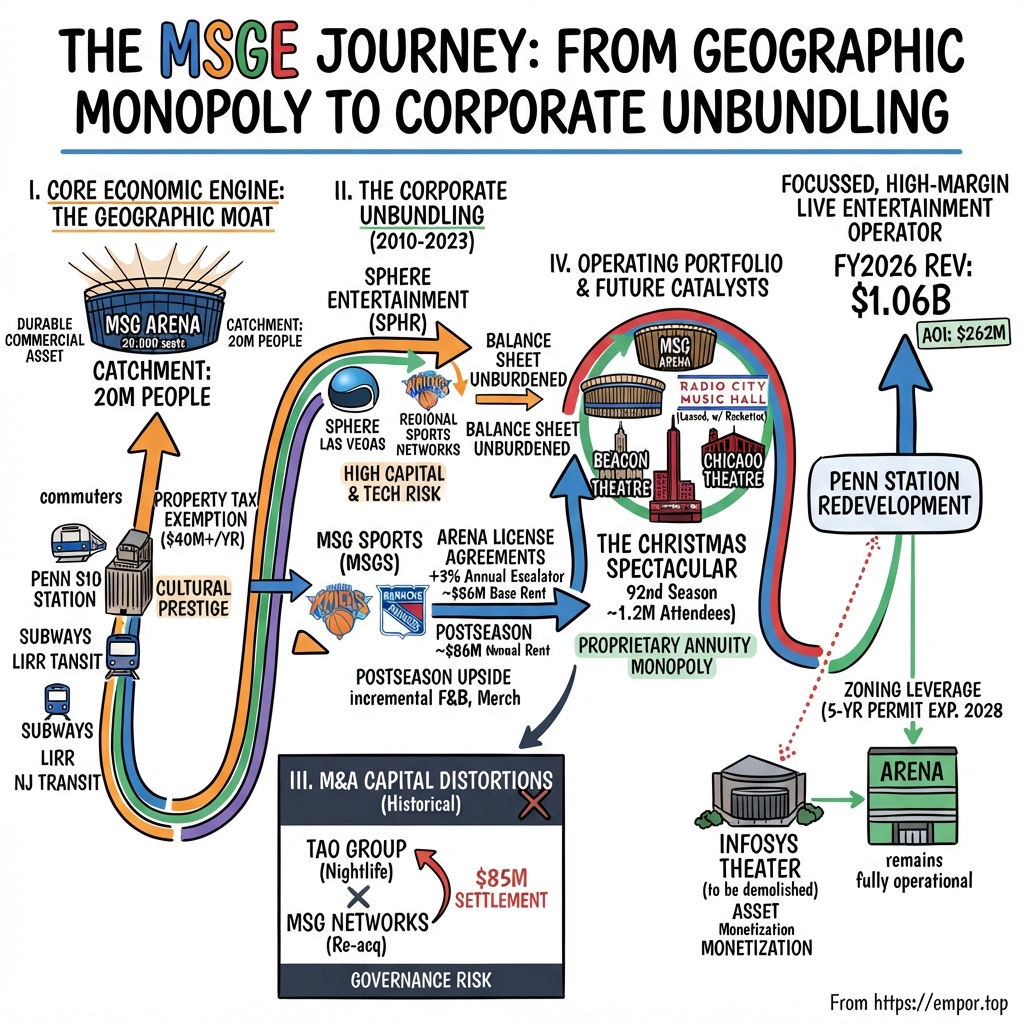
Madison Square Garden Entertainment Corp. (NYSE: MSGE): The Economics of a Monopolistic Stage
I. Prologue & The Anatomy of "The World's Most Famous Arena"
On a Tuesday evening in Midtown Manhattan, between 7:15 and 7:40, a transit pattern unique to New York unfolds beneath the sidewalks of Seventh Avenue. A Long Island Rail Road train empties eight hundred passengers onto a platform. A New Jersey Transit train does the same one level below. Fourteen subway lines feed the same subterranean concourse. Then, rather than dispersing onto the streets, thousands of those commuters ascend an escalator and emerge—without stepping outside, without navigating traffic, and without needing a parking garage—inside a 20,000-seat arena.
That transit funnel encapsulates the core business. Madison Square Garden is not merely an iconic venue; it sits directly atop the busiest transportation hub in North America. Consequently, its addressable audience on any given evening is not limited to local residents, but encompasses anyone with access to Penn Station—a catchment area spanning three states and roughly 20 million people. No other major arena operates with that physical geometry. It is an artifact of 1960s urban planning that became one of the most durable commercial assets in American live entertainment.
Untangling the corporate web
A necessary clarification precedes any analysis, because a series of corporate restructurings orchestrated by the Dolan family has created a complex web of public entities. Madison Square Garden Entertainment Corp.—trading under the ticker NYSE: MSGE—does not own the New York Knicks or the New York Rangers. Those franchises belong to Madison Square Garden Sports Corp. (NYSE: MSGS). Nor does it own the $2.3 billion Sphere in Las Vegas or the regional sports networks; those assets reside within Sphere Entertainment Co. (NYSE: SPHR). MSGE owns the venue network itself and the proprietary live productions staged within it.
The operating portfolio is compact: the Madison Square Garden Arena, with roughly 20,000 seats; the Infosys Theater at Madison Square Garden—the 5,600-seat venue inside the complex, renamed in February 2026 under an expanded partnership with Infosys;1 Radio City Music Hall, with approximately 6,000 seats, held under a long-term lease; the Beacon Theatre on the Upper West Side, seating roughly 2,800, also leased; and the Chicago Theatre, with about 3,600 seats, owned outright. MSGE also owns a proprietary production that functions less like a touring show and more like an annuity: The Christmas Spectacular Starring the Radio City Rockettes, which completed its 92nd holiday season in the fiscal year ended June 30, 2026.2
That constitutes the entire operating base: five venues and an annual holiday production. In fiscal 2026, that portfolio generated $1.06 billion in revenue and $262.2 million in adjusted operating income.2
The investment puzzle
That straightforward footprint conceals the central tension in the investment case for MSGE. On one side sits an asset that is practically impossible to replicate. An operator cannot assemble a multi-acre superblock in Midtown Manhattan, secure the requisite zoning, and build a competing 20,000-seat arena directly over a primary rail terminus. The land is unavailable at an economically viable price, and the municipal approval process would almost certainly preclude it. Anchoring that physical moat is a long-term contractual stream of license fees from two premier sports franchises, a holiday franchise with no direct substitute, and a live-entertainment market where consumer demand has sustained elevated ticket pricing.
On the other side sits the Dolan family's governance profile: a dual-class share structure granting voting control, a twenty-year history of shifting assets among affiliated public vehicles, an $85 million settlement resolving shareholder litigation over one of those transactions, and executive decisions that have placed the company's regulatory standing and public reputation under scrutiny. Investors have historically discounted the equity accordingly—a valuation penalty widely dubbed the "Dolan discount."
The central analytical challenge is not to endorse or dismiss that discount, but to evaluate its components: which aspects of the company's competitive moat are structurally durable, which are subject to political risk, and does the historical record demonstrate management's ability to convert premier real estate into sustained shareholder value rather than capital-intensive architecture?
Where this story goes
The trajectory runs through a century and a half of New York civic history, though the decisive events are recent. It encompasses a privately financed arena transformation exceeding $1 billion; a corporate restructuring strategy that split a single company into four distinct public entities; an ill-fated foray into hospitality alongside a troubled regional sports network re-acquisition; a Las Vegas development whose escalating construction costs threatened the parent balance sheet and precipitated the April 2023 spin-off that established the current MSGE; and, most critically, a May 2026 federal designation of a master developer for an $8 billion Penn Station reconstruction—a plan that preserves the Arena while proposing the demolition of the adjacent theater.3
That Penn Station redevelopment represents a pivotal variable for MSGE equity, reframing the traditional bear case in ways rarely anticipated several years earlier. Evaluating that opportunity requires first understanding the physical and financial architecture of the arena itself.
 Subscribe on LinkedIn
II. The Four Gardens & The Cablevision Heritage
There have been four Madison Square Gardens, and only the first two were anywhere near Madison Square.
From velodrome to Moorish palace
The original arena, opened in 1879 at Madison Avenue and 26th Street, was a converted passenger rail depot with a leaking roof and a business model dependent on whatever drew a crowd: P.T. Barnum's circus, six-day bicycle races, and prizefights of questionable legality. Its successor, opened in 1890, was Stanford White's Moorish-revival design, topped with a tower and a nude statue of Diana that scandalized the city. The building entered American folklore in 1906 when White was shot dead on its roof garden. For most of its existence, the second Garden operated at a loss, establishing an early pattern: the venue was often more culturally prominent than financially lucrative.
Garden III, opened in 1925 at Eighth Avenue and 49th Street, was built by sports promoter Tex Rickard. Seeking a winter tenant to fill open dates, Rickard established the New York Rangers—creating a sports franchise specifically to program an arena, a structural relationship that continues to define the modern operating model. For four decades, Garden III served as the premier stage for American professional prizefighting.
Garden IV is the current arena, and its construction followed what architectural historians widely regard as New York's most notorious act of civic demolition. In 1963, the cash-starved Pennsylvania Railroad monetized its Midtown air rights by demolishing McKim, Mead & White's pink-granite, Beaux-Arts Pennsylvania Station—a 1910 landmark modeled on the Baths of Caracalla—and moving passenger concourses underground. In its place rose Charles Luckman's concrete arena drum, which opened in 1968. The civic outrage over the station's destruction spurred the creation of New York's Landmarks Preservation Commission. It also generated an enduring challenge for the venue: an organized, generational coalition of urban planners, transit advocates, and civic organizations convinced that Madison Square Garden occupies land essential to regional transit improvement.
That civic opposition resurfaced six decades later during municipal proceedings over the arena's special operating permit.
The cable man's conglomerate
Charles "Chuck" Dolan was an early pioneer in the cable industry. He wired lower Manhattan in the 1960s, conceptualized the premium television model that became HBO, sold it to Time Inc., and subsequently built Cablevision Systems into a suburban powerhouse across Long Island, Westchester County, and northern New Jersey—territory that was exceptionally dense and affluent.
The opportunity to acquire the arena arrived in August 1994. Viacom, having acquired Paramount Communications and seeking to pare down debt, sold the Madison Square Garden operation—the arena, the Knicks, the Rangers, and the MSG regional sports network—to a fifty-fifty partnership of ITT Corporation and Cablevision for $1.075 billion.4 Three years later, facing a hostile takeover bid from Hilton and needing cash, ITT agreed in March 1997 to sell its half to Cablevision for $650 million, completing the transaction that June.5 James L. Dolan, Chuck's son, assumed control of the properties.
The strategic rationale behind a cable operator owning a major arena centered on distribution defense. As direct-broadcast satellite providers like DirecTV and Dish Network challenged cable's market share with broader channel lineups, exclusive regional sports broadcasts remained the primary programming asset satellite could not easily replicate. Owning the Knicks and Rangers secured the programming rights for the MSG regional sports network, giving suburban households an indispensable reason to retain Cablevision subscriptions. In strategic terms, the arena functioned as a content anchor protecting the core cable cash flows.
In 1997, Cablevision also acquired the long-term lease to Radio City Music Hall, restored the Art Deco landmark, and assumed stewardship of the Rockettes—the precision dance company founded in 1925 and resident at the hall since 1932. What appeared at the time to be a civic gesture bundled into a regional telecommunications strategy became one of the most profitable, recurring cash generators in the live entertainment portfolio.
The 2010 unbundling begins
As the Dolan family prepared Cablevision for what ultimately became a 2016 sale to Altice, Madison Square Garden was spun off in 2010 as an independent public company. The defining feature was not its asset mix, but its governance architecture: Class B super-voting shares granting ten votes apiece and the right to elect 75 percent of the board of directors. The structure enabled the Dolan family to exercise complete operational control while holding a minority economic interest.
Subsequent corporate restructurings stemmed from that fundamental governance reality. Whether executing contentious transactions or allocating debt among corporate entities, executive leadership operated without the risk of a contested shareholder vote.
For public investors, the primary takeaway from the Cablevision era is that the Garden rarely functioned as an autonomous, standalone enterprise. Instead, the venue served broader strategic objectives: subscription retention, family voting control, and ultimately capital allocation for an ambitious construction project in Nevada. The central analytical question for MSGE is whether that era of structural shifts has ended or merely paused.
III. The $1 Billion Overhaul & The Corporate Unbundling Machine
In the summer of 2011, construction crews began cutting a 20,000-seat arena into pieces while the Knicks and Rangers were still actively competing on the floor.
Renovating a building that cannot close
The operational constraint was severe and self-imposed: the Garden would not miss a single regular-season NBA or NHL game. Construction proceeded across three consecutive off-seasons. Crews demolished and rebuilt entire seating bowls between June and October, suspending all structural work the moment the sports seasons commenced. The upper bowl was stripped down and reconstructed one summer, the lower bowl the next, with hospitality suites, concourses, and broadcast infrastructure threaded around both.
Predictably, the capital requirements expanded. Initial estimates near $500 million eventually surpassed $1 billion—a final cost the company formally acknowledged when the transformation concluded in 2013.6 A key structural distinction lay in the financing. Unlike the vast majority of contemporary American arena developments, the project bypassed municipal bond issuances, public stadium authorities, and dedicated sales-tax districts; the overhaul was funded entirely through the company's operating cash flow and balance sheet.
That capital deployment delivered specific architectural and economic yields. Physically, it added the Chase Bridges—two suspended pedestrian catwalks hung from the ceiling that created sellable inventory out of open air—alongside fifty-eight reconstructed event-level suites, widened concourses, a 360-degree center-hung scoreboard, and modernized food and beverage facilities. Economically, the objective was yield optimization. Because zoning and physical boundaries prevent physical expansion in Midtown Manhattan, the commercial model required extracting significantly higher revenue per attendee through premium hospitality, luxury suites, and higher-margin concessions.
The exemption that Albany never quite repeals
Underpinning the arena's unit economics is an anomaly that never appears as an expense line on the income statement, yet preserves tens of millions of dollars annually. In 1982, after the Garden's then-owner, Gulf & Western, publicly entertained relocating the Knicks and Rangers to New Jersey, the New York State Legislature granted Madison Square Garden a full exemption from municipal real property taxes. Unlike standard commercial abatements in public finance, this statutory carve-out carries no expiration date. An analysis published by the New York City Independent Budget Office in July 2023 calculated the foregone tax revenue at more than $900 million cumulatively since 1982, exceeding $40 million annually in recent years.7
For over four decades, state lawmakers have regularly introduced legislation to revoke the benefit—most recently through Senate Bill S4384 in the 2023–24 legislative session and Senate Bill S957 in the 2025–26 session, with the latter proposing to eliminate the exemption effective with the 2026 assessment roll.89 None of these measures has passed. In practice, the perpetual threat of repeal serves as durable political leverage in Albany, resurfacing whenever the arena operator seeks state approvals, transit accommodations, or operating concessions.
The spin-off machine
Beginning in 2015, the Dolan family initiated a multi-stage corporate disaggregation, with each corporate action reflecting distinct structural pressures.
2015 — MSG Networks. The regional sports networks were separated into an independent public entity. The underlying logic anticipated secular industry trends: accelerating cord-cutting threatened linear cable affiliate fees, and isolating the network assets insulated the live entertainment and venue portfolio from declining pay-TV distribution multiples.
April 2020 — The Grand Partition. The remaining enterprise split in two. Madison Square Garden Sports Corp. (MSGS) retained the Knicks and Rangers franchises. Madison Square Garden Entertainment Corp.—the initial public iteration of the venue business—took the real estate, proprietary live productions, the Tao Group hospitality subsidiary, and an ambitious development in Nevada known as the MSG Sphere. The execution arrived at an unprecedented operational standstill: the transaction finalized in April 2020, precisely as the COVID-19 pandemic suspended live gathering worldwide.
The contractual backbone
That 2020 separation established the fundamental commercial mechanism governing MSGE today: the Arena License Agreements. Although the athletic franchises were transferred to an independent corporate entity, they remained anchor tenants. MSGS executed 35-year agreements to license the arena from MSGE, committing to base contractual fees that escalate at roughly three percent annually.10
In financial terms, this arrangement converted two professional sports franchises—subject to inherent on-court performance cycles—into a long-duration, inflation-linked commercial cash stream. MSGE collects revenue across roughly eighty-two regular-season home dates plus postseason appearances, insulating baseline arena rent from whether the teams are contending or rebuilding. In fiscal 2026, arena license fees and related tenant leasing revenue contributed $86.2 million.2
That contractual baseline represents the financial floor. The upside, however, extends well beyond fixed rent: during postseason games, MSGE directly participates in high-margin merchandise, concession, and luxury-suite economics. That operational leverage framed the financial expansion achieved in fiscal 2026, while highlighting the balance-sheet friction that emerged from preceding capital allocations.
IV. M&A Capital Deployment: Distortions, Bailouts, and The Sphere Near-Death Experience
Any enterprise anchored by an exceptional commercial asset eventually confronts the same capital allocation dilemma: the core business generates surplus cash, leaving executive leadership to determine where to redeploy it. For Madison Square Garden, the controlling family's deployment record between 2017 and 2023 remains the primary historical benchmark for evaluating the current capital-return program.
The nightclub detour
In January 2017, MSG acquired a 62.5 percent controlling interest in Tao Group Hospitality for approximately $181 million, taking over a portfolio of dining and nightlife venues that included Tao, Marquee, and Lavo. The stated strategic rationale appeared plausible on paper: the company already catered to affluent patrons in major metropolitan centers, and nightlife theoretically targeted the same demographic during later hours. Management envisioned cross-selling arena suite holders into private clubs and steering nightlife clientele into live events. In 2021, the company acquired the remaining minority stake for roughly $99 million and merged Tao with Hakkasan Group.
In operational practice, however, premium nightlife presented an entirely distinct risk profile. Nightclubs are capital-intensive, driven by transient consumer tastes, reliant on key operators, and subject to rapid obsolescence—venues often experience peak appeal for only a few years before declining into burdensome lease liabilities. That vulnerability intensified in 2020 when the COVID-19 pandemic abruptly shuttered every location in the portfolio.
The divestiture arrived in April 2023, when Tao Group was sold to Mohari Hospitality at a $550 million enterprise value.11 While the headline valuation suggested a profitable exit, the proceeds were neither reinvested in core venue enhancements nor returned to shareholders through repurchases. Instead, management directed the capital toward debt retirement and cash requirements for a construction venture in the Nevada desert.
Buying back the thing you just sold
In 2021, six years after separating MSG Networks to insulate the venue portfolio from the secular decline of regional sports networks, MSGE reacquired the business. The exchange ratio was 0.172 MSGE shares for each MSGN share, structured as an all-stock transaction.12
Public shareholders vigorously contested the merger. Stockholders filed suit in the Delaware Court of Chancery, alleging that the Dolan family had used its control of both entities to push through a transaction that overpaid for a declining asset and diluted MSGE's public holders while consolidating family voting power.12 The complaint went beyond questioning commercial prudence, characterizing the transaction as an interested-party bailout of an impaired entity in which the family's economic interests diverged from those of outside investors.
The litigation concluded with substantial financial resolutions. MSG Entertainment's board agreed to an $85 million settlement of the shareholder suit.13 Separately, the MSG Networks side of the litigation was resolved for $48.5 million.14
For institutional investors, the significance extended far beyond the settlement amounts. While the $85 million agreement carried no formal admission of wrongdoing, it provided tangible evidence regarding governance risk: a controlled enterprise, where a shareholder vote was effectively guaranteed by the dual-class structure, had executed an intra-family transaction that resulted in a nine-figure recovery through Delaware courts. Any assessment of management stewardship at MSGE must account for this track record, particularly given its recency under the same executive leadership presiding today.
The black hole in the desert
The MSG Sphere was announced in 2018 with an initial projected cost of roughly $1.2 billion. The design was unprecedented: an 18,000-seat spherical auditorium encased inside and out in programmable LED displays, requiring bespoke civil engineering, specialized acoustic technology, and structural architecture without modern precedent.
By late 2022, projected construction costs had exceeded $2.3 billion as global supply-chain disruptions, pandemic-related shutdowns, and engineering complexities escalated. Because the corporate entity at the time housed both the Nevada development and the core venue assets, free cash flow generated by Madison Square Garden, Radio City Music Hall, and the Rockettes was continually redirected to finance the Las Vegas buildout.
By the end of 2022, the challenge had evolved from an aggressive capital deployment initiative into an existential balance-sheet risk. An exceptionally stable, highly cash-generative venue portfolio was acting as the financial backstop for a speculative development whose ultimate capital requirements remained indeterminate.
The April 2023 escape hatch
The solution took the form of a corporate separation, executed through a reverse carve-out designed to insulate the parent balance sheet.
The legacy corporate entity retained the Sphere, Sphere Studios, international development rights, and MSG Networks, adopting the name Sphere Entertainment Co. The traditional business—the Garden, the theaters, the Rockettes, and the Arena License Agreements—was spun out in April 2023 as a new Madison Square Garden Entertainment Corp.15
The structural mechanics of the transaction departed from conventional corporate spin-offs. Rather than separating a nascent, speculative venture from an established corporate parent, management spun off the profitable, century-old core operating assets while leaving the capital-intensive construction project inside the original public corporate shell. That sequencing directly determined debt allocation.
New MSGE began standalone life carrying a $650 million senior secured term loan facility and paid a cash dividend of roughly $145 million back to Sphere at distribution.15 In practical financial terms, the predictable cash flows of the venue business were leveraged to capitalize the entity from which it was separating. Sphere also retained roughly a third of MSGE's common stock, which it monetized through a secondary offering completed in September 2023, raising a further $180 million for its own purposes.[^16]
The separation ultimately delivered what public equity investors had sought: a focused, high-margin live-entertainment operator unburdened by technology-development risk or declining linear television viewership. Yet MSGE did not achieve that profile cost-free; it incurred substantial funded debt and dividend obligations to subsidize an affiliated enterprise under common voting control.
Whether that transaction represented a final structural realignment or simply the latest iteration of inter-company asset transfers constitutes the core of the governance discount. Evaluating that risk requires examining the underlying financial performance of the operating portfolio itself.
V. The Core Business: Machine Architecture & Unit Economics
Inside Madison Square Garden at four in the afternoon on a concert day, the atmosphere is entirely industrial: trucks backing into subterranean loading docks, riggers suspended in harnesses, and catering stations assembling along service corridors. By seven o'clock, that logistical scaffolding vanishes, replaced by 20,000 patrons paying premium prices for an experience designed to feel seamless. The economic spread between those two operational realities—logistics in, high-margin revenue out—defines the enterprise.
Although MSGE reports results under a single operating segment, its revenue generation functions as four distinct economic engines operating across a shared infrastructure.
Engine one: concerts and live events
This represents the core volume driver. In fiscal 2026, the company welcomed approximately 6.4 million guests across nearly 960 events.2 The Garden itself hosts well over 150 events in a typical year, while the theater network collectively stages several hundred more.
MSGE does not operate as a promoter and does not absorb touring artist risk. Instead, it functions as a venue landlord supported by an integrated concession and hospitality operation. Revenue flows through venue rental and facility fees, ticketing surcharges and partner rebates, food and beverage sales, and a contractual share of merchandise. In fiscal 2026, entertainment offerings produced $810.1 million, while food, beverage, and merchandise contributed an additional $164.4 million.2
That commercial structure benefits from a durable industry tailwind. As music streaming replaced physical sales with fractional-cent royalty payouts, artist economics shifted decisively toward live touring and branded merchandise. The resulting supply of major tours expanded, itineraries lengthened, and ticket prices consistently outpaced inflation—absorbed by resilient consumer demand. Within that touring ecosystem, MSGE sits at the apex of the global routing pyramid.
The operating leverage inherent in that model was evident in the fourth quarter of fiscal 2026: the company more than doubled the number of concerts staged at the Garden compared to the prior-year period, lifting entertainment offerings revenue for the quarter by 29 percent.16
Engine two: the license agreements in practice
While the baseline contractual floor established by the Knicks and Rangers license agreements provides downside protection, fiscal 2026 illustrated the variable upside embedded in the arrangement.
In June 2026, the New York Knicks won the NBA championship, defeating the San Antonio Spurs in five games to claim the franchise's first title since 1973.17 For MSG Sports, the financial impact was substantial: playoff-related revenue climbed by approximately $67 million compared to the prior year, when the team reached the Eastern Conference Finals.18
For MSGE, however, the financial contribution was far more modest, reflecting the underlying contractual division. On the company's fourth-quarter earnings call, Chief Financial Officer David Collins outlined the revenue-sharing mechanics: MSGE shares 50 percent of net food and beverage profits with the teams, retains 30 percent of net merchandise sales, and earns commissions on single-event luxury suite rentals. Under those formulas, the championship postseason run added $7.4 million to MSGE's fourth-quarter revenues.16
That figure clarifies the commercial reality of the "playoff windfall." While a championship run generates high-margin cash—with nearly the entire $7.4 million dropping directly to operating income—it represents an incremental contribution against an adjusted operating income base of $262.2 million rather than an independent investment thesis. Team athletic success provides high-visibility upside, but fundamental enterprise value from championship contention accrues primarily to MSGS rather than MSGE.
Engine three: the Rockettes annuity
The third economic engine centers on one of the most distinctive proprietary franchises in commercial entertainment.
The Christmas Spectacular runs seven to eight weeks annually, from early November through early January, at Radio City Music Hall. The production operates with virtually no direct substitute. Staged exclusively at Radio City, the Rockettes' signature routines have evolved across nine decades into an intergenerational holiday ritual, conferring the pricing power of a cultural monopoly.
The production's unit economics reflect classic operating leverage. The seasonal cost base is predominantly fixed: dancer salaries, stage crews, the orchestra, venue maintenance, and theatrical staging. Once ticket sales clear those seasonal fixed costs—typically achieved within roughly the first 70 performances—each incremental performance drops to the bottom line at minimal variable cost. Management's primary volume lever has consequently been expanding the performance schedule.
The historical trajectory demonstrates steady execution of that strategy. Fiscal 2024 drew more than 1.0 million attendees across 193 performances.[^20] Fiscal 2025 expanded to approximately 1.1 million tickets across 200 performances.19 In fiscal 2026, the production achieved its highest attendance in twenty-five years, exceeding 1.2 million tickets across 215 paid performances and generating roughly $195 million in revenue during its 92nd season.16 For the upcoming 2026 holiday season, management has scheduled 230 performances.16
Three consecutive years of mid-single-digit performance growth, with each season setting a revenue record, demonstrate effective commercial execution. Yet the volume lever faces physical ceilings. The holiday season spans a fixed calendar window, and scheduling up to five shows a day in a 6,000-seat auditorium leaves limited operational slack. At 230 performances, future revenue expansion will depend less on adding dates and more on dynamic ticket pricing and ancillary per-capita spending—a shift that exposes revenue growth to broader consumer discretionary sensitivity. For analysts tracking the franchise, the key operating metric is shifting from total ticket volume to net yield per performance.
Engine four: sponsorship, signage and suites
The fourth engine is among the most profitable elements of the operating model. Under a joint sales agreement, MSGE serves as the exclusive sales representative for luxury suites, venue signage, and marquee sponsorship packages across both its own properties and MSG Sports' inventory.
Commercial momentum continued in fiscal 2026, highlighted by a renewed and expanded partnership with Infosys that secured naming rights for the complex's theater,1 contractual renewals with Lexus and Anheuser-Busch, and a new multiyear agreement with the prediction-market platform Kalshi.16 In addition, management cited capital renovations across premium suites—most notably on the Lexus level—as a driver of higher contract yields, with additional suite modernization scheduled for fiscal 2027.16
This targeted spending highlights a distinct capital allocation discipline. High-end suite refurbishment represents one of the highest-return investments available to an arena operator: a modest, predictable capital outlay backed by multiyear corporate lease commitments, avoiding greenfield construction risk and long-duration balance-sheet encumbrances.
The residency innovation
The company's most influential commercial innovation of the past decade required no structural capital deployment.
Between 2014 and July 2024, Billy Joel staged a historic monthly residency at the Garden, completing 104 consecutive sold-out performances and 150 lifetime appearances at the arena. The operational insight behind the residency model was transformative: an iconic venue can become a cultural destination in its own right, rather than merely one stop along a touring itinerary. Operationally, residencies eliminate recurring load-in and teardown expenses, stabilize venue staffing, allow stage production to remain in place, and drive elevated per-capita merchandise sales among an audience treating the event as a destination experience.
The principal risk to this model is revenue concentration. Following the conclusion of Joel's run, management focused on proving that residency economics could outlive an individual headliner. In late summer 2026, Harry Styles embarked on a 30-date residency running from August through October, staging roughly three performances per week—a commitment management projected would drive a record concert tally at the Garden in the fiscal first quarter ending September.16 Beyond the arena, the format has expanded across the portfolio: Bon Jovi and Phish have anchored recurring Garden engagements, composer Joe Hisaishi established an extended run at Radio City, and comedians Seth Meyers, John Oliver, and Jerry Seinfeld have maintained multi-night residencies at the Beacon Theatre.16
Collins acknowledged to investors that the format functions as a flexible commercial concept rather than a standardized template. "Every residency is going to look a little different," he told analysts, noting that artists require tailored scheduling and production terms.16 That distinction properly defines the commercial reality: residencies represent a proven operational capability, but remain opportunistic bookings rather than perpetual contracted revenue.
The operational architecture thus functions with high cash conversion. The central question for investors is whether external municipal or regulatory forces can disrupt that commercial engine from the outside.
VI. Competitive Landscape & The Tri-State Arena Wars
When a global touring act has a single open date in the New York metropolitan area and four regional arenas competing to book it, the allocation decision reveals the competitive hierarchy of the market.
The contenders
Barclays Center, Brooklyn. Roughly 19,000 seats, opened in 2012, and owned by BSE Global under Joe Tsai. Home to the NBA's Brooklyn Nets and the WNBA's New York Liberty, the arena established itself by targeting genres and audiences the Garden historically underserved—particularly hip-hop, combat sports, and entertainment appealing to a younger, outer-borough demographic.
Prudential Center, Newark. Approximately 19,500 seats, home to the NHL's New Jersey Devils, and operated by Harris Blitzer Sports & Entertainment. The arena captures suburban traffic west of the Hudson River, serving catchment populations for whom traveling into Midtown Manhattan presents significant friction.
UBS Arena, Belmont Park, Long Island. Approximately 19,000 seats, opened in 2021, developed and operated in partnership with Oak View Group, and home to the NHL's New York Islanders. On paper, it represents the most formidable physical challenger: a modern venue designed specifically around concert acoustics, avoiding the spatial compromises of an arena built in 1968.
Why the Garden keeps winning the top tier
That competitive dynamic resolves through three distinct mechanisms, arranged in descending order of durability.
The first is geographic gravity, and it is the only advantage that is structurally permanent. A ticket buyer traveling from Westchester County, Long Island, or northern New Jersey can reach Madison Square Garden on a single commuter train without driving or parking. Reaching Belmont Park or Newark from across that broader suburban footprint requires highway congestion, transit transfers, or both. Eliminating that travel friction converts directly into aggregate ticket demand and, at the margin, into premium ticket pricing, because consumer willingness to pay incorporates the time and expense of transit.
The second is price realization. The Garden benefits from an audience demographic unmatched in North America: corporate entertainment budgets, destination tourists traveling specifically for marquee events, and exceptional residential wealth within Midtown's immediate transit radius. That spending density generates gross box-office potential per performance that suburban venues struggle to duplicate. Consequently, promoters route tier-one talent to the Garden even when rival facilities offer discounted rental terms, because the artist's total take is larger.
The third is cultural prestige, which is the least tangible and the most easily overstated. "Playing the Garden" retains a distinct career milestone for musicians, comedians, and combat sports athletes that no other North American arena has duplicated. Yet cultural capital is not measurable, not contractual, and not permanent; it represents an asset that can erode quietly over decades.
The promoter question
The primary commercial risk to the arena's pricing power stems not from competing venues, but from the intermediaries controlling tour routing.
Live Nation Entertainment and AEG Presents operate between performers and venue landlords. Live Nation in particular is vertically integrated—promoting tours, managing artists, owning venues, and controlling Ticketmaster. In theory, a vertically integrated promoter could exert leverage over independent venue owners by steering tours toward proprietary facilities.
In practice, that leverage encounters a hard boundary at the top tier of live entertainment. Live Nation owns clubs, theaters, and outdoor amphitheaters, but possesses no 20,000-seat arena in Midtown Manhattan, and a promoter cannot unilaterally bypass the nation's premier media market on a major tour. That structural asymmetry preserves MSGE's bargaining leverage at the apex of the market.
That defense, however, does not extend across the entire booking calendar. For secondary or mid-tier touring acts that can viably substitute dates at Barclays Center, Prudential Center, or UBS Arena, MSGE must compete on conventional commercial terms, occasionally conceding pricing ground.
A similar vulnerability governs the theater portfolio, where MSGE's competitive position is considerably weaker than at the flagship arena. Radio City Music Hall, the Beacon Theatre, and the Chicago Theatre compete in an intensely crowded market of 2,000- to 6,000-seat auditoriums, many controlled directly by vertically integrated promoters. On the fiscal 2026 fourth-quarter earnings call, management acknowledged that theater bookings were pacing behind expectations for the quarter ending September 2026, noting that the forward booking window spans only three to six months—offering limited revenue visibility.16 That operational volatility confirms that the company's monopolistic pricing power applies strictly to a single Midtown arena rather than the entire venue portfolio.
Which raises the question of who makes the strategic decisions governing that building.
VII. Governance, Capital Allocation, & The Dolan Playbook
James L. Dolan occupies an unconventional position atop a publicly traded corporation in 2026. He serves as Executive Chairman and Chief Executive Officer of MSGE, while simultaneously holding the Executive Chairman role at both Sphere Entertainment and MSG Sports. Outside the boardroom, he fronts a touring blues-rock band that has opened for the Eagles, and has engaged in protracted public disputes with fans, journalists, former athletes, and litigants—a pattern documented at length by The Wall Street Journal in January 2023.20
The arithmetic of control
The foundation of that posture is structural. Class B shares carry ten votes each and elect 75 percent of the board of directors, anchoring the Dolan family's voting control comfortably above 70 percent.
Under that architecture, conventional mechanisms of public shareholder accountability do not function. A proxy contest cannot succeed, and an advisory withhold campaign is purely symbolic. Outside investors can publish letters and accumulate shares, but they cannot compel an asset sale, unseat directors, or veto an interested-party transaction. Historically, the only avenues that have produced tangible outcomes at Dolan-controlled entities are litigation in the Delaware Court of Chancery—which, as past shareholder challenges demonstrated, yielded financial settlements rather than structural reform—and the equity market's valuation discount.
This is not a moral critique, but an analytical reality with direct valuation consequences. In a corporate structure where minority public holders possess no governance enforcement mechanisms, the investment case rests entirely on the controlling shareholder's capital choices—making the historical record of those decisions the primary subject of diligence.
The record since April 2023
On that front, balance-sheet management and operational execution since the April 2023 spin-off have shown measurable discipline.
The underlying financial requirements remain manageable. Maintenance capital expenditures are modest relative to the company's operating cash generation: capital outlays are directed primarily toward digital technology and premium suite refurbishment rather than heavy civil engineering, the arena having been substantially rebuilt a decade ago.16 Debt-service burdens also remain contained, with net interest payments totaling $32 million in fiscal 2026.16
Balance-sheet leverage has fallen significantly. MSGE began its standalone corporate life carrying $650 million in senior secured term debt. By June 30, 2026, the company held $294 million in unrestricted cash against $579 million in total debt, resulting in net debt of roughly $285 million and reducing net leverage to approximately 1.1 times adjusted operating income.2116 That ratio stands well below the 2.0 times threshold institutional investors established as the initial post-spin target, achieved within roughly three fiscal years.
Management itself, however, noted an important accounting nuance: the reported cash balance "includes a significant amount due to promoters, which reflects the robust concert activity ahead."16 Because ticket proceeds collected prior to scheduled performances represent pass-through obligations rather than unencumbered corporate liquidity, headline cash balances at a venue operator can overstate immediate balance-sheet flexibility. The decline in net leverage is therefore best evaluated as a genuine directional improvement rather than an unencumbered cash cushion.
Capital returns through share repurchases have followed a measured trajectory. The board authorized a $250 million share repurchase program in March 2023.[^24] Subsequent execution has proceeded steadily rather than aggressively: the company repurchased approximately $40 million of Class A stock in fiscal 2025,19 followed by about $25 million—or roughly 623,000 shares—in fiscal 2026.16 Cumulatively since the spin-off, management has retired approximately 6.1 million shares for $205 million, leaving $45 million remaining under the authorization.1621
Those figures support two contrasting interpretations. The constructive view highlights an enterprise that simultaneously halved its net leverage and retired more than a tenth of its public share count—a capital-allocation performance exceeding that of most levered spin-offs. The skeptical view observes that the pace of share repurchases decelerated in fiscal 2026, dropping from $40 million to $25 million during a year when revenue climbed 13 percent, adjusted operating income expanded 18 percent, and headline cash balances expanded more than sixfold. Rather than accelerating capital returns alongside rising operating profitability, the company has accumulated cash—and executive commentary indicates the underlying strategy.
The narrative to test
On the fiscal 2026 earnings call, Chief Financial Officer David Collins reiterated management's capital allocation priorities in deliberate sequence: maintain a strong balance sheet, preserve flexibility for compelling opportunities, and opportunistically return capital to shareholders.16 In corporate finance, such prioritization is rarely accidental. Within an enterprise governed by family voting control, preserving flexibility for compelling opportunities signals strategic ambitions that demand close examination.
When asked by LightShed analyst Brandon Ross whether proceeds from the prospective theater transaction might be directed toward a Sphere-related venture, Collins stated that he was "not in a position to speculate on any hypothetical venue transactions at this time."16 Pressed separately regarding the eventual deployment of those proceeds, Collins noted that the company remained "mindful of the potential tax implications" and would evaluate reinvesting in another New York City venue to minimize tax leakage.16
That posture reflects an executive deliberately keeping options open. Yet the substantive takeaway is unambiguous: an enterprise generating over a billion dollars in annual revenue, operating at 1.1 times net leverage, and facing potentially hundreds of millions of dollars in transaction proceeds is openly evaluating the acquisition or construction of replacement venue real estate rather than committing that capital to shareholder distributions. Furthermore, leadership declined to rule out structural transactions involving affiliated public companies under common family control.
Management's operational credibility on the core business has been solid: forward guidance has remained conservative, with reported financial results surpassing expectations across fiscal 2024, 2025, and 2026. Booking disclosures—including candid commentary regarding softer theater demand—have been detailed rather than promotional. The operating record has demonstrated consistent execution. The capital allocation strategy, by contrast, carries the historical shadow of inter-company engineering—a precedent that faces its next immediate test in the complex municipal, transit, and real-estate negotiations centered on the arena's Midtown footprint.
VIII. Strategic Frameworks: 7 Powers & Porter's Five Forces
Stripping away corporate history leaves a fundamental analytical question: where does excess economic return actually originate, and how durable are its defenses?
Hamilton Helmer's 7 Powers
Cornered Resource — high, with an asterisk. The primary power is positional. A competitor cannot build a 20,000-seat arena atop Penn Station because only one such transit hub exists, and an arena already occupies it. Land acquisition costs, municipal zoning, community board reviews, and the physical impossibility of assembling a multi-acre Midtown superblock make new entry not merely expensive, but practically unavailable. The Christmas Spectacular Starring the Radio City Rockettes represents a second cornered resource of a different variety: a trademarked, place-specific cultural tradition backed by ninety-two seasons of accumulated consumer habit. The crucial qualification—examined in the subsequent analysis of municipal permitting—is that while the primary asset is cornered by geography, its operation remains licensed by politics.
Brand — high. The Garden's marque significantly reduces the marketing friction required to sell an event. Announcing an arena date frequently clears inventory without extensive promoter advertising. That intangible value generates measurable economic yields, reflected in both performer routing preferences and consumer willingness to absorb elevated ticket pricing.
Scale Economies — moderate, and narrower than corporate messaging suggests. The primary scale advantage resides in corporate partnerships and premium hospitality: a partner securing a brand presence across the Lexus level can be cross-sold into Radio City Music Hall, the Beacon Theatre, and the Chicago Theatre through a single commercial negotiation at negligible incremental cost. Beyond the corporate sales apparatus, however, venue operations remain stubbornly local. Managing five regional properties does not yield meaningful procurement leverage over food, beverage, or theatrical staging.
Network Effects — essentially absent. An additional concertgoer does not increase the venue's utility to the next attendee. Performers and audiences do not form a two-sided network in an economically self-reinforcing sense.
Counter-Positioning — none. MSGE does not operate a commercial model that competitors are structurally prevented from replicating. Competing arena operators can and do structure recurring residencies.
Switching Costs — asymmetric. For concert promoters, switching costs are low; tours can and frequently do route dates to rival facilities, particularly across the theater tier. For consumers, switching costs operate as an emotional and cultural barrier: The Christmas Spectacular offers no direct substitute for families observing an annual holiday ritual, and competing regional venues cannot confer the prestige of attending a marquee event at the Garden.
Process Power — modest and relationship-dependent. The arena residency model represents a genuine operational capability developed over a decade. Yet management's acknowledgment that every residency requires bespoke staging and scheduling indicates that the format reflects specialized executive relationship management rather than an institutional, self-executing process.
Porter's Five Forces
Threat of new entrants — near zero at the flagship arena tier. The barrier to constructing a directly competing 20,000-seat arena in Midtown Manhattan represents as close to a structural zero as exists in public equities.
Supplier power — high and expanding. Marquee artists and global promoters function as suppliers who command the vast majority of gross ticket receipts. MSGE's counter-strategy rests on controlling ancillary revenue streams: concessions, facility fees, merchandise splits, and premium luxury suites. This structural division explains why per-capita spending and suite refurbishment remain central to earnings expansion: the venue operator does not maximize margin at the box office gate, but captures the high-margin economics surrounding it.
Buyer power — low for marquee events, significant in the theater tier. Manhattan's concentration of corporate entertainment accounts and high-net-worth households sustains dynamic ticket pricing for flagship arena dates. Consumer price sensitivity is not uniform, however. In the mid-tier theater portfolio—where ticket buyers face extensive entertainment alternatives within a short transit radius—price resistance and booking volatility emerge far more quickly.
Threat of substitutes — moderate and historically unrealized. The substitution thesis has persisted for decades, arguing that streaming platforms, advanced home audiovisual systems, and virtual reality would erode attendance at in-person gatherings. Across that period, live attendance and pricing power have both expanded, demonstrating that digital media functions as a promotional complement rather than a substitute for shared physical experiences. The more immediate substitution risk is budgetary: consumers managing discretionary spending may prioritize a single marquee arena performance over several mid-tier theater productions, a pattern that pressures secondary venues before affecting the flagship arena.
Rivalry — moderate and tiered. Barclays Center, UBS Arena, and Prudential Center compete aggressively for secondary touring dates and possess pricing flexibility. For tier-one global talent and marquee multi-night engagements, however, the Garden retains dominant market power as the metropolitan price-maker.
The honest synthesis
MSGE's competitive moat is narrower than marketing materials imply, yet more durable than the prevailing governance discount suggests. The enterprise is not a broadly diversified live-entertainment conglomerate. It rests upon two core assets—the geographic location of a single arena and the institutional tradition of a single holiday production—surrounded by a portfolio of conventional commercial theaters operating in competitive metropolitan markets.
That concentration is not necessarily a structural defect; it provides analytical clarity. The entire equity thesis hinges on evaluating two specific propositions: the durability of the arena's physical position against regulatory and transit pressures, and management's capital allocation discipline with the surplus cash those core assets generate. Testing those dynamics against the company's operating and political record reveals how that balance functions in practice.
IX. The Historical Falsification Layer & Stress Tests
Every investment thesis deserves its strongest counterargument, drawn from the company's own operating history rather than hypothetical scenarios. Four core claims define the investment case for MSGE, and each can be tested against the specific historical mechanisms that challenge or break it.
Test #1: Is the regulatory moat indestructible?
The claim: Madison Square Garden is a permanent fixture of New York City, effectively sovereign on its Midtown site.
The disconfirming event: In September 2023, the New York City Council voted on MSG's special operating permit—the municipal zoning authorization required for an arena seating more than 2,500 people. Management applied for a permanent permit, having operated under a ten-year permit granted in 2013. The Council granted only five years, expiring in 2028, and framed the shortened duration explicitly as leverage to force corporate cooperation on Penn Station's redevelopment.22
What this proves: The Garden does not own the right to operate; it rents that right from a political body on a renewable term, and the renewal window has shrunk. In Hamilton Helmer's 7 Powers framework, the venue is cornered against commercial competitors, but not against the sovereign authority. That introduces a fundamentally different risk profile than conventional "irreplaceable real estate" implies, and it stands as the primary structural qualifier on the bull case.
The shifting reality: In April 2025, the U.S. Department of Transportation assumed control of the Penn Station reconstruction from the MTA. In May 2026, federal transportation officials and Amtrak selected Penn Transformation Partners—a joint venture of Halmar International and Skanska—as master developer for the roughly $8 billion project.3 The preliminary design unveiled the following month preserved the Garden at its current location, requiring instead the acquisition and demolition of the adjacent theater to construct a new grand transit entrance along Eighth Avenue.3
On June 8, 2026, MSGE disclosed a non-binding memorandum of understanding with the master developer and Amtrak. Two stipulations are critical: an acknowledgment that the arena "must remain fully operational at all times as required by the Company," and the contemplated transfer of the Infosys Theater to the master developer, subject to definitive documentation and final developer agreements. Management explicitly cautioned that there can be no assurance a transaction will close on those terms, or at all.23
The calibrated conclusion: The claim that the arena is immovable survives, but its justification has shifted. The venue remains in place not because its municipal moat was impenetrable, but because federal planners prioritized a design that preserves the arena bowl while acquiring the adjacent theater. That resolution represents a favorable outcome MSGE did not unilaterally dictate. Furthermore, the 2028 special permit expiration remains active: federal transit planning does not supersede City Council zoning jurisdiction, leaving local officials with future leverage to extract civic concessions. The measured reality is that existential relocation risk has receded, but recurring political-extraction risk remains.
Watch for: definitive documentation replacing the non-binding memorandum for the theater transfer, and the municipal political environment as the 2028 permit renewal approaches.
The property tax exemption: The statutory carve-out remains what it has been for forty-four years: a perpetual legislative target that lawmakers have never repealed. Senate Bill S957 in the 2025–26 session sought to eliminate the exemption starting with the 2026 assessment roll, but failed to pass.9 Four decades of unsuccessful repeal attempts establish a meaningful historical baseline. It is not an absolute guarantee, however, and a repeal would introduce an immediate pretax cash-flow headwind of $40 million to $50 million against a $262.2 million adjusted operating income base—a material earnings impact of roughly fifteen to twenty percent.7
Test #2: Is management a disciplined steward of public shareholders' assets?
The disconfirming event: Beginning in 2022, MSG Entertainment deployed facial-recognition software at venue entrances to identify and eject attorneys from law firms actively engaged in litigation against the company—including lawyers who had no role in the disputes and were attending public performances with their families on personal tickets.
The escalation: In January 2023, New York Attorney General Letitia James sent a formal inquiry warning the company that the practice could violate state civil rights laws and unlawfully deter claimants from seeking legal redress.[^27] The confrontation posed immediate commercial risk when the New York State Liquor Authority launched an investigation into the company's licenses—the high-margin foundation of venue food and beverage economics.
The legal outcome: The company largely prevailed in court. In May 2024, a federal judge dismissed a biometric-privacy lawsuit challenging the attorney ban,24 reaffirming the broad legal discretion private venue operators maintain over public admission.
What this proves, and does not prove: The litigation record does not prove MSGE violated the law. What it demonstrates is a governance reality that court dismissals do not resolve: controlling management proved willing to risk the enterprise's liquor licenses, regulatory relationships, and public reputation in pursuit of a personal legal tactic—precisely when the company required discretionary zoning renewals from municipal authorities. The City Council's September 2023 permit vote occurred eight months after the Attorney General's warning letter, with Council members explicitly citing management's adversarial posture in granting a shortened five-year term.22
The calibrated conclusion: The thesis that management acts as a conventional, risk-averse steward is rejected in its strong form. The surviving reality is that leadership operates premier live entertainment assets effectively, but non-operating executive decisions introduce idiosyncratic, unhedgeable key-man risk. For investors, this dynamic supports valuing the operating cash flows on their standalone merits while treating the governance discount as a permanent structural feature rather than an arbitrage opportunity destined to close.
Test #3: Does the capital-allocation record support the current discipline narrative?
The claim: MSGE operates as a focused capital allocator dedicated to returning excess cash flow to equity holders.
The disconfirming record: The historical ledger between 2017 and 2023 outlines four major capital distortions: a $181 million acquisition of dining and nightlife assets that ended in a pressured divestiture; a 2021 re-acquisition of a declining regional sports network that triggered an $85 million board settlement13 alongside a $48.5 million settlement for target shareholders;14 a Las Vegas construction development whose capital requirements doubled from original estimates; and an April 2023 spin-off that saddled the newly independent venue company with $650 million in senior secured term debt while requiring a $145 million cash distribution back to the entity it was leaving.15
Weighing the evidence: These missteps occurred recently under the same controlling shareholder, identical board governance, and the same chief executive presiding today. The capital misallocations were substantial and the financial remedies incomplete: while underperforming assets were eventually divested, public shareholders bore the dilution and balance-sheet leverage required to fund them.
Against that historical record sit three years of measurable operational discipline: gross leverage reduced from $650 million to approximately $285 million in net debt, $205 million deployed to retire more than a tenth of the outstanding share count, and a disciplined pause on speculative acquisitions.
The calibrated conclusion: The claim of sustained capital discipline remains intact but unproven. Three years of measured execution cannot overturn six preceding years of value-destructive transactions, especially when the underlying catalyst—an affiliated corporate entity with substantial capital requirements—persists under common family control at Sphere Entertainment, which is currently developing a second venue in Abu Dhabi targeted for completion by late 2029.25 This discipline narrative is falsifiable through a single upcoming catalyst: the deployment of prospective theater transaction proceeds. If hundreds of millions of dollars in net proceeds are directed toward debt reduction and share repurchases, the discipline case gains genuine credibility. If capital is instead committed to greenfield venue developments or inter-company transactions with Dolan affiliates, the historical playbook is reaffirmed. Executive leadership has already declined to rule out such transactions.16
Test #4: Can the Rockettes work outside Christmas?
The claim: The Rockettes franchise represents an intellectual property asset that can be commercialized beyond the traditional holiday window.
The disconfirming record: Management tested this premise directly on two separate occasions. Heart and Lights was developed as a spring theatrical production for 2014, but was pulled during previews before its formal premiere. It was reworked into the New York Spring Spectacular, which staged performances across 2015 and 2016 before being permanently discontinued. Tens of millions of dollars in creative development and production staging yielded no lasting commercial franchise.
The calibrated conclusion: This claim is rejected outright. The experimental record demonstrated that the Rockettes' commercial moat and consumer pricing power are strictly bound to the seasonal holiday tradition. Any equity valuation attributing optionality to year-round theatrical expansion relies on a thesis the company itself disproved. Management has appropriately focused recent strategy on maximizing seasonal yields rather than extending the calendar—scheduling 230 performances, introducing a new scene, and incorporating updated visual technology for the 93rd season.16 That represents a disciplined, incremental commercial strategy informed by prior operational missteps.
Four stress tests yield four distinct verdicts: one narrowed, one rejected in its strong form, one unproven, and one rejected outright. That distribution defines the investment profile of MSGE: an exceptional, geographically protected operating core paired with structural governance constraints that require constant analytical calibration.
X. The Bull vs. Bear Case & What to Watch
The bull case
A cash machine with a narrowing capital structure. In fiscal 2026, revenue reached $1.06 billion and adjusted operating income reached $262.2 million—gains of 13 percent and 18 percent, respectively—generated from a fixed asset base requiring no major new construction.2 With net leverage declining to roughly 1.1 times adjusted operating income, the balance sheet offers genuine operational flexibility.21 For fiscal 2027, management projected continued growth in adjusted operating income, noting that the Garden was roughly 90 percent booked toward its annual target as of August 2026, alongside an anticipated record concert tally in the first quarter ending September.1621
Demand has proven durable, not merely cyclical. More than five years after the initial post-pandemic reopening, live entertainment demand has demonstrated structural resilience rather than transient exuberance. Ticket pricing has risen materially without dampening attendance, and fiscal 2026 attendance of 6.4 million across roughly 960 events represents a sustainable operating baseline rather than a temporary recovery.2
The theater transaction may be a large, unmodeled asset sale. If the memorandum of understanding translates into a definitive agreement, MSGE stands to monetize a 5,600-seat venue that faces physical expansion limits, while management projects that its event calendar can be largely absorbed by the company's remaining New York theaters.16 Although transaction proceeds remain undisclosed, the underlying commercial logic is compelling: MSGE would divest its competitively weakest venue to a public infrastructure project unconstrained by entertainment economics, while the arena—the primary generator of excess economic returns—is contractually guaranteed to remain fully operational throughout construction.23
The Christmas annuity keeps compounding. The Christmas Spectacular has delivered three consecutive record-setting seasons alongside expanding performance counts, with management scheduling 230 performances for the 2026 holiday run.16
The bear case
The 2028 permit remains the sovereign's option, not the company's. The arena's special operating permit expires in 2028, and the New York City Council has demonstrated both an appetite to truncate renewal terms and an explicit intent to use zoning authorization as political leverage.22 While federal oversight of the Penn Station redevelopment mitigates existential relocation risk, it does not displace municipal zoning authority or eliminate future demands for civic concessions.
Re-conglomeration risk is unresolved and structurally enabled. Nothing in MSGE's dual-class governance architecture prevents controlling shareholders from directing company cash flows toward affiliated corporate obligations. Sphere Entertainment is pursuing international expansion with a venue targeted for Abu Dhabi by late 2029,25 while its MSG Networks subsidiary recently restructured roughly $804 million of debt.25 The 2021 network re-acquisition demonstrated that capital and assets can be shifted across Dolan entities to absorb financial distress, with shareholder litigation detailing the resulting dilution to public investors. Executive leadership's refusal to rule out "hypothetical venue transactions" when asked directly about Sphere underscores that structural cross-entity exposure remains active.16
The tax exemption is a recurring, un-hedgeable political liability. Forty-four years of legislative survival establish a meaningful historical baseline, not an immutable guarantee, and municipal fiscal pressures in New York City continue to mount.79
The theaters are the soft underbelly. Management disclosed that theater bookings were pacing behind expectations for the quarter ending September 2026, reaching only about 60 percent of the full-year booking goal within a narrow forward booking window of three to six months.1621 The theater portfolio operates in an intensely competitive metropolitan market without monopolistic pricing power. Moreover, demolishing the Infosys Theater removes roughly 5,600 seats of New York inventory whose financial contribution management hopes—but has not yet demonstrated—it can recapture across other regional venues.16
Concentration and comparison risk. Residency revenue turns over alongside individual artist schedules, and prior-year comparisons face headwinds from the absence of major family productions such as Cirque du Soleil, only partially offset by an engagement of Les Misérables.16 In a broader consumer downturn, discretionary spending reductions would simultaneously pressure ancillary per-capita spending and corporate suite renewals—the two highest-margin components of venue operations.
The buyback is decelerating, not accelerating. Share repurchases slowed from $40 million in fiscal 2025 to $25 million in fiscal 2026, leaving $45 million remaining under the current board authorization during the company's most profitable operating year.1916
The three KPIs that matter
For institutional investors, the analytical debate resolves into three observable operational indicators:
1. Garden event count and booking pace. This represents the primary barometer of the arena's pricing power and market share at the apex of live entertainment. With management now disclosing quarterly progress against full-year booking targets, investors should track the Garden's percentage-complete benchmark alongside total concert volume. An arena that remains roughly 90 percent booked well in advance of the operating year confirms its standing as the indispensable regional price-maker.
2. Christmas Spectacular revenue per performance. Total ticket volume is approaching a physical calendar ceiling at 230 performances. The critical analytical metric is net revenue divided by paid performances, which isolates whether dynamic ticket pricing and ancillary per-capita spending can drive top-line expansion once performance growth plateaus.
3. The disposition of theater-sale proceeds. Rather than an operational ratio, this capital event represents the decisive test of management stewardship over the next twenty-four months. Allocating transaction proceeds toward debt retirement or share repurchases would substantiate the post-spin capital discipline thesis. Conversely, deploying capital into speculative greenfield construction or structural transactions with Dolan-controlled affiliates would confirm the historical pattern of inter-company capital reallocation.
XI. Epilogue & Core Investing Lessons
There is a photograph, reproduced across civic histories of New York, showing a stone eagle from the original Pennsylvania Station being hoisted away to a landfill in New Jersey. For decades, it has served as an emblem of civic loss. Yet that archival image carries an alternative interpretation: the concrete drum erected over that rubble has outlived the initial outrage, scaled past $1 billion in annual revenue, and—as of mid-2026—prompted federal transit authorities to engineer an $8 billion rail reconstruction around it.
That paradox captures the essence of Madison Square Garden Entertainment: a private, controlled corporation operating what functions as a civic square, situated directly atop the continent's busiest transit interchange, under a municipal operating permit that periodically expires.
What this case teaches
Moats end where politics begins. MSGE's commercial moat against regional arena rivals is practically impregnable: Barclays Center, UBS Arena, and Prudential Center cannot capture the apex of the live touring market, and physical and zoning barriers prevent the construction of a competing Midtown arena. Yet the company has rarely faced existential threats from commercial competitors; its meaningful vulnerabilities have stemmed instead from the City Council, the state legislature, and the state attorney general. When investors underwrite an asset whose competitive advantage is positional, they are underwriting a political relationship—requiring the same analytical rigor applied to municipal authorities as to core unit economics.
Dual-class control is a two-sided instrument, and both sides show up. The governance structure that enabled James Dolan to spend $1 billion overhauling the Garden without public subsidies—a multi-year capital outlay few quarterly-earnings-focused boards would have sanctioned—also permitted the re-acquisition of a declining regional cable network over shareholder objections, a move ultimately resolved through nine-figure legal settlements. Patient capital rarely arrives without agency risk. The analytical response is neither to dismiss controlled companies nor to overlook governance history, but to price the governance discount objectively and evaluate the controlling shareholder on future capital allocation choices rather than corporate messaging.
Focus is a strategy, and separation is how it gets implemented. Standalone life began for MSGE when it was spun out of its parent company laden with funded debt. Yet stripped of the Sphere's capital requirements and regional sports network distribution headwinds, the core operating profile became fully visible for the first time: a high-margin, cash-generative enterprise anchored by an inflation-linked contractual baseline and two structurally protected assets. The corporate separation did not invent that underlying cash flow; it simply unburdened it from the capital demands of speculative expansion.
And finally: the most reliable asset in the portfolio is a ninety-two-year-old holiday production. Beyond the flagship arena, premier corporate partnerships, and extended artist residencies, the company's most predictable cash generator remains an annual theatrical franchise: The Christmas Spectacular, operating with a largely fixed cost base, no direct commercial substitute, and consecutive seasons of record attendance and revenue. Across an enterprise shaped by billion-dollar redevelopments and repeated corporate partitions, the steadiest engine of economic compounding proved to be an intergenerational tradition: an auditorium filled with families observing the same holiday ritual, in the same Art Deco hall, across decades.
References
-
Infosys and Madison Square Garden Family of Companies Renew & Expand Multi-Year Digital Innovation Partnership — Infosys Newsroom, 2026-02-02 ↩↩
-
Madison Square Garden Entertainment Corp. Reports Fiscal 2026 Fourth Quarter and Full Year Results — MSGE Investor Relations, 2026-08-12 ↩↩↩↩↩↩↩
-
Feds pick design for Penn Station rebuild, won't move Madison Square Garden — Gothamist, 2026 ↩↩↩
-
Madison Square Garden Sold By Viacom To ITT, Cablevision — The Seattle Times, 1994-08-29 ↩
-
How Madison Square Garden's Renovation Surpassed $1 Billion — The New York Times, 2013-10-24 ↩
-
An Examination of The Madison Square Garden Property Tax Exemption — New York City Independent Budget Office, 2023-07 ↩↩↩
-
New York State Senate Bill S4384: Repeal of Madison Square Garden Real Property Tax Exemption — The New York State Senate ↩
-
New York State Senate Bill S957 (2025-2026 Session) — The New York State Senate ↩↩↩
-
Madison Square Garden Entertainment Corp. Form 10-K for Fiscal Year Ended June 30, 2024 — SEC EDGAR, 2024-08-16 ↩
-
MSG Sells Tao Group Hospitality to Mohari for $550 Million — Bloomberg, 2023-04-18 ↩
-
Madison Square Garden Entertainment Corp. Form 10-K for Fiscal Year Ended June 30, 2021 — SEC EDGAR ↩↩
-
Madison Square Garden Entertainment's Board Reaches $85M Deal to Settle Shareholder Suit — The Hollywood Reporter ↩↩
-
Court Approves $48.50 Million MSG Networks Stockholder Litigation Settlement — Wolf Popper LLP ↩↩
-
Sphere Entertainment Co. Form 8-K: Completion of Spin-off of MSG Entertainment — SEC EDGAR, 2023-04-20 ↩↩↩
-
MSGE (MSGE) Q4 2026 Earnings Call Transcript — The Motley Fool, 2026-08-12 ↩↩↩↩↩↩↩↩↩↩↩↩↩↩↩↩↩↩↩↩↩↩↩↩↩↩↩↩↩
-
Closer look at how the Knicks won the 2026 NBA championship — NBA.com, 2026 ↩
-
Knicks' Title Run Creates $67 Million Bump for MSG Sports — Front Office Sports, 2026 ↩
-
Madison Square Garden Entertainment Corp. Reports Fiscal 2025 Fourth Quarter and Full Year Results — Business Wire, 2025-08-13 ↩↩↩
-
Boycotts, Bans and Ballgames: The Feuds of James Dolan — The Wall Street Journal, 2023-01-27 ↩
-
MSG Entertainment FY2026 slides: revenue tops $1B, AOI up 18% — Investing.com, 2026-08-12 ↩↩↩↩↩
-
'Now is our moment': Councilmember details decision to extend Madison Square Garden's permit 5 years — Gothamist, 2023 ↩↩↩
-
Madison Square Garden Entertainment Corp. Form 8-K: Non-Binding Memorandum of Understanding Regarding Penn Station Redevelopment — SEC EDGAR, 2026-06-08 ↩↩
-
Judge dismisses lawsuit against MSG over facial recognition attorney ban — Reuters, 2024-05-09 ↩
-
Sphere Entertainment Co. Reports Second Quarter 2026 Results — Sphere Entertainment Co., 2026-07-30 ↩↩↩
 LinkedIn
 WhatsApp
 Reddit
 Hacker News
 Email
Email Kindle
 RSS Feed
 Spotify
 Apple Podcasts
 Amazon Music
 Audible
 YouTube