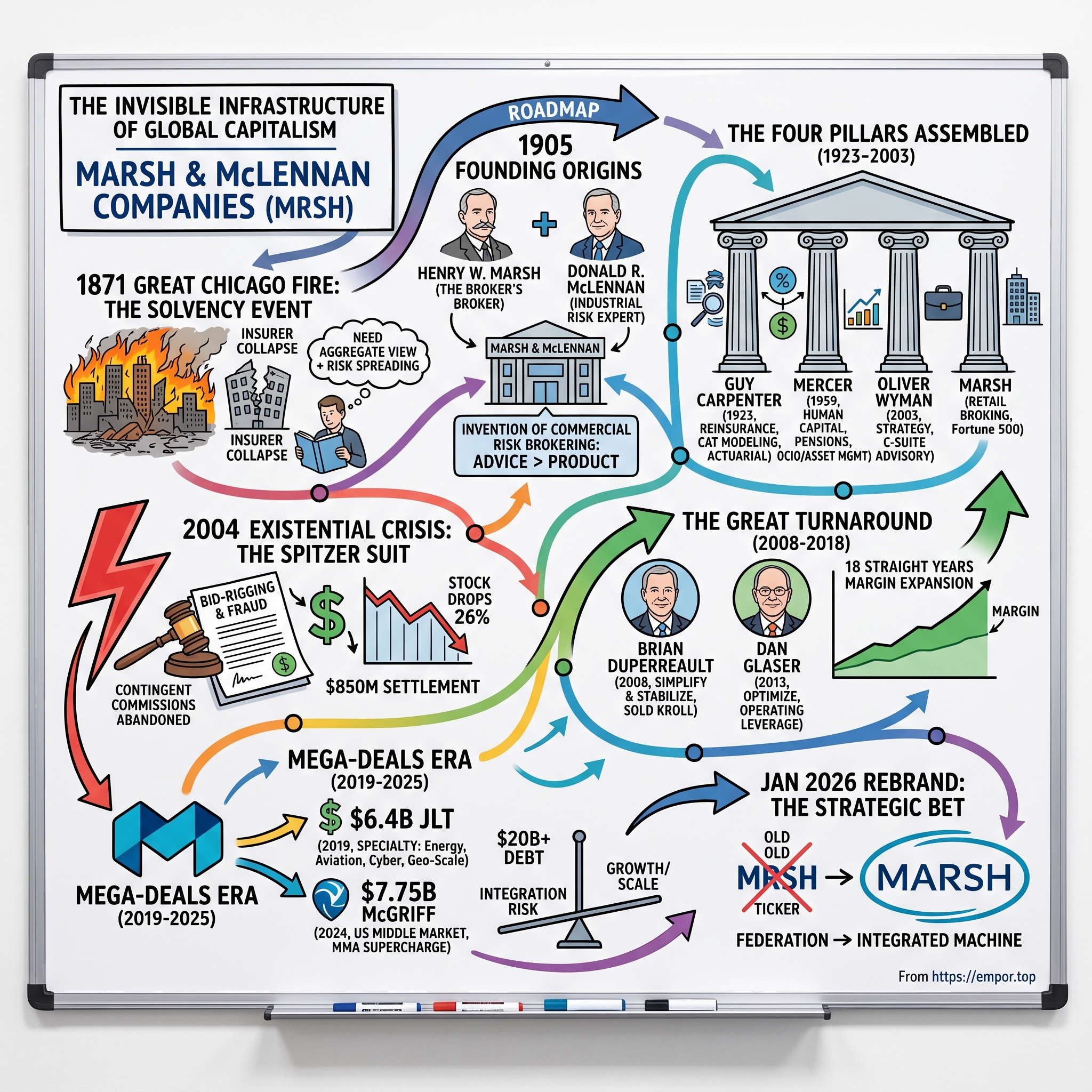
Marsh & McLennan Companies: The Invisible Infrastructure of Global Capitalism
I. Introduction & Episode Roadmap
There is a particular kind of company that most people have never knowingly encountered and yet cannot escape. When a container ship the length of three football fields slips out of the Port of Rotterdam, someone brokered the coverage on its hull and the cargo inside. When a pharmaceutical giant runs a global clinical trial, someone structured the liability program that lets it. When a mid-sized manufacturer in Ohio renews its employee health plan, or a European reinsurer decides how much of a hurricane it can afford to hold on its own balance sheet, there is a broker in the middle taking a slice — never touching the risk itself, never paying the claim, simply standing at the toll gate where risk changes hands.
For most of its life, that company answered to the name Marsh & McLennan Companies, and to the New York Stock Exchange ticker MMC. As of January 14, 2026, it answers to something simpler. The firm formally collapsed its identity into a single masterbrand — Marsh — and moved its listing to the ticker MRSH, retiring the MMC symbol it had carried for decades.[^1]1 The legal entity, Marsh & McLennan Companies, Inc., and its SEC filer identity remained intact, but the storefront changed.2 It is a fitting place to begin, because the rebrand is not cosmetic trivia. It is the visible surface of a strategic argument the company has been making internally for years — that four legendary but separate franchises are worth more welded into one integrated machine than kept as a federation of independent brands. Whether that argument is right is one of the live questions of this story.
By the numbers, this is one of the largest professional-services firms on earth. Revenue reached roughly $26.98 billion in 2025, up from $24.46 billion in 2024, on a base of more than 90,000 colleagues advising clients in over 130 countries.[^1]3 It manufactures nothing. It underwrites nothing on its own balance sheet — it does not accept the risk that a building burns or a ship sinks. It lends nothing. And yet it sits astride the flow of well over $100 billion in annual insurance premium and advises on something in the neighborhood of $17 trillion of client assets.4 The thesis worth testing across this episode is how a firm that carries none of the underlying financial risk — not underwriting risk, not credit risk — nonetheless built an inescapable position in global commercial insurance, reinsurance, corporate benefits, and C-suite consulting.
The arc runs like this. We start with fire — literally, the Great Chicago Fire and the world of nineteenth-century industrial risk that gave birth to commercial brokerage. We watch the assembly of four pillars: Marsh in retail broking, Guy Carpenter in reinsurance, Mercer in human capital, and Oliver Wyman in strategy. We then confront the near-death experience — the 2004 bid-rigging scandal that a crusading New York attorney general named Eliot Spitzer turned into an existential threat, erasing roughly half the company's market value in weeks. We trace the long, unglamorous turnaround under Brian Duperreault and Dan Glaser that rebuilt the firm into a margin-expanding compounder, and the mega-deals — the $5.6 billion Jardine Lloyd Thompson acquisition and the $7.75 billion McGriff purchase — that defined its recent M&A era. Finally, we open the hood on the financial engine, stress-test the moats against Hamilton Helmer and Michael Porter, and lay out the bull and bear cases as the interest-rate tailwind and the hard insurance market that flattered recent results both begin to fade. Let us start where the money first learned to fear fire.
 Subscribe on LinkedIn
II. Founding Origins & The Invention of Commercial Risk Brokering (1871–1970s)
On the night of October 8, 1871, a fire broke out in or near a barn on Chicago's West Side and, fanned by dry autumn winds across a city built almost entirely of wood, burned for two days. It destroyed roughly a third of the city and left a third of its residents homeless. The Great Chicago Fire is remembered today as an urban catastrophe and a folk legend about a cow. For the insurance industry it was something else: a solvency event. Dozens of insurers, having cheerfully written policies across a tinderbox city with no sense of their aggregate exposure, simply collapsed and could not pay. The lesson that rippled out from the ashes was that risk in an industrializing economy was becoming too large, too concentrated, and too correlated for any single local agent or carrier to handle by instinct. Someone needed to sit above the transaction — to understand exposure in the aggregate, to spread a single enormous risk across many carriers, and to advise the buyer rather than merely sell a policy.
That is the intellectual seed of commercial risk brokerage, and it is the world into which Henry W. Marsh and Donald R. McLennan walked. Marsh was a broker's broker, a salesman convinced that large corporations needed insurance advice rather than insurance product. McLennan, working out of the railroad and lumber economy of the Upper Midwest, understood industrial risk — the exposures of a railway, a grain elevator, a mill. In 1905 their two agencies merged to form Marsh & McLennan, and the firm oriented itself from the start toward the biggest, most complex risks in America: the railroads, steel mills, and manufacturers whose scale had outgrown the old way of buying coverage.[^1]
The genuine innovation here is easy to miss because it feels so obvious in hindsight. Marsh & McLennan helped convert insurance from a product a company bought into a function a company managed. The firm did not simply place a policy and pocket a commission; it helped the largest enterprises of the age think about their entire portfolio of risks — property, liability, marine, business interruption — as something to be engineered, syndicated across multiple insurers, and continuously advised upon. This is the origin of what would later be called corporate risk management, and the broker made itself the indispensable orchestrator of it.
It helps to understand why this seemingly modest role — the man in the middle — turned out to be the more durable place to stand than the carrier's seat. An insurance company lives and dies by its underwriting judgment and its balance sheet. Misprice a hurricane season, under-reserve a wave of liability claims, and you can be insolvent in a single year, exactly as the Chicago fire proved. The broker, by contrast, is largely indifferent to whether any individual policy pays out. Its franchise is the relationship and the knowledge — who insures what, at what price, on what terms — and that knowledge compounds. Every renewal, every claim negotiated, every new exposure mapped deepens the broker's understanding of the client and of the market, and none of it puts capital at risk. Over a long enough horizon, the intermediary that owns the information and the relationship captures a remarkably stable slice of the economics while the risk-takers around it endure boom and bust. This is why, more than a century later, the broker trades at a premium valuation to the carriers it serves.
Through the middle of the twentieth century the firm rode the expansion of the American corporation itself. As companies grew national and then multinational, their risks multiplied — factories abroad, fleets at sea, workers to protect, executives to indemnify — and each new layer of complexity was a new reason to lean on a broker who could see the whole picture. The firm grew alongside its clients, embedding itself deeper into their operations until, for many large enterprises, the annual insurance program was simply something Marsh handled. That embeddedness, built patiently over decades, is the raw material of the switching costs that define the business today.
Just as important was what the firm chose not to do. It never became an insurer. It never put its own capital behind the promise to pay a claim. This is the structural decision that defines the entire business to this day: the broker collects a fee or commission for advice and placement, while the carrier bears the actual risk of loss on its balance sheet. When a factory burns, the insurer writes the check; the broker's income does not depend on whether the loss occurs. The firm formalized this posture and its access to capital when it went public in 1962, cementing a corporate structure that separated advisory economics from underwriting liability.[^1] That separation is the reason a broker can grow into a highly profitable, capital-light compounder while carriers wrestle with catastrophe losses and reserve adequacy. For an investor, the takeaway from this founding era is that the company's most valuable asset was never a product or a factory — it was a position: standing between the buyer and the seller of risk, trusted by both, and owning the relationship with the buyer. Everything that follows is an effort to widen that position and defend it. The first great widening was to start brokering insurance not for corporations, but for the insurers themselves.
III. Assembling the Four Pillars: Guy Carpenter, Mercer, & Oliver Wyman (1923–2003)
Here is a strange and wonderful idea: if a corporation needs a broker to buy insurance, then an insurer needs a broker to buy insurance on its insurance. That second-order product is called reinsurance — coverage that carriers purchase to offload the tail of their own portfolios, so that a single hurricane or a run of large claims does not wipe them out. And the intermediary who arranges it, the reinsurance broker, occupies one of the most quietly lucrative perches in all of finance.
Marsh & McLennan climbed onto that perch in 1923 by acquiring Guy Carpenter & Company, giving it the first of what would become four pillars.[^1] The economics of reinsurance broking are worth dwelling on because they explain a lot about why this company compounds. Reinsurance is sold in enormous blocks to a small, sophisticated set of buyers — the world's insurers — and structuring those deals requires deep catastrophe modeling, actuarial firepower, and access to global reinsurance capital. There are only a handful of firms on the planet that can credibly do it at scale. That scarcity, plus the analytical complexity, is why the reinsurance segment throws off operating margins well north of thirty percent, richer than almost anything else under the corporate roof. In 2025, Guy Carpenter generated roughly $2.5 billion of revenue as the group's most profitable engine per dollar.17 It is a business where being one of two or three credible players is worth more than being one of two hundred.
The second pillar answered a different postwar question. As American corporations emerged from the Second World War, they took on a vast new category of obligation to their own employees: pensions, health benefits, disability, executive compensation. These promises were financially enormous and fiendishly technical — a pension is, in effect, a multi-decade actuarial bet a company makes on its own workforce. In 1959 the firm moved into this world with the acquisition of the business that would become Mercer, and over the following decades built it into the global leader in human capital advisory.[^1] Mercer's role is to help companies design, fund, and manage the promises they make to people. By 2025 it was the largest of the two consulting brands, at roughly $6.2 billion of revenue, and it had extended from advice into asset management — running money for clients as an outsourced chief investment officer.17 Management has said the firm advises on close to $17 trillion of assets globally and is the largest OCIO provider in the market, with delegated assets under management reaching $727 billion by early 2026.4[^6] That evolution, from giving advice to managing the money directly, quietly turned a consulting franchise into something with the recurring, fee-on-assets economics of an asset manager.
The Mercer story contains a quiet transformation that most casual observers miss and that is worth drawing out, because it changed the character of the earnings. For most of its life Mercer was a pure advisor — it told pension funds and corporate treasurers how to invest, and billed for the advice. But over the past two decades it increasingly offered to make and implement those decisions directly, as a delegated or "outsourced chief investment officer." The distinction is enormous. Advice is a project you can cancel; running the money is a recurring, fee-on-assets relationship that grows with markets and compounds with new mandates. Mercer built this into the largest OCIO business in the world, and on the firm's early-2026 calls its investments arm was among the fastest-growing pieces of the entire company, its delegated assets swelling past $700 billion.[^6] In effect, a consulting franchise grew an asset-management business inside itself — one with the annuity-like economics that investors prize — and the firm has continued to feed it, agreeing in 2026 to acquire the private-markets specialist AltamarCAM to extend Mercer's reach into the alternatives that pension and wealth clients increasingly demand.[^6] It is a reminder that the most interesting parts of a sprawling firm are sometimes hiding inside the segments, not the headlines.
The fourth pillar came last and was assembled rather than bought whole. Between 2003 and 2007 the firm combined its Mercer Management Consulting operations with the acquired strategy boutique Oliver, Wyman & Company to create Oliver Wyman Group, a top-tier management consultancy specializing in financial services, aviation, and risk strategy — a firm that competes for C-suite mandates alongside McKinsey, BCG, and Bain.[^1] By 2025 Oliver Wyman generated roughly $3.6 billion of revenue.17
There is a subtler point buried in how these four businesses were built, and it speaks to the firm's whole theory of itself. None of the four is a commodity. Reinsurance broking requires modeling talent so specialized that only a handful of firms compete for it. Actuarial and pension consulting requires credentialed experts who take years to train. Strategy consulting sells the judgment of its partners. In each case the firm was buying its way into a business where expertise, data, and relationships — not price — determine who wins. That is a deliberate pattern. Marsh & McLennan consistently avoided the low-margin, high-volume corners of financial services and clustered instead around advice for the complex and the high-stakes. It is the difference between selling car insurance to millions of consumers and designing the risk program for a global airline. The former is a scale-and-price game; the latter is a trust-and-expertise game, and the latter is where durable margins live.
That clustering also created the raw material for cross-selling, at least in theory. A multinational that uses Marsh to place its property program is a natural customer for Mercer's benefits advice, Guy Carpenter's reinsurance intelligence, or Oliver Wyman's strategy work. Whether the firm has ever fully realized that cross-sell — whether a client relationship in one silo reliably becomes revenue in another — is one of the perennial questions about diversified professional-services firms, and it is precisely the promise the 2026 rebrand into a single "Marsh" is meant, finally, to cash. The skeptic's view is that four proud, independently run franchises rarely collaborate as smoothly as the org chart implies; the optimist's view is that shared data and a single brand can at last knit them together. We will return to that tension, because it is the central strategic bet of the current era.
Step back and the architecture reveals its logic. The firm had built two engines that pull in different weather. Risk & Insurance Services — Marsh and Guy Carpenter — rises and falls with the insurance pricing cycle. Consulting — Mercer and Oliver Wyman — is driven by corporate demand for advice on people and strategy, which does not move in lockstep with insurance rates. In a soft insurance market, benefits restructuring and strategy work can hold up; in a downturn, companies still must fund pensions and manage risk. The result is a portfolio designed to smooth the cycle. That was the promise, at least. The scandal that nearly destroyed the company would test whether the diversified structure could survive a self-inflicted wound at its very core.
IV. The Existential Crisis: Eliot Spitzer, Bid-Rigging, & Near Collapse (2004–2007)
Trust is the entire product. A broker's client hands over its most sensitive risk information and, crucially, delegates the judgment of which insurer offers the best deal — because the whole point of a broker is that it works for the buyer. Now imagine discovering that your broker was quietly being paid by the sellers to steer you toward their policies, and in some cases soliciting fake, inflated bids from carriers so that a pre-selected winner would look competitive. That was the accusation, and it struck at the one asset the firm could not afford to lose.
The mechanism had a bland name: contingent commissions, formalized in what the industry called placement service agreements. On top of the ordinary commissions carriers paid for winning business, insurers also paid brokers additional "contingent" bonuses based on the volume and profitability of the business steered their way. Marsh was collecting something on the order of $800 million a year from these arrangements. The problem is the conflict baked into the structure: a broker paid extra by the carrier for volume has an incentive to place business where its bonus is fattest, not where the client is best served. On October 14, 2004, New York Attorney General Eliot Spitzer — then at the height of his career as the self-styled "Sheriff of Wall Street" — filed a civil complaint alleging bid-rigging, steering, and fraud at Marsh.56
The market reaction was violent and immediate. The stock fell roughly 26% in a single session and, from its pre-suit level, went on to lose close to half its value at the trough — a destruction of somewhere around $10–11 billion in market capitalization.5 Within days the firm's leadership was gone. On October 25, 2004, chief executive Jeffrey W. Greenberg resigned, and the board installed Michael G. Cherkasky — a former prosecutor who had run the firm's Kroll investigations unit — as president and CEO to fight the regulatory fire.7 Cherkasky's mandate was not growth; it was survival. On January 31, 2005, Marsh agreed to a settlement establishing an $850 million restitution fund for clients, payable over four years, and — just as consequentially — agreed to abandon contingent commissions.5 The broader industry followed, and the practice was effectively banned across the major brokers.
To feel the full weight of the crisis, you have to appreciate how naked a broker is once its integrity is questioned. A manufacturer whose plant burns can rebuild; a bank that loses money can raise capital. But a broker that clients no longer trust to give honest advice has lost the only thing it sells. In the weeks after the complaint, the fear inside the firm was not merely legal liability — it was that clients would flee en masse to competitors, that carriers would sever relationships to protect themselves, and that the talent, the star brokers whose relationships were the business, would walk out the door and take their clients with them. Any of those cascades could have been fatal, and all three were live possibilities in the autumn of 2004. Cherkasky's job, more than settling with the attorney general, was to stop the bleeding of clients and people before the franchise unravelled.
He largely succeeded, but the cost was years of stalled growth and a battered stock. The settlement's abolition of contingent commissions removed a high-margin revenue stream overnight, and the firm spent the back half of the decade rebuilding both its economics and its reputation from a defensive crouch. For a time, Marsh & McLennan looked like a wounded giant that competitors — Aon and a rising Gallagher among them — might steadily pick apart. That it did not merely survive but eventually emerged stronger is a genuine achievement, though it took new leadership and the better part of a decade to prove.
It is worth being precise about what this episode teaches, because the temptation is to file it as ancient history. The deeper point is that the firm's most dangerous vulnerability was never external competition or a bad insurance cycle — it was an internal incentive structure that quietly corrupted the very thing clients paid for. The contingent-commission model made the firm money right up until the moment it nearly destroyed it, because the hidden conflict eroded the trust that is the whole franchise. Removing that revenue stream was painful in the short run and clarifying in the long run: it forced the company to justify its fees on the honest basis of advice and placement quality rather than on hidden kickbacks. A skeptical investor should note the pattern, because it recurs across financial intermediaries — the most profitable practices are sometimes the ones hiding the most conflict. The rebuild that followed would take years and two very different chief executives, and it would ultimately transform the firm from a scandal-scarred transaction shop into the disciplined compounder investors know today.
V. The Great Turnaround & Strategy Pivot: Duperreault, Glaser, & The Compounder Flywheel (2008–2018)
By 2008 the immediate legal crisis had passed, but the company was still a wounded animal — margins depressed, carrier relationships strained, culture defensive, and a stew of non-core businesses cluttering the balance sheet. What it needed was not a firefighter but an operator, and it found one in Brian Duperreault. A Bermuda-based insurance industry veteran who had spent decades at AIG and then run the insurer ACE, Duperreault took the CEO seat in 2008 knowing the business from the carrier side of the table — a rare vantage point for a broker's chief executive. His instinct was to simplify. He divested distractions, most symbolically selling the Kroll corporate-investigations unit — the very business the crisis-era CEO had come from — to Altegrity for $1.13 billion in cash in a deal announced in June 2010 and completed that August.8 The message was that the firm would recommit to what it did best — risk and people — and stop trying to be a conglomerate of unrelated services. Duperreault restored carrier relationships, imposed governance discipline, and stabilized the ship.
The more consequential figure arrived next. Dan Glaser, who took over as CEO in 2013, was a Marsh lifer — a broker who had come up inside the business and understood it in his bones. Where Duperreault stabilized, Glaser optimized, and he did so with a monomania about operating leverage that became the defining trait of his decade in charge. The scoreboard he cared about was margin, and under his tenure the firm strung together an extraordinary run of consecutive years of adjusted operating margin expansion — a streak that reached 18 straight years by 2025 and that management openly treats as a point of institutional pride.[^6] For investors, a streak like that is worth interrogating rather than applauding on reflex, and we will stress-test its durability later. But its existence tells you something real: this became a company organized around the discipline of doing a little more with a little less, every single year, through good markets and bad.
It is worth pausing on the psychology of that streak, because it reveals something about how the firm is run. A company that promises itself margin expansion every year is making a demanding commitment: it must find efficiency even in years when revenue disappoints, and it must resist the temptation to over-hire or over-spend in the good years. Glaser institutionalized a culture of what insiders describe as continuous, incremental productivity — trimming here, automating there, holding the line on compensation ratios — so that operating leverage became a habit rather than an event. The risk of such a streak, and the reason an analyst should watch it rather than cheer it, is that it can create pressure to hit the number through means that borrow from the future: under-investing in technology, stretching staff, or leaning on one-time items. So far the evidence suggests the expansion has been broadly organic and healthy, but a streak is also a trap — the year it breaks, the market will ask whether the whole model was as durable as advertised.
Glaser's signature strategic invention was the Marsh McLennan Agency, or MMA, launched in 2009. The insight behind it was a genuine market gap. The mega-broker Marsh was built to serve the Fortune 500 — enormous, complex, global accounts. At the other end sat thousands of local mom-and-pop agencies serving small businesses. In between lay the vast American middle market: companies too big for the corner agency but too small to command the attention of a global broker. MMA was built to roll up that middle. It became a programmatic acquisition machine, buying dozens upon dozens of regional agencies and folding them into a national platform, eventually assembling a middle-market engine that would grow past $3.5 billion in revenue.[^1] The beauty of the model is that it married organic dominance at the top of the market with a repeatable, capital-deployable acquisition strategy in the middle — a way to keep buying growth at reasonable multiples while the core compounded.
The through-line of this decade is a shift in the nature of the revenue. The firm moved deliberately away from pure transactional commission dependence toward recurring, fee-for-service advisory relationships, and it drove client retention to roughly 95% — a stickiness that turns each year's revenue into a high-probability starting point for the next.[^1] Post-crisis operating margins that had sagged into the low teens climbed back toward and past 20% on a consolidated basis and far higher within the core insurance segment. What emerged was a flywheel: retain clients at extraordinary rates, expand the services sold to each, deploy excess cash into accretive middle-market acquisitions, and let operating discipline widen margins on the way. Having proven the flywheel worked at home, the firm was ready to test it on a far larger stage — through the biggest acquisitions in its history.
VI. Mega-M&A Era: Benchmarking the $6.4B JLT & $7.75B McGriff Acquisitions (2019–2025)
For most of its modern life, Marsh had grown through a steady drumbeat of small "string of pearls" acquisitions — a phrase management still uses — punctuated by the occasional larger move. In September 2018 it broke that pattern with the boldest bet in its history to that point. On September 17–18, 2018, it announced the acquisition of Jardine Lloyd Thompson Group, the London-listed specialty broker, for £19.15 per share in cash, valuing JLT's equity at roughly £4.3 billion, or about $5.6 billion, and giving the deal an enterprise value near $6.4 billion.89 The transaction closed on April 1, 2019.9
The strategic logic was specialty and geography. JLT was strongest exactly where scale and expertise matter most — in complex specialty lines like energy, aviation, marine, and cyber, and in fast-growing Asian and UK markets. It brought roughly $2 billion of revenue and about 10,000 colleagues.8 Combining JLT Re with Guy Carpenter created a reinsurance powerhouse, and the enlarged specialty franchise deepened the firm's moat in precisely the areas where clients cannot simply shop on price — you cannot casually re-broker the insurance program for an offshore oil platform or a global airline fleet. Management targeted roughly $250 million of annual cost synergies over about three years and, on the evidence of the margin trajectory that followed, integrated the business without derailing the compounding machine.9 The Financial Times noted at the time that the deal cemented Marsh's position at the very top of a consolidating global broking industry.10 The price was full — mid-teens as a multiple of forward earnings — and the deal briefly lifted leverage, but the firm deleveraged on schedule and the acquisition is now generally regarded as a strategic success rather than an overpay.
Then, in the autumn of 2024, came the record-breaker. On September 30, 2024, the firm announced it would acquire McGriff Insurance Services for $7.75 billion in cash, plus the assumption of a deferred tax asset worth roughly $500 million — the largest acquisition in the company's history.1112 The seller was TIH, the entity formerly known as Truist Insurance Holdings, which by then had passed into private-equity ownership after Truist Financial sold it down. The deal closed on November 15, 2024.13 McGriff brought about $1.3 billion of revenue and roughly 3,500 employees, and — critically — it was folded not into the global Marsh brand but into MMA, supercharging the middle-market rollup engine and deepening US commercial P&C, employee benefits, and specialty distribution.1213
Here is where an independent lens matters most, because the two deals invite a genuine debate. McGriff was expensive — a mid-teens multiple of EBITDA — and it was struck near the top of a hard insurance market, when broker revenues were being flattered by years of rising premium rates. The obvious activist critique is that Marsh paid a peak multiple for a peak-cycle asset, and that if commercial insurance rates soften, the acquired revenue base grows more slowly than the deal model assumed. On the firm's own first-quarter 2026 earnings call, management acknowledged that pricing had turned: primary commercial insurance rates fell about 5% in the quarter, with property down 9%.[^6] That is the environment McGriff now operates into. The counter-argument is that the middle market, where MMA competes, has historically shown far more stable pricing through cycles than the large-account market — a point CEO John Doyle made explicitly on that same call, arguing MMA has been a tailwind to growth "for most years and most quarters."[^6] The honest verdict as of mid-2026 is unresolved: JLT has earned its keep, but McGriff's return on invested capital will be proven or disproven over the next several years, and it is the single clearest test of whether management's acquisition discipline held at the top of the cycle.
The mechanics of integrating a broker are worth understanding, because they explain where these deals succeed or fail. A broking business is, at bottom, a collection of producers — the individuals who own the client relationships — and their books. When you buy a firm like McGriff, you are really buying the loyalty of those producers and the stickiness of their clients. The integration risk is that key producers, newly cashed out and courted by rivals, walk away and take their clients with them, hollowing out the very revenue the buyer paid a premium for. This is why acquirers structure earn-outs and retention packages, and why the true test of a deal is not the first-year revenue but whether the acquired book is still intact three and four years later. Marsh's MMA machine had, over fifteen years and more than a hundred smaller deals, built genuine institutional muscle at this — a repeatable playbook for absorbing an agency, retaining its people, and plugging it into national scale. McGriff is that playbook attempted at ten times the usual size, and the jury will be out until the producer-retention data is in.
There is also a balance-sheet dimension the bulls tend to gloss over. To fund McGriff, the firm leaned on debt, and by early 2026 total borrowings stood above $20 billion. That is comfortably serviced by the firm's enormous cash generation, and management has a long record of deleveraging after big deals — it did exactly that after JLT. But it does mean the firm entered a softening pricing environment carrying more leverage than usual, having spent its firepower at what may prove to be a cyclical peak in broker valuations. If organic growth disappoints and rates keep falling, the margin for error on the McGriff price narrows.
Benchmarked against peers, the firm's M&A record looks disciplined. Its closest rival, Aon, saw its ambitious attempt to merge with Willis Towers Watson collapse in 2021 under antitrust pressure, and later paid a rich price for the middle-market broker NFP. Arthur J. Gallagher, meanwhile, built its own scale partly by acquiring assets that regulators forced other brokers to divest. Against that backdrop, Marsh's pattern — one transformational specialty deal, one transformational middle-market deal, and a steady stream of tuck-ins — reads as coherent rather than opportunistic.
The contrast with Aon is especially instructive, because the two firms represent two philosophies of how to run a global broker. Aon has pursued a more radical operating-model overhaul — famously reorganizing itself around a single global profit-and-loss and a firm-wide "Aon United" model, and its failed WTW tie-up would have been the industry's boldest consolidation, halted only when U.S. antitrust regulators signalled they would sue. When that merger died, Aon paid a substantial break fee and then pivoted to the NFP acquisition to buy back some of the middle-market exposure the WTW deal was meant to add. Marsh's approach has been more incremental and, arguably, lower-risk: rather than betting the company on one enormous merger, it compounded through a long series of digestible deals plus two big-but-survivable ones. Neither philosophy is obviously superior — Aon's integration has at times delivered faster margin gains, while Marsh's has arguably produced steadier organic growth — but the divergence matters for investors choosing between the two, and it frames the central question about McGriff: whether Marsh's incremental, retention-focused integration machine can absorb a deal of that scale as smoothly as it absorbed a hundred smaller ones. Whether the firm created value is ultimately a question the financial statements answer, and it is to those that we now turn.
VII. Segment Deep-Dive: Economics, Sizing, & The Financial Machine
Strip away the storytelling and a business is just a machine for converting inputs into cash. So let us open this one up. In 2025 the firm generated $26.98 billion in total revenue, up roughly 10% from $24.46 billion in 2024, of which 4% was underlying, or organic, growth and the remainder came from acquisitions like McGriff and from currency.174 GAAP operating income was about $6.2 billion, adjusted operating income about $7.3 billion, and the full-year adjusted operating margin came in at 27.1% — seasonally higher in the first quarter, at 31.8% — a level worth flagging as unusually high for any services business and central to both the bull and bear cases.17[^6] Adjusted earnings per share reached $9.75, against GAAP diluted EPS of $8.43.17 The audited detail behind these figures sits in the Form 10-K the company filed with the SEC in February 2026.14 The company splits into two reportable segments, and their economics are quite different.
Risk & Insurance Services is the larger engine, at $17.3 billion of revenue in 2025, close to two-thirds of the total.17 Inside it, Marsh itself — global commercial broking plus MMA's middle-market machine — is the giant, at $14.4 billion, and it is the core driver of corporate risk placement and renewal commissions. Its adjusted operating margin is formidable, running above 38% in early 2026.[^6] Alongside it, Guy Carpenter contributes roughly $2.5 billion of reinsurance broking at even richer margins. The segment's revenue is partly a function of insurance pricing: when premiums rise, commission-based revenue rises with them, which is why the multi-year hard market of the early 2020s was such a powerful, and cyclical, tailwind.
The Consulting segment is the smaller engine, at $9.8 billion in 2025, about a third of revenue, and it carries a structurally lower margin — around 21–22% adjusted — because consulting is a people business where talent captures more of the economics.17[^6] Mercer's $6.2 billion spans health, wealth, and career advisory, with its investments and OCIO business increasingly resembling an asset manager earning fees on that $727 billion of delegated assets. Oliver Wyman's $3.6 billion is classic high-end strategy consulting, more project-based and therefore choppier quarter to quarter — its career and project work softened in early 2026 even as health and investments grew.[^6]
Now for the part the outline rightly calls the "hidden" engine, and the part that most deserves an independent eye: fiduciary income. When a client pays an insurance premium, the broker holds that cash briefly before remitting it to the carrier — billions of dollars of other people's money sitting in transit. On those fiduciary balances the firm earns interest, and because there is essentially no cost attached, it drops almost entirely to profit. In a high-rate world this is a beautiful thing — but the honest way to size it is to watch the disclosed line move with rates. Fiduciary interest income was $453 million in 2023, rose to $497 million in 2024 as rates peaked, and then fell to $403 million in 2025 as central banks began cutting — and it kept falling into 2026, running about $88 million in the second quarter, down from a year earlier.1718 So this is real, high-margin money, on the order of $400–500 million a year at the peak, but it is now a shrinking contribution rather than a growing one. That direction of travel matters enormously: a meaningful slice of the earnings growth of 2023–2024 came from rising rates on this float, and that slice is now reversing — a point the bear case leans on heavily.
What ties the machine together is cash conversion. This is a capital-light business — no factories, no underwriting reserves, no loan book — so a high share of operating profit becomes free cash flow, which management recycles into dividends, buybacks, and acquisitions. In the first quarter of 2026 alone the firm returned $440 million in dividends and repurchased $750 million of stock, and it guided to roughly $5 billion of total capital deployment for the year.[^6] Why does the capital-light structure matter so much to an investor? Because it changes what growth costs. A manufacturer that wants to grow must build factories; a bank that wants to grow must hold more capital against its loans. A broker that wants to grow must mostly hire people and, increasingly, buy software and data — investments that are expensed, not capitalized, and that do not tie up a growing balance sheet. The result is that a large share of operating profit converts to free cash flow that the firm can hand back to shareholders or redeploy into acquisitions, rather than plowing it into ever-larger physical assets just to stand still. Over time, this is the difference between a business that must constantly feed itself capital to grow and one that spins off cash it can compound elsewhere. It is the single most important reason the broking model is prized by long-term investors, and it is why buybacks — shrinking the share count year after year — are such a natural and recurring use of the firm's cash.
The engine, in short, is a high-retention, high-margin, cash-generative flywheel — but one whose two most recent accelerants, hard-market pricing and high interest rates, are both fading at once. That makes the quality of management and the discipline of capital allocation more important, not less.
VIII. Current Management & Capital Allocation Discipline
When Dan Glaser retired at the end of 2022, the succession was as un-dramatic as this company likes things to be. John Q. Doyle, announced as the incoming chief executive in September 2022 and effective January 1, 2023, was the definition of a known quantity: he had run the Marsh broking business from 2017 to 2021, served as group president and chief operating officer through 2022, and before joining had spent much of his career at AIG on the carrier side, including running its US commercial insurance operations.15 Like Glaser, Doyle is an insurance-industry insider rather than an outsider brought in to shake things up — which tells you the board wanted continuity of strategy, not reinvention.
Doyle's public posture, audible across recent earnings calls, is relentlessly on-message about three things: organic growth, margin expansion, and — increasingly — artificial intelligence. On the first-quarter 2026 call he framed the firm's entire AI strategy around being an "AI winner" through growth, productivity, and efficiency, pointing to a restructuring program branded "Thrive" that targets $400 million of savings against roughly $500 million of charges, with a portion of the savings reinvested into producer talent and technology.[^6] An independent listener should treat this with measured skepticism. Every large services firm now claims AI will make it more efficient rather than disintermediate it, and Marsh's argument — that its proprietary data, trusted relationships, and role advising on complex, bespoke risk make it an AI beneficiary rather than a victim — is plausible but self-serving and, as yet, unproven in the financials. When an analyst on that call pointedly asked how much of any AI-driven productivity gain Marsh would keep versus compete away to clients, Doyle's answer leaned on the claim that the firm is not a "discounted insurance broker" — a reasonable defense, but a qualitative one.[^6]
Alongside Doyle sits Mark McGivney, the long-serving chief financial officer who in early 2026 also took on the chief operating officer title — a consolidation of authority worth watching, since it concentrates strategy and finance in one executive.[^6] McGivney is the steward of a capital-allocation framework that management describes as balanced and disciplined: reinvest in the business first, organically and through acquisition; grow the dividend every year; and use buybacks to mop up whatever capital M&A does not consume. The firm has raised its dividend for 16 consecutive years, lifting the quarterly payout to $0.90 per share in mid-2025, a 10% increase.16 Here it is worth correcting a piece of investor folklore, in the spirit of an independent platform: this is a strong 16-year streak of increases, not the multi-decade record sometimes claimed — the company's dividend history includes the trauma of the mid-2000s crisis era, and the current unbroken run dates to the post-crisis recovery.
On the question of management credibility, the most useful evidence is behavior over time rather than any single quarter's rhetoric, and here the record is genuinely strong. For more than a decade the firm has set conservative top-line guidance — historically framing organic growth in the mid-single digits — and then delivered at or above the high end, a pattern of under-promising and over-delivering that is the opposite of the overpromising that plagues weaker management teams. The narrative across earnings calls has been strikingly consistent: the same emphasis on balanced capital allocation, the same margin-expansion commitment, the same "string of pearls" M&A language year after year. When the firm has stumbled — the Greensill litigation, the occasional soft quarter at Guy Carpenter or in Oliver Wyman's project work — management has generally named the issue plainly rather than burying it, and the fiduciary-income and pricing headwinds now facing the business have been flagged repeatedly rather than sprung on investors. That consistency is itself a form of moat: it earns the benefit of the doubt that lets a premium multiple persist.
The place a skeptic should press hardest is the newest chapter of the narrative — the AI story and the rebrand. Both are, as yet, arguments rather than results. The claim that the firm will be an "AI winner" and that consolidating four brands into one will unlock cross-selling are exactly the kind of confident, hard-to-falsify assertions that deserve to be tested against outcomes, not accepted on management's word. A disciplined observer will watch whether AI actually shows up as sustained margin expansion beyond the Thrive program's mechanical cost cuts, and whether the single-brand structure produces measurably more cross-business revenue — or whether, a few years from now, these prove to have been narrative flourishes layered over a business that was going to compound at roughly the same rate regardless.
On alignment, executive pay is weighted toward long-term performance stock units tied to multi-year adjusted-EPS growth and relative total shareholder return, and senior executives face meaningful stock-ownership requirements. That is a governance structure designed to reward compounding rather than swing-for-the-fences risk, and it broadly matches the firm's actual behavior. But an activist would push on two things. First, the McGivney dual role and the general concentration of power raise ordinary governance questions about oversight. Second, and more materially, capital allocation deserves scrutiny precisely because management preaches discipline: the firm deployed $7.75 billion on McGriff at a peak multiple, took on debt to do it — total debt stood at $20.6 billion in early 2026 — and simultaneously acknowledged softening pricing.[^6]11 Discipline is easy to claim and hard to prove; the McGriff return will be the evidence. There is also a live reminder that this is a business exposed to its own advice: in the first quarter of 2026 the firm booked a $425 million litigation charge related to its role, beginning in 2014, as broker for the collapsed finance group Greensill Capital.[^6] Professional-liability tail risk is a permanent feature of the model, not a bug that was fixed in 2005. Whether management's record justifies the market's trust is ultimately a question about the durability of its competitive advantages — so let us game those out.
IX. Competitive Moats: Hamilton Helmer's 7 Powers & Porter's 5 Forces
Imagine you are a well-funded, brilliant team that has decided to build a global insurance broker from scratch to dethrone Marsh. Where do you even begin? You would need licenses in 130-plus countries, relationships with thousands of carriers built over decades, catastrophe models fed by proprietary loss data you do not have, and the trust of Fortune 500 risk managers who will not hand a billion-dollar program to an unknown. This thought experiment is the fastest way to see why the moats here are unusually deep, and it is worth running them through two frameworks.
Start with Hamilton Helmer's Seven Powers. The primary power is scale economies. Marsh channels well over $100 billion of premium flow to carriers annually, and that aggregation gives it leverage no single client could command — better terms, broader coverage, and the ability to secure capacity in tight markets.4 A carrier that wants access to Marsh's book of business cannot easily dictate terms to the firm that controls distribution to thousands of buyers. The second, and perhaps most durable, is switching costs. Once a multinational's risk management, global compliance, complex renewals, and employee benefits are woven into Marsh and Mercer workflows, changing brokers becomes an operational hazard a risk manager is loath to undertake — which is exactly why client retention sits near 95%.[^1] The third is a cornered resource: decades of proprietary global loss data, Guy Carpenter's catastrophe models, and — not to be underestimated — the concentration of elite broking and consulting talent under one roof. On the firm's Q1 2026 call, leaders pointed to AI tools trained on nearly $200 billion of loss information as a data asset competitors cannot replicate.[^6] The fourth is process power: the institutionalized, hard-won workflows for placing genuinely complex risks — an airline fleet, an offshore rig, a global cyber tower — that cannot be stood up overnight.
Run the same business through Porter's Five Forces and the picture is consistent. Barriers to entry are very high, for all the reasons the thought experiment exposed — regulatory reach, carrier networks, and placement scale are close to unreplicable. Buyer power is low-to-moderate: large corporates depend on Marsh's clout to secure capacity, though the very largest, most sophisticated clients can and do negotiate hard on fees. Supplier power — here the "suppliers" are the insurance carriers — is limited, because carriers rely on the broker for distribution and no single carrier can dictate to a broker of this scale. Substitutes are, for now, weak: software and AI so far complement the human broker rather than replace the trust and accountability a CFO wants standing behind a multi-million-dollar coverage decision — though this is precisely the force most likely to shift over the next decade, and the one an investor should watch hardest. Finally, competitive rivalry is best described as a disciplined oligopoly. The global commercial-broking industry is dominated by a handful of giants — Marsh, Aon, WTW, and Arthur J. Gallagher — that compete fiercely for talent and clients but broadly refrain from destructive price wars.
The rationality of that oligopoly deserves a moment, because it is doing a lot of quiet work in the investment case. In many industries, four large players would compete margins into the ground. In global broking they largely do not, for a structural reason: the product is not price-shopped the way a commodity is. A Fortune 500 risk manager choosing between Marsh and Aon is not primarily comparing fees; they are comparing the depth of the two firms' specialty expertise, the strength of their carrier relationships, the quality of their claims advocacy when a disaster strikes, and the switching cost of moving a global program. That competitive dynamic rewards investment in capability rather than price-cutting, which is why all four majors sustain high margins simultaneously. It also means the firms compete most fiercely not on price but on talent — poaching star producers and consulting partners — which is why wage inflation, not fee compression, is the margin risk that actually keeps management awake. This is a genuinely attractive competitive structure, and it is a large part of why these businesses compound so reliably.
But an honest assessment must note where the moats are shallower than the bull case implies. At the very largest end of the market, sophisticated corporate buyers do have real fee-negotiating power, and some have experimented with unbundling or bringing risk functions in-house. The reinsurance business, so profitable in the hard market, is now visibly softening — Guy Carpenter's revenue shrank in the second quarter of 2026 as reinsurance rates fell.18 And the switching costs, while high, are not infinite: a determined, well-resourced rival can and does win marquee accounts. The moats are wide, but they are not walls, and the pricing cycle can erode the earnings they protect even when the competitive position holds.
The one force worth flagging as genuinely uncertain is substitution via technology, and it connects to the strategic argument that opened this story. The firm's decision to collapse Marsh, Guy Carpenter, Mercer, and Oliver Wyman into a single "Marsh" masterbrand is, in moat terms, a bet that integration and shared data create more value than the independent equity of four storied names.1 That may strengthen the cross-sell and data advantages — or it may dilute powerful individual franchises, particularly Oliver Wyman, whose strategy consultants trade partly on independence from an insurance broker. The moats are real and wide today. The question the next section confronts is whether they are widening or quietly narrowing.
X. Strategic Position, Material Risk Radar, & Bull vs. Bear Case
If you are going to track this company as an investor, you do not need fifty metrics. You need three, and management hands them to you every quarter. The first is underlying (organic) revenue growth — the cleanest read on whether the core business is winning new clients and expanding wallet share independent of acquisitions and currency. It ran 4% in the first quarter of 2026 and ticked up to 5% in the second quarter, reported on July 21, 2026, even as insurance pricing kept falling — a reassuring sign that new-business wins and rising client demand are offsetting rate headwinds, but still a step down from the 7% organic pace of 2024.[^6]18 This is the single number to watch for whether the machine can hold mid-single-digit growth once its cyclical tailwinds are fully gone. The second is adjusted operating margin expansion, the discipline that has defined the firm for 18 straight years; the streak's continuation, or its first break, will be the tell on operating leverage.[^6] The third is fiduciary interest income together with free-cash-flow conversion, because the former is the swing factor most exposed to falling rates and the latter is the ultimate measure of earnings quality in a capital-light model.[^6]
The material risks are not exotic macro fears but specific, mechanical pressures. The first is commercial P&C rate softening: because a chunk of Marsh and Guy Carpenter revenue is a commission on premium, falling insurance prices are a direct organic headwind — and prices are now falling steadily, down 5% in the first quarter of 2026 and 6% in the second, with reinsurance so soft that Guy Carpenter's revenue actually shrank about 2% in the second quarter.[^6]18 The second is interest-rate cuts, which erode the high-margin fiduciary income that flattered recent earnings, already visibly declining. The third is McGriff integration and leverage: a $7.75 billion deal struck at a full multiple, financed with debt, that must retain its producers and deleverage as the pricing environment turns against it.11[^6] The fourth is the war for talent — a people business is always one aggressive competitor's hiring spree away from margin pressure, and professional-liability tail risk, as the Greensill charge showed, never fully goes away.[^6]
So, the spine — why this wins, and what breaks it. The bull case is that Marsh is the quintessential non-bank compounder: an oligopolist with near-95% retention, deep switching costs, a proven middle-market rollup engine in MMA, and structural demand growth from the rising complexity of risk itself — cyber, climate, and, increasingly, the risks and opportunities of AI. On the Q1 2026 call, leaders argued the cost of risk is climbing at perhaps twice the rate of GDP even as insurance prices soften — meaning the underlying need for the firm's advice grows regardless of the pricing cycle.[^6] If that holds, mid-single-digit organic growth plus continued margin expansion plus buybacks compounds into double-digit earnings growth across cycles, and the moats ensure it is not competed away.
The bear case is that the impressive growth of recent years was substantially borrowed from two cyclical lenders that are now calling in their loans. The multi-year hard insurance market inflated commission revenue; high interest rates inflated fiduciary income. Both are reversing at once, which is precisely why organic growth has slowed to 4% and why margin expansion is getting harder to manufacture. Into that softening backdrop, management paid a peak multiple for McGriff and added leverage. And over the longer horizon, the substitution question looms: if AI can eventually commoditize parts of placement and advice, the very data-and-trust moat management touts could thin. A short-seller would add that a firm trading at a premium multiple has priced in continued perfection, leaving little room for the deceleration that is already visibly underway.
It is worth confronting one piece of consensus folklore directly, in a myth-versus-reality spirit, because it colors how the stock is often discussed. The myth is that Marsh is essentially recession-proof — that because companies must carry insurance and fund pensions regardless of the economy, the firm's revenue barely notices downturns. The reality is more nuanced. Much of the business is genuinely resilient: mandatory coverages get renewed, and Mercer's benefits work is non-discretionary. But meaningful pieces are cyclical in ways the myth glosses over. A large chunk of revenue is a commission on insurance premium, so when pricing softens — as it is doing now — that revenue grows more slowly or shrinks even if the underlying coverage is unchanged. Oliver Wyman's strategy consulting is discretionary and can be cut hard in a downturn, as its softening project work in early 2026 showed. And the fiduciary-income windfall was a pure gift of the rate cycle, now reversing. So the firm is resilient, not immune — a distinction that matters a great deal when a premium valuation is built on the assumption of steady compounding through anything.
The independent verdict is that both cases are partly true, and the tension between them is the whole point. This is a genuinely excellent business with real, wide moats and a strong operating culture — and it is entering a period where its two biggest recent accelerants are fading, its largest-ever acquisition is unproven, and a technological substitution risk it dismisses is worth watching closely. The evidence for the bull case is concrete and observable in the retention and margin data; the evidence for the bear case is equally concrete in the rate and fiduciary-income trends. Which narrative dominates over the next few years will be settled not by management's confidence but by those three KPIs.
XI. Playbook: Key Business & Investing Lessons
The first lesson is the oldest and the most powerful: do not take balance-sheet risk when you can toll-gate it. The defining choice of this company, made more than a century ago and never reversed, was to stand between the buyer and seller of risk without ever bearing the risk itself. It earns a fee on the flow while carriers absorb catastrophe losses and lenders absorb defaults. That structural position — capital-light, cash-generative, and insulated from the underlying loss experience — is the reason a broker can compound more reliably than the insurers it serves. When you evaluate any intermediary, ask who is holding the risk when things go wrong; the best businesses often arrange to be holding a fee instead.
The second lesson is that surviving a near-death legal crisis requires eliminating the incentive that caused it, not just paying the fine. The contingent-commission scandal was existential precisely because it corrupted the trust that is the entire product. The firm did not merely settle for $850 million; it abolished the conflicted revenue stream and rebuilt its economics on honest advice. The counterintuitive result was a stronger franchise. For investors, the durable warning is that a firm's most profitable practice can also be its most dangerous when it hides a conflict — and the Greensill charge is a reminder that in an advisory business, professional-liability risk is a permanent tenant, never fully evicted.
The third lesson is that programmatic middle-market M&A can create real, repeatable alpha — when it is disciplined. MMA showed that combining organic dominance at the top of a market with a rollup machine in the underserved middle produces durable growth that neither strategy achieves alone. But the same playbook, executed at a peak multiple with borrowed money, is how good acquirers become mediocre ones. The McGriff deal is the live test of whether the discipline that built MMA survived contact with the largest check the firm ever wrote.
The fourth lesson is that counter-cyclical diversification smooths volatility but does not abolish the cycle. Pairing insurance broking with benefits and strategy consulting genuinely dampens the swings — soft insurance markets can be offset by consulting demand, and vice versa. Yet the recent past showed the limit of that logic: when both of the firm's cyclical accelerants, insurance pricing and interest rates, turn down together, diversification softens the blow but cannot erase it. The deepest lesson of this story may be the humblest one — that even the finest capital-light compounder, sitting on the widest moat in its industry, still ultimately answers to the cycles it works so hard to transcend. The next few years, as those cycles turn, will reveal how much of Marsh's excellence was structural and how much was simply good weather.
References
-
Marsh McLennan and its businesses will brand as Marsh — Marsh McLennan, 2025-10 ↩↩
-
Marsh McLennan to Change Its NYSE Symbol to "MRSH" on January 14 — Business Wire, 2025-12-29 ↩
-
Marsh NYSE ticker switch from MMC to MRSH goes live — The Insurer, 2026-01-14 ↩
-
Marsh McLennan Form 10-K Annual Report for FY 2024 — U.S. SEC EDGAR, 2025-02-12 ↩↩↩↩
-
Marsh & McLennan to Pay $850 Million to Settle Bid-Rigging Case — The New York Times, 2005-02-01 ↩↩↩
-
Spitzer Sues Marsh & McLennan for Bid Rigging, Fraud — Insurance Journal, 2004-10-14 ↩
-
Marsh & McLennan CEO Greenberg Resigns — The Washington Post, 2004-10-25 ↩
-
Marsh & McLennan to Buy Britain's JLT for $5.6 Billion — Reuters, 2018-09-17 ↩↩↩
-
Marsh McLennan to Acquire Jardine Lloyd Thompson Group — Business Wire, 2018-09-17 ↩↩↩
-
Marsh McLennan Buying Spree Strengthens Broking Dominance — Financial Times, 2018-09-18 ↩
-
Marsh McLennan to Buy McGriff Insurance for $7.75 Billion — Reuters, 2024-09-30 ↩↩↩
-
Marsh McLennan to Acquire McGriff Insurance Services — Business Wire, 2024-09-30 ↩↩
-
Marsh McLennan Completes $7.75B McGriff Acquisition — Insurance Journal, 2024-11-18 ↩↩
-
SEC Filings (CIK 0000062709) — U.S. Securities and Exchange Commission, 2026 ↩
-
Marsh McLennan Announces John Q. Doyle to Succeed Daniel S. Glaser as President and CEO — Marsh McLennan, 2022-09-26 ↩
-
Marsh McLennan Increases Quarterly Cash Dividend — Marsh McLennan, 2025-07-09 ↩
-
Marsh Reports Fourth Quarter and Full Year 2025 Results — Marsh (Marsh McLennan), 2026-01-29 ↩↩↩↩↩↩↩↩↩
-
Marsh Q2 2026 Revenue Climbs 6%; Reinsurance Broking Slips — Insurance Journal, 2026-07-21 ↩↩↩↩
 LinkedIn
 WhatsApp
 Reddit
 Hacker News
 Email
Email Kindle
 RSS Feed
 Spotify
 Apple Podcasts
 Amazon Music
 Audible
 YouTube