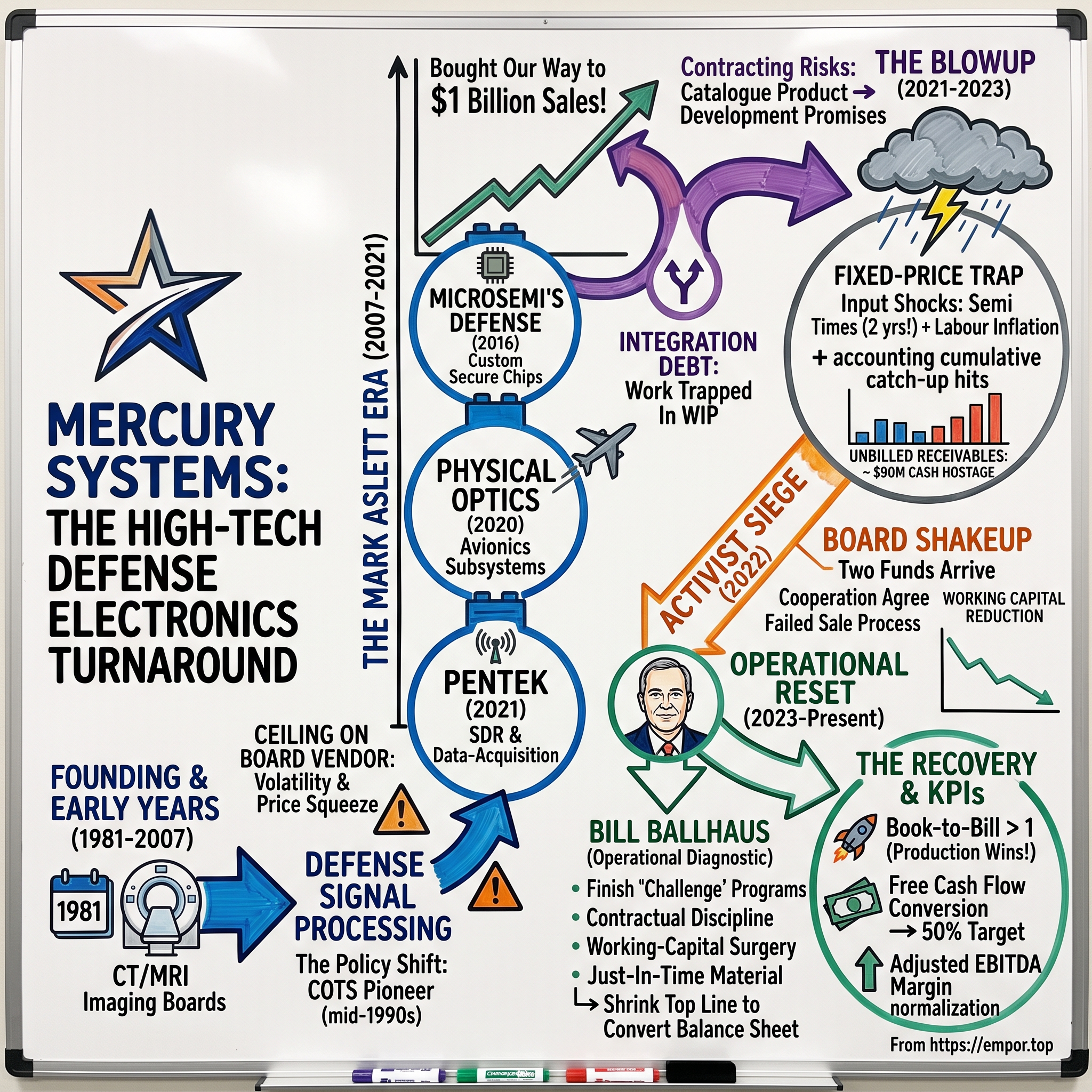
Mercury Systems: The High-Tech Defense Electronics Turnaround
I. Introduction & Episode Roadmap (00:00 - 08:00)
One Cent on the Dollar
On August 13, 2024, Mercury Systems closed the books on a fiscal year in which it generated $835 million of revenue and $9.4 million of adjusted EBITDA.2
Read that again slowly. A company with nearly a billion dollars of sales, embedded in some of the most important radar, electronic warfare and mission-computing programs in the United States arsenal, threw off roughly one cent of adjusted operating cash earnings for every dollar of product it shipped. Three years earlier, the same business had converted more than twenty-one cents of every revenue dollar into adjusted EBITDA.11
Nothing about the end market had collapsed. Defense budgets were rising. The backlog was intact. What had collapsed was the company's ability to convert its own contracts into profit.
That is the puzzle at the centre of this story, and it is a more interesting puzzle than the usual defense-sector narrative. Mercury did not lose a franchise program. It did not get displaced by a cheaper competitor. It did not have an accounting fraud, whatever the plaintiffs' bar alleged.
What Mercury did was something subtler and far more common in industrial roll-ups. It bought its way from a $200 million board-level component vendor into a $1 billion subsystems integrator, and in the process quietly changed the risk profile of its own contract book — from selling catalogue hardware at known margins to promising fixed prices on technology that had not yet been invented. Then the pandemic arrived, semiconductor lead times went from ten weeks to nearly two years, engineering labour inflated, and every one of those promises came due at once.
Mercury Systems at a Glance
Mercury Systems today trades on the Nasdaq Global Select Market under the ticker MRCY, headquartered at 50 Minuteman Road in Andover, Massachusetts.2
It is what the industry calls a Tier 2 or merchant supplier: not a prime contractor that holds the platform contract with the U.S. government, but the company that builds the processing guts inside the prime's system. Its content sits inside land-based air and missile defence radar, aerial refuelling tankers, naval helicopters, missile defence interceptors and classified secure-processing programs.2
Revenue for fiscal 2025 was $912.0 million, and through the first nine months of fiscal 2026 the company had grown 8.6% organically while roughly doubling its adjusted EBITDA margin off the trough.31 The market has noticed: the shares changed hands around $100 in late July 2026, giving Mercury roughly $6 billion of market value, against a fifty-two-week range that ran from about $50 to about $128.23
That price range tells you the honest state of the debate. Somebody thinks this is a mid-teens-margin business that got lucky with a defense-spending cycle. Somebody else thinks it is a low-to-mid-20s-margin business that is two years from proving it. Both positions are defensible from the same set of filings, which is exactly what makes Mercury worth two hours of your attention.
The Narrative Spine
The story runs through four distinct acts.
First, the promise and the arithmetic of defense M&A roll-ups — why buying capability is so seductive in this industry and why the bill arrives late.
Second, the mechanics of firm-fixed-price development contracts and percentage-of-completion accounting, which is where a good business turned into a bad one without anyone lying about anything.
Third, the activist intervention: Starboard Value and JANA Partners arriving in 2022, a failed sale process, and the removal of a fifteen-year chief executive.
Fourth, the operational reset under Bill Ballhaus, which is now roughly three years old and has produced real, verifiable improvement — alongside a set of claims about the future that are not yet proven.
The route runs from a 1981 startup in Chelmsford, Massachusetts building signal processors for medical scanners, through the serial acquisition machine of the 2010s, into the margin blowup, the boardroom fight, the current segment economics and competitive position, and finally to the two or three numbers that will actually settle the argument.
Along the way it is worth holding one question in mind, because it is the question the company's own guidance is a bet on. Is Mercury a structurally advantaged supplier that mismanaged a transition, or a structurally squeezed middleman that got a cyclical reprieve? The answer determines whether the last three years were a repair job or a rescue.
 Subscribe on LinkedIn
II. Founding & Early Years: The COTS Pioneer (1981–2007) (08:00 - 20:00)
A Company Built to Look Inside the Human Body
Mercury Computer Systems was incorporated on July 14, 1981 — the same year MS-DOS shipped and IBM launched its first personal computer.6 The founder was Jay Bertelli, and the original problem he set out to solve had nothing to do with missiles. It had to do with pictures.
In the early 1980s, medical imaging was a computationally brutal business. A CT or MRI machine collects an enormous stream of raw sensor readings that mean nothing to a human eye; turning that stream into a cross-sectional image of a patient's abdomen requires an enormous number of mathematical transforms performed very fast.
General-purpose computers of the era were hopeless at it. The fix was specialised hardware — array processors and digital signal processing boards purpose-built to do one narrow class of arithmetic at extraordinary speed. That was Mercury's founding trade: not computers, but computation, sold as a board you slid into somebody else's machine.
It turned out that the military had the identical problem wearing different clothes. A radar antenna is also a sensor producing a firehose of raw signal that has to be turned into a picture — in this case a picture of aircraft, ships and incoming missiles — under a hard real-time deadline. Sonar is the same problem underwater. Electronic warfare is the same problem applied to the radio spectrum.
Mercury's medical-imaging boards were, with modest translation, defense signal-processing boards. That structural adjacency between commercial computing and defense sensing is the through-line of the entire company, and it is still how management describes the business four decades later.
The Policy Shift That Made a Market
The event that turned adjacency into a market was bureaucratic rather than technological.
Through the Cold War, the Pentagon largely insisted on custom, military-specification electronics: chips and boards designed and qualified specifically for defense use, produced at low volume and eye-watering cost. By the early 1990s that model was breaking. Commercial silicon was improving on an eighteen-month cadence while mil-spec parts took five years to qualify, which meant the military was paying a fortune to field electronics that were obsolete on arrival.
The reform push under Secretary of Defense William Perry in the mid-1990s pressed the services to buy commercial off-the-shelf hardware — COTS — wherever they credibly could.
That policy shift was Mercury's opening. If you were a defense prime told to use commercial processors in a naval radar, you needed a partner who understood both worlds: someone who could take a commercial microprocessor and package it so it survived vibration, salt fog, temperature extremes and electromagnetic interference, and who could guarantee the part would still be available a decade later when the ship came in for refit.
Mercury built exactly that competence — ruggedisation, thermal management, obsolescence management, and the software to make heterogeneous processors work together — and rode it into the sensor-processing chains of major naval and missile-defense programs. The company listed on Nasdaq in 1998.6
The Ceiling on a Board Vendor
Here is the part that matters for everything that follows. For all its technical strength, Mercury spent its first quarter-century structurally capped.
It sold boards — sophisticated, high-margin, but boards. A board is a slot inside a chassis inside a subsystem inside a platform. The dollar content Mercury captured per aircraft or per ship was modest relative to the value of the mission it enabled, and the customer relationship was mediated entirely by the prime contractor who owned the chassis, the software architecture and the requirements.
Three consequences flowed from that position.
The first was volatility. Board orders track procurement lots, and procurement lots are lumpy, politically determined and easily deferred. A single program slipping a year could move a meaningful share of revenue.
The second was ceiling risk on content. As commercial processors absorbed more function per chip, the number of boards required per system trended down even as capability went up — a deflationary treadmill familiar to anyone who has watched a component supplier in any electronics value chain.
The third was commoditisation pressure at the edges. The COTS doctrine that opened the market to Mercury also opened it to everyone else who could assemble commercial silicon onto a rugged card, and there were plenty of those.
By the time Jay Bertelli handed over the chief executive's chair in November 2007, Mercury had built a genuine technical reputation and a genuinely constrained business model.7 Revenue was in the low hundreds of millions. The company was excellent at a job whose economics were slowly being squeezed.
Whoever took over would face a strategic question with only two real answers: stay a component specialist and accept the ceiling, or move up the stack toward larger, stickier, higher-content positions — and accept a different set of risks entirely. Mercury's next chief executive chose the second answer, emphatically, and spent fourteen years executing on it.
III. The Mark Aslett Era: The Serial M&A Engine (2007–2021) (20:00 - 38:00)
A Telecom Survivor Takes the Helm
Mark Aslett arrived at Mercury on November 19, 2007 from outside the defense establishment.7
He was a telecom operator by background — chief executive of Enterasys Networks, and before that a run of senior roles at Marconi plc, including president of Marconi Communications in North America.7 Telecom equipment in the early 2000s had been a bloodbath: brutal consolidation, collapsing pricing, and a hard lesson in what happens to component vendors when the value in a system migrates elsewhere.
Aslett came to Mercury having watched, up close, exactly the fate that awaited a board-level supplier that stayed a board-level supplier.
His strategic response was consistent for fourteen years and is best understood as a single sentence: move up the value chain, and buy the way there. Rather than selling a card that plugged into somebody else's box, Mercury would sell the box — pre-integrated subsystems combining processing, radio-frequency and microwave front ends, secure microelectronics and software, delivered as a functioning capability rather than a component.
The pitch to primes was seductive. Defense primes were under their own margin pressure and increasingly willing to outsource electronics they had historically built in-house. If Mercury could take a whole subsystem off a prime's hands, it captured multiples of its old content per platform and inserted itself far deeper into the program.
Three Deals That Built the Modern Company
The problem with moving up the stack organically is that it takes a decade. So Mercury bought. The company completed more than twenty acquisitions across its history, the great majority during Aslett's tenure.6 Three of them defined the shape of the modern company.
Microsemi's defense businesses, 2016. On March 23, 2016, Mercury agreed to acquire the embedded security, RF and microwave, and custom microelectronics businesses of Microsemi Corporation for $300 million.8 Those businesses carried roughly $100 million of trailing revenue and about $28 million of pro forma standalone adjusted EBITDA across roughly 275 employees in Phoenix, Camarillo, San Jose and West Lafayette, and the transaction closed on May 2, 2016.8[^9]
Mercury funded it with a $200 million term loan plus cash on hand that included about $94 million of net proceeds from a stock issuance — a mix of leverage and equity signalling that the company would not let balance-sheet constraints slow the strategy.8
What Mercury bought was not primarily revenue. It was the Phoenix microelectronics operation, which gave the company a domestic, accredited facility for designing, packaging and testing secure custom chips — a trusted-manufacturing position that Mercury still describes as differentiating, and which its fiscal 2025 annual report identifies as IPC-1791 certified and accredited by the Defense Microelectronics Activity.2
In plain terms: for certain classes of defense electronics, the government cares intensely about who physically touched the silicon, in which country, under whose security controls. A supplier that can prove custody of that chain has an advantage no amount of engineering talent alone will replicate, because the qualification is bureaucratic as well as technical and takes years to obtain.
Physical Optics Corporation, 2020. The second defining deal was the largest and, in hindsight, the most consequential. On December 30, 2020, Mercury completed the acquisition of Physical Optics Corporation for $310 million.9
POC was expected to generate over $120 million of revenue for the calendar year then ending, and Mercury paid roughly thirteen times next-twelve-months EBITDA — a full price by any standard, struck at the top of the defense-technology valuation cycle.9 It brought avionics mission computers, ruggedised displays and secure data storage, and the strategic logic was explicit: it would let Mercury deliver more complete, pre-integrated avionics subsystems.9
It also brought something less advertised — a large California operation with its own systems, culture and program portfolio, whose integration would still be unfinished more than two years later.
Pentek, 2021. The third was smaller and cleaner. Mercury acquired Pentek on May 27, 2021 for $65 million in cash against roughly $20 million of expected forward revenue.10 Pentek built rugged commercial off-the-shelf software-defined radio and data-acquisition boards — a genuine technology tuck-in that deepened Mercury's ability to digitise radio signals at the sensor edge.10
Around these three sat a longer tail: Custom MMIC, Avalex Technologies, Themis Computer, Syntonics, Atlanta Micro and others, each adding a capability, a customer set, a facility and an integration obligation.
The Engine Worked, and the Crack Was Already There
The financial engine worked, at least on the metrics Wall Street was grading. Revenue climbed from $234.8 million in fiscal 2015 to $924.0 million in fiscal 2021.2 Fiscal 2021 adjusted EBITDA reached $201.9 million — a margin near 22% — with GAAP net income of $62.0 million and free cash flow of $51.6 million.11
Mercury became the premier pure-play in a category investors had been hunting for: a defense-exposed business with software-like margins, secular content growth, an acquisitive management team and none of the political baggage of a prime. The stock was rated accordingly.
But look carefully at that fiscal 2021 picture and a hairline crack is visible.
Revenue rose more than fourfold over six years while the share count and the debt load both climbed, meaning a large portion of the growth was purchased rather than generated. Adjusted EBITDA margin peaked and then flattened rather than expanding, which is unusual for a business supposedly moving toward higher-value subsystems and gaining scale. And free cash flow ran persistently well below adjusted EBITDA, because integrated subsystems consume far more working capital than boards do — longer build cycles, more inventory, more cash trapped between doing the work and being allowed to bill for it.
Those are the fingerprints of what practitioners call integration debt: growth booked today, operational obligation deferred to tomorrow.
The strategy of moving up the value chain was not wrong. Mercury's content per platform genuinely rose and its positions genuinely deepened. What was underappreciated — inside the company and outside it — was that the new business Mercury had bought its way into carried a fundamentally different contractual risk profile from the business it came from.
Selling a catalogue board is a product transaction. Delivering an integrated subsystem for a prime's franchise program is a development program. And development programs, in this industry, are where companies go to get hurt.
IV. The Anatomy of a Defense Blowup: Fixed-Price Contracts & Unbilled Receivables (38:00 - 54:00)
The Call That Changed the Company
On May 2, 2023, Mercury's third-quarter fiscal 2023 earnings call opened with an unfamiliar voice reading the safe-harbour statement: Michelle McCarthy, senior vice president and interim chief financial officer.4 Ninety minutes later the story of the company had changed permanently. The next trading day, the stock fell 17.3% to close at $37.44.13
To understand what broke, start with the contract.
When Mercury sold a board, the transaction was straightforward: catalogue product, known cost, known price, revenue recognised on shipment. When Mercury bid to develop a custom subsystem for a prime, the contract became something else — typically a firm-fixed-price development contract. The customer agrees to pay a set amount for a defined capability. If it costs the contractor more to deliver than planned, the contractor eats every dollar of the overrun. There is no cost-plus safety net, no escalation clause for a semiconductor that suddenly costs nine times more.
Mercury took that risk almost universally. On the May 2023 call, Aslett acknowledged that most of the company's contracts were firm-fixed-price with only about 10% being cost-plus-fixed-fee, and said Mercury would seek cost-plus structures on new development work "where possible, and where it makes sense."4
That single disclosure reframes the entire preceding decade. The company had migrated its revenue mix toward development work while retaining the contract structure appropriate to catalogue product.
A Mix Shift Sold as Good News
The mix shift itself was dramatic and, importantly, was described by management as a positive leading indicator right up until it wasn't.
The ratio of production to development revenue moved from roughly 80:20 to roughly 60:40 by fiscal 2023, with customer-funded R&D revenue roughly doubling.4 Development programs, management explained, carried gross margins in the low-to-mid 30s on average against above 40% for mature production programs — a ten-percentage-point margin gap applied to a growing share of the business.4
Pre-pandemic, the average period of performance on a Mercury program ran about eighteen months; over the pandemic that stretched to roughly thirty months.4 Longer programs mean more time for costs to drift and more inflation to absorb against a fixed price.
Then the input shocks landed simultaneously. Semiconductor processor lead times, historically ten to twelve weeks, peaked in Mercury's first fiscal quarter of 2023 at fifty-two to ninety-nine weeks — call it one to two years to get a chip.4 In a single quarter, the company made roughly $10 million of end-of-life semiconductor purchases where prices had risen nearly ninefold.4
Engineering labour inflated in a tight market. Manufacturing yields on new products came in below plan. Every one of those costs fell on Mercury, because Mercury had promised a price.
The Accounting Trap, Explained Simply
Now the accounting, which is where a cost problem became an earnings event.
On long-term contracts recognised over time, a contractor books revenue and profit in proportion to progress — typically measured by costs incurred against total estimated costs at completion. That estimate, the EAC, is a management judgment, and it is revised whenever facts change.
Here is the mechanical trap. If a program's estimated total cost rises, the percentage complete on the same work performed falls, and the margin the contractor is entitled to across the whole contract falls with it. Under the accounting rules, the correction is not spread forward. It is taken immediately as a cumulative catch-up, so a revision discovered in one quarter forces the company to reverse profit it recognised in prior quarters.
McCarthy walked through exactly this mechanism, explaining that changes in estimates "require a cumulative catch up of prior program margin performance," which "resulted in an outsized impact in the quarter in which the changes in estimate were identified."4
The visible result was gross margin falling to 34.3% from 39.4% a year earlier, adjusted EBITDA of $43.5 million against $52.5 million, and a full-year adjusted EBITDA guidance cut of roughly $44 million at the midpoint.4 By the time fiscal 2023 closed, Mercury disclosed that execution challenges across approximately twenty programs had driven roughly $56 million of impact and substantial forecasting volatility.12
Where the Cash Went
The second casualty was cash, and it was worse than the earnings.
Because revenue was being recognised as material was consumed and hardware assembled, while invoicing rights were generally tied to shipping finished hardware, Mercury accumulated an enormous balance of unbilled receivables — work performed and booked as revenue, but not yet billable.
On the same call, management quantified the trap: completing the challenged programs would release about $30 million of unbilled receivables, and a further $60 million sat behind them on other programs waiting for the same shared technologies and the same specialised engineers to be freed up.4 Roughly $90 million of cash was effectively hostage to a dozen engineering problems.
Free cash flow was negative $46.5 million in fiscal 2022 and negative $60.1 million in fiscal 2023 — more than $100 million of cumulative burn across two years in which the company reported positive adjusted EBITDA in both.1112
Prepared Remarks Versus the Q&A
The dynamic on these calls is worth studying, because it is a case study in how management framing lags reality.
The scripted portion of the May 2023 call leaned hard on transitory language: challenges were "short-term," "not unique to Mercury," "largely timing and cost related," and structurally the business model and outlook were "sound."4
The Q&A was less accommodating. Baird's Peter Arment asked, in effect, how a fourth quarter implied at roughly 31% adjusted EBITDA margin three months earlier had become a guide of 18% to 21%, given that the development mix and pandemic effects were already known.4 JPMorgan's Seth Seifman asked management to simply name the top five or six problem programs; Aslett declined, saying the capabilities were specialised and the company would not link specific technologies to known programs.4
Neither answer was evasive in a dishonest sense, but neither gave investors a way to independently verify the scope of the problem — which is precisely the condition under which the market stops extending the benefit of the doubt.
There was also an outside voice. In July 2022, the short-oriented research firm Glasshouse Research had published a report alleging that Mercury overstated organic growth, that the Physical Optics acquisition was a disaster, and that its "1MPACT" value-creation initiative had failed; the stock fell 7.8% that day.13 Those allegations later formed part of a securities class action. At the time they were dismissed by most sell-side coverage. In retrospect, the report was directionally early on the two things that mattered most: integration and organic quality.
For investors, the lesson generalises beyond Mercury. Adjusted EBITDA in a percentage-of-completion business is an estimate resting on other estimates. The number that cannot be estimated away is cash. Mercury's free cash flow diverged from its adjusted EBITDA for two consecutive years before the earnings finally broke, and that divergence was visible in the filings the whole time.
Someone was watching. In fact, two people were.
V. The Activist Siege, Failed Sale Process, & Board Shakeup (54:00 - 66:00)
Two Funds Arrive Together
In January 2022, before the margin story had fully broken, Starboard Value disclosed a stake in Mercury Systems and pressed the company to drop its shareholder rights plan — the so-called poison pill.14 By early February, both Starboard and JANA Partners held positions, and the public conversation about Mercury changed shape overnight.14
These are two of the more effective activist franchises in the market, and their arrival together is a specific signal. It usually means the target is a good asset with a governance or execution problem, valuable enough that somebody would buy it if the board could be persuaded to sell.
The activist case against Mercury largely wrote itself from the filings.21 A serial acquirer had spent hundreds of millions of dollars, expanded revenue several-fold, and delivered flat-to-declining margins and negative free cash flow. Organic growth was hard to isolate because acquisitions kept resetting the base. Integration was visibly incomplete — the Physical Optics business in Torrance, California was still being brought onto Mercury's systems in fiscal 2023, more than two years after closing, a delay management attributed largely to pandemic travel restrictions.4
For an activist, that combination is close to ideal: the underlying franchise is sound, the value destruction is self-inflicted, and the remedies are governance-shaped.
The Settlement, and Where the Nominees Were Placed
Mercury settled rather than fight. On June 24, 2022, the company announced cooperation agreements with both funds and appointed two new independent directors: William Ballhaus, the JANA nominee, and Howard Lance, the Starboard nominee, both placed on the Nominating and Governance Committee and the M&A and Finance Committee, with customary standstill provisions attached.[^16]15
The committee assignments were the tell. Putting activist nominees on the M&A committee is not a symbolic gesture; it is a signal that future capital allocation would be contested from inside the boardroom.
Ballhaus was a former chairman and chief executive of Blackboard; Lance was the former chief executive of Maxar Technologies.15 Both were operators with restructuring histories rather than portfolio managers.
An Auction With Forty Approaches and No Deal
What followed through late 2022 and into 2023 was a formal strategic review — a sale process. The context was almost perfectly hostile.
Interest rates were rising sharply, which raised the cost of leverage for private equity buyers just as the credit markets tightened. Meanwhile, the very problems that made Mercury cheap made it hard to underwrite: a buyer conducting diligence in early 2023 would have found a portfolio of firm-fixed-price development programs whose costs at completion management itself was still revising quarter by quarter.
In an auction, uncertainty of that kind does not produce a discount. It produces an absence of bids.
The outcome was disclosed on June 23, 2023, and the disclosure was unusually specific. The board said it had contacted more than forty potential bidders and executed confidentiality agreements with twenty parties, and that the proposals received did not reflect the company's intrinsic value.16 It concluded the sale process and declared that enhanced execution under refreshed leadership was the better path.16
In the same announcement, Mark Aslett resigned as president and chief executive effective the following day, after nearly sixteen years, with Ballhaus stepping in as interim president and chief executive.16[^19] Chairman William O'Brien said he would not stand for re-election, Gerard DeMuro joined as an independent director, and the board expanded toward ten members with four new appointments inside a single year.16
The market read the combination — no sale, no chief executive — as bad news, and the stock fell 9.6% to $31.50 on June 26.13[^20]
What the Failed Auction Actually Proved
Set the emotion aside and consider what the process revealed.
Forty approaches and twenty signed confidentiality agreements is a thorough process, not a token one. That level of interest confirms the strategic asset was real: trusted domestic microelectronics, sole-source content on long-lived programs, and a customer list of primes is not something a buyer walks away from lightly.
That nobody bid at a price the board would accept says something different — either the board's view of intrinsic value was too high, or buyers could not get comfortable with the program risk, or both.
The board chose the interpretation that required it to fix the company rather than sell it. Given that Mercury's shares subsequently traded materially higher than the level at which the process concluded, that judgment has so far been vindicated by outcome, though it is worth remembering that it was made under duress and with limited alternatives.
The interim tag came off on August 15, 2023, when Ballhaus was named president and chief executive, and he assumed the chairmanship ahead of the 2023 annual meeting.17
Consolidating chairman and chief executive in one person immediately after an activist-driven governance overhaul is, in pure governance terms, a step backward — it concentrates authority in the same seat the activists had just constrained. The counterargument, which the board evidently accepted, is that a turnaround needs an unambiguous centre of gravity. Investors evaluating Mercury's governance today should hold both facts: the board was refreshed under external pressure, and it then rebuilt a combined chair-and-chief-executive structure.
The activists themselves did not stay for the whole ride. Starboard's Mercury position no longer appeared in its Q3 2024 holdings report, indicating an exit roughly a year after the leadership change and well before the operating recovery was complete.22 That timing is itself instructive about the activist model: the fund's job was to force the intervention, not to underwrite the multi-year repair.
The Legal Overhang
One overhang from the period took longer to clear.
A securities class action was filed against Mercury in the U.S. District Court for the District of Massachusetts on December 13, 2023, alleging that the company's SEC filings and earnings-call statements were false or misleading.2 The case, brought on behalf of purchasers between February 3, 2021 and February 6, 2024, settled for $32.5 million, with final approval granted on June 5, 2026.18
Mercury's fiscal 2025 accounts carried $13.0 million of net litigation and settlement expense, and its third-quarter fiscal 2026 balance-sheet commentary referenced both the payment of the legal settlement and offsetting insurance proceeds.21 The settlement resolves the financial exposure without any admission, and the defendants denied wrongdoing.18
For investors, the relevant residue is not the dollar amount, which is manageable against a $6 billion market value. It is the reminder that this company's disclosure practices were litigated, and that the incoming management team inherited a credibility deficit it had to pay down in public.
VI. The Ballhaus Operational Reset: Burning Down the Backlog (66:00 - 80:00)
An Engineer Who Learned to Count Cash
Bill Ballhaus is, by training, the sort of person you would want diagnosing a program-execution failure.
He holds a bachelor's in mechanical engineering from UC Davis, a master's and doctorate in aeronautics and astronautics from Stanford, and an MBA from UCLA's Anderson school.17 His operating career runs through Hughes, Boeing and BAE Systems into three chief executive roles — DynCorp International from 2008, SRA International from 2011 through the creation of CSRA, and Blackboard from 2016 until its merger with Anthology in 2021.17
That is an unusual résumé: a genuine aerospace engineer who spent fifteen years running services and software businesses where cash conversion, not technology, is the scoreboard.
Refusing the Old Framing
His first move was to refuse the previous framing.
Where prior management had described a dozen or so problem programs inside a portfolio of three hundred, Ballhaus's team named approximately twenty "challenge" programs and attached them to the $56 million of fiscal 2023 cost growth.124 He then did something that sounds trivial and is not: he stopped calling the problem temporary and started reporting against it every quarter.
On the November 7, 2023 call covering his first full quarter, he reported that two programs had been completed in the prior quarter and two more in the current one, that cost growth on the challenge portfolio had fallen to roughly $6 million — of which $5 million came from a single program — and, crucially, that a further $12 million of cost growth had appeared outside the twenty named programs.4
That last disclosure is the most credible thing in the entire transcript. A management team managing the narrative would have kept the bad news inside the quarantine. Ballhaus explicitly attributed the $12 million to a "more rigorous program management review process" that had just begun, and conceded the level "was not expected in the first quarter."4
Telling investors that a newly installed control system is finding problems the old one missed is expensive in the short run and is the only way to rebuild forecast credibility.
The Four Priorities and the Working-Capital Surgery
The diagnostic had four legs, which the company has since carried as its four stated priorities: performance excellence, organic growth, margin expansion and free cash flow.15
The first leg was mechanical — finish the challenge programs, absorb the estimate revisions, and get the associated hardware out the door so it could be billed. The second was contractual discipline: shift new development bidding toward cost-plus structures where possible and lean back on standardised, reusable building blocks rather than bespoke one-offs. The third, and most operationally invasive, was working capital.
The working-capital surgery deserves explanation because it produced a genuinely counterintuitive result.
Ballhaus described the old model plainly on the November 2023 call. Mercury had been ordering material far ahead of need, which under over-time revenue accounting meant material got kitted, labour got charged, revenue got recognised — and unbilled receivables grew, because billing rights attached to hardware shipment. On a late-stage program, he noted, the unbilled balance could represent 80% or more of total contract value, meaning nearly all the revenue had already been booked and only the cash remained outstanding.4
The fix was to pivot hard to just-in-time material and to point factory capacity at finishing hardware sitting in work-in-process.
The cost of that fix was immediate and severe. Completing hardware tied to old unbilled balances consumes enormous manufacturing capacity while generating almost no new revenue, because the revenue was recognised in prior periods. Buying less material forward mechanically reduces over-time revenue recognition.
So the first quarter of fiscal 2024 saw revenue fall 20% year over year to $181 million, with over-time revenue dropping from a near-record $143 million to $105 million.4 Management chose to shrink the top line in order to convert the balance sheet — an unambiguously correct decision that would have been very difficult for a chief executive who owned the prior strategy to make.
The Trough, and the Question Buried Inside It
Fiscal 2024 was the bottom, and it was ugly on every GAAP line. Revenue fell to $835.3 million, gross margin compressed to 23.5%, the company recorded a $137.6 million net loss, and adjusted EBITDA landed at $9.4 million.2 Restructuring charges of $26.2 million covered workforce reductions eliminating roughly 350 positions.2
Operating expenses were cut hard. Research and development spending fell from $108.8 million in fiscal 2023 to $101.3 million in fiscal 2024 and then to $67.6 million in fiscal 2025, with selling, general and administrative expense falling from $166.8 million to $154.4 million over the last of those steps.2 A further reduction on January 29, 2025 eliminated about 145 positions at a cost of $4.9 million.2
That R&D trajectory is the single most important open question in the reset, and it deserves scepticism rather than applause.
Company-funded R&D at Mercury fell by roughly 38% in two years. Part of that is genuinely benign — engineers moved from overhead onto direct program charges as customer-funded development ramped, which is an accounting shift rather than a capability cut. Part of it is straightforward cost reduction.
The distinction matters enormously, because in a business whose entire claim to advantage rests on being technologically ahead of both the primes' internal divisions and its merchant competitors, a sustained cut to internal invention is a mortgage on future content wins that will not show up in the numbers for three to five years.
The Recovery, and How Close the Company Came
The recovery that followed is, in fairness, real and measurable.
Fiscal 2025 revenue recovered to $912.0 million, gross margin improved 440 basis points to 27.9%, and adjusted EBITDA reached $119.4 million.23 The margin improvement was driven principally by a $52.2 million improvement in net estimate-at-completion impacts year over year — though it is worth noting that even in the recovery year, net EAC changes were still a $21.1 million drag on gross margin, not a benefit.2 The business was losing less on legacy contracts, not yet winning on them.
The cash result was the headline. Free cash flow reached a record $119.0 million in fiscal 2025 against $26.1 million the prior year, cash on hand ended at $309.1 million, and long-term debt stood at $591.5 million.32
By the third quarter of fiscal 2026, net working capital had been reduced by approximately $225 million, or 34%, from its peak in the first quarter of fiscal 2024, and the company applied $150 million against its revolver in the fourth quarter.1 Converting more than a year's worth of adjusted EBITDA out of the balance sheet is the most objective evidence available that the operational diagnosis was correct.
A credit detail worth flagging, because it shows how close the company came to a financing problem. An amendment to Mercury's revolving facility set capacity at $900.0 million with a temporary reduction to $750.0 million until the company met a minimum consolidated EBITDA test of $75.0 million, calculated with add-backs for cost savings and EAC charges. That restriction was lifted upon filing the fiscal 2025 second-quarter compliance certificate.2
Investors reading the recovery should understand that in fiscal 2024 the company's lenders were negotiating around its ability to clear a $75 million EBITDA threshold. That is how thin the margin for error had become.
The Team and the Incentives
On leadership, one correction to the common description of the team is warranted. Mercury's chief financial officer is Dave Farnsworth, who joined from HawkEye 360 and, before that, served as vice president and chief financial officer for Raytheon's Integrated Defense Systems and its Intelligence, Information and Services segment.2
He is joined by chief legal officer Stuart Kupinsky, who worked with Ballhaus at Blackboard, and chief human resources officer Steven Ratner, previously of Raytheon Missiles & Defense.2 The pattern is unmistakable: Ballhaus assembled a team drawn from the customer side of the table and from his own prior company. That improves program-execution literacy and raises a mild governance question about independence of challenge inside the executive suite.
On incentives, the fiscal 2025 annual report states plainly that adjusted EBITDA is used in determining a portion of bonus compensation for executives.2 The specific weighting of free cash flow, return on invested capital and organic margin in current executive incentive plans is set out in the company's proxy materials rather than the annual report and is not detailed here.
What can be said from behaviour rather than documents is that management has consistently led with cash flow and margin in its quarterly communication for three years, and has stopped leading with acquisitions — a marked change from the prior era, and one that has been consistent across every call since the reset began.
VII. Core Business, Segment Economics, & Industry Structure (80:00 - 94:00)
What Mercury Actually Sells
Picture the nose of an air-defence radar vehicle parked in a desert. The antenna is the sensor. Somewhere behind it sits a rack of electronics whose job is to take the raw electromagnetic return, digitise it, filter it, run the detection algorithms, decide what is a threat and hand a track to the operator — in milliseconds, in fifty-degree heat, under vibration, with an adversary actively trying to jam the spectrum.
Mercury does not build the radar and does not own the contract. Mercury builds a very large share of what sits in that rack. That is the business, and it is a good one to be in provided you can get paid properly for it.
Mercury reports as a single operating segment, which frustrates anyone hoping for clean divisional economics, but it discloses revenue three different ways, and together those cuts describe the business precisely.2
Three Ways to Cut the Revenue
By product grouping in fiscal 2025, integrated solutions — full subsystems combining components, modules and software — generated $475.9 million; modules and sub-assemblies, essentially the classic board business, generated $246.1 million; and components, the basic building blocks such as amplifiers, switches, oscillators, converters and MMICs, generated $190.0 million.2
Roughly half of Mercury is now the up-the-stack business Aslett spent a decade building, and it is the half that carried the fixed-price development risk. Notably, modules and sub-assemblies grew about 33% in fiscal 2025 while integrated solutions grew about 4% — the legacy board business, the one everyone assumed was structurally capped, was the growth engine of the recovery year.2 That is an inconvenient fact for the strategic thesis that value had permanently migrated upward.
By end application, C4I — command, control, communications and intelligence, including rugged secure rackmount servers — was the largest at $398.2 million. Radar contributed $169.7 million, electronic warfare $96.9 million, other sensor and effector applications $98.8 million, and unspecified other applications $148.4 million.2
By platform, airborne dominated at $410.7 million, followed by other at $192.2 million, land at $166.3 million, naval at $86.9 million and space at $56.0 million.2
The most revealing movement inside fiscal 2025 was land revenue rising $50.5 million while airborne fell $20.6 million, with the largest program increases attributed to LTAMDS, KC-46, MH-60R/S, THAAD and a secure processing program, partly offset by declines on the SCAR and ADTS programs.2
No single program accounted for 10% or more of revenue in either fiscal 2025 or 2024 — genuine program diversification, and a point Ballhaus returned to repeatedly on the May 5, 2026 call when analysts pressed him to name specific drivers.24
The Sandwich
Now the structural position, which is the crux of the investment question. Mercury sits in a sandwich.
Above it are the primes and the government: RTX Corporation accounted for 13% of fiscal 2025 revenue, Lockheed Martin 10% and the U.S. Navy 10%, together a third of the business, and five customers accounted for 48% of receivables and unbilled balances.2
Below it are the commercial semiconductor suppliers whose silicon Mercury packages — the Intel, AMD and NVIDIA processing roadmaps, ultimately manufactured in significant part by 台積電 TSMC.
Mercury adds enormous value in between: ruggedisation, security, thermal design, obsolescence management, certification and integration. But it controls neither the roadmap beneath it nor the demand above it.
The Peer Comparison That Frames Everything
That is a legitimately difficult place to earn a high return, and the peer comparison makes the point without mercy.
Curtiss-Wright's Defense Electronics segment — the closest listed analogue, selling embedded computing into broadly the same customer set — generated $499.9 million of sales in the first half of calendar 2025 and $135.3 million of operating income, an operating margin of roughly 27%.20 That is operating margin, after depreciation and amortisation, on a business of almost identical scale to Mercury's whole-year run rate in the relevant categories.
Mercury's entire company posted a 13.1% adjusted EBITDA margin in fiscal 2025 and a GAAP operating loss.23
The gap is the single most important fact in any Mercury analysis, and it is not explained by the end market, which both companies share. It is explained by contract structure and execution discipline. Curtiss-Wright largely avoided taking unhedged fixed-price risk on unproven development at scale; Mercury did not.
That comparison is what turns "Mercury has a great franchise" from an assertion into a testable claim. If the franchise is genuinely differentiated, the margin gap should close as legacy contracts roll off. If it does not close, the franchise was never worth what the strategy assumed.
The other competitors are consolidated inside larger parents — the former Abaco Systems business under AMETEK, and CAES under Honeywell — which removes them as pure-play benchmarks but does not remove them as bidders. Every one of these firms competes for the same design-win slots on the same programs.
How Mercury Wins, and How It Loses
How does Mercury actually win a slot? Three mechanisms, in descending order of durability.
The strongest is open-architecture standards leadership. Mercury is an active member of VITA, the Sensor Open Systems Architecture initiative, the Future Airborne Capability Environment consortium and the VICTORY consortium.2 The Department of Defense has pushed hard toward modular open systems architecture — the principle that a subsystem should be swappable like a PCI card rather than welded into a bespoke design — because it reduces lifetime cost and vendor lock-in for the government. That policy directly favours a merchant supplier who builds to the standard and directly disadvantages a prime's internal division that prefers proprietary integration.
The second is trusted, onshore secure microelectronics: the accredited Phoenix facility, BuiltSECURE anti-tamper and secure-boot technologies, and safety-certifiable BuiltSAFE processing for aviation applications.2
The third is incumbency itself, which is discussed in the next section.
How does Mercury lose? Three ways, symmetrically. A prime decides to insource the subsystem and keep the margin. Mercury under-executes on a development program, which not only destroys the economics of that contract but delays the follow-on production orders — precisely the compounding failure of fiscal 2023 and 2024. Or the supply chain slips and hardware does not ship, which in this business means cash does not arrive.
One capital-allocation signal worth noting in the current era: rather than expanding its manufacturing footprint, Mercury sold certain manufacturing operations to Cicor Group in fiscal 2025, recording a $3.3 million gain on $6.2 million of proceeds, and separately sold the mc.com domain name for $2.7 million.2
Meanwhile it added capacity in the highly automated Phoenix facility, bringing 50,000 additional square feet of factory space into operation and acquiring a critical manufacturing process technology provider in the third quarter of fiscal 2026.1
The pattern — divest generic assembly, concentrate capital in accredited, differentiated, automated manufacturing — is the correct instinct for a business trying to escape the middleman squeeze. Whether it is executed at sufficient scale to close a fourteen-point margin gap with Curtiss-Wright is not yet demonstrated.
VIII. Strategic Frameworks: Helmer's 7 Powers & Porter's 5 Forces (94:00 - 104:00)
The Three Powers Mercury Actually Holds
Strip away the narrative and ask the cold question: what, if anything, prevents a competitor from taking Mercury's business tomorrow?
Hamilton Helmer's framework is useful here precisely because it is unforgiving — a power must both raise the company's economics and be genuinely difficult to replicate. Mercury credibly holds three, and it is worth being explicit that it holds only three.
Switching costs are the strongest, and they are structural rather than commercial. Once a piece of processing hardware is qualified into a defense platform, replacing it is not a purchasing decision; it is a re-certification project. The new part must be tested against the same environmental, electromagnetic, safety and security requirements, integrated with software written against the old part's behaviour, and in many cases re-approved by the government customer.
On a safety-critical avionics system, that process consumes years and millions of dollars. The economic consequence is that a design win on a long-lived platform converts into a production annuity lasting a decade or more — which is why Mercury's disclosure that no single program exceeds 10% of revenue is more reassuring than it first appears.2 It is not a portfolio of contracts; it is a portfolio of annuities.
The limit of this power is equally important: switching costs protect installed content but do nothing to win the next platform, and a supplier distracted for two years by internal restructuring may simply not be present when the next generation is designed in.
Counter-positioning is real but moderate, and it is policy-dependent. Mercury's open-architecture posture is a business model the primes' internal electronics divisions cannot fully adopt without cannibalising themselves. A prime that has historically earned integration margin on proprietary subsystems has a rational incentive to resist modularity; a merchant supplier building to open standards has every incentive to accelerate it.
When the Department of Defense mandates open standards, it is effectively legislating Mercury's business model into the requirements documents. That is powerful — and it is also, crucially, a policy preference rather than a physical law. Procurement doctrine changes. A future administration prioritising speed over interoperability could weaken the mandate, and with it the counter-positioning.
Process power is genuine but narrow. The accredited trusted-manufacturing position, anti-tamper packaging and safety-certifiable design pedigree are capabilities accumulated over years that a well-funded entrant cannot simply purchase.2 The honest qualification is that this power applies to a subset of Mercury's revenue — the secure microelectronics and safety-critical avionics content — not to the whole company. Rugged embedded boards are competitively contested.
What Mercury Does Not Have
What Mercury lacks is as instructive as what it holds.
There is no meaningful scale economy: at under a billion dollars of revenue it is subscale against both its customers and its component suppliers, and its cost per unit is not obviously advantaged versus Curtiss-Wright. There are no network effects. There is no brand power in a market where procurement is technical and price-competitive. There is no cornered resource — no exclusive access to talent, patents or supply that competitors cannot obtain.
Three powers, applying unevenly across the portfolio, is a real moat but a modest one, and it is consistent with a business that should earn good-not-spectacular returns when well run.
Porter: Why Even Good Execution Has a Ceiling
Buyer power is high and is the dominant force in this industry. A supplier deriving a third of revenue from three customers, with five customers representing nearly half its receivables exposure, negotiates from weakness on price and terms.2 The primes know Mercury's cost structure well — several of Mercury's own executives came from Raytheon — and they hold the government relationship.
Buyer power also travels through payment terms, which is a large part of why Mercury's working capital ballooned: billing rights tied to hardware delivery are a customer-favourable term, and the supplier finances the gap.
Supplier power is moderate to high and rising. Mercury depends on commercial processor roadmaps it does not control and on foundry capacity allocated overwhelmingly to consumer and data-centre customers whose volumes dwarf defense. When leading-edge capacity is tight, a defense buyer ordering thousands of units is not the priority call. The nine-fold price increase on end-of-life semiconductor purchases in fiscal 2023 was supplier power expressing itself in the crudest possible way.4
Threat of insourcing is high and permanent. Every prime continuously re-evaluates make-versus-buy on electronics. The merchant supplier's defence is that it can amortise development across many programs and many primes, so its unit economics beat any single prime's captive division. That argument holds only while the merchant is demonstrably better and cheaper — which is precisely what a period of program overruns and delayed deliveries calls into question.
Barriers to entry are very high, which is the force working in Mercury's favour. Security clearances, facility accreditations, AS9100 quality certification, cleared engineering talent and multi-year military qualification cycles make de novo entry impractical. The realistic competitive threat is not a startup; it is an adjacent incumbent with an existing clearance footprint expanding sideways.
Rivalry among existing competitors is intense but disciplined, contested slot by slot on long-cycle programs where losing a design-in means losing a decade of production.
Put the two frameworks together and a coherent picture emerges. Mercury operates in an industry with formidable entry barriers and powerful buyers — a structure that protects incumbents from disruption while capping their returns. Within that structure, Mercury holds real but partial powers concentrated in its secure microelectronics and its open-architecture positioning.
The implication for investors is specific. The company's targeted low-to-mid-20% adjusted EBITDA margin is achievable in principle, because a direct peer earns roughly that in operating margin today. But it is not conferred by structure. It has to be executed, contract by contract, and it can be given back the same way.
IX. Bull vs. Bear Case & What to Watch (104:00 - 116:00)
The Most Confident Call in Five Years
The May 5, 2026 earnings call was the most confident Mercury has sounded since the blowup, and it is worth examining closely — not because confidence is evidence, but because the details underneath it are.
Third-quarter fiscal 2026 bookings hit a record $348.3 million against $235.8 million of revenue, a book-to-bill of 1.48, lifting backlog to a record approaching $1.6 billion, up 17.9% year over year, with trailing-twelve-month bookings of $1.23 billion.1
Revenue grew 11.5% organically. Gross margin reached 29.3%, up 230 basis points, and adjusted EBITDA of $36.1 million produced a 15.3% margin, up 360 basis points.1 Domestic revenue, roughly 88% of the total, grew 17%.1
Management raised full-year expectations to revenue growth approaching mid-single digits from low single digits, and adjusted EBITDA margin to mid-teens.1 Cash stood at $331.8 million with net debt of $259.7 million.1
The Bull Case
The bull case rests on three legs, each with evidence behind it.
Demand. The book-to-bill has now been positive for several consecutive quarters — 1.23 in the second quarter of fiscal 2026 and 1.48 in the third — and Ballhaus was explicit that the third-quarter bookings were driven largely by follow-on production orders across missile, C4I and space programs.1914
That specific mix matters enormously, because it is the empirical test of the entire recovery thesis. Mercury's argument since 2023 has been that the painful development programs would convert into high-margin production. Follow-on production bookings are that conversion actually happening, not a forecast of it.
Margin normalisation as backlog mix improves. Management frames this as converting legacy lower-margin backlog while adding new bookings at target margins, and points to operating expenses down 14.3% year over year in the quarter as evidence of operating leverage.1 The mechanism is arithmetically straightforward and does not require heroic assumptions — it requires only that new contracts are priced better than old ones and that the company stops taking EAC hits.
Cash conversion. Management targets 50% free cash flow conversion within a broader profile of above-market growth and low-to-mid-20% adjusted EBITDA margins.1 Given that roughly $225 million has already been extracted from working capital, the remaining opportunity is smaller than it was — but the flip side is that further growth should now be less cash-hungry than it was under the old material-ordering model.
Beyond the plan, there is genuine optionality that management has been careful not to put in the numbers: increased global defense budgets, munitions acceleration and domestic priorities such as Golden Dome. Ballhaus stated on the call that none of those tailwinds were reflected in bookings or outlook, and that the company was seeing them begin to appear as multiyear strategic agreements with primes at increased quantities.1 Excluding upside from guidance is the behaviour of a management team that has learned what happens when you include it.
The Bear Case
The bear case is equally grounded, and starts with the quality of the recent beats.
In both the second and third quarters of fiscal 2026, Mercury accelerated work originally planned for later periods — roughly $25 million of revenue, $15 million of adjusted EBITDA and $25 million of cash pulled from the fourth quarter into the third.1 That is a real operational capability, and it also means reported quarters have repeatedly flattered themselves at the expense of subsequent ones.
Alembic Global's Pete Skibitski put his finger on it directly, noting that the raised full-year guide still implied fourth-quarter revenue down year over year.4 Ballhaus's answer — that adjusting for a $30 million pull-forward into the prior year's fourth quarter, the growth comparison looked consistent — was reasonable but required the analyst to accept a bridge rather than read a number.4
The working-capital story has slowed. Skibitski also pressed on why unbilled receivables had declined only modestly, and Farnsworth's answer was that new production ramps were adding fresh unbilled balances even as old ones burned down.4 Free cash flow was an outflow of $1.8 million in the third quarter against an inflow of $24 million a year earlier, and inventory rose about $12 million sequentially on work-in-process.1
None of that is alarming in isolation. It does mean the easy cash has been harvested and future free cash flow must come from earnings rather than from balance-sheet release.
Competitive position may have eroded invisibly. While Mercury spent fiscal 2024 and 2025 restructuring, cutting headcount twice and reducing internal R&D by nearly two-fifths, Curtiss-Wright's Defense Electronics business grew sales 13% year over year in the first half of calendar 2025 and expanded operating margin.202 Design-in decisions made during Mercury's distraction will express themselves in production revenue five to ten years out, invisibly, in the form of programs Mercury simply is not on.
The legacy tail is reduced, not eliminated. Net EAC changes remained a drag in fiscal 2025, and the third quarter of fiscal 2026 still carried roughly $3 million of higher inventory reserves partially offsetting margin gains.21 The mechanism that caused the original blowup has not gone away.
Macro-political timing risk persists. Continuing resolutions, budget delays and shifting procurement priorities can push orders by quarters, and a Tier 2 supplier feels that whiplash amplified because it sits behind the prime's own scheduling.
The Activist Stress Test
What would a sceptical investor challenge today? Three things.
First, valuation has run well ahead of delivered results. The shares traded between roughly $41 and $54 in the fourth quarter of fiscal 2025 and around $100 in July 2026, a re-rating that prices in substantial completion of a margin recovery that is, on the company's own numbers, only about halfway to target.223
Second, governance concentration: a combined chairman and chief executive, a senior team recruited substantially from the chief executive's prior employer and from a major customer, and no activist remaining on the register to apply pressure.
Third, the reliance on adjusted metrics. Mercury has reported a GAAP net loss in every fiscal year since 2022, including the recovery years, and adjusted EBITDA excludes stock-based compensation of $38.3 million in fiscal 2025, which is a real economic cost to shareholders.2
Three KPIs That Settle the Argument
Adjusted EBITDA margin against the low-to-mid-20% target, watched alongside the net EAC change disclosed each quarter. This is the direct measure of whether the franchise is genuinely differentiated or whether Mercury is a mid-teens-margin assembler.
Free cash flow conversion relative to adjusted EBITDA, now that the working-capital release is largely exhausted. Conversion sustained near the 50% target would confirm the earnings are real; a renewed gap would signal the old pattern returning.
Book-to-bill together with the production-versus-development mix of new bookings. A strong book-to-bill filled with fixed-price development work would be a warning disguised as good news — and that is exactly the mistake the company made before.
X. Playbook & Business Lessons (116:00 - 124:00)
There is a moment in every roll-up story where the acquiring company stops being the thing it was and becomes something else, usually without noticing. For Mercury, that moment was not a specific acquisition. It was the accumulated decision, taken contract by contract over several years, to keep selling under catalogue-product terms while delivering custom engineering.
Lesson 1: The Contract Sets the Risk, Not the Technology
Mercury's engineers were not wrong that they could build the capabilities they promised — they eventually built almost all of them. What they could not do was build them for the price and on the schedule agreed before the work began, in an environment where a key semiconductor could cost nine times more and arrive two years late.
A firm-fixed-price development contract is, in economic substance, the contractor writing the customer a free option on cost inflation and technical difficulty. When Mercury's mix shifted toward development while its contract structure remained roughly 90% fixed-price, the company was systematically short volatility across a growing share of its business, and 2021 to 2023 was the volatility event.4
The generalisable rule is that a company's risk profile can change materially without any announcement, any strategy day or any line item — simply through the accumulated terms of the deals it signs. Investors who track only revenue and margin will miss it. Investors who read the contract-type disclosure and watch the gap between adjusted EBITDA and free cash flow will not.
Lesson 2: Acquisitions Create Obligations That Mature After the Revenue
Mercury bought more than twenty businesses and delivered the revenue growth on schedule.6 What it deferred was integration: common systems, common program-management discipline, common cost visibility.
The Physical Optics business was still being brought onto Mercury's business systems in fiscal 2023, which meant that during the years when the company most needed early warning on program costs, it lacked visibility into a large part of its own operations.4 That is integration debt in its purest form, and its defining characteristic is that it is invisible in good conditions and catastrophic in bad ones. The lender negotiating a $75 million minimum EBITDA covenant in fiscal 2024 was pricing that debt years after the deals that created it.2
For anyone evaluating a serial acquirer, the diagnostic question is not "was the multiple reasonable?" It is "can this company see inside what it bought?" — and the honest test is whether organic growth, cash conversion and forecast accuracy hold up as the acquisition cadence slows.
Lesson 3: Activists Force the Intervention; Someone Else Performs the Surgery
The Starboard and JANA campaign delivered exactly what activism is good at — a board refresh, a strategic review that tested the market, and ultimately a change of chief executive. It did not deliver the fix.
The failed auction, which looked at the time like a defeat, turned out to be the most valuable thing the process produced, because it forced the board to stop looking for an exit and start funding a repair.
The surgery itself took a different skill set: a chief executive willing to shrink revenue 20% in a quarter to convert the balance sheet, to disclose that a new control system was finding problems the old one had missed, and to keep reporting against a named list of failing programs quarter after quarter.4 Notably, the activists had exited before the recovery was evident.22
The lesson for investors is that governance intervention and operational repair are separate processes on separate clocks, and confusing the announcement of the first for the achievement of the second is one of the more expensive errors in special-situations investing.
The Question That Remains
Which returns to the question the whole story turns on.
Mercury's technical moat — trusted domestic microelectronics, open-architecture leadership, decade-long qualified positions on platforms that cannot easily swap suppliers — survived the crisis substantially intact, and the recovering bookings and backlog are evidence for that.1 The financial performance did not, and it is not yet fully restored. The company is currently earning roughly half the margin its closest listed peer earns on comparable work.202
Management has told the market exactly what it intends to close that gap with, on a schedule, in public, for three consecutive years — which is itself a form of accountability the previous regime did not offer. The evidence so far is consistent with the plan. It is not yet proof of it, and the distinction between those two states is the entire remaining investment question.
References
-
Mercury Systems Reports Third Quarter Fiscal 2026 Results — GlobeNewswire, 2026-05-05 ↩↩↩↩↩↩↩↩↩↩↩↩↩↩↩↩↩↩
-
Mercury Systems, Inc. Form 10-K for fiscal year ended June 27, 2025 — U.S. Securities and Exchange Commission, 2025-08-11 ↩↩↩↩↩↩↩↩↩↩↩↩↩↩↩↩↩↩↩↩↩↩↩↩↩↩↩↩↩↩↩↩↩↩↩↩↩↩↩
-
Mercury Systems Reports Fourth Quarter and Fiscal 2025 Results — GlobeNewswire, 2025-08-11 ↩↩↩↩
-
Mercury Systems (MRCY) Earnings Call Transcripts — Seeking Alpha ↩↩↩↩↩↩↩↩↩↩↩↩↩↩↩↩↩↩↩↩↩↩↩↩↩↩↩↩
-
Mercury Systems Investor Relations — Mercury Systems, Inc. ↩
-
Shaping what's next: 40 years of innovation — Mercury Systems ↩↩↩↩
-
Mercury Computer Systems Appoints Mark Aslett As President, CEO — RTTNews, 2007-11-19 ↩↩↩
-
Mercury Systems to Acquire Embedded Security, RF and Microwave, and Custom Microelectronics Businesses from Microsemi Corporation — GlobeNewswire, 2016-03-23 ↩↩↩
-
Mercury Systems Completes Acquisition of Physical Optics Corporation — GlobeNewswire, 2020-12-30 ↩↩↩
-
Mercury Systems acquires Pentek — GlobeNewswire, 2021-05-27 ↩↩
-
Mercury Systems Reports Fourth Quarter and Fiscal 2022 Results, Form 8-K Exhibit 99.1 — U.S. Securities and Exchange Commission, 2022-08-02 ↩↩↩
-
Mercury Systems Reports Fourth Quarter and Fiscal 2023 Results and Progress Against Enhanced Execution Plan — GlobeNewswire, 2023-08-15 ↩↩↩
-
Shareholder Alert: Pomerantz Law Firm Announces the Filing of a Class Action Against Mercury Systems, Inc. — PR Newswire, 2024-01-29 ↩↩↩
-
With Starboard and Jana Partners holding stakes, Mercury Systems has options for building value — CNBC, 2022-02-05 ↩↩
-
Mercury Systems appoints Howard Lance and Bill Ballhaus to Board of Directors — GlobeNewswire, 2022-06-24 ↩↩
-
Mercury Systems to Focus on Enhanced Execution of Strategic Plan Under Refreshed Leadership Team — GlobeNewswire, 2023-06-23 ↩↩↩↩
-
Mercury Systems Names Bill Ballhaus as President and CEO — GlobeNewswire, 2023-08-15 ↩↩↩
-
Mercury Systems Securities Class Action Settlement — Claim Depot, 2026 ↩↩
-
Mercury Systems Reports Second Quarter Fiscal 2026 Results, Form 8-K Exhibit 99.1 — U.S. Securities and Exchange Commission, 2026-02-03 ↩
-
Curtiss-Wright Corporation Form 10-Q for the quarter ended June 30, 2025 — U.S. Securities and Exchange Commission, 2025-08 ↩↩↩
-
Mercury Systems, Inc. SEC Filings — U.S. Securities and Exchange Commission EDGAR ↩
-
Starboard Value LP Q3 2024 13F Holdings Report — 13f.info ↩↩
-
Mercury Systems Inc Stock Market Quote & Financial Overview — Reuters ↩↩
 LinkedIn
 WhatsApp
 Reddit
 Hacker News
 Email
Email Kindle
 RSS Feed
 Spotify
 Apple Podcasts
 Amazon Music
 Audible
 YouTube