Merit Medical Systems: The MedTech Compounder's Operational Awakening
I. Introduction & Episode Roadmap
On January 4, 2026, an executive who had led the same company for thirty-eight years sent a brief note to a board he had personally assembled and stepped down.
Fred P. Lampropoulos—the Greek-American entrepreneur whose immigrant family spent their first week in Salt Lake City living out of a car parked at Pioneer Park, who served as a Special Forces officer, and who founded Merit Medical Systems in 1987 around a single improved syringe—resigned as a director and Chair of the Board, citing personal reasons.12 The company disclosed that the departure was not the result of any dispute with management or the board, nor any matter related to financial reporting, internal controls, operations, policies, or business practices.1 Four days later, Merit named F. Ann Millner, its former Lead Independent Director, as Chair, and the board voted to reduce its size from eleven members to ten.1
The founder's name is now absent from the leadership of a company he built into a business generating just over $1.5 billion of annual revenue.3 That marks the ending of one era, but it also frames the central question facing Merit Medical in mid-2026: whether the operating system assembled over the past six years functions without the founder who built its culture—and whether the margin expansion that re-rated the stock was a one-time cleanup or a durable, repeatable capability.
What Merit actually is
Merit manufactures the unglamorous, indispensable hardware of interventional medicine: syringes that inflate angioplasty balloons, sheaths that hold open an arterial puncture for catheters, microcatheters that navigate into a tumor's blood supply, alongside drainage tubes, biopsy needles, guidewires, and pre-packaged sterile trays opened before catheterization procedures. None of these products make headlines, but all are essential in the procedure room. The scale of the operation is substantial. Merit serves more than 14,270 customers worldwide, employs roughly 7,500 people across about 43 countries, maintains over 800 sales and clinical personnel, and operates eleven global manufacturing facilities spanning roughly two million square feet.34 In the second quarter of 2026, it reported revenue of $418.8 million, up 10% as reported and 9% in constant currency, with a non-GAAP operating margin of 22.6% and non-GAAP earnings per share of $1.19.5
At a share price near $85 in late July 2026, the equity was valued at roughly $5.1 billion—a substantial mid-cap valuation, though notably below the "$6 billion-plus" figure circulated in earlier sell-side framing.6 Establishing the correct baseline matters, because much of the bull case rests on multiple expansion, and multiples compound off actual figures.
The narrative spine
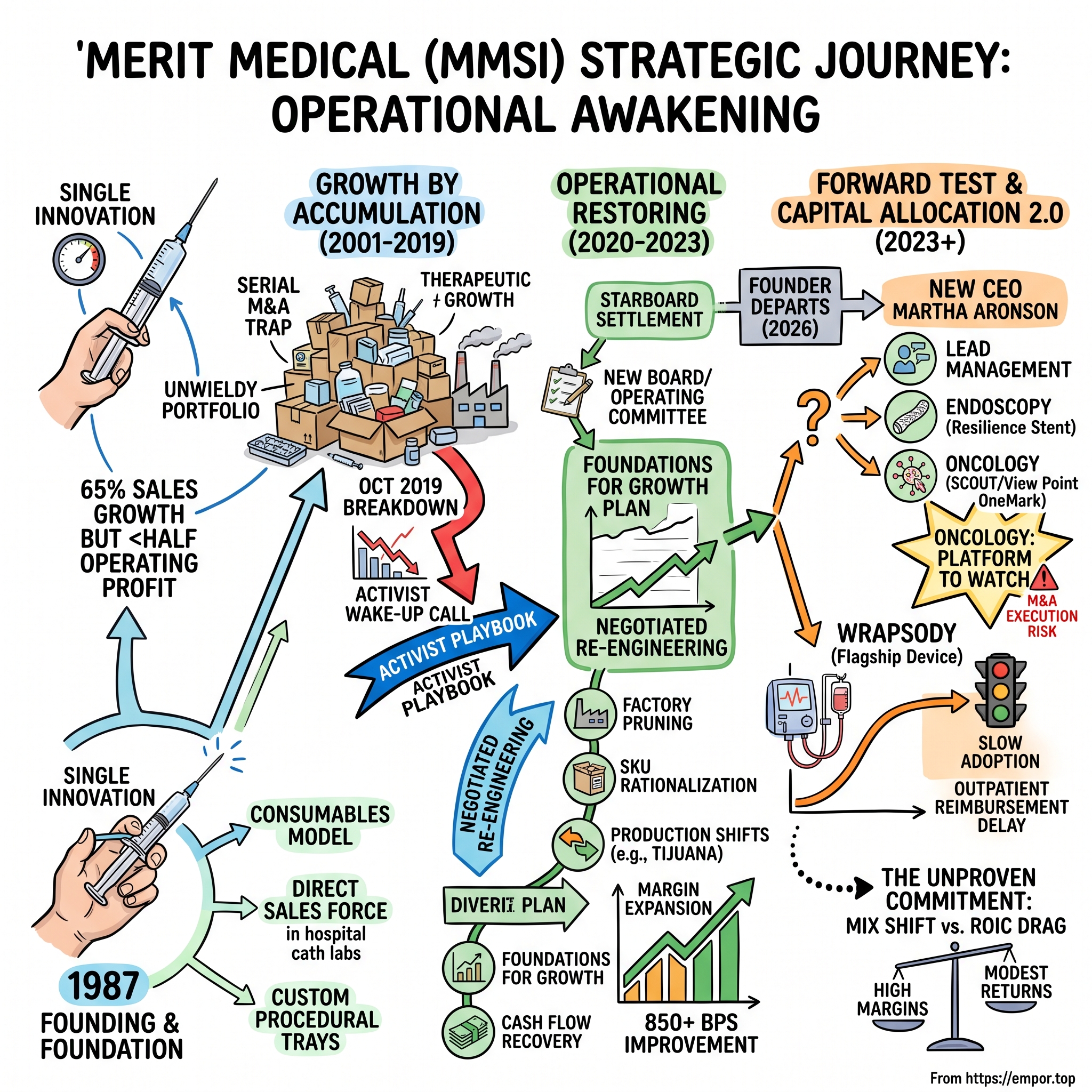
For roughly three decades, Merit grew by accumulation: adding products, manufacturing plants, SKUs, acquisitions, and geographic markets. Revenue compounded steadily, but operating margins did not. In late 2019, that divergence reached a breaking point. The stock dropped sharply, drawing the attention of an activist investor. What followed was an instructive corporate restructuring in mid-cap medical technology—not a founder ouster, but a negotiated re-engineering that lifted non-GAAP operating margin from 11.8% in 2019 to 20.3% in 2025, representing roughly 850 basis points of improvement across six years.4
Then, having completed the most demanding phase of that operational cleanup, the founder relinquished leadership and departed entirely.
Four themes
The workflow anchor. What the low-margin custom procedural tray actually secures is a genuine position inside hospital catheterization labs—though it represents a narrower asset than standard narratives suggest, and one Merit is intentionally downsizing.
The serial acquirer's trap. How dozens of tuck-in transactions and roughly $1.3 billion of acquisition spending since 2016 produced an unwieldy portfolio, and what was required to unwind it.4
The activist playbook. How Starboard Value secured a margin commitment without forcing an executive exit, unlocking hidden operating leverage within a founder-run industrial business.
The forward test. A flagship dialysis device called WRAPSODY whose U.S. launch has underdelivered against management's initial projections, a fresh wave of acquisitions completed around the founder's departure, and a three-year strategic plan expiring in five months with no successor roadmap yet published.
The core analytical reality is straightforward: Merit has proven its ability to take costs out, but it has yet to demonstrate that high-margin therapeutic franchises can grow rapidly enough to justify a premium multiple, while returns on invested capital remain modest. The next three years will determine which trajectory the company takes.
 Subscribe on LinkedIn
II. The Genesis: Fred Lampropoulos & The Cath-Lab Revolution (1987–2000)
Picture a cardiac catheterization lab in the mid-1980s. A cardiologist threads a catheter from the femoral artery in the groin up into the coronary arteries, positions a balloon inside a narrowed vessel, and then must inflate that balloon to pressures that would burst a bicycle tire—while knowing precisely how much pressure is being applied. Too little does nothing; too much tears the artery. The tooling for this procedure was often improvised, sometimes reusable, and rarely designed with the operator's hands in mind. Percutaneous coronary intervention was exploding as a procedure category, but the instruments supporting it had not caught up.
The founder
Fred Lampropoulos had served as chairman and chief executive at Utah Medical Products before leaving to launch his own venture. In 1987, he founded Merit Medical on what the company describes as a single innovation: a stronger, safer disposable syringe.2 The core insight was ergonomic and economic rather than scientific. A single-use inflation device with a clear barrel and a precise pressure gauge gave the operator immediate visual feedback while eliminating the sterilization risks of reusable equipment. Because it was a consumable item, every procedure generated a recurring sale.
This single device established the foundation for Merit's business model. The company was not designed around high-margin implants requiring decade-long clinical trials; it was built to sell high-volume disposable supplies used in everyday procedures. Lampropoulos attributed the company's operational approach to habits formed during his military service as a combat officer—specifically, active observation and listening—and over his career he accumulated more than 200 patents across cardiac, peripheral, gastrointestinal, and pulmonary devices.2 His hands-on involvement in manufacturing plants and catheterization labs established a product development culture rooted in immediate clinical feedback.
That intensity became the company's growth engine, though it later created operational bottlenecks as the business scaled.
Going public, building distribution
Merit completed its initial public offering on NASDAQ on May 10, 1990—a listing Lampropoulos cited in his farewell statement thirty-five years later as the benchmark for long-term shareholder returns.7 The IPO capital funded the expansion of a direct sales force. In medical technology, direct commercial access creates a durable competitive advantage. A sales representative physically present in the cath lab—who understands local clinical workflows, knows materials managers, and resolves inventory bottlenecks immediately—builds customer lock-in that third-party distributors cannot match.
Merit built that presence hospital by hospital. Today's commercial architecture—combining direct-to-hospital sales, modified direct models, established distribution networks, and original equipment manufacturer (OEM) partnerships—stems directly from strategy decisions set in the early 1990s.4
The tray, and what it really bought
Merit then introduced a packaging strategy that shaped its commercial economics for decades. Rather than selling individual components separately, Merit began assembling the complete disposable payload for a specific procedure—syringes, tubing, manifolds, drapes, and guidewires—into a customized, pre-sterilized tray tailored to a hospital's or physician's exact preferences. Clinical teams opened a single package containing every required item arranged in sequential order.
The economics of procedural trays are often misunderstood. Trays carry lower gross margins than proprietary devices because a significant portion of their contents consists of commodity items or third-party components passed through at narrow markups. However, custom trays secure commercial position. Once a hospital standardizes its catheterization lab on a Merit tray configuration, switching to a competitor requires re-validating procedural workflows, retraining staff, and renegotiating complex bills of materials. Competitors cannot easily displace a custom tray simply by offering an individual component with slightly better specifications.
Two analytical caveats refine this view. First, procedural trays create switching friction rather than an impenetrable moat, conferring minimal pricing power against hospital purchasing consortia that benchmark individual line items. Second, custom trays now represent a shrinking, low-margin segment of Merit's overall business. Under the reporting structure adopted in 2026, the Procedural Solutions platform generated $124.7 million in 2025 revenue—representing less than 10% of the company's $1.516 billion total.8 In the second quarter of 2026, platform revenue fell 12% as reported, reflecting management's deliberate divestiture of the DualCap product line.5
While procedural trays historically served as a commercial entry point into hospital catheterization labs, management has systematically pruned the low-margin line. By 2000, Merit had established its core foundation: a consumables-driven product portfolio, a direct hospital sales force, and embedded workflow positions in catheterization labs. What the company still lacked was scale beyond coronary cardiology—an expansion phase that provided geographic and clinical reach over the next two decades, along with cost structures that eventually forced a major operational overhaul.
III. The Growth Engine & The Dark Side of Serial M&A (2001–2019)
The logic of expansion was seductive and, for a long time, effective. Merit's sales force was already standing in the interventional suite. The same room, or one down the hall, hosted interventional radiologists draining abscesses and embolizing uterine fibroids, vascular surgeons maintaining dialysis access, oncologists delivering chemoembolization, gastroenterologists placing esophageal stents, and pulmonologists managing airways. Every one of those procedures required access sheaths, catheters, wires, and disposables. Merit could sell them all through commercial channels it already owned, and the incremental cost of adding another product to an existing sales bag appeared close to zero.
Building the perimeter
So the company bought and built its way outward.
Over roughly two decades, Merit assembled a portfolio spanning interventional radiology, vascular surgery, interventional oncology, gastroenterology, and pulmonology. It added microcatheter families, access sheath lines, drainage systems, biopsy devices, embolic microspheres for blocking blood supply to tumors and fibroids, and airway and esophageal stents. The embolotherapy franchise built around Embosphere microspheres and the SwiftNINJA steerable microcatheter—assets that anchor the modern Vascular and Interventional platform—traces to this era of expansion.4
The reported top-line growth was notable. Revenue moved from $603.8 million in 2016 to $727.9 million in 2017, $882.8 million in 2018, and $994.9 million in 2019.9 That represented an annual compound growth rate above 15%, giving Merit the appearance of a steady compounder. But examining the profit line revealed an entirely different company.
The number that reframes the era
Operating income in 2016 was $34.9 million on $603.8 million of revenue. By 2019, on $994.9 million of revenue—a 65% increase in sales—GAAP operating income had dropped to $15.4 million, with net income falling to $5.5 million, or $0.10 per share.9 Generating 65% more revenue while producing less than half the operating profit demonstrated that whatever the acquisitions were purchasing, it was not earnings power.
The underlying breakdown reflected a classic serial-acquirer failure mode. Each transaction arrived with its own manufacturing plant, quality management system, regulatory registrations, product catalog, and overlapping customer relationships. Little of this infrastructure was rationalized, because integration is slow operational work that yields no press releases. As a result, manufacturing facilities, duplicate product families, and regulatory filings accumulated across dozens of countries.
Merit has not disclosed a directly comparable count of how many manufacturing sites it operated at its 2019 peak, making the frequently cited figure of "more than twenty" unverified. What the company did disclose in its 2025 annual report was a consolidated footprint of eleven global manufacturing facilities, structured around specialized personnel that allow Merit to shift production to whichever site offers the best economics.3 That operational flexibility was the result of subsequent consolidation, not the initial state of the business.
Two deals, one quarter
Two late-2018 transactions illustrated the compounding operational stress. In October 2018, Merit agreed to acquire Cianna Medical—maker of the SCOUT radar breast tumor localization and SAVI brachytherapy systems—for $135 million upfront plus earn-outs of up to $65 million, valuing the transaction at up to $200 million.[^10] Two months later, in December 2018, it acquired substantially all the assets of Vascular Insights, including the ClariVein specialty infusion and occlusion catheter systems for superficial venous disease, for $40 million upfront plus up to $20 million in milestone payments.[^11]
These acquisitions brought two distinct integrations, two separate sales motions, and two new R&D facilities into a company that was already struggling to integrate its existing portfolio within a single quarter.
October 30, 2019
The operational reckoning arrived on October 30, 2019. Merit reported third-quarter adjusted earnings of $0.28 per share, missing consensus estimates by roughly 38% and falling 40% below prior-year levels. Selling, general, and administrative expenses had surged 31% year-over-year to $86.9 million, driving an operating loss of $2.8 million.10 Management reduced its full-year revenue guidance from a range of $1.007 billion–$1.029 billion down to $986 million–$995 million, and withdrew its 2020 financial targets just three months after reaffirming them.11
Contemporaneous analysis linked the breakdown directly to the delayed integrations of Cianna and Vascular Insights, which disrupted sales productivity and slowed R&D output.10 The following morning, Merit shares fell by roughly a third in premarket trading.11
Where the damage was really visible
The cash flow statement reflected the full extent of the pre-2020 operational strain. In 2019, Merit generated $77.8 million in operating cash flow while spending $81.5 million on property, plant, and equipment, resulting in negative free cash flow of $3.7 million.9 Placed in context, a billion-dollar medical device company operating a high-margin consumables model failed to convert its top-line sales into distributable cash during a period of macroeconomic stability.
Working capital absorption was a central driver: inventory expansion consumed $27 million and receivables absorbed another $17.9 million as the company built stock and managed extended collection cycles across an unintegrated footprint.9 At the same time, capital expenditures ran at more than double normal historic levels, while the balance sheet absorbed $301.8 million in net cash outflows for acquisitions in 2018 alone—funded through $215 million in equity issuance and $116.5 million in net new debt.9 Merit was purchasing top-line growth using external capital rather than internally generated cash.
The reclassification
This operational breakdown prompted a revaluation among investors. A business previously evaluated as a stable mid-cap compounder was reframed as an unintegrated roll-up burdened by weak cost controls and absent cash generation. Legal scrutiny followed. A consolidated securities class action covering stock purchases between February 26, 2019, and October 30, 2019, resulted in a November 2021 agreement in principle to settle for $18.25 million, with approximately $8.2 million expected to be covered by insurance proceeds.[^14] While manageable financially for a company of Merit's size, the settlement underlined the governance lapse.
The era demonstrated that acquiring assets and integrating them require distinct operational capabilities, and that a founder-led business without internal governance counterweights can prioritize expansion over execution. That counterweight ultimately arrived from the outside in January 2020.
IV. The Starboard Activist Wake-Up Call & "Foundations for Growth" (2020–2023)
With Merit's share price depressed following the October 2019 collapse, Starboard Value LP disclosed a stake of approximately 9% in January 2020.[^15] Shares rose on the announcement, signaling market enthusiasm for external oversight following management's missed targets.
The diagnosis anyone could have made
Starboard's investment thesis was straightforward: Merit possessed strong market positions, recurring consumable demand, and high regulatory barriers, yet its operating margin had remained flat for years while peers expanded profitability. The spread between actual and potential earnings formed the core activist opportunity. Starboard's strategy followed a standard operational playbook: secure board seats for experienced operational executives, mandate public margin expansion targets with firm deadlines, and enforce management accountability during execution.
The settlement that did not remove the founder
Rather than engaging in a protracted proxy contest, Merit opted to negotiate while Starboard refrained from seeking the removal of the founder. On May 26, 2020, with Starboard holding approximately 8.7% of outstanding shares, the two parties announced a settlement agreement.12 Merit nominated three medical device industry veterans for election at its June 22, 2020 annual meeting: Lonny Carpenter, who had spent nearly thirty years at Stryker, including service as Group President of Global Quality and Operations; David Floyd; and James T. Hogan.
Four incumbent directors stepped down, including co-founder Kent W. Stanger. The board contracted to nine directors, seven of whom were independent, and established a framework to select a new Lead Independent Director. In exchange, Starboard withdrew its director nominations and agreed to customary standstill and voting provisions.12
The clause that mattered
The settlement's most significant provision was structural. The board established a new Operating Committee, chaired by Carpenter and including Lampropoulos, charged with working alongside management to set operational margin targets by the announcement of third-quarter 2020 results.12 This governance change converted profitability goals from discretionary internal targets into formal board deliverables with explicit public deadlines, monitored by directors with deep experience managing large-scale global manufacturing operations.
Foundations for Growth
On November 10, 2020, Merit unveiled its "Foundations for Growth" restructuring plan. The three-year initiative committed the company to compounding organic constant-currency revenue at 5% to 7% through December 31, 2023, expanding non-GAAP operating margin to between 18% and 21% for full-year 2023, and generating at least $300 million in cumulative free cash flow over the plan's duration.13 Reaching these metrics required a substantial operational turnaround: at the time of the announcement, Merit was projecting a full-year 2020 GAAP net loss between $11.8 million and $15.0 million, with annual revenue expected to contract 3.5% to 4.5% as pandemic restrictions suppressed elective procedure volumes.13
The unglamorous execution
Execution relied on fundamental industrial rationalization. Management transferred product lines to lower-cost manufacturing sites in Tijuana, Mexico, and Pearland, Texas, closed redundant facilities, and pruned low-margin product offerings. Capital expenditures dropped from $81.5 million in 2019 to $27.9 million in 2021 as the company shifted from footprint expansion to operational consolidation.9 Working capital management improved concurrently, curbing historical cash absorption into excess inventory.
Chief Financial Officer Raul Parra later summarized this sustained strategy during the fourth-quarter 2025 earnings call as throwing "the kitchen sink at the gross margin," pointing to pricing discipline, product and geographic mix, ongoing SKU rationalization, and production shifts to low-cost regions as primary operational levers.14 During the second-quarter 2026 earnings call, Parra detailed further execution measures: Merit transferred its largest manufacturing department to Tijuana over the preceding year, introduced shop-floor automation to improve labor productivity, and transitioned freight transport from air to ocean to reduce shipping expenses, accepting higher in-transit inventory as a trade-off.15
This disciplined operational focus marked a direct departure from the uncoordinated expansion that characterized the pre-2020 period.
What actually happened versus what was promised
Non-GAAP operating margin expanded consistently over the plan period, moving from 11.8% in 2019 to 13.2% in 2020, 14.4% in 2021, 15.5% in 2022, and reaching 17.2% in 2023.4 While this represented roughly 540 basis points of steady margin expansion, it fell short of the 18% to 21% target established in the original plan.413
Cumulative free cash flow during the initiative totaled $299.4 million, effectively matching the targeted benchmark of at least $300 million.4 Cash generation experienced a major operational recovery, rebounding from negative territory in 2019 to $119.3 million in 2021 and $108.5 million in 2023.9
This execution record provides context for evaluating management's multi-year guidance. Merit delivered substantial operational gains without fully achieving its initial public margin commitments. Rather than dwelling on the minor shortfall, management introduced a subsequent three-year plan in February 2024 with updated financial targets. This pattern highlights why financial analysis should weight demonstrated operational margin expansion over forward-looking management targets.
Merit's share price recovered significantly as operating performance improved, establishing the restructuring as a notable case study in constructive activism. Starboard's intervention unlocked verifiable cost efficiencies within a founder-led company while preserving leadership continuity, even if progress took longer and delivered slightly less than initial commitments. The business that emerged from the Foundations for Growth program possessed a higher baseline margin structure, setting the stage for its next operational phase.
V. Inside the Business Today: Segment Economics & Core Product Moats
If you built a model of Merit Medical in early 2025, you now have to throw it away. In April 2026 the company formally abandoned the reporting architecture it had used for years — Cardiovascular and Endoscopy segments, subdivided into Cardiac Intervention, Peripheral Intervention, Custom Procedural Solutions and OEM — and replaced it with two product categories and eight platforms.8 Anyone still describing Merit in terms of "PI" and "CI" is describing a company that no longer reports itself that way.
The new architecture
Merit now splits revenue into Foundational products — the access and enabling hardware used in vascular and other procedures — and Therapeutic products, the devices and systems that actually treat a disease.8 For 2025, Foundational generated $1.029 billion and Therapeutic $487.4 million, on total revenue of $1.516 billion.8 Roughly two-thirds enabling, one-third treating. Underneath sit eight platforms: Access, Vascular Intervention, Procedural Solutions, Cardiac Therapies, Renal Therapies, Oncology, Endoscopy, and OEM. Access and Procedural Solutions are entirely Foundational. Cardiac Therapies, Renal Therapies, Oncology and Endoscopy are entirely Therapeutic. Vascular Intervention and OEM straddle both categories.8
CEO Martha Aronson has explained the internal logic clearly: each platform is co-led by a marketing lead and an R&D lead, surrounded by cross-functional and cross-geographic teams, so that a single group owns a product line globally rather than having strategy fragmented across regions and legacy segments.14 The external reporting change followed the internal reorganization, not the other way around.
Access is the ballast
At $588.5 million in 2025, Access is by a wide margin the largest platform — sheaths, introducers, guidewires, inflation devices, the direct descendants of Fred Lampropoulos's original syringe.8 It grew 5% in constant currency in the second quarter of 2026.5 Demand drivers named by management include the Prelude radial sheath used for wrist-artery access, the Prelude Wave hydrophilic sheath introducer with SNAP Fix technology, and diagnostic wires.14 This is a mature, competitive, GPO-exposed business that grows roughly with procedure volumes and mix. It funds everything else. It will not re-rate the stock, and it is not supposed to.
Therapeutic is the growth engine — with an asterisk
The math here is striking, and so is the caveat. Therapeutic revenue rose from $288.6 million in 2022 to $487.4 million in 2025 — a compound annual rate of about 19% — while Foundational compounded at roughly 6% over the same window.8 But management has been careful to disclose that on an organic basis, stripping out acquisitions, Therapeutic grew closer to 11% a year.14 That distinction is the whole ballgame: roughly eight percentage points of the nineteen came from buying, not building. Eleven percent organic growth in a differentiated device portfolio is a genuinely good outcome. It is simply not nineteen.
Within Therapeutic, three platforms deserve individual attention.
Cardiac Therapies nearly doubled from $49.4 million in 2024 to $93.4 million in 2025, almost entirely on the Cook Medical lead management acquisition.8 It grew a further 22% in constant currency in the second quarter of 2026.5 The product set spans electrophysiology, structural heart and lead extraction — Worley and Ventrax delivery systems, HeartSpan transseptal access, Tempo pacing leads, SOLO PACE, and the Evolution extraction family.4
Endoscopy more than doubled over three years, from $31.9 million in 2022 to $72.5 million in 2025, and grew 29% in the second quarter of 2026 — the fastest-growing platform Merit owns.85 Merit launched the Resilience through-the-scope esophageal stent in the US in March 2026, designed for migration resistance and accurate placement in malignant strictures and fistulas.14
Renal Therapies grew from $21.8 million in 2022 to $52.8 million in 2025, but actually declined 2% in the second quarter of 2026, held back by a product recall; excluding that impact, management said the platform grew about 10%.815 The portfolio spans HeRO and Surfacer access devices, BioFlo dialysis catheters, and WRAPSODY.4
Oncology is the platform to watch
At $96.8 million in 2025, Oncology has been, in Aronson's own words on the first-quarter 2026 call, "pretty much a one-product platform" built on SCOUT radar localization.16 The technology in plain terms: when a radiologist biopsies a suspicious breast lesion, the surgeon who later removes it needs to find the exact spot. The traditional method involves threading a wire into the breast on the morning of surgery — uncomfortable for the patient, logistically awkward for the hospital, and requiring a separate procedure. SCOUT instead places a tiny reflector at the time of biopsy; a handheld radar probe then locates it in the operating room, with no wire and no radioactive seed.
Merit's addressable slice has been roughly 300,000 to 400,000 US procedures a year out of about 1.6 million breast biopsies, because SCOUT tends to be reserved for higher-risk patients.16 Management has said the broader wire-free localization market grows around 13% annually against underlying breast cancer incidence growth near 4%.16 That gap between a $100 million platform and a much larger procedure pool is exactly the opening the View Point Medical acquisition was designed to attack.
OEM is the platform most investors misread
At $207.6 million across both categories in 2025, OEM is substantial — and routinely misunderstood.8 Parra pushed back firmly when an analyst on the first-quarter 2026 call asked whether Merit should divest it. Merit is "not a contract manufacturer," he said; it sells its own products, and in effect sells capacity, so divesting the business would simply strand plant.16 The business is also genuinely lumpy. OEM sales fell 15% in the fourth quarter of 2025 and 14% in the first quarter of 2026 on customer destocking and Asia-Pacific weakness, then rebounded 15% in the second quarter of 2026, helped partly by restocking following product line transfers to Tijuana.141615 Management maintains that mid-to-high single-digit growth is the normalized annual rate.
An investor should treat any single OEM quarter as noise, and should be skeptical of both bullish and bearish extrapolations from it.
Where Merit sits competitively
The comparison that clarifies everything is gross margin. Boston Scientific generated $20.1 billion of 2025 revenue at a GAAP gross margin near 69% and a GAAP operating margin close to 20%.17 Merit's GAAP gross margin in 2025 was about 48.7% on $1.515 billion of revenue, with GAAP operating income of $184.4 million.3 On a non-GAAP basis Merit's gross margin reached 55.8% in the second quarter of 2026, its highest ever — though that figure included $6.9 million of refunds on previously paid tariffs recognized within cost of sales. Excluding them, it was 54.2%, still up 98 basis points year over year despite roughly $2 million of incremental tariff cost.515
The structural gap versus a large-cap implant maker is not a failure of execution. It is the mathematical consequence of selling enabling hardware and trays rather than drug-eluting stents and ablation platforms. That is also the strategic point. Merit does not compete head-on with Boston Scientific, Medtronic, テルモ Terumo, Teleflex, privately held Cook Medical, or BD on flagship implants. It supplies the infrastructure of the room — the products used regardless of whose implant goes in. That is a defensible commercial position and a permanent margin ceiling at the same time. The only route above the ceiling is mix shift into therapeutics, which is precisely what management is attempting, and precisely what it keeps buying.
Two structural drags worth carrying in any model
Most of Merit's products are sterilized using ethylene oxide. The company's own annual report warns that regulations under consideration in the US, EU and elsewhere to limit EtO use for medical sterilization "could have a material adverse effect on our business," alongside a parallel warning about potential restrictions on per- and polyfluoroalkyl substances in medical products.3 Neither is a near-term earnings event. Both are genuine tail risks to a manufacturing network built around current processes. Separately, China's 带量采购 volume-based procurement program has depressed Merit's selling prices there since 2022, and the company explicitly expects those negative impacts to continue through 2026.3 China grew only about 2% in the first quarter of 2026 and low single digits in the second, and management guides to low single digits for the year.1615
Roughly 40% of Merit's revenue comes from customers outside the United States, which makes both currency and non-US reimbursement policy permanent features of the earnings profile rather than occasional surprises.14
VI. Capital Allocation 2.0, M&A Benchmarking & The Growth Pipeline (2023–2026+)
The successor plan to Foundations for Growth is not called FFG 2.0, and getting the name right matters because the targets are different. On February 28, 2024, Merit introduced Continued Growth Initiatives — CGI — with three targets for the three years ending December 31, 2026: organic constant-currency revenue growth of 5% to 7% compounded, a non-GAAP operating margin of 20.0% to 22.0% in 2026, and cumulative free cash flow of more than $400 million.[^22]
Two targets banked, one contested
Free cash flow reached $182.8 million in 2024 and nearly $216 million in 2025, meaning the $400 million cumulative target was cleared with a full year still to run — a milestone Chief Financial Officer Raul Parra highlighted on consecutive calls as "a small victory lap."914 Profitability has also tracked well. Non-GAAP operating margin reached 20.3% in 2025, up 131 basis points year over year, while the fourth quarter of 2025 delivered 21.0% alongside a record $74 million in quarterly free cash flow and a company-record quarterly gross margin of 54.5%.14 In the second quarter of 2026, non-GAAP operating margin reached 22.6% including tariff refunds, or 20.9% excluding them.515
It is worth comparing performance in 2025 with management's initial commitments for that year. The high end of original 2025 guidance targeted 10% constant-currency revenue growth, a 19.7% non-GAAP operating margin, and $150 million in free cash flow. Merit delivered 11% growth, a 20.3% margin, and over $215 million in free cash flow.14 Following earlier Foundations for Growth shortfalls, that represented a notable improvement in guidance discipline. Organic growth, however, has proven harder to stabilize. Merit posted 6.6% organic constant-currency growth in the fourth quarter of 2025, slowing to 3.7% in the first quarter of 2026 excluding divested revenue, before rebounding to 9% in the second quarter — its strongest organic performance in three years.141615
That volatility reflects the underlying business structure. Merit's organic growth does not follow a steady line; it represents a portfolio of eight platforms whose quarterly results fluctuate independently. As Parra observed on the second-quarter call, it functions like an "index style portfolio" that yields strong aggregate results when multiple platforms perform simultaneously.15
The acquisitions, benchmarked
The post-activism transaction history reflects greater financial discipline than the pre-2019 rollout, though in aggregate it exceeds typical tuck-in scale.
In June 2023, Merit acquired a portfolio of dialysis catheters and the BioSentry biopsy tract sealant system from AngioDynamics for $100 million in cash, while separately acquiring the Surfacer Inside-Out access catheter system from Bluegrass Vascular Technologies.[^23] The acquired dialysis assets generated approximately $14.4 million in 2023 revenue.[^23] BioSentry seals the tract left by a lung biopsy needle to reduce pneumothorax risk — a logical extension for a business already selling biopsy hardware.
In July 2024, Merit agreed to acquire the assets of EndoGastric Solutions for approximately $105 million in cash. Its principal asset, EsophyX, is a device for transoral incisionless fundoplication — a scope-based alternative to surgery for chronic reflux performed through the mouth without external incisions. The acquired assets generated roughly $26 million in 2023 revenue, with Merit projecting approximately $30 million on an annualized basis.[^24] In November 2024, Merit closed the acquisition of Cook Medical's lead management business for $210 million plus assumed liabilities.[^25] That portfolio generated roughly $37 million in 2023 revenue — implying a purchase multiple near 5.7 times trailing sales — while Merit estimated the addressable global cardiac lead market at over $900 million across the U.S., Europe, and Asia.18
Lead management illustrates the strategic logic of targeted acquisitions. When a pacemaker or defibrillator lead becomes infected or fails, it must be extracted. Over time, leads scar into vein walls, effectively integrating into surrounding vascular tissue. Extraction requires specialized dilator sheaths that separate the lead from tissue without tearing the vein — a low-volume, high-complexity procedure with few qualified suppliers, performed in electrophysiology labs where Merit already maintains commercial relationships.
This profile fits the criteria for an effective add-on acquisition: an adjacent call point, high structural margins, limited competition, and adoption driven by physician preference rather than purchasing committees.
The pace continued after the founder left
Merit acquired Biolife in May 2025, adding patented hemostatic devices — notably StatSeal — used to control bleeding at access sites across interventional radiology, cardiology, dialysis, electrophysiology, biopsy, and drainage.415 On the second-quarter 2026 earnings call, management raised expected annualized Biolife revenue to approximately $23 million, up from initial projections of $18 million to $20 million, noting that its standalone manufacturing site retains sufficient capacity to support expansion.15
In November 2025, Merit completed the purchase of the C2 CryoBalloon technology from Pentax of America for $22 million in total consideration, including $19 million in cash at closing.4 The device treats Barrett's esophagus — a precancerous condition caused by chronic reflux — by freezing abnormal tissue while preserving surrounding esophageal structure. Production was moved to Merit's South Jordan facility with an additional line installed, and annualized revenue is expected to reach $8 million to $9 million.15
On April 1, 2026, Merit acquired View Point Medical for $140 million in total consideration: $90 million in cash at closing plus two deferred payments of $25 million due on the first and second anniversary dates.16
View Point: the first real test of the new CEO
This transaction marks the first major capital allocation test for Chief Executive Officer Martha Aronson. The primary asset is OneMark, an ultrasound-enhanced tissue marker system placed during biopsy, paired with a detection imaging platform. Management frames the acquisition around market expansion rather than product cannibalization: SCOUT addresses several hundred thousand higher-risk procedures, whereas OneMark applies to the roughly 1.3 million lower-risk breast biopsies performed annually in the U.S., expanding Merit's addressable procedure volume by three to four times.16
The two systems differ in physical operation — radar versus ultrasound — and carry distinct price points. As Aronson outlined on the second-quarter call, clinicians can deploy OneMark for routine biopsies while reserving SCOUT MD for complex localization.15 Management's financial targets for View Point are specific: projected annual revenue growth of at least 20%, non-GAAP gross margins around 70%, non-GAAP operating margins above company averages, 2026 revenue of $2 million to $4 million scaling to $14 million to $16 million in 2027, and $0.05 in non-GAAP earnings per share dilution in 2026, including roughly $2 million in foregone interest income.16
Merit launched SCOUT MD — which features four distinct reflector shapes to enhance x-ray visibility — in late May 2026, followed by the U.S. launch of OneMark in July.15 If 2027 oncology platform revenue falls short of management's target band, the acquisition risk becomes apparent.
WRAPSODY: the flagship, and the cautionary tale
WRAPSODY targets a widespread clinical challenge in hemodialysis access. Patients receiving long-term dialysis rely on surgically created arteriovenous fistulas or synthetic grafts, which frequently narrow or block over time. Conventional balloon angioplasty offers short-term relief, while standard stents often fail as tissue grows through open mesh walls. WRAPSODY is designed as a cell-impermeable endoprosthesis, using a solid barrier layer to prevent cellular ingrowth and keep the vessel open.
Clinical results from the WAVE trial showed high patency rates: at six months, target lesion primary patency reached 89.8% in fistula patients and 82.0% in graft patients.19 At twelve months, primary patency in fistula patients stood at 70.1% compared with 41.6% for standard balloon angioplasty, and at twenty-four months remained at 48.6% versus 29.8%.4 Nearly half of treated patients maintained vessel patency at two years, compared with under one-third receiving standard care. The U.S. Food and Drug Administration granted premarket approval in December 2024, followed by Health Canada approval on April 30, 2025. Merit is expanding real-world clinical data through the WRAP North America Registry, targeting enrollment of up to 250 patients across the U.S. and Canada.1920
Despite positive clinical trial data, initial commercial adoption was slow. Merit guided full-year 2025 U.S. WRAPSODY revenue to just $2 million to $4 million.20 For 2026, guidance remains at approximately $7 million and has been reiterated on each quarterly call.141615 Relative to the size of the target patient population and Merit's $1.6 billion revenue base, these early revenue figures remain modest.
Why: the reimbursement mechanics
The delay in revenue generation reflects reimbursement logistics rather than clinical performance. To secure payment above standard bundled rates, medical device manufacturers must obtain dedicated coding or add-on status. Merit secured a New Technology Add-on Payment effective October 1, 2025, but NTAP covers only hospital inpatient procedures.20 The majority of dialysis access maintenance procedures occur in hospital outpatient departments, ambulatory surgical centers, or physician office-based labs, which require Transitional Pass-Through reimbursement codes.
On November 13, 2025, the Centers for Medicare & Medicaid Services notified Merit that its TPT application required additional review and was deferred to the calendar year 2027 outpatient rulemaking process, pushing potential implementation to January 1, 2027.20 Rather than delaying full rollout, Merit withdrew its TPT application and initiated broad U.S. commercial distribution, choosing to compete on clinical outcomes in price-sensitive outpatient settings without supplementary reimbursement.20
Aronson acknowledged that previous payment strategy decisions had "impacted the pace of U.S. commercialization."20 On the fourth-quarter 2025 earnings call, she noted that "our original 2025 [WRAPSODY] revenue expectations missed the mark."14 This adjustment shifts the timeline for WRAPSODY's financial impact outward, placing the growth trajectory on outpatient adoption against established market alternatives.1415
VII. Porter's 5 Forces & Hamilton Helmer's 7 Powers Analysis
Strip away the corporate narrative to address the essential question for a long-term investor: what structural barriers prevent competitors from eroding this business?
The 7 Powers, tested rather than asserted
Switching costs are Merit's genuine power — and they are narrower than usually claimed.
They operate at two levels. At the clinician level, an interventionalist develops tactile familiarity with a specific sheath's insertion feel, a microcatheter's torque response, or an inflation device's pressure feedback. Device preference in interventional medicine often resembles a musician's attachment to an instrument more than a routine purchasing choice. At the institutional level, a custom tray configuration embeds Merit into a hospital's clinical workflow and bill of materials. Neither barrier is absolute. Both prove far weaker in commodity access lines—where a group purchasing organization can mandate a system-wide product conversion—than in specialized therapeutics such as lead extraction sheaths, where physician preference dictates the choice. The strategic implication is clear: Merit's moat is strengthening in the specialized therapeutic assets it is acquiring and weakening in the legacy commodity lines it inherited.
Process power exists in tray manufacturing and, more interestingly, in cost engineering.
Assembling thousands of unique sterile kit configurations on reliable lead times represents an operational capability that competitors cannot easily duplicate. The more compelling proof of process power, however, lies in the company's margin trajectory. Expanding non-GAAP operating margin by roughly 850 basis points across six years—while navigating pandemic disruptions, supply chain bottlenecks, labor shortages, and new tariffs—reflects systematic operational execution.4 Whether this cost-engineering capability has been fully institutionalized within management systems, or depended heavily on key individuals, remains the central test following the founder's departure.
Counter-positioning is the weakest of the commonly claimed powers.
The conventional argument holds that custom kit assembly and niche accessories are too operationally complex and low-volume for industry giants like Medtronic or Boston Scientific to pursue. That observation contains truth; large-cap medical device makers generally avoid managing thousands of low-margin stock-keeping units. Yet this dynamic fails the strict definition of counter-positioning, as no structural business-model conflict preventing a larger competitor from entering these markets exists. The barrier is merely a lack of financial incentive. Incentives shift over time. Cook Medical provides a clear case study: as a private firm free from quarterly margin pressure, it comfortably operated in lead management for decades before eventually electing to sell the business.
Scale economies are modest, and in R&D they run against Merit.
Merit distributes regulatory, clinical training, and commercial overhead across a global footprint spanning roughly 43 countries, backed by more than 800 sales and clinical personnel.34 This infrastructure provides genuine operating leverage within its specific market tier. Compared to a peer like Boston Scientific—which generates roughly thirteen times as much revenue—Merit remains severely subscale in research spending and in absorbing fixed compliance costs such as the European Union's Medical Device Regulation.17 Merit allocated approximately 6.2% of revenue to research and development on a trailing basis.6 In absolute dollars, that budget represents a small fraction of what industry leaders invest. In research and development, scale serves as a competitive disadvantage rather than an asset, helping explain why the company frequently purchases external innovation instead of developing it in-house.
Cornered resource, branding, and network economies are absent.
Merit maintains an extensive patent portfolio alongside differentiated technology, including WRAPSODY's cell-impermeable barrier, SCOUT's radar localization, and StatSeal's hemostatic agent. None of these assets, however, qualifies as an uncopiable resource, and the business possesses neither consumer brand equity nor network effects. Investors should not rely on them for structural protection. A minor exception exists in Merit Sensor Systems, a subsidiary that manufactures silicon pressure sensors for the company's digital inflation devices and blood pressure monitors.3 This business provides a modest, tangible degree of vertical integration in a component class that would otherwise represent an external supply chain risk.
The Five Forces, sharpened
Buyer power is high, and is the single most important structural constraint on this business.
Merit's annual report states the dynamic directly: healthcare consolidation, group purchasing organizations, and public cost-containment programs generate persistent pressure for price concessions, threatening revenues and pricing strategy.3 China's volume-based procurement program represents the most aggressive form of this pressure, driving continuous price reductions in that market since 2022.3 This structural headwind explains why workflow integration through procedural trays fails to translate into pricing leverage. A hospital consortium negotiating a multi-year vendor contract retains dominant bargaining power over commodity disposables, no matter how accustomed clinicians are to a specific kit layout. The workflow anchor secures customer retention, not pricing power.
Supplier power is low to moderate, but input logistics are a live variable.
Key raw inputs—such as medical-grade resins, stainless steel, and electronic components—are sourced from fragmented supplier networks. During recent earnings calls, Chief Financial Officer Raul Parra noted that suppliers had not imposed raw material price increases despite shipping disruptions in the Middle East, though fuel surcharges remained a standard operating expense.1615 Logistics bottlenecks nevertheless impacted revenue, causing Merit to miss roughly $1.5 million in shipments during the first quarter of 2026 when carriers failed to collect finished product from the region.16 Management also built defensive buffer stocks of resin and key materials—a risk-mitigation choice that absorbed cash and elevated inventory levels.15
Substitution risk is low at the procedure level and real at the product level.
Core procedural steps remain secure; interventional care will always require physical arterial access. At the product level, however, individual Merit components face direct competition, while clinical advancements can shift entire treatment paradigms.
Merit participates on both sides of this substitution curve. Its EsophyX device for transoral incisionless fundoplication directly challenges invasive Nissen fundoplication surgery. Data from a multicenter randomized controlled trial comparing the two approaches was presented at Digestive Disease Week in the second quarter of 2026, with management reporting high session attendance and clinical findings supporting the procedure as an effective alternative for chronic gastroesophageal reflux disease.15 While Merit finances the displacement of traditional surgical methods in gastroenterology, rival medical device firms are similarly funding technologies designed to replace Merit's established product lines.
Barriers to new entry are high.
Stringent regulatory requirements—including U.S. Food and Drug Administration clearance and premarket approval, European Union Medical Device Regulation compliance, and comprehensive quality systems—combine with the heavy capital cost of establishing a direct hospital sales force to make startup entry at scale unfeasible. The genuine competitive risk stems not from emerging ventures, but from established medical device majors choosing to target a specific category, or well-capitalized private peers willing to accept longer payback periods.
Rivalry is intense and rising in exactly the categories Merit needs to win.
Peripheral and cardiac access markets are contested by well-funded multinational competitors offering broader product portfolios. In dialysis access—the target market for WRAPSODY—established incumbents maintain entrenched positions backed by existing reimbursement coverage and deep clinical relationships. Chief Executive Officer Martha Aronson characterized commercial competition as "a day-to-day battle out there."15 Similarly, management's assertion that the market "definitely support[s] a third player" expresses commercial optimism rather than structural advantage.14 That projection may ultimately materialize, but it does not constitute economic moat protection.
Synthesis
Merit's competitive position is resilient, clearly defined, and fundamentally bounded. Dislodging the company from its established footprint in catheterization laboratories is difficult for rivals. Yet generating large-cap operating margins within those legacy commodity categories is equally difficult for Merit. Future value creation depends almost entirely on product mix shift—reallocating revenue toward specialized therapeutic categories where clinical differentiation, rather than institutional purchasing committees, dictates pricing power. Management has oriented its strategy around this shift. The central investment question is whether Merit can execute that transition rapidly enough through organic growth.
VIII. Management Credibility, Governance & Skeptical Investor Stress Test
The most consequential reality surrounding Merit's management in mid-2026 is that the outline investors relied on eighteen months earlier is obsolete. There is no longer a founder-chief executive with an unresolved succession timeline. The leadership handover occurred in public, on a defined schedule, and is complete.
How the handover was actually run
The transition sequence moved in an orderly fashion. On July 7, 2025, Merit announced that Martha G. Aronson would become President and Chief Executive Officer effective October 3, 2025, with Fred Lampropoulos continuing as Chairman.7 He served as Executive Chair through January 3, 2026 under a CEO Transition Agreement, resigned as a director and Chair on January 4, and signed a three-month consulting contract at $250,000 per month.1 Lead Independent Director F. Ann Millner described a "meticulous selection process" and thanked Lampropoulos for thirty-eight years of leadership.7 In his departure statement, the founder asserted that the business had never been in a stronger position.7
While outgoing founders routinely offer optimistic farewell assessments, Merit's expanding operating margins and recovering cash flow largely validated that claim.
Martha Aronson
Aronson brought deep external industry experience rather than an internal tenure.
She spent nearly two decades at Medtronic in domestic and international leadership roles, later serving as Senior Vice President and President for North America at Hill-Rom, and subsequently as Executive Vice President and President of Global Healthcare at Ecolab, where she oversaw healthcare operations in the $500 million to $1 billion range. Her board experience includes serving as Chair of CONMED, along with director roles at Methode Electronics, Clinical Innovations, Cardiovascular Systems, Beta Bionics, Hutchinson Technology, Bright Uro, and OmCare. She earned an economics degree from Wellesley College—graduating magna cum laude and Phi Beta Kappa—and holds a Master of Business Administration from Harvard Business School.7
Her contracted annual base salary was set at $1.0 million, with total fiscal 2025 compensation reported at roughly $6.7 million, reflecting sign-on grants and equity awards during her initial months in office.21
What she has actually done in ten months
Over her first ten months as chief executive, Aronson's operational decisions followed a distinct pattern. She conducted a listening tour across most of Merit's global facilities—touring plants, reviewing regional operations, hosting employee town halls, and participating in a physician advisory board session.14 In early 2026, Merit convened its first global sales meeting in Salt Lake City.14 She assembled a refreshed executive leadership team alongside a Global Operating Committee composed of senior Merit managers.4 She reorganized internal operations around eight distinct platforms and aligned external reporting accordingly, releasing four years of restated historical platform revenue to enable comparable financial modeling.8
On the portfolio side, Aronson divested the DualCap line for $28 million effective February 17, 2026, characterizing the product as a low-margin, non-core asset that consumed disproportionate plant capacity and commercial focus.14 She withdrew WRAPSODY's U.S. pass-through application to accelerate commercial distribution rather than wait through another regulatory rulemaking cycle, and allocated $140 million to acquire View Point Medical in her largest capital commitment to date. Merit framed this transition in its January 2026 presentation as moving from "founder-led to founder-inspired."4 While standard corporate branding, the tagline reflects a structural effort to eliminate key-person risk.
Board governance evolved in parallel. On May 19, 2026, shareholders elected Scott Ward to the board. Ward brought over forty years of medical technology experience, including nearly three decades at Medtronic and service as Chairman, President, and CEO of Cardiovascular Systems through its acquisition by Abbott, joining both the Governance and Sustainability Committee and the Finance and Operating Committee.15
Raul Parra and continuity
Chief Financial Officer and Treasurer Raul Parra provides executive continuity. Having joined Merit in 2009 and assumed the top financial role in July 2018, Parra managed financial reporting through the 2019 earnings breakdown, the Starboard activism settlement, and both subsequent multi-year restructuring plans.4 His fiscal 2025 total compensation was reported at roughly $4.8 million.21 His quarterly commentary offers direct operational detail, routinely outlining seasonal performance trends—noting that first and third quarters reflect softer volumes due to summer holidays and deferred elective procedures, whereas second and fourth quarters represent peak operational periods.15
When asked during the second-quarter 2026 earnings call why management did not raise full-year targets beyond the first-half outperformance, Parra noted that company practice is to pass through achieved upside while leaving second-half expectations unchanged.15 While investors may debate that conservative posture, management has maintained the policy consistently.
What the analyst Q&A actually reveals
Quarterly analyst exchanges center on three recurring themes, each producing distinct disclosures.
On WRAPSODY, analysts have repeatedly questioned whether the $7 million full-year 2026 guidance is conservative. Management's responses have remained restrained. Aronson has pointed to commercial competition, price sensitivity across outpatient facilities, and variable pricing across different sites of care, while declining to provide detailed unit pricing.1415 Following initial adoption delays, executive commentary has reflected a measured stance.
On M&A, inquiries focus on whether recent acquisition activity indicates a return to pre-2019 roll-up patterns. Capital structure metrics offer near-term reassurance: as of June 30, 2026, Merit held $448.7 million in cash against $747.5 million in total debt, supported by approximately $697 million in undrawn credit capacity and an adjusted net leverage ratio of 1.6 times.515 Recent transactions were financed through existing liquidity rather than added debt. Additionally, the company maintains 3.00% Convertible Senior Notes due 2029, with potential share dilution explicitly incorporated into management's financial guidance.5
Broader capital allocation parameters, however, remain less defined. Management indicated that a formal M&A playbook and allocation framework are under development as part of long-term planning, but has yet to disclose minimum hurdle rates or a maximum leverage limit.15
On gross margin expansion, analysts have consistently questioned sustainability, with one observer describing the multi-year gain as exceptional for a hardware business.14 Parra has pointed to specific operational levers—including Tijuana plant transfers, product mix, ocean freight transitions, and pricing discipline—rather than general efficiency targets, though the remaining room for margin expansion stays unquantified.
The skeptical stress test
A critical evaluation of Merit's mid-2026 position highlights five specific operational and financial vulnerabilities.
First, returns on invested capital remain modest despite operating margin expansion. Trailing return on invested capital stands below 6% and return on equity near 9%, with intangible assets accounting for roughly 40% of total assets.6 Merit has deployed approximately $1.3 billion into acquisitions since 2016.4
A company generating non-GAAP operating margins near 21% while earning single-digit returns on invested capital reveals an underlying tension: accumulated acquisition premiums and goodwill, rather than ongoing plant operations, depress overall capital efficiency. This return drag represents a central analytical challenge that management has not explicitly addressed on earnings calls.
Second, working capital commitments remain substantial. Days of inventory outstanding exceed 170 days.6 Management has defended these elevated levels as intentional risk mitigation—building buffer stock to support longer ocean transit times, ensure supply continuity, and offset potential geopolitical disruptions in the Middle East.15 Nevertheless, tying up capital in inventory contributed to a 14% year-over-year decline in first-half 2026 free cash flow, despite rising net profitability.515
Third, segment reporting was restructured during a transitional period. Merit retired the legacy segment structure that investors had monitored for years, replacing it with platform classifications that highlight higher-margin therapeutic categories.
The company mitigated transparency concerns by providing four years of restated historical revenue by platform.8 However, management initially stated it would not report quarterly platform revenue on an ongoing basis before reversing position in July 2026 to commit to full quarterly platform disclosures.815 While the policy shift restored visibility, the initial reluctance raised governance questions.
Fourth, manufacturing quality risks require ongoing monitoring. Merit disclosed a Class I recall affecting a renal product on its first-quarter 2026 call, noting it was the company's first Class I event since 2017 and financially immaterial to 2026 results.16 Management resolved the recall before the end of the second quarter, though executives acknowledged that some clinical accounts transitioned to alternative vendors during the disruption, requiring time to regain.15
While a single Class I recall over nine years represents a solid operational record relative to industry peers, operating eleven global manufacturing plants means quality control remains a primary risk factor.
Fifth, the current strategic framework expires at year-end following the founder's exit. The Continued Growth Initiatives plan concludes on December 31, 2026. Management is developing its 2027–2029 strategic roadmap, with updated long-term financial targets scheduled for release after CGI expires.15
As a result, Merit enters late 2026 in an interim period regarding medium-term targets. Led by a chief executive ten months into her tenure, management is reviewing the broader portfolio, with Aronson stating that "everything on the table," including evaluating whether specific product families align with long-term strategy.15 While a comprehensive portfolio review is appropriate for new leadership, investors currently lack a published multi-year financial framework.
IX. Key Investment Spine, KPIs & Bear vs. Bull Case
Myth versus reality
Three consensus assumptions about Merit warrant scrutiny before evaluating its forward outlook.
The first myth is that the custom procedural tray serves as the company's moat. In reality, custom trays represent a modest, low-margin, and intentionally pruned segment that management has systematically divested. The true moat relies on clinician preference within specialized therapeutic categories—such as lead extraction, dialysis access, breast lesion localization, and gastroesophageal reflux disease—rather than tray lock-in.
The second myth is that Foundations for Growth delivered an unqualified success. While the initiative produced substantial operational gains, it concluded in 2023 with a non-GAAP operating margin of 17.2% against an 18% to 21% target, and cumulative free cash flow of $299.4 million against an at-least $300 million promise.413 The operational improvement was genuine, but the public target fell slightly short.
The third myth is that WRAPSODY represents an immediate financial catalyst. Management guided U.S. revenue for the device to between $2 million and $4 million in 2025 and approximately $7 million in 2026, relative to full-year 2026 total revenue guidance of $1.631 billion to $1.643 billion.205 While WRAPSODY offers long-term option value supported by strong clinical trial data, its commercial adoption remains constrained by an unresolved outpatient reimbursement pathway. It is not a 2026 earnings driver.
The three KPIs that matter
Navigating Merit's financial disclosures requires focusing on three core operational metrics.
Organic constant-currency revenue growth. This provides the clearest measure of underlying demand by stripping out acquisition contributions and foreign exchange swings across a business that generates roughly 40% of its revenue outside the United States.14 Under the Continued Growth Initiatives plan, management targeted 5% to 7% annual compound organic growth. Recent quarterly performance—6.6%, followed by 3.7%, and then 9%—underscores the volatility of individual quarters and highlights why investors should track trailing four-quarter averages.141615
Non-GAAP operating margin, adjusted for non-recurring items. This metric indicates whether cost-engineering discipline survived the founder's departure and whether product mix shift is lifting overall profitability. The CGI target endpoint calls for a 20% to 22% non-GAAP operating margin in full-year 2026. Evaluating this performance requires stripping out unusual items: for instance, second-quarter 2026 results were boosted by roughly 170 basis points of tariff refunds, a benefit management reported both with and without the adjustment.515
Free cash flow conversion, evaluated alongside Therapeutic category growth. Management guided full-year 2026 free cash flow to at least $200 million, offset by roughly $90 million in planned capital expenditures—including a Utah distribution center that absorbed about $30 million in 2025.14 Cash conversion reveals working capital discipline and capital efficiency. Tracking it alongside organic growth in the Therapeutic segment shows whether Merit is successfully shifting its sales mix to permanently elevate its operating margin ceiling.
The bull case, stated precisely
In the optimistic scenario, Merit achieves its CGI margin targets and demonstrates that its operating model functions effectively without its founder. The Therapeutic category continues compounding at a double-digit organic rate, driving group gross margin higher and raising a structural profitability ceiling that constrained the business for decades. Meanwhile, organic innovation remains intact: roughly 10% of 2025 revenue growth across Merit's two largest legacy categories originated from products launched that same year.14
Capital deployment delivers on its promises. Lead management develops into a durable, high-margin franchise with few direct competitors. The Endoscopy platform achieves scale as EsophyX, C2 CryoBalloon, and the Resilience stent are cross-sold by a unified sales team into a multibillion-dollar market, backed by clinical trial data supporting transoral incisionless fundoplication. View Point's OneMark system meets its 2027 revenue targets, validating Chief Executive Officer Martha Aronson's initial major acquisition. WRAPSODY secures outpatient reimbursement coverage or wins market share on two-year vessel patency data alone, expanding beyond its $7 million baseline. Finally, management's upcoming 2027–2029 strategic plan establishes higher-quality operational benchmarks, and the leadership team executes consistently against them, driving multiple expansion toward higher-margin medical technology peers.
The bear case, stated equally precisely
In the pessimistic scenario, organic growth slows toward the lower end of expectations. The 9% organic growth recorded in the second quarter of 2026 proves to be a temporary rebound driven by customer restocking in OEM, recovery from a renal product recall, and favorable prior-year comparisons rather than an accelerating trend—a risk highlighted by analysts and supported by management's lower third-quarter guidance attributed to summer seasonality.15
Margin expansion stalls as low-hanging facility consolidation opportunities are exhausted. Net tariff expenses are projected at approximately $16 million, or $0.21 per share, in 2026—up from $9 million realized over the final eight months of 2025—in a regulatory environment described by management as changing on a weekly basis.1514 Hospital purchasing group demands and Chinese volume-based procurement continue to compress pricing, while tariff refunds that aided 2026 fail to recur.
WRAPSODY struggles to gain traction in price-sensitive outpatient centers without specialized pass-through reimbursement. Return on invested capital remains below 6% as Merit continues to buy growth through acquisitions. With over $575 million committed across six transactions since 2023—including AngioDynamics, EndoGastric Solutions, Cook Medical, Biolife, C2 CryoBalloon, and View Point—goodwill and intangible assets now comprise roughly 40% of total assets, leaving the balance sheet exposed to impairment risks if revenue projections miss expectations.63 Finally, the leadership transition exposes organizational friction, as the founder's clinical relationships and hands-on operational management prove difficult to replicate through institutional structures.
The realistic middle
The empirical evidence depicts a company that has successfully restructured its cost base, maintains realistic financial guidance, and occupies a defensible competitive position within its core markets. However, Merit has yet to prove it can consistently generate the organic top-line growth required to support a premium valuation multiple. While its margin expansion trajectory is largely reflected in current financial results, its long-term growth thesis remains an unproven commitment—awaiting the release of its next multi-year strategic roadmap.
X. Strategic Playbook & Investing Lessons
Lesson 1: Operational activism does not require a decapitation — but the founder question is a timing question, not a binary one
The Starboard Value campaign is widely cited as proof that activists can work constructively with founders, but the deeper reality is more instructive. Starboard did not seek Lampropoulos's removal in 2020. Instead, it secured a board Operating Committee with a strict deadline and a published margin target—a structural governance mechanism rather than an immediate executive replacement.12 The founder then delivered five years of steady operational improvement before stepping down on his own timetable five and a half years later, with an outside chief executive installed through a structured transition and an independent chair named the following day.17
The transferable insight is that constraining a founder's discretion at the board level can unlock dormant operating leverage while preserving the commercial relationships, product intuition, and cultural authority that built the business. Replacing the founder outright would have risked those assets at the precise moment the company needed operational stability. But the leadership transition eventually remains inevitable. The shareholders who benefited most were those who held through the operational turnaround—and those taking on risk today are underwriting the business on the other side of that handoff.
Lesson 2: The low-margin anchor is a real mechanism, and investors consistently overrate it
Custom procedural trays performed as economic theory predicts by embedding Merit into catheterization-lab workflows, making vendor replacement slow and cumbersome. What custom trays failed to deliver was pricing power against consolidated hospital buyers, as narrow markups precluded them from lifting group profitability. Merit's strategic actions confirm this reality: management has systematically pruned tray SKUs, divested non-core assets like DualCap, and redirected manufacturing capacity and commercial focus toward proprietary lines where clinical differentiation—rather than a hospital purchasing committee—dictates pricing.14
The broader lesson extends far beyond medical technology. When evaluating any loss-leader strategy, investors should assess whether customer lock-in converts into pricing power or merely into commercial presence. Presence holds value by lowering acquisition costs and buying time, but pricing power is far more valuable because it directly expands operating margins.
Lesson 3: The M&A maturation curve is visible in the multiples paid and in the reasons given
Before 2019, Merit purchased top-line revenue—attempting two integrations within a single quarter across an unwieldy manufacturing footprint, resulting in a year of negative free cash flow. After 2020, Merit pivoted to purchasing strategic adjacency: acquiring assets that fit existing commercial call points, carry above-average gross margins, and include explicit financial targets against which management can be evaluated. The View Point transaction exemplifies this disciplined approach, announced with explicit revenue, growth, gross margin, and earnings dilution targets attached before recognizing its first dollar of sales.16
That shift reflects tangible progress in capital allocation discipline, visible in corporate messaging as well as financial metrics—with acquisitions now justified by procedure volumes and margin profiles rather than broad strategic expansion. The key unresolved question is whether the aggregate return on roughly $1.3 billion of deployed acquisition capital will rise above the company's cost of capital.46 Six years into the operational turnaround, that return metric has not yet expanded, leaving it as the ultimate benchmark of long-term value creation.
References
-
Merit Medical Systems, Inc. Form 8-K — SEC EDGAR, 2026-01-08 ↩↩↩↩↩
-
Utah's Merit Medical founder named Salt Lake Chamber 'Giant in our City' — KSL.com, 2019-05-31 ↩↩↩
-
Merit Medical Systems, Inc. Annual Report on Form 10-K for the year ended December 31, 2025 — SEC EDGAR, 2026-02-24 ↩↩↩↩↩↩↩↩↩↩↩
-
Merit Medical Investor Presentation, J.P. Morgan Healthcare Conference — Merit Medical Systems, 2026-01-13 ↩↩↩↩↩↩↩↩↩↩↩↩↩↩↩↩↩↩↩↩↩
-
Merit Medical Reports Second Quarter 2026 Results and Updates Full-Year 2026 Guidance — SEC EDGAR Exhibit 99.1, 2026-07-30 ↩↩↩↩↩↩↩↩↩↩↩↩
-
Merit Medical Systems, Inc. (CIK 0000856982) filings and financial data — SEC EDGAR ↩↩↩↩↩↩
-
Merit Medical Names Martha Aronson as New President and Chief Executive Officer — SEC EDGAR Exhibit 99.1, 2025-07-07 ↩↩↩↩↩↩
-
Merit Medical Systems, Inc. Form 8-K — Historical Revenue by Foundational and Therapeutic Product Categories and by Platform — SEC EDGAR, 2026-04-13 ↩↩↩↩↩↩↩↩↩↩↩↩↩↩
-
Here's Why Merit Medical Systems Stock Is Tumbling — The Motley Fool, 2019-10-31 ↩↩
-
Merit Medical down 33% premarket on Q3 miss, guidance cut — Seeking Alpha, 2019-10-30 ↩↩
-
Merit Medical Announces Agreement With Starboard — SEC EDGAR Exhibit 99.2, 2020-05-26 ↩↩↩↩
-
Merit Medical to Present "Foundations for Growth" Program and Financial Targets for 2020 to 2023 — SEC EDGAR Exhibit 99.1, 2020-11-10 ↩↩↩↩
-
Merit Medical Systems, Inc. (MMSI) Q4 2025 Earnings Call Transcript — Seeking Alpha, 2026-02-24 ↩↩↩↩↩↩↩↩↩↩↩↩↩↩↩↩↩↩↩↩↩↩↩↩↩↩
-
Earnings call transcript: Merit Medical tops Q2 2026 estimates and lifts outlook — Investing.com, 2026-07-30 ↩↩↩↩↩↩↩↩↩↩↩↩↩↩↩↩↩↩↩↩↩↩↩↩↩↩↩↩↩↩↩↩↩↩↩
-
Merit Medical (MMSI) Q1 2026 Earnings Transcript — The Motley Fool, 2026-05-01 ↩↩↩↩↩↩↩↩↩↩↩↩↩↩↩↩
-
Boston Scientific Corporation (CIK 0000885725) filings — SEC EDGAR ↩↩
-
Merit Medical inks $210M takeover of Cook's lead management business — MedTech Dive, 2024-09-18 ↩
-
Merit Medical's Wrapsody Receives FDA Approval — Endovascular Today, 2024-12-20 ↩↩
-
Merit Medical Provides Update on U.S. Reimbursement and Commercial Strategies for WRAPSODY Cell-Impermeable Endoprosthesis — SEC EDGAR Exhibit 99.1, 2025-11-13 ↩↩↩↩↩↩↩
-
Merit Medical Systems, Inc. Definitive Proxy Statement (DEF 14A) — SEC EDGAR, 2026-03-31 ↩↩
 LinkedIn
 WhatsApp
 Reddit
 Hacker News
 Email
Email Kindle
 RSS Feed
 Spotify
 Apple Podcasts
 Amazon Music
 Audible
 YouTube