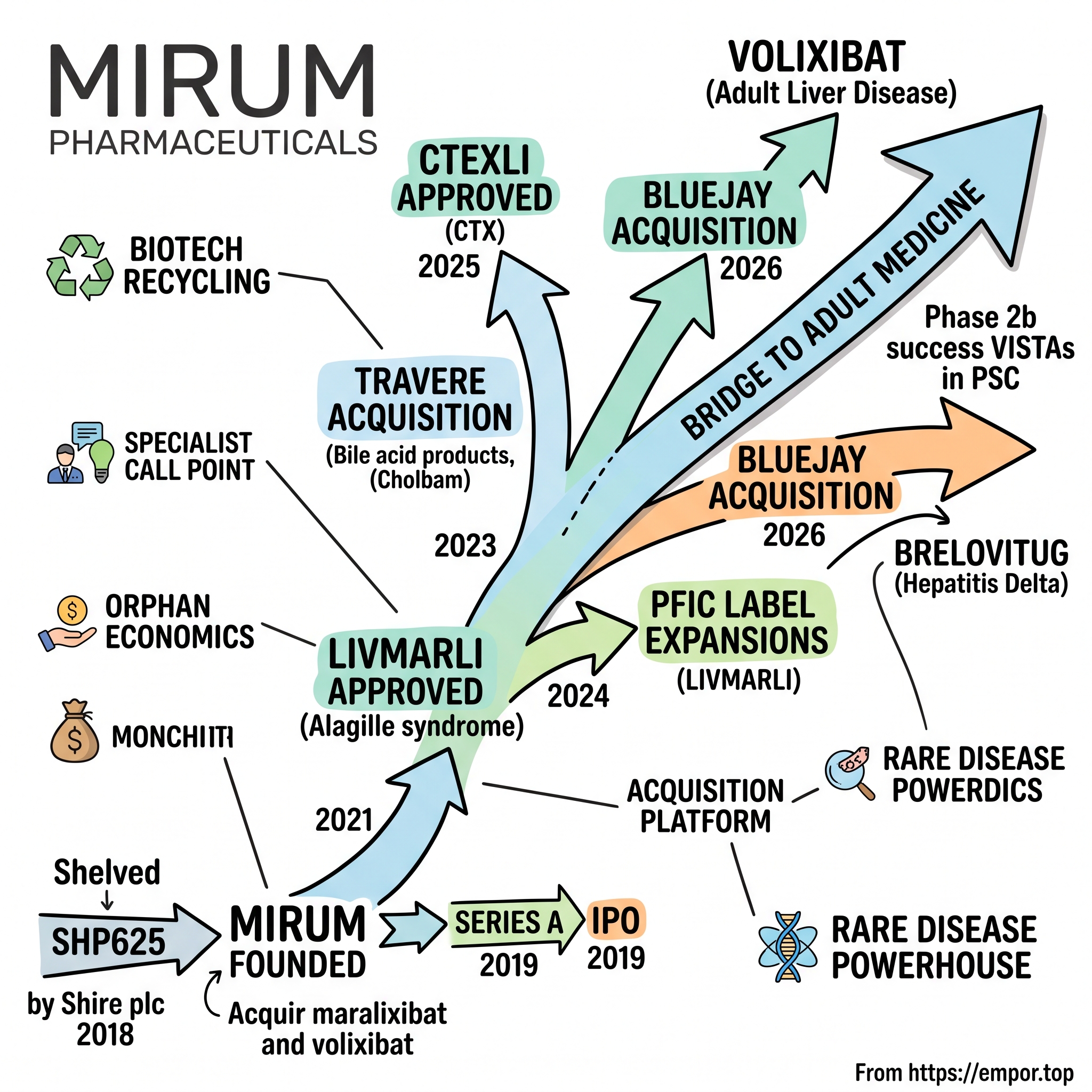
Mirum Pharmaceuticals: Rescuing Shelved Science to Build a Rare Disease Powerhouse
I. Introduction & Episode Roadmap
In the autumn of 2018, a molecule named SHP625 sat in a filing cabinet inside one of the world's most acquisitive pharmaceutical companies, largely neglected.
The asset carried a troubled history. Four years earlier, it served as the centerpiece of a $260 million acquisition.1 It subsequently failed its headline clinical trial, triggering a renegotiation in which the seller's shareholders agreed to forfeit most of their earn-out.2 Its parent company, Shire plc, was in the final months of being acquired by Takeda in one of the largest deals in pharmaceutical history. Pipeline assets were evaluated against a strict benchmark: whether a drug could realistically become a blockbuster.
For a compound targeting a few thousand children worldwide with rare genetic liver diseases that most physicians had never encountered, the internal verdict was clear: it could not.
However, a small team of executives who had spent years working on the molecule viewed the situation differently. In November 2018, they acquired the rights to the drug and established Mirum Pharmaceuticals. Eight months later, the company completed an initial public offering at $15.00 per share.3 By 2025, Mirum reported $521.3 million in annual net product sales and raised its subsequent full-year revenue guidance to between $660 million and $680 million, with its stock trading near $107 per share.428
That growth reflects an underlying mechanism that is repeatable. Since 2021, Mirum has applied this playbook at increasing scale and higher operational risk.
The trajectory—from discarded pipeline candidate to a commercial-stage rare disease platform—highlights not merely that the strategy succeeded once, but why it succeeded and whether it can withstand Mirum's expansion into broader therapeutic markets.
The company as it stands today. Mirum Pharmaceuticals, Inc. trades on the NASDAQ Global Market under the ticker MIRM.3 Headquartered in Foster City, California, the commercial-stage biopharmaceutical company operates across two business segments defined by management as distinct: rare liver diseases and rare genetic diseases. Its commercial portfolio features LIVMARLI (maralixibat), an oral ileal bile acid transporter inhibitor approved for cholestatic pruritus in Alagille syndrome and progressive familial intrahepatic cholestasis; Cholbam (cholic acid), indicated for bile acid synthesis disorders; and Ctexli (chenodiol), approved in 2025 as the first therapy for cerebrotendinous xanthomatosis.467 Its development pipeline extends beyond the founding asset to include volixibat for adult cholestatic liver disease, brelovitug for chronic hepatitis delta, zilurgisertib for fibrodysplasia ossificans progressiva, and MRM-3379 for Fragile X syndrome.5
Four threads to follow.
The first is biotech recycling. Mirum's founding thesis posited that large pharmaceutical corporations systematically misprice niche assets—not due to faulty science, but because the economics of a $50 billion revenue base cannot justify prioritizing a $300 million market opportunity. While that valuation gap provides repeatable entry points, the strategy has drawn increasing competition.
The second is the rare disease commercial machine. Ultra-orphan therapeutics command high list prices that would face severe resistance in primary care, yet they are commercialized by compact sales teams targeting a concentrated network of specialist prescribers. This structure yields distinct economics: Mirum's disclosures indicate a commercial cash contribution margin in the mid-50% range—a profitable model, though below the 90% gross margins frequently attributed to orphan drugs in casual industry analysis.58
The third is acquisition as a substitute for research. Mirum has built its portfolio primarily through acquisitions and licensing rather than internal discovery. The 2023 acquisition of Travere Therapeutics' bile acid portfolio demonstrates this approach in commercial assets, while the 2026 acquisition of Bluejay Therapeutics represents its largest and highest-risk transaction to date.
The fourth is the bridge to adult medicine. Ultra-rare disease franchises eventually hit ceiling constraints driven by small patient populations. Mirum's expansion strategy relies on volixibat and brelovitug, which target adult liver conditions with patient bases significantly larger than Alagille syndrome. Whether this transition succeeds represents the central core of the investment thesis.
A key analytical principle frames this narrative. The strategy Mirum presents is coherent and supported by historical execution, but management claims require continuous testing against objective financial performance, competitive dynamics, and execution risks—particularly where long-term results remain unproven.
To examine how the founding asset became available, the story begins in San Diego with a specific hypothesis regarding bile acid biology.
 Subscribe on LinkedIn
II. The Lumena & Shire Era: The Birth and Abandonment of Maralixibat (2011–2018)
Understanding the asset's development trajectory requires examining the underlying pathology.
The liver synthesizes bile acids—detergent-like molecules essential for breaking down dietary lipids. Bile flows from the liver through a network of ducts into the intestine to facilitate digestion, where approximately 95% of the bile acid pool is reabsorbed near the terminal ileum and transported back to the liver. It is an efficient enterohepatic recycling system.
In cholestatic liver diseases, this drainage pathway fails. In Alagille syndrome, a rare genetic disorder, patients are born with a paucity of interlobular bile ducts. In progressive familial intrahepatic cholestasis, genetic mutations disrupt the hepatocellular transport pumps responsible for bile secretion. In both conditions, bile acids accumulate within the liver—causing tissue damage and fibrosis—and spill into systemic circulation, triggering severe cholestatic pruritus.
The clinical term understates the severity of the symptom. Cholestatic pruritus is deeply debilitating: pediatric patients scratch continuously, often causing open skin lesions. Standard interventions traditionally relied on off-label bile acid sequestrants with poor tolerability, or surgical biliary diversion—a procedure that routes bile through an abdominal stoma into an external collection bag to relieve intolerable itching.
The pharmacological strategy targeted the recycling mechanism directly. By inhibiting reabsorption in the distal ileum, bile acids are excreted in stool rather than returning to a compromised liver. The ileal bile acid transporter (IBAT) mediates this reabsorption process. Inhibiting IBAT with a minimally absorbed oral agent interrupts the enterohepatic circuit while minimizing systemic exposure—acting as a valve on the return flow rather than attempting a direct repair of the biliary architecture.
Lumena assembles the portfolio. Lumena Pharmaceuticals was established in San Diego in the early 2010s to develop IBAT inhibitors, with Mike Grey among its founders and RiverVest Venture Partners among its backers.9 Lumena licensed compounds to evaluate them in niche indications overlooked by their original developers. LUM001—later named maralixibat—was directed toward pediatric cholestatic liver diseases, while LUM002—later named volixibat—was targeted at fatty liver disease.
Shire buys the story. On May 30, 2014, Shire announced the acquisition of Lumena for approximately $260 million upfront, alongside milestone-contingent earn-outs.1 The acquisition aligned with Shire's established rare disease portfolio and a gastrointestinal franchise generating over $800 million in annual revenue, while Lumena offered late-stage optionality across four potential orphan indications.1 Peak sales projections for the programs at the time reached approximately $2 billion.2
That $2 billion sales expectation defined the threshold required to justify long-term priority within Shire's pipeline.
The endpoint problem. In April 2015, a Phase 2 trial of SHP625 in pediatric Alagille syndrome missed both its primary and secondary endpoints.2 The trial design relied on reductions in serum bile acid levels—a quantitative laboratory biomarker that failed to show consistent statistical movement in the study.
By September 2015, Shire restructured the acquisition agreement, replacing the milestone structure with a $90 million settlement to former Lumena shareholders, as disclosed in its third-quarter financial report.2 Shire's head of R&D stated publicly that the company remained committed to ongoing studies while determining whether a viable development path existed.2
Behind the missed statistical endpoint lay a notable clinical divergence. While biochemical markers showed inconsistent change, investigators observed that trial participants experienced meaningful reductions in pruritus and improved sleep continuity. Several patients remained on maralixibat for years through extension protocols because treating physicians observed sustained clinical benefit.
This divergence exposed a structural vulnerability in large-scale drug development. In corporate portfolio governance, formal protocol endpoints take precedence over secondary clinical observations, as statistical plans dictate regulatory filings and executive resource allocation.
Deprioritization. By 2018, as Shire was being acquired by Takeda in a transaction valued at approximately $62 billion, the combined pipeline underwent systematic triage. A pediatric candidate with a failed Phase 2 trial, a high-cost Phase 3 commitment ahead, and a target population of a few thousand patients did not meet corporate investment criteria.
This outcome reflected corporate economic scale rather than flawed pharmacology. Shire evaluated maralixibat against its extensive global cost structure, where a candidate with $300 million in peak revenue potential represented an inefficient allocation of managerial and commercial resources. For a smaller, lean organization, that same market potential offered a viable foundation for a standalone commercial business.
Furthermore, large pharmaceutical companies face institutional disincentives against revisiting deprioritized assets. Once SHP625 was designated internally as a Phase 2 failure, advancing it required overcoming significant institutional resistance. For individual executives, championing a high-risk Phase 3 trial for a previously failed asset during a major corporate integration carried substantial career risk with limited professional upside. The rational corporate decision was to reallocate capital—creating a structural mispricing that nimble acquirers could exploit.
Simultaneously, orphan drug economics evolved between 2014 and 2018. Industry precedents demonstrated that small patient populations could support sustainable commercial models through premium pricing structures. By 2018, modeling a target population of a few thousand patients at several hundred thousand dollars annually offered a viable commercial thesis—one that had not yet been fully integrated into Shire's initial evaluation.
The executives who recognized the disconnect between the clinical observations and the evolving market economics were positioned to acquire the discarded asset.
III. Rescuing the Asset & The Founding of Mirum (2018–2019)
There is a narrative in biopharma where executives rescue a deprioritized drug out of pure sentimental commitment to patients. While human connection played a role, the founding of Mirum was fundamentally a business transaction: a targeted piece of corporate arbitrage executed by insiders who recognized the unexploited value of the asset.
The founders. Mike Grey had run Lumena and knew the compounds intimately. Niall O'Donnell was a managing director at RiverVest, which had backed Lumena, bringing both investor relationships and historical due diligence.9 Chris Peetz added corporate development experience: from May 2014 to December 2016, he served as chief financial officer and head of corporate development at Tobira Therapeutics, a liver disease specialist acquired by Allergan in November 2016, following prior corporate development roles at Jennerex and Onyx Pharmaceuticals and merger advisory work at LaSalle Corporate Finance.10
That background reflects a specific organizational DNA: Peetz was not a scientist-founder, but a dealmaker who specialized in liver disease. From its inception, Mirum was structured as a deal-making organization built around an acquired clinical asset.
The buyback. On November 7, 2018, Mirum announced that it had acquired exclusive global rights to develop and commercialize both maralixibat and volixibat from Shire in exchange for an upfront payment, an equity stake in Mirum, and potential milestones and royalties.9 Although the upfront cash figure was not disclosed, the equity component was telling. A seller liquidating a valueless asset typically demands cash; taking equity served as a financial hedge, preserving a call option if the drug succeeded under new management.
The transaction structure also reflected Mirum's capital position. Lacking the cash required to acquire the asset outright at full option value, the founders funded a portion of the purchase price using equity.
Capital. Simultaneously, Mirum closed a $120 million Series A financing led by New Enterprise Associates, with participation from Deerfield Management, Frazier Healthcare Partners, Novo Holdings, Pappas Capital, RiverVest Venture Partners, and Rock Springs Capital.9 For a Series A round in 2018, $120 million was substantial, signaling that investors were not funding exploratory research but rather a late-stage Phase 3 program they viewed as substantially de-risked.
That confidence rested on clinical data generated under Shire. At the time of the financing, maralixibat held FDA Breakthrough Therapy designation based on a Phase 2 study in progressive familial intrahepatic cholestasis type 2 (PFIC2) that showed sustained responses over more than two years. In addition, the Phase 2b ICONIC study in Alagille syndrome had demonstrated interim reductions in both bile acids and pruritus compared to placebo.9 Mirum had effectively acquired a program after another company had financed its initial, high-risk development.
The reframe. Mirum's main strategic pivot involved redefining the pivotal trial's primary endpoint. Rather than relying on serum bile acid reduction as the registrational endpoint, the company centered its regulatory strategy on patient-reported pruritus, supported by long-term event-free survival comparisons against natural history cohorts.
This change represented a fundamental shift in clinical rationale. Management argued that serum bile acid levels were an imperfect proxy, and that in a disease defined by severe pruritus, direct measurement of itching was more clinically meaningful than a laboratory biomarker. The FDA accepted the rationale. At the same time, endpoint adjustments following a trial failure warrant careful scrutiny, as post-hoc reframing is a common strategy for distressed assets. The approach was ultimately validated by subsequent controlled data rather than the conceptual argument alone.
Executing this strategy presented significant methodological challenges. Quantifying pruritus required a validated instrument: a daily diary in which patients, or caregivers reporting for young children, scored symptom severity on a standardized scale. Developing and validating such an instrument to regulatory standards is time-intensive and yields subjective data compared to standard blood tests. While large pharmaceutical corporations managing broad pipelines often prioritize quantitative blood markers, a single-asset company whose survival depends on demonstrating symptomatic efficacy was incentives-aligned to perform this validation. Mirum's focus on cholestatic itch measurement built institutional capability that subsequently supported trials across its liver portfolio, including volixibat.
Leadership transition and IPO. Grey served as chairman and chief executive officer at founding, with Peetz as president and board member. Peetz was appointed chief executive officer in early 2019 as the company transitioned from asset acquisition to clinical execution.910
Eight months after completing its Series A, Mirum moved quickly to public markets. On July 17, 2019, the company priced an initial public offering of 5 million shares at $15.00 per share, listing on the Nasdaq Global Market the following day and closing the transaction on July 22 for gross proceeds of $75 million.3
That compressed timeline was enabled by favorable market conditions in 2019, when biotech investors strongly backed late-stage, single-asset orphan drug candidates. However, the $75 million gross proceeds provided modest capital, sufficient to fund the pivotal Phase 3 program but leaving little reserve. Consequently, Mirum would need to return to capital markets repeatedly to fund ongoing operations and future expansion.
With public shareholders and a single clinical asset that had previously failed a Phase 2 trial under prior ownership, Mirum faced immediate pressure to execute.
IV. Clinical Validation & Commercial Launch: LIVMARLI's Breakthrough (2019–2022)
On September 29, 2021, the FDA approved LIVMARLI (maralixibat) oral solution for treating cholestatic pruritus in Alagille syndrome patients one year of age and older—making it the first approved therapy for the condition.611 Less than four years after Mirum was established, the molecule that had been deprioritized during Shire's acquisition by Takeda became a commercially labeled drug.
The approval validated Mirum's regulatory pivot. By accepting itch reduction as the primary basis for approval in a cholestatic disease, the FDA established a precedent that Mirum would subsequently apply across its liver pipeline, including its volixibat program.
Monetizing the voucher. The approval of a rare pediatric disease therapy granted Mirum a Rare Pediatric Disease Priority Review Voucher—a transferable asset that allows a sponsor to shorten a subsequent FDA review timeline. In November 2021, Mirum agreed to sell the voucher for $110 million, completing the transaction in December for $108.0 million in net proceeds after commissions.12
The $108.0 million in net proceeds exceeded the $75 million in gross proceeds raised in Mirum's initial public offering. Monetizing the voucher immediately provided non-dilutive liquidity to a single-product company without a near-term internal pipeline candidate requiring accelerated review, establishing a pattern of converting regulatory assets directly into balance sheet strength.
Building the commercial engine. Commercializing an ultra-orphan drug differs fundamentally from primary care pharmaceutical sales. Lacking broad consumer advertising or large-scale physician detailing, patient distribution in the United States concentrates around specialized pediatric hepatology centers.
To target this concentrated market, Mirum deployed a compact sales force. Management later disclosed that its U.S. liver field team comprised approximately twenty representatives targeting around 1,500 healthcare providers.8 Because prescriber networks in rare diseases are fixed and small, commercial selling costs remain largely capped. Revenue scales through patient identification and pricing rather than sales force expansion, generating significant commercial operating leverage on incremental volume.
Pricing dynamics and sector risks. LIVMARLI is weight-dosed, leading to broad variation in annual patient costs. Published economic analyses estimate the annual treatment cost for an average-sized patient at approximately $391,000, with costs ranging from roughly $129,000 to over $1.9 million per patient per year based on weight.13
These high list prices reflect standard ultra-orphan commercial models, which amortize development costs across narrow patient populations. Payers have generally reimbursed these costs in the absence of therapeutic alternatives, though reliance on premium pricing presents an ongoing regulatory and reimbursement risk across the rare disease sector.
Weight-based dosing also creates an internal revenue growth mechanism in pediatric populations. As pediatric patients grow, their required dosage—and corresponding annual therapy cost—increases automatically over time. For chronic therapies with high treatment adherence, this weight progression provides a steady tailwind to same-patient revenue that operates independently of list price increases or new patient additions.
Distribution and access infrastructure. Ultra-orphan therapies are distributed through specialized channels. Rather than retail pharmacies, distribution flows through a small network of specialty pharmacies, resulting in revenue concentration among a few commercial customers in financial reporting. In practice, specialty pharmacies serve primarily as distribution logistics intermediaries rather than drivers of demand.
The primary operational cost lies in patient access infrastructure. Managing prior authorization approvals, navigating payer appeals, coordinating genetic testing, and administering patient assistance programs require dedicated staff that exceeds the size of the direct sales force. These support functions represent a substantial component of selling, general, and administrative expenses, which standard industry calculations of field sales costs often overlook.
Geographic expansion and label extensions. Mirum subsequently expanded LIVMARLI along both geographic and label axes. The European Commission granted marketing authorization for LIVMARLI to treat cholestatic pruritus in Alagille syndrome patients two months and older in late 2022, following a favorable CHMP opinion in September 2022.14 On March 13, 2024, the FDA expanded LIVMARLI's label to include cholestatic pruritus in progressive familial intrahepatic cholestasis (PFIC) patients five years and older. This approval was supported by the Phase 3 MARCH study—a 93-patient randomized trial evaluating PFIC types 1, 2, 3, 4, 6, and undetermined genotypes, which represented the largest randomized study conducted in the disease.15 In July 2024, the FDA lowered the minimum age for the PFIC indication to twelve months and approved a higher-concentration oral formulation.16 By March 2025, Mirum's Japanese commercial partner, Takeda, secured regulatory approval for LIVMARLI in both Alagille syndrome and PFIC.17
The partnership with Takeda highlights a notable corporate turn: Takeda, which inherited the decision to shelve maralixibat upon acquiring Shire, ultimately served as Mirum's commercial distribution partner for the molecule in Japan.
These label expansions significantly widened the target market, as PFIC represented a broader commercial opportunity than Alagille syndrome. By mid-2025, LIVMARLI had evolved from a single pediatric niche treatment into an expanded rare liver disease franchise. However, Mirum remained dependent on a single asset, setting the stage for portfolio diversification through strategic acquisitions.
V. Masterclass in Capital Allocation: The Travere Bile Acid Portfolio Acquisition (2023)
In mid-2023, Travere Therapeutics faced a common biopharma dilemma: it owned two profitable commercial products that no longer aligned with its long-term strategic direction.
Travere's primary focus was Filspari, a kidney disease therapy competing in a large, capital-intensive market. Alongside Filspari sat Cholbam and Chenodal, legacy bile acid products serving small patient populations. These products shared virtually no prescribers with Travere's nephrology sales force. While they generated positive cash flow, they also created operational drag for an organization allocating capital toward a major primary care launch.
This situation mirrored Shire's deprioritization of maralixibat five years earlier, illustrating a recurring structural inefficiency in the pharmaceutical industry: assets are often orphaned not because of clinical or commercial failure, but because they become strategically misaligned with their parent corporate structures.
Terms. On July 17, 2023, Mirum announced an agreement to acquire Travere's bile acid portfolio for up to $445 million—comprising $210 million in upfront cash and up to $235 million in milestone payments tied to annual net sales thresholds ranging from $125 million to $500 million.18 The transaction closed on August 31, 2023, with the final upfront payment recorded at $210.4 million.19
What Mirum actually bought. Cholbam was approved for bile acid synthesis disorders caused by single enzyme deficiencies and as adjunctive treatment for peroxisomal disorders with liver involvement.18 Chenodal, at the time of purchase, held a legacy label for radiolucent gallstones—an indication with minimal commercial value—but was being prescribed off-label for cerebrotendinous xanthomatosis (CTX) and was undergoing Phase 3 development for that indication.18
The analytical value of the transaction centered on Chenodal. Mirum was not merely buying existing cash flow; it was acquiring a late-stage regulatory candidate with an established base of patients already receiving the drug off-label. This structure allowed Mirum to fund late-stage development through existing product revenue while securing a pre-existing patient population ahead of potential regulatory approval.
On the price. The upfront payment represented a modest multiple of the portfolio's trailing net product sales—substantially lower than the mid-single-digit revenue multiples typical for de-risked commercial assets. This pricing reflected seller circumstances rather than market concessions. Travere was a motivated seller seeking to reduce cash burn; the transaction included milestone payments that shared future upside; and Chenodal's CTX indication remained an unapproved pipeline asset dependent on an ongoing Phase 3 trial. Mirum secured a lower valuation by assuming regulatory and clinical execution risks that larger strategic buyers declined to take.
The strategic fit provided the primary operational advantage. Bile acid synthesis disorders and CTX are managed by the same specialized metabolic and hepatology specialists that Mirum's field force already visited. By integrating the acquired therapies into its existing commercial structure, Mirum added product revenue without expanding its sales force proportionally.
How it was paid for — and a correction worth making. Industry descriptions sometimes characterize the acquisition as non-dilutive. That description is inaccurate. Mirum financed the transaction primarily through an oversubscribed private placement of common stock that raised approximately $210 million in gross proceeds, led by Frazier Life Sciences alongside Avidity Partners, BVF Partners, Longitude Capital, Sofinnova Investments, and other existing and new investors.19 Separately, in April 2023, Mirum had priced an upsized $275.0 million offering of 4.00% convertible senior notes due 2029.20
In effect, Mirum acquired a commercial portfolio at a reasonable valuation by issuing equity into a receptive market while layering on convertible debt. While the transaction represented effective opportunistic financing, it relied directly on equity expansion. Evaluating management's capital allocation requires recognizing both sides of the ledger: the assets were acquired on favorable terms, but existing shareholders funded the purchase through dilution.
The catalyst arrives. On February 24, 2025, the FDA approved Ctexli (chenodiol) tablets for adults with cerebrotendinous xanthomatosis, making it the first and only approved treatment for the disease.7 CTX is a rare autosomal recessive metabolic disorder where a missing enzyme leads to toxic accumulation of bile alcohols and cholestanol in tendons and the central nervous system, causing progressive neurological impairment and premature death. It affects an estimated 1,000 to 2,000 individuals in the United States. Approval rested on results from the Phase 3 RESTORE study, where Ctexli met its primary endpoint by demonstrating a statistically significant reduction in urine bile alcohols.7
The regulatory approval fundamentally altered the commercial profile of the drug. What had been a generic legacy compound used off-label became an exclusivity-protected, branded orphan therapy backed by a dedicated commercial team. Mirum's rare genetics team has since been actively identifying undiagnosed CTX patients—management's stated reason for the bile acid franchise's steady growth.8
What the deal reveals about how Mirum thinks. Comparing the Travere acquisition with the earlier Shire transaction highlights a consistent corporate strategy. In both cases, Mirum identified assets that larger organizations had rationally deprioritized, negotiated terms reflecting seller urgency rather than intrinsic asset value, and created value by completing clinical development and commercialization. Rather than relying on internal discovery science, Mirum succeeded through focused commercial execution in niche indications.
While this model has proven effective, it carries structural risks. A strategy dependent on acquiring discarded assets requires a continuous pipeline of mispriced targets available on favorable terms. As competing buyers adopt similar strategies, acquisition multiples tend to rise. Furthermore, the Travere transaction occurred during a period of constrained biotech capital markets in 2023, when sellers faced heightened pressure to liquidate non-core assets—an environment that may not persist across all market cycles.
Ultimately, the Travere transaction achieved three key objectives: it provided immediate cash generation, transitioned Mirum from a single-asset company into a portfolio company with a second commercial team, and established a template management has followed ever since. All three mattered for what came next.
VI. Commercial Execution & Segment Breakdown: The $600M+ Revenue Engine Today
By early 2026, the financial metrics transitioned from a narrative of asset rescue into the realities of an operating commercial business.
The trajectory. Total net product sales expanded from $336.4 million in fiscal 2024 to $521.3 million in fiscal 2025—a 55% annual increase that exceeded management's original guidance range.4 Within that total, LIVMARLI generated $360.0 million, split between $244.7 million in the United States and $115 million internationally, while the acquired bile acid medicines contributed $161.3 million.45 Fourth-quarter net product sales reached $149 million, compared with $99 million in the prior-year period.5
Management initially entered 2026 guiding to full-year net product sales between $630 million and $650 million.4 Following a first quarter that delivered $159.9 million in net product sales—comprising $113.8 million from LIVMARLI (up 55% year-over-year) and $46.1 million from the bile acid franchise (up 20%)—the company raised its full-year guidance to between $660 million and $680 million.21
What is actually driving growth. The underlying drivers of this growth require granular examination. On Mirum's first-quarter 2026 earnings call, management attributed the commercial outperformance primarily to expanding adoption in PFIC, specifically among adult patients. Chief Executive Chris Peetz informed analysts that older adolescents and adults represented the primary growth vector, noting that the company remained in the early stages of educating adult providers on genetic testing, with only a minority currently testing patients—implying a substantial remaining pool of undiagnosed individuals.8
This management thesis warrants evaluation from two perspectives. Optimistically, it highlights a genuine growth vector: because PFIC was historically categorized as a pediatric condition, adults carrying milder genotypes frequently went undiagnosed for decades and are only now being identified as genetic testing expands. Skeptically, it describes expansion reliant on permanently altering physician diagnostic behavior—a process without a predictable timeline. Once the pool of undiagnosed adults is identified, this growth catalyst will abate. Neither management nor independent analysts can precisely quantify that patient population, and Mirum does not disclose active commercial patient counts.
International, and a lesson in revenue quality. A disclosure by Chief Financial Officer Eric Bjerkholt on the fourth-quarter 2025 earnings call provided key context regarding revenue quality: Japan contributed $22 million in 2025 net sales driven by channel inventory build rather than underlying patient demand, meaning 2026 Japanese revenue would adjust lower even as the commercial launch proceeded as planned.5
Volunteering that a portion of prior-year revenue represented distributor stocking rather than end-user demand offers important transparency. It also underscores a structural feature of international expansion: ex-U.S. territories governed by distribution partners generate volatile revenue that does not consistently mirror quarterly patient uptake.
Margins, stated accurately. Mirum reported a commercial cash contribution margin of approximately 55% for 2025, representing a significant increase over prior periods, and maintained a mid-50% contribution margin in the first quarter of 2026.58 Full-year 2025 operating expenses totaled $543.4 million—comprising $186 million in research and development, $257 million in selling, general, and administrative expenses, and $100 million in cost of sales—which included $95 million in non-cash charges such as stock-based compensation and intangible asset amortization.45 The company recorded a full-year net loss of $23.4 million for 2025 while generating positive operating cash flow.45
Two analytical conclusions emerge from these financials. First, industry generalizations depicting orphan drug commercialization as yielding 90% gross margins overstate Mirum's operating profile; when accounting for intangible asset amortization from acquisitions and the non-field costs of specialty distribution and patient support, contribution economics are solid but far from effortless. Second, the divergence between GAAP net losses and positive operating cash flow stems largely from non-cash amortization associated with the Travere transaction—an accounting artifact of expanding through asset acquisition rather than internal discovery, indicating that GAAP net income understates the underlying cash generation of the commercial portfolio.
The competitive picture. Mirum operates alongside competing therapies in the IBAT inhibitor class. Ipsen, following its acquisition of Albireo, commercializes odevixibat under the brand name Bylvay for PFIC and Alagille syndrome, as well as Kayfanda in the European Union, reporting €180 million in 2025 Bylvay sales—a 32.5% increase from €135.9 million in 2024.22
This comparison provides the clearest disclosed benchmark in the pediatric cholestasis market. Comparing LIVMARLI's $360 million in 2025 sales against Bylvay's roughly €180 million indicates that Mirum commands the larger market share in pediatric cholestasis and continues to expand off a larger baseline. However, because neither company discloses product sales by specific indication and their international commercial footprints vary, market share claims for individual indications remain unverified estimates rather than confirmed disclosures.
The patient identification funnel. Below headline revenue, commercial expansion depends on a specialized patient identification model. In broad primary care indications, commercial strategy focuses on capturing market share among already diagnosed and treated patients. In rare disease markets, a majority of the addressable population remains undiagnosed. A pediatric patient with unexplained cholestatic pruritus and elevated liver enzymes may spend years consulting general pediatricians and dermatologists before receiving an accurate diagnosis. An adult with a mild PFIC genotype is often misdiagnosed with idiopathic cholestasis, while a CTX patient may present with cataracts, tendon xanthomas, and neurological symptoms across multiple specialists who fail to connect the underlying etiology.
Consequently, commercial execution relies primarily on disease detection rather than brand switching: establishing genetic testing protocols in academic centers, funding diagnostic screening initiatives, and educating adult hepatologists on adult presentations of genetic liver conditions. This model possesses a distinct commercial property: because patient identification expands the diagnosed market, Mirum's growth does not require taking existing patients from competitors, allowing multiple IBAT inhibitors to grow concurrently. However, detection-driven growth continuously consumes an unquantified pool of undiagnosed patients. As that pool is converted into treated patients, the rate of new patient additions will eventually normalize.
Ipsen's development history also offers a relevant risk indicator: Bylvay failed its Phase 3 trial in biliary atresia—a condition expected to account for approximately half of the enrolled population in Mirum's ongoing EXPAND basket study.5 Management contends that trial designs differ, noting that Ipsen's study and Mirum's earlier EMBARK trial evaluated serum bilirubin in infants immediately following Kasai portoenterostomy, whereas EXPAND enrolls older post-Kasai pediatric patients experiencing persistent cholestatic pruritus, measuring a distinct clinical endpoint in a different patient population.5 While the clinical distinction is logical, its validity ultimately depends on Phase 3 trial results rather than theoretical differentiation.
Myth versus reality. Four common assertions regarding Mirum's commercial operations are contradicted by financial disclosures.
Myth: Orphan drug gross margins consistently exceed 90%. Reality: Mirum reported a commercial cash contribution margin of approximately 55% in 2025.5 The difference reflects tangible operating expenses: amortization of acquired product rights, specialty pharmacy distribution fees, comprehensive patient support infrastructure, and the accounting treatment of acquired commercial assets whose purchase price amortizes across income statements over time.
Myth: Mirum financed its portfolio expansion without equity dilution. Reality: Expansion has relied heavily on equity issuances and convertible debt offerings. While the sale of the priority review voucher generated non-dilutive capital, corporate acquisitions and trial funding were predominantly equity-financed.
Myth: Mirum maintains a verified, precise market share in Alagille syndrome. Reality: Neither Mirum nor Ipsen breaks down revenue by indication. Financial disclosures confirm that LIVMARLI's total sales are approximately double Bylvay's global revenue and growing at a faster rate, but specific indication share estimates lack official reporting.422
Myth: The acquired bile acid portfolio represents a stagnant legacy asset. Reality: The segment generated 31% sales growth in 2025 and 20% year-over-year growth in the first quarter of 2026, driven primarily by Ctexli's regulatory approval and the deployment of a dedicated patient identification program.421 While growing more slowly than LIVMARLI, the portfolio operates as an active growth contributor rather than a passive cash generator.
The commercial foundation is established, expanding, and cash-generative; its ultimate valuation depends on whether Mirum can successfully transition this rare disease engine into broader adult therapeutic indications.
VII. The Hidden Optionality: Volixibat & The Adult Hepatology Frontier
Volixibat came with maralixibat in the 2018 Shire deal. For years it was the other molecule — the one nobody modeled. In 2026 it became the most consequential thing Mirum owns.
The strategic logic. Alagille syndrome and PFIC are ultra-rare by definition. However well Mirum executes, the arithmetic ceiling is set by epidemiology. Management's stated long-term view is that LIVMARLI's total brand potential is above $1 billion, of which roughly a third depends on the EXPAND basket indication succeeding.5 Even taking that at face value, it is a bounded number.
Adult cholestatic liver disease is not bounded in the same way. Primary sclerosing cholangitis — progressive inflammatory scarring of the bile ducts — has no approved pharmacotherapy anywhere. Primary biliary cholangitis is substantially more prevalent, and while approved therapies exist, a large fraction of patients continue to suffer severe itch despite them. Both diseases produce the same cholestatic pruritus that Mirum has spent a decade learning to measure and treat.
The mechanistic bet is that the itch is the same problem in a different disease. That bet is now supported by controlled data.
VISTAS. On May 4, 2026, Mirum announced that the Phase 2b VISTAS study of volixibat in PSC met its primary endpoint.23 The study enrolled 158 patients, with 111 forming the primary analysis cohort of moderate-to-severe itch and 47 a secondary mild-itch cohort, dosed at 20 mg twice daily.23
The results were unambiguous on efficacy. Volixibat-treated patients showed a 2.72-point reduction from baseline on the Adult ItchRO scale, a placebo-adjusted difference of 1.64 points, with a p-value below 0.0001. A ≥2-point improvement — the threshold generally regarded as clinically meaningful — was achieved by 55.6% of volixibat patients versus 26.3% on placebo. Improvement appeared within two weeks.23
Set the statistics aside for a moment. In a disease with zero approved drugs, roughly one in two treated patients experienced a clinically meaningful reduction in their most debilitating symptom, against roughly one in four on placebo. That is a real effect, and the placebo response rate is itself informative — it confirms that itch scales are noisy and that the drug had to clear a substantial sham signal to reach significance.
The safety data, read honestly. Treatment-emergent adverse events occurred in 93.5% of volixibat patients versus 84.0% on placebo; Grade 3 or higher events in 13.0% versus 11.1%; serious adverse events in 10.4% versus 6.2%. Gastrointestinal effects and diarrhea (3.9%) were the mechanistically expected findings, alongside elevations in liver enzymes and bilirubin.23
Blocking bile acid reabsorption means more bile acid reaching the colon, which means loose stools. That is the mechanism working, not a surprise. The near-doubling of serious adverse events on a small base is the item to watch — it may be noise in a 158-patient study, or it may be a signal that matters at scale in a population with progressive liver disease. Chief Medical Officer Joanne Quan characterized VISTAS as delivering "a clear and compelling efficacy signal."23 That is an accurate description of the efficacy data and not a complete description of the risk-benefit profile, which the FDA will assess.
PBC. The VANTAGE study in PBC produced a supportive interim analysis: a 3.82-point reduction in itch with a placebo-adjusted difference of 2.32 points, 75% of treated patients achieving a greater than 50% reduction in serum bile acids, and significant improvement in fatigue at week 16, with diarrhea the most common adverse event and all cases mild to moderate.24 The FDA granted volixibat Breakthrough Therapy designation for cholestatic pruritus in PBC in October 2024.24 Full VANTAGE results are expected in the first quarter of 2027.21
Regulatory path. Mirum planned a pre-NDA meeting with the FDA in the summer of 2026 and a U.S. NDA submission in the second half of the year.2123 On the fourth quarter 2025 call, Peetz explained the safety database question directly: prior FDA interactions, including discussions framed around PBC, had established what the agency wanted, with acknowledgment that PSC is a smaller population, and Mirum therefore expected the VISTAS study alone to constitute a sufficient safety database for the PSC indication.5
The commercial build, and its cost. Extending into adult hepatology requires a different field organization. Mirum said it would expand from roughly 20 United States liver field personnel reaching about 1,500 providers to approximately 60, reaching over 4,000 healthcare professionals — beginning in late 2026, with the team fully operational in early 2027.8
Tripling the field force is where the elegant orphan cost structure starts to erode. Fixed selling costs that were trivially small become materially larger, and they are incurred before any revenue arrives. If volixibat is approved and adopted, that spending is trivially justified. If approval slips or uptake disappoints, Mirum will be carrying a substantially heavier commercial base against the same pediatric revenue.
And pricing. Asked how volixibat would be priced, Peetz pointed to the PPAR agonists used in PBC as "a good planning benchmark" while declining to commit, and noted the distinguishing feature that in PSC there are no other approved medicines.5 The subtext is worth decoding: PSC pricing could be set well above PBC benchmarks precisely because there is no comparator, but a single molecule serving two indications with very different competitive contexts creates an awkward pricing problem. Mirum has not solved it publicly.
The hepatitis delta bet. Alongside volixibat, Mirum acquired an entirely new modality. On January 26, 2026, it completed the acquisition of Bluejay Therapeutics, adding brelovitug — a fully human monoclonal antibody targeting hepatitis B surface antigen on both HDV and HBV, carrying FDA Breakthrough Therapy and EMA PRIME designations.25 The consideration was approximately $620 million, comprising $250 million in cash and $370 million in Mirum stock, plus up to $200 million in sales-based milestones.26
Hepatitis delta is the most aggressive form of viral hepatitis, requiring co-infection with hepatitis B, and in the United States there is no specifically labeled therapy. On April 27, 2026, Mirum reported that the Phase 2b portion of AZURE-1 met its primary endpoint: among the first 53 patients at week 24, the composite of virologic response plus ALT normalization was achieved by 45% of the 300 mg weekly arm and 35% of the 900 mg every-four-weeks arm, versus 0% in the delayed-treatment arm, with 100% of the 300 mg arm and 75% of the 900 mg arm achieving virologic response.27
A zero percent control rate makes the comparison easy. But note what Mirum's chief medical officer conceded when an analyst at Stifel pressed on the 900 mg arm looking like an outlier: the numbers are small, the endpoint is a hard week-24 cutoff that puts patients on one side of a line, responses deepen with continued treatment, and a final assessment awaits the full AZURE-1 and AZURE-4 Phase 3 datasets.8 That is a candid, non-defensive answer to a hostile-adjacent question, and it is the right way to read the data.
Brelovitug is also expensive. Bjerkholt guided to roughly a $150 million increase in R&D spending tied to the program, about half of it chemistry, manufacturing and controls work ahead of a planned BLA — the reason 2026 R&D steps up sharply.5
Mirum has therefore converted itself from a company with one asymmetric bet into a company with four. That materially changes both the upside distribution and the standard to which management should be held.
VIII. Management Credibility, Governance, & Analyst Q&A Audit
The cleanest way to assess a management team is not to read what they say about themselves. It is to line up what they promised against what happened, and to watch how they answer questions they did not want.
The people. Peetz co-founded the company and has run it since 2019, bringing a corporate development rather than laboratory background.10 He also serves on the board of Arcutis Biotherapeutics. Peter Radovich is president and chief operating officer and handles commercial detail on calls. Eric Bjerkholt is chief financial officer. Joanne Quan is chief medical officer and, notably, is brought onto calls specifically for Q&A rather than prepared remarks — a small structural choice that puts the person most able to answer hard clinical questions in front of analysts rather than behind a script.8
Mike Grey, the co-founder who carried maralixibat from Lumena through Shire and back, remains associated with the company he helped create twice.
Guidance discipline. The record is genuinely good, and specific. For 2025, Mirum guided and then delivered $521 million, which Peetz described as "exceeding the upper end of our guidance range."5 For 2026, the company opened at $630–650 million in February and raised to $660–680 million in May after a strong first quarter.421 Raising guidance one quarter into the year is a mild positive signal; it suggests initial guidance was set conservatively rather than aspirationally.
Narrative consistency. Comparing the fourth quarter 2025 and first quarter 2026 calls, the story does not wobble. Both open with the same framing — a commercial base funding a pipeline, four potentially registrational readouts within eighteen months, financial self-sufficiency. Both attribute growth to the same drivers in the same order: Alagille leadership, accelerating PFIC uptake, international expansion. Timelines stated in February were reiterated or met in May. That consistency is worth something; strategy narratives that shift quarter to quarter usually signal that the underlying business is not behaving as described.
Where the record is less flattering. Two things deserve explicit attention.
First, the capital allocation narrative and the capital allocation behavior are not perfectly aligned. Management emphasizes financial independence and self-sustaining operations, and the operating business does now generate cash. But Mirum has repeatedly funded strategic moves with securities: $210 million of equity for Travere, $275 million of 2029 convertible notes in 2023, approximately $268.5 million of private placements around the Bluejay closing, and $370 million of stock as Bluejay purchase consideration.1920526 Then, on May 12, 2026, Mirum priced $600.0 million of 0.00% convertible senior notes due June 2032, with an initial conversion price of approximately $138.94 — a 30% premium to the $106.88 closing price — applying roughly $475 million to exchange transactions retiring approximately $237.2 million of the 2029 notes along with the issuance of approximately 3.2 million shares, and reserving the remainder for general corporate purposes explicitly including further acquisitions.28
Read that last clause carefully. A company that has just completed a $620 million acquisition raised additional capital and stated that some of it may fund more acquisitions. That is a legitimate strategy for a serial consolidator. It is also precisely the pattern an activist investor would flag: management describing discipline while building a permanent acquisition war chest funded by convertible securities that dilute if the strategy works.
Second, the Bluejay transaction represents a genuine departure that has been narrated as continuity. Peetz framed brelovitug as fitting "squarely within our core strengths in rare disease" and building on "deep expertise in rare liver conditions."25 Both statements are true at the level of the organ. But hepatitis delta is an infectious disease treated with an injected monoclonal antibody, requiring virology expertise, biologics manufacturing, and — by management's own description — outreach to infectious disease specialists and selected primary care providers.8 Mirum's entire operating history is small-molecule oral therapy for genetic disease sold to a few hundred specialists. The $726.3 million in-process R&D charge that drove a $790.2 million first-quarter net loss and $949.3 million in quarterly operating expenses is an accounting artifact of the deal structure, but the strategic stretch behind it is not an artifact.21
How they handle pressure. The first quarter 2026 call produced an unusually direct exchange. Mirum had just licensed zilurgisertib from Incyte — an oral ALK2 inhibitor for fibrodysplasia ossificans progressiva, a disease in which soft tissue progressively ossifies into a second skeleton, with FDA priority review granted and a PDUFA date of September 26, 2026 — for $16 million upfront, $25 million on U.S. approval, sales milestones, and mid-to-high single-digit royalties, with Incyte retaining any priority review voucher.218
Jon Wolleben of Citizens put the obvious objection plainly: it was unusual to in-license an asset under FDA review whose pivotal data nobody outside the companies had seen. Peetz did not deflect. He acknowledged the situation's uniqueness, stated that Mirum had full access to the clinical data, the regulatory correspondence and the NDA itself, and explained that Incyte wanted the data presented at a medical meeting first.8 When Charles Wallace of H.C. Wainwright asked how many PROGRESS study patients might convert at launch, Peetz declined and said he did not want to get into specifics ahead of the data presentation.8
That is the right answer, and it is also an unresolved diligence gap for outside investors. Mirum has committed capital and launch resources to a product whose efficacy data the public market has not seen. The company sized the opportunity at over $200 million in global peak sales across roughly 300 U.S. and 900 global patients.8 Shareholders are being asked to underwrite a judgment they cannot independently check until the data is presented.
Elsewhere, the answers were concrete rather than evasive. Asked about the 2026 growth deceleration implied by guidance — 55% growth in 2025 versus roughly 21–25% guided — Bjerkholt did not reach for macro language; he identified the Japan inventory dynamic and explained that bile acid growth is steady rather than accelerating.5 Asked about profitability, he stated plainly that GAAP profitability was pushed to approximately 2028 because of R&D spending on brelovitug and volixibat, with Peetz adding the expectation of positive operating cash flow in 2027.8 Naming a later date for profitability without hedging is a small act of credibility.
The overall assessment: an execution-focused team with a good delivery record, a consistent narrative, and a real willingness to give specific answers — combined with an accelerating appetite for acquisition-driven expansion that is outrunning the evidence base investors can see.
IX. Strategic Frameworks: Porter's 5 Forces & Hamilton Helmer's 7 Powers
Frameworks are only useful if they are applied with enough honesty to produce a negative finding somewhere. Applied to Mirum, several do.
Hamilton Helmer's 7 Powers.
Counter-positioning is the power Mirum was built on, and the one most clearly demonstrated. The company adopted a business model—a lean organization, patient-reported endpoints, ultra-orphan pricing, and a compact field force—that incumbents could not adopt without harming their own economics. Shire could not run a forty-person organization around maralixibat; that was the fundamental disconnect. The evidence is the outcome: an asset written down to a $90 million settlement became a franchise generating $360 million a year.24 The caveat is that counter-positioning is a transitional power in Helmer's framework. It works while the incumbent's rational choice is inaction. Mirum is now itself a mid-cap buyer competing for assets, and the arbitrage window on shelved orphan drugs has narrowed considerably as capital has flowed into the strategy.
Switching costs are real but narrower than commonly asserted. A stable pediatric patient whose itch is controlled on a weight-dosed liquid represents genuine stickiness—neither the family nor the physician wants to experiment. Adherence in this population is driven by immediate, perceptible symptom relief, which provides strong reinforcement. But switching costs operate at the level of the established patient, not the new patient. Every newly diagnosed child is a fresh competitive decision between LIVMARLI and Bylvay, and Mirum's commercial expansion depends on securing new patients rather than serving the installed base alone.
Cornered resource is the most contestable claim. Mirum holds patents, orphan drug exclusivities, and regulatory designations across its portfolio, and orphan exclusivity in particular represents a firm legal barrier for the specific indications it covers. But a cornered resource in Helmer's definition implies preferential access to an asset rivals cannot replicate—and Ipsen acquired a competing IBAT inhibitor and secured regulatory approval. The underlying biological mechanism is not cornered. Specific molecules and specific indications are protected only for finite regulatory periods.
Scale economies represent the power that is genuinely compounding. The Cholbam, Ctexli, and prospectively zilurgisertib franchises are commercialized by a single rare genetics sales force targeting overlapping specialist centers; management explicitly stated that the significant majority of FOP patients are cared for at centers already prescribing Ctexli and Cholbam.8 Adding a fourth therapy to a sales team already visiting those centers carries minimal incremental cost. That operating leverage drives the commercial model and provides the strongest rationale for continued portfolio acquisitions.
Process power—the accumulated organizational capability in identifying undiagnosed patients, designing trials centered on itch endpoints, and navigating orphan reimbursement—is plausible but difficult to verify independently from outside disclosures. The recurring empirical evidence is that Mirum consistently identifies undiagnosed patients in PFIC and CTX. That reflects either genuine institutional expertise or the natural consequence of being the first commercial entity with a financial incentive to search. Likely both factors contribute.
Two powers are absent. There are no network economies—one patient's adoption creates no incremental utility for another. Nor is there branding power in a consumer sense; prescribing decisions in this category are driven by clinical trial data and payer coverage rather than brand affinity.
Porter's Five Forces.
Threat of new entrants: low, but not negligible. Regulatory requirements, orphan exclusivity periods, and the multi-year expense of running clinical trials in narrow patient populations deter casual market entry. The primary entry risk stems not from early-stage startups but from large pharmaceutical companies re-evaluating indications once an orphan market grows beyond several hundred million dollars in annual revenue.
Bargaining power of buyers: moderate, and rising. Payers hold limited leverage when no therapeutic alternative exists, which describes most of Mirum's current commercial portfolio. Reimbursed coverage is generally achievable because denying an approved therapy to a pediatric patient without options is difficult to defend. However, European health authorities negotiate pricing more aggressively than U.S. commercial payers, launch timelines in Europe are longer, and the broader ultra-orphan pricing framework remains vulnerable to long-term regulatory policy shifts. This force represents the most likely vector to shift unfavorably over a ten-year horizon.
Threat of substitutes: low in the near term. Off-label bile acid sequestrants are poorly tolerated and offer limited clinical benefit. Surgical biliary diversion and eventual liver transplantation remain the primary non-pharmacological alternatives in severe disease—explaining why patients generally maintain therapy. Over a longer time horizon, gene therapies or direct genetic correction for monogenic cholestatic conditions would represent a structural substitute threat, though no such programs are near commercial approval.
Bargaining power of suppliers: low. Small-molecule active pharmaceutical ingredient manufacturing is routinely outsourced to contract developers in a competitive market. The exception is brelovitug: monoclonal antibody manufacturing is capital-intensive, technically complex, and concentrated among a smaller set of specialized manufacturers. The approximately $75 million in CMC investment budgeted for that program reflects this operational difference directly.5
Competitive rivalry: moderate. In pediatric cholestasis, market structure operates effectively as a commercial duopoly with Ipsen, where both companies continue to report top-line growth—indicating that they are jointly expanding the diagnosed patient pool rather than competing primarily on brand switching. That represents the benign phase of market expansion, which will grow more competitive as diagnosis rates approach saturation. In adult hepatology, competitive rivalry is materially higher: PBC already features established second-line therapies, while in hepatitis delta, management acknowledged that Hepcludex is approved in Europe and under regulatory review in the United States, alongside competing dual-agent regimens in clinical development.5 Mirum will not enjoy the clear field in adult indications that it maintained during the initial launch in Alagille syndrome.
The composite structural picture reveals a company with durable protections around its core pediatric niche, alongside higher competitive and execution risks surrounding the broader adult indications it is acquiring to drive future growth.
X. Analysis, Risk Radar, & Bull vs. Bear Case
The risk radar — mechanisms, not categories.
Pipeline concentration risk has replaced single-asset risk. Mirum has committed roughly $830 million in headline consideration across the Bluejay and Travere acquisitions combined, alongside the zilurgisertib license, while stepping up research and development spending by approximately $150 million for a single program.18265 Four potentially registrational clinical readouts arrive within eighteen months. If volixibat and brelovitug both succeed, that capital deployment will look prescient in hindsight. If both fail, Mirum will be left with a much higher cost base, convertible debt maturing in 2029 and 2032, and a pediatric franchise approaching maturity. The primary failure mode is not insolvency, but strategic exhaustion: a company that spent its optionality to end up back where it began, with a solid but bounded business.
The penetration ceiling is the quiet risk. Growth currently depends heavily on identifying previously undiagnosed adult PFIC and CTX patients. That is inherently a finite exercise, and Mirum does not disclose how much of the addressable population remains to be found. As physician education saturates, growth will inevitably revert to underlying disease incidence—the very low rate of new births with these conditions. Management's "early innings" framing may be accurate, but it remains unfalsifiable to outside observers.
European pricing is a structural headwind, not a temporary one. Health technology assessment authorities in Germany, France, and the United Kingdom enforce cost-effectiveness thresholds that ultra-orphan list prices struggle to satisfy. Lengthy access negotiations delay commercial launches and reduce realized net pricing. Consequently, international revenues trail U.S. figures despite comparable underlying disease prevalence.
Exclusivity has a horizon. Patent estates and orphan exclusivities for maralixibat, volixibat, and chenodiol extend into the 2030s. That provides a multi-year runway, but not an indefinite one. Chenodiol in particular is an established molecule whose protection relies heavily on regulatory exclusivity for the newly approved CTX indication rather than composition-of-matter patents—a narrower layer of intellectual property defense.
Accounting judgment deserves a flag. Mirum's GAAP financial results are heavily distorted by acquisition accounting, including the $726.3 million in-process research and development charge recorded in the first quarter of 2026, ongoing intangible amortization of acquired product rights flowing through cost of sales, and contingent consideration for milestone obligations to Travere, Shire/Takeda, Bluejay's former holders, and Incyte.215 While standard practice, this accounting treatment renders reported net earnings an unhelpful guide to underlying operating performance in either direction. Furthermore, carrying values for intangible assets depend on assumptions regarding peak product revenues that remain unproven, making future impairment charges a tangible risk if any acquired asset underperforms.
The convertible structure is a slow-acting dilution mechanism. Zero-coupon notes converting at $138.94 require no cash interest payments, explaining their balance-sheet appeal. However, they convert into equity if the stock appreciates. Consequently, equity investors holding Mirum because the growth strategy succeeds will find that very success triggers dilution.
The bull case. LIVMARLI and the bile acid franchise continue compounding toward and past $800 million in annual net sales as adult PFIC diagnosis expands and international markets mature, generating sufficient cash to fund pipeline development from operations. Volixibat secures regulatory approval in PSC as the first available therapy for the disease, commands premium pricing without a direct comparator, and leverages an expanded field force already calling on target specialists. The VANTAGE trial succeeds in PBC, opening access to a significantly larger adult patient population. Brelovitug successfully clears Phase 3 trials in hepatitis delta, establishing a competitive single-agent clinical profile against complex combination or injectable alternatives. Zilurgisertib launches into a concentrated FOP market already covered by Mirum's rare genetics team. As guided, the company achieves positive operating cash flow in 2027 and GAAP profitability around 2028, spreading fixed commercial overhead across six or seven marketed products rather than three. In this scenario, Mirum completes its evolution into a diversified rare disease platform, compounding economies of scale rather than hitting a growth plateau.
The bear case. Pediatric cholestasis growth saturates faster than anticipated as the undiagnosed adult PFIC patient pool is exhausted, slowing LIVMARLI sales growth toward single-digit incidence rates. European pricing constraints continue to cap international expansion. Volixibat's regulatory timeline slips beyond management's projections—either because the serious adverse event imbalance observed in VISTAS draws heightened FDA scrutiny or because regulators demand additional safety data prior to approving a therapy for progressive liver disease—leaving a tripling field sales force fully expensed ahead of revenue. In PBC, volixibat enters a crowded market where PPAR agonists are already entrenched, relegating the drug to second- or third-line use for refractory itch and capturing a fraction of the theoretical market opportunity. Brelovitug meets trial endpoints but faces stiff competition from approved therapies in a hepatitis delta market that proves harder to diagnose and smaller in clinical practice than epidemiological models suggest. Concurrently, Ipsen gains ground in pediatric cholestasis, while Mirum's aggressive acquisition appetite—funded by convertible issuances explicitly raised for dealmaking—yields an overpriced, misaligned transaction driven by auction dynamics rather than seller distress.
The activist's question. A skeptical investor would not critique the commercial core, which continues to execute effectively. The vulnerability lies in strategic drift. Mirum originated as a disciplined buyer executing a specific mispricing arbitrage on a single undervalued asset. It now manages four distinct development programs spanning small molecules and biologics across genetic liver disease, adult hepatology, viral hepatology, skeletal disorders, and neurodevelopmental conditions, alongside a tripling field organization and a mandate to pursue further acquisitions. The fundamental question is whether the "rare disease" umbrella represents a coherent operational strategy or an elastic label used to justify opportunistic expansion. While management's argument—that a shared specialist call point creates commercial overlap—is persuasive for genetic conditions like FOP and CTX, it is markedly weaker for viral hepatitis delta. Management must be required to demonstrate tangible commercial synergies rather than assume them.
The KPIs that matter. Three key performance indicators define the trajectory.
First, LIVMARLI net product sales growth split between U.S. and international markets, evaluated alongside management commentary on adult PFIC patient additions. This metric reflects the core cash generator's health and directly tests whether the adult PFIC identification thesis is expanding or exhausting its addressable pool.
Second, volixibat's regulatory progression—specifically the outcome of the pre-NDA meeting, the formal acceptance and timeline of the NDA submission, and the VANTAGE study readout in the first quarter of 2027. With VISTAS having demonstrated efficacy, these milestones determine whether the bridge into adult hepatology can be crossed and focus squarely on safety, regulatory tolerance, and broader market expansion.
Third, the trajectory toward achieving positive operating cash flow in 2027 relative to management's guidance. With research and development expenses expanding by roughly $150 million and field sales staff tripling, this figure provides the definitive measure of whether corporate expansion is being organically sustained by commercial cash flow or underwritten by capital markets.
XI. Playbook: Business & Investing Lessons
1. The denominator determines the decision. Shire did not misjudge maralixibat's peak sales; it judged them correctly and concluded the asset was too small for its corporate scale. The same asset was transformational inside a company one two-hundredth its size. Whenever a large organization discards an asset, the critical question is not whether the company evaluated the science incorrectly, but whether it evaluated the compound relative to its own corporate cost structure. Those represent distinct errors, and only the second is reliably exploitable.
2. When the biomarker and the patient disagree, investigate before believing either. Mirum's central scientific insight was that serum bile acid reduction was a convenient laboratory proxy rather than a valid clinical endpoint for a disease defined by severe pruritus. Regulators accepted the reframed endpoint, and controlled clinical trial data confirmed the strategy. The broader lesson, however, is not to reflexively favor patient-reported outcomes over quantitative biomarkers, but to recognize that endpoint selection is an analytical assumption. Assumptions embedded in a failed trial warrant rigorous re-examination before discarding the underlying pharmacology. Investors must also account for survivorship bias: for every reframed endpoint that succeeds, many others fail quietly.
3. Buy the call point, not just the revenue. The Travere acquisition generated value less through purchase price concessions than through commercial overlap: Mirum's sales representatives were already visiting the same specialist centers. Acquiring commercial products generates operating leverage only when distribution networks genuinely overlap. Investors evaluating bolt-on transactions should ask whether the acquirer's existing field force already calls on those target prescribers, rather than accepting management assertions of revenue synergy.
4. Be precise about what "non-dilutive" means. Priority review voucher sales and royalty monetizations are genuinely non-dilutive funding events. Equity private placements and convertible debt offerings are not, regardless of their strategic rationale. Mirum has deployed both mechanisms. The distinction is critical because funding growth through equity or convertibles asks shareholders to accept immediate per-share dilution for potential future corporate accretion, which must ultimately be measured on a per-share basis rather than top-line revenue growth.
5. Small monopolies are excellent businesses until they hit their ceiling. Dominating an ultra-rare disease with two thousand patients yields predictable, high-margin revenue with minimal direct competition. That market structure also carries a visible growth ceiling. The central strategic question for any ultra-orphan drug company is how management deploys cash flow before reaching that natural ceiling. Mirum's chosen strategy—reinvesting cash into larger, higher-risk adult indications—is logical and aggressive, but remains unproven. The alternative strategy—harvesting the core commercial franchise and returning capital to shareholders—is rarely pursued by biotech management teams.
6. Watch what a serial acquirer does after it succeeds. Discipline under financial constraint is easily mistaken for permanent strategic discipline. Mirum negotiated favorably when it possessed minimal cash and leverage. It now operates as a well-capitalized acquirer with an explicit mandate to continue buying assets, which creates different incentives, higher competitive prices, and heightened deal risks. Subsequent transactions will test whether management's capital allocation discipline was structural or merely situational.
7. Distinguish growth from detection. On an income statement, revenue growth derived from diagnosing previously unidentified patients appears identical to growth driven by capturing market share or increasing prices. Economically, however, they differ fundamentally: identifying undiagnosed patients depletes a finite pool of existing cases, whereas market share expansion and price realization do not. In rare diseases where a majority of patients remain undiagnosed, the essential question for investors is not the current growth rate, but the size of the remaining undiagnosed population and the methodology used to measure it. Mirum has demonstrated strong revenue execution, but the precise depth of that undiagnosed patient pool remains an unquantified variable.
8. Cost structures are advantages until you change them. A lean twenty-person sales force was the foundation of Mirum's initial operating leverage, making a niche asset viable where a large pharmaceutical cost structure could not justify it. Tripling that field force to expand into adult hepatology may represent a logical strategic trade-off, but it simultaneously erodes the company's original cost advantage. Investors should recognize when a business exchanges a lean structural advantage to pursue a broader market opportunity: it may prove to be the correct strategic trade, but it is an exchange of risk rather than pure expansion.
XII. Epilogue
There is a version of Mirum's story that ends in 2021, and it is a compelling narrative: a molecule written off during a corporate acquisition, acquired by executives who recognized its unexploited value, and approved as the first therapy for a disease that had none. That version is complete, satisfying, and no longer the one that defines the investment thesis.
The central question now is what a company does after an asset rescue succeeds. Mirum converted one salvaged compound into three commercial products, built a field organization reaching the primary prescribers across its specialist niches, and generated positive operating cash flow. It then deployed that cash—alongside substantial equity and convertible debt offerings—toward markets significantly larger than its initial pediatric focus: adult cholestatic liver disease, viral hepatitis, skeletal ossification, and neurodevelopmental conditions.
The clinical evidence supporting that expansion is material but incomplete. The VISTAS study met its primary endpoint with a statistically significant reduction in cholestatic pruritus, and the Phase 2b portion of AZURE-1 demonstrated clear separation from a zero-response control arm. However, these remain Phase 2b data sets for an organization that has never launched a drug into a market with entrenched competitors, has never manufactured a biologic at commercial scale, and is tripling its field sales force ahead of regulatory approvals.
The core pediatric business underneath provides a durable, cash-generative foundation protected by orphan exclusivity, strong patient adherence, and a lean commercial structure that larger pharmaceutical rivals cannot easily replicate. That commercial base offers meaningful downside protection.
What Mirum is asking investors to underwrite is the bridge into broader markets—a transition that can only be evaluated once fully executed. Over the eighteen months following mid-2026, four registrational readouts, a PDUFA target date, an NDA submission, and a tripled commercial organization will resolve the central thesis. A company that spent seven years proving large pharmaceutical corporations systematically mispriced a single niche molecule is now betting that it can correctly price and commercialize four broader programs. The founding deal succeeded against a distracted seller with minimal option value; the current expansion is being executed at scale, in competitive markets, and with shareholder capital.
References
-
Shire Adds to Rare Disease Portfolio with Acquisition of Lumena Pharmaceuticals, Bringing Late Stage Compounds for Rare GI/Hepatic Conditions — PR Newswire, 2014-05-30 ↩↩↩
-
Shire Terminates Milestone Payments to Former Lumena Shareholders After Liver Drug Fails — BioSpace, 2015-10-23 ↩↩↩↩↩↩
-
Mirum Pharmaceuticals Announces Pricing of Initial Public Offering — PR Newswire, 2019-07-17 ↩↩↩
-
Mirum Pharmaceuticals Reports Fourth Quarter and Year-End 2025 Results and Provides Business Update — Business Wire, 2026-02-25 ↩↩↩↩↩↩↩↩↩↩↩
-
Mirum Pharmaceuticals Fourth Quarter and Year-End 2025 Results — release and earnings conference call, Mirum Pharmaceuticals Investor Relations, 2026-02-25 ↩↩↩↩↩↩↩↩↩↩↩↩↩↩↩↩↩↩↩↩↩↩
-
U.S. FDA Approves LIVMARLI (maralixibat) as the First and Only Approved Medication for the Treatment of Cholestatic Pruritus in Patients with Alagille Syndrome One Year of Age and Older — Business Wire, 2021-09-29 ↩↩
-
Mirum's CTEXLI (chenodiol) Tablets Receives FDA Approval for Treatment of Cerebrotendinous Xanthomatosis (CTX) — Business Wire, 2025-02-24 ↩↩↩
-
Mirum Pharmaceuticals First Quarter 2026 Results — release and earnings conference call, Mirum Pharmaceuticals Investor Relations, 2026-05-06 ↩↩↩↩↩↩↩↩↩↩↩↩↩↩↩
-
Mirum Pharmaceuticals Secures $120 Million in Series A Financing to Develop Phase 3-Ready Maralixibat for Rare Liver Diseases — PR Newswire, 2018-11-07 ↩↩↩↩↩↩
-
Mirum Pharmaceuticals Appoints Chris Peetz as Chief Executive Officer — PR Newswire, 2019 ↩↩↩
-
NDA 214662 Corrected NDA Approval Letter, Mirum Pharmaceuticals, Inc. — U.S. Food and Drug Administration, 2021 ↩
-
Mirum Pharmaceuticals Sells Rare Pediatric Disease Priority Review Voucher — Business Wire, 2021-11-17 ↩
-
Maralixibat (Livmarli) — CADTH Reimbursement Review, NCBI Bookshelf ↩
-
Mirum Pharmaceuticals' LIVMARLI (maralixibat) Approved by the European Commission for the Treatment of Cholestatic Pruritus in Patients with Alagille Syndrome Two Months and Older — Mirum Pharmaceuticals Investor Relations, 2022 ↩
-
FDA Approves Label Expansion for Maralixibat (Livmarli) in PFIC — HCPLive, 2024-03-13 ↩
-
Mirum's LIVMARLI Now Approved for PFIC in Patients 12 Months and Older — Business Wire, 2024-07-25 ↩
-
LIVMARLI Now Approved in Japan for ALGS and PFIC — Business Wire, 2025-03-27 ↩
-
Mirum to Acquire Travere Therapeutics' Bile Acid Product Portfolio — Business Wire, 2023-07-17 ↩↩↩↩
-
Mirum Pharmaceuticals, Inc. Form 10-K for Fiscal Year 2023 — U.S. Securities and Exchange Commission ↩↩↩
-
Mirum Pharmaceuticals Prices Upsized $275.0 Million Convertible Senior Notes Offering — Business Wire, 2023-04-12 ↩↩
-
Mirum Pharmaceuticals Reports First Quarter 2026 Financial Results and Provides Business Update — Mirum Pharmaceuticals Investor Relations, 2026-05-06 ↩↩↩↩↩↩↩↩
-
Ipsen delivers strong results in 2025, driven by solid performance — Ipsen FY2025 Results Announcement, 2026-02-12 ↩↩
-
Mirum Pharmaceuticals Announces Primary Endpoint Met in VISTAS Study of Volixibat in Patients with Primary Sclerosing Cholangitis — Business Wire, 2026-05-04 ↩↩↩↩↩↩
-
Volixibat Granted Breakthrough Therapy Designation for Cholestatic Pruritus in Primary Biliary Cholangitis — Business Wire, 2024-10-10 ↩↩
-
Mirum Pharmaceuticals Completes Acquisition of Bluejay Therapeutics, Expanding Global Leadership in Rare Disease — Mirum Pharmaceuticals Investor Relations, 2026-01-26 ↩↩
-
Mirum Acquires Bluejay, Adding Brelovitug Treatment for HDV — Pharmaceutical Technology (PharmTech), 2026 ↩↩↩
-
Mirum Pharmaceuticals Announces Primary Endpoint Met in Phase 2b Portion of the AZURE-1 Study of Brelovitug in Chronic Hepatitis Delta Virus — Business Wire, 2026-04-27 ↩
-
Mirum Pharmaceuticals Prices $600.0 Million Convertible Senior Notes Offering; Refinances a Portion of 2029 Convertible Notes — Business Wire, 2026-05-12 ↩↩
 LinkedIn
 WhatsApp
 Reddit
 Hacker News
 Email
Email Kindle
 RSS Feed
 Spotify
 Apple Podcasts
 Amazon Music
 Audible
 YouTube