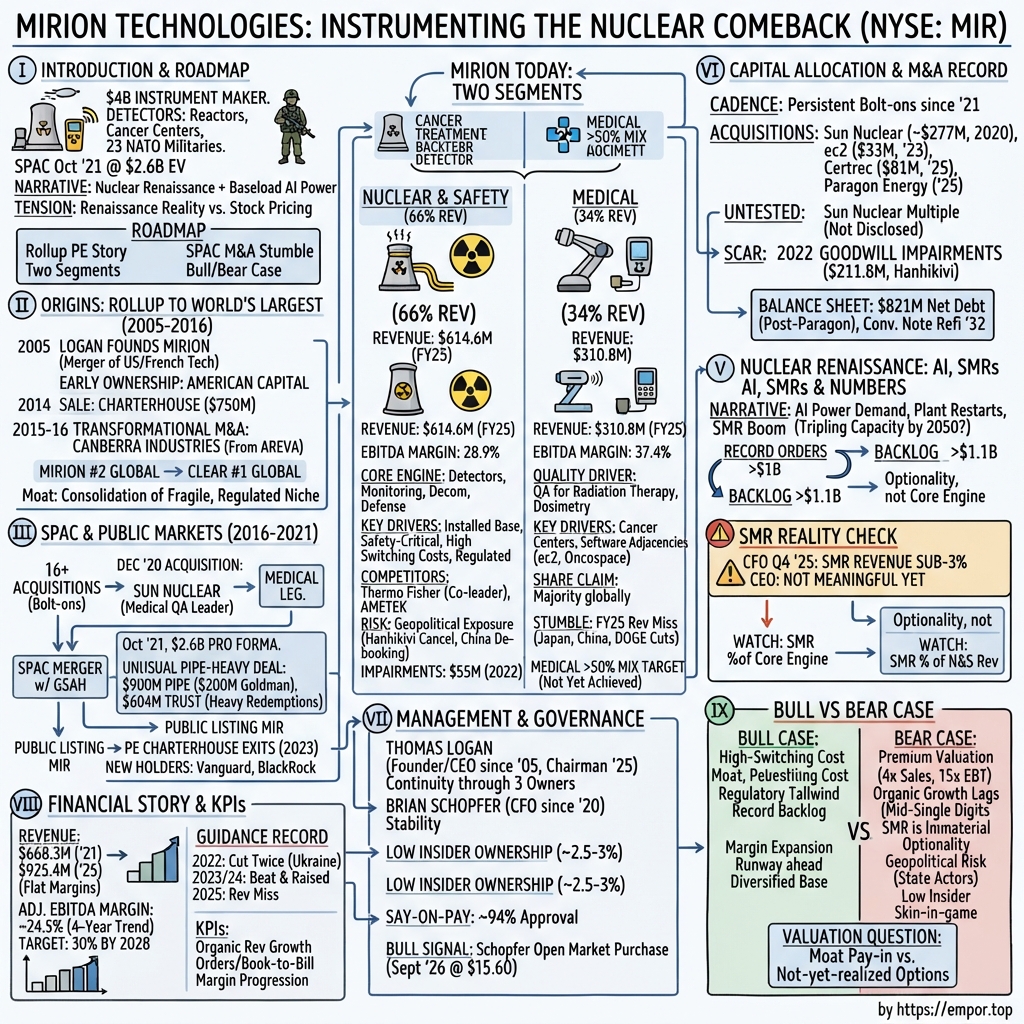
Mirion Technologies: The Instrumentation Company Betting on a Nuclear Comeback
I. Introduction & Episode Roadmap
Walk into the control room of almost any operating nuclear power plant on Earth — a pressurized water reactor outside Lyon, a boiling water reactor in Ontario, a VVER in the Czech Republic — and somewhere in the wall of instrumentation, behind a panel that has not been redesigned since the 1990s, sits a small box measuring radiation. It does not generate electricity. It does not split atoms. It simply watches, continuously, alerting operators if anything leaks, drifts, or accumulates where it should not. Regulators require it. Insurance underwriters mandate it. Plant managers replace it on a schedule dictated not by preference but by operating license conditions.
There is a strong likelihood that box carries the Mirion name.
Mirion Technologies is an enterprise valued at roughly $4 billion that most generalist investors have rarely encountered. Its instruments sit inside the global installed base of nuclear reactors, in the quality-assurance workflow of the large majority of American cancer-treatment centers, and in the hands of soldiers across the majority of NATO member militaries.1 In the most direct sense, it represents critical infrastructure that operates largely out of view — the essential plumbing of radiation safety.
What makes the company notable, however, is not the hardware alone, but the timing.
Mirion went public in October 2021 through a merger with a Goldman Sachs–sponsored special purpose acquisition company, at a pro forma enterprise value of roughly $2.6 billion.2 That was an unusual moment to bring a nuclear-exposed instrumentation business to public markets. The industry was still navigating the prolonged aftermath of Fukushima: Germany was phasing out its remaining reactors, Japan's fleet sat largely idle, and the phrase "nuclear renaissance" had already been invoked and discredited multiple times. Then market dynamics shifted. Surging demand from artificial-intelligence data centers created an urgent need for firm, carbon-free baseload power that intermittent renewables could not guarantee. Utilities began exploring restarts for retired reactors. Governments committed funding to new builds. Small modular reactors — SMRs — advanced from design concepts to commercial orders.
Mirion, supplying the picks and shovels of radiation measurement regardless of which reactor design ultimately prevails, suddenly found itself adjacent to one of the most prominent thematic trades in global markets.
That shift defines the central tension: How much of the nuclear revival has actually materialized in Mirion's reported revenue, backlog, and margins — and how much is optimism that the share price has already reflected in advance? Crucially, some of the clearest evidence comes directly from management. Mirion's chief financial officer has repeatedly placed a modest, disciplined estimate on the commercial SMR opportunity, resisting the temptation to let market enthusiasm run unchecked. That level of tempered disclosure provides an analytical anchor that warrants close examination.
The narrative roadmap moves through several distinct chapters: the company's origins as a private-equity rollup consolidating a fragmented niche; its arrival on public markets through an unusually PIPE-dependent SPAC structure; the two-segment operating model in place today; the core nuclear-and-safety franchise and whether its competitive moat withstands scrutiny; the actual commercial numbers beneath the renaissance headline; the medical business built around Sun Nuclear; capital allocation and acquisition performance, including a costly misstep; executive leadership and ownership dynamics; and finally an empirical evaluation of the bull and bear cases.
The story begins where the company took shape — with a rollup.
 Subscribe on LinkedIn
II. Origins: From Rollup to the World's Largest Nuclear-Measurement Company (2005–2016)
In 2005, the market for radiation-detection instruments reflected the fragmented legacy of postwar industrial policy. It was populated by small, specialized manufacturers across France, the United States, and Germany that had emerged from, or developed alongside, national atomic energy programs in the 1950s and 1960s. Each business occupied a narrow niche: one produced personal dosimeters worn by personnel; another manufactured fixed-area monitors mounted to reactor containment walls; a third focused on laboratory spectroscopy systems used to identify specific isotopes. These vendors served overlapping customer bases and complied with identical regulatory standards, yet rarely competed directly because their product catalogs seldom overlapped.
Thomas Logan recognized a structural opportunity in that fragmentation. The underlying physics of scintillation detectors and ionization chambers was mature and stable, meaning the commercial barrier was operational rather than technological. Nuclear utilities had little desire to manage dozens of separate vendor relationships for radiation safety; they favored a single qualified partner that could supply hardware, perform routine calibrations, provide maintenance, and manage regulatory documentation. Yet no supplier had assembled that unified offering.
Logan founded Mirion in 2005 by merging several legacy U.S. and French radiation-detection and dosimetry businesses under a single roof, and he has served as chief executive ever since.3 That leadership continuity is notable: Mirion changed ownership three times and completed a public listing over the ensuing two decades, with Logan leading the business throughout. In a private-equity ecosystem where portfolio companies routinely change chief executives with each ownership transition, that sustained leadership provided uncommon operational stability.
The platform's initial growth was backed by American Capital Ltd., the Bethesda-based business development company that owned the platform and funded its expansion through the 2000s and into the 2010s.3 The operating playbook was disciplined and repeatable: acquire an adjacent detection business, integrate it into a centralized sales and service network, retain core engineering talent, and eliminate duplicative administrative overhead. While generating little public attention, systematic execution of that roll-up strategy delivered steady cash generation.
In November 2014, American Capital sold Mirion to Charterhouse Capital Partners, the London-based private equity firm, for approximately $750 million.4 American Capital reported a 21 percent compounded return on the investment.4 That return validated the central premise of Mirion's operating model: consolidating a fragmented, heavily regulated, and technically conservative niche could generate superior returns. Because that fragmentation was a structural consequence of early national nuclear programs rather than a temporary market inefficiency, routine competitive pressures had not eliminated it.
The pivotal transaction in Mirion's history followed shortly thereafter.
In December 2015, under Charterhouse's ownership, Mirion agreed to acquire Canberra Industries from AREVA, the French state-controlled nuclear champion that was then navigating a financial crisis severe enough to require a government restructuring.3 The transaction closed in 2016. Canberra was not a routine bolt-on acquisition; it was Mirion's primary global competitor in nuclear measurement, representing the other half of what had effectively operated as a duopoly. Canberra brought an established franchise in spectroscopy, radiological waste characterization, and laboratory instrumentation, supported by an institutional customer base that closely mirrored Mirion's existing accounts.
Acquiring a principal peer from a distressed seller gave Mirion immediate scale advantages. Mirion disclosed roughly $30 million of expected synergies from the combination.3 The strategic outcome, however, proved more consequential than the cost-reduction target: the transaction transformed a major roll-up platform into the clear global leader in nuclear measurement, establishing an integrated catalog that spanned the entire radiation-detection workflow — from personal dosimeters to reactor containment monitors and analytical laboratories.
Mirion's competitive position was not established through technological invention. The company did not rely on a singular breakthrough patent or category-defining product launch. Instead, its market dominance was constructed through consolidation — serving as the buyer of choice in an industry of subscale family businesses and divested corporate assets. These customer relationships proved exceptionally durable because switching a qualified radiation-safety vendor requires rigorous regulatory recertification and paperwork rather than a routine procurement order.
That structural advantage, however, carries distinct vulnerabilities: the risk of overpaying for assets and a continuous dependence on an available pipeline of viable targets. Both factors would be tested as Mirion transitioned to the public markets. By 2020 and 2021, Charterhouse sought an exit, ultimately turning to the defining corporate finance vehicle of that cycle: a special purpose acquisition company.
III. The Private-Equity Playbook and the Road to Public Markets (2016–2021)
A review of Mirion's transaction history reveals a clear operating pattern: the company has completed roughly sixteen acquisitions since 2016.1 Rather than pursuing a single transformational transaction followed by years of integration, Mirion maintained a steady, disciplined cadence of bolt-on deals. Corporate development functioned as an ongoing operational discipline rather than an occasional strategic event, establishing Mirion as a serial acquirer whose organic growth and deal pipeline were deeply intertwined.
The most consequential of those transactions closed in December 2020, and it had nothing to do with nuclear power.
Sun Nuclear Corporation, based in Melbourne, Florida, manufactured the quality-assurance hardware and software that oncology clinics use to verify that radiation-therapy equipment delivers prescribed treatment doses with millimeter-level precision. In clinical practice, a medical linear accelerator functions as an exacting, high-energy beam delivery system; Sun Nuclear supplies the calibration and beam-profiling tools that confirm the radiation is targeted exactly where medical physicists intend. Any calibration error risks either failing to control the tumor or damaging surrounding healthy tissue. As a result, cancer centers perform these verification procedures continuously on mandatory regulatory schedules, creating a highly recurring revenue stream that operates much like an industrial consumable model — with the critical difference that healthcare regulations strictly prohibit skipping a test.
Mirion acquired Sun Nuclear for approximately $276.9 million, funded through an extension of its credit facility plus related-party notes.3 The purchase represented the final major initiative of the private-equity era, establishing the Medical segment as a genuine second pillar of the business rather than an ancillary product line.
An important caveat belongs directly in the narrative rather than in a footnote: Sun Nuclear's standalone financials at the time of the acquisition were never publicly disclosed. Consequently, the valuation multiple Mirion paid cannot be independently verified. Assertions that Mirion acquired the asset cheaply or overpaid for it rely on an undisclosed denominator. The purchase price is documented, but the underlying earnings power acquired remains unquantified, meaning the transaction must be evaluated by the segment's subsequent financial performance.
Ten months later, Charterhouse initiated its exit.
In June 2021, Mirion announced a business combination with GS Acquisition Holdings Corp II, a special purpose acquisition company sponsored by Goldman Sachs.5 The transaction valued Mirion at an enterprise value of approximately $2.6 billion pro forma, which the sponsors framed as 13.3 times estimated calendar-2022 adjusted EBITDA.5 In the context of mid-2021 — when SPAC sponsors routinely merged with pre-revenue electric-vehicle concepts and speculative space ventures at valuations detached from fundamental earnings — an established, cash-generative instrumentation business transacting at low-teens EBITDA appeared notably conventional.
The transaction's capital structure revealed an even more instructive dynamic. The merger was supported by a $900 million private investment in public equity — a PIPE — anchored by Goldman Sachs itself at $200 million, alongside Fidelity, BlackRock, Janus Henderson, and Neuberger Berman.5 Against that commitment, only roughly $604 million of the SPAC's trust proceeds remained after redemptions.6
Comparing those two figures highlights a critical reality: the institutional PIPE was substantially larger than the remaining trust capital. The original SPAC investor base — primarily arbitrage funds and retail traders who held GSAH II shares in anticipation of a sponsor-led catalyst — redeemed heavily rather than retaining equity in Mirion. The transaction crossed the finish line not on retail enthusiasm, but because dedicated fundamental institutions conducted direct diligence on the operating business and underwrote the valuation.
That institutional participation provided stronger fundamental validation than typical SPAC transactions during the 2021 cycle, confirming that professional asset managers were willing to commit substantial capital. Yet it also meant that Mirion entered the public markets with a shareholder register assembled largely through negotiated institutional allocations rather than an organic trading base.
The post-close ownership structure directly mirrored that financing arrangement. PIPE investors held approximately 44 percent of the equity, public SPAC shareholders retained roughly 37 percent, and Charterhouse alongside legacy owners held about 19 percent.7 Mirion's shares began trading on the New York Stock Exchange on October 20 and 21, 2021, following the formal closing of the business combination.2
Charterhouse then executed a standard private-equity exit. The sponsor reduced its position through two secondary offerings in 2023 — selling roughly $85.6 million in shares in March and approximately $53.6 million in May.8 By 2024 and 2025, the company's largest shareholders of record were institutional index managers, led by Vanguard at roughly 9.8 percent and BlackRock at roughly 7.5 percent.9 The private-equity sponsor that assembled modern Mirion had effectively completed its departure.
For public market investors, that ownership transition carries two distinct implications. The elimination of sponsor overhang removed an exit-motivated seller that could weigh on the share price, leaving the register anchored by long-term institutional capital. However, the sponsor's exit also removed a concentrated, activist owner with direct operational incentives to discipline management on capital allocation. In its place sit passive index managers that cast proxy ballots but rarely intervene in strategic decisions — an ownership dynamic that becomes increasingly relevant when examining executive stewardship and governance.
What remained was to examine what those institutional investors actually bought: two distinct operating segments united under a single public equity ticker, and an operational revenue mix that has unfolded along a different path than management initially projected.
IV. Mirion Today: Two Segments, One Investment Case
Fiscal 2025 marked the period when Mirion moved past explaining net losses to public shareholders.
Revenue reached $925.4 million, adjusted EBITDA totaled $227.9 million for a 24.6 percent margin, and net income under generally accepted accounting principles reached $28.8 million — the company's first full year of positive GAAP profit since it began trading.10 For an enterprise that had spent four years asking investors to look past purchase-accounting amortization, impairment charges, and transaction adjustments toward an adjusted EBITDA figure, delivering positive net income on the statutory bottom line represented a tangible operating milestone rather than an accounting formality.
The company reports across two operating segments, each driven by distinct end-market dynamics.
Nuclear & Safety — rebranded from its earlier "Industrial" label — generated $614.6 million of revenue in fiscal 2025, accounting for roughly two-thirds of the business, at a segment adjusted EBITDA margin of 28.9 percent.10 This division serves as the operational volume engine and the platform's historical foundation: fixed detectors, containment monitors, dosimetry hardware, and analytical laboratory systems sold into commercial nuclear power plants, defense and homeland-security agencies, decommissioning projects, national laboratories, and scientific institutions.
Medical produced $310.8 million, representing roughly one-third of total revenue, but at a materially higher segment margin of 37.4 percent.10 This segment encompasses Sun Nuclear and its core radiation-therapy quality-assurance portfolio, alongside clinical dosimetry services.
Beneath those divisional labels lies a commercial structure that prevents a business exposed to periodic capital-equipment cycles from operating as a purely cyclical industrial supplier. A substantial portion of Mirion's revenue does not stem from initial hardware shipments, but from the aftermarket obligations that accompany equipment throughout its service life: sensor calibration, radiation source replacement, certified spare parts, recurring dosimetry badge monitoring, software maintenance, and mandated regulatory testing. A radiation monitor installed in a reactor building in 2014 generates recurring maintenance and consumable revenue every year it remains in service. Operators rarely re-bid those service contracts because the installed instrumentation is already qualified under specific operating licenses. While market observers frequently describe this as a razor-and-blade model, the commercial reality is even more entrenched: a consumer can readily change razor blades, whereas a licensed nuclear utility faces substantial regulatory and engineering hurdles to substitute a qualified safety instrument.
The margin spread between the two divisions — roughly 850 basis points — represents the primary structural feature of Mirion's income statement. Medical accounts for one-third of total revenue but generates closer to two-fifths of segment operating profit, effectively lifting the consolidated margin profile. Any analysis that categorizes Mirion strictly as a nuclear equipment vendor misses where its underlying earnings power is concentrated.
That margin dynamic underscores an operational divergence between management's initial public targets and its subsequent portfolio evolution. At the time of the 2021 SPAC transaction, management articulated an objective for the Medical segment to eventually generate more than half of total revenue, reasoning that healthcare end-markets offer faster baseline growth, superior margins, and less exposure to the lumpy, politically sensitive capital expenditure cycles of commercial nuclear power.5 Four years later, that portfolio shift has not materialized. Instead, the revenue mix has tilted in the opposite direction: Medical remains at approximately one-third of sales, while acquisitions completed in 2025 pushed commercial nuclear-power exposure alone toward roughly 40 percent of the overall company.1
Market participants interpret that development through two competing frameworks. The constructive view holds that operating conditions changed fundamentally: the long-term outlook for nuclear power improved materially after 2022, and reallocating capital toward nuclear assets represented a rational response to new commercial demand rather than an execution failure. The skeptical view contends that an explicit long-range portfolio target was quietly sidelined without formal retraction, and that capital deployed in 2025 went into the lower-margin division at a time when broad thematic enthusiasm for nuclear power made those transactions straightforward to finance and present to investors.
Both interpretations remain defensible, and observers cannot yet resolve them definitively because the 2025 acquisitions have not operated long enough to demonstrate their full cycle return on capital. The empirical test, however, is straightforward: if Nuclear & Safety's segment margin expands toward Medical's levels over the next two to three years, the capital pivot will be validated as effective opportunism. If segment margins remain near 29 percent while consolidated profitability targets stall, the strategy will look less like disciplined portfolio management and more like chasing an investment theme.
That structural reality defines the analytical path forward. The subsequent analysis follows the capital where it is most heavily concentrated — examining Nuclear & Safety first, followed by the Medical franchise.
V. The Core Engine: Nuclear & Safety — Industry Structure, Competition, and How Mirion Actually Wins
To understand why a nuclear utility does not casually change radiation-instrumentation vendors, it helps to understand what "qualified" means in this industry.
When a plant is licensed, the regulator approves not just the reactor but the safety systems around it, including the specific instrumentation that monitors radiation in the containment building, the coolant loops, the stack effluent, and the areas where workers move. Changing that instrumentation is not a purchasing decision. It is a licensing amendment. It requires documentation that the new device meets the same qualification standards — seismic, environmental, electromagnetic, accuracy across a defined range — plus a paper trail proving the replacement is equivalent or better, plus in many cases regulator sign-off. The engineering cost of switching is modest. The regulatory and schedule cost is not, and in a facility where an unplanned outage day costs seven figures in lost generation, schedule risk dominates everything.
The result is that a qualified position inside an operating plant behaves less like a product sale and more like an annuity with a multi-decade tail. Sell the detector once; sell the calibration services, spare parts, source replacements, software updates, and eventual like-for-like refresh for the remaining life of the license. And nuclear licenses keep getting extended — the American fleet has been marching from 40-year to 60-year and now toward 80-year operating licenses, which lengthens the annuity every time a regulator signs.
That is the moat claim in its strongest honest form: high switching costs created by regulation rather than by technology, embedded in assets with the longest operating lifecycles in industrial infrastructure. In Hamilton Helmer's 7 Powers vocabulary, it is primarily switching-cost power, reinforced by something close to process power — decades of accumulated nuclear-specific qualification history, test data, and regulatory relationships that a new entrant cannot buy and cannot compress in time. It is emphatically not a network effect, and it is not a cornered resource; there is no proprietary physics here.
Now let us test the claim rather than admire it.
The customer-concentration test. A common failure mode in regulated-infrastructure businesses is that the "diversified" customer base turns out to be three utilities and a government agency. Mirion's disclosures do not support that worry: no single customer exceeded 10 percent of revenue or of accounts receivable in fiscal 2024 or fiscal 2025.18 For a company with heavy government and utility exposure, that is a genuine point in the moat's favor. Bargaining power that would be crushing if concentrated in one buyer is diffused across hundreds of plants, laboratories, and defense ministries with no coordinated procurement.
The competitive test. Mirion's most consistently named competitor is Thermo Fisher Scientific, which is repeatedly identified alongside Mirion as a co-leader in radiation detection and monitoring — portal monitors, contamination monitors, isotope-identification instruments.1 AMETEK and Fuji Electric also appear among the leading players in the segment's competitive landscape.1 What does not exist in any independent public source is a credible market-share percentage. Nobody publishes an audited share table for nuclear radiation instrumentation.
Here is where it is worth resisting the temptation to write "global leader" and move on. On an earnings call, Mirion's own chief executive conceded that the company's "share position is a bit uneven" across product categories.11 That is management volunteering a limitation, and it should be taken at face value: leadership in this business is real in some product lines and merely competitive in others. The accurate formulation is that Mirion is the largest pure-play in nuclear measurement, with the broadest catalog, competing against a diversified scientific-instruments giant with far greater scale and a lower cost of capital in the categories where their portfolios overlap.
Porter's five forces, briefly and concretely. Supplier power is low — the inputs are semiconductors, scintillator crystals, and machined components, none sole-sourced in a way that confers pricing leverage. Buyer power is low to moderate — utilities and defense ministries are large and procurement-savvy, but the switching mechanics described above blunt their ability to threaten a change of vendor credibly. Threat of new entrants is genuinely low; the barrier is not capital but time, because qualification history cannot be purchased. Substitutes are essentially absent, since radiation monitoring is mandated rather than elective. Rivalry is moderate and concentrated among a handful of qualified players.
That is a favorable structure. And now the disconfirming evidence, which belongs here, next to the claim, rather than exiled to a risk appendix.
Hanhikivi. In 2022, Mirion had work tied to the Hanhikivi nuclear plant project in Finland — a new build being developed by Rosatom, the Russian state nuclear corporation. Russia's invasion of Ukraine ended that project. The cancellation contributed to a $55 million impairment recognized in the second quarter of 2022, part of approximately $211.8 million in total goodwill impairments for that fiscal year.12 The consequence flowed straight to the bottom line: a full-year GAAP loss of $(1.53) per share against $0.37 of adjusted earnings per share.13 Management had already cut guidance in the first quarter, explicitly tying the reduction to the war's supply-chain and Russian-project fallout.14
China. In July 2026, an $18 million order for a Chinese new-build project — booked back in 2019 — was cancelled outright, which management attributed to geopolitical tension rather than to any performance failure.11 Seven years of backlog, removed by a decision made in a capital far from Mirion's engineering offices.
Read those two episodes together and a precise conclusion emerges, which is neither "the moat is fake" nor "these were one-offs."
The switching-cost advantage described above is real, and it applies to the installed base: reactors already operating, already licensed, already using Mirion equipment. Nothing about Hanhikivi or the Chinese de-booking contradicts that. But the moat does not extend to the new-build order book, where Mirion is exposed to whether a project gets built at all — and in nuclear, that decision is made by states, subject to sanctions, alliances, and diplomacy. Twice now, in two different geographies, on two different continents, orders have evaporated for reasons that had nothing to do with Mirion's product, price, or execution.
So the calibrated verdict: the moat claim survives, narrowed. It is a strong claim about recurring revenue from the operating fleet and a weak claim about growth revenue from new construction. That distinction matters enormously for how one reads the renaissance narrative — because the renaissance is, almost by definition, a story about new construction.
Which is exactly where the argument gets interesting.
VI. The Nuclear-Renaissance Narrative: AI Power Demand, SMRs, and What the Numbers Actually Show
For roughly three years, the nuclear-adjacent equity trade has been one of the market's most compelling narrative engines, supported by tangible commercial catalysts.
Constellation announced a restart of Three Mile Island Unit 1 to supply Microsoft. Amazon struck a deal with Talen for nuclear-adjacent capacity. Google signed agreements for future reactor output. The U.S. Department of Energy established a loan program measured in the tens of billions of dollars for new reactor deployment. Each represents a binding transaction with major counterparties, collectively marking the first sustained revival in Western nuclear sentiment since the 1970s. On Mirion's second-quarter 2026 earnings call, management framed the long-term horizon explicitly: global nuclear capacity, by its estimate, could triple to roughly 1.5 terawatts by 2050.11
Mirion's own operating disclosures reflect that momentum. Orders exceeded $1 billion in 2025, rising 26 percent year over year to a record high.10 Backlog surpassed $1.1 billion by the second quarter of 2026, up roughly 40 percent from the prior year.11 The company backed that exposure with capital through two acquisitions in 2025: Certrec, a nuclear regulatory-compliance software business, for $81 million in July, and Paragon Energy Solutions, announced in September, which supplies highly engineered components to large-scale nuclear plants and to small modular reactors in the United States.151
Backlog growth of 40 percent alongside mid-single-digit organic revenue expansion highlights an important operational dynamic: commercial demand is being booked considerably faster than it is being recognized. In a long-cycle industrial business, that divergence is characteristic of an early-stage inflection. Yet it also introduces operational vulnerability: revenue conversion lags orders, leaving the thesis dependent on projects remaining intact between contract signing and final equipment delivery. The cancellation of the Chinese order in July 2026 serves as a direct reminder that bookings do not guarantee revenue.
What distinguishes Mirion analytically, however, is how corporate leadership has addressed that market enthusiasm.
On the fourth-quarter 2025 earnings call, Chief Financial Officer Brian Schopfer addressed small modular reactors — the focal point of the nuclear narrative and a major driver of thematic market multiples. His response anchored the opportunity to a concrete figure. SMR-related revenue would be "sub-3 percent of our total revenue" in the 2026 guidance, had been below 2 percent in 2025, and was "maybe even sub-1.5 percent." While framing the technology as promising, Schopfer described the commercial contribution as "not meaningful in the grand scheme of things."10
Chief Executive Tom Logan reinforced that measured assessment on the same call rather than softening it. The core installed-base thesis, Logan explained, is "not dependent upon any particular view on new build or SMR dynamics," framing new construction and SMRs as "attractive incremental opportunities on top of" the existing fleet rather than the foundation of the business.10 On a subsequent call in 2026, Logan reiterated that caution, noting that the company has "historically been very cautious about expressing confidence in the SMR-type timeline."11
That posture is uncommonly disciplined. A management team with strong incentives to promote a hot market narrative — supporting a re-rated share price, satisfying sell-side analysts eager to model SMR upside, and maintaining an expensive equity currency for acquisitions — chose instead to quantify the opportunity at under 3 percent of sales and label it immaterial. That disclosure provides a meaningful baseline of executive credibility.
It also represents the single most important piece of disconfirming evidence in the entire nuclear investment thesis, originating directly from the executive suite.
The analytical consequence is direct: any framing presenting SMRs as Mirion's primary near-term growth driver is contradicted by the company's own financial disclosures. The accurate formulation is far narrower: SMR and new-build exposure is real, optional, and currently immaterial; the operating installed base is the actual engine. That recalibration is less sensational, but it is substantially more defensible.
It also establishes an empirical benchmark for future performance. SMR-attributable orders and revenue as a percentage of the Nuclear & Safety segment are metrics management has now put on the record. If that contribution climbs meaningfully into the mid-single digits over the next two to three years, the optionality is converting and the valuation multiple begins to justify itself. If it stalls near current levels while the thematic narrative continues, management's "incremental, not core" guidance will have been validated, and investors will have paid an upfront premium for an unexercised option.
An exchange from the second-quarter 2026 earnings call captured the active debate. When analysts pressed management on the risk of an "AI data-center air pocket" — a scenario where hyperscaler capital expenditure decelerates and cools nuclear demand — management offered a structural rebuttal. Utilities have already made the decisions to life-extend and restart plants, those decisions run on decade-long timelines, and a wobble in data-center construction does not cause a utility to un-extend a license it has already applied for.11
That argument is coherent and aligns with the installed-base thesis management has maintained since the 2021 public listing. Yet two analytical caveats apply. First, management is defending its own commercial position, and a structural thesis conveniently insulates the company from near-term cyclical shocks. Second, that very same quarter delivered an empirical reminder that demand can evaporate for reasons unrelated to utility planning: an $18 million Chinese order that had survived seven years of project development was cancelled amid shifting geopolitical dynamics.
Crucially, the installed base can expand without a single new reactor breaking ground. When a utility extends an operating license from 60 to 80 years, the regulator does not simply grant administrative approval. It mandates an aging-management program, requiring plant operators to demonstrate that instrumentation, cabling, and monitoring systems will remain qualified for an additional two decades. In practice, operators must replace 1980s-era analog equipment with modern digital equivalents — and every replacement must undergo formal regulatory qualification. Life extension functions not as a passive licensing event, but as a comprehensive refresh cycle for an aging fleet. The same operational logic applies to power uprates, post-Fukushima safety retrofits, and the decommissioning market, where radiological characterization and measurement represent the entire scope of work. None of those revenue streams require new reactor construction.
The nuclear renaissance is therefore best understood as two distinct developments sharing a single headline. One is a slow, steady, highly probable expansion of maintenance, life-extension, and upgrade spending across an installed base of roughly 400 gigawatts of operating reactors — and that one is showing up in Mirion's revenue today.1 The other is a speculative, highly uncertain pipeline of new builds and SMRs that dominates investor attention and equity valuations, but has yet to reach the income statement.
That division makes the other half of the business — the Medical segment, entirely decoupled from nuclear power — far more critical to the investment case than its revenue share suggests.
VII. Medical Segment: Sun Nuclear and the Radiation-Therapy QA Franchise
A medical physicist arrives at the cancer center before the first patient. The linear accelerator has been idle overnight. Before anyone is treated, the physicist runs a calibration check: a detector array is positioned in the beam, a plastic phantom shaped roughly like a human torso absorbs a test dose, and software compares what the machine actually delivered against what the treatment plan specified. If the numbers diverge beyond strict tolerances, the machine does not treat patients that day.
This protocol occurs every morning across radiation-oncology departments throughout the developed world, underpinning the commercial franchise Mirion acquired in late 2020.
Sun Nuclear is described as present in the large majority of U.S. cancer-treatment centers and a majority of centers globally for radiation-therapy quality assurance.1 That claim reflects a formidable commercial footprint, but it is also unquantified — much like the nuclear instrumentation segment, no independent source publishes audited market-share data for radiation-therapy QA. The competitive set is well-defined: IBA Dosimetry, part of Belgium's IBA Group; Standard Imaging; PTW Freiburg; Fluke Biomedical and its RaySafe line, under Fortive; and RTsafe.1 These are credible, specialized competitors, several possessing long-standing European institutional relationships. Sun Nuclear's market leadership is plausible and consistent with industry feedback and executive commentary, yet without public benchmark data, it remains an informed estimate rather than an independently verified fact.
What makes the segment economically compelling is easier to demonstrate than precise market share. Two factors underpin its roughly 37 percent adjusted EBITDA margin. First, the customer cannot forego the purchase: medical physics QA is a mandatory condition of clinical accreditation and professional practice standards, not a discretionary capital upgrade. Second, the software and workflow layer creates even steeper switching costs than the hardware. Once a hospital's medical physics team builds its QA protocols, historical trend data, and staff training around a single vendor's software environment, migrating to an alternative platform requires rebuilding institutional processes from scratch. That dynamic mirrors the switching-cost logic of the nuclear fleet, operating through clinical workflow rather than reactor licensing.
Mirion has systematically reinforced that software layer through programmatic acquisitions. CIRS, a maker of the tissue-equivalent phantoms used in those morning checks, was acquired for an undisclosed price.1 ec2 Software Solutions, which supplies workflow software for nuclear medicine departments, was acquired for $33 million in November 2023.1 And in 2025 Mirion added Oncospace, an artificial-intelligence-driven radiation-oncology software business.1 The strategic rationale is straightforward: anchor customer relationships with mandatory hardware, embed proprietary software that becomes difficult to displace, and allow the high-margin software stream to elevate segment profitability.
The strategic rationale is coherent. The fiscal 2025 performance, however, presented a direct test.
Management attributed a full-year revenue shortfall in part to weakness in radiation-therapy QA hardware across Japan, China, and Europe, compounded by softness in the U.S. Labs & Research business tied to the 43-day federal government shutdown and to Department of Energy spending reductions under the administration's cost-cutting agenda.16 Management's characterization was that this represented "demand deferral rather than a secular change."16
That explanation warrants neither automatic acceptance nor reflexive dismissal. It is mechanically plausible: hospital capital budgets and research grants can be delayed, and a federal funding lapse halts procurement orders in real time. Yet "deferral, not decline" is among the most routine explanations offered by capital-equipment executives during cyclical downturns, and its validity can only be evaluated in hindsight — when the delayed orders either materialize or disappear.
A more subtle analytical concern lies in the geography. Hardware softness concentrated across Japan, China, and Europe cannot easily be attributed to U.S. political friction. Hospital capital allocations in Tokyo, Beijing, or Frankfurt are entirely detached from budget impasses in Washington. Bundling international commercial softness with domestic federal budget cuts under a single explanatory umbrella provides a tidy narrative, but investors should treat foreign hardware weakness as an independent, unresolved variable.
The empirical test is straightforward: whether radiation-therapy QA and Labs & Research revenue rebounds over subsequent quarters. If shipments reaccelerate, management's diagnosis of temporary timing friction will be validated. If the softness persists — turning a temporary deferral into an extended slowdown — the narrative of Medical as an insulated, premium-margin growth engine will weaken considerably.
For now, the calibrated verdict is balanced: the segment's underlying economics remain intact and reflected in its 37 percent margin, but its near-term growth trajectory faces an open question that management has asserted rather than demonstrated. That execution question bears directly on Mirion's broader acquisition track record — highlighting the need to examine how effectively the platform has converted deployed capital into shareholder value.
VIII. Capital Allocation: The M&A Record, Benchmarked
Every serial acquirer eventually faces the same audit. Not "did you do deals?" — the cadence answers that — but "what happened to the money?"
The public-era acquisition record is short enough to list and long enough to judge. Sun Nuclear at approximately $276.9 million, just before the listing.3 ec2 Software at $33 million in 2023. An air-monitoring bolt-on at roughly $45 million in late 2024. Certrec at $81 million in July 2025. And Paragon Energy Solutions, announced in September 2025, the largest of the recent set.115 The pattern is consistent with the pre-public era: mid-sized, adjacent, technically related, and small enough individually that no single deal is existential.
That last property is a genuine risk-management feature. A company that has never bet the balance sheet on one transformational acquisition has also never created the conditions for a single catastrophic destruction of capital. It is the discipline of small bets — less heroic than a transformational deal, and considerably harder to get badly wrong.
But two areas of the record deserve to be examined rather than praised.
Where the record is untested. The Sun Nuclear acquisition is the largest capital deployment in Mirion's public history and the foundation of its highest-margin segment. It is also the deal whose economics cannot be independently evaluated. Specialty medtech and instrumentation businesses of that character have historically transacted somewhere in the range of 12 to 18 times EBITDA, or three to five times revenue — but applying that range to Sun Nuclear requires knowing Sun Nuclear's EBITDA or revenue at the time of purchase, and those figures were never disclosed. The intellectually honest statement is that we know what Mirion paid and do not know what it bought in financial terms. Anyone rendering a verdict on the price is filling in the blank with assumption. What can be said is that the segment now produces over $300 million of revenue at a 37 percent margin — an outcome consistent with a good acquisition, though not proof of one, since subsequent bolt-ons and organic growth are bundled into that figure.
Where the record has a scar. The roughly $211.8 million of goodwill impairments recognized in fiscal 2022 is the clearest capital-allocation test case in Mirion's public history. It is important to characterize it precisely rather than dramatically. A portion was directly attributable to the Hanhikivi cancellation and the broader collapse of Russia-linked business. A portion arose from routine annual impairment testing in a year when discount rates rose sharply and equity valuations across the sector fell — a mechanical effect that hit many acquisitive companies simultaneously and reflects the cost of capital as much as the quality of any specific deal.
Still: an impairment is an accounting acknowledgment that prior deployments of capital are worth less than what was paid for them. It carried real GAAP consequences, it was large relative to the company's equity base at the time, and it belongs in the same conversation as the acquisition record rather than in a separate risk paragraph. The fair reading is not that Mirion is a poor allocator of capital — the evidence does not support that verdict — but that the company has one documented instance of paying for assets whose value did not survive contact with geopolitical reality, and that the exposure which caused it has not been eliminated, as the 2026 Chinese de-booking demonstrated.
It is also fair to note what an acquisitive company's record cannot tell you from the outside. Mirion does not disclose post-acquisition revenue or margin performance deal by deal, which is standard practice and also the reason nobody outside the company can verify whether ec2, CIRS, or the air-monitoring bolt-on met their underwriting cases. The absence of disclosed failures is not evidence that there were none; it is evidence that the disclosure regime does not require them to be surfaced individually unless they trigger an impairment. The 2022 impairment is visible precisely because it crossed that threshold. Smaller disappointments, if they exist, would be invisible — absorbed into segment results and into the flat consolidated margin line discussed in the next section. An investor should hold that as a genuine limit on what can be concluded, in either direction.
The balance sheet. Net debt ended fiscal 2025 at approximately $821 million, elevated by the Paragon transaction.1 Earlier in that year, in May 2025, Mirion issued $450 million of convertible notes and used the proceeds to refinance existing term debt, pushing maturities out to 2032 on improved terms.1
The framing matters. This was not a distressed refinancing executed under pressure; it was an opportunistic one executed while the equity was strong and credit markets were open, which is precisely when a leveraged acquirer should be terming out debt. The cost, as always with converts, is potential future dilution rather than current interest expense — a trade that favors the company if the shares underperform and favors the noteholders if they do not. Management has stated a target of approximately 2.5 times leverage excluding further M&A by the end of 2026.11 No covenant breaches or liquidity stress appear in the filings and press releases reviewed for the fiscal 2022 through fiscal 2025 period.
One accounting note that is routinely conflated and should not be. There was a restatement in April 2021 concerning warrant and temporary-equity accounting. It occurred at the GS Acquisition Holdings level, before Mirion's business was combined into the vehicle, and it stemmed from a Securities and Exchange Commission statement that forced essentially every SPAC formed in 2020 and 2021 to reclassify its warrants.7 It was an industry-wide event, not a Mirion-specific misstatement, and no restatement of Mirion's own post-merger operating financials appears in the filings reviewed. Investors screening for accounting red flags should distinguish the two; conflating them produces a false signal.
What the whole record suggests is a management team that deploys capital steadily rather than boldly, in sizes it can absorb, with one documented write-down driven substantially by an exogenous shock, and one large foundational deal whose price cannot be graded. That is a reasonable, unspectacular record — which raises the natural question of who exactly is doing the deploying, and what they are paid to optimize.
IX. Management & Governance: Founder-CEO, Incentives, and the Ownership Question
Thomas Logan has led Mirion for more than two decades. After founding the business in 2005, he guided it through American Capital's ownership, Charterhouse's buyout, and the Goldman Sachs–sponsored SPAC transaction, ultimately adding the chairman's title to his chief executive role in February 2025.9
Twenty years is an unusually long tenure in any executive seat. It is exceptionally rare in an enterprise owned sequentially by three private equity sponsors, each arriving with its own investment thesis, board, and reporting demands. Financial sponsors routinely replace chief executives upon acquiring a portfolio company. That Logan navigated three ownership transitions suggests either that he consistently delivered the operating results each owner underwrote, or that his domain expertise in a heavily regulated niche was too difficult to replace. Both explanations speak to operational competence; neither guarantees superior capital-allocation discipline, which requires a distinct skill set.
Brian Schopfer has served as chief financial officer since May 2020, predating the public listing.9 The company has experienced no finance-chief turnover since its market debut. Across the 2021 de-SPAC cohort, where CFO churn proved widespread as aggressive forecasts collided with the discipline of quarterly public filings, that continuity stands out. It also reinforces the conservative disclosure posture highlighted earlier: the executive who pegged the commercial SMR opportunity at under 3 percent of revenue is the same finance leader who managed the books before public market expectations took hold.
Combining the chairman and chief executive roles in February 2025 departs from modern corporate governance best practices, which favor an independent board chair. While common among mid-cap companies, the structure naturally raises the question of whether the board maintains sufficient independent oversight to challenge executive decisions. For now, institutional support appears intact: say-on-pay approval exceeded 94 percent in both the 2025 and 2026 annual meetings, and no activist investors have emerged on the register.9 The proxy record reflects broad shareholder satisfaction, but it also reveals an absence of external pressure mechanisms holding leadership accountable.
Executive compensation remains moderate relative to peer industrial platforms. Logan's total compensation reached approximately $1.94 million in 2023, while Schopfer received roughly $1.88 million.9 Those packages signal neither excessive payout nor extraordinary restraint. Annual and long-term incentive plans link payouts to adjusted EBITDA metrics and equity awards, though the proxy statement leaves the exact performance weighting across adjusted EBITDA, revenue, and total shareholder return unspecified beyond those baseline categories.9
A more significant governance consideration lies in executive ownership. Insiders hold only roughly 2.5 to 3 percent of outstanding shares. For a chief executive who founded the platform two decades ago, that equity stake is remarkably low. The explanation is structural rather than alarming: because private equity sponsors controlled Mirion throughout its private history, management equity was largely cashed out during successive recapitalizations rather than rolled forward. Logan did not accumulate or preserve the substantial ownership stake typically associated with a founder-led enterprise.
As a result, the conventional thesis that leadership possesses significant skin in the game does not apply to Mirion. Executive alignment depends primarily on annual equity grants and incentive scorecards rather than a concentrated personal holding built over decades. Following Charterhouse's complete exit, the shareholder register is dominated by passive institutional indexers that routinely support management ballots. That dynamic creates an environment of minimal friction and muted governance pressure — an arrangement that functions smoothly during periods of operational strength, but offers few internal mechanisms for course correction if performance falters.
Against that structural backdrop sits a recent and tangible transaction. On September 2, 2026, Schopfer purchased 20,000 shares on the open market at $15.60 per share.17 The context sharpens the signal: the stock had retreated from a 2025 peak near $30 into the mid-teens. This transaction was not an equity grant, an option exercise, or a scheduled trading plan. It represented a chief financial officer deploying personal capital into his company's stock following a sharp valuation pullback. While insider purchases can occasionally be symbolic, an open-market acquisition by a seated CFO after an equity de-rating provides a meaningful signal, given that the chief financial officer possesses the clearest line of sight into near-term cash generation and operational trends.
A single transaction by an executive whose total holding remains modest does not resolve broader governance questions. Yet it offers tangible commercial behavior rather than rhetoric, providing a pragmatic counterweight to structural ownership concerns.
Observed behavior also serves as the most reliable framework for evaluating Mirion's broader financial trajectory — specifically, comparing what leadership promised public markets against what the business has delivered.
X. The Financial Story: Margins, Guidance Discipline, and the KPIs That Matter
A review of Mirion's four-year scorecard as a public company reveals a central tension in the investment case.
Revenue grew from $668.3 million in fiscal 2021 to $925.4 million in fiscal 2025 — roughly 38 percent cumulative growth, a respectable outcome for an industrial business navigating a period marked by war in Europe, acute supply-chain friction, and the sharpest interest-rate hiking cycle in four decades.310
Over that same four-year span, however, the company's adjusted EBITDA margin moved from approximately 24.2 percent to 24.6 percent.310
That represents just forty basis points of margin expansion across four years, during which the revenue base expanded by more than a third.
That figure warrants rigorous scrutiny because it cuts directly against the core economic logic of the rollup model. A programmatic consolidation strategy in a fragmented niche is supposed to create shareholder value primarily through operating leverage: by acquiring adjacent businesses, centralizing sales and distribution, unifying service networks, and consolidating regulatory overhead, profit margins should expand as fixed costs are spread across a wider revenue base. Instead, Mirion added roughly $257 million of revenue with virtually no operational leverage.
Management has offered several valid explanations. Transitioning to a publicly listed entity in 2022 established a permanent corporate cost structure — auditing, regulatory compliance, investor relations, corporate insurance, and board fees — that did not exist during the private-equity era. That same year brought severe industrial input-cost inflation. Furthermore, serial bolt-on acquisitions are inherently margin-dilutive in the near term, as newly acquired businesses arrive with their own standalone overhead and integration costs before anticipated synergies can be extracted.
Yet while each explanation is credible on its own terms, they have collectively served as the operating rationale for four consecutive years. On its second-quarter 2026 earnings call, management reiterated its target of reaching a 30 percent adjusted EBITDA margin by 2028.11 Delivering on that projection requires roughly 540 basis points of margin expansion over approximately three years from a platform that produced just 40 basis points in the preceding four. Such an inflection is not impossible — margin realization can accelerate once acquisition integration costs subside and incremental volume flows through an established operating footprint. Nevertheless, it represents a forward-looking expectation that historical execution has not yet validated. Until basis points materialize on the income statement, the margin expansion thesis remains entirely unproven.
The guidance record, stated plainly.
Mirion reduced its financial guidance twice in 2022. The initial cut accompanied first-quarter results, driven by supply-chain disruptions tied to the war in Ukraine and the sudden loss of Russian project revenue.14 A second downward revision followed in the third quarter, and the company concluded the year with $164.7 million in adjusted EBITDA against an initial target range of $175 million to $185 million.13
Forecasting discipline improved markedly over the next two years, as Mirion consistently beat consensus expectations and raised guidance throughout 2023 and 2024.8
Fiscal 2025 delivered a mixed outcome: revenue missed management's guidance due to the international hardware softness and domestic research funding delays discussed earlier, yet adjusted EBITDA still finished within the guided range.1016
Evaluating that record requires balance. The 2022 shortfall was driven by an exogenous, verifiable geopolitical shock that no corporate budgeting process could reasonably forecast. The subsequent two years of beat-and-raise execution demonstrated conservative, credible guidance. The 2025 revenue miss, however, remains unresolved because management's characterization of customer delays as a temporary deferral rather than a structural decline has not yet been confirmed by subsequent financial prints.
There is also an instructive operational signal in the composition of the 2025 results. Missing on revenue while meeting an adjusted EBITDA commitment demonstrates that management actively reined in expenses to protect profitability. That level of operational discipline is real, but it is also a finite lever: a leadership team can only offset top-line softness with cost controls for so long before reductions begin to curtail the commercial investments required to generate future growth.
Where the company stands now.
Fiscal 2026 guidance called for reported revenue growth of 22 to 24 percent, with organic growth pegged at 5 to 7 percent, adjusted EBITDA between $285 million and $300 million, and adjusted free cash flow of $155 million to $175 million.10 The wide spread between reported and organic growth reflects the impact of recent M&A, with Paragon Energy Solutions and Certrec driving the expansion. In practical terms, roughly three-quarters of Mirion's guided headline growth in 2026 is purchased rather than generated organically.
Through the first half of 2026, organic growth hovered around 2 percent, Medical segment demand remained soft, and the Chinese reactor order was de-booked.1811 Management reaffirmed its full-year guidance despite those headwinds.11 That posture sets up an immediate test of guidance credibility: delivering a full-year organic growth rate of 5 to 7 percent after generating just 2 percent across the first six months demands a significant acceleration in the second half of the year, making upcoming earnings releases critical to evaluating management's forecasting rigor.
The KPIs that matter.
Three operational metrics warrant primary attention going forward:
Organic revenue growth. This metric strips away acquisition noise to reveal whether Mirion's core franchise is genuinely accelerating alongside the nuclear cycle or merely expanding through corporate development. With reported growth running above 20 percent while organic growth lingers in the low single digits, the gap between the two provides the clearest indicator of underlying commercial momentum.
Orders, book-to-bill, and backlog. These forward-looking figures capture new-build and life-extension demand long before it converts into recognized revenue. Tracking order velocity is essential, as is monitoring de-bookings — the specific mechanism through which long-cycle nuclear backlogs can evaporate without an operational failure.
Adjusted EBITDA margin progression. The rate of annual basis-point expansion toward the 30 percent target represents the definitive test of whether Mirion's consolidation model can deliver operating leverage at public-company scale.
Over the next two to three years, the trajectory of those three metrics will resolve the central questions surrounding Mirion's commercial execution — providing the empirical evidence to settle the debate between the bull and bear theses.
XI. Bull vs. Bear: The Investment Debate
Set the two cases against each other properly, because both are built from real facts and the disagreement is genuine rather than a matter of one side being uninformed.
The bull case.
Start with structure. Mirion sells legally mandated equipment into assets with the longest operating lives in industrial infrastructure, with switching costs created by regulators rather than by contract terms. The customer base is genuinely diversified, with no single customer above 10 percent of revenue — an unusual property for a company with this much government and utility exposure, and one that removes the single most common failure mode of infrastructure suppliers.
Then add the cycle. After four decades of Western nuclear retrenchment, the direction has reversed, and the reversal is driven by a demand source — data-center electricity load — that is structurally indifferent to the political arguments that killed nuclear in the 1980s. Record orders above $1 billion and backlog above $1.1 billion are the company's own evidence that this is reaching its order book rather than merely its press coverage.
Then add the runway. If the 30 percent margin target is delivered on the current revenue trajectory, the earnings power of this business in 2028 looks very different from 2025, and none of that requires a single small modular reactor to be commissioned. Add a chief executive who has run the business for twenty years, a chief financial officer who has held his seat since before the listing and who just bought stock with his own money, and a management team whose public statements have been notably less promotional than the environment invited.
The bear case.
Start with price. The shares have traded at roughly four times sales and around fifteen times EBITDA — a valuation that has already re-rated substantially on the nuclear-renaissance narrative.19 The bear argument is not that the business is bad. It is that the multiple is paying for a version of the future that management itself has declined to endorse.
Then stack the evidence. Organic growth is running in the low-to-mid single digits, not the double digits a structural inflection would imply. The company's own chief financial officer has quantified SMR revenue at under 3 percent of the total and called it immaterial. Margin expansion has been promised since the 2021 listing and has produced 40 basis points in four years. The two largest disclosed setbacks in the public record — the Hanhikivi write-down and the Chinese de-booking — share a single root cause, which is that selling nuclear instrumentation means selling to states, and states cancel things for reasons no vendor can influence or forecast. That is not a one-off; it is a recurring feature of the addressable market. And the alignment argument is weaker than the founder-CEO framing suggests, given insider ownership of roughly 2.5 to 3 percent.
An activist or short-side analyst would press three specific points. First, disclosure: reported growth of 22 to 24 percent alongside organic growth of 5 to 7 percent means the headline number tells you mostly about acquisitions, and the burden should be on management to lead with organic. Second, the margin target: after four years of flat margin, a 540-basis-point commitment over three years requires a bridge, and investors are entitled to the specific line items rather than the aspiration. Third, the mix: the stated ambition for Medical to exceed half of revenue has quietly inverted, and a strategic target abandoned without acknowledgment is worth an explanation.
Through the frameworks.
Porter's five forces, applied to the consolidated company, produce a favorable but not extraordinary structure: low supplier power, low-to-moderate buyer power, low entry threat, negligible substitution, moderate rivalry concentrated among a few qualified players. The binding constraint is not any of the five forces — it is that the addressable market's growth is set by government energy policy and healthcare capital budgets, neither of which Mirion influences.
Through 7 Powers, the honest inventory is short. Switching costs — strongly present, evidenced by regulatory qualification mechanics and the recurring service tail. Process power — plausibly present, in the accumulated qualification history and nuclear-specific institutional knowledge that took decades to build. Scale economies — claimed by the consolidation thesis but, on the evidence of four years of flat margin, not yet demonstrated at the operating line. Cornered resource, network effects, counter-positioning, branding — absent or immaterial.
Two of seven, with a third asserted but unproven, is a real competitive position. It is not an exceptional one. And against Thermo Fisher, the comparison is uncomfortable in a specific way: Thermo operates at vastly greater scale across scientific instruments generally, which means in overlapping categories it can compete on cost structure and distribution reach that Mirion cannot match. Mirion's defense is focus and nuclear-specific qualification depth, which is a genuine defense in the reactor-facing categories and a thinner one in the broader detection markets where Thermo is strongest.
The synthesis.
The installed-base moat and the regulatory tailwind are real and evidenced — by segment margin, by recurring service revenue, by customer diversification, and by the mechanics of nuclear licensing. That part of the story is not in doubt.
The new-build and SMR layer is real optionality that has not converted, and management says so explicitly and repeatedly. That part of the story is a call option with no established strike date.
The margin-expansion layer is a promise with four years of contrary evidence behind it and a three-year deadline in front of it.
So the valuation debate reduces to a clean question: how much of the current multiple is paying for the proven annuity, and how much is paying for the two unproven layers stacked on top of it? Reasonable investors will answer that differently. What should not be in dispute is that they are three separate claims with three separate levels of evidence, and that conflating them — treating the proven annuity's durability as though it validated the unproven options — is the specific analytical error this story invites.
XII. Risk Radar
The risks that matter most for Mirion are those with a demonstrated operational mechanism, rather than the boilerplate disclosures typical of industrial filings.
Geopolitical risk operating as shadow concentration. Mirion's customer disclosures confirm that no single client accounts for more than 10 percent of revenue, providing meaningful commercial diversification. Yet that metric understates sovereign exposure. In new-build nuclear, the primary unit of risk is not the customer but the project — and nuclear projects are licensed, funded, sanctioned, and cancelled by governments. The Finnish Hanhikivi cancellation and the de-booked Chinese reactor order both evaporated through this political channel. While any individual project loss is manageable, the structural exposure is permanent: as long as Mirion pursues international new-build contracts, sovereign friction will remain an ongoing risk to backlog conversion.
Government funding and appropriation cycles. This exposure is not theoretical. Department of Energy budget reductions and a 43-day federal government shutdown measurably curtailed Labs & Research revenue in fiscal 2025.16 A meaningful portion of Mirion's institutional customer base relies on public appropriations that are structurally vulnerable to legislative gridlock and shifting political priorities, introducing timing friction that directly affects quarterly results.
Execution and timing risk on 2025 acquisitions. Paragon Energy Solutions and Certrec were acquired largely to capitalize on new-build and SMR momentum. If commercial adoption materializes more slowly than the current order book suggests — a scenario consistent with management's disclosure that SMRs represent under 3 percent of revenue — integration expenses and purchase-accounting amortization will weigh on an operating margin that has already proven difficult to expand. The core vulnerability is not asset quality, but deploying capital ahead of an inflection whose commercial timeline remains uncertain.
Valuation and expectations asymmetry. When an equity's multiple expands on a thematic narrative, the share price becomes vulnerable not only to operational deterioration, but to results that merely fail to accelerate. The second-quarter 2026 earnings release illustrated that sensitivity: although margins expanded and earnings beat consensus forecasts, organic growth lagged, and the shares dropped roughly 9 percent.20 In an environment where valuation multiples already price in a structural acceleration, steady baseline execution and modest organic expansion can trigger an immediate market de-rating.
Scale-advantaged competition. Thermo Fisher Scientific's entrenched position across broader scientific instrumentation and adjacent radiation-detection categories remains a structural reality. That scale advantage does not directly threaten Mirion's qualified reactor installed base, but it establishes a competitive ceiling that limits how profitably Mirion can expand into overlapping laboratory and industrial monitoring markets.
Risks deliberately excluded. Rapid technological obsolescence does not represent an acute threat: the underlying physics of radiation detection is mature, and the software platforms Mirion is integrating are designed to reinforce customer retention and support margins rather than face sudden disruption. Similarly, balance-sheet refinancing risk remains minimal following the May 2025 convertible debt restructuring that extended maturities out to 2032 on favorable terms. Excluding boilerplate items keeps the analytical focus squarely on the operational and geopolitical dynamics that drive financial outcomes.
XIII. Business & Investing Lessons
Regulation can be a moat, and the moat comes bundled. The same regulatory frameworks that prevent a utility from casually replacing an instrumentation vendor also leave corporate backlogs vulnerable to sovereign decisions made in Moscow or Beijing. Demand driven by regulation is durable because a government mandates it — which means that same government, or a geopolitical adversary, can also defund, sanction, or diplomatically obstruct it. The durability and the fragility originate from the identical structural mechanism. Any enterprise whose commercial demand is created by policy carries sovereign risk as an ongoing operating liability rather than a periodic exogenous shock.
Consolidation economics work until they have to prove themselves at scale. The Canberra acquisition established genuine market leadership from a distressed seller's restructuring, and Mirion's private-equity tenure delivered a compounded return that validated the initial thesis. Yet the central economic promise of a roll-up strategy — that expanding the top line unlocks operating leverage and widens margins — has yet to materialize in the public markets. Generating 38 percent revenue growth over four years while adjusted EBITDA margins expand by just 40 basis points demonstrates that scaling a platform does not automatically eliminate duplicative overhead. For investors evaluating serial acquirers, operating margin progression is the metric that matters most, yet it is often the last one scrutinized amid headline acquisition volume.
Management's own words are the most efficient falsification tool available. The clearest analytical boundary in Mirion's public disclosures was established when its chief financial officer quantified small modular reactor revenue at under 3 percent of sales and described the commercial contribution as "not meaningful in the grand scheme of things" — delivered precisely when market multiples were pricing in an imminent wave of new construction. No third-party survey or financial model provided a cleaner limit on narrative overreach. When evaluating any thematic transformation story, the most revealing signal often lies in how leadership quantifies an opportunity in quarterly question-and-answer exchanges rather than how it characterizes market potential in prepared remarks.
A story can be true and over-owned simultaneously. The nuclear revival is backed by tangible commercial catalysts, and Mirion's position across the operating fleet is genuine. Neither reality, however, establishes whether prevailing valuation multiples offer an attractive risk-adjusted entry point. Those are two fundamentally distinct questions. The most common analytical error in thematic investing is confirming the secular thesis and assuming that validation automatically extends to the equity price.
XIV. Epilogue & What to Watch
Three proof points operate on three distinct timelines.
The near-term test arrives over the next few quarters: whether second-half organic growth rebounds sufficiently to validate the full-year target of 5 to 7 percent after running near 2 percent through the first six months of 2026. Delivering on that commitment will test both underlying demand and forecasting discipline, while clarifying whether the Medical segment softness observed in 2025 was the temporary deferral management described or the onset of an extended slowdown.
The multi-year test centers on small modular reactors and the broader new-build trajectory. By explicitly capping commercial SMR exposure at under 3 percent of revenue, management established an empirical baseline that investors can monitor over time. If SMR-attributable revenue expands into the mid-single digits and beyond, the thematic optionality priced into the equity multiple will begin converting into recognized earnings. If that contribution stalls near current levels, the market will find that management's disciplined "incremental, not core" guidance was accurate all along — and that leadership signaled that boundary well in advance.
The decisive test rests on operating margin. Delivering on management's target of a 30 percent adjusted EBITDA margin by 2028 requires roughly 540 basis points of expansion over approximately three years, measured against a four-year public track record that yielded just 40 basis points. Every quarterly financial print provides a fresh data point on the central unproven question in Mirion's equity thesis — whether two decades of consolidating a fragmented, highly regulated niche ultimately produces a structurally more profitable enterprise, or merely a larger one.
XV. Outro & Links
The primary record for Mirion is unusually accessible for a mid-cap industrial: annual filings lay out the segment detail, quarterly releases document the guidance history in sequence, and earnings-call transcripts capture how management responds under direct questioning rather than in prepared remarks. For those continuing the work, the company's investor relations portal provides the natural starting point, with the fiscal 2025 and fiscal 2022 annual reports bracketing the range between the platform's strongest operating year and its most challenging.21112
References
-
Mirion Technologies FY2025 Form 10-K, filed 2026-02-19 — SEC EDGAR ↩↩↩↩↩↩↩↩↩↩↩↩↩↩↩↩↩
-
Mirion Technologies Announces Completion of Business Combination with GS Acquisition Holdings Corp II — BusinessWire, 2021-10-20 ↩↩
-
Mirion Technologies Form S-1, 2021 (pre-SPAC financials, Sun Nuclear disclosure) — SEC EDGAR ↩↩↩↩↩↩↩↩
-
Charterhouse Said to Buy Mirion From American Capital — Bloomberg, 2014-11-20 ↩↩
-
Business Combination Agreement Form S-4, 2021-06 — SEC EDGAR ↩↩↩↩
-
Mirion Technologies Gets SPAC Deal With GSAH: What Investors Should Know — Benzinga, 2021 ↩
-
Mirion Technologies 2026 DEF 14A Proxy Statement, filed 2026-04-01 — SEC EDGAR ↩↩↩↩↩↩
-
Mirion Announces Fourth Quarter and Full Year 2025 Financial Results, Provides Full Year 2026 Financial Guidance — Mirion Press Release, 2026-02-11 ↩↩↩↩↩↩↩↩↩↩
-
Earnings Call Transcript: Mirion Technologies Posts Q2 2026 EPS Beat as Shares Slide — Investing.com, 2026-07-29 ↩↩↩↩↩↩↩↩↩↩
-
Mirion Technologies FY2022 Form 10-K (goodwill impairment year) — SEC EDGAR ↩↩
-
Mirion Technologies Announces Fourth Quarter and Fiscal Year 2022 Financial Results and Provides Fiscal Year 2023 Financial Guidance — Mirion Press Release, 2023-02-14 ↩↩
-
Mirion Technologies Announces First Quarter 2022 Financial Results and Updates Full Year Guidance — Mirion Press Release, 2022 ↩↩
-
Mirion to Acquire Paragon Energy Solutions, One of the Leading Providers of Highly Engineered Solutions for Large-Scale Nuclear Power Plants and Small Modular Reactors in the United States — Mirion Press Release, 2025-09-24 ↩↩
-
Mirion Announces Third Quarter 2025 Financial Results and Updates Full Year Guidance — Mirion Press Release, 2025-10-29 ↩↩↩↩
-
Form 4 — Brian Schopfer open-market purchase, 2026-09-02 — SEC EDGAR ↩
-
Mirion Announces First Quarter 2026 Financial Results — Mirion Press Release, 2026-04-29 ↩
-
Mirion Technologies Stock: Gradually Becoming More Attractive — Seeking Alpha ↩
-
Mirion Q2 2026 Slides: Margins Expand as Organic Growth Lags — Investing.com, 2026-07-29 ↩
 LinkedIn
 WhatsApp
 Reddit
 Hacker News
 Email
Email Kindle
 RSS Feed
 Spotify
 Apple Podcasts
 Amazon Music
 Audible
 YouTube