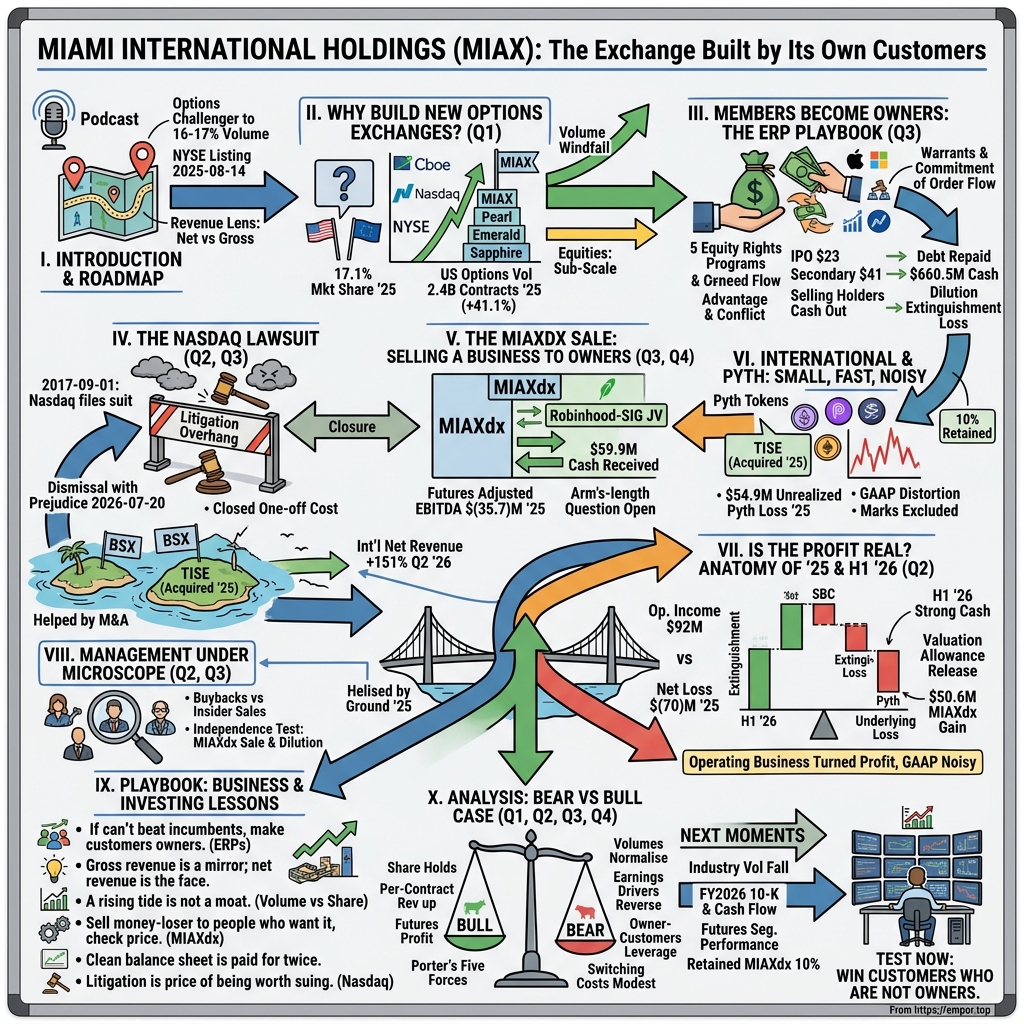
Miami International Holdings (NYSE: MIAX): The Exchange Built by Its Own Customers
I. Introduction & Episode Roadmap (0:00–6:00)
At 9:30 a.m. Eastern, the American options market wakes up all at once. Millions of orders to buy and sell the right to buy or sell a share of Apple, an S&P 500 ETF or a meme stock at a fixed price spill out of brokerage apps, hedge fund algorithms and market-maker servers. Each of those orders has to land somewhere. There are roughly seventeen licensed options exchanges in the United States, and the routing systems that decide where an order goes make that choice in microseconds, weighing fees, rebates, queue position and the odds of getting filled.
On about one in six of those decisions, the answer is a venue run by Miami International Holdings. MIH, which trades on the New York Stock Exchange as MIAX, operates four US options exchanges (MIAX Options, MIAX Pearl, MIAX Emerald and MIAX Sapphire), a small equities exchange, a futures business and a pair of offshore exchanges in Bermuda and the Channel Islands1. It handled about 17.1% of all US options contracts in 20251. On 2025-08-14 it became a public company, listing on the NYSE after pricing its IPO at $23.00 a share5.
That is the one-line version: a challenger that started from zero in a market owned by Cboe, Nasdaq and the NYSE, and climbed to a solid number three or four. The more interesting version starts with two pairs of numbers that do not seem to belong to the same company.
The first pair is about revenue. MIH reported total revenues of about $1.36 billion in 20252. Yet the money it actually kept, after paying out the rebates and transaction costs that attract order flow, was about $430 million2. Roughly two-thirds of every revenue dollar walks straight back out the door to the very traders who generated it.
The second pair is about profit. MIH earned operating income of about $92 million in 2025, yet reported a net loss of about $70 million2. A business that made money from running exchanges somehow lost money for its shareholders in the same year.
Each pair hides a story, and together they frame the four questions this piece will test.
First: did MIAX create its profit surge, or did the options-volume cycle lend it? Sections II and VII take that on, by separating market share from market growth.
Second: how much of the earnings is real, given crypto token marks, a tax release and a gain on selling a business? Sections IV, VI and VII walk the bridge from operating profit to net income.
Third: do the owners and customers shape the economics? MIAX was built by trading firms that bought equity in exchange for sending it orders. Some of those same firms later bought a business from it. Sections III, V and VIII examine what that means.
Fourth: do Futures and International earn their keep? Sections V and VI look at the diversification bets.
Why "net revenue" is the right lens
Before going further, it is worth settling the accounting language, because the rest of the story depends on it.
An options exchange makes most of its money by charging a fee on each contract traded. But exchanges compete for orders by paying for them. The dominant model in US options is "maker-taker" or its cousins: the exchange charges the side that takes liquidity a fee and pays the side that posts liquidity a rebate. Exchanges also pay to route orders to other venues when they cannot fill them at the best price. Under US accounting rules, MIH books the full fee as revenue and records the rebates and routing payments as "cost of revenues." That makes gross revenue a measure of throughput, not of economics.
Think of it like a ticket reseller who books the full face value of every ticket as revenue and then hands most of it to the promoter. The number that tells you whether the business is any good is what is left after the promoter is paid. For MIH, that is "revenues less cost of revenues," which the company and this piece call net revenue2.
Through that lens, MIH's 2025 looks very different from the headline. Gross revenue grew about 20%, but net revenue grew about 56%2. Something happened that made the business far more profitable per contract and far bigger at the same time. Was it skill, or weather? To answer that, the story starts where MIAX did: a crowded market that did not seem to need another exchange.
 Subscribe on LinkedIn
II. Why Build a Fourth, Fifth and Sixth Options Exchange? (6:00–18:00)
Picture the US options market in the late 2000s. The Chicago Board Options Exchange, the original listed-options venue founded in 1973, still dominated index options. The International Securities Exchange had proven that an all-electronic venue could steal share. Nasdaq and NYSE had each bought or built options exchanges. Traders already had more venues than they could comfortably connect to.
Into that crowd came a group in Princeton, New Jersey, led by Thomas P. Gallagher, building a new options exchange from scratch. MIAX Options went live in December 20125. Gallagher, who remains Chairman and CEO1, had a theory: options trading was becoming a technology business, the incumbents were running older systems stitched together through acquisitions, and a venue built for speed and capacity from day one could win order flow from market makers who cared about every microsecond.
The theory was only half the battle. In exchange land, technology does not win share on its own. Liquidity wins share, because traders send orders where other traders already are. A new exchange is an empty restaurant: nobody wants to eat there because nobody eats there. The way MIAX broke that loop, by turning its biggest customers into its owners, is the subject of the next section. This one is about what it built and whether it is winning.
The licence-stacking strategy
The striking thing about MIAX is not that it built one options exchange. It built four. MIAX Pearl followed in 2017, MIAX Emerald in 2019 and MIAX Sapphire in 20245. Why would a company want four venues trading the same products?
The answer lies in how US options pricing works. Each exchange files a fee schedule with the Securities and Exchange Commission, and each schedule has to treat similarly situated members fairly. That makes it hard for one exchange to offer every possible pricing model at once. A venue cannot easily run a pure maker-taker model for the professional algorithm crowd and a traditional "pro-rata" model that rewards market makers who commit to quoting, all under one rulebook. So the operator families each run several licences: Cboe, Nasdaq and the NYSE parent ICE all hold multiple options exchanges. MIAX simply copied the playbook. Each licence is a different storefront with a different price list, catering to a different kind of trader, sharing one technology platform behind the counter.
That matters for the economics. The marginal cost of an additional licence is low once the matching engine, the market-data feeds and the regulatory staff exist. The marginal revenue can be meaningful if the new pricing model attracts flow that would otherwise go elsewhere. Licence-stacking is how a challenger turns a fixed cost base into more shelf space.
The industry map
The US options market is a small number of families wearing many hats. Cboe, Nasdaq and ICE each run several venues, and together with MIAX they account for most of the volume, with independents and newer entrants splitting the rest. Industry share figures move every month; the approximate picture is that Cboe's family is the largest, Nasdaq's and MIAX's families sit in a tight group behind it, and NYSE's options exchanges trail. Those rankings are approximate and shift with the mix of index versus single-stock trading, where Cboe's proprietary index products give it a structural edge MIAX lacks.
Within that map, MIAX's 17.1% share for 20251 is real scale. It is not a niche player picking up scraps; it is one of the four or five operators that every serious options broker and market maker must connect to.
The business model in one paragraph
MIH earns money four ways: transaction and clearing fees on each contract or share traded, access fees for connecting to its venues, market-data fees for the price feeds it produces, and other services1. Against that, it pays liquidity rebates and routing costs. The same brokers and market makers who generate the fees are also the recipients of the rebates. MIAX's biggest customers are also its biggest cost line, and, as Section III will show, many of them were also its owners.
The windfall year
Then came 2025. US options volume hit about 2.4 billion contracts across the industry, up about 41% on 20241. Average daily volume across MIH's options venues rose from about 6.7 million contracts to about 9.5 million1. That is the kind of growth exchange operators dream about and cannot manufacture: retail traders discovering short-dated options, institutions hedging volatile markets, and an industry-wide surge in activity.
Here is the first clue in the puzzle. If MIAX had been winning share, its volume would have grown faster than the industry. It did not. Its share in Q2 2026 was 16.5%, against 16.7% a year earlier3. Its 2025 share of 17.1% is in the same band. MIAX held its position in a rising market; it did not take ground.
The second clue points the other way. Net revenue per contract in options rose about 6% to $0.124 in Q2 20263. That means MIAX was keeping slightly more of each contract after paying rebates, through price changes, mix shifts toward higher-fee products or customers, or tighter rebate terms. Q2 2026 options ADV was about 11.0 million contracts, up about 25%3. So of the roughly 35% jump in group net revenue that quarter3, most came from volume and a smaller slice from better pricing per contract. The cycle did the heavy lifting; MIAX added a modest pricing improvement on top.
The Equities footnote
MIH also runs an equities exchange, MIAX Pearl Equities. It is sub-scale: about 1.0% of US equity volume in 2025, with its volume down about 8% that year1, and Q2 2026 ADV down another 4.6% with share at 0.9%3. In the most liquid stock market in the world, where share is fought over by Cboe, Nasdaq, NYSE, IEX, MEMX and dozens of off-exchange venues, MIAX is a bit player. It is worth one sentence in an investment case, and it gets one: Equities is a technology option, not a profit engine.
The falsification test
The strongest version of the bull case is that MIAX is a challenger that wins. The test of that claim is its own record. Between 2022 and 2024, net revenue grew from about $196 million to about $276 million52, a pace of roughly 19% a year. That is a respectable growth rate for an exchange, consistent with steady share gains and a growing market. Then 2025 delivered 56%2. That is not the same company getting suddenly better at competing; the share data say otherwise. It is the same company catching a wave.
The verdict for this section: MIAX is a durable number-three-to-four player with real scale and a sound technology platform, and its per-contract pricing has edged up. But the 2025 surge was mostly lent by the market. Share is flat to slightly down. The challenger has become an incumbent in its own right, and incumbents earn what the market gives them.
The number that will settle the question is not on any page yet: MIAX's net revenue and share in the first quarter in which industry options volume falls year on year. If share holds and per-contract revenue holds, the business is sturdier than a pure volume play. If both slip, the 2025 numbers were weather.
But all of this assumes MIAX could get order flow in the first place. How does an empty restaurant fill its tables? By giving the regulars a piece of the restaurant.
III. The Members Who Became Owners: The ERP Playbook (18:00–30:00)
Imagine pitching a large options market maker in 2012. They already connect to a dozen venues. Every new connection costs them engineering time, compliance work and fees. You are asking them to quote on your exchange, which has no volume, in the hope that volume will come because they quoted. Why would they bother?
MIAX's answer was an elegant piece of financial engineering called the Equity Rights Program. Trading firms that committed to sending order flow to MIAX venues earned the right to acquire equity in the parent company, typically through warrants that vested as volume targets were met5. MIAX ran five of these programs over its life5. The pitch, in effect, was: help us build this exchange, and you will own a piece of what you build.
It was a clever fix for the empty-restaurant problem. A market maker that quoted on MIAX was no longer just paying fees to a vendor; it was building the value of its own investment. Every contract it sent was, in part, a contribution to its own balance sheet. The more firms joined, the more liquidity appeared, the more other firms found it worthwhile to connect.
Not a new idea, a new wrapper
Customer ownership of exchanges is as old as exchanges. The NYSE and Nasdaq were for decades owned by their members before they demutualised and listed in the 2000s. The CBOE was a member-owned organisation until its own conversion and IPO in 2010. What was different about MIAX was the direction of travel. The incumbents started member-owned and became public companies to escape the conflicts of member control. MIAX started as a company and used targeted member ownership to buy liquidity. The old exchanges sold off member ownership; MIAX bought member loyalty with it.
The price of loyalty
That loyalty came with a bill, and it was paid in shares. At the time of the IPO, there were about 19.0 million warrant shares outstanding at a weighted average exercise price of $8.715. Next to an IPO price of $23.00, those warrants carried large built-in gains for their holders, and every exercise added to the share count.
The share count tells the story of that bill coming due. Shares outstanding were about 85.5 million at the end of 2025 and about 98.6 million by mid-202614. In Q2 2026, the diluted weighted average share count, which counts in-the-money warrants and equity awards, was about 110.7 million3. Warrant exercise and share compensation explain much of the climb. For a public shareholder, the ERP is not a historical curiosity; it is a continuing source of dilution, and the economics of any per-share calculation have to account for it.
Who are the owners, and how much do they matter?
Here the story hits the edge of what the company publishes in the material that frames this piece. MIH lists large trading firms among its historical ERP participants, and its filings flag that a small number of customers account for a meaningful portion of activity1. The precise percentages of revenue from the largest customers and the post-IPO holdings of the biggest ERP participants are disclosed in the 10-K concentration note and the proxy statement's principal-stockholders table rather than in the summary materials, and this piece does not assert figures it cannot tie to those tables.
What can be said with confidence is the structure. The firms that send the most flow are among the firms that receive the most rebates, and some of them hold or held equity. That is a three-way relationship (customer, cost, owner) that no incumbent exchange family has to manage to the same degree. It is MIAX's clearest source of advantage, because it locked in liquidity early, and its clearest source of potential conflict, because a member-owner negotiating a rebate is negotiating with a company it partly owns.
The IPO and the secondary
On 2025-08-13 the registration became effective, and the next day MIAX began trading on the NYSE5. The company sold 15 million shares at $23.00, raising net proceeds of about $310 million5. Wellington Management had indicated interest in buying up to $40 million of shares as a cornerstone investor5, a signal designed to tell other buyers that a sophisticated long-only firm was willing to anchor the book.
Then the stock nearly doubled. In December 2025, existing holders sold shares in a secondary offering at $41.001. The company received nothing from that sale; every dollar went to the selling stockholders1. The announced size of the secondary was 6.75 million shares, while the annual report later described it as about 7.8 million, a gap most likely explained by the underwriters' option being exercised on top of the base deal, though the company's own filings should be read to confirm it.
The juxtaposition is worth sitting with. The company raised capital at $23. Four months later, insiders and early holders sold at $41. That is not wrongdoing; lock-ups, warrant exercises and secondary sales are how early investors get liquidity, and the company's IPO price was set by an institutional book. But for the public investor, it means that the people with the best information about MIAX chose to sell a slice of their holdings at a price nearly 80% above where the company itself had issued shares. Lock-ups expired on 2026-02-091, opening further supply.
Warburg Pincus: lender with a kicker
The other early capital partner was Warburg Pincus, which lent MIH $100 million in August 2024 and another $40 million in June 2025 under a senior secured term loan due 20295. Like many growth-stage loans, it came with warrants attached. Warburg got a coupon plus a slice of the upside. MIH got capital before it could tap public markets.
What did each party want? Warburg wanted a secured, high-yield position with an equity option on a company approaching an IPO. Wellington wanted an allocation in a newly listed exchange at a reasonable price. MIH wanted to cross the bridge to public markets without diluting itself prematurely. Everyone got roughly what they wanted, but someone had to pay for the warrants, and that someone was the company's income statement, as Section VII will show.
The clean balance sheet, and its cost
After the IPO, MIH used proceeds to repay the term loan. By the end of 2025, total debt was about $1.5 million, down from $37.0 million a year earlier2, and by mid-2026 cash had grown to about $660 million4. On paper, that is a pristine balance sheet for an exchange operator.
But the repayment triggered a loss on debt extinguishment of about $108 million in 20252, reflecting the premium, unamortised costs and the value of the warrants that had been attached to the loan. That single line is a large part of why the company reported a net loss in its first year as a public company. The balance sheet was cleaned, and the cleaning was not free: the warrants made the capital expensive, and the IPO paid for both the principal and the kicker.
The verdict for this section: the ERP model is how MIAX bought liquidity, and it worked. It also wove customers, costs and owners together in a way that public investors must keep testing. The structure is clear; how concentrated it remains after the IPO and secondary is the question the next proxy and 10-K answer. And the first time that structure faced an outside adversary was not a pricing war. It was a lawsuit.
IV. The Nasdaq Lawsuit: Nine Years, $30 Million (30:00–38:00)
On 2017-09-01, Nasdaq filed suit against Miami International Holdings, alleging that MIAX had infringed seven Nasdaq patents and misappropriated trade secrets4. MIAX, then a five-year-old challenger, had been chipping away at the share of exchanges that included Nasdaq's own options venues. The suit landed in federal court in New Jersey, close to MIAX's Princeton technology base.
It is worth asking why a giant would sue a challenger. Large exchange operators do not generally litigate against small rivals for sport. Patent and trade-secret suits are expensive, slow and uncertain. A company usually reaches for them when the rival is taking something that matters: people, ideas or customers. Whatever the merits, which the court never ruled on in a final judgment, the suit is a signal of how seriously Nasdaq took the threat.
Nine years in court
The case dragged on for almost nine years. Patent cases involving exchange technology tend to move through claim construction, challenges at the Patent Trial and Appeal Board, expert discovery and motion practice, and this one followed a long arc of that kind. For MIAX, it meant a steady drain of legal fees, about $7.0 million in 2023 and about $8.9 million in 202451, and a disclosure overhang hanging over every capital-raising document. An investor reading the IPO prospectus had to price an open lawsuit from one of the three biggest exchange families.
The ending
In June 2026, the parties reached a settlement in principle. On 2026-07-20, the US District Court for the District of New Jersey dismissed all claims and counterclaims with prejudice4, meaning neither side can bring them again. MIH booked a $30.0 million litigation settlement charge in Q2 20263.
The charge is the most visible piece. It explains a large part of why Q2 2026 operating expenses rose about 46% to roughly $113 million3. Strip it out, and the expense growth that quarter looks much more like the steady rise of a company investing in technology and marketing than a cost blowout.
What the summary releases do not spell out is the full shape of the deal: whether the $30 million is a payment from MIH to Nasdaq, whether it includes a licence to the disputed technology going forward, or whether any portion flows over time. The legal-proceedings note in the Q2 2026 10-Q is where that detail lives4, and investors should read it rather than assume a simple cheque. A one-time payment and a running royalty would have very different implications for future margins.
A closed chapter, with one caveat
The verdict here is straightforward. The Nasdaq litigation was a real, quantified and now closed cost. Nine years of fees plus a $30 million charge is a meaningful sum for a company of MIH's size, but it is a one-off. Its closure removes an uncertainty that weighed on every prospectus risk factor since 2017. It also says something flattering about MIAX: you do not get sued for nine years by Nasdaq unless your technology and your share gains are worth suing over.
The caveat is about the broader control and audit record. A newly public company's first annual report includes the auditor's opinion, any critical audit matters and management's assessment of internal controls. Those sections, Item 8 and Item 9A of the 10-K1, are where an investor learns whether the auditor flagged anything about Pyth token valuation, the debt extinguishment or revenue recognition on rebates. This piece makes no claim either way about that record; it is the right place for a diligent investor to look before concluding that the books are as clean as the balance sheet.
With the litigation behind it, MIH turned to a different kind of housekeeping: deciding which of its newer businesses to keep. Its answer, early in 2026, was to sell one of them to two of its most important customers.
V. The MIAXdx Sale: Selling a Business to Your Own Customers (38:00–50:00)
On 2026-01-20, MIH announced that it had sold 90% of MIAXdx to a joint venture formed by Robinhood and Susquehanna International Group, keeping 10% for itself4. On the surface, it was a modest transaction: a futures-and-event-contracts subsidiary changing hands. Underneath, it was one of the most revealing deals in the company's history, because both buyers trade on MIAX's exchanges.
What MIAXdx was
MIAXdx was a derivatives clearing and exchange platform regulated by the Commodity Futures Trading Commission, the futures regulator, which gave it the ability to list and clear event contracts and futures products1. Event contracts are the regulated cousin of prediction markets: a contract that pays $1 if an event happens (an election result, a rate decision, a sports outcome) and nothing if it does not. In 2025 and 2026, they became one of the hottest corners of finance, as retail brokers raced to offer them.
Why would Robinhood want a regulated event-contract venue? Because retail customers wanted to trade those contracts, and owning the venue lets a broker control product design, listing speed and economics, rather than renting someone else's. Why would SIG want in? Because SIG is one of the largest options and derivatives market makers in the world, and a new retail-heavy product category is exactly where a market maker wants to sit at the centre of the order book. The buyers were the natural owners of the asset.
The price
MIH received about $59.9 million in cash, net of the cash held by MIAXdx at closing, and booked a gain of about $50.6 million4. A gain that large relative to the cash received suggests the business had a small carrying value on MIH's books, consistent with a unit that had been built internally and had accumulated losses rather than acquired at a high price.
Whether $59.9 million was a fair price is the question that matters, and here the outside observer has limited tools. The buyers were not strangers. Both are major trading participants on MIAX venues, which means their flow drives a meaningful slice of MIAX's revenue and rebate payments. In a related-party situation, the protections an investor looks for are a special committee of independent directors, a fairness opinion and a competitive process. The related-party and subsequent-events notes in the 10-K and the Q2 2026 10-Q are where MIH would describe them14. Until an investor has read those notes, the arm's-length question is open: the deal may well have been priced fairly, but the evidence is not in the headline.
There is a further twist. Event contracts were booming in early 2026. An asset that was a cost centre for MIH in 2025 may have been worth considerably more to buyers with millions of retail accounts. That is a reasonable explanation for why selling made sense, and it is also an argument that MIH sold a strategic option in a hot category to two of its own customers. Both things can be true. The retained 10% is MIH's hedge against having sold too early.
Does Futures earn its keep?
The sale sits inside a larger question about MIH's Futures segment. The segment includes MIAX Futures (the former Minneapolis Grain Exchange, which MIH acquired in 20205), and until January 2026, MIAXdx. Futures is where MIH has spent heavily to build a second leg beyond options. In 2025 it posted adjusted EBITDA of about negative $36 million2. That is a large loss next to group operating income of about $92 million.
The capital-allocation record in Futures is therefore the record of a build that has not yet paid. MIH signed a ten-year licence with Bloomberg to list futures on Bloomberg indices5, and in Q2 2026 it launched products tied to them, the Tini and B500 index futures3. Futures net revenue grew only about 2% in Q2 20263, in a quarter when the options business grew far faster.
This is the optionality test, and it is worth being blunt. Launching a futures contract is a technical milestone, not a revenue line. The futures industry is dominated by CME Group, whose deep liquidity in equity-index, rate and commodity contracts makes it extraordinarily hard to dislodge. Many index futures launched by challengers over the past two decades have quietly faded for want of liquidity. MIAX's own Futures record, through 2025, is a story of milestones not yet converted into earnings. Until the segment shows sustained net revenue growth and a narrowing loss, the Bloomberg launches should be framed as a lottery ticket MIH has paid for, not an engine it has built.
A brief note on Dorman Trading, the futures commission merchant MIH acquired in October 20225: it gives MIH a clearing and brokerage capability on the futures side. The purchase price relative to peers is not a useful benchmark here, and it is not material to the investment case.
The verdict
Selling a money-losing build to the people best placed to make it work can be smart capital allocation, and the $50.6 million gain on a small book value suggests MIH got real money for it. But the buyers were MIH's customers, and the deal was struck in a hot market. Read together with the ERP history, the MIAXdx sale is the clearest example of how deeply MIH's economics are intertwined with the firms that trade on it. The arm's-length verdict waits on the related-party disclosure. The Futures verdict waits on a full year of segment results without MIAXdx in them.
If Futures is the expensive bet, International is the small one, and it comes with a strange passenger: a crypto token.
VI. International, TISE and the Pyth Tokens: Small, Fast, Noisy (50:00–60:00)
The Bermuda Stock Exchange sits in Hamilton, a small island capital better known for reinsurance than trading floors. It lists insurance-linked securities, funds and debt that use Bermuda as a legal domicile, and it is a world away from the high-frequency options battles of Chicago and New Jersey. MIH owns it1. In June 2025, it added a second island exchange: The International Stock Exchange (TISE) in Guernsey, a listing venue for debt securities and investment funds1.
Together they form MIH's International segment. It is small. In Q2 2026, International net revenue was about $5.7 million, up about 151% year on year3. That growth rate is eye-catching, but most of it reflects TISE being included for the full quarter rather than organic expansion of BSX. The segment posted positive adjusted EBITDA of about $2.0 million in 20252.
Why include it at all?
International matters to the story not for its size but for what it says about MIH's ambitions. Listing exchanges in offshore financial centres earn steady fees from issuers and funds that need a recognised listing. They are less cyclical than options trading and can be profitable at small scale. For a group whose core business swings with options volume, a small, fee-based offshore listing franchise is ballast. TISE's acquisition price is not one the company has made prominent in its summary results, so no judgement on whether MIH overpaid can be fairly made here. What can be said is that International is profitable, growing partly through acquisition, and too small to move group earnings.
Currency exposure is correspondingly small. Foreign-currency translation adjustments swung from a gain of about $1.1 million in H1 2025 to a loss of about $1.6 million in H1 20264, immaterial next to group earnings. The company's market-risk disclosure in the 10-K describes the exposure1; it is not a variable investors need to model closely.
The Pyth tokens
Then there is the strange passenger. BSX publishes its market data to the Pyth Network, a blockchain-based "oracle" that supplies price data to decentralised finance applications. In exchange, BSX receives Pyth tokens, the network's native crypto asset1.
Think of it as a newspaper that licenses its stock tables to a new platform and gets paid in that platform's shares rather than cash. If the platform's shares fall, the newspaper's income statement takes the hit, even though nothing about its stock tables has changed.
That is exactly what happened. MIH holds the tokens at fair value, classified as Level 2 (meaning they are valued using observable market inputs adjusted for factors like lock-up restrictions), and they unlock on a schedule running through 20281. When Pyth's market price fell in 2025, MIH booked an unrealized loss of about $54.9 million2. That single non-cash mark wiped out more than half of the year's operating income in the GAAP net-income figure.
Management excludes these marks from its adjusted measures2, which is reasonable: the tokens have nothing to do with how many options contracts MIAX matches. But the tokens are real assets on the balance sheet, and their value moves with crypto sentiment. For a GAAP-focused investor, the Pyth position is a source of noise that can swing quarterly earnings by tens of millions of dollars in either direction until the tokens unlock and are, presumably, sold.
The verdict: International earns a place in the story as a small, profitable growth vector, mainly through acquisition. It does not earn a place in the valuation as a major driver. The Pyth tokens matter mainly because they distort the earnings picture, which brings the story to its central accounting question: underneath all this noise, how much does MIH really earn?
VII. Is the Profit Real? The Anatomy of 2025 and H1 2026 (60:00–74:00)
Two headlines, same company, same year. "MIH posts $92 million operating income." "MIH reports $70 million net loss." A casual investor could read either and walk away with the wrong idea. The truth lives in the space between them.
Walking the bridge
Start with net revenue of about $430 million in 20252. That is what MIH kept after paying rebates and routing costs.
Subtract operating expenses of about $339 million, up from about $279 million in 20242. Those cover people, technology, depreciation, regulatory costs, marketing and professional fees. Within them sits share-based compensation of about $57.6 million, which includes about $8.0 million of one-time IPO-related payments such as special bonuses and director termination costs2. What remains is operating income of about $92 million2.
That is the first real fact in the bridge: in 2024, MIH's operating income was about negative $2.8 million2. The operating business turned from roughly break-even to clearly profitable in a single year. Most of that swing is the options volume boom flowing through a largely fixed cost base. An exchange's costs (technology, staff, regulation) do not scale with every contract, so when volume jumps, a large share of incremental net revenue drops straight to operating profit. This is operating leverage, and it works in both directions.
Now go below the operating line. Subtract the roughly $108 million loss on debt extinguishment from repaying the Warburg term loan, and the roughly $55 million unrealized loss on Pyth tokens2. Add interest income and other items, subtract taxes, and the result is a net loss of about $70 million, or about negative $1.00 per diluted share2, against positive $1.39 in 20241.
So what was "real" in 2025? The extinguishment loss was a real economic cost, but a one-time one: it was the price of the clean balance sheet. The Pyth loss was a real change in an asset's value, but unrelated to the exchange business and unlikely to recur at that scale every year. Share-based compensation is a real, recurring cost that should not be ignored; it is how MIH pays people, and it dilutes shareholders. The fair summary is that MIH's underlying exchange business earned something close to its operating income in 2025, and its GAAP loss was manufactured by two non-recurring, non-operating items.
H1 2026: noisy in the other direction
If 2025 was artificially depressed, the first half of 2026 was artificially inflated. MIH booked the $50.6 million MIAXdx gain4, and it released about $109.2 million of a valuation allowance on its deferred tax assets4. A valuation-allowance release is an accounting judgement: when a company that has been losing money becomes confident it will earn enough taxable income to use its past tax losses, it reverses a reserve it had set against those losses, and the reversal flows through the income statement as a tax benefit. It is a non-cash gain that says something positive about management's confidence in future profits, but it is not earnings from operations.
Strip out both, and add back the $30.0 million Nasdaq charge as a one-off in the other direction3, and the H1 2026 run-rate is much less dramatic than the headline. Q2 2026 GAAP diluted EPS was $0.40; the company's adjusted figure was $0.483. The gap between them tells you how much noise there is in any single quarter.
Cash tells the cleaner story
Cash flow cuts through much of this. Operating cash flow was about $184 million in H1 2026, against about $66 million in H1 20254. That is a striking improvement, and it is broadly consistent with an exchange business that is genuinely producing cash from higher volumes.
But two cautions apply. First, exchanges collect fees and pay rebates on monthly cycles, and clearing-related balances can swing working capital sharply from one quarter-end to the next. Part of the H1 2026 strength may be timing. The balance sheet's receivables and payables lines, and the full-year cash-flow statement, are the places to check whether the improvement holds over twelve months1.
Second, some of the earnings power now comes from the IPO cash itself. Interest income rose from about $2.7 million in H1 2025 to about $9.6 million in H1 20264, earned on Treasury bills and certificates of deposit funded by the IPO proceeds and accumulated cash. That is real money, but it is a return on capital raised from shareholders, not a return on running exchanges. If rates fall or the cash is deployed, that line shrinks.
Pay and incentives
Share-based compensation deserves a word of its own because it is the largest recurring item between the operating story and the per-share story. After the IPO-inflated 2025 figure of about $57.6 million, management guided 2026 share-based compensation to $29–32 million2. If delivered, that roughly halves a material expense and will lift per-share earnings meaningfully. Executive pay details for Gallagher and other named officers are set out in the 2026 proxy statement, which is where investors can test how much of that compensation is tied to performance and how much to time served.
Reinvestment
On the investment side, MIH is light. Capital expenditure, including capitalised software, was about $27.9 million in H1 2026 against about $16.9 million a year earlier4, and management guided 2026 capex to $40–45 million2. At the midpoint, that is roughly 3% of 2025 gross revenue and about a tenth of net revenue. For a technology-intensive business, that is modest: matching engines and data centres need steady upgrades, but they do not need constant reinvestment at the scale of a factory or a cloud provider. Information-technology expense rose to about $10.2 million in Q2 2026 from about $8.9 million3, and marketing jumped from about $0.6 million to about $3.2 million3, a sign MIH is spending to promote its new futures products.
Guidance discipline
With only two full reporting cycles as a public company, MIH's record of hitting its own guidance is short. The two items worth tracking are the ones it has quantified: 2026 share-based compensation and 2026 capex. Comparing how management described those on the Q4 2025 call and again on the Q2 2026 call will be the first real test of whether its guidance is conservative, accurate or optimistic.
The verdict: the operating business has genuinely turned from break-even to profitable, and H1 2026 cash generation is strong. But GAAP earnings have been noisy in both directions, and no single headline number in 2025 or the first half of 2026 is a clean measure of run-rate profit. A fair reading puts underlying earnings power somewhere near the operating line, plus interest income, minus a more normal level of share-based compensation, and leaves the final answer open until the full-year 2026 cash flow is read. That brings the story to the people producing the numbers.
VIII. Management Under the Microscope (74:00–80:00)
The first earnings call as a public company is a rite of passage. The CEO reads prepared remarks that sound triumphant; the analysts, who have spent weeks building models, ask the questions that keep them up at night. For MIH, those questions have centred on two numbers: net revenue per contract, and market share. Is MIAX's pricing improvement durable? Is share stable, or quietly slipping?
Thomas Gallagher has run MIH since before its first exchange launched, and he remains Chairman and CEO1. He is a founder-operator: the person who pitched the ERPs, guided the company through nine years of Nasdaq litigation and took it public. That longevity is an asset in a business where relationships with market makers and regulators matter enormously. It also concentrates authority. Combining the chairman and CEO roles in one founder means board independence must come from the other directors, and the 2026 proxy statement and the annual-meeting vote results filed on Form 8-K are where investors can test how independent that board is and how shareholders voted on pay.
The record so far
As a public company, MIH's record is about a year long. Over that year, management did what it said it would do with the IPO money: it repaid the term loan, cleaned up the balance sheet and accumulated cash. It sold a money-losing unit, settled a long-running lawsuit and began buying back stock, repurchasing about $17.0 million in H1 20264. On their face, those are coherent capital-allocation moves.
The tests of independence lie elsewhere. The MIAXdx sale to Robinhood and SIG, discussed in Section V, and the continuing ERP dilution, discussed in Section III, are the decisions where the interests of public shareholders and member-owners could diverge. A skeptical investor would want to see that independent directors approved the MIAXdx deal and that the board is actively managing dilution.
The activist's question
Picture a skeptical long/short investor reading MIH's filings. Their first question would be about the buyback. Why does a company with about $660 million of cash and almost no debt need to buy back stock at all, when insiders and early holders sold at $41 in December 20251? There are good answers: the cash may exceed operating needs; buybacks can offset dilution from warrant exercises and equity awards. But $17 million of repurchases is small next to the roughly 13 million shares added to the count between year-end and mid-202614. The buyback barely dents the dilution.
Their second question would be about the cash pile. Exchanges need regulatory capital, and clearing and futures businesses need margin buffers. But a large, interest-earning cash balance in a company with no debt invites the question of what it is for. Is MIH saving for an acquisition? For Futures losses? For a special dividend? Management's answer to that question on future calls will be one of the clearer windows into its capital-allocation priorities.
Their third question would be about price. The company issued shares at $23 in August 2025. The stock closed 2025 at $44.38, giving MIH a market value of about $3.0 billion1. Holders sold at $41 in between. That pattern is common for successful IPOs, but it means the company left money on the table at the IPO, and that the insiders chose to take some off the table near the highs.
The verdict: the record is short and, so far, coherent. Management has delivered the basic promises of a newly public company. The tests that matter, independence in related-party deals, discipline on dilution and a clear plan for the cash, are still being run. With that, the story can step back and draw out what MIAX teaches.
IX. Playbook: Business & Investing Lessons (80:00–86:00)
"If you can't beat the incumbents, make your customers your owners." In 2012, MIAX was an empty exchange in a crowded market. The ERP turned trading firms into stakeholders and filled the order book faster than any fee schedule could. For founders, the lesson is that in a network business, the hardest customer to acquire is the first one, and equity is the most powerful currency for buying them. For investors, the lesson is that equity never stops being a currency: the warrants that bought liquidity in 2012 were still adding to the share count in 2026.
"Gross revenue is a mirror; net revenue is the face." MIAX books about $1.36 billion of revenue and keeps about $430 million. The rest is the reflection of its customers' trading. Any investor who values an exchange on gross revenue is valuing the traffic, not the toll booth. The lesson travels well beyond exchanges: travel agents, ad networks, payment processors and marketplaces all wear the same mirror.
"A rising tide is not a moat." In 2025, MIAX's options volume rose more than 40% while its market share went sideways. Every exchange looked brilliant that year. The test of a competitive advantage is how a company performs when the tide goes out. Until MIAX shows its share and pricing can hold in a down year, its 2025 surge is evidence of a good business in a great market, not of a great business.
"Sell the money-loser to the people who want it, then check the price." MIAXdx was a cost centre for MIH and a strategic prize for Robinhood and SIG. Selling it to them was logical. But a sale to your own biggest customers needs more scrutiny than a sale to strangers, not less. The process, not the gain, tells you whether the price was right.
"A clean balance sheet is paid for twice." MIH paid off its Warburg loan with IPO money and booked a $108 million loss doing it. The balance sheet is now pristine. Investors who see a debt-free exchange should remember that someone paid the interest, the warrant value and the prepayment premium to make it so, and that someone was the shareholder.
"Nine years of litigation is the price of being worth suing." Nasdaq does not spend nine years in court against a nuisance. The $30 million settlement closed the case; the fact of the case is the compliment.
X. Analysis & Bear vs. Bull Case (86:00–96:00)
Go back to the trader at 9:30 a.m. with an order to route. Seventeen venues are available. Each posts a fee schedule; each offers a different rebate for posting liquidity and a different fee for taking it. The trader's smart order router weighs them all in microseconds. Loyalty does not enter the calculation unless it is written into a contract or a cap table. That single moment is the heart of the moat question: why would this order go to MIAX, and what would make it stop?
Porter's Five Forces
Buyer power is high. MIAX's customers are a small number of large brokers and market makers who generate most of its volume. They are sophisticated, they connect to every venue and their routers switch flow based on price. Several of them are, or were, MIAX owners, which helps lock in flow but also gives them a seat on both sides of every pricing negotiation. The MIAXdx sale showed how deeply some of those relationships run. Buyer power is the single biggest constraint on MIAX's pricing.
Rivalry is intense and regulated. About seventeen venues compete for the same order flow, and fee schedules are public and filed with the SEC. Price competition is constant; a rival can match a rebate in a filing. Regulation dampens the most extreme forms of price war, but it also makes undercutting easy to copy.
Supplier power is moderate. The key suppliers are technology vendors, data-centre operators and talent. MIAX built its own trading technology, which reduces dependence on external vendors. The Options Clearing Corporation, the industry's central clearing house, is a shared utility rather than a supplier that can squeeze one exchange.
Threat of substitutes is real but limited. Options can be traded only on registered exchanges in the US; there is no equivalent of the equities "dark pool" that captures large slices of stock trading off-exchange. But substitutes exist in other forms: single-stock futures, leveraged ETFs, event contracts and, at the margin, crypto derivatives. Retail traders who once bought short-dated options might instead buy prediction-market contracts, which is part of why the MIAXdx sale is strategically interesting.
Barriers to entry are significant but not insurmountable. A new options exchange needs an SEC licence, a technology platform, connectivity with every major broker and, above all, liquidity. MIAX itself is proof that a well-funded, technically strong entrant can break in, which cuts both ways: it is evidence of MIAX's capability and evidence that another entrant could follow the same playbook.
Hamilton Helmer's 7 Powers
Scale economies are the most plausible source of power. MIAX runs four options licences on one platform, and its fixed costs are spread across about one-sixth of the national market. A new entrant would carry the same fixed costs on a fraction of the volume. That advantage is real against small rivals, but MIAX is not the scale leader; Cboe and Nasdaq spread their costs across larger and more diverse franchises.
Counter-positioning helped MIAX early. The ERP model was something incumbents, by then public companies answerable to diversified shareholders, could not easily copy without diluting their own investors. That power was strongest in the 2010s. Now that MIAX is public, it faces some of the same constraints its rivals once did.
Network effects exist, since liquidity attracts liquidity, but they are shared across the market. Order routing rules require brokers to seek the best price across all venues, which weakens any single venue's network effect. MIAX benefits from the network, but it does not own it.
Switching costs are low for market makers, who are already connected to every venue. Cornered resources are absent; the closest candidate, the Bloomberg index licence for futures, is not yet producing meaningful revenue. Branding and process power are not decisive in this market.
The moat, then, is narrower than the 2025 growth suggests. MIAX has real scale, a strong technology platform and a sticky owner-customer base. It does not have pricing power that has been tested through a down cycle; the 6% rise in net revenue per contract is encouraging but young.
Valuation as data
At the end of 2025, the market valued MIH at about $3.0 billion against equity of about $1.15 billion by mid-202614. Measured against its 2025 net revenue, the market capitalisation was roughly seven times the money the business actually keeps. Cboe, Nasdaq, ICE and CME, the natural benchmarks, are larger, more diversified and far more mature, and each carries index franchises, data businesses or clearing houses MIAX lacks. The comparison of current multiples on 2026-10-03 against those peers is the investor's homework, but the qualitative point is clear: a market value several times equity and net revenue assumes that MIAX keeps a healthy share in a market that stays busy, and that its newer businesses stop losing money.
The material risks
A fall in options volume. The business is volume-geared. If retail and institutional trading cool, operating leverage runs in reverse, and net revenue will fall faster than costs.
Fee and rule changes. The SEC regulates exchange fees, rebates and market structure. Changes to access-fee caps, maker-taker rules or order-routing requirements could compress MIAX's economics or reshuffle share.
Technology failure. An exchange is a promise of uptime. An outage, a matching-engine error or a cyber incident could cost share overnight and invite regulatory scrutiny.
Owner-customer conflict. If MIAX's most important customers are also its most important owners and the buyers of its assets, there is a risk that pricing and capital decisions tilt toward their interests.
The KPIs that matter
Three numbers capture the investment case.
Options net revenue per contract, which was $0.124 in Q2 2026, up about 6%3, is the purest test of pricing power.
Options market share, at 16.5% in Q2 2026 against 16.7% a year earlier3, tells you whether MIAX is winning or merely riding.
Futures adjusted EBITDA, at about negative $36 million for 20252, tells you whether the diversification bet is turning or still burning.
Bull and bear
The bull case is that share holds, net revenue per contract keeps rising, Futures losses narrow as Bloomberg-linked products gain traction, and the cash pile compounds into either accretive acquisitions or capital returns. In that world, MIAX is a smaller, faster-growing peer to the exchange giants, and the market's current valuation is a reasonable price for a durable franchise.
The bear case is that options volumes normalise, revealing 2025 as a cyclical peak; the one-off earnings drivers (Pyth reversals, the MIAXdx gain, the tax release) disappear; dilution continues; and owner-customers use their leverage to keep rebates high and fees low. In that world, MIAX is a well-run exchange whose public-market value was set in a boom.
The evidence today leans toward a revised version of the bull case: a real, durable business with modest, not yet proven, pricing power, whose 2025 results flattered its competitive position. The KPI that would confirm the stronger bull case is stable share and rising net revenue per contract through a down volume quarter. The event that would falsify it is a share drop in that same quarter.
XI. Epilogue (96:00–99:00)
On 2026-10-03, MIH is a different company from the one that listed fourteen months earlier. It is debt-free. It holds about two-thirds of a billion dollars in cash. Its nine-year legal war with Nasdaq is over. It has sold the event-contracts business to two of its biggest customers and launched index futures under a Bloomberg licence. Its options franchise is handling volumes that would have seemed fanciful a few years ago.
Yet each of the four questions remains partly open, and each will be decided by a moment that has not happened yet.
The first moment is the quarter in which US options volume finally falls year on year. That will happen; markets do not grow 40% forever. When it does, MIAX's market share and net revenue per contract will tell investors whether the 2025 surge was MIAX's or the market's. If share holds and per-contract revenue holds, the first question resolves in MIAX's favour. If share slips as volumes fall, the business is a cyclical beneficiary with a good platform.
The second moment is the FY2026 annual report. It will deliver the first clean full-year cash-flow statement as a public company, the full related-party disclosure on MIAXdx, and the customer concentration note. Those three documents will answer the second and third questions more directly than any earnings call: how much MIH really earns in cash, and how much its biggest customers shape that number.
The third moment is the Futures segment's full-year 2026 result. Without MIAXdx, and with the Tini and B500 launches in the market for most of the year, the segment's net revenue and adjusted EBITDA will show whether the losses are narrowing. A smaller loss would be progress. A flat or wider loss would make the Futures build look like what many futures challengers have been: an expensive education.
The fourth moment is quieter. What happens to the retained 10% of MIAXdx? If event contracts keep booming and Robinhood and SIG build a large business on the platform MIH sold them, the 10% stake becomes a reminder of what MIH gave up. If MIH later sells the remaining stake at a much higher implied value, the original price will look low. Either way, that small holding is a running scorecard on the deal.
Above all of these sits the tension that has run through the whole story. MIAX's edge was bought with its customers' loyalty, paid for in equity. Its biggest shareholders are its biggest customers. Its biggest customers are its biggest cost. Is MIAX's advantage its own, or its owners'?
XII. Outro (99:00–100:00)
Go back one last time to the trader at 9:30 a.m., deciding where to send an order. For most of MIAX's history, the answer was partly settled in advance: the trader's firm owned a piece of the exchange, and sending flow there was, in a small way, investing in itself. That was the genius of the model, and the reason MIAX exists.
The test now is different. MIAX has to win the orders of traders who do not own it, in a quarter when there are fewer orders to go around. It remains the only exchange group whose biggest shareholders are also its biggest customers, its biggest costs and, now, the buyers of its own spin-out. Whether that is a fortress or a family arrangement is the question its next down year will answer.
References
-
Miami International Holdings, Inc. Form 10-K for fiscal year 2025 — SEC EDGAR, 2026 ↩↩↩↩↩↩↩↩↩↩↩↩↩↩↩↩↩↩↩↩↩↩↩↩↩↩↩↩↩
-
Miami International Holdings Reports Fourth Quarter and Full Year 2025 Financial Results — MIAX Investor Relations, 2026-02-25 ↩↩↩↩↩↩↩↩↩↩↩↩↩↩↩↩↩↩↩↩↩↩↩
-
Miami International Holdings Reports Second Quarter 2026 Results (8-K exhibit) — SEC EDGAR, 2026-08-05 ↩↩↩↩↩↩↩↩↩↩↩↩↩↩↩↩↩
-
Miami International Holdings, Inc. Form 10-Q for the period ended 2026-06-30 — SEC EDGAR, 2026 ↩↩↩↩↩↩↩↩↩↩↩↩↩↩↩↩↩
-
Miami International Holdings, Inc. Form 424B4 IPO prospectus — SEC EDGAR, 2025-08 ↩↩↩↩↩↩↩↩↩↩↩↩↩↩↩
 LinkedIn
 WhatsApp
 Reddit
 Hacker News
 Email
Email Kindle
 RSS Feed
 Spotify
 Apple Podcasts
 Amazon Music
 Audible
 YouTube