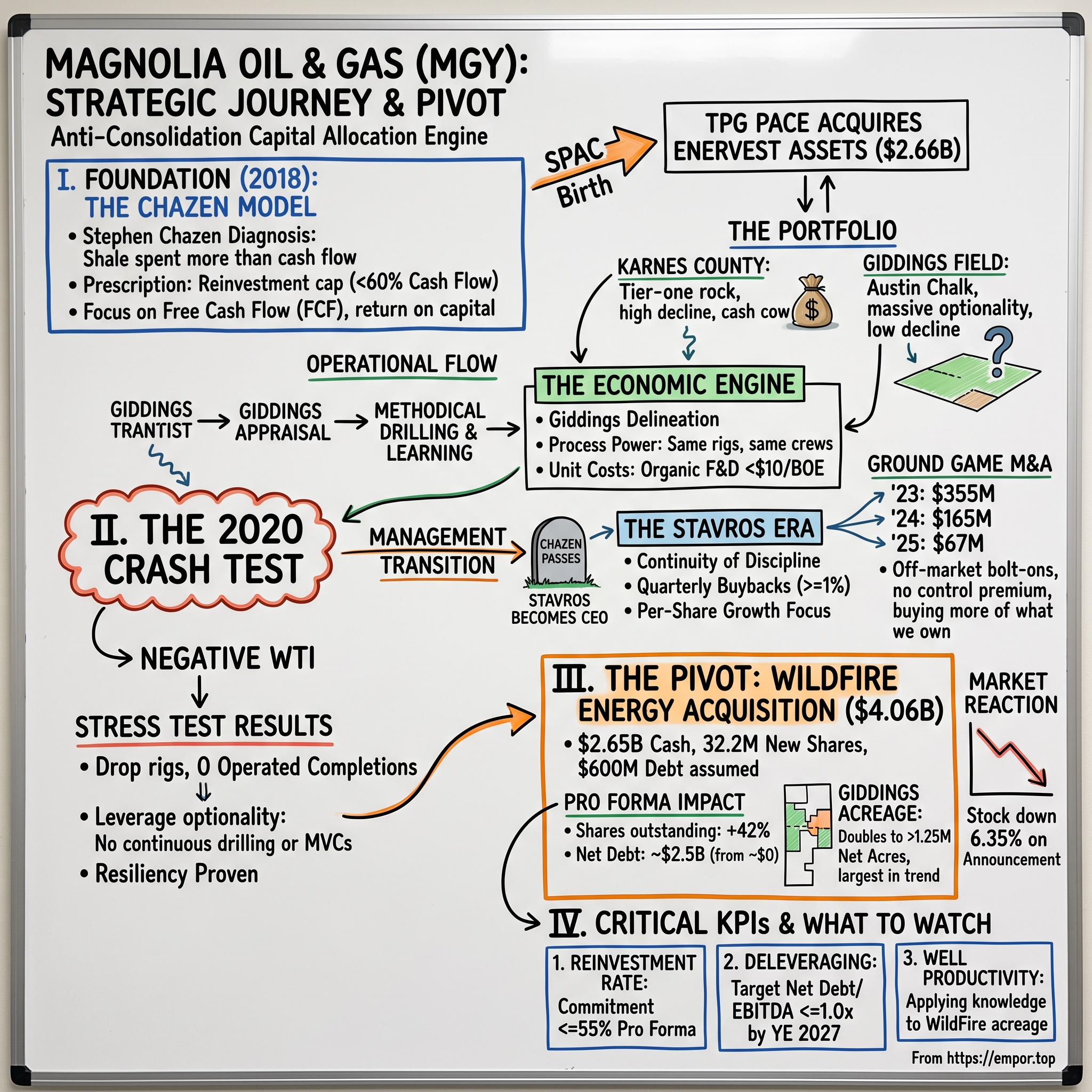
Magnolia Oil & Gas Corporation (NYSE: MGY): The Anti-Consolidation Capital Allocation Engine
I. Introduction & Episode Roadmap
On the morning of Monday, July 20, 2026, at seven o'clock Central time, Chris Stavros dialed into a conference call that contradicted almost everything Magnolia Oil & Gas had told investors about itself for eight years.
For nearly a decade, Magnolia had been the shale industry's designated grown-up. It capped drilling spend at roughly half of cash flow. It carried $400 million of debt against a quarter-billion dollars of cash. It bought back at least one percent of its own shares every quarter, shrinking the company on purpose while the rest of the sector went shopping. Management said, repeatedly and on the record, that it had no interest in "shock and awe."
Then Magnolia announced it was buying WildFire Energy for approximately $4.06 billion — a transaction larger than the entire enterprise value at which Magnolia itself was created — funded with $2.65 billion of cash, 32.2 million newly issued shares, and the assumption of $600 million of WildFire's 7.5% notes due 2029.1 Two days later it priced 46.3 million shares of new stock at $23.75 apiece, raising $1.1 billion gross, at a 13% discount to where the shares had last traded before the announcement.2
Do the arithmetic on the share count and you find the crux of this story. Magnolia had 185.4 million shares outstanding at the end of March 2026. Pro forma for the equity offering and the shares going to WildFire's owners, that number becomes roughly 263.9 million — a 42% increase. Long-term debt goes from $400 million to about $2.57 billion.2 The company whose entire investment identity was fewer shares, less debt just issued a great many shares and a great deal of debt in a single week.
The market noticed. Magnolia's stock fell 6.35% on announcement day to $25.53 and traded down as much as 12.6% in the premarket session that followed.3 As of July 24, 2026, the shares changed hands around $25.33, giving the company a market capitalization of roughly $4.7 billion — below the price it agreed to pay for WildFire.4
What this story is actually about
This is not a story about whether one deal was good or bad; that answer will take five years and a full commodity cycle to resolve. It is a story about what happens when a business model built on restraint meets an opportunity that can only be seized by abandoning restraint. It is a test of whether Magnolia's edge was ever really structural — a genuine cost and capital-allocation advantage — or whether it was mostly a disciplined temperament that lasted exactly as long as no sufficiently tempting asset came along.
The road here runs through eight distinct chapters:
- The capital-destruction era that made Magnolia's founding thesis possible, and the man — Stephen Chazen — who diagnosed it.
- The 2018 blank-check transaction that assembled the assets, and whether the price paid was as good as it looked.
- The two very different oilfields Magnolia owns: a mature, oil-rich cash machine in Karnes County and a sprawling, once-dismissed Austin Chalk position at Giddings.
- April 2020, when West Texas Intermediate printed a negative number and Magnolia's design was stress-tested in real time.
- The succession from Chazen to Stavros, what management has actually been paid to do, and how much stock insiders really own.
- The consolidation wave that swept the Lower 48 — and Magnolia's decision, after years of refusing, to join it.
- A structural analysis of the industry: where the moat is real, where it is rhetoric, and how the WildFire deal changes both.
- The bull case, the bear case, the questions a skeptical investor should ask, and the two or three numbers that will actually settle the argument.
Start where Magnolia started: with an industry that spent a decade turning capital into rock.
 Subscribe on LinkedIn
II. E&P Paradigm Shift & The Steve Chazen Genesis
Picture the American shale patch in 2014. Rig counts are climbing, laterals are lengthening, sand volumes per well are doubling. Production charts in investor presentations point up and to the right at angles that would embarrass a software company. And underneath all of it, the arithmetic is quietly broken: the sector as a whole is spending more cash drilling wells than those wells generate, and it is plugging the gap with high-yield bonds and freshly printed equity.
The business model, stripped of its jargon, was this: raise capital, convert it into barrels, report growth, use the growth to raise more capital. It worked beautifully in a rising price environment and catastrophically in a falling one. When oil collapsed from over $100 in mid-2014 to under $30 by early 2016, the bill arrived. Companies that had promised production compound annual growth rates instead delivered restructurings, distressed exchanges, and equity wipeouts.
The intellectual shift that followed was genuine and industry-wide. Institutional investors stopped asking energy producers how fast they were growing and started asking how much cash they returned and what return they earned on the capital they employed. The magic words became free cash flow, return on capital employed, and reinvestment rate — the share of operating cash flow a producer plows back into new drilling.
The man who saw it early
Stephen Chazen was not a wildcatter. He was a financial architect who happened to run an oil company, and the distinction mattered.
Chazen joined Occidental Petroleum in 1994 as executive vice president for corporate development — a deal man's title — and spent two decades there, serving as president and chief executive from May 2011 to April 2016, and later returning as chairman of the board.5 His reputation at Occidental was built not on discovering oil but on the unglamorous work of selling what did not fit, buying what did, and refusing to let the balance sheet get away from him.
That background shaped a particular diagnosis of the shale industry, and Chazen's version of it was blunt. Producers, in his reading, treated capital as though it were free and depletion as though it were somebody else's problem. A shale well is not a factory; it is an asset that gives back most of its value in the first two years and then fades. If you spend $1.30 to extract $1.00 of present value and call the difference "growth," you are not building a company. You are running a very expensive conversion of investor cash into hydrocarbons.
His prescription was almost embarrassingly simple, and he stated it publicly at the moment Magnolia was announced in March 2018: invest less than 60% of cash flow, fund a drilling program from that budget, and let production growth be whatever falls out of the arithmetic rather than the target that drives it.6 The rule's genius is that it is self-enforcing in both directions. In a price boom, a percentage-of-cash-flow cap does allow the budget to rise — but far more slowly than the temptation to spend. In a bust, the budget shrinks automatically, without a board meeting, a press release, or a covenant breach.
Why a rule beats a forecast
Most energy companies are, whether they admit it or not, leveraged bets on a commodity forecast. Management assumes a price deck, builds a capital plan around it, and if the deck is wrong the plan becomes a liability — rigs under contract, crews committed, a growth number promised to the market.
Chazen's design inverted this. Rather than forecasting the price, he built a structure that behaved sensibly across a range of prices. That is a meaningfully different claim, and it deserves scrutiny rather than applause: a reinvestment cap only protects you if your assets are cheap enough that 50-60% of cash flow actually funds a decent amount of drilling. On a high-cost asset, the same rule produces a shrinking company. The rule and the rock have to work together, which is why the next question — what Magnolia actually bought — matters more than the philosophy.
For investors, the takeaway from this era is that Magnolia's founding idea was never proprietary. Reinvestment discipline became industry consensus within a few years. What was potentially proprietary was the combination of that discipline with an asset base cheap enough to make it non-punitive. Whether Magnolia got such an asset base is the subject of the next chapter.
III. The 2018 SPAC Birth: TPG Pace & EnerVest Acquisition
In early 2017, TPG's Pace Group and Chazen formed TPG Pace Energy Holdings with a specific mandate: raise a pool of public money, find a large producing asset base, and run it with a discipline that public markets were beginning to demand but few management teams could supply.6 The vehicle listed on the NYSE in May 2017 and went looking.
It found its target in an unlikely place — inside a private equity fund complex that needed to sell.
The seller's problem was the buyer's opportunity
EnerVest, the Houston institutional fund manager, had spent roughly a decade assembling a South Texas position. Institutional funds, however, have finite lives. Assets held in a vintage fund eventually have to be monetized regardless of whether the commodity is cooperating, and in 2017–2018 the commodity was cooperating only intermittently. EnerVest founder John Walker's public framing of the deal was telling: he described Chazen's Occidental playbook as "a great match" for the acreage EnerVest had spent ten years assembling.6 Translated: the assets were fine, the ownership structure was wrong.
On March 20, 2018, TPG Pace announced it would acquire the oil and gas assets of EnerVest's South Texas Division for approximately $2.66 billion in cash and stock, forming Magnolia Oil & Gas Corporation. The transaction closed on July 31, 2018.67
What $2.66 billion bought
The asset package was two things bolted together, and understanding the asymmetry between them explains everything that followed.
The first was roughly 14,000 net acres in Karnes County — a small, dense, extraordinarily productive slice of the Eagle Ford Shale. Break-evens were advertised in the low $30s per barrel, new-well paybacks under a year.6 This is tier-one rock by any definition, and there was very little of it.
The second was approximately 345,000 net acres in the Giddings Field, an Austin Chalk position the market largely regarded as a graveyard. Combined production was about 40,000 barrels of oil equivalent per day — 31,000 from Karnes and only 9,000 from Giddings — and the total stream was 62% oil.6 Almost all the acreage was held by production, meaning no drilling was required to keep the leases alive. That detail sounds like a footnote. It is not; it is the single most important structural feature of the whole deal, and it becomes decisive in 2020.
Did Magnolia overpay?
At announcement, management valued the transaction at approximately 5.0 times estimated 2018 EBITDA of $513 million, with about $240 million of estimated free cash flow after capital spending and an implied 10% free cash flow yield.6 Contemporary basin transactions of the era — Concho's acquisition of RSP Permian, Diamondback's acquisition of Energen — cleared at multiples several turns higher, though those were Permian assets in a Permian bull market and the comparison is imperfect.
The honest assessment is more interesting than "cheap." Magnolia paid a fair-to-good price for the Karnes production and got the Giddings acreage nearly free. That was not because Chazen outsmarted the market on Giddings geology; nobody, including Magnolia, knew what Giddings was worth in 2018. It was because a fund manager facing maturities was selling a package, and the package contained a large optional asset that the buyer had no obligation to develop. The optionality was real and unpriced. Whether it would prove valuable was, at that moment, unknowable.
The capital structure was the other half of the deal
The financing tells you as much about the thesis as the assets. Magnolia was designed to be equity-financed. Only about $300 million of funded debt was anticipated at closing — roughly 0.6 times estimated EBITDA — alongside an undrawn credit facility. EnerVest took about $1.2 billion in cash and retained roughly 120 million shares, leaving it with 51% of the company. A $330 million private placement at $10.00 per share, anchored by Fidelity, Davis Selected Advisers and Capital Research, brought in the kind of long-only institutional base Chazen wanted. Chazen and certain TPG executives personally subscribed for an additional $25 million on the same terms.6
That last detail matters for a reason that recurs later in this story. Chazen did not merely design an owner-operator model; he wrote a personal check into it. By March 2020 he owned more than 6.8 million Magnolia shares outright and said so publicly, in a press release, during the worst week the industry had seen in decades.8
The company that emerged had the assets, the balance sheet and the shareholder register it wanted. What it did not yet have was any idea that four-fifths of its production would eventually come from the acreage nobody had wanted.
IV. Asset Geology & Segment Economics: Karnes Cow vs. Giddings Engine
In the summer of 2020, on a quarterly call conducted while the oil market was still smoldering, Steve Chazen did something unusual for an executive presenting a distressed quarter. He spent most of his prepared remarks teaching geology.
Magnolia had drilled fourteen horizontal wells in a core area of Giddings with at least 180 days of production history. The average well had produced 1,374 barrels of oil equivalent per day over those 180 days, about half of it oil. More striking than the rate was the shape: 30-, 90- and 180-day oil rates of 781, 783 and 677 barrels per day respectively. In plain terms, the wells barely declined.9
An analyst asked whether that flatness came from clever choke management or artificial lift. Chazen's answer was one of the more useful explanations of unconventional reservoir behavior ever given on an earnings call.
Two rocks, two personalities
Think of the Eagle Ford at Karnes as a sealed jar of oil under pressure. Hydraulic fracturing shatters the jar. Everything rushes out at once: enormous initial rates, spectacular first-year cash flow, and then a steep, unforgiving decline. You get your money back fast and then you need another well.
The Austin Chalk at Giddings is different. The rock is naturally fractured — riddled with pre-existing cracks from geological history. When you frac a horizontal well there, you create the artificial fracture network and connect into the natural one. The natural fractures do not surrender their oil quickly; as Chazen put it, "it takes a while for the oil to move in there."9 The result is a well that peaks in its second month rather than its first, declines gently, and ultimately recovers meaningfully more barrels than a Karnes well — but pays you back more slowly.
This creates an elegant portfolio property that Chazen exploited explicitly. In a high-price world, you want your barrels now, so you drill Karnes. In a low-price world, you want to stretch production into the future when prices may be better, so you drill Giddings. "At $100 oil we probably switch to all Karnes drilling," he told analysts in August 2020. "In a low-price environment, you want to stretch the production over time."9 The two assets are not merely diversification; they are a price-contingent allocation switch.
The Giddings re-rating
Giddings had been drilled before — twice. A vertical drilling cycle ran from the late 1970s into the early 1980s; a horizontal cycle ran through much of the 1990s.7 Both left behind a reputation for heterogeneity and disappointment. The market's 2018 view of Austin Chalk was that it was a lottery: sometimes you hit a natural fracture swarm and got a monster, usually you did not.
Magnolia's contribution was not a technological breakthrough so much as a methodical one. The early program deliberately scattered wells across the position — "we would drill a well and then move the rig off many miles or sometimes several counties," as Chazen described it — not to develop efficiently, but to learn.9 By 2020 that appraisal work had outlined a core area of roughly 70,000 acres. By 2026 the delineated development area had grown to approximately 240,000 acres, with appraisal continuing outside it.10
The economic transformation is best measured in unit costs. In 2019 a Giddings well cost about $8.5 million; by mid-2020 the first multi-well pad averaged about $7 million.9 By early 2026, management described a standard Giddings well as costing roughly $1,000 per foot with laterals of 8,000 to 8,500 feet — with average drilled feet per day up 8% and completed feet per day up 6% in 2025 alone.10 Wells now come in three- to four-well pads across the development area.11
Repetition, in other words, did what technology alone could not. Magnolia has run the same drilling rigs with the same crews for years; when an analyst noted the company had used the same Patterson rig since inception, Stavros agreed that running the same equipment and personnel over a multi-year period "does translate into benefits with time."10 That is a real, if modest and imitable, form of process advantage.
Where the company stands today
At the end of 2025, Magnolia held a total leasehold position of 818,230 gross (613,360 net) acres: 79,350 gross (55,370 net) acres in the Karnes area and 738,880 gross (557,990 net) acres in Giddings.7 Full-year 2025 production averaged 99,793 barrels of oil equivalent per day — 40% oil, 32% natural gas, 28% NGLs — from interests in 2,867 gross (1,948 net) wells.7
The mix shift is the story. Giddings accounted for approximately 82% of total company volumes by the first quarter of 2026, growing 9% year over year while oil from the field grew 8%.11 Karnes, the asset that supplied three-quarters of production at inception, now supplies less than a fifth.
The product mix is the trade-off. Giddings produces roughly 35–36% oil, against a corporate average near 40%.10 Because oil sells for many times the per-barrel-equivalent price of natural gas, that mix matters enormously: in 2025 oil was 40% of Magnolia's volumes but 70% of its revenue, while natural gas was 32% of volumes and 15% of revenue.7 Average realized prices tell the same story — $63.18 per barrel of oil, $2.76 per Mcf of gas, and $19.56 per barrel of NGLs.7
What the economics actually prove
Strip away the narrative and two hard numbers validate the asset quality. First, lease operating expense of $5.12 per barrel of oil equivalent in 2025, down 7% year over year, against gathering, transportation and processing of $1.84 and general and administrative of $2.66 per boe.7 Second — and this is the number that matters most — organic proved developed finding and development cost of $9.25 per boe in 2025, and $9.85 averaged over 2023–2025.10
Finding and development cost is the price of manufacturing a barrel of reserves. At under $10 per barrel of oil equivalent with realizations in the $60s for the oil component, the spread is wide enough that Magnolia can plausibly generate returns at commodity prices that would embarrass most of the sector. Return on capital employed of 18% in 2025 — a year of falling oil prices — and a five-year average of 34% are consistent with that claim.10
Two caveats belong here. Giddings' gentle decline is a genuine asset, but it is also why the company must keep proving up new areas: 43.6 MMboe of the 210.2 MMboe of year-end 2025 proved reserves were undeveloped, and all of it is scheduled for development within one year — an unusually aggressive conversion assumption that flatters the reserve profile relative to peers who book five years of locations.7 And the resource is concentrated: two customers accounted for 41% and 20% of combined oil, gas and NGL revenue in 2025.7
The rock, then, is good and getting better understood. The question the next chapter answers is whether the structure built around the rock could survive an actual catastrophe.
V. The 2020 Oil Crash Test & Operational Resiliency
On April 20, 2020, the front-month West Texas Intermediate futures contract settled at negative $37.63 per barrel. Sellers paid buyers to take delivery. Storage at Cushing was full, demand had evaporated under global lockdowns, and Saudi Arabia and Russia had spent March waging a market-share war into the teeth of the collapse.
For a leveraged shale producer with rigs under multi-year contract and drilling obligations attached to leasehold, this was an extinction event. Chesapeake Energy, Whiting Petroleum and Denbury Resources all filed for Chapter 11 that year. Others survived by issuing rescue financing at terms that transferred most of the remaining equity value to new capital.
Magnolia did none of these things, and the reason is worth spelling out because it is structural rather than heroic.
The design showed up before the crisis did
On March 24, 2020 — with the collapse barely two weeks old — Magnolia published an operations update that reads, in retrospect, like a manual on optionality. The company announced it would drop its one operated rig in the Karnes area at the end of the first quarter. It explained precisely why it could: both operated drilling rigs were on short-term contracts, the company had no long-term service obligations, it was "not required to drill to maintain any of its credit metrics," it had no contractual drilling obligations, and nearly all of its acreage was held by production.8
Read that list again. Every item is a liability that Magnolia did not have. The company was not resilient because it reacted well; it was resilient because five separate categories of forced spending had been designed out of the business two years earlier. A producer with a three-year rig contract, a minimum-volume commitment to a midstream partner, and leases requiring continuous drilling cannot stop spending in April 2020 even if stopping is obviously correct. Magnolia could stop, and it did.
Chazen also used the release to make a commitment that would define the following twelve months: no additional bonded indebtedness, no draw on the revolver, no debt maturities before 2026.8
What the numbers looked like at the bottom
The second quarter of 2020 was the trough, and it was ugly in absolute terms. Production averaged 64,100 barrels of oil equivalent per day. Adjusted EBITDAX collapsed to $40 million for the quarter. Drilling and completion capital was $27 million — 68% of adjusted EBITDAX, above the 60% rule, simply because the denominator had cratered.9
But the company completed no operated wells between February and the end of the third quarter, began the quarter with $146 million of cash and ended it with $117 million, kept its $400 million of senior notes untouched, and maintained roughly $570 million of liquidity including an undrawn $450 million credit facility.9 Total adjusted cash costs including interest and G&A fell to $8.50 per boe — down 29% year over year and 18% sequentially — as the company executed against a $55 million cost-reduction program.9
There is a subtler point in the Giddings data from that quarter. Oil production from the field declined only 1.5% sequentially despite no new wells being brought online.9 A field with a shallow decline rate is, in a downturn, a form of insurance: you can stop drilling for two quarters and your revenue base does not fall out from under you. This is precisely the opposite of a high-decline Permian position, where a drilling halt of six months produces a double-digit production decline.
The uncomfortable part of the lesson
It would be a mistake to read 2020 as proof that Magnolia's model makes it immune to commodity risk. It does not. Revenue fell, earnings went negative, and the equity traded down with the sector. What the model did was convert an existential threat into a bad year — it removed the tail risk of forced liquidation rather than the ordinary risk of cyclical loss.
Investors should be precise about the mechanism, because it is the mechanism, not the outcome, that can be relied upon in the future. Low fixed obligations plus held-by-production acreage plus short-cycle service contracts plus low absolute debt equals the ability to make the economically correct decision under stress. That is a genuine and durable advantage — as long as the company keeps those four conditions in place.
Which raises an obvious question about a company that has just committed to $2.57 billion of pro forma long-term debt. Hold that thought; it returns in Section VII.
The 2020 test also happened to be Chazen's final full crisis. Two years later, Magnolia faced a different kind of shock.
VI. Management Transition, Incentives, & The Chris Stavros Era
On September 21, 2022, Magnolia announced that Stephen Chazen would no longer be able to serve as chairman, president and chief executive "due to serious health reasons," and that Christopher Stavros — the company's chief financial officer since inception — had been named president and CEO and appointed to the board, effective immediately.12
Two days later, on September 23, the company announced Chazen's death. He was 76. In the statement, Stavros described a man who "didn't follow trends, but rather established trends," and who "had a profound impact on how E&P companies are managed."13
Founder transitions are where strategies go to die, particularly when the strategy is a set of self-imposed constraints rather than a contract. Constraints survive only as long as someone is willing to enforce them against the constant temptation to grow.
The successor was not a surprise
Stavros was, by design, the least disruptive possible choice. He had served as Occidental's senior vice president and CFO, having joined the company in 2005 and been named CFO in 2014 after stints as vice president of investor relations and treasurer. Before Occidental he covered the oil and gas sector as a senior analyst at UBS. He retired from Occidental in May 2017 and joined Chazen at Magnolia's founding.12 The lineage is exact: two Occidental finance executives who had worked together for nearly two decades, rebuilding the discipline they had practiced at a much larger company inside a much smaller one.
Stavros's public manner reflects that background. He talks in cash flow terms rather than geological ones, deflects questions about accelerating activity, and has a habit of undercutting his own targets. Asked in May 2026 about the company's stated goal of roughly 10% long-term dividend growth, he responded: "I try to catch myself on creating targets. The target is somewhat artificial in a way, but it is designed to speak to what the business is capable of doing." He then described dividend growth as an arithmetic outcome of mid-single-digit volume growth plus quarterly buybacks — "it sort of just falls out of the model."11
That framing is analytically honest and rare. Most management teams present dividend growth as a promise. Stavros presents it as a residual.
The track record, tested against the promises
The right way to assess management credibility is to compare what was said against what happened, over several years, including the years that did not go well.
On capital discipline, the record has been consistent. Drilling and completion capital was 51% of adjusted EBITDAX for full-year 2025 and 54% in the fourth quarter of that year; the first quarter of 2026 again came in at 51%.1411 Across five years, management has maintained one of the lowest reinvestment rates in the U.S. producer universe while delivering among the highest rates of production growth per share.10
On guidance, the pattern has been to under-promise. In 2025 Magnolia guided to moderate growth and delivered 11% total production growth with capital spending below the original plan, achieved partly because better-than-expected well performance allowed six completions to be deferred into 2026.10 Asked in May 2026 whether the 5% growth guidance for the year was conservative, Stavros said the company had "a reasonable chance of surprising a little higher" and that he "would probably take the over."11 By the July 20 announcement, standalone 2026 growth guidance had been raised to approximately 6% on the back of second-quarter production of 106,100 barrels of oil equivalent per day.1
On the temptation to spend windfalls, management has repeatedly declined. Asked in February 2026 where the extra cash would go at $70–75 oil, Stavros was categorical: "Another rig doesn't come into the picture. That's not the plan." Asked again in May whether higher prices would prompt acceleration, he invoked a marathon rather than a sprint, noting that "with every barrel we accelerate and pull forward, it simply means I have to replace that barrel that much quicker."1011
That is a strong record of doing what was said. It is also, as of last week, a record with an asterisk — discussed in the next section.
What management is actually paid for
Compensation design is where stated priorities become enforceable ones, and Magnolia's is more specific than the industry norm.
For 2025, 75% of the annual cash bonus opportunity was tied to three quantitative metrics, each weighted equally at 25%: Operating Margin, Free Cash Flow Percentage (defined as adjusted EBITDAX minus drilling and completion capital, as a percentage of adjusted EBITDAX), and Net Debt to EBITDAX. The remaining 25% is a qualitative assessment by the compensation committee. At least 50% of long-term equity compensation is granted as performance share units tied to relative total shareholder return over a three-year period, with the balance in time-vesting restricted stock units.15
This is a well-constructed set of incentives for the strategy as advertised. "Free Cash Flow Percentage" is literally the reinvestment rate inverted — management is paid, in cash, for not spending. Net Debt to EBITDAX, added as a metric in 2024, pays for balance sheet restraint. Notably, bonuses are capped at 100% of the target opportunity, removing the asymmetry that encourages swinging for the fences. And there are no employment agreements, no excise tax gross-ups, and no defined benefit plans.15
Two observations complicate the picture. First, return on capital employed — the metric management cites most often in its own presentations, at 18% for 2025 — is not itself a compensation metric.1015 Second, and more materially, the Net Debt to EBITDAX bonus metric now sits awkwardly against a transaction that will take net debt from roughly zero to approximately $2.5 billion. How the compensation committee handles that in the 2026 and 2027 cycles will be genuinely informative about whether the metric has teeth or is adjusted when it becomes inconvenient.
The ownership question deserves a straight answer
Magnolia's investor narrative emphasizes owner-operator alignment. The proxy is more sobering. As of the record date for the 2026 annual meeting, Stavros beneficially owned 646,080 shares, general counsel Timothy Yang 445,999, and CFO Brian Corales 99,461. All directors, nominees and current executive officers as a group — ten individuals — held 1,715,417 shares, which the proxy footnotes as less than 1% of shares outstanding.15
For context, Chazen alone owned more than 6.8 million shares outright in 2020 — roughly four times what the entire current board and executive team hold today.8 Institutional holders dominate the register: BlackRock with roughly 27.2 million shares, Vanguard with 20.8 million, and American Century with 11.2 million.15
This is not evidence of misalignment — relative TSR-linked equity awards create real economic exposure, and Magnolia maintains stock ownership guidelines, a clawback policy, and prohibitions on hedging and (without consent) pledging.15 But investors should not accept the "management treats corporate cash as owner-operator capital" framing at face value. The founder was an owner-operator. The current team is a well-incentivized professional management team, which is a different and more common thing.
Separately, one structural simplification did occur during the first quarter of 2026: EnerVest, the original private equity shareholder, sold its remaining position, eliminating the Class B share class and the associated LLC unit structure entirely.11 A dual-class arrangement created for tax and exit reasons in 2018 finally disappeared eight years later — a genuine, if belated, governance improvement.
VII. M&A Strategy & Capital Deployment: Bolt-Ons vs. Consolidation Mania
Between late 2023 and 2025, the American oil industry reorganized itself. ExxonMobil bought Pioneer Natural Resources for roughly $59.5 billion. Chevron pursued Hess for about $53 billion. Diamondback took Endeavor Energy Resources for approximately $26 billion. ConocoPhillips acquired Marathon Oil in an all-stock deal valued at $22.5 billion including net debt. Something in the order of a quarter-trillion dollars of transaction value changed hands as scale became the organizing principle of the sector.
Magnolia sat it out — loudly.
The ground game
Instead of auctions, Magnolia ran what management calls a ground game: small, off-market purchases of leasehold, working interests and mineral royalties in the acreage it already operated. The cash flow statement records the cadence: $355.5 million of acquisitions in 2023, $165.4 million in 2024, and $66.6 million in 2025, funded entirely from operating cash flow with no equity issued.7 Individual transactions included $264.1 million for Giddings producing properties in November 2023 (structured with up to $40 million of contingent consideration tied to future WTI prices, of which only $5.5 million was ultimately paid across two tranches), $41.8 million in July 2023, and $120.4 million in April 2024.7
The logic Stavros articulated was consistent and specific. "Buying more of what we already own" increases working interest and net revenue interest on wells the company already understands, converts scattered tracts into contiguous blocks that permit longer laterals, and — critically — avoids paying a control premium for someone else's decline curve.11
He was explicit about what he would not buy. In February 2026: "I'm not and never really have been a big proponent of very large PDP-heavy deals as you're more likely to pay full value for these or even higher." And: "You don't want to buy somebody else's decline curve." And: "Large deals come with obviously greater risk."10
The first quarter of 2026 delivered the ground game at its best. Magnolia closed roughly $155 million of bolt-ons adding about 6,200 net acres and 500 barrels of oil equivalent per day of low-decline production, approximately 45% oil. In Karnes, the transactions assembled a largely undeveloped, contiguous 10,000 gross-acre block across Karnes and Gonzales Counties, raising working interest in the area to about 93% with average net revenue interest near 80% and enabling laterals approaching 10,000 feet where the company had historically been constrained to shorter wells. In Giddings, the deals increased interests across roughly 45,000 gross acres.11
Asked whether there was an upper limit on transaction size, Stavros answered on May 7, 2026: "The plan is not to shock and awe. It is not about that. You are not going to wake up one day and find us looking at out-of-basin deals."11
Ten weeks later
On July 19, 2026, Magnolia and Magnolia Oil & Gas Operating LLC signed a purchase and sale agreement with WildFire Energy I LLC to acquire 100% of WildFire Intermediate Holdings, LLC.16
WildFire was formed in 2019 as a partnership between Warburg Pincus, Kayne Anderson and a management team led by CEO Anthony Bahr and President and COO Steve Habachy — both alumni of WildHorse Resource Development. It grew through acquisitions, most significantly Hawkwood Energy in 2021, into one of the largest privately held oil and gas producers in the United States.17
The consideration: $2,650 million in cash, 32,203,000 shares of Magnolia Class A common stock, and the assumption of $600 million of WildFire's 7.500% senior notes due 2029 — approximately $4.06 billion in total. Magnolia deposited $200 million into escrow on signing. Closing is subject to Hart-Scott-Rodino clearance and is expected late in the third quarter of 2026.161
What Magnolia gets is roughly 810,000 net acres in Giddings — more than doubling its position there to over 1.25 million net acres, with about 120,000 acres of overlap in different formations — producing approximately 53,000 barrels of oil equivalent per day at roughly 70% oil, with a base decline rate of about 29%. The package includes a sand mine supplying approximately 80% of Magnolia's annual sand consumption and more than 500 miles of gas gathering pipelines in Giddings.1
Is it consistent with the strategy, or a break from it?
A fair reading finds evidence on both sides, and investors should hold both.
For consistency: this is not an out-of-basin deal. It is the same field, the same three target formations — Austin Chalk, Eagle Ford and Woodbine — and adjacent, overlapping acreage. Nor is it the PDP-heavy purchase Stavros disparaged. Netherland, Sewell & Associates estimated WildFire's total proved reserves at 271.2 MMBoe as of December 31, 2025, of which 139.8 MMBoe were proved developed — meaning roughly half the booked reserves are still undeveloped, plus 107.8 million barrels of probable oil reserves on top.1819 Management committed to keeping the model intact: capital spending limited to 55% of adjusted EBITDAX on a pro forma basis, share repurchases of at least 1% of outstanding shares per quarter, and a dividend raised 9% to $0.18 per share quarterly.1
Against consistency: the scale is a category change, not an extension. WildFire's total proved PV-10 of $4.11 billion at year-end 2025 pricing exceeded Magnolia's own standardized measure of discounted future net cash flows of $2.52 billion.187 Magnolia is acquiring a reserve base larger than its own. And the funding is precisely what the company spent eight years avoiding: 46,315,790 shares sold at $23.75, a $1.5 billion 364-day unsecured bridge facility committed by JPMorgan, Citigroup and Wells Fargo, a reserve-based revolver amended to $2.25 billion of maximum commitments with a $2.0 billion borrowing base, and approximately $500 million of planned new long-term debt.216
There is also a governance detail worth noting: the equity offering was explicitly not conditioned on the acquisition closing.2 Magnolia raised $1.07 billion net before it had HSR clearance. If the deal fails, the company holds the cash for general corporate purposes — and shareholders hold 46 million additional shares against an unchanged asset base.
The capital return engine, before and after
The record being interrupted here is a real one. Since beginning repurchases in 2019, Magnolia has bought back 83.7 million shares, reducing weighted average diluted shares outstanding by approximately 28% net of issuances.11 Through year-end 2025 it had repurchased 47.1 million shares under its formal authorization at a cost of $913.3 million, with the board raising the authorization to 60 million shares on February 5, 2026.7 The dividend has risen every year since 2021, from $0.28 annualized to $0.66 before the WildFire increase.1 Cumulative capital returned since inception approaches $2 billion — roughly 40% of the company's current market capitalization.1
In 2025 alone, Magnolia returned about 75% of its $426.6 million of free cash flow through $205.5 million of buybacks (8.9 million shares, a 4.4% reduction) and $113.1 million of dividends.14
Now consider the pro forma arithmetic. Buying back 1% of shares per quarter on a 264-million-share base costs substantially more per percentage point of the old share count. Management's deleveraging plan targets net debt to EBITDA of no more than 1.0 times by year-end 2027, supported by projected cumulative free cash flow exceeding $4.5 billion through 2030 at July 15, 2026 strip pricing, and more than $100 million of annual synergies by year-end 2027 — $60 million from drilling, completions and facilities, $20 million from field operations and $20 million from corporate G&A, with an estimated net present value of about $700 million.120
Those are management's numbers, generated with management's price deck, and they are the crux of the bull case. They are not yet evidence.
What the market said
Shareholders did not applaud. Magnolia's stock fell 6.35% on July 20 to close at $25.53 and traded down as much as 12.6% to $23.82 in the following premarket session.3 The equity was then priced at $23.75 — below the pre-announcement close of $27.26 on July 17.2 As of the most recent close, at $25.33, the shares remain below where they traded before the deal and below the 50-day average of roughly $27.15.4
The market's message is not subtle: investors bought Magnolia for a specific pattern of behavior and are repricing the stock now that the pattern has changed. Whether they are right depends on whether $4.06 billion buys assets good enough to justify a 42% larger share count and $2.5 billion of net debt. That question decomposes into industry structure, which is next.
VIII. Industry Structure, Porter's 5 Forces, & Helmer's 7 Powers
Every energy investor eventually confronts an uncomfortable truth: oil and gas producers sell an undifferentiated commodity into a global market they cannot influence. No branding, no switching costs, no network effects. In the language of competitive strategy, the industry looks structurally unattractive. So what, exactly, is Magnolia's edge — and does it survive contact with the frameworks?
Porter's Five Forces, applied honestly
Bargaining power of buyers: low, but concentrated. Crude oil and natural gas trade against benchmarks — WTI, Magellan East Houston, Henry Hub — that no individual producer sets. That sounds like buyer power is irrelevant, and at the level of price it is. But at the level of counterparty, Magnolia is concentrated: two customers accounted for 41% and 20% of combined revenue in 2025.7 Diversification of counterparties is thin even where diversification of pricing is total.
Bargaining power of suppliers: moderate and currently favorable. Oilfield service costs are the largest controllable input. Magnolia's structural answer is contract flexibility — the short-term rig arrangements that proved decisive in 2020. In February 2026 Stavros described service costs as "flat to slightly down," with some costs locked in with key providers through the first half of the year, adding candidly that for service companies "this has been a tough way to make a living."10 The WildFire sand mine represents genuine backward integration into one input: post-close, roughly 80% of Magnolia's annual sand consumption will be self-supplied.1
Threat of new entrants: low. Tier-one acreage is finite and largely spoken for, capital intensity is extreme, and the technical learning curve in a heterogeneous play like the Austin Chalk is measured in years of well results.
Threat of substitutes: real but slow. Electrification erodes long-run oil demand in transport, but petrochemical feedstock, aviation, heavy transport and industrial demand are not readily substituted this decade. The material near-term risk is not demand disappearance — it is oversupply, whether from OPEC+ policy or from U.S. production growth.
Competitive rivalry: high, and shifted. Producers do not compete for customers; they compete for acreage, for services, and for capital. The consolidation wave changed the acreage competition materially. As Stavros put it in February 2026, "the larger the opportunity or maybe deal size... the tougher it is and maybe the more expensive it is." He also noted, half-joking, that land prices are being influenced by parties he cannot see — "for all I know, we could be competing with those who are looking to build a data center."10 That aside is more revealing than it sounds: in the Texas land market, artificial intelligence infrastructure has become an unexpected bidder for surface real estate.
The Porter conclusion is that industry structure is genuinely poor, and no producer escapes it. Advantage in this business is not positional; it is a matter of cost curve, capital cost, and allocation quality.
Helmer's Seven Powers: what Magnolia has and does not have
Hamilton Helmer's framework asks a stricter question than Porter: what mechanism creates a persistent differential return that competitors cannot copy? Applied to Magnolia, most of the seven powers do not apply. Three arguably do, in descending order of confidence.
Cornered resource — the strongest claim, now materially strengthened. Magnolia's Karnes acreage is a small, high-quality piece of the Eagle Ford that cannot be replicated at any price. More interestingly, the pro forma Giddings position of over 1.25 million net acres makes Magnolia the largest acreage holder in the Eagle Ford/Austin Chalk trend, ahead of the next-largest holder at roughly 725,000 net acres according to Enverus data cited in the transaction presentation.20 Position in a specific rock is the most defensible thing an E&P can own, and Magnolia just bought a great deal more of it. Note the honest qualifier: acreage scale is a cornered resource only if the rock underneath is economic. That is precisely what the WildFire undeveloped inventory has yet to prove at Magnolia's hands.
Process power — real, modest, and eroding by nature. Years of repetition with the same rigs and crews in the same field have compounded into measurable efficiency: 8% improvement in drilled feet per day and 6% in completed feet per day in 2025, well costs falling from roughly $1,100 to about $1,000 per foot, and organic proved developed F&D below $10 per boe.10 This is genuine. It is also the kind of advantage competitors close over time by hiring the same service providers. Its most credible expression is the claim that Magnolia can apply its Giddings subsurface knowledge to WildFire's acreage and lower well costs there — a testable proposition with a two-year verification window.
Counter-positioning — the power that just got weaker. For eight years, Magnolia's model was something larger, more indebted, growth-committed peers could not easily copy without breaking promises to their own shareholders. That is textbook counter-positioning. The WildFire transaction complicates it considerably. A company carrying $2.57 billion of pro forma long-term debt has less freedom to make the 2020 decision — drop the rig, complete nothing, wait — than one carrying $400 million against $267 million of cash. Management asserts the leverage increase is temporary and targets net debt to EBITDA of 1.0 times or less by year-end 2027.1 Until that deleveraging is demonstrated through a full price cycle, the counter-positioning claim should be treated as suspended rather than proven.
What Magnolia clearly does not have: scale economies of the ExxonMobil variety, brand, network effects, or switching costs. Its general and administrative cost of $2.66 per boe is respectable for a company of 262 employees but is not the sub-$1.50 figure sometimes attributed to it, and it is a modest line item next to lease operating expense.7
The honest structural verdict: Magnolia owns a good position in a bad industry, operates it unusually well, and has historically financed it unusually conservatively. Two of those three remain intact. The third is now an open question, and the bear case starts there.
IX. Strategic Risk Radar, Activist Stress Test, & Bull vs. Bear Case
Suppose you are a portfolio manager who has owned Magnolia for five years precisely because it did not do things like this. You have a call scheduled with Chris Stavros. What do you ask?
The four questions a skeptical owner should ask
"You told us in February you don't like large deals. What changed?" The defensible answer is that WildFire is not the deal he disparaged — it is adjacent, in-basin, roughly half undeveloped by proved reserves, and oilier than Magnolia's own production at approximately 70% oil versus 40%.191 The less comfortable observation is that the objection Stavros raised was about price — that large PDP-heavy packages clear at full value — and Magnolia paid $4.06 billion against a proved developed producing PV-10 of $2.46 billion.18 The premium above developed value, roughly $1.6 billion, is a bet on undeveloped inventory that Magnolia has not yet drilled.
"Why issue equity at a 13% discount rather than wait?" The $23.75 pricing against a $27.26 pre-announcement close was a real cost to existing holders.2 The counter-argument is that the alternative — funding the full $2.65 billion cash portion with debt and the bridge — would have pushed leverage well past what management is willing to carry. There is no free option here; the company chose dilution over leverage, having previously promised to avoid both.
"What happens to the deleveraging plan at $50 oil?" The $4.5 billion cumulative free cash flow projection through 2030 assumes strip pricing as of July 15, 2026.20 Magnolia carries no hedges on any of its production — a policy management describes as central to strategy, providing upside capture and, historically, tolerable because leverage was near zero.10 Being unhedged with $2.5 billion of net debt is a materially different proposition from being unhedged with none. Notably, WildFire was hedged, carrying a $134.6 million short-term derivative liability at March 31, 2026 and recording a $273.0 million loss on derivative instruments in that quarter alone.21 Whether Magnolia maintains its no-hedge doctrine post-close is one of the most consequential undisclosed decisions in this transaction.
"Does the buyback commitment survive?" Management says yes — at least 1% of outstanding shares per quarter.1 But repurchases now compete with a deleveraging target, and the capital allocation priority list in the transaction presentation places debt reduction fourth, ahead of bolt-on acquisitions but behind the dividend and the buyback.20 The first two quarters after closing will reveal whether that ordering holds when the numbers get tight.
Myth versus reality
Three beliefs about Magnolia circulate widely enough among generalist investors to be worth testing against the filings.
Myth: Magnolia has permanently shrunk itself, and always will. The share-count reduction is real and was achieved over seven years. But the pro forma count of roughly 263.9 million shares does not merely pause that trend — it reverses more than the entire reduction achieved since 2022. At the end of that year Magnolia had approximately 213.9 million Class A and Class B shares outstanding combined.7 Pro forma for the offering and the seller consideration, the company will have roughly 23% more shares than it did four years ago, and buying back 1% per quarter takes years to work that off. The compounding machine has not been switched off, but it has been reset several notches.
Myth: sub-0.5x leverage is a structural feature of the business. It has been a choice, not a constraint, and the contractual envelope has just widened dramatically. The amended and restated reserve-based facility requires compliance with a leverage ratio of less than 3.50 to 1.00 and a current ratio greater than 1.00 to 1.00.16 Management's own target is 1.0 times or less by the end of 2027.1 So the informal norm was near zero, the new stated target is one turn, and the contractual ceiling is three and a half turns. Investors should be clear which of those three numbers is a promise and which is merely a permission.
Myth: a $30-something break-even means the company is safe at almost any price. The low-$30s figure quoted at inception described new-well economics on Karnes acreage in 2018 dollars.6 Corporate cash break-even is a different and higher number, because it must also cover a dividend the company has raised six years running, interest of $27.5 million annually on the existing notes through 2032 — a figure that rises materially once the assumed 7.500% notes and new borrowings are layered on — and a buyback management has committed to maintaining.716 Well-level economics tell you whether to drill. Corporate break-even tells you whether the capital return program survives a downturn, and those are not the same test.
One further mechanical detail belongs in this list rather than the risk section: WildFire's owners agreed only to a 30-day lock-up on the 32.2 million shares they receive, with the company obliged to register their resale under a registration rights agreement carrying demand, piggyback and shelf rights.16 Roughly a month after closing, a private equity seller will hold a freely marketable block equal to more than a tenth of the pro forma company.
The current risk radar
Product mix and Gulf Coast gas pricing. Giddings produces proportionally more gas and NGLs than Karnes, exposing realizations to regional pricing. Asked in May 2026 whether new Permian gas takeaway capacity would depress prices in the second half, Stavros pointed to precedent rather than prediction: when the Matterhorn pipeline came online the prior year, concerns about realization impact did not materialize.11 Corales added that Magnolia sells close to Gulf Coast markets, keeping tolling fees low.11 Both answers are reasonable; neither is a guarantee. The WildFire assets, at roughly 70% oil, structurally reduce this exposure by lifting the pro forma corporate oil mix toward 50%.20
Karnes depletion. Karnes now supplies under a fifth of volumes, and the corporate oil cut has drifted from 62% at inception to 40% in 2025.67 The Q1 2026 Karnes bolt-on, which assembled a 10,000-acre contiguous block adding what Stavros described as multiple years of drilling, partially addresses this — as does the oilier WildFire package.11
Execution and integration. Magnolia has never integrated anything remotely this large. The $100 million synergy target and the claim that Magnolia's technical expertise will lower WildFire well costs are assertions, not results. Integration risk is the single largest new risk in the story, and it is not primarily a financial risk — it is an organizational one for a company with 262 employees.7
Refinancing and cost of capital. Magnolia's existing $400 million of 6.875% senior notes mature in 2032; the assumed WildFire notes carry a 7.500% coupon and mature in 2029, with the amended revolver's maturity linked to that date if more than $100 million of those notes remain outstanding.716 Interest expense, historically a rounding error at $21.6 million in 2025, becomes a real line item.7
Legal and accounting overhangs — modest but present. Certain Magnolia LLC unit holders, EnerVest Energy Institutional Fund XIV-C and the company have been named as defendants in a lawsuit in which plaintiffs claim entitlement to a minority working interest in certain Karnes County assets. The litigation is in the pre-trial stage, exposure is "currently not reasonably estimable," and the co-defendants retain all such liability.7 Separately, the aggressive proved undeveloped reserve conversion assumption — all PUDs scheduled for development within one year — is an accounting judgment that management itself flags as potentially not comparable to peers.7 Neither is alarming; both belong on a diligence list.
The bull case
Magnolia post-WildFire owns the largest acreage position in the Eagle Ford/Austin Chalk trend, in a region with premium access to Gulf Coast markets, with a demonstrated ability to manufacture proved developed reserves for under $10 per barrel of oil equivalent. The acquired production is oilier and lower-decline than its own, improving both revenue quality and capital intensity. If the $100 million synergy target is achieved and the drilling cost expertise transfers, Magnolia will have bought scale in its own backyard at a moment when comparable scale in the Permian trades at prices it refused to pay.
If free cash flow tracks anywhere near management's projection, the leverage is genuinely transitory, and by 2028 investors would own a company producing well over 150,000 barrels of oil equivalent per day, roughly half of it oil, with a normalized balance sheet, a growing dividend and a resumed buyback against a share count that has stopped growing. The reinvestment discipline that defined the first eight years would then apply to an asset base twice the size.
The bear case
The bear case does not require the deal to be a disaster. It only requires it to be ordinary.
Magnolia paid roughly $76,000 per flowing barrel of oil equivalent per day — one sell-side estimate put it near $72,000 per flowing barrel excluding the value of undeveloped land and other assets — and about $1.6 billion above proved developed producing PV-10.318 If WildFire's undeveloped inventory turns out to be merely good rather than exceptional, the acquisition is value-neutral at best after eight years of compounding value through share reduction.
Meanwhile the specific things that made Magnolia investable are now weaker: the share count is 42% higher, the balance sheet carries real debt, the no-hedge policy is riskier, and the counter-positioning against leveraged peers has narrowed. If oil trades in the $50s through 2027, deleveraging stalls, the buyback becomes discretionary, and the dividend growth trajectory that "just falls out of the model" stops falling out.
There is also a reflexive risk worth naming. Magnolia's shareholder base self-selected for capital discipline. That base has been diluted — literally — by 46 million shares sold to whoever would take them at $23.75, plus 32 million shares going to a private equity seller subject only to a 30-day lock-up.16 Investor turnover of that magnitude changes who owns the company and what they will tolerate.
The activist frame
Would an activist find purchase here? The traditional targets are largely absent: there is no bloated cost structure, no sprawling non-core portfolio, no related-party complexity now that the Class B structure is gone, and no history of missed guidance. What an activist would attack is precisely the thing that just happened — a management team that spent eight years telling shareholders it would not do large deals, doing a very large deal funded with discounted equity, and asking to be judged on projections rather than the record it had built.
The counter, which management has effectively already made, is that the record is the reason to extend trust: this is a team that has consistently delivered production above guidance with capital below plan, returned 75% of free cash flow, and never once broken the reinvestment cap in a full year.
Both positions are defensible. The evidence that will settle them is described next.
X. Playbook: Business & Investing Lessons
Lesson 1: Design the business for the price you fear, not the price you hope for
The most durable insight in this story is architectural. Magnolia was not built to profit from $80 oil; it was built to function at $40. Every design choice followed from that: short-term rig contracts, acreage held by production, no drilling commitments, no minimum-volume midstream obligations, minimal debt, and a spending cap expressed as a percentage rather than an absolute.
The payoff appears only in crisis, which is why most companies skip it. In March 2020, Magnolia could enumerate five categories of forced spending it did not have, and therefore stop drilling within weeks. The lesson generalizes far beyond energy: optionality is purchased in advance, at the cost of some efficiency, and it is worth the price precisely in the years when nobody wants to pay it.
The corollary is the uncomfortable one. Optionality can be sold as well as bought, and it is usually sold in good times for something that looks like a bargain.
Lesson 2: A rule beats a judgment, until someone decides the rule doesn't apply
The reinvestment cap is a governor on a machine. It prevents over-drilling in booms and protects cash in busts without requiring anyone to be clever about the oil price. The evidence that it functioned is unambiguous: reinvestment rates in the low 50s as a percentage of adjusted EBITDAX across multiple years, one of the lowest in the peer universe, while production per share grew faster than most.
But rules of this kind are self-imposed, and self-imposed rules have exactly one enforcement mechanism: the willingness of management and the board to be bound. Magnolia has committed to a 55% pro forma cap post-WildFire — a five-point loosening from the roughly 50-51% actually delivered.1 Small on its face. Worth watching, because the first amendment to a rule is always the cheapest one.
Lesson 3: Buying what nobody wants works, but only if you can afford to be wrong
The Giddings acquisition in 2018 is a case study in counter-cyclical asset aggregation. A twice-disappointed play, dismissed as heterogeneous, was included in a package sale by a motivated seller and became four-fifths of the company's production within eight years.
The under-appreciated enabler is that Magnolia could afford to be patient. The acreage was held by production, so no capital was required to retain it. That let the company spend two years drilling scattered appraisal wells to learn rather than to produce — an activity that would have been impossible under lease expiry pressure or covenant stress. Cheap options are only valuable if you can hold them to expiry.
The 2026 version of this bet is different in kind. Magnolia is paying $4.06 billion for acreage that is already understood to be prospective, in a field it has already de-risked, at a price set by a competitive process with sophisticated private equity sellers on the other side. That can still be a good deal. It cannot be the same kind of deal.
Lesson 4: Per-share is the only unit that matters
Magnolia's most-cited achievement is not production growth; it is production growth per share. Between 2019 and early 2026 the company repurchased 83.7 million shares, reducing weighted average diluted shares by roughly 28% net of issuances, while production roughly doubled. A shareholder who never bought another share owned a materially larger claim on a materially larger business.
Stavros described the mechanism precisely: buybacks reduce the cash outlay required to pay a given dividend per share, which allows the dividend per share to grow faster than total dividend cost — "its compounding effects are enormously beneficial."11
Which makes the WildFire transaction the ultimate test of the same arithmetic, run in reverse. Share count rises 42%. For the deal to create value on the metric Magnolia taught its investors to use, the acquired cash flow must grow per-share cash flow despite that denominator. Management says it will, immediately and substantially.1 The framework by which to judge them is the one they built.
XI. Critical KPIs & What to Watch
Three numbers will settle the argument. Everything else is commentary.
1. Reinvestment rate — drilling and completion capital as a percentage of adjusted EBITDAX
This is the single metric that defines whether Magnolia is still Magnolia. It has run in the low 50s for years, most recently 51% for full-year 2025 and 51% in the first quarter of 2026.1411 The pro forma commitment is 55% or less.1
What to watch: whether the actual figure lands closer to 50% or drifts to the 55% ceiling once WildFire's development program is folded in, and — critically — whether the company still reports it prominently every quarter. A metric that quietly disappears from the earnings deck is telling you something. So is one that gets redefined to exclude the acquired assets' capital during an "integration period."
2. Net debt to EBITDA, against the stated year-end 2027 target
Management has committed publicly to reaching 1.0 times or less by the end of 2027, from a starting point of roughly $2.5 billion of net debt against essentially zero before the deal.12
What to watch: the quarterly trajectory, not the endpoint. Deleveraging that depends on a rising oil price is not deleveraging; it is a commodity bet with a deadline. Watch whether debt reduction is funded by free cash flow at the prevailing strip, and watch whether the buyback and dividend hold while it happens. If repurchases fall below the promised 1% of shares per quarter, the deleveraging is being financed by breaking a different promise. Related and equally revealing: whether the company remains completely unhedged. A quiet adoption of a hedging program would be a rational risk-management response to higher leverage — and an implicit acknowledgment that the balance sheet no longer absorbs price volatility on its own.
3. Giddings well productivity on acquired acreage — oil rate and cost per lateral foot
The entire value case for WildFire rests on one testable claim: that Magnolia's subsurface knowledge and drilling execution will produce better wells at lower cost on WildFire's acreage than WildFire itself achieved.
What to watch: the two operating statistics Magnolia already discloses — well cost per lateral foot (roughly $1,000 per foot on a standard 8,000–8,500 foot Giddings well as of early 2026) and drilled and completed feet per day — measured specifically on the acquired position, alongside oil production growth in absolute barrels rather than percentage mix.10 If costs on acquired acreage converge toward Magnolia's legacy figures within eighteen months of closing, the technical thesis is validated and the synergy target is credible. If they do not, the company has bought scale rather than an advantage, and the premium above proved developed value will have been an expensive lesson.
Watch these three and the rest of the story explains itself.
References
-
Magnolia Oil & Gas Announces Acquisition of WildFire Energy (Form 8-K, Exhibit 99.1) — Magnolia Oil & Gas Corporation / U.S. Securities and Exchange Commission, 2026-07-20 ↩↩↩↩↩↩↩↩↩↩↩↩↩↩↩↩↩
-
Prospectus Supplement (Form 424B5): 46,315,790 Shares of Class A Common Stock — Magnolia Oil & Gas Corporation / U.S. Securities and Exchange Commission, 2026-07-20 ↩↩↩↩↩↩↩
-
Magnolia Oil & Gas To Acquire WildFire Energy, Stock Sinks — Benzinga, 2026-07-21 ↩↩↩
-
Magnolia Oil & Gas (NYSE: MGY) Stock Price & Market Overview — Reuters, 2026-07-25 ↩↩
-
Industry Vet, Long-time Occidental Exec Stephen Chazen Dies at 76 — Hart Energy, 2022-09-23 ↩
-
TPG Pace Energy Holdings Announces $2.66 Billion Business Combination with EnerVest's South Texas Division to Form Publicly Traded Magnolia Oil & Gas Corporation (Form 8-K, Exhibit 99.1) — TPG Pace Energy Holdings Corp. / U.S. Securities and Exchange Commission, 2018-03-20 ↩↩↩↩↩↩↩↩↩↩
-
Annual Report on Form 10-K for the Fiscal Year Ended December 31, 2025 — Magnolia Oil & Gas Corporation / U.S. Securities and Exchange Commission, 2026-02-12 ↩↩↩↩↩↩↩↩↩↩↩↩↩↩↩↩↩↩↩↩↩↩↩
-
Magnolia Oil & Gas Provides Update on Current Operations (Form 8-K, Exhibit 99.1) — Magnolia Oil & Gas Corporation / U.S. Securities and Exchange Commission, 2020-03-24 ↩↩↩↩
-
Magnolia Oil & Gas Second Quarter 2020 Earnings Conference Call (webcast, transcript and slides) — Magnolia Oil & Gas Corporation, 2020-08-06 ↩↩↩↩↩↩↩↩↩
-
Magnolia Oil & Gas Fourth Quarter and Full Year 2025 Earnings Conference Call (webcast, transcript and slides) — Magnolia Oil & Gas Corporation, 2026-02-06 ↩↩↩↩↩↩↩↩↩↩↩↩↩↩↩↩
-
Magnolia Oil & Gas First Quarter 2026 Earnings Conference Call (webcast, transcript and slides) — Magnolia Oil & Gas Corporation, 2026-05-07 ↩↩↩↩↩↩↩↩↩↩↩↩↩↩↩↩
-
Magnolia Oil & Gas Corporation Appoints Christopher Stavros as President and Chief Executive Officer and to the Board of Directors (Form 8-K, Exhibit 99.1) — Magnolia Oil & Gas Corporation / U.S. Securities and Exchange Commission, 2022-09-21 ↩↩
-
Magnolia Oil & Gas Corporation Mourns the Passing of Former Chairman, President and Chief Executive Officer Stephen Chazen (Form 8-K, Exhibit 99.2) — Magnolia Oil & Gas Corporation / U.S. Securities and Exchange Commission, 2022-09-23 ↩
-
Magnolia Oil & Gas Corporation Announces 2025 Fourth Quarter and Year End Results — Magnolia Oil & Gas Corporation, 2026-02-05 ↩↩↩
-
Definitive Proxy Statement (Schedule 14A) for the 2026 Annual Meeting of Stockholders — Magnolia Oil & Gas Corporation / U.S. Securities and Exchange Commission, 2026-03-24 ↩↩↩↩↩↩
-
Current Report on Form 8-K: Purchase and Sale Agreement with WildFire Energy I LLC, Amended and Restated RBL Facility and Bridge Facility Commitment Letter — Magnolia Oil & Gas Corporation / U.S. Securities and Exchange Commission, 2026-07-20 ↩↩↩↩↩↩↩↩
-
Warburg Pincus and Kayne Anderson to Sell WildFire Energy to Magnolia Oil & Gas for $4.06 Billion — Warburg Pincus, 2026-07-21 ↩
-
Estimated Proved and Probable Reserves of WildFire Energy I LLC as of December 31, 2025, Netherland, Sewell & Associates, Inc. (Form 8-K, Exhibit 99.5) — Magnolia Oil & Gas Corporation / U.S. Securities and Exchange Commission, 2026-07-20 ↩↩↩↩
-
Certain Updated Disclosure Regarding the WildFire Acquisition (Form 8-K, Exhibit 99.1) — Magnolia Oil & Gas Corporation / U.S. Securities and Exchange Commission, 2026-07-20 ↩↩
-
Magnolia Oil & Gas to Acquire WildFire Energy — Investor Call Presentation (Form 8-K, Exhibit 99.2) — Magnolia Oil & Gas Corporation / U.S. Securities and Exchange Commission, 2026-07-20 ↩↩↩↩↩
-
WildFire Energy I LLC Condensed Consolidated Interim Financial Statements for the Quarterly Period Ended March 31, 2026 (Form 8-K, Exhibit 99.3) — Magnolia Oil & Gas Corporation / U.S. Securities and Exchange Commission, 2026-07-20 ↩
 LinkedIn
 WhatsApp
 Reddit
 Hacker News
 Email
Email Kindle
 RSS Feed
 Spotify
 Apple Podcasts
 Amazon Music
 Audible
 YouTube