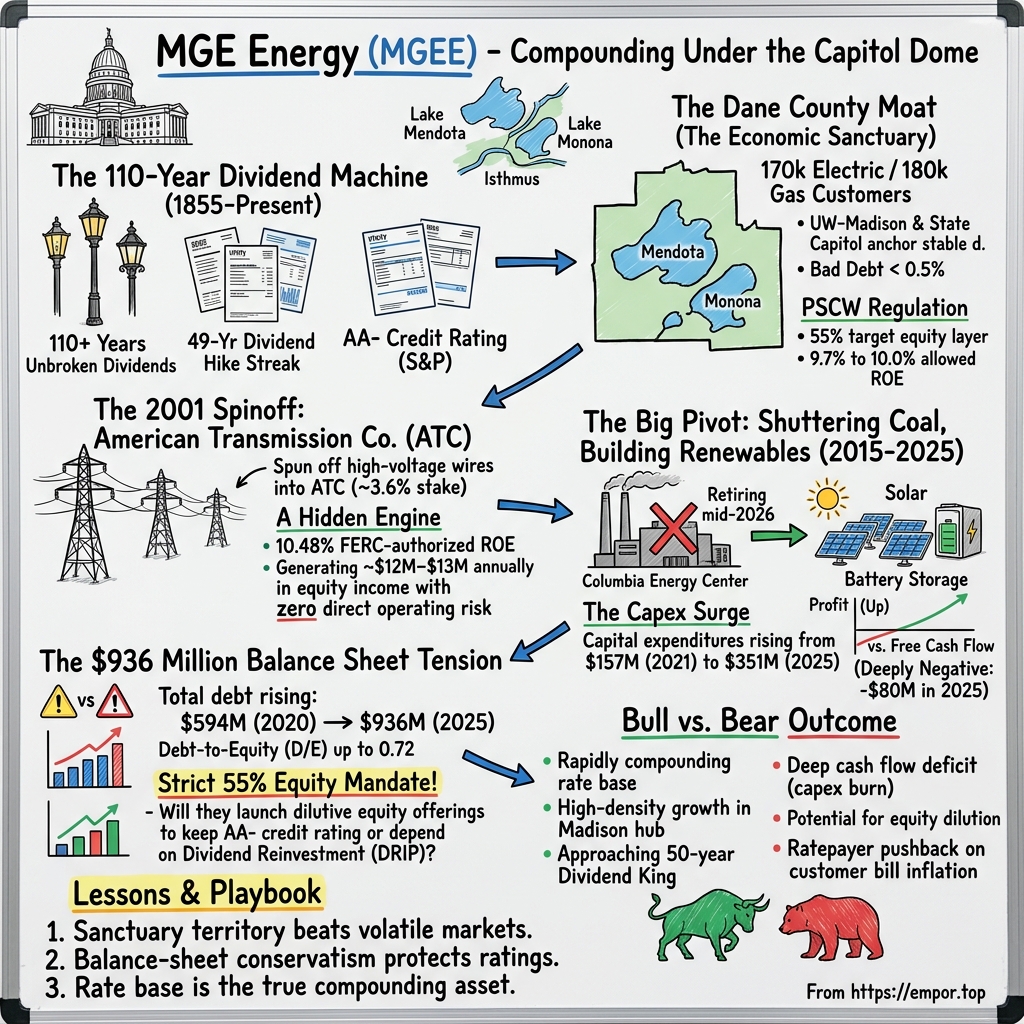
MGE Energy: The Madison Utility Compounding Under the Capitol Dome
I. The 110-Year Dividend Machine Under the Isthmus
Every spring, a particular kind of crowd gathers for MGE Energy's annual meeting in Madison, Wisconsin. Fund managers in quarter-zip vests are not the core of it. The core is retired professors from the university up the hill, state employees who spent careers in the Capitol, and households who first bought a few shares because an offer came in the same envelope as their gas bill. Many of them have reinvested every dividend for decades. They own a small piece of the company that lights their kitchens, and they have watched that piece pay them more almost every year of their adult lives.
Their patience has been rewarded in a way that is close to unique in American business. MGE Energy has paid cash dividends for more than 110 years, and it has raised its annual dividend for 49 consecutive years.3 That means the increases began in the late 1970s, before the Three Mile Island accident, before the Volcker interest-rate shock, and before most of today's utility executives had finished school. Through stagflation, the savings-and-loan crisis, the Enron collapse, the 2008 financial crisis and a pandemic, the cheque to Madison households grew every single year.
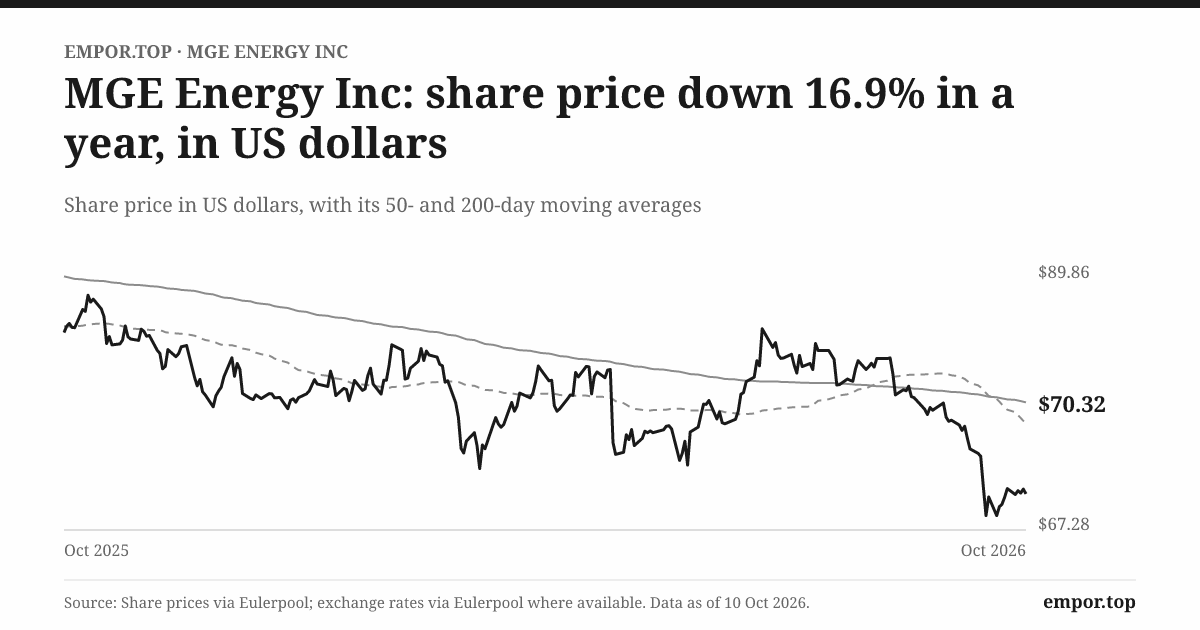
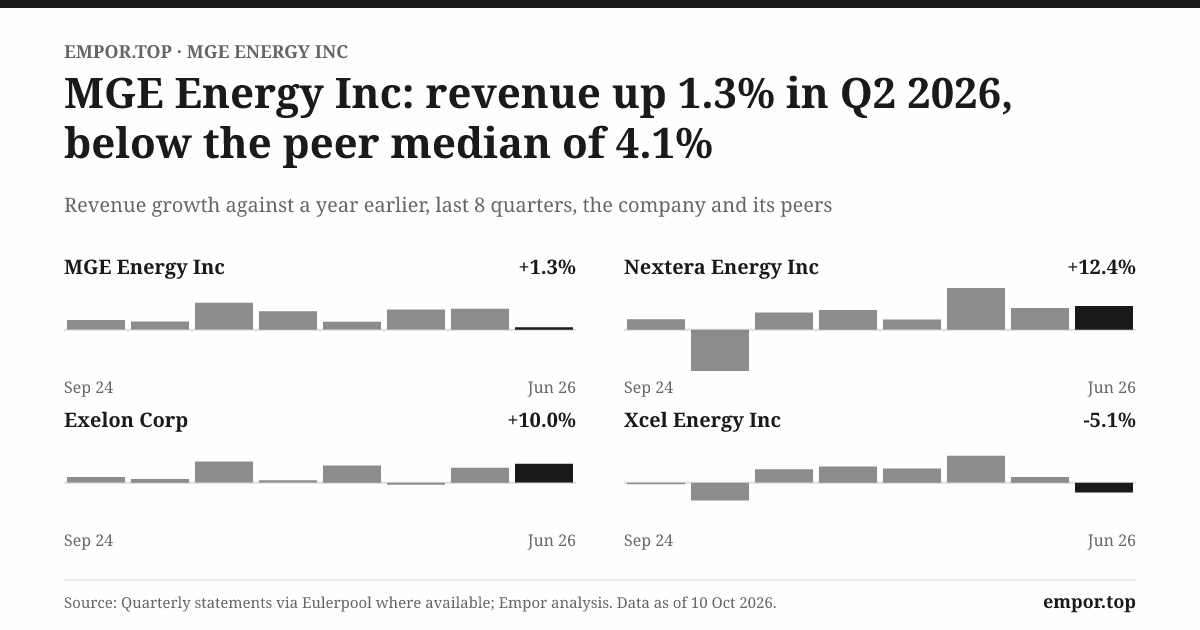
Here is the puzzle this story sets out to solve. MGE Energy is not large. Its market value is about $2.6 billion, its share price stood at roughly $70 on October 10, 2026, and its revenue over the past twelve months came to about $767 million.4 It serves a single region of one Midwestern state. It has never bought a rival, never chased an overseas acquisition and never run an investment bank's playbook. Yet its utility subsidiary carries an AA- issuer rating from S&P, one of the highest among American combination electric-and-gas utilities.11 How did a mid-sized company on a strip of land between two lakes build one of the cleanest balance sheets in corporate America?
The first clue is cash. Over the eight years from 2018 to 2025, MGE Energy reported about $843 million of net profit, but its operations generated about $1.5 billion of cash, roughly 1.8 times its accounting earnings.23 For most companies, a gap that size would be a red flag in the other direction, a hint that profits were being flattered. For a utility it is the opposite. Power plants, poles and pipes are written down every year through depreciation, a cost that hits the income statement but never leaves the bank account. The cash keeps coming in while the books record the slow wearing-out of assets the customers have already been charged for.
The second clue is geography. MGE's home is Dane County, centred on Madison, a city built on an isthmus between Lake Mendota and Lake Monona. The State Capitol sits at the centre of that isthmus, and the University of Wisconsin-Madison sprawls along Mendota's southern shore. Government and higher education are about the least cyclical employers in the American economy. When factories in Milwaukee or Detroit lay off workers in a recession, the legislature still meets and the lecture halls still fill. A utility whose customers work for those institutions has an unusually steady set of bill-payers.
The third clue is the regulator. Wisconsin invented much of modern American utility regulation, and its Public Service Commission has a long reputation among bond investors for being firm but predictable. MGE operates under rules that let it earn an authorized return on equity of 9.70% for 2024 and 2025, rising to 10.00% for 2026 and 2027, on a capital structure that is roughly 55% shareholder equity.612 That equity-heavy structure is the hidden backbone of the AA- rating.
Put those three clues together and the shape of the business becomes clear. MGE Energy is the archetype of the classic American regulated monopoly, operating in something close to an economic sanctuary. Demographic stability, a government and university baseload, and a constructive regulatory compact have insulated its earnings for generations. Net profit grew in every year from 2019 through 2025, from about $87 million to about $135 million.23
But the playbook that built the sanctuary is now colliding with the largest capital cycle in the company's modern history. MGE has committed to retiring its share of coal generation and building solar, wind and batteries in its place, with management describing a clean-energy investment programme on the order of $1.5 billion through 2030.8 Capital spending reached a record $351 million in 2025, and free cash flow, the money left after operations fund investment, swung to about minus $80 million.2 The company that once financed itself comfortably from its own cash flows is now borrowing to grow.
That tension frames the three questions at the heart of this story. First, can MGE fund a record clean-energy build and keep its 49-year dividend streak without breaking its equity layer or diluting the loyal shareholders in that meeting room? Second, does Wisconsin's regulatory compact stay durable as coal retirements push customer bills and utility leverage higher? And third, is the company's roughly 3.6% stake in American Transmission Company a permanent booster to returns, or a structure that federal regulators could squeeze?3
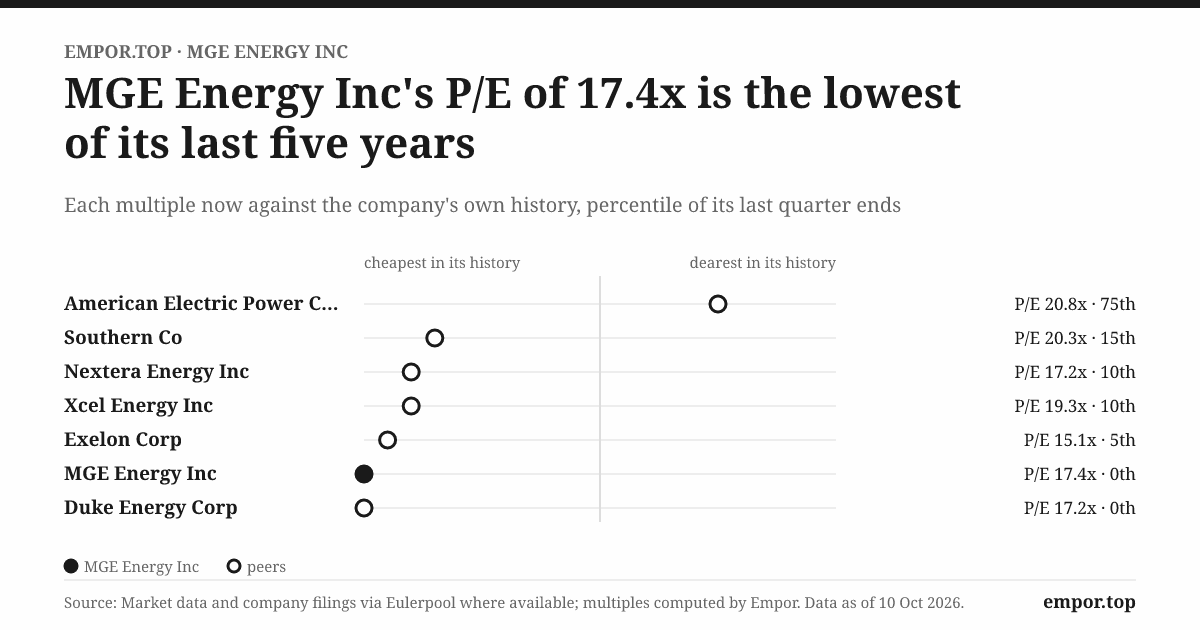
Today MGE serves roughly 170,000 electric customers and 180,000 natural gas customers.3 The market, notably, is less enthusiastic than it once was. The stock trades at about 17.4 times trailing earnings, against a five-year median near 24.7 times, and sits almost a fifth below its 52-week high.4 Investors are paying less for each dollar of MGE's profit than at almost any time in recent memory. Whether that discount reflects interest rates, a cash-hungry build-out, or something deeper is the question this story will try to answer. To understand why the company behaves the way it does, though, the story has to start with a gas lamp on a muddy frontier street.
 Subscribe on LinkedIn
II. Gaslight on Lake Monona: Electrifying the Isthmus (1855–1990s)
In 1855 Madison was a raw frontier capital, only a few years into Wisconsin statehood, with a Capitol building that looked more like a county courthouse than a seat of government. That year a group of local businessmen incorporated the Madison Gas Light Company to make gas from coal and pipe it to street lamps.1 Thomas Edison was eight years old. Samuel Insull, the man who would later build the modern electric utility industry and then watch it collapse around him, had not yet been born.
The economics of a gasworks were simple and unforgiving. Coal was roasted in sealed ovens called retorts, the escaping gas was cleaned and stored, and then it travelled through cast-iron mains under the streets. Coal arrived by rail and the works sat near the shore of Lake Monona. It was dirty, capital-heavy work, and a gas company that overbuilt its mains or mispriced its gas could ruin its backers. The habit that would define MGE for the next 170 years, an almost physical reluctance to take on capital it could not see a return on, started there.
Electricity came to Madison late in the nineteenth century, first as arc lamps and then as incandescent service to homes and shops. In 1902 the gas and electric businesses were combined as Madison Gas and Electric Company, the corporate entity that still runs the utility today.3 The new company did what small-city utilities across America did: it built generating plants near town, strung wires along the streets and slowly convinced households that electric light was worth the bill.
What Madison did next was not typical, and it matters for understanding the company today. In 1907, under the progressive governor Robert La Follette, Wisconsin passed a public utility law that extended the authority of its Railroad Commission to gas, electric and water companies. That commission later became the Public Service Commission of Wisconsin.6 It was among the very first state bodies in the country to regulate utilities on what became the standard American model: in return for an exclusive franchise and the obligation to serve everyone, a utility is allowed to recover its prudent costs and earn a fair return on the capital it invests, and no more.
This was the "Wisconsin Idea" in action: the belief, nurtured at the university, that expert commissions could settle economic disputes better than politicians or courts. For MGE it meant that from the earliest days of electrification, its relationship with the state was a negotiated compact rather than a fight. The commission's offices were, and still are, a short walk from the utility's own. Few utilities in America have operated so long, and so literally, next door to their regulator.
The next forty years tested the compact. In the 1920s Samuel Insull's Middle West Utilities and other holding-company empires bought up hundreds of local utilities, stacking layer after layer of debt on top of operating companies. When the Depression hit, those pyramids collapsed, wiping out investors and prompting Congress to pass the Public Utility Holding Company Act of 1935. MGE was not part of those empires. It stayed a locally governed company with a conservative capital structure. The lesson, that financial engineering is the fastest way for a utility to destroy shareholder capital, became part of its culture.
Geography reinforced the conservatism. Because Madison's growth depended on the Capitol and the university rather than on heavy industry, MGE never had a giant steel mill or auto plant whose closure could cripple it. Neighbouring utilities in industrial Wisconsin had to plan for big swings in factory load; MGE planned for steady growth in homes, offices and state buildings. Even today the company says no single customer accounts for 10% or more of its revenue.3
That stability let MGE stay small while neighbours merged. Wisconsin Electric Power grew into WEC Energy Group, and Wisconsin Power and Light became part of Alliant Energy. Those companies became multi-state holding groups. MGE stayed in its contiguous territory around Dane County. Today the regulated utility accounts for more than 98% of the holding company's assets and revenues.3 There is no out-of-state subsidiary to hide a bad bet, and no distant regulator to manage.
The energy crises of the 1970s provided the era's biggest test. Oil and gas prices exploded and inflation ran at double digits. Utilities that had committed to giant nuclear projects found costs spiralling, and several came close to insolvency. MGE's route was more modest. It took minority shares in large coal units built with its larger neighbours, most notably the Columbia Energy Center near Portage, a plant it co-owns with Alliant Energy and WEC Energy Group.313 Joint ownership let a small utility buy into the scale economies of a big plant without carrying the whole construction risk itself.
The second shield in that decade was regulatory. Wisconsin's fuel and purchased-gas rules let utilities pass changes in commodity costs through to customers, so a spike in coal or gas prices became a higher customer bill rather than a hole in shareholder earnings.6 It was during the late 1970s, in the heart of that inflationary decade, that MGE's run of annual dividend increases began.3
There is a consensus story about MGE that says this conservatism was simply a matter of luck: a sleepy college town that never asked anything difficult of its utility. The record suggests something more deliberate. MGE repeatedly chose minority stakes over sole ownership, local focus over expansion, and a thick equity cushion over higher leverage. Each choice cost it some growth. Each choice also made it harder to blow up. By the 1990s the company had become a model of what a small regulated utility could be. Then a wave of deregulation swept across the United States, and for the first time in a century the basic deal of the regulated monopoly was put up for negotiation.
III. The Wisconsin Restructuring That Wasn't: The Birth of ATC (1998–2002)
In the late 1990s, the fashionable idea in American energy policy was that utilities should be broken apart. California led the charge. It forced its utilities to sell power plants, created a wholesale market and let customers choose suppliers. Enron's traders called it the future. Within a few years it became a catastrophe: rolling blackouts, wholesale prices up many times, one of the state's biggest utilities in bankruptcy and, by the end of 2001, Enron itself collapsed in fraud.
Wisconsin was watching the same debate and came to a different answer. Its lawmakers were worried about something more specific than abstract competition. The state's transmission grid, the high-voltage lines that carry bulk power between plants and cities, was fragmented among several utilities and was widely seen as congested, which made Wisconsin vulnerable to shortages and price spikes during summer peaks. What the state needed was a stronger grid, not a retail market.
So Wisconsin wrote a bespoke compromise. It kept the retail monopoly: Madison households would still buy their power from MGE, under PSCW rates. But the investor-owned utilities would contribute their transmission lines to a new, independent company that would own and operate the high-voltage grid. In exchange, each utility received an ownership stake in proportion to the assets it handed over. That company, American Transmission Company LLC, began operating on January 1, 2001, and is generally described as the first multi-state, transmission-only utility in the United States.9
For MGE, giving up its transmission wires looked at the time like a modest loss of control. In hindsight it was one of the best trades in the company's history. MGE Energy today holds an ownership interest of about 3.6% in ATC and its holding company, through a subsidiary called MGE Transco Investment LLC.3 It no longer has to manage the planning, construction and politics of high-voltage lines across several states. It simply collects its share of the profits.
Shortly after ATC was formed, Madison Gas and Electric reorganised itself under a new parent. MGE Energy, Inc. was established as a holding company in 2002 and became the listed entity on NASDAQ under the ticker MGEE.2 The structure was simple: the regulated utility underneath, plus a few non-utility holdings, the most important of which is the ATC stake. Unlike the holding companies of the 1920s, this one was not a debt pyramid. No significant long-term debt sits at the holding company; the borrowings sit at the regulated utility, where the commission can see them.3
Why does the ATC stake matter so much? Because it is regulated by a different referee. Transmission is overseen not by Wisconsin's commission but by the Federal Energy Regulatory Commission, which sets the return on equity for transmission owners in the Midwest grid run by the Midcontinent Independent System Operator, known as MISO.10 After years of litigation, FERC set the base return for MISO transmission owners at 9.98%, and transmission owners that belong to the regional grid operator receive an extra half-point incentive for participating. That combination produces ATC's authorized return of about 10.48%.9
Set that number beside MGE's own retail return, which the Wisconsin commission set at 9.70% for 2024 and 2025.6 The passive investment earns a higher authorized return than the business MGE actually operates. The equity earnings from ATC came to about $12.3 million in 2024 and $13.0 million in 2025, recorded as other income.3 Against pre-tax profit of about $156 million in 2025, that is roughly 8% of the company's profit before tax, earned with no trucks, no linemen and no rate cases of its own.2
It is worth being careful about what that number means. The ATC stake is not a growth engine on the scale of MGE's own capital programme; its carrying value of roughly $128 million, which sits in the company's investments line, is small next to $2.6 billion of plant.2 Its equity income grows only as ATC grows its own grid, which in turn depends on MISO's plans for new long-distance lines. What it provides is diversification of regulator: a second, federal stream of regulated income that does not depend on Madison customers' bills.
The ATC relationship is also MGE's main related-party exposure, and it is a clean one. MGE pays ATC for network transmission service under FERC-approved tariffs that are public and apply to every customer of the grid.9 Shared services between the holding company and the utility are allocated using methods approved by the Wisconsin commission, with no royalty or management fees flowing to any private party.3 There is no founder family, no promoter, and no side entity collecting rents.
The historical test of the ATC claim cuts both ways. In favour: the stake has produced steady equity income for a quarter of a century without the kind of write-down that has hit many utility side bets. Against: the 10.48% return is the product of a federal decision that has already been cut once, in the long fight over MISO transmission returns, and could be cut again by a future complaint or by FERC policy on incentive adders. The fair conclusion is that the ATC stake is a durable, high-quality affiliate, but its return premium over MGE's retail business is a regulatory choice, not a law of nature.
The episode also says something about MGE's leadership in that era. A company that had fought the forced divestiture of its wires might have tried to preserve control or extract a cash payment. MGE took equity and stayed passive. It turned out that owning a sliver of a well-run monopoly can be better than owning all of a small one. To see why the retail monopoly left behind still delivers such predictable profits, though, the story has to move inside the commission's hearing room.
IV. The Machinery of the Monopoly: Cost-of-Service and Fuel Rules
Picture a hearing room at the Public Service Commission of Wisconsin. The setting is undramatic: fluorescent lights, binders, a court reporter. Around the tables sit MGE accountants, commission staff and consumer advocates from the Citizens Utility Board. They are debating, sometimes for weeks, questions like whether a new solar array should earn 9.70% or 10.00% on the equity invested in it, how fast an old coal unit should be depreciated, and how many customers MGE will add next year. Every few years these arguments produce a rate order, and that order quietly sets most of MGE's profits for the period it covers.6
The economics come down to one equation, and it is worth taking slowly. A utility's rate base is the value of the plant it has built to serve customers, minus the depreciation already charged. The commission allows the utility to earn a return on that rate base, blended between the interest on its debt and an authorized return on its equity. Then it sets customer rates high enough to cover operating costs, depreciation, taxes and that return. In plain terms, profit is roughly the size of the rate base multiplied by the allowed return on the equity portion of it.
Think of it as a toll road whose owner is told by the state how much it may earn on every mile of road it builds. The owner cannot raise tolls to exploit a traffic jam, and cannot lose money because of one either. The only way to earn more is to build more road that the state agrees is useful. That is why the single most important number in this story is not revenue or customers but how much plant MGE is allowed to put into its rate base, and how quickly.
The commission authorized a 9.70% return on equity for MGE's 2024 and 2025 test years, and the framework for 2026 and 2027 moves to 10.00%.612 The equity share of the capital structure used to set rates sits around 55%.12 Both numbers are generous by national standards. Many state regulators set equity layers closer to 50% or below, which leaves utilities more dependent on debt and more exposed to rising interest rates.
Now the trick that confuses many first-time readers of utility accounts. MGE's revenue bounces around, sometimes violently. It rose almost 18% in 2022, fell about 3% in 2023, slipped again in 2024, and then climbed about 10% in 2025.2 A reader who looked only at the top line might think the business was cyclical. Net profit, meanwhile, rose in every one of those years.2
The explanation is the pass-through. Under the Purchased Gas Adjustment clause, the cost of natural gas that MGE buys for its customers flows straight into their bills, dollar for dollar, with no mark-up.3 A similar fuel rule governs the cost of fuel and purchased power for the electric business, with a band around a forecast within which MGE carries the variance and beyond which customers do.6 When wholesale gas prices spiked in 2022, MGE's revenue jumped because customers were paying more for the molecules; when gas prices collapsed in 2023, revenue fell. In neither case did MGE earn a profit margin on the gas itself.
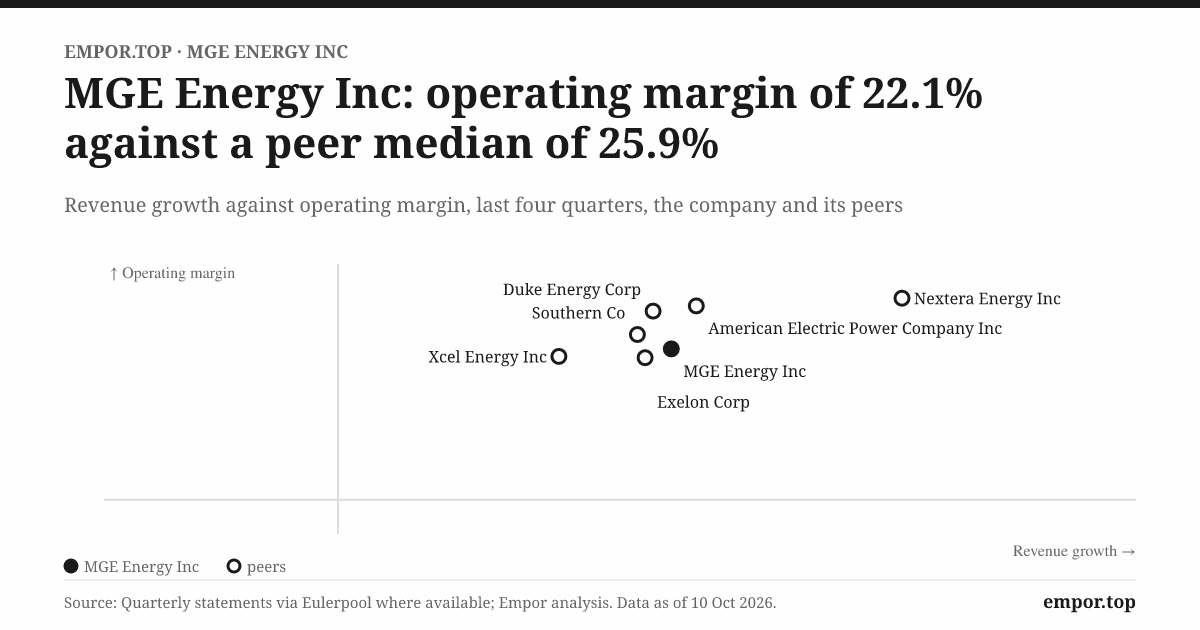
The lesson for an investor is that MGE's revenue is a misleading thermometer. Operating margin moved in a narrow band, from about 19% in the early 2020s to about 23% in 2025, and the rise reflects rate increases and new plant rather than any commodity windfall.2 What looks like volatility is really a conduit. The economics live in the rate base.
Cash moves to its own seasonal rhythm. Wisconsin's cold-weather rules forbid utilities from disconnecting residential heating customers for non-payment between November 1 and April 15.6 That protects households in a state where winter can kill, but it also means receivables swell in the coldest months and are worked down in spring. MGE's debtor days, the number of days of revenue sitting unpaid on the balance sheet, have stayed in a band from the high forties to the high fifties since 2018, reaching 56 days in 2025.2 For a business that bills hundreds of thousands of households monthly and records energy delivered but not yet billed, that range is unremarkable and steady.
Working capital looks far stranger in the figures. Measures of working capital days swung from positive in 2024 to sharply negative in 2025, and calculations of inventory and payables days produced numbers in the thousands.2 Those figures are artefacts of how a utility's balance sheet maps onto standard ratios: under- and over-collected fuel balances, regulatory deferrals and construction accruals all land in current accounts. The commission's deferral mechanisms smooth them over time. They are a reason to read utility ratios cautiously, not a sign of operating stress.
What about credit quality? Allowances for credit losses remain small relative to receivables, and bad debt expenses are recoverable through rates.3 The customer base helps. The University of Wisconsin-Madison and state government are among the largest loads in the territory, and households in a university-and-government town tend to have steadier incomes than those in an industrial one.3 There is no customer whose departure could shake the company.
Here is where an honest assessment has to push back against the comfortable picture. The Dane County moat is real, but it is a moat that protects returns on capital already approved. It does not guarantee approval of the next dollar. The commission can and does trim rate requests, and consumer advocates intervene in every case. Historically, MGE's earned return on equity has hovered near its authorized level, between about 9.5% and 10.4% across 2018 to 2025, and stood at 10.3% for the twelve months to June 2026.24 That steadiness is strong evidence that the compact has worked. It is also a reminder that the return is capped: MGE will not earn 15% on equity in a good year, because the regulator would claw it back.
So the machine converts kilowatt-hours and therms into profit with remarkable predictability, as long as the rate base grows and the regulator stays constructive. For most of MGE's history, that rate base grew slowly. Then, in the late 2010s and early 2020s, the company decided to rebuild its generating fleet almost from scratch.
V. The Capex Pivot: Shuttering Coal, Building Renewables (2015–2025)
In early 2021, Alliant Energy, WEC Energy Group and MGE announced together that they planned to retire the Columbia Energy Center, the coal plant near Portage that had supplied a large share of MGE's power since the 1970s.13 For a utility whose identity had been built on caution, it was a statement of intent. MGE had already set goals of cutting carbon emissions from its electricity supply by 80% by 2030 from 2005 levels and reaching net-zero carbon electricity by 2050.8
Why retire a working plant? Because coal had become an expensive asset to keep alive. Federal rules on coal combustion residuals, the ash left after burning coal, required costly handling and pond closures. Ageing boilers needed maintenance capital. Running a coal unit in a MISO market increasingly priced by cheap gas and wind was eating into its economics. And Madison's customers, in a city that votes heavily for climate action, wanted cleaner power. Retiring Columbia removed a stack of future compliance liabilities.3
The retirement date has proved slippery. The co-owners pushed it back more than once as MISO raised concerns about grid reliability and as replacement projects took longer to come online, and the plant's closure was most recently targeted for around mid-2026.3 That delay is a quiet piece of evidence about how hard the transition is. A plant cannot simply be switched off until the grid operator agrees enough replacement capacity is ready.
For shareholders, the more important story is what replaced Columbia. Under cost-of-service rules, every dollar MGE invests in an approved solar farm or battery goes into the rate base and earns the authorized return. Seen through that lens, the clean-energy pivot is not a cost burden. It is the main vehicle for growing earnings.
The capital spending numbers tell the tale. MGE spent about $157 million on capital projects in 2021, a little over a quarter of its revenue.2 By 2025 that figure had more than doubled to a record $351 million, almost half of revenue.2 Net property, plant and equipment grew from about $1.8 billion in 2020 to about $2.6 billion in 2025.2 In five years MGE added roughly 45% more plant to its balance sheet, by far the fastest build of its modern history.
The projects are the physical evidence. MGE took minority stakes in large solar farms built in southern Wisconsin with its larger neighbours, including Badger Hollow in Iowa County, Paris, which pairs solar with battery storage in Kenosha County, and Darien, near the Illinois border.8 It also took a share of the Saratoga solar project in Wood County.8 The pattern is familiar from the Columbia era: MGE buys a slice of a big project rather than building a small one alone, sharing scale and construction risk with partners. In effect, the company that co-owned coal plants with Alliant and WEC now co-owns solar farms with them.
Here comes the cost. Operating cash flow grew substantially, from about $138 million in 2021 to about $263 million in 2025.2 But capital spending grew faster. In 2025, after paying for $351 million of investment, MGE's free cash flow came to about minus $80 million.2 Across the eight years from 2018 to 2025, cumulative free cash flow was about minus $184 million, while the company paid about $449 million in dividends over the same period.2 Every one of those dividend dollars, plus the free-cash-flow gap, had to come from somewhere, and that somewhere was mostly borrowing.
This is the moment to fact-check the comfortable consensus. The common description of MGE is a cash machine that funds itself. The record of the past decade says something narrower. MGE's operations generate plenty of cash relative to profit, but it has not, in most years, generated enough to fund both its capital programme and its dividend. The years 2023 and 2024 were the exceptions, when free cash flow turned positive.2 In 2025 the gap reopened, widely.
Has a transition like this destroyed capital before? The best test lies in MGE's own history. The company's older urban plant, Blount Generating Station on the Madison isthmus, was moved from coal to natural gas and eventually retired. In those transitions, Wisconsin regulators allowed undepreciated costs to be recovered through rates over time rather than forcing shareholders to absorb write-offs.6 That pattern is the norm in Wisconsin and is the basis for the commission granting deferral and amortization treatment to environmental and decommissioning costs.3 It strongly suggests the Columbia retirement will not produce a large shareholder loss.
But the history does not prove that every new dollar will earn its full return. Renewable projects carry their own risks. Interconnecting to the MISO grid involves long study queues, and supply chains for panels and batteries have faced tariffs and shortages.10 If costs overrun, the commission can disallow amounts it considers imprudent. So the evidence leaves the central claim intact but narrowed: the clean-energy build is a reliable rate-base engine, provided MGE keeps projects on schedule and budget. The number to watch is whether earned return on equity stays near the authorized 10%.
There is a subtler point about timing, too. When Columbia retires, its remaining value must be amortized while new plant enters rate base. For a period the company carries both. That creates a temporary drag where customers pay for two generations of assets at once. It is the kind of thing that makes bills rise and gives intervenors ammunition.
So the pivot transformed MGE. A company that once paid its dividend comfortably from its own cash flow has become a capital-hungry borrower. Which raises the obvious next question: how much more borrowing can the balance sheet take?
VI. Balance Sheet Stress Test: The $936 Million Debt Question
Imagine MGE's finance team around a table in early 2026, looking at a spreadsheet of the next few years. Total borrowings had reached about $936 million at the end of 2025, up from about $594 million five years earlier.2 Interest rates had reset well above the near-zero levels of the early 2020s. The capital plan still called for heavy investment. And every financing decision had to protect the one asset that made all of this possible: a credit rating that let MGE borrow more cheaply than almost any utility its size.
Start with the arithmetic. Borrowings grew at roughly 9.5% a year over five years, and in 2025 alone they rose by about $149 million.2 Shareholders' equity grew too, from about $976 million in 2020 to about $1.3 billion in 2025, because MGE retains roughly half its profits.2 But debt grew faster. Debt-to-equity rose from about 0.61 to about 0.72 over the same span.2
How does MGE borrow? Almost entirely at the utility level, through unsecured senior notes typically sold privately to insurance companies and other long-term investors. The company issued tranches of senior notes in 2024 and again in 2025 to fund its capital programme.3 The holding company itself carries no significant structural debt, which matters because debt at a holding company sits behind the utility's creditors and is the classic way utility groups get into trouble.3
The regulator sets the guardrail. Wisconsin's commission uses a capital structure with about 55% equity to set rates, which means MGE is expected to finance its rate base with roughly 55 cents of shareholder money for every dollar.12 If MGE leaned harder on debt, it would not earn more; the commission would simply set rates on the 55% structure regardless, and the utility's credit metrics would weaken. So the 55% layer works as both a gift and a constraint. It gives shareholders a generous equity base on which to earn a return, but it also forces the company to keep raising equity as rate base grows.
That leads to the most interesting fact in MGE's capital history. The company has kept raising equity without selling large blocks of stock. Shares outstanding barely moved, from about 36.49 million at the end of 2024 to about 36.54 million at the end of 2025, an increase of well under 0.2%.3 New shares came almost entirely through the dividend reinvestment and direct stock purchase plan, where customers and shareholders buy small amounts directly from the company, and through employee plans.14 The company has had no large follow-on offering, no rights issue and no warrants over the past decade.
How has MGE grown its equity without issuing shares? By retaining earnings. With a payout ratio of roughly half, MGE keeps about half of every dollar of profit, and that retained cash builds equity. In 2025 the payout ratio fell to about 50%, the lowest in eight years, down from about 56% in 2020.2 That decline is quiet but meaningful. Management has let dividend growth run a little slower than earnings growth, which leaves more money inside the company to fund the build.
Liquidity is run tight on purpose. Cash fell to about $6.6 million at the end of 2025 from about $21.3 million a year earlier.2 For a company with a $3.2 billion balance sheet, that is almost nothing. It reflects a deliberate choice to fund day-to-day needs through bank credit lines and commercial paper rather than sit on idle cash.3 It also means MGE depends on functioning credit markets, though its ratings give it access in all but the worst conditions.
What do the rating agencies say? S&P rates the utility AA- with a stable outlook, and Moody's rates its senior unsecured debt A1, also stable.1112 Both agencies point to the supportive Wisconsin commission, the fuel recovery mechanisms, low industrial exposure and a conservative balance sheet, with cash-flow coverage measures such as funds from operations to debt typically above the low twenties in percentage terms.12 Both also flag the same weakness: the heavy capital programme and the negative free cash flow it creates.
Here is the stress test, built only from MGE's own numbers. The company has a capital plan that runs into the hundreds of millions each year. Operations produce something over $250 million of cash. Dividends absorb close to $70 million. In a year like 2025, that leaves a gap of roughly $150 million that must be borrowed or raised. Retained earnings add around $65 to $70 million of equity per year. If debt keeps growing about twice as fast as retained equity, the ratio will keep climbing. At some point the 55% equity layer will bind, and MGE will have to choose.
The choices are few. It can slow the capital programme, which slows earnings growth. It can cut the dividend growth rate further, which strains the streak's spirit if not its letter. Or it can issue equity in a larger and more deliberate way, most likely through an at-the-market programme that sells shares gradually into the market. An at-the-market programme is not a scandal; most large American utilities run one. But for MGE it would mark the end of a distinctive record.
How should investors weigh the risk? The historical evidence argues against panic. Debt-to-equity of 0.72 is still low for a utility; many larger peers run above 1.1 times.15 MGE also has a long record of matching its capital plan to its financing capacity. But the trend is clear and the arithmetic is unforgiving. The claim that MGE can fund its build without meaningful dilution looks intact for now and less certain with every year of negative free cash flow. The signals to watch are the utility's equity ratio in its annual filings and any announcement of a formal equity programme. Those decisions rest with a small, stable leadership team.
VII. Stewardship Under Keebler: Incentives, Governance, and Credibility
Each year MGE Energy's compensation committee meets to decide how much its executives should be paid. In many companies that meeting is a negotiation about growth targets and stock price hurdles. At MGE, the scorecard looks different. It weighs earnings and return on equity, but also safety, reliability measures watched by the Wisconsin commission, customer satisfaction and environmental milestones.5 The committee's job is to pay executives for running a utility well, not for making it bigger at any cost.
The man at the centre of that scorecard is Jeffrey M. Keebler, chairman, president and chief executive.5 Keebler came to MGE from outside the company and took over the top job in the late 2010s, inheriting a utility with a famously cautious culture and a coal-heavy generating fleet.57 His defining decision has been to lead the company into its renewable build while keeping the financial habits of his predecessors. He has not tried to transform MGE into a regional consolidator, and under his tenure the company has made no large acquisitions.2
Pay rose noticeably in 2025. Keebler's total compensation increased from about $2.1 million in 2024 to about $3.6 million in 2025, including a base salary of about $796,000, a cash incentive of about $866,000 and stock awards of about $1.4 million.5 An increase of that size deserves scrutiny. It coincided with a year in which net profit rose about 12.5% and earnings per share rose about 12%, the strongest growth of the recent period, which suggests the incentive plan paid out as designed rather than being reset to guarantee rewards.2 By the standards of American utility CEOs, $3.6 million is modest. Leaders of much larger peers commonly earn several times that.
Shareholders appear to agree. Advisory say-on-pay votes and director elections have routinely received support above 94%.5 There has been no visible activist campaign and no significant dissent. The board has an independent majority, with independent audit, compensation and governance committees.7
The auditor offers another check. PricewaterhouseCoopers issued clean, unqualified opinions for 2024 and 2025 with no material weaknesses in internal controls.3 The one recurring critical audit matter, the accounting for regulatory assets and liabilities, is standard across American utilities, because judging whether a regulator will allow a deferred cost to be recovered is inherently a matter of estimate.3
Who owns the company? Institutions hold roughly 70% to 76% of the shares. BlackRock is the largest holder with roughly 14.9%, followed by Vanguard at about 11.2% and State Street at about 4.5%.5 These are mostly index funds, which means they hold MGE because it sits in benchmarks, not because they chose it. They rarely push for change.
The remaining roughly quarter to a third of the shares is held largely by retail investors, many of them local customers who use the direct stock purchase plan.14 This group is MGE's distinctive constituency. They tend to buy and hold, reinvest dividends and treat the stock as something close to a municipal bond with growth. Insiders and directors together hold less than 1.5%.5 There is no founder, no controlling family and no dual-class structure.
Is management credible? The fairest test is behaviour over time rather than words. On that test, the record is strong in the areas management controls most directly. Earnings grew every year from 2019 to 2025. Earned returns stayed close to authorized ones. The dividend rose every year. The capital programme has been delivered in partnership with larger utilities without visible write-offs.23
But an activist would challenge two points. The first is the slipping Columbia retirement date, which shows that the transition is harder than the original 2021 announcements implied, even if much of the delay came from the grid operator and co-owners rather than MGE alone.13 The second is the financing question. Management has spoken of maintaining a strong balance sheet, but the clearest evidence of that commitment will be what it does when debt nears its limits: whether it issues equity promptly to protect the rating, or lets leverage drift to preserve the share-count record.
The verdict is that MGE's stewardship is disciplined and low-drama, with pay incentives that reward reliability as much as growth. That is a narrower claim than "flawless." It leaves the biggest decision of Keebler's tenure, how to finance the next leg of the build, still ahead. Before weighing that, it helps to ask exactly where MGE's advantage comes from, and whether it could erode.
VIII. Moat Analysis & Hamilton Helmer's 7 Powers
Imagine a merchant power developer who decides to compete with MGE in downtown Madison. The plan is ambitious: build a solar-and-battery microgrid, string private distribution lines to office towers around the Capitol Square and sell power directly. The plan dies on paper. Under Wisconsin law, retail electric service in MGE's territory belongs to MGE. A developer cannot simply string wires along public streets and sign up customers.6 The moat is not cleverness or brand. It is statute.
Hamilton Helmer's 7 Powers framework asks what lets a company earn persistently above its cost of capital and why rivals cannot copy it. For MGE, the primary power is a cornered resource: an exclusive franchise to deliver electricity and gas in its territory. Nobody else can legally duplicate the wires and pipes. The resource is not for sale and does not wear out, though it comes with a ceiling: the regulator decides what return it can earn.
The secondary power is switching costs, and they are close to total. A household in Madison cannot change its distribution provider. A rooftop solar owner still needs the grid for nights, winters and backup, and is subject to commission-approved tariffs for that connection.6 Even a large institution such as the university must connect to MGE's system to receive grid power. The switching costs are physical, not just contractual.
The supporting power is scale economies. The cost of the network, substations, lines, gas mains and the control systems, is spread over roughly 350,000 meters.3 Any rival would face the same fixed costs over a tiny customer base. MGE's scale is small by utility standards, which is why it shares big generating projects with larger neighbours. Within Dane County, though, its density gives it an unmatchable cost per customer.
The remaining powers do not apply in a meaningful way. Counter-positioning, network effects, brand and process power matter for companies that compete for customers. A regulated monopoly does not compete for customers in the same sense, so these powers are immaterial. The one place brand faintly matters is with regulators and the public: a utility with a good reputation earns more benefit of the doubt in a rate case.
Porter's Five Forces tells a consistent story. The threat of new entrants is extremely low, because new distribution utilities need commission certificates that will not be granted in an existing territory.6 The bargaining power of buyers is low commercially, since no customer negotiates its own tariff and none accounts for 10% of revenue, but high politically. Customers organise through intervenors such as the Citizens Utility Board, which argues against rate increases in every case.6 That political buyer power is the true limit on MGE's pricing.
Supplier power is moderate. Natural gas producers, pipelines and wholesale power sellers have pricing power in their own markets, but fuel and purchased-power costs pass through to customers.3 Construction contractors and panel suppliers compete for regional work, though supply-chain shocks can raise costs. The threat of substitutes is low to moderate. Rooftop solar, heat pumps and efficiency all change how much electricity and gas a customer buys. But MGE has positioned itself to own much of the new solar itself, and electrification of vehicles and heating can increase electric demand even as gas demand declines over decades.
Competitive rivalry is close to non-existent. Alliant and WEC serve neighbouring territories that do not overlap with MGE's, and they are as much partners as rivals, co-owning Columbia, Badger Hollow and other plants.138
Now test the moat against its strongest counter-evidence. The most serious long-term threat is not a rival utility but erosion of the gas business. Madison is a climate-conscious city, and if building codes or policy push homes off natural gas, MGE's gas rate base could shrink over decades, leaving pipes that must still be paid for by fewer customers. There is no sign of that in recent results; gas customers still number around 180,000.3 But it is the mechanism that could break part of the moat, and it is worth watching.
The second test is the profitability the moat permits. Return on equity stood at about 10.3% over the twelve months to June 2026.4 That is solid, but it is capped by regulation. Return on invested capital, which includes debt, is lower, around 6.5%.4 In other words, the moat protects a reliable, regulated return rather than an exceptional one. The moat is wide, but the castle is not especially rich.
The verdict is that MGE's moat is about as durable as moats get, rooted in law and physics rather than taste. Its value to shareholders depends not on the moat but on how much new capital the regulator lets MGE put behind it, and at what return. That brings the story to how the market currently prices that bargain.
IX. Valuation Context & The Bull vs. Bear Case
Picture an institutional utility analyst comparing three Wisconsin companies on a screen: MGE Energy, Alliant Energy and WEC Energy Group. All three operate under the same commission, share generating plants and serve neighbouring territories. MGE has the strongest credit rating and the lowest leverage. In October 2026 it traded at about 17.4 times trailing earnings.4 The analyst's question is whether that multiple is a bargain for quality or a fair price for a cash-hungry build-out.
Begin with history. MGE's five-year median price-to-earnings ratio is about 24.7 times.4 Today's multiple is nearly 30% below that. Part of the reason is that MGE used to trade at a scarcity premium; small, high-quality utilities with long dividend records attracted loyal buyers willing to pay up. Part is sector-wide. When interest rates rose, investors could get high yields on Treasury bonds, so they paid less for utility stocks, which are often bought as bond substitutes.
The other multiples tell a similar story. Enterprise value, which adds debt to market value, stands at about 11.7 times EBITDA, and the stock trades at about 1.8 times book value.4 The dividend yield is about 2.7%.4 That yield is lower than many utilities pay, which reflects MGE's lower payout ratio and its historical premium.
Against peers, MGE no longer looks expensive. Alliant and WEC have traded in roughly the high teens to around 20 times earnings, while carrying debt-to-equity ratios well above MGE's.15 On that comparison, the market is charging little or no premium for MGE's superior balance sheet. The price appears to assume that MGE's earnings growth will be ordinary and that its cleaner balance sheet will gradually look more like its peers' as it borrows to build.
One more number deserves interpretation. MGE's PEG ratio, price-to-earnings divided by expected growth, is about 3.8.4 A high PEG usually suggests the stock is pricey relative to its growth. For a utility, the ratio is less meaningful, because growth is slow by design and the market values stability. But it is a reminder that, even after the multiple's decline, investors are not getting fast growth cheaply.
Now the bull case, stated as strongly as the evidence allows. First, the rate base is growing faster than at any time in MGE's modern history. Net plant rose from about $1.8 billion in 2020 to about $2.6 billion in 2025, and management describes a clean-energy programme of about $1.5 billion through 2030.28 Under a 10.00% authorized return, that build should translate into earnings growth well above MGE's historical base rate. The recent results support that view: net profit rose about 27% in the June 2026 quarter, and trailing earnings per share reached about $4.04.4
Second, regulatory visibility is high. The commission's decisions for 2024–2025 and the framework for 2026–2027 give investors a clear view of the allowed return and equity layer.6 Third, Madison's economy keeps growing, adding homes, offices and technology and biotech businesses, which supports steady customer additions. Fourth, the balance sheet still has room. A debt-to-equity ratio of 0.72 leaves MGE able to borrow more before it nears peer levels.2
The bear case is equally concrete. Free cash flow was about minus $80 million in 2025, and with capital spending running at hundreds of millions a year, the company will likely keep borrowing after paying dividends.2 Customer bills are rising as customers pay both for new renewables and for the remaining value of retired coal plants, which invites stronger opposition in future rate cases. The financing gap may force MGE into regular equity issuance, ending its near-zero dilution record. And ATC's return depends on federal decisions that have already been cut once; a further reduction would trim MGE's other income.9
Which side does the evidence favour? Over the past decade, the bull case has been right about earnings: they grew every year and returns held near authorized levels. The bear case has been right about cash: free cash flow has been negative in most years and debt has climbed. The two are not in contradiction; they describe the same business. The real disagreement is about the price of the growth, whether it will be financed with debt the rating can bear or with shares that dilute existing owners. The evidence leaves the bull case intact on earnings and unproven on financing.
That narrows what matters to three numbers. The first is earned return on equity against the authorized 10.00%. MGE earned about 10.3% over the twelve months to June 2026, a strong reading that suggests the build is being recovered efficiently.4 The second is the equity ratio and leverage. Debt-to-equity reached 0.72 at the end of 2025 and has trended upward for five years; the next step is whether it keeps rising or is pulled back by equity issuance.2 The third is the dividend payout ratio, which fell to about 50% in 2025, the lowest in eight years.2 A payout ratio that keeps falling would signal that management is prioritising the balance sheet; one that climbs would signal pressure.
None of these numbers says what MGE stock is worth. They say what the market will be watching as it decides whether today's discount is a fair reflection of a heavier capital cycle or a misjudgment of a quality franchise. That decision, in turn, rests on lessons that run through MGE's entire history.
X. Playbook: Business & Investing Lessons
The first lesson begins in a lecture hall and a legislative chamber. MGE never had a steel mill to lose. Its biggest customers were a university and a state government, and its households were people who worked for them. Over 170 years that gave the utility something that cannot be bought: demand that does not collapse in a recession. The lesson for founders and investors is that a modest, stable market can be worth more than a large, volatile one. Operating in an economic sanctuary beats competing for volume in a booming but fickle market. MGE's customers did not make it rich; they made it predictable, and predictability compounded.
The second lesson is about the equity layer. MGE has carried a thick cushion of shareholder equity for decades, and its regulator rewards it with a 55% equity structure. For years critics might have called that lazy capital, money that could have been levered up to boost returns. The clean-energy build shows why the cushion matters. When capital spending doubled, MGE could borrow heavily without losing its AA- rating, because it started from so much equity. In capital-intensive monopolies, balance-sheet conservatism is not idle money; it is the reserve that lets a company keep building when the capital cycle turns violent.
The third lesson comes from the gas price swings of 2022 and 2023. Revenue jumped almost a fifth and then fell, while earnings climbed steadily through both years. An investor who watched only revenue would have seen a cyclical company; one who watched the rate base would have seen a compounder. Do not confuse commodity revenue volatility with business volatility. In a cost-of-service utility, the income statement is a pipe the commodity flows through, and rate base is the only asset that compounds.
The fourth lesson is the strangest. In 2001 Wisconsin forced MGE to give up its high-voltage wires. A quarter-century later the slice of ATC it received in exchange earns a higher authorized return than the business it kept, and contributes close to a tenth of its pre-tax profit without a single truck or lineman. Surrendering assets under a mandate does not have to be a loss. Sometimes a forced spin-off produces a better business than the one left behind, provided the seller takes equity and lets competent people run it.
The fifth lesson is the one that defines MGE's next decade. Capital spending is the only way a regulated utility grows earnings, and in 2025 MGE spent more than ever before. But every dollar of new rate base must be financed before it earns a cent, with debt that strains the balance sheet or equity that dilutes owners. That is why free cash flow turned deeply negative in the year earnings grew fastest. For a regulated utility, capex is both the profit engine and the dilution threat, and the art lies in running the engine without consuming the owners.
XI. Epilogue
Tonight, MGE Energy sits at the most consequential point in its modern history. The Columbia coal units that powered Madison for half a century are at the end of their life, with retirement targeted for around mid-2026 after repeated delays.313 Across southern Wisconsin, solar farms in which MGE owns a share feed power into the MISO grid.8 The company that once lit Madison with coal gas is now trying to light it with sunlight and batteries, while keeping the financial discipline that made it one of the most trusted utilities in America.
Several events will decide how that story ends. The first is the commission's treatment of Columbia's retirement. If regulators allow the remaining value to be recovered through rates over time, as they have with past plant retirements, MGE will close the coal chapter without a hit to shareholders. A partial disallowance would be the first real crack in the Wisconsin compact.
The second is the 2026–2027 rate framework in practice. The 10.00% return is now in effect, alongside new solar and battery assets entering rate base.6 The test is whether MGE's earned return stays near that level and whether customers and their advocates accept the bills that come with it. Early results are encouraging: earnings per share have grown strongly in the first half of 2026.4 But rate fatigue builds slowly and arrives suddenly.
The third is financing. With borrowings approaching $1 billion and free cash flow negative, MGE will soon have to decide how much equity to raise and how.2 An at-the-market equity programme in late 2026 or 2027 would not break the company, but it would close the chapter in which MGE grew its equity almost entirely from retained earnings and customer stock purchases. Avoiding it would require slowing the build or accepting higher leverage, each of which carries its own cost.
The fourth is symbolic. MGE is one increase away from its 50th consecutive annual dividend increase.3 That milestone would place it among the small group of American companies that have raised their dividend every year for half a century. It would also make the decision about equity issuance more delicate. A company that has spent decades earning the trust of local retail shareholders will be reluctant to dilute them at the moment of its most celebrated milestone.
The central questions remain open. Wisconsin's compact has held for more than a century, and the evidence suggests it will hold again, but its generosity is being tested by rising bills. The ATC stake remains a high-quality affiliate, but its premium depends on federal policy. And the biggest question, whether MGE can fund its transformation without diluting its loyal owners, will be answered in the next two or three years of filings. The tension that remains is simple: the faster MGE builds, the more it earns, and the more it must borrow or sell to keep building.
XII. Outro
On the isthmus between Lake Mendota and Lake Monona, the coal that once came to the shore of Monona for Madison's gasworks and power plants is long gone. The old smokestacks have gone quiet. Out in the rolling farmland beyond the city, rows of solar panels tilt toward the sun, owned in part by the same company that lit the city's first street lamps in 1855.
MGE Energy has survived panics, the Depression, the collapse of the holding-company empires, the energy crises and the deregulation craze by doing one thing well: serving a single region with reliability and discipline. Its next test is the hardest, because it requires the company to spend more than ever while staying who it has always been. If it succeeds, it will prove something the rest of the market tends to forget. In a world obsessed with disruption, the most durable compounding happens when you own the wires, protect the balance sheet and never stray far from home.
References
-
MGE Energy Investor Relations Landing Page — MGE Energy, Inc., 2026-10-10 ↩
-
SEC EDGAR Browse CIK 0001161728 — U.S. Securities and Exchange Commission, 2026-10-10 ↩↩↩↩↩↩↩↩↩↩↩↩↩↩↩↩↩↩↩↩↩↩↩↩↩↩↩↩↩↩↩↩↩↩
-
MGE Energy Form 10-K Annual Report for the Year Ended December 31, 2024 — U.S. Securities and Exchange Commission, 2025-02-26 ↩↩↩↩↩↩↩↩↩↩↩↩↩↩↩↩↩↩↩↩↩↩↩↩↩↩↩↩↩↩↩↩
-
MGE Energy Form 10-Q Quarterly Report for the Period Ended June 30, 2026 — U.S. Securities and Exchange Commission, 2026-08-06 ↩↩↩↩↩↩↩↩↩↩↩↩↩
-
MGE Energy DEF 14A Notice of Annual Meeting of Shareholders and Proxy Statement — U.S. Securities and Exchange Commission, 2026-04-02 ↩↩↩↩↩↩↩
-
Public Service Commission of Wisconsin (PSCW) Docket Filings and Rate Orders — Public Service Commission of Wisconsin, 2025-12-15 ↩↩↩↩↩↩↩↩↩↩↩↩↩↩↩
-
MGE Energy Corporate Governance and Board of Directors — MGE Energy, Inc., 2026-10-10 ↩↩
-
MGE Energy Clean Energy Plan and Decarbonization Targets — Madison Gas and Electric, 2026-05-18 ↩↩↩↩↩↩↩
-
American Transmission Company (ATC) Corporate Overview and Transmission Projects — American Transmission Company LLC, 2026-03-31 ↩↩↩↩
-
Midcontinent Independent System Operator (MISO) Planning and Interconnection Queue — MISO Energy, 2026-06-30 ↩↩
-
S&P Global Ratings Utility Credit Bulletins: Madison Gas and Electric Rating Profile — S&P Global Ratings, 2025-11-14 ↩↩
-
Moody's Investors Service Credit Opinion: Madison Gas and Electric Company — Moody's, 2025-10-22 ↩↩↩↩↩↩
-
Alliant Energy, WEC Energy, and MGE Announce Columbia Energy Center Retirement Plan — Wisconsin State Journal, 2021-02-02 ↩↩↩↩↩
-
MGE Energy Dividend Reinvestment and Direct Stock Purchase Plan Prospectus — U.S. Securities and Exchange Commission, 2024-03-15 ↩↩
-
Peer Trading Multiples via SEC Filings — U.S. Securities and Exchange Commission, 2026-10-10 ↩↩
 LinkedIn
 WhatsApp
 Reddit
 Hacker News
 Email
Email Kindle
 RSS Feed
 Spotify
 Apple Podcasts
 Amazon Music
 Audible
 YouTube