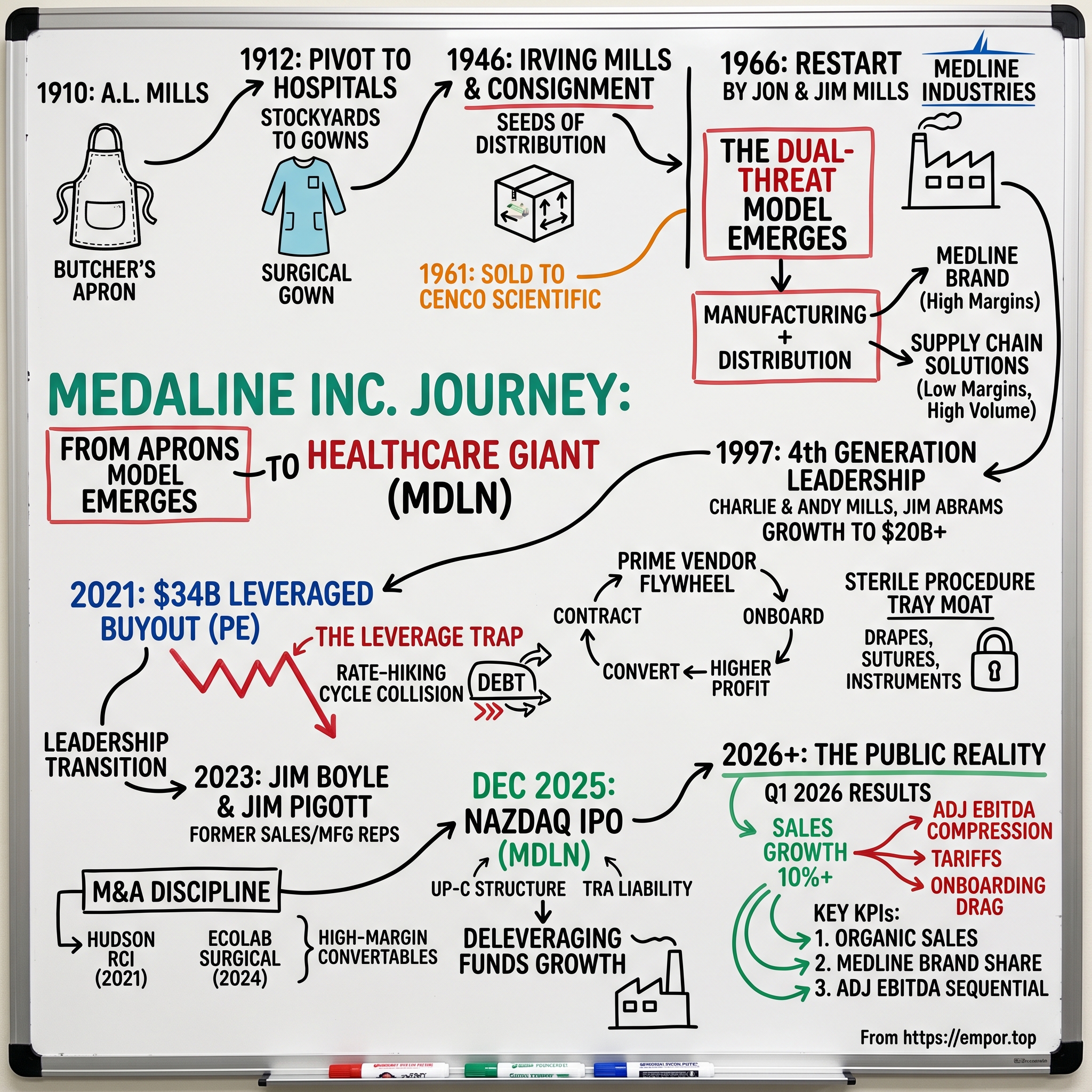
Medline Inc.: The Shadow Behemoth of Healthcare Logistics and Manufacturing
I. Introduction: The $50 Billion Dual-Threat Monster
On the morning of December 17, 2025, traders on the Nasdaq Global Select Market watched a ticker symbol appear that almost none of them had ever typed before: MDLN. The underwriters had priced it the night before at $29.00 a share. It opened at $35. By the closing bell it had run up more than 41% to $41, giving the company a market capitalization of roughly $54 billion.12
The company was Medline. And the strange thing about Medline is that virtually every American has touched its products — and virtually none of them know it. If you have been born in a U.S. hospital in the last several decades, there is a good chance the striped receiving blanket wrapped around you as a newborn came off a Medline line. If you have had surgery, the gown, the drape, the tray of instruments arranged in a specific order for a specific surgeon — a meaningful share of that was probably Medline's too. The company sits underneath American healthcare the way plumbing sits underneath a house: invisible, unglamorous, and absolutely load-bearing.
The offering itself was historic. Medline raised $6.26 billion, including the full exercise of the underwriters' 32.4 million-share greenshoe, bringing the total to 248,439,654 Class A shares sold at $29.00.3 It was the largest U.S. IPO of 2025 and the largest healthcare listing in years.2 Goldman Sachs, Morgan Stanley, BofA Securities and J.P. Morgan led a syndicate that ran to seventeen bookrunners and twenty-two co-managers — the kind of underwriting cast you assemble when you are trying to place a very large amount of stock into a very deep book.1
Behind the ticker sat a business that in fiscal 2025 generated $28.4 billion in net sales, up 11.5%, with adjusted EBITDA of $3.5 billion.4 To put that in perspective: Medline was, at the time of listing, the largest privately held manufacturer and distributor of medical supplies in the United States, and it had been growing at low-double-digit rates in an industry where growing at the rate of hospital admissions is considered respectable.
Here is the paradox this story is about. Medline traces its lineage to a garment shop opened in Chicago in 1910 that made heavy-duty aprons for stockyard butchers.5 From that beginning it became something that essentially does not exist elsewhere in American med-surg supply at scale: a company that both manufactures the products and owns the trucks that deliver them. As of its IPO filings, Medline operated 70 global distribution facilities — 45 of them in the United States, spanning more than 26 million square feet — an owned fleet of more than 2,100 MedTrans trucks, and roughly 30 manufacturing facilities, 24 of them in North America.6 It sells around 190,000 of its own branded products and distributes another 145,000 third-party items from more than 1,300 suppliers.6
That combination is the entire investment question. Pure distributors move other companies' boxes and earn margins measured in single-digit percentage points at best. Pure manufacturers earn attractive gross margins but depend on someone else's trucks and someone else's sales relationships to reach the shelf. Medline does both, and the financial signature of that choice is stark: in 2025 the Medline Brand segment produced 48.3% of net sales but 80.6% of segment adjusted EBITDA, while Supply Chain Solutions produced 51.7% of sales and just 19.4% of segment profit.6 More than half the revenue exists, in effect, to create the relationship that lets the other half sell.
That is the elegant version. The messy version arrived five months after the IPO, when the company reported its first public quarter and the stock market discovered that this machine has an exposed nerve — tariffs on imported commodity components — and no easy way to pass the cost through to hospital customers who negotiate through group purchasing organizations on multi-year contracts.
This is the story of how a family got from butcher aprons to a $50 billion listing across 116 years; why the dual-threat model produces economics that Cardinal Health and McKesson cannot replicate; how a $34 billion leveraged buyout in 2021 collided with the fastest rate-hiking cycle in four decades; why the Mills family handed the keys to a former San Antonio sales rep; and what the first year of public-market scrutiny has revealed about which parts of the thesis are real and which parts are still management assertion.
 Subscribe on LinkedIn
II. The Mills Family Dynasty: Aprons to Gowns (1910–1965)
Chicago's Union Stock Yards in 1910 was not a place for the fastidious. It covered roughly a square mile on the South Side, processed a substantial fraction of America's meat, and employed tens of thousands of men doing brutal, wet, dangerous work. Upton Sinclair had published The Jungle four years earlier, and the yards were the most notorious industrial workplace in the country. It was also, if you looked at it commercially rather than morally, a market: thousands of workers destroying their clothing every single day.
A.L. Mills opened Northwestern Garment Factory that year to sell them heavy-duty aprons.5 It was a wonderfully unromantic business. The product was a piece of canvas. The competitive advantage was durability and price. There was no technology, no patent, no brand. What there was, and this matters for everything that follows, was a lesson in industrial cloth: what fabrics survive punishment, what stitching fails first, how to price a consumable that a customer buys over and over.
The pivot came in 1912, and it came from the customer side rather than the strategy side. Hospitals in Chicago needed uniforms and surgical gowns, and the requirements were different from the stockyards — the garments had to survive repeated sanitizing rather than repeated blood and grease. Mills took the work and reoriented the company around it, renaming the business Mills Hospital Supply.5
Read that pivot properly and it is not a heartwarming anecdote about serving nurses. It is a margin decision. The stockyards were a commodity market with brutal buyers. Hospitals were an institutional market with specifications, reorder cycles, and a purchasing agent who cared about reliability more than about squeezing the last penny. A.L. Mills traded a market where he had no pricing power for one where he had some. Every subsequent generation of the family made a version of this same trade.
The second generation was Irving Mills, who by any measure was the more consequential figure. He joined the business at twelve years old, in 1918, and took over at eighteen in 1924 — a promotion timeline that tells you something about both family expectations and mortality in that era.5 He later went back and earned a business degree from Northwestern in 1939, which is an unusual sequence: run the company first, study business afterwards.5 During the Second World War, as demand for civilian uniforms softened, he pushed the company harder into hospital textiles.5
Irving's genuinely important innovation, though, was not a product. In 1946, one of his sales representatives worked out a way to serve Colorado hospitals that were cut off by winter road closures: ship goods on consignment, let the hospital hold the inventory and pay as it consumed.5 This is worth pausing on, because it is the intellectual seed of everything Medline later became. Consignment shipping solves a customer's problem — I cannot get supplies when I need them, and I cannot afford to pre-buy a season's worth — by moving the inventory risk onto the supplier. In exchange, the supplier gets something enormously valuable: physical presence inside the customer's building, and visibility into what the customer actually consumes.
That model let Mills Hospital Supply escape the Midwest. Branch operations followed in Texas, Virginia, and Ohio.5 A regional textile maker was becoming a national distributor of medical supplies, and the family had learned the lesson that would define the dynasty: the distribution relationship is the asset; the product is what you monetize it with.
Then, in 1961, Irving Mills sold the whole thing to Cenco Scientific.5 The family was out.
The reasons for the sale are not documented in detail in the public record. What is documented is what happened next, and it is the most important decision in the company's history. Five years later, in 1966, Irving backed his sons Jon and Jim in starting over from nothing. He put in $500,000 — real money in 1966 — and the new company, Medline Industries, did about $1 million of revenue in its first year.57 Jon took the president's role; Jim ran it as chief executive.5
Consider what that restart actually required. The family had just been paid for a national business with branch offices and customer relationships built over five decades. They had presumably signed the non-competes that come with such a sale. And they chose to begin again in the same industry, from scratch, at sub-$1 million scale — a rounding error against what they had sold.
The strategic content of that decision was that the sons did not simply rebuild a distributor. They built a company that manufactured and distributed.5 The family's original competence — knowing how to make things out of cloth cheaply and well — was recombined with the distribution relationships they knew how to build. That is the origin of the dual-threat structure. It was not conceived in a strategy offsite in the 2000s. It was baked in at the founding in 1966, because it was the only combination of assets the Mills family actually had.
For investors, the takeaway from this early history is narrow but real: Medline's vertical integration is not a bolted-on initiative that a later management team can reverse or a competitor can quickly copy. It is the company's original architecture, compounded over sixty years. Which raises the obvious question — if it is so advantageous, why has no large distributor successfully replicated it?
III. The Fourth Generation and the Rise of the Dual-Threat Model (1966–2021)
The answer to that question is the most interesting strategic material in the Medline story, and it took the company roughly fifty years to fully exploit.
The early decades were an education in what does not work. Medline went public in 1972 and took itself private again in 1977 — a five-year experiment with public markets that the family evidently found unrewarding, and which is worth remembering when we get to 2025.5 By 1984 revenues had reached $120 million and the company moved into a 435,000-square-foot facility in Mundelein, Illinois.5 Along the way there was at least one moment of genuine marketing eccentricity: a 1979 product catalogue that cost $300,000 to produce and featured surreal imagery — belly dancers in surgical masks among them — designed to fight the perception that Medline's lower prices meant lower quality. Textile sales rose 40%.5 It is a small story, but it captures a recurring Medline problem: being the value option in a category where buyers equate price with clinical risk.
The modern company begins in 1997. Charlie Mills, Jim's son, became CEO; Andy Mills, Jon's son, became president; Jim Abrams became chief operating officer.58 The fourth generation would run the business together for the next twenty-six years, taking it from roughly $1 billion of revenue around 2000 to more than $20 billion.58
The distributor's dilemma
To understand what they built, you have to understand the trap their competitors were in.
Consider McKesson. In fiscal 2025 it generated $359.9 billion of revenue and $4.92 billion of operating income — an operating margin of about 1.4%.9 Cardinal Health did $222.6 billion of revenue and $2.7 billion of operating earnings in its fiscal 2025, roughly 1.2%.10 These are magnificent businesses in absolute dollar terms and they are extraordinarily hard to displace at scale. But they are, structurally, toll roads. They buy a product from a manufacturer, warehouse it, ship it, and keep a sliver. Their earnings are a function of volume and working-capital efficiency, not of what the product is.
That model has a specific vulnerability: the distributor cannot decide what the customer buys. It can influence, it can offer a private label at the margins, but the clinical decision — which gown, which catheter, which suture — belongs to the manufacturer's brand and the clinician's habit.
Now consider the manufacturer's dilemma, which is the mirror image. A specialty device maker has real gross margins and real product differentiation. What it does not have is the truck, the warehouse, the ordering system, or the contract with the hospital's supply chain department. It reaches the shelf on someone else's terms and pays for the privilege.
What Medline built instead
Medline decided to own both ends. The physical evidence of that decision, as disclosed around the IPO, is a network of 70 global distribution facilities, 45 of them in the U.S., positioned to provide next-day delivery to roughly 95% of U.S. customers, holding around $4.8 billion of global inventory and about 80 days of on-hand stock.6 It runs more than 2,100 of its own trucks rather than renting capacity from third-party carriers.6 On the manufacturing side, it operates roughly 30 facilities, 24 in North America, supported by more than 600 global sourcing partners.6 Selling it all is a U.S. commercial team of about 4,000 people, inside a global workforce exceeding 45,000 across more than 100 countries.6
Owning the fleet sounds like a capital-intensive mistake until you think about what it buys. A hospital cannot hold much inventory — space is clinical revenue, and expired sterile product is a write-off. So it needs deliveries that are frequent, reliable, and increasingly delivered not to a loading dock but to the specific floor or supply closet where the product will be used. A third-party carrier cannot economically do low-value, high-frequency, inside-the-building delivery. An owned fleet on a dense route can. Reliability, in this business, is not a service attribute; it is the product.
The two segments and the conversion playbook
The commercial architecture that sits on top of this has two parts.
Supply Chain Solutions is the distribution business: roughly 145,000 third-party products from more than 1,300 suppliers, plus supply-chain optimization services.6 Its economics are thin by design — in the first quarter of 2026 the segment ran an adjusted EBITDA margin of about 4.8%.11 Better than a pure pharmaceutical distributor, but not a business you would build for its own sake.
Medline Brand is the manufacturing business: roughly 190,000 proprietary med-surg products.6 This is where the money is. Recall the 2025 split — under half of sales, more than four-fifths of segment profit.6
The mechanism that connects them is the Prime Vendor agreement. Medline signs a multi-year contract to be a hospital system's primary distributor. As of the IPO it disclosed more than 1,600 such relationships, together representing $18.0 billion of net sales — the majority of the company.6 Once inside, Medline's sales organization works, product category by product category, to convert the customer's clinical spend from third-party brands to Medline Brand equivalents.
Think of Supply Chain Solutions as buying an option. The distribution contract costs Medline margin to win, and it commits capital to inventory and trucks. What it purchases is the right — not the guarantee — to sell higher-margin proprietary product into a customer whose ordering, data, and physical supply rooms Medline already operates. The strike price is low; the payoff depends entirely on execution by 4,000 sales people against clinicians who have opinions.
The sterile procedure tray, explained plainly
The most underappreciated asset in this system is the custom sterile procedure tray, and it is worth explaining in non-industry terms.
A surgical procedure requires dozens of items — drapes, gowns, sponges, sutures, basins, syringes, specific instruments — that must all be sterile and must be opened in a particular order. A hospital can source these separately and have staff assemble them, which consumes nursing labor and creates opportunities for a missing item to delay a case. Or it can buy a tray: a single sealed package containing exactly those items, in the order the surgeon wants them, assembled and sterilized by the supplier.
Once a surgical team is trained on a specific tray, switching becomes genuinely expensive — not in dollars for the tray itself, but in operating-room workflow. New tray means retraining scrub nurses, revalidating the setup, and absorbing the risk of a fumbled case in the highest-stakes room in the building. Hospital administrators are usually willing to fight over the price of gloves. They are much less willing to fight the surgeons over the tray.
This is a switching-cost moat built out of muscle memory rather than technology. But it should be assessed honestly: it locks in product categories already converted. It does nothing to guarantee the next conversion, and it does not protect the commodity end of the catalogue, where a glove is a glove and the buyer is a procurement professional with a spreadsheet. That distinction — defended installed base versus contested new business — turns out to matter a great deal when tariffs arrive.
By 2020, this machine was doing roughly $17.5 billion in annual revenue.7 Then the world's healthcare supply chains broke, and the family got an offer.
IV. The $34 Billion Leverage Trap: The 2021 PE Mega-LBO
In the spring of 2020, American hospitals discovered something they had been told for two decades was a solved problem: that their supply chains were long, thin, and mostly located somewhere else. Gowns, masks, and gloves were suddenly unobtainable. Health systems that had spent years optimizing for cost per unit found that cost per unit is irrelevant when the unit does not exist.
Medline's position in that moment was the payoff on sixty years of unfashionable capital allocation. The company held large inventories, owned its own plants, and drove its own trucks. Where a leaner competitor had to call a broker, Medline could call a factory it owned. The commercial result was a step-change in credibility with hospital supply chain executives, and it showed up in the growth rate.
It also showed up in the phone calls the Mills family started receiving.
On June 5, 2021, Medline announced that Blackstone, The Carlyle Group, and Hellman & Friedman — joined by GIC, Singapore's sovereign wealth fund — would invest in the company.12 Press reporting valued the transaction at approximately $34 billion including debt, making it the largest leveraged buyout since the global financial crisis.13 The consortium took a majority position; the Mills family remained the largest single shareholder, and the company described itself as remaining family-led.12
The stated logic was growth capital: expanding the product portfolio, accelerating international expansion, strengthening the global supply chain.12 Charlie Mills framed it as enabling acceleration "while preserving the family-led culture that is core to our success," and Blackstone's Joe Baratta offered the standard partnership language about supporting continued strong growth.12 Critically for the culture question, the entire senior management team stayed: Charlie Mills as CEO, Andy Mills as president, Jim Abrams as COO — the same trio that had run the company since 1997.12
What the deal actually was
Strip away the press release and the structure is straightforward. The sponsors contributed roughly $17 billion of equity, and the balance came from debt.13 In September 2021 the financing came to market: roughly $14.8 billion raised across the bond and loan markets, plus about $2.1 billion of commercial mortgage bonds secured on the real estate.13 It was one of the largest leveraged buyout financings ever completed.
Two observations about the timing, which was — through no fault of the participants — close to catastrophic.
First, the deal was underwritten in the cheapest money environment in modern financial history and financed into a market that was, by September 2021, at the very peak of risk appetite. Within six months, the Federal Reserve began the most aggressive tightening cycle in four decades. A capital structure with a large floating-rate term loan component is a bet that short rates stay low. That bet lost.
The magnitude is visible even after substantial deleveraging: in the first quarter of 2026, with total debt down to $12.76 billion, Medline still paid $136 million of net interest — and that was an improvement from $210 million in the comparable 2025 quarter, when the debt load was roughly $4 billion higher.11 Annualize the 2025 figure and you get something on the order of $800 million a year of interest against adjusted EBITDA that was running around $3.4 billion. Roughly a quarter of the operating cash generation of one of America's best supply-chain businesses was going to lenders.
Second, and more subtly, high leverage constrains the very strategy the sponsors said they were funding. Medline's growth model requires it to spend money years before it earns money: build the distribution center, buy the trucks, hire the sales team, carry the inventory, then convert the customer to house brand over the following two to three years. That is a working-capital-and-capex-hungry model. Debt service competes directly with it.
This is the central tension of the 2021 transaction, and it is the honest answer to why Medline is public today. The sponsors did not take Medline public because a family business finally matured into a listed company. They took it public because a balance sheet built for a 2021 interest rate environment did not work in a 2025 one, and equity markets were the cheapest available source of deleveraging capital.
There is a fair counter-argument, and investors should weigh it. Private ownership brought real operating discipline. It brought capital for automation and acquisitions. It brought professional governance to a company that had been run by three men from the same family for a quarter century. And the Mills family, by retaining roughly 21% ahead of the listing, kept its interests aligned rather than cashing out entirely.7
But the sequence is what it is. And the first consequence of new ownership was the end of the family's operating era.
V. Passing the Torch & M&A Discipline (2023–2024)
On June 28, 2023, Medline announced that Charlie Mills, Andy Mills, and Jim Abrams would step back from day-to-day management effective October 1 of that year, after more than twenty-six years running the company together.8 They did not leave. Charlie Mills became chairman; Andy Mills and Jim Abrams became vice chairmen.8 But the operating company passed out of family hands for the first time since 1966.
The successors were not outside executives brought in to professionalize a family business. They were the two longest-serving lieutenants in the building.
Jim Boyle
Jim Boyle joined Medline in 1996 as a sales representative in San Antonio, Texas. He holds a Bachelor of Science in Industrial Distribution from Texas A&M — a degree that is exactly what it sounds like, the study of how goods move through channels to industrial buyers.8 By the time of his appointment he was executive vice president with responsibility for a customer base of more than 5,000 healthcare providers and roughly $21 billion of annual sales, overseeing commercial strategy, marketing, operations, logistics, and distributed products.8
The biography matters more than it usually does. Medline's competitive advantage lives at two points: the loading dock and the conversation between a sales rep and a materials manager. Boyle spent twenty-seven years at both. Whatever else one concludes about him, he is not a financial executive parachuted into an industrial company.
Alongside him, Jim Pigott became president and chief operating officer. Pigott joined in 1992 and had run the manufacturing side — 27 product divisions, more than 20 manufacturing sites, some 14,000 employees — as well as global sourcing and inventory management, and had led international expansion.8 Between the two of them, Medline's operating leadership covers precisely the two halves of the dual-threat model: Boyle owns the channel, Pigott owns the factory.
Investors should note both what this succession does and does not tell us. It signals cultural continuity and deep operating knowledge. It does not tell us how either man performs under public-market conditions, because until December 2025 neither had ever run a listed company. Boyle's compensation is tied heavily to adjusted EBITDA performance, and his personal stake, while very large in dollar terms, is a fractional share of the company. The alignment is real but the track record as a public-company CEO is now roughly two quarters long. That is not enough to judge.
Capital allocation: two deals, one pattern
What we can assess is how Medline has deployed capital under private-equity oversight, and here the record is unusually legible because the two significant acquisitions were both carve-outs from public companies with disclosed terms.
Hudson RCI, 2021. In May 2021, Teleflex agreed to sell a substantial portion of its respiratory business to Medline for $286 million in cash, reduced by $12 million of working capital that did not transfer.14 The assets included Hudson RCI-branded products for oxygen and aerosol therapy, active humidification, non-invasive ventilation, and incentive spirometers — product lines that had generated $139 million of revenue in 2020.14 The deal closed on June 28, 2021.
Roughly two times sales for an established respiratory franchise is not a bargain-hunting price, but it is nowhere near what a strategic medtech buyer pays for growth assets. And the strategic fit is precise: these are consumable, clinically-specified products that flow through exactly the hospital departments where Medline already has contracts and trucks. Teleflex was selling a business it considered non-core to its higher-growth vascular and interventional portfolio; Medline was buying a product line it could push through a distribution channel Teleflex did not own.
Ecolab Surgical Solutions, 2024. Announced on April 30, 2024 and closed on August 1, 2024, Medline acquired Ecolab's global surgical solutions business for approximately $950 million in cash.1516 The assets included the Microtek sterile drape franchise, operating-room equipment, and a fluid temperature management system, and roughly 3,500 employees transferred with the business.1617 Neither party disclosed the unit's standalone revenue.
Pigott's framing at announcement was that Medline was acquiring "a leading portfolio of operating room products with such a strong reputation for protecting patients and healthcare workers," and that it expanded Medline's OEM and product development capabilities.15 Ecolab, for its part, was clear that it was selling a business that did not fit its model of a technology anchor plus proprietary consumables and service, and it directed proceeds toward a $500 million buyback.16
The pattern across both deals is consistent and worth naming: Medline buys clinically-specified, consumable, high-margin product lines that a large diversified seller has decided are non-core, at prices in the low-single-digit multiple of sales, and then runs them through a distribution channel that the seller could never access on the same terms. This is the disciplined version of vertical integration — buying the manufacturing content that most benefits from Medline's channel, rather than buying scale for its own sake.
The stress test on this record is that both acquisitions are relatively small against a company doing $28 billion of revenue, and neither has been subjected to public disclosure of its post-acquisition returns. Medline does not break out acquisition performance. An investor cannot yet verify that the Microtek business is earning its cost of capital; the claim of synergy realization remains a management assertion supported by circumstantial evidence rather than a disclosed number.
By late 2025, with a new operating team in place and the debt still weighing, the sponsors made the call they had been contemplating for years.
VI. The Public Markets Awakening: The December 2025 IPO
There is a specific ritual to the largest IPOs. The roadshow, the book-building, the moment when the syndicate desk realizes demand is running far ahead of the deal and calls the issuer to ask whether they would like to sell more stock at a higher price. Medline had that call.
The offering was upsized. It priced on the evening of December 16 at $29.00 per share for 216,034,482 Class A shares — with the underwriters holding a 30-day option on an additional 32,405,172 — and began trading on December 17.1 The greenshoe was exercised in full, and the transaction closed with 248,439,654 shares sold and $6.26 billion raised.32 The first-day trading told the rest of the story: opening at $35, closing at $41, up more than 41%, at a market capitalization around $54 billion.18
A 41% first-day pop is worth interpreting carefully rather than celebrating. It means the buy-side valued the company roughly $6 billion higher than the price at which the selling shareholders agreed to transact. That gap is a transfer from pre-IPO owners to IPO allocatees, and it suggests the deal was priced conservatively — plausibly deliberately, to guarantee the deleveraging proceeds and build an aftermarket for the very large sponsor stake still to be sold.
Where the money went
This was not a growth-capital raise. Net proceeds were approximately $7.05 billion. Of that, roughly $5.08 billion went to purchase new Common Units from Medline Holdings, which in turn repaid $731 million of euro-denominated term loans and $3.29 billion of U.S. term loans; remaining proceeds went toward repurchasing equity interests from pre-IPO owners.111
The balance-sheet effect was substantial. Total debt stood at $12.76 billion as of March 28, 2026, comprising $2.50 billion of unsecured 5.25% notes due 2029 and $10.26 billion of secured borrowings.11 Against 2025 adjusted EBITDA of $3.5 billion, that is roughly 3.6 times gross leverage — down from a post-LBO level that was materially higher.411 The interest saving is already visible in the quarterly numbers discussed earlier.
For a business whose growth model requires spending ahead of revenue, this is the meaningful outcome of the listing. Medline has announced construction of a 1.2 million square foot distribution center in Midlothian, Texas, targeted to be fully operational in the second quarter of 2027 — the kind of commitment that is much easier to make when a quarter of your EBITDA is not pre-committed to lenders.19
The structure investors inherited
Two features of the post-IPO structure deserve scrutiny, because they are the sort of thing that gets glossed over in a hot deal.
First, the share structure. Medline listed as an Up-C: public investors hold Class A shares, while pre-IPO owners hold Common Units in the operating partnership plus Class B shares carrying voting rights but no economic rights.6 Voting power remained concentrated — designating stockholders held roughly 61.7% of the vote after the offering, against about 22.7% for public shareholders.6 Public investors bought economics, not control.
Second, the tax receivable agreement. Under the TRA, the company owes cash payments to pre-IPO owners as it realizes certain tax benefits created by the structure. As of the first quarter of 2026, the TRA liability stood at $4.02 billion, having increased by $479 million following the March 2026 secondary offering.11 This is a real, multi-year cash obligation to the former owners that sits outside the debt figure and outside adjusted EBITDA. It is disclosed and legal and entirely standard in Up-C structures — and it is also the kind of item an activist investor would put on the first slide, because it means a meaningful share of future free cash flow is spoken for before a public shareholder sees it.
The sponsors did not wait long to begin selling. On March 3, 2026, Medline launched a secondary offering; it priced on March 4 at $41.00 and closed on March 10 with 86,250,000 shares sold, including the full 11,250,000-share greenshoe, by stockholders affiliated with Blackstone, Carlyle, Hellman & Friedman, and a subsidiary of the Abu Dhabi Investment Authority.20 Medline sold no shares and received no proceeds.20
That the sponsors could place 86 million shares at the December first-day closing price, three months after listing, says the aftermarket was absorbing supply well. It also establishes the pattern investors should expect: a large registered overhang working its way to market over time. Two months after that offering, the company reported its first full quarter as a public company, and the tone changed.
VII. The Public Reality: Q1 2026 Earnings & Operational Squeeze
On May 6, 2026, Jim Boyle and chief financial officer Mike Drazin held Medline's first quarterly earnings call as a public company.21 The prepared remarks were confident. The numbers were a study in contradiction.
The top line was excellent
Net sales reached $7.4 billion, up 10.7%, with organic growth of 10.1%.22 For context on why that is impressive: this is a business selling commodity and semi-commodity supplies into an industry whose underlying volume grows in the low-to-mid single digits. Double-digit growth in med-surg distribution is a share-gain number, not a market-growth number.
The source of that share gain was disclosed and specific. Medline closed 2025 with $2.4 billion of total new customer signings, and the first quarter of 2026 reflected the onboarding of those wins.4 Boyle's framing on the call — growing with existing customers, executing implementations at scale, winning new customers — is consistent with the segment mix: Supply Chain Solutions did $3.89 billion of sales in the quarter against Medline Brand's $3.47 billion.11 New customers arrive as distribution volume first.
Management also pointed to operational investment: the Mpower AI platform for supply-chain decisioning, Symbotic robotic systems in distribution centers, and the company's first Canadian prime vendor partnership, with Mohawk Medbuy covering nine acute care hospitals in Ontario.21 The Canadian win is small in dollars but strategically notable — the prime vendor model is being exported.
The bottom line was not
Net income fell 25.8% to $239 million. Adjusted EBITDA fell 10.6% to $776 million, from $868 million a year earlier.22 Diluted EPS was $0.16; adjusted diluted EPS $0.33.22 Operating cash flow was $412 million and free cash flow $316 million.22
Adjusted EBITDA margin compressed roughly 250 basis points, to about 11%, and Supply Chain Solutions margin declined about 60 basis points to 4.8%.21 Growing sales by more than 10% while shrinking profit by more than 10% is a nineteen-point spread between revenue and earnings growth. Something structural is happening underneath.
Three things happening at once
Tariffs. The company reported absorbing approximately $85 million of net tariff-related costs in the quarter.22 On the call, management discussed a larger gross figure — around $120 million before mitigation — with executives noting they expected favorability from the prevailing 10% rate through mid-year and were planning on higher rates returning thereafter.21 The exposure is concentrated in exactly the products you would guess: nitrile gloves, plastic medical components, and other commodity items sourced from Asia. This is the flip side of the 2020 story. Medline's owned North American plants insulated it during a supply shock, but they do not manufacture everything, and the commodity tail of the catalogue is imported like everyone else's.
Onboarding drag. Winning $2.4 billion of new business is not free. It requires hiring, inventory build, and distribution capacity in advance of the revenue — and critically, in advance of any conversion to Medline Brand. A newly onboarded customer initially shows up as low-margin Supply Chain Solutions volume carrying incremental cost. The margin arrives later, if the conversion works.
IPO-related compensation. Non-recurring incentive payouts following the listing hit the period costs, as flagged in the fourth-quarter 2025 results as well.4
The first two are the ones that matter analytically. The third is arithmetic that washes out.
The analyst friction
The sharpest exchange on the call was about guidance, and rightly so. Medline raised its full-year 2026 organic sales growth guidance to 8.5%–9.5%, from the 8%–9% range set in February — while leaving adjusted EBITDA guidance unchanged at $3.5 billion to $3.6 billion.224
Raising the revenue outlook while holding the profit outlook flat is a statement, whether or not management frames it as one: the incremental revenue is arriving at approximately zero incremental EBITDA. Management's answer was that they expect sequential EBITDA improvement in the second half as tariff effects turn favorable and onboarding investment stabilizes.21 Analysts pushed on competitive positioning and pricing; management responded with the "differentiated value prop" language.21
The most useful disclosure on the call was mechanical rather than rhetorical. Asked about passing tariff costs through, executives noted their standard practice of notifying customers roughly 45 to 60 days ahead of price adjustments.21 That is the sound of a company with contractual pricing constraints describing a process, not a company describing pricing power. And it is the honest heart of the bear case.
The hard truth about who sets prices
Hospital supply contracts in the United States are largely negotiated through group purchasing organizations and integrated delivery networks — buying consortia with enormous aggregated volume and multi-year agreements with locked or formula-bound pricing. The buyers are health systems under sustained financial pressure from labor costs and reimbursement. When an input cost rises for Medline, the company cannot simply reprice. It negotiates, it notifies, it waits for a contract window.
So in the near term, Medline eats the tariff. The critical unanswered question — and it is genuinely unanswered as of mid-2026 — is whether this is a timing problem that resolves as contracts reset over the next 12 to 24 months, or a structural margin reset. Management has told investors it is the former. One quarter of public data is not sufficient to confirm or refute that. The second-half sequential improvement management guided to is the first real test of the claim.
VIII. The Medline Playbook: Business & Investing Lessons
Step back from the quarterly noise and Medline offers a handful of transferable lessons — several of which cut against conventional strategic wisdom.
Channel control can beat product superiority. The dominant assumption in medical products is that clinical differentiation wins. Medline's history suggests something narrower and more useful: for the roughly 80% of hospital consumption that is functionally interchangeable, whoever controls the ordering system, the delivery truck, and the supply room controls the purchase. Medline does not need to make the best gown. It needs to make an acceptable gown that arrives reliably at a competitive price into a supply room it already services. The premium manufacturer with superior product but no logistics relationship is competing on a field where it does not own the ball.
Use the low-margin business to buy an option on the high-margin one. This is the flywheel, and it is genuinely elegant: accept thin returns on distribution to acquire the customer relationship, then monetize that relationship by converting spend to proprietary product. The mathematics only work if two conditions hold — the distribution business at least covers its capital cost, and the conversion rate is high enough to justify the wait. Q1 2026 is a useful illustration of the risk: when you win a great deal of new distribution business at once, you pay all of the option premium up front and receive none of the payoff for two to three years. The strategy is sound; the reported earnings in the interim are ugly.
Vertical integration is insurance, and insurance has a deductible. In 2020 owning factories was worth an enormous amount. In 2026 owning factories has not prevented an $85 million quarterly tariff hit, because the vertical integration covers finished-goods assembly of many items but not the commodity inputs and the lowest-cost consumables. The honest framing is that Medline's manufacturing footprint reduces the variance of supply availability far more than it reduces the level of input cost. Those are different benefits and investors should not conflate them.
Financial engineering has a maturity date. The 2021 LBO is a clean case study in the limits of leverage. The business performed — revenue compounded and the company kept winning customers throughout. The capital structure did not, because it was underwritten against a rate environment that vanished. The consequence was that a company which had chosen private ownership since 1977, and which operates on a two-to-three year conversion cycle, is now explaining quarterly margin compression to analysts. Leverage did not break Medline. It did force it to change the ownership form that suited its operating model.
A fifth lesson, less flattering: durable advantage in this business is boring and slow, and it therefore looks weakest exactly when it is being extended. Every dollar Medline spends onboarding a new health system depresses today's margin and builds tomorrow's installed base. Public markets are structurally poor at valuing that trade. That mismatch, more than tariffs, may be the defining tension of Medline's first years as a listed company.
With the playbook laid out, the question becomes how it holds up against the field.
IX. Competitive Benchmarking, Porter's 5 Forces, and Hamilton Helmer's 7 Powers
The field
Set Medline against its nominal competitors and the first thing you notice is that they are not really the same business.
McKesson at $359.9 billion of revenue and roughly 1.4% operating margin, and Cardinal Health at $222.6 billion and roughly 1.2%, are principally pharmaceutical distributors.910 Their revenue is enormous because drugs are expensive; their margins are microscopic because they are logistics intermediaries for products whose economics belong to the manufacturer. Both have medical-surgical segments, and both have found those segments strategically awkward.
Medline, at $28.4 billion of revenue and a 12.2% adjusted EBITDA margin in 2025, earns roughly an order of magnitude more margin per revenue dollar.46 The comparison is not a claim that Medline is a better-run company than McKesson. It is a statement that Medline is in a different business — roughly half manufacturer — and that this structural choice, not superior execution, accounts for most of the margin gap.
The most instructive competitor is Owens & Minor, historically the closest analogue: a med-surg distributor that also manufactured its own products. In 2025 it moved to divest its Products & Healthcare Services segment and reposition as a pure-play home-based care company, with continuing-operations revenue guided to roughly $2.8 billion.23 The company that most closely resembled Medline's model concluded it could not compete in it and exited. That is the strongest available evidence that the dual-threat position is genuinely difficult to hold at subscale.
The corollary is a risk: it also means Medline's remaining large distribution competitors have limited incentive to defend med-surg share aggressively, but the manufacturers whose products Medline displaces — Becton Dickinson, Cardinal's own brands, 3M's successor health businesses — are perfectly capable of competing on the clinical merits in specific categories.
Porter's Five Forces
Bargaining power of buyers: high, and structurally so. GPOs and IDNs aggregate purchasing across hundreds of facilities and negotiate multi-year contracts. The evidence is not theoretical — it is the 45-to-60-day price-change notification process management described, and the observed inability to pass through $85 million of tariff cost inside a quarter.2122 This is the single most important force in the industry and it caps Medline's margin ceiling permanently.
Threat of new entrants: very low. Replicating 45 U.S. distribution centers, 26 million square feet, 2,100 trucks, $4.8 billion of inventory, and a 4,000-person commercial team is a multi-billion-dollar, multi-decade project against an incumbent with better route density.6 No rational capital allocator attempts it. This force is Medline's strongest protection.
Threat of substitutes: low for the product, moderate for the channel. Hospitals will not stop consuming gowns and trays. But direct-from-manufacturer purchasing, e-commerce marketplaces, and self-distribution by the very largest health systems are live alternatives at the margin. The counterweight is that self-distribution requires a health system to become a logistics company, which most have tried and few have sustained.
Supplier power: moderate and asymmetric. For the 145,000 third-party products in Supply Chain Solutions, Medline is a channel and the manufacturer holds the brand. For the 190,000 Medline Brand products, Medline is the manufacturer — but depends on more than 600 sourcing partners for inputs, which is precisely where tariff exposure lives.6
Rivalry: intense but not price-destructive in med-surg. Contract cycles are long, switching is disruptive, and the number of credible national players is small. Competition happens in bursts at renewal rather than continuously.
Helmer's 7 Powers
Switching costs — the primary power. Discussed at length earlier: the sterile procedure tray, the supply-room integration, the ordering system, the clinician's trained hand. The evidence that this power is real is the 1,600-plus prime vendor relationships representing $18.0 billion of sales and the observed persistence of those contracts.6 The evidence that it is bounded is that it protects converted categories, not new ones.
Scale economies — real, and mechanically explainable. Distribution costs are dominated by fixed facility and route costs. A truck driving a dense route with a full trailer costs barely more than one driving a sparse route half-empty. Every incremental customer in an existing service area improves the unit economics of every existing customer. This is why the new-customer land grab, expensive as it is today, is rational.
Counter-positioning — historically the deepest power, and now weakening. For decades Medline could manufacture while distributing, and its distributor rivals could not respond in kind without alienating the manufacturers whose products constituted their business. That is a textbook counter-positioning trap: the incumbent's existing business model prevents it from copying the challenger. The reason to flag it as weakening is that Medline is now large enough that this asymmetry is common knowledge, private-label penetration is an accepted industry practice, and the constraint on rivals is commercial rather than absolute.
Process power — probably emerging, not yet proven. The Symbotic robotics deployments and the Mpower platform are exactly the sort of accumulated operational capability that becomes a durable advantage.21 But automation is purchasable, and Symbotic sells to whoever will buy. Until Medline discloses distribution cost per case or throughput metrics that separate it from peers, process power is a hypothesis.
Powers Medline does not have: no meaningful network economies, no branding power in the consumer sense, no cornered resource, no patent-based counter-positioning. This is not a criticism — it is a description of where the advantage does and does not live, which matters when assessing what could erode.
X. The Investment Spine: Bull vs. Bear Case
Why Medline wins from here
The conversion runway is the core bull argument, and it is at least partly measurable. A substantial portion of the $2.4 billion of new business signed in 2025 entered the system as low-margin Supply Chain Solutions volume during late 2025 and the first half of 2026.4 If Medline converts even a normal historical share of that spend to Medline Brand over the following two to three years, gross margin expands mechanically without a single new customer win. The company has done this repeatedly across sixty years — that is the basis for the claim. What an investor cannot yet verify from public disclosure is the conversion rate on this specific cohort, which is why it belongs in the KPI list below rather than in the assumption set.
Deleveraging converts interest into optionality. The IPO paydown reduced quarterly net interest from $210 million to $136 million year over year.11 Every further turn of leverage reduction releases cash into a capital allocation menu — automated distribution capacity, onshore manufacturing, and the carve-out acquisitions the company has executed competently. This is arithmetic, not a forecast.
The competitive structure is favorable and getting more so. Owens & Minor's retreat from the model removes the closest structural competitor.23 The pharmaceutical distributors have limited appetite to fight for med-surg share at Medline's margin structure. Barriers to entry are prohibitive.
Tariffs may be a timing issue. If contract windows reset over 12 to 24 months and rates normalize, the current margin compression reverses. Management guided to sequential improvement in the second half of 2026.21
What could break the case
The tariff pass-through may not happen, and the mechanism for that failure is clear. Health systems face real financial distress; GPOs exist specifically to resist supplier price increases; and Medline's own described process — notify 45 to 60 days ahead, wait for the window — is not the behavior of a company with pricing power.21 If commodity import costs stay elevated and pass-through lags persistently, the 12.2% adjusted EBITDA margin of 2025 becomes the peak rather than the baseline.
Growth may be being bought rather than won. This is the sharpest activist-style challenge available. Medline raised sales guidance while holding EBITDA guidance flat.22 The uncomfortable reading is that the company is signing new business at incremental economics near zero, and that the conversion payoff is an assumption rather than a demonstrated result. Management's rebuttal is the historical conversion track record. Both readings fit the current data, and only time separates them.
The capital structure has claims ahead of public shareholders. The $4.02 billion tax receivable agreement liability is a real multi-year cash obligation to pre-IPO owners that sits outside debt and outside adjusted EBITDA.11 Combined with $12.76 billion of debt, a meaningful share of the company's future free cash flow is spoken for.11
Governance is concentrated and the overhang is large. Public shareholders hold roughly 22.7% of the voting power against about 61.7% for designating stockholders.6 The sponsors demonstrated in March 2026 that they will sell into strength — 86.25 million shares at $41.00 — and substantial holdings remain.20 Neither fact is improper; both are facts a minority shareholder should price.
Logistics cost inflation compresses the thin half of the business. Supply Chain Solutions ran at a 4.8% margin in the first quarter of 2026.21 Warehouse labor and fuel inflation have limited buffer to work against before that segment's contribution approaches zero.
Execution risk in the transition itself. Boyle and Pigott are deeply experienced operators with no public-company track record. The first quarter revealed a management team explaining a large earnings decline in its debut — handled straightforwardly, but with the credibility test still ahead. The specific thing to watch is whether the promised second-half sequential EBITDA improvement materializes. A management team that hits a specifically guided recovery earns real credit; one that revises the explanation earns real skepticism.
The three KPIs that matter
Everything above collapses into three things worth tracking. Not a dashboard — three.
1. Organic sales growth against the 8.5%–9.5% guided range. This is the share-gain metric. Sustained high-single-digit organic growth in a mid-single-digit market means the prime vendor model keeps winning. A slip toward market growth means the land grab has ended and the conversion story has to carry the whole thesis alone.
2. Adjusted EBITDA margin, and specifically its sequential trajectory through the second half of 2026. The 2025 full-year figure was 12.2%; the first quarter of 2026 ran roughly 11%.621 This single series answers the central question of whether tariff and onboarding pressure is timing or structural. It is also the metric management explicitly guided against, which makes it the cleanest available test of management credibility.
3. Medline Brand share of total net sales. In 2025 it was 48.3%.6 Because Medline Brand carries the overwhelming majority of segment profit, this ratio is the most direct public proxy for whether the conversion flywheel is actually turning on the newly signed cohort. If distribution volume grows and this share erodes, Medline is buying revenue. If this share holds or rises while sales grow at 9%, the flywheel is real.
XI. Epilogue & Outro
There is a line you can draw from a canvas apron sold to a Chicago stockyard butcher in 1910 to a sterile procedure tray assembled to a named surgeon's preference in 2026, and the line is straighter than it looks. Both are consumables. Both are bought repeatedly by an institutional customer. Both depend on the supplier understanding the customer's work well enough to make something they will keep buying. Four generations of the Mills family found variations of the same insight, lost the company once in 1961, rebuilt it from $1 million of revenue in 1966, and compounded it to $28.4 billion.54
What Medline demonstrates is not the power of a brilliant strategic insight. It is the power of picking one unglamorous vertical, integrating patiently along it for six decades, and refusing to let go of the customer touchpoint — even when that meant buying trucks that any consultant would have told you to outsource.
What the public market chapter will demonstrate is something different, and it is genuinely undecided as of mid-2026. Medline's operating model runs on two-to-three year cycles. Public markets run on ninety-day ones. The first quarterly report as a listed company showed exactly that friction: excellent growth, compressed profit, and a management team asking investors to trust a payoff that arrives later. Whether that trust is warranted is a question the second half of 2026 will begin to answer, and the numbers to watch are already on the table.
References
-
Medline announces pricing of upsized initial public offering — Medline Newsroom, 2025-12-16 ↩↩↩↩
-
Medline makes Nasdaq debut, raising $6.26B in year's largest IPO — Fierce Biotech, 2025-12-17 ↩↩↩
-
Medline announces closing of upsized initial public offering and full exercise of underwriters' option to purchase additional shares — Medline Newsroom, 2025-12-18 ↩↩
-
Medline reports fourth-quarter and full-year 2025 results — Medline Newsroom, 2026-02-25 ↩↩↩↩↩↩↩↩
-
History of Medline Industries, Inc. — FundingUniverse ↩↩↩↩↩↩↩↩↩↩↩↩↩↩↩↩↩↩
-
Medline Inc. Files IPO Registration Statement (Form S-1) — StockTitan SEC filing summary ↩↩↩↩↩↩↩↩↩↩↩↩↩↩↩↩↩↩↩↩
-
Five Members Of Medline's Mills Family Are Now Billionaires — Forbes, 2025-12-17 ↩↩↩
-
Medline announces leadership transition naming new CEO and President & COO — Medline Newsroom, 2023-06-28 ↩↩↩↩↩↩↩
-
McKesson Corporation Reports Fiscal 2025 Fourth Quarter and Full Year Results — McKesson, 2025-05-08 ↩↩
-
Cardinal Health Reports Fourth Quarter and Fiscal Year 2025 Results and Raises Fiscal Year 2026 Guidance — Cardinal Health Newsroom, 2025-08-12 ↩↩
-
Medline Inc. Quarterly Earnings Report (Form 10-Q, period ended 2026-03-28) — StockTitan SEC filing summary ↩↩↩↩↩↩↩↩↩↩
-
Blackstone, Carlyle and Hellman & Friedman to invest in Medline — Medline Newsroom, 2021-06-05 ↩↩↩↩↩
-
Blackstone, Carlyle and Hellman & Friedman to buy majority stake in medical supplier Medline — CNBC, 2021-06-05 ↩↩↩
-
Teleflex Signs Definitive Agreement to Sell Certain Respiratory Assets and Reaffirms Adjusted EPS Guidance — GlobeNewswire, 2021-05-18 ↩↩
-
Medline to acquire surgical solutions business from Ecolab, Inc. — Medline Newsroom, 2024-04-30 ↩↩
-
Ecolab Closes Sale of Global Surgical Solutions Business — Ecolab Newsroom, 2024-08-01 ↩↩↩
-
Medline completes successful acquisition of surgical solutions business from Ecolab Inc. — PR Newswire, 2024-08-01 ↩
-
Medline debuts on Nasdaq after biggest IPO of 2025 — CNBC, 2025-12-17 ↩
-
Medline's growth continues as it breaks ground on 1.2 million sq. ft distribution center in Midlothian, Texas — PR Newswire ↩
-
Medline Inc. announces closing of secondary offering of Class A common stock and full exercise of underwriters' option to purchase additional shares — GlobeNewswire, 2026-03-10 ↩↩↩
-
Earnings call transcript: Medline Q1 2026 sees strong revenue amid margin pressures — Investing.com, 2026-05-06 ↩↩↩↩↩↩↩↩↩↩↩↩↩
-
Medline reports first-quarter 2026 results — Medline Newsroom, 2026-05-06 ↩↩↩↩↩↩↩↩
-
Owens & Minor Reports First Quarter 2025 Financial Results — Owens & Minor Investor Relations, 2025-05-08 ↩↩
 LinkedIn
 WhatsApp
 Reddit
 Hacker News
 Email
Email Kindle
 RSS Feed
 Spotify
 Apple Podcasts
 Amazon Music
 Audible
 YouTube