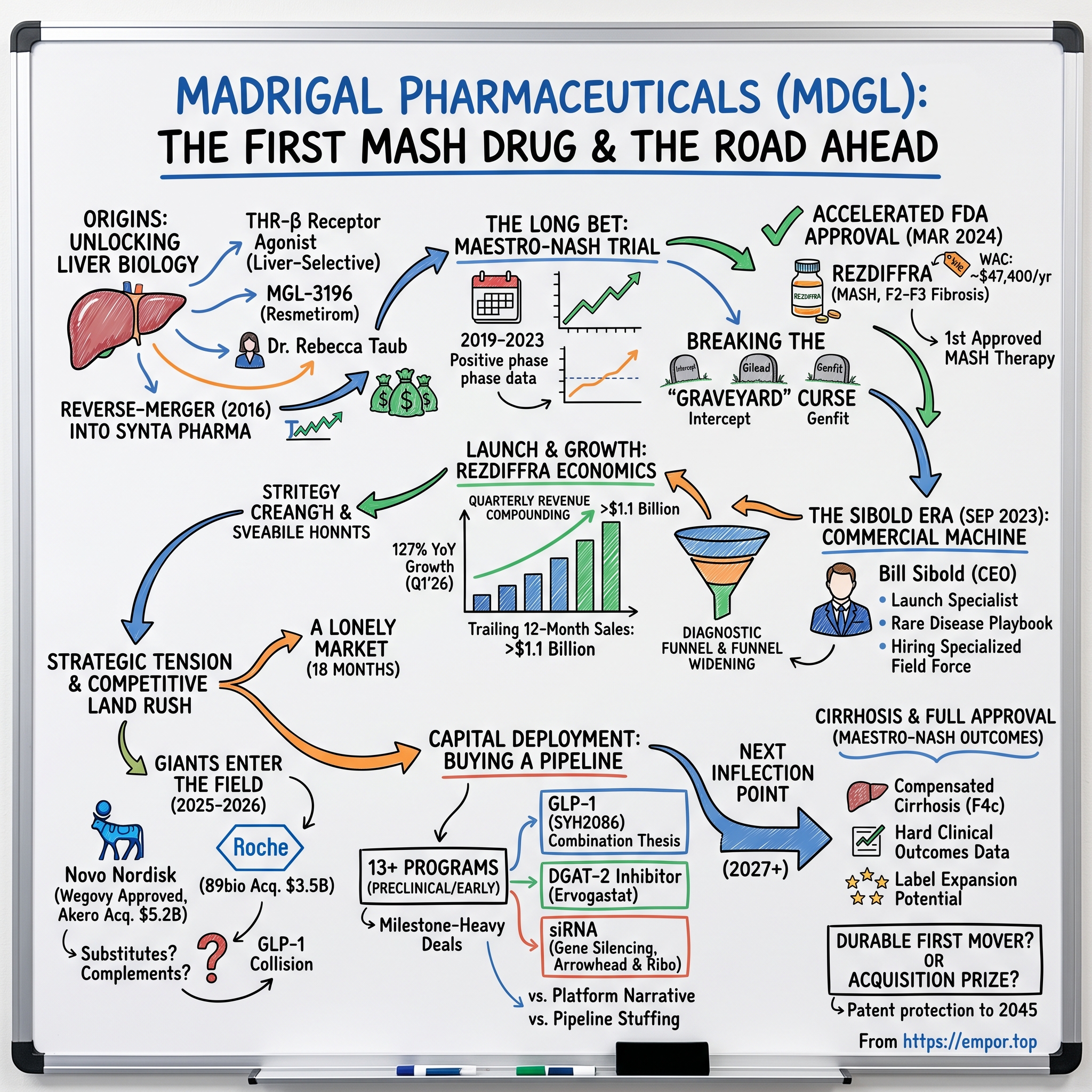
Madrigal Pharmaceuticals: The First Drug for a Disease Nobody Could Crack
I. Introduction & Episode Roadmap
On the afternoon of March 14, 2024, a press release crossed the wire that a certain corner of the drug-development world had spent the better part of two decades waiting for, and had learned, through repeated heartbreak, not to believe in. The U.S. Food and Drug Administration had granted accelerated approval to Rezdiffra — generic name resmetirom — the first medicine ever cleared to treat metabolic dysfunction-associated steatohepatitis, the fatty-liver disease that until recently the field had called NASH.1 For a condition estimated to afflict more than twenty million Americans, and to be silently scarring the livers of a meaningful slice of the developed world, there had been, until that Thursday, exactly zero approved therapies. There had instead been a graveyard.
That word — graveyard — is not marketing hyperbole borrowed from a pitch deck. It is the term the industry itself used, because the list of companies that had marched confidently into fatty-liver disease and been carried out was long and included some genuinely formidable names.2 Into that field walked Madrigal Pharmaceuticals, a company that for most of its life was a single molecule, a single scientist's conviction, and a burn rate. When the FDA letter arrived, Madrigal was worth a few billion dollars and had never sold a pill. As of mid-2026 it is a roughly $12 billion Nasdaq biopharmaceutical company whose one product crossed a billion dollars in trailing annualized sales inside of two years — a pace of commercial ramp that, in an industry where "blockbuster" is the highest compliment, arrived faster than almost anyone modeled.
Here is why this story matters right now rather than as a historical curiosity. In the eighteen months after Rezdiffra's approval, the category it pioneered went from radioactive to red-hot. Novo Nordisk got its obesity blockbuster Wegovy approved in the same liver-disease indication and then paid up to $5.2 billion to buy a competing MASH biotech. Roche wrote a check of up to $3.5 billion for another.34 A disease nobody could crack became, seemingly overnight, the terrain that two of the largest pharmaceutical companies on earth decided they had to own.
Which frames the tension this piece will chase from here to the end. Is Madrigal a durable first mover — the company that proved the biology, built the diagnostic and reimbursement plumbing, and now sits on a genuine head start with patent protection running to 2045? Or is it a single-product company standing in the path of the most commercially dominant drug class of the decade, about to be steamrolled by GLP-1s wielded by firms with a hundred times its balance sheet? The honest answer, as of this writing, is that both cases are live, and the evidence for each is real. What follows is the origin science, the near-death clinical middle years, the graveyard-breaking approval, the arrival of a commercial CEO named Bill Sibold, the land rush now underway, and a clear-eyed accounting of what wins from here and what breaks the case.
 Subscribe on LinkedIn
II. Origins: A Cast-Off Molecule from Roche's Metabolic Lab
Every good origin story has a moment of overlooked value, and Madrigal's begins not in a garage but in a corporate research campus in Nutley, New Jersey, inside the metabolic-disease group of the Swiss pharmaceutical giant Roche. There, roughly fifteen years before the FDA would ever say yes, scientists were chasing an elegant and slightly counterintuitive idea: that you could use the body's own thyroid machinery to melt fat out of the liver without wrecking the heart.
The biology is worth slowing down for, because it is the whole foundation of the company. Thyroid hormone is one of the master regulators of metabolism, and it comes in two flavors of receptor. Thyroid hormone receptor-alpha lives heavily in the heart and bone; crank it up and you get the racing pulse, the palpitations, the bone loss that make old-fashioned thyroid hormone a dangerous way to try to lose weight. But thyroid hormone receptor-beta — THR-β — lives predominantly in the liver, and in the liver its job is essentially to burn fat and clear cholesterol. The dream was a molecule that would selectively agonize the beta receptor in the liver and largely ignore the alpha receptor everywhere else: all of the fat-burning, none of the cardiac cost. A "good" thyroid pathway, switched on precisely where you wanted it.
The scientist who saw the value in the overlooked compound was Rebecca Taub, a physician-researcher with deep roots in liver biology and metabolic disease and a résumé that included work on teams behind major drugs.5 Taub recognized that a THR-β agonist that had been developed and then set aside had exactly the profile fatty-liver disease demanded, and she built a company around it. The vehicle that eventually put that private science onto the public markets was unusual: rather than a traditional IPO, Madrigal reverse-merged in July 2016 into Synta Pharmaceuticals, a struggling public company that had exhausted its own pipeline and was hunting for strategic alternatives. The all-stock deal was valued at roughly $60 million, and Madrigal's shareholders ended up owning about 64% of the combined entity — a back-door listing that handed a promising liver molecule a Nasdaq ticker and a cash runway without the theater of a roadshow.6 The lead compound carried the unlovely designation MGL-3196; it would later be christened resmetirom.
In 2018, positive Phase 2 data put Madrigal on the map as a serious NASH contender, and the stock behaved accordingly. But to understand why that data mattered, you have to understand what everyone around Madrigal was failing at. NASH drug development had become a running joke and a capital incinerator for reasons that were genuinely, maddeningly hard to engineer around. The disease is heterogeneous — a spectrum of fat, inflammation, and scarring that varies enormously patient to patient. The regulatory endpoints the FDA would accept rested on liver biopsy, an invasive, unpleasant, variable procedure that made large trials slow, expensive, and noisy; two pathologists could read the same slice of liver differently. And the surrogate markers everyone hoped to use — reductions in liver fat, movements in enzymes — kept proving to be weak predictors of whether the drug actually stopped the disease from progressing. Intercept Pharmaceuticals, Genfit, Gilead, and others had each, by this point, either failed outright or stumbled badly against exactly these problems.2 The graveyard was not a metaphor for bad luck. It was a structural feature of a disease that resisted measurement. That is the difficulty Madrigal was underwriting when it bet the company on one pill.
III. The Long Bet: MAESTRO-NASH and the Near-Death Middle Years
For most of the stretch from 2019 to 2023, Madrigal was the purest expression of a risk that keeps biotech investors awake: a single-asset, single-shot company. Resmetirom was effectively the entire enterprise. There was no revenue, no second program to cushion a failure, and a cash-burn clock ticking against a binary outcome that would either validate a decade of work or vaporize it. This is the part of the story that gets romanticized in hindsight and felt like slow-motion peril in real time.
The instrument of the bet was MAESTRO-NASH, the pivotal Phase 3 trial, and its design reflected a shrewd reading of what the FDA might accept. Rather than wait years for hard clinical outcomes — the liver failures, transplants, and deaths that take a long time to accumulate — Madrigal pursued the accelerated-approval pathway, which lets a drug reach patients on the strength of a surrogate endpoint reasonably likely to predict benefit. The trial was built to show two things on biopsy: resolution of the steatohepatitis (the active inflammation) and, crucially, improvement in fibrosis, the scarring that actually drives the disease toward cirrhosis. Getting a large enough biopsy-controlled trial across the line meant raising money repeatedly and diluting shareholders along the way — the price of admission for a company with no product to fund itself.
The mechanics matter less than the causality, so hold onto the shape of the risk rather than the trial-arm arithmetic. What had to go right was a chain: the molecule had to hit the histology endpoints cleanly enough to satisfy a skeptical agency; the safety profile had to stay clean, because a well-tolerated oral pill was the entire differentiation thesis; and it all had to happen before the cash ran out or a competitor got there first. When the positive topline results landed, the stock re-rated in the way biotech stocks do when the market stops pricing a company as a lottery ticket and starts pricing it as a business with a real drug coming. That re-rating was the hinge. It converted Madrigal from a clinical-stage story into a company that suddenly had to learn how to sell something — a problem it did not yet have the people to solve, which is precisely where the next chapter turns.
IV. March 2024: Breaking the Graveyard's Curse
Return to that Thursday in March 2024. The specific contours of the FDA's decision are where the real analysis lives, because approval is not a binary — the fine print determines the size of the prize and the shape of the risk. The agency granted accelerated approval for Rezdiffra in noncirrhotic MASH with moderate-to-advanced liver fibrosis, the F2-to-F3 population, to be used alongside diet and exercise.1 It was the first approved MASH therapy in history. The graveyard's curse was broken.
But read the word "accelerated" carefully, because it carries a debt. Accelerated approval is provisional approval. It rests on that surrogate endpoint — the biopsy-measured improvement in fat, inflammation, and fibrosis — rather than on proof that patients actually avoid cirrhosis, liver failure, and death. In exchange for getting to market years early, Madrigal owes the FDA confirmatory outcomes data down the road, and until that data arrives the approval can, in principle, be pulled. That distinction — provisional versus full, surrogate versus outcome — is not a footnote. It is the load-bearing risk in the bear case, and it is why the cirrhosis-outcomes trial discussed later in this piece is the single most important unresolved catalyst hanging over the company.
Then came the surprise that reset expectations. The Street had modeled a slow, grinding launch, and for defensible reasons: this is a diagnosed-by-biopsy-or-imaging disease, prescribed by specialists, gated by insurance prior authorizations, with a patient-identification problem that no amount of drug quality solves overnight. Analysts penciled in a trickle. Instead Rezdiffra beat consensus out of the gate, posting $14.6 million in its first partial quarter against expectations closer to $4 million, and by the end of 2024 more than 11,800 patients were on therapy.7 The drug then proceeded to beat sales projections for four consecutive quarters — a rhythm that, in a launch, is worth more than any single number, because it tells you the demand was real and the ramp was compounding rather than front-loaded.8
Management priced the drug to match its confidence. Rezdiffra launched at a wholesale acquisition cost of roughly $47,400 per year, landing near the high end of the $39,600-to-$50,100 cost-effectiveness range that the Institute for Clinical and Economic Review had independently calculated.9 This was a tell. A company anxious about adoption prices at the friendly end of the band to grease reimbursement; Madrigal priced at the top, betting that unmet need and clean tolerability gave it leverage. That confidence has largely been vindicated by the volume ramp — but it also caps management's room to maneuver, because a drug priced at the ceiling of what payers will call cost-effective has little cushion to discount if a cheaper or better rival forces the issue.
The reimbursement reality is the structural governor worth internalizing. Payers do not simply wave the drug through; they require documented F2-to-F3 fibrosis, established via a FibroScan, an ELF blood test, or a FIB-4 score, before they will cover it. Prescribing has concentrated among hepatologists, gastroenterologists, and metabolic-focused endocrinologists rather than the primary-care doctors who see the bulk of fatty-liver patients. The consequence is a diagnostic bottleneck: the market can only grow as fast as patients get tested, staged, and referred, independent of how good the drug is. That funnel — not efficacy, not payer willingness — is the thing that ultimately dictates the slope of the curve, and it is why the next phase of the story was about hiring someone who knew how to widen it.
V. The Sibold Era: From Science Project to Commercial Machine
There is a moment in the life of a successful science-led biotech when the founders have to admit that the skills that got the company to approval are not the skills that will make it a business. Madrigal reached that moment in September 2023, roughly six months before the FDA decision, when it named Bill Sibold its chief executive officer.10 The timing was the whole point. A company of scientists was about to attempt one of the hardest commercial launches in pharma — a specialty drug for a disease most doctors had never diagnosed — and the board went out and hired a launch specialist to run it before the starting gun rather than after the stumble.
Sibold's background was the résumé of a commercial operator, not a bench scientist: senior commercial leadership at Sanofi's Genzyme rare-disease unit, head of U.S. commercial operations at Biogen, an undergraduate degree from Yale and an MBA from Harvard.10 Genzyme is the tell in that list — it is the company that essentially wrote the playbook for building specialized field forces, identifying hard-to-find patients, and navigating the prior-authorization maze for high-priced specialty medicines. That is precisely the diagnostic-funnel problem Rezdiffra faced. Bringing in Sibold was, in effect, the board buying that playbook.
His incentives are structured to reward exactly the outcome shareholders want. Sibold holds roughly 0.45% of the company, a stake worth on the order of $46 million at the recent share price, and his compensation is skewed overwhelmingly toward equity — around 93% of roughly $12.2 million in annual pay comes in stock and options rather than cash.11 An executive paid mostly in stock only gets rich if the stock works, and on the numbers, so far, it has. That is the charitable read. The skeptical read is that a stock-heavy package in a richly valued single-product company is also an incentive to keep the narrative inflated, which is a lens worth carrying into the pipeline-deal discussion later.
Two governance details round out the picture. First, the founder handoff was clean rather than dramatic: Rebecca Taub stepped back from chief medical officer to senior scientific and medical advisor in April 2025, with David Soergel installed as executive vice president and CMO — the orderly signal of a company completing its shift from R&D-led to commercial-led, and worth exactly one sentence rather than a subplot.12 Second, the balance sheet is run by CFO Mardi Dier, who joined in March 2024 at the dawn of the launch and now manages a treasury of roughly $818 million in cash and marketable securities against a $350 million term loan as of the first quarter of 2026 — enough to fund an aggressive licensing spree, which we will get to, without a dilutive equity raise.13 For a company that spent its clinical years diluting shareholders to survive, funding expansion out of product cash flow is a genuine and creditable change in character.
The ownership register reads like a conventional large-cap: passive and value institutions — Janus Henderson at roughly 8.8%, Paulson & Co. near 6.1%, Oakmark around 6% — rather than any concentrated activist. There is no activist campaign at Madrigal today. But one behavioral data point deserves a flag rather than a verdict: insider selling has run heavy, with well over a hundred Form 4 transactions filed in a single 2025 quarter. The overwhelming majority of that is routine, pre-scheduled 10b5-1 selling of equity compensation — exactly what you would expect when a stock triples and executives are paid in options. It is not, on its face, evidence of internal doubt. But in a stock priced for a great deal to go right, the cadence of insider selling is a thing a careful investor watches rather than ignores, if only to see whether it ever shifts from routine to urgent.
VI. The Business Today: Rezdiffra's Economics
Strip away the pipeline press releases and the competitive drama, and Madrigal today is one product. Rezdiffra is essentially 100% of revenue. That concentration means the interesting analysis is not about business mix — there is none — but about the shape of a single growth curve and the durability of a single drug's unit economics. So trace the curve, because it is genuinely remarkable.
The first partial year of 2024 established the launch. Full-year 2025 delivered $958.4 million in net product revenue, with the fourth quarter alone contributing $321.1 million and more than 36,250 patients on therapy by year-end.14 Then the first quarter of 2026 posted $311.3 million in revenue, up 127% year over year, with patients on Rezdiffra exceeding 42,250 — roughly two and a half times the count a year earlier — pushing trailing-twelve-month sales past $1.1 billion.15 A drug that did not exist commercially twenty-four months earlier had crossed blockbuster status. Very few launches in the history of the industry compound like that.
The more important question is what is driving the curve, because the source of growth tells you how defensible it is. This is not price-driven growth. The expansion is coming from a widening diagnosed-and-treated population, from payer coverage maturing as prior-authorization pathways get worn in, and from the beginnings of international rollout — volume, not price hikes. That distinction matters enormously for how you underwrite the future. A pharma company that grows by raising price each year is renting its growth from a payer's patience and a patent clock; a company that grows by adding patients is building an installed base. Rezdiffra's ramp is the second kind, which is the more defensible kind, and it is the single strongest piece of evidence in the bull case.
The ceiling on that ramp is the funnel already described — testing infrastructure and physician awareness, not efficacy or affordability. Management's own addressable-market math starts from millions of F2-to-F3 MASH patients in the United States and then discounts hard for how many actually get a FibroScan, get staged, and get referred to a prescriber who writes the script. The gap between the epidemiological population and the diagnosed-and-treated population is the entire growth runway, and closing it is a slow, grinding, disease-awareness project rather than a switch anyone can flip.
Three structural features distinguish Rezdiffra from a typical specialty launch. The first is a second geographic leg: in August 2025 the European Commission granted conditional marketing authorization, making Rezdiffra the first approved MASH therapy in Europe as well, with a country-by-country rollout that began in Germany that September against an estimated pool of roughly 370,000 diagnosed F2-to-F3 patients across the region.16 Europe is real, but it is early — a source of optionality more than a number already banked, and an investor should treat any valuation that fully prices the European opportunity with suspicion, because reimbursement in Europe is slower, more fragmented, and more price-sensitive than in the United States.
The second feature is genuinely unusual: patent runway. In mid-2026 Madrigal secured additional U.S. patents covering resmetirom's dosing regimens and indications that push exclusivity out toward 2045 — an extraordinarily long horizon for a small molecule, where the norm is closer to a ten-to-twelve-year commercial window before generics arrive.17 If those patents hold up against the inevitable challenges, that is not a marketing point; it is a structural asset that changes the discounted value of the franchise. The caveat is the "if" — method-of-use and dosing patents are more vulnerable to invalidation than composition-of-matter patents, and the 2045 date is a claim to be tested in court someday, not a settled fact.
The third feature is a distant regulatory shadow worth naming precisely so it is neither ignored nor overstated. Under the Inflation Reduction Act, small-molecule drugs become eligible for Medicare price negotiation nine years after approval. Rezdiffra, approved in 2024, is shielded until roughly the early-to-mid 2030s. That is a real headwind — small molecules get the shorter leash than biologics under the law — but it is years away and should be weighed as a future erosion of pricing power, not a present threat. Which brings us to the reason the calculus around Rezdiffra changed so abruptly: the category it created stopped being lonely.
VII. Industry Structure: The MASH Land Rush
For eighteen months, Madrigal had a market to itself. Then the cavalry it least wanted showed up. To understand why, you have to appreciate how violently the perception of this category flipped. In 2023, MASH was where drug programs went to die. By 2025, analysts were sizing the MASH treatment market near $13 billion and projecting it toward $30 billion-plus by the early 2030s, and two of the world's largest pharmaceutical companies were writing multibillion-dollar checks to get in. What changed? Two things at once. Rezdiffra's commercial ramp furnished real-world proof that patients could be found, treated, and reimbursed — it de-risked the commercial question that had always shadowed the scientific one. And, simultaneously, the GLP-1 obesity drugs began generating data suggesting they worked on the liver too. A proven market plus a proven drug class colliding is a land rush.
The GLP-1 collision is the central competitive fact of Madrigal's world, so give it its due. In August 2025, Novo Nordisk's Wegovy — semaglutide, the same molecule behind the global obesity phenomenon — won FDA approval for noncirrhotic MASH with F2-to-F3 fibrosis, landing squarely on top of Rezdiffra's label.18 The pivotal ESSENCE trial had shown steatohepatitis resolution in 63% of patients versus 34% on placebo, a result that grabbed attention precisely because it came from a drug tens of millions of people were already taking for weight loss.18 Here is the strategic question that hangs over everything: are GLP-1s and resmetirom substitutes, complements, or something in between? The honest answer is that nobody yet knows, and the ambiguity is itself the risk. GLP-1s work by driving weight loss, which improves the liver indirectly; resmetirom works directly on liver metabolism regardless of weight. A plausible clinical future has them prescribed sequentially or in combination — patient loses weight on a GLP-1, then adds resmetirom to attack residual fibrosis — which would make them complements. An equally plausible future has the GLP-1, already in the patient's medicine cabinet for obesity, simply crowding resmetirom out at the top of the funnel. Madrigal is betting on combination; that is precisely why it went shopping for its own GLP-1, as the next section describes.
Now the M&A benchmarking, which is the value-critical comparison for judging whether Madrigal itself is cheap, fair, or expensive. In October 2025, Novo Nordisk agreed to acquire Akero Therapeutics — developer of efruxifermin, an FGF21-analogue injectable — for up to $5.2 billion, structured as roughly $4.7 billion upfront at $54 a share in cash plus a $6-per-share contingent value right tied to a 2031 cirrhosis approval.3 A month earlier, in September 2025, Roche agreed to buy 89bio — developer of pegozafermin, another FGF21 analogue — for up to $3.5 billion, a roughly $2.4 billion equity check at about an 80% premium plus milestone-linked CVRs.4 Sit with what those prices imply. Novo and Roche each paid multiple billions for late-stage, largely pre-revenue assets — bets on optionality. Madrigal, by contrast, has the in-hand, revenue-generating, first-approved asset actually selling more than a billion dollars a year, and trades around $12 billion. On a per-probability-adjusted-patient or peak-sales basis, that comparison can be read two ways, and both are worth stating. Either the acquirers overpaid for optionality and Madrigal looks cheap on a sum-of-the-parts basis — a de-risked franchise valued at only a few turns of what a coin-flip pipeline asset fetched. Or the market is correctly discounting a single-product company more heavily than a diversified $200 billion acquirer can afford to, because Novo and Roche can absorb a MASH failure and Madrigal cannot. The tension does not resolve cleanly, and anyone who tells you it does is selling something.
Run the two analytical frameworks quickly. On Porter's Five Forces: barriers to entry are high (the clinical and regulatory gauntlet is brutal, as the graveyard attests); buyer power is moderate (payers are concentrated and price-sensitive, but genuine unmet need hands the seller real leverage); substitute risk is currently low but rising fast as GLP-1 and FGF21 data mature; supplier power is immaterial; and internal rivalry is intensifying by the quarter. On Hamilton Helmer's 7 Powers, Madrigal has a plausible claim to two. There is counter-positioning: it built a liver-selective, oral, well-tolerated small molecule while the GLP-1 incumbents were focused on the scale, the weight-loss market, leaving the liver-histology flank open. And there is a first-mover/switching-cost argument now that hepatologists have built prescribing habits and payers have built prior-auth pathways specifically around Rezdiffra — the plumbing, once laid, favors the incumbent. But be honest about the limits: neither power is unbreachable. Counter-positioning evaporates the moment a GLP-1 or FGF21 shows clearly superior fibrosis-reversal data, because a doctor will switch for efficacy. And switching costs in prescribing are habits, not contracts; they slow a competitor, they do not stop one.
The competitive set to track is stark in its asymmetry: Novo Nordisk, now armed with both Wegovy and Akero's efruxifermin; Roche, holding 89bio's pegozafermin; Eli Lilly, whose tirzepatide is generating its own liver-disease data; and a tail of earlier-stage players. Novo and Roche are each $100 billion-plus enterprises. Madrigal remains the only pure-play — the one company whose entire fate rides on this single disease. That is either its purest expression of conviction or its greatest vulnerability, and the company's answer to the firepower gap was not to sell. It was to go shopping.
VIII. Capital Deployment: Buying a Pipeline Instead of Building One
Faced with two giants entering its category, a single-product company has roughly three options: sell itself, out-innovate on its own dime, or buy optionality faster than it could build it. Madrigal chose the third, and it did so at a pace that is either impressively decisive or slightly frantic, depending on how you squint. In the span of about a year, the company went from essentially one drug to a portfolio of roughly thirteen programs, almost entirely through in-licensing rather than a single big acquisition.
The deal log is worth walking, because the structure of the deals is as revealing as the assets. In July 2025 came the CSPC Pharmaceutical Group agreement: an exclusive global license to SYH2086, a preclinical oral small-molecule GLP-1 receptor agonist out of China, for $120 million upfront and up to $2 billion in milestones plus royalties.19 This was the strategic centerpiece — Madrigal buying its own GLP-1 so that it could own the combination thesis rather than depend on a rival's molecule, with clinical development slated to begin in the first half of 2026. Separately, Madrigal in-licensed ervogastat, a Phase 2 oral DGAT-2 inhibitor, and additional early assets from Pfizer, building further combination optionality around Rezdiffra. Then in February 2026 came the largest by headline value: an exclusive global license from Suzhou Ribo Life Science for six preclinical siRNA programs, $60 million upfront against milestones that could reach $4.4 billion.20 And in May 2026, an exclusive global license to Arrowhead Pharmaceuticals' ARO-PNPLA3 — a clinical-stage siRNA targeting a genetic driver of MASH, an asset that had reportedly been passed over by Johnson & Johnson — for $25 million upfront and up to $975 million in milestones plus tiered royalties.21
Notice the pattern in the money. The upfront checks are small — $120 million, $60 million, $25 million — while the eye-catching totals are almost entirely back-loaded, milestone-contingent "biobucks" that only get paid if the programs actually succeed. That structure is the single most important thing to understand about Madrigal's dealmaking, because it lets you interrogate the strategy honestly. Read charitably, this is disciplined, cash-flow-funded portfolio construction: Madrigal is using its Rezdiffra revenue to buy a broad shot-on-goal pipeline at low upfront cost, retaining the option to walk away from any program that stumbles without a crippling write-down, and assembling the combination-therapy building blocks — a GLP-1, a DGAT-2 inhibitor, siRNA gene-silencers — that a "MASH platform" would need. Read skeptically, it is pipeline-stuffing: a rapid-fire accumulation of preclinical and early-clinical assets designed to keep the "we are a platform, not one drug" narrative alive against the existential fact that Novo and Roche can outspend Madrigal by orders of magnitude. The truth is that both readings are simultaneously supportable right now, because none of these licensed assets has generated the human data that would tell you which it is. This is a tension to surface, not resolve. The milestone-heavy structure is real evidence of financial discipline; the sheer volume of deals in twelve months is real evidence of narrative urgency. Watch which programs actually advance into and through the clinic — that is the only thing that will adjudicate it.
Which leaves the strategic question the whole section circles: why stay independent at all? Novo and Roche have demonstrated, with their checkbooks, that they will pay up for MASH assets, and Madrigal is the most obvious prize on the board — the de-risked, revenue-generating, patent-protected pure-play. Management's implicit answer is that the combination-therapy future is worth more built than sold, and that a company with $800 million of cash and a billion-dollar drug can fund its own platform rather than hand the upside to an acquirer. Whether that is conviction or hubris depends entirely on whether the licensed pipeline produces a single winner — and on whether Madrigal's balance sheet can go the distance against balance sheets a hundred times its size. The next inflection point will say a great deal about the answer.
IX. The Next Inflection: Cirrhosis and Full Approval
Somewhere in a network of clinical sites, roughly 845 patients with compensated MASH cirrhosis are being followed in a trial called MAESTRO-NASH OUTCOMES, which completed enrollment in October 2024 with data expected around 2027.22 This is the trial that matters more than any other single event in Madrigal's future, and it matters for two distinct reasons that are worth separating.
The first reason is regulatory. Recall that Rezdiffra's current approval is accelerated — provisional, built on a surrogate. MAESTRO-NASH OUTCOMES is designed to deliver the real thing: hard clinical-outcomes data showing that treated patients actually avoid the bad events, the progression to decompensation, the liver failures. A positive readout would convert the accelerated approval toward full approval and retire the single largest overhang in the bear case — the possibility, however remote, that confirmatory data disappoints and the FDA's provisional grant comes under pressure.
The second reason is commercial. The trial studies compensated cirrhosis — the F4c population — which sits one rung more advanced than Rezdiffra's current F2-to-F3 label. That population is materially larger and sicker, and a label expansion into it would open a new and substantial pool of patients for whom, again, there is no approved therapy. So a positive result would do double duty: shore up the existing franchise's regulatory foundation and expand its addressable market in one stroke.
Frame the risk without flinching. This is a multi-year wait on a trial in a sicker, harder-to-treat population, where the disease is further along and drugs have historically had a tougher time showing benefit. There is genuine trial risk here — a negative or ambiguous readout is entirely possible, and it would hit both the regulatory and commercial theses at once. And the uncomfortable truth for anyone underwriting the stock at its current valuation is that the market has already priced in a good deal of optimism about this outcome. The catalyst is real, the upside is real, and the downside is real; what is not available is the comfort of knowing which way it breaks before 2027.
X. Business & Investing Lessons (Playbook)
Step back from the ticker and the trial data, and Madrigal offers a set of transferable lessons that are worth extracting precisely because the company is not yet a finished story — the playbook is being written in real time, and some of its pages may still get torn out.
The first lesson is about patient, science-led capital allocation. Madrigal is a case study in the proposition that conviction in genuinely differentiated biology can survive a "graveyard" category — but only if the science is real. THR-β agonism was not a me-too bet; it was a mechanistically distinct approach to a problem everyone else was attacking from the same failing angles. The lesson is not "believe in your molecule." It is "a graveyard is only fatal if your thesis is the same as the tombstones," and telling those two situations apart in advance is the entire skill.
The second lesson is about the timing of leadership change. The single most instructive management move in this story is that the board brought in a commercial CEO roughly six months before approval, not after the launch sputtered. Most companies wait for the stumble. The phase change from R&D-led to commercial-led has to happen at exactly the right moment — early enough to build the machine before it is needed, but not so early that you starve the science of scientific leadership. Madrigal threaded that needle, and the launch beat expectations. That sequencing is the replicable insight.
The third lesson is about first-mover advantage and its expiry date. Madrigal enjoyed roughly eighteen months of true monopoly before Wegovy's MASH label arrived. First-mover advantage in a brand-new disease category is real, but it is a clock, not a moat. The entire value of that window lies in what you build during it — the diagnostic pathways, the payer coverage, the prescriber habits — because those are the assets that persist after the monopoly ends. A first mover that spends its window doing anything other than laying down switching costs has wasted the only durable advantage it will ever get for free.
The fourth lesson is about pricing as a confidence signal with a cost. Pricing at the top of the accepted cost-effectiveness band told the market management believed in the drug's value. But that same decision caps the room for error: a company priced at the ceiling has nowhere to go but down on price when a cheaper or better competitor arrives. Confidence and vulnerability, in pricing, are the same decision viewed from two sides.
And the fifth lesson, the one still unresolved: in a category that multiple much-larger acquirers are entering via M&A, remaining independent is itself an active strategic bet, not a default. The investor's job is to watch whether the in-licensing pace is funding genuine competitive differentiation or is a defensive reaction to being outgunned on capital. That is not a lesson you can grade yet. It is a question you hold open.
XI. Bull vs. Bear & Analyst Stress Test
Lay the two cases side by side, because the gap between them is unusually wide for a company this size — which is itself the most honest thing you can say about Madrigal.
The bull case rests on proof, not promise. Here is a first mover with real, accelerating, non-price-driven revenue that crossed a billion dollars within two years of launch and beat sales expectations quarter after quarter — evidence that demand is genuine and the diagnostic funnel, however slow, is widening. Patent protection potentially running to 2045 would give the franchise an extraordinary runway if it holds. International expansion adds a second geographic leg still in its infancy. The MAESTRO-NASH OUTCOMES readout offers real optionality on the larger cirrhosis population and on converting to full approval. The balance sheet funds an entire pipeline expansion without dilution — a creditable reversal from the company's cash-burning past. And management has, so far, done what it said it would do, which in a sector full of overpromising is worth something.
The bear case is equally concrete. This is a single-product company facing simultaneous entry from two giants — Novo Nordisk, wielding a GLP-1 blockbuster plus an FGF21 analogue, and Roche, holding another FGF21 — each with commercial and balance-sheet firepower Madrigal cannot match. Short interest ran near 22% at points in 2025, reflecting real skepticism that GLP-1s and FGF21s will erode Rezdiffra's addressable pool faster than Madrigal's own borrowed pipeline can diversify its revenue. The accelerated approval still awaits outcomes confirmation. Premium pricing leaves thin room for the discounting that intensifying competition tends to force. And the elevated insider-selling cadence, while largely routine, is the kind of thing that looks different in hindsight if the story turns.
The stress test is to ask where the proof points actually are versus where the case still rests on narrative. On the bull side, the revenue is proof — patient counts, coverage maturation, the four-quarters-running beat are hard facts, and management directed analysts to exactly these on recent earnings calls when pushed on durability. On the bear side, the pipeline is narrative — thirteen programs, but not one with the human efficacy data that would prove the combination thesis or justify the biobucks. The most productive place to listen is the earnings-call Q&A, where analysts have pressed management specifically on three things: whether GLP-1 combination data will actually materialize in Rezdiffra's favor, how fast European reimbursement will convert to sales, and whether the licensing spree is disciplined capital allocation or defensive theater. Management's answers on the commercial metrics have been concrete; its answers on the pipeline are necessarily promissory, because the data does not exist yet. That asymmetry — concrete on the drug in hand, promissory on everything meant to follow it — is the truest summary of where the company sits.
If you track nothing else, track these. First, Rezdiffra's combined U.S. and EU quarterly net sales growth and patients-on-therapy count — the single cleanest read on whether the funnel is still widening or the GLP-1s are crowding it. Second, payer coverage and prior-authorization approval rates, the leading indicator of the diagnostic funnel's health. Third, the MAESTRO-NASH OUTCOMES timeline and readout, the binary that resets both the regulatory and the competitive picture. Those three, watched over time, will tell you which of the two cases above is winning.
XII. Epilogue
As of July 2026, Madrigal Pharmaceuticals sits in a position that would have seemed fantastical to anyone watching the NASH graveyard fill up a decade ago: a roughly $12 billion company built entirely on the audacious proposition that a category everyone had written off could be cracked. It cracked it. And in doing so it flipped its own role — from the plucky single-molecule underdog nobody believed in, to the incumbent that two of the largest drug companies on earth are now racing to dislodge. That is a remarkable arc, and it is worth admiring without mistaking admiration for a verdict on the stock.
What to watch over the next twelve to twenty-four months narrows to three storylines. The first is the European launch cadence beyond Germany — whether the second geographic leg becomes a number or stays an option. The second is the first real-world evidence on how GLP-1s and resmetirom actually get used together in the clinic: sequenced, combined, or one crowding out the other. That data, when it arrives, will do more to settle the bull-bear debate than any earnings beat. And the third is the most delicious open question of all — whether the incumbent becomes the acquired. Novo and Roche have now demonstrated, in cash, that they will pay up for MASH assets. Madrigal is the most obvious remaining prize, and the same independence that reads as conviction today would read as a missed exit tomorrow if the competitive tide turns. The company that broke the graveyard's curse has bet that it is worth more building the future than selling it. Whether that bet pays is the story's final unresolved act.
References
-
Madrigal Pharmaceuticals Announces FDA Approval of Rezdiffra — Madrigal IR, 2024-03-14 ↩↩
-
FDA Approves First MASH Drug: Madrigal's Rezdiffra Breaks Ground in Notorious Biopharma Graveyard — Fierce Pharma, 2024 ↩↩
-
Novo Nordisk to Acquire Akero Therapeutics — Novo Nordisk, 2025-10 ↩↩
-
Roche Enters into a Definitive Merger Agreement to Acquire 89bio — Roche, 2025-09-18 ↩↩
-
About Madrigal / Our Leaders — Madrigal Pharmaceuticals corporate site ↩
-
Madrigal Pharmaceuticals Completes Merger with Synta to Create Leading Cardiovascular-Metabolic Diseases and NASH Company — GlobeNewswire, 2016-07-22 ↩
-
Madrigal Pharmaceuticals Announces Preliminary Fourth-Quarter and Full-Year 2024 Net Sales, Year-End Cash and Total Patients on Rezdiffra — Madrigal IR, 2025 ↩
-
Madrigal's Rezdiffra, the first-ever MASH drug, beats sales projections for 4 quarters in a row — Fierce Pharma, 2025 ↩
-
Madrigal's MASH Drug Launch Gets Off to a Fast Start — BioPharma Dive, 2024 ↩
-
Madrigal Pharmaceuticals Appoints Bill Sibold as Chief Executive Officer — Madrigal IR, 2023-09-11 ↩↩
-
Madrigal Pharmaceuticals Announces Company Founder Rebecca Taub, M.D. to Become Senior Scientific and Medical Advisor — Madrigal IR, 2025-04-16 ↩
-
Madrigal Pharmaceuticals Reports First-Quarter 2026 Financial Results — Madrigal IR, 2026 ↩
-
Madrigal Pharmaceuticals Reports Fourth-Quarter and Full-Year 2025 Financial Results — GlobeNewswire, 2026-02-19 ↩
-
MADRIGAL PHARMACEUTICALS, INC. Form 10-Q FY2026 (Q1) — SEC EDGAR ↩
-
Madrigal Receives European Commission Approval for Rezdiffra — Madrigal IR, 2025-08-19 ↩
-
Madrigal Pharmaceuticals Announces Three New Resmetirom Patents, Strengthening IP Portfolio — GlobeNewswire, 2026-07-13 ↩
-
Wegovy Approved by FDA for the Treatment of Adults with Noncirrhotic MASH — PR Newswire/Novo Nordisk, 2025-08-15 ↩↩
-
Madrigal Pharmaceuticals Enters into Exclusive Global License Agreement for Oral GLP-1 Receptor Agonist with CSPC Pharmaceutical Group Limited — Madrigal IR / GlobeNewswire, 2025-07-30 ↩
-
Madrigal Expands its MASH Pipeline with Exclusive Global Licensing Agreement for Six Preclinical siRNA Programs (Ribo) — Madrigal IR, 2026-02-11 ↩
-
Arrowhead Pharmaceuticals Licenses Clinical MASH Program Targeting PNPLA3 to Madrigal Pharmaceuticals — Business Wire, 2026-05 ↩
-
Madrigal Pharmaceuticals Completes Enrollment of Clinical Outcomes Study — Madrigal IR, 2024-10 ↩
 LinkedIn
 WhatsApp
 Reddit
 Hacker News
 Email
Email Kindle
 RSS Feed
 Spotify
 Apple Podcasts
 Amazon Music
 Audible
 YouTube