Metropolitan Bank: The New York Lender That Left Fintech—and Is Testing Payments Again
I. From a fintech fine to a record quarter
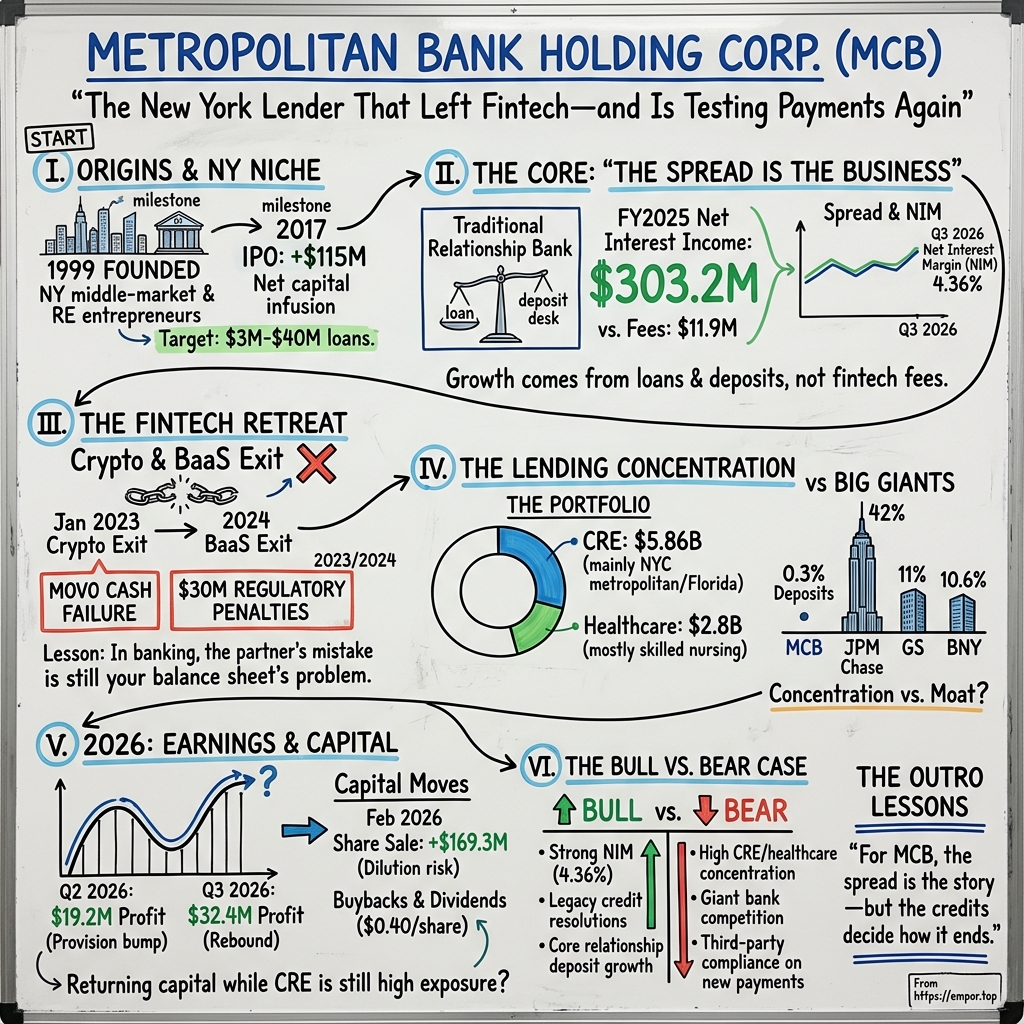
On the morning of October 21, 2026, Mark DeFazio got on a conference line to talk about a quarter that would have been hard to picture three years earlier. Metropolitan Bank Holding Corp., the Manhattan lender he had run since its first day, had just earned $32.4 million in three months, about four and a half times the $7.1 million it had earned in the same quarter of 2025.1 Its net interest margin, the gap between what the bank earns on its loans and securities and what it pays for its money, had widened to 4.36%.1 Loans had passed $7.5 billion. Deposits had jumped by almost $600 million in a single quarter, to about $8.3 billion.1 For a bank that had spent much of 2023 apologizing to regulators, it was a striking set of numbers.
The apology is the other half of this story. In October 2023 the Federal Reserve fined Metropolitan Commercial Bank about $14.5 million, and the New York State Department of Financial Services imposed its own penalty, for a combined total the Fed put at roughly $30 million.2 The offense had nothing to do with skyscraper loans. In 2020, through a third-party program manager, the bank had opened prepaid card accounts for people who were not who they said they were, and those accounts were then used to collect fraudulently obtained state unemployment benefits at the height of the pandemic.2 By then the bank had already said it was leaving crypto. Within months it would decide to leave Banking-as-a-Service, the business of renting its charter to fintech partners, altogether.3
So the October call carried an unusual double message. The headline was a classic spread-banking quarter: more loans, cheaper deposits, a fatter margin and a much smaller provision for bad loans than the quarter before. Underneath it, management was talking about payments again. Two gaming operators had signed on to a new payments platform and were being integrated, a third had agreed to come aboard after a delay, and CFO Daniel Dougherty said the bank hoped to be live in the first quarter of 2027.4 The bank that had walked away from fintech was walking back toward it, this time with a narrower product and, it says, a different approach.
That sets up three questions that run through this story. The first is whether Metropolitan is a defensible niche bank or a concentrated credit bet wearing a niche bank's clothes. At the end of 2025, commercial real estate loans made up about $5.9 billion of a $6.8 billion loan book, and healthcare lending, mostly to skilled nursing homes, was about $2.8 billion.5 The second is whether the 2026 earnings surge is a new operating level or a favorable stretch of the rate-and-credit cycle. Nine-month net income was $83.1 million against $42.2 million a year earlier, but the second quarter of 2026 had already shown how quickly a single bad loan can dent results.16 The third is whether payments can become durable income this time without reviving the control failures that came with them last time.
A word on what exactly is being analyzed. Metropolitan Bank Holding Corp. is the company listed on the New York Stock Exchange under the ticker MCB. It owns all of Metropolitan Commercial Bank, the operating bank that makes the loans and takes the deposits, and it has no outside parent.5 The holding company publishes parent-only accounts in a note to its annual report, but those mostly show dividends flowing up from the bank and are not the business. This story uses the consolidated numbers, because that is where the borrowers, the depositors and the risks actually sit.
The verdict on the opening question has to be provisional. The earnings rebound is real: it shows up in net interest income, in loan and deposit growth and in a sharp fall in credit costs from the second quarter to the third. But a rebound measured across three quarters cannot establish what this bank earns across a full cycle. To see why, the story needs to go back to what DeFazio set out to build, and to the kind of borrower he thought the big banks would never treat properly.
 Subscribe on LinkedIn
II. The bank DeFazio built for borrowers the giants missed
Picture a New York real-estate family that owns a dozen buildings in Brooklyn and Queens. It wants to refinance one property and buy another, and the deal has a wrinkle: an unusual tenant, a partnership structure, a timeline that does not fit a standard credit form. At a national bank the request goes into a queue and comes back priced off a template, if it comes back at all. What the family wants is a lender who already understands its business, can see the buildings from the office window and can say yes or no within days.
That borrower is the customer Metropolitan was built for. The bank was established in 1999, and its founding pitch, as it later told prospective shareholders, was "helping these underserved clients build and sustain wealth."7 The clients were real-estate entrepreneurs and middle-market companies, too large for a neighborhood savings bank and too small, or too idiosyncratic, to get top attention from the money-center giants. The bank has focused on commercial real estate and commercial and industrial lending since its inception.7
Mark DeFazio was the obvious person to build that kind of bank, because he had spent his career on the lending side of New York real estate. He started in banking in 1982 at Richmond County Savings Bank on Staten Island, then spent 13 years at Israel Discount Bank, finishing as senior vice president and head of commercial real estate.7 He was a founding member of Metropolitan Commercial Bank, served as its president from the start and added the chief executive title in 2002.7 In the 2026 proxy he was 62 and the only director who was not independent; he has sat on the board since 1999.8 Few listed banks in America have had the same person at the top for the whole of their existence. That continuity is useful, because it means the record of the bank is also a record of one leader's judgment, with no change of regime to blame for the bad years or credit for the good ones.
DeFazio's style has been that of a loan officer who never stopped being one: deal-focused, relationship-heavy and willing to go after business that other banks found awkward. That instinct explains both of the bank's big strategic bets. The first was the core lending franchise. The second, which came early, was payments. By the time of its IPO filing in 2017, Metropolitan already described itself as an issuing bank for debit card programs nationwide, including general-purpose reloadable, payroll, corporate, incentive and gift cards.7 In other words, the fintech business that later went wrong was not a late pivot. It had been part of the bank's identity almost from the start, a way to gather low-cost deposits and fees that a seven-branch lender could not have collected on its own.
The IPO as a capital inflection
When Metropolitan filed to go public on October 4, 2017, it was still a small bank. It had about $1.6 billion of assets, $1.3 billion of loans and deposits and roughly $115 million of shareholders' equity at the end of June that year, spread across five banking centers.7 Its target real-estate customers then were entrepreneurs with a net worth of $5 million or more, and its typical loan ran from $2 million to $20 million.7
The IPO in November 2017 sold about 3.1 million shares plus 465,000 over-allotment shares at $35 each and raised approximately $115 million net.9 That roughly doubled the equity base in one move, and equity is what a bank needs to grow, because regulators require capital to rise with the loan book. The capital went straight to work. By the end of 2025, Metropolitan reported $8.3 billion of assets, $6.8 billion of loans, $7.4 billion of deposits and about $743 million of equity, and its target borrower had moved upmarket: loans "generally between $3 million and $40 million," real-estate entrepreneurs with a net worth of $50 million or more, and middle-market companies with up to $400 million of revenue.5 It now operates seven banking centers, four in Manhattan plus Boro Park in Brooklyn, Great Neck on Long Island and Lakewood in New Jersey, along with a loan production office in Miami and a planned center in West Palm Beach.5
That shift says something important. The bank that went public chasing $2 million loans to $5 million entrepreneurs now chases loans up to twice as large for clients ten times as wealthy. It is still small compared with the giants, but it is no longer the scrappy lender the IPO prospectus described, and larger loans mean each bad credit hits harder.
Growth, but not a straight line
The temptation is to tell the IPO as a simple success story. The earnings record is lumpier than that. Net income rose from about $5.0 million in 2016 to $12.4 million in 2017, $30.1 million in 2019, $39.5 million in 2020 and $60.6 million in 2021.9101112 Then the line wobbled. Reported profit was $59.4 million in 2022, held down by a $35 million reserve set aside for the regulatory matters described in the opening; the company also reported adjusted net income of $94.4 million, a non-GAAP figure that removes items management considers unusual.12 Profit reached $77.3 million in 2023, fell to $66.7 million in 2024 and recovered only partly to $71.1 million in 2025.5
Read as a whole, the record shows a bank that grew roughly fourteen-fold in earnings from 2016 to 2025, which is genuine. But it also shows three years, from 2023 to 2025, in which profit went sideways while the balance sheet kept expanding. Growth in a bank is not like growth in a software company. Every new loan is another credit decision, and every new deposit is another funding relationship that can leave. The bank DeFazio built grew substantially; it also grew the risks it holds. To understand which of those forces is winning, the next step is to see how this bank actually makes its money.
III. The spread is the business
Inside a commercial bank, two conversations happen at once. On one side of the floor, a loan officer is pricing a commercial real-estate loan: how much the borrower can pay, how long the money will be out, what the building is worth if things go wrong. On the other side, the treasury team is working out what it will cost to fund that loan, whether from a property manager's operating account that pays almost nothing, a title company's escrow balances or a municipal deposit that demands a competitive rate. The bank's profit is, more or less, the difference between those two conversations.
At Metropolitan, that difference is nearly the whole story. In 2025 the bank earned $303.2 million of net interest income, meaning interest received on loans and securities minus interest paid on deposits and borrowings, and just $11.9 million of non-interest income from fees and other sources.5 For every $100 of revenue, roughly $96 came from the spread. KBRA, the rating agency, called the bank's earnings "heavily spread-dependent" in its January 2026 review, and noted that loans made up about 83% of average earning assets in 2025, yielding about 7.3%.13 Other income, the miscellaneous line that sometimes props up a bank's results, was $3.5 million against pre-tax income of $101.5 million in 2025, about 3%.5
This matters for how an investor reads the company. With most businesses, a standard check on earnings quality is whether profit turns into cash. For a bank, that test is close to meaningless. When Metropolitan makes a loan, the cash goes out under investing activities; when a depositor puts money in, it comes in under financing activities. A bank that is growing fast can look as though it is burning cash, and one that is shrinking can look as though it is throwing it off. The better test is to follow three lines through the income statement: net interest income, the provision for credit losses and operating expenses. Everything that matters about this bank's earnings power shows up in how those three move together.
The three dials
The first line, net interest income, has three dials. The first is the size of the loan book and what it yields. A bank that lends at around 7% and grows its loans by roughly $1 billion in a year, as management says Metropolitan expects to do in 2026, adds earning assets quickly.4 The second dial is the cost and mix of deposits. Metropolitan gathers money from six types of depositor: its own borrowers, retail clients, corporate cash-management clients such as property managers, title companies and bankruptcy trustees, governments and municipalities, title and 1031-exchange escrow, and EB-5 escrow accounts, the funds held for foreign investors pursuing US residency through investment.5 Some of those balances are cheap and sticky; others are rate-sensitive and can move quickly. In the third quarter of 2026, the bank paid an average of 2.49% on its deposits, down from 2.57% in the second quarter, and about $1.8 billion of its deposits paid no interest at all.1 The third dial is interest rates themselves, which shift both sides of the spread at once.
KBRA's history helps here. The bank's margin was about 3.5% in 2022 and 2023, reached 4.10% in the fourth quarter of 2025 and then climbed further to 4.36% in the third quarter of 2026.131 That is a big move. Applied to a balance sheet of $8 billion or more, each tenth of a percentage point of margin is worth roughly $8 million of annual revenue before tax, so the widening since 2023 explains a large part of the earnings recovery by itself.
The bank's own explanation contains a caution. Management said the third quarter's margin was flattered by unusually high prepayment penalties and deferred fee recognition, and that the "normalized" figure was more like 4.20% to 4.25%.4 Its guidance for the fourth quarter was 4.15% to 4.20%, and it said the best case for 2027 was to hold that range.4 It also described itself as "slightly liability sensitive," meaning its funding costs tend to reprice faster than its assets, and said its forecasts assumed the Federal Reserve would raise rates in December 2026 and again in March 2027, each 25-basis-point move typically costing about five basis points of margin.4 On top of that, about $1 billion of interest-rate swaps that had protected the bank against rising funding costs roll off in April and August 2027.45 Put plainly, management itself is guiding to a margin a little below the third quarter's peak, with a known headwind arriving next year. The 4.36% is the high-water mark of a good cycle, not a floor.
The cost of running the bank
The second and third lines are where discipline shows. Operating expenses have risen as the bank grew. Metropolitan had 328 employees at the end of 2025, up 35 in a year.5 Technology costs went from $4.9 million in 2023 to $11.0 million in 2024 and $17.1 million in 2025, more than tripling in two years.5 In the first nine months of 2026, compensation expense rose $11.6 million year on year and deposit program fees, the payments the bank makes to partners and programs that bring in deposits, rose $5.4 million.14 Management told analysts it expected deposit program fees in the fourth quarter to be about 25% higher than in the third.4
The bank does not disclose research and development spending as a separate line, and it does not isolate what the technology build has produced in productivity. What it can point to is the efficiency ratio, the share of revenue consumed by operating costs, which fell to 49.2% in the third quarter of 2026 from 55.7% in the second.1 That looks like progress, but much of the improvement came from revenue rising, not costs falling, and the second quarter included $3.3 million of what the bank called isolated expense items.6 Management has also started a small artificial-intelligence team of six people and promised a report on its return on investment during 2027.4 An AI tool might eventually trim back-office costs or speed loan documentation. It will not change the fact that this bank lives on the spread.
Technology spending in proportion, then, looks like the cost of becoming a larger bank and of rebuilding payments infrastructure, not a separate engine of value. The more important point is the dependency. A strong margin can lift earnings fast, as 2026 has shown. It cannot protect the bank from a borrower who stops paying, and it cannot stop depositors from demanding more when rates rise. Metropolitan's first attempt to escape that dependency, by building a fee business on top of the spread, is what led it into the most damaging chapter of its history.
IV. The fintech bet ended in a retreat
On January 9, 2023, Metropolitan issued a short press release that marked the end of an era. The bank said it would exit all crypto-asset-related business, citing "recent developments in the crypto-asset industry, material changes in the regulatory environment regarding banks' involvement in crypto-asset related businesses, and a strategic assessment of the business case."3 The timing was not subtle. FTX had collapsed two months earlier. Voyager Digital, a crypto lender whose customer funds had sat at Metropolitan, had filed for bankruptcy the previous summer. Banks that had courted digital-asset deposits were suddenly being asked hard questions by regulators and depositors alike.
The numbers in that release are worth holding onto, because they show how small the crypto business really was. Metropolitan said it had four active institutional crypto-asset clients, which together accounted for about 1.5% of total revenue and 6% of total deposits, and that it had no loans outstanding to any of them.3 The wind-down was to be completed during 2023.3 In other words, crypto had been a deposit-gathering sideline, not a profit center. The bank lost some cheap funding when it left, but not much income.
The Voyager relationship lingered longer than the deposits did. After Voyager failed, its plan administrator sued the bank. The suit was dismissed in 2025, and on October 9, 2026, the Second Circuit affirmed that dismissal.14 That closes one legal thread from the crypto period, though it took more than three years.
Two exits, not one
It is easy to remember Metropolitan's retreat from fintech as a single event. There were really two. The first, in 2023, was the crypto exit. The second came in early 2024, when the bank decided to wind down its Global Payments Group's Banking-as-a-Service business entirely. Its annual report states it simply: "In 2023 the Company completed the exit from the business associated with digital currency entities... In 2024 the Company exited the GPG BaaS business."5
The second exit mattered more, because the BaaS business was the heart of the payments franchise that had been part of the bank since before its IPO. In that model, a fintech company designs a product, such as a prepaid debit card or a digital account, and markets it to consumers. The fintech needs a chartered bank to hold the money and connect to the card networks, so it rents the bank's charter. The bank earns fees and gets cheap deposits. The fintech, or a program manager it hires, often handles signing up customers.
That arrangement is where the trouble started. The Federal Reserve found that Metropolitan, "through a third-party program manager," had opened prepaid card accounts without "adequate procedures for verifying each applicant's true identity."2 In 2020, the bank opened such accounts for illicit actors, who used them to receive illegally obtained state unemployment insurance benefits.2 Bloomberg Law reported that the bank had been the sponsoring bank for MovoCash debit cards, that an administrator at MovoCash had allegedly opened accounts using fraudulently obtained personal information, and that about $300 million of fraudulent pandemic-era benefits had flowed through.15 The Fed's penalty was about $14.5 million; together with the New York Department of Financial Services' action, the penalties came to roughly $30 million, which Bloomberg Law put at $29.5 million.21516 Both regulators required the bank to strengthen its customer identification, due diligence and third-party risk management.2
There was a further cost. In the third quarter of 2024 the bank recorded a separate $10 million reserve for an investigation by the Washington State Attorney General, which was resolved in the fourth quarter of that year.5 Add the $35 million reserve taken in 2022 for the federal and state orders, and the cleanup consumed well over a year's worth of the payments business's revenue.12
The mechanism deserves to be said plainly, because it will matter for the bank's future. Outsourcing customer onboarding to a partner does not outsource the bank's legal responsibility. Know-your-customer rules exist precisely so that the institution holding the money knows whose money it is. When a program manager opens accounts carelessly, or dishonestly, the regulator does not fine the program manager. It fines the bank. This is not peculiar to Metropolitan; several sponsor banks came under enforcement as the BaaS boom faded. But Metropolitan's version was unusually concrete: a pandemic, a flood of unemployment claims and a set of accounts that the bank could not confirm belonged to real, eligible people.
What the retreat cost, and what it removed
Measured by revenue, the Global Payments Group was never the engine. Its revenue was $19.0 million in 2023, $13.4 million in 2024 and zero in 2025.5 Against net interest income of more than $300 million, that is a rounding error the bank could absorb, and it did. Profit went sideways during the exit years for other reasons too, but the loss of GPG revenue was manageable.
What the retreat removed was more important than what it cost: an operating model in which the bank's compliance depended on the conduct of partners it did not fully control. Even so, the orders tied to the fintech program remain part of the bank's regulatory history, and they shape how any future payments venture will be supervised.5
Which brings the story to 2026. In March, American Banker reported that Metropolitan, having "exited the payments sector in 2024 after running afoul of regulators," planned to re-enter with a gaming product that would give operators real-time payment capability.17 DeFazio was confident about the pitch: "We think the value proposition is so significant that an operator that chooses to work with us … will point those transactions in our direction."17 By the October call, two gaming operators had signed and were being integrated, testing was expected within 30 to 45 days, a third operator had been pushed to the first quarter of 2027 because of "competing priorities," and management hoped to be live in the first quarter.4 DeFazio said the platform, together with activity tied to HUD-related lending, should deliver "a meaningful uplift in fee income beginning in the back half of 2027."4
Compare that with the 2023 exit and some things have clearly changed. The product is narrower: payments for licensed gaming operators rather than a broad menu of consumer cards marketed by fintechs. The counterparties are regulated businesses with their own compliance obligations, not startups recruiting retail customers. And the bank appears to be building the platform itself rather than renting its charter. Other things are not yet visible. On the call, management did not quantify expected revenue, and the discussion of controls, the issue that ended the last venture, was not part of the prepared story.4 Gaming payments bring their own scrutiny around money laundering, geography and age verification. A bank that was fined for weak onboarding will be judged on how it onboards.
The verdict is a narrow one. Leaving crypto and BaaS removed a modest revenue stream and a meaningful source of regulatory exposure. It did not prove that the bank had become good at payments; it proved that the bank knew when to stop. The new platform has to prove two things at once: that operators will bring it volume, and that the controls are stronger than they were in 2020. Until then, the bank's value rests on the business it never left, lending to a specific kind of New York borrower. The next question is whether that business has an edge.
V. A relationship niche in a market ruled by giants
Metropolitan's favorite customer is easy to describe. It is a company or a real-estate investor that needs somewhere between about $3 million and $40 million.5 That is a strange size in American banking. To a community bank, a $30 million loan can be a dangerous share of capital. To JPMorgan Chase, it is a small file that will be priced by formula. Metropolitan's argument is that this middle ground is underserved, and that it can win borrowers there through speed, local knowledge and direct access to senior decision-makers.
The argument has a natural appeal in New York, a market crowded with property owners, family offices, healthcare operators and mid-sized businesses whose finances do not fit neatly into a credit model. A lender who knows the neighborhoods, the families and the operators can make loans that look odd on paper but are sound in practice, and can charge a little more for the certainty of a quick, informed answer. That is the promise. The test is whether the record shows it.
What the share data says
The Federal Reserve offers an unusually clean test. In its Community Reinvestment Act evaluation, published in November 2025, it measured Metropolitan's place in its New York assessment area. The bank held 0.3% of local deposits, ranking 25th of 109 institutions.18 JPMorgan Chase held 42.1%, Goldman Sachs Bank 11.1% and BNY 10.6%.18 In small-business lending, Metropolitan ranked 100th of 255 lenders, with less than 0.01% of the market.18
Those numbers cut both ways. On one hand, a 0.3% share in the deepest banking market in the country means there is plenty of room to grow without needing to dominate anything. On the other, they flatly contradict any notion that Metropolitan has market power. It is a minnow among whales. A borrower who dislikes its terms has dozens of alternatives, from the giants down to other community banks and to private credit funds that have grown rapidly in commercial real estate. The "underserved niche" is a real segment, but it is not a protected one.
That shapes how the competitive question should be framed. Large banks compete on scale, breadth of product and the lowest funding costs in the country. Regional and community banks compete for the same local relationships Metropolitan wants. Nonbank lenders compete on flexibility and speed, precisely the qualities Metropolitan sells. The bank's case rests on service, underwriting knowledge and execution, not on any structural barrier. That is a legitimate way to run a bank. It is just not a moat in the strict sense, and the bank does not disclose the evidence that would turn it into one, such as client retention rates, the share of business coming from repeat borrowers, or a premium in loan pricing over competitors. Until it does, switching costs and pricing power remain plausible but unproven.
The concentration that comes with the specialty
The same specialization that gives the bank its pitch also concentrates its risk. At the end of 2025, commercial real estate loans were about $5.9 billion of a $6.8 billion loan book, so the large majority of the bank's lending was secured by property.5 Healthcare lending was about $2.8 billion, including about $2.7 billion to skilled nursing facilities.5 The bank's own breakdown shows healthcare accounting for about 43% of its real-estate loans and about 35% of its commercial and industrial loans.5 Its CRE and C&I lending is concentrated in the New York metropolitan area and Florida.5
Skilled nursing deserves a moment, because it is not an ordinary property type. A nursing home's revenue depends heavily on Medicaid and Medicare reimbursement rates, on staffing costs and on state regulation. The building is collateral, but the cash flow that repays the loan comes from an operating business with thin margins and a government payer. That makes healthcare real estate a specialty lending market in which expertise genuinely matters. It also means a change in reimbursement policy or a staffing squeeze can hit many borrowers at once. A bank with nearly $3 billion in this sector is making a large, correlated bet that it understands the operators better than other lenders do.
Regulators have a rule of thumb for this. Supervisory guidance looks more closely at banks whose CRE loans, excluding owner-occupied property, exceed 300% of capital, or whose CRE book has grown by 50% or more over three years.5 Metropolitan describes that guidance in its filings. The more useful thing for an investor is the direction: whether CRE is growing faster or slower than the capital that stands behind it.
An outside view
KBRA offers an independent read on the same tension. When it affirmed the bank's ratings in January 2026, with the bank's deposits and senior unsecured debt at BBB+ and the holding company's senior secured debt at BBB, all with stable outlooks, it credited solid operating performance, an improving funding profile and a higher margin.13 In the same breath, it flagged limited geographic diversification, loan diversification "below peer levels" with "sizable concentrations in commercial real estate and healthcare/skilled nursing facility (SNF) lending," a rise in nonperforming assets from historically low levels driven by "an idiosyncratic borrower situation in 3Q25," and a decline in capital.13 That idiosyncratic borrower is the reason the third quarter of 2025 earned only $7.1 million, which is what made the third quarter of 2026 look so dramatic by comparison.113 KBRA also noted that realized credit losses had remained minimal.13
The rating agency's verdict, in effect, is that the bank runs well inside a concentrated box. That matches the evidence. Local expertise, tailored service and access to decision-makers are plausible advantages; the bank's growth from $1.6 billion to more than $8 billion of assets suggests borrowers value them. But a 0.3% deposit share does not establish a moat, and the specialty concentrates the bank in a small number of asset types and places.
The Florida push is worth watching for the same reason. The bank has a loan production office in Miami and planned a banking center in West Palm Beach for the second quarter of 2026.5 Expansion into a second market diversifies a New York-centric book in principle, and many New York real-estate families and healthcare operators already own property there. But a lender's edge in relationship banking is local by definition. Knowing which Brooklyn landlord is reliable does not transfer automatically to a Palm Beach condominium developer, and an out-of-market CRE relationship was the loan the bank charged off in the second quarter of 2026.6 Geographic diversification helps only if the underwriting knowledge travels with it.
So the question changes. It is no longer whether Metropolitan can find good borrowers; its growth says it can find plenty of borrowers. It is whether the bank recognizes losses early enough when some of those borrowers weaken. In 2026, it got a live test.
VI. The earnings surge met a credit-speed bump
Banks rarely announce their bad news with drama. Metropolitan's came in the plain language of an earnings release on July 21, 2026. Net income for the second quarter was $19.2 million, down from $31.4 million in the first quarter, and diluted earnings per share fell from $2.92 to $1.54.6 The reason was a $13.3 million provision for credit losses, "driven primarily by a single commercial and industrial ('C&I') loan in a non-core portfolio segment," plus $3.3 million of what the bank called isolated non-interest expense items, including a one-time legal accrual of $1.8 million.6
The quarter had other awkward features. Deposits were essentially flat at about $7.7 billion, which the bank attributed to seasonal outflows of municipal deposits and the planned exit of a $100 million high-cost treasury deposit.6 Nonperforming loans fell to 0.91% of the book from 1.01%, but the improvement came the hard way: the bank charged off an out-of-market CRE loan relationship.6 Net charge-offs, the loans actually written off, ran at 1.95% of average loans on an annualized basis.6 For a lender whose rating agency had praised minimal realized losses only six months earlier, that was a sharp change.13
Three months later the picture had flipped. Third-quarter net income rose to $32.4 million and diluted EPS to $2.58.1 The margin widened to 4.36% from 4.08%. Loans grew by about $205 million in the quarter, to roughly $7.5 billion, and deposits jumped by about $589 million, to roughly $8.3 billion.1 The provision fell to about $5.1 million, and net charge-offs dropped to an annualized 0.18% of loans.1 Return on equity reached 13.1%.1
Building the bridge
Where did the improvement come from? The bank's own numbers allow a fairly clean bridge. Net interest income was $97.6 million in the third quarter, up almost 8% from the second.1 That came from three sources acting together: a larger loan book, a lower cost of deposits and, in that particular quarter, elevated prepayment penalties and fee recognition that management itself said would not repeat at the same level.14 Credit costs fell by about $8 million from the second quarter, and expenses fell by about $2 million as the isolated items dropped away.16 The tax rate helped too, falling to 29.5% from 31.1% as the bank began buying investment tax credits.1
Seen across the year, the drivers are clearer still. Nine-month net income nearly doubled, to $83.1 million from $42.2 million, mainly because net interest income rose with a bigger and better-priced balance sheet while provisions were lower than in the bad stretch of 2025.1 Management guided to net interest income growth of more than 20% for the year and loan growth of close to $1 billion, against $724 million achieved through September.4 It reported a pipeline of about $700 million in signed term sheets and another $600 million out for signature or under review, priced at around 7.03%.4
That is real operating improvement: more loans, more deposits and a wider spread. But it is not all structural. The margin has been helped by a rate environment that management expects to turn less helpful, and some of the third quarter's margin was one-off. The deposit surge also had a specific source. About three-quarters of third-quarter deposit growth came from EB-5 escrow accounts, and DeFazio told analysts that a cutoff date for certain applications had "caused some of the outsize uptick," with growth expected to continue, "perhaps not at the same pace."4 EB-5 balances are tied to an immigration program whose rules change with policy. They are useful funding, but not the kind of granular, everyday operating deposit that gives a bank a durable cost advantage.
What the analysts pressed on
The October call was short on hostile questions, which is itself information. Feddie Strickland of Hovde Group asked whether EB-5 inflows could reverse and pressed on the large nonaccrual loans. DeFazio said the bank expected "some recoveries in the fourth quarter" on legacy nonperforming loans that were being restructured or were in the legal process.4 Dougherty went further: "I am convinced that our credit performance has begun to revert" toward its long-term levels.4 When Strickland asked about expense growth in 2027, Dougherty said, "It's a little early for that."4 David Konrad of KBW asked about deposit betas and non-interest-bearing balances; Timur Braziler of UBS asked about deposit momentum and the $10 billion asset threshold, at which banks face tougher regulation. Dougherty said management did not see the two as related.4
The answers were confident, but most were qualitative. The bank did not put a figure on expected recoveries, did not give a 2027 expense number and described its credit outlook as a conviction rather than a forecast. The fresh evidence that did arrive cut the other way: nonperforming loans edged up to 0.95% of the book, about $72 million, "primarily attributable to a single CRE loan being placed on non-accrual status."1 The bank's credit problems in 2025 and 2026 have come one large loan at a time: an idiosyncratic borrower in the third quarter of 2025, a non-core C&I loan in the second quarter of 2026, an out-of-market CRE relationship charged off, and now another single CRE loan.1361 Each, on its own, can be described as isolated. Four in about a year begin to look like what happens when a bank makes larger loans to a concentrated set of borrowers.
The longer record has its own warning. In 2022, reported earnings were depressed by the $35 million regulatory reserve, and the company also presented a much higher adjusted figure.12 Adjusted earnings can be a helpful way to see the underlying run-rate, but the regulatory costs were real cash out of shareholders' pockets, and so were the 2025 and 2026 credit losses. The reported series is the one that counts.
The earnings surge, then, is a genuine improvement built on a bigger balance sheet and better funding, but the second quarter showed how quickly a single credit can erase a third of a quarter's profit. The tests that matter now are the dull ones: the provision line, the charge-off rate, the nonperforming-loan ratio, the margin and the cost of deposits. Management, meanwhile, has made a set of capital decisions that assume the good version of that story.
VII. A capital raise, then buybacks
In late February 2026, Metropolitan did something it had not done since its IPO: it went back to the equity market. The bank agreed to sell about 2.1 million new shares, with an option for underwriters to buy 315,000 more, raising approximately $169.3 million net.19 For a bank with about $743 million of equity at the end of 2025, that was a substantial addition, close to a quarter of its book.5
The arithmetic for existing shareholders was equally substantial. Shares outstanding rose from about 10.1 million at the end of 2025 to about 12.3 million by September 2026, an increase of roughly 22%.514 Any investor who owned a slice of the bank before the offering owned a noticeably smaller slice afterward. That is the price of growth capital, and in banking it is often worth paying, because a bank that runs short of capital cannot lend at all. The question is what the capital was for, and what happened to capital after it arrived.
Why the raise was needed
The background was a slow erosion of the cushion. KBRA noted that holding-company common equity tier 1 capital, the core measure of a bank's loss-absorbing equity, had fallen from 11.9% of risk-weighted assets at the end of 2024 to 10.7% at the end of 2025, partly because of share repurchases and the start of a quarterly dividend in the third quarter of 2025.13 So in 2025 the bank had bought back stock and started paying dividends while its loan book grew and its CET1 ratio fell. Then, a few weeks into 2026, it raised new equity. By September 2026, holding-company CET1 stood at 12.8% and total risk-based capital at 13.9%, and the bank was well capitalized by regulatory definitions.1
The sequence is what a skeptical investor notices. The 2017 IPO brought in about $115 million and the 2026 offering about $169 million. In between, the bank returned capital through buybacks, and in 2025 it began paying dividends. Returning capital and then raising it again is not necessarily wrong; growth can outrun internal capital generation, and markets are open at some times and not others. But it does mean that some of the 2026 raise effectively replaced capital the bank had handed back in 2025.
Returning capital again
Capital returns resumed quickly after the raise. The board, which had authorized up to $150 million of repurchases beginning in 2025, approved a further $50 million program in June 2026.146 The quarterly dividend went from $0.25 to $0.35 in July and to $0.40 in October.61 In the third quarter, the bank repurchased 112,225 shares at an average price of $89.11, about $10 million.14 Dougherty told analysts the September purchases were made at roughly 109% of estimated year-end 2026 book value, adding: "Buying shares north of book value is new to MCB."4 Management said about $40 million of buyback capacity remained.4
That remark is a useful piece of market evidence, because it shows roughly where the stock traded against the bank's net assets in September: a little above book value. For a bank earning a 13% return on equity in its best recent quarter, that price implies the market is not paying up for the third quarter's profitability; it is pricing something closer to the bank's uneven longer record and its concentration. How that multiple compares with the bank's own history and with its closest peers is a question the September purchase price alone cannot answer.
Here, then, is the live tradeoff. The bank raised dilutive capital in February, then by October was raising its dividend and buying stock above book value, while CRE still made up the large majority of its loans and nonperforming loans were edging up. Management's implicit view is that the capital ratios are now ample and that the credit problems are isolated. The opposing view is that a bank with this concentration should build its cushion through a full credit cycle before returning it. Both can be argued; neither is proven by the numbers yet.
The CEO's record on pay and promises
Management behavior offers another way to judge capital decisions. DeFazio's reported compensation was about $3.0 million in 2023, $5.6 million in 2024 and $4.8 million in 2025, while net income went from $77.3 million to $66.7 million and then $71.1 million.8 In other words, his pay rose by more than 80% in the year that profit fell. Shareholders noticed. At the May 2025 annual meeting, the advisory vote on 2024 executive pay failed, with about 3.7 million votes for and 5.4 million against.20 A failed say-on-pay vote is rare at an American bank, and this one was not close.
The board responded. According to the 2026 proxy, the company reached out to stockholders holding more than 70% of its shares, and four directors met investors representing about 47.5%.8 It broadened the scope of misconduct covered by its clawback policy, raised stock-ownership requirements for non-management directors and created the possibility of a vice chair as part of succession planning.8 The proxy describes annual incentives tied to net interest income growth, loan growth and EPS growth, and longer-term performance shares tied to return on tangible equity and growth in tangible book value per share.8 At the April 2026 meeting, the advisory vote on 2025 pay passed easily, with about 8.4 million votes for and 0.4 million against.21
The redesign is an improvement in responsiveness. Whether it improves alignment is less clear. Rewarding loan growth and net interest income growth pays executives for making the bank bigger, which is exactly the behavior that adds concentrated credit risk. The return on tangible equity and book-value measures provide a counterweight, because losses and dilution eat into both. A shareholder would want to see how credit quality, not just growth, feeds into pay. DeFazio himself owned about 1.35% of the company as of the 2026 proxy, a meaningful personal stake but not a controlling one.8 No shareholder controls the bank. BlackRock reported 6.90% and Patriot Financial Partners III 5.44% in the proxy; Wellington reported 8.2% as of June 30, 2026; and in November, Patriot reported sales that took it to 4.76%, below the 5% reporting threshold.82223 A long-standing private-equity backer trimming its stake while management buys back shares is not a red flag by itself, but it is a reminder that insiders and early investors weigh the price differently.
There is one older governance episode worth knowing. The bank disclosed that a 2016 loan to an executive was extended in 2021 and later repaid, and that a proposed 2023 loan of $7.5 million to help executives exercise options and pay taxes was rescinded after the company concluded such loans likely were not permitted under applicable law and regulation.5 It was caught and reversed, but it belongs in the same file as the prepaid-card findings: a culture that moved fast, then had to correct itself.
Leadership itself shifted in November 2026. Dixiana Berrios, executive vice president and chief operating officer of both the holding company and the bank, ceased serving effective November 16, 2026, and her employment terminated that day.24 The filing gave no reason and named no successor.24 A COO in a bank building a new payments platform, absorbing technology investment and approaching the $10 billion asset threshold carries much of the operational load. Her departure without a named replacement is a near-term execution question, especially for the payments launch scheduled for the first quarter.
The capital story, then, is a bank that raised real money to grow, diluted its owners materially to do so and then resumed returning capital within months. That can be the right call if the credits behave. Which leads to the larger question an investor actually has to answer.
VIII. Analysis & Bear vs. Bull Case
Imagine an investor sitting with three documents on the desk: the third-quarter release, with its 4.36% margin and $32.4 million of profit; the year-end annual report, with its $5.9 billion of commercial real estate and nearly $3 billion of skilled-nursing exposure; and the February offering prospectus, with its 2.4 million new shares. Beside them is the March American Banker story about gaming payments. The task is to decide what the bank's growth is actually worth, and what evidence would show that it earns its cost of risk and capital.
The bull case
The optimistic version runs like this. Metropolitan is a well-run relationship bank in the largest commercial market in America, with plenty of room to grow from a tiny market share. It has moved upmarket since its IPO without losing its identity, and its margin, now above 4%, is high for a commercial bank. Its funding profile has improved: it has no Federal Home Loan Bank advances, about $4.2 billion of secured borrowing capacity and minimal other borrowings, and it says it will fund all future loan growth with deposits.144 Its capital ratios, after the raise, are comfortably above regulatory minimums. Its credit losses in 2025 and 2026 came from a handful of specific loans that are now being worked out, and management expects recoveries. If loans and deposits keep growing without looser underwriting, the margin holds near guidance and legacy credits resolve without repeated large provisions, the bank can compound earnings at a respectable rate while returning capital. Payments would then be a bonus, not a necessity.
The bear case
The skeptical version starts from the same facts. More than four of every five loan dollars are secured by commercial real estate, much of it in one metropolitan market, and nearly $3 billion sits with nursing-home operators whose economics depend on government reimbursement.5 Credit problems have arrived as a series of single large loans rather than a broad deterioration, which is exactly how concentration risk tends to look until a downturn turns isolated cases into a pattern. Deposit growth leans on EB-5 escrows that can slow with policy, and uninsured deposits rose to about $2.4 billion in September 2026, from about $2.0 billion at the end of 2025, a sizable share of the funding base.145 The bank is slightly liability sensitive, management is modeling further Fed hikes and its rate swaps roll off in 2027.4 Held-to-maturity securities had a carrying value of about $465 million but an estimated fair value of about $405 million in September, a gap of about $60 million that does not show up in book value but would surface if the bank ever had to sell.14 And the bank is returning capital again while its concentration is little changed.
The competitive map
A Porter-style look at the industry explains why the margin is not guaranteed. Rivalry is intense, especially against banks many times Metropolitan's size; the Fed's deposit-share data shows how lopsided the market is.18 Buyers have power: a borrower seeking $20 million can approach many lenders, from JPMorgan to a private credit fund, and the bank discloses no borrower concentration figures or retention data that would show customers are locked in.5 Depositors, the bank's suppliers of money, have even more power, as rising deposit betas and the bank's own deposit program fees show. Substitutes are growing, since nonbank lenders compete for exactly the bespoke real-estate and healthcare loans Metropolitan specializes in. The threat of new entry is limited by regulation; chartering and supervising a bank is expensive, which protects incumbents in general but does not single out Metropolitan.
Hamilton Helmer's seven powers framework makes the moat question sharper. Scale economies belong to the giants, not to a bank with 0.3% of local deposits. Network effects are absent in relationship lending. Switching costs exist in the soft sense that a borrower who knows the bank's lenders may stay, but there is no disclosed evidence of retention or pricing premiums. Brand is local and modest. There is no cornered resource: talented lenders can be hired away. Process power, the candidate the bank would most likely claim, would show up as consistently better credit outcomes than peers in the same asset classes, and the 2025 and 2026 loan problems weaken that case without destroying it. Counter-positioning is the most interesting possibility: big banks may simply choose not to compete hard for $3 million to $40 million idiosyncratic real-estate loans, leaving room for specialists. That is real, but it is a space, not a barrier. The verdict is that Metropolitan's moat is narrow and unproven. Specialized underwriting and service are genuine candidates; the evidence that would turn them into a durable advantage, such as long-run loss rates below peers in CRE and healthcare, client retention and a loan-pricing premium, is not something the bank publishes.
The optionality the market should discount
Payments and artificial intelligence are the bank's two future stories, and both deserve skepticism proportionate to the record. The last payments business peaked at $19 million of revenue in 2023 and went to zero two years later, after costing tens of millions in penalties and reserves.52 The new gaming platform has signed operators and a target launch quarter, but no live volume, no disclosed revenue target and no public account of how controls have changed. Signing an operator is not the same as earning a fee. The AI team, six people strong, is promised a return-on-investment report next year.4 Neither should be counted as a current value driver until the bank shows customers, volumes, fees and clean compliance.
The questions a skeptic would ask
A skeptical long-short investor or activist would put three questions to the board. First, why return capital while CRE remains concentrated and nonperforming loans are rising, especially after a dilutive raise? Second, how much of the 2026 earnings gain comes from the margin cycle rather than franchise improvement, given management's own guidance that the margin will slip from the third quarter's level? Third, what specifically changed in onboarding, monitoring and partner oversight before re-entering payments, and who now owns that work after the COO's departure? Clear, measurable answers would strengthen the bull case. Vague ones would strengthen the bear case.
There is also a scale question hiding in plain sight. With more than $8 billion of deposits and a loan book growing by close to $1 billion a year, the bank is approaching the $10 billion asset line at which American banks face heavier supervision, tougher stress-testing expectations and, for debit-card issuers, caps on interchange fees. Management told analysts it did not see deposit momentum and the threshold as related, and said the expense structure of a $10 billion bank was already in its run rate.4 That is a claim worth testing in the 2027 expense line. The bank also carries about $623 million of unused loan commitments and about $31 million of standby letters of credit, promises to lend that could be drawn just when borrowers are under pressure.14 None of this is alarming on its own. Together, it describes a bank whose next stage of growth will cost more to supervise and fund than its last one did.
Three indicators will settle most of the argument. The first is the net interest margin, last reported at 4.36% and guided toward the 4.15% to 4.20% range.14 The second is credit quality, best tracked through the nonperforming-loan ratio, which was 0.95% in the third quarter and rising, alongside provisions and charge-offs.1 The third is the cost and growth of deposits, at 2.49% in the third quarter and falling, but resting partly on EB-5 inflows.14 If the margin holds, nonperformers fall and deposits keep growing at a stable cost, the bull case gains force. If any of the three breaks, the earnings gain of 2026 could fade before newer initiatives contribute.
IX. Playbook: Business & Investing Lessons
Go back to January 2023. The bank that had built part of its identity on being a sponsor for card programs announced it was leaving crypto, and within about a year it was leaving Banking-as-a-Service altogether. The business that had once differentiated Metropolitan from every other mid-sized New York lender was abandoned after a strategic reassessment and an expensive encounter with regulators. That moment, and the ones that followed it, hold the lessons that belong to this bank.
The first lesson is about the difference between a niche and a moat. Metropolitan has a real niche: middle-market borrowers and real-estate entrepreneurs who need $3 million to $40 million and value speed and expertise. It has grown more than five-fold in assets since its IPO by serving them. But in a market where JPMorgan holds more than 40% of local deposits and Metropolitan holds 0.3%, the niche is a place to fight, not a fortress. Every founder who has found an underserved segment should remember that "underserved" describes the current state of competition, not a permanent right to the customers. A niche is a place to compete; it is not proof you can set the price.
The second lesson comes from the prepaid-card accounts of 2020. A fintech partner's program manager opened accounts, illicit actors used them to collect pandemic unemployment benefits, and the bank, not the partner, paid about $30 million in penalties and took years to clean up. The broader lesson reaches well beyond banking. Any business that lends its license, its platform or its brand to a partner inherits that partner's failures. Outsourcing a task does not outsource the accountability. In banking, the partner's mistake is still your balance sheet's problem.
The third lesson is about growth and credit. In 2026, Metropolitan grew its loan book by more than $700 million in nine months and expects to approach $1 billion for the year. In the second quarter, a single commercial loan in a non-core segment drove a $13.3 million provision and cut quarterly profit by about 40%. That is the trade every lender makes: each new loan adds income and adds a risk that only time reveals. Investors who admire loan growth should ask, every time, what the loans will look like in the next downturn. Growth is not free when every new loan adds a credit decision.
The fourth lesson is about capital. Metropolitan raised about $169 million of new equity in February 2026 and, within months, was raising its dividend and buying shares above book value, while its CRE concentration was largely unchanged. Whether that proves wise depends on credit outcomes still to come. The principle is simple. A dollar returned to shareholders is a dollar that will not be available to absorb a surprise. Capital returned is capital no longer available for surprises.
X. Epilogue
As of November 22, 2026, Metropolitan Bank enters the last weeks of its year with about $7.5 billion of loans, about $8.3 billion of deposits, roughly 12.3 million shares outstanding and a payments platform in testing with two gaming operators.1144 Its COO has just left without a named successor.24 Its CEO has been in charge for the entire life of the bank. And its next big reporting moment, the full-year 2026 results in early 2027, will begin to show whether the year's improvement can survive the arrival of a less friendly rate environment.
Several things will decide that. The first is whether loan growth continues to be funded by stable deposits. Management promised that deposit growth would exceed loan growth and that it would fund all future lending with deposits.4 If that holds without deposit costs rising faster than loan yields, the margin can stay near guidance. If EB-5 inflows slow and the bank has to buy deposits with higher rates or larger program fees, the margin will compress faster than the bank's forecast of about five basis points per quarter-point Fed hike. The roll-off of about $1 billion of swaps in April and August 2027 will test that sensitivity directly.4
The second is credit. Watch the nonperforming-loan ratio against the third quarter's 0.95%, and the provisions and charge-offs that will follow. Management said it expects recoveries in the fourth quarter on legacy problem loans.4 If those recoveries arrive and no new large single loans join the list, the "isolated" description of the past year's problems will look accurate. If another big CRE or healthcare credit goes bad, the pattern will be harder to explain away, especially as the bank's large CRE and skilled-nursing books season.
The third is capital. The bank's capital ratios rose after the February raise, but dividends and buybacks are now running again, and the CRE book keeps growing. The figure to watch is CRE concentration as a share of capital: if it falls while capital returns continue, the board's decisions will look justified; if it rises, the bank will have spent its cushion on shareholders rather than on safety.
The fourth is payments. The bank hopes to be live in the first quarter of 2027 and to see a meaningful uplift in fee income in the second half.4 The milestones that matter are live customers, transaction volumes, fee income and a clean compliance record, not launch dates. A third operator is promised for the first quarter. If operators bring meaningful volume and examiners raise no concerns, Metropolitan will have shown it learned from 2020. If volumes are thin or regulators question onboarding, the bank will have reopened a chapter it paid heavily to close.
The last is leadership. With no named COO, investors will want to see whether strategy, expense plans and guidance stay consistent from one call to the next, and whether the bank names a successor with operational depth. The bank's story, in other words, is still being written. The credit cycle has not tested this loan book at its current size, and the payments platform has not processed a dollar in production. The tension that remains is the same one that ran through the whole story: a bank that is good at finding borrowers must now prove it is equally good at avoiding the ones that fail.
XI. Outro
Return to the loan officer on one side of the floor and the funding desk on the other. The loan officer is looking at a family that owns buildings across Brooklyn and Queens, or a nursing-home operator that needs to refinance before Medicaid rates are reset. The funding desk is looking at the cost of the next dollar of deposits, from a title company's escrow, a municipality or a foreign investor's EB-5 account. In 2025, the gap between those two desks produced $303.2 million of net interest income, while everything else the bank did produced $11.9 million.5
That is the bet, compressed into a single image. Metropolitan is still a spread bank trying to make focused relationships and newer payment capabilities work inside one regulated balance sheet. Its growth depends on making concentrated lending relationships pay, and its future options depend on proving it can build new businesses with stronger controls than the ones that failed it before. For MCB, the spread is the story—but the credits decide how it ends.
References
-
Q3 2026 earnings release — Metropolitan Bank Holding Corp., 2026-10-20 ↩↩↩↩↩↩↩↩↩↩↩↩↩↩↩↩↩↩↩↩↩↩↩↩↩
-
Federal Reserve announcement of enforcement action against Metropolitan Commercial Bank — Federal Reserve, 2023-10-19 ↩↩↩↩↩↩↩
-
Metropolitan Bank Holding Corp. announces exit from crypto-asset related business — Metropolitan Bank Holding Corp., 2023-01-09 ↩↩↩↩
-
Metropolitan Bank (MCB) Q3 2026 earnings call transcript — The Motley Fool, 2026-10-21 ↩↩↩↩↩↩↩↩↩↩↩↩↩↩↩↩↩↩↩↩↩↩↩↩↩↩↩↩↩↩↩↩
-
2025 Form 10-K — Metropolitan Bank Holding Corp., 2026-02-20 ↩↩↩↩↩↩↩↩↩↩↩↩↩↩↩↩↩↩↩↩↩↩↩↩↩↩↩↩↩↩
-
Q2 2026 earnings release — Metropolitan Bank Holding Corp., 2026-07-21 ↩↩↩↩↩↩↩↩↩↩↩↩
-
Form S-1 registration statement — Metropolitan Bank Holding Corp., 2017-10-04 ↩↩↩↩↩↩↩
-
2026 proxy statement — Metropolitan Bank Holding Corp., 2026-03-20 ↩↩↩↩↩↩↩
-
Metropolitan Bank Holding Corp. achieves net income of $12.4 million for full year 2017 — Metropolitan Bank Holding Corp., 2018-01-29 ↩↩
-
Full-year 2019 results — Metropolitan Bank Holding Corp., 2020-01-29 ↩
-
Full-year 2020 results — Metropolitan Bank Holding Corp., 2021-01-21 ↩
-
Full-year 2022 results — Metropolitan Bank Holding Corp., 2023-01-20 ↩↩↩↩
-
KBRA affirms ratings for Metropolitan Bank Holding Corp. — KBRA, 2026-01-28 ↩↩↩↩↩↩↩↩↩
-
Q3 2026 Form 10-Q — Metropolitan Bank Holding Corp., 2026-11-06 ↩↩↩↩↩↩↩↩↩↩
-
NYC bank to pay $30 million for missing pandemic benefits fraud — Bloomberg Law, 2023-10-19 ↩↩
-
NYDFS consent order — Metropolitan Commercial Bank — New York State Department of Financial Services, 2023-10-18 ↩
-
New York's Metropolitan eyes opportunity in gaming payments — American Banker, 2026-03-17 ↩↩
-
CRA Performance Evaluation, Metropolitan Commercial Bank — Federal Reserve, 2025-11-03 ↩↩↩↩
-
February 2026 share offering Form 8-K — Metropolitan Bank Holding Corp., 2026-02-25 ↩
-
2025 annual meeting voting results — Metropolitan Bank Holding Corp., 2025-05-20 ↩
-
2026 annual meeting voting results — Metropolitan Bank Holding Corp., 2026-04-29 ↩
-
Schedule 13G/A for Metropolitan Bank Holding Corp. — Wellington Management Group LLP, 2026-08-13 ↩
-
Schedule 13D/A for Metropolitan Bank Holding Corp. — Patriot Financial Partners, 2026-11-06 ↩
-
Form 8-K on departure of chief operating officer — Metropolitan Bank Holding Corp., 2026-11-19 ↩↩↩
 LinkedIn
 WhatsApp
 Reddit
 Hacker News
 Email
 Kindle
 RSS Feed
 Spotify
 Apple Podcasts
 Amazon Music
 Audible
 YouTube