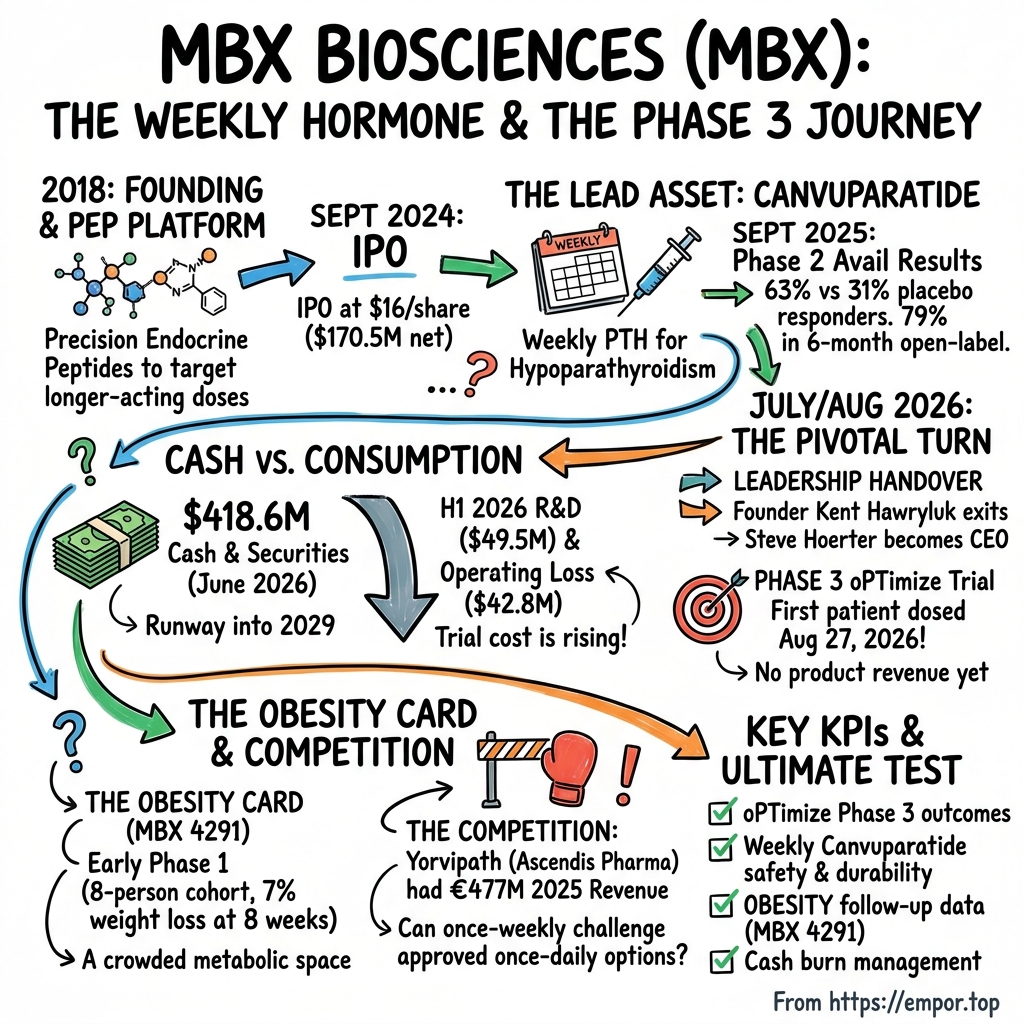
MBX Biosciences: The Weekly Hormone and the Phase 3 Test
I. A Phase 3 trial begins—and the founder leaves
On August 27, 2026, somewhere in a clinic that MBX Biosciences did not name, an adult with chronic hypoparathyroidism received the first dose in a pivotal Phase 3 trial called oPTimize.1 The injection came from the same device the company intends to sell if the drug is ever approved, a small detail that says a great deal about where the company thinks it is headed.2
Over 26 weeks, that patient and roughly 160 others will either receive canvuparatide, a once-weekly version of parathyroid hormone, or a placebo, with three patients getting the drug for every one who does not.2 At the end of that half-year, MBX will learn whether the molecule it has spent eight years building can do, in a large and rigorous trial, what it appeared to do in a small one.
The press release that announced the dosing carried a quote from Steve Hoerter, MBX's chairman, president and chief executive.2 A reader who had followed the company since its 2024 listing might have looked twice at the name. For almost the whole of MBX's existence, the face of the company had been Kent Hawryluk, its co-founder and chief executive since January 2020.3
Yet on July 13, 2026, about six weeks before that first Phase 3 injection, Hawryluk stepped away as CEO and left the board, and Hoerter, who had been executive chair since the previous November, took the top job.4 The founder had carried the company from an Indiana start-up to a Nasdaq listing and through the Phase 2 trial that justified this pivotal study. He did not stay to see the pivotal study begin.
That contrast is the right place to start, because it captures what MBX is today. It is a company that has reached a genuinely new stage, a late-stage clinical program with a design agreed after an end-of-Phase-2 meeting with the U.S. Food and Drug Administration.5 It is also a company that has never sold a single dose of anything.
It reported no product revenue in any period on record, through June 30, 2026.6 It has no approved drug and no demonstrated commercial model. What it has instead is money. At the end of June, MBX held $418.6 million in cash, cash equivalents and marketable securities, which management said would fund operations into 2029.7
So this is a story about a company still being tested. The first test is clinical: does the signal canvuparatide produced in Phase 2 survive a larger, longer, stricter trial? The second is financial: can a company that lost about $87 million in 2025, and whose losses are still widening, reach that answer without repeatedly asking shareholders for more capital?8
The third is strategic: can MBX's peptide-engineering approach, which it calls the PEP platform, produce more than one good candidate, so that the company becomes a medicine business rather than a single-asset bet with a string of early options attached?
MBX is a Delaware corporation listed on the Nasdaq Global Select Market under the ticker MBX, and it reports a single operating segment: the discovery and development of precision peptide therapies.8 Its pipeline reaches across three different kinds of disease. Canvuparatide targets hypoparathyroidism, a rare endocrine disorder. MBX 4291 and a cluster of earlier molecules target obesity, the largest and most crowded market in modern pharmaceuticals.
Imapextide, an older program, was tested in post-bariatric hypoglycemia, a condition in which blood sugar crashes after weight-loss surgery.9 Those three arenas could hardly be more different in size, competition and evidence. What links them is a claim about chemistry: that MBX knows how to make hormone-like peptides last longer in the body, so patients can inject less often.
On November 6, 2026, the market valued that claim at about $2.3 billion. Subtract the cash, and investors were paying roughly $1.9 billion for a pipeline whose most advanced asset had just begun its pivotal trial.
That price embeds a great deal of hope, and a great deal of risk. The useful question is not whether MBX has a good story. It plainly does. The question is which parts of the story have been proved, which parts are still promises, and what it will cost to find out.
To answer it, the story has to go back to 2018 and to a group of people who had already done this once before.
 Subscribe on LinkedIn
II. A peptide company built before it had a product
MBX began in August 2018 as an Indiana limited liability company, and it later converted into a Delaware corporation in April 2019.10 Its headquarters sat on North Meridian Street in Carmel, Indiana, a suburb north of Indianapolis better known for roundabouts than for biotech.10
The choice of location was not an accident of real estate. It was a choice of people. Indianapolis is Eli Lilly's home city, and Indiana University sits an hour south in Bloomington. MBX was founded, in its own words, by "pioneers in the endocrine drug development field."10
The scientific pioneer was Richard DiMarchi, a chemist whose laboratory at Indiana University developed the technology that became MBX's platform.10 DiMarchi's reputation rested on a single, very consequential idea: that a peptide hormone could be chemically redesigned to hit more than one receptor at once.
MBX describes him as the inventor of the first dual and triple incretin agonists, the class of molecules that sits behind the modern wave of obesity drugs, and he is a member of the National Inventors Hall of Fame and the National Academy of Medicine.10 He is not an MBX employee. Instead, he serves as principal investigator under a research agreement between MBX and Indiana University, a relationship that would later show up in the company's related-party disclosures.10
The business pioneer was Kent Hawryluk. Before MBX, he spent more than two decades as a life-sciences entrepreneur and investor.10 He had been a partner at Twilight Venture Partners since 2003, co-founded and served as chief business officer of Avidity Biosciences, and co-founded two earlier DiMarchi-linked ventures, Marcadia Biotech and MB2.3 Those two companies are the template for MBX.
Their GLP-1 and glucagon programs were transacted with Eli Lilly, Merck, Novo Nordisk and Roche.10 In other words, the founders had already proved that DiMarchi's chemistry could create assets that large drug companies wanted to buy. What they had not done was build a company that carried its own medicine to approval and sold it. That is the leap MBX was designed to attempt.
The platform at the center of the attempt is called PEP, short for Precision Endocrine Peptide.10 The idea is easier to grasp with an analogy. Many hormones in the body are short-lived messengers: they are released, they deliver a signal, and enzymes and the kidneys clear them away within minutes or hours. That is fine for a healthy gland that produces the hormone continuously. It is a problem for a patient who has to replace it with injections, because a short-lived hormone means frequent dosing and sharp peaks and troughs in blood levels.
PEP tries to change the delivery schedule without changing the message. Its tools include chemical modifications to the peptide, fatty acylation, which lets the molecule hitch a ride on albumin in the blood, and what MBX calls programmable prodrug technology, in which the drug is injected in an inactive form and converts to the active hormone at a designed, gradual rate.10 The goals, as the company states them, are high potency, selectivity for the intended receptor, half-lives long enough for weekly or less frequent dosing, and blood levels that stay relatively flat between doses.10
The first products of that platform became the early pipeline. MBX 2109, now called canvuparatide, was a prodrug of parathyroid hormone designed for once-weekly injection. MBX 1416, now imapextide, was a long-acting antagonist aimed at post-bariatric hypoglycemia. Later came the obesity molecules, beginning with MBX 4291, a prodrug intended to combine GLP-1 and GIP activity in a once-monthly injection.109 On paper, the logic was elegant: one chemical toolkit, applied to hormone after hormone, each time promising fewer injections and smoother control.
But it is worth being precise about what that toolkit was, and was not, at founding. Patents, design rules and pharmacokinetic claims are technical assets. They can create the option to build a medicine. They are not proof that patients will benefit, that doctors will prescribe, or that payers will reimburse.
A platform company earns the word "platform" only when it repeatedly turns its chemistry into candidates that survive clinical testing. At founding, MBX had a promising method and an experienced team. It had no clinical proof that the method worked in people.
Private investors were willing to fund that gap. Before its listing, MBX raised roughly $214 million through convertible notes and preferred stock from a roster of specialist investors that included Deep Track, RA Capital, OrbiMed, Frazier and NEA.10 That money paid for the first clinical work, and it left those investors with large stakes that would shape the company's shareholder base and board for years afterward.
Then came the public markets. MBX filed its registration statement on August 23, 2024, and it completed its initial public offering in mid-September, selling about 11.7 million shares at $16 each for net proceeds of about $170.5 million.108
It is tempting to treat an IPO as the moment a company "makes it." For MBX, the listing was a financing event, not a change in the business model. Revenue was still zero. Losses were still rising. The company had simply swapped a private group of funders for a public one, and in doing so it gained access to a deeper pool of capital that it would return to again and again.
What made that pool deep enough was the first real clinical test of PEP. If canvuparatide could show, in a placebo-controlled trial, that a once-weekly hormone could take patients off their daily pills, MBX would have its first piece of evidence that the platform could produce a medicine. That test arrived a year after the IPO.
III. The weekly PTH candidate clears its first hurdle
To understand why canvuparatide matters, start with the four small glands in the neck that most people never think about. The parathyroid glands, each about the size of a grain of rice, sit behind the thyroid and release parathyroid hormone, or PTH.
PTH is the body's thermostat for calcium. When blood calcium drops, PTH tells the bones to release some, tells the kidneys to hold onto more, and helps activate vitamin D so the gut absorbs more from food. Calcium, in turn, keeps nerves and muscles firing properly.
When those glands are damaged or removed, often during neck surgery, a patient can develop chronic hypoparathyroidism. Without enough PTH, blood calcium falls. Patients can experience tingling, muscle cramps, fatigue and a fog that makes ordinary work difficult. The conventional treatment is a daily routine of calcium supplements and active vitamin D, which raise blood calcium by brute force rather than by restoring the hormone's fine control.
That approach can keep calcium in range, but it does not replace PTH's work at the kidney, so excess calcium can spill into the urine. MBX estimates that more than 250,000 patients live with chronic hypoparathyroidism across the United States and the European Union, with more than 7,000 new cases a year.2 It is a rare disease, but not a tiny one, and it is one where the treatment burden is daily and lifelong.
Replacing PTH itself is the obvious answer. The difficulty is that natural PTH is short-lived, so replacement therapies have historically required daily injections. Canvuparatide's proposition was simple to state and hard to achieve: a prodrug that releases active PTH slowly enough that one injection a week could keep calcium stable and free patients from the pill routine.
On September 22, 2025, MBX reported the topline results of its Phase 2 trial, called Avail.11 The design was modest in size. Sixty-four adults were randomized into four groups, three receiving once-weekly canvuparatide at different doses and one receiving placebo, and every participant completed the 12-week blinded period.11
The key measure was a composite responder endpoint. To count as a responder, a patient had to keep albumin-adjusted serum calcium in the normal range while becoming independent of conventional therapy, meaning off active vitamin D and with calcium supplements cut down to a low level.11
That composite is the right way to read the trial. A drug that merely raised calcium would be unremarkable, because high-dose supplements can do that. The question was whether canvuparatide could keep calcium normal while the crutches were taken away. At 12 weeks, about 63% of patients on canvuparatide met that bar, compared with about 31% of patients on placebo, a difference that was statistically significant.11
The placebo number deserves as much attention as the drug number. Nearly a third of placebo patients also met the composite endpoint. That is not unusual in hypoparathyroidism trials, because the protocol actively manages supplements and some patients can tolerate reductions for a period. But it means the real effect of canvuparatide in Avail was the gap between the two arms, roughly 32 percentage points, not the headline 63%. A listener who remembers only "63%" remembers half the result.
The trial offered two further signals. Among a subset of patients with elevated urinary calcium at screening, canvuparatide reduced urine calcium by about 48%, against about 33% on placebo, a hint that restoring the hormone might address the kidney problem that supplements cannot.11
On safety, the company reported no treatment-related serious adverse events, no discontinuations related to canvuparatide and no deaths, with injection-site reactions in about 19% of treated patients versus 13% on placebo.11 Those are encouraging findings for a small trial. They are also findings from 64 people over three months, which is too few and too short to rule out rarer or slower-emerging problems.
Then came the open-label extension. About 94% of Avail participants chose to continue into it, a signal in its own right that patients wanted to stay on the drug.11 At six months, about 79% of evaluable patients met the responder definition, including patients who had started on placebo and switched to canvuparatide.11 In June 2026, MBX presented one-year data at the ENDO meeting, which it said demonstrated sustained benefit.[^12]
Here the story needs a careful hand. An open-label extension is not a controlled trial. Everyone knows they are receiving the drug, there is no placebo arm for comparison, and physicians are free to keep adjusting doses. Higher response rates over time are consistent with a durable effect.
They are also consistent with doctors getting better at titrating, with patients who did poorly dropping out of the evaluable group, and with the natural optimism of an unblinded setting. The extension data support durability as a signal. They do not establish it as a fact.
What investors heard, though, was clear enough: the lead program worked well enough to justify a pivotal trial, and the company moved fast. That same month, it sold about 11.1 million new shares at $18 in a follow-on offering, raising about $187.4 million net.8
That sequence, positive data followed immediately by an equity raise, is the standard choreography of clinical-stage biotech, and it is rational: a company should sell shares when the price reflects its best evidence. It also means that each step of clinical progress has been paired with dilution, a pattern that will matter when the story turns to money.
The next step ran through the regulator. On March 9, 2026, MBX announced that it had completed a successful end-of-Phase-2 meeting with the FDA and laid out its Phase 3 design.5 The company also announced that the European Medicines Agency had granted canvuparatide orphan designation.5
An end-of-Phase-2 meeting is not an approval or a guarantee. It is the moment when a sponsor and the regulator agree on what a pivotal trial must show. Its value lies in reducing the risk of designing the wrong trial, not the risk of failing the right one.
The design that emerged is worth hearing in full because it is stricter than Phase 2 in several ways; oPTimize began dosing in August.2 oPTimize is global, randomized, double-blind and placebo-controlled. Patients receive a fixed dose of 600 micrograms weekly, or placebo, for four weeks, then enter an 18-week window in which doses can be individually titrated up to 1,600 micrograms, and finally a four-week maintenance period in which no increases to the study drug, active vitamin D or calcium are allowed.2
The primary endpoint, measured at week 26, requires a patient to meet four conditions at once: normal albumin-adjusted serum calcium, independence from active vitamin D, calcium supplements at or below 600 milligrams a day, and no increase in study-drug dose in the four weeks before the measurement.2 After the blinded period, patients can enter a 78-week open-label extension.2
Compare that with Avail. The pivotal trial runs more than twice as long before the primary readout. It adds a requirement that the dose be stable at the end, which prevents a patient from "responding" only because a physician kept pushing the dose up. And it enrolls about two and a half times as many patients.
Each of those changes makes the result more meaningful if it is positive, and each raises the bar canvuparatide must clear. Secondary endpoints will look at urinary calcium normalization, physical functioning and hypocalcemia symptoms, along with bone and kidney measures.2
MBX has not published a date for topline results.2 The arithmetic of enrollment, a 26-week blinded period and analysis suggests the answer will not come quickly, but the company has not stated it, and the speed of recruitment in a rare disease is never certain.
What can be said is that the actual test has now been defined. It is not whether canvuparatide works in principle. It is whether roughly 120 patients on drug can beat roughly 40 on placebo, by a margin regulators find convincing, on a demanding composite endpoint, with a clean safety record over six months.
If the answer is yes, MBX will have a credible path to a filing. It will not yet have a business. Because by the time canvuparatide could reach the market, it will not be the first PTH replacement there.
IV. The incumbent already has a commercial business
While MBX was recruiting the first patients into its pivotal trial, a Danish company called Ascendis Pharma was already selling a parathyroid-hormone replacement. Ascendis's drug, YORVIPATH, is a once-daily prodrug of PTH, and it is approved and on the market.8 In 2025, YORVIPATH generated €477 million in revenue for Ascendis.[^13] MBX, through June 2026, had generated nothing.6
That comparison is not meant to diminish MBX. It is meant to frame the war game properly. Ascendis is not a hypothetical competitor in a future market. It is the incumbent in a market that already exists, with physicians who have prescribed its drug, patients who have learned to inject it, payers who have negotiated coverage, and a supply chain that delivers it.
Revenue of nearly half a billion euros in a rare disease also answers an important question for MBX bulls: patients and payers are willing to pay for PTH replacement at scale. The market is real. The question is how much of it is left for a second entrant.
The clinical landscape is not static either. AstraZeneca is developing eneboparatide, another PTH-receptor therapy dosed once daily.8 So canvuparatide, if it reaches the market, will face at least one established commercial product and possibly a second product backed by one of the world's largest drug companies. A small specialist market with a commercial incumbent and a big-pharma challenger is not a blank sheet. It is a contested field.
How do patients and doctors choose in a market like this? Hypoparathyroidism is managed by a relatively small community of endocrinologists. That has two consequences. First, physician familiarity and comfort matter enormously, because a specialist who has successfully transitioned dozens of patients to one therapy has a strong reason not to experiment.
Second, evidence matters, because those specialists read trial data closely and talk to one another. Reimbursement matters too, since a rare-disease drug lives or dies by whether insurers will pay, and reliable supply matters most of all for a patient whose calcium levels depend on never missing a dose.
MBX's answer is convenience. Canvuparatide is designed to be injected once a week rather than once a day.2 For a patient facing a lifetime of treatment, the difference between 365 injections a year and 52 is not trivial. The company's Phase 2 results also showed that weekly dosing could achieve the composite endpoint, which suggests the convenience does not obviously come at the expense of control.11
But convenience is a hypothesis about patient preference, and it needs to be tested against the specific habits of this market. There is no head-to-head trial comparing canvuparatide with YORVIPATH. oPTimize compares canvuparatide with placebo, not with the incumbent.2 So MBX will not have evidence that weekly dosing produces better outcomes, only evidence that it produces good ones.
Whether doctors will switch stable patients from a daily drug they already trust, whether payers will reimburse a second product at a comparable price, and whether patients value one fewer injection a day enough to change are all open questions. Weekly dosing may matter a great deal. It may matter only at the margin, for new patients rather than switchers. The record does not yet say.
Applied with restraint, Michael Porter's five forces sharpen the point. The bargaining power of buyers, here the clinicians and payers who decide which product a patient gets, rises the moment an approved alternative exists. A payer who already covers YORVIPATH can ask what a second PTH therapy adds before agreeing to cover it on good terms.
Patient need, however real, does not by itself guarantee MBX access to those patients. And the threat of substitutes runs in both directions: just as canvuparatide threatens to substitute for a daily injection, eneboparatide and any future long-acting competitors threaten to dilute whatever premium a weekly product might command. A first-to-weekly position could be valuable. It is not a monopoly.
None of this means MBX cannot win a meaningful share. Rare-disease markets have often supported two or three successful products, particularly where patients respond differently or tolerate one therapy better than another. And a market that grew to nearly half a billion euros for the incumbent shows how much value PTH replacement can create.
But MBX's commercial edge is, today, an assertion built on a dosing schedule and a Phase 2 trial. The proof will come in three stages: a pivotal result that holds up, an approval, and then the slower evidence of prescriptions, reimbursement and persistence.
This is also where the PEP platform needs to be judged honestly. Platforms can become moats when they produce something competitors cannot replicate, or when they create switching costs, scale economies or distribution advantages. MBX has none of those yet. It has a capability, a method for designing longer-acting peptides, that has produced one candidate with encouraging Phase 2 results.
Ascendis, notably, built YORVIPATH on its own prodrug technology. Long-acting chemistry is a competitive arena, not a cornered resource. Until canvuparatide reaches the market and earns share against an approved product, the platform is a hypothesis about capability rather than an established advantage.
Which brings the story to the resource that buys MBX time to test every one of these hypotheses: the cash.
V. The cash buys time; the trials consume it
Picture MBX's balance sheet at the end of June 2026 as a reservoir. On one side, a large body of water: $418.6 million in cash, cash equivalents and marketable securities, mostly invested in U.S. government and agency securities.76 On the other side, an outflow pipe that has been steadily widening.
In the first six months of 2026, MBX spent $42.8 million in cash on its operations and recorded $49.5 million of research and development expense.6 The question every investor in a clinical-stage company eventually asks is simple: how long until the reservoir runs dry, and what will the company have to show for the water it used?
Start with the losses, because they describe the company's spending pattern. MBX's annual net loss grew from about $26 million in 2022 to about $87 million in 2025.108 That is more than a tripling in three years, and it is not a sign of trouble in itself.
It is the cost of moving canvuparatide from early trials to Phase 3, of starting obesity programs and of building the team to run them. Full-time headcount rose from 36 in August 2024 to 63 by the end of 2025.108 In the first half of 2026, the net loss was $60.6 million, up from $43.3 million a year earlier.76
The second quarter of 2026 is where the acceleration becomes most visible. Research and development spending in that quarter alone was about $31 million, nearly double the $17.7 million of a year earlier, while general and administrative costs more than doubled, to about $9.9 million.7
Put differently, MBX's spending on research in the second quarter was almost twice what it was in the first quarter of the same year. That jump coincided with Phase 3 preparation and expanding obesity work, and it will not reverse while those programs are running.
Interest income softens the blow but does not change the picture. Because MBX holds hundreds of millions in Treasury-like securities, it earns real money on its idle cash: about $11.1 million in 2025 and $7.6 million in the first half of 2026.68 That is roughly a tenth of the operating loss, enough to extend the runway by a few months but not enough to make the company self-sustaining. The reservoir earns a little rain. It does not refill itself.
Management has guided that the cash will fund operations into 2029.7 A simple check suggests that guidance is plausible but already assumes rising spending. If the second quarter's operating loss of about $41 million were simply repeated each quarter, and offset by investment income, the company would burn something like $140 million to $150 million a year.
Stretching $418.6 million from mid-2026 into 2029 implies spending in that range or modestly higher. Any meaningful step-up, larger obesity trials, faster Phase 3 enrollment, the manufacturing scale-up a commercial launch would require, would compress that timeline. Runway guidance is a forecast built on management's current plan, not a fixed fact.
The more important point is where the reservoir came from. MBX did not generate this cash. Over 2022 through 2025, the company's cumulative net losses totaled about $205 million and its operating cash outflow about $188 million, and it paid no dividends because it had nothing to distribute.108 Its cash was raised from shareholders, in three major waves after the listing.
The IPO in September 2024 brought in about $170.5 million net. The follow-on after the Phase 2 data in September 2025 raised about $187.4 million net. And in February 2026, the company used an at-the-market offering, selling shares gradually into the market, to raise $85.0 million net from about 2.25 million shares at a weighted average price of about $38.76.68
That ATM sale is a revealing detail. It took place after the Phase 2 data and before the FDA meeting outcome was public, at a price more than twice the IPO level.65 Selling shares at a higher price is better for existing shareholders than selling them cheaply, and the price reflected the progress the company had made.
But it was still dilution. MBX's share count rose from about 44.9 million at the end of 2025 to about 48.0 million at the end of June 2026.6 Each wave of capital has bought more trial time; each has also given a larger slice of the eventual business, if there is one, to new investors.
Compare the capital raised with the clinical progress it financed. Since the IPO, MBX has raised roughly $440 million net in public equity. In return, it has a completed Phase 2 trial, an agreed Phase 3 design, a pivotal trial that has started dosing, early obesity data, and a pipeline of preclinical candidates.
That is real progress. It is also progress that has not yet produced a dollar of revenue, and the most expensive stages, Phase 3 completion, a regulatory filing, a possible launch, still lie ahead.
There is one figure that a casual reader might misinterpret. Data providers report MBX's "borrowings" at about $596,000 at the end of 2025.8 That number is not a loan. It corresponds to operating-lease liabilities, the accounting recognition of future rent payments on offices and labs.8
Lease liabilities rose to about $3.3 million by June 2026 after a new office and laboratory lease in Burlington, Massachusetts, began.6 MBX has no disclosed borrowing facility, no covenants and no rated debt.6 Refinancing risk is not the issue here. The balance-sheet risk is burn, and the possibility that the next equity raise comes at a less favorable moment.
The quality of the reported losses is not in question either. Over the four years, the gap between accounting losses and cash outflow was modest, and it came from the usual places for a research company: non-cash stock compensation and lease charges on one side, investment income and the timing of payments to trial vendors on the other. In 2025, for instance, operating cash outflow of about $80 million sat against the net loss of about $87 million, with a rise in amounts owed to suppliers partly offset by larger prepayments for research work.8
Ernst & Young issued a clean opinion on the 2025 and 2024 statements.8 As an emerging-growth company, MBX is exempt from an auditor attestation of its internal controls, so investors get a little less assurance than they would at a larger issuer.8 The company reported no material legal proceedings at the end of 2025, and about $6.7 million of unrecognized tax benefits with no material interest or penalties, an accounting judgment worth knowing about but not a looming liability.8 The balance sheet, in other words, is what it appears to be: a pile of cash being converted into clinical data.
It is also worth saying what MBX has not done with its capital. The company has reported no material acquisitions.8 Nearly all of its spending has gone into internal research, clinical trials, people, facilities, and the securities portfolio that holds its unspent cash. That means there is no acquisition premium to judge and no write-down to explain. It does not, by itself, prove discipline. A young company that has done only internal development has simply not yet faced the classic temptation of buying growth.
The single most useful number to watch from here is quarterly operating cash use. It will reveal how fast Phase 3 enrollment and the obesity trials are consuming the reservoir, and whether "into 2029" still holds once the pivotal program and its drug supply are fully running. In the first half of 2026, that number averaged a little over $21 million a quarter.6 The second-quarter jump in spending suggests it will not stay there.
And the largest source of future spending pressure is the one that makes MBX's story bigger than a single rare disease: obesity.
VI. The obesity pipeline makes the platform a bigger—and harder—claim
On May 11, 2026, MBX held what it called an Obesity Day, and for a few hours the company that had spent years talking about a rare calcium disorder talked about the biggest market in medicine.9 There is a certain irony in the setting. Richard DiMarchi's reputation rests on inventing the first dual and triple incretin agonists, the very class of multi-receptor molecules that now defines the obesity boom.10
The giants who sell those drugs have built some of the most valuable franchises in the history of the industry. MBX, a company with no product revenue, was stepping onto their field with a molecule that had been tested in a handful of people.
The molecule was MBX 4291, a prodrug designed to deliver combined GLP-1 and GIP activity, the same two-hormone approach behind the current generation of leading obesity drugs.9 MBX's twist was the dosing interval. Where today's leading products are injected weekly, MBX 4291 is designed with the goal of once-monthly dosing.9 The prodrug chemistry is the same idea that underpins canvuparatide: inject an inactive form and let it convert gradually into the active hormone, so that a single injection can sustain an effect for weeks.
The early pharmacology was encouraging on that narrow point. In single-ascending-dose testing across five cohorts, ranging from 15 to 180 milligrams, MBX reported an effective half-life of about 26 days, which the company said supports monthly dosing, and it reached the maximum tolerated single dose at 180 milligrams.9
Half-life is a measure of how long a drug lingers in the blood, and a long one is a necessary condition for monthly dosing. It is not a sufficient one. A drug can last a long time in the body and still cause too much nausea at the peak, or lose its effect before the next dose, or simply not produce enough weight loss to compete.
Then came the number that drew attention. In the first cohort of the multiple-ascending-dose part of the study, eight participants received four weekly 30-milligram doses followed by a single 120-milligram monthly dose, or placebo.9 Six of them received the drug; two received placebo.9
Because the data were still blinded, MBX reported a mean weight loss of about 7% across all eight at eight weeks, with individual results ranging from zero to 16%.9 On tolerability, the company reported only one participant with a gastrointestinal event through eight weeks, a case of mild diarrhea after the first dose, no nausea or vomiting in that cohort, and no serious adverse events.9
It is worth slowing down on that cohort, because the number is easy to over-read. Eight people is a tiny sample. Two of them were on placebo, which means the drug-treated average was presumably higher than 7%, but nobody outside the blinded data knows by how much, and the range from zero to 16% shows how widely individuals varied.
Eight weeks is also a very short time in obesity, where the leading drugs show their full effect over many months. The data are a signal worth following. They are not a basis for comparing MBX 4291 with marketed products, and they say almost nothing yet about whether monthly dosing can match the efficacy and tolerability of weekly regimens over a year.
MBX designed the next stage to answer more of those questions. Two 12-week multiple-dose cohorts of 30 participants each, with 20 on drug and 10 on placebo in each, were set up to produce data that the company has guided to the fourth quarter of 2026.97 Those cohorts will be larger, longer and better controlled than the first. They will still be Phase 1.
The obesity day also widened the funnel. MBX described MBX 5765, a monthly prodrug candidate that adds amylin-pathway activity to incretin signaling, a combination the industry is pursuing aggressively, and said IND-enabling studies would begin.9
By August, the company was also pointing to preclinical data for MBX 6180, a triple agonist targeting GLP-1, GIP and glucagon receptors, at a scientific meeting in the fourth quarter.7 The strategic intent is clear: use PEP to build a family of long-acting obesity molecules, so that MBX is not betting on a single mechanism in a market where mechanisms keep evolving.
Here the platform story meets its first piece of disconfirming evidence. Imapextide, the old MBX 1416, was tested in a Phase 2a trial called STEADI in people with post-bariatric hypoglycemia, and MBX reported increases in the lowest blood-glucose point after a meal of about 17%, 28% and 34% at three escalating doses.9 That is the kind of dose-response a drug developer hopes to see.
Yet at the same obesity update, MBX said it was not pursuing a Phase 2b study in that indication.9 Whatever the reasons, commercial, strategic or clinical, the effect is that one of the platform's two original clinical programs did not advance to the next stage in its first indication. It is a reminder that a positive proof-of-concept result is not the same as a program with a path forward.
This matters for how to judge the obesity push. The bull case is straightforward: obesity is a market of enormous scale, a monthly injection could be genuinely differentiated, and a small company with the right molecule could command a valuable partnership or acquisition.
The bear case is equally straightforward: the field is dominated by companies with vastly greater resources, established manufacturing and commercial reach, and dozens of other companies are chasing longer intervals and new combinations.8 Being a little more convenient is not enough in a market where the incumbents keep improving.
What would falsify the platform thesis in obesity? Three things would. Follow-up data that fail to show weight loss competitive with existing weekly drugs would. Tolerability that worsens as doses rise and intervals lengthen would.
And a pattern of spending across more and more early programs without any of them advancing into larger trials would. Each obesity cohort, and each new candidate, draws on the same reservoir of cash that must fund canvuparatide's pivotal trial. The obesity programs add option value only if they earn their claim on that cash with data.
The fourth-quarter MBX 4291 readout is the next clue. It will be weighed by the market against the cost of producing it, and it will arrive under a chief executive who was not running the company when the program began.
VII. A new CEO inherits the pivotal trial
The board met on July 9, 2026; the leadership change took effect four days later.4
The company's announcement framed it as an executive leadership transition.[^14] The filings give few clues about why it happened at that moment, and MBX has not explained the reasoning beyond the announcement itself. What they do describe is the terms.
Hawryluk left with a standard but meaningful package. He agreed to consult for the company through August 16, 2026, and received severance equal to 12 months of base salary, a year of health-insurance continuation, his target bonus and accelerated vesting of equity through August 2027, along with an extended window to exercise his options.4
That is not unusual for a departing founder-CEO. It does mean the company paid for the transition in both cash and equity, at a time when it was also ramping trial spending.
His record is the right place to start the assessment. Under Hawryluk, MBX raised its private rounds, listed, ran the Phase 2 trial that produced the canvuparatide result, secured an end-of-Phase-2 agreement with the FDA and prepared the pivotal trial. In 2025, his total compensation was about $2.99 million, including a cash performance bonus of about $359,000.3 The company lost about $87 million that year.8
The proxy describes bonuses for Hawryluk, then-CFO Richard Bartram and chief medical officer Salomon Azoulay as tied to clinical, research and development, business-development and organizational goals, rather than any financial measure.3 For a company with no revenue, that is reasonable; there is no revenue or profit to target. It also means pay was set against milestones the company largely controls, not against outcomes that prove commercial value.
Hoerter brings a very different résumé. He spent his career on the commercial side of biotech before running a company. He was a senior commercial executive and then chief commercial officer at Clovis Oncology between 2011 and 2016, chief commercial officer at Agios Pharmaceuticals from 2016 to 2019, and then president and chief executive of Deciphera Pharmaceuticals from March 2019 until June 2024, when Deciphera was acquired by Ono Pharmaceutical (小野薬品工業).3 He joined MBX's board in April 2025 and became executive chair in November 2025.3
Read as a career, that background tells a story. Hawryluk was a builder of science-first companies whose earlier ventures sold assets to large pharmaceutical partners. Hoerter is an operator who has launched drugs and sold a company.
Choosing him to lead MBX into Phase 3 suggests the board wants someone who can think about launch, market access and, possibly, a strategic outcome, while the pivotal trial runs. That is an inference from the résumé, not a stated strategy, and the record is far too short to judge how he runs MBX. He has been chief executive for less than four months.
His terms as CEO are on record. His base salary is $665,000 with a target bonus of 60% of salary, and in August 2026 he received options on 331,000 shares and 71,000 restricted stock units.4 Earlier, as executive chair, he had received an option on about 33,750 shares, and his total 2025 board pay, covering service from April, was about $1.0 million.3 At the same time, John Smither, who had been interim chief financial officer since Bartram's resignation took effect in March 2026, became CFO with a $530,000 base salary, a 40% target bonus and a $150,000 relocation bonus.43
The clinical side of the leadership did not change. Salomon Azoulay, chief medical officer since June 2024, came to MBX after nearly two decades at Pfizer, where he rose to chief medical officer of Pfizer Essential Health, followed by chief medical officer roles at Roivant and Sumitovant Biopharma.3 Continuity in the medical function matters more than it might appear in a handover like this one, because the person who designed the trial with the FDA is still the person running it.
The full picture of how the new packages compare with performance will only appear in the next proxy. What is clear already is that the new team holds sizable equity grants whose value depends on the clinical outcome.
There is one governance wrinkle worth noting. In May 2026, while still executive chair, Hoerter entered into a strategic-advisory consulting agreement with MBX, effective May 1, approved by unanimous written consent of the board, under which he received options on about 74,000 shares and about 12,000 restricted stock units.12 The consulting fee itself has not been disclosed.12
The arrangement meant Hoerter was no longer an independent director under Nasdaq rules.12 In hindsight, the consulting deal looks like a bridge to the CEO role two months later. That makes it understandable, but it does mean a material relationship between the board chair and the company existed, with an undisclosed fee, during a period of leadership change.
Shareholders sent a measured signal at the June 2026 annual meeting. About 4.58 million votes were withheld from director Patrick Heron, and about 7.60 million from director Edward Mathers, while ratification of the auditor passed with about 43.7 million votes in favor and fewer than 2,000 against.13
Heron is a managing partner at Frazier, one of MBX's largest shareholders, whose affiliated entities held about 14% of the company at the time of the proxy.3 Withheld votes of that scale are a visible minority protest, not a revolt; both directors were elected. But in a company with a concentrated institutional shareholder base, they suggest some investors wanted more independence on the board.
The board has since added one. On October 20, 2026, MBX appointed Peter Radovich as an independent director, bringing the board to eight members.14 The company has not published an updated assessment of the board's overall independence since the changes of 2026.
Ownership remains heavily institutional. In November 2026, FMR, the parent of Fidelity, reported a stake of about 15% as of September 30.[^18] OrbiMed, an early investor, reported a stake of about 6.4% in August after disclosed sales.[^19] The April proxy listed Frazier at about 14%, NEA and Wellington at about 7% each.3
Institutional ownership of that kind is not the same as management alignment. The April proxy's ownership table predates Hoerter's appointment as CEO, so the next proxy and the relevant insider filings will be the place to see how much stock the new leadership team actually owns.
One related-party item completes the picture. MBX's research agreement with Indiana University funded work led by DiMarchi, a director and former officer. The contract, extended through April 2026, carried total stated costs of about $6.8 million across its amendments, and MBX paid about $1.0 million under it in 2025, roughly 1% of its operating expenses.8
The filings describe it as a research arrangement with an option to license resulting technology, without characterizing whether its pricing is arm's length.8 It is small in dollars and logical in substance, since the platform's science originated in that lab. It is still the kind of arrangement a careful shareholder tracks.
So how credible has management been? The cleanest test is promises against outcomes. In March, MBX said it planned to start Phase 3 in the third quarter of 2026.5 In August, it reaffirmed that plan and said sites were being activated.7 On August 27, it dosed the first patient.1 That is a promise kept, and it was kept through a CEO change.
The company has also been consistent about the fourth-quarter MBX 4291 data, guiding to the same window in May and in August.97 Against that, the decision not to advance imapextide in its original indication shows that not every program has followed its early path. On the narrow evidence available, the company has hit its stated timelines; the harder tests, holding spending in check and delivering pivotal data, belong to the new team.
VIII. The evidence behind the platform is still one pivotal trial deep
Look at MBX's pipeline chart, and the picture is almost lopsided. One bar stretches into Phase 3: canvuparatide. Then there is a gap. The obesity programs sit in Phase 1 and preclinical stages, and imapextide stands after a Phase 2a study without a Phase 2b plan in its first indication.9
The chart still contains no approved product, and revenue remains zero.6 The company spent about $79.2 million on research and development in 2025 and $49.5 million in the first half of 2026.68 All of that spending supports one late-stage asset and a set of earlier bets.
That shape tells the story of what MBX can claim today. It can claim a capability. Its chemists have designed peptides with long half-lives, and one of them produced controlled Phase 2 results in a rare disease. It cannot yet claim commercialization. Peptide design, patents and clinical milestones can enable medicines, but they are not prescriptions, reimbursement contracts or patients who stay on therapy for years. The distance between the two is where most drug companies' value is created or destroyed.
The economic model MBX is trying to build is conventional for its stage. If canvuparatide succeeds, the company can sell it directly, which would require building sales, manufacturing and distribution capabilities it does not have today, or it can license or partner it.8
The obesity programs, given the scale of that market, are more likely candidates for partnering, though MBX has announced no such deal. Today, the company discloses no product pricing, no recurring revenue, no customers and no commercial commitments, because it has none.8 Conventional customer concentration analysis does not apply. Neither does churn.
What does apply is operational dependence. Like most clinical-stage companies, MBX relies on contract research organizations to run its trials and contract development and manufacturing organizations to make its drug supply.8 The company does not name those suppliers or disclose how concentrated its spending is among them.8 That matters more than it might seem.
A pivotal trial depends on sites recruiting on schedule and on a steady supply of drug in the commercial device. A manufacturing delay or a vendor problem can push timelines back by months, and specialized manufacturers can be difficult to replace on short notice. MBX's execution risk is therefore partly in the hands of third parties whose replaceability it does not quantify.
The real moat test for a platform company is repeatability. A single good molecule can be luck, a strong biological target, or simply a well-chosen indication. A platform proves itself when the second and third candidates, built with the same tools, also produce strong clinical results. MBX's record so far is mixed in a way that fits its age. Canvuparatide has controlled Phase 2 data and is in Phase 3. Imapextide produced proof-of-concept data but did not advance in its first indication.
MBX 4291 has encouraging but very early pharmacology. The other obesity molecules are preclinical. On that evidence, the platform claim is narrowed to a smaller version: PEP has produced one late-stage candidate and several promising early ones. Whether it is a repeatable engine will depend on canvuparatide's pivotal outcome, the obesity data, and any partnership terms a large company is willing to pay.
MBX has not made a material acquisition or reported a write-off of a major investment.8 That is a fact about a young company, not a verdict on its judgment.
So far, its capital allocation has been limited to funding internal development and holding unspent cash in government securities. The test of discipline will come later, when the company must choose how much to spend on obesity versus canvuparatide's launch preparation, whether to partner or go it alone, and whether to keep funding programs whose data are only moderately good.
Which leaves the question that every investor in MBX ultimately has to answer: at the price the market sets, what exactly is being paid for?
IX. Analysis & Bear vs. Bull Case
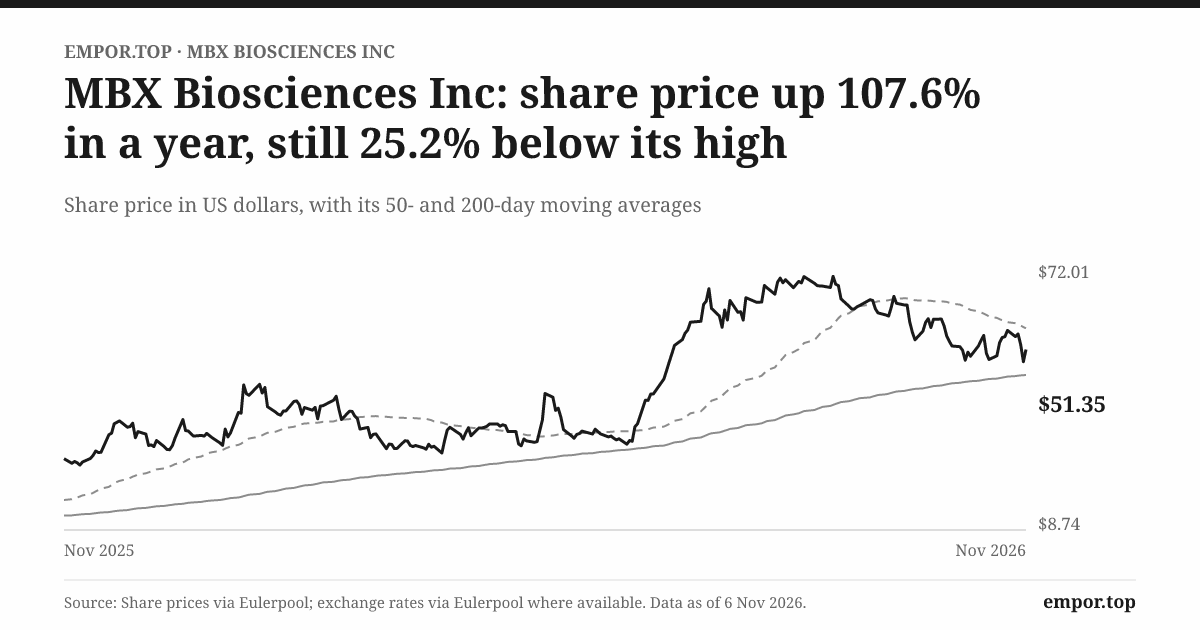
On November 6, 2026, MBX's shares closed at $51.35, giving the company a market value of about $2.3 billion. The price was about 25% below the 52-week high of $68.62 and more than double the 52-week low of $24.07.
The stock's one-year volatility ran at about 74%, and at its worst point in its short public life it had fallen almost 78% from a prior peak. Those numbers describe a stock that moves violently on news, which is exactly what one would expect for a company whose value rests on future data.
Start with what the price implies. With roughly $418.6 million in cash and securities at the end of June, the market was paying about $1.9 billion in enterprise value for the pipeline.7 For context, Ascendis's YORVIPATH generated about €477 million in 2025 revenue.[^13]
So the market is valuing MBX's entire pipeline at roughly four times the incumbent PTH product's annual revenue, after converting currencies, before canvuparatide has completed Phase 3, before approval, and before a single sale. That is not irrational for a company with a promising late-stage asset and a platform in obesity, but it is a price that assumes a substantial probability of success.
The bull case runs as follows. Canvuparatide's Phase 2 data showed a clear separation from placebo on a demanding composite endpoint, with clean safety in the trial and a signal of durability in the extension.11 The pivotal trial is well designed, agreed with the FDA, and has started on schedule.15
Weekly dosing could be a meaningful advantage for patients managing a lifelong disease, in a market already shown to be worth hundreds of millions of euros a year for the incumbent.[^13] Management says the company's cash will fund operations into 2029, which should carry the company through the pivotal readout.7 And the obesity programs offer option value in the largest market in medicine, where even an early-stage asset with a credible monthly profile could attract a lucrative partnership.
The bear case is just as specific. Phase 3 trials often fail to reproduce Phase 2 results, and oPTimize is longer and stricter than Avail, with a dose-stability requirement Avail did not have.211 YORVIPATH is already commercial, with a head start in physician familiarity, payer contracts and patient experience, and a second daily product is advancing at AstraZeneca.8[^13]
The clinical edge of weekly dosing remains unproven against the incumbent.2 Obesity competition is formidable, and the MBX 4291 data are too small and preliminary to establish any edge.9 Meanwhile, spending is accelerating and every wave of capital has come with dilution.76
The moat question deserves a full argument here, using Hamilton Helmer's seven powers, the sources of durable competitive advantage. Scale economies require volume, and MBX has none. Network effects do not apply to a therapeutic. Counter-positioning, a business model an incumbent cannot copy without harming itself, is weak: Ascendis could pursue a weekly product if the market demanded one, and nothing about its business prevents it.
Switching costs could eventually work in MBX's favor once patients are stable on canvuparatide, but today they work against it, protecting the incumbent's patients. Branding is irrelevant until there is a product. Process power, the hard-to-copy organizational know-how that some companies build over decades, is possible in peptide chemistry, but it has to be demonstrated through repeated successes, and MBX has one late-stage candidate.
That leaves the cornered resource. MBX's patents and its access to DiMarchi's lab and know-how are its best claim to a unique asset. But a patent on one molecule does not prevent competitors from designing different molecules for the same target, as Ascendis's own prodrug PTH demonstrates.
On the evidence of the filings, MBX has potential know-how and intellectual property; it does not yet have a cornered resource, customer switching costs, distribution advantage, proven cost position or recurring revenue. The honest verdict is that its competitive power is prospective.
The five forces point to the same market pressures: high buyer power, meaningful supplier dependence and intense rivalry, with substitutes available and development costs moderating the threat of new entrants.8
An activist investor looking at MBX would push on capital allocation. The company has raised roughly $440 million in public equity since its IPO and is spending at an accelerating rate across a growing number of programs.68
A skeptic would ask whether every obesity candidate deserves funding while the lead asset's pivotal trial is underway, whether the company should partner obesity early to preserve cash, and why the board approved a consulting fee for its chair without disclosing the amount.12 None of these questions implies wrongdoing. They are the questions that determine whether the cash buys data or merely buys time.
Valuation metrics need care. The enterprise-value-to-sales ratio is technically zero, because there are no sales, which tells an investor nothing about whether the stock is cheap. The price-to-book ratio of about 6.0 compares the market value with a balance sheet made up almost entirely of equity proceeds and government securities; it measures how much the market values the pipeline above the cash, not any operating return.
Book value per share is about $9.12. And with a public history only since September 2024, there is no meaningful history of MBX's own trading multiples to compare against. The free-cash-flow yield of about minus 3.7% is the one ratio that speaks plainly: for every $100 of market value, the company consumes almost $4 a year, a reminder that shareholders are funding the wait. The value of this company will be set by clinical data, not by multiples.
Three indicators matter most. The first is oPTimize's progress: enrollment and, eventually, the pivotal endpoint. Today the reading is a trial that has dosed its first patient, with no topline date given.2 The second is quarterly operating cash use, which ran at a little over $21 million a quarter in the first half of 2026 and is rising.6
The third is canvuparatide's safety, durability and supplement-independence measures, which so far have been positive in Phase 2 and its open-label extension.11[^12] The MBX 4291 readout is a secondary check on whether the platform has a second leg.
Management has so far met the timelines it set for canvuparatide and MBX 4291.11597 What changed across those months was the scale of spending and the leadership. Whether the new team keeps the same discipline on timelines while spending rises is the most important thing to listen for on the next call.
X. Business & Investing Lessons
The first lesson comes from the Avail result. "A clinical result can open a door; it cannot walk through Phase 3 for you." The result justified a pivotal trial.11 It did not guarantee a pivotal result, and the stricter design of oPTimize is a reminder that the next test is harder than the last.
Investors who price a Phase 2 success as if it were an approval are paying twice for the same hope. The wider principle for founders is that each layer of proof must be earned on its own terms, and the most dangerous moment is the one right after a good result, when it is easiest to believe the next one is assured.
The second lesson is about the reservoir. "A cash balance is time bought with capital." MBX's cash came from equity raises.768 The company spent $42.8 million on operations in the first half of 2026 alone.6
The cash gives it time to run the pivotal trial, and the shareholders who funded it accepted dilution in exchange. For investors, the lesson is to measure a biotech's balance sheet not as a fortress but as a clock. The useful question is never how much cash a company has, but how many proof points that cash will buy.
The third lesson concerns the platform. "A platform is a promise until it repeats." PEP has produced one candidate now in Phase 3, while its record across other programs remains mixed.9
A single successful candidate is evidence that a platform can work; it is not evidence that it works reliably. For founders, the lesson is that the word "platform" should be earned through repetition, not claimed at founding. For investors, it is a reminder to value the lead asset on its merits and treat the rest as options, not as a pipeline already priced at success.
The fourth lesson is about the market canvuparatide hopes to enter. "Convenience is a hypothesis until patients, doctors and payers choose it." Weekly dosing is a meaningful improvement on paper, and it could matter a great deal to patients.2 The incumbent has already established a market with daily dosing.[^13]
The incumbent's commercial momentum, the absence of head-to-head data and the cautious habits of specialist physicians all mean that convenience will be tested in the market, not just in the trial. For any company whose advantage is "easier to use," the lesson is that ease of use only becomes a moat when it changes behavior at scale.
The fifth lesson belongs to the summer of 2026. "A founder's exit is a data point, not a verdict." The leadership change came just before the pivotal trial began.4 His successor's commercial background suits the stage when commercial questions start to matter.43
Outsiders tend to read such handovers as either a vote of no confidence or a sign that a sale is coming. The record supports neither reading yet. What it supports is narrower and more useful: the board has chosen a commercial operator for the stage when commercial questions start to matter, and the choice will be judged by whether timelines and spending discipline survive the change.
XI. Epilogue
Tonight, MBX stands at the beginning of its longest test. Somewhere, trial sites are recruiting adults with chronic hypoparathyroidism into oPTimize, the test that will define the company.2 At headquarters, a new leadership team is setting the pace of spending and disclosure.4
The next moments are already visible. The first is the fourth-quarter MBX 4291 readout.97 If the data show weight loss that holds up against placebo with good tolerability at monthly intervals, the obesity option will start to look like a second leg. If they disappoint, the platform story narrows back to canvuparatide.
Quarterly results will show whether spending continues to accelerate.76 If spending rises sharply without commensurate milestones, the "into 2029" guidance will come under pressure, and the next equity raise could arrive at a less favorable moment.
The next proxy will offer the first formal look at the new leadership's alignment.414
And then there is the big one: oPTimize's complete dataset. If canvuparatide meets its primary endpoint with a clean safety profile, MBX will have a credible path to a regulatory filing and a genuine product to bring to market or to partner. If it fails, or produces a marginal result, the company will be left with a cash balance, a set of early obesity programs and a platform whose central proof point did not hold.
Neither outcome is a shortcut to commercialization. Even a positive pivotal result will leave MBX facing an incumbent with a head start, payers with an approved alternative and a launch it has never executed. The tension at the center of this story remains: a company with a good molecule and a lot of cash is trying to become a company with a product and a business, and the distance between those two is measured in years and hundreds of millions of dollars.
XII. Outro
Return to that first patient in August, receiving a weekly injection from a device designed for the market MBX hopes to reach.2 For that patient, the promise is a simpler routine. For the company, the injection is the start of a test that will take years to complete.
MBX is a bet on the distance between a promising molecule and a medicine people can actually obtain. It has crossed the first part of that distance with a Phase 2 result and a pivotal trial that is now underway. Commercialization remains ahead: the company has no product revenue or approved drug.6 The trial has started. The company still has to earn the ending.
References
-
Form 8-K: Phase 3 oPTimize First Patient Dosed — MBX Biosciences, SEC, 2026-08-27 ↩↩↩
-
Exhibit 99.1: MBX Biosciences Announces First Patient Dosed in Phase 3 oPTimize Trial — MBX Biosciences, SEC, 2026-08-27 ↩↩↩↩↩↩↩↩↩↩↩↩↩↩↩↩↩↩
-
2026 Proxy Statement — MBX Biosciences, SEC, 2026-04-22 ↩↩↩↩↩↩↩↩↩↩↩↩
-
Form 8-K: Executive Leadership Transition, Item 5.02 — MBX Biosciences, SEC, 2026-07-13 ↩↩↩↩↩↩↩↩↩
-
Exhibit 99.1: Successful End-of-Phase 2 FDA Meeting and Phase 3 Plan — MBX Biosciences, SEC, 2026-03-09 ↩↩↩↩↩↩↩
-
Form 10-Q for the quarter ended June 30, 2026 — MBX Biosciences, SEC, 2026-08-06 ↩↩↩↩↩↩↩↩↩↩↩↩↩↩↩↩↩↩↩↩↩
-
Exhibit 99.1: Second Quarter 2026 Financial Results — MBX Biosciences, SEC, 2026-08-06 ↩↩↩↩↩↩↩↩↩↩↩↩↩↩↩↩
-
Form 10-K for 2025 — MBX Biosciences, SEC, 2026-03-12 ↩↩↩↩↩↩↩↩↩↩↩↩↩↩↩↩↩↩↩↩↩↩↩↩↩↩↩↩↩↩↩↩
-
Exhibit 99.1: Obesity Portfolio Update and MBX 4291 Phase 1 Data — MBX Biosciences, SEC, 2026-05-11 ↩↩↩↩↩↩↩↩↩↩↩↩↩↩↩↩↩↩↩↩
-
Form S-1 — MBX Biosciences, SEC, 2024-08-23 ↩↩↩↩↩↩↩↩↩↩↩↩↩↩↩↩↩↩
-
Exhibit 99.1: Phase 2 Avail Topline Results — MBX Biosciences, SEC, 2025-09-22 ↩↩↩↩↩↩↩↩↩↩↩↩↩↩
-
Annual Meeting Voting Results, Form 8-K — MBX Biosciences, SEC, 2026-06-05 ↩
-
Form 8-K: Appointment of Peter Radovich — MBX Biosciences, SEC, 2026-10-22 ↩↩
 LinkedIn
 WhatsApp
 Reddit
 Hacker News
 Email
 Kindle
 RSS Feed
 Spotify
 Apple Podcasts
 Amazon Music
 Audible
 YouTube