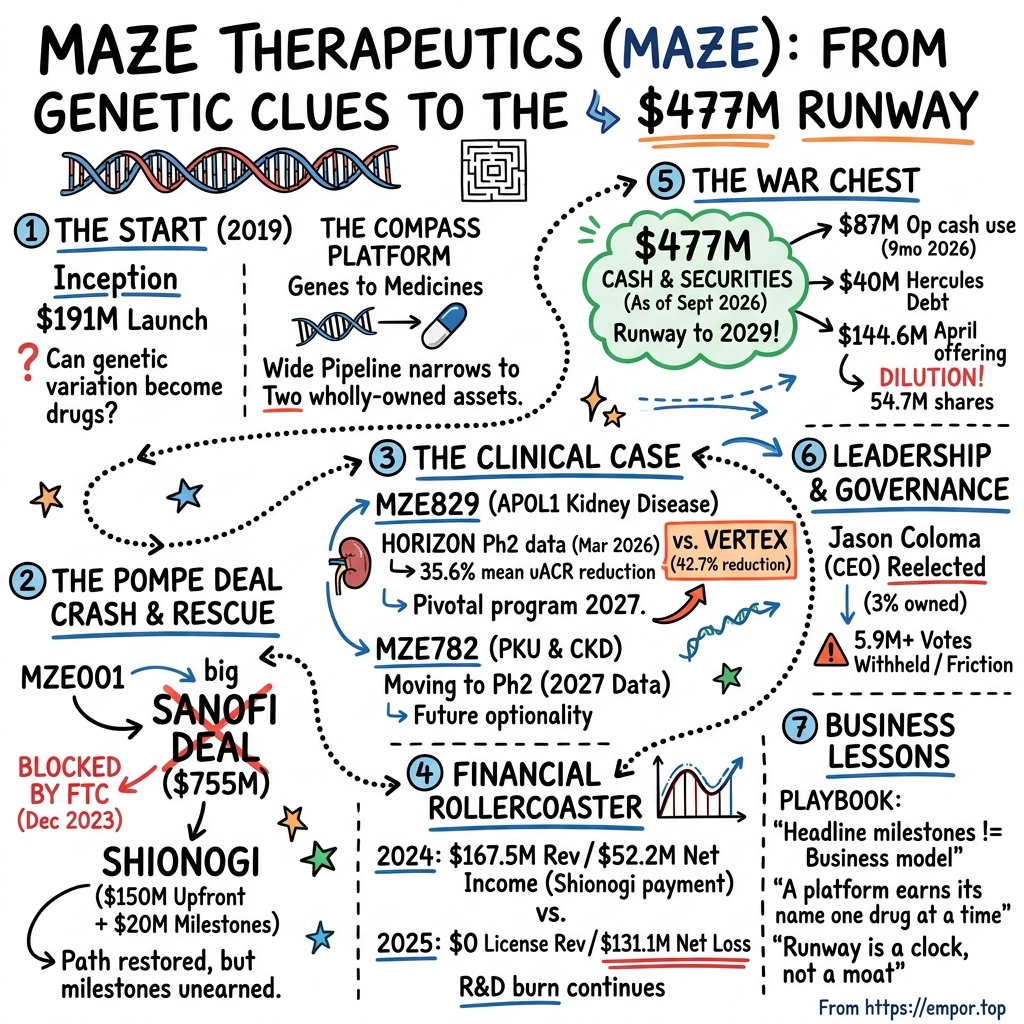
Maze Therapeutics: The Genetic Clues, the Drug Deals, and the $477 Million Runway
I. The Clue That Became a Company
At the end of February 2019, a new biotech company stepped out of the South San Francisco fog carrying an unusually large launch round for a company with no drug in a human being: $191 million.[^1] The pitch was elegant enough to fit on a napkin. Every person carries thousands of small differences in their DNA. Most of them do nothing. A few make people sick.
And a precious handful do the opposite: they quietly protect their carriers from diseases that devastate everyone else. If you could find those protective quirks, work out exactly what they do inside a cell, and then build a pill that copies them, you would have a medicine whose first clinical trial had, in a sense, already been run by nature on millions of people over thousands of years.
That is the promise Maze Therapeutics was built on. The company called its discovery engine Compass, and it grew up in the orbit of Third Rock Ventures, the Boston firm that specializes in incubating companies around a scientific idea and then hiring the operators to run them, and which remains Maze's largest shareholder.1 Charles Homcy, whom the company describes as its co-founder, chaired the board from June 2018 until October 2025.1 The operator arrived a few months after the launch. Jason Coloma, a venture partner at Third Rock since 2016 and before that a nine-year dealmaker at Roche and Genentech, became chief executive in July 2019.1 He has run the company ever since.
Now jump forward nearly eight years, to a quarterly filing published on November 9, 2026. The company that launched with $191 million reported $477 million in cash, cash equivalents and marketable securities at the end of September.2 On the surface, that looks like a story of compounding: a start-up that more than doubled its war chest.
Read one line further, and the picture changes. Maze had no product sales. It had never had product sales. It reported zero revenue in the third quarter, a net loss of almost $48 million for those three months alone, and an accumulated deficit of more than $600 million since its founding.2 The $477 million is not profit that built up. It is mostly money that new shareholders handed over in the twenty months since the company went public, and it exists to be spent.
That distinction is the heart of this story. Maze is a clinical-stage biotech, which means its business model is, at this point, a sequence of experiments funded by other people's capital. Its only revenue has come from licensing drugs it discovered to larger companies, which pay upfront fees and promise more money if the drugs keep succeeding.3 That model produced one spectacular year and several empty ones. Meanwhile the company's two wholly owned drugs, MZE829 for a genetically defined form of kidney disease and MZE782 for a rare metabolic disorder and broader chronic kidney disease, are still in mid-stage trials.3
So three questions will follow Maze through this story. The first is scientific: does the Compass approach of reading protective genetics actually produce better medicines, or just plausible targets? The second is economic: when Maze's science works, who captures the value, Maze's shareholders or the larger partners who license and sell its drugs? The third is financial: how much of the company will existing owners have to give away, in new shares and secured debt, before the first two questions are answered?
The verdict at the outset is narrow and worth stating plainly. Maze has built a well-funded drug-development company and, in March 2026, produced its first meaningful clinical signal in patients. It has not shown that its science can generate durable product revenue, and it will not be able to show that for years. Everything that follows is about the distance between a genetic clue and a business, and how a company pays its way across that gap.
 Subscribe on LinkedIn
II. A Map from Genes to Medicines
Picture a lock that has been jammed in millions of houses. Locksmiths have spent decades trying to force it open. Then someone notices that in a few houses, the lock works perfectly, because the owner happened to cut a slightly different key. You no longer need to understand everything about the lock. You need to study that one key.
That is roughly how Maze describes its approach. The company says it is "harnessing the power of human genetics to develop novel, small molecule precision medicines for patients living with kidney and metabolic diseases."3 In practice, Compass has two halves. The first half is statistical: mining enormous population databases, such as the UK Biobank, the Million Veteran Program, Vanderbilt's BioVU and the National Institutes of Health's All of Us cohort, to find genetic variants that track with lower or higher risk of disease.3
The second half is what the company calls "variant functionalization": taking a variant that looks interesting on a spreadsheet into the laboratory and working out what it physically does to a protein.3 Does it break the protein? Make it less active? Change its shape? Only once the mechanism is clear does the chemistry begin, with medicinal chemists hunting for a small molecule, an ordinary pill, that reproduces the protective effect in people who were not lucky enough to inherit it.
The cleanest illustration is the program that now anchors the company. A protein called APOL1 comes in versions, and two of them are well known to kidney doctors because people who inherit two copies of these high-risk variants face a sharply elevated chance of kidney disease. Maze's interest was sharpened by a rarer variant, known as N264K, which researchers studied in the Million Veteran Program, BioVU and All of Us.3
Carriers of that variant appeared to be shielded from the kidney damage the high-risk versions cause. To a company built on protective genetics, that is a near-perfect clue: it suggests that blocking a specific function of APOL1 is not only safe but beneficial. MZE829 is Maze's attempt to bottle that clue.
The second program followed the same logic. Analyses drawn from the UK Biobank and the German Chronic Kidney Disease study pointed Maze toward a transporter called SLC6A19, which pulls certain amino acids back into the body from the gut and kidney.3 People with naturally reduced activity of that transporter appear to tolerate that reduction, and Maze believes deliberately blocking it could help two very different groups of patients. That program became MZE782.
It is worth pausing on what this method does and does not buy. Genetic evidence improves the odds that a target matters in human disease, which is the single largest reason drugs fail. It also tells a company something about safety, because people who carry a naturally weakened version of a protein are a living record of what happens when it is turned down. What it does not do is solve chemistry, dosing, side effects, trial design or commercial reality. A protective variant tells you which door to open. It says nothing about whether your key will fit, how much it will cost to cut, or whether a rival will reach the door first.
The early Maze looked broader than the company does today. Its first wave of work spanned rare muscle disease, neurology and kidney medicine. Over time, the portfolio narrowed sharply. MZE001, the Pompe disease drug that will dominate the next chapter, was licensed out. A program aimed at the ALS-linked gene ATXN2 went to Neurocrine Biosciences in May 2024, and a program built around UNC13A, another ALS target, went to Trace Neuroscience the previous month.3 Then, in August 2026, Neurocrine notified Maze that it would terminate the ATXN2 license effective November 2026, returning a program that a partner had paid for and then chosen to walk away from.2
Not every early bet survived even that long. In 2022, Maze wrote down and dissolved Contour, a joint venture it had set up, booking a net loss of about $2.4 million and leaving no remaining investment on its books.4 The sum was small, but the episode is a useful reminder that a discovery company's portfolio is a funnel, and that most of what enters it does not come out the other end as a medicine.
What remains at the core is two wholly owned clinical programs, MZE829 and MZE782, both aimed at kidney and metabolic disease.3 Focus can be a strength. A company with roughly 141 employees, 108 of them in research and development at the end of 2025, cannot run a sprawling portfolio well.3 But the narrowing also clarifies the test. The platform claim, the idea that Compass is a repeatable machine rather than a lucky hit, no longer rests on a slide of many programs. It rests on two.
That sets the bar for everything that follows. To earn the word "platform," Maze needs more than targets and more than clinical entry, which are milestones a well-funded company can buy. It needs repeated clinical proof that its genetically chosen drugs work in patients, evidence that they are meaningfully different from what competitors offer, and eventually approval and adoption. So far, the clearest early evidence that someone else valued what Compass produced came not from a patient but from a partner, and from the antitrust regulator who stopped that partner.
III. The Pompe Deal That Collapsed at the FTC
On December 11, 2023, the three sitting commissioners of the Federal Trade Commission voted unanimously to sue to block a drug deal that most people outside the rare-disease world had never heard of.5 The target was not a merger of giants. It was an exclusive license that Sanofi, through its Genzyme subsidiary, had agreed to take on a single experimental pill from Maze. The FTC valued the arrangement at up to $755 million.5 Sanofi had agreed to pay $150 million upfront, with the balance tied to future milestones.4 And the commission argued that the whole point of the deal, from Sanofi's side, was to make sure the pill never threatened Sanofi's business.
To see why, it helps to understand Pompe disease. It is a rare inherited disorder in which the body lacks enough of an enzyme that breaks down glycogen, a stored form of sugar, inside cells. Glycogen piles up, especially in muscle, and the muscles, including the heart and breathing muscles, weaken over time. The standard treatment is to replace the missing enzyme by infusion. Sanofi, the FTC said, was a monopoly supplier of FDA-approved Pompe therapies, which patients receive through lengthy intravenous infusions every two weeks, at a cost the commission described as hundreds of thousands of dollars for an annual course of treatment.5
MZE001 attacked the problem from the other end. Think of a bathtub that keeps overflowing because the drain is clogged. Enzyme replacement is a plumber who comes every other week to clear the drain. MZE001, an inhibitor of an enzyme called glycogen synthase 1, tries to turn down the tap, so less glycogen is made in the first place.5
It was an oral tablet taken twice daily; it had finished a Phase 1 study in 129 healthy volunteers in December 2022, and the FTC described it as Phase 2-ready and potentially the first oral medication available for Pompe patients.35 For a monopolist selling biweekly infusions, a pill that might one day reduce the need for them, or be combined with a rival's product, is exactly the kind of nascent competitor antitrust law worries about.
The FTC's theory, laid out in its complaint, was that Sanofi had singled out MZE001 shortly after Maze revealed its plans for the drug in 2021, and that taking control of it would both extend Sanofi's monopoly and reduce competition to develop new Pompe drugs.5 The agency asked a federal court in Massachusetts for a temporary restraining order and preliminary injunction.5
Note the legal shape of what happened. This was not an acquisition of Maze. Maze would have remained an independent company. But because an exclusive license can transfer control of an asset as completely as a purchase, it was reviewable under premerger rules, and the FTC treated the rights to the drug as the thing being acquired.
The fight was short. Two days after the vote, Sanofi, Genzyme and Maze filed a joint motion with the FTC's own staff to dismiss the case, stating that the companies had terminated the license agreement and that Sanofi had withdrawn its premerger notification.6 On December 20, 2023, the commission granted the motion and dismissed the complaint without prejudice.6 The $150 million upfront payment that Maze had expected to receive when the license transferred never arrived from Sanofi.
The order itself is a single page. It was signed for a commission then chaired by Lina Khan, alongside Rebecca Kelly Slaughter and Alvaro Bedoya, under docket number 9422, and it named Sanofi, Genzyme and Maze as respondents.6 Because the dismissal was without prejudice, the agency kept the right to act again if a similar deal resurfaced. Rarely has a nine-day legal fight said so much about a drug that had never been given to a patient. It also sent a signal to every large drugmaker shopping for licenses: buying a pill that might compete with your own franchise would invite scrutiny, which may have narrowed the pool of natural buyers for assets like MZE001.
For Maze, the episode cut two ways at once. On one hand, it was a remarkable piece of external validation. A federal regulator had argued, in public and in writing, that a Maze molecule was a credible enough threat to the dominant Pompe franchise that its largest seller would pay hundreds of millions of dollars to control it. Few early-stage biotechs get that kind of endorsement.
On the other hand, it exposed how little of that headline value Maze actually controlled. The $755 million was a ceiling, made mostly of contingent milestones. The partner's motives were not necessarily aligned with the drug's success. And a decision made in Washington, about Sanofi's market position rather than MZE001's science, could strand the asset overnight.
Maze did not stay stranded for long. In January 2024, Shionogi, the Osaka-based drugmaker known in Japan as 塩野義製薬, announced an exclusive license to MZE001.[^8] Maze received a $150 million upfront payment and became eligible for further development, regulatory and commercial milestones, plus tiered royalties on any sales.3 Shionogi had no competing Pompe franchise to protect, which made it, in antitrust terms, a much cleaner home for the drug. The economics mirrored the Sanofi proposal's upfront fee almost exactly, which suggests the asset's near-term price had been set by the drug's data rather than by Sanofi's strategic anxiety.
Shionogi then did what a partner is supposed to do: it advanced the program. When the first patient entered its Phase 2 study, Maze recognized a $20 million milestone in March 2026 and collected the cash in April.2 That is the licensing model working as designed. But it also shows the structure of the payoff.
The upfront fee arrived when Maze handed over the rights. The milestones arrive only when Shionogi chooses to spend its own money to push the drug forward, on Shionogi's timetable. Royalties arrive only if the drug is approved and sells, years from now if ever. Maze does not disclose the total value of the remaining milestones, and it does not set the development plan.
Which leaves the question that will recur throughout Maze's story. Licensing turned a promising molecule into $170 million of cash so far, which helped fund everything else the company has done. It also transferred most of the long-term upside, and all of the control, to someone else. When the company's own drugs mature, will Maze keep them, or sell them the same way? The answer starts with what the Shionogi money did to Maze's income statement.
IV. The Year Maze Looked Profitable
Imagine an investor glancing at Maze's financial statements for 2024 with no other context. Revenue: $167.5 million. Net income: $52.2 million.3 For a company founded five years earlier, that would look like an unusually fast path to profitability. A year later, the same investor would see revenue of zero and a net loss of $131.1 million.3 Nothing catastrophic had happened in between. The business had simply gone back to being what it always was.
The 2024 number was almost entirely licensing. Shionogi's $150 million upfront payment made up the bulk of it; Trace Neuroscience paid $15 million upfront for the UNC13A program, and Neurocrine paid $2.5 million for ATXN2.3 Under accounting rules, Maze recognizes an upfront license fee as revenue at the moment control of the license transfers to the partner, because at that point the company has delivered what it sold.3 That is a sensible rule, and nothing about it is aggressive. But it means that a single signed agreement can land in one quarter as pure revenue with almost no associated cost, flipping the entire year into profit.
The cost base, meanwhile, never stopped growing. Research and development spending rose from about $74 million in 2023 to $108.4 million in 2025.43 In the first nine months of 2026 it hit $109.3 million, already more than all of 2025.2 In the third quarter alone, Maze spent $40.2 million on R&D, up from $25.2 million a year earlier, an increase of about 60%, as MZE829 moved through its expanded Phase 2 study and MZE782 entered patient trials.2 General and administrative costs, the price of being a public company with a growing team, climbed from about $24 million to almost $37 million over the same nine-month comparison.2
The bottom line followed. Maze lost about $48 million in the third quarter of 2026, compared with about $30 million a year earlier, even after a modest rise in interest income.2 Per share, the loss widened from 66 cents to 79 cents, a smaller increase than the dollar loss because the share count had grown in the meantime.2 Investors who watch earnings per share at a company like this can be misled in both directions, because issuing stock spreads a larger loss over more shares.
Put those lines together and the shape of the business becomes clear. Maze is a research organization with operating expenses of about $50 million a quarter and rising, punctuated occasionally by partner payments that arrive when someone else decides to buy or advance one of its discoveries. In 2024, a partner check was large enough to cover a year of spending and then some. In 2025, there was no check. In 2026, the only check was Shionogi's $20 million milestone, enough to cover a little over a month of operating costs at the current pace.
The people tell it too. Maze had 121 employees in September 2024, 95 of them in research and development; by the end of 2025 it had 141, with 108 in R&D.43 A company harvesting a licensing windfall would have held its team steady or trimmed it. Maze did the opposite, which is the right instinct for a company whose only path to lasting value runs through its own trials, and also the reason the costs will keep climbing.
The cash tells the same story with less noise than the income statement. Following the money matters here because biotech accounts carry large non-cash items, especially stock-based compensation, that can make losses look worse than the cash drain. In 2024, the $52.2 million profit became $76.0 million of cash generated by operations, helped by non-cash charges.3
In 2025, the $131.1 million loss translated into $111.9 million of operating cash used. In the first nine months of 2026, a $116.9 million loss became $87.0 million of operating cash burn.32 There is no working-capital trick hiding in those figures. Maze has no inventory, essentially no receivables, and the Shionogi milestone was collected within weeks of being earned.2 The cash burn is the real economic cost of running the experiments.
One small offset deserves mention because it is easy to mistake for operating strength. Maze earns interest on its pile of Treasuries and corporate debt: $11.8 million in 2025 and $9.2 million in the first nine months of 2026.32 That is real money, and it stretches the runway by a few weeks every year. But it is a function of how much cash shareholders have provided and what the Federal Reserve sets as the price of money. It falls as the cash is spent and would shrink if rates fell. It is the return on a savings account, not on a drug.
So the 2024 profit should be read for what it was: a financing event that happened to pass through the income statement. It funded roughly a year and a half of operations. It did not demonstrate recurring operating profitability, and the company has never claimed it did.
The measure that matters from here is simple to state and hard to change: how much cash Maze receives from partners versus how much it spends, until the day, if it comes, when it has products of its own. For now, the only way to change that ratio in shareholders' favor is clinical data good enough to make the company's own drugs valuable. The first such data arrived in March 2026.
V. MZE829's First Human Signal Meets Vertex
On March 25, 2026, the same day Maze filed its annual report, the company released the number it had been working toward since that protective APOL1 variant first caught its scientists' attention. In an open-label Phase 2 study called HORIZON, twelve patients with APOL1-mediated kidney disease who had taken MZE829 for twelve weeks showed an average reduction of 35.6% in a measure of protein leaking into their urine.7 Half of them saw that measure fall by more than 30%.7 For a company whose entire thesis was that human genetics could point the way to better drugs, this was the first time the pointer had been tested in patients who actually had the disease.
To understand why that matters, start with the disease. Maze estimates that about six million African Americans, roughly 13% of that population, carry two high-risk versions of the APOL1 gene, and that about a fifth of them, more than a million people, have chronic kidney disease attributable at least in part to those variants.3 The company sizes its initial addressable population in the United States at at least 250,000 patients.3
The high-risk APOL1 protein is believed to form toxic pores in the membranes of kidney cells, like a drill punching holes in a wall, and the damaged cells let protein escape into the urine and slowly lose their ability to filter blood. Existing kidney drugs, such as blood-pressure medications and the newer SGLT2 inhibitors, slow kidney disease in general but do not address this genetic cause.
That is where precision becomes a commercial idea as well as a scientific one. If you can identify patients with a simple genetic test, you know exactly whom to treat, whom to enroll in trials, and whose disease is driven by the mechanism your drug targets. MZE829 is designed to stop the pore from working. Maze also believes it disrupts the pore's assembly, a feature the company calls a "dual mechanism."3
In the analogy, it both blunts the drill and stops the drill from being put together. In a Phase 1 study of 111 healthy volunteers reported in October 2024, the drug showed a half-life of about 15 hours, supporting a single 250-milligram pill once a day.3 Convenience of that kind matters in a chronic disease where patients already take several medicines.
The HORIZON details reward a careful reading. Fifteen patients enrolled and all were included in the safety analysis; twelve met the protocol's threshold for efficacy evaluation.7 The patients were mixed by design, a so-called basket study: eight had APOL1 kidney disease without diabetes, five of whom had biopsy-confirmed focal segmental glomerulosclerosis, or FSGS, a particularly aggressive form; seven had diabetes as well.7 All were on stable background therapy such as SGLT2 inhibitors or GLP-1 drugs.7
The headline 35.6% average concealed a wide spread. The FSGS patients saw a mean reduction of 61.8%, and patients without diabetes 48.6%.7 Among the five evaluable diabetic patients, only two reached the 30% response threshold, with reductions of about 35% and 47%.78 Safety was clean for a study of this size: no serious adverse events, no severe treatment-related ones, and one early discontinuation for mild nausea.7
Read the limits as clearly as the signal. Twelve patients is a tiny number, and in the FSGS subgroup the striking 62% figure rests on four of them.8 The study was open label, meaning both patients and doctors knew everyone was on the drug, with no placebo group for comparison. Follow-up was twelve weeks. And the endpoint, the urinary albumin-to-creatinine ratio or uACR, is a biomarker.
Think of it as a smoke detector: when protein leaking into the urine falls, it suggests the fire in the kidney is smaller. Regulators have come to accept that kind of reduction as reasonably likely to predict benefit, which is why it can support accelerated approval, but it is not the same as preventing dialysis or kidney failure. Those are the outcomes payers and doctors ultimately pay for.
The rival with a head start
The subgroups also hint at how the market could be cut. Tahir put the U.S. FSGS population with APOL1 disease at around 10,000 patients, a figure he suggested may be an underestimate, within the broader pool of about 250,000.8 A drug that proved clearly superior in FSGS could own a high-value niche even if it ended up level with a rival in the broader population. That is a plausible strategy, but it rests on four patients today.
Maze is not alone at this door, and the company it faces is one of the most formidable in the industry. Vertex Pharmaceuticals, the company that built a franchise dominating cystic fibrosis by targeting a genetically defined disease with small molecules, has been developing its own APOL1 inhibitor, inaxaplin, for years. In September 2026, Vertex reported that inaxaplin had produced a 42.7% reduction in proteinuria at week 13 in a subgroup of its Phase 2b AMPLIFIED study, alongside an update on its pivotal AMPLITUDE program.[^11] Maze's own filings list companies advancing APOL1-targeted candidates among its competitive risks.3
It is tempting to put 35.6% next to 42.7% and declare a winner. That would be a mistake. The studies enrolled different patients, used different durations and endpoints, and the Vertex figure comes from a specific subgroup rather than a broad basket. Maze's FSGS subgroup did better than Vertex's number; its diabetic subgroup looked weaker. None of that is a head-to-head comparison, and anyone who presents it as one is selling something. The fair reading is that both drugs appear to work on the same biology at a broadly similar early magnitude, and that Vertex is further along, with far deeper pockets and a sales force that already calls on specialists.
There is a pleasing irony in the cast list. Harold Bernstein, Maze's president of research and development and chief medical officer since October 2022, spent four years at Vertex before a stint at BioMarin.1 Maze's medical leadership knows the rival's development culture from the inside. That is useful, but it does not change the arithmetic of being second.
When analysts pressed on the rivalry at a Wells Fargo healthcare conference in September 2026, CFO Misbah Tahir was disciplined to the point of reticence: "We'll certainly let Vertex speak to their drug."8 He also offered a sense of how thin the whole field's evidence still is, noting that only about 25 patients with this disease had been read out across the field at that point.8
More revealing was his answer on design. Asked whether Maze's pivotal trial would resemble Vertex's one-year accelerated-approval structure, he called that "a reasonable starting point or a base case assumption."8 In other words, Maze is not planning to outflank Vertex with a novel regulatory path. It plans to follow the road Vertex is paving, and to win, if it wins, on the drug itself.
So what would validate the dual-mechanism claim? Management's argument is that blocking both assembly and function should produce deeper or more consistent responses. The evidence that would support it is fuller HORIZON data showing that the effect holds up across more patients, especially diabetics, who are a large share of the APOL1 population; durability beyond twelve weeks; a safety profile that stays clean as exposure lengthens; and a pivotal design that regulators accept. The evidence that would weaken it is equally specific: responses that shrink as the sample grows, a diabetic signal that stays weak, or Vertex reaching the market with a label broad enough to make a second entrant's case a marginal one.
The next chapter is already in motion. Maze lowered the uACR threshold for entry into HORIZON from 300 to 200 and capped FSGS enrollment, so that the expanded study better reflects the broad patient population.8 It has completed enrollment across three cohorts and expects to report additional data in early 2027; Tahir had guided to roughly 10 to 15 patients in each segment, three to four times the original dataset.[^12]8 Management says a pivotal program is planned for the first half of 2027.[^12]
Here is the claim at its weakest point. An encouraging change in a biomarker in a dozen unblinded patients is proof of concept. It is not a kidney outcome, an approval, a market share or a price. Maze has earned the right to run a bigger trial, which is precisely what a Phase 2 proof of concept is supposed to deliver. Whether MZE829 is the better drug, or merely the second one, is a question that larger and longer studies will answer. And the company's case does not rest on MZE829 alone, because the same discovery engine produced a second program aimed at a very different problem.
VI. MZE782: A Second Chance to Prove the Platform
There is a particular kind of childhood in which every meal is a calculation. Children born with phenylketonuria, or PKU, cannot properly break down phenylalanine, an amino acid found in most protein-rich food. Left unchecked, it builds up in the blood and damages the developing brain. The traditional answer is a lifelong, severely restricted diet supplemented with medical formula, a regimen that many patients find hard to sustain into adulthood. Maze estimates that at least 60,000 people are living with PKU across key geographies.3
MZE782 approaches PKU from an unusual angle. Instead of trying to fix the broken metabolic step, it targets SLC6A19, the gut-and-kidney amino-acid transporter.3 Block it, and more phenylalanine leaves the body in urine rather than being reabsorbed. It is the bathtub logic again, this time opening a second drain rather than turning down the tap. The genetic clue is that people with naturally reduced SLC6A19 activity appear to live with it, which suggests the approach may be tolerable.
The early human data were striking on their own terms. In a Phase 1 study of 112 healthy adults reported in September 2025, a single 960-milligram dose raised 24-hour urinary phenylalanine excretion about 39-fold from baseline, and 240 milligrams twice daily for a week produced about a 42-fold increase, comfortably past a pre-set ten-fold benchmark.3 Even a lower 120-milligram once-daily dose produced about a twelve-fold increase.3 The dose-response is what pharmacologists hope to see: more drug, more effect, in a predictable way.
Maze then moved into patients. Its PKU Phase 2 study, called CIPheR, has three arms: 120 milligrams twice daily, 240 milligrams twice daily, and 240 milligrams twice daily combined with an existing BH4-based therapy, with topline data expected in 2027.8[^12] The combination arm is a tell. It suggests Maze sees MZE782 not only as a stand-alone treatment but as something that could be layered onto the drugs PKU patients already take, which would make it easier for specialists to adopt and harder for payers to dismiss.
Discipline matters here. A healthy volunteer excreting more phenylalanine is a pharmacology result, not a therapeutic one. The question for PKU patients is whether blood phenylalanine falls enough, for long enough, to matter clinically, and whether the drug lets them eat more normally. Phase 1 progress shows the pump can be blocked. It does not show the patient will feel the difference.
The competitive landscape is also more crowded than the size of the disease suggests. The existing pathways include the diet itself; oral drugs that boost the residual activity of the broken enzyme, which Maze says work for only an estimated 10% to 20% of classic PKU patients; and an injectable enzyme substitute that requires daily subcutaneous dosing and carries a risk of anaphylaxis.3
An oral drug with a different mechanism that could be added to existing regimens has a plausible niche, which is presumably why Maze is testing a combination arm. But PKU is a rare disease with established specialists and established options, and a new drug must show not just activity but a meaningful improvement in patients' lives.
Then there is the bigger bet. Maze also wants to test MZE782 in chronic kidney disease, a condition affecting about 37 million Americans and roughly 700 million people worldwide.3 The rationale is that changing how the kidney handles amino acids might reduce strain on it, and Maze points out that about a quarter of patients respond inadequately to SGLT2 inhibitors, one of the current pillars of care.3
If that worked, it would turn a rare-disease drug into a mass-market one. It is also the most speculative claim in the company's portfolio: there is no patient data in CKD yet, the standard of care already includes several drug classes, and large kidney-outcome trials are among the most expensive studies in medicine.
The timeline offers a small but useful test of execution. In its annual report, filed in March 2026, Maze said it planned to start the PKU Phase 2 trial in mid-2026 and the CKD Phase 2 trial in the second half of 2026.3 The PKU study did get under way roughly as planned.
The CKD study did not: by September, Tahir was guiding to a start in the "first half of next year," and the company's November update places it in the first half of 2027.8[^12] Tahir said nothing was gating the start. A slip of a few months for a Phase 2 trial is common and, on its own, minor. But it is the kind of gap between plan and delivery that investors should log, because the value of a pipeline depends on its clock.
So keep MZE782 in proportion. It is genuine optionality, because a single drug that might address two very different diseases broadens the possible payoff of the platform, and because a success would answer the question of whether Compass can produce more than one good medicine. But it is earlier, less proven and further from revenue than MZE829. Its value should rise only with patient data and a credible path to adoption, not with trial starts. Which raises the deeper question: if one or both of these drugs works, what stops someone else from taking the reward?
VII. The Platform's Moat Is Still a Clinical Question
Run the war game forward a few years and imagine the best case. MZE829's expanded HORIZON data hold up, the pivotal trial succeeds, and Maze stands at the edge of the APOL1 kidney market with an approvable drug. What happens next is no longer about genetics. It is about a nephrologist in Atlanta deciding which of two pills to prescribe, an insurer's pharmacy committee deciding which one to cover, and a patient deciding which one they can tolerate. In that room, a protective variant discovered in a biobank is a footnote.
This is the uncomfortable truth about discovery platforms. Genetic precision helps a company choose targets with better odds and identify patients with a test. Those are real advantages in the laboratory and the clinic. They do not by themselves create the things that make a drug business durable: lower development costs than rivals, switching costs for patients, pricing power with insurers, or a reason for doctors to prefer one product over another. Once a target has been validated in public, every competitor can read the same papers. Vertex did not need Compass to find APOL1.
The competitive map Maze faces has several layers. The first is the direct rival. Vertex is the lead APOL1 competitor, with a more advanced program, a pivotal trial already running,[^11] a commercial organization and a balance sheet many times larger than Maze's. Being first matters in specialty medicine because the first drug sets the treatment guidelines, trains the prescribers, and negotiates the formulary positions that a second entrant has to dislodge. A follower needs a clear reason to switch, such as better efficacy, better safety, more convenient dosing, or a population the leader's label does not cover.
The second layer is the standard of care. APOL1 patients are already treated with blood-pressure drugs, SGLT2 inhibitors and, increasingly, GLP-1 medicines, the same classes HORIZON patients were taking.7 A targeted APOL1 drug would most likely be added on top of those, which is good for addressable volume but means payers will scrutinize the incremental benefit. For MZE782 in CKD, the standard of care is broader still, spanning several drug classes with large outcome trials behind them.3
The third layer is the buyer. Rare and specialty kidney drugs in the United States are paid for by a concentrated group of insurers and pharmacy-benefit managers, plus Medicare, which already devotes more than 24% of its spending, about $130 billion, to chronic kidney disease.3 A payer that sees two similar APOL1 drugs has every incentive to play them against each other on price. That is the buyer-power version of the moat question, and it argues against assuming that a second-to-market drug will command a premium.
The fourth layer is the partner. If Maze decides not to commercialize alone, large pharmaceutical companies can finance and launch an asset in ways a 141-person company cannot. That is the MZE001 lesson in reverse. A partner brings money and reach, and in return takes control and most of the economics. The more competitive the market, the stronger the partner's bargaining position, because a partner who could license a rival asset has alternatives, while a biotech with one late-stage drug does not.
None of this means Maze lacks advantages. It has a plausible discovery capability, demonstrated by its licensed and clinical programs. It has a focused set of genetically selected targets in kidney and metabolic disease, where a genetic test can define the patient. And its APOL1 drug may turn out to be better, or just different enough to own a segment, such as patients with FSGS. But those are hypotheses about clinical differentiation, not demonstrated barriers. The moat claim, as of today, is unproven.
What would change the assessment is concrete. Replicated clinical benefit in a larger, controlled population would be the first step. A safety and tolerability profile that compares favorably with inaxaplin's would be the second. A clear place in the treatment pathway, defined by guidelines and payers rather than by press releases, would be the third. And evidence that Compass can produce multiple successful drugs, not one, would convert the platform from a story into a process. Each of those requires time and money, which is why the most important number at Maze is not a trial result. It is the runway.
VIII. $477 Million, and the Cost of Getting to 2029
Maze went public in the first week of February 2025, selling 8.75 million shares at $16 apiece.4 After about $15 million of underwriting fees and costs, the company kept roughly $125 million.2 At the same moment, the preferred shares that venture investors had accumulated over six years converted into about 32.6 million common shares.2 It was a respectable debut in a nervous biotech market, and it should have been the beginning of a straightforward funding story. Instead, it was the first step of a sequence that tells you how a clinical-stage company actually pays for itself.
The second step came within months, and not on easy terms. By the end of June 2025, the stock traded at $12.27, almost a quarter below the IPO price.3 Maze nonetheless raised about $141 million net in a September 2025 private placement of common shares and pre-funded warrants, a structure that lets large holders buy exposure without crossing ownership thresholds.2 Among the investors were funds including Deep Track Capital, Janus Henderson and Frazier Life Sciences.1 Private placements of this kind are a vote of confidence from specialists who have seen nonpublic diligence, but they also tell the market that the company needed capital before its key data had arrived.
Then came HORIZON, and the market's mood turned. In April 2026, a few weeks after the topline data, Maze sold 5.54 million shares at $23.50, plus pre-funded warrants for another 850,000 shares, raising about $144.6 million net.2 Through September, it also tapped a $200 million at-the-market program, which lets a company dribble shares into the market at prevailing prices, selling about 1.49 million shares at an average of $29.32 for about $42.2 million net, with about $156 million of capacity left.2 That is sound opportunism. Raising money when the stock is near its highs, after good news, costs existing holders less ownership per dollar than raising it in a slump.
Add up the four equity raises since listing and the total comes to roughly $450 million of net proceeds. Set that beside the $477 million of liquidity at September 30, and an uncomfortable symmetry appears: almost the entire balance sheet is new shareholders' money from the past twenty months.2 The Shionogi cash and the pre-IPO capital have largely been spent on the experiments that made the later raises possible. That is how clinical biotech works, but it reframes the war chest. It is not a fortress the business built. It is a deposit others made on the next set of answers.
The share count shows the price. Maze had about 49.3 million common shares at the end of 2025 and about 56.4 million at September 30, 2026.2 The cover of the quarterly report listed about 54.7 million as of November 4.2 The decline is not a buyback. In October 2026, Maze entered an exchange transaction that retired about 2.78 million shares in return for warrants with a near-zero exercise price, subject to ownership limits.2 Economically, those warrants are almost the same as shares; they simply sit outside the share count. So investors who want the true denominator need to add the pre-funded and exchange warrants back in. Dilution has not shrunk. It has changed form.
Alongside the equity, Maze added debt. Early in 2026 it signed a senior secured facility with Hercules Capital of up to $200 million, of which $40 million was funded.2 The loan bears interest at the greater of 7.95% or the prime rate plus 0.95%, matures on February 1, 2031, and is secured by substantially all of Maze's assets except its intellectual property.2
The remaining tranches depend on clinical and financing milestones, covenants and the lender's approval. Venture debt like this is cheap relative to selling stock at a low price, and the intellectual-property carve-out protects the crown jewels. But the lien, the covenants and the roughly $1 million a quarter of interest expense are real constraints, and a lender's approval is not guaranteed at the moment a company most needs it.2
The fine print on the loan is worth a sentence more. Principal repayments are not scheduled until 2030 and 2031, and Maze owes an end-of-term charge of about $2.6 million on top of the principal.2 So the debt does not threaten the 2027 readouts. What it does is put a secured creditor ahead of shareholders for the period when the company will be spending most heavily, and give that creditor a say over whether the next tranches are available. That is a reasonable trade for a company with this much cash. It would be a harder one if the data disappointed and the cash began to run low.
Now to the runway itself. Management says its cash will fund operations into 2029.[^12] Simple arithmetic shows why that claim is plausible and why it is fragile. In the second quarter, the company had about $495 million of cash and investments; by the end of the third, despite about $14 million of fresh at-the-market proceeds, it had $477 million.82
Operating cash use averaged about $29 million a quarter in the first nine months of 2026, but spending accelerated through the year as trials expanded: stripping out the fresh stock sales, the balance fell by roughly $32 million in the third quarter alone.2 At around $40 million a quarter, $477 million lasts roughly three years, which reaches into 2029. Add a pivotal APOL1 trial, a CKD Phase 2 study and the build-out a company needs before a regulatory filing, and that quarterly figure will climb. A runway guide is an output of a plan, and the plan includes assumptions about how much the next trials will cost.
The composition of the pile also matters. At September 30, about $154 million sat in cash and cash equivalents, about $236 million in marketable securities due within a year, and about $87 million in securities due later.2 Holdings due after more than a year had risen from about $18 million at the start of 2026, a shift toward longer-dated paper as the balance grew.2 Against all of that, the accumulated deficit had reached about $606 million, up from about $490 million at the start of the year.2
Interest income helps, but modestly. Maze's treasury holdings are conservative, predominantly U.S. Treasuries with some commercial paper and corporate debt, all maturing within two years, and the company attributes its unrealized losses to rates rather than credit.2 That is the right posture for money that will be needed for trials. It is also a reminder that treasury income is not an operating business.
So has management's capital allocation been sound? On the evidence, mostly yes in tactics and unproven in strategy. The company raised before data when it had to, raised more after data when it could, layered in non-dilutive debt with sensible protections, and kept most of the cash in safe instruments. What the record cannot yet show is whether the money is buying the right experiments. The value of $477 million depends entirely on what the 2027 readouts establish, and on the people deciding how to spend it.
IX. Jason Coloma's Bet, and the Shareholders' Vote
Jason Coloma's résumé reads like a map of the modern biotech economy. He did research at the University of California, San Francisco and at Cytokinetics, consulted at L.E.K., then spent nine years at Roche and Genentech, ending as a global head of oncology partnering, the person who decided which outside drugs one of the world's largest drugmakers would license.1
He holds a biology degree from the University of San Francisco, a Ph.D. and a master's in public health from UC Berkeley, and an MBA from Dartmouth's Tuck School.1 He then moved from pharma to the venture side before taking over at Maze in July 2019.1
That background helps explain the shape of Maze. A dealmaker who spent nearly a decade evaluating licensing opportunities for big pharma knows exactly what a large partner will pay for, and Maze's record of out-licensing MZE001, ATXN2 and UNC13A reflects that instinct. The question for public shareholders is whether the same leader will be as effective at the opposite task: holding on to a drug, running a pivotal trial, and perhaps building a commercial company.
Coloma has meaningful exposure to the outcome. As of March 31, 2026, he beneficially owned about 1.52 million shares, or 3.0% of the company.1 The composition matters, though. About 1.11 million of those shares were options exercisable within 60 days, and roughly 414,000 were held directly or through a family trust.1 Options give a chief executive powerful upside if the stock rises, but they do not expose him to the downside the way owned shares do.
His reported compensation for 2025 was about $3.46 million, including about $2.37 million in stock awards and about $0.46 million in incentive pay, down from about $5.84 million in 2024 when a large option grant inflated the total.1 Directors and executive officers as a group held about 5.3%.1 For a company of this size, that is a reasonable alignment, if not an extraordinary one.
The finance seat changed in September 2025, when Misbah Tahir succeeded Amy Bachrodt as chief financial officer, with a $50,000 signing bonus and total 2025 compensation of about $3.96 million, much of it in initial equity grants.1 The transition was orderly, and Tahir has become the company's main voice at investor conferences. It matters mainly because the CFO now oversees a balance sheet that has more than doubled and acquired secured debt.
The board went through its own transition. Hervé Hoppenot, the former chief executive of Incyte, became chair in October 2025, succeeding co-founder Charles Homcy, who remains a director.1 The board says all directors except Coloma and Homcy are independent, and the audit and compensation committees are fully independent.1
There are small related-party flows to note: Maze paid founders and certain directors about $0.3 million for consulting in 2025, including $240,000 to Homcy and $60,000 to director Richard Scheller.13 Against an annual cost base of well over $100 million, those sums are immaterial. They are worth knowing mainly because a co-founder who is also a paid consultant is not fully independent of management, which the board acknowledges.
Then there was the vote. At the June 2026 annual meeting, shareholders reelected Coloma and director Neil Kumar, but 5.93 million votes were withheld from Coloma and 7.66 million from Kumar.9 With roughly 50 million shares outstanding at the time, that is dissent equivalent to about 12% to 15% of the company, and a larger share of the votes actually cast.3
Withheld votes do not unseat a director under plurality voting, and Maze does not disclose the reasons. Plausible candidates include the staggered board, the emerging-growth-company status that spares Maze an advisory vote on executive pay, and individual directors' other commitments, but those are possibilities, not disclosed causes.13 It is a concrete governance signal, and the next proxy will show whether it grows or fades.
The auditor vote was quieter. Ernst & Young's ratification drew only 728 votes against, though more than 100,000 abstentions.9 The firm gave the 2025 financial statements an unqualified opinion, and because Maze remains an emerging growth company it was not engaged to audit internal controls, a standard exemption for newly listed companies but one that leaves public holders relying on management's own assessment.3
The fairest way to judge management is not by its credentials but by its record against its own words. That record is still short. The HORIZON and PKU milestones arrived roughly as planned, while the CKD trial slipped from the second half of 2026 to the first half of 2027. The financing was well timed. The next twelve months, with their promised data and pivotal start, will turn a thin record into a real one. And those twelve months are, in a sense, the lesson of the entire company.
X. Playbook: Business & Investing Lessons
The first lesson belongs to the year Maze looked profitable. A single signed license made the research company look profitable; a year later, it was back to losing money. The temptation, for founders and investors alike, is to treat a big partner check as proof of a business. It is better understood as a down payment by someone else on a future you have given them. A headline milestone is not a business model; it is a loan from the future that never has to be repaid, and never repeats on schedule.
The second lesson comes from the protective APOL1 variant and the drug it inspired. Compass found a target Vertex had also found independently, but Maze's genetic insight did not stop a better-funded rival from moving further ahead. A discovery engine is only as valuable as the medicines that come out of it, measured in patients and prescriptions rather than in programs and press releases. A platform earns its name one medicine at a time, and so far Maze has one early proof and one promising pharmacology result.
The third lesson comes from the strangest scene in the story: the Sanofi license that collapsed under FTC scrutiny. It showed both the value of a Maze discovery and how little of that value Maze controlled. A partner's interest can be strategic rather than scientific, a deal's headline number is mostly contingent, and outside forces can cancel it. Shionogi then restored the program's future, but on its timetable and with most of the upside. Partnering buys time and gives up control, and the price of both is set by how many alternatives each side has.
The fourth lesson sits on the balance sheet. Maze's cash gives it time to reach the next readouts, but nearly all of it came from new shareholders and will be spent on experiments. Runway is a clock, not a moat. Its only value is what it lets the company prove before it runs out, and the faster clinical spending rises, the faster that clock ticks.
Taken together, these lessons describe a company whose asset value, clinical evidence and realized cash move on different timetables. A molecule can be worth $755 million on paper in December and nothing a week later. Twelve patients can move a stock above its IPO price while proving nothing commercial. And cash can arrive in a single quarter for work done over years. Investors who keep those three clocks separate will read Maze more clearly than those who merge them.
XI. Analysis & Bear vs. Bull Case
Stand at the November 20, 2026 close and look at what the market is paying. Maze shares closed at $31.37, almost double the $16 IPO price.8 With about 54.7 million common shares outstanding, that is roughly $1.7 billion of market value before counting the pre-funded and exchange warrants that are economically equivalent to shares.2 Subtract the $477 million of liquidity and add back the $40 million of Hercules debt, and investors are paying somewhere around $1.3 billion for the pipeline itself.2
Conventional multiples are meaningless here: there are no earnings to divide by, and the only revenue is milestone timing. What the price appears to assume is that MZE829 has a meaningful chance of reaching approval, that MZE782 carries real option value, and that the company can fund both without crippling dilution. That is a probability-weighted bet on future clinical data, not a valuation of a business that exists today.
The bull case starts with the clinical signal. HORIZON produced an encouraging early signal in APOL1 disease, particularly in FSGS, with no major safety concerns.7 APOL1-mediated kidney disease affects more than a million Americans and has no targeted therapy, so there is room for more than one drug, especially if one proves better in particular subgroups.3
MZE782 offers a second, mechanistically distinct shot, with two possible markets.3 The company has funded its upcoming trials and readouts, including a planned 2027 pivotal start for MZE829, without needing to raise capital at a distressed price. And Shionogi's continued investment in MZE001 is a reminder that Compass has produced at least three assets outside companies chose to pay for.
The bear case begins with HORIZON's limitations, especially the thin FSGS and diabetic evidence.78 Vertex is further along, better resourced and, with its cystic fibrosis franchise, has the template for exactly this kind of genetically defined small-molecule business. Maze has no product revenue, expects continued losses, and is accelerating spending. Its share count has grown substantially since the IPO, and it holds a secured loan and unused at-the-market capacity that can be drawn quickly. The CKD timeline has already slipped once.
Five forces, seven powers
Run Maze through Michael Porter's industry lens and the picture is mostly about the strength of others. Rivalry is intense and asymmetric: Vertex is the incumbent-in-waiting in APOL1, and established drug classes occupy CKD and PKU. Buyer power is high, because concentrated insurers and Medicare will decide whether a second APOL1 drug earns a premium or a discount.
Supplier power is moderate: clinical research organizations and contract manufacturers are plentiful, but large trials depend on a limited pool of nephrology sites and genetically identified patients. The threat of substitutes is real, because many kidney drugs slow disease generically, and future gene-based or antisense approaches could address APOL1 differently. The barrier to entry is the cost and time of clinical development, which protects Maze from new start-ups, but not from Vertex, which is already past it.
Hamilton Helmer's seven powers sharpen the moat question. Maze has no scale economies, network effects or switching costs today, because it sells nothing. Brand does not apply to a clinical-stage company. Counter-positioning is weak: Vertex is not structurally prevented from pursuing the same strategy, it is pursuing it. The candidate powers are two. One is a cornered resource, in the form of patents on MZE829 and MZE782 and the know-how of the Compass process. Patents are real but protect molecules, not targets, so they keep copycats off Maze's chemistry, not off its biology.
The other is process power, the claim that Compass systematically finds better targets than others. That power, if it exists, would show up only as a pattern of clinical successes over time, and the evidence so far amounts to one promising Phase 2 and one strong Phase 1. The moat therefore depends on clinical differentiation. If MZE829 proves differentiated, the moat becomes a patented, superior product in a genetically defined niche. If it proves merely comparable, Maze becomes a follower in a market a stronger company will lead.
An activist looking at Maze would ask three pointed questions. Why does a 141-person company need both a $200 million debt facility and a $200 million at-the-market program, rather than a clear plan to partner MZE829 or MZE782 at the moment of maximum leverage? Why should shareholders trust a 2029 runway guide that does not spell out the cost of the pivotal program it funds? And would the company's long-term value be higher if management committed to retaining a defined share of MZE829's economics, rather than repeating the MZE001 playbook? None of these implies wrongdoing; each is the kind of question the June withheld votes suggest some holders are already asking.
The stress test cuts both ways. If HORIZON's expanded data are strong, Maze faces a strategic fork: commercialize alone, which means a large build-out and more capital, or partner on terms that will be set partly by how threatening Vertex looks at the time. A positive readout does not automatically become shareholder value; it becomes bargaining power, and bargaining power is only as good as the alternatives.
If the data disappoint, the arithmetic turns. At current spending, a large part of the remaining cash would already be committed to MZE782's trials and the organization's fixed costs, and the stock would likely no longer support a raise on favorable terms. The company would be left with MZE782, Shionogi's milestones and a much smaller valuation.
Three measures will tell investors which path Maze is on. The first is MZE829's clinical execution: the early-2027 expanded HORIZON data across three cohorts, and the pivotal program's design and start in the first half of 2027. The second is MZE782's readouts: PKU topline data in 2027 and whether the CKD trial starts on its revised timetable.
The third is quarterly operating cash use against available liquidity, with spending rising.2 Price appreciation from $16 to $31 does not resolve any of them. It simply means the market has started to pay in advance for answers that have not arrived.
XII. Epilogue
Tonight, Maze Therapeutics is a company waiting for its own experiments. The HORIZON study finished enrolling across its three cohorts. The PKU trial is dosing patients. The CKD study is being prepared. The cash sits in Treasuries, the loan sits on the balance sheet, and the at-the-market program sits ready. No product launch is expected in 2027. Almost everything else will.
The first moment will be the expanded HORIZON readout in early 2027.[^12] It will be three or four times the size of the March dataset, with a lower entry threshold that brings in patients closer to the broad population a drug would treat.8 If the average proteinuria reduction holds near the original level and the diabetic group improves, Maze will have a credible case that MZE829 belongs in the market alongside Vertex, and perhaps ahead of it in some patients. If the effect shrinks as the sample grows, a familiar pattern in small open-label studies, the dual-mechanism claim will look like marketing, and the company's center of gravity will shift toward MZE782.
The second moment will be the pivotal program itself, planned for the first half of 2027.[^12] Its design, its size and what regulators say about it will reveal how much it will cost and how long it will take. Tahir's base case, a one-year accelerated-approval design similar to Vertex's, would put an approval decision years away, after Vertex has had its chance to establish the market.8 Whether Maze runs that trial alone or with a partner will answer the question that has followed the company since the Sanofi deal: when Maze has something valuable, does it keep it?
The third moment will be MZE782's PKU data later in 2027.[^12] A meaningful fall in blood phenylalanine in patients would be the platform's second clinical proof and a reason to believe Compass is a process rather than a lucky find. A disappointing result would narrow the story back to one drug. The CKD trial's start, now promised for the first half of 2027, will be a smaller test of whether the company's dates mean what they say.[^12]
Through all of it runs the fourth clock, the cash. Every quarter will show operating burn rising as trials scale, against a balance sheet the company says will fund operations into 2029.[^12] Watch whether Maze sells more stock on the at-the-market program, draws more Hercules tranches, or strikes a partnership that brings cash in rather than sending value out. Each choice will say something about how management judges its own odds.
None of those outcomes will prove durable commercial economics. A good 2027 can strengthen the investment case dramatically; a bad one can narrow it to a fraction of what the market pays today. But even the best year leaves the hardest part ahead: an approval, a launch, a price, and enough patients and doctors choosing Maze's pill over a rival's to pay back more than $600 million of accumulated losses. The tension that remains is the one this company was born with. The clues are real. The medicines are not yet.
XIII. Outro
In February 2019, Maze launched with $191 million and a bet that the luckiest people on Earth, the ones whose genes quietly protect them, could show the rest of humanity how to be well. Seven years later it holds $477 million, has twelve patients' worth of evidence that the bet can work in the clinic, and still has no product revenue.
What makes Maze unlike other biotechs is not the money or the disease area. It is that the company's best moment and its most instructive one were the same: the Sanofi deal's collapse under regulatory scrutiny. Maze has been trying ever since to prove that its discoveries are worth as much in its own hands as they are in someone else's. The next year of trials is when the map it drew from human genetics will finally be checked against the territory, and when Maze will learn whether it leads patients, and shareholders, from clues to cures and, at last, to cash.
References
-
2026 Proxy Statement (DEF 14A) — Maze Therapeutics, SEC, 2026-04-28 ↩↩↩↩↩↩↩↩↩↩↩↩↩↩↩↩↩
-
Form 10-Q for the quarter ended September 30, 2026 — Maze Therapeutics, SEC, 2026-11-09 ↩↩↩↩↩↩↩↩↩↩↩↩↩↩↩↩↩↩↩↩↩↩↩↩↩↩↩↩↩↩↩↩↩↩
-
Form 10-K for the year ended December 31, 2025 — Maze Therapeutics, SEC, 2026-03-25 ↩↩↩↩↩↩↩↩↩↩↩↩↩↩↩↩↩↩↩↩↩↩↩↩↩↩↩↩↩↩↩↩↩↩↩↩↩↩↩↩↩↩↩
-
Form 424B4 final prospectus — Maze Therapeutics, SEC, 2025-01-31 ↩↩↩↩↩
-
FTC Seeks to Block Sanofi's Acquisition of Rare Disease Drug That Threatens Sanofi's Monopoly — Federal Trade Commission, 2023-12-11 ↩↩↩↩↩↩↩
-
Order Dismissing Complaint, In the Matter of Sanofi, Genzyme Corporation and Maze Therapeutics, Docket No. 9422 — Federal Trade Commission, 2023-12-20 ↩↩↩
-
Maze Therapeutics reports positive topline Phase 2 HORIZON results (Exhibit 99.2) — Maze Therapeutics, SEC, 2026-03-25 ↩↩↩↩↩↩↩↩↩↩↩
-
Maze Therapeutics at Wells Fargo 21st Annual Healthcare Conference, transcript and stock quote — Stock Analysis, 2026-09-09 ↩↩↩↩↩↩↩↩↩↩↩↩↩↩↩
-
2026 annual meeting voting results (Form 8-K, Item 5.07) — Maze Therapeutics, 2026-06-10 ↩↩
 LinkedIn
 WhatsApp
 Reddit
 Hacker News
 Email
 Kindle
 RSS Feed
 Spotify
 Apple Podcasts
 Amazon Music
 Audible
 YouTube