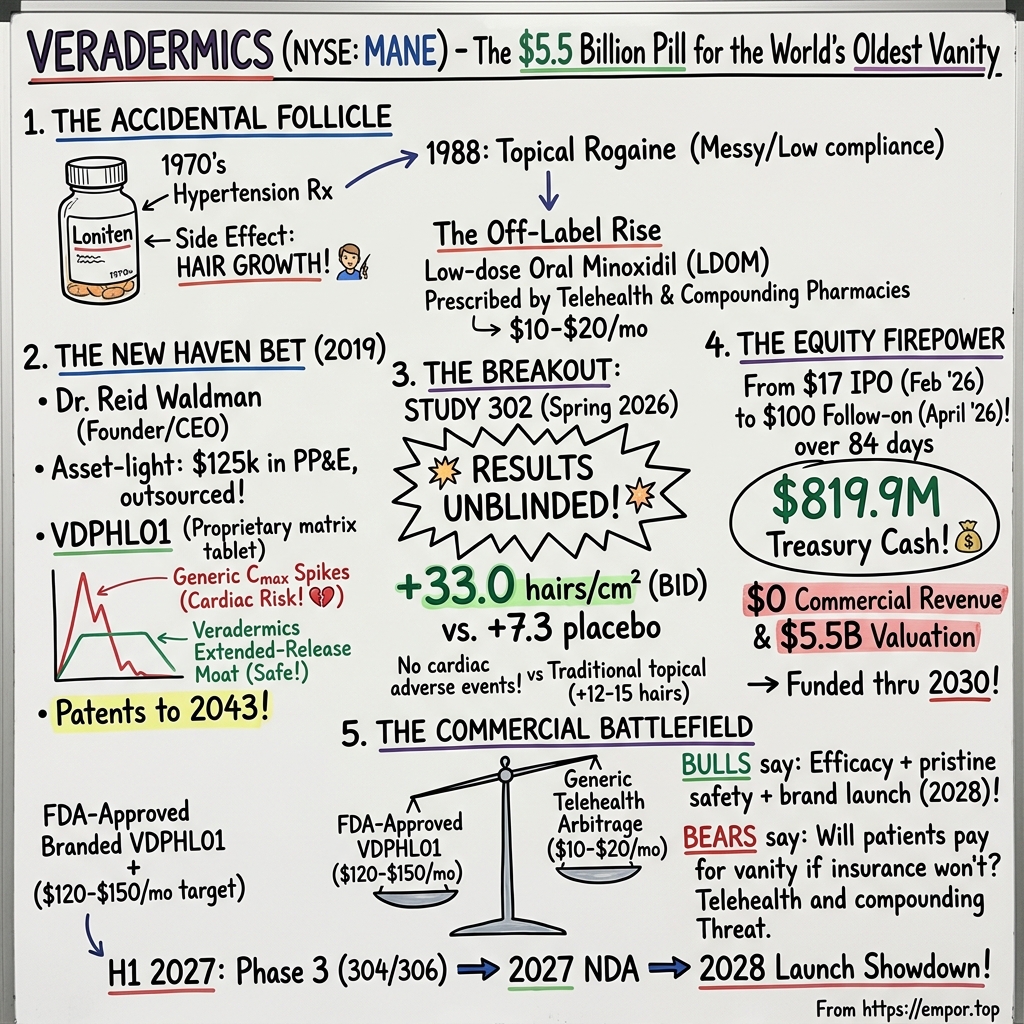
Veradermics: The $5.5 Billion Pill for the World's Oldest Vanity
I. The $100 Million Follow-On at the Yale Club
On April 29, 2026, Veradermics priced a stock offering at a round $100.00 a share.[^1] The company had no product on any pharmacy shelf, had never booked a dollar of sales, and fewer than three months earlier had sold its first public shares at $17.00 on the New York Stock Exchange under the ticker MANE.1[^3] The offering was upsized. Alongside it came a private placement of pre-funded warrants priced at $99.99999, a number so close to a hundred dollars that only a securities lawyer could love it.[^1] When the books closed, the company had pulled in more than $414 million from investors in a single transaction.[^1]
The scene is worth sitting with, because it inverts the usual biotech story. The normal arc for a small drug developer is a long, humiliating trudge: raise money at a discount, burn it, raise again at a lower price, and hope the data arrives before the cash runs out. Veradermics did the opposite. It raised money twice in roughly twelve weeks, and the second time it charged almost six times as much per share as the first.[^1]1
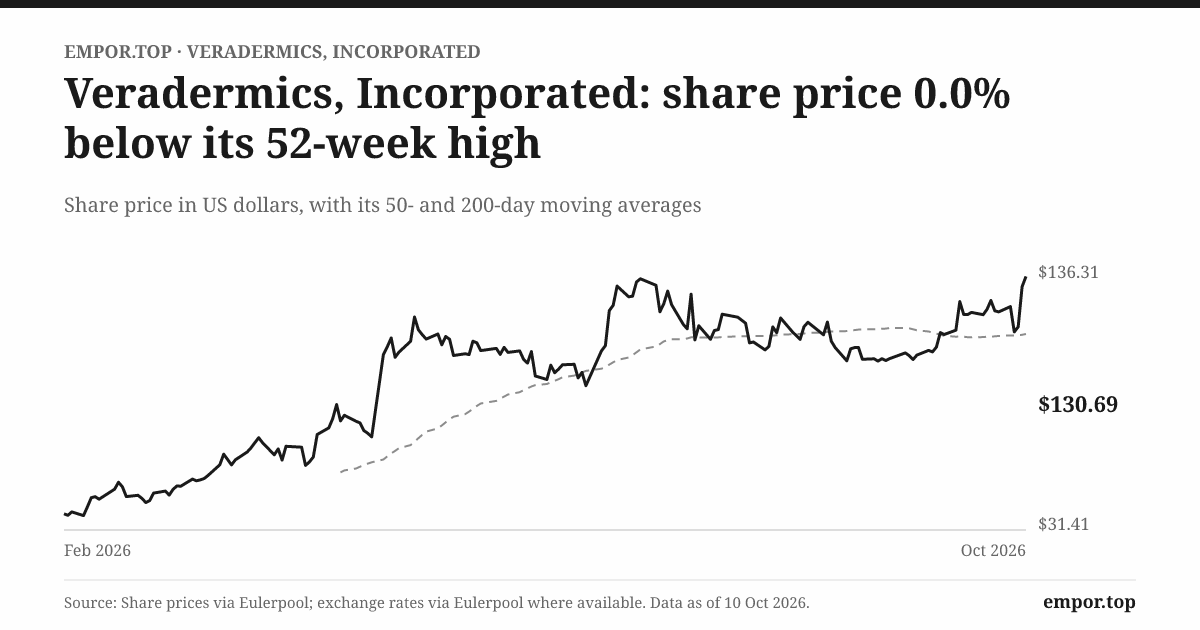
By October 10, 2026, the stock closed at $130.69, its highest price of the past year and roughly seven and a half times the IPO price.2 That gave a company with zero revenue a market value of about $5.5 billion.2 Subtract the cash and the market is paying roughly $4.6 billion for what remains, which is essentially one molecule in one tablet for one condition.2
That molecule is the twist. Veradermics did not discover a new biology of the hair follicle. Its lead asset, VDPHL01, is an extended-release oral tablet of minoxidil, a drug that has been around for half a century and that anyone can buy as a cheap generic.13 The company's bet is that the old drug's problem was never whether it grows hair. It was how fast it hits the bloodstream.
So the story turns on three questions. The first is scientific: will the large Phase 3 trials repeat the startling hair-count gains of the earlier study, without the cardiac side effects that have shadowed minoxidil since the 1970s? The second is commercial: can a patented tablet command branded prices when doctors can already write a prescription for a generic pill that costs about the same as a sandwich? The third is financial: is the war chest big enough to survive if the answer to the second question turns out to be "only partly"?
The balance sheet, at least, gives the company room to find out. At the end of June 2026, Veradermics held about $820 million in cash and marketable securities and carried essentially no debt.[^6]4 Over the twelve months to June, it lost about $103 million at the operating level.5 Those two numbers together are the whole financial plot: the company has roughly eight years of cash at today's spending rate, or, more realistically given that spending will climb into a launch, enough to reach 2030 by management's own estimate.[^6]
The verdict that follows from all this is simple to state and hard to resolve. Veradermics is a pure inflection play. A clinical result engineered a massive recapitalization, and that recapitalization removed the financing risk that kills most small biotechs. What it could not remove is the risk that sits downstream of approval, in the pharmacy aisle and the telehealth app, where a ten-dollar generic is already doing a version of the same job. To understand why that generic exists at all, and why it took fifty years for anyone to try to patent the fix, the story has to go back to a blood pressure pill that kept growing hair on the wrong patients.
 Subscribe on LinkedIn
II. The Accidental Follicle: From Upjohn's Loniten to Telehealth Arbitrage
In the 1970s, the Upjohn Company in Kalamazoo, Michigan, was testing a powerful vasodilator for patients whose blood pressure refused to come down with ordinary drugs. Minoxidil worked. It opened the blood vessels so aggressively that it could tame hypertension that had beaten everything else, and it reached the market as an oral tablet called Loniten.1 It also did something nobody had asked for. Patients began growing hair, thick and dark, on their foreheads, their cheeks, their arms, and in some cases on scalps that had been bare for years.1
For a cardiovascular drug, that was a nuisance. For a pharmaceutical company, it was a lottery ticket. The obvious move was to sell the pill to bald men. The obvious problem was that the pill was a serious cardiac drug. Minoxidil drops blood pressure by relaxing arteries, and the body fights back by speeding up the heart. In vulnerable patients the drug can cause fluid retention and, in rare cases, fluid around the heart, which is why oral minoxidil carries a boxed warning, the strongest caution the FDA puts on a label.19 Nobody was going to get a cosmetic indication for a pill that needed that kind of warning.
So the industry went topical. Rub the drug on the scalp, keep most of it out of the bloodstream, and the heart is spared. That compromise became Rogaine, which turned minoxidil into one of the most recognized consumer health brands of the late twentieth century.1 For the next three decades the pharmaceutical answer to hair loss was a bottle of liquid or foam, plus, from the late 1990s, the oral pill finasteride for men.
The topical compromise had a fatal flaw, and it was human rather than chemical. Topical minoxidil is greasy, can irritate the scalp, and must be applied every day, forever, because stopping it lets the hair fall out again.1 There is also a quieter biological catch. Minoxidil itself is not the active form; an enzyme in the scalp, a sulfotransferase, converts it into the molecule that actually stimulates the follicle, and people vary widely in how much of that enzyme they carry.1 That variation is one reason topical minoxidil works well for some people and barely at all for others. Taken together, the mess and the inconsistency produce exactly what you would expect: many patients simply stop.
The market underneath this is enormous. Veradermics estimates that about 50 million men and 30 million women in the United States live with androgenetic alopecia, the hereditary pattern hair loss that thins the crown in men and widens the part in women.1 For women the menu was especially thin, because finasteride is not used in women who could become pregnant. Eighty million people, one messy liquid, and one pill unsuitable for a large share of them: that is the shape of an underserved market.
Then dermatologists started doing something quietly radical. Through the 2010s, a growing body of clinical reports showed that very low doses of oral minoxidil, a fraction of the blood pressure dose, could regrow hair with manageable side effects in many patients.1 Low-dose oral minoxidil, which dermatologists shorten to LDOM, became one of the most talked-about off-label treatments in the specialty. It was cheap, it was a pill, and adherence to a pill is far better than adherence to a nightly scalp ritual.
The direct-to-consumer telehealth companies saw the same thing and built businesses on it. Platforms such as Hims & Hers and Ro now prescribe generic oral minoxidil, sometimes compounded with finasteride, through a smartphone questionnaire and a monthly subscription that costs in the range of ten to twenty dollars.13 The drug is old, the tablets are generic, and doctors are free to prescribe an approved drug for an unapproved use. No company owns that business, and none could patent it.
That is the hidden lesson of minoxidil's fifty years. Demand was never the problem. The molecule always worked, patients always wanted a pill, and doctors were willing to prescribe it the moment the evidence felt good enough. What was missing was a version safe enough to earn an FDA label for hair, and a commercial owner with a reason to spend hundreds of millions of dollars proving it. The off-label market proves the demand is real. It also proves, uncomfortably for anyone who wants to charge a premium, that the demand is already being met for pocket change. Into that gap walked a dermatologist from New Haven.
III. The Formulation Bet in New Haven: Enter Dr. Reid Waldman
Reid Waldman is a dermatologist, and in 2019 he became the founding chief executive of a company built on a single, almost stubbornly narrow idea.1 Working from New Haven, Connecticut, where the company still keeps modest offices at 470 James Street, Waldman looked at oral minoxidil and saw a problem of timing rather than chemistry.14
The idea goes like this. When you swallow an ordinary minoxidil tablet, the drug floods into the bloodstream quickly, peaks, and then fades. Pharmacologists call the height of that peak Cmax, the maximum concentration. The peak is where the trouble lives: the sudden drop in blood pressure, the reflex jump in heart rate, the palpitations and dizziness that make cardiologists nervous. The follicle, by contrast, does not need a spike. It needs steady exposure over time. If you could shave off the peak while keeping the total amount of drug the follicle sees roughly the same, you might keep the hair benefit and shed most of the heart risk.
The analogy is a garden hose. An immediate-release tablet is a bucket of water dumped on the lawn at once: most of it runs off, and some of it floods the basement. An extended-release tablet is a drip line that delivers the same water slowly, all day. Veradermics' answer is a proprietary gel-matrix tablet that swells in the gut and releases minoxidil gradually, designed for once- or twice-daily dosing.13 The company calls the product VDPHL01.
This is what makes Veradermics unusual, and it should be said plainly. The company did not discover new biology. It took a validated molecule with known efficacy and a known liability, and tried to engineer the liability away with formulation chemistry. That choice strips out the biggest risk in drug development, which is that the drug simply does not work. It also means the entire technical moat rests on the delivery system and the patents around it. Veradermics says its formulation patents run to at least 2043, and that date is the single most important number in its intellectual property story.110
Waldman brings a dual perspective that shaped the bet. As a practicing clinician, he saw what patients were already asking dermatologists for, and what dermatologists were already prescribing off-label. As a founder, he understood that a cheap, unpatented practice could only become a large business if someone produced the data to make it on-label, and owned a version that a generic could not legally copy. Clinician-founders often sell the patient story better than the economics; Waldman's pitch tied the two together, and it is the economics half that remains unproven. The company's financial operations are run by Dominic Carrano, who joined as vice president of finance in 2022 and became chief financial officer in February 2025.14
The operating model reflects the thesis. Veradermics owns no factories and no labs to speak of. At the end of 2025 its property, plant and equipment was worth about $125,000, roughly the cost of furnishing a small office, and in earlier years it carried none at all.4 Clinical trials run through contract research organizations, and the tablets are made by contract development and manufacturing organizations.14 In the industry this is called a virtual biotech. It keeps fixed costs tiny and lets nearly every dollar go into trials, which is why the company could run years of early work on modest venture budgets.
The trade-off is control. A company that makes nothing itself depends entirely on the partners that do, and Veradermics discloses that its formulation work relies on third-party manufacturers whose failure would delay trials and an eventual application to the FDA.14 For a drug whose whole claim to fame is a precisely shaped release curve, the partner who presses the tablets is not a vendor. It is the product.
So the founding bet left one question that no amount of formulation cleverness could answer in advance. Would the smoothed-out pill grow as much hair as the dermatologists' cheap generic, and would it do so with a cleaner heart profile? That answer arrived in the spring of 2026.
IV. The Breakout Readout: Study 302 and the 33-Hair Delta
The number that changed the company was a count of hairs in a small circle of scalp. In androgenetic alopecia trials, investigators tattoo or mark a target area, photograph it at high magnification, and count the thick, pigmented terminal hairs, the ones dermatologists call non-vellus, as opposed to the fine peach fuzz that does not count as cosmetic improvement.9 Success is measured in hairs gained per square centimetre over months of treatment.
In the spring of 2026, Veradermics unblinded Part A of Study 302, a randomized, placebo-controlled trial in men. After six months, patients on once-daily VDPHL01 had gained about 30 hairs per square centimetre, and patients on the twice-daily dose about 33.3[^3] Patients on placebo gained about 7.3 The statistical significance was overwhelming, with p-values below one in ten thousand, and the drug arms separated from placebo as early as the second month.3
What does a 33-hair gain mean to someone who is not counting follicles? The useful comparison is the net difference over placebo, which for the twice-daily arm came to roughly 26 hairs per square centimetre. Published trials of the incumbent treatments, finasteride and topical minoxidil, have generally reported net gains in the low teens or less on similar measures, though cross-trial comparisons are notoriously treacherous because methods, baselines and populations differ.1 Even with that caveat, the size of the gap explains the market's reaction. Biotech investors are trained to discount data, and this was data that survived a heavy discount.
The female data added a second market. In Study 207, an earlier Phase 2 trial in women with pattern hair loss, VDPHL01 produced gains of roughly 23 hairs per square centimetre, and around nine in ten participants reported being satisfied.3 That matters more than the smaller number suggests, because women are the group for whom the current menu is thinnest. If VDPHL01 becomes the first oral drug approved for female pattern hair loss, it would be entering a market with almost no on-label competition at all.
Then the safety readout, the part the whole formulation bet was built for. Across its Phase 2 trials, the company reported no cardiac adverse events of special interest, and overall adverse event rates comparable to placebo.31 Investigators monitored participants with continuous heart-rhythm recordings and echocardiograms, and the company reported no symptomatic low blood pressure and no fluid collecting around the heart.13 If that profile holds, it is exactly the evidence the founding thesis required: the blunted peak appears to keep the follicle benefit and leave the heart alone.
Here the story needs a sceptic, because the market has already paid for the good news. Three cautions bear directly on the claim.
The first is size. Phase 2 trials are small and often run at sites experienced with the protocol, and the female Study 207 was open-label, meaning participants knew they were taking the drug, which inflates satisfaction scores and can bias measurement.3 The pivotal programme is larger and more diverse: Study 304 in men, and Study 306, a Phase 2/3 trial in women that the company has sized at more than five hundred participants.3[^3] In larger trials, placebo responses tend to drift up and adherence tends to drift down, and the gap between drug and placebo commonly narrows. The history of drug development is full of Phase 3 trials that confirmed a drug works but shrank the headline.
The second is duration. Six months of clean heart monitoring in a controlled trial is not the same as years of chronic use in a population that includes older patients, people on other blood pressure drugs, and people who take an extra pill when they forget a dose. The low-frequency events that matter for a boxed warning are, by definition, rare, and rare events hide in small studies. The company's 12-month safety extensions are designed to address this, and their results will go into the eventual application.3
The third is the comparator that matters commercially. Study 302 compared VDPHL01 to placebo, not to the dermatologists' generic low-dose minoxidil. That is the right regulatory design, but it means the data does not prove VDPHL01 grows more hair than the cheap pill already in circulation. It suggests it may be safer, and safety, not efficacy, is where the branded premium will have to be earned.
Weighing it, the efficacy claim survives the stress test in a narrower form: VDPHL01 very likely works, and the open question is by how much in Phase 3, not whether. The safety claim is promising and unproven at commercial scale. The number that will confirm or narrow both is the drug-versus-placebo gap in Study 304 and Study 306, expected in the first half of 2027, alongside the integrated cardiac data.[^3]3 For now, though, the spring readout did something more immediate than settle the science. It opened a window in the capital markets, and management walked straight through it.
V. The Balance Sheet Fortification: From $17 IPO to $820 Million Treasury
At the end of 2025, Veradermics' balance sheet looked, at a glance, like a company in trouble. Shareholders' equity was negative, about minus $121 million.4 That number was mostly an accounting artefact of a private company on the eve of listing: venture investors' preferred stock is typically carried outside ordinary shareholders' equity until it converts at the IPO, which can leave common equity in the red even while the company sits on plenty of cash.4 And it did sit on cash: about $142 million in cash and short-term investments, against borrowings of four thousand dollars.4 The red ink was a label problem, not a solvency problem, and the IPO was about to rewrite the label.
The first move came in February 2026. Veradermics sold about 15.1 million shares at $17.00 on the New York Stock Exchange, raising roughly $256 million before fees.18 At that moment it was a respectable mid-sized biotech listing, priced before the Study 302 data and therefore priced with real uncertainty about whether the pill would work.
Then the data landed, the stock ran, and management made the decision that defines this chapter. Rather than waiting for Phase 3, which is what many boards do on the theory that better data will fetch a better price, Veradermics went back to the market almost immediately. On April 29 it priced about 3.8 million shares at $100.00, plus 300,000 pre-funded warrants in a private placement, for more than $414 million of gross proceeds.[^1]6 Two offerings, roughly twelve weeks apart, at prices nearly six times apart.
The logic is ruthless and correct for a company in this position. Clinical-stage biotech is a business where the cost of capital swings violently with sentiment, and the moment of maximum enthusiasm is usually the moment between a great Phase 2 readout and an uncertain Phase 3. Raise then, and you fund the risky part of the journey with other people's optimism. Wait, and you are betting the window stays open. The follow-on diluted existing holders by roughly a tenth, but it did so at a price that, as of October, was still below where the stock trades.[^1]2
Just as important is what management did not do. It did not sign a partnership with a large pharmaceutical company, which is the usual way a small biotech pays for late-stage trials. Such deals bring cash and expertise but hand over a large share of future profits, often the international rights entirely. By raising in public markets instead, Veradermics kept all worldwide commercial rights to VDPHL01.1[^6] If the drug becomes a blockbuster, shareholders keep the whole thing. If it disappoints, there is no partner to share the cost of the launch.
The cash flow history supports the view that the money goes where the company says it goes. Across 2023 to 2025, Veradermics reported cumulative net losses of about $111 million and burned about $107 million from operations, a gap of only a few million dollars, explained mainly by non-cash stock compensation and prepayments to trial and manufacturing partners.4 Free cash flow over the same three years was about minus $109 million, almost all of it operating spend.4 In plain terms, the losses are real cash leaving the building to pay for trials, and there is no capitalized research quietly propping up the balance sheet. That is what a clean clinical-stage ledger should look like.
The treasury has started to pay its own way, at least partly. In 2025, interest income of about $3.3 million trimmed the operating loss.4 In the second quarter of 2026, with the vault far fuller, the gap between the operating loss of about $30 million and the pre-tax loss of about $23 million implies roughly $6 to 7 million of investment income in a single quarter.5[^6] The company holds the money in Treasury bills, government money market funds and high-grade commercial paper.4 At today's rates, the cash pile is paying for something like a fifth of the burn.
Put the pieces together and the runway is long. About $820 million in cash and securities at June 30, against operating burn of roughly $100 to $120 million a year, gives management its estimate of liquidity into 2030.[^6] There is no debt to refinance and no covenant to trip.4 The honest caveat is that burn will not stay flat: a commercial launch is far more expensive than a trial programme, and the company's own spending is already climbing. Still, the financing risk that ends most small biotechs has, for now, been taken off the table.
That leaves the risk the cash cannot buy away. A company can fund itself to 2030 and still discover, on launch day, that customers will not pay its price. Whether they will depends on the shape of the moat around a fifty-year-old molecule.
VI. The Moat Analysis: 7 Powers and Porter's Five Forces
Picture a thirty-four-year-old man on his phone, thumbing through two options. One is a prescription from his dermatologist for an FDA-approved, extended-release tablet, made by a company that will need to recover a billion dollars of development and launch costs. The other is a telehealth subscription for generic oral minoxidil, delivered in a discreet box, for roughly the price of two coffees a month.3 He has heard both work. Which does he choose, and what would it take to change his mind?
That consumer is the moat question in miniature. Veradermics has not announced a price, and any figure for a branded monthly cost is today an analyst's guess, not a company disclosure. But the shape of the dilemma is clear: a branded aesthetic drug will almost certainly cost many times the generic, and the company must give the buyer reasons worth that multiple.
Hamilton Helmer's 7 Powers framework asks what lets a business earn persistently high returns despite competition. Applied to Veradermics, the answer is a short list of real powers and a longer list of hopes.
The strongest is Cornered Resource, and it is the patent estate. Formulation patents running to 2043 mean no generic manufacturer can copy VDPHL01's specific release profile for roughly fifteen years after a 2028 launch.110 That is a meaningful runway. Its limit is just as important: the patents protect the tablet, not the molecule, and not the idea of taking minoxidil by mouth. They stop a copycat VDPHL01. They do nothing to stop a doctor prescribing plain generic minoxidil.
The second is a modest form of Process Power. Making a tablet that reliably releases a drug at a precise rate, batch after batch, at commercial scale, is genuinely hard, and the know-how built with manufacturing partners is not trivial to replicate. But it is know-how shared with outsourced partners, so it is less proprietary than the same expertise would be inside a company-owned plant.
Branding is the power Veradermics needs most and has least. It is pre-commercial, so its consumer brand equity is effectively zero. The aspiration is to become the Botox of hair, a name patients ask for by itself. That is achievable, but it has to be built with years of marketing spend, and nothing in the record proves it yet.
Switching costs are a split verdict. Once a patient has regrown hair on VDPHL01, stopping risks losing it, which creates strong retention. But at the first prescription, switching costs are zero, and that first choice is where the generic wins on price. Scale economies and network effects are negligible for a single prescription drug.
Michael Porter's five forces tell the same story from the other side.
The bargaining power of buyers is high. Insurers generally treat hair loss as cosmetic and exclude it, so many patients will pay out of pocket, and self-pay customers are acutely price-sensitive.1 Where insurers do engage, pharmacy benefit managers will point to cheaper alternatives. The threat of substitutes is very high: generic immediate-release minoxidil, compounded capsules, topical solutions, finasteride, and a stream of new hair-growth candidates in other companies' pipelines.13
Supplier power is moderate to high: dependence on outside manufacturers means a single inspection problem can freeze supply.1 Barriers to entry are paradoxical. The barrier to a competing FDA-approved product is high, because it takes years of trials. The barrier to the real competitor, off-label generic prescribing, is nearly nonexistent. Rivalry in aesthetic and consumer hair care is intense and noisy.
Weighed together, the analysis narrows the moat thesis rather than rejecting it. Veradermics has a defensible product, protected from imitation, but not a defensible market, because the market is already being served by an unpatentable substitute. The moat's real width depends on something the patents cannot provide: whether an FDA label, with on-label promotion and a demonstrably cleaner safety profile, persuades patients and doctors that the safe pill is worth many times the cheap one. The evidence that would settle it is launch pricing and the mix of insured versus self-pay prescriptions in the first year after a 2028 launch.3 That is where the battle moves next: into the commercial plan.
VII. The Commercial Battlefield: Payers, Cash-Pay, and the Telehealth Threat
By the summer of 2026, the line item that told the story of Veradermics' ambitions was not research. It was general and administrative spending. In the second quarter of 2025, G&A had been about $1.7 million, the kind of number a lean virtual biotech spends on a handful of executives, lawyers and accountants.5 A year later it was about $10.9 million, more than six times higher, driven by commercial readiness hires, compliance and the costs of being a public company.5 Research spending rose too, from about $14 million to about $19 million, but the faster climb was in building the machine that will one day sell the drug.5
That shift is the clearest signal of where management thinks the real work lies. The company plans a two-pronged go-to-market model: traditional prescriptions written by dermatologists and routed through pharmacies and insurers, alongside a self-pay, cash-pay digital channel modelled on how aesthetic and weight-loss drugs have reached consumers directly.3
The insured channel looks hard. Hair loss is classed by most plans as a cosmetic condition, so coverage, where it exists at all, would likely come with prior authorizations, step therapy requiring patients to try cheaper options first, and placement on expensive formulary tiers. Any insurer asked to pay a brand price will reasonably point out that a generic version of the same molecule costs pennies.
So the cash-pay channel is where the war will be fought, and the company has openly borrowed a playbook. In the last few years, Eli Lilly and Novo Nordisk have shown that patients will pay hundreds of dollars a month out of pocket for GLP-1 obesity drugs bought through direct-to-consumer platforms when insurers decline, and AbbVie's Allergan aesthetics business built Botox into a household name sold almost entirely on cash pay.3 The analogy is attractive and imperfect. GLP-1 drugs had no cheap generic substitute; Botox has no off-label pill alternative costing ten dollars. VDPHL01 does.
That substitute is backed by sophisticated competitors. Telehealth operators such as Hims & Hers and Ro have built large subscriber bases selling exactly the product Veradermics is trying to displace, and they own the customer relationship, the app, the delivery box and the monthly billing.3 They may be partners rather than rivals: a platform could add a branded VDPHL01 tier for customers who want the FDA-approved version. But a platform that earns healthy margins on a cheap generic has little reason to steer customers toward a costlier brand unless customers ask for it.
Could Veradermics change the rules instead? The tempting route is regulatory. Once an approved version exists, a company can argue to the FDA that compounded copies of the same product are no longer justified, a lever that has been used against compounders in other markets. But that lever has a hard limit here: it reaches compounded copies, not ordinary generic minoxidil tablets prescribed off-label, which are legal FDA-approved products used at a doctor's discretion. No company has disclosed any petition of this kind for oral minoxidil, and Veradermics has not said it will file one.
The honest verdict is that commercial success depends on persuading consumers to pay out of pocket for safety and convenience, against a substitute they already know works. That is possible; consumers pay premiums for branded aesthetics all the time. But it is a marketing problem, not a clinical one, and the company's own rising G&A shows it knows it. The question an outsider has to ask next is whether the people closest to the company, its founders and its earliest investors, are acting like they believe the launch will work.
VIII. Governance, Ownership, and the Insider Equation
In August 2026, with the stock trading well above $100, two filings landed that a nervous shareholder could easily misread. SR One Fund II, one of the company's early venture backers, filed an amended Schedule 13D disclosing that it had sold 321,749 shares on August 12, bringing its stake below the 5% reporting threshold.117 In the same month, Reid Waldman sold 67,500 shares under a pre-arranged Rule 10b5-1 trading plan.11
Both deserve context before judgement. Venture funds have fixed lifespans and owe returns to their own investors, so selling into a liquid market after an IPO is what they exist to do, not a vote of no confidence. SR One's sale was a small fraction of a large early position. Rule 10b5-1 plans are set up in advance precisely so that executives cannot time sales to inside information; Waldman's sale was under a tenth of his holding, and after it he still owned about 818,000 shares, roughly 2% of the company.11 At October's price that stake is worth over $100 million, which is a meaningful alignment with outcomes.
On the other side of the ledger sits Viking Global Investors, one of the more fundamentally driven hedge funds in healthcare, which reported holding about 2.15 million shares, roughly 5.8% of the company, in a Schedule 13G filed in February 2026.12 That filing predates the follow-on and the summer, so it is a snapshot of early conviction rather than a current position. After the April offering, the rest of the register spread widely across biotech specialist funds.11
The governance plumbing is clean on the measures that matter at this stage. The company discloses no material related-party transactions, no royalty arrangements with founders, no loans to insiders and no off-balance-sheet vehicles.14 Its auditor issued an unqualified opinion on the 2025 accounts with no reported material weaknesses.4 Stockholders held their first annual meeting as a public company in June 2026.13 Executive pay is dominated by equity awards, which ties management's fortunes to the share price and, through milestone-based vesting, to clinical and regulatory progress.1
A sceptical activist would push on two points rather than these. First, equity-heavy pay rewards share price, and in clinical biotech the share price can be maximized by excellent capital-markets timing as much as by commercial execution; the April raise was good for the company and also very good for the value of everyone's options. Second, the board is a venture-era board, built to run trials and IPOs. Whether it has the consumer marketing and commercial pharmaceutical depth to oversee a cash-pay launch against telehealth incumbents is a question the next two years will answer.
The verdict here is that insider behaviour looks like ordinary post-IPO liquidity rather than an exit, and governance carries none of the red flags that sink small companies. Clean governance, though, does not make a thesis right. To test the thesis itself, the story needs the history of companies that tried this exact move before.
IX. Historical Falsification and Thesis Stress Test
Dermatology has a graveyard, and it is full of clever formulations. Over the past two decades, specialty companies repeatedly took old, cheap molecules, reformulated them into patented once-daily or better-tolerated versions, won FDA approval, and priced them as brands. The extended-release minocycline Solodyn for acne, the combination gel Epiduo, and the dapsone gel Aczone are among the familiar examples. They often succeeded at first. Then insurers began demanding that patients try the generic parent molecule first, pharmacies substituted cheaper alternatives where they could, and once patents lapsed or challengers arrived, branded volumes eroded quickly. The whole dermatology reformulation model came under heavy payer pressure in the late 2010s.
That record tests three claims at the heart of the Veradermics thesis.
The first claim is that patent protection to 2043 guarantees monopoly pricing. The reformulation history narrows this sharply. A formulation patent stops copies of the formulation; it does not stop doctors and payers from choosing the old molecule instead. In those earlier cases, the threat was rarely an identical generic. It was a cheaper version of the same active ingredient that was good enough. For VDPHL01, that version already exists and is already the standard of care in telehealth. History does not reject the patent's value, but it says the patent defends the product, not the price.
The second claim is that an FDA label will force doctors to abandon off-label generic minoxidil. Here the counterevidence is structural. American law lets physicians prescribe approved drugs for unapproved uses, and nothing about VDPHL01's approval would make generic minoxidil illegal for hair.9 The only things that would push prescribers away are a regulatory signal against off-label oral minoxidil, which the FDA has not issued, or clinical evidence strong enough that doctors fear liability for prescribing the cheap pill. The Study 302 data compares VDPHL01 with placebo, not with generic minoxidil, so that evidence does not yet exist.3 The claim survives only in a smaller form: the label gives Veradermics the right to advertise and detail, a powerful asset, but not a captive market.
The third claim is that the asset-light model maximizes returns. Financially, it has. The company has spent its capital almost entirely on trials rather than buildings, which is why its accounts show a return on invested capital of roughly minus 1,270% in 2024, an absurd-looking number that mostly reflects how small the invested capital base is next to the losses of a pre-revenue company.4 Operationally, the model concentrates risk. A batch failure, a stability problem or an FDA inspection finding at the manufacturing partner could delay the drug application or interrupt supply, and the company's own risk factors say so.1 The claim is intact but conditional: capital-light is efficient until the day it is not.
Weighing all three, the history does not refute the Veradermics thesis, but it shrinks the most optimistic version of it. Formulation patents alone have not guaranteed premium economics in dermatology. What could make this case different is the safety story, because the old reformulations mostly sold convenience, while VDPHL01 aims to sell the removal of a cardiac risk. The evidence that would confirm the revised thesis is clear: a clean Phase 3 safety package, a label without the boxed warning that sits on old minoxidil, and early prescription data showing patients choosing the brand at its price. With the thesis stress-tested, the lessons of the story so far come into focus.
X. Playbook: Business & Investing Lessons
The first lesson belongs to the morning of April 29, 2026, when a company with no product sold stock at $100 a share, weeks after selling it at $17. Most boards wait for the next milestone, believing better data will fetch a better price. Veradermics understood that the market's eagerness is itself a perishable asset, and that the most dangerous part of a biotech's life is the long silence before Phase 3. Raising at the peak of enthusiasm turned a scientific gamble into a financed one. In clinical-stage biotech, you raise cash not when you need it, but when the market is eager to give it to you.
The second lesson lives in a telehealth app that sells generic oral minoxidil for the price of a lunch, thriving the whole time Veradermics ran its trials. Reformulating a known drug is the most comforting move in pharmaceuticals because it removes the question of whether the molecule works. That comfort is exactly the trap. The risk does not disappear; it moves to the pharmacy counter, where an old molecule has old, cheap rivals. Eliminating clinical biology risk by reformulating an old drug merely transfers all your risk downstream into pricing defense.
The third lesson is written on a balance sheet that carried $125,000 of equipment while burning around $100 million a year through other companies' labs and factories. Asset-light businesses look brilliant on return-on-capital charts and fragile on the day a partner's inspection goes wrong. When the product is a precisely engineered release curve, the factory that makes it is the moat. A virtual biotech has no capital expenditure, but it has no operational control; your supply chain is only as secure as your CDMO's FDA inspection history.
The fourth lesson belongs to the consumer on the phone choosing between two pills. In most of pharma the customer who matters is an insurer, and the game is formulary access. In aesthetics, the customer is a person deciding whether a branded pill is worth giving up something else that month. That changes everything, from pricing to advertising to who the real competitors are. If insurance won't pay for vanity, your real competition isn't Pfizer; it's the patient's discretionary spending budget.
XI. Analysis: The Bull vs. Bear Case
Imagine the spreadsheets on analysts' screens this autumn, each built around a single cell labelled peak sales. In the gloomy version, generic competition squeezes VDPHL01 into a niche of a few hundred million dollars a year. In the triumphant version, it becomes an aesthetic blockbuster selling billions. The stock at $130.69 implies a market value of about $5.5 billion and an enterprise value of about $4.6 billion once the cash is set aside.2 Book value is about $19.47 a share, almost all of it cash, so the market is paying roughly six and a half times the money in the bank.2 Whatever the spreadsheet says, the price is not betting on the gloomy cell.
The bull case runs in four steps. First, the pivotal trials, Study 304 in men and Study 306 in women, confirm a hair-count advantage close to Study 302's, with the same overwhelming statistics, setting a new efficacy standard for the condition.3 Second, the blunted-peak profile earns a label without a cardiovascular boxed warning, giving doctors a clean reason to prefer the brand over a generic that carries one.19 Third, VDPHL01 becomes the first oral drug approved for female pattern hair loss, a market with almost no on-label rivals, and builds a direct-to-consumer franchise protected by patents into the 2040s.110 Fourth, the cash pile funds the launch without new dilution.[^6]
The bear case runs in four mirror-image steps. Larger Phase 3 populations compress the drug-placebo gap, turning a spectacular result into a merely good one. The FDA decides that the class history of oral minoxidil justifies a cardiovascular warning on all formulations, which would weaken the safety differentiation and complicate consumer advertising. Telehealth platforms keep selling generic minoxidil at a fraction of the brand's price, while insurers decline to cover a cosmetic indication. And because the valuation rests on all of this, any delay or stumble could pull the stock sharply back toward its cash value, as the stock's one-year volatility of about 90% suggests the market already knows.2
The moat analysis earlier argued that Veradermics owns a defensible product but not yet a defensible market; the bull and bear cases are simply the two answers to whether the product can capture the market. What the price assumes is clear: a high probability of approval, a clean label, and a launch that converts a meaningful slice of an off-label market already served cheaply. That is a demanding set of assumptions for a company with no revenue, and it leaves little room for an ordinary disappointment.
Three measures will settle the debate more than any others. The first is the efficacy gap over placebo in Studies 304 and 306; the latest reading is Study 302's gap of roughly 26 hairs per square centimetre in the twice-daily arm, with the pivotal readouts due in the first half of 2027.3 The second is the cardiac safety record in the 12-month extension cohorts; the latest reading is zero cardiac adverse events of special interest in Phase 2.3 The third is the quarterly cash burn as commercial spending ramps; the latest reading is an operating loss of about $30 million in the second quarter of 2026, flat on the first quarter but rising sharply from a year earlier.5 After launch, a fourth will dominate everything else: monthly prescriptions and the net price actually realized.
XII. Epilogue
Tonight, Veradermics stands at the high-water mark of its short public life. The stock sits at its peak, the vault holds about $820 million, and the hard part has not started.2[^6]
The next scene is the first half of 2027, when Study 304 in men and Study 306 in women read out.3 That is the moment the spring of 2026 gets tested. If the hair-count gap holds near Study 302's, the company will have shown that its first result was not a small-trial mirage. If it shrinks to something closer to the incumbents', the market will have to recalculate everything it has paid for.
After that comes the regulatory gauntlet. Management plans to file a new drug application with the FDA, which on its current timeline points to late 2027, and the fight that matters will not be over approval as much as over the label.3 The single most consequential sentence in the company's future may be whether the approved label carries a cardiovascular boxed warning. Without one, Veradermics can sell safety. With one, it is selling a more expensive version of a familiar risk.
Then comes the commercial showdown, with a planned launch in 2028 into a market the telehealth companies have spent years cultivating with generic pills.3 The launch price, the share of prescriptions paid in cash, and how many patients refill after three months will reveal whether consumers value an FDA label as much as investors do.
The outcomes are stark. In one, Veradermics becomes the rare reformulation company that built a lasting aesthetic franchise, a Botox-style name for hair worth far more than today's price. In the other, it joins the long list of formulation companies that won the science and lost the pharmacy counter, left with a good drug, a large cash balance and a share price drifting toward the money in the bank. The tension that remains is the one this story began with: Veradermics has removed nearly every risk money can remove, and none of the risks only customers can.
XIII. Outro
Somewhere in Upjohn's files from the 1970s are notes on blood pressure patients who started growing hair where they did not expect it. For forty years, that accident was too dangerous to sell as a cosmetic and too valuable to forget. Dermatologists eventually found their way around the danger with tiny doses and a prescription pad, and a generation of telehealth companies turned the workaround into a subscription.
Veradermics did the thing nobody else bothered to do. It engineered the danger out of the pill, proved in one remarkable trial that the hair benefit survived, and raised enough money to see the project through to the end of the decade. Its battle now is not with biology. It is with a ten-dollar generic that doctors already know how to prescribe. Veradermics built a perfect pharmacological machine to tame an unruly molecule; now it has to prove that consumers will pay a fortune for the patent.
References
-
Veradermics, Inc. Form 424B4 Prospectus (Initial Public Offering) — SEC EDGAR, 2026-02-04 ↩↩↩↩↩↩↩↩↩↩↩↩↩↩↩↩↩↩↩↩↩↩↩↩↩↩↩↩↩↩↩↩↩
-
Veradermics Incorporated (MANE) Listing Data — New York Stock Exchange, 2026-10-10 ↩↩↩↩↩↩↩↩
-
Veradermics Pipeline & Platform Overview — Veradermics, 2026-05-14 ↩↩↩↩↩↩↩↩↩↩↩↩↩↩↩↩↩↩↩↩↩↩↩↩↩↩
-
Veradermics, Incorporated Form 10-K for the Fiscal Year Ended December 31, 2025 — SEC EDGAR, 2026-03-30 ↩↩↩↩↩↩↩↩↩↩↩↩↩↩↩↩↩
-
Veradermics Form 10-Q for the Quarterly Period Ended June 30, 2026 — SEC EDGAR, 2026-08-11 ↩↩↩↩↩↩
-
Veradermics, Inc. Form 8-K Current Report (Follow-On Offering Closing) — SEC EDGAR, 2026-05-02 ↩
-
Schedule 13D/A Beneficial Ownership Amendment by SR One Fund II Aggregator LP — SEC EDGAR, 2026-08-20 ↩
-
Veradermics Inc (MANE:New York) Overview & Capital Structure — Bloomberg ↩
-
FDA CDER Guidance for Industry: Androgenetic Alopecia, Developing Drugs for Treatment — U.S. FDA ↩↩↩↩
-
Patent Full-Text Database: Extended Release Minoxidil Formulations (Veradermics) — USPTO ↩↩↩
-
Veradermics Form 10-Q and Section 16 Insider Filings, Period Ended June 30, 2026 — SEC EDGAR, 2026-08-11 ↩↩↩↩
-
Schedule 13G Beneficial Ownership Report by Viking Global Investors LP — SEC EDGAR, 2026-02-13 ↩
-
Veradermics, Inc. Form 8-K Current Report (Results of 2026 Annual Meeting of Stockholders) — SEC EDGAR, 2026-06-18 ↩
 LinkedIn
 WhatsApp
 Reddit
 Hacker News
 Email
Email Kindle
 RSS Feed
 Spotify
 Apple Podcasts
 Amazon Music
 Audible
 YouTube