ManpowerGroup: The Story of the Company That Rents Out the Economy's Pulse
I. Introduction & Episode Roadmap
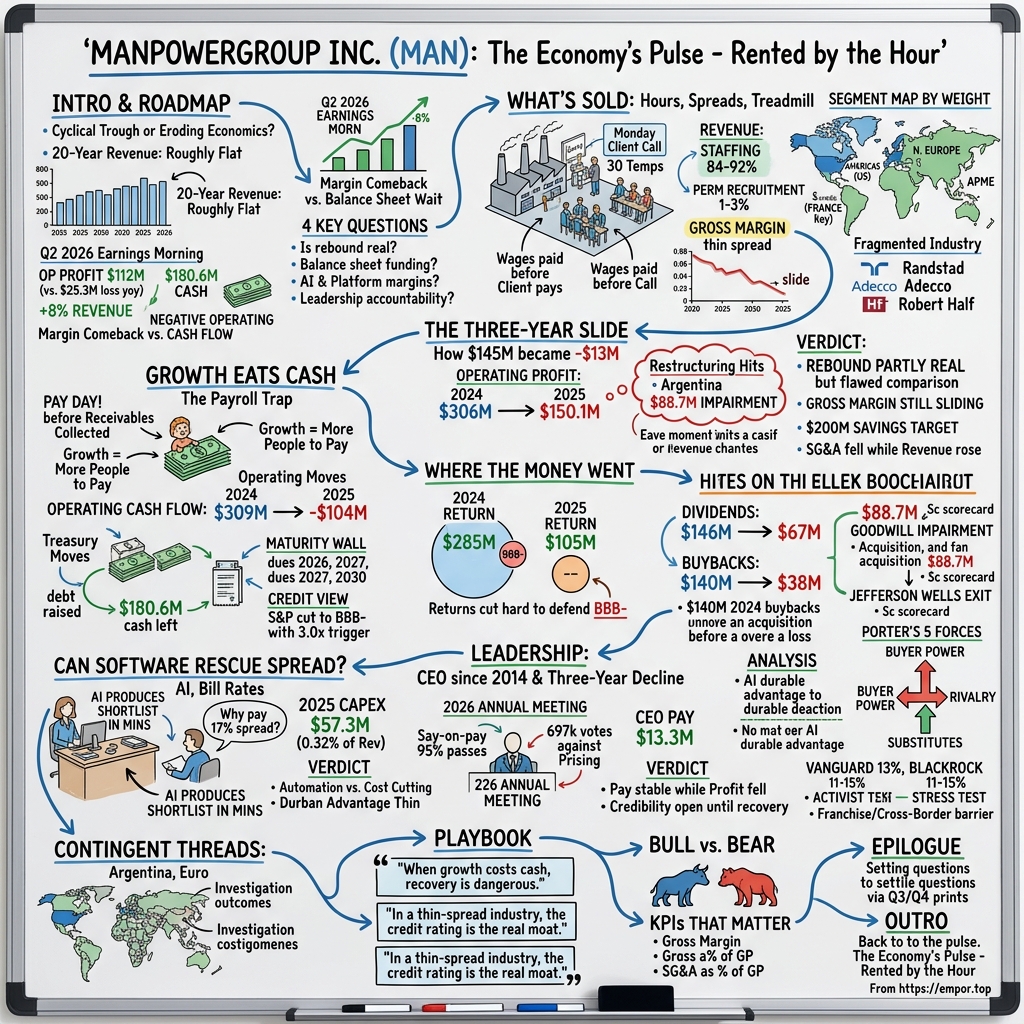
It is a summer morning in 2026, and ManpowerGroup's second-quarter numbers have just gone out. On the surface, they look like a turnaround. Operating profit for the quarter came in at $112.0 million, against a loss of $25.3 million in the same quarter a year earlier.[^1] Revenue rose 8%.[^1] After three years of falling profits, a downgrade and a loss-making year, this is the sort of release a company hopes will change the conversation.
Then you reach the cash flow statement. Operating cash flow for the first half of 2026 was still negative, an outflow of about $129 million.1 Cash on the balance sheet had dropped to about $181 million at June 30, down from $871 million six months before.1 The profit had come back. The cash had not.
That gap between earnings and cash is the thread running through this episode. It is also the oldest story in staffing. The company pays wages every week or two. Clients pay their invoices weeks later. When business improves, the company has to fund more of those wages before any of the new money arrives. So a recovery in staffing shows up as profit before it shows up as cash, and in the meantime it can strain the balance sheet.
Start with two pairs of numbers. In 2005 ManpowerGroup booked about $15.85 billion of revenue. In 2025 it booked about $17.96 billion.2 Over twenty years, in nominal dollars, through globalisation, a financial crisis, a pandemic and the arrival of AI, the top line grew by roughly an eighth. Profit has moved much more. Net earnings were $465.7 million in 2019.3 In 2025 the company lost $13.3 million.3
Who the company is. ManpowerGroup trades on the New York Stock Exchange under the ticker MAN. It is a Wisconsin corporation headquartered in Milwaukee, and it ranks among the three largest staffing companies in the world.4 Roughly 80% of its revenue comes from outside the United States, mostly in euros.[^1] It sells under three main brands. Manpower is the high-volume staffing business: industrial, logistics and office workers. Experis supplies IT and professional talent. Talent Solutions bundles outsourced recruitment, workforce management and career transition services.4 Much of its US presence runs through franchisees, who own their offices and pay royalties to the company.4
Why spend an episode on a company whose revenue line has barely moved in two decades? Because ManpowerGroup is a pure test of something every investor eventually has to judge: a business with almost no pricing power, whose results depend on the economic cycle and on its own cost discipline. Margins in staffing are thin, so a small change in costs makes a large difference to profit. When volumes turn, the earnings swing is dramatic in both directions. For anyone trying to tell a cyclical trough from a slow structural decline, this is a clean case to study.
There are four questions to keep in mind.
First, is the 2026 rebound real? Is it a genuine operating recovery, or is it mostly an easy comparison with a bad year, plus help from currency and Argentina?
Second, can the balance sheet carry the recovery? A business that uses up cash when it grows needs enough of a cushion to get through the upturn. ManpowerGroup's rating now sits one notch above junk.
Third, does technology help or hurt? The company is centralising its systems onto a platform it calls PowerSuite and talking up AI. Will that widen its margins, or will AI give clients a reason to push bill rates down?
Fourth, is leadership accountable? Jonas Prising has run the company since 2014. Profits have fallen for three years, yet shareholders still approved his pay by a wide margin.
The short answer to the first question, which the rest of the episode tests, is this: so far, what we are seeing is operating leverage on a flat top line, not real growth. Whether margins recover, and whether the balance sheet holds out long enough for that to happen, are the questions that decide the investment case.
Before judging the recovery, it helps to look at what the company actually sells.
 Subscribe on LinkedIn
II. What Is Actually Being Sold: Hours, Spreads, and a Twenty-Year Treadmill
Picture a distribution warehouse outside Lyon, or a component plant in Ohio, at 6:40 on a Monday morning. A shift supervisor is short-staffed because a large order came in on Friday. The supervisor rings the local Manpower branch and asks for thirty people by Wednesday. Over the next two days the branch screens candidates, checks right-to-work documents, books safety inductions and sets up payroll. Those thirty workers become ManpowerGroup's employees. On their first payday, the company pays their wages. The client will pay ManpowerGroup's invoice for those same hours roughly a month or two later.
That scene is the business. ManpowerGroup sells hours of work. Each hour has a bill rate, which is what the client pays. The worker's wage and the employer taxes and benefits attached to it are the company's cost of services. The difference between the two is gross profit, and in 2025 it came to about 16.7% of revenue.3 Put another way, of every dollar billed, roughly 83 cents passes straight through to the worker and the tax authorities. The remaining 17 cents has to pay for every branch, recruiter, salesperson, IT system and head-office function, and whatever is left after that is the company's profit.
Revenue mix. ManpowerGroup's revenue is overwhelmingly staffing and interim work. Staffing makes up about 91% of revenue in the Americas, 91% in France, 92% in Italy, 87% in Northern Europe and 84% in Asia Pacific Middle East.4 Permanent recruitment is the business of finding someone a job and charging a placement fee. It carries far higher margins, but at ManpowerGroup it is only 1% to 3% of revenue in each region.4 Outcome-based work, in which the company runs a whole function such as a warehouse or help desk for a fixed fee, accounts for between 2% and 12%.4 So in practice, ManpowerGroup's results are driven by the volume of hours and the size of the spread.
Where the revenue comes from. The company reports in four regions.
- Americas. The US is the core market here, and much of it runs through franchises. At the end of 2025 there were 138 franchise offices in the Americas, and 127 of them were in the US.4
- Southern Europe. This region, built around France and Italy, carries the most weight. In the second quarter of 2026, France alone produced $1,177.6 million of revenue out of a group total of $4,860.2 million, close to a quarter of the company.[^1] France is the single most important country in the business.
- Northern Europe. The UK, the Nordics, Germany and the Netherlands make up this region. Its margins have been thinner and its restructuring heavier.
- APME. Asia Pacific Middle East is led by Japan and Australia.
Franchises. The franchise structure is the one place where the model is capital-light. ManpowerGroup consolidates only the royalties and fees it receives from franchisees; the franchise offices' revenue does not appear on its books.4 The franchisees pay the wages and carry the receivables. ManpowerGroup earns income on the brand and the systems. That arrangement covers only a small part of the business, though. Everywhere else, the company is the employer of record, carrying both the payroll and the credit risk on the client.
The twenty-year record. Revenue was $22.0 billion in 2011, at its peak. It came close to that level again in 2018. It then slipped to $20.9 billion in 2019 and dropped to $18.0 billion in the 2020 pandemic year. It recovered to $20.7 billion in 2021 and has declined steadily since, reaching $17.85 billion in 2024.2 Over twenty years, compound growth works out to well under 1% a year, which means revenue has fallen in real terms. The cycle produces large swings, but there is no underlying growth trend. Part of the explanation is currency: when the euro weakens, reported dollar revenue falls even if the business in Europe is unchanged.
Customers. Large multinational clients account for about 60% of revenue.4 These are sophisticated buyers. They run formal procurement processes, usually work with several staffing providers at once, and treat staffing as a cost line to be squeezed at every renewal. The company names no customer that accounts for more than 10% of revenue,4 so no single client could sink it. But the client base as a whole has strong bargaining power. Most staffing arrangements can be ended by either side on short notice, and the company does not publish average contract length, minimum volumes or what share of revenue is recurring.
Competitors. ManpowerGroup's closest peers are the Dutch company Randstad and the Swiss company Adecco. Both are larger, and between them the three cover most large multinational contracts.[^12]5 Robert Half, which is US-focused and concentrated in professional and finance staffing, competes with Experis rather than with the industrial staffing business.[^14] Below these large firms, the industry is highly fragmented. Starting a local staffing agency requires a phone, a licence and enough working capital to cover a few payrolls. The large firms win where size matters: compliance across dozens of national labour codes, a single master service agreement covering forty countries, and the credit capacity to fund a payroll of hundreds of millions of dollars before the client pays.
Recent margin trend. Gross margin fell from 17.3% in 2024 to 16.7% in 2025.3 It then fell further to 16.0% in the second quarter of 2026, compared with 16.9% a year earlier.[^1] The company points to business mix and weaker permanent recruitment as the main causes.[^1] For the margin to fall while volumes are recovering is a warning sign. In a healthy upturn, staffing firms usually win back some pricing as labour gets scarcer. That is not happening at ManpowerGroup.
Pricing power here is weak, revenue is short-dated, and the margin depends mostly on the business mix. That framework is what's needed to understand how profit of $145 million turned into a loss.
III. The Three-Year Slide: How $145M Became −$13M
The fourth-quarter 2025 release came out in early 2026. It was the kind of document a chief financial officer would prefer not to have to explain. Revenue for the year was roughly flat, about 0.6% higher in dollars and about 2.1% lower in constant currency.3 Even so, the company reported a full-year net loss of $13.3 million.3 Restructuring costs, pension settlements and Argentina-related charges together reduced earnings per share by $3.26.3 On top of that came an $88.7 million impairment of goodwill and intangible assets.3 Full-year operating profit fell to $150.1 million, from $306.0 million in 2024, a drop of about half.3
How can profit fall by half on flat revenue? The answer is a fixed cost base sitting on a thin margin.
The mechanics. Take a company that bills $18 billion a year at a 17% gross margin. That produces about $3 billion of gross profit. Most of that gross profit is used up by selling, general and administrative costs (SG&A): branches, recruiters, salespeople, IT and head office, which together run to a little under $3 billion. Operating profit is the small amount left over. If gross margin slips by half a percentage point, about $90 million of gross profit disappears, and SG&A does not fall on its own to offset it. Branch leases and technology contracts still have to be paid. So the whole $90 million comes straight out of operating profit, which was only around $300 million to start with. That is how a slip of a fraction of a percentage point in gross margin can wipe out a large share of operating earnings.
The earnings path shows the pattern. Net earnings were $88.8 million in 2023, recovered to $145.1 million in 2024, and then turned into a $13.3 million loss in 2025.3 Diluted earnings per share went from $3.01 in 2024 to a loss of $0.29.3 Compare that with 2019, when the company earned $465.7 million.3 Revenue today is about 14% below the 2019 level, while earnings are close to zero. That is how strongly operating leverage works in both directions in this business.
The 2026 rebound. In the second quarter of 2026, SG&A came to $668.3 million, 4.6% lower than a year earlier, while revenue rose 8%.[^1] That is the strongest evidence that the restructuring is having an effect: costs went down while volume went up. Adjusted earnings per share came to $0.99, including about $0.14 from the Jefferson Wells sale and other items.[^1]
Three caveats temper that picture.
- An easy comparison. The second quarter of 2025 included an operating loss of $25.3 million, so almost any normal quarter would look like a large improvement against it.[^1]
- Currency. Revenue grew 8% as reported, but only about 6% in constant currency.[^1] A weaker dollar made results earned in euros look larger.
- Argentina. Revenue in Argentina and other Americas rose about 29%.[^1] That growth is largely the arithmetic of a high-inflation currency: wages and bill rates in pesos keep rising, so revenue rises with them. It is not evidence of a broader recovery in demand.
Meanwhile, gross margin kept falling. The cost-cutting is real, but the spread on each hour sold is still narrowing.
The transformation programme. Management has described a plan to move the business onto common systems, centralise back-office work and cut layers of overhead. The target is about $200 million of permanent run-rate savings by 2028.[^10] That is the central claim to test. Measured against an SG&A base of roughly $2.7 billion a year, $200 million is about 7%.[^1] Delivered in full, it would be meaningful: on 2025's operating profit, it would add more than a full year's worth. The real question is whether those savings show up in reported profit, or whether lower pricing, wage increases and reinvestment absorb them first.
There are reasons to be sceptical. When S&P downgraded the company in November 2025, it noted that staffing "typically recovers within 24 months." This downturn had lasted about three years. S&P also pointed to weak performance "despite restructuring."6 In other words, the company has run cost programmes before, and earnings kept falling anyway. The most generous reading is that past programmes were simply overwhelmed by falling volumes, and that this one coincides with a demand recovery. The less generous reading is that restructuring has become a permanent line item, with charges recurring every year and the promised margin improvement always about a year away.
What to watch: SG&A as a share of gross profit over four consecutive quarters. If that ratio falls steadily while gross margin holds steady, the savings are reaching profit. If the ratio is flat because gross profit is falling as fast as costs, the programme is only offsetting the decline.
The currency factor. Around 80% of revenue is earned outside the US.[^1] That means the reported dollar results move with the euro-dollar exchange rate. Since July 2018, Argentina has been accounted for as a hyperinflationary economy.4 Under that accounting, the company has to recognise losses as the peso depreciates. Argentina-related charges were among the items that reduced 2025 earnings per share by $3.26.3 Guidance for the third quarter of 2026 included a currency headwind of about two cents per share.[^1] In any given quarter, the currency effect is usually small. But it adds up over time, and it makes the reported numbers harder to read.
On the calls. Over the fourth-quarter 2025, first-quarter 2026 and second-quarter 2026 earnings calls, management told a consistent story. It attributed the losses to restructuring and one-off items, separated Argentina out as a special case, and presented lower SG&A as evidence that the transformation was working.[^1]3 Analysts kept coming back to the same two points that management had not fully answered: why gross margin was still falling as volumes returned, and what was happening to permanent recruitment fees.
Where does that leave the rebound? It is partly real. SG&A is falling while revenue grows, which is what a cost programme is supposed to produce. But the result is helped by an easy comparison, by currency and by Argentina, and gross margin is still declining. The case remains open until the third- and fourth-quarter 2026 results show whether margins are holding.
Even if profit does recover, there is another constraint, and it shows up in the cash flow statement.
IV. The Payroll Paid Before the Client Pays: Why Growth Eats Cash
Payday comes every week or two, and the money has to be in the account. On June 30, 2026, clients owed ManpowerGroup about $4.73 billion.1 That is more than a quarter of a year's revenue, already earned and paid out as wages, but not yet collected. It is the largest asset on the balance sheet. It is also the main reason growth uses up cash rather than producing it.
How the cash cycle works. Picture a pipe that has to be full before anything flows out the other end. When the business is shrinking, the pipe empties: collections from old, larger invoices exceed the payroll for new, smaller ones, and the company produces cash. That is why staffing companies often report their best cash flow in recessions. When the business grows, the pipe has to be refilled. Each additional dollar of revenue requires the company to fund wages for weeks before the client pays.
ManpowerGroup's recent figures show the pattern clearly. Operating cash flow was a positive $309.2 million in 2024, while revenue was shrinking. In 2025 it was negative $104.1 million.3 Free cash flow, after capital spending, went from about $258 million to about −$161 million.3 S&P had expected this and said "negative working capital" would produce a free-cash-flow deficit of $150 million to $200 million in 2025.6 In the first half of 2026, operating cash flow was −$129.0 million, an improvement on −$342.8 million a year earlier, but still negative.1
The point to take from this is that cash will lag earnings in any recovery. That is how a business that funds payroll ahead of collections works. The real question is how long the lag lasts and how deep it gets before cash flow turns positive.
Receivables quality. Against the $4.73 billion of receivables, the company carries a credit-loss allowance of $76.3 million, about 1.6%.1 For a mostly multinational client base, that may be reasonable. Large companies rarely fail to pay their staffing bills. The risk is concentrated among small and mid-sized clients, who are the first to delay payments when a slowdown hits manufacturing. The 60% of revenue from multinationals lowers the risk of defaults, but it raises dependence on a small number of large accounts that can stretch their payment terms. An allowance of 1.6% after three weak years is on the thin side. If write-offs rise over the coming quarters, that number will need to increase, and the increase will come out of earnings.
The treasury moves. Debt and cash moved sharply over eighteen months:
- At the end of 2024, total debt was $952.8 million.3
- By the end of 2025 it had risen to $1,677.1 million, and cash had grown to $871.0 million from $509.4 million.3
- In the first half of 2026, the company repaid $585.8 million.1 Cash fell to $180.6 million, and total debt came down to about $1,043 million: $476.2 million short-term and $567.3 million long-term.1
The likely explanation is that the company borrowed in 2025 to prefund debt maturing in 2026, so the extra borrowing sat on the balance sheet as cash for a while. Then, in 2026, it used that cash to repay the maturing debt. That is sensible treasury management. The result, though, is that the cash buffer is gone. The company now has $180.6 million of cash against $476.2 million of short-term debt, and working capital is still absorbing cash as the business grows.
The company has notes due in 2026, 2027 and 2030.4 That means more refinancing is coming. The cost of that refinancing depends partly on the credit rating.
The credit view. On November 21, 2025, S&P cut ManpowerGroup to BBB-, one notch above junk, from BBB, with a stable outlook.6 S&P's reasoning was that adjusted leverage would rise to about 2.8 times EBITDA in 2025, from 1.8 times in 2024, and then ease toward 2.5 to 3 times. S&P set clear thresholds. It would consider an upgrade if leverage stayed below 2.0 times, and a downgrade if leverage rose above 3 times. It explicitly listed higher shareholder distributions as one of the ways leverage could breach that limit.6 In June 2026 the company's covenant ratio of net debt to EBITDA was 2.51 times, and it reported no covenant violation and no material weakness in internal controls.1
Has the balance sheet been tested before? Over the past twenty years, the company has been through the 2009 downturn, the euro crisis and the 2020 collapse without a rating below investment grade, and over the recent stretch the filings show no equity raise.71 That is real evidence of resilience. But this downturn is different in one way: earnings have stayed weak long enough that leverage has risen gradually, rather than spiking and then falling back with the cycle. The balance sheet survived earlier downturns because it went into them strong. This time it has much less room.
The balance sheet can carry a gradual recovery. It has little room for a second downturn, and none for a return to large shareholder payouts. That raises the question of what the company did with its cash before this squeeze.
V. Where the Money Went: Buybacks, Dividends, and the Jefferson Wells Exit
The cash-flow statement tells the capital allocation story more plainly than any letter to shareholders. In 2024, ManpowerGroup paid out $145.8 million in dividends and bought back $140.0 million of its own stock.3 That came to about $286 million returned to shareholders, close to the full amount of that year's free cash flow. In 2025, dividends fell to $66.7 million and buybacks to $38.2 million.3 In the first half of 2026, dividends were $33.5 million, and buybacks were a token $0.3 million.1
The retreat from shareholder returns. The dividend cut was severe: cash dividends fell by more than half in a single year. Companies with long dividend records cut payouts that sharply only when they have to, and here the reason was the balance sheet. Under S&P's own trigger, higher distributions can lead to a downgrade.6 So every dividend decision is now also a credit decision. A board that is deciding whether to raise the dividend is effectively deciding how much rating headroom to give up.
The 2024 buyback. The $140 million of buybacks in 2024 deserves a hard look. They were made a year before the loss and the downgrade.3 At the time, earnings had already been falling for a year. The company bought its own stock at prices that assumed the 2024 earnings level was a floor. It wasn't. If that $140 million had stayed on the balance sheet, it would now cover close to a third of the short-term debt. Buybacks at a cyclical peak look like good capital management while earnings are steady. Looking back at this one, it was the wrong time.
The scorecard on acquisitions. The $88.7 million impairment of goodwill and intangible assets taken in 2025 was an admission that some earlier acquisitions had been worth less than their price.3 Goodwill sits on the balance sheet because the company once paid above book value for businesses it expected to grow, mainly professional-services and Talent Solutions businesses. An impairment confirms that, for at least part of that portfolio, the expected growth did not arrive. The company does not report the original price paid for each deal alongside the impairment, so it is not possible to compare the impaired businesses' earnings with what was paid for them.
Then there is Jefferson Wells. It was a professional-services business supplying finance, risk and compliance specialists, and it had been part of the group for years. ManpowerGroup sold it in the first half of 2026 for net proceeds of $87.5 million.1 The gain on the sale contributed to the roughly $0.14 of non-operating items in second-quarter adjusted earnings per share.[^1] The decision made financial sense: it brought in cash at a point when cash was tight, and it reduced exposure to an area where AI tools are already doing a lot of the analysis that clients used to pay specialist contractors for. But it also tells you something about the strategy. For years, management pitched the move from low-margin industrial staffing toward higher-value professional services as the company's growth path. Selling one of those professional-services businesses to fund the balance sheet runs against that story.
An activist looking at this record would ask a pointed question: why was $140 million spent buying back stock at the top of the cycle, only for the company to be selling businesses and cutting the dividend eighteen months later? That doesn't mean the board acted recklessly. Buybacks in this industry have often been spread across a cycle without much harm. But the timing in this case was costly, and it is a fair question about how well management reads its own cycle.
The share count on the 2026 proxy record date was 46,489,646.8 Years of buybacks had reduced it substantially, so each share now represents a larger claim on whatever recovery comes.
Since 2024, management has cut shareholder payouts sharply to protect the investment-grade rating. That was the correct decision. But the payouts it had made just before were, in hindsight, poorly timed, and the impairment and the Jefferson Wells sale both suggest that the move into professional services did not work as planned. The next obvious question is whether technology can make the remaining business more profitable.
VI. Can Software Rescue a Spread Business? PowerSuite, AI, and the Bill-Rate Question
Picture a recruiter's desk in an Experis office. Ten years ago, finding a contract Java developer meant days of searching job boards and calling candidates. Today, an AI tool can scan thousands of profiles and return a ranked shortlist before the recruiter has finished a coffee. The procurement manager at the client knows this too. Their question is a simple one: if the shortlist only takes minutes, why is the company still paying a 17% markup on every hour?
That question is the risk sitting under ManpowerGroup's technology plan.
What the plan is. ManpowerGroup's transformation programme centres on PowerSuite. The idea is to replace dozens of separate national systems for recruiting, scheduling, payroll and invoicing with one shared platform, then centralise the back office around it.[^10] Every country unit has historically run its own systems. Consolidating them removes duplicate IT spending, redundant finance staff and manual processes. That is where most of the $200 million in run-rate savings is supposed to come from.[^10]
What the spending shows. Capital expenditure was $57.3 million in 2025, about 0.3% of revenue.3 In the first half of 2026 it fell to $14.8 million, against $31.3 million a year earlier.1 So the company is talking more about automation while spending less on technology. Two explanations are possible. One is that the main build is finished and the company is now rolling it out. The other is that the programme is mainly cost cutting presented as a technology project. Either way, the money coming out of the business is going into restructuring charges, meaning severance and branch closures. It is not going into building software. ManpowerGroup does not disclose its total employee headcount in a way that lets outsiders track the trend precisely, so the clearest evidence of the programme's effect is the decline in SG&A.
Where AI hits first. AI does not threaten all of ManpowerGroup's revenue equally. A warehouse picker or a forklift driver still has to show up in person. The more exposed areas are permanent recruitment, where a placement fee rewards search work that AI is getting good at, and knowledge-work contracting, where AI tools can reduce the number of hours a client needs to buy. Permanent recruitment is only 1% to 3% of revenue.4 That is reassuring in one sense, since the most exposed business is the smallest. But permanent recruitment fees are also among the highest-margin revenue the company earns, so a small loss of revenue there takes away a disproportionate share of gross profit. That is part of why gross margin keeps falling.
The moat test.
Start with the industry, using Porter's five forces:
- Buyer power is high. About 60% of revenue comes from large multinationals that use several suppliers and run regular tenders.4 They can move volume between providers easily.
- Substitutes are growing. Clients increasingly hire contingent workers directly through their own platforms, gig marketplaces are expanding, and AI sourcing tools are becoming common. Each of these lets a client bypass a staffing firm for part of the work.
- Rivalry is intense. Randstad and Adecco compete for the same multinational contracts at similar scale. Robert Half competes in professional staffing.[^12]5[^14] When volumes fall, everyone protects market share by cutting price.
- The threat of new entrants is high at the local level. Starting a local staffing business requires little more than working capital and a licence.
- Supplier power is cyclical. The suppliers here are workers. When labour is scarce they gain pricing power, and when it is plentiful they lose it.
Then Hamilton Helmer's seven powers:
- Scale economies exist, but they are modest. ManpowerGroup's size is about the same as its main rivals', so it has no cost advantage over them.
- Network effects are weak. A larger pool of candidates helps fill orders faster, but candidates register with several agencies at once.
- Switching costs are low for most clients. Moving staffing volume from one provider to another is straightforward.
- Brand carries some weight with workers and smaller clients, but very little in multinational procurement, where price and compliance drive decisions.
- Counter-positioning is absent. The incumbents all run essentially the same model.
- Cornered resource and process power are where the strongest case lies. Managing compliance with dozens of national labour codes, and running multi-country master service agreements for global clients, is genuinely hard to replicate. A start-up cannot offer a multinational one contract covering 40 countries.
That last point is the most credible advantage ManpowerGroup has, but it is also shared. Randstad and Adecco can offer the same thing. So it protects the large firms as a group against smaller competitors, rather than protecting ManpowerGroup's margin against its peers.
The counter-evidence. The gross margin itself is the best evidence on whether the company has pricing power. It fell from 17.3% in 2024 to 16.0% in the second quarter of 2026, during a period when volume was recovering.3[^1] If ManpowerGroup had a strong position with its clients, it would be pushing prices up as demand returned, and the margin would be rising. Management has given no guidance suggesting the gross margin will return to its earlier peak.
My conclusion is that the moat is narrow and unproven. It exists mainly as a barrier that protects the large firms from smaller rivals. The upside from PowerSuite is a lower cost base, which is real if the company delivers it. But there is no evidence yet that AI or PowerSuite gives ManpowerGroup any lasting advantage over its competitors, and the shift in pricing power toward clients is visible in the margin numbers. A cost advantage that every major competitor can also build is unlikely to stay with ManpowerGroup's shareholders. It is more likely to be competed away in lower prices to clients.
All of this leads to the question of who is running the business, and whether they should be held accountable for the results.
VII. A Twelve-Year Chief Executive and a Three-Year Decline
ManpowerGroup held its annual meeting in early May 2026. As usual, every director was re-elected, and the say-on-pay vote passed with about 95% support: 33,747,251 shares for and 1,685,166 against.9 A little further down the results, 697,037 shares were voted against the re-election of the chairman and chief executive, Jonas Prising.9
The person. Prising became chief executive in 2014 and chairman in 2015. He is 61.8 He was born in Sweden and spent his early career outside the staffing industry before joining ManpowerGroup and working up through its international operations, so he knows the European business from the inside. He has put much of his public profile into themes like the future of work, the skills revolution and "learnability," and he regularly speaks at Davos on those subjects. That gives ManpowerGroup a voice beyond its size. It also opens a question about where his attention goes. The broader workforce agenda he promotes has had little visible effect on the margin of a staffing business that charges by the hour. His chief financial officer is John T. McGinnis.8
Pay and performance. Prising's reported total compensation for 2025 was about $13.3 million, up roughly 2.6% from the year before.8 In the same period, net earnings fell from a profit of $145 million to a loss of $13 million.3 Headlines like that tend to suggest a pay plan that doesn't respond to results. The breakdown is more balanced. Base salary was around $1.3 million. Stock awards made up most of the package, at about $10.9 million. His annual cash bonus, the non-equity incentive, was only about $0.97 million.8 So the part of the pay plan linked to the year's results did fall. Most of the headline figure is equity granted at a value that assumes the shares will perform. If they don't, he won't realise that value. McGinnis's reported compensation was about $4.5 million.8 Neither the realised-pay figures nor the pay-versus-performance table in the proxy show the board reaching for discretionary adjustments to protect executives from the downturn.
Board form. Nine of the ten directors are independent, and Julie Howard serves as lead independent director.8 The proxy discloses no material related-party transactions.8 The auditor is Deloitte & Touche's Milwaukee office.4 The 2026 second-quarter 10-Q reported no material weakness in internal controls.1 On governance structure, there is nothing to criticise.
What the vote tells you. Shareholders approved the amendment to the equity plan by 34,200,746 votes to 1,237,260.9 The biggest vote against any director, 1,013,882 shares, was cast against Ulice Payne Jr.9 Taken together, these are signs of mild disagreement, not a shareholder revolt. ManpowerGroup's largest holders are passive index investors. Vanguard held 12.95% and BlackRock 11.13% in early 2026, and BlackRock reported 14.9% as of June 30, 2026.7 Funds like these rarely vote against management unless governance has visibly broken down. A 95% approval from that shareholder base means shareholders haven't revolted. It doesn't mean they've approved of the strategy.
Is management's word reliable? Management guided third-quarter 2026 earnings per share to $0.96–$1.06.[^1] That guidance assumed an effective tax rate of about 44%.[^1] That tax rate deserves attention. A rate that high means a large share of the company's profit is earned in high-tax European countries, or that losses in some countries cannot be offset against profits in others, or both. That point is crucial for earnings quality: a large part of any pre-tax recovery never reaches shareholders. The pattern across recent earnings calls is also worth noting. Management has generally put the decline down to macro conditions, especially weak European manufacturing, while the analysts' persistent questions about the falling gross margin have only partly been addressed.[^1]3 The tone of management's explanations has been consistent. Their predictive power is a different matter. The bet that 2024 was the bottom, implied by that year's buyback, turned out to be wrong.
An activist's view. No shareholder controls ManpowerGroup, so it is exposed to activist pressure in principle. An activist would point to twenty years with no revenue growth, a thin margin, and a long-serving CEO who also chairs the board. The likely demands would be to split the roles of CEO and chairman, sell Talent Solutions or Experis to a strategic buyer at a higher valuation multiple, and return the proceeds to shareholders. The structure of the company makes that harder than it sounds. The franchise network, the cross-border client contracts and the shared PowerSuite platform tie the brands together. And S&P's leverage trigger limits how much of any sale proceeds could be paid out. A breakup would mean disentangling the businesses at the same time as protecting the credit rating.
My conclusion is that governance is in good order and investors remain supportive. On substance, the record is mixed. Pay held steady while profits fell, but the annual bonus did fall with results. Whether management deserves credit depends on two things it hasn't yet delivered: the $200 million of savings and a recovery in margins.
That leaves a few smaller risk threads, mostly running back to the company's single biggest market.
VIII. Contingent Threads: France, Argentina, and the Fine Print
In 2013, France's competition authority opened an investigation into ManpowerGroup and several of its competitors in the French temporary-staffing market. The company confirmed the investigation publicly.10 France is the largest single country in the company's Southern Europe segment. In the second quarter of 2026 it generated about a quarter of group revenue.[^1] Any finding of anticompetitive conduct there would therefore have mattered.
ManpowerGroup describes its current legal proceedings as routine.4 Its recent filings do not report any material fine or ongoing liability from the 2013 investigation.4 Given that the matter is more than a decade old and the company reports no material exposure, it should be treated as background rather than a live risk. That conclusion would change only if a quantified outcome came to light.
France matters for a more practical reason, though. French labour law, the country's temporary-work tax regime and its manufacturing cycle together have a large effect on group results. A downturn in French industrial hiring hits ManpowerGroup harder than an equivalent downturn almost anywhere else.
Argentina is the other recurring issue. Because of hyperinflation accounting there, currency losses keep cutting into reported earnings. The company booked a net foreign exchange loss of $21.8 million in 2023, mostly from Argentina,4 and Argentina was again one of the charges that reduced earnings in 2025.3 Argentina also inflates revenue growth in the Americas, which is why the 29% growth figure discussed in section III should be read cautiously.
The currency translation effect from the euro, also covered in section III, was a small benefit to growth this year. Guidance points to a headwind of about two cents per share in the third quarter.[^1]
None of these issues changes the investment case. They do explain why reported results move around from quarter to quarter in ways that have little to do with how many hours ManpowerGroup sells.
IX. Playbook: Business & Investing Lessons
At the end of 2025, ManpowerGroup's balance sheet carried $871 million of borrowed cash.3 By the middle of 2026, most of it had been used to repay debt.1 That same period also saw the dividend halved. Those two moves sum up the company's position today. The lessons below are drawn from that story.
1. When growth costs cash, recovery is the dangerous part. In most businesses, a recession is the moment of greatest danger. In payroll-funded staffing, the danger comes later. During the 2024 downturn, ManpowerGroup generated about $300 million of operating cash, because shrinking receivables released money back to the company. Then volumes began to recover, and operating cash flow turned negative. The upturn that investors cheer is the stage where receivables grow ahead of collections and the balance sheet takes the strain. Founders who sell outcomes before they collect for them face the same exposure. A company built this way has to make sure its balance sheet is strong enough before growth returns, not after.
2. A spread business can only pay for its restructuring once. A company earning roughly 17 cents of gross profit on every dollar of revenue cannot cut its way to growth. Revenue has been flat since about 2013, and over that period restructuring has become almost an annual expense. The $200 million savings target matters because it may be the last significant cost lever still available. If the savings are passed on to clients through lower prices, the company will have spent restructuring money without improving its margin. The thing to watch is SG&A as a share of gross profit, not the restructuring charges or the announced targets.
3. In a thin-spread industry, the credit rating is the real moat. ManpowerGroup's main barrier to entry is its ability to fund large payrolls for multinational clients before getting paid, and that depends on cheap, dependable credit. A BBB- rating with a 3x leverage trigger therefore protects the business model as much as any brand or technology platform does. That's why the dividend cut was a strategic decision, not just a defensive one. Seen this way, investment grade is part of what the company sells to its largest clients.
4. Buy back stock before the downturn and you buy at the peak. In 2024, ManpowerGroup spent $140 million on buybacks, a year before it posted a loss, cut its dividend and was downgraded. That money could have covered a large share of the short-term debt that is now coming due. A cyclical business that buys back stock on the assumption that profits have bottomed is betting on its own forecast. For investors, the lesson is to judge buybacks by when they happen in the cycle, not by how large they are.
5. Twelve years, one cycle: tenure is not a verdict. Jonas Prising has run the company through a pandemic, a recovery and a three-year decline. The 95% say-on-pay vote shows that shareholders are patient. It doesn't show that they've endorsed his record. The fair way to judge his tenure is by whether the savings reach the margin before the cycle turns again.
X. Analysis: Bull vs. Bear and the KPIs That Matter
Picture two analysts on the second-quarter 2026 earnings call. One is looking at the $112.0 million of operating profit, against a loss of $25.3 million a year earlier.[^1] The other is looking at the −$129.0 million of operating cash flow for the half.1 They are looking at the same company and coming to opposite conclusions, and both are working from accurate figures.
The bull case. The bull case rests on three points.
- Operating leverage is starting to work. SG&A is falling while revenue is rising, so each additional dollar of revenue adds more to profit.[^1]
- The downturn has run long. It is now about three years old, against S&P's observation that staffing typically recovers within 24 months.6 On that reading, a recovery is overdue.
- The balance sheet has been repaired. About $586 million of debt has been repaid, and the dividend has been cut. That gives the company room to wait out a slow recovery.1
If European manufacturing recovers, and if the $200 million of savings are delivered alongside even stable gross margins, then earnings per share in a normal year could return toward the $3 level seen in 2024.3 That would happen on a smaller share count and with leaner costs.
The bear case. The bear case rests on four points.
- Gross margin is still falling in the middle of a volume recovery, from 16.9% to 16.0%.[^1] That points to clients gaining bargaining power or to an unfavourable shift in business mix, not just the normal cycle.
- Revenue hasn't grown in twenty years.2
- Cash flow is negative, and the rating sits one notch above junk.6
- The tax rate is around 44%.[^1] That reduces how much of any recovery reaches shareholders.
On top of that, clients have strong buyer power, as discussed in section VI, and AI is a growing substitute for the higher-margin parts of the business.
How the market prices it. The best measure of what investors expect is the price of the stock relative to the company's own earnings history. Management's third-quarter guidance implies annualised earnings per share of roughly $4.[^1] That is above the $3.01 earned in 2024, but well below what the company earned when net income was around $466 million in 2019.3 Historically, staffing stocks have traded on the expectation of mid-cycle earnings, not on their latest results, and that tends to make them look expensive at the bottom of a cycle and cheap at the top. Randstad and Adecco offer the closest comparison: the same cycle, the same exposure to Europe, and the same pressure on gross margins.[^12]5 Robert Half is the professional-staffing benchmark, but its business is weighted much more heavily toward white-collar work, which is exposed to AI in a different way.[^14] The question for investors is whether ManpowerGroup's earnings will return to the 2019 level. The market's current price suggests it expects a partial recovery, not a full one.
The three KPIs to track.
- Gross margin. It was last reported at 16.0%, down from 16.9% a year earlier.[^1] This is the best single measure of pricing power and business mix.
- SG&A as a share of gross profit. SG&A fell 4.6% even as revenue grew, so this ratio is improving.[^1] It shows whether the transformation programme is turning into actual profit.
- Free cash flow, against net debt to EBITDA. Free cash flow was −$161.4 million in 2025, and the covenant ratio stood at 2.51 times in June.31 These two together show whether the recovery is outrunning its own funding needs.
The main risks. Five risks matter most.
- Demand: a further slowdown in European manufacturing and in commercial hiring.
- Refinancing: the company has $476.2 million of short-term debt, and its cash buffer is now thin.1
- AI: AI tools are starting to compress fees in permanent placement and knowledge-work contracting.
- Execution: the PowerSuite rollout could go wrong.
- Currency and Argentina: both continue to distort reported results.
Weighing these points together, the evidence leans toward a cyclical rebound that has not yet translated into higher margins. The bull case needs gross margin to stabilise. The bear case only needs it to keep sliding.
XI. Epilogue
As of October 3, 2026, ManpowerGroup's third-quarter results are a few weeks away. Management's guidance range is $0.96 to $1.06 per share.[^1] Earlier this year, the profit line was what investors watched. This quarter, the more important number is cash.
Here is what to watch, in order of how soon it will be known.
Third- and fourth-quarter margins. If gross margin holds at about 16% and SG&A keeps falling while volumes grow, the case for real operating leverage gets much stronger. If gross margin falls again, the bear case gains ground: it would suggest the savings are being passed to clients rather than showing up in profit. Watch for any evidence of how much of the $200 million savings target has actually been delivered, not just announced.
Full-year 2026 free cash flow. A cash outflow in the first half of the year is normal for this business. A full-year outflow would be a different story, and a second negative year at the current cash level would draw attention from S&P. How the company handles its 2026 and 2027 notes matters too. If it repays them from operating cash, the balance sheet is healing. If it refinances them at higher rates, the recovery is effectively being funded with debt.
The next dividend and buyback decision. Every dollar the company returns to shareholders now counts against S&P's 3x leverage trigger. A dividend increase would signal that the board is confident. If that confidence turned out to be misplaced, it could cost the company a notch on its rating.
Permanent recruitment. Permanent placement revenue over the next four quarters is the clearest early indicator of AI's effect on the business. In a normal recovery, it rebounds first and fastest. If it stays flat while temporary staffing hours recover, something structural has changed.
The 2027 proxy. The 2027 proxy will show whether pay tracked results over a full four years. The next say-on-pay vote will show whether shareholders are still willing to wait.
Each of these lines up with one of the four questions from the start of the episode: whether the recovery is real, whether the balance sheet holds, whether technology helps or hurts, and whether management is accountable. None of them has been answered yet.
XII. Outro
Return to the morning of the second-quarter results. ManpowerGroup's profit had recovered. Its cash had not, because the company was paying the new workers who had produced that profit before its clients had paid the company. That gap is the business model, and twenty years of flat revenue show how hard it is to escape. Over that time, ManpowerGroup has been a bet on the timing of the economic cycle, not on growth. The company earns a small margin on each hour of work it supplies, and when hiring slows, it has to keep paying its own costs until demand comes back.
References
-
Form 10-Q for the quarter ended June 30, 2026 — SEC ↩↩↩↩↩↩↩↩↩↩↩↩↩↩↩↩↩↩
-
ManpowerGroup annual revenue 2005–2025 — stockanalysis.com ↩↩↩
-
ManpowerGroup Reports 4th Quarter 2025 Results — ManpowerGroup, 2026 ↩↩↩↩↩↩↩↩↩↩↩↩↩↩↩↩↩↩↩↩↩↩↩↩↩↩↩↩↩↩↩
-
ManpowerGroup downgraded to BBB- by S&P — Investing.com, 2025-11-21 ↩↩↩↩↩↩↩
-
ManpowerGroup SEC filings index (10-K, 10-Q, 8-K, 13G/A) — SEC EDGAR ↩↩
-
Form 8-K annual meeting voting results — SEC, 2026-05-08 ↩↩↩↩
-
ManpowerGroup confirms French Competition Authority investigation — PR Newswire, 2013 ↩
 LinkedIn
 WhatsApp
 Reddit
 Hacker News
 Email
Email Kindle
 RSS Feed
 Spotify
 Apple Podcasts
 Amazon Music
 Audible
 YouTube