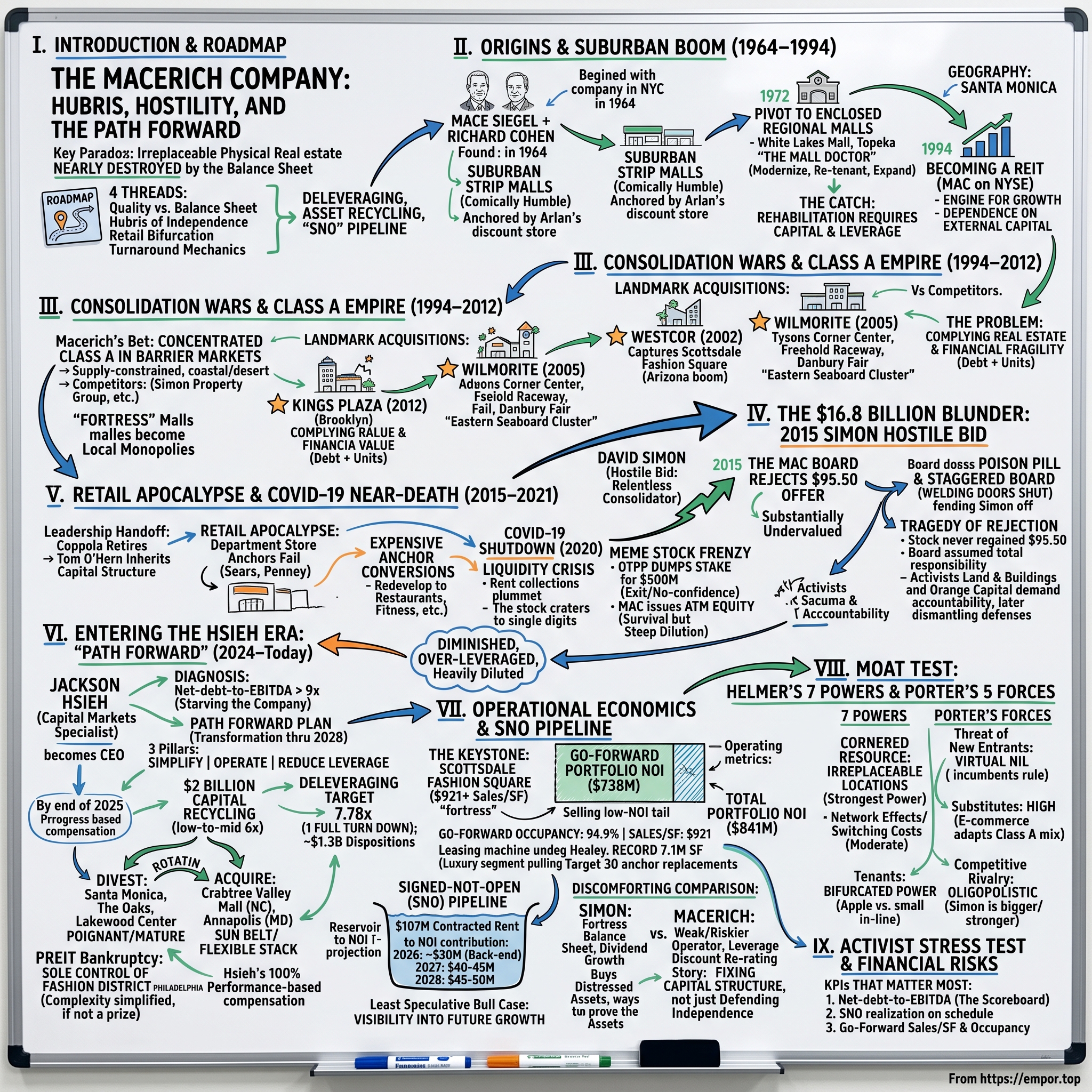
The Macerich Company: Hubris, Hostility, and the Path Forward for America's Fortress Malls
I. Introduction & Episode Roadmap
On the morning of March 9, 2015, the phones on the trading desks of every real estate investment shop in America lit up at once. Simon Property Group — the largest mall owner on the planet, run by the notoriously aggressive David Simon — had gone public with an unsolicited, all-out bid to swallow its most coveted rival. The target was The Macerich Company, a REIT that owned some of the most productive shopping centers in the United States. The offer was audacious in both size and hostility: roughly $16.8 billion in enterprise value, an escalating cash-and-stock package that would top out at $95.50 per Macerich share.1
Macerich's board said no. Not "let's negotiate," not "sweeten it." No. They swallowed a poison pill, staggered their board so it couldn't be replaced in a single vote, and told the world that their portfolio of "fortress" Class A malls — Scottsdale Fashion Square, Queens Center, a commanding stake in Tysons Corner Center — was worth far more than what Simon was dangling.[^2]
Here is the uncomfortable part. More than eleven years later, on this July day in 2026, Macerich stock has never again touched $95.50. It has not touched half of it. It cratered into the single digits during the pandemic, the company's leverage ballooned past nine times earnings before interest, taxes, depreciation, and amortization (EBITDA), and management had to sell tens of millions of new shares at fire-sale prices simply to keep the lights on and the creditors at bay.
So this is a story about a paradox. How does a company that owns genuinely irreplaceable physical real estate — the kind of land you literally cannot rebuild in Northern Virginia or Queens — nearly destroy itself? The answer is not about the buildings. It is about the balance sheet, the leverage, and the human tendency to confuse "we are right about our assets" with "therefore we are right to reject $95.50 in cash and stock." Owning the best real estate in the country does not exempt you from arithmetic.
And then there is the sequel, which is why Macerich is interesting again in 2026 rather than merely a cautionary tale. A new chief executive, Jackson Hsieh, took the wheel in March 2024 with a turnaround manual he calls the "Path Forward Plan," and he is trying to prove that the assets were, in fact, worth defending — just not with the capital structure the prior regime built.[^6]
Four threads run through this story, and it is worth naming them at the top:
- Quality versus the balance sheet. Trophy real estate and a fragile capital structure can coexist inside the same company, and the second can bury the first.
- The hubris of independence. A board that blocks a takeover inherits total accountability for whatever happens next.
- The bifurcation of retail. The "retail apocalypse" was never uniform. Class B and C malls died; the best Class A centers mutated into experiential, mixed-use town squares.
- The turnaround mechanics. Deleveraging, asset recycling, and the wonky-but-crucial "Signed-Not-Open" leasing pipeline that lets a REIT grow cash flow without printing new stock.
We keep an independent posture throughout. Where management says it will win, we ask what evidence supports the claim and what would prove it wrong. Let's start where it started — with two men in New York and a name stitched together from their own.
 Subscribe on LinkedIn
II. Origins of the Portmanteau & The Suburban Mall Boom (1964–1994)
The name is a tell. "Macerich" is not a place, not a Latin root, not a founder's surname. It is two first names welded together — Mace Siegel and Richard Cohen — a small piece of vanity that has quietly survived on the New York Stock Exchange ticker for three decades.8 Two men, October 1964, New York City. Siegel was the deal-maker and operator; Cohen brought much of the early capital. Their first swing was almost comically humble: a strip mall built on a former athletic field in Ames, Iowa, anchored by a discount store.8
For their first eight years, that was the whole business — grinding out suburban strip centers. They eventually developed eighteen of them, sixteen anchored by a now-forgotten discount chain called Arlan's.8 This is worth pausing on, because it is the opposite of the glossy luxury image Macerich would later cultivate. The company was born in the unglamorous plumbing of American consumerism: cheap boxes, discount anchors, secondary markets.
The pivot came in September 1972, and it defined everything after. Macerich bought the White Lakes Mall in Topeka, Kansas — an enclosed regional mall — through a joint venture with an insurance company partner.8 Overnight, the founders' ambition changed shape. They were no longer building modest strip centers; they were acquiring big, complicated, enclosed malls and fixing them. This became the company's entire personality, later earning Macerich the industry nickname "the Mall Doctor": buy a tired or troubled regional mall, then aggressively expand it, re-tenant it, and modernize it into something far more valuable.
The 1975 purchase of Lakewood Center in Lakewood, California cemented both the strategy and the geography.8 Siegel and Cohen had figured out something that sounds obvious now but wasn't universally believed then — that dense, affluent coastal markets produce dramatically better retail economics than the middle of the country. To be close to that redevelopment work, they moved the headquarters from New York to Santa Monica, where it remains. The center of gravity of the company shifted from the East Coast financiers who founded it to the Southern California operators who would build it.
It is worth dwelling on the "Mall Doctor" philosophy, because it explains both Macerich's later brilliance and its later fragility. A pure developer builds new; a pure operator holds and manages. Macerich chose a third path — buy something broken, diagnose what was wrong with it, and rehabilitate it. That is a high-skill, high-touch, capital-intensive discipline. Done well, it generates outsized returns, because you are buying at a distressed price and selling into the value you personally create. But it has a structural catch that would haunt the company for decades: rehabilitation requires capital, usually borrowed, and the returns arrive years after the debt is drawn. A redevelopment strategy is, almost by definition, a leverage strategy. The Mall Doctor is always carrying a mortgage on the patient.
The choice to become a REIT in 1994 was therefore not a cosmetic financial detail — it was the engine that let a redevelopment-and-acquisition strategy run at national scale. Consider the trade the REIT structure makes. In exchange for distributing the overwhelming majority of its taxable income to shareholders as dividends, a REIT largely escapes corporate income tax, which lowers its cost of capital versus an ordinary corporation. But that same requirement — pay out most of your earnings — means a REIT cannot easily fund growth from retained profits the way a normal company can. It must return to the capital markets again and again, issuing new stock and new debt to buy the next asset. That dependence on external capital is the REIT sector's original sin: it works beautifully when markets are open and cheap, and it turns lethal when markets slam shut. Macerich would experience both faces of that bargain.
By the early 1990s, Macerich had a proven playbook and a portfolio, but it had a problem every ambitious real estate operator eventually hits: acquiring malls is enormously capital-intensive, and private financing caps how fast you can grow. The solution was the defining financial event of the era for the whole sector — going public as a REIT.
In March 1994, Macerich completed its initial public offering on the New York Stock Exchange under the ticker MAC, structured as a real estate investment trust that owned fifteen properties and roughly ten million square feet.8 The REIT structure was the key that unlocked the next twenty years. A REIT pays little to no corporate income tax so long as it distributes the bulk of its taxable income to shareholders as dividends — which makes it a tax-efficient vehicle for owning income-producing property, and, crucially, a machine for tapping public equity and debt markets to fund acquisitions. Revenues jumped from $86 million in 1994 to $155 million by 1996 as the newly public company went shopping.8 The suburban strip-mall shop from Ames, Iowa had become a publicly traded consolidator with a war chest. Now it needed targets — and the fragmented American mall industry was full of them.
III. The Consolidation Wars & Building the Class A Empire (1994–2012)
Picture the American mall industry in the late 1990s as a patchwork quilt — hundreds of regional malls owned by dozens of local developers, insurance companies, and family partnerships, most of them undercapitalized and none of them at national scale. The newly public REITs saw the same opportunity a private-equity roll-up artist sees today: buy the fragments, gain scale, professionalize the management, and re-rate the cash flows.
Macerich's competitors chose breadth. Simon Property Group, in particular, built an empire by owning a vast number of malls across every tier of quality and every corner of the map. Macerich made a different bet — one that would define its identity and, eventually, both its glory and its vulnerability. Rather than owning the most malls, it wanted to own the best malls, concentrated in high-barrier-to-entry markets: supply-constrained coastal corridors and affluent desert enclaves where you simply cannot build a competing center next door.
The company's early public-market growth came, revealingly, arm-in-arm with the very rival that would later try to swallow it. In 1998, Macerich teamed with the Simon DeBartolo Group in a joint venture to buy twelve regional malls from ERE Yarmouth for roughly $974.5 million, adding some 10.7 million square feet across eight states.8 Co-investing with Simon to gain scale, then being targeted by Simon seventeen years later, is one of those ironies the mall industry specializes in — a business small enough that the same handful of players keep circling the same assets across decades. The man steering Macerich through this period was Arthur Coppola, a founder's protégé who had risen through the company and would become its defining chief executive. Coppola was, by every account, a true believer in the redevelopment craft and in the intrinsic superiority of Class A real estate. That conviction was Macerich's greatest asset for twenty years — and, in 2015, its greatest liability.
The first landmark move came in 2002, when Macerich acquired Westcor, the dominant mall operator in Arizona, for approximately $1.475 billion, picking up nine regional malls and a large bank of development land in the fast-growing Phoenix metropolitan area.8 The jewel of that deal was Scottsdale Fashion Square, which would become the crown of the entire portfolio — a luxury magnet in one of America's wealthiest desert markets. Westcor didn't just add properties; it gave Macerich a regional monopoly in a metro that was about to boom demographically. This is the strategy working exactly as intended: buy the dominant asset in a growing market before the growth shows up in the rent roll.
Then came the aggressive one. On April 25, 2005, Macerich closed its acquisition of Wilmorite Properties for approximately $2.333 billion — a figure that included assuming roughly $879 million of existing debt and issuing $240 million of preferred and common operating-partnership units.9 The prize inside was extraordinary: interests in eleven regional malls, anchored by three genuinely premier centers — Tysons Corner Center in McLean, Virginia (among the highest-sales-volume malls in the country), Freehold Raceway Mall in New Jersey, and Danbury Fair Mall in Connecticut.9 With one check, Macerich stapled an "Eastern Seaboard" cluster of trophy assets onto its Western portfolio. But notice the mechanism of the deal — nearly a billion dollars of assumed debt and a large slug of stock-like units. Macerich was buying quality, but it was buying it with leverage and dilution. That pattern — great assets financed with a heavy balance sheet — was becoming a habit.
The 2012 acquisition of Kings Plaza told the same story in miniature. On November 28, 2012, Macerich bought the 1.2-million-square-foot Kings Plaza super-regional mall in Brooklyn from an affiliate of Vornado Realty Trust for $751 million — $721 million in cash plus a sliver of restricted stock.10 Kings Plaza was Brooklyn's dominant indoor mall, sitting on top of one of the densest, most supply-constrained retail markets in America. Paying $751 million for a single mall signaled Macerich's willingness to write premium checks for irreplaceable urban dominance.
There is a persistent myth about this era worth correcting: that Macerich simply overpaid for trophies out of ego, and that the acquisitions were value-destructive from day one. The reality is more nuanced. Through the mid-2000s, these deals largely worked — Westcor's Arizona assets rode the Phoenix demographic boom, Tysons Corner threw off enormous cash flow, and the properties genuinely re-rated as Macerich professionalized and expanded them. The problem was never that the assets were bad or that the prices were insane for the quality. The problem was the form of the payment: each landmark deal loaded on more debt and issued more equity-like units, so that even as the asset base grew more valuable, the claims against it grew faster and more rigid. Macerich was compounding real estate value and financial fragility at the same time. In a rising market, only the first half of that sentence is visible.
At their zenith, these assets behaved like local monopolies. In a supply-constrained market, a dominant Class A mall is effectively the only place a national retailer can reach a critical mass of affluent shoppers in person. That gave Macerich real pricing power over its in-line tenants, double-digit leasing spreads, and vacancy rates in the low single digits. The company had built exactly what it set out to build: a concentrated collection of the best retail real estate in the country — a portfolio whose sales productivity ranked among the highest in the American mall industry.
And that is precisely why what happened next stung so badly. When you own the best assets and you know it, it becomes psychologically very hard to sell — even when someone offers you a king's ransom. Which brings us to March 2015.
IV. The $16.8 Billion Blunder: The 2015 Simon Hostile Takeover Bid
David Simon does not make friendly first moves when he wants something badly. So when Simon Property Group publicly disclosed its interest in Macerich in early March 2015, everyone in the sector understood the subtext: the biggest shark in the tank had decided to eat the highest-quality fish, and it was going to do it in the open, in front of Macerich's own shareholders.1
To understand the drama, you have to understand David Simon. As chairman and CEO of Simon Property Group, he ran the largest retail-real-estate company in the world, and he had earned a reputation as the sector's most relentless consolidator — a dealmaker who viewed the mall industry as a chessboard he was destined to control. Simon buying Macerich would not have been a merger of equals; it would have been the apex predator absorbing the highest-quality prey on the board, further entrenching an already dominant position. That strategic logic was exactly why Simon wanted it so badly — and exactly why Macerich's rejection carried a whiff of principled defiance as well as self-interest.
The bid escalated fast. Simon's pursuit climbed from an initial level around $91 per share to what it called a "best and final" offer of $95.50 per share — a roughly 50/50 mix of cash and Simon stock, valuing Macerich's equity at about $16.8 billion.1 For context, this was an all-time high price for the stock and a substantial premium to where Macerich had been trading before Simon showed up. In cash-and-stock takeover terms, it was a genuine, credible, richly valued offer from the one buyer with the balance sheet to pay it — and, given Simon's dominance, one that raised obvious antitrust questions about combining two of the sector's largest owners.
Macerich's board, led by long-time chief executive Art Coppola, refused even to sit down at the table. On March 17, 2015, the company formally rejected the proposal, declaring that it "substantially undervalued" Macerich and pointing to the premium quality of its assets and its future growth runway as justification.[^2] Coppola had spent a career building this portfolio the hard way, mall by mall, redevelopment by redevelopment. To him, selling at any price was selling the family silver. The conviction was sincere. Whether it was in shareholders' interest is a separate question — and that separation is the entire lesson.
Then came the scorched-earth phase. To fend Simon off, the board deployed the classic anti-takeover arsenal: a "poison pill" shareholder rights plan that would massively dilute any hostile acquirer who crossed an ownership threshold, plus a classified (staggered) board structure that made it impossible for an outside bidder to replace the directors in a single annual meeting.[^2] These are the corporate-governance equivalent of welding the doors shut. They are also, to activist investors and governance watchdogs, red flags — because they entrench management and insulate it from accountability to the very owners it serves.
Simon, unwilling to wage a multi-year siege against a fortified board, withdrew its offer on April 1, 2015.2 The walls had held. But the aftermath was ugly. Activist investors — most prominently Jonathan Litt's Land and Buildings, along with Orange Capital — went public with blistering critiques of Macerich's governance, calling the defensive structures insular and value-destructive and demanding accountability for rejecting such a premium. Under the pressure, Macerich eventually backed down on its defenses: by late May 2015 it agreed to eliminate the poison pill and take steps to improve its governance and board independence.[^4] The fortress had, in the end, quietly dismantled its own walls — after using them exactly once, to block a deal shareholders never got to vote on.
There is a defense of the board worth stating fairly before we render judgment, because hindsight makes fools of everyone. In early 2015, Macerich's rejection did not look obviously wrong. Class A mall fundamentals were still strong, sales per square foot were rising, and the "retail apocalypse" was not yet a headline. A reasonable director could believe that Simon was trying to steal a premium asset at a cyclical moment, and that Macerich shareholders would do better holding on. The offer was also half stock — meaning Macerich holders were being asked to accept a large slug of Simon equity, whose value they would have to trust. None of that is trivial, and a board that negotiates hard is doing its job.
The indictment is not that the board declined a specific price. It is that it refused to engage at all, and then reached for entrenchment tools that removed the decision from shareholders entirely. There is a meaningful difference between "we think $95.50 undervalues us, come back with more" and "we will weld the doors shut so you cannot even make your case to our owners." The poison pill and staggered board did the second thing. That is where the independent lens matters most. A board is absolutely permitted to believe its company is worth more than a bid. But when a board blocks a premium offer and takes the "we'll do better on our own" path, it assumes total responsibility for the outcome. It is making a promise, whether it says so or not: trust us, independence will create more value than $95.50 in hand. The verdict on that promise took a decade to arrive, and it was brutal. As the retail landscape deteriorated and Macerich's own leverage bit down, the stock never came close to recovering to Simon's rejected price. Rejecting $95.50 became one of the most-cited wealth-destruction episodes in modern REIT history — not because the assets were bad, but because the board's confidence in the assets blinded it to the risk sitting on its own balance sheet.
The tragedy is that the rejection wasn't punished immediately. For a couple of years, it even looked defensible. And then the ground gave way.
V. The Retail Apocalypse & COVID-19 Near-Death Experience (2015–2021)
Every turnaround story has a moment where the protagonist's earlier choices come due all at once. For Macerich, that reckoning arrived in the second half of the 2010s and detonated in 2020.
The leadership handoff came first. Art Coppola — the architect of both the empire and the Simon rejection — retired from the CEO role in 2018, passing the reins to Tom O'Hern, a long-time Macerich insider who had served for years as the company's chief financial officer. That lineage matters: O'Hern inherited not just the trophy assets but the capital structure that had financed them — a balance sheet layered with property-level mortgages and joint-venture debt accumulated across two decades of acquisitions. He took command just as the tide went out.
The "retail apocalypse" was the tide. Across the late 2010s, the department-store anchors that had defined the American mall for generations began to fail in waves — Sears, then Bon-Ton, then JCPenney lurching toward bankruptcy, while once-dominant in-line tenants like Forever 21 collapsed. For a Class B or C mall owner, a dead anchor is often a death sentence: the box goes dark, foot traffic evaporates, co-tenancy clauses let other tenants cut rent or leave, and the whole center spirals. Macerich's response was the expensive one that its asset quality demanded. Rather than let the boxes rot, it poured capital expenditure into reclaiming, subdividing, and redeveloping those cavernous anchor spaces into experiential and lifestyle uses — restaurants, fitness, entertainment, medical, even residential. That was the correct strategic instinct. But redevelopment is slow and cash-hungry, and it was consuming capital precisely when the balance sheet could least afford it.
The mechanics of an anchor conversion are worth understanding, because they are the physical heart of the modern mall thesis. When Sears vacated a 150,000-square-foot box, the landlord did not simply find another Sears — that species was extinct. Instead, Macerich had to buy back the box (anchors often own or ground-lease their pads on favorable terms), demolish or gut it, subdivide it into multiple smaller spaces, run new utilities and entrances, and lease it to a curated mix of tenants who each pay far more per square foot than the department store ever did. Done right, this converts a dead, low-rent liability into a high-rent, traffic-generating asset — a genuine value-creation engine. Done at scale, across dozens of boxes, during a credit crunch, it is a cash-flow sinkhole that can drown an over-levered owner before the payoff arrives. Macerich was running the right play with the wrong balance sheet, and the timing could hardly have been crueler.
Then March 2020 dropped the wall on top of everything. COVID-19 shut down physical retail nationwide. Tenants stopped paying rent, and Macerich's collections plummeted to historic lows. A company already carrying heavy leverage and facing a wall of debt maturities suddenly had a fraction of its cash flow — the textbook setup for a liquidity crisis. For a period in 2020, the market was openly pricing the possibility that Macerich might not make it, and the stock fell into the single digits.
What happened next was one of the strangest chapters in the company's history — and pure luck. In January 2021, retail traders on Reddit's r/WallStreetBets turned their attention to heavily shorted stocks, igniting the "meme stock" frenzy that sent GameStop and AMC vertical. Macerich, with its very high short interest, got swept into the mania, and its shares spiked far beyond what its fundamentals justified.
One shareholder read that spike correctly and acted with cold discipline. The Ontario Teachers' Pension Plan (OTPP), a Macerich holder since the late 1990s, seized the speculative surge to dump its entire 16.4% stake for roughly $500 million.3 Think about the asymmetry of that moment: while retail traders were buying a mall REIT because it was a short-squeeze target, one of the most sophisticated institutional investors in the world was quietly handing them its entire position at prices it never could have gotten on fundamentals. It was, in hindsight, a near-perfect exit — and a vote of no confidence from a two-decade owner.
Macerich management played the same window from the other side. To avoid default and pay down its revolving credit lines, the company launched a series of large at-the-market (ATM) equity offerings, selling new shares into the elevated demand. This stabilized the balance sheet and bought survival — but at a steep, permanent cost to existing owners. Issuing large quantities of stock at depressed, post-pandemic prices is dilution in its most painful form: every long-term shareholder's slice of the company shrank, and the shares sold cheap can never be bought back at that price. The company survived. The equity holders paid for it.
By 2021, Macerich had cheated death, but it was a diminished, over-leveraged, heavily diluted version of the empire that had rejected Simon six years earlier. The assets were still world-class. The capital structure was still broken. Fixing that gap would require a different kind of leader — someone who thought like a financier first and a mall operator second.
VI. Entering the Hsieh Era: The "Path Forward" Turnaround (2024–Today)
On February 6, 2024, Macerich announced that Jackson Hsieh would become president and chief executive officer effective March 1, succeeding the retiring Tom O'Hern.[^6] The hire raised eyebrows for an unusual reason: Hsieh had spent roughly three decades on Wall Street — senior roles at Morgan Stanley and UBS, then the CEO chair at Spirit Realty Capital — but he had never actually run shopping centers.7 Macerich was hiring a capital-markets and balance-sheet specialist to fix a company whose problem was, above all, its capital structure. The board was essentially conceding that the disease was financial, not operational.
Hsieh's credibility came from one recent, concrete accomplishment. At Spirit Realty, a net-lease REIT, he had engineered a turnaround that culminated in Spirit's roughly $9.3 billion sale to Realty Income, announced in October 2023.[^10] He had, in other words, demonstrably created value at a REIT and returned it to shareholders through a sale — the exact skill set a battered, over-levered Macerich needed. Whether that same playbook transferred to the messier world of mall operations was the open question.
There was also symbolism in the hire that shouldn't be missed. For most of its history, Macerich had been run by mall people — operators and developers who loved the real estate. Bringing in a financier signaled that the board had finally, painfully internalized the lesson of the prior decade: the constraint was never the quality of the buildings. It was the money wrapped around them. When a company that owns the best assets keeps underperforming, the answer is often not a better operator but a better capital allocator. Hsieh was hired to be exactly that.
His diagnosis was blunt and quantitative. In his first weeks, Hsieh identified Macerich's core disease as a net-debt-to-EBITDA ratio above nine times.[^7] That number deserves translation, because it is the crux of the whole story. Net-debt-to-EBITDA measures how many years of cash earnings it would take to repay net debt. Conservative REITs run around five to six times. Above nine times, a company is starving — nearly all of its cash flow is spoken for by lenders, it cannot easily fund redevelopment or acquisitions, and the equity market slaps a discounted valuation multiple on it because so much of the enterprise value belongs to creditors. Macerich owned trophy assets but had almost no financial freedom to do anything with them. High leverage does something subtler and more corrosive too: it inverts the risk-reward for equity holders. When a company is this levered, small swings in property values or interest rates produce enormous swings in the thin sliver of equity underneath — which is precisely why the stock behaved like a call option through 2020 and 2021, cratering and spiking on news that barely moved the underlying real estate. Deleveraging is not just about safety; it is about restoring a normal relationship between the business and its stock.
Hsieh also found, on arrival, a company that had never built the basic managerial scaffolding a turnaround requires. By his own account, Macerich lacked a mission statement, articulated core values, a ranking system to compare its own properties against one another, and five-year business plans for individual assets.7 For a company this old and this large, that is a striking admission — and a clue as to how a portfolio of world-class real estate had drifted into financial trouble. You cannot allocate capital rationally across assets you have never ranked. One of Hsieh's first moves was to impose that discipline: a framework scoring each center on trade-area growth, competitive position, and financial return, which in turn determined what to keep, what to sell, and where to invest.7
The remedy, developed inside Hsieh's first 45 days and unveiled in 2024, was the "Path Forward Plan," a multi-year transformation running through 2028 built on three pillars: simplify the business, drive operational performance, and — above all — reduce leverage.[^7]7 The plan set a deleveraging target of the low-to-mid-6x range over roughly a four-year horizon, to be achieved primarily through a $2 billion capital recycling program — selling non-core, slower-growth malls and joint-venture stakes to pay down debt — while concentrating the company on a curated "Go-Forward Portfolio" of premier Class A assets.[^7]
By the end of 2025, the early results were real, if not yet finished. Leverage had come down a full turn, to 7.78x net-debt-to-EBITDA — down from north of nine — on the back of roughly $1.3 billion of completed dispositions against the $2 billion target.5 A full turn of deleveraging in under two years is meaningful progress, though the destination of the low-to-mid-6x range is still several turns and several billion dollars of asset sales away. The plan is working; it is not done.
The capital recycling had a distinctive signature: sell mature, slow-growth assets and redeploy into dominant centers in faster-growing markets. Macerich divested a cluster of California properties — Santa Monica Place, The Oaks, and the historically symbolic Lakewood Center among them, totaling more than three million square feet — and rotated the capital into higher-growth geographies.7 There is a poignancy to selling Lakewood Center in particular: it was the 1975 acquisition that made Macerich the Mall Doctor and pulled the company west to Santa Monica. Parting with it is a statement that the turnaround is not sentimental. Under Hsieh's ranking framework, a legacy trophy in a slow-growth trade area is just capital that could work harder somewhere else.
Somewhere else meant the Sun Belt. The clearest example was the June 2025 acquisition of Crabtree Valley Mall, the dominant, high-traffic retail asset in the Raleigh–Durham market of North Carolina — roughly 1.4 million square feet in one of the fastest-growing metros in the country.47 The logic is a direct application of the strategy: buy the irreplaceable, dominant center in a market where population and income are compounding, so that demographic growth does the heavy lifting on future rents. In early 2026, Macerich extended the pattern by acquiring the dominant regional mall in Annapolis, Maryland — notably structured without assuming an expensive existing mortgage, financed instead with cash and the revolving credit line so that Macerich retained full flexibility over the asset's capital stack.5 That structuring choice is a small but telling sign of the new discipline: rather than inherit a legacy mortgage at whatever rate and terms it carried, management kept the property unencumbered and preserved its options — the kind of detail the old, deal-hungry Macerich might not have prioritized.
There is a fair critique to register even here. Buying assets — even great ones — while the stated top priority is deleveraging is in tension. Every dollar spent on Crabtree or Annapolis is a dollar not applied to debt reduction, and it invites the skeptical question of whether a company in balance-sheet repair should be shopping at all. Management's defense is that these are funded by recycling proceeds from lower-quality sales, not by new leverage, and that they are underwritten to be accretive to the 2028 plan rather than stabilized assets bought at full price.57 That is a coherent answer, but it is also exactly the sort of "we're growing responsibly" narrative that requires the results to prove it. An investor should watch whether the acquisitions genuinely earn their keep or quietly slow the deleveraging clock.
Alongside the buying and selling ran a campaign to simplify Macerich's notoriously complex web of joint ventures. This is an under-appreciated part of the diagnosis. Over two decades of dealmaking, Macerich had accumulated a thicket of partial ownership structures — assets it co-owned with pension funds, developers, and rivals, each with its own debt, its own partner, and its own governance. Joint ventures can be efficient, but a portfolio riddled with them is hard to value, hard to control, and hard for investors to underwrite; the "look-through" leverage buried inside JVs is one reason Macerich's true financial position was murkier than a simple balance sheet suggested. Untangling that complexity is itself a form of value creation, because clarity earns a higher multiple.
The most striking example arrived in late 2023, when the company's JV partner PREIT filed for Chapter 11 bankruptcy and transferred its 50% stake in Fashion District Philadelphia to Macerich in exchange for a release from the associated debt.[^8] Macerich took full control of the asset — a genuinely mixed outcome. Sole ownership of a struggling downtown Philadelphia property is not obviously a prize, and taking on a distressed urban asset cuts against the "concentrate on the winners" logic. But it removed a bankrupt partner, eliminated a source of complexity and dispute, and gave Macerich unilateral control to decide the property's fate rather than negotiating every move with a co-owner in bankruptcy court. Simplification sometimes means owning more of something you are ambivalent about, precisely so you can control the exit.
Finally, Hsieh moved to align his own incentives with shareholders in ways worth noting because they are behavioral evidence, not just rhetoric. He is bound by a stock-ownership requirement of six times his base salary, and — the more telling signal — he voluntarily elected to take 100% of his 2025 long-term incentive awards as performance-based LTIP units tied to Macerich's total shareholder return.7 A CEO who converts his entire long-term pay into instruments that pay off only if the stock outperforms is putting his personal net worth where his plan is. It does not guarantee success. But it is the opposite of the entrenchment posture that defined the 2015 board, and the market noticed the difference.
Incentives, though, don't lease space or generate cash. To judge whether the turnaround is real, you have to go down into the operating engine — the portfolio segments and the leasing pipeline.
VII. Operational Economics: The Go-Forward Portfolio & SNO Pipeline
Walk into Scottsdale Fashion Square on a Saturday and you will not think "distressed REIT." You will see valet lines, luxury flagships, and the specific hum of a place where people come to spend. That sensory reality — the sheer productivity of the best assets — is what the financial statements are trying to capture when Macerich splits its portfolio in two.
The company now reports through the lens of a "Go-Forward Portfolio" (the keepers) versus the total portfolio (keepers plus the assets on the way out the door). The gap between them is the whole thesis. For full-year 2025, the Go-Forward Portfolio generated $738 million in net operating income (NOI), the substantial majority of the company's total portfolio NOI of $841 million.5 Read that carefully: the assets Macerich intends to keep produce roughly seven of every eight dollars of NOI, while the roughly one-eighth coming from non-core assets slated for sale drags down the blended productivity. NOI, for the uninitiated, is simply property income after property-level operating expenses — the cleanest measure of what the real estate itself earns before financing and corporate costs. When Macerich sells the low-NOI tail, headline NOI falls, but quality per remaining square foot rises. That trade-off is the source of much of the friction we'll see on the earnings calls.
The productivity gap shows up in the operating metrics too. Go-Forward Portfolio occupancy ended 2025 at 94.9%, up 60 basis points sequentially, and tenant sales in that portfolio ran at $921 per square foot versus $881 for the total portfolio.511 Sales per square foot is the retail landlord's north-star metric — it measures how much revenue tenants ring up per foot of space, which in turn determines how much rent they can sustainably pay. At north of $900 per foot, Macerich's core real estate sits among the most productive physical retail square footage in the world, and the luxury segment, up 5.5% in 2025, is pulling that number higher.5 High and rising sales productivity is the single best evidence that the "fortress" thesis is more than a slogan — retailers keep selling more per foot in these locations, which is exactly what should happen if the locations are genuinely irreplaceable.
The leasing machine is where the turnaround becomes visible quarter to quarter. In 2025, under Senior EVP of Leasing Doug Healey, Macerich signed a company-record 7.1 million square feet of new and renewal leases — an 85% increase over 2024 — and committed all 30 of the anchor and big-box replacement spaces targeted under the restructuring plan.5 Those 30 replacements alone represent about 2.9 million square feet projected to generate roughly $750 million in annual tenant sales once open.5 Filling a record volume of space while completing every targeted anchor backfill is strong evidence of genuine retailer demand for these centers — you cannot fake 7.1 million square feet of signed leases. On the Q4 2025 call, Hsieh framed leasing as "the engine" of the plan and said the heavy lifting of de-risking it was substantially complete, with the company shifting into an "execution and conversion" phase.5
Which brings us to the quietly crucial concept in this entire story: the Signed-Not-Open (SNO) pipeline. Here is the mechanism in plain terms. When a retailer signs a lease, it does not start paying rent the next day — it needs months to build out the store. During that gap, the lease is signed but the store is "not open," and the rent has not yet hit the income statement. The SNO pipeline is the sum of all that contracted-but-not-yet-flowing rent. It is, in effect, cash flow you can already see coming, locked in by signature, waiting to switch on.
At the end of 2025, Macerich's SNO pipeline stood at roughly $107 million, having crossed its $100 million target.5 Management guided that this pipeline would contribute incremental NOI of about $30 million in 2026 (back-end weighted within the year), rising to $40–$45 million in 2027 and $45–$50 million by 2028.5 There is a reason this pipeline exists at unusual size right now rather than being a normal, small feature of the business: it is the direct product of the record leasing surge. When you sign 7.1 million square feet in a single year, a large share of those tenants are, by definition, not yet open — so the SNO backlog swells. The pipeline is essentially the 2025 leasing achievement viewed from the future, waiting to be recognized as cash. This is the most important thing to understand about the bull case, because it is the least speculative. Much of Macerich's projected cash-flow growth over the next three years is not a forecast of new demand — it is the scheduled commencement of leases that are already signed. If those tenants open on time and pay, that NOI arrives regardless of the macro environment, and it drives deleveraging organically, without another dilutive equity raise. The word "if" is doing real work in that sentence — build-out delays and tenant failures can push the timing — but the visibility here is genuinely higher than a typical growth story.
Signed leases and rising sales are the demand side of the ledger. Whether that demand adds up to a durable competitive advantage is a different question — and for that we need the strategy frameworks.
VIII. Strategic Moat: Hamilton Helmer's 7 Powers & Porter's Five Forces
Ask a skeptic why anyone should own a mall REIT in the age of Amazon, and the honest answer is: most malls, you shouldn't. The entire investment case for Macerich rests on the claim that its specific assets are categorically different from the dying middle of the industry. Let's stress-test that claim using two frameworks investors know well — Hamilton Helmer's 7 Powers and Michael Porter's Five Forces — and see how much of the moat is real versus rhetorical.
Cornered Resource — the strongest of the powers. Helmer's "cornered resource" is preferential access to something valuable that competitors cannot replicate. For Macerich, that something is physical location. You cannot build a new one-million-square-foot regional mall next to Tysons Corner Center or Queens Center, because the land is not available, the zoning does not permit it, and the cost would be prohibitive. High-density, high-income metros have a finite quantity of land entitled for large-scale retail, and the incumbents already sit on it. This is the most defensible part of the story, and it is not really contestable: the assets genuinely are irreplaceable in a literal, physical sense. The catch — and it is important — is that a cornered resource protects the asset's scarcity, not necessarily its cash flow. Scarcity keeps competitors from building nearby; it does not force any given retailer to keep paying rising rent if consumer behavior shifts.
Network Effects — moderate power. A great mall is a two-sided marketplace. Premium retailers — Apple, Zara, Sephora, luxury boutiques — need to be where affluent shoppers concentrate, and affluent shoppers gravitate to the location with the densest cluster of desirable brands. Foot traffic attracts retailers, and retailers attract foot traffic, forming a self-reinforcing loop that entrenches the dominant mall in each trade area. This is real, but it is weaker than a digital network effect because it is local and it is contestable at the margin by e-commerce, by lifestyle centers, and by consumers simply choosing to shop less in person. It reinforces dominance where dominance already exists; it does not create it from nothing.
Switching Costs — moderate power. When a retailer opens a flagship in a Macerich center, it sinks millions of its own dollars into the build-out — glass storefronts, bespoke lighting, custom interiors. Walking away means abandoning that capital and disrupting an established customer base, which creates real inertia toward renewal. It is a genuine source of stickiness for in-line tenants, though it does little to bind the mega-brands, who have the leverage to demand favorable terms precisely because they are the traffic-drivers.
Now flip to Porter's Five Forces, which asks about the structural attractiveness of the industry Macerich competes in.
Threat of new entrants — virtually nil. The era of building new suburban regional malls is over. Elevated interest rates, high construction costs, and the scarcity of entitled land make ground-up regional mall development economically unviable. New supply, the traditional killer of real estate returns, simply is not coming. This is a strong positive for incumbents.
Threat of substitutes — high, and permanent. E-commerce is the substitute that never goes away. But the Class A response has been adaptation rather than resistance: shift the tenant mix away from commodity apparel toward things the internet cannot deliver — experiential dining, fitness, health services, entertainment. The evidence that this is working is in those rising sales-per-foot and the specific tenants Macerich has been signing, from Dick's House of Sport to entertainment venues.7 The substitute threat is real; the best malls have blunted it by becoming something other than a place to buy commodities.
Bargaining power of tenants — bifurcated. This is the subtle one. Mega-brands like Apple or a major luxury house wield significant leverage; they act as magnets that pull traffic, and they demand low rent-to-sales ratios as the price of their presence. Against smaller in-line tenants, who depend entirely on the anchor-driven traffic, Macerich retains strong pricing power. So the landlord's pricing power is real but uneven — strongest over the many small tenants, weakest over the handful of brands it most wants.
Competitive rivalry — oligopolistic. The premier mall sector is highly consolidated among Simon Property Group, Brookfield Properties, and Macerich. Nationally they compete for retailers' finite store-opening budgets; locally, each flagship mall is effectively a geographic monopoly. It is a comfortable structure to operate in — but note that Simon, the same rival from 2015, remains far larger, better capitalized, and lower-levered, which shapes everything about how Macerich must play its hand.
The Simon comparison is the uncomfortable subtext of the entire investment case, and it deserves to be made explicit. Simon Property Group emerged from the same retail downturn as the sector's fortress balance sheet — investment-grade rated, modestly levered, paying a healthy and growing dividend, and able to opportunistically buy distressed assets while competitors were forced sellers. Macerich, by contrast, spent the same years diluting shareholders and selling assets to survive. The two companies own broadly similar-quality real estate; the difference in outcomes was almost entirely the balance sheet. For an investor, that comparison cuts both ways. The bear says: why own the weaker, riskier operator when the stronger one is available? The bull says: precisely because Macerich trades at a discount born of its balance sheet, the deleveraging story offers a re-rating that the already-healthy Simon cannot. The entire Macerich thesis is a bet that the gap between the two — the "leverage discount" — closes over time.
It is worth puncturing one popular myth here, the idea that "the internet killed the mall." The evidence inside Macerich's own portfolio contradicts the blanket version of that claim. Sales per square foot in the go-forward assets kept rising into 2026, the luxury segment grew, and marquee physical-first and digitally native brands alike kept signing leases and opening stores in these centers.57 What the internet actually killed was the undifferentiated mall — the Class B and C centers selling commodity apparel that a website sells more conveniently. The dominant, experience-rich centers did the opposite of dying; they consolidated the trade area's traffic as weaker competitors closed. The real story is not death but Darwinian sorting, and Macerich's bet is that it owns the survivors. That is a testable claim, and so far the sales data supports it — but it is a claim about these specific assets, and it collapses the moment an investor generalizes it to malls as a category.
The net read: Macerich's moat is real but asymmetric. The physical scarcity of the assets is close to bulletproof; the cash-flow durability that scarcity supposedly protects is more contingent — on consumer behavior, on execution, and on a balance sheet that is still healing. A moat around the land does not automatically moat the equity. Which is exactly what a skeptical investor would press on next.
IX. Activist Stress Test, Financial Risks, & Earnings Call Friction
Imagine a sharp-elbowed activist investor building a slide deck on Macerich in 2026. What would they attack, and where would management's answers hold up? Running that exercise is the fairest way to test the turnaround, because it forces the story to survive its harshest reading.
The activist's first slide writes itself, because Macerich already lived it. Management credibility, historically, was poor. The prior regime under Art Coppola rejected a premium buyout using entrenchment tools, then ran a debt-heavy capital-allocation strategy that left the company dangerously exposed when COVID hit. That is a documented pattern of prioritizing management autonomy and asset-pride over shareholder outcomes — and it cost owners enormously. Any assessment of the current team has to be measured against that scar tissue.
Against that backdrop, the current management's credibility has been rebuilt through behavior rather than promises. Hsieh set specific, quantified milestones — a leverage target, a $2 billion disposition figure, a dated SNO ramp — and has so far delivered against them: a full turn of deleveraging, $1.3 billion of dispositions completed, every anchor replacement committed, all reported on schedule.5 Consistency of narrative across the 2024 plan launch and the 2025 and 2026 calls, combined with the 100% performance-based pay election, is the kind of evidence that separates a real operator from a storyteller. The caveat is honesty about the clock: the plan runs to 2028, and the hardest, most valuation-sensitive part — getting from 7.78x to the mid-6x range — is still ahead. Credibility earned is not credibility proven.
Now the risk radar, restricted to what actually matters for this business:
Refinancing and cost-of-capital risk is the big one. Even at 7.78x, Macerich carries a large absolute pile of debt, much of it property-level mortgages. In a world of higher-for-longer interest rates, refinancing maturing mortgages at higher coupons compresses funds from operations (FFO) — the REIT equivalent of earnings. And this is not hypothetical: on the Q4 2025 call, management disclosed that the 29th Street loan, roughly $76 million at Macerich's share, had gone into default, with lender discussions ongoing.5 It is a single, contained asset, not a systemic crack — but it is a live reminder that "declining leverage" and "no more distressed properties" are not the same statement.
Execution risk in the transformations is real and capital-intensive. Converting dead anchor boxes into mixed-use — residential, hotels, medical, entertainment — is exactly the right long-term move, but it is expensive, slow, and exposed to construction cost overruns and municipal zoning delays. Every quarter of "frictional downtime" while a box is being re-tenanted is NOI that isn't earning.
Macro and consumer-spending risk is moderate and cyclical. A consumer pullback driven by inflation or recession would pressure in-line tenant sales, raise the risk of tenant defaults, and weaken Macerich's hand at renewal. The luxury tilt cuts both ways — affluent consumers are more resilient in ordinary downturns but can retrench sharply in a genuine shock.
The dividend question is the quiet governance issue. A REIT is, to many of its owners, an income vehicle — people buy it for the payout. Macerich's dividend has been a shadow of its pre-pandemic self, cut hard to conserve cash and never fully restored, and every dollar the company channels toward deleveraging and redevelopment is a dollar it is not returning to shareholders. Management's implicit argument is defensible: pay down debt and reinvest now, and a larger, safer, faster-growing dividend can follow later. But it asks income investors to wait, and it means the stock is currently valued on a turnaround narrative rather than on cash in hand. An activist would fairly ask how long "later" is, and what happens to the thesis if the promised growth arrives more slowly than the SNO schedule implies. The counter is that raising the dividend before the balance sheet is fixed would repeat exactly the mistake that nearly sank the company — prioritizing the payout over durability. On this one, discipline and patience are probably the right call, but they are a real cost borne by today's owners for tomorrow's.
Finally, the calls themselves — because the tension between prepared remarks and analyst Q&A reveals where the story is soft. The momentum was already building through 2025 — on the Q3 2025 call, management reported leasing running well ahead of the prior year as the plan gathered pace.[^13] Across the recent quarters, management has been at its most convincing on specifics: Hsieh walked analysts through the exact SNO ramp and defended the Annapolis structure as a deliberate choice to avoid assuming an expensive mortgage and preserve balance-sheet flexibility.56 Those are concrete, checkable answers — the good kind.
Where analysts pushed hardest was on the near-term cost of the strategy. Go-Forward NOI grew only about 1.8% in 2025 — 2.5% excluding the drag from the Forever 21 bankruptcy — against a stated CAGR target of roughly 5.2% through 2028.5 Analysts repeatedly probed the gap: why is NOI growth so muted, and how much of that is the self-inflicted drag from selling assets and taking anchor boxes offline? Management's answer — that near-term cash-flow "drag" is the deliberate price of long-term deleveraging and higher-quality growth — is analytically coherent, but it is also an admission that the payoff is deferred. An investor is being asked to underwrite a 2027–2028 outcome on the strength of a 2025–2026 that looks, on the surface, sluggish. Whether that patience is rewarded is the crux of the bull and bear cases.
X. Playbook: Business & Investing Lessons
Step back from the quarter-to-quarter and the Macerich saga distills into a handful of durable lessons — the kind that outlast any single company's stock chart.
1. Asset quality cannot outrun a bad balance sheet. This is the master lesson of the whole story. Macerich owned, and still owns, some of the finest retail real estate in America. It did not matter. Excessive leverage stripped away operational flexibility, forced massive equity dilution at the exact bottom of the cycle, and destroyed shareholder value even as the underlying properties kept ringing the register. Great assets financed badly are a worse investment than good assets financed conservatively. The balance sheet is not a footnote to the business; in a downturn, it is the business.
2. Governance hubris carries total accountability. When a board blocks a premium buyout in favor of a "long-term independence" narrative, it is making an implicit promise that it can do better on its own — and it forfeits any excuse for what follows. The 2015 rejection of $95.50 was defensible as a judgment about asset value and indefensible as a bet with other people's money on a fragile balance sheet through an unknowable future. The lesson is not "always sell." It is that entrenchment tools transfer the entire burden of proof onto management, and the market eventually collects.
3. The physical-retail halo is real, but conditional. E-commerce did not kill premium physical retail; it bifurcated it. The best Class A centers became essential customer-acquisition and brand-building channels for the very brands that supposedly threatened them, from Apple to digitally native names opening their first stores. But the halo only shines on genuinely dominant, experiential assets — it is not a property of "malls" as a category, and any investor who generalizes from Macerich's best centers to the industry at large will get hurt.
4. In REIT investing, watch the pipeline, not just the snapshot. Current occupancy and current NOI are lagging indicators. The Signed-Not-Open pipeline — leases signed but not yet paying — is a leading one, offering unusual visibility into cash flow that has not yet arrived. Sophisticated capital allocators look past today's rent roll to the contractually committed rent waiting to switch on. It is one of the few places in equity investing where near-term growth is genuinely, if not perfectly, pre-visible.
These lessons set up the final question every investor actually cares about: from here, does Macerich win or not?
XI. Bull vs. Bear Case & Epilogue
The bull case is a story about visible, mechanical improvement. Jackson Hsieh is executing a specific plan and hitting its milestones: leverage has fallen a full turn from above 9x to 7.78x, with a credible path toward the mid-6x range by 2028.5 The SNO pipeline of roughly $107 million provides unusually high visibility into NOI growth through 2028 — much of the next three years' cash-flow expansion is already under contract, not merely forecast.5 And the capital-recycling program is doing what it promised, rotating capital out of slow-growth assets like the divested California properties and into dominant, higher-growth centers like Crabtree and Annapolis.47 If you believe the assets are irreplaceable — and the physical evidence says they are — then a management team that fixes the balance sheet while the assets keep producing $921-per-foot sales is unlocking value that the market's discounted multiple does not yet reflect. The 100% performance-based pay says the CEO is betting his own net worth on exactly that outcome.7
The bear case is a story about arithmetic and time. Even at 7x-ish leverage, Macerich remains far more sensitive to macro shocks and interest-rate moves than conservatively financed REITs, and the 29th Street default is a reminder that pockets of distress still exist inside the portfolio.5 Keeping Class A malls "premium" demands relentless, heavy capital reinvestment — tenant improvements, redevelopments, anchor conversions — which limits the free cash flow available to grow the dividend and competes for the same dollars earmarked for deleveraging. And the entire timeline is execution-dependent: any slippage in opening the anchor replacements, converting the SNO pipeline, or closing the remaining $400–450 million of dispositions pushes out the deleveraging math and keeps the stock range-bound.5 The muted ~1.8% Go-Forward NOI growth in 2025 is the bear's exhibit A that the promised acceleration is still theoretical.5
Weigh them honestly and the truth is that both cases are partly right, and they resolve on the same three variables. This is not a company where the outcome is unknowable; it is one where the outcome is measurable, if you watch the right things.
The KPIs that matter most:
- Net-debt-to-EBITDA. This is the whole thesis in one number. The move from 9x-plus toward the mid-6x target is the difference between a discounted, financially constrained REIT and a healthy one. Track it every quarter; it is the scoreboard for the entire Path Forward Plan.
- SNO NOI realization. The pipeline is only worth what actually opens and pays. Watch whether the roughly $30 million of incremental NOI guided for 2026, scaling to $40–$50 million by 2028, converts on schedule — it is the cleanest test of execution.5
- Go-Forward Portfolio sales per square foot and occupancy. At $921 per foot and 94.9% occupancy, these measure whether the "fortress" thesis is intact.5 If sales productivity keeps climbing and occupancy holds above the mid-90s, the assets are doing their job; if they slip, the moat is thinner than advertised.
The epilogue writes itself into an open question. In 2015, a board bet that Macerich's assets were worth more than $95.50 a share and that it could realize that value alone. It was catastrophically wrong on timing and on the balance sheet, if not on the assets themselves. A decade later, a very different kind of leader is making a narrower, better-hedged version of the same wager: that this real estate is genuinely irreplaceable, and that fixing the capital structure — rather than defending independence for its own sake — is how you finally prove it. The assets have not changed. The question is whether, this time, the arithmetic will be allowed to catch up to the quality. That answer will be written quarter by quarter, in the leverage ratio and the leasing pipeline, between now and 2028.
References
-
Simon Property Group Makes Hostile Bid for Rival Macerich — Reuters, 2015-03-09 ↩↩↩
-
Simon Property Group Withdraws Hostile Bid for Macerich — Reuters, 2015-04-01 ↩
-
Ontario Teachers' Pension Plan Sells Macerich Stake for $500 Million Amid Reddit Rally — Financial Post, 2021-02-05 ↩
-
Macerich Acquires Crabtree Mall in Raleigh in Capital Recycling Move — CoStar Group, 2025-06-18 ↩↩
-
The Macerich Company (MAC) Q4 2025 Earnings Call Transcript — The Motley Fool, 2026-02-24 ↩↩↩↩↩↩↩↩↩↩↩↩↩↩↩↩↩↩↩↩↩↩↩
-
The Macerich Company Q1 2026 Earnings Call Transcript — The Motley Fool, 2026-05-06 ↩
-
Macerich CEO Jackson Hsieh on the Mall Giant's Turnaround — Commercial Observer, 2025-12 ↩↩↩↩↩↩↩↩↩↩↩↩
-
Macerich Completes Acquisition of Wilmorite — SEC Form 8-K (FY2005) ↩↩
-
Macerich Announces Plans to Acquire Kings Plaza and Green Acres Mall — PR Newswire, 2012 ↩
-
Macerich Q4 2025 Investor Presentation — SEC Form 8-K (FY2025) ↩
 LinkedIn
 WhatsApp
 Reddit
 Hacker News
 Email
Email Kindle
 RSS Feed
 Spotify
 Apple Podcasts
 Amazon Music
 Audible
 YouTube