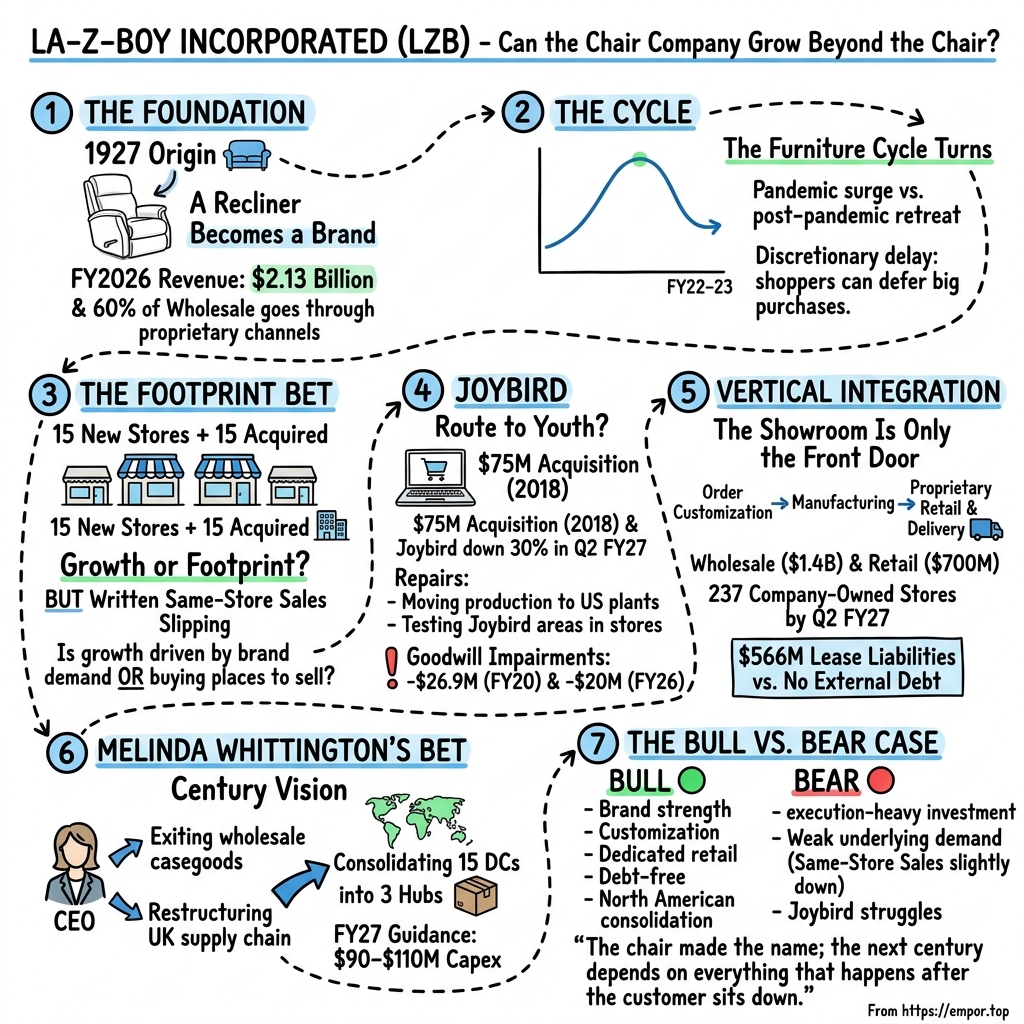
La-Z-Boy Incorporated: Can the Chair Company Grow Beyond the Chair?
I. Fifteen New Stores, One Uncomfortable Question
Picture a La-Z-Boy Furniture Galleries store on a suburban arterial road somewhere in the American Midwest, a few weeks before the company's fiscal year ended in April 2026. The parking lot is wide, the building is bright, and the showroom is laid out like a series of living rooms that nobody lives in. There is a sectional in a sample fabric, a power recliner with a phone-charging port in the armrest, a swatch wall with hundreds of options, and a design consultant who will happily spend an hour helping a couple decide between two shades of oatmeal. What makes this particular store interesting is not the furniture. It is the sign on the door. Until recently, the store belonged to an independent dealer who had operated under the La-Z-Boy name for years. Now it belongs to La-Z-Boy Incorporated itself.
That change of ownership was happening across the map. In fiscal 2026, La-Z-Boy opened 15 new company-owned stores and acquired another 15 from an independent operator, the largest independent-store acquisition in the company's history.1 For a business approaching its hundredth birthday, it was a statement of intent: the company wanted to own more of the moment when a customer sits down, leans back and decides to buy. It was also happening at an awkward time. Across those same months, written same-store sales in the company's Retail segment fell about 3%, which means that the stores La-Z-Boy already owned were taking fewer orders than a year earlier.1
That tension is the whole story in miniature. The company reported fiscal 2026 sales of about $2.13 billion, up less than 1% on the prior year.1 Within that small gain sat a larger fact: roughly $60 million of sales came from acquired stores and about $32 million from net new stores.1 Strip those out, and the existing business shrank. The growth was real, in the sense that cash registers rang, but it was purchased growth and built growth rather than the sound of more customers walking into the same doors.
Then came the second quarter of fiscal 2027, reported on November 17, 2026. Retail delivered sales rose 14%, a number that would look terrific in a headline.2 Underneath, written same-store sales slipped slightly, and Joybird, the online furniture brand La-Z-Boy bought in 2018 to reach younger buyers, saw written sales fall about 30%.2 Adjusted consolidated operating margin dropped to 5.0% from 7.1% a year earlier.2 The company kept adding stores, adding three more in the quarter and agreeing to buy another, while the demand signal from its existing footprint stayed soft.2
So which is it? Is La-Z-Boy growing because more people want its furniture, or because it is buying and building more places to sell it? Those are very different businesses. One has a brand that pulls customers in. The other is a roll-up of retail real estate, which can be a perfectly good business, but it is valued on a different logic, carries different risks, and depends on paying sensible prices for stores rather than on the magic of a famous name.
There is a subtlety in how those acquisitions show up in the numbers, and it matters for anyone reading the headlines. When La-Z-Boy buys a gallery from an independent dealer, it is usually buying a store that was already selling La-Z-Boy furniture. Before the deal, the furniture moved from a La-Z-Boy factory to the dealer, and La-Z-Boy booked a wholesale sale. After the deal, the same sofa moves from the factory to a company store, the wholesale sale becomes an internal transfer that disappears on consolidation, and La-Z-Boy books the full retail price instead. The company captures more of each customer's dollar. But the customer is the same customer, sitting in the same showroom, buying the same chair. Reported Retail growth from an acquisition therefore says almost nothing about whether more households want La-Z-Boy furniture. It says the company now owns a bigger slice of the households it already had.
That is not a criticism of the strategy. Owning the retail relationship can be a good use of capital if the price paid is sensible and the company runs the stores better than the dealer did. It is simply a reason to look past delivered sales to the measure that cannot be bought: whether the stores that were open a year ago are taking more orders today.
To understand the answer, it helps to know what La-Z-Boy actually is today. It is a publicly listed Michigan corporation, traded on the New York Stock Exchange under the ticker LZB, and it is nobody's subsidiary.1 It runs two main operating segments. Wholesale designs and manufactures upholstered furniture, mostly in North America, and sells it to independent dealers, to retail partners and to La-Z-Boy's own stores. Retail is the network of company-owned La-Z-Boy Furniture Galleries, which sells directly to consumers. Joybird, the online brand, sits in a reporting bucket called Corporate and Other, alongside royalties from companies licensed to use the La-Z-Boy name.1 In fiscal 2026, Wholesale sold about $450 million of furniture to its sister Retail segment, sales that vanish on consolidation because the company is, in effect, selling to itself.1
Four questions run through everything that follows. The first is whether the brand can hold its ground in a fragmented market where customers can buy a sofa from a giant private manufacturer, a big-box chain, an online pure-play or an importer they have never heard of. The second is whether La-Z-Boy's integrated model, where it designs, builds, displays and delivers, can turn a wave of investment into better margins rather than just higher fixed costs. The third is whether Joybird is a fixable growth asset or a costly misreading of where the younger customer was heading. The fourth is whether management can keep returning cash to shareholders while also funding a recovery that depends on a consumer who has not yet come back in force.
None of those questions is answered by counting stores. Store growth is easy to count: a ribbon gets cut, a sign goes up, a press release goes out. Profitable same-store demand is much harder to manufacture, because it depends on people choosing to buy something they could easily postpone. That is the real test La-Z-Boy faces as it heads into its centennial, and to see why the stakes are so high, the story has to go back to the chair itself.
 Subscribe on LinkedIn
II. A Recliner Becomes a Brand
In March 1927, two cousins in Monroe, Michigan, a small town on the western shore of Lake Erie, left their jobs to start a furniture business.3 Edward Knabusch had the instincts of a salesman. Edwin Shoemaker had the hands and head of an engineer.4 They set up in the garage of Knabusch's father and gave their enterprise the kind of name only founders could love: the Kna-Shoe Manufacturing Company, a mash-up of their surnames.4 It later became Floral City Furniture, after Monroe's nickname.4
The product that changed everything was not, at first, the overstuffed living-room throne people picture today. It was a wooden-slat porch chair that reclined, built around 1928.3 The cousins realized that a reclining mechanism could be adapted to upholstered indoor furniture, which could be sold all year rather than only in the summer, and they patented that design in January 1929.3 By then, they had a name for the chair, too. La-Z-Boy, a phonetic wink at a lazy boy settling in for the evening, stuck so well that it eventually became the name of the company, which formally changed to La-Z-Boy Incorporated in 1996.3
Here is the part of the origin story that matters for investors almost a century later. The name did two jobs at once. It described a product, the reclining chair, and it built a consumer brand that people could ask for by name. Most furniture is sold as a category: shoppers go looking for "a couch" or "a dining table" and choose among unfamiliar labels on the tag. La-Z-Boy was one of the rare furniture makers whose name entered everyday speech, in the same way that people once asked for a Kleenex rather than a tissue. That gave the company something unusual in its industry: a reason for a shopper to walk into a specific store before seeing a specific piece.
The cousins understood this early. Knabusch, the marketer of the pair, treated the chair as something to be promoted rather than merely stocked, and the company's later decades of advertising, celebrity endorsements and showroom displays grew out of that instinct.4 Shoemaker's contribution was quieter but just as durable: a mechanism that made the product work, and a habit of engineering improvements that would keep the recliner competitive as rivals copied the idea. Brand and engineering, marketing and manufacturing, were bundled together from the first year. That bundle is still what the company is selling.
The company Knabusch and Shoemaker founded spent most of the twentieth century as a product-led manufacturer, selling through independent furniture retailers that showcased the chairs among other brands. Over the following decades it moved, step by step, toward something closer to vertical integration. It developed dedicated La-Z-Boy Furniture Galleries, often run by independent dealers who operated under the brand. It built in-store Comfort Studios, branded spaces inside partner retailers. And it began buying many of those independent galleries and running them itself. By fiscal 2026, about 60% of Wholesale sales flowed through what the company calls proprietary channels, which include company-owned stores, independently owned La-Z-Boy galleries and dedicated La-Z-Boy spaces at partner retailers.1
That shift is the strategic core of the modern company. The approaching 2027 centennial gives management a natural stage to tell that story.
Comfort Studios deserve a brief explanation, because they are the least visible and perhaps the cleverest part of the network. A Comfort Studio is a dedicated La-Z-Boy area inside a multi-brand furniture store, with the company's own displays, fabrics and presentation standards. The partner retailer owns the floor and the customer relationship; La-Z-Boy gets a branded store-within-a-store without paying the rent. It is a way to extend the brand's physical reach into towns where a full company gallery would not pay, and it is part of why so much of Wholesale's volume counts as proprietary. It also means a meaningful slice of La-Z-Boy's presentation depends on partners whose individual importance the company does not quantify.1
Yet the shape of the revenue model sets limits on how far the story can go. La-Z-Boy sells furniture one order at a time. There are no subscriptions, no long-term customer contracts, and no recurring service plans that lock buyers in. Orders are fulfilled within a year, and the company reports no backlog of unfulfilled performance obligations stretching into the future.1 When a family buys a sectional, the relationship might lie dormant for a decade before they need another one. Every sale has to be won again.
Even the money the company spends on product development is modest by the standards of branded consumer goods. Research and development expense was about $11 million in fiscal 2026, roughly half a percent of sales, a level that has barely moved over three years.1 That is typical for furniture, where innovation tends to mean a new mechanism, a new fabric or a new silhouette rather than a laboratory breakthrough. It also means La-Z-Boy's product edge rests more on execution, design and customization than on technology a rival could not license or imitate.
That is why the brand question is more delicate than it first looks. A memorable name can win attention and earn a visit. It does not, by itself, prove that customers will pay more for a La-Z-Boy than for a comparable chair from a rival, or that they will keep coming back. The company's filings do not establish pricing power or protection from substitution; they describe a famous brand operating in a highly competitive market.1 Furniture is a postponable purchase, and shoppers can compare dozens of alternatives on their phones before they ever get into the car.
So the founding asset comes with a question attached. A great name got La-Z-Boy into the showroom. Whether it keeps the company there depends on what happens when customers have reasons to wait, and the last six years gave La-Z-Boy a vivid lesson in exactly that.
III. The Furniture Cycle Turns
In the spring of 2020, the furniture business stopped. As the pandemic spread across North America, La-Z-Boy temporarily idled its plants and closed its stores, and the company spent part of the year cutting costs and conserving cash while it waited to learn whether customers would ever return.5 For a company whose economics depend on full factories and busy showrooms, it was a frightening few months. Upholstery plants are expensive to keep running when nobody is ordering, and expensive to restart when everyone suddenly is.
Then the strangest thing happened. People who were stuck at home started looking hard at their living rooms. The couch that had been fine for watching a movie twice a week was now an office, a classroom and a place to sleep after a long day of being nowhere. Government stimulus checks, rising home values and canceled vacations put cash in household budgets. Furniture, a category that had grown slowly for years, became one of the hottest purchases in American retail. La-Z-Boy's order books swelled faster than its plants could fill them, and its delivery times stretched as it tried to hire and restart production.6
The result was a boom that carried sales to a peak in fiscal 2022 and fiscal 2023. Then the tide went out. As the economy reopened, consumers shifted spending back to travel and experiences. Mortgage rates jumped, which froze the housing market, and fewer home moves meant fewer reasons to buy new furniture. Inflation squeezed budgets for exactly the kind of big-ticket discretionary item a sofa represents. La-Z-Boy's sales retreated from the peak, and by fiscal 2026 they still sat below it.1
The temptation, at the top of a boom, is to believe the business has permanently changed. Investors heard plenty of versions of that story across the consumer world during 2021 and 2022: the home had become the center of life, the e-commerce shift had leaped forward a decade, and companies selling home goods had found a new, higher growth rate. The long record tells a calmer story. From fiscal 2016 to fiscal 2026, La-Z-Boy's sales grew from about $1.5 billion to about $2.1 billion, an annual pace of roughly 3.4%.71 Net income attributable to the company grew more slowly, from about $79 million to about $102 million, or roughly 2.6% a year.71
Those numbers deserve a moment, because they reframe the pandemic. A business that grew sales by about three and a half percent a year over a decade, in a period that included both a pandemic collapse and an extraordinary boom, is a modestly growing company with pronounced cycle exposure. That is a perfectly respectable description. It is not the description of a company whose growth accelerated permanently when everyone was stuck at home. And the fact that profit grew more slowly than sales over the decade tells you that the extra revenue did not come with improving profitability. Each dollar of sales in fiscal 2026 produced slightly less profit than a dollar did a decade earlier.
Fiscal 2026 itself fits that pattern. Sales rose about 0.8% and attributable net income rose about 2.4%.1 Positive, yes. Modest, also yes. And much of the sales gain came from acquired and new stores rather than from the existing base. The leadership change during the decade, when Kurt Darrow handed the chief executive role to Melinda Whittington in 2021, did not alter the company's ownership or structure, so the ten-year record is a fair test of the business rather than a story of two different companies stitched together.8
Why is La-Z-Boy so exposed to the cycle? Because of what it sells. Nobody needs a new recliner this month. A household that feels confident, has just moved house or has seen its home value rise will happily replace a tired sofa. A household worried about layoffs, stuck in a home it cannot afford to sell, or stretched by grocery bills will make the old one last another year. That flexibility is the defining economic feature of the furniture category. It means demand can swing far more than the underlying population or housing stock would suggest, and it means a furniture company's results tell you as much about consumer mood as about the company's own competitiveness.
The pandemic, viewed this way, was less a revelation than a stress test. It showed that La-Z-Boy's brand and supply chain could capture a surge when the whole category surged. It did not show whether the company was winning share from rivals, because almost every furniture seller grew in 2021 and almost every one shrank afterward. The boom revealed demand pulled forward, not a new structural trajectory.
That leaves the cycle unable to answer the most important question on its own. When the furniture market eventually recovers, as cyclical markets usually do, will La-Z-Boy win more customers, or will it simply benefit from easier comparisons against weak years? A rising tide lifts every sofa.
There is also a quieter lesson in the boom that is easy to miss. When orders surged, the constraint was not demand but capacity, and the company's response—hiring, adding shifts, extending delivery times—raised the cost base just as revenue peaked. When orders fell, that cost base did not fall as fast. Much of what Melinda Whittington's team has done since, closing plants, cutting headcount and redesigning the distribution network, can be read as unwinding the consequences of a boom that briefly looked like a new normal. The difference between a brand with real competitive strength and a brand that merely rides the cycle shows up in how much more it grows than the market, and that is precisely the evidence that same-store sales are supposed to provide.
Back in 2018, before the boom and the bust, management had placed a bet on a different kind of growth entirely. It wanted a customer who might never set foot in a La-Z-Boy showroom at all.
IV. Joybird: A Younger Customer for $75 Million
In July 2018, La-Z-Boy announced that it was buying Joybird, a Los Angeles-area direct-to-consumer furniture company that sold mid-century-inspired sofas and chairs online.9 Joybird was everything La-Z-Boy was not. It had no network of suburban showrooms. Its customers browsed bright, colourful designs on a website, customized fabrics and leg styles, and ordered from their phones. Its brand spoke to younger, urban buyers who associated La-Z-Boy, rightly or wrongly, with their parents' basement. Where La-Z-Boy's name evoked comfort and tradition, Joybird's evoked design and personality.
The thesis was easy to state. Joybird would give La-Z-Boy a route to a younger consumer and an e-commerce capability that would have taken years to build internally, while La-Z-Boy would give Joybird the scale, sourcing and manufacturing muscle of an established furniture company. Management described the deal as a way to reach customers through a different brand and a different channel.9 It was, in that sense, a classic incumbent move in the late 2010s, when every legacy consumer company seemed to be buying a digitally native brand to inherit its relationship with millennials.
The price tag was modest by acquisition standards. La-Z-Boy agreed to guaranteed payments of $75 million, which included $7.5 million of founder-related prepaid compensation, plus two potential earn-out payments if Joybird hit future performance targets.9 The earn-out structure is telling. It meant that part of the eventual price would depend on whether Joybird delivered the growth both sides expected, which is a sensible way for a buyer to share risk with sellers when the target's future is uncertain.
The first serious challenge to the thesis arrived quickly. In fiscal 2020, La-Z-Boy recorded a $26.9 million goodwill impairment on Joybird.5 Goodwill is the accounting residue of an acquisition: the difference between what a buyer pays and the identifiable assets it receives. When a company writes down goodwill, it is admitting, in accounting language, that the acquired business is worth less than the assumptions behind the purchase. An impairment of that size, less than two years after the deal, on a guaranteed price of $75 million, was a substantial early markdown. The pandemic gave context, since valuations and forecasts across retail were being slashed in early 2020, but it did not erase the signal.
Then the pandemic boom arrived, and online furniture sellers had their moment. For a while, Joybird looked like a bet that might pay off after all. The more durable evidence, though, comes from the years after the boom faded. In fiscal 2026, Joybird's sales fell about 10% to roughly $131 million, and La-Z-Boy recorded a further $20 million goodwill impairment.1 The company's auditor, PwC, flagged the Joybird impairment as a critical audit matter, which is the auditor's way of telling shareholders that this number required especially subjective judgments about future sales, operating income and discount rates.1 The latest quarter brought another sharp sales decline.2
That is a long arc of disappointment. Two impairments, sales declining in the latest full year, a sharp drop in orders in the latest quarter, and an auditor singling out the valuation as a matter of heightened judgment. The disconfirming evidence here involves the same business, the same customer and largely the same management regime that made the original bet, so it carries real weight. It does not reject the idea that a younger, online customer is worth reaching. It narrows the claim considerably: whatever Joybird offered strategically, it has not yet demonstrated durable growth or acceptable returns.
Management's repair plan has two parts. The first is to move Joybird's production into La-Z-Boy's existing U.S. plants, which should lower costs by using factory capacity the company already owns rather than separate production.10 The second is to test Joybird-branded areas inside La-Z-Boy stores, giving the online brand a physical presence it never had.10 On the November 18, 2026 call, management framed both moves as ways to fix Joybird's cost structure and widen its reach.10
The logic is coherent. If Joybird's problem is that it costs too much to make and too few people encounter it, consolidating production and adding showroom exposure addresses both. But there is an irony worth noticing. The original thesis was that Joybird would bring La-Z-Boy a customer who did not want to visit a traditional showroom. The repair plan puts Joybird into traditional showrooms. That might work, and it might reflect an honest recognition that pure online furniture is a harder business than it looked in 2018, when customers proved reluctant to buy a sofa they had never sat on. Still, it is a different thesis from the one that justified the deal.
The economics of online furniture help explain why. A sofa is bulky, expensive to ship, damaged easily and awkward to return, and many shoppers want to touch the fabric and test the cushions before committing a month's rent to a piece they will keep for a decade. Digitally native furniture brands that thrived on cheap advertising in the late 2010s found that customer acquisition costs rose as competitors crowded the same social-media feeds, while shipping and returns ate into margins. Joybird's trajectory fits that broader pattern, which suggests that at least part of its problem lies in the channel itself rather than only in execution.
Strategic fit is not the same as commercial proof. Moving production into existing plants is a capability, and capability is not demand. A store test is an experiment, not a result. The things that would actually validate Joybird are sales that stop falling, standalone operating margins that turn positive and stay there, and repeat demand that does not depend on heavy promotion. La-Z-Boy does not publish a standalone profit history for Joybird, which makes it hard for outsiders to judge how much the brand has cost the company in operating losses since 2018.
Did La-Z-Boy overpay? The honest answer is that the evidence supports scrutiny rather than a clean verdict. Against $75 million of guaranteed payments, the company now owns a business generating around $131 million of annual sales, which is small relative to La-Z-Boy's $2.1 billion total but not trivial. The goodwill impairments say the original valuation assumptions were too optimistic. The earn-outs and the absence of disclosed comparable transactions make it impossible to compute a precise overpayment. What can be said is that the acquisition has not yet earned its keep, and the next few quarters, after production consolidation and the in-store test, will show whether it ever will.
Joybird, in the end, is a sideshow in revenue terms. The main event is the system that La-Z-Boy has built around its own brand, the showrooms, factories and delivery trucks that turn a customer's choice into a chair in the living room. That system is where any lasting advantage would have to live.
V. The Showroom Is Only the Front Door
Follow a single order through the machine. A couple walks into a company-owned La-Z-Boy store on a Saturday afternoon. They sit in a dozen chairs, settle on a reclining sofa, then spend forty minutes choosing a fabric, a configuration and whether they want power headrests. They are not buying a box off a shelf. They are commissioning a piece of furniture, and they will not take it home that day. They pay a deposit at the counter, and La-Z-Boy promises a delivery window several weeks out.1
Behind the counter, the order travels upstream. It lands in a Wholesale plant, most likely in the United States or Mexico, where workers cut the fabric, build the frame, install the mechanism and upholster the piece to that couple's specification. The finished sofa moves through La-Z-Boy's distribution network to a regional warehouse and then onto a home-delivery truck. Before the truck leaves, the couple pays the balance.1 Only when the sofa arrives in their living room does La-Z-Boy's Retail segment recognize the sale as revenue.1
That small sequence explains a surprising amount about the company's economics. Start with the cash. Because Retail customers pay a deposit when they order and the rest before delivery, La-Z-Boy carries almost no consumer credit risk; it does not finance furniture for shoppers the way some retailers do. Joybird is even tidier, collecting the full price when the online order is placed.1 At the end of fiscal 2026, customer deposits and deferred revenue totaled about $113 million, which is money customers had handed over for furniture they had not yet received.1 In effect, shoppers were financing part of La-Z-Boy's working capital. The exposure that does exist sits on the other side of the business, in Wholesale receivables owed by independent dealers. Those balances were about $131 million at the end of fiscal 2026 and barely moved by October, with a small allowance for doubtful accounts.111 The company reviews significant accounts quarterly and limits its exposure to some dealers, but it does not publish an aging schedule showing how long those balances have been outstanding.1 For now that is a diligence gap rather than a red flag.
Next, the profit pools. In fiscal 2026, Wholesale generated about $1.4 billion of sales and Retail about $700 million.1 When La-Z-Boy sells a sofa through its own store, it earns the manufacturing margin in Wholesale and then the retail margin in Retail, collecting both slices of the same customer's dollar. When it sells through an independent dealer, it earns only the Wholesale slice but reaches customers in places where it does not want to own real estate. The two channels are complements: company stores deepen economics in dense markets, while dealers and partner spaces extend the brand's reach. By the second quarter of fiscal 2027, the company owned 237 stores, and the La-Z-Boy name appeared in more than 1,400 Comfort Studio and branded-space locations at partner retailers.2 That is a broad physical footprint: a dedicated La-Z-Boy space within driving distance of many American households.
A crowded room of rivals
Now set that system against the competitive field, which is anything but tidy. The largest force in American furniture is not a public company at all. Ashley, the privately held Wisconsin-based manufacturer and retailer, operates at a scale far beyond La-Z-Boy's and was confident enough in 2024 to spend about $1 billion buying the mattress company Resident Home.12 Among listed companies, Bassett Furniture is a useful scale marker: it reported about $335 million of sales in fiscal 2025, less than a sixth of La-Z-Boy's revenue.13 Flexsteel, another listed American maker, competes in overlapping upholstery categories. Beyond them sits an enormous long tail of big-box chains, regional furniture stores, private-label importers, mass merchants and online pure-plays, many sourcing from Asia. These companies differ so much in mix and scope that comparing their margins directly would mislead; revenue tells you who is large, not who is good.
Run the industry through Michael Porter's five forces and the picture is sobering. Rivalry is intense, because branded, private-label, online and imported furniture all compete for the same living room, and the product is easy to display side by side. Buyer power is substantial in a quiet way: individual shoppers have no bargaining leverage at the counter, but they have the ultimate power to wait. A customer who knows that furniture stores run holiday promotions can simply delay the purchase until the next one. The threat of substitutes is persistent, since a slightly worn sofa can always be kept another year and a comparable recliner is available from many sellers. Supplier power is moderate but carries real geopolitical exposure: La-Z-Boy sources cut-and-sewn fabric and leather sets from China and Vietnam and buys Chinese-sourced raw fabric, while saying it is diversifying vendors.1 Tariffs and trade disputes therefore reach directly into the cost of a La-Z-Boy chair. The threat of new entrants is mixed: starting an online furniture brand is easy, as Joybird's own founders proved, but building national manufacturing and a showroom network is very hard.
That last point is where La-Z-Boy's genuine strength lies, and it is worth testing rather than assuming. The company has three things that a new entrant cannot easily copy. It has a name customers recognize, an ability to custom-build upholstered furniture quickly in North America, and a dedicated retail footprint. Those are real. The question is whether they add up to a moat, meaning an advantage that lets the company earn superior returns for a long time.
Here the evidence thins out. La-Z-Boy does not disclose customer concentration by partner, the share of revenue from its top customers, how often buyers come back, or its market share.1 Without retention data, nobody outside the company can say whether La-Z-Boy owners are unusually loyal. Without market-share data, nobody can say whether the company is gaining or losing ground. The disclosure the company does provide points the other way: written same-store sales fell in fiscal 2026 and slipped again in the latest quarter, at a time when the company was adding showrooms.12 A brand with strong pricing power would be expected to hold its existing customers through a soft patch better than that.
Vertical integration deserves the same balanced test. Controlling the plant, the warehouse and the showroom lets La-Z-Boy coordinate the experience in ways a multi-brand retailer cannot, such as offering hundreds of fabric choices with a reliable delivery promise. But integration has a cost structure attached. Factories, distribution centers and stores carry fixed costs that do not shrink when orders fall. In a boom, integration amplifies profits; in a slump, it amplifies the pain. The integrated model is a strategic asset only if volume is high enough to absorb the overhead.
Technology adds a final wrinkle, and it is easy to overstate. On the November 2026 call, management described work on artificial intelligence in search, the consumer experience, analytics and internal processes.10 That is sensible housekeeping for a retailer whose customers increasingly start their furniture search online. It is not a new revenue model. AI may help a shopper find the right sectional faster or help the company forecast fabric demand, but it does not replace the physical product, create subscription revenue or change the fact that customers can delay the purchase indefinitely.
So the showroom is only the front door. Behind it sits a real system of brand, manufacturing and distribution that rivals would struggle to replicate in full. In front of it sits a customer who can shop widely, wait for a deal and walk out. The unresolved competitive question is whether La-Z-Boy can preserve price and margin when that customer holds all the time in the world. Answering it has become the central job of the executive who now runs the company.
VI. Melinda Whittington's Bet: Shrink the Perimeter, Rebuild the Core
Melinda Whittington did not come to La-Z-Boy through the furniture trade. She arrived as a finance executive shaped by large consumer-products companies, joined La-Z-Boy as chief financial officer, and became chief executive in April 2021, succeeding Kurt Darrow, the longtime leader who had steered the company through the previous two decades.8 She later added the role of board chair.8 Her timing was extraordinary. She took the top job just as the pandemic boom was cresting, which meant her first big test was managing a business with record order backlogs, and her second was managing the same business as those orders evaporated.
Her finance chief is newer still. Taylor Luebke became chief financial officer in January 2025, which means the person now explaining the distribution budget and the margin bridge to analysts has owned those numbers for less than two years.8 That is not unusual, but it does mean the current team's guidance track record is short. The fiscal 2027 plan, with its heavy capital spending and its promise that investment costs will fade, is the first full investment cycle on which this finance leadership will be judged from start to finish.
Executives who come up through finance tend to look at a company as a portfolio: which businesses earn their cost of capital, which ones distract management, and which ones should be sold or closed. Whittington's tenure has carried that fingerprint. Her team gave its plan a grand name, "Century Vision," pegged to the approaching centennial, but the substance of the strategy is easier to see in what the company stopped doing than in the slogan.14
The first move was to shrink the perimeter. La-Z-Boy sold its American Drew and Kincaid wholesale casegoods businesses, which made wood furniture such as bedroom sets and dining tables, a category where the company had little brand advantage and faced heavy import competition.1 It completed a restructuring of its UK supply chain, closing UK manufacturing after a significant customer transition there in fiscal 2025 led to a $20.6 million goodwill impairment on the UK business.1 It closed an upholstery assembly plant in Mexico and streamlined some smaller plants.1 Headcount fell from about 10,600 to about 10,200 full-time equivalents over the year, a reduction the company attributed to the casegoods disposal, the UK closure and lower staffing in Mexico.1
Each of those decisions points in the same direction: concentrate on North American upholstery, where the brand is strongest and the custom-build model has the most advantage, and stop spending management attention on businesses that dilute returns. It is a coherent strategy, the kind any thoughtful activist might have recommended. And for a while, the numbers rewarded it. In fiscal 2026, Wholesale operating margin rose to 7.4% from 5.6% the year before.1 Put simply, for every $100 of Wholesale sales, the segment kept almost $2 more in operating profit than it had a year earlier. That is a meaningful improvement for a manufacturing business, and it is the strongest evidence that the cleanup was working.
When the margin went the other way
The second quarter of fiscal 2027 complicated the picture. Adjusted consolidated operating margin fell to 5.0% from 7.1% a year earlier.2 That is a big drop, and it is worth decomposing before drawing conclusions. Management pointed to two causes. The first was the cost of investment: the company is consolidating plants and rebuilding its distribution network, and those projects create duplicated costs, start-up inefficiency and disruption while they are underway. The second was a comparison problem. A year earlier, the company had benefited from a warranty-related arrangement that flattered the prior-year quarter's margin by about 110 basis points, or 1.1 percentage points.210 Take that one-off out of the comparison, and roughly half of the margin decline reflects an unusually easy year-ago quarter rather than a deterioration in the business.
That still leaves the other half, which reflects real costs, real softness in demand and a Joybird business shrinking quickly. On the November 18 call, analysts pressed management on the timing of the investment costs and the path back to higher margins, and management framed the pressure as temporary, tied to transition costs that should fade as the projects are completed.10 It is a reasonable explanation. It is also, by definition, a promise about the future, and the market's skepticism is visible in the share price, which stood near the bottom of its range for the past year.15
The biggest of those projects is the distribution overhaul. La-Z-Boy is consolidating 15 distribution centers into three regional hubs, an effort designed to improve delivery speed and reduce the cost of moving furniture from factory to home.10 To fund it, along with store and manufacturing projects, management guided fiscal 2027 capital spending to between $90 million and $110 million, up from about $76 million in fiscal 2026 and about $54 million two years earlier.101 In other words, the company is roughly doubling its annual investment over three years. A hub-and-spoke network can lower freight costs and inventory needs, much as airlines use hub airports to fill planes more efficiently. But hub consolidations are notoriously hard to execute, because for a period the company runs both the old system and the new one, and delivery mistakes land directly on customers who have already paid.
Compare the June and November versions of the story. On the fiscal 2026 fourth-quarter call in June, management presented the year's Wholesale margin improvement as proof that the portfolio cleanup was paying off, and laid out fiscal 2027 as a year of investment in the supply chain.1614 By November the language was consistent on the direction, with the same projects and the same rationale, but the investment was showing up in the numbers before the benefits had. That consistency counts for something; there was no abrupt change in strategy or explanation. What remains unproven is the payoff. The savings from the three-hub network and the customer benefits of faster delivery have not yet been demonstrated.
Pay, ownership and the board
Incentives matter in a story like this, because a transformation is precisely the moment when management could be rewarded for activity rather than results. Whittington's reported compensation rose from about $5.9 million in fiscal 2024 to $7.3 million in fiscal 2026.8 Over the same period, net income attributable to La-Z-Boy fell from about $125 million to about $102 million.81 Pay went up by almost a quarter while profit fell by nearly a fifth. The board raised her target long-term incentive from 380% to 425% of salary, lifted her salary about 4%, and paid her annual cash incentive at 95% of target.8
The defense of that package is that most of it is equity-based, so its eventual value rises and falls with the share price, and that the incentive metrics include sales, operating margin, cash flow and relative total shareholder return.8 The criticism is that the targets evidently allowed near-full payouts in a year when the business barely grew and the existing stores sold less. Both points are true. The divergence between pay and profit is worth monitoring, not because it is extreme by American corporate standards, but because it shows the incentive system has not yet tightly linked rewards to the outcome shareholders care about most.
Shareholders did not object. At the August 2026 annual meeting, the say-on-pay proposal received about 34.5 million votes in favor and about 0.8 million against.17 The director with the most withheld votes, Lauren Peters, received about 2.7 million.17 Nine of the ten directors are independent, and the board has an independent lead director to counterbalance Whittington's dual role as chief executive and chair.8 None of the directors or executives had pledged their shares, which removes one common governance risk.8 The ownership register is dominated by passive giants: BlackRock held about 15% of the shares as of mid-2026, and various Vanguard and Dimensional entities held most of the rest of the large stakes.8 There is no controlling shareholder and no activist on the register, which means accountability rests largely on the board and on the market's patience.
Those passive stakes have drifted down a little: a year earlier, BlackRock had reported about 17%, though the dates and the specific Vanguard entities named differ between the two proxy statements, so the change cannot be read as a clean trend or as a vote of no confidence.18
The vote does not erase the pay-profit gap, and the strategy label does not prove the strategy. Whittington's credibility now rests on a measurable outcome: what margins and cash generation look like once the warranty comparison has rolled off and the distribution transformation is substantially complete. If the three hubs and the consolidated plants deliver, the last two years will look like disciplined investment. If they do not, they will look like a company spending heavily in a downturn. And the money for all of it comes from a balance sheet that, at first glance, looks like a fortress.
VII. Cash Looks Strong—Until the Costs Come Due
On October 24, 2026, the last day of its fiscal second quarter, La-Z-Boy reported $246.7 million of cash and no external debt.2 For a consumer company in a soft market, that is an enviable position. There is no bond maturity looming, no lender demanding repayment and no covenant breach to worry about. The company also has a $200 million unsecured revolving credit line that runs to July 2030 and had nothing drawn on it at the end of fiscal 2026.191 Many retailers enter a downturn with debt on their backs. La-Z-Boy enters with a cushion.
The question is how much of that cushion is truly available for shareholders, and the answer requires peeling back a few layers. Start with the headline cash generation. Over the three fiscal years from 2024 to 2026, La-Z-Boy produced about $550 million of operating cash flow against about $329 million of net income.1 On the surface, that is superb: the business turned every dollar of accounting profit into about $1.67 of operating cash.
Look closer, and two items explain much of the gap. The first is lease accounting. Under current rules, a company that rents its stores records the right to use those buildings as an asset and amortizes it over time, and that amortization is added back when calculating operating cash flow. In fiscal 2026 alone, lease-asset amortization was about $84 million, the single biggest non-cash add-back in the cash-flow statement.1 It is a real cost, because the rent still has to be paid, but the accounting presentation can make operating cash look richer than the cash available after paying landlords. The second item was inventory: La-Z-Boy released about $26 million of cash in fiscal 2026 by carrying less inventory.1 That is good management, but it is a one-time benefit; a company cannot shrink its inventory forever.
So the cash conversion is real, but it is not the same as free cash. A store-heavy company has to be judged on what is left after rent, capital spending and acquisitions, and on that measure the picture is less generous. At the end of April 2026, La-Z-Boy carried about $566 million of recognized lease liabilities, almost entirely operating leases on stores and facilities.1 It has no borrowings, but those lease obligations behave like debt in an important way: the payments are fixed and continue whether customers show up or not. A balance sheet with no debt but substantial leases is not the same as one with no fixed obligations at all. Consider, too, that the company's credit agreement was amended in July 2025, reducing the fixed-charge coverage covenant, which measures earnings against fixed costs such as rent and interest, from 1.75 times to 1.50 times.19 There was no sign of strain, and the change simply gave more headroom, but the covenant's focus on fixed charges is a reminder that lenders view the lease load as part of the risk picture.
Then add capital spending. Fiscal 2026 capital expenditures were about $76 million, and management has guided fiscal 2027 to $90–110 million.110 Add the cost of acquiring stores, which in fiscal 2026 included that record 15-store deal. And then add the returns to shareholders. In fiscal 2026, La-Z-Boy spent about $47 million on share buybacks and about $38 million on dividends, together about $85 million.1 Shares outstanding fell from about 41.2 million to 40.3 million over the year.1 In May 2026, the board authorized a new $300 million repurchase program with no expiration date.1 Interest income on the cash pile, about $12 million in fiscal 2026, was falling as rates declined and cash balances shrank.1
Not every dollar of that cash sits where it is easiest to use. At the end of fiscal 2026, about $62 million of the company's cash was held by foreign subsidiaries.1 Currency, by contrast, has been a modest earnings item: the small other-expense line in fiscal 2026 mostly reflected translation amounts reclassified when the UK factory closed, a one-off rather than a recurring drag, and the company does not describe a material hedging program.1 Nor are there hidden legal liabilities lurking behind the cash. The company reports ordinary-course lawsuits and its status as a potentially responsible party at some environmental cleanup sites, with probable losses accrued and no additional material loss considered probable. PwC issued a clean opinion on both the financial statements and internal controls, with no material weakness reported.1 The one accounting judgment the auditor singled out was, again, Joybird's goodwill.
Put those together and the pattern of the year so far becomes clear. Cash fell from about $303 million at the end of April to about $247 million at the end of October, a decline of more than $55 million in six months as the company funded capital spending, store acquisitions, dividends and buybacks while earnings softened.12 That is not alarming for a company with no debt. It does show that the cushion is being drawn down.
The capital-allocation record deserves the same honesty. Joybird has produced two goodwill impairments. The UK business produced another. The store acquisitions are expanding the proprietary retail channel, but La-Z-Boy has not disclosed the price paid for the 15-store deal or the returns those stores are earning.1 Without transaction-level numbers, outsiders cannot judge whether the acquisitions add value or simply move existing sales from a dealer's books to La-Z-Boy's. It would be wrong to call the store deals accretive or the Joybird purchase a definitive overpayment. The record supports scrutiny, not a precise verdict. What it does not support is the claim that the company's acquisitions have consistently earned high returns.
The stress test is easy to state. Suppose demand stays soft for another two years. Can La-Z-Boy keep paying its dividend, keep buying back shares, keep acquiring stores and still fund the distribution and manufacturing overhaul without reaching for its credit line? On current numbers, probably yes for a while, given the cash balance and an operating business that still generates cash. But the full-cycle payout capacity has not been tested by a long downturn with this level of investment, and a skeptical investor would want to see free cash after leases, capex and deals rather than the more flattering operating-cash figure. That leads naturally to the question the stock market is answering every day: what is all of this worth?
VIII. Analysis & Bear vs. Bull Case
On November 21, 2026, La-Z-Boy shares closed near $29.74, giving the company a market value of roughly $1.2 billion.15 The stock was trading close to its 52-week low of about $28 and far below its high of about $45, and well under its average price over the previous 200 trading days.15 At that price, the shares traded at roughly 17 times trailing earnings.15 Within days of the second-quarter results, the market had delivered its own verdict on store-led growth paired with falling margins: it was not yet convinced.
Is 17 times expensive or cheap? On its own, the number says little. It is a snapshot taken at a moment when trailing earnings include a weak half-year, and any multiple of a cyclical company depends heavily on whether the earnings in the denominator are near a peak, a trough or somewhere in between. A fair judgment would compare it with La-Z-Boy's own multiple over a full cycle and with earnings normalized across good and bad years. Those comparisons, rather than the snapshot, would tell an investor whether the market is pricing in a recovery or merely reflecting depressed current profits.
The case for the chair
The bull case begins with assets that are genuinely scarce in furniture. La-Z-Boy has one of the few furniture brands that consumers recognize unprompted. It can custom-build upholstered furniture in North America with a fabric range and delivery promise that importers struggle to match. It has a dedicated retail footprint of company stores, independent galleries and branded spaces in partner stores. And it has no external debt. A bull would argue that Whittington's simplification has removed the distractions, that the three-hub distribution network will lower costs and speed delivery, and that when the housing market eventually unfreezes and households resume moving, La-Z-Boy will be better positioned than at any point in its history to capture that demand, keeping both the manufacturing and retail margin on a growing share of its sales.
Run the business through Hamilton Helmer's seven powers, the framework for identifying durable competitive advantages, and the bull can claim two with some confidence. The first is branding, meaning a customer willingness to pay more or choose first because of the name. La-Z-Boy has the recognition; what it lacks is published proof of price premiums or retention. The second is cornered resource in a loose sense: the national network of dedicated showroom space, much of it in long-established locations, is hard for a newcomer to assemble. A partial claim exists for scale economies in North American upholstery manufacturing and distribution, where La-Z-Boy is large relative to listed peers such as Bassett, though small relative to Ashley.1312 The other powers are largely absent. There are no network effects, since one customer's sofa does not make the product better for the next. Switching costs are negligible, because a household that bought a La-Z-Boy recliner a decade ago faces no penalty for buying elsewhere next time. Counter-positioning and process power are hard to argue for a century-old incumbent in a mature industry.
The case against
The bear case starts with the same evidence that opened this story. Written same-store sales fell in fiscal 2026 and slipped again in the latest quarter, while store count rose.12 Sales remain below the pandemic-era peak.1 The purchase is postponable, buyers can wait for promotions, and the company does not publish the retention or market-share data that would prove brand loyalty. Joybird is shrinking fast, with written sales down about 30% in the latest quarter and two goodwill impairments on its record.21 The margin recovery depends on a complex distribution overhaul that has not yet delivered its savings. Capital spending is rising toward $100 million a year, the company keeps buying stores at undisclosed prices, and the cash pile is shrinking. Each of those risks might be manageable alone. Together, they describe a company asking investors to pay for an execution story before the execution has been proved.
A skeptical investor, the kind of activist who writes long letters to boards, would focus on capital allocation. Why keep buying back shares and acquiring stores while the distribution transformation and the Joybird recovery still need proof? Why pay the chief executive more each year while profit falls? Why not disclose the economics of the store acquisitions, so shareholders can judge whether they create value? Why keep Joybird at all if, after eight years, it has not shown a path to sustainable profitability? These are legitimate questions, and the absence of an activist on the register does not make them less relevant. Management has a partial answer to each: buybacks are funded from a debt-free balance sheet, store acquisitions put more of the brand under company control, and Joybird's repair plan is underway. The answers are plausible. They are not yet evidence.
Weigh it all, and the verdict narrows rather than rejects the bull case. The brand and the integrated system are real assets, but the record of recent years does not show them conferring the kind of pricing power or customer lock-in that would make La-Z-Boy resilient to the furniture cycle. The fair description is a well-known brand with a solid balance sheet and a coherent plan, operating in a brutally competitive, discretionary market, and currently in the expensive middle of a transformation.
Three measures will decide which story wins. The first, and most important, is written same-store sales in the Retail segment, which fell about 3% in fiscal 2026 and declined slightly in the second quarter of fiscal 2027.12 Only when this number turns positive and stays positive will there be evidence that demand, rather than store count, is driving growth. The second is Wholesale operating margin, which improved to 7.4% in fiscal 2026 before consolidated margins fell in the latest quarter under investment costs and a tough warranty comparison.12 It must recover once those effects fade. The third is Joybird's written sales and operating result, currently heading the wrong way, with written sales down about 30%.2 Joybird must stabilize, or the company must reconsider the bet.
The decision rule follows. Evidence of same-store growth and margin recovery after the investment period would strengthen the case that La-Z-Boy is rebuilding a stronger core. Continued store-led growth with weak comparable sales and margin pressure would weaken it, suggesting the company is buying revenue rather than earning it. Those are the moments when history, rather than management's plan, gets the final word, and they carry lessons that reach well beyond the furniture business.
IX. Playbook: Business & Investing Lessons
Go back to the showroom floor, to the couple choosing between two shades of oatmeal fabric. Everything La-Z-Boy has built converges on that moment: the name on the sign, the factory that will cut and sew their sofa, the truck that will bring it home, and the promise that the wait will be worth it. The lessons of this story all start there.
The first lesson belongs to the brand. Its name still gets families through the door, but it has not insulated existing stores from weak demand. "A famous chair earns a place in the showroom; it does not guarantee the next order." For founders, the point is that brand recognition and pricing power are different assets, and only the second one pays dividends in a downturn. For investors, a brand's value shows up in how it performs when customers have every reason to wait, not in how many people can name it.
The second lesson belongs to the stores. La-Z-Boy's expansion, fifteen opened and fifteen bought in a single year, gave it more control over the customer experience and a bigger share of every sale. It also gave it more rent, more staff and more fixed cost. "Buying the channel only works if the customer comes through it." The only honest measure of that bet is whether existing stores grow. A company can always add revenue by acquiring distribution; it cannot acquire demand.
The third lesson belongs to Joybird, the online brand that was supposed to bring a younger customer and now relies on space inside La-Z-Boy showrooms. Two impairments and a 30% drop in written sales later, the strategic logic of 2018 still sounds sensible, which is precisely the problem. "A strategic fit still has to become a business." Acquirers often fall in love with what a target represents, a generation, a channel, a capability, and underweight the plain question of whether it makes money. The lesson for investors is to discount the strategic narrative around any acquisition until the standalone economics appear, and to notice when the repair plan quietly contradicts the original thesis.
The fourth lesson belongs to the balance sheet. La-Z-Boy has no debt and a substantial cash pile, yet that cash fell by more than $55 million in six months as the company funded investment, acquisitions and shareholder returns simultaneously. "Cash is strongest when the next investment has already paid for itself." A debt-free balance sheet buys time, not results. The discipline that matters is sequencing: proving that the last investment earned its return before committing to the next one.
Running through all four is management's burden. Melinda Whittington's team has a plan that makes sense on paper: simplify the portfolio, rebuild the supply chain, own more of the retail channel, fix Joybird. A coherent plan is not yet a record of execution, and the next year will start to show which one this is.
X. Epilogue
Tonight, La-Z-Boy stands in the middle of its transformation. The holiday selling season, traditionally one of the most important stretches of the furniture year, is underway. Its distribution and Joybird projects are still in progress, and the company has guided to elevated capital spending for the full fiscal year.10
The store machine has not paused either; second-quarter expansion means the footprint is set to grow whatever the holiday comparable-sales number turns out to be.2 That makes the coming quarters a clean experiment of sorts. If total Retail sales keep rising while same-store orders stall, the gap between the two will widen into the clearest possible picture of how much of La-Z-Boy's growth is bought rather than earned. Somewhere in Michigan, planning has already begun for a centennial celebration in 2027.
The next quarterly call, due in early 2027, will be the first real checkpoint, and it will answer a series of questions in sequence. The first is whether written same-store sales improve. A holiday season that brings existing stores back to growth would be the clearest evidence yet that demand, not store count, is driving the business. Another decline, even a slight one, would extend a streak that has now lasted through a full fiscal year and into the next.
The second is whether margins begin to recover. As the warranty comparison fades from the numbers, the underlying margin trend should become visible. If margins stabilize while the distribution transformation is still underway, management's explanation of temporary investment costs will gain credibility. If they keep falling after the comparison effect has gone, the explanation will start to look like a story about a business with structurally higher costs.
The third is whether Joybird stops shrinking. The production consolidation may make Joybird cheaper to build. It will not make customers want it. The real test is whether orders stabilize once the brand appears in La-Z-Boy stores. A recovery would vindicate the repair plan; continued decline would raise the question of whether the company should keep investing in it at all.
The fourth is how much cash is left after the business pays for everything it has committed to. If the company can sustain dividends and buybacks while funding the transformation and acquiring stores, the balance sheet will have earned its fortress reputation. If the cash pile keeps shrinking quarter after quarter, the board will face a choice about which priority to fund first.
What remains genuinely open is whether the investment program earns its promised return. That is not something any filing can answer today, because the hubs are not finished, the plant consolidation is not complete and the customer has not decided. The milestone of a hundred years in business will make good headlines. The story will turn on a much smaller set of numbers.
XI. Outro
Come back, one last time, to the couple in the showroom. They have chosen their sofa. They have paid their deposit. Behind them stands a century of brand recognition, a factory in North America that will build the piece to order, a distribution network being rebuilt around them and a major store expansion. In front of them is a decision they could have postponed, a dozen rivals they could have chosen instead, and a delivery promise that La-Z-Boy now has to keep.
That is what makes La-Z-Boy distinctive as a furniture company. The unresolved test is whether its system can grow without relying on ever more stores. The chair made the name; the next century depends on everything that happens after the customer sits down.
References
-
Annual Report on Form 10-K for FY2026 — La-Z-Boy Incorporated / SEC, 2026-06-16 ↩↩↩↩↩↩↩↩↩↩↩↩↩↩↩↩↩↩↩↩↩↩↩↩↩↩↩↩↩↩↩↩↩↩↩↩↩↩↩↩↩↩↩↩↩↩↩↩↩↩↩↩↩↩↩↩
-
FY2027 Second Quarter Results — La-Z-Boy Incorporated / SEC, 2026-11-17 ↩↩↩↩↩↩↩↩↩↩↩↩↩↩↩↩↩
-
La-Z-Boy Founders Edwin Shoemaker and Edward Knabusch, 1927-1928 — The Henry Ford ↩↩↩↩
-
Edward Knabusch and Edwin Shoemaker — Lemelson-MIT Program ↩↩↩↩
-
FY2020 Annual Report on Form 10-K — La-Z-Boy Incorporated / SEC, 2020-06-25 ↩↩
-
FY2016 Annual Report on Form 10-K — La-Z-Boy Incorporated / SEC, 2016 ↩↩
-
2026 Proxy Statement — La-Z-Boy Incorporated / SEC, 2026-07-15 ↩↩↩↩↩↩↩↩↩↩↩
-
Joybird Acquisition Announcement — La-Z-Boy Incorporated / SEC, 2018-07-19 ↩↩↩
-
FY2027 Q2 Earnings Call Transcript — Seeking Alpha, 2026-11-18 ↩↩↩↩↩↩↩↩↩↩
-
Quarterly Report on Form 10-Q for period ended October 24, 2026 — La-Z-Boy Incorporated / SEC, 2026-11-17 ↩
-
Scoop: Quiet juggernaut Ashley Furniture makes $1B acquisition — Axios, 2024-03-13 ↩↩
-
Annual Report on Form 10-K for FY2025 — Bassett Furniture Industries / SEC, 2026 ↩↩
-
FY2026 Fourth Quarter Results — La-Z-Boy Incorporated / SEC, 2026-06-16 ↩↩
-
La-Z-Boy Incorporated (LZB) Stock Price and Statistics — StockAnalysis, 2026-11-21 ↩↩↩↩
-
FY2026 Q4 Earnings Call Transcript — La-Z-Boy Incorporated / Seeking Alpha, 2026-06-17 ↩
-
2026 Annual Meeting Voting Results — La-Z-Boy Incorporated / SEC, 2026-08-25 ↩↩
-
2025 Proxy Statement — La-Z-Boy Incorporated / SEC, 2025-07-16 ↩
-
Second Amendment to Credit Agreement — La-Z-Boy Incorporated / SEC, 2025-07-01 ↩↩
 LinkedIn
 WhatsApp
 Reddit
 Hacker News
 Email
 Kindle
 RSS Feed
 Spotify
 Apple Podcasts
 Amazon Music
 Audible
 YouTube