LXP Industrial Trust: The Anatomy of a Pure-Play Pivot and the $5 Billion Private Equity Endgame
I. Introduction & The Core Conundrum
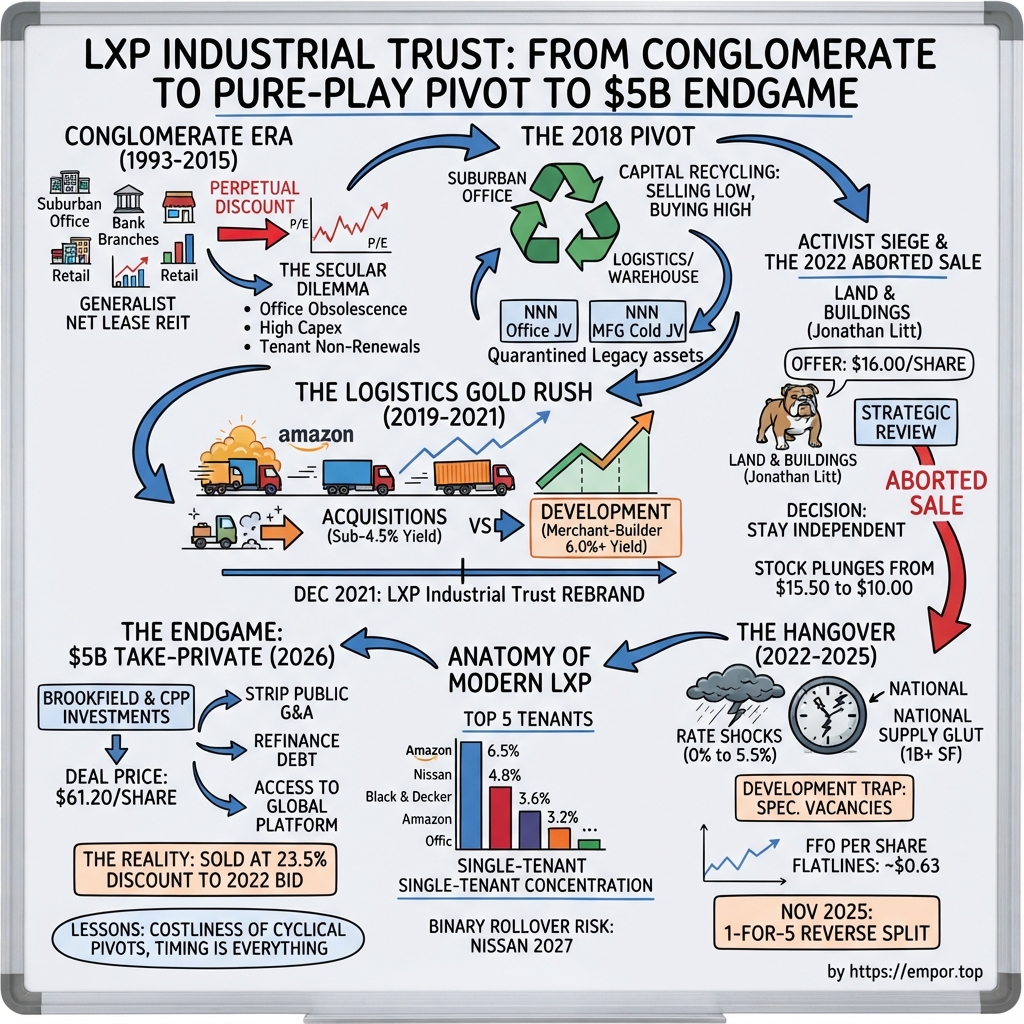
Before the market opened on Monday, July 20, 2026, a joint press release crossed the wire from a real estate investment trust headquartered on North Flagler Drive in West Palm Beach, Florida. Brookfield Asset Management and the Canada Pension Plan Investment Board had agreed to acquire LXP Industrial Trust in an all-cash transaction valued at roughly $5.2 billion, including net debt and preferred equity. Shareholders would receive $61.20 per share—a 12.3% premium over the 30-day volume-weighted average price and 19.8% above the 90-day average. The buyers were acquiring approximately 53 million square feet of warehouse and logistics space across 108 properties in the Sunbelt and Midwest, and LXP's board of directors had approved the deal unanimously.1
By the conventions of REIT mergers and acquisitions, it was a respectable outcome. It also marked the end of a 33-year run as a public company, answering a question the market had debated since the winter of 2022.
That question centered on what the company was truly worth. On January 28, 2022, activist investor Land & Buildings Investment Management sent LXP's board an unsolicited letter proposing to acquire the company for $16.00 per share in cash—a 22% premium to the $13.12 price before the activist's involvement became public—backed by fully committed debt financing and an explicit offer to raise the price if due diligence revealed more value.3 Because LXP had not yet executed its 1-for-5 reverse share split, that proposal was worth $80.00 per share on a split-adjusted basis. The board responded by announcing a full strategic review on February 8, 2022, hired three investment banks, and then, on April 8, 2022, unanimously suspended the process and told shareholders that continued independent execution was the better path.45
Four and a half years later, the same board agreed to sell the company for $61.20 per share. That was 23.5% below what an activist had put on the table in cash—before the Federal Reserve's rate-hiking cycle, before a national warehouse supply wave, and before the protracted valuation grind that followed.
This outcome was not the product of accounting fraud, operational failure, or a deteriorating business. LXP owned high-quality institutional warehouses. Expiring leases rolled over at substantial positive rent spreads, and its balance sheet ended up stronger rather than weaker. The reality is more nuanced and uncomfortable: LXP is a case study in what happens when a management team executes a strategy that is analytically sound, yet still fails to capture the public-market valuation multiple the pivot was designed to achieve.
The strategic shift was sweeping. LXP began life as a diversified net-lease vehicle—a hybrid portfolio of suburban office campuses, specialty retail assets, light manufacturing facilities, and warehouses assembled under the accounting logic of triple-net leases. Starting in earnest in 2018, management set out to divest nearly everything outside of logistics and rebuild LXP as a pure-play Class A warehouse REIT focused on 12 target markets across the Sunbelt and lower Midwest.6 Management delivered on that objective. By 2021, the operational transformation was largely complete, and the company rebranded to reflect its new identity.11 Yet the valuation multiple re-rating that was supposed to follow—the central rationale for the entire overhaul—did not materialize in the magnitude required to justify the effort.
Along the way, several pivotal episodes defined the journey: a 2006 mega-merger that built the conglomerate management later spent a decade dismantling; an office portfolio sold at capitalization rates nearly double the yields on replacement industrial properties; a 514-acre land bank that functioned simultaneously as a valuable development pipeline and an earnings drag; a reverse share split executed at a conspicuous crossroads; a chief executive telling analysts on a spring 2026 earnings call that development remained the best use of capital while privately negotiating the sale of the company; and a preliminary merger proxy, filed on September 4, 2026, disclosing management's own net asset value estimates—figures that sat well above the buyout price shareholders were asked to accept.2
A single comparison frames the entire transaction. Over the 12 months preceding July 17, 2026—the final trading session before the merger agreement was signed—LXP shares traded between $38.75 and $58.51.2 At $61.20 per share, the buyout price cleared the top of that 52-week trading range. Under standard public-market metrics, shareholders received a cash exit at a premium. Yet that same trading range highlights the core contradiction: a company whose underlying real estate management valued at up to $67.33 per share spent an entire year trading as low as $38.75, never once trading at what its own board believed the assets were worth.2 The persistent gap between public equity pricing and private real estate value was not an anomaly to be lamented; it is the fundamental business model of private equity, and it explains why this transaction occurred.
The analysis that follows traces that arc in sequence: the conglomerate era; the decline of suburban office and the subsequent pure-play pivot; the logistics development boom; the activist campaign; the post-2022 market adjustment; the composition of the modern portfolio; corporate governance and executive compensation structures; the endgame with Brookfield and CPP Investments; an assessment of whether single-tenant industrial real estate can ever sustain a durable competitive advantage; and the competing investment theses, grounded in the key operating metrics that ultimately decided the company's fate.
The story begins where the original conglomerate was assembled.
 Subscribe on LinkedIn
II. Origins & The Conglomerate Era (1993–2015)
The business that became LXP did not begin as a real estate investment trust. It started in 1973 as a private firm arranging sale-leaseback transactions—a financing niche in which operating companies sell their corporate real estate, enter long-term leases to remain in place, and extract cash for other uses. Will Eglin joined the firm in 1987 and helped take it public in 1993 as Lexington Corporate Properties, with E. Robert Roskind as chairman.10 The trust was formed that year and converted to a Maryland real estate investment trust in December 1997.6
The structural logic of a triple-net-lease REIT is straightforward. Under a triple-net lease, the tenant pays property taxes, insurance, and routine maintenance. The landlord collects contractual rent with minimal property management overhead. Operating margins are high, and cash flows behave less like conventional multi-tenant real estate and more like corporate bonds—streams of contractual payments backed by tenant credit, with physical buildings serving as collateral. Net-lease REITs operate primarily as spread businesses: they borrow at one rate, acquire properties at higher yields, and retain the difference. When borrowing costs are low and credit is abundant, the model generates steady growth; when capital reprices, that spread compresses.
Eglin became chief executive in 2003, and by the middle of that decade the spread business was expanding rapidly.8 The defining transaction of that period came on July 23, 2006, when Lexington agreed to merge with Newkirk Realty Trust in a transaction creating a company with roughly $4.6 billion in enterprise value. Newkirk shareholders received 0.80 Lexington shares for each share held, and the combined entity was renamed Lexington Realty Trust. Management pitched the combination on scale and geographic diversification: more than 350 properties across 44 states, investment-grade tenants representing approximately 56% of annualized base rent, and coastal-market exposure rising from 13% to roughly 30% of total rent. Eglin characterized it as a "transformational merger" that would create "an unmatched diversified single tenant investment platform."17
Roskind framed the combination as uniting "the best qualities of two complementary platforms with unparalleled management experience and expertise."17
In retrospect, those selling points highlight how property-market philosophies evolved. Diversified. Complementary. The terms celebrated in 2006 assembled the structural complications management spent the 2010s dismantling. The merger's central selling point—that investment-grade corporate tenants generated the majority of base rent—reflected what net-lease investors valued at the time: corporate credit was the primary asset, while the building functioned largely as a contract wrapper. Two decades later, LXP's own annual report inverted that hierarchy explicitly, stating that its industrial underwriting focused "more on real estate characteristics such as location and related demographic and local economic trends than it does on tenant credit."6 That reversal—from underwriting credit counterparty risk to underwriting local real estate fundamentals—marked the central strategic shift in the company's history, requiring roughly fifteen years and a financial crisis to complete.
The Newkirk merger produced a landlord to a broad cross-section of commercial tenants: suburban office parks, automotive service facilities, big-box retail stores, light manufacturing plants, and warehouses spread across 44 states without dominant concentration in any single market. In single-tenant net lease, that breadth introduced an underappreciated operational risk. When a multi-tenant office building loses a tenant occupying 8% of its square footage, occupancy dips to 92%. When a single-tenant building loses its occupant, physical and economic occupancy drops from 100% straight to zero. The landlord must then absorb property taxes, insurance, site security, and debt service while funding tenant improvements and leasing commissions to attract a replacement—in an asset class where a bespoke facility may have few alternative users. The bond analogy holds while contractual payments continue; upon lease expiration, the owner is left holding a vacant, highly specialized property.
The 2008 global financial crisis tested that framework directly. Credit markets froze, debt maturities loomed, tenant distress increased, and cash distributions came under pressure. In September 2009, Lexington declared a quarterly distribution of $0.18 per share—or $0.72 annualized—and satisfied approximately 90% of the payout in common stock rather than cash, issuing roughly 3.9 million common shares to retain about $18.9 million of liquidity.18 While permitted under temporary IRS rules enacted during the credit crisis to help REITs satisfy distribution mandates, the measure functioned in practice as equity dilution to conserve liquidity rather than a conventional cash return.
For investors evaluating management across a full cycle, the episode offered two distinct takeaways: Lexington had carried a balance sheet into the downturn that could not support its cash distribution through a severe contraction, yet executive leadership navigated the liquidity squeeze, preserved enterprise solvency, and avoided selling core real estate at cyclical lows.
A persistent valuation discount followed. Throughout the 2010s, Lexington traded at lower multiples than focused peer REITs. Investors seeking exposure to industrial logistics were unwilling to own a vehicle that paired distribution centers with suburban office campuses. That bundle imposed clear analytical friction: two distinct property types with divergent capital expenditure profiles, tenant retention patterns, and long-term demand curves. Public equity markets priced that complexity as a discount.
The persistence of real estate conglomerate discounts is rooted in market structure. A REIT's equity is analyzed and traded primarily by dedicated sector specialists. An industrial analyst assessing Lexington's warehouses had to underwrite an office portfolio outside their mandate; an office specialist faced the reciprocal constraint. As a result, the natural institutional buyer base remained narrow, and marginal investors applied a discount for the non-core assets. Benchmark index classification compounded the problem: diversified REITs sat in diversified index categories rather than in the pure-play industrial sleeves that captured sector capital inflows. The discount was not an indictment of physical asset quality, but a structural penalty on portfolio assembly. Closing that gap required unbundling the enterprise—an expensive, multi-year process that redefined the company's next chapter.
III. The Great Unwind: Suburban Office Decay & The 2018 Pivot
The most candid rationale for why LXP walked away from office real estate did not appear in an investor presentation. It came from Will Eglin in a trade-press interview, distilled into a plain operational reality: office tenants prefer newly built space, and renovating older buildings is capital-intensive everywhere.10
That observation captured the structural dilemma facing the sector. A suburban office building functions as a depreciating asset requiring substantial, recurring capital infusions merely to maintain existing rent levels. Whenever a tenant's lease approaches expiration, the landlord must negotiate tenant improvement allowances, demolish and reconstruct interior layouts, pay leasing commissions, and offer rent concessions. Even after absorbing those costs, the landlord faces the risk that the occupant will relocate. A modern warehouse, by comparison, is an adaptable shell built around logistics efficiency: a concrete slab, high ceiling clearances, dock doors, fire suppression systems, and a spacious truck court. When an industrial tenant departs, the incoming occupant typically installs its own racking systems and occupies the facility. The recurring capital expenditure burden between the two property types differs by an order of magnitude—a divergence that systematically widens the spread between reported funds from operations and distributable cash flow.
By 2017, industrial assets represented 49% of LXP's portfolio. In 2018, management moved aggressively to accelerate that transition. Over the course of that year, the trust sold roughly $1.1 billion of office and non-core properties, booked approximately $253 million in gains, and expanded industrial exposure to 71% of total assets. In 2019, LXP divested an additional $600 million in non-core holdings while allocating approximately $700 million toward warehouse and logistics facilities, pushing industrial properties past 80% of the portfolio.10
The structural anchor of that divestment program was unveiled on September 4, 2018. LXP agreed to recapitalize and contribute 21 office properties—encompassing roughly 3.8 million square feet that were 98.6% leased, with an average building age of 23 years and a weighted-average remaining lease term of 9.5 years—into a joint venture with an affiliate of Davidson Kempner Capital Management. The transaction valued the portfolio at $726 million. Davidson Kempner acquired an 80% equity interest, while LXP retained 20% alongside property and asset management responsibilities. Net cash proceeds totaled approximately $565 million, which management designated for industrial acquisitions and balance-sheet deleveraging.9
From a portfolio-engineering standpoint, the structure served an explicit purpose. Instead of auctioning 21 suburban office assets into an illiquid market at steep discounts, LXP segregated them into an off-balance-sheet vehicle. This preserved potential upside through an incentive promote while removing the assets from the trust's direct public valuation multiple. The Office Joint Venture continued operating through 2026, retaining five properties with LXP maintaining its 20% equity stake.6 When an analyst on the first-quarter 2026 earnings call asked why these legacy partnerships remained on the books, Eglin was succinct: little remained within the office venture, and the trust had been liquidating assets as fast as market liquidity permitted.14 It was an unadorned summary of an eight-year asset wind-down.
Management implemented an analogous structure in 2021, transferring 22 special-purpose industrial assets into the NNN MFG Cold Joint Venture while retaining a 20% interest.6 The objective mirrored the office transaction: preserve exposure to higher-yielding manufacturing and cold-storage facilities without subjecting public shareholders to single-tenant renewal risk on specialized properties. Notably, that vehicle included $250 million in follow-on equity commitments for future acquisitions, representing a $50 million funding obligation for LXP; as of the 2025 annual report, the entity had not completed an acquisition since its inaugural transaction.6 While modest in the context of the total enterprise, that lack of activity signaled how rapidly institutional underwriting standards tightened for specialized industrial real estate.
Historical falsification: did capital recycling actually create value?
The thesis management presented to shareholders—and which sell-side analysts largely endorsed—was that reallocating capital from office assets to logistics would build net asset value over time. In theory, industrial represented a superior growth sector, and public markets would eventually award the trust a dedicated pure-play trading multiple.
The financial record, however, tells a more complicated story when evaluated against transaction pricing.
The 2018 office disposition portfolio was capitalized at an 8.6% GAAP capitalization rate and an 8.1% cash cap rate.9 Because a capitalization rate represents net operating income divided by property value, a higher cap rate translates to a lower valuation multiple. LXP was effectively selling income streams at roughly 12 times earnings. The reinvestment options available at the market's peak proved far more expensive. During the first quarter of 2022, as institutional bidding for logistics space crested, LXP acquired two adjacent Class A warehouses in Northern Kentucky at a weighted-average stabilized GAAP cap rate of 4.9% and a cash cap rate of 4.5%—a valuation multiple of roughly 22 times cash flow.12 Subsequent office dispositions fetched firmer pricing, such as the December 2021 joint-venture office transactions that cleared in what Eglin termed the "low six" cap-rate range. Even so, by the spring of 2022, he acknowledged that rising interest rates had reduced the value of long-term leased properties, with pandemic-driven shifts permanently dampening office demand.12
The underlying arithmetic was unforgiving. Selling cash flow at 12 times earnings and buying replacement income at 22 times inevitably dilutes per-share operating earnings unless the gap is offset by lower borrowing costs, development yields, or rapid rent expansion. That consequence was not an operational misstep; it was the mechanical price of changing asset classes in a competitive market. LXP absorbed that cost directly. Adjusted Company FFO—the trust's standard measure of operating cash earnings—stood at $223.2 million in 2021 before declining to $193.1 million in 2022. It stood at $206.2 million in 2023, $189.4 million in 2024, and $187.3 million in 2025.7 Five years after management declared the pure-play transformation substantially complete, operating cash earnings in nominal dollars remained 16% lower than where they started.
Management's communication stood in contrast to those figures. As late as its 2025 annual report, when outlining ongoing sales of assets situated outside core target markets, the trust maintained: "We do not expect capital recycling to have a material dilutive impact on earnings."6 That statement captured the central operational assumption of the pivot. Yet when evaluated alongside five consecutive years of Adjusted Company FFO disclosures, the assertion reflected strategic intent rather than financial realization.
The historical record does not invalidate the underlying strategic rationale. LXP exited a structurally compromised sector ahead of the steepest post-2022 office valuation declines, and its 2018 sales timing proved prudent. What the record refutes is the assertion of financial accretion. Capital recycling shielded LXP from an outright collapse in office valuations, but it required shareholders to absorb multi-year earnings dilution that the company never fully recovered. Whether that tradeoff was warranted depends on the alternative, and remaining a diversified REIT holding suburban office campuses through the mid-2020s offered little upside.
What cushioned that earnings dilution during the initial stages of the pivot was an unprecedented surge in nationwide logistics demand.
IV. The Logistics Gold Rush & Capital Deployment (2019–2021)
An exchange during the first-quarter 2022 earnings call, reviewing the closing months of 2021, captured the operating climate of that era. LXP had acquired a vacant 233,000-square-foot warehouse in Northern Kentucky and fully leased the entire building within 21 days of closing.12
Under ordinary market conditions, securing an occupant for an empty big-box distribution facility requires six to twelve months of marketing and lease negotiations. In late 2021, that process took three weeks, and industrial landlords were securing contractual rent escalators at levels rarely achieved before.
The COVID-19 pandemic accelerated industrial tenant demand far beyond prevailing forecasts. E-commerce adoption surged, corporate supply chains pivoted from lean just-in-time inventory to buffer-heavy just-in-case stockpiling, and consumer-facing enterprises competed for distribution footprints situated near major population centers. In LXP's designated target markets—including Dallas-Fort Worth, Atlanta, Phoenix, Indianapolis, Columbus, Central Florida, Greenville-Spartanburg, and Memphis—market rents expanded at rates that rendered standard underwriting models obsolete within quarters. By the first quarter of 2022, management reported that prevailing rents across its target footprint had risen approximately 15% year over year. New leases were securing annual contractual escalators averaging 3.3%, compared to a historical portfolio average closer to 2.5%, with submarket escalators reaching toward 4% in the most competitive logistics hubs.12
The merchant-builder machine
That operating climate prompted LXP's most consequential capital-allocation decision of the cycle. With institutional capital flooding into logistics, acquiring completed, fully stabilized Class A warehouses offered initial yields in the low-to-mid 4% range—pricing that behaved more like low-yielding fixed income than real estate equity. Rather than bidding for finished properties at cyclical peak valuations, LXP pivoted toward development. The primary vehicle was programmatic partnerships with merchant builders: regional development specialists who identified land parcels, navigated local municipal entitlements, and supervised construction. LXP provided the bulk of the joint-venture equity capital, while the merchant partners managed local zoning and absorbed the bulk of construction cost overruns.6
The economic rationale rested on development yield spreads. If a fully leased property traded at a 4.5% capitalization rate, constructing an identical facility at a 6.0% yield on cost created roughly 150 basis points of value spread upon stabilization. In theory, executing that strategy systematically generated organic net asset value independent of public-market multiple expansion. Subsequent project deliveries confirmed that the model could deliver high yields under favorable leasing conditions, such as a Greenville-Spartanburg project that stabilized at an 8% initial cash yield.14
To sustain this development pipeline, LXP accumulated raw acreage across its primary operating markets. By year-end 2025, the trust retained interests in approximately 514 acres of developable land, concentrated across Phoenix, Columbus, Indianapolis, Atlanta, and Central Florida.6 The anchor of this land strategy was its footprint in metropolitan Phoenix, which management estimated on the first-quarter 2022 earnings call could support up to seven million square feet of bulk logistics space if developed with large-format industrial facilities.12
In December 2021, with its warehouse portfolio nearly fully occupied, Lexington Realty Trust announced its formal rebranding as LXP Industrial Trust, retaining its ticker symbol on the New York Stock Exchange. Eglin framed the change as one that "more accurately reflects LXP's portfolio focus and growth strategy."11 After spending more than a decade encumbered by a diversified conglomerate structure that equity analysts discounted, the trust had repositioned itself within the commercial real estate sector's most coveted asset class.
The trap inside the machine
Yet development margins depend on two foundational assumptions: market rents must continue expanding during construction, and prevailing capitalization rates must remain low through project completion and lease-up. Speculative development—breaking ground without an executed pre-lease—represents an unhedged bet on both conditions. It also introduces structural operational drag. A speculative project generates zero operating income during the eighteen to twenty-four months required to permit, construct, and lease the property, all while consuming capital for property taxes, insurance, and capitalized debt service.
In 2021, with corporate borrowing costs near 3% and asking rents advancing at double-digit annual rates, speculative building appeared compelling. In practice, it was a highly cyclical undertaking launched at the peak of an economic cycle. Industrial developers nationwide were operating under identical assumptions and deploying capital simultaneously—the precise dynamic that transforms an attractive spread business into a market-wide supply overhang.
The portfolio also contained a second, subtler structural constraint that would influence valuation for years to come. LXP maintained a longer weighted-average lease term than many pure-play industrial peers, standing at 6.8 years as of the first quarter of 2022.12 While extended lease durations provide cash-flow stability during downturns, they delay rent repricing during an inflationary expansion, keeping in-place rents locked well below market rates. Management embraced this condition as its central investment thesis. At the beginning of 2022, leadership disclosed that the trust's industrial leases were approximately 16% below prevailing market rents, projecting that the mark-to-market spread would expand to roughly 42% by 2027 as older agreements expired in a higher-rent environment.12
That embedded mark-to-market upside served as management's primary justification for remaining an independent public REIT. That conviction was about to face an immediate challenge from an activist investor offering a cash exit instead.
V. The Activist Siege: Land & Buildings, The $16 Offer, and The Aborted Sale (2021–2022)
Jonathan Litt built his career on a specific observation: real estate investment trusts frequently trade below the private-market value of their underlying properties, and the primary obstacle to realizing that value is often executive leadership.
On December 6, 2021, Land & Buildings Investment Management nominated Litt and Donna Brandin—the former chief financial officer of Equity Residential—to LXP's board of trustees. The accompanying letter was direct. It asserted that over Eglin's then-eighteen-year tenure as chief executive, LXP's total shareholder returns had trailed both its proxy peers and industrial peers by nearly 500 percentage points; that earnings and dividends had both fallen by more than 60% over that span; that the board had "consistently failed to close the discount between the Company's net asset value and its share price"; and that Eglin had received more than $65 million in total compensation over the course of that underperformance.8
Beyond the activist rhetoric, Litt's structural critique was difficult to dispute: LXP had completed the complex operational work of becoming a logistics pure-play, yet public markets had failed to reward the transition. If equity investors were unwilling to award the trust an industrial trading multiple, Litt argued, that value should be unlocked through a private-market transaction.
On January 28, 2022, Land & Buildings followed up with an unsolicited proposal to acquire LXP for $16.00 per share in cash—a 22% premium over the unaffected price of $13.12 before the activist's stake became public. The offer carried no financing contingency, required customary due diligence alongside the waiver of anti-takeover provisions, and stated that Land & Buildings was open to adjusting the price upward if diligence uncovered additional value.3 LXP shares closed that trading session at $14.41 on a pre-split basis.
The board responded on February 8, 2022, announcing a comprehensive review of strategic alternatives—encompassing "a wide range of options including, among other things, a sale, merger and other business combinations." The trust retained BofA Securities, Evercore, and Wells Fargo Securities as financial advisors, with Paul Hastings serving as legal counsel. In a public statement, Eglin emphasized the company's recent progress, noting that over five years LXP had evolved into "a leading, predominantly single-tenant industrial REIT with a much stronger and more valuable portfolio," while maintaining that the board was "open to all credible opportunities to unlock value."4 Investors responded favorably: on February 9, 2022, LXP shares closed at a split-adjusted $77.45—the equivalent of $15.49 prior to the split, within reach of Litt's proposed price.
Sixty days later, the strategic review concluded without a deal.
On April 8, 2022, LXP announced that its board had unanimously decided to suspend the process, citing a material shift in macroeconomic conditions, geopolitical tensions, and debt-market volatility since February. Richard S. Frary, the lead independent trustee, stated that continued independent execution remained the best path to create shareholder value, while Eglin noted that the review had generated "clear feedback reaffirming the merits of LXP's strategy and transformation."5
Four weeks later, on the first-quarter 2022 earnings call, Eglin addressed the aborted sale directly. Calling out what he described as "quite a bit of misinformation in the market," he walked analysts through the mechanics of the review. The company had engaged three independent investment banks incentivized to deliver a transaction and had executed non-disclosure agreements with a wide field of strategic and financial buyers. However, benchmark borrowing costs had climbed by more than 100 basis points while discussions were underway. That rate spike, Eglin argued, hit LXP especially hard due to its longer weighted-average lease duration, as long-term fixed cash flows are particularly sensitive to rising discount rates. Potential acquirers conveyed that any whole-company bid would depend on debt markets stabilizing, and none submitted an actionable acquisition proposal for the entire business.12
That explanation is consistent with market conditions at the time. The spring 2022 interest-rate shock was severe, commercial real estate transaction volume contracted abruptly, and long-duration lease portfolios became harder to finance as borrowing costs rose. The record contains no evidence indicating that alternative whole-company bids emerged during the formal auction.
Yet that operational context does not resolve the central contradiction. Land & Buildings had placed a cash offer on the table before the formal review began, backed by committed debt financing and an invitation to negotiate upward. Rather than engaging directly on that proposal, the board initiated an auction that ended without a transaction, leaving the company to execute on its own. Management then backed its stand with corporate capital: following the suspension, LXP repurchased roughly 1.2 million shares at an average price of $13.41 before entering its earnings blackout period.12 Repurchasing stock at $13.41 while walking away from an all-cash proposal of $16.00 is a defensible capital-allocation choice only if intrinsic value sits well above both numbers. The board acted on the conviction that it did.
Historical falsification: was independence the value-maximizing choice?
The question for shareholders is whether the board's decision to remain independent maximized value over the long run.
The market data provides a clear answer. From its February 2022 peak of $77.45 on a split-adjusted basis, LXP's stock fell over the course of the year to roughly $44.05 by October 2022—a decline of approximately 43% in eight months. According to the trust's pay-versus-performance disclosures, a $100 investment in LXP at year-end 2020 was worth $152.23 at the end of 2021, but dropped to $67.04 by the close of 2022.7 The stock never returned to $16.00 pre-split—or $80.00 split-adjusted—at any point before the board agreed to the $61.20 cash buyout.
The broader record offers some mitigating context. Over the five-year period from year-end 2020 through year-end 2025, that same $100 investment in LXP grew to $129.76, outpacing the MSCI US REIT Index benchmark tracked in the company's executive compensation plan, which finished at $102.95.7 LXP outperformed its benchmark index across the full five years. Yet it did so by enduring a steep drawdown followed by a multi-year recovery—a path that exposed shareholders to prolonged market volatility without ever regaining the dollar figure an activist had offered in cash.
The historical record supports a two-part conclusion: while management's technical explanation for suspending the strategic review in April 2022 reflects real financing constraints, the decision to remain independent did not maximize value for shareholders. LXP's underlying assets were indeed worth more than public markets recognized across the 2022–2025 period, as demonstrated by the private equity buyout at a premium to prevailing trading prices. However, by bearing four years of market cycles in search of a public valuation re-rating, the board ultimately delivered an all-cash exit that was 23.5% below the price available in 2022.
The interest-rate pressures that disrupted the 2022 review were just beginning to reshape the industrial sector.
VI. The Hangover: Rate Shocks, The Supply Wave, and The Development Trap (2022–2025)
Every developer who broke ground in 2021 was, in effect, committing to deliver a completed building into the economic landscape of 2023.
That dynamic penalized LXP directly. While interest-rate increases are often cited as the blanket explanation for commercial real estate downturns, the Federal Reserve's tightening campaign, which began in March 2022, exerted three compounding pressures simultaneously. First, it raised the direct cost of new borrowing. Second, it widened property capitalization rates, mechanically reducing the asset value of existing buildings. Third, and most damaging for a merchant development strategy, it dismantled the exit assumptions underpinning projects already underway: a warehouse underwritten to trade at a 4.5% capitalization rate upon stabilization was suddenly valued closer to a 6.0% cap rate—representing an approximate 25% drop in asset value on the identical dollar of rental income.
Compounding that valuation reset was an industry-wide surge in new construction. On the first-quarter 2022 earnings call, LXP's head of asset management observed that Dallas had "over 60 million square feet being developed" and highlighted Atlanta and Indianapolis as markets absorbing substantial new deliveries, while maintaining that tenant demand had kept pace.12 That balance did not hold. During 2022, Amazon—LXP's largest tenant—publicly acknowledged that it had overbuilt its distribution network and planned to curtail expansion. When questioned on the first-quarter call, management offered a specific defense: every facility leased to Amazon operated at full capacity, no subleasing discussions had occurred, the weighted-average remaining lease term across those assets stood at 8.5 years, and in-place rents sat approximately 23% below market rates.12 That underwriting proved durable: Amazon remained LXP's primary tenant through 2025, with long-term leases extending through 2033.
What proved far more vulnerable was the speculative development pipeline.
The operational friction was detailed in LXP's own financial disclosures. During 2025, the trust sold interests in 11 warehouse facilities for gross proceeds of $389.1 million. Two of those assets were vacant development projects encompassing 2.1 million square feet across Ocala, Florida, and Indianapolis, which cleared for an aggregate gross price of $174.6 million.6 In the executive compensation disclosures of the 2026 proxy statement, the board cited among Eglin's achievements for 2025 that he had "resolved overhang from vacant development projects through fully leasing one project and selling two projects to a user."7
That disclosure encapsulated the hazards of speculative logistics development: the trust funded construction without committed tenants, carried the completed square footage vacant long enough for trustees to classify it as an operational overhang, and ultimately liquidated the properties to an owner-occupier. The drag flowed directly onto the income statement. In 2025, LXP's property operating expenses increased by $3.9 million year over year, driven in part by carrying costs on vacant development properties placed into service.6 An unoccupied warehouse produces zero revenue while actively consuming capital for real estate taxes, property insurance, site security, and capitalized debt service.
The earnings that would not grow
On the first-quarter 2022 conference call, LXP's chief financial officer told analysts that management expected 2022 to represent "our earnings trough year," projecting that operational performance would accelerate into 2023 as development deliveries stabilized and contractual lease rollovers captured higher market rents.12 During that baseline year, third-quarter Adjusted Company FFO stood at $0.17 per diluted share on total revenues of $80.1 million.19
The subsequent results diverged from that trajectory. Total gross revenues reached $340.5 million in 2023, $358.5 million in 2024, and $350.2 million in 2025.6 On a split-adjusted basis, Adjusted Company FFO per diluted share came in at $3.20 in 2024 and $3.15 in 2025.6 Converted to pre-split equivalents, those figures represented approximately $0.63 to $0.64 per share—trailing the roughly $0.66 per share generated in 2022, the period designated as the operational trough.
Three years after that inflection point was promised, per-share operating earnings remained lower than at the trough. That outcome reflected systemic headwinds rather than isolated accounting items: the compound dilution of capital recycling, ongoing carrying charges on vacant development deliveries, and an elevated cost of capital that made incremental growth expensive. Operating reality had moved in the opposite direction of management's projections.
Two material qualifications balance that record. First, core leasing spreads verified management's underlying commercial thesis: across 2025, LXP signed 4.9 million square feet of new and extended leases, achieving a 29.7% increase in base rents and a 27.7% cash rent spread on second-generation space.6 The embedded rent mark-to-market was real, but its cash contribution was insufficient to offset portfolio dilution and vacant carrying costs. Second, management strengthened enterprise solvency: during 2025, LXP paid down $50 million of its term loan, retired $28.1 million in trust preferred securities at a 5% discount to par, and completed a tender offer retiring $140 million of its 6.750% senior notes maturing in 2028, concluding the year with no impairment charges recorded in either 2024 or 2025.6 For an institution that had preserved liquidity during the 2008 credit crisis by issuing stock in lieu of cash distributions, those balance-sheet actions demonstrated disciplined debt management.
An accounting judgment worth naming
That clean impairment record, however, rested on accounting estimates rather than independent market observations. In its report on the 2025 financial statements, Deloitte & Touche LLP—LXP's independent auditor since 2017—designated the valuation of real estate investments and potential impairment as the audit's sole critical audit matter, reserved for matters involving "especially challenging, subjective, or complex judgments."6 Under GAAP accounting, a commercial property is tested for impairment by comparing its carrying value against estimated undiscounted future cash flows. Because undiscounted projections over an extended holding period compound future cash receipts without applying a time-value discount, the threshold for recognizing an impairment is permissive. In its audit commentary, Deloitte identified the sensitive management inputs that governed those tests: management's assumptions on estimated holding periods, rental rates and capitalization rates.6
Deloitte issued an unqualified audit opinion, and the disclosures reflected standard accounting practice. For public investors evaluating a trust that had carried vacant speculative warehouses through 2023 and 2024 before divesting them to user-buyers, the takeaway was structural: avoiding book write-downs depended on modeling assumptions that assets would be retained over horizons sufficient to recover invested capital. Impairment testing under historical cost accounting allowed management to defer the market value adjustments taking place in private transactions.
The reverse split
On November 10, 2025, following the close of regular trading, LXP implemented a 1-for-5 reverse share split, consolidating its common stock from approximately 295.8 million shares outstanding to roughly 59.2 million. Shares began trading on a split-adjusted basis the following morning under a new CUSIP, and the quarterly dividend was restated from $0.14 to $0.70 per share.13
Reverse stock splits are economically neutral by design, leaving each shareholder's proportional equity interest and fundamental ownership claim unchanged. Their purpose is primarily institutional and optical. Equities priced below $10 frequently face investment restrictions from mutual funds, institutional fiduciaries, and algorithmic screens, whereas a stock trading in the mid-$40 range fits standard institutional guidelines. Corporate boards routinely utilize the mechanism to improve share-price presentation.
The timing, however, added notable context to the trust's governance timeline. According to disclosures in the merger proxy, LXP had engaged in intermittent acquisition discussions with Brookfield since 2024, had signed a non-disclosure agreement in April 2025, and had received and rejected a $50.00-per-share indication in July 2025—all before the split.2 Four months after turning down Brookfield's initial approach, the board altered the nominal denominator of its equity, and eight months later agreed to a buyout at $61.20. While the split complied with corporate conventions and altered neither intrinsic value nor the eventual cash consideration, it reset the nominal anchor of the stock price heading into final negotiations.
What the corporate restructuring could not alter was the physical portfolio beneath it—an asset base that, on detailed inspection, was both higher in quality and more geographically concentrated than headline metrics suggested.
VII. The Anatomy of Modern LXP: Portfolio, Tenant Concentration, and Cash Flows
Along the interstate rings circling Greer, South Carolina, Whitestown, Indiana, or Goodyear, Arizona, modern distribution facilities share an almost uniform silhouette: pale tilt-up concrete walls, 36-foot clear ceiling heights, roughly a hundred loading dock doors, and deep truck courts engineered to maneuver 53-foot trailers—with little exterior signage identifying the property owner. Across several states, ten of those facilities belonged to LXP.
At year-end 2025, the trust held equity interests in approximately 108 consolidated properties across 14 states, encompassing roughly 52.7 million square feet that were 97.1% leased. The facilities averaged 9.9 years in age—relatively young for the national industrial inventory—and generated annualized cash base rent of $5.26 per square foot across the consolidated portfolio.6
That geographic footprint was deliberate. LXP concentrated its capital across twelve target markets in the Sunbelt and lower Midwest, selected against criteria management outlined in its annual report: expanding transportation and logistics networks, hubs attracting manufacturing reshoring, proximity to major population centers, demographic and employment growth, competitive labor and utility costs, and land availability and cost.6 Notably, physical and regulatory supply barriers were secondary considerations. The markets management selected—including Phoenix, Dallas-Fort Worth, Atlanta, Columbus, Indianapolis, Houston, Central Florida, Greenville-Spartanburg, Savannah, Memphis, and San Antonio—ranked among the least land-constrained in the country. Constructing warehouses in regions with abundant open acreage carried structural consequences for long-term pricing power.
How the leases actually work
Most of LXP's properties operated under net or similar lease structures, where the tenant covers substantially all real estate taxes, utilities, property insurance, and routine maintenance. However, the trust disclosed in its annual report that certain agreements required the landlord to absorb specified operating expenses. On newer leases negotiated in a competitive leasing environment, "the obligations of our property owner subsidiaries" could include partial responsibility for ongoing operating costs and capital repairs.6 At the margin, the purest form of the triple-net structure was yielding to tenant concessions as landlords competed for occupancy.
Organic revenue growth relied on contractual rent escalators. At year-end 2025, 99.3% of LXP's leases included scheduled rent bumps, delivering an average next-step escalation rate of 2.8%.6 In a net-lease model, that mechanism functions as a steady compounding engine, generating nearly 3% annual same-property revenue growth without requiring incremental capital deployment or leasing renegotiations. However, because that rate trailed headline inflation across much of the post-2021 period, fixed escalators also highlighted a core vulnerability of the model: contractual step-ups offer steady income during low-inflation periods, but deliver negative real growth when consumer prices surge.
The metric that shifted most dramatically across the cycle was the portfolio's weighted-average lease term. In early 2022, that duration stood at 6.8 years; by December 31, 2025, it had compressed to 4.8 years.126 That contraction reflected the maturation of management's mark-to-market strategy: as agreements approached expiration, shorter remaining durations brought properties closer to rental repricing. At year-end 2025, approximately 73.8% of annualized base rent was tied to leases scheduled to expire between 2026 and 2031.6 Yet an abbreviated lease duration cut both ways: while it positioned the trust to capture embedded rent increases, it simultaneously amplified rollover risk by accelerating the pace at which space required re-leasing.
The tenants
The tenant roster was anchored by institutional credits. Approximately 47.4% of annualized base rent came from occupants carrying investment-grade credit ratings at the tenant, guarantor, or parent level. Furthermore, the largest single tenant accounted for 6.5% of total base rent—a comparatively modest top-tenant concentration for the single-tenant sector.6
According to disclosures in the 2025 annual report, the trust's leading corporate occupants reflected standard logistics anchors. Amazon led the portfolio with five leases across 3.42 million square feet—representing 6.7% of consolidated space—generating roughly $18.1 million in annualized base rent, or 6.5% of the total, with expiration dates staggered between 2030 and 2033. Nissan held two leases covering 2.97 million square feet and approximately $13.4 million in rent, both set to expire in 2027. Stanley Black & Decker accounted for two leases across 2.29 million square feet and roughly $10.0 million, expiring in 2029 and 2033. Walmart occupied three facilities encompassing 2.35 million square feet and approximately $9.2 million in rent, with terms ending between 2027 and 2031. GXO Logistics operated two leases spanning 1.55 million square feet and roughly $7.4 million, expiring in 2026 and 2028. In the aggregate, the top fifteen tenants accounted for 40.6% of total square footage and 41.4% of annualized base rent.6
Beyond the top five, the tenant roster mirrored the broader drivers of the post-pandemic logistics expansion: third-party logistics providers and corporate shippers including FedEx, DHL Supply Chain, Georgia-Pacific, Owens Corning, Olam, Drive Automotive, Asics, and healthcare apparel brand FIGS.6
Historical falsification: are single-tenant net leases really bond-like?
The net-lease sector has long rested on the premise that single-tenant assets generate bond-like income: contractual, predictable, and operationally hands-off. In its 2025 annual report, LXP made that case directly, asserting that a portfolio composed predominantly of single-tenant industrial assets "mitigates against unexpected costs and the cyclicality of many asset classes" while offering "defensive attributes."6
Yet the trust's own regulatory disclosures detailed the structural vulnerability beneath that thesis. In the risk factors of that same filing, management noted that tenant insolvency or default "is likely to cause a significant or complete reduction in the operating cash flow generated by the property leased to that tenant," potentially requiring non-cash impairment charges.6
Specific portfolio holdings illustrated the operational stakes. At 6495 Polk Lane in Canton, Mississippi, LXP owned a 1,466,000-square-foot distribution facility that was 100% occupied under a single lease set to expire on February 28, 2027.6 That one building represented approximately 2.8% of the trust's total consolidated square footage, concentrated with a single tenant on a single expiration date. Similarly, Nissan's two facilities represented 5.8% of portfolio space and 4.8% of total base rent, with both leases rolling in 2027.6 An unrenewed lease at the Canton facility alone would instantly reduce company-wide occupancy by 280 basis points. Because a vacant single-tenant building abruptly shifts from generating net income to requiring carrying costs for taxes, insurance, and maintenance, the financial impact on cash flow significantly outstrips the lost top-line rent.
That binary dynamic highlights the operational divergence between single-tenant and multi-tenant industrial assets. In a multi-tenant warehouse park, a tenant vacating 20,000 square feet within a 400,000-square-foot building creates a localized 5% vacancy that property managers can address incrementally. In a 1.5-million-square-foot single-tenant facility, there is no middle ground: the landlord either retains a paying occupant or absorbs an enormous vacant shell. Furthermore, the universe of commercial enterprises capable of utilizing a distribution center of that scale is measured in dozens of corporations nationwide rather than thousands.
Addressing that rollover exposure on the April 2026 conference call, management reported that the trust was "in advanced negotiations in some cases" regarding the large 2027 facilities, projecting "a very high rate, if not 100% renewal on the big boxes that we have," specifically referencing Nissan.14 That confidence was supported by recent leasing execution: by April 2026, management had addressed roughly 57% of the portfolio's 2026 lease expirations, securing an average cash rent increase of approximately 25%.14 Nevertheless, such projections remained forward-looking expectations, delivered while leadership was engaged in confidential talks to sell the trust. Following the closing of the buyout, managing the 2027 rollover at Canton and across the larger facilities would shift from public shareholders to Brookfield and CPP Investments—underscoring the private buyers' willingness to underwrite substantial single-tenant concentration risk.
Evaluating how those strategic decisions were incentivized requires examining the trust's governance framework and executive compensation structures.
VIII. Management, Governance, and Capital Allocation Track Record
T. Wilson Eglin spent virtually his entire executive career at the trust. Having joined the predecessor firm in 1987, helped take it public in 1993, and joined the board as a trustee in 1994, Eglin had served as chief executive since 2003—a tenure spanning nearly four decades at the company and more than two decades in the corner office. At 61 years old, he held the titles of chairman, chief executive officer, and president simultaneously.710
The executive team around him was similarly long-tenured: Nathan Brunner served as executive vice president, chief financial officer, and treasurer, having succeeded Beth Boulerice when she stepped down effective March 1, 2025; Joseph S. Bonventre; Brendan P. Mullinix as chief investment officer; and James Dudley leading asset management.2 On quarterly earnings calls, the division of responsibilities followed a well-rehearsed pattern: Eglin framed corporate strategy, Brunner reviewed balance-sheet mechanics and financial guidance, Mullinix addressed development underwriting, and Dudley answered questions on leasing volume and tenant negotiations. It was a stable, technically fluent leadership group that had executed the company's operating playbook together for years.
That continuity, however, concentrated corporate authority. Eglin designed the strategy, oversaw the operational pivot, chaired the board that evaluated the 2022 activist buyout proposal, presided over the suspension of that strategic review, and personally conducted the discussions with Brookfield that culminated in the sale. The trust had no independent board chair to separate executive leadership from boardroom oversight. In its 2026 proxy statement, the board defended combining the chairman and CEO roles as appropriate given "Mr. Eglin's critical role in creating and implementing our current strategy" and his guidance through "our transformation from a diversified net-lease REIT into an industrial REIT."7 The board did maintain an independent lead trustee with a defined remit, and every trustee other than Eglin met independence standards.7
Ownership and alignment
Executive share ownership was comparatively modest. As of the March 25, 2026 record date, Eglin beneficially owned 806,072 common shares—approximately 1.4% of the trust's outstanding stock. Of that total, 418,174 shares were held directly, 361,726 were subject to performance- or time-based vesting schedules, and 26,172 sat in trust. Across the boardroom, all trustees and executive officers as a group owned 1,665,934 shares, or 2.8% of the company.7
Against that insider stake, the shareholder register was dominated by passive index capital: BlackRock held 16.8%, Vanguard owned 10.0%, and State Street accounted for 5.7%—meaning roughly one-third of the company was held by three passive asset managers.7 That ownership structure explains a critical dynamic of the trust's public-market chapter. Passive index funds track benchmarks rather than agitating for strategic overhauls or divesting on earnings disappointments. An enterprise can trade at a chronic discount to private real estate values without facing pushback from its largest shareholders. That dynamic created the governance vacuum that prompted Jonathan Litt's activist campaign in late 2021—and ultimately limited his leverage, as building an activist voting coalition among structurally passive holders proved difficult.
How the incentives were built
LXP's long-term executive incentive program allocated 60% of target equity awards to performance-based shares and 40% to time-vested shares. Within the performance component, vesting was split equally between two metrics: half was tied to relative total shareholder return compared to the MSCI US REIT Index, and half was measured against a designated competitor peer group, each evaluated over a three-year performance cycle with cliff vesting.7
That compensation architecture had two structural features. First, it relied strictly on relative total shareholder return, incorporating no absolute return hurdles and no operational benchmarks—no targets for funds from operations per share, no same-property net operating income thresholds, and no return-on-invested-capital requirements. Executive teams could earn maximum payouts simply by outperforming a declining real estate index. Second, the mechanism functioned precisely as constructed across the post-2022 downturn: the 2023 grant, tracking performance from January 2023 through December 2025, paid out at 65% of target on the peer-group metric and 99%—described in filings as essentially at target—on the index benchmark. Furthermore, as of the 2026 proxy statement, the 2024 and 2025 grants were tracking at the maximum payout of 200% on the peer-group measure.7
That outcome reflected the mechanics of relative performance measurement. Equity awards granted near the market trough in 2024 and 2025 tracked at maximum compensation levels primarily because the trust's stock rebounded from a sharply depressed valuation—the identical recovery that lifted a $100 investment made at year-end 2020 from $67.04 at the close of 2022 to $129.76 by the end of 2025.7 Relative return formulas inherently reward cyclical rebounds off market lows. They do not require, nor do they measure, whether per-share operating cash flows or earnings expanded.
Public shareholders registered minimal formal objection to these arrangements. In 2025, approximately 96% of votes cast endorsed the advisory say-on-pay resolution, aligning with a five-year approval average of 97%.7 Yet that lack of pushback reflected the trust's institutional shareholder profile: with one-third of outstanding equity held by passive asset managers who routinely vote in line with proxy advisory firm guidelines, lopsided say-on-pay tallies signaled compliance with standard governance templates rather than proactive shareholder enthusiasm for management's capital allocation.
The change-of-control math
The Brookfield and CPP Investments acquisition provided an immediate liquidity event for accumulated equity incentives. At the $61.20 buyout price, Eglin's 361,726 unvested restricted share awards—stipulated to vest in full at maximum performance upon closing—carried an implied value of approximately $23.3 million, in addition to roughly $27.2 million for his 444,346 shares not subject to vesting restrictions.2 Furthermore, under the company's executive severance agreement, a qualifying termination following a change in control stood to deliver total payments and benefits valued at approximately $21.6 million, calculated using the December 31, 2025 share price of $49.58.7
The preliminary merger proxy acknowledged this alignment friction directly, noting in the board's summary of countervailing considerations that certain trustees and executive officers "may have conflicts of interest in connection with the Merger, as they may receive certain benefits that are different from, and in addition to, those of the Company's other shareholders."2 While such disclosures and transaction incentives are standard in real estate buyouts of this scale, they highlight an essential structural asymmetry: the executive leadership negotiating the final transaction price held performance awards whose vesting conditions were contractually deemed satisfied at maximum upon a change of control, irrespective of the ultimate per-share valuation secured for public investors.
The trust did undertake periodic boardroom refreshment. Three new trustees joined the board following 2021, including Arun Gupta in April 2022—a venture investor with cybersecurity and software backgrounds, appointed weeks after the suspension of the strategic review—and Derrick Johnson later in 2022, a senior operating executive at Agiliti with direct supply-chain and logistics experience.7 Across the full slate of trustee nominees in 2026, average tenure stood at 10 years, and 7 years among independent nominees.7 During that same period, the trust relocated its corporate headquarters from midtown Manhattan to West Palm Beach, Florida.7 While these moves addressed criticisms of board entrenchment, the timing was notable: each governance adjustment occurred after activist pressure had materialized rather than before it.
The pressure that finally resolved the trust's public-market dilemma, however, came from a different direction entirely.
IX. The Endgame: Brookfield, CPP Investments, and The $61.20 Take-Private (2026)
The most revealing document in the company's recent history is the "Background of the Merger" disclosure within the preliminary proxy statement filed on September 4, 2026—compressing twenty-eight months of private negotiations into a detailed corporate chronology.2 The process originated not as a takeover defense, but as an effort to raise external capital.
In April 2024, Eglin approached BofA Securities to explore finding an institutional partner to purchase an interest in a portfolio of LXP properties alongside an equity investment in LXP shares. The goal was to fund external growth without issuing equity at a discounted share price. BofA introduced the concept to Brookfield, which expressed initial interest. By July 2024, Brookfield proposed purchasing a package of 30 LXP properties. Management declined to sell the full package, and the talks ended.2
A parallel negotiation with an unnamed "Party B" regarding a programmatic development joint venture extended through late 2024, collapsing that December when Party B decided against moving forward. The discussion was briefly revived in mid-2025 before stalling permanently.2
On March 18, 2025, a Brookfield representative contacted Eglin to request a private discussion. When the executives spoke four days later, the focus shifted from buying individual assets to acquiring the entire company. LXP and Brookfield executed a non-disclosure agreement on April 8, 2025, and the trust began sharing non-public operational data on May 9, 2025.2
The ladder
What followed was a fifteen-month negotiation during which the board steadily pushed the purchase price higher against a determined suitor.
On July 9, 2025, Brookfield submitted an initial non-binding cash indication of $50.00 per share, compared to LXP's closing price that day of $41.70. Eglin briefed the lead independent trustee, and the full board met on July 29. Concluding that the proposal failed to reflect intrinsic value, trustees declined to offer a counterproposal.2
On October 16, 2025—shortly after LXP announced the sale of its vacant development assets to eliminate a visible operational drag—Brookfield raised its offer to $55.00 per share against a market close of $46.65. On October 29, the board rejected the offer again.2
On March 18, 2026, Brookfield increased its bid to $56.00, while shares traded at $48.71. At that point, the board adjusted its posture: on April 14, 2026, trustees held separate review sessions with BofA Securities and J.P. Morgan to evaluate asset valuations, recent REIT transaction pricing, net asset value estimates, and the relative merits of continuing as an independent public REIT versus pursuing a sale. The board subsequently authorized Eglin to inform Brookfield that $56.00 remained inadequate, but that exclusivity could be granted at $60.00 or higher.2
Brookfield introduced CPP Investments as its equity co-investor in April 2026 and delivered a revised offer of $57.25 on April 27, formalizing it in a written proposal on May 4 against a $50.62 closing price. The board rejected that offer on May 19. On June 1, Eglin advised Brookfield that any actionable proposal had to begin with a six. On June 6, the consortium submitted an offer of $60.00 per share.2
The final pricing adjustment reflected tactical negotiation. During a board meeting on July 15, 2026, after LXP shares had rallied, BofA and J.P. Morgan reviewed how the rising stock price shifted transaction multiples. Directors instructed management to request $61.20 per share—a price calculated as an approximate 10% premium to prevailing trading levels plus the anticipated third-quarter dividend, which the buyers insisted on eliminating prior to closing. Two days later the sponsors agreed.2 The parties executed the merger agreement on Sunday, July 19, and announced the transaction before markets opened the following morning.
The terms, and what they reveal
The definitive agreement established specific transaction safeguards: a 40-day go-shop window with a five-day extension for qualified excluded parties; a two-tier company termination fee set at 1.5% of equity value—roughly $54 million—for an accepted superior proposal from an excluded party, rising to 3.0% under standard circumstances; and a parent termination fee of approximately $289 million, or about 8% of equity value, payable if the buyer group breached the agreement or failed to close.2 The transaction carried no financing contingency. Equity and debt commitment letters fully covered the total cash consideration, and LXP secured specific-performance rights to compel closing.12
The board conducted an active post-signing market check. BofA and J.P. Morgan solicited 51 prospective acquirers—comprising 29 financial sponsors, 14 sovereign wealth funds and institutional asset managers, and 8 strategic operating companies. Fourteen parties requested confidentiality agreements, and twelve executed them to gain access to the trust's non-public data room. When the go-shop period expired at 11:59 p.m. on August 28, 2026, no bidder had submitted an alternative proposal.2
That outcome provided the board's central justification that $61.20 represented fair market pricing: across more than fifty institutional investors contacted, none proved willing to top the consortium's bid.
However, the proxy disclosures highlighted two procedural complexities that accompanied that market check. First, between June 16 and July 2, 2026, an unidentified "Party C" submitted multiple unsolicited inquiries regarding a whole-company acquisition. On each occasion, LXP informed Party C that it could not enter discussions because the board had granted Brookfield exclusivity through July 29—a constraint directors acknowledged during a July 2 board meeting.2 A potential competing buyer was turned away while final pricing was being established. While Party C retained the right to participate during the subsequent go-shop, the proxy did not disclose whether it re-engaged.
A secondary disclosure concerned advisor positioning. At the July 15, 2026 meeting where directors finalized the $61.20 price, the board reviewed a formal relationship disclosure from BofA Securities detailing commercial ties between BofA and its affiliates on one side and LXP, Brookfield, and CPPIB on the other.2 Global investment banks routinely lend to, advise, and co-invest alongside major private equity managers, and providing written relationship disclosures is standard practice. It also explained why the board engaged J.P. Morgan alongside BofA in April 2026, obtaining fairness opinions from two separate investment banks prior to signing.2
The second and more significant revelation was valuation benchmarking. Management's standalone net asset value estimate as of March 31, 2026, spanned $59.62 to $67.33 per share, and $55.72 to $63.43 on a change-of-control basis. Independent sell-side analyst NAV estimates ranged from $49.79 to $66.90.2 BofA's discounted cash flow model indicated a valuation range of $49.25 to $65.73; its public-market trading comparables analysis—benchmarked against First Industrial Realty Trust and STAG Industrial—yielded $49.42 to $72.47 based on 2027 EBITDA multiples and $54.28 to $72.71 on 2027 funds from operations; and its precedent-transaction analysis of nine historical REIT mergers yielded a range from $46.68 to $73.04.2
The $61.20 buyout price fell within each of those analytical ranges, but below the midpoint of most of them. While the price exceeded the consensus of published analyst NAV estimates—a metric the board emphasized in its fairness evaluation—it sat below the midpoint of management's own standalone NAV assessment.2 Shareholders were presented with a transaction that cleared at a discount to what management estimated the assets were worth in private hands, yet delivered an immediate premium over public market trading prices. That persistent structural spread was the catalyst for taking the trust private.
Why Brookfield and CPP wanted it
The buyers' investment thesis was straightforward and did not rely on operational turnaround assumptions.
The sponsors acquired 53 million square feet of modern Class A logistics assets averaging less than ten years in age, concentrated in target hubs benefiting from domestic manufacturing reshoring and supply-chain reconfiguration, at a cost basis they viewed as attractive relative to current replacement cost.16 In announcing the transaction, Lowell Baron, chief executive officer of Brookfield's real estate business, characterized the acquisition as aligned with investing in high-quality logistics real estate generating durable cash flows, while Sophie van Oosterom, global head of real estate at CPP Investments, highlighted the sector's long-term institutional demand.1
A privately held operating structure offered three distinct economic advantages over a public REIT wrapper. First, general and administrative efficiency: LXP had projected $39 million to $41 million in G&A expenses for 2026, a substantial portion of which supported public listing overhead—securing regulatory filings, conducting annual audits, managing investor relations, and compensating executive officers.14 Folding the properties into an existing global logistics portfolio substantially reduces those duplicative corporate costs. Second, balance-sheet flexibility: private owners can access secured asset-level debt markets and specialized institutional facilities priced directly to collateral quality rather than relying on a small-cap REIT's unsecured corporate debt ratings.
Third, and most importantly, capital patience. LXP's internal five-year financial projections prepared for its board and financial advisors modeled Cash Net Operating Income rising from $280 million in 2026 to $376 million in 2030, with Adjusted Company FFO expanding from $200 million to $252 million—an expansion plan requiring management to lease vacant space, build out the 514-acre land inventory, and capture embedded lease rollovers over five years.2 Pursuing that multi-year stabilization in public markets required defending flat quarterly earnings before equity analysts. In a private portfolio, capital could be deployed across an extended horizon without public-market volatility.
That fundamental contrast leads directly to the question underpinning the trust's entire public existence: was there ever an iteration of LXP that public markets would have valued at full asset replacement cost?
X. Playbook & Strategic Powers: Why Single-Tenant Industrial Has No Cornered Resource
The most revealing assessment of LXP's competitive position came not from an equity analyst, but from LXP's own board in its formal justification for approving the buyout. Among the material factors supporting the sale, the merger proxy cited "the challenges the Company has faced given its lack of scale, including the impact of lack of scale on its cost of capital, G&A efficiency and the ability to achieve desired concentration levels in target markets."2
A corporate board does not make that admission casually. It is a formal acknowledgment that the trust could not, as an independent enterprise, overcome its structural disadvantages. Evaluating LXP through Hamilton Helmer's framework of the seven business powers confirms that assessment across every operational dimension.
Scale economies — weak. LXP's roughly 53 million square feet represented a small fraction of the footprint controlled by the industry's leading industrial platforms. In warehouse ownership, physical scale does not confer proprietary pricing power over tenants; rental rates are negotiated submarket by submarket against localized availability. What scale does provide is borrowing efficiency and general and administrative leverage—the exact advantages the board conceded LXP lacked. At roughly $40 million of annual G&A against approximately $350 million of revenue, LXP carried a corporate overhead burden near 11% of gross revenue—a drag that an institutional platform several times its size could spread far thinner.146
Network effects — none. A distribution center in Whitestown, Indiana does not enhance the utility or market value of a warehouse in Goodyear, Arizona. Logistics facilities are consumed locally. The closest approximation to a network benefit is tenant relationship expansion across multiple locations—a dynamic that is commercially real, but economically modest.
Counter-positioning — none. Operating a portfolio of single-tenant Class A logistics facilities is not a model that incumbent landlords or well-funded competitors are structurally unable to copy. Institutional peers such as STAG Industrial and First Industrial Realty Trust, alongside numerous private real estate funds, execute overlapping strategies. Indeed, BofA's fairness analysis selected precisely two public peers—First Industrial and STAG—as the closest operational analogues to LXP's business model.2
Switching costs — low to moderate, and eroding. Installed material handling systems, interior racking, and automated logistics infrastructure require significant capital to relocate, creating tangible moving friction when a tenant's lease approaches expiration. That operational friction supported LXP's healthy cash rent spreads on renewals. However, that pricing power remained bounded. LXP's own annual report acknowledged that uncertainty from international trade policy had caused some tenants "to reevaluate their space needs and consolidate into other spaces or move to facilities with lower rental rates," while competitive pressure forced landlords to accept operating-expense and capital-repair obligations on new leases.6 A switching cost that erodes during periods of market softening is not a durable moat; it is a temporary negotiating advantage.
Branding — negligible. Corporate logistics directors do not select distribution centers based on the identity of the landlord. Tenant leasing decisions are determined by clear ceiling heights, loading-dock ratios, truck-court depth, ESFR sprinkler ratings, power capacity, labor demographics, and driving proximity to interstate corridors.
Cornered resource — absent, and this is the crux. The genuinely defensible position in industrial real estate belongs to owners of infill parcels in supply-constrained coastal metros, where land scarcity, strict municipal zoning, and community opposition make new construction exceptionally difficult. Scarcity in those markets is legally and geographically protected. LXP explicitly pursued the opposite profile, selecting markets characterized, in its own words, by favorable "land cost and availability."6 That approach was a rational development choice—inexpensive land is what makes development yield spreads achievable in the first place—but it represents the exact antithesis of a cornered resource. When industrial rents in Columbus or Indianapolis rise enough to justify construction, developers build new supply, and that rent expansion is competed away. That dynamic was not an execution failure; it was the inherent reality of the markets management targeted.
Process power — weak. LXP's merchant-builder program was structured intelligently and generated tangible yield spreads during the upcycle. However, the model is entirely replicable. Any adequately capitalized REIT or private real estate vehicle can partner with regional merchant builders on identical terms, and many did—contributing directly to the national wave of new warehouse deliveries that flooded the market in 2022 and 2023.
Evaluating the business through Michael Porter's five forces framework leads to the identical conclusion.
Buyer power is high. LXP's primary counterparties included Amazon, Walmart, Nissan, FedEx, DHL, and GXO Logistics—sophisticated corporate enterprises with dedicated in-house real estate divisions, national portfolio leverage, and the institutional resources to run competitive bidding processes whenever a lease expires. The resulting asymmetry is pronounced: a single corporate tenant accounted for up to 6.5% of LXP's annualized rent, whereas LXP represented a fractional rounding error in that tenant's overall real estate budget.6
Threat of new entry is high. As the post-2020 cycle demonstrated, institutional capital rapidly enters greenfield logistics development whenever projected yields appear attractive, and municipal entitlements remain accessible across the Sunbelt and lower Midwest.
Rivalry is intense and fragmented. LXP competed for tenants and acquisitions against focused public peers, regional operators, and global private equity managers—and ultimately agreed to sell itself to one of those private managers in July 2026.
Supplier power is dictated primarily by land prices and construction materials, both of which escalated sharply between 2021 and 2022, directly compressing merchant development margins. Substitutes remain limited over the near term, though industrial demand drivers continue to evolve. On the first-quarter 2026 call, management pointed to data-center-adjacent users and advanced-manufacturing suppliers—including activity surrounding TSMC's Phoenix semiconductor fabrication complex and a Google data-center campus adjacent to LXP's Richmond redevelopment project—as the newest demand catalysts across its markets.14 Modern distribution facilities are not being displaced by alternative structures; they are being adapted to meet shifting technological and supply-chain requirements, providing underlying support for well-located industrial property.
The strategic takeaway is clear. LXP assembled institutional-grade assets across growing logistics hubs and managed them with operational discipline, yet it possessed no structural economic moat. In a commoditized sector lacking durable entry barriers, investment returns ultimately gravitate toward the cost of capital—and the capital provider with the lowest funding costs holds the definitive advantage. A small-cap public REIT bearing a $40 million corporate overhead burden and an investor base dominated by passive index funds operated at a permanent disadvantage compared to global private sponsors like Brookfield.
XI. Bull vs. Bear Case & What Investors Must Track
Evaluating LXP requires examining both the bull and bear arguments in their strongest forms, testing each claim against the empirical record.
The bull case, as management built it
One: the embedded mark-to-market was real, and it delivered. This was never mere rhetoric. LXP disclosed in early 2022 that its warehouse leases sat roughly 16% below prevailing market rates and projected that the mark-to-market gap would widen toward 42% by 2027.12 The subsequent operating record verified that dynamic. In 2025, the trust executed 4.9 million square feet of leases at base and cash rent increases of 29.7% and 27.7% on second-generation space.6 In the second quarter of 2026, it completed 2.3 million square feet of second-generation leases at increases of 43.1% and 26.2%.16 By April 2026, management had already addressed roughly 57% of the year's lease expirations at an average cash rent increase of approximately 25%.14 Verdict: intact and confirmed. This represented the central operational projection management made that the financial disclosures fully supported.
Two: Sunbelt and lower-Midwest demand would prove structural. This thesis was also largely confirmed, albeit after an inventory digestion period. On the first-quarter 2026 call, management reported that nationwide net industrial absorption in the first quarter stood at approximately 40 million square feet—the strongest first quarter in three years—and that roughly 29 million square feet, or 72%, occurred across LXP's target markets, with Columbus vacancy declining by more than 300 basis points over the trailing year.14 Verdict: intact. Target market fundamentals functioned largely as underwritten, even as macroeconomic timing and interest-rate cycles delayed the payoff.
Three: balance-sheet safety. LXP entered the interest-rate shock with more than 91% of its debt fixed at a weighted-average interest rate of 2.85% and a weighted-average maturity of 7.3 years, which insulated near-term cash flow from the Federal Reserve's tightening cycle.12 By the first quarter of 2026, net debt to adjusted EBITDA stood at 5.1 times, supported by an undrawn $600 million revolving credit facility.14 Verdict: intact, with the historical qualification that this same institution once satisfied 90% of a quarterly dividend in common stock to conserve $18.9 million of cash liquidity.18 The fortified balance sheet reflected a management team that had absorbed the lessons of past credit cycles rather than an effortless institutional trait.
The bear case, as an activist would prosecute it
One: the supply trap is a permanent feature, not a cycle. This remains the most formidable structural argument against the portfolio. In markets with unconstrained land availability, developer competition caps long-term real rent appreciation: every sustained rent increase triggers new speculative construction, which ultimately re-establishes supply-demand balance and curtails landlord pricing power.
Two: the single-tenant binary cliff is unhedged and concentrated. Nissan's two leases, both scheduled to expire in 2027—including a 1.47-million-square-foot facility in Canton, Mississippi—highlighted the binary risk of large single-tenant boxes. Management projected a renewal rate near 100% on those facilities, but that expectation had not been converted into executed agreements in the trust's final public disclosures.614
Three, and the one that actually decided the outcome: capital allocation. Here the empirical record is clear. Management sold office properties at wide capitalization rates and acquired logistics facilities at historically low yields; speculative development delivered into a nationwide supply wave, generating two vacant facilities that had to be sold to an owner-occupier; and per-share operating earnings in 2025 remained below the level achieved in 2022, the period leadership had designated as the operational trough.61219 An activist critique would pair those capital-allocation results with governance frictions: combined chairman and chief executive roles, a relative total shareholder return incentive formula devoid of operational return hurdles, a shareholder register one-third dominated by passive index funds, and an all-cash acquisition proposal of $16.00 per share rejected in 2022 that the public market never matched again.
A fourth item belongs on the list and rarely appears: the June 2026 sequencing. On June 1, 2026, LXP announced the $103 million acquisition of a 37-acre infill covered-land site in Phoenix—a Class A office campus net-leased through March 2031 at $16.1 million of annual cash rent, intended for industrial redevelopment into 400,000 to 450,000 square feet upon lease expiration—and raised its full-year Adjusted Company FFO guidance to a range of $3.30 to $3.40 per share from $3.22 to $3.37.15 On that identical day, Eglin advised Brookfield that any actionable buyout proposal would need to begin with at least $60.00 per share.2 While both actions were legally and operationally justifiable—a board must manage ongoing operations during strategic discussions, and raising earnings expectations while seeking a higher acquisition price is internally consistent—investors purchasing shares on June 1 on the strength of improved guidance did not know that the company was fourteen days from entering an exclusivity agreement with a private buyer. That disclosure gap illustrates the routine informational asymmetry between corporate insiders and public shareholders.
The three metrics that actually mattered
Beyond strategic narratives, LXP's fate ultimately hinged on three operating metrics. They offer the clearest analytical lens for assessing single-tenant logistics real estate, providing direct insight into business health rather than relying on headline earnings.
Same-store cash NOI growth. This metric isolates organic property-level cash performance from the distortions of acquisitions and dispositions—the critical test of whether the underlying portfolio was improving during a multi-billion-dollar capital recycling program. LXP's decelerating trajectory told the story: same-store cash NOI grew 5.1% in the first quarter of 2022, slowed to 2.9% for full-year 2025, moderated to 2.0% in the first quarter of 2026, and slowed to 0.5% in the second quarter of 2026, against full-year guidance of 1.5% to 2.5%.1261416 Because contractual escalators averaging 2.8% established a baseline for same-property revenue, reported growth falling below that threshold signaled that occupancy losses and lease concession pressures were eroding cash flow.
Cash re-leasing spreads paired with retention. A high leasing spread by itself can be misleading, as a landlord can manufacture higher headline rents by granting months of free rent or heavy tenant improvement allowances. Evaluating the spread alongside capital expenditures and tenant retention reveals the true economic return. LXP's disclosures were notably robust here: leasing activity throughout 2025 required a weighted-average tenant improvement and leasing commission cost of just $1.22 per square foot, confirming that cash rent gains were genuine.6 For 2026, management guided to an expected retention rate of 70% to 80% while noting on the first-quarter call that actual renewals were tracking ahead of that baseline, providing a buffer against unforeseen vacancies.14
Development yield on cost versus prevailing exit cap rate. This spread determines whether a merchant development strategy generates economic value. Developing a warehouse at an 8% stabilized yield when comparable assets trade at a 6% capitalization rate creates substantial equity value upon completion. Constructing at a 6% yield into a 6% market, however, means assuming two years of construction, lease-up, and carrying risks for zero economic margin. LXP's later project completions achieved attractive spreads. Its 2021-vintage speculative starts, which delivered directly into the 2023 supply overhang, failed that test—explaining why two completed projects exited the portfolio as vacant buildings sold to a user-buyer.
The historical record does not reduce to a simplistic judgment on whether LXP was a well-run or poorly run enterprise. It was a disciplined operating business with institutional-grade assets, strong leasing execution, and no durable economic moat—the precise condition under which competent management earns an unexceptional return in a competitive, capital-intensive industry.
XII. Epilogue & Core Investing Lessons
The transaction requires approval by a majority of all votes entitled to be cast at a special meeting, and the parties expect closing in the fourth quarter of 2026.1 Shareholders will receive no further regular dividends between signing and closing, and the transaction is taxable to them; LXP shareholders have no appraisal or dissenters' rights under the terms disclosed.2 Absent a superior proposal that did not materialize during the go-shop, the thirty-three-year public history of a company that began as a private sale-leaseback shop in 1973 concludes with an all-cash sale at $61.20 per share.
What remains unresolved is narrower than it appears, but worth detailing because the transaction has not yet closed. Because the merger proxy is preliminary, the special shareholder meeting has not yet been scheduled. The board noted in its own assessment that the merger requires no significant regulatory approvals and carries no financing condition, which removes the two conditions that most often break real estate transactions.2 Shareholders remain free to vote against the merger for any reason, including if an unsolicited alternative emerges before the meeting—though after the go-shop expired, the company may no longer solicit one, and a superior proposal arriving now would trigger the higher 3.0% termination payment rather than the go-shop rate.2 The board also flagged the risk of merger-related shareholder litigation, which in transactions of this size is close to routine and rarely changes an outcome.2 Barring an unforeseen disruption, the remaining steps are procedural rather than strategic.
Three lessons carry beyond this particular company.
The first is the cost of changing asset classes in public markets. LXP's strategic diagnosis was correct—suburban office was structurally impaired, while industrial logistics was structurally advantaged—and management acted on that insight earlier and more thoroughly than most diversified peers. Yet executing that pivot in public markets produced years of per-share earnings dilution. Selling property income at an 8% capitalization rate to acquire replacement income at a 4.5% cap rate dilutes earnings mechanically, no matter how sound the strategic direction. Public companies are judged quarterly on per-share results. A portfolio transformation that is analytically sound over a decade but dilutive over five years tests investor patience beyond what equity markets tolerate. The strategic case and the shareholder value case are not identical, and corporate boards must rigorously underwrite both.
The second concerns firm cash bids. In January 2022, an activist offered $16.00 per share in cash with no financing contingency and an explicit willingness to negotiate higher. The board conducted a strategic review, could not secure an actionable whole-company bid amid an interest-rate shock, and elected to continue independently—a decision it explained in unusual detail and defended on a public call.12 That operational explanation was substantively accurate. Yet that decision ultimately cost shareholders roughly 23.5% of a certain cash outcome, measured over four and a half years of subsequent execution. The lesson is not that boards must accept every initial premium. Rather, when a board rejects transaction certainty in favor of an independent operating thesis, it must state explicitly what operational milestones must occur for the thesis to beat the cash, and hold itself strictly to that standard. LXP's thesis was embedded mark-to-market rent growth. That mark-to-market arrived, delivering leasing spreads of 25% to 40%, and still failed to produce a share price above the rejected bid—because it was overwhelmed by portfolio dilution, development vacancy drag, and a broad-based valuation reset across the asset class. An investment thesis can prove correct and still lose money.
The third is about what net-lease real estate actually is. A triple-net single-tenant warehouse is fundamentally a financial contract wrapped in concrete: a fixed stream of contractual payments from a corporate credit, escalating at 2.8% annually, with residual value dependent on whether an alternative tenant wants that specific facility in that specific submarket when the lease expires. Where the underlying land is genuinely scarce, that structure compounds value. Where land is unconstrained, the asset behaves like a leveraged bond with a re-leasing option attached: exposed to interest-rate shifts on acquisition, to new speculative supply upon lease rollover, and to the superior bargaining power of corporate counterparties far larger than the landlord throughout.
LXP assembled a respectable version of that business. Brookfield and CPP Investments agreed to acquire it because that same business is worth more inside a private platform with cheaper capital, leaner corporate overhead, and an extended holding period than it was worth inside a public REIT required to justify its quarterly numbers every ninety days. That outcome is not an operational failure of management. It is a reflection of which capital structures are structurally best suited to own assets that lack an economic moat—and it explains why so much of the nation's logistics real estate has steadily migrated from public equity markets into private institutional hands.
References
-
Brookfield and CPP Investments to Acquire LXP Industrial Trust in $5.2 Billion All-Cash Transaction, Form 8-K Exhibit 99.1 — SEC EDGAR, 2026-07-20 ↩↩↩↩↩
-
Form PREM14A Preliminary Merger Proxy Statement — SEC EDGAR, 2026-09-04 ↩↩↩↩↩↩↩↩↩↩↩↩↩↩↩↩↩↩↩↩↩↩↩↩↩↩↩↩↩↩↩↩↩
-
LXP Industrial Trust to Review Letter from Land & Buildings (including text of the January 28, 2022 proposal letter) — GlobeNewswire, 2022-01-30 ↩↩
-
LXP Industrial Trust Board Initiates Review of Strategic Alternatives, Form 8-K Exhibit 99.1 — SEC EDGAR, 2022-02-08 ↩↩
-
LXP Industrial Trust Suspends Strategic Alternatives Process, Form 8-K Exhibit 99.1 — SEC EDGAR, 2022-04-08 ↩↩
-
Form 10-K Annual Report for the Fiscal Year Ended December 31, 2025 — SEC EDGAR, 2026-02-12 ↩↩↩↩↩↩↩↩↩↩↩↩↩↩↩↩↩↩↩↩↩↩↩↩↩↩↩↩↩↩↩↩↩↩↩↩↩↩↩↩
-
Form DEF 14A Definitive Proxy Statement — SEC EDGAR, 2026-04-03 ↩↩↩↩↩↩↩↩↩↩↩↩↩↩↩↩↩
-
Land & Buildings Nominates Donna Brandin and Jonathan Litt for Election to the Board of Lexington Realty Trust, Form DFAN14A — SEC EDGAR, 2021-12-06 ↩↩
-
Lexington Realty Trust Announces Disposition of 21 Office Assets for $726 Million to Joint Venture — GlobeNewswire, 2018-09-04 ↩↩
-
Lexington Realty Trust Focuses on Single-Tenant Industrial Assets — Nareit REIT Magazine, March/April 2020 ↩↩↩↩
-
Lexington Realty Trust Announces Corporate Rebranding to LXP Industrial Trust, Form 8-K Exhibit 99.1 — SEC EDGAR, 2021-12-15 ↩↩
-
LXP Industrial Trust (LXP) CEO Will Eglin on Q1 2022 Results — Earnings Call Transcript — Seeking Alpha, 2022-05-05 ↩↩↩↩↩↩↩↩↩↩↩↩↩↩↩↩↩↩
-
LXP Industrial Trust Announces Effectiveness of Reverse Share Split, Form 8-K Exhibit 99.1 — SEC EDGAR, 2025-11-10 ↩
-
LXP Industrial (LXP) Q1 2026 Earnings Call Transcript — The Motley Fool via Yahoo Finance, 2026-04-29 ↩↩↩↩↩↩↩↩↩↩↩↩↩
-
LXP Industrial Trust Provides Recent Business Activity Update and Increases 2026 Adjusted Company FFO Guidance — GlobeNewswire, 2026-06-01 ↩
-
LXP Industrial Trust Reports Second Quarter 2026 Results — GlobeNewswire, 2026-07-29 ↩↩
-
Lexington Corporate Properties Trust and Newkirk Realty Trust to Merge, Form 425 Exhibit 99.1 — SEC EDGAR, 2006-07-23 ↩↩
-
Lexington Realty Trust Announces Third Quarter 2009 Dividend Payment, Form 8-K Exhibit 99.1 — SEC EDGAR, 2009 ↩↩
-
LXP Industrial Trust Reports Third Quarter 2022 Results, Form 8-K Exhibit 99.1 — SEC EDGAR, 2022-11-03 ↩↩
 LinkedIn
 WhatsApp
 Reddit
 Hacker News
 Email
Email Kindle
 RSS Feed
 Spotify
 Apple Podcasts
 Amazon Music
 Audible
 YouTube