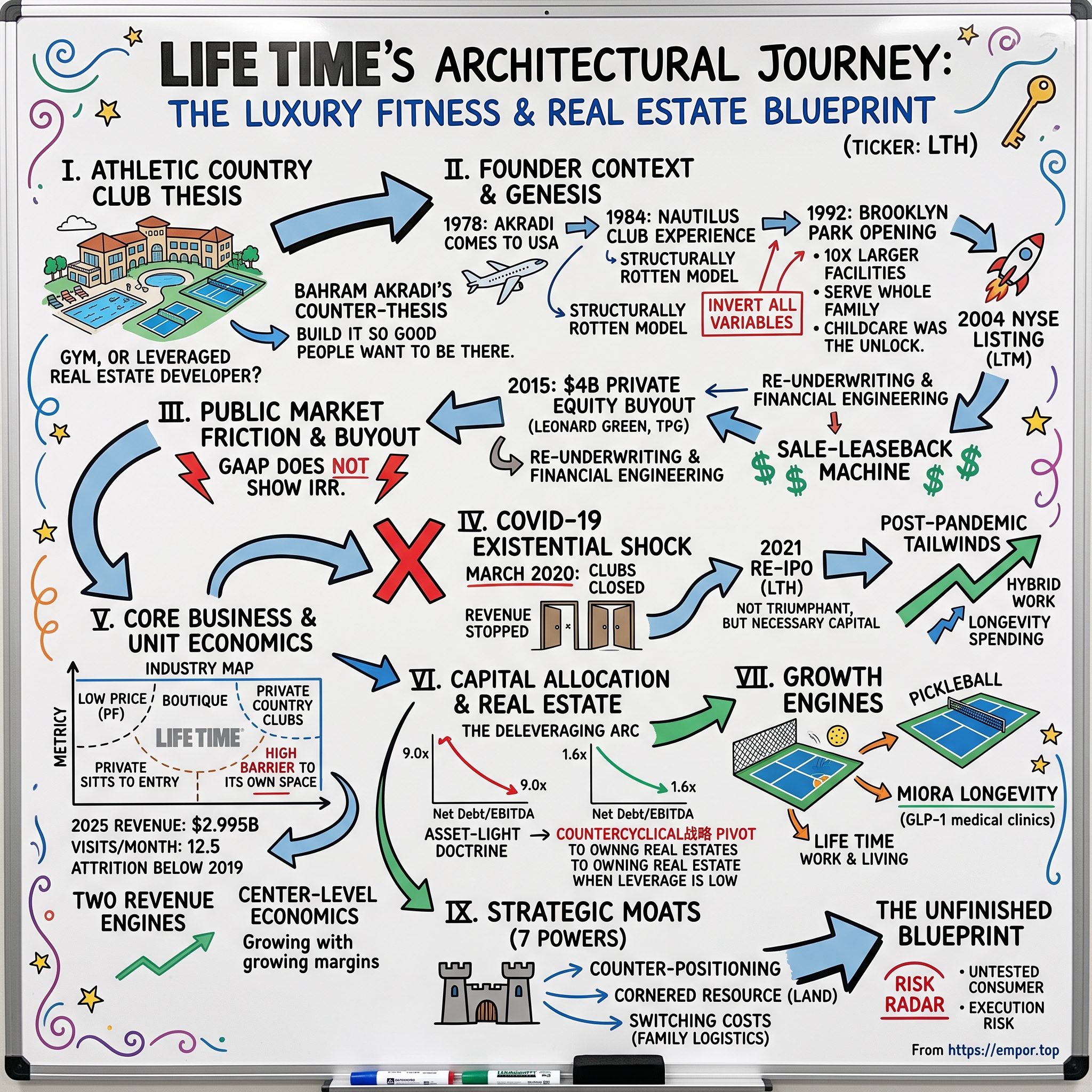
Life Time Group Holdings: The Architectural Blueprint of Luxury Fitness & Real Estate
I. Introduction & The "Athletic Country Club" Thesis
Drive through the affluent outer ring of almost any large American metro — Frisco, Texas; Chanhassen, Minnesota; Gilbert, Arizona; Ardmore, Pennsylvania — and eventually you pass a building that does not look like a gym. It looks like a small resort. Two hundred cars in the lot at nine in the morning on a Tuesday. An outdoor pool with a waterslide and cabanas. Rows of pickleball courts under a canopy. A porte-cochère. A café with a barista. And inside, somewhere past the spa and the childcare center and the basketball court, there is also, incidentally, exercise equipment.
That building is the product of a single, stubborn, three-decade argument made by one man: that the fitness industry had been built backwards. The conventional gym business model of the 1980s and 1990s was, at its core, a bet against the customer — sign people up in January, collect dues from members who never came, and rely on contract breakage and inertia to paper over churn that routinely ran 40% or worse. Bahram Akradi's counter-thesis was that if you built a facility so good that people actually wanted to be there every week, you could charge multiples of the market price, and the economics would take care of themselves.
Thirty-four years later, the argument has a scoreboard. Life Time Group Holdings, Inc. (NYSE: LTH) closed fiscal 2025 with revenue of $2.995 billion, up 14.3% year over year, adjusted EBITDA of $825.2 million, and net income of $373.7 million — a 139% increase.1 It operated 189 athletic country clubs across the United States and Canada at year-end, having opened ten during the year.1 Average revenue per center membership reached $3,531, up 11.7%.1 The company's members visited roughly 122 million times in 2025, an average of 12.5 visits per membership per month.2 As of late July 2026 the shares traded around $42, against a 52-week range of roughly $24 to $44, giving the company a market capitalization near $9.4 billion.[^3]
Those are good numbers. They are also, importantly, not the whole story — and this is where a neutral reading has to diverge from the company's own framing. Life Time is simultaneously one of the best-executing consumer operators in America right now and one of the most capital-hungry businesses in the S&P universe of consumer discretionary names. In 2025 it generated $871 million of operating cash flow and spent $891.5 million on capital expenditures.1 Free cash flow was $206.5 million — positive, but only after $227.4 million of sale-leaseback proceeds were counted in the company's own definition.1 The balance sheet carries roughly $4.2 billion of funded debt and another $2.6 billion of lease obligations.3 Every dollar of that operating momentum sits on top of a physical plant that must be continuously rebuilt.
So the question this story asks is not "is Life Time a good gym company." It plainly is. The question is sharper: is Life Time a premium consumer brand that happens to own real estate, or a leveraged real estate developer that happens to sell memberships? The answer determines whether the current earnings power is durable through a cycle or merely well-timed. Management's answer, delivered with unusual bluntness on the first-quarter 2026 call, is that the distinction is meaningless — that Life Time earns north of 30% cash-on-cash returns whether it leases a shell or builds and sells it back.4 That is a strong claim. It deserves testing, not repetition.
A second thread runs through everything: the outline of this business has changed three times. It was a public suburban growth story from 2004 to 2015. It became a private, sale-leaseback-financed urban expansion vehicle from 2015 to 2020. It nearly died in 2020, came back public in 2021 carrying an uncomfortable debt load, and has since been remade into something else again — a pricing-led, capacity-constrained, mix-managed premium subscription business with a medical clinic bolted onto the side. Each transformation was authored by the same person. Whether that consistency is a moat or a key-man risk is one of the more interesting governance questions in the small-cap-to-mid-cap consumer space.
We start where the argument started: with a 17-year-old getting off a plane from Tehran in 1978.
 Subscribe on LinkedIn
II. Founder Context & The Genesis of Suburban Luxury (1992–2004)
Bahram Akradi's father was an officer in the Iranian air force who, in the mid-1970s, concluded that something was coming.5 He was right; the revolution arrived in 1979. But his son had already left. Akradi came to the United States in 1978, at seventeen, and enrolled at the University of Colorado to study electrical engineering.5 He never practiced as an engineer. What he did instead, starting in 1984, was work at a Minneapolis health club called Nautilus Fitness Center — and discover that the fitness business was an engineering problem badly solved.6
He was good at it. Between 1984 and 1989 he served as co-founder, executive vice president and part owner of the company that became U.S. Swim & Fitness Corporation, which grew into the second-largest health club operator in the Twin Cities before the partners sold to Bally Total Fitness.5 That experience is the hinge of the entire Life Time story, because it taught Akradi the industry's operating model from the inside — and he came away convinced it was structurally rotten.
The flaw he could not stop seeing
The 1980s health club was, in economic terms, an option-selling business. You leased 15,000 to 25,000 square feet in a strip mall, spent aggressively on advertising in December and January, sold multi-year contracts with punitive cancellation terms, and then quietly prayed that most members would stop coming by March. The facility could not physically serve everyone who had signed up. Profitability depended on non-attendance. Retention was a cost, not an asset. And the customer relationship was, by design, adversarial — you made money when the customer's good intentions failed.
Akradi's insight was less about fitness than about the shape of the asset. If the building is small, you must oversell it. If you oversell it, the experience degrades. If the experience degrades, churn rises. If churn rises, you must spend more on marketing, which forces you to discount, which lowers price, which means you must oversell even harder. The 1980s gym was a doom loop dressed as a business model.
The escape, he decided, was to invert every variable at once. Build the facility ten times larger. Charge four times the price. Serve the whole family rather than the individual. And treat retention — not enrollment — as the primary operating metric.
Brooklyn Park, 1992
The corporate entity was incorporated in Minnesota in 1990 as FCA, Ltd.; the name Life Time Fitness was registered in March 1992.5 The first club opened in Brooklyn Park, a suburb north of Minneapolis, and it looked absurd by the standards of the day: a facility measured in the tens of thousands of square feet where competitors measured in the low tens, with a pool, a gymnasium, group fitness studios, and — the detail that mattered most — childcare.
Childcare was not an amenity. It was the unlock. A gym membership is an individual purchase that competes with every other discretionary line item in a household budget. A family athletic club membership is a household infrastructure decision that competes with nothing, because there is no substitute. If both parents work out, the kids swim, the teenager plays basketball, and Saturday morning is spent at the club, then cancelling is not a budget decision — it is a lifestyle demolition. The switching cost is emotional and logistical, not financial.
The second unlock was real estate arithmetic. In the 1990s, high-visibility parcels of eight to fifteen acres in wealthy, growing suburbs were available at prices that made ground-up construction economic. Life Time bought land, built to its own specification, and captured both the operating margin of the club and the appreciation of the dirt underneath it. That was, in effect, a two-engine business hiding inside one P&L — and it would take another twenty years and a private equity buyout before anyone monetized the second engine properly.
The 2004 listing
By 2004 the model had been proven across enough Midwestern markets to fund a national rollout, and on June 30, 2004, Life Time Fitness, Inc. priced an initial public offering of 9.9 million shares at $18.50 per share, listing on the New York Stock Exchange under the ticker LTM.7 The stock opened at $20.75 and the offering raised roughly $183 million, selling about 30% of the company.8
The thesis sold to public investors was straightforward: take a format that works in Minneapolis and replicate it in every affluent suburb in America. What the prospectus could not fully convey was how much capital that replication would eat, and how completely the pace of growth would be dictated not by demand but by the company's ability to fund $20 million to $30 million buildings, one at a time, out of a balance sheet that grew far more slowly than the opportunity.
That mismatch — between a founder's ambition and a public market's tolerance for front-loaded capital — is what eventually blew the company off the exchange. It took eleven years.
III. Public Market Friction & The $4B Private Equity Buyout (2004–2015)
There is a specific kind of frustration that afflicts asset-heavy compounders in public markets, and Life Time had it badly. Every new club was, in accounting terms, an immediate cash outflow and a delayed earnings inflow. Land, permits, construction, pre-opening staffing and marketing all hit the cash flow statement two to three years before the facility reached mature contribution. Build twelve clubs a year and you are permanently carrying two to three years of unproductive capital on the books.
Public shareholders could see the depreciation. They could see the debt. What they could not easily see — because GAAP does not report it — was the mature-club cash-on-cash return sitting underneath. So the stock traded on quarterly free cash flow, which was structurally negative during expansion, rather than on the internal rate of return of the underlying assets, which was excellent. Analysts pushed for slower building and faster earnings. Akradi refused to shrink the boxes or thin the amenities, because thinning the amenities was the same as re-entering the commodity business he had spent his life escaping.
The escape hatch
In March 2015, Life Time agreed to be acquired by affiliates of Leonard Green & Partners and TPG in a transaction valued at more than $4.0 billion, with each share converting into the right to receive $72.10 in cash.910 The deal closed on June 10, 2015; other participants included LNK Partners and Akradi himself, who rolled equity and stayed as chairman and chief executive.11
Read the buyout properly and it was not a rescue. It was a re-underwriting. The sponsors were not buying a broken company; they were buying a company whose asset base was worth more than the public market would pay for the earnings stream, and whose growth rate was capped only by access to capital. Their thesis had two legs: unlock the real estate, and use the proceeds to buy growth the equity market wouldn't fund.
Financial engineering in the dark
What followed is the most consequential capital-structure decision in the company's history, and it is the one investors still argue about. Under private ownership, Life Time leaned hard into sale-leasebacks: selling owned clubs to REITs and institutional real estate buyers, then leasing them back on long-term contracts with fixed annual rent escalators, typically in the low single digits.
The mechanics deserve plain language, because the accounting obscures them. Imagine you own your house outright and it is worth $40 million. You sell it for $40 million and immediately sign a 20-year lease to keep living in it at $2.6 million a year, rising ~2% annually. You now have $40 million of cash and no mortgage. You also have a $2.6 million annual obligation that does not care whether you have a job. You have converted a flexible asset into a rigid liability, and you have been paid for the privilege. In a growth phase, that trade is fantastic — you redeploy the $40 million into a new club that earns well above the implied cap rate. In a downturn, it is the reason you cannot breathe.
The proceeds funded two things. First, geographic expansion into dense urban markets — New York, Boston, Chicago, the Bay Area — where buying land outright was economically impossible and a leased footprint was the only way in. Second, the ordinary work of private equity: paying down acquisition debt, funding distributions, and financing continued development without tapping a public equity market the company had just left.
By the end of the private period, Life Time had built the thing the sponsors wanted — a national, premium-priced network with meaningful urban presence. It had also built a liability structure with almost no give in it. Operating lease obligations are, for practical purposes, senior fixed-cost debt that shows up in rent expense rather than interest expense. The company entered 2020 with billions of dollars of committed rent and billions more of funded debt, against a revenue line that was 100% dependent on physical facilities being open.
Then the facilities closed.
IV. Existential Shock: COVID-19 & The 2021 Re-IPO
On March 16, 2020, Life Time closed every club it operated and furloughed more than 90% of a workforce exceeding 36,000 people.12 Revenue did not decline. It stopped.
It is worth sitting with the arithmetic of that moment, because it is the single best stress test the model will ever get. In 2019, Life Time generated $1.90 billion of revenue and $30.0 million of net income.13 In 2020, revenue fell to $948.4 million — essentially cut in half — and the company posted a net loss of $360.2 million.13 Rent obligations did not pause. Interest expense of roughly $128 million did not pause.13 A business built on the premise that people should physically gather in enormous buildings had been legislated out of existence, indefinitely, in most of its markets.
2021 was, counterintuitively, worse on the bottom line. Revenue recovered to $1.32 billion as clubs reopened, but the company recorded a net loss of $579.4 million, weighted down by asset impairments, restructuring, share-based compensation charges tied to the IPO, and interest expense that ballooned to $224.5 million as emergency financing was drawn.13 Two years of pandemic cost Life Time roughly $940 million of accumulated GAAP losses.
The survival playbook
The response was conventional in kind and aggressive in degree: preserve cash, defer and renegotiate rent with landlords, draw on credit facilities, raise capital from the sponsor group, and keep the highest-value members engaged through digital programming until reopening. There was no clever hedge. There was only liquidity and time.
What is analytically interesting is which members came back. The company's own subsequent disclosure — attrition falling below 2019 levels by mid-2023 — suggests the household-integration thesis held under maximum stress.14 Families that had built their week around the club returned; the marginal, price-driven, low-usage member did not always. That sorting effect turned out to be strategically useful, and management would later industrialize it deliberately.
Back to the exchange
Life Time returned to the public market in October 2021, and the pricing tells you how the market felt about a heavily levered, capital-intensive gym operator in the middle of a pandemic. The company had filed to sell 46.2 million shares at $18 to $21. It sold 39.0 million shares at $18.00 — the bottom of the range, and 16% fewer shares than planned — closing the offering on October 12, 2021 for gross proceeds of $702.0 million.15[^17] Shares began trading on the NYSE under LTH on October 7, 2021, valuing the company at roughly $3.6 billion.16
That is not a triumphant re-listing. It is a company taking the capital it could get, on the terms available, because it needed the capital. The proceeds went primarily to repaying emergency borrowings rather than funding growth. For the sponsors, it was not an exit but a first crack in the door — Leonard Green, TPG and Partners Group would still be selling shares in secondary offerings three and four years later.
The tailwinds nobody underwrote
Then the post-pandemic world turned out to be unusually kind to exactly this format. Hybrid work redistributed demand across the day, filling the 10 a.m.–3 p.m. trough that had historically been dead capacity in suburban clubs — a pure margin gift, since the building and most of its staffing costs are fixed. Affluent households migrated further into the suburbs and exurbs, precisely where Life Time's land bank sat. And the culture-wide reallocation of discretionary spending toward health, longevity and in-person social connection arrived at the moment Life Time had 150-plus buildings that were simultaneously gyms, restaurants, spas, coworking spaces and social clubs.
For investors, the honest read on 2020–2021 is dual-edged. The pandemic proved the model's fragility — zero revenue, unchanged fixed costs, an existential outcome without sponsor support. It also proved the model's stickiness, because the members who returned came back at higher engagement than before. Both facts are true, and the second does not cancel the first. What changed afterward was not the fragility; it was the leverage that sat on top of it.
V. The Core Business, Industry Structure & Unit Economics
To understand why Life Time earns what it earns, you have to understand what it is not competing with.
The industry map
The American fitness market is not one market. It is four, and they barely touch.
High-volume, low-price is the Planet Fitness end of the spectrum: $10 to $25 a month, small boxes, minimal staffing, and an operating model whose profitability still depends on low utilization. It is a genuinely good business — arguably a better return on capital business than Life Time — but it competes for a customer who is, by definition, price-first. There is essentially no demand overlap.
Boutique studios — the Barry's, OrangeTheory, F45, SoulCycle cohort — sell a single discipline at $30 to $40 per class. The economics are attractive on a per-square-foot basis and terrible on a durability basis: switching costs are near zero, the format is subject to fashion cycles, and the customer typically stacks two or three studios rather than consolidating. They are a threat to a member's wallet share, not to a member's membership.
High-end urban is Equinox and its imitators: premium pricing at comparable or higher levels than Life Time, but in 30,000 to 45,000 square foot leased urban footprints serving individuals, mostly young professionals, without the family infrastructure. Equinox competes head-on with Life Time's urban clubs and barely at all with its suburban ones.
Private country clubs charge initiation fees that can run from tens of thousands into six figures, are frequently seasonal, and are built around golf and tennis rather than year-round comprehensive fitness. They are the closest cultural analogue to what Life Time sells — which is precisely why Akradi appropriated the phrase "athletic country club" — but they are a fundamentally different product with a fundamentally different capital structure.
Life Time sits in a category it largely invented and, more importantly, one that is structurally difficult to enter. That difficulty is not brand. It is dirt, permits, and time.
Myth versus reality on price and retention
Here it is worth correcting a piece of received wisdom that circulates in investor commentary about this company: the idea that Life Time is a $250–$350 per month business with ~75% retention.
The reality is more nuanced, and the actual numbers are in the disclosures. In the first quarter of 2026, average monthly dues across the entire membership base were $230, up approximately 10.5% year over year.4 In the fourth quarter of 2025 the figure was $223.2 The $250–$350 range describes the rack rate — the price a new member pays to join a busy club today — not what the average member actually pays. Roughly two-thirds of the membership base still pays below rack rate, a legacy gap management sized at approximately $19.5 million per month in Q4 2025, essentially unchanged from the $17–18 million per month gap disclosed in mid-2023.214
That gap is the single most important number in the equation, and it cuts both ways. On the bull side, it is a large, self-executing revenue pipeline: as legacy members leave and are replaced at rack rate, revenue rises with no incremental member and no incremental cost. Management calls this "churn" and books it as favorable mix — it contributed 3.5 percentage points of the 8.6% comparable center revenue growth in Q1 2026, versus 3.0 points from actual price increases and 2.3 points from in-center businesses.4 On the bear side, the gap has not narrowed in three years, and the CFO explicitly said he does not expect it to close: "I don't see a world where it's ever closed. That's part of the kind of the retention play, having members pay under the rack rate."2 Translation: the company is deliberately running a two-tier pricing system in which loyalty is rewarded with a permanent discount. That is a rational retention tool. It is also an admission that the headline rack rate is not achievable across the base.
Retention itself is not disclosed as a clean annual figure. What the company does disclose is directionally supportive: attrition fell below 2019 levels in mid-2023 and stayed there, and visits per membership rose 4.8% in 2025 to 12.5 per month.214 Usage is the leading indicator of retention in this industry — the more someone uses the club, the less likely they are to cancel — and usage is rising. That is real evidence. But investors should treat "~75% retention" as an inference, not a reported metric.
The two revenue engines
Life Time's revenue splits into membership dues plus enrollment fees, and in-center revenue. In 2025 dues grew 13.9% and in-center grew 15.1%.1 Dues are the high-margin recurring foundation. In-center is everything else the member buys once inside: LifeCafe, LifeSpa, personal training, small-group training, swim lessons, kids' programming, racquet sports.
The crucial nuance — and management is refreshingly direct about it — is that in-center revenue carries a lower margin than dues. On the Q1 2026 call, the CFO explained that strong dues performance flows almost entirely to the bottom line while dynamic personal training "has a little lower margin than dues does."4 Back in 2023 Akradi made the same point more bluntly: spa and café revenue "come at a lower margin" than the corporate average.14 So the in-center flywheel is not a margin story. It is an engagement-and-retention story that happens to also generate incremental contribution dollars. Investors who model in-center growth as automatically accretive to EBITDA margin are modeling it wrong.
Center-level unit economics
Life Time does not publish a standard per-club P&L, so any unit-economic reconstruction is inference from management commentary and portfolio-level disclosure. Here is what is actually said.
On returns, Akradi's Q1 2026 formulation was unusually specific: "When we go into these clubs, into a lease with our leasehold improvement dollars in, we are always north of 30% in aggregate. And when we are doing our clubs and take them to sale-leaseback we do that or better."4 Notably, that is a step down in stated ambition from 2023, when he described targeting "that high 30s, low 40s IRR after sale-leaseback."14 Neither figure is auditable from filings. Both are management assertions about unlevered returns on invested capital, and the direction of travel — from "high 30s to low 40s" to "north of 30%" — is worth logging.
On scale, the disclosed numbers are more useful. Existing clubs average roughly 4,400 to 4,600 memberships each; new clubs are being planned at 3,700 to 4,000 memberships.24 This is the deliberate inversion at the heart of the modern strategy: build to a lower member count, at a higher price, for a better experience. Akradi's own framing of the original sin is remarkably candid for a founder: "We sold it way too cheap. That caused actually a contrary outcome to what was — what I wanted. We couldn't get it with 11,500 memberships in 100,000 square feet club."4
On margin, the portfolio-level data is the best proxy. Adjusted EBITDA margin reached 27.5% for full-year 2025, up 170 basis points, and 28.7% in Q1 2026, up 160 basis points.14 Center-level contribution margins run materially higher than the consolidated figure because corporate G&A sits above them; a single mature urban club in downtown Austin was cited at a 58% contribution margin in 2023 on just 35,000 square feet.14 New clubs now reach contribution-margin-positive within one to three months of opening, versus longer historical ramps.2
The analytical conclusion is this: the unit model works, and it appears to be working better than it did five years ago, because the company has stopped selling volume and started selling scarcity. But the returns figures that make the model look extraordinary are management-sourced and unverifiable from the outside. What is verifiable — margin expansion, rising visits, rising dues, faster ramps — is consistent with the claim without proving its magnitude.
Which raises the question of how all of this is paid for.
VI. Capital Allocation & Real Estate Architecture
In July 2023, Bahram Akradi told analysts something that reads very differently in 2026 than it did at the time: "We have no intention of ever changing the strategy of the company from asset-light strategy."14 At that moment, net debt to adjusted EBITDA stood at 4.2x, down from 9.0x a year earlier, and the company was hunting for developer-funded sites — roughly 200 identified asset-light opportunities, of which about 20 deals had been executed.14
Three years later, Life Time guided to $875 million to $915 million of growth capital expenditure for 2026, on top of $140–150 million of maintenance capex and $130–140 million for modernization, technology and corporate investment.1 Over half of that growth capital is for clubs opening in 2027 and beyond.1 The company is nearly doubling the square footage it opens versus 2024 and 2025.1 Whatever else this is, it is not asset-light.
This is not a gotcha. It is the most important thing to understand about how Akradi allocates capital: the asset-light posture was a function of leverage, not of philosophy. When the balance sheet was stressed, he leaned on developers and landlords to fund the buildings. When leverage fell to 1.6x by the end of 2025 and the company earned a BB credit rating, he pivoted straight back to owning dirt and pouring concrete.2 Investors should understand the strategy as countercyclical to the company's own balance sheet rather than as a fixed doctrine — and they should expect it to flip again if leverage rises.
The deleveraging arc
The trajectory from the re-IPO to today is genuinely impressive, and it is the strongest single piece of evidence for management's execution credibility. Net debt to adjusted EBITDA went from 9.0x in mid-2022, to 4.2x in mid-2023, to 2.3x at the end of 2024, to 1.6x at the end of 2025 — comfortably inside Akradi's stated 2.0x ceiling.214 Adjusted EBITDA more than doubled over the same window, from $339.8 million in 2022 to $825.2 million in 2025.113
Most of that deleveraging came from the denominator, not the numerator. Total debt including lease obligations was $4.04 billion at the end of 2022 and $6.75 billion at the end of 2025.3 The company did not pay down debt so much as it grew into it. That is a legitimate and often superior way to delever — but it means the absolute obligation is larger today than it was at the bottom, and the safety of the ratio depends entirely on EBITDA holding.
The sale-leaseback machine, revisited
The sale-leaseback is now a recurring, budgeted funding line rather than an emergency lever. Life Time completed $227.4 million of sale-leasebacks in 2025.1 It guided to a minimum of $300 million for 2026 in February, then closed approximately $200 million in April alone and raised the full-year target to roughly $400 million.14
Akradi's Q1 2026 framing of this is the closest thing to a formal capital-allocation doctrine the company has articulated. The argument runs: Life Time builds $400–600 million of fee-owned, sellable real estate per year; it sells roughly $400 million of it; therefore the owned real estate portfolio grows even as the company monetizes part of it annually. "We're not trading our real estate assets to be cash flow positive. We are adding to that."4 He projected free cash flow above $400 million by roughly 2030 on the current plan.4
The skeptical read is worth stating plainly, because it is the central bear argument on this stock. Free cash flow of $206.5 million in 2025 included $227.4 million of sale-leaseback proceeds.1 Strip the asset sales out and the company consumed cash. That is not fraud or even aggressive accounting — the company discloses the components clearly, and building a factory and selling the building is a perfectly ordinary financing decision. But it does mean the "free cash flow positive" headline currently depends on a functioning institutional net-lease market with acceptable cap rates. If interest rates rise materially, buyers demand higher yields, proceeds per building fall, and the funding math tightens. The 2026 upsizing from $300 million to $400 million happened because the market was, in Akradi's words, "robustly open."2 Markets that are robustly open can close.
There is also a subtler point buried in the Q4 2025 call. Akradi described pairing newly built clubs with older properties carrying very low book value so that gains and losses offset for tax purposes — "so we can adjust those and not pay taxes on the gain and loss."2 That is sophisticated tax management. It is also a reminder that the sale-leaseback program's net proceeds depend on a portfolio-level optimization that is opaque to outside investors.
Returning capital
In February 2026, the board authorized a $500 million share repurchase program — the first meaningful return of capital in the company's post-IPO life.1 Akradi framed it as opportunistic and subordinate to the leverage target: buy when the stock is below fair value, but never at the cost of breaching 2.0x.2 On the Q1 2026 call he reiterated the intent without committing to a pace.4
The context matters. Leonard Green, TPG and Partners Group have been methodically selling down: 23 million shares in a February 2025 offering that raised $699.2 million, and a further 20 million shares announced in June 2025, after which the voting group held approximately 43.1% of the company.1718 A buyback authorized while the largest holders are still distributing stock is a defensible use of capital — it absorbs supply — but investors should understand it as operating alongside a multi-year sponsor exit rather than in a vacuum. The share count has grown steadily, from about 193 million weighted average shares in 2021 to 218 million in 2025, diluting per-share progress relative to the EBITDA growth rate.13
For a long-term investor, the capital allocation record reads as follows: management inherited a distressed balance sheet, fixed it faster than almost anyone expected, and then immediately re-levered the investment rate rather than the debt ratio. Whether that is discipline or restlessness depends on what the new clubs earn. Which brings us to what the company is actually building into those clubs.
VII. Future Growth Engines: Medical Longevity (Miora/GLP-1) & Pickleball
Pickleball: the amenity that behaved like a strategy
In February 2023, Life Time announced it had nearly 500 permanent pickleball courts and intended to exceed 1,000 by the end of 2024.19 It did not get there. By April 2024 the count was above 630 across roughly 130 clubs, and by 2026 press coverage put it above 650 across the network.20 The company remains, by a wide margin, the largest owner-operator of permanent pickleball courts in North America — but the stated target was missed by a factor of roughly one-third, and the company quietly stopped repeating it.
That is a small thing, and it is worth noting precisely because it is small: it is a data point on how management sets and retires targets. Aspirational numbers get announced loudly and, when they do not land, are not revisited.
The strategic logic behind pickleball was nonetheless sound and remains so. Racquet sports solve three problems simultaneously. They fill off-peak hours, converting fixed square footage into incremental revenue at almost pure contribution margin. They generate fee revenue above dues — leagues, clinics, tournaments, court time. And they attract exactly the demographic Life Time wants: affluent, 40-plus, socially motivated, and unlikely to churn because the friend group is at the club. A pickleball league is a retention product disguised as a sport.
The honest limitation is that pickleball is not a separately disclosed revenue line and, on the evidence available, is not individually material to a $3 billion company. It is a good amenity investment that supports the core, not a second business. The outline framing of "immediate materiality" overstates it.
Miora: real optionality, slow execution, and a narrative reversal
Life Time announced MIORA Longevity and Performance on November 29, 2023, opening its first location at the Life Time Target Center club in Minneapolis.21 The concept is a cash-pay medical wellness clinic embedded inside the health club: physician-supervised weight management including GLP-1 medications, hormone optimization, peptide therapy, blood panels, DEXA body-composition scans, and recovery modalities like cryotherapy, red-light and infrared.22
The scaling has been deliberate to the point of slow. Life Time had two Miora locations open at the end of 2024. By the February 2026 call, it had seven or eight.2 Akradi's own framing on the Q1 2026 call was "crawl, walk, run," citing HIPAA compliance and medical regulation as reasons the rollout cannot move at the pace of a fitness class launch.4 He also acknowledged, unprompted, that some openings hit construction and permitting problems.2
The long-term ambition is expansive — "can we have a Miora in just about every club eventually? The answer is yes, just like we have personal training in every club" — but with an explicit caveat that the model is still being fine-tuned before a faster rollout in the next 12 to 24 months.4
Here is the part that matters most for assessing management credibility, and it is a genuine reversal. In July 2023, asked directly about GLP-1 weight-loss drugs, Akradi was dismissive: "it doesn't impact our business... This will become like everything else will come and go, people will learn their lesson with that."14 Less than three years later, on the Q1 2026 call, the framing had inverted completely: "It is going to be a home run win for all exercise facilities across the country... It's a wrong bet, thinking that GLP is going to hurt the health club business."4
Both statements dismiss GLP-1s as a threat. But the 2023 version dismissed them as a phenomenon, and the 2026 version builds a growth engine on top of them. That is a meaningful strategy shift executed without any acknowledgment that the earlier view was wrong — a pattern worth watching in a founder-led company where no one internally is positioned to challenge the CEO.
The underlying clinical argument is, on the science, largely correct and easy to explain. GLP-1 receptor agonists cause weight loss by suppressing appetite. When the body loses weight rapidly through caloric restriction, a meaningful share of what is lost is lean muscle mass, not just fat — and losing muscle in middle age degrades metabolic health, bone density and functional strength. The medically appropriate countermeasure is resistance training plus high protein intake. Life Time sells both: personal training and a café that sells protein-forward food and its own LTH supplement line. If GLP-1 usage continues broadening, the population of people who need structured strength training expands rather than contracts.
Akradi went further, claiming that Miora members using GLP-1s "actually are not losing muscle mass" because of the combined nutrition and exercise protocol.4 That is a clinical claim with no published data behind it, made on an earnings call. Investors should treat it as marketing until it is substantiated.
The falsification test for Miora is straightforward: if the concept is genuinely additive, it should show up as accelerating in-center revenue per membership in clubs that have it, and the location count should compound. If two years from now Miora is still in twenty clubs and unquantified in disclosures, it is an interesting amenity, not a business line. As of the most recent call it is neither proven nor discredited — it is a real option with real regulatory and operational risk attached, and the company has not disclosed a single financial figure for it.
Life Time Work and Life Time Living: correctly sized as small
The company also operates premium coworking spaces (Life Time Work) and leases luxury apartments adjacent to clubs (Life Time Living), both of which bundle club access.2324 Neither is separately disclosed, and neither appears in management's discussion of growth drivers with any prominence. The correct way to think about them is as land-yield optimization: if you own twelve acres in an affluent suburb and the club uses eight, putting apartments or offices on the remainder increases the return on the parcel and creates a captive membership pipeline. They are real estate efficiency plays, not new markets. Investors should size them accordingly.
The one that may matter more than any of them
Buried in the Q1 2026 Q&A is a growth vector the outline does not anticipate: the digital membership base. Life Time's app-based subscriber count reached roughly 3.3 million by February 2026 and continues adding approximately 100,000 subscribers a month, with an AI companion product (branded LAIC/Lacy) that generates workouts and answers health questions.24 Management has explicitly deprioritized monetizing this directly — no advertising, no near-term subscription push — and repositioned it as a top-of-funnel conversion tool into paid club memberships.4
That is a defensible choice, but it is also an admission that a 3.3 million-person digital audience has, so far, produced no disclosed revenue. It is a free option that has cost real money.
VIII. Earnings Call & Transcript Deep-Dive: Transcripts as Primary Evidence
If you want to understand Life Time, read the Q&A rather than the prepared remarks. The prepared remarks are competent and unremarkable. The Q&A is where Akradi — who is, by some distance, the most conversationally unfiltered CEO in the sector — reveals what he is actually optimizing for.
The tonal signature
A representative exchange from February 2026: an analyst asked about January trading. Akradi's response, verbatim: "You are so clever, but I am more clever than you. I told you guys, don't ask middle of the quarter questions. That's just inappropriate for us to answer."2
Another, from the same call, on margins: "I told you guys don't go beyond 25% EBITDA margin because we want to invest... I have no qualms about just guiding you guys again that the EBITDA margin we're giving you is phenomenal, in my opinion. It is not to be taken lightly at these levels. And we want to make sure people don't get ahead of themselves."2
And from Q1 2026, after posting a record margin: "The Street is not asking for more, more and more because this is the Doomsday for public service public companies on a long-term basis — you keep trying to squeeze more and you cannot pinch the customers' experience or the team members' experience... But don't expect more."4
This is a CEO actively managing expectations downward on a metric he keeps beating. That is rare and, from a long-term-owner perspective, generally healthy. The 2024 investor day framed a long-term algorithm of roughly 23.5% to 24.5% adjusted EBITDA margin.2 The company delivered 27.5% in 2025 and 28.7% in Q1 2026, and management responded by raising the full-year 2026 midpoint to 28% while simultaneously warning analysts not to extrapolate.14
There are two readings. The generous one: a founder with a 34-year horizon refusing to sacrifice member experience for a quarter of margin, which is exactly what you want from an owner-operator. The skeptical one: setting targets low enough to beat reliably is itself a form of expectation management, and a company that has beaten its own long-term margin algorithm by 300–400 basis points for two consecutive years arguably set the algorithm wrong.
What analysts actually push on
The recurring questions across 2023 through 2026 cluster tightly, and the pattern is revealing.
Capex composition. Wells Fargo's analyst pressed in Q1 2026 on how much of the $260 million quarterly capex related to clubs opening that year. The answer — roughly half is for 2027 and 2028 clubs — is structurally important, because it means reported free cash flow always understates the cash economics of the current estate and overstates the drag from any single year.4 Akradi turned this into a moat argument: "this is what the advantage of Life Time business is, the incredible moat that is around this company... because it takes such a long time to develop these things."4
Members per club. Analysts have asked repeatedly for a target. Management has refused just as repeatedly, and the Q1 2026 answer was the clearest articulation of the strategy on record: "It's fewer memberships, but we end up with better revenue, better margin, better results, better experience... we don't want to emphasize membership. I want to emphasize revenue and EBITDA and our margin pass-through."4 Deutsche Bank's analyst prefaced the question by saying he did not believe members per club was the right metric — and was told he was correct.
The qualified medical membership drawdown. This is the most operationally significant disclosure of the last year and the one most likely to confuse a casual reader of the headline numbers. Life Time has been deliberately shrinking the population of low-dues memberships administered through third-party medical insurance providers. In Q1 2026, those memberships fell by roughly 15,000, down 14.9% year over year, while all other memberships grew by roughly 27,000, or 3.7%.4 Total membership growth looked anemic at 1.4%. Dues revenue grew 11.9%.4
Management guided total membership growth of 0.5–1.0% in Q2, 1.0–1.5% in Q3 and 2.0–3.0% in Q4 2026 — while guiding growth excluding qualified medical memberships of 3.5–3.8% in Q2 and 4–5% in Q3 and Q4.4 This is a company voluntarily suppressing its most visible growth metric to improve revenue quality. It is strategically coherent. It also creates a two-year window in which headline membership growth will look weak for reasons that have nothing to do with demand — and a corresponding window in which any genuine demand softening would be invisible, because it would be attributed to the deliberate mix shift.
That is the disclosure risk investors should hold in mind. Management has, in effect, built a legitimate explanation for weak membership numbers that will remain available to it whether or not the underlying reason is legitimate.
Consistency and drift across three years
Comparing the mid-2023 call to the 2026 calls produces a mixed scorecard.
Consistent: the refusal to discount or advertise ("zero marketing, zero promotions, zero efforts to sell" in 2023; "we're not promoting, we're not advertising, we're not giving a 3 month for them to join" in 2026);414 the primacy of member experience over cost control; the deleveraging commitment, which was delivered ahead of schedule; the club-by-club, revenue-and-contribution-margin framework.
Drifted: the asset-light doctrine, abandoned once leverage permitted; the stated return threshold, which slipped from "high 30s, low 40s IRR" to "north of 30%"; the GLP-1 position, reversed entirely; the pickleball court target, quietly dropped; the margin algorithm, exceeded by so much that the original guidance now reads as uninformative.
Unexplained: the December 2023 departure of CFO Bob Houghton, effective at year-end and characterized in trade press as abrupt, at precisely the moment the company was pushing to reach positive free cash flow.25 Erik Weaver, a company insider since 2004 who had been controller, served as interim CFO from January 2024 and was made permanent on August 1, 2024.26 The company disclosed the change without substantive explanation. In a founder-dominated company, a CFO exit during a critical financing transition is the kind of event that deserves more disclosure than it received.
The net assessment: management's operational credibility is high and earned — they said they would delever and they delevered faster than promised; they said clubs would ramp faster and the ramp data supports it. Their narrative credibility is more mixed, because strategy shifts get presented as continuity rather than as changes of mind.
IX. Strategic Frameworks: 7 Powers & 5 Forces Analysis
Strip away the language and the question is simple: what actually stops someone from doing this?
Hamilton Helmer's 7 Powers
Counter-positioning — the primary power, and the most durable. A budget operator cannot become Life Time without destroying its own economics. Planet Fitness's model depends on a low-cost box and low utilization; adding pools, spas, childcare and racquet courts would multiply its capital intensity by an order of magnitude while cannibalizing the price point that defines it. Equinox cannot become Life Time without buying suburban land it does not own and does not want. A boutique studio cannot become Life Time at all. This is textbook counter-positioning: the incumbent's existing profit pool is the reason it cannot copy the new model. It has held for thirty years, which is the strongest possible evidence.
Cornered resource — genuine, and underappreciated. The scarce input is not fitness equipment. It is entitled, permitted, high-visibility land of eight to fifteen acres in the wealthiest suburbs of America's growth markets, accumulated over three decades, plus the institutional capability to move a site from land acquisition through zoning, permitting, construction and opening. Akradi described urban sites the company had been negotiating "for 5 years, 6 years, 7 years."4 That lead time is the moat. A competitor with unlimited capital still needs half a decade per site.
Scale economies — real but modest. Life Time spreads corporate overhead, procurement, technology and marketing across 189-plus centers, and the margin expansion of the last three years partly reflects that leverage. But this is a local business: a club in Dallas gains almost nothing operationally from a club in Boston. Scale here is a purchasing and G&A advantage, not a network advantage. It is worth basis points, not multiples.
Switching costs — strong, and the most underrated line item. The relevant switching cost is not a contract. It is a family's weekly logistics. Cancelling means finding new childcare arrangements, a new swim instructor, a new pickleball league, a new social group, and explaining to a teenager why they can no longer see their friends after school. The company's own evidence — attrition below 2019 levels and visits per membership up 4.8% — is consistent with switching costs that are rising rather than eroding.2
Branding — emerging, not yet decisive. Akradi's claim that customers "are not talking about the price" and join without promotion is a brand-power claim, and rising dues alongside rising retention is real supporting evidence.4 But brand power in fitness has historically been fragile, and Life Time has no pricing evidence through a genuine consumer recession at current price points.
Process power — plausible. The ability to reliably open a $40-million-plus facility that reaches contribution-margin-positive in one to three months is a repeatable organizational capability accumulated over decades.2 It is hard to copy and hard to buy.
Network economies — essentially absent. A member in Chicago derives negligible value from another member joining in Phoenix. Multi-club access has modest value for travelers. This is not a network business and should not be valued as one.
Porter's Five Forces
Threat of new entrants: very low. Ground-up club capital cost runs into the tens of millions per facility, development timelines are multi-year, and the pipeline requires capital committed three years before revenue. Akradi's assessment — "If I took off on my own and I brought some of the best people with me, we couldn't put a dent into a Life Time" — is self-serving but structurally hard to dispute.4 The realistic entrant is not a clone; it is a well-funded competitor picking off individual amenities.
Bargaining power of buyers: moderate and rising with price. Every membership is cancellable monthly. That is the discipline. The offsetting factors are the household integration described above and the absence of a true substitute for a multi-sport family facility. But note the direction of travel: as average dues rise 10%+ annually and rack rates push past $300, the company is climbing toward a price point where the household calculus genuinely changes. Pricing power is being consumed, not merely demonstrated.
Threat of substitutes: moderate, and more nuanced than usually described. Home fitness equipment, outdoor activity, budget gyms and boutique studios all compete for the same hours. The pandemic-era fear that connected home fitness would gut club membership proved wrong — if anything it expanded the category. The more realistic substitution risk is partial: a member who keeps the membership but shifts personal training spend to a cheaper independent trainer, or racquet time to a dedicated pickleball facility. That erodes in-center revenue without showing up in membership counts.
Bargaining power of suppliers: low, with one exception. Equipment manufacturers compete hard for contracts of this scale. Food and spa supply chains are fragmented. The exception is labor — Life Time employs a workforce that exceeded 34,000 as of 2023, heavily weighted toward trainers, instructors, aquatics staff and hospitality roles in tight suburban labor markets.14 Management has disclosed wage inflation of 2.5% to 3% and described managing healthcare costs through a captive insurance structure.2 Labor is the single largest controllable operating cost and the one most exposed to a tight employment market.
There is a second supplier that rarely gets named: landlords and net-lease investors. In a sale-leaseback-funded model, the capital markets are a supplier, and their bargaining power varies inversely with the availability of cheap money.
Competitive rivalry: low to moderate, and geographically fragmented. In most affluent suburban trade areas Life Time is effectively a local monopoly in its format. Head-to-head competition with another 100,000-plus square foot multi-sport resort operator is rare. Rivalry is real in dense urban markets against Equinox and in specific amenities against specialists. It is nearly absent in the suburban core.
The framework verdict: Life Time's competitive position is stronger than its financial risk profile. The business is protected. The balance sheet is what makes the equity volatile.
X. Playbook: Business & Investing Lessons
Lesson 1 — Physical scale is a form of counter-positioning that digital cannot arbitrage. The instinct of the last fifteen years has been to treat asset-heavy consumer businesses as inferior to asset-light ones. Life Time is a reminder that in categories where the experience is the product, the asset is the barrier. A 120,000-square-foot building with a pool, a spa, twelve pickleball courts and a childcare center cannot be disrupted by an app, undercut by a startup, or replicated in eighteen months. The corollary is uncomfortable: the same asset that protects you in good times imprisons you in bad ones. 2020 proved both halves.
Lesson 2 — Capping demand can raise revenue. The most counterintuitive operating move in this story is deliberately serving fewer people. Life Time is planning new clubs for 3,700 to 4,000 memberships where existing clubs average 4,400 to 4,600, and raising price to compensate.24 The logic is that congestion is the primary destroyer of premium experience, and premium experience is the primary determinant of price tolerance and retention. Fewer members × higher dues × lower churn × less facility wear can beat more members × lower dues on every line of the P&L. This only works if demand genuinely exceeds supply — it is a scarcity strategy, and scarcity strategies fail instantly when demand softens.
Lesson 3 — Sale-leasebacks convert equity risk into fixed obligation, and the conversion is not free. When Life Time sells a club and leases it back, it exchanges a flexible asset for a rigid, escalating, decades-long payment. In expansion, the arbitrage is real: raise capital at an implied cap rate below the return on the next club. In contraction, the rent bill arrives regardless of whether the doors are open. This is the same trade that has periodically destroyed levered retailers and casual dining chains. Life Time's version is better underwritten than most — the properties are genuinely valuable and the leverage is currently low — but the structural asymmetry is identical, and no amount of good execution removes it.
Lesson 4 — Reframing a category expands its addressable spend. The move from "fitness center" to "health infrastructure" is not just marketing. A gym membership competes with streaming subscriptions for discretionary dollars. A medically supervised metabolic-health program competes with healthcare spending, which households treat very differently. If Miora works, Life Time will have relocated part of its revenue from the discretionary bucket to the essential one. That is the highest-leverage strategic idea in the company. It is also, currently, the least proven — seven or eight clinics in a 189-club estate, with no disclosed financials.2
Lesson 5 — Watch what a founder does with the balance sheet the moment it heals. The most predictive thing in this story is not any operating metric. It is that Akradi, given a repaired balance sheet, immediately redeployed it into the most capital-intensive growth program in company history rather than into buybacks or dividends. The $500 million repurchase authorization is real, but the $875–915 million growth capex budget is nearly twice its size.1 This is a builder, not an allocator of returns. Investors should own the stock understanding which one they are getting.
XI. Analysis, Risk Radar & Bear vs. Bull Case
Why this wins from here
The strongest version of the bull case is not about growth — it is about the quality of the growth already visible in the numbers.
Comparable center revenue grew 11.1% in 2025 and 8.6% in Q1 2026, and management has been explicit about the composition: mix, price and in-center utilization, with volume actually negative.14 That is the composition you want. Revenue growth driven by existing members paying more and buying more is far more durable, and far more capital-efficient, than growth driven by adding members. It requires no new buildings.
Margin has expanded 170 basis points in 2025 and 160 in Q1 2026, and the drivers are structural rather than cyclical: operating leverage on fixed center costs and corporate G&A as dues revenue rises.14 New clubs are reaching contribution-margin-positive within one to three months, meaningfully faster than the historical ramp, which shortens the payback period on every incremental dollar of growth capex.2
The demand signal is corroborated by behavior, not just by management assertion. Visits per membership rose 4.8% in 2025 to 12.5 per month, and total visits reached approximately 122 million.2 Rising usage in a business where usage predicts retention is the single most credible operating datapoint the company produces, because it is hard to manufacture.
And the runway, if management is even half right, is long. Akradi has consistently cited a domestic white-space estimate of 450 to 500 clubs against 189 operating today, with 50 to 75 sites in the development pipeline.24 At 12 to 14 openings a year, that is a decade-plus of expansion without leaving North America — and the company has not begun to test international demand it says exists.
Layer on the optionality — Miora at scale, the LTH supplement line, 3.3 million digital subscribers as a conversion funnel — and the bull case is a mid-teens revenue compounder with expanding margins, a repaired balance sheet, and multiple unpriced call options.
What breaks the case
The consumer has not been tested at these prices. Average monthly dues rose from roughly $163 in mid-2023 to $230 in Q1 2026 — a 41% increase in under three years.414 A family membership at rack rate now represents a serious monthly commitment. Life Time's affluent customer base is genuinely more resilient than a budget operator's, but "more resilient" is not "immune," and the current price point has never been tested against a white-collar employment shock. Akradi's own answer on the Q1 2026 call — "Absolutely zero. We're not seeing any negative pressure. I have expected it. I have thought this macro cannot deliver this" — is notable for the admission embedded inside it: he expected weakness and has not seen it.4 Expecting weakness that never arrives is not the same as being insulated from it.
Fixed obligations amplify everything. Roughly $2.6 billion of lease obligations with contractual escalators, plus roughly $4.2 billion of funded debt, sit ahead of equity holders.3 Rent ran approximately 12% of revenue in 2023.14 In an expansion, operating leverage on a fixed cost base is a gift. In a contraction, the identical mechanism works in reverse and does so violently — a 10% revenue decline against a largely fixed cost structure is not a 10% EBITDA decline. The 2020 experience is the reference case, and it produced a $360 million loss on a smaller cost base.13
The funding model has an interest-rate dependency. The sale-leaseback program requires institutional buyers willing to accept a given yield. If rates rise materially, cap rates expand, proceeds per property fall, and the company must either sell more buildings for the same cash, slow the development pipeline, or fund growth with debt. None of those is catastrophic; all of them compress the free-cash-flow trajectory Akradi projected out to 2030.4 This is the mechanism most likely to turn a good year into a disappointing one without anything going wrong operationally.
Miora carries regulatory and liability exposure that a gym does not. Prescribing GLP-1s, hormone replacement and peptides inside a health club means HIPAA compliance, state-by-state medical practice regulation, physician supervision requirements, malpractice exposure, and — in the case of compounded peptides — an FDA landscape that has shifted repeatedly. Akradi acknowledged the complexity directly.4 The risk is not that Miora fails commercially; it is that a compliance failure in a medical business contaminates a consumer brand built entirely on trust.
Execution risk in the build program is at a multi-year high. The company is nearly doubling square footage opened versus 2024 and 2025, with over half of 2026 growth capex committed to 2027-and-beyond clubs.1 More concurrent construction means more exposure to cost inflation, permitting delay and — the risk nobody models — a soft opening cohort. Life Time has been opening clubs into an exceptionally strong environment. A cohort of clubs opening into a weak one would carry pre-opening costs and negative contribution margin for longer than the current guidance assumes.
Key-man concentration. Every strategic pivot in this story — the format, the buyout, the sale-leaseback machine, the pricing inversion, the Miora bet — traces to one person who has now been running the company for 34 years. There is no publicly articulated succession plan. That is a material, unpriced risk for a business whose competitive advantage is substantially an accumulated judgment about site selection and member experience.
The activist stress test
What would a skeptical concentrated investor challenge?
Free cash flow definition. The most obvious target. Reported 2025 free cash flow of $206.5 million included $227.4 million of sale-leaseback proceeds.1 An activist would argue the company is not yet self-funding and would demand a metric that excludes asset sales. Management's counter — that owned real estate is being added to faster than it is sold, so the portfolio grows even net of monetization — is a legitimate defense but has not been quantified in a way outsiders can verify with a property-level schedule.4
Buyback timing versus sponsor selling. Repurchasing shares while Leonard Green and TPG distribute stock invites the question of whether the company is providing an exit rather than creating value.1718 The answer depends entirely on the price paid, and the company has not committed to a pace or a valuation discipline beyond "below fair value to us."4
Disclosure quality. Life Time has genuinely improved here — the Q1 2026 earnings supplement broke out comparable center revenue into mix, price, in-center and volume for the first time, and multiple analysts thanked management for it on the call.4 But there is still no disclosed club-level P&L, no retention rate, no segment reporting for Miora, Work or Living, and no property-level real estate schedule. For a company whose entire equity story rests on unit economics and asset value, that is thin.
Governance. A founder-chairman-CEO with a voting group still holding roughly 43% of the stock, an unexplained CFO transition, and a board approving a large buyback during a sponsor sell-down is a governance profile that would attract attention in almost any other sector.1825
Target-setting discipline. The pickleball target, the investor-day margin algorithm, and the shifting return threshold are individually minor. Collectively they suggest management sets directional targets rather than commitments — which is fine, as long as investors price them that way.
The three KPIs that matter
Everything above reduces to three things worth tracking each quarter.
1. Average monthly dues and average revenue per center membership. These are the purest tests of whether the premium positioning is real. Dues reached $230 and ARPM $930 in Q1 2026.4 If dues growth decelerates toward the rate of general inflation while membership counts are also flat, the pricing power thesis is breaking. If ARPM grows faster than dues, in-center attach is deepening. Watch the spread between the two.
2. Adjusted EBITDA margin against free cash flow before sale-leaseback proceeds. Margin alone can be flattered by mix and by deferring maintenance. The combination — margin holding above the high 20s while cash generation improves excluding asset sales — is the only real proof that the business self-funds. Management has projected free cash flow above $400 million by roughly 2030; the annual trajectory toward that number, calculated without sale-leaseback proceeds, is the single most informative series an investor can maintain.4
3. Net debt to adjusted EBITDA. At 1.6x, this is currently a non-issue.2 It will not stay there automatically. The company is spending nearly a billion dollars a year on growth while buying back stock, and Akradi has committed to a 2.0x ceiling. If leverage drifts back toward 2.5x or beyond, the asset-light playbook returns, growth slows, and the equity re-rates. This ratio is the early warning system for every other risk in the story.
XII. Epilogue & Outro
Return to the parking lot. Two hundred cars on a Tuesday morning, in a building that a 1990s fitness executive would have called financially insane — too big, too expensive, too many amenities that do not directly generate revenue, aimed at a customer who could simply choose not to show up.
Thirty-four years after the first club opened in Brooklyn Park, that insane building generates roughly $3 billion in annual revenue across a 189-club network, throws off $825 million of adjusted EBITDA, and sits inside a balance sheet that recovered from near-death faster than almost anyone forecast in 2021.12 The arc runs from a single Minnesota facility, through a $4 billion leveraged buyout, through a pandemic that closed every door on the same day, to a company that now argues its scarcest asset is not equipment or brand but permitted land and the institutional patience to develop it.
What Bahram Akradi built is unusual less for its ambition than for its consistency. The core argument has not changed since 1992: make the experience good enough that people want to come, and the price will follow. Everything else — the sale-leasebacks, the buyout, the re-IPO, the dynamic pricing, the medical clinics — has been financing and packaging in service of that one idea. The strategic pivots have been frequent and sometimes unacknowledged; the underlying thesis has not moved an inch.
The open question is whether the thesis survives its author, and whether an asset base this heavy can be compounded through a real consumer downturn rather than around one. Life Time has been tested by a pandemic, which it barely survived on the strength of sponsor capital and landlord forbearance. It has not been tested by a recession at $230 average monthly dues with a billion-dollar annual construction program in flight. Both the moat and the leverage are real. Which one dominates will be decided by an economy that, so far, has declined to cooperate with anyone's forecast — including, by his own admission, the founder's.
References
-
Life Time Reports Fourth Quarter and Full-Year 2025 Financial Results — Life Time Group Holdings, 2026-02-24 ↩↩↩↩↩↩↩↩↩↩↩↩↩↩↩↩↩↩↩↩↩↩
-
Life Time Group Holdings Q4 and Full Year 2025 Earnings Call Transcript — Seeking Alpha, 2026-02-24 ↩↩↩↩↩↩↩↩↩↩↩↩↩↩↩↩↩↩↩↩↩↩↩↩↩↩↩↩
-
Life Time Group Holdings, Inc. — EDGAR Filings and Reports (CIK 0001869198) — U.S. Securities and Exchange Commission ↩↩↩
-
Life Time Group Holdings Q1 2026 Earnings Call Transcript — Seeking Alpha, 2026-05-05 ↩↩↩↩↩↩↩↩↩↩↩↩↩↩↩↩↩↩↩↩↩↩↩↩↩↩↩↩↩↩↩↩↩↩↩↩↩↩↩↩↩↩↩
-
Bahram Akradi — Immigrant Entrepreneur Hall of Fame, The Immigrant Learning Center ↩↩↩↩
-
Life Time Fitness, Inc. Announces Pricing of Initial Public Offering — Business Wire, 2004-06-30 ↩
-
Life Time raises $702 million in latest IPO — Star Tribune, 2021-10-07 ↩
-
Life Time Fitness Agrees to Be Acquired for $4 Billion — The Wall Street Journal, 2015-03-16 ↩
-
Life Time Fitness Enters Into Definitive Agreement to Be Acquired by Affiliates of Leonard Green & Partners and TPG — Life Time Group Holdings Investor Relations, 2015 ↩
-
Life Time Fitness Announces Completion of Acquisition by Affiliates of Leonard Green & Partners and TPG — TPG, 2015-06-10 ↩
-
Life Time Fitness Reopens With Coronavirus Safety Protocols — Patch, 2020 ↩
-
Life Time Group Holdings, Inc. — Form 10-K for Fiscal Year 2021 — U.S. Securities and Exchange Commission, 2022-03-10 ↩↩↩↩↩↩↩
-
Life Time Group Holdings Q2 2023 Earnings Call Transcript — Seeking Alpha, 2023-07-25 ↩↩↩↩↩↩↩↩↩↩↩↩↩↩
-
Life Time Announces Closing of $702 Million Initial Public Offering — Life Time Group Holdings Investor Relations, 2021-10-12 ↩
-
Life Time goes public again – valued at US$3.6bn — Health Club Management, 2021 ↩
-
Life Time Announces Commencement of Secondary Offering of 23,000,000 Shares of Common Stock — Life Time Group Holdings, 2025-02-27 ↩↩
-
Life Time Announces Commencement of Secondary Offering of 20,000,000 Shares of Common Stock — PR Newswire, 2025-06-05 ↩↩↩
-
Life Time, The Largest Provider of Permanent Pickleball Courts, Hosting and Presenting Nine Pro Pickleball Tournaments Nationwide in 2023 — Life Time Group Holdings Investor Relations, 2023-02-20 ↩
-
Life Time Continues Pickleball Expansion with Opening of 22 Courts at Life Time Kingwood in Humble, TX — Life Time Group Holdings Investor Relations, 2023-09 ↩
-
Life Time Launches MIORA — First-of-Its-Kind Offering for Longevity, Performance and Health Optimization — Life Time Group Holdings, 2023-11-29 ↩
-
Life Time Launches Medical Wellness & Longevity Clinic — Athletech News, 2023-11 ↩
-
Coworking Space and Health Club Experience — Life Time Work ↩
-
Life Time Living — Luxury Apartments With A Focus On Health ↩
-
Life Time Group CFO abruptly resigns amid push for positive cash flow — CFO Dive, 2023-12 ↩↩
-
Life Time Group interim CFO moves to permanent seat — CFO Dive, 2024-08 ↩
 LinkedIn
 WhatsApp
 Reddit
 Hacker News
 Email
Email Kindle
 RSS Feed
 Spotify
 Apple Podcasts
 Amazon Music
 Audible
 YouTube