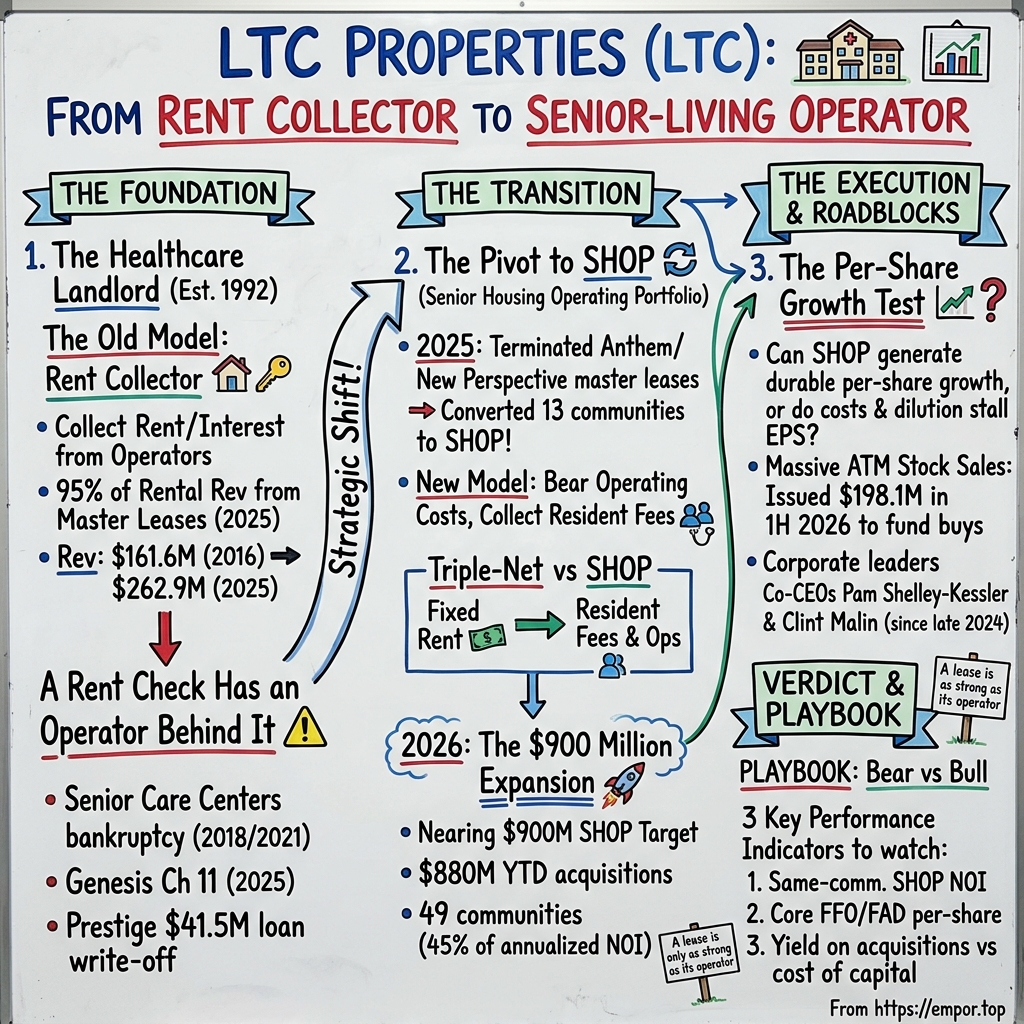
LTC Properties: From Rent Collector to Senior-Living Operator
The $900 Million Bet on Senior Housing
On the morning of October 21, 2026, a short press release went out from Westlake Village, California, at a quarter past nine Eastern. It described a 130-unit senior-living community in Pennsylvania, built in 2023, offering independent living, assisted living and memory care, sitting in the low-to-mid 90s on occupancy, with spare land beside it for cottages that have not yet been built.1
LTC Properties paid $52 million for it. The seller was not named. The deal was off-market. IntegraCare, a company that had first appeared in LTC's world only three weeks earlier, would keep running the building.12
On its own, that is a small transaction, the sort a large healthcare landlord would close without a press release. What made it worth announcing was the running total underneath. With that purchase, LTC said it had completed more than $880 million of senior-housing acquisitions in 2026, closing in on the $900 million midpoint of its guidance for the year.1
Its senior housing operating portfolio, the business that real-estate people call SHOP, now holds 49 communities run by 13 operators, 11 of them new to LTC. Those communities produce 45% of the company's pro forma annualized net operating income.1
To see why that last number is startling, consider what LTC was eighteen months earlier. In the spring of 2025 it did not have a SHOP portfolio at all. It was a small, specialized healthcare real estate investment trust that owned nursing homes and assisted-living buildings, leased them to operators on long contracts, lent money to other operators against their buildings, and collected checks.
The SHOP platform launched in May 2025 with 13 communities converted from existing leases.3 By the time of the Pennsylvania deal it was nearly four times that size, and management had told analysts it saw a path to getting 75% of its NOI from SHOP by the end of 2028.4
That is not how small landlords usually behave. A landlord's charm is its patience: buy a building, sign a fifteen-year lease with a 2.5% annual escalator, let the operator worry about payroll and food costs, and send the rent out to shareholders as dividends. LTC has spent more than thirty years as exactly that kind of company.
Now it is buying communities in Alabama, Iowa, Florida, Virginia, Maryland, Minnesota and Pennsylvania at a pace of roughly one every week or two, and in each one it takes on not a tenant's rent but the building's whole profit and loss: the resident fees on one side, and the nurses, cooks, utilities and management fees on the other.325
So this story is about a bet, and the bet has three parts. The first is whether owning the operating economics of senior housing can make LTC grow faster per share than it did as a rent collector.
The second is whether LTC can manage the risks that come with being much closer to the care business, a business that has twice in the last decade shown LTC what an operator's failure looks like. The third, and the one that will matter most to shareholders, is whether acquisitions funded largely by selling new shares and old assets will earn more than they cost.
There is a twist that runs through every chapter. At LTC, revenue, earnings and per-share earnings tell three different stories, and they rarely agree. In the second quarter of 2026, total revenue jumped from about $60 million to about $99 million year over year. Diluted earnings per share rose from 32 cents to 56 cents.
And Core funds from operations per share, the measure LTC itself steers investors to as its cleanest read of recurring earnings, was 68 cents in both quarters.6 Every one of those numbers is accurate. Rent, resident fees, gains on property sales and credit write-offs flow through the income statement in very different ways, so the company can look like it is booming, standing still or shrinking depending on which line a reader picks.
The verdict going in is straightforward. The transformation is already large enough to change what LTC is. Whether it is a better company per share is not yet proven, and the evidence that will settle it, seasoned NOI from the 2026 cohort and per-share earnings after all the new shares are counted, has mostly not arrived. To judge how much is at stake, it helps to start with what LTC was before anyone at the company said the word SHOP.
 Subscribe on LinkedIn
The Quiet Growth of a Healthcare Landlord
LTC Properties was incorporated in Maryland on May 12, 1992, and began operating that August, in the era when healthcare REITs were a niche invented to separate nursing-home buildings from the companies that ran them.7 The idea was simple and durable.
An operator of skilled nursing facilities or assisted-living communities wants to spend its scarce capital on staff, licenses and systems, not bricks. A REIT will buy the building, lease it back to the operator, and accept a steady stream of rent in return. Investors get a high-yield, tax-advantaged security backed by real property; operators get liquidity.
By 2016 LTC had matured into a polished version of that model. Its annual report described a company that invested through property acquisitions, sale-leasebacks, mortgage loans, joint ventures, construction financing and structured finance such as mezzanine and preferred-equity lending.87 It was not glamorous. It was a lender and landlord to an industry most investors preferred not to think about, run from a Southern California suburb by a team small enough to fit in a conference room. At the end of 2016 LTC employed 24 people.9
Over the following decade, the business grew steadily. Revenue rose from $161.6 million in 2016 to $262.9 million in 2025, and net income available to common shareholders went from $84.7 million to $117.3 million.87 That is roughly 60% more revenue over nine years, a pace of about 5% a year. Steady enough to matter, particularly for a company that paid out most of its cash as dividends and so had to fund growth with new capital.
But that comparison flatters 2025, and the reason why is the first lesson in reading LTC. Net income in 2025 included a $77.8 million gain on selling ten properties, most of them older skilled nursing facilities in Virginia, Florida and California that had been bought decades ago at a fraction of what they fetched.7
A gain on sale is real money to the shareholder who owned the building, but it is not something a company earns again next year from the same asset, because the asset is gone. Strip it out and the picture changes sharply. Nareit funds from operations, the industry's standard yardstick, fell to $77.3 million in 2025 from $125.7 million in 2024.7
That is a nearly 40% decline, in the same year revenue rose by about a quarter. The main cause was a single non-cash charge: a $41.5 million write-off of interest LTC had accrued on its largest mortgage loan. Transaction costs also jumped to $8.2 million from $0.8 million as the SHOP buying spree started.7 So the headline trend, revenue and net income both up, hides an operating year that was much messier than it looks.
This is why property REITs speak in a dialect of their own. Net income for a landlord is distorted in two directions. Depreciation pushes it down, because accounting rules assume buildings wear out even when their market value is rising. Gains on sale push it up, sometimes enormously, when old assets are sold.
Nareit FFO corrects for both, adding back depreciation and removing sale gains, so it gets closer to the cash a property portfolio throws off from operations. LTC then adjusts further to Core FFO, which strips out items management considers one-time, such as write-offs and transaction costs, and to funds available for distribution, or FAD, which also removes non-cash rent accounting and subtracts the capital spending a portfolio needs to stay competitive.
Each step makes the earnings look cleaner, and each step requires trusting management's judgment about what counts as one-time. A $41.5 million interest write-off is excluded from Core FFO. So, eventually, are the transaction costs of buying 49 communities. Neither is imaginary.
That is why none of these measures alone proves the case. Nareit FFO is too noisy in a transformation year, Core FFO is only as good as its exclusions, and FAD can be flattered by assets young enough to need little capital spending. The honest approach is to read all three and ask what changed per share.
The historical record, then, establishes something real but limited. LTC built a durable, specialized capital-allocation business that survived the nursing-home industry's recurring crises and grew over a decade. It did not build a per-share growth engine; growth came mostly from raising capital and deploying it at a spread. And it built that business as a lender and lessor, which raises the question that hangs over everything that follows. Does a company designed to underwrite operators from a distance have the capability to take on the operators' own economics?
For most of that decade the company had a single face. Wendy Simpson joined the board in 1995, became chairman in 2013 and served for years as chief executive, presiding over the lend-and-lease model through the Senior Care bankruptcy and the pandemic.10 At the end of 2024 she handed the chief executive role to two long-time lieutenants and became executive chairman.
Her pay told the story of the handoff: about $5.08 million as CEO in 2024, about $1.02 million in 2025.10 The new leaders inherited a sound balance sheet, a tested operator book and an investor base that had come to LTC for steady monthly dividends, not reinvention. Within five months of taking over, they launched SHOP.
To answer that, one has to start where the money actually comes from.
A Rent Check Has an Operator Behind It
Picture a 120-bed skilled nursing facility in a mid-sized Texas or Michigan town. On LTC's balance sheet, it is a line of real estate. In the town it is something very different: a 24-hour operation with dozens of nurses and aides, a kitchen, a laundry, a therapy gym, a billing office arguing with Medicaid and Medicare Advantage plans, and a manager who wakes up every morning wondering whether enough staff will show up.
Under a triple-net lease, all of that belongs to the operator. LTC owns the building on paper. The operator must fill the beds, staff the floors, collect the reimbursement and, only after all of that, pay the rent.
That arrangement was the heart of LTC for three decades, and it remains a large part of the company today. It helps to separate the three ways LTC makes money, because each has a different payer, a different pricing unit and a different set of risks.
The first is rent. Under a triple-net lease, the "net" refers to the three big property costs—taxes, insurance and maintenance—all shifted to the tenant, who also generally funds capital expenditures.7 LTC's rent is set by contract and typically rises each year through fixed escalators, often 2% to 3%, or increases linked to inflation, specified dollar steps, or a share of revenue above a threshold.7 The pricing unit is the building, not the bed. Whether the facility is 70% full or 95% full, the rent is the same, until the moment the operator cannot pay it.
The second is interest. LTC lends to operators through mortgage loans and financing receivables, collecting a coupon in return. At the end of 2025 its mortgage loans were secured by 26 properties across five states and held by six borrowers.7 A loan is a different promise from a lease. LTC does not own the building; it holds a claim on it, and its upside is capped at the interest rate.
The third is the newest, and it is the one this story is about. In a SHOP community, LTC does not collect rent at all. It owns the building through a taxable subsidiary and hires a third-party operator under a management agreement to run it.7 Residents pay monthly fees for their apartment and care, and those fees flow into LTC's revenue as "resident fees and services."
Against them sit the community's operating costs, wages, food, utilities, insurance and the operator's management fee, which flow into LTC's expenses. The pricing unit is now the occupied apartment and the level of care in it. Fill more units, raise rates faster than wages rise, and LTC keeps the difference. Lose residents, or watch overtime explode during a staffing shortage, and LTC eats it.
The difference is the difference between being a bond and being a business. A triple-net lease transfers property taxes, insurance, maintenance and capex to the tenant and leaves LTC holding a fixed claim. SHOP puts operating costs much closer to LTC's own results. The 2025 income statement shows the mechanics. Resident fees brought in $72.1 million; senior-housing operating expenses absorbed $54.1 million.7 What was left, about $18 million, was the SHOP portfolio's NOI for the year.7
LTC tried to manage the risk in its lease book with structure. At the end of 2025, 95% of its rental revenue came from master leases or cross-defaulted leases, and the weighted-average remaining lease term was 47 months.7 A master lease bundles several buildings with one operator under a single contract, so the operator cannot keep the profitable facilities and walk away from the weak ones. Cross-default provisions link separate leases, so a default on one is a default on all. Both protect the landlord against cherry-picking.
A 47-month average sounds long, but it is shorter than the image of a fifteen-year healthcare lease suggests, and it is not evenly spread. About 7% of LTC's annualized triple-net rent was scheduled to expire in 2026, 12% in 2027 and 13% in 2028.7 Expirations are moments of truth in this business. A tenant whose buildings cover the rent comfortably can renew, buy the property, or demand a reset; a tenant with thin coverage can hand back the keys.
Executives later described approaching the end of a lease term as getting "daylight," the point at which LTC could look past the rent to the underlying cash flow of the operation and decide whether to reset the rent, re-tenant the building, or sell it, often to the operator itself.4 The lease ladder, in other words, is not just a schedule of risk. It is the calendar on which LTC's portfolio reshuffle has been timed.
Who is on the other side of those contracts matters more than any clause. The largest single exposure at the end of 2025 was Prestige Healthcare, which accounted for 11.9% of LTC's total revenue and 12.6% of total assets, mostly through a $179.9 million mortgage loan on 14 skilled nursing centers in Michigan.7 Among triple-net tenants, measured instead against rental revenue, HMG Healthcare was 12.5%, Carespring 11.9%, and Encore Senior Living and Brookdale Senior Living 11.0% each.7
Those are two different denominators, and the distinction matters: Prestige's share is of everything LTC earns, while the tenant shares are of rent only, a pool that has been shrinking as leases convert to SHOP and older properties are sold. Within its slice of the business, each of those tenants is a material relationship. Below them, Genesis Healthcare was 9.8% of rental revenue.7
It is worth naming who LTC's counterparties are not. A conventional company worries about suppliers. LTC has no meaningful supplier concentration; it buys almost nothing except buildings and advice. Its economically relevant counterparties are the operators who owe it rent or interest and, increasingly, the thousands of individual residents who sign agreements in its SHOP communities. Those residents are a diffuse and small credit exposure, with SHOP receivables of only about $3.1 million net at the end of 2025.7 The concentrated exposures are the operators and borrowers.
And here is the complication that LTC's own record supplies. A long lease can secure the rent stream on paper. It cannot make a failing operator solvent. When the care business behind the contract breaks, a master lease simply means that more buildings default at once. LTC's annual report says so itself: in a master lease, a default "could reduce or eliminate rental revenue from several properties."7 The company had already learned that lesson in a bankruptcy courtroom.
The Rent Roll Meets Bankruptcy Court
On December 4, 2018, Senior Care Centers, a Texas operator and one of LTC's three largest tenants, filed for Chapter 11 bankruptcy, citing lease terminations from other landlords and continuing operational problems.11 Senior Care had been responsible for about 11% of LTC's rental revenue.11 It did not pay December rent. LTC held roughly $2 million in a letter of credit and a few million more in maintenance and property-tax escrows as security, modest cushions against a tenant of that size.11
At first, the system worked the way landlords say it should. During 2019, while still in bankruptcy, Senior Care chose to assume LTC's master lease rather than reject it, a signal that the buildings were worth keeping. In March 2020 it emerged from bankruptcy, and a newly formed parent, Abri Health, became co-tenant and co-obligor on the lease.12 The contract had survived the court process. This was the textbook case for why master leases matter: the operator could not shed the weaker buildings, so it kept the whole portfolio.
Then the textbook ran out. Within weeks of emerging, the reorganized operator was hit by the pandemic. In March 2021 Senior Care and Abri defaulted, failing to pay rent and other obligations. LTC drew on the letter of credit, sent a notice of termination effective April 17, 2021, and on April 16, the day before termination, the tenant filed for Chapter 11 again.12
In August 2021 the bankruptcy court approved a settlement in which LTC paid $3.3 million to the tenant's affiliates in exchange for their cooperation in handing over 11 skilled nursing centers to affiliates of HMG Healthcare. HMG took over on October 1, 2021.12
Count the years. From the first filing to the completed handover took nearly three. LTC ultimately paid a departing tenant to leave, and its rental income from those buildings in 2021 consisted largely of security deposits being applied.12 The happy ending is real: HMG is now LTC's largest triple-net tenant.7
But the episode is the strongest historical test of the claim that master leases insulate a landlord from operating shocks, and the verdict is that they help without insulating. The lease kept the portfolio together and gave LTC leverage to replace the operator. It did not prevent years of lost or uncertain rent.
Senior Care was not alone. In 2020, an affiliate of Senior Lifestyle Corporation paid only $13.8 million of its $18.4 million contractual rent, and in 2021 it defaulted entirely. LTC transitioned 18 of its assisted-living communities to five different operators and sold others.12
It would be easy to blame the pandemic and move on, but the numbers argue for proportion. Direct COVID relief to tenants was modest. Between April and December 2020, rent abatements and deferrals, net of repayments, came to about 2% of LTC's contractual rent.13 The damage came through a different channel: accounting recognition. Under lease accounting, a landlord books rent on a straight-line basis, averaging the escalating payments over the life of the lease and carrying a receivable for the gap.
When collection is no longer probable, that receivable must be written off and the tenant moved to cash-basis accounting, where revenue is only what actually arrives. In 2020 LTC wrote off $23.2 million of straight-line rent and lease-incentive receivables.12 By the end of 2021, 19 operators representing about 52.6% of LTC's rental income were being accounted for on a cash basis.12
That last figure is the one that should stay with an investor. More than half of the rent roll was, under the company's own accounting, not reliably collectible enough to accrue. The cash mostly kept coming; Genesis, for example, was moved to cash basis in 2020 after flagging going-concern doubts yet stayed current.12 But the episode exposed a material, documented failure mode in the old model. Contract rent and accounting revenue can run ahead of collectible cash, and when they do, the correction arrives all at once.
The failure mode did not disappear with the pandemic. In 2025 Genesis Healthcare itself filed for Chapter 11. LTC wrote off $1.3 million of straight-line rent tied to its master lease on six skilled nursing facilities with 782 beds in New Mexico and Alabama.7
After a bankruptcy judge approved the sale of Genesis's assets to a new investment group, Genesis had still paid contractual rent through February 2026.7 So far, a contained event. But an operator worth nearly a tenth of the rent roll went through bankruptcy, and that is now the base rate, not an anomaly.
The Prestige story belongs beside the rent story, because it shows the same dynamic in a loan. During the pandemic, reimbursement problems in Michigan, where its buildings were concentrated, hit Prestige hard, and LTC agreed to let it pay a current rate of 8.5% on its mortgage while the contractual rate was 11.14%.
The gap remained Prestige's obligation, payable from security deposits or at maturity, and LTC accrued it as interest income under the effective-interest method.7 Even at the end of 2025, the security LTC held from Prestige totaled only $6.1 million.7
In mid-2025, with Prestige's performance improving, the two sides struck a new deal. Prestige would go back to paying the full contractual rate from July 1, 2025, and in return it got the right to prepay the whole loan at par, without penalty, during a 12-month window beginning in July 2026.714 Because a par prepayment meant LTC would never collect the interest it had accrued above the cash rate, LTC wrote off $41.5 million of accrued effective interest in the third quarter of 2025.7
That was non-cash in the year it was recorded, but it was not costless: it was the accounting admission that years of reported interest income would never arrive as cash. Management framed the trade as strategic, a way to reduce concentration in one operator and one state that had caused disruption.15 Prestige then gave notice of its intent to repay.7
The payoff date has drifted. In February 2026, management expected it on or about July 1; in August, it was modeling October 1 because of the HUD financing timeline; by October 1, LTC said it expected the loan to pay off in early to mid-November.1542 Each delay had a stated reason, and the HUD commitments were reported to be in hand. But until the cash arrives, one of the largest single funding sources in LTC's 2026 plan is still a promise.
Other receivables deserve scale rather than alarm. At the end of 2025 LTC carried $22.7 million of interest receivable and $17.9 million of straight-line rent receivable, and the company does not publish an aging schedule for either.7 Much of the interest receivable reflects effective-interest accruals on mortgages and financing receivables, about $14.1 million on mortgage loans alone, the same accounting mechanism that produced the Prestige write-off.7 The $3.1 million of net SHOP receivables, with a $0.3 million reserve, is a smaller and different matter: those are resident balances, not operator credit.7
Put the record together and a strategic fork appears. When an operator struggles, a landlord has three choices. It can insist on the rent and fight through court, as LTC did with Senior Care. It can find a replacement operator, which LTC did successfully but slowly. Or it can stop being a landlord, take the building's economics onto its own books, and hire a manager. In 2025, LTC chose the third path at scale.
The Lease Became a Business LTC Had to Run
Anthem Memory Care operated 12 memory-care communities for LTC across California, Colorado, Kansas, Illinois and Ohio, all under triple-net master leases.7 Memory care is the most intensive corner of senior housing: locked units, residents with dementia, high staffing ratios, and families paying premium rates for safety.
It is also a business where rent coverage can get thin. By early 2025, the Anthem portfolio's cash flow was running close to the rent LTC was collecting, which, as an executive later told analysts, meant there was upside to capture if LTC owned the operations rather than the lease.15
In the second quarter of 2025, LTC terminated the Anthem master leases and converted all 12 communities into its brand-new SHOP segment. It wrote off Anthem's $2.7 million working-capital note and $0.4 million of related interest in the process.7
At the same time it ended a lease with New Perspective Senior Living and converted that community, paying New Perspective a $6.0 million lease-termination fee.7 Those 13 communities, with a gross book value of about $175 million, were the seed of the platform.43 Management called these "cooperative conversions," and argued they were a cost-effective way to launch with buildings LTC already knew.14
It is worth pausing on what that move means. For three decades, when an operator's coverage got thin, LTC's tools were rent deferrals, lease amendments and, as a last resort, a replacement operator. With Anthem, it chose something different. It gave up a contractual claim on rent and took the full operating exposure, betting that it could earn more by owning the outcome than by owning the promise.
The first-year results were encouraging. On the February 2026 call, management said the original 13 converted properties had grown NOI 22% over their 2024 pro forma, producing $16.2 million of combined rent and NOI in 2025 against $12.3 million of rent in 2024.15 An analyst noted that comparison was "apples-to-oranges," setting NOI under the new structure against rent under the old, and management agreed it was fair.15
Then the conversions turned into acquisitions. LTC bought 11 communities for about $354.7 million in 2025.7 By year-end, the SHOP segment held 25 communities managed by seven independent operators, representing about 24% of the investment portfolio.7 In 2026, the pace accelerated. Management opened the year guiding to $600 million of SHOP acquisitions at the midpoint; in August it raised that to $900 million.154
Deals came in quick succession: $200 million for four Minnesota communities run by Lifespark in early September, nearly $160 million for three communities in Florida, Virginia and Maryland on October 1, $95 million for two in Alabama and Iowa on October 13, and the Pennsylvania purchase on October 21.5231 By then the portfolio had grown to 49 communities, with 13 operators.1
This is a transition, not a finished strategy, and it should be read as one. Management's own target has moved repeatedly. In February 2026 it described the transformation as complete by year-end at roughly 45% of the investment portfolio and 40% of NOI, after which growth would be an "evolution."15
By August it was talking about 50% of NOI by year-end and a path to 75% by the end of 2028.4 Faster than planned is not the same as better than planned, and the speed itself is a risk worth watching.
The accounting optics need separating from the operating results. When a lease converts to SHOP, the old rent disappears from revenue and is replaced by the community's entire resident-fee revenue, while the community's operating costs appear on the expense line. Revenue grosses up even if profit barely moves. That is exactly what happened in 2025.
Total revenue rose about $53 million, but $72.1 million of that was new resident fees, offset by $54.1 million of new operating expenses, and rental income actually fell by $16.1 million, partly because of the conversions.7 The step-up in revenue was real. The step-up in recurring property profit was much smaller.
The second quarter of 2026 gives the clearest window on the operating model so far. LTC's "core" SHOP portfolio, the 27 communities it owned at the start of the year, ran at 90.0% average occupancy, generated $13.3 million of NOI in the quarter, and earned a 26.9% NOI margin.16 In plain terms, of every dollar a resident paid, about 27 cents was left after running the building.
That is a respectable margin for a portfolio weighted toward memory care, which made up roughly 30% of the core units.4 Management guided to about 14% NOI growth for this core group in 2026 at the midpoint, driven more by rate than occupancy, after occupancy lagged its internal plan by about 90 basis points in the first half.4
Now hold that beside the per-share results. Core FFO per share was 68 cents in the second quarter of 2026, exactly where it had been a year earlier. Core FAD per share was 70 cents, a penny below the 71 cents of the prior-year quarter.6 The CFO explained why: more shares outstanding from at-the-market equity sales, less income from skilled nursing properties sold and loans repaid, and higher interest expense, offset by growing SHOP NOI and new loan income.4
In other words, the SHOP portfolio was growing nicely, and everything required to fund it was eating that growth. An analyst on the August call put the full-year math bluntly: normalized FFO growth for 2026 was running at about 1.5%. Co-CEO Pam Kessler accepted the figure and called it the price of a "heavy lift transformation year," an investment the team was making "consciously" so that the company emerging in two years would be stronger.4
That is an honest answer, and it also sets the test. The capital behind this growth is not in corporate overhead. LTC's headcount went only from 23 in 2023 to 25 at the end of 2025, while revenue rose from $197.2 million to $262.9 million.177 Real-estate capital improvements were $7.3 million in 2025, down from $13.7 million.7
The big investment is in the buildings themselves and in the operating relationships, plus new hires in accounting, financial planning, analytics and asset management that management described as continuing.15 Corporate G&A rose to $31.1 million in 2025 from $27.2 million, and 2026 guidance called for $31.7 million to $33.9 million.716
There is a reason capex is low, and it will not last. LTC says it has deliberately bought young buildings, with an average age around nine years, and budgets roughly $1,500 per unit of recurring capital spending.15 An analyst asked whether that was simply too low for a portfolio approaching $1 billion.
Management said it was not deferring anything and that the young age justified the number; Kessler added that LTC's budget could not be compared to peers with older portfolios. The analyst's rejoinder was the right one: young becomes old.15 FAD flatters a young portfolio, and investors should expect that advantage to fade.
The newer risk is also a different kind of risk. Under a triple-net lease, the question was whether the tenant could pay. Under SHOP, the questions are whether occupancy rises, whether rate increases stick, whether labor costs stay below plan, whether government reimbursement holds up in the care-heavy corners of the portfolio, and whether a regional manager in Iowa or Alabama executes well week after week.
SHOP gives LTC more control: it can replace a manager under the agreement's terms without a bankruptcy fight. But it also puts every one of those variables directly into LTC's earnings. The tenant-credit risk shrinks. The operating risk grows.
Which leaves the question the next chapter has to answer. A company that spent thirty years underwriting operators now needs to be a disciplined owner of operating businesses run by third-party managers it mostly met in the last eighteen months. What, exactly, can it do better than the giants that have been doing this for years?
The Advantage Is Access to Deals; the Proof Is Per-Share NOI
Dave Boitano joined LTC as chief investment officer in April 2025, after nearly five years as a senior vice president at Lument, the lender formerly known as ORIX Real Estate Capital, and earlier executive roles in seniors-housing finance including at an S&P 500 REIT.10 On his first earnings call, he said what had drawn him was LTC's positioning to partner with "strong, regionally focused operators."14
Eighteen months later, his press releases had developed a refrain. The October 13 deals, he and his colleague Michael Bowden said, came from repeat sellers LTC had done business with before, and both would be run by existing SHOP operators. "Deep relationships continue to fuel our growth," Bowden said.3 The Pennsylvania deal on October 21 was off-market, and Boitano said LTC's "long-standing industry relationships give us a distinct advantage."1
Boitano has described how that works in practice. LTC hunts in what he called the "onesie-twosie" part of the market, single buildings and small portfolios, where sellers know their deal matters to the buyer. When sellers hold buyer interviews, which he said had become fashionable, he can bring LTC's chief executives onto the call to show how seriously the company takes a $50 million purchase, and he argued that "certainty of execution matters an awful lot" to any seller.15 A REIT the size of Welltower is unlikely to send its CEO to pitch for a single 85-unit community in Iowa.
That is LTC's claimed edge in one sentence: a small buyer, known and trusted in the industry, that can win deals the big players either cannot see or will not bother with. To test it, first map the battlefield.
LTC is a minnow among whales. Omega Healthcare Investors alone reported 1,027 operating healthcare facilities at the end of 2025, run by 89 operators across 42 states and the U.K.18 Welltower and Ventas are far larger still, each with very big senior-housing operating portfolios alongside medical office buildings, outpatient facilities and other property types.1920
LTC's whole company is valued at a few billion dollars and owns somewhere around 160 properties.3 Comparing company-wide market shares would be meaningless, because each peer combines a different mix of SHOP, triple-net, skilled nursing, medical office and other assets. What matters is the specific market LTC is competing in: single communities and small portfolios of stabilized, relatively new senior housing, priced in the tens of millions of dollars.
In that arena, the economics follow Michael Porter's five forces more closely than LTC's press releases suggest. The operators have real bargaining power, particularly where a property has few credible replacement managers in its region; that is why LTC's management agreements include incentive fees tied to both top-line and bottom-line performance.14
Residents and their families have local alternatives, and their willingness to accept annual increases is the price lever every SHOP thesis depends on. Government shapes much of the payer side through Medicare and Medicaid, especially in skilled nursing and memory care.
Rival buyers compete for the same buildings: according to JLL's survey, seniors-housing transaction volume reached just over $24 billion on a rolling four-quarter basis at the end of 2025, the highest since 2015, and 86% of surveyed investors wanted more exposure in 2026.21
And new supply, the classic threat, is muted for now: JLL reported that construction starts had fallen 77% from their peak in primary markets.21 Management itself said construction near its own portfolio was "very light," though operators with development experience were starting to talk about gearing up.15
So does relationship sourcing show up in the evidence? Partly. The October deals were genuinely managed by existing SHOP operators, and some came from repeat sellers. But most operators are still new to LTC.1 That cuts both ways.
It shows LTC can attract managers, which is a real accomplishment for a company with no SHOP history. It also means most of these relationships are less than two years old and have not been tested by a downturn. The sourcing network is real. A durable cost or pricing advantage is not yet demonstrated.
Pricing is where the test gets sharper. LTC's October acquisitions were quoted at year-one cap rates of about 6.5% for the October 1 and October 13 deals and 6.9% for the Pennsylvania community, with the September Minnesota portfolio at about 7%.2315
A cap rate is the first-year NOI divided by the price, so a higher cap rate means a cheaper purchase. JLL put the average seniors-housing cap rate at about 6.2% at the end of 2025, and 85% of its survey respondents expected cap rates to keep falling.21 On the surface, LTC is buying at a discount to the market.
But be careful with that comparison. A national average blends assets of every age, size, acuity and market, and it is a different date from LTC's deals. It is not a property-specific comparable, and a 30-to-70-basis-point spread over a sector average does not establish that LTC avoided overpaying. More telling is the trend in LTC's own numbers.
In August 2025, LTC's stabilized SHOP acquisitions were underwritten at an estimated year-one yield of about 7%.14 In February 2026, Boitano said the company was "steadfast" in working to maintain that roughly 7% yield, while acknowledging there would be pressure as more capital "discovered" senior housing.15 By October, two of the deals were at about 6.5%. The yields LTC can buy at are compressing, as the market predicted.
The return targets have moved the other way. In August 2025, the targeted unlevered IRR on stabilized SHOP communities was "north of 10%," with acquisitions projected to grow at "fairly 3%-ish" a year.14 By 2026, every acquisition release cited an anticipated unlevered IRR in the "low-to-mid teens."132
Lower entry yields and higher expected returns can both be true only if growth in NOI is much faster than was assumed a year earlier. Management argues that is exactly what the first cohort has shown, pointing to guided growth in the core portfolio.4 Perhaps. But an IRR is an estimate of the future, and these are management underwriting figures until realized results arrive.
Hamilton Helmer's seven powers framework offers a useful discipline here, and it argues for caution. LTC has no network effect: one more operator does not make the platform more valuable to the others in any self-reinforcing way. It has no proprietary technology, no regulatory barrier that keeps rivals out, and no scale economy; if anything, it is subscale against Welltower and Ventas.
Its candidate powers are a modest form of cornered resource, the trust and relationships of a team that has worked in the industry for decades, and a process advantage in underwriting smaller deals that bigger buyers skip. Management has explicitly framed its small size as an advantage, describing a "denominator effect" in which modest investments move the needle.15 That is true arithmetic, but it is not a moat. It is a reason growth looks faster at LTC than at a giant, and it fades as LTC gets bigger.
Then there are the forces that can break the thesis regardless of sourcing. Labor is the largest cost in a senior-housing community, so wage inflation goes straight to margin. Occupancy can stall, as it did in the first half of 2026 relative to LTC's plan.
Medicaid and Medicare policy can shift with what one LTC executive called "stroke of the pen risk."15 Operator distress has been a recurring feature of LTC's history. And the cost of equity and debt determines whether a 6.5% acquisition is worth doing at all.
The challenge to management, then, is concrete. If deal access is the advantage, it should become visible in three places: same-community NOI that grows faster than peers' after the first-year honeymoon, realized returns that match the low-to-mid-teens IRRs in the press releases, and FFO and FAD per share that rise after the new shares are counted. Until then, the edge is a story told well, and the funding behind it is where the story becomes most concrete.
The Sale Gain, the Loan Write-Off, and the ATM
Open LTC's 2025 cash-flow statement and the first line looks reassuring. Cash from operations was $136.0 million, comfortably above consolidated net income of $123.9 million.7 For most companies, cash running ahead of profit is a sign of quality. At LTC in 2025, it is a puzzle with four pieces, and they need to be assembled before the comparison means anything.
Start with net income of $123.9 million. Add back depreciation and amortization of $37.9 million, because buildings are being expensed in the accounts even though no cash leaves. Add back $9.3 million of stock compensation for the same reason.
Add back the $41.5 million Prestige write-off, because it reversed income booked in earlier years rather than consuming cash in 2025. Then subtract the $77.8 million gain on property sales, because that cash belongs in investing activities, not operations. Adjust for working capital, including a rise in interest receivable, and the result lands near $136 million.7
Each step is legitimate, and the endpoint shows that the recurring business generated solid cash. But neither figure is a clean proxy for repeatable distributable earnings. Net income was inflated by a sale gain that will not recur on the same assets.
Operating cash flow was supported by interest from a Prestige loan that is about to be repaid and so will stop producing interest altogether. Its yield of more than 11% will be difficult for LTC to replace with senior-housing investments yielding 6.5%. In 2025 the effective-interest accruals and the write-off show how much the old lending book's earnings depended on judgments about collectability.
Now follow the money. In 2025 LTC spent $354.6 million buying real estate, essentially the 11 SHOP communities, against just $0.3 million the year before.7 It funded that with three sources. The first was old assets: ten property sales at a sales price of $129.4 million.7 The second was debt, through an enlarged credit facility. The third was new shares: LTC sold 2.80 million shares under its at-the-market program for $100.6 million of net proceeds.7
In 2026, every one of those sources ran faster. LTC sold another 5.26 million shares for $198.1 million net in the first half of 2026.22 In the second quarter alone, it sold 4.1 million shares for $155 million to pre-fund acquisitions.4 Shares outstanding reached about 53.9 million at June 30, 2026, against a weighted average of about 46.2 million in 2025.167
Since July, LTC has sold another 2.29 million shares for about $97 million.1 In August it filed a prospectus supplement for a new at-the-market program of up to $500 million of common stock, with seven sales agents and the option to use forward sales.23 Put simply, LTC's share count has risen by roughly a fifth in about eighteen months.
The disposition engine ran even harder. In August, management lifted its 2026 forecast for asset sales and loan payoffs to about $730 million, roughly $465 million more than it had guided in February, with a blended yield of about 7.3% on what it was selling.4 In September it sold 13 skilled nursing centers in Texas, with $12.4 million of annualized cash income and a $101 million net book value, using $167 million of the proceeds to fund the Minnesota acquisition.5
On October 1 it announced the sale of three skilled nursing centers and 17 seniors-housing communities, all under triple-net leases, for more than $260 million of gross proceeds and an expected gain of about $225 million.2 Year to date, LTC had raised $550 million from sales and the expected Prestige payoff, representing $33 million of annualized income, with expected gains of more than $330 million.2
Those gains are why the company's 2026 guidance for diluted earnings per share is $8.08 to $8.10, roughly three times its expected Core FFO.6 That EPS figure is mostly accounting gain on buildings bought long ago, and it says almost nothing about the recurring business.
The cleaner near-term test is the Core guidance: Core FFO per share of $2.76 to $2.78, and Core FAD per share of $2.83 to $2.85.6 For context, LTC opened 2026 guiding Core FFO to $2.75 to $2.79.15 Management raised its investment target by half in August and left the per-share midpoint unchanged; the CFO said the main reason was that acquisitions were closing later in the year than modeled.4
What does that tell an investor? LTC is selling older assets at prices that look good, and the gains suggest the market values those skilled nursing buildings well above their book cost. Management said most of the incremental sales were to operators or their affiliates, who wanted to own the buildings they ran.4 That is real value creation on the sell side.
But it also means LTC is swapping higher-yielding, slower-growing assets, skilled nursing leases and 11% loans, for lower-yielding, faster-growing ones. Kessler was candid that acquisitions would be "more neutral from day one," with the growth coming in later years.4 The bet only pays off if those later years arrive as promised.
The debt profile is manageable, but it has a shape worth noting. At the end of 2025, 70% of LTC's borrowings were fixed or hedged with swaps, and a one-percentage-point rise in benchmark rates would have added about $2.1 million to annual interest expense on the unhedged portion.7 Liquidity was $650.0 million.7 By June 30, 2026, debt was about $777 million net of costs, and the maturity schedule clustered in 2029, when $318 million comes due, including a $200 million revolver balance.16
The credit facility was expanded by $300 million to $1.1 billion in mid-2026, including a $900 million revolving line.64 Leverage was 4.2 times debt to annualized adjusted EBITDA, inside management's 4-to-5-times target.4 None of this is alarming. The point is that a growing share of the funding now comes from a revolver priced off floating rates and from equity sold at whatever the market will pay.
For 2027, Kessler told analysts to expect funding in "the normal course," roughly 70% equity and 30% debt, because the large recycling of older assets would mostly be finished.4 That is the crux. In 2026, LTC funded much of its growth by selling assets bought cheaply decades ago, a one-time currency.
From 2027, most of the funding will come from new shares. So the capital-allocation question comes down to a single comparison: will the new assets earn more than the blended cost of new equity, new debt and the operating risk that comes attached? The people responsible for that comparison are worth meeting.
Two Co-CEOs, One Per-Share Test
On September 22, 2026, LTC's board expanded from six seats to eight to make room for its two chief executives, Pam Kessler and Clint Malin.24 Executive Chairman Wendy Simpson, who has served on LTC's board since 1995, said the pair had "helped reshape LTC, combining strategic vision with disciplined execution."2410 After the change, five of eight directors are independent.24
The two co-CEOs are not outsiders brought in to shake up a sleepy REIT. They are lifers, and that is both their strength and the question about them. Pamela Shelley-Kessler joined LTC in 2000 as controller and served as chief financial officer from 2007 to December 2024; before LTC she had been a controller for a private commercial and multifamily developer and director of financial reporting at Irvine Apartment Communities, a publicly traded apartment REIT.10
Clint Malin joined in 2004 and spent two decades as chief investment officer; before that he ran corporate real estate at Sun Healthcare Group, a nursing-home operator later folded into Genesis, after starting his career at KPMG and Arthur Andersen.10 They have been co-presidents since May 2020 and co-CEOs since December 2024.10 In other words, the finance chief and the deal chief who managed the Senior Care default, the pandemic write-offs and the Prestige modification are the same people now leading the SHOP pivot.
On calls they play distinct roles. Kessler handles the framing and the capital questions, and she tends to answer directly; when an analyst put 1.5% FFO growth to her, she did not dispute it. Malin speaks as the dealmaker, emphasizing asset quality, young buildings and the competitive position against future supply. Around them they have built a new bench: Boitano as chief investment officer, Gibson Satterwhite promoted to run asset management in 2025, and Caroline Chikhale promoted to CFO.10
Their pay deserves to be set against the operating record. Each co-CEO's reported 2025 compensation was about $4.03 million, up from about $2.68 million in 2024, as they moved from co-presidents to co-CEOs.10 In the same year, Nareit FFO fell sharply.7 The compensation committee did not measure them on Nareit FFO.
Half of the annual bonus was based on an "Adjusted FAD per share" figure and half on the committee's qualitative judgment. The adjusted measure came in at $3.00 a share against a $2.86 target, funding that half at 175%; the qualitative half was scored at 100%; and the total bonus paid out at 137.5% of target.10
Look closer at how "Adjusted FAD per share" was built. It was Core FAD per share, adjusted to exclude the effect of equity issuance during 2025 and to include $7.4 million of one-time exit income from the redemption of preferred-equity investments.10 Excluding the dilution from new shares, in a year when the company sold 2.8 million of them, removes exactly the cost that a skeptical shareholder most wants management to bear.
The committee may have reasons: it did not want to penalize executives for raising growth capital the board approved. But it means the bonus metric measured the business before the per-share cost of funding it, while long-term equity awards, roughly half contingent on three-year total shareholder return, carry the per-share discipline instead.10
Shareholders largely accepted it. At the 2026 annual meeting, say-on-pay passed with about 31.45 million votes for and 1.23 million against, a comfortable margin; one long-serving director, Timothy Triche, drew about 1.11 million votes against.25 Directors and executive officers as a group owned about 2.2% of the shares, while BlackRock held 15.8%, Vanguard 9.6% and State Street 6.3%.10
The 2026 proxy reported no related-person transactions requiring disclosure since the start of 2025.10 The governance picture is clean and ordinary: no controlling shareholder, a mostly independent board, index funds as the largest holders. That also means the most likely check on management is not an activist with a board seat but a falling share price.
The auditor's work offers another signal. The 2025 audit produced unqualified opinions on both the financial statements and internal control, with no material weakness reported.7 The single critical audit matter was the purchase-price allocation for the 11 SHOP communities bought for $354.7 million, which required judgments about land comparables, capitalization rates and estimated NOI.7 That is not a red flag; it is an auditor pointing at the hardest estimate in the books. But it is the right place to point, because acquisition valuation is now the core execution risk at LTC.
A few smaller items round out the diligence. The company describes ordinary-course litigation that management does not expect to be material, and it reported no uncertain tax positions that would fail the more-likely-than-not standard.7 Because SHOP operations run through a taxable REIT subsidiary, LTC now records an income tax line; it was a modest $179,000 in 2025, but it will grow as SHOP profits grow.7 The portfolio is entirely in the United States, so foreign currency is not a material exposure.
Then comes the question a skeptical long-short investor would ask. With dilution continuing, why is buying more senior housing better than the alternatives? LTC could have repurchased shares, paid down the revolver, or simply held the existing lease book, which at the end of 2025 carried what management called historically strong rent coverage in skilled nursing.4
The answer management gives is growth: a triple-net portfolio growing at 2% to 3% a year cannot compound the way an operating portfolio can. That is a coherent argument. It becomes a convincing one only when realized per-share returns show up.
The credibility measure, then, is simple to state and slow to read. The deal and cohort evidence is encouraging so far, but the record of per-share growth has barely begun. Which brings the story to the full case, for and against.
Analysis & Bear vs. Bull Case
Step back and look at the whole board. Barely a year after launch, a 49-community operating platform is approaching half of LTC's annualized NOI. Skilled nursing, which was over half of NOI as recently as mid-2025, is heading toward the low 20s.4
The company that existed in 2024 is being sold off piece by piece, much of it to the operators who run its buildings, and replaced with a different company. The question is whether the new one has a credible reason to win, or simply a larger set of risks to manage.
The bull case begins with control. As a landlord, LTC's upside was capped by the escalator in the lease while its downside, as Senior Care and Senior Lifestyle showed, could be very large. In SHOP, the upside is open-ended and the downside is managed through the ability to replace a manager rather than litigate with a tenant.
The first cohort supports the thesis so far: the converted Anthem and New Perspective communities grew NOI faster than the old rent, and management guided the 27-community core group to about 14% NOI growth in 2026.154 Satterwhite told analysts that hitting that midpoint would mean LTC had "outperformed" its underwriting on about $460 million of new deals.4
The bull case continues with demographics and supply. An aging population is the tailwind every senior-housing investor cites, and JLL reported occupancy in primary markets at about 89.9% at the end of 2025, after 19 straight quarters of positive absorption, with construction starts far below their peaks.21
That combination gives operators room to push rates, which is exactly what LTC's core portfolio did in 2026 when occupancy lagged.4 Add a sourcing network that is visibly producing deals, a balance sheet with leverage of about 4.2 times, and a team that has hit its acquisition targets early, and the bull story writes itself: a small specialist turning itself into a faster-compounding senior-housing owner at the right point in the cycle.
The bear case begins where the per-share numbers do. Revenue nearly doubled in the second quarter while Core FFO per share stood still.6 That is not an accident of timing alone; it is the arithmetic of selling assets yielding 7% to 11% and buying assets yielding about 6.5% to 7%, while issuing shares to bridge the gap.
Management acknowledges that new acquisitions are roughly neutral on day one.4 So the entire case rests on future growth from properties LTC has owned for a few months, run by managers it has known for less than two years.
The bear case continues with history. LTC's record includes two operator bankruptcies at Senior Care, a default at Senior Lifestyle, a Genesis Chapter 11, and a $41.5 million reversal of interest income from its largest borrower.127 Each event was eventually managed, but each consumed years and real value. SHOP removes the tenant-bankruptcy mechanism, but it replaces it with direct exposure to labor costs, occupancy swings and local execution, the very things that drove LTC's tenants into distress in the first place.
Memory care, a large share of the core portfolio, is the most labor-intensive and volatile slice of senior housing; Satterwhite himself warned that the segment can bring "a lot of volatility."4 And entry yields are compressing as more capital chases the same buildings, while the 2027 funding mix will lean on new equity.
Here the competitive analysis from the deal chapter returns with its verdict. The forces most likely to squeeze LTC are rival capital bidding up assets and labor eating margins; the forces most likely to help are low new supply and residents' limited willingness to move once settled.
In Helmer's terms, LTC has at most a modest cornered resource in its relationships and a process edge in smaller deals, with no network effect, switching-cost lock-in for residents beyond the usual stickiness of a home, or scale economy. Demographic demand is a tailwind every senior-housing owner shares, which makes it a reason the sector may do well, not a reason LTC will do better. The moat, in short, remains unproven.
Three numbers will settle the debate, and an investor need track only these. The first is same-community SHOP NOI and occupancy. Its latest reading is the core portfolio at 90.0% occupancy, $13.3 million of quarterly NOI and a 26.9% margin, with guidance for about 14% growth in 2026.164
The direction is up, but it is one year of data on a small portfolio. The second is Core FFO and Core FAD per share after dilution: 68 cents and 70 cents in the second quarter of 2026, flat and slightly down from a year earlier.6
The third is the realized return on acquisitions against their funding cost, which LTC does not yet report as a single number; the anticipated low-to-mid-teens unlevered IRRs are management estimates.1 If the first rises, the second climbs as the 2026 cohort seasons, and the third shows up in reported results, the bull case wins. If the first stalls while the share count keeps rising, the bear case does.
The earnings calls show how the story has evolved, and where analysts have pushed. On the second-quarter 2025 call, as the Anthem and New Perspective conversions were completed, management was cautious: acquisitions were stabilized assets underwritten at about 7% year-one yields with IRRs "north of 10%," growth was projected at roughly 3% a year, and Kessler warned that value-add turnarounds were "messy" and best left for later.14
On the fourth-quarter 2025 call in February 2026, the tone had lifted. Management guided to $600 million of acquisitions, said the transformation would be complete within the year, and was already describing the 2026 underwriting as beating its earlier 7% target.
But analysts kept probing: Rich Anderson pushed on whether the 22% NOI growth was apples-to-oranges, and on whether $1,500 of capex per unit was too low.15 By the second-quarter 2026 call, the ambition had grown to $900 million and a 75%-SHOP target for 2028.
The analyst questions were sharper too: why keep per-share guidance flat after raising investment by $300 million, what return the company could earn after its cost of capital, whether the Prestige payoff would really close.4 The prepared remarks were specific about volumes and occupancy; the per-share answers relied on timing and the promise of growth in later years.
Valuation should be handled as data, not as a verdict. LTC's equity sales offer a clean window on how the market prices it. The August prospectus recorded a last sale of $38.72 on August 5, 2026; the shares LTC sold over the following weeks raised about $97 million from 2.29 million shares, or roughly $42 a share after commissions.231 At that level, the stock trades at about 15 times the midpoint of 2026 Core FFO guidance.
That multiple is a statement of expectation. It suggests investors are paying for faster growth than LTC delivered as a landlord, and it is what makes the equity-funded strategy work: each share sold at a higher multiple makes the next acquisition easier to justify. It also means the market has already priced in part of the transformation's promise, so the per-share proof matters even more.
Playbook: Business & Investing Lessons
The first lesson belongs to a bankruptcy courtroom. Senior Care Centers went bankrupt, kept its LTC master lease through reorganization, emerged, and then defaulted again the day before LTC's termination notice took effect.12 On paper, the master lease did everything it was designed to do. In practice, LTC still paid $3.3 million for an orderly exit and waited nearly three years to put a healthy operator in the buildings.
The wider lesson for anyone buying a lease-backed yield is that the contract is not the asset. A lease is only as strong as the operator who has to pay it. The operator's margins, staffing and payer mix are the real collateral, and investors who underwrite only the legal structure are underwriting the wrong thing.
The second lesson starts with the Anthem keys. When LTC ended those memory-care leases in 2025, it gained something it had never had in thirty years: control over how its buildings were run and a share of every dollar of upside. It also gained 12 payrolls, 12 kitchens and 12 occupancy reports to worry about.7
The early results were good, but the trade changed the nature of the risk rather than removing it. Taking the keys gives you control, and the payroll. For founders and investors alike, vertical integration is a choice about which risks to own, not a way to escape them, and the right question is whether the new owner is better at bearing those risks than the old one.
The third lesson is written in the share register. In the second quarter of 2026, LTC's revenue rose by about two-thirds, by midsummer its SHOP platform had grown from 27 communities to 39, and its Core FFO per share did not move at all, because the new properties had been paid for with new shares and with older, higher-yielding assets that were sold.616 A good acquisition is measured after the new shares are counted. Total assets, total revenue and total NOI are the numbers a company controls by spending. The numbers per share are the ones it must earn.
The fourth lesson is about the Prestige loan, and it is the subtlest. For years, LTC's income statement accrued 11.14% interest on a loan paying 8.5% in cash, and the difference was booked as income because it was contractually owed.
When LTC traded that claim for a borrower's right to prepay at par, $41.5 million of reported income vanished in a single quarter.7 Accrued is not the same as earned until the cash says so. Any business whose earnings include large accruals of money not yet collected, from rent straight-lining to deferred interest, deserves to be read on a cash basis first.
What ties these together is a measure of discipline that applies to the old LTC and the new one alike: repeatable NOI and per-share returns. Not gross assets. Not headline revenue. Not a projected IRR in a press release. The company that survived three decades of operator crises by being patient is now being asked to prove it can be fast and still be right.
Epilogue
Tonight LTC stands at the end of the most transformative eighteen months in its history. It owns 49 senior-housing communities it did not own in the spring of 2025.1 It has sold dozens of skilled nursing facilities and seniors-housing buildings, many to the operators who ran them, at prices the company expects to produce gains of more than $300 million this year.2
It has sold millions of new shares and opened a $500 million program to sell more.23 It is less than $20 million short of its $900 million acquisition midpoint, and it has said it intends to keep buying in 2027.1
The next moment that matters is close. LTC will report third-quarter results after the market closes on November 3, 2026, and hold its call the next morning.26 That quarter will be the first with most of the 2026 cohort on the books, and three readings will matter most.
First, whether occupancy in the core SHOP portfolio rebounded in the summer as it did a year earlier, pushing growth toward the high end of guidance, or stayed soft and pushed it toward the low end. Second, whether Core FFO per share finally starts rising, or stays flat as dilution and lost loan income keep pace with new NOI. Third, whether that guidance holds.6
Shortly after that, the Prestige payoff should arrive, now expected in early to mid-November.2 If it closes, LTC collects roughly $180 million to redeploy and drops its largest single credit exposure. If it slips again, the funding plan for the year's final acquisitions leans harder on the revolver and on equity.
Beyond Prestige, the concentrated triple-net operators still matter. Genesis's buildings now sit with a new owner after the bankruptcy sale, and HMG, Carespring and the other skilled nursing tenants will carry a smaller but still meaningful share of LTC's rent.7
Then comes the longer test. Completed sales and acquisitions should be compared with guidance, including the funding mix and the share count that results. The 2029 maturity wall will need refinancing on whatever terms the market offers in a few years.16 And the young buildings, which the company says need little annual capex today, will grow older, one year at a time.
If the 2026 cohort seasons into the low-to-mid-teens returns management has projected, and Core FFO per share begins compounding faster than it did in the landlord years, LTC will have done something rare: reinvented a thirty-year-old business without breaking it.
If occupancy stalls, labor costs climb or acquisition yields keep compressing while the share count rises, it will have traded a dull but dependable rent roll for a faster-moving set of risks, at a price paid in shares that cannot be unissued. The central question will not be answered by another acquisition announcement. It will be answered, slowly, by per-share earnings.
Outro
Go back to that Pennsylvania press release on October 21. In one $52 million transaction sat everything this story has been about. A building that will age. An operator, IntegraCare, that LTC had known for barely three weeks. Residents who will pay their monthly fees, or not, depending on the care they receive and the alternatives down the road. And, funding it all, a slice of revolver debt and a block of new shares sold to investors who are betting the whole thing will add up.1
For thirty years, LTC's story ended when the rent check cleared. Now LTC is betting that owning more of that operating equation can make a small specialist grow faster than its size would suggest. The rent check used to end the story. Now it starts one.
References
-
LTC Approaches 2026 SHOP Acquisition Target of $900 Million with Recent $52 Million Investment — LTC Properties, 2026-10-21 ↩↩↩↩↩↩↩↩↩↩↩↩↩↩↩↩
-
LTC Accelerates SHOP Growth With Another $160 Million in Acquisitions — LTC Properties, 2026-10-01 ↩↩↩↩↩↩↩↩↩↩
-
LTC's SHOP Momentum Continues with $95 Million in New Acquisitions — LTC Properties, 2026-10-13 ↩↩↩↩↩↩↩↩
-
2026 Q2 Analyst and Investor Call — LTC Properties, 2026-08-06 ↩↩↩↩↩↩↩↩↩↩↩↩↩↩↩↩↩↩↩↩↩↩↩↩↩↩↩↩
-
LTC's $200 Million Acquisition Accelerates SHOP Transformation — LTC Properties, 2026-09-02 ↩↩↩↩
-
LTC Reports 2026 Second Quarter Results — LTC Properties, 2026-08-05 ↩↩↩↩↩↩↩↩↩
-
2025 Form 10-K — LTC Properties, 2026-02-24 ↩↩↩↩↩↩↩↩↩↩↩↩↩↩↩↩↩↩↩↩↩↩↩↩↩↩↩↩↩↩↩↩↩↩↩↩↩↩↩↩↩↩↩↩↩↩↩↩↩↩↩↩↩↩↩↩
-
2026 Proxy Statement — LTC Properties, 2026-04-08 ↩↩↩↩↩↩↩↩↩↩↩↩↩↩
-
Second Quarter 2025 Earnings Call Transcript — LTC Properties, 2025-08-05 ↩↩↩↩↩↩↩
-
Fourth Quarter 2025 Earnings Call Transcript — LTC Properties, 2026-02-25 ↩↩↩↩↩↩↩↩↩↩↩↩↩↩↩↩↩↩
-
2Q 2026 Supplemental Operating and Financial Data — LTC Properties, 2026-08-05 ↩↩↩↩↩↩↩
-
Seniors Housing and Care Investor Survey and Trends Outlook, Spring 2026 — JLL, 2026 ↩↩↩↩
-
Consolidated Statements of Cash Flows, six months ended June 30, 2026 — LTC Properties, 2026 ↩
-
2026 ATM Prospectus Supplement, Form 424B5 — LTC Properties, 2026-08-06 ↩↩↩
-
LTC Elects Co-Presidents and Co-CEOs Pam Kessler and Clint Malin to Board of Directors — LTC Properties, 2026-09-25 ↩↩↩
-
2026 Annual Meeting Voting Results, Form 8-K — LTC Properties, 2026-05-27 ↩
-
LTC Announces Date of Third Quarter 2026 Earnings Release, Conference Call and Webcast — LTC Properties, 2026-10-14 ↩
 LinkedIn
 WhatsApp
 Reddit
 Hacker News
 Email
 Kindle
 RSS Feed
 Spotify
 Apple Podcasts
 Amazon Music
 Audible
 YouTube