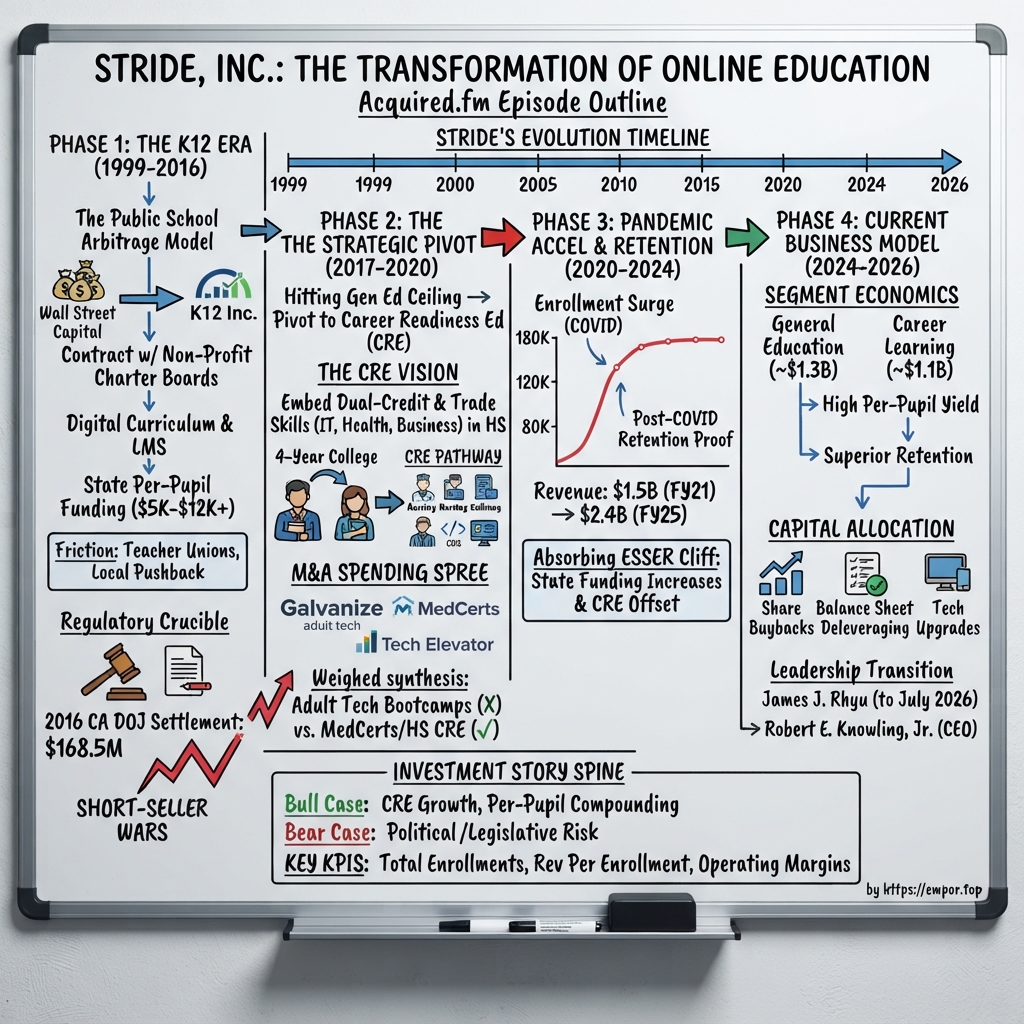
Stride, Inc.: The Transformation of Online Education
I. Introduction & Episode Roadmap
On Thursday, July 30, 2026, Stride, Inc. published a press release with two distinct announcements, though investors focused almost exclusively on the first. The company announced that James J. Rhyu had stepped down as chief executive officer and board chair, effective immediately, with independent director Robert E. Knowling, Jr. appointed as his successor.2 Lower in the release, Stride reported record preliminary results for fiscal year 2026: revenue of roughly $2.518 billion, operating income of $450.8 million, and adjusted EBITDA of $617.6 million.3
Wall Street responded sharply. Stride shares closed that day at $83.97, down nearly 15% from the prior session.4 When an analyst asked on the subsequent earnings call whether the sudden transition signaled weak fall enrollment, Knowling insisted it did not, stating that the board wanted "to move to the next level of growth and development of this enterprise."5 Whether that explanation holds up is one of the open questions this story addresses.
Abrupt shift has been a recurring theme throughout the company's 26-year history. Founded as K12 Inc. with backing from Michael Milken's education holding company and chaired by a former U.S. Secretary of Education, Stride went public on the eve of the 2008 financial crisis. It later faced a front-page New York Times investigation that erased a third of its market value in a single session,8 followed by a $168.5 million settlement with the California Attorney General over its marketing of student outcomes and attendance reporting.10 Despite short seller attacks, regulatory lawsuits, and skepticism that it was merely a pandemic beneficiary, Stride built the largest network of managed virtual public schools in the United States. In fiscal 2026, the company managed an average of 243,900 enrollments across 92 general education schools in 31 states and Washington, D.C., along with 57 career-learning schools and programs across 25 states and D.C.16
The core question. While it is easy to view COVID-19 as the primary driver of Stride's expansion, the pandemic merely accelerated an existing shift in demand. The company's underlying economics depend on three structural mechanics: how American public education allocates funding on a per-pupil basis, how state charter authorizations create high-friction, permission-based distribution channels, and how a strategic shift toward career-focused high school programs generates higher revenue per student and stronger retention than general education. Whether these mechanics form a durable competitive moat—or simply a temporary lead in a sector dominated by regulatory buyers—is the central thesis to evaluate.
What this story covers. The first section traces Stride from its founding through its 2007 IPO, highlighting the structural model that convinced Wall Street to evaluate a school management company like a software provider. The second section examines the regulatory crucible from 2008 through 2016, when disappointing academic outcomes collided with strong financial performance, testing the strength of its regulatory position. The third section details the company's 2017 to 2020 pivot into Career Learning, including a nearly quarter-billion-dollar investment in adult career bootcamps. The fourth section covers the post-pandemic era through fiscal 2026, analyzing a major technology platform migration in mid-2025 and the executive transition that followed a year later.
Throughout this analysis, each major claim required for a long-term investment thesis is tested against the strongest disconfirming evidence in Stride's operational record.
 Subscribe on LinkedIn
II. The Genesis: K12 Inc., Wall Street Capital, and the Public School Arbitrage (1999–2007)
Ron Packard did not come from education. He arrived from Goldman Sachs, where he worked in mergers and acquisitions, and McKinsey & Company, where he served as a management consultant. That background proved crucial: the enterprise he designed was less a pedagogical experiment than a financial structure built around public education funding.
The initial capital came from a distinctive corner of American business. Michael Milken—the former Drexel Burnham Lambert financier who redirected his capital into education and medical philanthropy after his securities conviction and prison term—had assembled a holding company called Knowledge Universe with his brother Lowell. Packard served as a vice president there and as chief executive of Knowledge Schools before spinning out to build K12. The Milkens invested $10 million into the venture, while William Bennett, Secretary of Education under Ronald Reagan and a prominent conservative voice on schooling, served as chairman of the board until 2005.8 Stride's regulatory filings date its founding to 2000 and record the rollout of its kindergarten-through-second-grade curriculum in September 2001, with additional grades and school partners added state by state thereafter.6
The structural insight, explained plainly. American public education funds the student rather than the building. Each state uses a legislative formula to allocate funding per enrolled child—a figure that varies widely by state and student classification, averaging $9,914 per enrollment across Stride's network in fiscal 2026.1 A traditional brick-and-mortar district spends a substantial share of those funds on physical infrastructure: real estate, facilities, utilities, buses, cafeterias, maintenance, and property insurance.
Charter school legislation, which expanded across states during the 1990s, created an alternative mechanism. Under these laws, a non-profit board could secure authorization to operate a public school and receive per-pupil funding without constructing physical school districts. K12 recognized that these volunteer boards often lacked the operational capacity to manage a school independently. They required curriculum, learning management systems, teacher recruitment and credentialing, home delivery of laptops and educational materials, enrollment marketing, state-compliant attendance tracking, and audit preparation.
K12 packaged these operational requirements into a single service bundle. In this "school-as-a-service" model, Stride does not collect per-pupil revenue directly from state treasuries. Instead, the non-profit school board receives the public allocation and contracts with Stride to provide curriculum, technology, instruction, and administrative support. Through this structure, Stride converted fragmented, permission-gated public funding into an enterprise software economics model: developing curriculum centrally, licensing it across authorized schools, and spreading fixed costs over an expanding student base.
These customer relationships provide long-term visibility. Stride's disclosures show that the average duration of its school-as-a-service agreements exceeds five years, with most contracts renewing automatically unless a school board provides advance notice within a specified window.6 That contractual length serves as the primary lock-in mechanism within the model, a key factor when evaluating the company's competitive moat.
The friction. Scaling this model required navigating substantial regulatory friction. Expanding into a new state demanded legislative approval, authorizer buy-in, and compliance with distinct state rules for attendance and testing. Traditional school districts opposed virtual charters, which drew per-pupil funding away from local systems. Teachers' unions similarly challenged a framework relying on instructors outside collective bargaining units—a structural feature that remains in place, as Stride reported that none of its approximately 9,200 employees were represented by a labor union as of June 30, 2026.6 Meanwhile, established textbook publishers had little incentive to support a competitor built to bypass printed materials.
The IPO. By late 2007, K12 brought its model to the public markets. The company priced its initial public offering on December 12, 2007, at $18.00 per share, offering 6.0 million shares in total—comprising 4.45 million new shares issued by the company and 1.55 million shares sold by existing investors, along with a 900,000-share over-allotment option. Bookrunners Morgan Stanley and Credit Suisse listed the stock on December 13 under the ticker LRN.9
While the ticker served as memorable branding, the listing occurred nine months before the collapse of Lehman Brothers. Nevertheless, the IPO established Stride as a public company whose revenue tracked state education spending, whose cost structure carried significant operating leverage, and whose expansion depended on state-by-state political authorization. That profile attracted both growth-oriented investors and persistent critics.
III. The Regulatory Crucible & Short-Seller Wars (2008–2016)
On the morning of December 13, 2011, subscribers to The New York Times found K12 Inc. featured on the front page. The report presented a sharp critique: the company was generating substantial profits from taxpayer funds while state data suggested its students performed well below academic averages, drawing comparisons to defense contractors optimizing against government spending. Market reaction was immediate—the stock fell 34% in a single session, dropping from $28.79 to $18.90.8
The article proved difficult to dismiss because it focused on a discrepancy between executive assertions and public records. In early 2011 investor presentations, chief executive Ron Packard told the market that K12 students outperformed state averages by 18 points in math and 20 points in reading. That October, he described academic results at Agora Cyber Charter School in Pennsylvania—one of the network's largest schools—as superior to typical public schools. However, The Times cited state data showing Agora students scored well below Pennsylvania averages in both reading and math. A local superintendent quoted in the report called the academic performance dismal, noting that the school received roughly $8,800 per student in public funding.8
Litigation quickly followed the news coverage. In January 2012, a shareholder filed suit in federal court in Alexandria, Virginia, alleging executives had misled investors about student performance and student-to-teacher ratios.8 A separate investor action in 2014 targeted stock sales by the former chief executive.25 Short sellers and education-policy advocacy groups intensified scrutiny through the middle of the decade. The bear case combined a financial argument—centered on churn-driven enrollment and heavy marketing expenditures—with a public-policy critique regarding corporate profits derived from underperforming tax-funded virtual schools.
Historical falsification pass #1: does the authorization network actually constitute a moat?
The claim. Stride's state-by-state authorization footprint and its two-decade compliance apparatus create a distribution moat with high switching costs for the non-profit boards it serves. A new entrant cannot easily enter the market, and an authorizer cannot easily terminate the relationship.
The strongest disconfirming evidence, part one. On July 8, 2016, K12 Inc. settled with the California Attorney General's office for $168.5 million—comprising $8.5 million in cash and $160 million in "balanced budget credits," effectively canceling debt owed to K12 by the affiliated non-profit boards.10 The state alleged that K12 and 14 California Virtual Academies, which collectively enrolled roughly 13,000 students, made misleading claims regarding academic progress, parent satisfaction, class sizes, hidden costs, and eligibility for admission to the University of California and California State University systems. Regulators also alleged that the company inflated attendance reporting submitted to the California Department of Education. According to a whistleblower, logging on for as little as one minute allowed a student to be counted for a full day of attendance—the primary metric determining state funding allocations. These allegations unfolded against a backdrop where the academies recorded a 36% graduation rate compared to the 78% state average.10 The settlement required K12 to reform its contracts with the CAVA schools, submit to independent reviews of special education services, adhere to advertising accuracy standards, and provide teacher training on attendance tracking.
The strongest disconfirming evidence, part two — and it is recent. In June 2026, Roscoe Collegiate Independent School District in West Texas declined to renew its contract for Lone Star Online Academy, a Stride-managed virtual school enrolling approximately 12,000 students. The academy had received an F rating from the Texas accountability system every year since opening in the 2021–22 school year, whereas the district's brick-and-mortar campuses earned A and B ratings. As a result, the virtual program threatened the accreditation standing of a district educating roughly 700 students in person.11 Staff members were informed of the non-renewal during a video call in mid-June 2026, several months after leadership assured employees in February that the school would remain open.12
Evaluating the evidence. Taken together, the two cases highlight distinct structural limits. The 2016 settlement involved a significant dollar figure but occurred a decade ago under a prior management regime and was remediated through contractual reforms and disclosure changes. Standing alone, it represents limited evidence against Stride's present-day moat. The Texas non-renewal presents a more direct challenge: it occurred in 2026 under current leadership, involving the core management business and demonstrating the precise failure mode that a regulatory moat is presumed to prevent. A single authorizing district of 700 students unilaterally eliminated 12,000 Stride enrollments—representing roughly 5% of the company's average enrollment base—specifically over academic performance. Chief Financial Officer Donna Blackman addressed the decision on the fiscal 2026 fourth-quarter earnings call without hedging, acknowledging that the company "certainly had some performance issues with that school" and adding, "we will never be able to ensure that we will have contracts leave us."5
The conclusion. This history does not completely refute the moat hypothesis, but it narrows the claim along a specific axis. The barrier protecting Stride is a barrier to entry: accumulating state authorizations, building compliance infrastructure, and absorbing fixed curriculum costs present substantial hurdles for prospective entrants. However, it is not a barrier to exit. Switching costs bind an authorizing board only while that board remains satisfied; when a virtual school's performance ratings threaten an authorizer's own accreditation, multi-year contracts with auto-renewal provisions provide little protection. Academic outcomes are therefore not merely a soft corporate responsibility metric for Stride; they serve as the fundamental renewal mechanism.
The forward test. Investors testing this thesis must monitor annual disclosures of net contract renewals and non-renewals, alongside state accountability ratings for the network's largest schools. A second loss on the scale of Roscoe would turn a narrowed moat thesis into a compromised one. Chief Executive Officer Robert Knowling appeared to acknowledge this dynamic in his first public remarks following his appointment, stating that "to grow our market share, in large part, we must improve student outcomes."5
That acknowledgement serves as the bridge to the company's next phase: a decade earlier, under mounting pressure within its core general education segment, Stride had already begun seeking new avenues for growth.
IV. The Great Pivot: Rebranding to Stride & The Career Learning Bet (2017–2020)
By the late 2010s, K12 Inc.'s initial growth engine faced a ceiling. Securing new charter authorizations had become politically contested, and the 2016 California settlement turned "for-profit virtual charter operator" into a widespread legislative accusation. Enrollment growth in traditional virtual public schools had slowed, leaving the company's investment narrative increasingly defensive.
The strategic shift that followed was as much political as commercial. Rather than asking state regulators for more virtual general education seats—a request that routinely sparked fights over test scores and student-teacher ratios—the company reframed the question: what if online high schools were uniquely positioned to deliver career and technical skills that traditional brick-and-mortar campuses could not afford to offer?
Why the career pitch worked. A single brick-and-mortar high school rarely has the student density or budget to staff separate pathways in cybersecurity, nursing assistance, game design, and business management simultaneously. In a single building, student interest in any one specialized track is often too small to justify a dedicated teacher's salary. By aggregating demand across 30 states through a virtual network, however, Stride could make each specialized pathway economically viable. This scale-driven structural advantage provided an easier political sell: state legislators skeptical of general online education were often far more receptive to workforce credentialing.
The shift also enhanced unit economics. Career Learning focuses on middle and high school students, a demographic that commands higher per-pupil state funding allocations and exhibits higher retention when working toward industry certifications. However, Stride's disclosures note an inherent cost trade-off: high school instruction is more expensive than elementary education because specialized subject-matter teachers in subjects like chemistry and calculus are required to support a broader elective catalog, pushing operating costs higher as the high school student mix expands.18
The adult learning bet. Having established that career preparation resonated within public school districts, management extended the logic beyond K-12 education: if a 17-year-old student sought an information technology certification, the company could apply a similar model to a 27-year-old adult learner. Between January and November 2020, Stride spent roughly a quarter of a billion dollars testing that thesis.
Galvanize came first in January 2020—a Denver-based operator of eight campuses offering software engineering and data science bootcamps alongside coworking space, acquired for approximately $165 million in cash.13 Stride's fiscal 2020 cash flow statement recorded $168.0 million paid for the transaction, net of cash acquired.14
On November 30, 2020, Stride acquired MedCerts, an online training provider for national healthcare certifications, purchasing 100% of the business for $70.0 million upfront plus $10.8 million in estimated contingent payments. The transaction represented total consideration of $81.1 million—with $55.0 million paid at closing, the remainder due at the 18-month mark, and $51.0 million booked as goodwill.14
That same month, the company announced the purchase of Tech Elevator, a coding bootcamp specializing in Java and .NET software development, for $23.5 million in cash, recorded as $16.1 million net of cash acquired.1514
Historical falsification pass #2: did the adult learning acquisitions build a lifelong learning flywheel?
The claim, as management framed it at the time. Acquiring adult bootcamps was intended to expand Stride beyond K-12 schooling into lifelong career education, serving as the central rationale for its corporate rebranding. As then-Chief Executive Officer Nate Davis stated during the announcement: "A great education doesn't stop at high school graduation. The Stride brand recognizes that, as a company, we are no longer limited by the boundaries of the K-12 market."16
The disconfirming evidence. Because Stride reports Adult Learning as a distinct segment, its financial trajectory provides a clear record of performance. Driven by pandemic-era reskilling demand, segment revenue grew from $11.0 million in fiscal 2020 to $55.8 million in fiscal 2021 and $91.5 million in fiscal 2022.18 Segment revenue reached a peak of $99.7 million in fiscal 2024.17 However, sales subsequently contracted to $80.4 million in fiscal 2025 and $56.6 million in fiscal 2026—marking a 29.6% drop in a single year and a 43% decline from its peak.1 In the fourth quarter of fiscal 2025, Stride took a $59.5 million non-cash impairment on intangible assets and lease right-of-use assets related to Galvanize. In its annual report, management formally designated Galvanize as "an asset group unrelated to our core operations, comprised entirely of Galvanize, a wholly-owned subsidiary."6
That characterization is revealing. Six years after deploying $168 million to buy an enterprise designed to establish a lifelong learning ecosystem, Stride's official filings categorized the asset as unrelated to its core business. Furthermore, on the fiscal 2026 fourth-quarter earnings call, management offered no detailed explanation for the 29.6% annual revenue drop in Adult Learning, nor did Wall Street analysts raise a single question about the segment—a silence highlighting how marginal the business has become to the equity story.5
Weighing it. The capital deployment logic failed to materialize as planned. Stride invested roughly $265 million into adult learning acquisitions that currently generate $56.6 million in shrinking annual revenue, alongside $59.5 million in asset write-downs. While management can point to broader industry headwinds—such as a tech hiring slowdown that eroded demand across coding bootcamps—cyclical pressure does not validate the original investment thesis. Instead, it demonstrates that standalone adult tech training lacked the structural durability of Stride's core public-school model.
The conclusion. The empirical record disproves the thesis that adult bootcamps could serve as a growth driver, leaving a far narrower benefit: allied healthcare credentialing displays greater demand stability than software coding, and MedCerts' curriculum offers valuable content for Stride's secondary-school programs—which management cited as a secondary objective when acquiring the business.14 The true commercial engine of the strategic pivot proved to be Middle & High School Career Learning distributed through Stride's established virtual public school network. In effect, while the adult acquisitions were originally pitched as a new distribution channel for lifelong learners, their primary value ended up being specialized curriculum for the company's legacy K-12 channel.
The forward test. Investors tracking this segment should monitor two key metrics: enrollment growth in Middle & High School Career Learning versus the trajectory of Adult Learning revenue. Continued revenue contraction or additional asset write-downs in Adult Learning would confirm that the segment has become immaterial, cementing Stride's reliance on public K-12 funding.
The rebrand. On November 17, 2020, K12 Inc. announced it was changing its corporate name to Stride, Inc., effective December 2020, concurrently with the MedCerts and Tech Elevator transactions.1626 A company spokesperson asserted at the time that the name change was unrelated to external brand perception or market feedback.16 However, that assertion warrants healthy skepticism: the retired K12 identity carried the baggage of a decade of investigative scrutiny, shareholder class actions, and a major state attorney general settlement. Significantly, the company chose to retain its original NYSE ticker symbol, LRN.
Just three months after adopting its new corporate identity, external events provided Stride with a growth catalyst no marketing strategy could have purchased.
V. The COVID-19 Windfall, ESSER Funding, & The Post-Pandemic Retention Proof (2020–2024)
In March 2020, essentially every school building in the United States closed. Traditional school districts that had long treated online learning as a niche accommodation for hospitalized or homebound students were forced to transition to remote instruction within days. Most struggled, relying on hastily arranged video conferences without coherent digital curricula. Stride, by contrast, had spent two decades building that exact operational infrastructure.
The demand surge was immediate. Average enrollments jumped 54.1%, rising from 120,900 in fiscal 2020 to 186,300 in fiscal 2021.14 Revenue grew from $1.04 billion to $1.54 billion over the same period,18 while operating income more than tripled.14
The bear case, stated fairly. Throughout 2021 and 2022, short sellers built a straightforward thesis: the surge was a temporary demand pull-forward rather than a permanent structural shift. Families had enrolled only because physical classrooms were shut. Once school buildings reopened, students would return, enrollment would revert toward pre-pandemic baselines, and Stride would be left with an inflated cost structure trading at a peak-earnings valuation. For investors who had watched pandemic-boosted fitness and video conferencing stocks collapse, the outcome seemed predictable.
What actually happened — including the part usually left out. Enrollment did contract. Average student counts slipped to 185,100 in fiscal 2022 and then to 178,200 in fiscal 2023—a cumulative decline of roughly 4% from the peak.1819 Describing this period as an unbroken expansion ignores the reality that Stride gave back a portion of its pandemic gains over those two years.
Crucially, however, enrollment never reverted to pre-pandemic levels. It stabilized at roughly 1.5 times its pre-pandemic baseline before re-accelerating: reaching 194,300 in fiscal 2024, 234,000 in fiscal 2025, and 243,900 in fiscal 2026—more than double its fiscal 2020 base.19171 Equally important, revenue never declined during the enrollment dip, expanding to $1.69 billion in fiscal 2022, $1.84 billion in fiscal 2023, and $2.04 billion in fiscal 2024.1819 A strategic mix shift toward higher-yielding Career Learning seats, combined with rising per-pupil state funding, expanded the top line even while student headcount temporarily drifted lower.
That divergence highlights a central mechanic of Stride's business model: revenue per enrollment is not a passive variable, but a second growth lever that can buffer—or temporarily mask—softness in total student volume.
The independent evidence. This retention pattern was not merely a company claim. Federal data compiled and reported in August 2026 showed that more than 600,000 students attended fully virtual public schools during the 2024–25 academic year—representing roughly one in eighty U.S. public school students and double pre-pandemic levels—with an additional 195,000 enrolled in hybrid online programs.7 Virtual enrollment skewed heavily toward secondary education, capturing 1.6% of high school students compared with 0.8% of students in grades one through eight.7 That high school concentration aligns directly with Stride's Career Learning focus.
However, national reporting also highlighted a significant counterweight: multiple academic studies show that students in virtual charter schools make substantially less academic progress and graduate at lower rates than peers in traditional schools. Education researcher Patrick Wolf noted that while self-selection bias may affect these comparisons, the broad takeaway remains clear: "if test scores are a priority, online schooling is probably not a good option for most."7 Both facts are essential to the investment thesis: sustained parental demand drives top-line expansion, while persistent academic gaps generate the state regulatory and contract renewal risks demonstrated in Texas.
On ESSER, a correction to the consensus framing. The federal Elementary and Secondary School Emergency Relief program injected roughly $190 billion into K-12 education, with the final funding tranche expiring on September 30, 2024.20 Market consensus widely framed this deadline as an impending fiscal cliff for education providers, assuming Stride's growth had been artificially sustained by federal relief grants.
That narrative misconstrued Stride's revenue mechanics. The company's revenue is overwhelmingly driven by state and local per-pupil funding formulas rather than direct federal emergency grants, with funding-based contracts accounting for the vast majority of both General Education and Middle-High School Career Learning revenue.18 Federal relief dollars flowed primarily to traditional school districts for physical safety, staffing, tutoring, facility upgrades, and mental health services—buyers Stride largely does not serve. Rather than suffering from a funding cliff, Stride achieved record financial results in fiscal 2025—the very year the cliff was expected to hit—with revenue rising 17.9% to $2.41 billion, enrollment increasing 20.4%, and adjusted operating income growing 58.6%.17
What did bite came from inside the building, twelve months later.
VI. Core Business Breakdown & Segment Economics
Picture the physical reality behind the abstraction. Every August, Stride ships laptops, headsets, printed workbooks, and science kits—beakers, microscope slides, circuit components—to a few hundred thousand residential addresses across 31 states. Roughly 9,600 teachers are managed across the network, of whom 5,900 are Stride employees and 3,700 are employed directly by the schools Stride manages under contract.6 Every one of those students generates an attendance record that must satisfy a state auditor. The company is simultaneously a curriculum publisher, a logistics operation, a staffing agency, a compliance bureau, and a consumer marketing business with one primary selling season per year.
The two lines of revenue. In fiscal 2026, General Education generated $1,417.8 million and Career Learning generated $1,100.3 million.1 The trajectories diverge sharply. General Education revenue declined 2.1% on 134,000 enrollments, which fell 2.5%. Career Learning grew 15.0% overall, but composition drives the story: Middle & High School expanded 19.1% to $1,043.7 million on enrollments of 109,700 (up 13.9%), while Adult Learning contracted.15
The analytical takeaway challenges a simple growth narrative: Stride is no longer a growing general education company with a career kicker. In fiscal 2026, it operated as a shrinking general education provider whose career segment grew fast enough to offset core declines. Total revenue growth of 4.7% represents the net result of those opposing forces. If growth in Middle & High School Career Learning decelerates before General Education stabilizes, overall top-line expansion will stagnate quickly.
Revenue per enrollment. Blended revenue per enrollment reached $9,914 in fiscal 2026, up 2.4%.1 Beneath that average, General Education realizes higher revenue per student at $10,243 (up 1.6%) than Career Learning at $9,512 (up 4.5%).1 This dynamic inverts a common assumption—that career students carry an inherent funding premium—reflecting state and program mix rather than pathway-specific pricing. Directionally, however, per-pupil realization in Career Learning is growing nearly three times as fast as in General Education, bringing the two metrics closer together.
Management's guidance on this lever for fiscal 2027 remains modest. Chief Financial Officer Donna Blackman told investors to expect revenue per enrollment to be "relatively flat to up slightly" compared with fiscal 2026, noting that most partner states had finalized their education budgets and that the funding environment "remains supportive."5 Investors should view "supportive" as roughly matching inflation rather than serving as a major growth driver. State per-pupil funding rates are established by legislatures, not negotiated by vendors.
Where the money goes. Gross margin in fiscal 2026 was 37.8%, down 140 basis points from 39.2%.1 Roughly 62 cents of every revenue dollar goes toward direct instructional costs and services: teacher salaries and benefits, platform maintenance, curriculum amortization, and home materials delivery. Stride does not report teacher compensation as a standalone line item, but company filings establish that its cost structure is dominated by personnel and technology, and that expanding high school enrollments increases operating costs.18
Below the gross margin line, operating leverage is evident. Selling, general, and administrative expense dropped 4.7% to $499.8 million even as revenue expanded, falling from 21.8% to 19.8% of revenue.16 Spread across a larger student base, national marketing and back-office expenses demonstrated fixed-cost leverage, driving a 290-basis-point expansion in operating margin to 17.9% during a year of gross margin compression.1
The capital intensity is not zero. Capital expenditures totaled $78.8 million in fiscal 2026, with $61.6 million allocated to software development and $16.6 million to curriculum development.1 Capitalized curriculum investments ranged between $17 million and $22 million annually over the past three fiscal years, amortized over approximately five years.6 This represents the ongoing maintenance cost of Stride's scale advantage: digital platforms require regular upgrades and curriculum must be continuously refreshed. Reflecting this capital commitment, free cash flow decreased by $17.8 million year over year to $355 million despite higher net earnings.5
A second-layer accounting note. Two items in company disclosures warrant investor attention. First, Stride contractually guarantees that certain managed schools will not incur annual operating deficits, reducing its own management fees to absorb shortfalls—an off-balance-sheet exposure that converts school-level budget deficits into vendor revenue losses.6 Second, revenue remains subject to annual school district financial audits of enrollment and funding counts; historical estimates of aggregate funding have differed from actual reimbursements by up to 2% of annual revenue.19 While neither factor signals immediate distress, both indicate that reported revenue involves more management estimation than traditional software models.
The competitive field. The consensus view among sell-side analysts is that Stride controls more than 50% of the managed virtual public school market. Federal data does not support that claim. Across more than 600,000 fully virtual public school students nationwide, Stride's approximately 240,000 K12-branded enrollments—a total that includes private-school students—represent a market share closer to 40%.7 While Stride remains the largest single provider in virtual education, it does not hold a market majority, a distinction that limits its pricing power.
The clearest peer benchmark is Pearson's virtual schools business. Pearson reported that enrollments for the 2025–26 academic year rose 13% in the fall semester, that it opened two new schools to bring its total to 41 across 31 states, and that it renewed all six of its expiring long-term contracts.21 Over the same fall period, Stride's enrollment grew 11.3%,24 before contracting 0.5% year over year in the quarter ending June 30, 2026.1 Pearson also disclosed that approximately 90% of its 2025 adjusted operating profit stemmed from assessments, virtual schools, and print, confirming that Stride faces a well-capitalized competitor.21
When asked about competitor performance on Stride's fiscal 2026 first-quarter earnings call, then-Chief Executive Officer James Rhyu congratulated rivals, noted that industry growth improves overall quality, and emphasized that Stride's absolute student additions "outpaced our largest competitors' raw growth numbers by a large margin."24 While accurate, adding more total students on a base three times larger is a function of scale rather than superior growth velocity. In an expanding market, relative growth rate measures market share momentum, and Stride lagged Pearson on that metric in fiscal 2026.
Beyond primary managed operators, the competitive landscape includes district-created online programs, private virtual options like Stride's K12 Private Academy, and a growing homeschool population. Stride's own regulatory filings identify the primary structural risk within its client base: partner school boards buying the full service bundle "could seek to transition to a self-managed school by inviting competitive alternatives to portions of the products and services now provided entirely by us."6 Contract unbundling, rather than direct competitor displacement, represents the main threat to Stride's distribution network.
This structural vulnerability highlights the strategic importance of executive leadership—raising key questions as the company navigates platform transitions and executive turnover.
VII. Management, Capital Allocation, & Leadership Transition (2021–2026)
James Rhyu's elevation to chief executive officer in January 2021 marked a planned succession rather than an emergency intervention. Nathaniel A. Davis—who joined the K12 board in 2009, became chairman in 2012, and assumed the CEO role in February 2018—retired, allowing the board to promote an executive who had spent eight years rotating through finance, product, and technology leadership.23 Rhyu had previously served as Chief Financial Officer, President of Product and Technology, and President of Corporate Strategy, Marketing, and Technology, bringing a background in financial discipline to operational execution.
His executive approach reflected that career path. Rhyu consistently framed enrolled families as customers rather than aid recipients, attributing growth to durable structural demand rather than pandemic-driven tailwinds. On Stride's fiscal 2026 first-quarter earnings call, he argued that families chose virtual schooling because of "safety issues like bullying or neighborhood violence, or health issues or special needs that cannot be met by local schools," framing Stride as "the only real affordable alternative" for many students.24 That narrative remained consistent throughout his tenure, anchoring management's messaging around core educational access.
The capital allocation record. While market commentators often describe Stride's capital allocation as disciplined, the empirical record reveals a more mixed performance.
In fiscal 2026, Stride repurchased approximately $188.7 million of common stock, retiring 2.3 million shares, with roughly $311.3 million remaining under an authorization extended through October 31, 2027.1 The company closed the fiscal year with $754.5 million in cash and cash equivalents alongside $203.5 million in marketable securities, offset by $418.0 million in long-term debt.1 Stride has never declared or paid a cash dividend.6
Counterbalancing those share repurchases were notable capital allocation missteps. The $59.5 million Galvanize write-down represented a material loss of capital, and management executed zero share buybacks during fiscal 2025 despite generating $373 million in free cash flow and ending that year with over $1 billion in cash and marketable securities.175 Share repurchases resumed only in fiscal 2026 after the stock declined, raising questions about whether management's buyback timing was genuinely opportunistic or merely reactive.
Near-term debt maturities. Stride faces an upcoming debt decision. In the first quarter of fiscal 2021, the company issued $420.0 million of 1.125% Convertible Senior Notes, netting $408.6 million after purchasing $60.4 million in capped calls to hedge dilution.614 These convertible notes mature on September 1, 2027. Backed by nearly $1.034 billion in combined cash and marketable securities, the obligation poses minimal liquidity risk.1 However, deciding whether to settle the debt with cash, refinance, or convert to shares will provide an early test of incoming executive leadership's capital deployment strategy.
Historical falsification pass #3: is this a top-tier execution team?
The claim. Stride's management delivers reliable operational execution and disciplined financial guidance—ensuring seamless enrollment intake, dependable systems, and consistent performance against targets.
The disconfirming evidence. In the summer of 2025, Stride undertook a major migration to new third-party learning and back-office platforms, leading to severe operational disruption. On an October 28, 2025 earnings call, CEO James Rhyu acknowledged that "the implementations did not go as smoothly as we anticipated," admitting that customers reported the systems "detracted from their overall experience." The resulting student withdrawals and reduced intake conversion cost Stride an estimated 10,000 to 15,000 enrollments.24 Management subsequently paused intake, with Rhyu noting that "you can't have a high-quality program if you're having customer experience issues," and advised investors not to expect typical in-year enrollment gains.24
Three structural factors compounded the setback. First, the timing was inflexible, as platform transitions must occur during the brief summer window between academic years—a window Rhyu characterized as "that one window of chance."24 Second, operational impairments struck both the student-facing learning software and the back-office administrative platform simultaneously.24 Third, management lacked early visibility into the disruption, with Rhyu admitting the company did not recognize the magnitude of the problem "until we got well into August"—weeks after management had guided the market toward 10% to 15% enrollment growth.24
Legal challenges quickly followed. On November 11, 2025, shareholders filed a putative securities class action in the Eastern District of Virginia, alleging misstatements regarding the platform transition. Following an amended complaint in March 2026, the federal court granted Stride's motion to dismiss all claims against the company and its executives on June 18, 2026.6 While the legal dismissal removed court-ordered liability, it did not erase the underlying operational disruption.
Evaluating the evidence. The platform failure provides a rigorous test of management execution because it occurred recently under current leadership and carried measurable financial consequences. Forfeiting up to 15,000 enrollments at an average revenue of roughly $9,900 per student represented a nine-figure top-line impact, turning fiscal 2026 from an expansion year into a remediation period. Conversely, three mitigating factors reflect positively on financial control: Stride achieved its revised October 2025 guidance—delivering revenue of $2.518 billion within its $2.48 billion to $2.555 billion range, and adjusted operating income of $498.4 million against a target of $475 million to $500 million.241 Furthermore, operating margins expanded despite lower volume, and the securities litigation was dismissed.
The conclusion. This operational episode refines rather than entirely refutes the execution thesis. Stride's leadership demonstrated strong financial control—revising targets transparently, meeting adjusted figures, and protecting operating margins during a volatile year. However, management failed to execute a critical software transition within a business dependent on a single annual intake window, while lacking real-time visibility into operational bottlenecks. For an enterprise relying entirely on digital delivery, platform execution remains a core operational vulnerability.
The forward test. The fall 2026 enrollment count—scheduled for release alongside fiscal 2027 first-quarter results in October—will serve as the definitive evaluation metric. Sustained re-registration rates and a resumption of in-year enrollment growth will indicate whether platform functionality has been fully restored or merely temporarily stabilized.
The leadership transition. This operational background provides context for the executive change on July 29, 2026. Stride's Form 8-K filing stated that Rhyu's departure "was not the result of any disagreement with the Company on any matter relating to the Company's operations, policies or practices."2 Concurrently, incoming Board Chair Steven B. Fink—the lead independent director elevated to Chair that same day—noted that the board "determined that now is the right time to transition leadership" to accelerate the "execution of our roadmap."3 Knowling offered a more direct assessment on the earnings call, stating the board concluded "that for Stride to reach its full potential, a new leader was needed to take the reins."5
Taken together, these statements point to a board-driven transition influenced by the platform disruptions of the preceding year. Wall Street's sharp 15% stock sell-off signaled initial investor concern regarding fall 2026 enrollment trends—an interpretation that Knowling and CFO Donna Blackman firmly rejected, with Blackman affirming that fall enrollment expectations aligned with prior quarterly messaging.54
Executive background and board composition. Age 71 at the time of his appointment, Knowling brings a combination of telecommunications, software, and public education experience. His executive career includes senior roles at Ameritech and US West, serving as Chairman and CEO of Covad Communications through its public offering, and leading SimDesk Technologies and Telwares.25 In public education, he served as the founding CEO of the NYC Leadership Academy, an initiative established under Mayor Michael Bloomberg and Chancellor Joel Klein to train public school principals.25 His board service includes prior directorships at Hewlett Packard Enterprise, Roper Technologies, and Citrix Systems, alongside current board positions at Raken, CECO Environmental, Rocket Software, and Stream Companies.2 Knowling joined Stride's board in 2018 and subsequently relocated to Virginia upon assuming the CEO role.5
Under his employment agreement, Knowling receives a $1.0 million base salary, a target annual cash bonus of 200% of salary beginning in fiscal 2027, annual equity grants, and 24 months of base salary as severance upon termination without cause.2 Simultaneously, Stride appointed Brian Shepherd—former CEO of CSG Systems International—to its Audit and Compensation Committees, with Fink highlighting Shepherd's extensive background in business support systems and software.3 Adding an enterprise billing and software executive to the board shortly after a costly platform migration reflects a clear governance effort to reinforce technology oversight.
The activist stress test. From an investor perspective, Stride's current positioning presents four key governance and strategic vulnerabilities:
First, the executive transition occurred without an overlap period or public search, despite occurring alongside record annual financial results. Second, appointing a 71-year-old sitting director as CEO leaves open whether leadership represents a long-term strategic placement or a temporary bridge. Third, the Adult Learning segment remains a contracting, impaired unit that management has neither restructured nor divested. Fourth, Stride's progress against its long-term financial targets displays a structural divergence. Set during its November 2023 investor day, Stride's fiscal 2028 targets called for revenue of $2.7 billion to $3.3 billion, adjusted operating income of $415 million to $585 million, and earnings per share of $6.15 to $8.35.22 By fiscal 2026, Stride had already achieved $498.4 million in adjusted operating income and $8.33 in adjusted EPS—placing profitability near the top of its five-year guidance two years early—while its $2.518 billion in revenue remained below the lower bound of its top-line target.1 Although CFO Blackman reaffirmed on the fourth-quarter call that Stride remains on track to meet its fiscal 2028 targets,5 the company has achieved its earnings goals primarily through margin expansion rather than the top-line growth driving its core valuation thesis.
VIII. Helmer's 7 Powers & Porter's 5 Forces Analysis
Strip away the narrative and war-game the position. Suppose a well-funded competitor decided tomorrow to take Stride's business. What would stop them, and what would not?
Scale economies — the dominant power, and a real one. Building a state-compliant K-12 curriculum plus a career pathway catalog requires a large fixed cost that must be paid before the first student enrolls. Stride amortizes that cost across roughly 243,900 enrollments; its capitalized curriculum spending alone has run between $17 million and $22 million annually, on top of $61.6 million spent on software development in fiscal 2026.16 A single school district launching its own online program spreads equivalent costs over only a few hundred students. This scale represents the genuine economic engine of the model, evidenced by the selling, general, and administrative leverage already demonstrated as back-office expenses fell in absolute terms while revenue expanded.
Process power — real, and narrower than it looks. Two decades of accumulated capability in charter school accounting, attendance auditing, multi-state teacher credentialing, and shipping science kits to homes are not easily replicated. Nor are they the capabilities that failed. The company's fiscal 2026 stumble stemmed from integrating third-party platforms—an exercise in generic enterprise IT execution rather than education-specific process knowledge, where Stride demonstrated no specialized advantage.
Counter-positioning — genuine but asymmetric. A traditional school district cannot transition fully virtual without stranding capital-bonded facilities and union-contracted staff, which explains why districts outsource virtual options rather than building competing programs. Yet counter-positioning operates symmetrically at the state level: that same fiscal logic gives local districts and political representatives a permanent incentive to constrain virtual charter growth, since every virtual enrollment transfers per-pupil funding out of district budgets. This dynamic protects Stride from direct district competition while ensuring persistent political opposition.
Switching costs — the weakest link, and the one to watch. For a student mid-pathway, changing schools is genuinely disruptive. For a non-profit school board, replacing Stride requires simultaneously replacing curriculum, learning platforms, administrative management, and compliance operations. That represents high operational friction—right up until failing academic performance ratings jeopardize an authorizer's accreditation, at which point, as events in Texas demonstrated, switching friction ceases to protect the contract. Filings also highlight a subtler erosion path: school boards unbundling individual services rather than terminating contracts wholesale.6 Partial substitution does not require a competitor to replicate Stride's entire operational stack; it requires only that single components become commoditized.
Brand, network economies, and cornered resources — largely absent. Stride enjoys no structural network effects, as individual student outcomes do not improve as network enrollment grows. Its public brand, weighed down by historical regulatory settlements and class-action litigation, remains neutral at best. Nor does the company hold cornered resources: digital curricula represent non-patented assets, and state authorization approvals are regulatory permissions rather than proprietary property.
Porter, force by force. Buyer power is high, and structurally entrenched. Funding rates are dictated by state legislative formulas rather than negotiated contracts; the primary client—the non-profit charter board—retains unilateral non-renewal power; and enrolled families can transfer students mid-year, redirecting public funding instantly. Stride functions as a price-taker on its primary revenue lines. Management's guidance that per-enrollment revenue will remain "relatively flat to up slightly" in fiscal 2027 reflects that structural reality.5
Threat of new entrants is low but not trivial. Regulatory friction, multi-state compliance obligations, and high upfront curriculum investments deter early-stage startups. However, Pearson's 13% fall enrollment expansion and complete contract renewal record demonstrate that well-capitalized industry incumbents can capture market share without facing structural entry barriers.21
Threat of substitutes is moderate and rising. Traditional brick-and-mortar campuses, private academies, micro-schools, hybrid programs, and unbundled homeschooling compete for the same student population. A January 2026 survey by the National School Choice Awareness Foundation cited in Stride's annual report revealed that 75% of parents considered, searched for, or executed a school change for their child over the prior year—a five-year high—with full-time virtual options capturing 10% to 15% of those switching families.6 A fluid market of that scale represents both an acquisition opportunity and a substitution risk.
Rivalry is low-to-moderate today. Two primary managed operators serve the sector, which historically limits aggressive price competition. However, competitive rivalry is intensifying: Pearson expanded its marketing investments specifically to capture student enrollment during Stride's 2025 platform migration disruptions.21
The synthesis. Stride operates as a scale-advantaged incumbent in a permission-gated market dominated by structurally powerful buyers. This structure yields a viable business model, but one fundamentally distinct from software enterprises possessing pricing power. Its competitive advantage resides in unit cost efficiency rather than pricing flexibility—meaning long-term financial performance depends entirely on enrollment volume and program mix rather than margin expansion on price. Consequently, the key operational risks remain those that directly impact student volume and contract retention.
IX. Strategic Risk Radar
Legislative and political risk remains the primary structural threat to Stride's business model. Every dollar of core revenue depends on state legislatures continuing to fund virtual students at or near parity with traditional brick-and-mortar pupils, and on authorizers granting operational approvals. The company's disclosures detail these concentration mechanics: Stride holds management agreements with thirteen schools in California, and while no single school accounts for more than 10% of revenue, "regulatory actions that affect the level or timing of payments for all similarly situated schools in that state could adversely affect our financial condition."6 The core exposure is jurisdictional concentration rather than single-customer risk—a vulnerability obscured by standard customer-concentration metrics. A single legislative session in a key state can impair a substantial block of revenue.
The academic outcomes data described earlier make this risk active rather than theoretical. When independent research consistently shows lower academic progress and graduation rates in virtual charters, and when pro-charter advocacy groups themselves have called for closing low-performing online schools, political pressure for enrollment caps and stricter attendance audits becomes bipartisan.7
AI presents a genuine two-sided risk that remains unresolved. The bear case is straightforward: if generative AI models can produce personalized instruction and assessments cheaply, Stride's fixed-cost advantage in curriculum development—its primary scale economy—erodes. A school district that could not afford to build a custom cybersecurity pathway in 2019 might assemble one by 2027 at a fraction of the cost. Stride's annual report acknowledges this threat directly, listing "entry of new competitors with superior technologies (including artificial intelligence) and lower prices" among its principal risks, alongside a growing body of regulations governing AI usage for children.6
The bull case is that AI automates content generation without displacing Stride's underlying operating system—the state regulatory authorizations, compliance infrastructure, credentialed teaching staff, attendance auditing, and home logistics. Chief Executive Officer Robert Knowling signaled plans to lean into the technology, citing "live and AI tutoring platforms" among the capabilities he wants better leveraged.5 Competitor Pearson has made a similar push, reporting deeper AI integration into study tools and a teacher assessment-generation tool deployed network-wide.21 Neither operator has yet published evidence that AI materially improves student outcomes at scale, leaving AI integration as a stated management goal rather than a proven competitive moat.
Technology migration risk has transitioned from hypothetical to demonstrated. The fiscal 2026 platform failure cost real enrollments and triggered securities litigation before the lawsuit was dismissed. The residual risk is financial: Chief Financial Officer Donna Blackman noted that while most one-time implementation costs have passed, "we will continue to incur some ongoing expenses associated with the new platforms," and guided fiscal 2027 gross margins to remain flat relative to fiscal 2026's compressed level rather than recovering toward fiscal 2025 levels.5 This guidance points to an ongoing cost shift: a complete platform remediation would restore gross margins, whereas flat guidance suggests the new infrastructure is permanently more expensive to run. Consequently, generating a return on this technology investment depends on driving future enrollment volume that has not yet been demonstrated.
Adult Learning functions as a small operational drag rather than a systemic risk. Generating $56.6 million in fiscal 2026, the segment represents roughly 2% of total revenue. The exposure is less financial than managerial: the unit absorbs executive focus, has already produced a $59.5 million asset impairment, and remains an unresolved portfolio item without an explicit turnaround strategy or exit path—the type of capital allocation drag that often attracts activist scrutiny.
Cybersecurity and data privacy represent an understated operational vulnerability. Stride maintains sensitive records on hundreds of thousands of minors and operates entirely through cloud-based systems. Regulatory filings identify cybersecurity breaches, third-party infrastructure outages, and unauthorized disclosures of student data among the company's material risks.6 For a company reliant on authorizer trust and parental confidence for contract renewals, a major data breach involving student records would carry immediate contractual and reputational consequences rather than simple compliance expenses.
X. The Investment-Story Spine: Bull vs. Bear Case & Key KPIs
Myth versus reality, first. Three consensus assumptions about Stride fail when tested against the historical record.
Myth: Stride is a COVID-19 beneficiary whose demand was borrowed. Reality: Student enrollment contracted by roughly 4% across fiscal 2022 and 2023, but then re-accelerated to double its pre-pandemic base, while annual revenue never declined during the contraction.18191 Independent federal data confirms the broader virtual public education category roughly doubled and remained at that higher baseline.7
Myth: Stride holds more than half the managed virtual public school market. Reality: Stride remains the industry's largest operator by a wide margin, but its roughly 240,000 enrolled students against a national base of more than 600,000 fully virtual public school students represents a market share closer to 40%, and key competitor Pearson grew faster during the most recent fall intake season.72124 The company's scale lead is clear, but market dominance does not equal a structural majority.
Myth: The pivot to career readiness represents a completed transformation. Reality: Middle & High School Career Learning is delivering robust expansion—posting 19.1% revenue growth and 13.9% enrollment growth in fiscal 2026—yet General Education still accounts for 56% of revenue and continues to contract.1 The strategic pivot remains an ongoing transition, and top-line results reflect the net balance between these opposing trends.
The bull case, evaluated against empirical evidence. The core bull argument rests not on an impenetrable regulatory moat, but on product mix. Secondary career pathways aggregate student demand across state networks that individual high schools cannot match, target high school students where virtual adoption is highest, and offer state lawmakers a workforce-development rationale far easier to defend than general virtual education. Supporting this product shift is demonstrated cost leverage—selling, general, and administrative expenses fell in absolute terms while top-line revenue expanded—alongside a balance sheet holding approximately $1.03 billion in cash and marketable securities against $418.0 million in long-term debt, providing liquidity for platform upgrades and share repurchases.1 Meanwhile, state per-pupil funding formulas offer a steady low-single-digit annual tailwind. If student enrollment resumes expanding and IT platforms stabilize, Stride's operating model can convert modest student volume gains into disproportionately faster profit growth.
The bear case, weighted against operational risks. Buyer power remains a permanent constraint: Stride does not dictate pricing, and authorizers can terminate contracts over academic underperformance, as demonstrated by the non-renewal of a 12,000-student Texas academy. General Education, which generates the majority of revenue, continues to shrink. The company's primary capital deployment outside core schooling yielded a $59.5 million asset impairment for a unit now officially designated as unrelated to core operations. Furthermore, recent software migration failures revealed operational execution vulnerabilities during the critical annual summer intake window, while competitor Pearson captured market share momentum. Finally, the board replaced the chief executive without an interim transition window or disclosed executive search immediately after reporting record annual financial results—signaling board dissatisfaction with technology execution and operational stability.
Where the strategic frameworks land. Applying 7 Powers analysis identifies one robust power in scale economies, a situational advantage in operational process, asymmetric protection in counter-positioning, and a vulnerability in switching costs, which fail when academic ratings threaten authorizer accreditation. Porter's Five Forces analysis establishes high buyer power as the binding economic constraint. Together, these frameworks show that Stride should be evaluated on student volume gains and program mix shifts rather than on contractual lock-in or pricing flexibility—making volume and mix metrics the critical indicators of performance.
The three things to actually track.
First: Career Learning enrollment as a share of total enrollment. In fiscal 2026, Middle & High School Career Learning accounted for 109,700 of 243,900 average enrollments, or roughly 45%, up from 41% in fiscal 2025.1 This ratio tracks both the primary growth engine and the mix shift required to offset ongoing declines in General Education. Continued expansion in this share validates the strategic transition, whereas a slowdown coupled with contracting General Education volume would flatten consolidated top-line growth.
Second: Total enrollment at the fall count date compared with the prior year. Fall enrollment serves as the primary operational benchmark, as initial student intake determines approximately 90% of annual revenue. Management cautioned that the fiscal 2027 comparison faces headwinds because fiscal 2026 ended with lower student volume than it started, eliminating carryover momentum; Chief Financial Officer Donna Blackman specifically advised investors that "year over year count date growth may appear more modest than what we have seen over the past few years."5 Consequently, the vital metric is whether in-year enrollment growth resumes after management intentionally paused intake during fiscal 2026 platform disruptions. Blackman stated she expects in-year expansion to return, noting the company does not anticipate closing enrollment windows "to the same extent" as during the platform transition.5 That statement forms a direct commitment for upcoming quarterly results.
Third: Revenue per enrollment, tracked separately by segment. Headline blended averages obscure the pricing convergence between General Education and Career Learning. Because Stride operates as a price-taker under state funding formulas, tracking realization by segment offers the clearest view of state legislative adjustments, student program mix shifts, and whether Career Learning yields a durable revenue premium per student.
Adjusted operating margin serves as a secondary indicator. With management guiding fiscal 2027 gross margins to remain flat and fixed back-office efficiencies largely realized, future margin expansion relies fundamentally on a recovery in total student volume.
XI. Playbook & Investing Lessons
Lesson one: regulatory arbitrage builds a channel, not a fortress. The founding insight—that per-pupil funding could be captured by a private operator providing school-as-a-service to non-profit boards—created a national distribution network that required two decades and substantial compliance investment to assemble, one that new entrants cannot easily replicate. Yet that same mechanism built a business whose pricing is dictated by state legislatures and whose contracts remain vulnerable to cancellation when an authorizing district protects its own accreditation. Regulatory arbitrage provides a durable unit-cost advantage but a fragile pricing position, requiring investors to evaluate those two mechanics separately.
Lesson two: repositioning away from a growth ceiling works best when it uses the existing distribution. The career-readiness pivot succeeded because Stride funneled new educational programs through channels it already controlled: schools it managed, student populations it served, and state legislative relationships it had built over two decades. Middle & High School Career Learning revenue expanded from $96 million in fiscal 2020 to $1,043.7 million in fiscal 2026—a more than tenfold increase over six years—with essentially no new authorization fights.181 Delivering new product economics across an installed distribution network represents the highest-return growth strategy available to an incumbent.
Lesson three: adjacency is not distribution. The adult bootcamp acquisitions brought distinct customer demographics, sales models, regulatory frameworks, and demand cycles. Although the strategic narrative of lifelong learning appeared coherent, it proved flawed because Stride's core competency—operating inside publicly funded K-12 school systems—did not translate to selling software bootcamps directly to adults during an IT hiring slowdown. The instructive contrast lies in the outcome of those transactions: three acquisitions produced a single primary asset, MedCerts, whose main value emerged not as a standalone adult business but as specialized curriculum integrated back into the secondary school network. When evaluating acquisitions targeted at new customer segments, the critical question is not whether the strategic narrative sounds plausible, but which specific operational capabilities genuinely transfer.
Lesson four: in a single-intake-window business, execution risk is compounded, not linear. Whereas software disruptions typically cost continuous-subscription businesses a single quarter of revenue, Stride lost an entire fiscal year because its customers make enrollment choices during a concentrated annual window. When an enterprise operates around a single intake period—whether a tender cycle, selling season, or fall enrollment—operational execution risks during that window carry disproportionate impact. For investors, the corollary is that operational recovery is inherently delayed: management cannot demonstrate that system remediations succeeded until the subsequent intake window opens.
Lesson five: durable demand and good outcomes are separate questions, and both matter. Post-pandemic enrollment retention resolved the demand question decisively: a significant segment of families actively selects full-time virtual education, a trend confirmed by independent federal data. However, persistent research highlighting weaker academic progress in virtual charter schools remains an unresolved vulnerability—serving as the direct trigger for authorizer non-renewals and legislative scrutiny. An investment thesis focused solely on parental demand while ignoring academic performance overlooks the precise mechanism that leads to contract cancellations.
XII. Epilogue & Outro
Twenty-six years after a former Goldman Sachs banker and a former U.S. Education Secretary raised capital from Michael Milken to teach kindergarteners over dial-up connections, the company they built generates $2.518 billion of revenue, serves roughly a quarter of a million students, and has a new chief executive who arrived with no transition period and a mandate framed around student outcomes rather than financial targets.15
That framing is either the most important statement Robert Knowling has made or the least. The optimistic interpretation is that he has correctly diagnosed the core constraint: Stride does not lose contracts on price or technology; it loses when a school's academic performance ratings give an authorizer a reason to walk away. Improving student outcomes is therefore not a public-relations gesture but the core growth strategy, and a former head of the NYC Leadership Academy is an unusually credentialed executive to pursue it. The skeptical view is that promising to improve student outcomes is standard executive rhetoric, the academic research on virtual schooling remains stubbornly unfavorable, and a 71-year-old director elevated overnight may serve more as a stabilizer than a builder.
The near-term facts will arrive quickly. Applications were tracking slightly behind the prior year as of early August 2026, while conversion and re-registration rates were running ahead—a mixed early signal management cautioned against extrapolating from, as Chief Financial Officer Donna Blackman repeatedly declined to provide a fiscal 2027 enrollment figure, noting that parents make final enrollment decisions in August and September.5 Formal guidance will arrive alongside first-quarter results in October, when the fall count date will be established and platform functionality will be evaluated by reported data rather than executive assurances.5 Knowling stated he intends to consider opportunistic share repurchases once the trading window opens at the end of October, providing the first observable capital-allocation decision of his tenure.5
The broader narrative extends beyond a single fiscal year. Roughly one in eighty American public school students now attends a fully virtual school—double the pre-pandemic rate—and the largest single operator of those schools is a publicly traded company whose revenue is dictated by state legislatures, whose contracts are renewed by volunteer boards, and whose competitive advantage rests on cost structure rather than customer lock-in.7 Whether Stride represents a durable enterprise or a permissioned model that exists at the pleasure of state governments is the central question long-term investors are underwriting—and it is a question the next eighteen months, rather than the past twenty-six years, will answer.
References
-
Stride reports fourth quarter and full year 2026 financial results — Stride, Inc. Investor Relations, 2026-08-04 ↩↩↩↩↩↩↩↩↩↩↩↩↩↩↩↩↩↩↩↩↩↩↩↩↩
-
Stride, Inc. Form 8-K, Item 5.02 — Leadership Transition — U.S. SEC, 2026-07-29 ↩↩↩↩↩↩
-
Stride Announces CEO Succession (Exhibit 99.1 to Form 8-K) — Stride, Inc. / U.S. SEC, 2026-07-30 ↩↩↩
-
CEO of ed tech provider Stride out after 5+ years — Virginia Business, 2026-07 ↩↩
-
Stride (LRN) Q4 2026 Earnings Call Transcript — The Motley Fool, 2026-08-11 ↩↩↩↩↩↩↩↩↩↩↩↩↩↩↩↩↩↩↩↩↩↩↩
-
Stride, Inc. Form 10-K for fiscal year ended June 30, 2026 — U.S. SEC, 2026-08-05 ↩↩↩↩↩↩↩↩↩↩↩↩↩↩↩↩↩↩↩
-
Why virtual public school enrollment has doubled in recent years — Chalkbeat, 2026-08-27 ↩↩↩↩↩↩↩↩
-
K12 Inc.'s Public Status and Growth Attract Scrutiny — Education Week, 2012-02 ↩↩↩↩↩
-
K12 Inc. Announces Pricing of Initial Public Offering — Stride, Inc. Investor Relations, 2007-12-12 ↩
-
Attorney General Kamala D. Harris Announces $168.5 Million Settlement with K12 Inc. — California Office of the Attorney General, 2016-07-08 ↩↩↩
-
One of Texas' largest virtual schools closed, leaving 12,000 students in the lurch — Texas Standard, 2026 ↩
-
Lone Star Online Academy's closure and virtual education's growing pains — Texas AFT, 2026 ↩
-
K12 Inc. Expands into Talent Development with Acquisition of Tech Pioneer Galvanize — Stride, Inc. Investor Relations, 2020-01 ↩
-
Stride, Inc. Form 10-K for fiscal year ended June 30, 2021 — U.S. SEC, 2021-08-11 ↩↩↩↩↩↩↩
-
Stride, Inc. Expands Ability to Meet Demands of IT Skills Gap with Acquisition of Tech Elevator — Stride, Inc. Investor Relations, 2020-11 ↩
-
K12 Rebrands Itself as Stride Inc., and Announces Two Acquisitions — EdWeek Market Brief, 2020-11 ↩↩↩
-
Stride Achieves Another Record Year — Stride, Inc. Investor Relations, 2025-08 ↩↩↩↩
-
Stride, Inc. Form 10-K for fiscal year ended June 30, 2022 — U.S. SEC, 2022-08-10 ↩↩↩↩↩↩↩↩↩
-
Stride, Inc. Form 10-K for fiscal year ended June 30, 2024 — U.S. SEC, 2024-08-07 ↩↩↩↩↩
-
ESSER money for schools is running out, creating a fiscal cliff — Chalkbeat, 2023-09-13 ↩
-
Pearson plc Form 6-K — Preliminary Results — U.S. SEC, 2026 ↩↩↩↩↩↩
-
Stride Announces Plan to Continue Record Growth of General Education and Career Programs while Expanding into New Markets — Stride, Inc. Investor Relations, 2023-11-14 ↩
-
Nathaniel A. Davis Retires as Chief Executive Officer of Stride, Inc. — Stride, Inc. Investor Relations, 2021-01-26 ↩
-
Stride (LRN) Q1 2026 Earnings Call Transcript — The Motley Fool, 2025-10-28 ↩↩↩↩↩↩↩↩↩↩
-
Investor Lawsuit Targets K12 Inc. and Stock Sales of Former CEO — Education Week, 2014-04 ↩
-
K12 Inc. Acquires Another Coding Bootcamp and Adopts a New Name: Stride — EdSurge, 2020-11-20 ↩
 LinkedIn
 WhatsApp
 Reddit
 Hacker News
 Email
Email Kindle
 RSS Feed
 Spotify
 Apple Podcasts
 Amazon Music
 Audible
 YouTube