Liquidia Corporation: The David-vs-Goliath Biotech War
I. Introduction & Episode Roadmap
On July 22, 2026, shares of a company that most generalist investors could not have identified two years earlier jumped roughly 8% in a single session. There was no clinical data readout that day, no FDA decision, no earnings release. What moved the stock was a federal judge in Wilmington, Delaware asking an uncomfortable question about the integrity of documents that the opposing party — a $20 billion rare-disease incumbent — had filed in a patent case, and demanding to know which attorney had altered a key response.1 For Liquidia Corporation, that is a perfectly ordinary way to have a Wednesday. This is a company whose share price has, for six years running, been driven as much by dockets as by data.
The setup is almost too neat. Liquidia (NASDAQ: LQDA) is a Research Triangle Park, North Carolina company that took a particle-engineering technique borrowed from semiconductor photolithography and used it to build a dry-powder inhaled version of treprostinil — a drug molecule that United Therapeutics (NASDAQ: UTHR) had spent two decades turning into the commercial backbone of pulmonary hypertension treatment. Liquidia's product, YUTREPIA, is not a new molecule. It is a new way of getting an old molecule into the deep lung. That distinction is the entire story: it is why Liquidia could not simply file a generic application and wait, why it had to fight a patent war on four fronts, and why the fight took the better part of six years.
The company won. In May 2025 the FDA granted full approval for YUTREPIA in both pulmonary arterial hypertension and pulmonary hypertension associated with interstitial lung disease.2 By the first quarter of 2026, less than a year into launch, Liquidia was reporting its third consecutive profitable quarter, on an annualized net revenue run rate above $500 million, funded entirely from operations.3 For a company that had never sold a branded product before June 2025, that is an extraordinarily fast ramp.
It is also, and this is the part worth holding onto, not yet a settled outcome. The patent that United Therapeutics still has in play covers the PH-ILD indication — roughly half of Liquidia's prescription base — and the Delaware trial on it concluded with post-trial briefing rather than a verdict.4 A separate trade-secrets case in North Carolina, arising from the 2016 departure of a United Therapeutics executive to Liquidia, survived summary judgment in July 2025 and is headed to trial.5 And in February 2026, United Therapeutics unveiled Tresmi, a soft-mist inhaled treprostinil that its own management described in category-killing terms, with a filing planned for late 2026 and a launch targeted for 2027.6 The incumbent, in other words, has responded to being out-engineered by trying to out-engineer back.
There is one more element that makes this story unusual even by biotech standards. The person running Liquidia's assault on United Therapeutics' franchise is Dr. Roger Jeffs, who spent eighteen years at United Therapeutics — as President and Chief Operating Officer from 2001 to 2014, then President and Co-CEO alongside founder Martine Rothblatt until his retirement in 2016.7 He helped build the prostacyclin franchise he is now attacking. That is a fact, not a thesis, and it cuts both ways: it explains Liquidia's uncanny commercial precision, and it also explains why United Therapeutics has spent years arguing in court that Liquidia's advantage was misappropriated rather than earned.
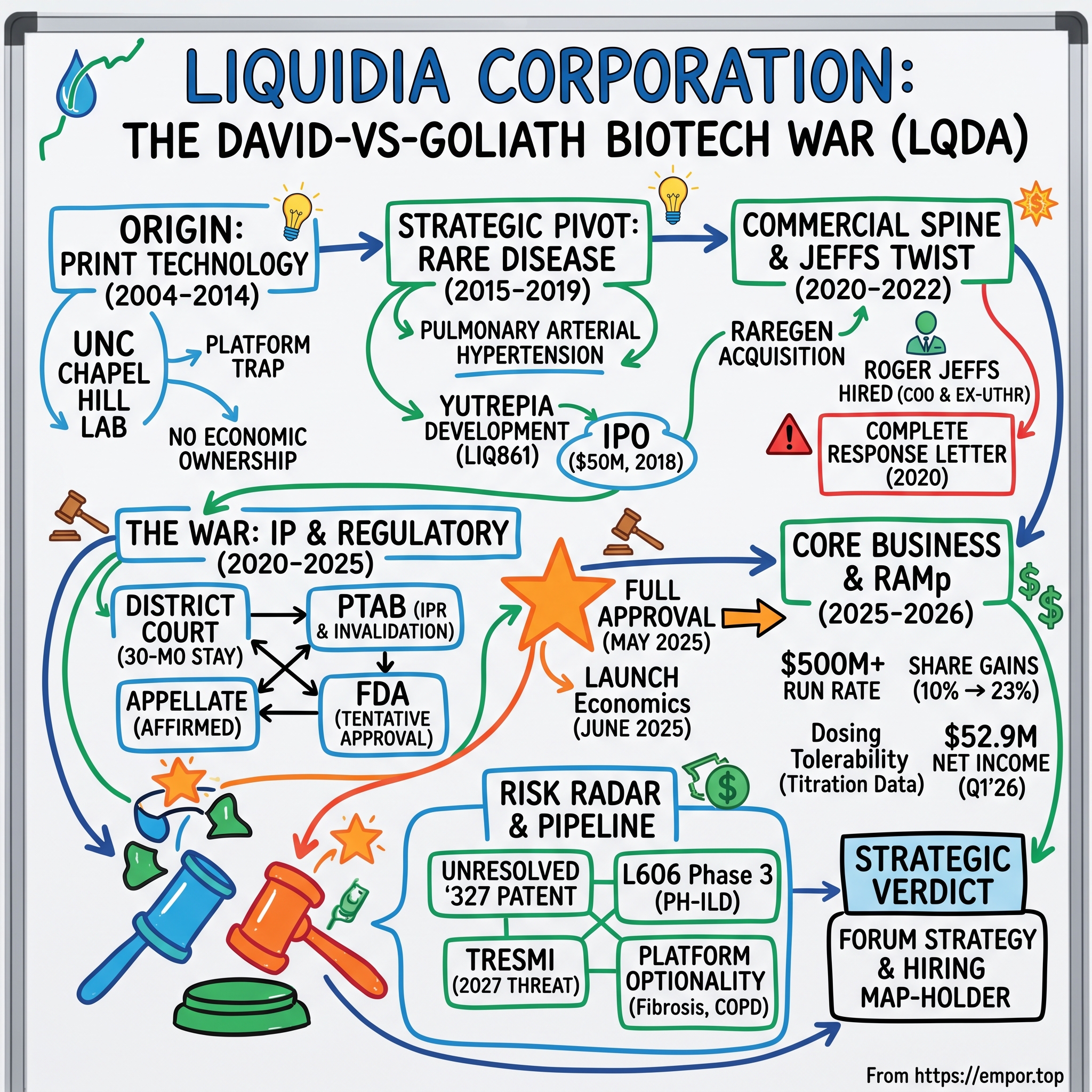
What follows traces the arc: the university lab where the particle technology was invented and the decade Liquidia spent failing to commercialize it; the pivot that narrowed a "platform for everything" into a single rare-disease bet; the acquisition and the executive hire that gave a research company a commercial spine; the legal and regulatory war that consumed 2020 through 2025; the launch economics that are now visible in the numbers; the pipeline that management is using to argue this is more than one product; and finally the honest ledger of what could still break the case. The technology is genuinely differentiated. Whether differentiation converts into a durable business, against an incumbent with $3.2 billion of revenue and a new device of its own, is the open question.
 Subscribe on LinkedIn
II. Origin Story: Semiconductor Lithography Meets Nanomedicine (2004–2014)
The Molding Insight
Picture a chemistry lab at the University of North Carolina at Chapel Hill in the early 2000s. On one bench, graduate students are working with liquid fluoropolymers — the slippery, non-stick chemistry family that gives you Teflon. On another, someone is thinking about how Intel prints circuit features onto silicon wafers with light. The insight that connected the two benches belonged to Joseph DeSimone, then Chancellor's Eminent Professor of Chemistry at UNC-Chapel Hill and simultaneously a distinguished professor of chemical engineering at NC State — a rare dual appointment that says something about how the university system regarded him.8
The idea was this. Semiconductor manufacturing is, at its core, a molding problem: you make a template, you press or print a pattern, you get millions of identical features with tolerances measured in nanometers. Pharmaceutical particle manufacturing, by contrast, was — and largely still is — a smashing problem. To make an inhalable powder, you take crystalline drug substance and you grind it in a jet mill, or you spray-dry it, and you get a distribution of particles: some the right size, many too big, many too small, all of them irregular in shape. You then sieve and blend and hope.
DeSimone's group asked what would happen if you molded drug particles instead of grinding them. The answer became PRINT — Particle Replication in Non-wetting Templates. A fluoropolymer mold, so non-stick that the liquid drug formulation will not wet its surface, is filled with a precursor solution; the material is solidified; the particles are released. Because the mold defines the particle, every particle comes out the same: same size, same shape, same porosity, same composition.8 The layman's version: conventional inhaled-drug manufacturing is like making gravel with a hammer, while PRINT is like making ice cubes with a tray.
Liquidia Technologies was founded in 2004 to commercialize that technique.8 For a while, it looked like exactly the kind of platform company that venture investors dream about. Uniform particles matter for vaccines, where the immune system responds differently to different particle geometries. They matter for oncology, where circulation time depends on shape. They matter enormously for inhaled therapeutics, where whether a particle lands in your throat or in your alveoli is almost entirely a function of its aerodynamic diameter. Liquidia signed a multi-year collaboration with GlaxoSmithKline covering vaccine and inhaled product candidates, a deal characterized at the time as potentially worth several hundred million dollars.9 In 2011, the Bill & Melinda Gates Foundation made a $10 million equity investment — reported as the foundation's first equity investment in a for-profit biotech.10
The Platform Trap
This is the part of the story that reads as triumphant and was, in business terms, the problem.
Consider what a decade of platform licensing actually produced. Liquidia had validation from one of the world's largest pharmaceutical companies and one of the world's most sophisticated philanthropic investors. It had a technology that scientists found genuinely exciting. It had research funding that did not dilute shareholders. What it did not have, by 2014, was a single approved product, a single dollar of product revenue, or economic ownership of any of the assets its technology was being used to build. In a partnership structure, the partner controls the timeline, the indication, the go/no-go decision, and the majority of the economics. The platform company becomes a very sophisticated contract research organization with equity upside it cannot influence.
This is a recurring trap, and it deserves naming precisely because it looks so much like success from the outside. A platform that can do everything is, from a capital-allocation standpoint, a platform that has not decided anything. Every additional therapeutic area adds a scientific program, a regulatory pathway, a manufacturing requirement, and a business-development relationship — and divides the same finite engineering team and cash balance across more fronts. Meanwhile the clock on the underlying patent estate runs regardless.
There is a second, subtler problem with platform licensing that only becomes visible in hindsight. When a large partner runs your technology through its own development process, the institutional knowledge accumulates on their side of the table. Liquidia's engineers learned to make particles; the partner's teams learned what to do with them — which formulations to advance, which regulatory arguments worked, which manufacturing tolerances mattered at scale. A licensing-first company can spend a decade generating know-how that lodges primarily in someone else's organization.
DeSimone himself is worth pausing on, because founder trajectory tells you something about a company's center of gravity. He was, by any measure, an academic superstar: a named professorship at two universities simultaneously, a body of work in supercritical carbon dioxide chemistry that predated PRINT entirely, and later a directorship of the Kenan Institute of Private Enterprise.10 He was also serially entrepreneurial, going on to co-found a 3D printing company built on a conceptually related insight about using light and chemistry to shape matter continuously rather than in discrete steps. That pattern — a scientist who generates platform insights and hands operational execution to others — is common and productive in research, and it is a structural weakness in a company that eventually needs to sell something to a physician on a Tuesday afternoon.
The honest assessment of Liquidia's first decade is that the science was excellent and the business model was not. The company had proven that PRINT worked. It had not proven that PRINT was worth owning. Those are different claims, and the gap between them is where most university spinouts die.
There is a useful counterfactual for investors evaluating any platform company: if the platform genuinely conferred advantage, why did a decade of partnerships not produce a single approved product? Sometimes the honest answer is bad luck or partner reprioritization. Sometimes it is that the platform is a solution looking for a problem where the problem is severe enough to pay for it. Liquidia's eventual answer — a chronic, life-limiting disease where the existing delivery method was the primary source of patient suffering — was the first application where the technology's specific advantage mapped exactly onto the market's specific pain.
What changed was not the technology. It was the decision, forced by a decade of not-quite-arriving, to stop selling the platform and start using it.
III. The Strategic Pivot to Rare Disease & The IPO (2015–2019)
To understand why Liquidia picked pulmonary arterial hypertension, you have to understand what it is like to take the existing treatment.
PAH is a disease in which the small arteries of the lungs narrow and stiffen. The right side of the heart, which is built to push blood through a low-pressure circuit, is forced to work against a high-pressure one. Over time it fails. It is a rare disease — the addressable U.S. population runs in the tens of thousands — and it is progressive and, historically, fatal. Prostacyclin analogs like treprostinil are among the most effective vasodilators available: they relax those pulmonary vessels and reduce the load on the right heart. Treprostinil is not a marginal therapy. For many patients it is the therapy.
Why Pulmonary Arterial Hypertension
The problem was never the molecule. It was the delivery. The dominant inhaled formulation, nebulized Tyvaso, required patients to sit with a nebulizer and take a series of breaths per session, four times a day, every day, indefinitely.
Inhaled prostacyclins are irritating to the airway; cough and throat irritation are the characteristic side effects, and they are dose-limiting. The clinical consequence is subtle but important: if a patient cannot tolerate escalating the dose, the patient does not get the full benefit of the drug. The ceiling on efficacy is set by the ceiling on tolerability.
This is where a particle-engineering platform stops being an interesting science project and becomes a product thesis. If irregular, jet-milled particles deposit disproportionately in the upper airway — where the irritation receptors are — and if uniform, engineered particles can be tuned to fly past that region and deposit in the deep lung, then the same molecule in a better particle should produce less irritation per unit of delivered drug. Higher tolerable dose. Fewer breaths. Same active ingredient.
Liquidia built LIQ861 — later branded YUTREPIA — around that hypothesis: a dry-powder treprostinil delivered from a small, palm-sized capsule inhaler requiring low inspiratory effort, so that patients with compromised lung function could still generate enough flow to disperse the powder.2 Note what this design does and does not claim. It does not claim a novel mechanism of action; treprostinil's pharmacology is unchanged. It claims a superior delivery envelope. That is a narrower claim, but it is also a more falsifiable one — you can test it by asking whether real patients titrate higher and cough less.
The Device and the Physics
The device choice mattered as much as the powder. Liquidia paired YUTREPIA with a small, single-use capsule inhaler — the kind of palm-sized device a patient can carry in a pocket and operate in a few seconds. Set that against the alternative the market had lived with: a tabletop nebulizer, a power source, a mouthpiece to clean, and a session that has to be repeated on schedule four times every day for the rest of a patient's life. For a person whose disease already limits how far they can walk, the difference between "step outside and take a breath" and "sit down at the machine again" is not a convenience feature. It is a substantial share of the treatment burden.
There is a physics point worth dwelling on, because it explains why this is harder than it sounds. Dry-powder inhalers do not push the drug into the lung; the patient's own inhalation supplies the energy that breaks the powder apart and carries it inward. That is a problem when your patients, by definition, have compromised cardiopulmonary function. A device that requires a forceful inhalation to work will underdose exactly the patients who need it most, and will do so invisibly — the capsule empties, the patient believes they took their dose, and much of it never reaches the deep lung. Designing for low inspiratory effort is therefore not an ergonomic nicety; it is a condition for the product working at all in the intended population.
It also, critically, defined the regulatory pathway. Because the active ingredient was already approved, Liquidia could file a 505(b)(2) New Drug Application, relying in part on United Therapeutics' safety and efficacy data rather than replicating it from scratch. That was the cheap door into a multi-billion-dollar market. It was also the door that walked Liquidia directly into Hatch-Waxman patent litigation, because relying on a competitor's approval data means certifying against a competitor's patents. Liquidia's founders chose speed and capital efficiency, and the price of that choice was a lawsuit. It is worth being clear-eyed: that was a deliberate trade, not an accident.
The clinical program was correspondingly pragmatic. INSPIRE was an open-label Phase 3 study rather than a placebo-controlled outcomes trial — again, appropriate for a 505(b)(2), and again, less definitive. It enrolled both prostacyclin-naïve patients and patients transitioning from other inhaled therapy, and reported that the drug was well tolerated across a dose range from 26.5 mcg up to 159 mcg, with the great majority of patients completing the two-month assessment.11 Investors should register both halves of that: the tolerability signal was real and it was generated without a comparator arm.
Going Public on Fifty Million Dollars
To fund the Phase 3 and the NDA, Liquidia went public. On July 26, 2018 the company began trading on Nasdaq under LQDA, selling 4.5 million shares at $11.00 and closing the offering with $50 million of gross proceeds — below the roughly $57.5 million it had initially sought.12 Neal Fowler, a former Johnson & Johnson executive, was chief executive. Fifty million dollars is a modest sum against a Phase 3 program, an NDA, and a manufacturing scale-up, and the offering's shortfall against its own target was an early, quiet signal that public markets were not yet convinced.
It is worth sitting with how strange the risk profile of this company looked to a 2018 investor. Liquidia was not asking the market to underwrite whether a molecule worked — treprostinil's efficacy had been established for years, by someone else, at considerable expense. It was asking the market to underwrite three entirely different questions: whether a manufacturing process could be scaled reliably, whether the FDA would accept a bridging data package, and whether a much larger company's lawyers could be beaten. Those are engineering, regulatory and legal risks rather than biological ones. In principle they are more tractable than "does this drug work." In practice they are harder to diligence, because there is no readout date, no p-value, and no independent data safety monitoring board to tell you how it is going. That structural opacity is a large part of why the stock traded the way it did for the next six years — and why the eventual resolution was so violent when it came.
The pivot was the right call, and it was not sufficient. Liquidia now had focus, a clinical asset, and a listing. What it did not have was a commercial organization, a revenue line, or any relationship with the pulmonary hypertension physicians who would ultimately decide whether YUTREPIA got prescribed. A drug company without a salesforce is a licensing deal waiting to happen — which is precisely the trap the company had just spent a decade escaping.
Solving that required buying something. And the thing Liquidia bought came with a person attached.
IV. The Commercial Masterstroke & The Roger Jeffs Twist (2020–2022)
There is a version of the RareGen deal that looks like a small, unglamorous tuck-in acquisition, and there is a version that looks like the single most consequential capital allocation decision in Liquidia's history. Both are accurate.
RareGen LLC was a specialty commercial organization with an exclusive partnership with Sandoz, dating to August 2018, to market and commercialize generic treprostinil injection — the first fully substitutable generic of United Therapeutics' Remodulin, launched in March 2019.13 It was not a large business. But it did three things that Liquidia could not have built quickly at any price.
First, it produced revenue immediately, in a company that otherwise had none. Second, it embedded Liquidia inside the actual distribution machinery of pulmonary hypertension: the specialty pharmacies, the pump-service infrastructure, the reimbursement pathways, and above all the relationships with the accredited Pulmonary Hypertension Care Centers where the sickest patients are managed. Third — and this is the part that only became visible later — it gave Liquidia standing and litigation experience against United Therapeutics before the main event ever started. Liquidia's RareGen subsidiary and Sandoz were already suing United Therapeutics in New Jersey federal court, alleging Sherman Act violations, state antitrust and unfair-competition claims, and breach of a prior settlement, over restrictions on the cartridges needed to administer generic treprostinil subcutaneously.13
Liquidia was learning how this opponent litigates, on someone else's dime, before it had a product of its own to defend.
The economics were remarkably cheap. Liquidia announced the acquisition on June 29, 2020 and closed it on November 18, 2020, acquiring 100% of RareGen for stock.14 The company's subsequent annual report placed the fair value of purchase consideration at approximately $20.8 million, based on shares valued at $3.38 each, with an additional earnout of up to roughly 2.7 million shares contingent on 2021 generic treprostinil net sales — a threshold that was not met, so those shares were never issued.15
Twenty million dollars of paper, at a share price that would later look like a rounding error, for a commercial platform and a front-row seat in the courtroom. The earnout's failure is itself informative: the generic injection business underperformed the expectations built into the deal, which is a reminder that the acquisition's value was strategic and optionality-driven, not financial.
The Complete Response Letter
The timing of the close is where the story turns genuinely uncomfortable, and it is the most useful stress test of this management team available in the record. One week after Liquidia completed the RareGen acquisition, the FDA issued a Complete Response Letter for the LIQ861 New Drug Application, dated November 25, 2020.42 A Complete Response Letter is the agency's formal refusal to approve as filed. For a single-asset company that had just spent its equity acquiring a commercial organization to sell a product it did not yet have permission to sell, the sequencing could hardly have been worse.
The company's response is the part worth grading. It did not restructure, it did not shelve the asset, and it did not pivot to a new therapeutic area. It stated a plan to submit a response in mid-2021 and then did so.42 Managements reveal themselves in how they handle regulatory setbacks far more than in how they handle good news: the failure modes are strategy drift, blame-shifting toward the agency, and quiet timeline extensions that never get reconciled. Liquidia did none of those. That is one data point, not a pattern, but it is the earliest evidence that this team says specific things and then does them — the behavior that would matter enormously when it started making commercial forecasts five years later.
Then came the part that no amount of capital could have purchased on its own.
The Man Who Helped Build the Fortress
Roger Jeffs joined Liquidia's board in 2020 in connection with the RareGen transaction and became chief executive in 2022, succeeding Fowler.16 To describe his prior career as "relevant experience" undersells it considerably. Jeffs joined United Therapeutics in 1998, during its startup phase, as Director of Research, Development and Medical. He served as President and Chief Operating Officer from 2001 to 2014, and as President and Co-CEO from 2015 until his retirement in 2016 after an eighteen-year tenure. Over that period he helped take the company public, oversaw the development and approval of six rare-disease products, and ran a commercial organization that compounded revenue at more than 20% annually to a $1.5 billion run rate.7 Before United Therapeutics he had done clinical development at Amgen and Burroughs Wellcome. He holds a chemistry degree from Duke and a pharmacology PhD from UNC's School of Medicine — which is to say, he is a Research Triangle native in the fullest sense, professionally and geographically.
The strategic logic is easy to state and hard to overstate. In a market with essentially one dominant supplier, the binding constraint on a challenger is rarely the science. It is knowing which two hundred physicians write most of the prescriptions, what they actually complain about, how the incumbent's contracts with specialty pharmacies are structured, where the patent estate is thin, and what the incumbent's internal commercial reflexes will be when attacked. Jeffs had spent eighteen years accumulating exactly that map.
It is equally important to state the other side plainly, because it is a live legal matter rather than a rhetorical flourish. United Therapeutics has litigated aggressively over the movement of people and information from its organization to Liquidia. A trade-secrets and unfair-trade-practices case in the North Carolina Business Court, arising from documents allegedly retained by Dr. Robert Roscigno, a former United Therapeutics executive who joined Liquidia, survived summary judgment on July 23, 2025 and was ordered to trial; the court credited expert testimony about the strategic value of the documents and the potential "head start" they could have conferred.517
Liquidia has argued that the individual components of those documents were publicly available. A court has not yet resolved it. Any investor assessment of the "asymmetric executive recruit" as a strategic playbook has to hold both facts at once: it appears to have worked, and its legality in part remains before a jury.
On management style, the behavioral record is more useful than any biography. Jeffs has run a consistent narrative for four years — engineered particles enable higher tolerated doses, higher doses produce better outcomes, better outcomes drive switching — and the company has, so far, done roughly what it said it would do on roughly the timeline it said. The executive bench was built out with commercial and medical specialists rather than platform scientists: Michael Kaseta as chief financial officer, Scott Moomaw as chief commercial officer, Rajeev Saggar as chief medical officer, and Russell Schundler as general counsel — a general counsel who, tellingly, appears on earnings calls to field analyst questions about litigation strategy.18 That org chart is the clearest statement of what kind of company Liquidia decided to become.
A skeptic should press on two things here, and both are legitimate. First, a chief executive who spent eighteen years building the product his current company is attacking has an incentive structure worth examining: the personal narrative of returning to beat one's former employer is compelling, and compelling narratives can survive longer than the evidence supporting them. Second, "intimate knowledge of a competitor" is a phrase that sounds like an asset on a slide and looks different in a deposition. Investors should read the trade-secrets docket as a real contingent liability rather than as background noise, and should note that the company has not disclosed a quantified exposure for it.
The counterweight is that this management team's incentives are heavily equity-weighted and its narrative has been unusually stable across four years of filings and calls — the same three-step argument about dose, tolerability and switching, restated without material revision as the evidence accumulated. Narrative consistency is not proof of correctness. But narrative inconsistency is one of the most reliable early warnings in equity analysis, and by that test Liquidia has not raised a flag.
Which brings us to the war itself.
V. David vs. Goliath: The Great Treprostinil IP & Regulatory War (2020–2025)
Every patent thicket looks impenetrable until someone finds the load-bearing wall.
United Therapeutics had built, over two decades, one of the more effective franchise defenses in specialty pharma. Treprostinil itself was long off-patent as a composition of matter; what protected the business was a lattice of formulation, method-of-treatment, and device patents layered on top of the molecule, combined with regulatory exclusivities, combined with the practical reality that pulmonary hypertension prescribing is concentrated in a small number of expert centers with entrenched habits. In 2025, total Tyvaso revenue — nebulized plus dry powder — reached $1.88 billion within a $3.18 billion company.19 Defending that is not a legal side-project. It is the business.
The company also had a device answer ready. Tyvaso DPI, a dry-powder inhaled treprostinil developed with MannKind Corporation (NASDAQ: MNKD) using MannKind's Dreamboat inhaler technology, launched as a defensive and offensive counter — a way to give patients the convenience of a powder without ceding the field. MannKind earns a 9% royalty on Tyvaso DPI net sales.20 By the time YUTREPIA reached the market, Tyvaso DPI was already the larger half of the franchise.
Four Fronts at Once
Against that, Liquidia fought on four fronts more or less simultaneously.
Front one: the district court. United Therapeutics sued in Delaware under Hatch-Waxman, asserting patents including U.S. Patent No. 10,716,793 — the '793 patent — which triggered the statutory 30-month stay of FDA approval. This is the standard incumbent play: the lawsuit itself, regardless of merit, buys two and a half years of monopoly. For a franchise generating over a billion dollars a year, a 30-month stay is worth more than most litigation budgets.
Front two: the Patent Trial and Appeal Board. Rather than only defending in district court, Liquidia went on offense at the PTAB with an inter partes review of the '793 patent. This is the strategic choice that separates challengers who survive from challengers who bleed out. District court patent litigation is slow, expensive, and decided by generalist judges applying a clear-and-convincing-evidence standard. IPR is faster, cheaper, decided by technically trained administrative patent judges, and applies a preponderance standard. For a small company facing a large one, the asymmetry of the forum matters as much as the strength of the art. The PTAB found the challenged claims unpatentable over prior art.
Front three: appellate. United Therapeutics appealed. On July 24, 2023, the U.S. Court of Appeals for the Federal Circuit issued its opinion in the parallel appeal, and in December 2023 the Federal Circuit affirmed the PTAB's invalidation of the '793 patent.21
United Therapeutics petitioned the Supreme Court. On October 7, 2024, certiorari was denied, and every claim of the '793 patent became permanently unenforceable.22 Six years of litigation, resolved by a one-line order.
Front four: the FDA. Here Liquidia won the patent war and still could not sell anything, which is the most instructive part of the whole saga. On August 16, 2024, the FDA granted YUTREPIA tentative approval — the agency's way of saying the drug is safe and effective and manufacturable, but something other than science is blocking it.[^23] The blocker was a three-year regulatory exclusivity attached to Tyvaso DPI's PH-ILD indication, an exclusivity earned by running the clinical study that supported it. Patents can be invalidated; statutory exclusivity simply runs. Liquidia challenged the FDA's exclusivity determination and lost that argument on the merits of timing. The lesson for investors is durable: regulatory exclusivity and patent protection are separate moats, and beating one does not touch the other.
United Therapeutics, for its part, took the unusual step of suing the FDA itself over the handling of Liquidia's application — a move that drew attention precisely because incumbents rarely sue their own regulator.23 That cross-claim was dismissed without prejudice in May 2025 by Judge Kelly of the U.S. District Court for the District of Columbia, on the ground that United Therapeutics had failed to establish standing.24
The exclusivity expired.
On May 23, 2025, the FDA granted YUTREPIA full approval for adults with PAH and with PH-ILD, in four capsule strengths — 26.5, 53, 79.5 and 106 mcg.225 United Therapeutics immediately sought a temporary restraining order and preliminary injunction in the Middle District of North Carolina to stop the launch; that request was denied on May 30, 2025. Five business days later, Liquidia scheduled its first commercial shipment.26 Healthcare Royalty released a $50 million tranche on June 23, 2025, triggered by the injunction denial and first commercial sale — a financing structured, in effect, as a bet on the litigation.27
Two additional legal facts belong on the ledger, because they cut in opposite directions and both are unresolved.
In Liquidia's favor: in September 2024, the New Jersey district court found that United Therapeutics' interference with the launch of generic treprostinil injection caused losses exceeding $137 million, though the final award remained subject to offsets and further determination.13 United Therapeutics disclosed an accrual of $74.9 million related to a final judgment in that Sandoz-related litigation.28 That is a real, if partial, financial recovery flowing toward the RareGen business Liquidia bought for $20.8 million in stock.
Against Liquidia: the '327 patent. United Therapeutics sued in September 2023 asserting U.S. Patent No. 11,826,327, which relates specifically to treating PH-ILD. Judge Andrews denied a preliminary injunction in May 2024, finding among other things that United Therapeutics had not shown Liquidia's obviousness challenge lacked substantial merit and had not shown the public interest favored an injunction.29 Liquidia counterclaimed for a declaration of non-infringement, invalidity and unenforceability, alleging that United Therapeutics failed to disclose material prior art during prosecution.30 A bench trial was held, and post-trial briefing was ordered in July 2025.4 As of late July 2026, the decision remains outstanding — and the July 22 hearing that moved the stock 8% concerned the court's questions about altered filings rather than the merits.1
Myth Versus Reality: What Actually Decided This
Myth versus reality on the patent war. The consensus retelling of this story compresses to a single sentence: Liquidia invalidated United Therapeutics' patent and won. That version is wrong in three specific ways, and each one matters for how an investor should think about what happens next.
The first myth is that the patent case was the decisive event. It was not. Invalidating the '793 patent removed a blocker; it did not produce approval. What actually determined the launch date was a regulatory exclusivity that no court touched and no argument shortened — the three years attached to Tyvaso DPI's PH-ILD indication, which ran from mid-2024 to May 2025 regardless of the patent's fate. Liquidia beat the Supreme Court petition in October 2024 and still could not sell a capsule for another seven months. In pharmaceuticals, exclusivity earned by running a trial is often the more durable protection, because it is administrative rather than adversarial. There is no forum in which to attack it.
The second myth is that the incumbent's strategy failed. Measured against the goal of preventing competition, yes. Measured against the goal of delaying it, the record is closer to a success. Six years of litigation, a 30-month statutory stay, an appeal to the Federal Circuit, a certiorari petition, an unusual suit against the FDA, and injunction attempts in two districts — each individually unsuccessful on the merits, and collectively worth billions of dollars in retained franchise revenue during the years YUTREPIA was approvable but unsold. The uncomfortable lesson for challengers is that a defense can lose every argument and still work.
The third myth is that the war is over. The '793 patent is dead, but the patent that reads on PH-ILD is not, and its trial has been heard without a decision. Investors reading headlines about permanent invalidation should be precise about which patent, covering which indication, in which case.
The pattern across all four fronts is worth naming, because it is the transferable lesson. Liquidia did not win by having a better legal budget. It won by refusing to be a defendant. Every time United Therapeutics chose a forum, Liquidia opened a second one where the procedural rules favored a challenger. That is a strategy available to small companies, and it is used far less often than it should be — usually because boards experience litigation as a cost center rather than a competitive weapon.
Winning the right to sell, however, is not the same as selling. On June 2, 2025, Liquidia became something it had never been in twenty-one years of existence: a company with a product on a pharmacy shelf.
VI. Core Business & Commercial Execution: YUTREPIA vs. Tyvaso DPI
The launch numbers arrived faster than almost anyone modeled.
The Ramp
Start with the shape of the ramp. YUTREPIA generated $148.3 million of net product sales in 2025 from a June start, with $90.1 million of that in the fourth quarter alone.31 In the first quarter of 2026 it produced $129.9 million — 44% sequential growth on an already large base — carrying total revenue to $132.9 million against $3.1 million in the year-ago quarter, when the company had no branded product at all.3 Management characterized the annualized run rate as exceeding $500 million within a year of launch.18
Now the more revealing metric: share. Liquidia's share of the inhaled prostacyclin market moved from roughly 10% in the third quarter of 2025 to 16% in the fourth and nearly 23% in the first quarter of 2026, while the total market grew about 5% in each of those quarters.18 Read those two numbers together and the conclusion is uncomfortable for the incumbent. Liquidia was not primarily riding market expansion. It was taking share. United Therapeutics' own results corroborate it from the other side: in the first quarter of 2026, nebulized Tyvaso revenue fell 22% year over year to $127.2 million, while Tyvaso DPI grew 9% to $330.3 million — a franchise that in aggregate declined 2%, in a category that grew.28
That decomposition matters. The nebulized product is where YUTREPIA is doing its damage. This is exactly what the product thesis predicted: the patients most likely to switch are the ones enduring the least convenient, most irritating version of the therapy.
Does the Dosing Claim Hold Up?
The clinical evidence behind the dosing claim is now more than a marketing assertion, though it is still not a randomized comparison. In the open-label ASCENT study in PH-ILD patients, participants titrated to a median dose of 132.5 mcg at Week 8 and 159 mcg at Week 16, with the highest exposure reaching 318 mcg four times daily, and with mean daytime cough scores essentially unchanged from baseline through Week 16 and no discontinuations attributed to drug-related adverse events such as cough or throat irritation. Median six-minute walk distance improved by 21.5 meters at Week 8 and 31.5 meters at Week 16.3233 On the first-quarter call, chief medical officer Rajeev Saggar described patients dosing roughly 1.5 to 3 times higher than with traditional inhaled treprostinil.18
The correct analytical posture here is qualified acceptance.
Open-label studies with no control arm systematically flatter tolerability, because patients who enroll are motivated and investigators who believe in the drug are titrating it. But the direction and magnitude are consistent with the mechanism, they are consistent with what prescribers are actually doing in the market, and — most persuasively — they are consistent with the share shift. Physicians switching stable patients off a working therapy is the hardest behavior to induce in medicine. That it is happening at this rate is itself evidence.
The prescriber data supports a breadth-not-just-depth read. Since launch through the end of April 2026, Liquidia reported more than 4,500 unique patient prescriptions and approximately 3,750 patients started on therapy, from roughly 980 prescribers, with about 270 physicians having started five or more patients — that deeper cohort up roughly 25% since February.318 Roughly 85% of prescriptions converted into patient starts, and new starts split about 75% prostacyclin-naïve and 25% switches from other therapies.18 The naïve-heavy mix is important and slightly counterintuitive: Liquidia is winning more by being chosen first than by prying patients loose. That is a healthier long-term position, because first-line habits compound.
The economics are, frankly, the kind that make specialty pharma attractive in the first place. Against $129.9 million of product sales, cost of product sales was $11.1 million — a gross margin above 90%. Research and development was $12.6 million and SG&A was $46.9 million, the latter up nearly $17 million year over year as the commercial organization scaled.3
The result was $52.9 million of net income, $0.60 basic and $0.52 diluted earnings per share, and roughly $71.2 million of adjusted EBITDA, with cash rising to $222.8 million from $190.7 million at year-end 2025.331 The company also began recording income tax expense in the first quarter of 2026, which chief financial officer Michael Kaseta flagged as ongoing — an unglamorous but genuine milestone, since it means the accumulated-loss shelter is no longer doing all the work.18
One line item deserves a correction to the common framing. The legacy generic treprostinil business — the RareGen inheritance — contributed $3.0 million of service revenue in the quarter, an annualized rate near $12 million.3 It is no longer a meaningful funding source for operations. Its value now is the distribution relationships it bought and the antitrust judgment it produced, not its P&L contribution.
The PH-ILD Question
The PH-ILD question, and why it changes the size of the prize. Most of the attention on this company has focused on pulmonary arterial hypertension, because that is the classic prostacyclin indication and the one with the longest treatment history. But the second indication — pulmonary hypertension arising in patients whose lungs are already scarred by interstitial lung disease — may be the larger opportunity, and it behaves differently in three ways.
It is a bigger population than PAH, because interstitial lung disease is far more common than idiopathic pulmonary arterial hypertension, and a meaningful share of those patients develop pulmonary hypertension as their disease progresses. It is under-diagnosed, because the breathlessness caused by pulmonary hypertension is easily attributed to the underlying lung disease that the patient already has. And it is treated by a partly different physician population — pulmonologists and interstitial lung disease specialists rather than the pulmonary hypertension cardiologists who dominate PAH — which means a challenger is not only fighting for share of an existing prescription base but for the attention of physicians who may not have prescribed a prostacyclin before.
On the first-quarter call, Jeffs described the PH-ILD market as massively underpenetrated and sized the combined PAH and PH-ILD opportunity above $6 billion in potential revenue, with scripting split roughly evenly between the two indications.18 Take the dollar figure as a management estimate rather than a fact — total addressable market numbers from a company selling into that market are, definitionally, the most optimistic available construction. The structural argument underneath it is more robust than the number: an under-diagnosed indication with a partly untouched prescriber base is exactly where a new entrant with a tolerability advantage has the least incumbency to overcome. The even split between indications in Liquidia's own prescription data is the evidence that this is happening rather than merely being hoped for.
It also explains why the '327 patent — which reads specifically on PH-ILD — is the single most consequential unresolved item on the risk ledger. The patent covers the half of the business with the most room to grow.
On the competitive side, three dynamics are live.
United Therapeutics retains an entrenched salesforce, deep specialty-pharmacy and PBM contracting capability, and patient support infrastructure built over two decades — and it is not passive. Its answer is Tresmi, a proprietary treprostinil soft-mist inhaler unveiled in February 2026, which management characterized as a category-killing product and which the company claims reduced coughing in human studies by up to 90% relative to dry-powder inhalation. The plan is to file for approval in PAH and ILD during 2026 and launch in 2027.6 MannKind shares fell roughly 38% on the announcement, which tells you how the market read the implications for Tyvaso DPI's durability.6 MannKind, for its part, has pivoted toward developing a dry-powder formulation of ralinepag for United Therapeutics.34
Investors should take Tresmi seriously and also apply discount.
If a soft-mist inhaler genuinely eliminates the cough problem, Liquidia's central differentiation — tolerable higher dosing — is attacked at its root, by the only competitor with the salesforce to exploit it. Against that: the product is not yet filed, not yet approved, not yet priced, and the 90% figure comes from company-described studies rather than a published head-to-head. It is a 2027-and-beyond risk, not a 2026 one, and by 2027 Liquidia will have had two years to convert prescribers.
The second dynamic is Merck's Winrevair (sotatercept-csrk), approved in March 2024 as a first-in-class activin signaling inhibitor for PAH.35 Winrevair generated $149 million in the third quarter of 2025 alone as its launch gained momentum.36 The important structural point is that it is largely additive rather than substitutive: it is a disease-modifying biologic layered onto vasodilator therapy, not a replacement for prostacyclins. A well-funded competitor expanding treatment intensity in PAH plausibly grows the prostacyclin market rather than shrinking it — though it does compete for payer budget and for the patient's tolerance for injections.
The third dynamic is the one nobody controls: payers. Neither the first-quarter release nor the call disclosed gross-to-net detail or formulary tier positioning, and management's commentary stayed on volume, share and prescribers rather than pricing.18 In a category where two branded products contain the same active ingredient, that silence is the single largest gap in the disclosure. Reported net revenue already embeds whatever rebating is happening; investors simply cannot see the split between price and volume.
Myth Versus Reality: The Switching Ceiling
Myth versus reality on switching. The single most repeated claim about this launch — from bulls and bears alike — is that its ceiling is set by physician reluctance to move stable patients. The reality visible in the disclosed data is more nuanced, and it cuts against both camps.
The bear version says switching is nearly impossible, so YUTREPIA's growth must eventually stall at whatever share of new starts it can win. The data partly contradicts this: roughly a quarter of new starts have been switches, and management has described switching not only from inhaled competitors but from oral prostacyclins and, in some cases, from parenteral pump therapy.18 Movement is happening in multiple directions at once, which suggests the driver is the dosing envelope rather than dissatisfaction with any one competing device.
The bull version says the switch pool is the prize. The data partly contradicts that too: three quarters of starts have been prostacyclin-naïve, meaning the launch is being carried primarily by first-line capture, not conversion. That is strategically better but commercially slower, because naïve starts are gated by the rate at which new patients are diagnosed and escalated to prostacyclin therapy rather than by how persuasive a salesforce is.
The synthesis matters for modeling. A launch built on naïve starts compounds with the market rather than exhausting a fixed pool — but it also means Liquidia's growth is partly hostage to diagnosis rates and to treatment-guideline behavior it does not control. And it means the incumbent's most effective defense is not retention of existing patients; it is winning the newly diagnosed. That is precisely the fight a new device with a superior cough profile would be designed to win.
One further evidentiary point deserves weight because it is the hardest to spin. The company has disclosed that roughly 85% of prescriptions received converted into patients actually starting therapy.18 In specialty pharmacy, the gap between a written prescription and a patient on drug is where payer friction shows up: prior authorizations, step-therapy requirements, appeals, copay abandonment. A conversion rate that high implies YUTREPIA is not encountering severe access obstruction at this stage. It is the most useful publicly available proxy for the payer question that management otherwise does not address — though it says nothing about the price being paid to keep it that high.
That is the commercial picture: a genuinely fast, genuinely profitable launch, taking share from the weaker half of the incumbent franchise, with excellent unit economics and one material blind spot. The obvious next question is whether Liquidia is a one-product company.
VII. Platform Optionality & Pipeline Sizing: L606 & PRINT Beyond Treprostinil
Ask any biotech management team what happens after the first product, and you will get a pipeline slide. The useful exercise is to ask which pipeline items are financed, enrolled, and differentiated — and then to size them conservatively.
The lead program is L606, and its provenance is worth noting because it is not a PRINT product at all. L606 is a liposomal, sustained-release inhaled formulation of treprostinil licensed from Pharmosa Biopharm, a Taiwanese developer. Liquidia originally took North American rights and subsequently expanded the licensed territory to include key markets in Europe, Japan and elsewhere.3738 The mechanism is a different kind of engineering from PRINT: rather than molding the particle, the drug is encapsulated in liposomes — microscopic fatty bubbles — that release their payload slowly once deposited. The layman's version: PRINT changes where the drug lands; liposomes change how long it stays.
The clinical proposition is dosing frequency. YUTREPIA, like every other inhaled treprostinil, is a four-times-daily therapy. L606 is being developed for twice-daily administration via a short-duration nebulizer, with open-label data showing median doses around 229 micrograms and sustained pharmacokinetics across day and night.18 For a chronically ill patient managing a lifelong regimen, halving the number of daily administrations is not a trivial convenience — it is the kind of change that drives adherence, and adherence in prostacyclin therapy correlates with outcomes.
As of the first quarter of 2026, the Phase 3 RESPIRE study in PH-ILD was actively screening patients, with first patient entry described as imminent and no completion date disclosed.18 The European Medicines Agency had previously provided scientific advice supporting the study design.38
Beyond L606, management has signaled clinical work extending into idiopathic pulmonary fibrosis, progressive pulmonary fibrosis, pulmonary hypertension associated with COPD, and scleroderma-associated Raynaud's phenomenon.18 The PH-COPD program is the most interesting and the most honestly framed: Jeffs emphasized on the call that it requires an "enriched" patient selection strategy, that protocol design was still underway, and that initiation would be 2027 at the earliest.18 That is a management team describing a hard problem as hard, which is a modest but real credibility marker — prostacyclins have historically struggled in COPD populations precisely because vasodilating diseased lung can worsen gas exchange.
How should an investor size all of this? Deliberately small. Every one of these programs is pre-pivotal or pre-enrollment; none has a disclosed approval timeline; the fibrosis indications in particular sit in a therapeutic graveyard where far larger companies have failed repeatedly. The defensible treatment is to carry the pipeline as long-dated option value — plausibly under a tenth of present enterprise value — and to let YUTREPIA's trajectory carry the investment case. If L606 works, it extends the franchise's life beyond YUTREPIA's own competitive window, which is genuinely valuable. If it does not, nothing about the 2026 business breaks.
The broader PRINT platform question is separate and, at this point, largely dormant in the disclosed strategy. The technology remains theoretically applicable to small molecules, biologics and nucleic acids wherever uniform particle geometry improves pulmonary or localized delivery. But it is telling that Liquidia's own second product was in-licensed from a third party using entirely different chemistry. The company's commercial identity today is rare cardiopulmonary disease, not nanoparticle engineering. PRINT is the reason YUTREPIA exists; it is not obviously the reason anything else will.
There is also a defensive logic to L606 that management does not emphasize but investors should. The most credible threat to YUTREPIA is a competing device that solves the same tolerability problem by different means. A twice-daily sustained-release formulation does not compete on cough at all — it competes on frequency, an axis where every currently marketed inhaled treprostinil, including any new device from the incumbent, sits at four times daily. Owning rights to the sustained-release approach is, in effect, a hedge against being out-engineered on the axis Liquidia currently leads. That the hedge was in-licensed rather than invented internally is a point in favor of management's pragmatism and a point against any claim that PRINT is the company's enduring source of advantage.
The licensing structure carries its own considerations, of course. Territory expansions and milestone obligations to Pharmosa mean Liquidia does not capture the full economics of L606 the way it does with YUTREPIA, and the specific financial terms of the expanded agreement were not disclosed in the announcements.38 A partnered second product is worth materially less per dollar of revenue than a wholly owned one — a distinction that matters when sizing option value.
What is unambiguous is that all of it is being paid for internally. Management stated that clinical programs, the North Carolina manufacturing expansion, and the commercial buildout are funded from operating cash flow, with no external capital raises anticipated.18 A company that spent two decades depending on partners and royalty financiers is now self-funding its own optionality. That is the most meaningful pipeline statement in the deck.
Which raises the strategic question this whole story has been building toward: what, exactly, does Liquidia own that competitors cannot copy?
VIII. Acquired Playbook: Business, Strategy & Investing Lessons
Seven Powers, Honestly Applied
Hamilton Helmer's framework asks a deliberately harsh question: not "is this company good?" but "what specifically prevents a competitor from doing this, and for how long?" Applied to Liquidia, the answers are uneven — strong in one place, arguable in a second, and time-limited in a third.
Process Power is the strongest claim, and it is narrower than the marketing suggests. PRINT's fluoropolymer molding produces particle uniformity that jet-milling and spray-drying cannot match, and that capability is embedded in accumulated manufacturing know-how rather than in a single patent — the classic signature of process power, because it cannot be reverse-engineered from a document. The evidence that it is real is the dosing data: patients reaching median doses well above conventional inhaled treprostinil without cough scores deteriorating. But note the boundary. Process power protects how Liquidia makes a dry powder. It does not protect the therapeutic goal of high-dose, low-irritation inhaled treprostinil. Tresmi, if it delivers what United Therapeutics claims, would reach that same goal through soft-mist chemistry, entirely around Liquidia's process. Process power is a moat around a method, not around an outcome.
Counter-Positioning is real but temporary. For several years, United Therapeutics faced a genuine bind: endorsing higher-dose inhaled treprostinil validated Liquidia's central pitch and implicitly conceded that Tyvaso DPI's tolerability limited titration, while ignoring the dosing argument ceded the clinical high ground. That is textbook counter-positioning — the incumbent's existing product economics make the correct response self-harming.
The catch is that counter-positioning only holds while the incumbent's constraint holds. By launching a differently engineered device rather than defending the old one, United Therapeutics has chosen to eat the cannibalization — which is precisely the move counter-positioning theory says incumbents usually cannot make. MannKind's 38% single-day decline was the market pricing that willingness.
Cornered Resource is the most cited and the most fragile. Jeffs' institutional knowledge of the PAH physician ecosystem and United Therapeutics' vulnerabilities is genuinely difficult to replicate — there is exactly one person with that eighteen-year vantage point, and he works at Liquidia.
But cornered resources embodied in a single human being carry key-man risk, they depreciate as market knowledge ages, and in this specific case a portion of the underlying advantage is the subject of an unresolved trade-secrets trial. An advantage that a jury might characterize as misappropriated is not an advantage you can underwrite indefinitely.
Notably absent from the list: scale economies (Liquidia is a fraction of the incumbent's size), network effects (drugs do not have them), branding (prescribing in rare disease is data-driven), and switching costs at the patient level (which cut against Liquidia, since every switch requires a physician to disturb a stable regimen).
The Five Forces Around It
Porter's framework fills in the structure around those powers.
Rivalry is as intense as it gets in specialty pharma, and it is unusual in kind. The two competitors sell formulations of the same molecule, which strips away most sources of differentiation except delivery and access — and pushes competition toward litigation, specialty pharmacy relationships and rebating, all of which are margin-destructive over time.
Threat of new entrants is low, and this is Liquidia's most underappreciated protection. The barriers that kept Liquidia out for six years now work in its favor: a 505(b)(2) applicant must survive Hatch-Waxman litigation, clear regulatory exclusivities, build inhaled-drug manufacturing, and then earn access at a few hundred specialized centers. The next challenger faces the same gauntlet — and now faces two incumbents rather than one.
Buyer power sits at moderate-to-high and is rising. Payers and PBMs face two branded products with identical active pharmaceutical ingredient, which is the exact structure that maximizes their leverage. Physicians retain real discretion because these are complex patients, but formulary placement decides the economics.
Substitutes are increasingly relevant. Winrevair represents a mechanistically distinct approach, and oral prostacyclin-pathway agents compete for the same patients earlier in the treatment sequence — though Saggar noted meaningful switching from oral prostacyclins toward YUTREPIA.18
Supplier power is not a material issue in the disclosed cost structure, given gross margins above 90%.
Two lessons generalize beyond this company.
The first concerns forum strategy. Liquidia's decisive move was not a courtroom argument but a venue choice: attacking the '793 patent at the PTAB rather than only defending in Delaware. Small companies facing patent thickets routinely under-use that asymmetry because litigation is budgeted defensively. The framing that produces better outcomes is that a competitor's patent estate is an asset with an attack surface, and that attacking it is a capital allocation decision like any other.
The second concerns hiring as a form of M&A. Liquidia acquired a commercial organization for roughly $20.8 million in stock and, through the same transaction, acquired a relationship with the one executive who knew the target market from the inside. In a single-supplier market, the constraint on a challenger is almost never the molecule — it is knowing where the incumbent is soft. That knowledge is embodied in people, and it can be recruited. The essential caveat, which this case demonstrates as sharply as any in recent memory, is that the line between recruiting knowledge and appropriating information is drawn by courts, not by hiring managers.
Frameworks are diagnostic, not predictive. The forward-looking question is which of these advantages survives contact with 2027.
IX. Analysis, Current Risk Radar & Bull vs. Bear Case
Three Numbers That Matter
If you track only a handful of numbers on this company, track these three.
First: share of the inhaled prostacyclin market. Not revenue — share. Revenue growth in a rare disease can come from price, from channel stocking, or from a market that happens to be expanding. Share isolates the only thing that matters competitively: whether physicians are choosing YUTREPIA over Tyvaso DPI. The sequence through the first quarter of 2026 was 10%, 16%, 23%.18 The question is whether that curve is still steepening, flattening, or rolling over — and the answer will show up in share before it shows up anywhere else.
Second: the mix of new starts between prostacyclin-naïve patients and switches, along with the depth of the prescriber base. A launch carried by naïve starts is building durable habit; a launch carried by switches is harvesting a finite pool of dissatisfied patients. The roughly 75/25 naïve-to-switch split and the count of physicians who have started five or more patients are the two disclosures that reveal which kind of launch this is.18 Deepening prescriber concentration — more physicians writing repeatedly, not just more physicians trying once — is the tell for durable adoption.
Third: net revenue per patient on therapy. Liquidia discloses cumulative patients started and quarterly net product sales; the relationship between them is the closest available proxy for gross-to-net erosion, because management does not disclose rebating directly.3 If patient counts grow faster than revenue, price is being conceded to payers. In a two-branded-product category with an identical active ingredient, that is the most likely mechanism by which a spectacular launch turns into a mediocre business.
The Risk Radar
Now the risk radar, restricted to what is actually material here.
Litigation. The '327 patent decision from Judge Andrews remains outstanding after post-trial briefing.4 The patent reads on PH-ILD, which by management's own account represents roughly half of scripting. An adverse ruling would not remove YUTREPIA from the market in PAH, but it could expose Liquidia to damages and, in the tail case, to injunctive relief in the indication that has driven much of the growth.
The July 2026 courtroom developments concerning altered filings appear to have gone badly for United Therapeutics, and the market read them as reducing risk — but reported hearing color is not a ruling, and the underlying docket details have not been detailed in company statements.1 Separately, the North Carolina trade-secrets trial carries reputational and financial exposure that is difficult to size in advance.5 Liquidia's general counsel appearing on earnings calls to discuss unrelated Supreme Court induced-infringement precedent, and declining to forecast the outcome of the pending decision, is appropriate caution — but the fact that it is a standing agenda item is itself the point.18
Competitive displacement. Tresmi is the most consequential 2027 risk, and it is qualitatively different from ordinary competition: it targets Liquidia's differentiating attribute rather than its price or its access.
Commercial execution and cost. SG&A rose nearly $17 million year over year in a single quarter as the salesforce scaled.3 The launch has been efficient so far, but the incremental cost of the next ten points of share is almost certainly higher than the cost of the first twenty — later switchers are, by definition, the more reluctant ones.
Capital structure. This is the least-discussed item and deserves a look. Total assets stood at $401.5 million against stockholders' equity of $108.6 million at the end of the first quarter of 2026, implying substantial liabilities relative to the equity base — largely reflecting the HealthCare Royalty obligations layered on during the pre-revenue years, including the sixth amendment adding up to $100 million in three tranches and the $50 million launch-triggered drawdown, with aggregate payments to HCRx capped at 175% of amounts funded through 2033.33927 That structure was rational when the alternative was equity dilution at a low share price, and it is now expensive relative to the company's cost of capital as a profitable business. How management addresses it — refinancing, buying it down with cash, or simply paying the schedule — is a genuine capital allocation test, and the first one this team has faced with real money.
Governance and disclosure. An activist or a skeptical short seller would press on three specific things.
The absence of gross-to-net and formulary disclosure in a category where pricing is the obvious pressure point. The absence of formal revenue guidance alongside management's public statement of a "clear line of sight" to more than $1 billion of net revenue in 2027 — a striking claim to make while simultaneously declining to guide, and one worth holding management to.18 And insider selling into strength: director Stephen Bloch disposed of 78,596 shares worth roughly $6.3 million on July 20 and 21, 2026.40 Board-level sales after a stock that reached a market capitalization above $6 billion by mid-July 2026 are not inherently improper and are frequently pre-scheduled, but they belong in an honest ledger.41
Bull Versus Bear
The bull case rests on a chain that is, so far, mostly evidenced. YUTREPIA's dosing envelope is a genuine clinical differentiator; the share data shows physicians acting on it; the incumbent's nebulized franchise is visibly eroding while the total category grows; PH-ILD remains, by management's characterization, substantially underpenetrated; gross margins above 90% mean incremental revenue converts to cash at extraordinary rates; and the business already funds its own pipeline. If share continues to compound toward the high twenties or thirties across both indications, the combined opportunity management sizes above $6 billion is large enough that even modest further penetration supports a much larger revenue base than 2026's run rate.18 The critical supporting evidence is behavioral rather than promotional: patients are being started, not merely prescribed, at an 85% conversion rate, and the prescriber base is deepening.
The bear case does not require the drug to be bad. It requires only that the window be narrower than it looks. United Therapeutics can rebate aggressively — it has a $3.18 billion revenue base and every incentive to defend $1.88 billion of Tyvaso — and contract for preferred formulary status in ways that make YUTREPIA's clinical edge irrelevant at the pharmacy counter. Physicians switching stable patients is genuinely hard, which caps the switch pool. Tresmi arrives in 2027 aimed squarely at the cough differentiation. The '327 decision could impose damages or worse on half the business. The royalty obligation consumes cash for years. And a company whose stock has re-rated dramatically has, mechanically, less room for disappointment than one that has not.
The bear case is not that Liquidia loses. It is that Liquidia becomes a solid, second-position specialty pharma company with 20-something percent share and compressing net pricing — a fine business, valued as something considerably more.
There is a version of the stress test that has nothing to do with Liquidia's operations and everything to do with how the shares got here. A company whose equity value multiplied on the back of litigation outcomes and a launch curve has, by construction, a shareholder base that arrived for those reasons. Some of that capital is event-driven rather than fundamental — positioned for a ruling, a share-gain print, or a competitor's stumble. Event-driven ownership behaves differently from long-term ownership when the events resolve, in both directions. That is not a statement about the business; it is a statement about who is holding it, and it is a real consideration for anyone underwriting a multi-year position.
The related governance question is disclosure cadence. Liquidia has voluntarily released preliminary annual sales figures ahead of full results — as it did in January 2026 for the 2025 year — which is a shareholder-friendly practice.43 But voluntary disclosure of the flattering metric is not the same as systematic disclosure. The company reports patients started, prescribers, and share; it does not report net price, formulary position, or the economics of its payer contracts. In a launch that is going well, that asymmetry is easy to overlook. It becomes the central question the moment growth decelerates, because investors will have no way to distinguish a volume problem from a price problem until the revenue line has already told them.
The honest summary is that the technical and commercial questions have largely been answered in Liquidia's favor, and the pricing and legal questions have not been answered at all.
X. Epilogue & Final Verdict
Twenty-two years separate the UNC chemistry lab where fluoropolymer molds were first used to shape drug particles from the earnings call where a company reported its third consecutive profitable quarter. Almost none of that time was spent on the science. The science worked reasonably early. What consumed the years was everything around it: choosing a single indication out of a platform that could address many, buying a commercial organization the company could not build, recruiting the one executive who knew the opponent's map, invalidating a patent through three levels of the federal judiciary, waiting out a regulatory exclusivity that no court could shorten, and then surviving an eleventh-hour injunction motion by five business days.
Over the next twelve to twenty-four months, the story narrows to a small number of observable things. Whether the share curve keeps its slope as the easy switches are exhausted. Whether Judge Andrews' decision on the '327 patent arrives and what it says about the indication that supplies half the prescriptions. Whether L606 enrolls and reads out on a timeline that makes it relevant to the franchise's second decade rather than its third. Whether Tresmi's regulatory filing in late 2026 substantiates the cough claims that would undercut Liquidia's core differentiation. And whether a management team that has been unusually accurate about what it would accomplish stays accurate now that the promises have moved from courtrooms to commercial forecasts.
There is a temptation, with a story shaped this cleanly, to treat the outcome as inevitable in hindsight — the elegant technology, the insider who returned to dismantle his old fortress, the patent that fell. It was not inevitable. Liquidia came within an unfavorable ruling of never launching at all, and its own decade of platform partnerships nearly ended the company before the interesting part began.
What the record actually demonstrates is narrower and more useful: that a small company can beat a much larger one on a specific, well-chosen front, if it picks the right forum, buys the right distribution, hires the right map-holder, and engineers something the incumbent cannot easily copy.
Whether it can hold that ground once the incumbent stops defending and starts building is the next chapter, and it has not been written.
References
-
Liquidia Corp. (LQDA) Gains 8% Amid Patent Dispute Developments — GuruFocus, 2026-07-22 ↩↩↩
-
U.S. FDA Approves Liquidia's YUTREPIA (treprostinil) Inhalation Powder for Patients with PAH and PH-ILD — Liquidia Corporation via GlobeNewswire, 2025-05-23 ↩↩↩
-
Liquidia Corporation Reports First Quarter 2026 Financial Results — Liquidia Corporation via GlobeNewswire, 2026-05-11 ↩↩↩↩↩↩↩↩↩
-
United Therapeutics Corporation v. Liquidia Technologies, Inc., 1:23-cv-00975 (D. Del.) docket — CourtListener ↩↩↩
-
United Therapeutics Corp. v. Liquidia Techs., Inc., 2025 NCBC 37 — North Carolina Business Court, 2025-07-23 ↩↩↩
-
United unveils newly partnered soft mist inhaler; MannKind sinks — BioWorld, 2026-02 ↩↩↩
-
Roger Jeffs, Ph.D. — Management Profile, Liquidia Corporation ↩↩
-
IPO is latest step for 'superstar scientist' Joe DeSimone-founded Liquidia — WRAL TechWire, 2018-07-02 ↩↩↩
-
UNC spinoff Liquidia Technologies, GSK collaborate on product development — UNC News Archives ↩
-
Liquidia Founder, Joseph DeSimone, Named Director of Kenan Institute — Business Wire, 2012-07-17 ↩↩
-
Liquidia Releases Final LIQ861 Results from Pivotal Phase 3 INSPIRE Study in Patients with Pulmonary Arterial Hypertension — Liquidia Corporation ↩
-
Liquidia Technologies closes IPO with $50M in gross proceeds — WRAL TechWire, 2018-07-31 ↩
-
Court Finds United Therapeutics' Interference with Launch of Generic Treprostinil Injection Caused Losses of More Than $137 Million — Liquidia Corporation via GlobeNewswire, 2024-09-16 ↩↩↩
-
Liquidia Closes Acquisition of RareGen — Liquidia Corporation via GlobeNewswire, 2020-11-18 ↩
-
Liquidia Corporation Form 10-K for fiscal year 2021 — U.S. Securities and Exchange Commission ↩
-
Business Court Sends Trade Secret Matter to Trial; Denies Summary Judgment — Cranfill Sumner LLP ↩
-
Liquidia (LQDA) Q1 2026 Earnings Call Transcript — The Motley Fool, 2026-05-11 ↩↩↩↩↩↩↩↩↩↩↩↩↩↩↩↩↩↩↩↩↩↩
-
United Therapeutics Corporation Reports Fourth Quarter and Full Year 2025 Financial Results — United Therapeutics Investor Relations, 2026-02-25 ↩
-
What This MannKind Sale Signals With Tyvaso Royalties at $32.7 Million — Yahoo Finance, 2026 ↩
-
United Therapeutics Corp. v. Liquidia Technologies, Inc., No. 22-2217 — U.S. Court of Appeals for the Federal Circuit, 2023-07-24 ↩
-
United States Supreme Court Declines to Review Rulings that Invalidate United Therapeutics' Patent — Liquidia Corporation, 2024-10-07 ↩
-
United Therapeutics, in unusual step, sues FDA over rival's drug application — BioPharma Dive ↩
-
District Court Dismisses Dispute Filed by United Therapeutics Against Liquidia — Liquidia Corporation via GlobeNewswire, 2025-05-02 ↩
-
YUTREPIA (treprostinil) inhalation powder — Prescribing Information, U.S. Food and Drug Administration, 2025 ↩
-
Liquidia Schedules First Commercial Shipment of YUTREPIA (treprostinil) Inhalation Powder for Patients with PAH and PH-ILD — Liquidia Corporation via GlobeNewswire, 2025-06-02 ↩
-
Liquidia Receives $50 Million from Healthcare Royalty (HCRx) Following First Commercial Sale of YUTREPIA — Liquidia Corporation via GlobeNewswire, 2025-06-23 ↩↩
-
United Therapeutics Corporation Reports First Quarter 2026 Financial Results — BioSpace, 2026 ↩↩
-
District Court Issues Favorable Ruling and Denies United Therapeutics' Request to Block YUTREPIA Launch — Liquidia Corporation via GlobeNewswire, 2024-06-03 ↩
-
Liquidia Corporation Files Response to United Therapeutics Lawsuit and Files Counterclaims — Liquidia Corporation ↩
-
Liquidia Corporation Reports Fourth Quarter and Full Year 2025 Financial Results and Provides Business Update — Liquidia Corporation via GlobeNewswire, 2026-03-05 ↩↩
-
Liquidia to Present Clinical Data Across Its Portfolio at the Pulmonary Vascular Research Institute 2026 Annual Congress — Liquidia Corporation via GlobeNewswire, 2026-01-27 ↩
-
Yutrepia beefs up exercise capacity in adults with PH-ILD in trial — Pulmonary Hypertension News ↩
-
MannKind Announces Ralinepag Dry Powder Inhalation (DPI) Program to be Pursued for Pulmonary Hypertension and Fibrotic Lung Diseases — MannKind Corporation via GlobeNewswire, 2026-05-06 ↩
-
FDA Approves Merck's WINREVAIR (sotatercept-csrk), a First-in-Class Treatment for Adults with Pulmonary Arterial Hypertension — Merck & Co., 2024-03 ↩
-
Merck preps filings after blockbuster-in-waiting Winrevair succeeds in severe PAH study — Fierce Pharma ↩
-
Liquidia Corporation and Pharmosa Biopharm Announce Collaboration for Sustained-Release Inhaled Treprostinil Product in North America — Liquidia Corporation ↩
-
Liquidia and Pharmosa Biopharm Expand Collaboration to Develop Sustained Release Inhaled Treprostinil (L606) — Liquidia Corporation ↩↩↩
-
Liquidia Corporation Strengthens Financial Position by Amending HealthCare Royalty Agreement to Incrementally Add Up to $100 Million — Liquidia Corporation via GlobeNewswire, 2025-03-18 ↩
-
Liquidia director Stephen Bloch sells $6.28m in LQDA stock — Investing.com, 2026-07 ↩
-
Liquidia Corp (LQDA) Stock Up 6.2% and Still Undervalued — GuruFocus, 2026-07-17 ↩
-
Liquidia Receives Complete Response Letter from FDA for LIQ861 (treprostinil) Inhalation Powder for the Treatment of Pulmonary Arterial Hypertension — Liquidia Corporation, 2020-11-25 ↩↩
-
Liquidia Corporation Announces Preliminary Full-Year 2025 YUTREPIA Net Sales and Corporate Update — Liquidia Corporation via GlobeNewswire, 2026-01-09 ↩
 LinkedIn
 WhatsApp
 Reddit
 Hacker News
 Email
Email Kindle
 RSS Feed
 Spotify
 Apple Podcasts
 Amazon Music
 Audible
 YouTube