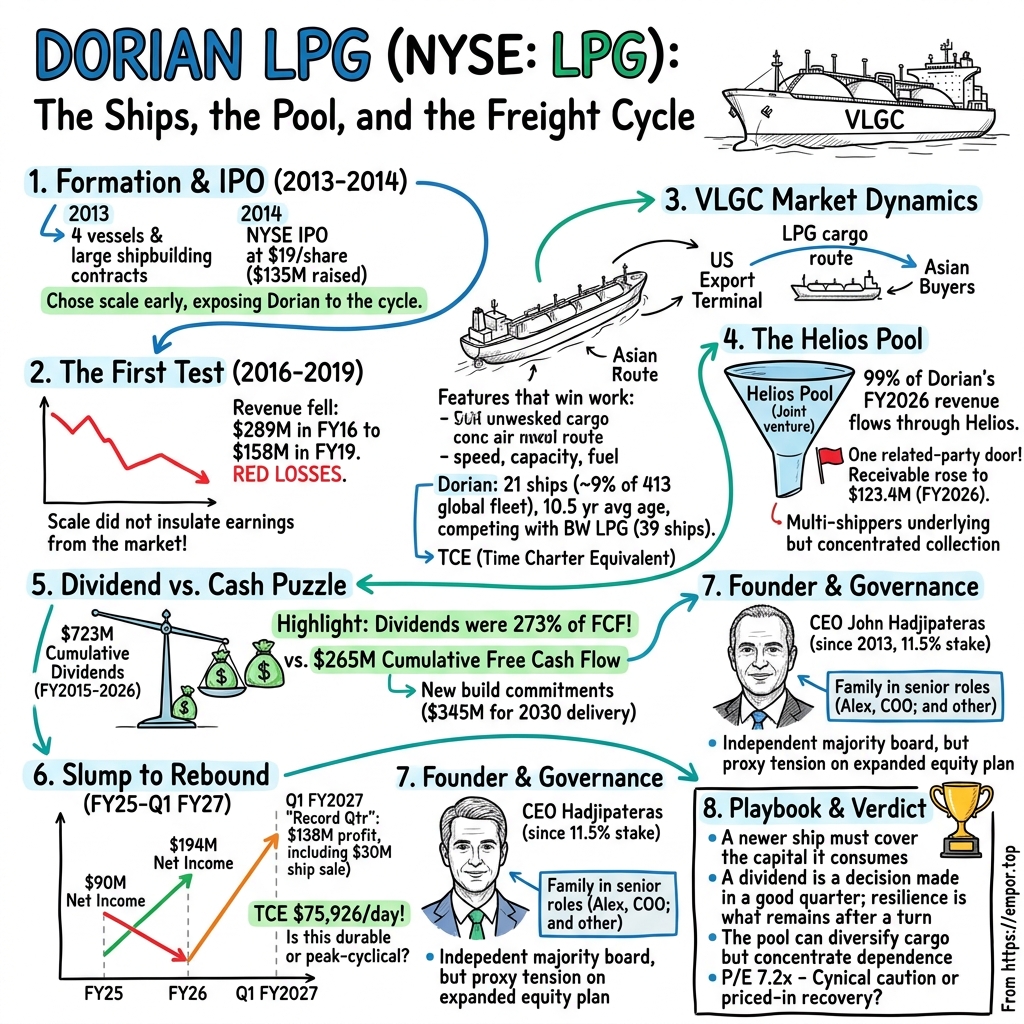
Dorian LPG: The Ships, the Pool and the Freight Cycle
I. A Record Quarter in a Volatile Market
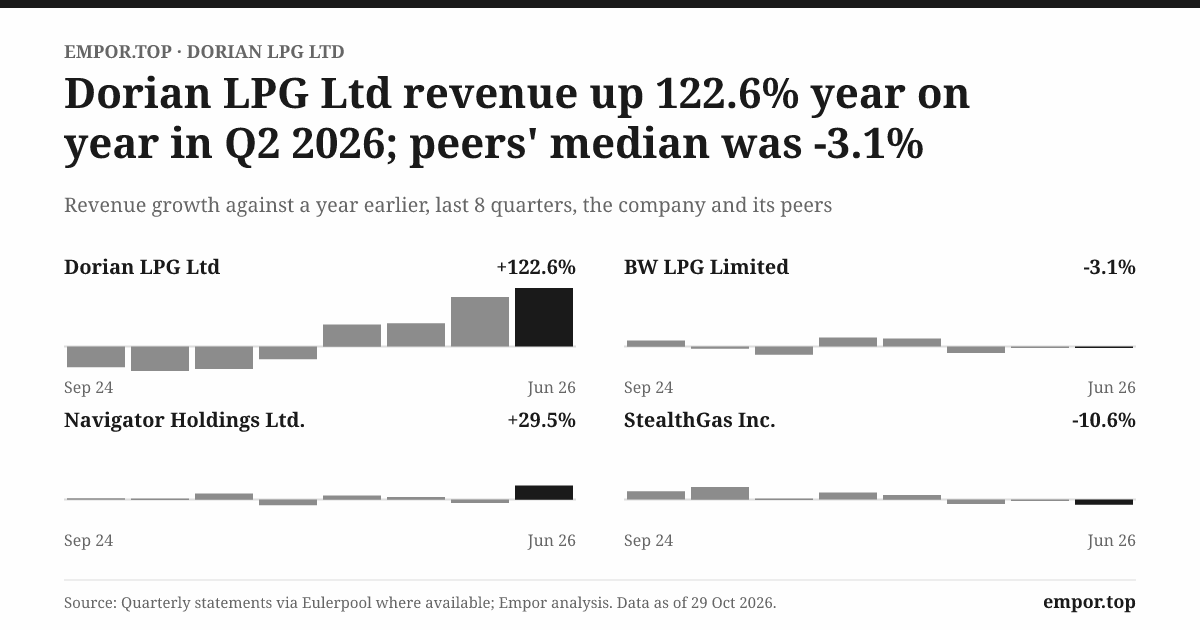
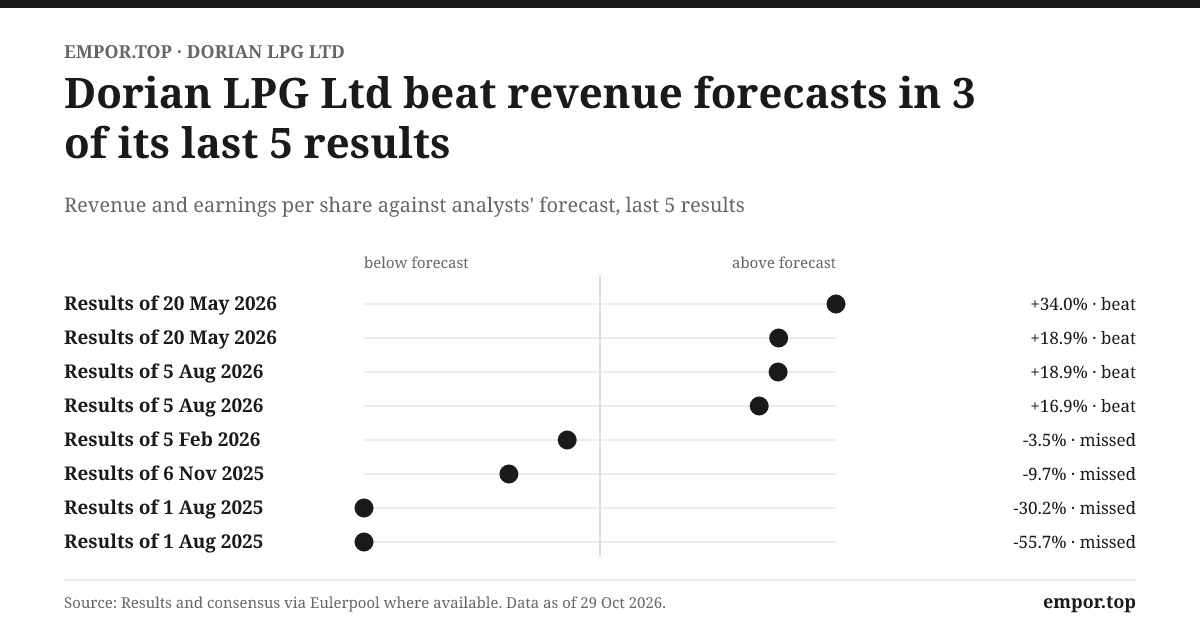
On August 5, 2026, John Hadjipateras had the kind of quarter a shipowner waits a career to report. The chairman and chief executive of Dorian LPG, then 76 years old and in the shipping business since 1972, told investors that his fleet of very large gas carriers had just earned more per day than at any point in the company's corporate life.12 Revenue for the three months to June 30 had more than doubled from a year earlier to about $188 million, and net income had jumped to $138 million from barely $10 million.1
The board declared a $1.00-per-share dividend, about $43 million in cash, which the company called its 19th consecutive irregular dividend.1 It was the sort of number that makes a high-yield screen light up. But Hadjipateras did not take a victory lap about his own brilliance. He pointed at the map.
The Strait of Hormuz had been effectively closed, he said, and that had "cut off nearly all supply volumes from the Middle East."3 Liftings of liquefied petroleum gas from the Gulf had collapsed by more than 70%, to roughly 3.4 million tons in the quarter, while American exports hit a record of nearly 20.8 million tons.3
Asian buyers who normally bought propane and butane a short voyage away in the Gulf now had to fetch it from Texas and Louisiana, on one of the longest trade routes in the business. The company's own release described the market as one of "high volatility and extraordinary freight rates."1
That is the first thing to understand about Dorian. The company owns ships. It does not own the weather, the canal, the war or the price of the cargo. Its results arrive through those forces, and in the summer of 2026 they all pushed in the same direction.
Look past the headline and the quarter tells a more careful story. Of that $138 million of net income, about $30 million came from selling a ship: the 2015-built Cobra, which went to a buyer in May for net proceeds of about $82 million.13 Strip out the gain and adjusted net income was about $107 million.1 That is still an extraordinary quarter for a company of this size, but it is a quarter in which almost a quarter of reported profit came from shrinking the fleet rather than sailing it.
The cleaner measure of the business is a shipping industry term worth learning once: time-charter equivalent revenue, or TCE. Think of it as the daily rent a ship earns after paying for the fuel and port costs of the voyage itself. Dorian's TCE was $75,926 per available day in the quarter, nearly double the $39,726 it earned a year earlier.1 Its own chief financial officer, Ted Young, called it "the highest TCE rate we have reported in our corporate existence."3
Here is why that number matters so much. Young guided that the fleet's cash costs, meaning crew, maintenance, overhead and interest, run at roughly $26,000 to $27,000 per day.3 A ship earning $40,000 a day leaves a healthy margin over that line. A ship earning $76,000 leaves almost three times as much. Revenue in shipping is elastic and costs are stubborn, so when rates double, profit can rise five- or tenfold. The arithmetic also runs the other way.
So the record quarter establishes the stakes rather than a new baseline. The question for a long-term owner is not whether Dorian can earn a fortune when the world's energy map is torn up. It plainly can. The question is what it earns, and what it keeps, when the map heals.
Four questions follow from that, and they organize this story. The first is whether the recovery that began in fiscal 2026 is durable or a freight-rate spike amplified by war and canal congestion.
The second concerns a company called Helios: almost every dollar Dorian earns flows through a commercial pool it does not consolidate, so does that pool diversify Dorian's customer risk or concentrate it? The third is whether the company can keep paying generous dividends while renewing an ageing fleet with ships that now cost about $115 million each.
The fourth is about the man at the helm: whether the long continuity of a founder who has run the company since 2013, with his sons in senior roles, sharpens execution or complicates governance.
Before going further, the boundary of the company needs to be drawn precisely, because it is easy to get wrong. Dorian LPG Ltd., a Marshall Islands corporation headquartered in Stamford, Connecticut, owns and operates VLGCs, the 82,000-to-93,000-cubic-metre tankers that carry refrigerated propane and butane across oceans.4 The Helios Pool, which markets most of those ships to charterers, is a separate entity governed jointly with the Japanese shipping group MOL. Dorian does not consolidate it.4
That matters for how to read every figure that follows. The revenue Dorian reports is its share of the pool's earnings, allocated by a formula. The pool's wider fleet, its customer contracts and its gross freight revenues are not Dorian's. When this story talks about customers, contracts and collections, it returns to that line.
The investment case can be drawn in both directions from the same facts. A modern fleet, a meaningful scale position and freight markets that reward long voyages can generate a great deal of cash, and in good years Dorian has returned most of it. But a business whose prices reset with every voyage, whose revenue flows through a single channel, which carries debt and keeps ordering expensive ships, and whose dividend is explicitly discretionary can look very different in a weak market. Dorian has been through such markets before, more than once.
To see how a company acquires that kind of exposure in the first place, the story has to go back to 2013, when Dorian assembled one of the world's largest VLGC fleets almost overnight.
 Subscribe on LinkedIn
II. The Fleet That Went Public Before the Cycle Turned
In April 2014, a fire broke out aboard a ship that did not yet exist as a ship. The Corsair was still a hull at Hyundai Heavy Industries in South Korea when flames damaged her, and Dorian warned investors in its IPO prospectus that the investigation was ongoing and her August delivery might slip.5 Twelve years later, in July 2026, the same Corsair left the Dorian fleet for about $81 million net, almost exactly what she had cost when she was delivered in 2014.36 Between those two moments lies the whole arc of Dorian's capital strategy: build big, early and new, then trade the ships as the cycle allows.
The company itself was a newcomer, but the people were not. Dorian LPG was incorporated in the Marshall Islands on July 1, 2013, as a subsidiary of Dorian Holdings, with the purpose of owning and operating LPG carriers.5 Its founding executives, John Hadjipateras and John Lycouris, had been in shipping management since 1972 and 1975 respectively, and had been involved in the purchase, management and sale of more than 35 vessels.5
Hadjipateras learned the trade in London. From 1972 to 1992 he was managing director of Peninsular Maritime, a ship brokerage, and he later ran Eagle Ocean, a firm offering chartering, ship sale and purchase, insurance and shipping finance services.2 He has been a member of the Baltic Exchange since 1972 and sat on the board of the US marine services group SEACOR Holdings from 2000 to 2013.2 Lycouris joined Peninsular in 1974 and spent decades beside him, handling the financing of newbuildings and second-hand ships.2
Dorian, in other words, was a new corporate wrapper around a very old partnership of brokers and financiers who knew how ships are bought, priced and sold.
That background explains the speed of what came next. On July 29, 2013, the new company issued about 18.6 million shares to Dorian Holdings, SeaDor Holdings, an affiliate of SEACOR, and other investors. In return it received four vessels, contracts to build three new VLGCs, options on three more, and about $162 million of net cash.5 The starting fleet was modest: three 82,000 cubic-metre VLGCs and one small pressurized carrier.5
The real leap came four months later. On November 26, 2013, Dorian acquired 13 VLGC newbuilding contracts, with the deposits already paid to the shipyards, from Scorpio Tankers in exchange for about 8 million shares, and simultaneously raised about $243 million in a private placement in Norway.5 Another Norwegian placement in February 2014 brought in about $96 million net, and an April placement to a vehicle linked to China's HNA Group added about $26 million.5
It is tempting to describe this as a string of acquisitions. It was really fleet formation. Scorpio did not sell Dorian an operating business; it swapped construction slots at Korean yards for a large equity stake. By the time of the IPO, Scorpio owned about 26% of Dorian, SeaDor about 19% and Dorian Holdings about 11%.5 The company had shareholders who understood shipping and a construction programme of 19 fuel-efficient 84,000 cubic-metre VLGCs at Hyundai and Daewoo, scheduled for delivery between July 2014 and January 2016.5
Dorian's shares had traded on the Norwegian over-the-counter market since July 30, 2013.5 In May 2014 it listed on the New York Stock Exchange under the symbol LPG, selling about 7.1 million shares at $19 each for gross proceeds of about $135 million.5
The prospectus laid out what the money was for. The total purchase price of the fleet was about $1.42 billion, and Dorian intended to borrow roughly $750 million to finish paying for its newbuildings.5 The pitch was scale and modernity: on completion, Dorian expected to "own and operate one of the industry's largest VLGC fleets," and every newbuilding would be an ECO-design ship built for fuel efficiency.5 The thesis was that American shale would push large volumes of LPG onto long routes to Asia, and that VLGCs were the cheapest way to move it.5
The early customer list was blue-chip. Dorian named Statoil and Shell among its customers, and the trader Petredec.5 Shell had agreed to take the newbuilding Comet on a five-year charter at $945,000 a month, about $31,000 a day.5 The prospectus described a "balanced chartering strategy" of multi-year time charters mixed with spot voyages.5 That balance would not last; within a decade, almost everything would run through a pool.
Was Dorian overpaying for those ships? No comparison of acquisition prices settles that question, and the right test is different anyway: did the vessels earn attractive returns across the cycle? Half of that answer came quickly, and it was unflattering.
Dorian took delivery of its new ships just as everyone else was taking delivery of theirs. Its own annual report later described "an influx of newbuild tonnage since early 2015 and continuing through late 2017," and a "downturn in spot market charter rates that began in 2016."7 By May 2018 the global VLGC fleet stood at 269 ships.7 Too many owners had read the same shale thesis and ordered the same ships at the same yards.
The results show what fleet scale does in an oversupplied market: very little. Revenue peaked at $289 million in fiscal 2016, Dorian's first full year with most of the new fleet, and then fell to $158 million by fiscal 2019.78 The company lost money in each of fiscal 2017, 2018 and 2019, including a loss of about $50 million in the last of those years.978 Owning 22 of the newest, most efficient VLGCs on the water, with an average age of just four years in 2018, did not protect earnings.7
The share price told the same story more brutally. By late May 2018, the $19 IPO stock closed at $6.96.10 And that is when Dorian's largest rival came knocking.
On May 29, 2018, BW LPG, the Oslo-listed giant of the VLGC trade, proposed an all-share combination offering 2.05 of its own shares for each Dorian share, worth about $7.86 at the time, a 13% premium.10 Dorian's board unanimously rejected it on June 15, citing "Dorian's younger, more fuel-efficient ships," its "superior commercial performance," its "stronger balance sheet" and the lack of benefit from the dual listing BW proposed.11 BW raised its offer to 2.12 shares in July, and said it would nominate directors to Dorian's board.1112
On October 8, 2018, BW's chairman, Andreas Sohmen-Pao, withdrew the proposal in a letter to Hadjipateras, complaining of the "absence of constructive engagement."12 BW also argued that Dorian's operating costs ran thousands of dollars a day above its own, a claim made by an interested bidder rather than an established fact.12
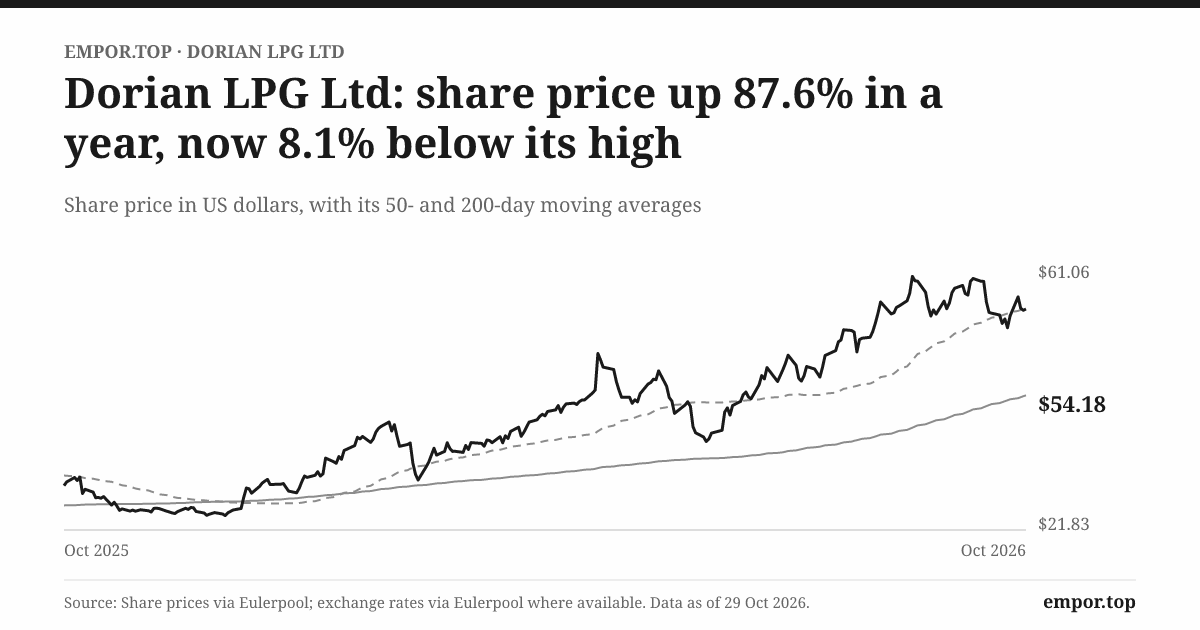
The episode is a useful character reference. At the bottom of the cycle, with the stock at about a third of its IPO price, management and the board bet that the fleet was worth more independent than inside a larger rival. Shareholders who held on were later proved right on price: the stock now trades near $54.13 But the bet was won by the freight market's recovery, not by any structural change in Dorian's business. That distinction will matter for everything that follows.
What Dorian did next was also revealing. Instead of growing, it shrank its share count.
Starting in 2019, it repurchased about 5.5 million shares in the open market for about $61 million, and in February 2021 it ran a tender offer that bought about 8.4 million shares at $13.50 each, after investors offered more than the company first sought.6 In fiscal 2021 alone, buybacks came to about $125 million.6 Shares outstanding fell from about 55 million in mid-2018 to about 43 million today.74 Buying back stock at $13.50 that later traded above $50 was one of the better capital decisions in the company's history.
The founding era leaves a clear verdict. Dorian's defining early decision was to build capacity at scale, fast, with equity raised from shipping insiders and Norwegian investors, rather than to grow gradually from a small operating base. That bought a modern fleet in one move. It also tied the company to a delivery schedule it could not change and a freight cycle it could not control. To understand when such a fleet earns its keep, one has to follow a single cargo across the ocean.
III. Why a VLGC Gets Paid
Picture a VLGC loading at an export terminal on the Houston Ship Channel. She is about 230 metres long, and her tanks hold propane chilled to around minus 42 degrees Celsius, cold enough to keep it liquid at near-atmospheric pressure. Her buyer is a petrochemical plant or a cooking-gas distributor in Japan, Korea, China or India. Her charterer might be an oil major, a commodity trader or an importer. And the question of which ship gets the cargo, and at what price, is decided by a handful of practical facts.
Where is the ship right now, and how fast can she get to the loading port? How much can she carry? How much fuel will she burn on the way, and which fuel? Is she young, clean and acceptable to the oil majors' vetting inspectors? And which route will she take: through the Panama Canal, with its congestion and auction fees, or the long way around the Cape of Good Hope?
Every one of those factors shows up in Dorian's economics. The company's revenue depends on freight rates, route distances, vessel availability and customer demand, not merely on how much LPG the world trades.4 That distinction sounds pedantic until you see it in action. In fiscal 2026, Panama Canal auction fees for a single transit ranged from about $200,000 to as high as $4 million, according to Dorian's chief commercial officer Tim Hansen.14 A ship that waits for a slot or goes around Africa takes longer to deliver its cargo.
Each extra day at sea removes a ship from the available pool for the next cargo, which tightens supply and lifts rates for everyone else.
This is the hidden engine of VLGC earnings: tonne-miles. Shipping demand is cargo tonnage multiplied by distance, which helps explain the record quarter.
How does a Dorian ship actually get paid? Mostly through the pool. In the Helios Pool, the manager pools the revenues and voyage costs of every participating vessel, then divides the net earnings using "pool points," which reflect each vessel's capacity, fuel consumption and speed, multiplied by the days each vessel spends in the pool.4 A larger, more efficient ship earns more points and a bigger slice. Pool revenue is recognized monthly.4
The pool, in turn, employs its ships in three ways: on spot voyages priced cargo by cargo, on contracts of affreightment that commit to move a set volume over time, and on time charters that rent a ship out at a fixed daily rate.4 At the end of fiscal 2026, Dorian had no vessel on a fixed time charter outside the pool.4 Inside the pool, seven Dorian ships were on time charters in the June quarter, which meant just over 75% of the pool's 29 vessels were exposed to the spot market.3 That is a deliberate posture: Dorian chose to ride the market rather than lock it in.
The organization behind all this is strikingly small. At March 31, 2026, Dorian employed about 90 shore-based staff in the United States, Greece and Denmark, alongside roughly 500 seafarers aboard its ships.4 A company with a market value of more than $2 billion is, at its core, a few dozen people deciding which ships to buy, how to finance them and where to send them. That is why the quality of a handful of decisions matters more here than in almost any other kind of listed business.
Dorian's fleet is not just its owned ships. At the time of the fiscal 2026 annual report it operated 27 VLGCs, of which 21 were owned or held on finance leases and six were chartered in from other owners.4 Its owned fleet averaged 10.5 years old, against 11.7 years for the global VLGC fleet.4
Chartered-in ships are a cheaper way to add capacity without buying it, but they carry a fixed daily cost: in the June quarter, Dorian paid about $41,000 a day for each of them, about $23 million in total.31 In a strong market, a chartered-in ship earning $76,000 a day is a money machine. In a weak one, it is a liability on a fixed rent.
Who else is at the terminal
Dorian is a significant owner but not the biggest. In its fiscal 2026 annual report, it named BW LPG, NYK Line and Petredec among its largest competitors, and counted 427 VLGCs in the world fleet, with the ten largest owners controlling about 41% of them.4 BW LPG's own March 2026 investor presentation, which counted ships as of December 2025, ranked BW first with 39 owned VLGCs, Petredec second with 21 and Dorian third with 20, out of 413 VLGCs on the water.15 On that count, BW had about 9% of the fleet and Dorian about 5%.15
That ranking is worth sitting with. BW is roughly twice Dorian's size by owned fleet. Behind both stand private Japanese, Korean and state-linked owners, from KSS Line and SK Shipping to Eneos Ocean, which BW's chart showed with 13 to 14 ships apiece.15 This is a fragmented, globally contestable market. No owner can raise prices by withholding ships, because a charterer with a cargo in Houston can simply call another broker.
So what advantage can Dorian defend? The honest answer is a relative one. A younger fleet earns more pool points and passes oil majors' vetting more easily. Fuel efficiency matters a great deal when fuel is one of the largest voyage costs. Dorian had 15 ships fitted with scrubbers, the exhaust-cleaning systems that let a vessel burn cheaper high-sulphur fuel oil, and these saved about $1,971 per day per vessel in the June quarter, net of their own running costs.3 That saving fluctuates with the fuel price spread: in the March quarter it was nearly $3,500 a day.14
Scale also helps. A pool with about 30 ships can position vessels in more places at once, cover more cargoes and offer charterers a more reliable service than a single ship can. Dorian's founders argued in 2014 that sister ships, identical vessels built to the same design, would bring operating efficiencies.5
Now apply the moat test, and apply it once. A moat in the strict sense means customers cannot easily take their business elsewhere, or that one company can earn more than its rivals for structural reasons. Dorian does not disclose customer retention, win rates, price realization against peers or any evidence that charterers cannot multi-source.
The fiscal 2026 annual report states that charterers weigh price, location, size, age and condition when choosing a ship, which is a description of a competitive market, not a protected one.4 And Dorian's ships earn rates set in that market; when the market collapsed in fiscal 2017 to 2019, the young fleet did not earn its way out of losses.
The historical record therefore narrows the claim rather than rejecting it. Dorian's fleet quality and pool access look like an edge in how much of the market rate it captures, not a shield from the market rate itself. The evidence that would confirm a real edge would be Dorian's TCE consistently above peers' in the same quarters, through both strong and weak markets. The fiscal 2018 annual report already showed that the Helios Pool carried most of the fleet's revenue; it does not show that Dorian's ships out-earned rivals' across a full cycle.7
The new ships and the fuel they burn
The technology question deserves a plain explanation, because it shapes the newbuilding programme. A dual-fuel VLGC can burn either conventional low-sulphur fuel oil or LPG from its own cargo tanks. Burning LPG cuts carbon dioxide emissions, Dorian estimates by about 20% on its newest ship, and it can be much cheaper.14 In the June quarter, LPG cost about $369 per tonne less than very-low-sulphur fuel oil.3 BW LPG, which has the most dual-fuel ships, said its own dual-fuel vessels saved about $5,000 a day in 2024.15
Dorian now operates six dual-fuel ships, including Areion, delivered in March 2026 from Hanwha Ocean and capable of carrying ammonia as well as LPG.316 Ammonia matters because some shipping and energy companies expect it to become a traded low-carbon fuel and a cargo in its own right. The International Maritime Organization is scheduled to vote on its Net-Zero Framework in December 2026, with implementation unlikely before 2028, according to Lycouris.3
This is operating economics, not a new business. Dual-fuel engines and ammonia-ready tanks may lower fuel costs, protect a vessel's appeal to charterers as emissions rules tighten and preserve its resale value. But they are a cost of staying competitive, and the industry is buying them too: of 413 VLGCs on the water in BW's count, 120 already had dual-fuel technology.15 An advantage that everyone can buy at a shipyard lasts only as long as the delivery queue. Dorian still has to demonstrate the savings and the utilization of its newest ships over years, not in a specification sheet.
If the ships themselves do not provide a fortress, the commercial arrangement might. That leads to the most unusual feature of Dorian's business: nearly all of its revenue passes through a single door.
IV. Helios: One Commercial Door, Many Charterers
Open Dorian's fiscal 2026 annual report to the page on customer concentration, and one line stands out. A single counterparty, the Helios Pool, accounted for 99% of Dorian's revenue in the year to March 2026, up from 95% two years earlier.4 For a company with a market value of about $2.3 billion, that looks at first like the most extreme customer concentration imaginable.
It is not quite that. Helios is not a customer in the ordinary sense. It is the commercial arm through which Dorian's ships find work, and it serves many customers of its own: global energy companies, commodity traders and importers.4 In fiscal 2026, no individual charterer of the pool accounted for more than 10% of the pool revenue allocated to Dorian.4 Two years earlier, two charterers had each crossed that threshold.4
So the question this section has to answer has two halves. Underneath, the demand for Dorian's ships appears spread across many buyers. On top, almost every dollar reaches Dorian through one channel that Dorian does not control alone.
The pool was born on April 1, 2015, when Dorian and Phoenix Tankers, a subsidiary of Mitsui O.S.K. Lines, began operating Helios LPG Pool LLC as a 50-50 joint venture.7 Phoenix has since been renamed MOL Energia, and the two partners jointly manage the pool's vessels commercially.4 By May 2026, Helios operated 31 VLGCs, of which 27 were Dorian's.4 In practice it is Dorian's fleet with a few partner ships attached.
The pool's grip on Dorian's revenue has tightened overall. In fiscal 2016, Helios accounted for about 70% of Dorian's revenue, and in fiscal 2018 about 67%, with the rest coming from time charters Dorian had arranged directly, such as the Shell contracts it had signed before the IPO.7 By fiscal 2024 the pool's share was 95%, and by fiscal 2026 it was 99%.4 The "balanced chartering strategy" the prospectus promised has become, in practice, a pool strategy with time charters arranged inside it.5
Why would a shipowner hand its commercial life to a pool? The logic is the same as the logic behind airline alliances or taxi dispatch. A single ship can only be in one place. A pool of 30 can cover cargoes in the US Gulf, the Middle East and West Africa simultaneously, quote more reliably, reduce empty ballast voyages and offer charterers contracts of affreightment that no one ship could promise. The pool spreads both opportunity and bad luck: a vessel caught waiting at Panama does not bear the whole cost alone, because pool earnings are shared on points and days.4
The accounting requires a translation. Dorian's financial statements label its pool revenue as coming from a "related party." That phrase usually means sales to a parent company or a controlling shareholder, and it often signals a governance concern. Here it means something narrower. Helios is jointly governed with MOL Energia, Dorian is not its primary beneficiary, and so the pool is an unconsolidated entity with which Dorian transacts.4 The related party is a joint venture with a Japanese shipping major, not a family holding company.
The scale of the relationship is large. Dorian recorded $474.9 million of net pool revenue in fiscal 2026, essentially all of its $481.5 million of revenue.4 It also earned about $2.7 million of related-party other income, including about $2.5 million of commercial management fees from Helios.4 That related-party income is small, about 1.4% of net income, and it reflects Dorian's role in running the pool rather than a separate business.4
The more consequential line is on the balance sheet. At March 31, 2026, Dorian's net receivable from the pool, including about $28.6 million of working capital it had contributed to pool operations, stood at $123.4 million, up from $74.4 million a year earlier.4 By contrast, its direct trade receivables and accrued revenues, money owed by anyone other than the pool, were just $2.0 million.4
That contrast tells you where the collection risk lives. It does not sit with a few thousand trade debtors. It sits with one entity that collects freight from charterers, pays voyage costs and then distributes the net to its members. When the pool's charterers pay slowly, or the pool needs more working capital to fund bunkers in a high fuel-price market, the money waits in Helios rather than in Dorian's bank account.
The working capital swing in fiscal 2026 shows the effect. As freight rates climbed, the pool receivable rose by about $49 million, absorbing cash that Dorian had earned on paper.4 Measured as days of revenue, receivables rose from 35 days in fiscal 2024 to 75 days in fiscal 2026.417 Some of that is mechanical: higher rates in the final quarter mean more revenue booked but not yet distributed at year-end. Some of it is the cost of fuel: in the June 2026 quarter, bunker prices rose by about 36% quarter on quarter, according to Dorian's chartering team.3 Whatever the cause, cash lagged profit.
Dorian recorded no allowance for doubtful accounts in fiscal 2024 to 2026, and no major customer bankruptcy, exit or unusual credit term is disclosed for those years.4 The pool arrangement has run for more than a decade, through the 2016 to 2019 downturn, without a disclosed collection failure. That is genuine reassurance, but it is not a stress test of the scenario that matters most: a sharp drop in rates combined with a large pool balance and a charterer in trouble.
The company does not publish an ageing schedule for the pool receivable, the pool's own top-customer shares over several years or the pool's financial statements. Those three disclosures would change the assessment most. An investor who wants to know whether a $123 million balance is two weeks of normal timing or two months of slow payers cannot tell from Dorian's filings.
The verdict on the customer question is therefore clear, and it runs both ways at once. The pool diversifies the underlying charterers: Dorian is not dependent on a single oil major or trader. But it concentrates Dorian's commercial and collection exposure in one jointly controlled channel. A dispute with MOL, a governance breakdown inside the pool or a sustained build-up of the receivable would hit nearly all of Dorian's revenue at once.
The pool also shapes how Dorian's dividend should be read. A company that collects its revenue monthly from a pool, with a receivable that can swell by tens of millions in a strong year, will not see every dollar of reported profit arrive in cash on time. That is the bridge into the question investors care about most: how much of Dorian's cash has actually been free, and how much has been paid out.
V. The Dividend Arrived Before the Cash Was Consistent
Put two numbers side by side and the shape of Dorian's capital policy comes into focus. Over the twelve fiscal years from 2015 through 2026, the company generated about $265 million of free cash flow, meaning operating cash flow after spending on ships.4 Over the same period it paid about $723 million in dividends, roughly 2.7 times its free cash flow.4 And yet cash and short-term investments rose by about $48 million over the period, from $279 million to $327 million.4
How can a company pay out almost three times its free cash flow and still end up with more cash? The answer is that the twelve-year free cash flow figure carries the cost of building the fleet in the first place. In fiscal 2015 and 2016, Dorian spent more than $1 billion on its newbuildings, producing deeply negative free cash flow in those two years, funded by the equity raised before and during the IPO and by debt.4 Take those two construction years out and free cash flow from fiscal 2017 to 2026 was about $1.3 billion, comfortably above the dividends paid.
Both readings are true, and both matter. The first says that the dividends have been paid out of the cash generated by a fleet that shareholders' capital built, and that across the full life of the fleet, distributions plus buybacks have exceeded the fleet's free cash flow. The second says that once the ships were in the water, the operating business has generated more cash than it paid out. The tension between them is the tension of every shipowner: the business throws off cash until it has to buy the next generation of ships.
Dorian's dividend history is short and lumpy. Until fiscal 2022, it paid none at all; the founders preferred buybacks. In the quarter to September 2021, when the fleet earned about $29,600 per available day, Ted Young told investors that the company had returned over $150 million of capital through its self-tender and a dividend.18 From then on, dividends became the main channel, labelled "irregular" every time.1
The irregularity is the point. The company never committed to a fixed payout ratio. Its payout ranged from zero to 173% of net income over the past decade, with a median of about 26%, and 54% in fiscal 2026.419 In fiscal 2025, when net income fell to $90 million, Dorian paid out $156 million, about 1.7 times its earnings.19 That is not a dividend policy in the utility sense. It is a board deciding, quarter by quarter, how much of the cash pile to hand back.
In August 2026, Young framed the record differently. By the time the latest dividend was paid, he said, Dorian would have paid nearly $811 million of dividends since the middle of 2021, against net income of $974 million over the same period.3 Measured against earnings, that is a payout of about 83%. Measured against free cash flow after the new ships Dorian has been ordering, it would be higher. Management chose the flattering denominator, which is common, but investors should keep both in view.
Cash conversion has been strong over the long record. Across fiscal 2015 to 2026, operating cash flow was about 156% of net income, largely because vessel depreciation, a non-cash charge of about $72 million in fiscal 2026 alone, depresses reported profit without consuming cash in the year.4 But depreciation is not imaginary. It is the accounting estimate of how fast the fleet is wearing out, and eventually the ships have to be replaced at today's prices.
The share sale in a strong market
On June 6, 2024, near the peak of the last up-cycle, Dorian sold 2 million new shares at $44.50 each, raising about $89 million before costs and about $84 million net, for "general corporate purposes."2019 At the time, the company operated 25 VLGCs, including four dual-fuel ships.20
There are two ways to read that sale. A critic would note that a company paying out more than its earnings in dividends was simultaneously issuing equity, which looks like financing distributions with new shares. A defender would note that the sale was priced near the cycle's high, at more than three times the $13.50 at which the company had bought back stock three years earlier, and that selling shares when they are dear is the mirror image of buying them back when they are cheap.
The record supports the defender on price and the critic on optics. It was meaningful dilution, about 5% of the share count, and it came in the same fiscal year that dividends far exceeded profit.
The next generation of ships
The clearest test of whether dividends and renewal can coexist arrived in September 2026. On September 4, Dorian announced an agreement with Hanwha Ocean in South Korea to build three 90,000 cubic-metre dual-fuel Panamax VLGCs for delivery in June, September and December 2030, at a total price of about $345 million, roughly $115 million each.21 That followed a June order for a similar vessel from HD Hyundai Heavy Industries for delivery in the third calendar quarter of 2029.1
Is $115 million a fair price? BW LPG's own presentation put the price of a comparable dual-fuel VLGC at a first-class yard at about $112.5 million in early 2026, so Dorian's price sits close to the market.15 On the May call, management noted that newbuilding prices had risen from about $65 million for a ship ordered in 2004 to about $115 million, an increase of roughly 2.5% a year.14
The comparison with the summer's sales is tempting and misleading. In May and July 2026, Dorian sold Cobra, Corsair and Constellation, three ships built in 2014 and 2015, for net proceeds of about $82 million, $81 million and $86 million respectively.3
Those ships cost roughly $79 million to $81 million each when new.6 Selling an eleven-year-old ship for more than its original cost after a decade of earnings is an excellent trade, and it reflects a hot second-hand market. But it says nothing about whether $115 million for a 2030 ship will earn a return. Different ships, different ages, different decades.
What the sales do reveal is a pattern of behaviour. Management has been willing to sell ships into strength, pay down the debt attached to them and recycle the proceeds. After the Cobra, Corsair and Constellation sales, Young said the company's cash balance stood at almost $600 million, and that the debt tied to two of the ships, about $48 million, had been repaid at sale.3
At the end of June, before most of those proceeds arrived, Young put net debt at under 10% of total capitalization.3 For a shipowner, that is a conservative balance sheet by any historical standard, and a long way from the roughly $750 million of borrowing the company planned when it was building its first fleet.5
A fourth sale, of Clermont, was expected to close by October.3
The September refinancing completed the picture. On September 2, 2026, Dorian signed a seven-year, $368.4 million credit facility with eight banks led by Nordea, priced at 140 basis points over SOFR, the US benchmark rate.2221 It combined a term loan of about $213 million with a $155 million revolving credit line, plus a $200 million accordion that lets the company borrow more later if lenders agree.21 It consolidated four existing facilities into one, including a $44 million balloon payment that had been due in December 2026.214
Dorian has no published credit rating from an agency; the relevant judgement is the banks', and the company reported that it was in compliance with its financial covenants at March 31, 2026.4 That is a vote of confidence from lenders, and a sensible move: it spreads out maturities and gives the company access to cash when it needs to pay shipyards. But a revolving line is borrowing capacity, not earnings.
At March 31, 2026, Dorian had about $566 million of debt and about $149 million of lease obligations, mostly on chartered-in ships, with about $100 million of debt scheduled to be repaid in fiscal 2027.4 The three Hanwha ships alone carry about $345 million of contract payments before 2030, on top of the ship ordered in June.211
Put those commitments next to the dividend and the question sharpens. At $1.00 per share each quarter, Dorian would pay out about $171 million a year.1 In a year like fiscal 2026, when operating cash flow was $210 million, that would be affordable alongside debt service, but barely so if shipyard payments are added.4 In a year like fiscal 2019, when operating cash flow was $8 million, it would not be.8
The verdict is that the payout has been a discretionary return of cyclical cash, not a stable dividend funded by recurring free cash flow. The balance sheet, with almost $600 million of cash after the summer's sales, can bridge a weak year or two. What the history does not show is that distributions, newbuilding payments and debt service can all be funded together through a prolonged slump. The company has never yet had to try. Whether it will depends on what happened between the trough of fiscal 2025 and the record of 2026, and whether that rebound can last.
VI. From the FY2025 Slump to a Record Rebound
In the year to March 2025, the same fleet that would later post record earnings looked like a company in retreat. Revenue fell 37% to $353 million, and net income dropped by more than two-thirds to $90 million.19 In the December 2024 quarter, Dorian's revenue was about half what it had been a year earlier.19 The ships had not changed. The market had.
Fiscal 2024 had been the high-water mark: revenue of $560 million and net income of $307 million, a 55% net margin.17 The fall the following year was a reminder of how quickly a shipowner's fortunes reverse. Operating profit collapsed from about $329 million to about $113 million on a revenue decline of about $207 million.1719 In other words, almost every lost dollar of revenue went straight through to lost profit, because the costs of running ships, paying crews and servicing debt barely moved.
That is the causal machinery of this business in one sentence. Freight rates and voyage length drive revenue. Vessel operating costs, chartered-in hire and interest do not fall in lockstep when rates do. Dorian's vessel operating costs ran at between about $9,800 and $10,600 per ship per day across fiscal 2026 and the June 2026 quarter, whatever the ships earned.161 The chartered-in fleet costs a fixed daily hire. Leverage in shipping is not only financial; it is operational.
What turned the market
The recovery came in stages. Through the first half of fiscal 2026, the market remained sluggish, and the company later described the year's "relatively slow start."14 Hansen also pointed to a dispute between the US and China over port service fees, which disrupted activity in October and November 2025.14
Then, late in February 2026, the Middle East's LPG exports began to unravel. Dorian's fourth-quarter release described a halt in exports from Saudi Arabia's Juaymah and Ras Tanura terminals, crude oil rising from about $64 a barrel in December 2025 to $106 in March 2026, and Middle East LPG exports falling from about 4 million tonnes in January to about 1.3 million in March, while American exports rose to nearly 6.3 million tonnes in March alone.16
Hansen called it "the de facto closure of the Strait of Hormuz."14 Hadjipateras added a sentence that told investors something about the company's luck as well as its strategy: "Fortunately, none of our people or ships are in the Middle East Gulf."16 Dorian's ships were concentrated on American liftings, which suddenly became the world's marginal supply.14
The results moved fast. Fiscal 2026 revenue recovered 36% to $481.5 million, and net income doubled to $193.7 million.16 TCE per available day was $52,238 for the year and $63,615 in the March quarter, then the second-highest in Dorian's history.1614 Three months later, the June quarter set a new record.1 And by early September, Dorian estimated it had fixed 99% of its days in the September quarter at more than $88,000 per day.21
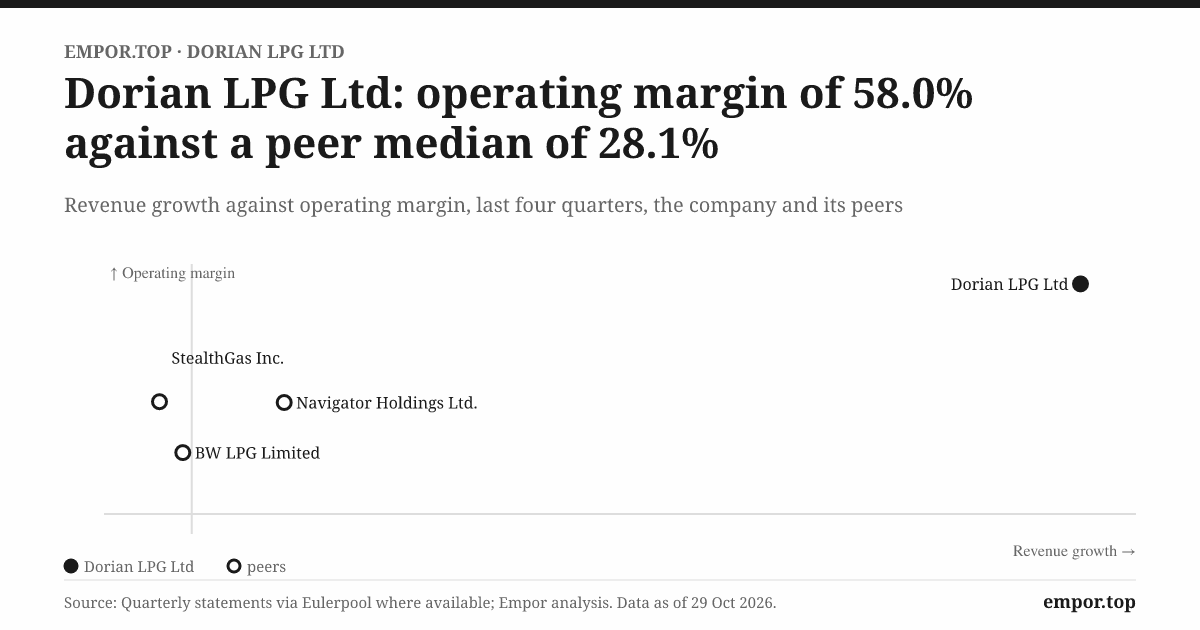
Look at the run of quarters and the trajectory is striking. Revenue went from about $84 million in the June 2025 quarter to about $188 million a year later, and the operating margin rose from under 20% to about 76%, helped by the vessel-sale gain.119 The engine did not change. The fuel did.
The August 2026 call is worth reading closely, because the prepared remarks and the analyst questions told different stories. The prepared remarks celebrated records, described the Hormuz disruption and noted that Panama was "congested again with elevated auction rates."3 Dorian's chartering team warned that a US-Iran ceasefire memorandum signed in mid-June had briefly knocked freight rates down from their highs, and that the breakdown of talks in early July showed "the fragility of peace."3
The analysts pressed on what happens when the disruption ends. Omar Nokta of Clarksons Securities asked how the market would behave if a peace agreement held. Hadjipateras replied that "every time there's a threat of peace, the oil price goes down and the shipping markets seem to suffer," called the reaction "kind of silly" and said he was "not worried about it."3 That is a confident view, and possibly a correct one, but it was offered without numbers.
Stephanie Moore of Jefferies asked about spot earnings in the current quarter and whether waiting times remained elevated. Young said it would be "premature" to comment and promised data later.3 When she asked how Dorian underwrites returns on a ship delivered in 2029 when the global orderbook was growing, Hadjipateras answered: "I don't like to see the newbuilding order book expanding as much as it has," and described the company's approach as "measured" and "incremental," without giving a return assumption.3
Where management did quantify, it was on costs. Young gave the $26,000 to $27,000 daily cash-cost guidance, broke down overhead into core costs and incentive pay, and described the debt and interest savings from the ship sales.3
Overhead in the June quarter was about $13.5 million. Young said roughly $4.2 million was incentive compensation, and core overhead was about $7.3 million.3 In other words, about a third of the quarter's cash overhead was bonus pay tied to the boom, a cost that should shrink naturally if rates fall. On the freight outlook, which is the variable that drives everything, management was candid that it could not forecast. That is honest. It also means the investor is buying exposure to a number the company itself declines to predict.
Supply is the other half of the equation
The bull case on demand is real: American LPG exports keep growing, the US share of global seaborne LPG exports had climbed to about 65% from under 50%, and longer routes to Asia consume more ship-days.3 But demand for shipping is only half the equation. The other half is supply, and on that front the evidence turned less friendly through 2026.
In May, Dorian's fourth-quarter release counted 116 VLGCs and VLACs, the ammonia-capable sister type, on order for delivery through 2029, about 27.5% of the existing fleet.16 By August, its first-quarter release counted about 155 deliveries due through 2030, including 50 orders placed in the June quarter alone, or about 35.7% of the fleet.1 High rates had triggered exactly what they always trigger in shipping: orders. Dorian itself contributed four of them.
The old cycle supplies the falsification test here. In 2013 and 2014, the shale thesis was right: US exports did boom. But the fleet grew even faster, and Dorian lost money for three years. The test of the current recovery is the same one: not whether LPG trade grows in the abstract, but whether cargo volumes and route miles grow faster than the fleet, by enough to keep rates above the level that pays for $115 million ships.
The verdict on durability is therefore cautious. The earnings recovery is real, and the cash it generated is in the bank. But management itself attributes it to geopolitical disruption and extraordinary volatility, and the orderbook now promises a wave of new capacity from 2027 onwards. Three numbers will settle the question better than any headline: TCE per available day, available days and utilization, and the pool receivable as a measure of cash conversion. The latest readings are $75,926 per day, 2,469 available days in the June quarter, and a pool balance of $123.4 million at the March year-end, rising.14
Who decides what to do with the cash when that answer becomes clear is the next part of the story. It is the same person who has made every major decision since 2013.
VII. Three Generations of Ships, One Founder at the Helm
On the morning of September 10, 2026, Dorian's shareholders gathered, in person or by proxy, at the company's offices at 27 Signal Road in Stamford.2 Most of the agenda was routine. Three directors were re-elected, the auditor was ratified and shareholders approved the executives' pay on an advisory vote by a margin of more than 20 to one.23 Then came the fifth item, a proposal to add 2.5 million shares to the company's equity incentive plan, lifting the pool of shares available for awards from about 4.9 million to about 7.4 million.2 It passed, but 10.5 million votes were cast against it and 17.1 million for.23
That vote is the most interesting governance signal Dorian has produced in years, and it sits beside a fact that has not changed since 2013. John Hadjipateras has been chairman, president and chief executive of Dorian since its inception.2 He has led it through several market cycles. The company has never had another leader.
Long tenure has obvious virtues in shipping. Ships are bought and sold on judgement about cycles, and the people who time those cycles well tend to be the ones who have seen several. Hadjipateras's career began in London in 1972.2 He has sat on the boards of the Greek Shipping Co-operation Committee and the council of INTERTANKO, the tanker owners' association, and is a member of the American Bureau of Shipping and, since 2025, Det Norske Veritas, the two great classification societies that certify ships as seaworthy.2
His public manner on earnings calls is that of an old broker: brief, wry, more comfortable with judgement than with forecasts.
His language has also been remarkably consistent. In November 2021, explaining why Dorian had ordered only a single newbuilding, he said the company's reluctance "should be viewed as a conservative approach to the new building market."18 In August 2026, explaining its new orders, he said "our plan is to pursue a conservative renewal program."3 Few executives use the same word about the same subject five years apart. Whether the behaviour matches the word is the right test.
What the record of decisions shows
Judged by behaviour, the record is mixed but more good than bad. The buybacks of 2019 to 2021 at prices as low as $13.50 were well timed.6 The refusal of BW's 2018 bid, at a price around $8, looks right in hindsight.10 The sales of 2014- and 2015-built ships in 2026 at roughly their original cost were sharp trades.36 Against that, the company sold new shares in 2024 while paying dividends that exceeded profit, and over its full life distributions have far exceeded cumulative free cash flow.204
Insider behaviour adds a modest data point. On January 7, 2026, with the shares around $27, Hadjipateras bought 15,000 shares through an indirect holding.24 As the stock more than doubled through the summer, several other insiders sold: the chief commercial officer, Tim Hansen, sold 50,000 shares at about $53 in September, and the CFO and several directors also sold.25 Insider sales after large stock awards are common and need not signal anything. But the founder's purchase was small, and the selling was broad.
The CEO's reported stake of 11.5% is substantial, but it needs a footnote. Of the roughly 4.9 million shares attributed to him, about 1.8 million are held with sole voting power, while about 2.9 million are counted because relatives and associates have given him revocable proxies to vote them.2 He disclaims beneficial ownership beyond his own economic interest.2 The alignment is real, but the voting bloc he controls is larger than the money he personally has at stake.
Family, board and pay
The family dimension is explicit. Alexander Hadjipateras, the CEO's son, aged 47, has been chief operating officer since April 2024 and managing director of Dorian's Athens management company since July 2023.2 A Georgetown history graduate with an executive MBA from HEC Paris, he worked at the digital agency Razorfish before joining Dorian, and sits on the board of the Helios Pool.2 His fiscal 2026 compensation was about $2.99 million.2 Another son, Peter Hadjipateras, was paid $666,500 in salary and cash bonus as chief information, security and sustainability officer.2
Nothing in that structure is improper, and the company discloses it clearly. It does raise two questions. The first is succession: the proxy does not disclose a succession plan for a 76-year-old chairman-CEO, and the board says it wants to retain "the organizational flexibility" to decide whether to combine or separate the roles.2 The second is accountability: when the founder chairs the board that oversees him, and his son is the obvious internal candidate, the independent directors carry more of the weight of challenge.
The board is better built for that task than a family company's might be. Seven of its nine directors are independent under NYSE rules.2 The lead independent director, Malcolm McAvity, was vice chairman of the commodity trader Phibro for more than 25 years.2 Mark Ross was president of Chevron Shipping, and Christopher Wiernicki, who joined in April 2026, spent 14 years as chairman and chief executive of the American Bureau of Shipping.2 These are people who know how ships, charterers and classification work.
Compensation is where the record invites the most scrutiny. Hadjipateras's total pay for fiscal 2026 was about $6.31 million, made up of a $750,000 salary, a $1.32 million cash bonus earned in the prior year but paid in fiscal 2026, $2.88 million of stock awards and a $1.36 million cash incentive for the year itself.2 Because the prior-year bonus lands in the current year's table, simple comparisons between pay and profit can mislead: his pay rose from about $5.3 million to $6.3 million while net income rose from $90 million to $194 million, but the two years are not neatly matched.24
Fiscal 2026 was also the first year of a more formula-driven cash incentive, which the company described as a response to "evolving governance expectations."2 The formula weights EBITDA at 40%, two safety measures at 25% combined and personal objectives at 35%.2 The EBITDA target for full payout was $167 million and the maximum was $205 million. Actual EBITDA came in at $310 million, far above the maximum, driven by a freight market transformed by the Hormuz closure.2
A formula is more disciplined than pure discretion, but a formula whose ceiling was overshot by half thanks to a war in the Gulf rewards the market as much as the management.
That context helps read the votes. Say-on-pay passed comfortably, with about 26.5 million votes for and 1.1 million against.23 The equity plan drew almost ten times as much opposition. Shareholders were relaxed about how much the executives were paid and uneasy about how many new shares could be issued to pay them, an increase equal to almost 6% of the shares outstanding.2 Neither vote is a verdict on leadership quality; together they say that dilution, not pay, is the governance nerve.
The messaging across the two most recent calls fits the same pattern of caution with an expansionary edge. On the May 2026 call, Hadjipateras said the company would "proceed judiciously mindful of our steadfast commitment to maintaining a solid balance sheet," and that "in the next few years, we hope to expand our fleet."14 Young described the aim as balancing "shareholder distributions, debt reduction, and fleet investment."14 By August, after the record quarter and the first order, Hadjipateras told an analyst that the company "would not exclude fleet expansion."3 Within weeks, it ordered three more ships.21
Management did distinguish the market from its own choices, which is to its credit: it attributed the record to Hormuz, Panama and American exports, not to its own genius.3 What it did not provide was a return threshold for new ships or a framework for how much cash would go to each use.
The verdict is that tenure and ownership align the CEO with shareholders, and the board has a strong majority of experienced independent directors. The combination of chair and CEO roles in one long-serving founder, the senior roles held by his sons, the absence of a disclosed succession plan and the large dissent on dilution make governance a live question rather than a settled one. The evidence does not show that the structure has impaired execution. It does mean that the next major decision, when a 76-year-old leader eventually steps back, has not been explained to shareholders in advance.
That leaves the question every investor ultimately has to answer: at today's price, what is the market assuming about all of this?
VIII. The Case for Dorian, and the Case Against the Cycle
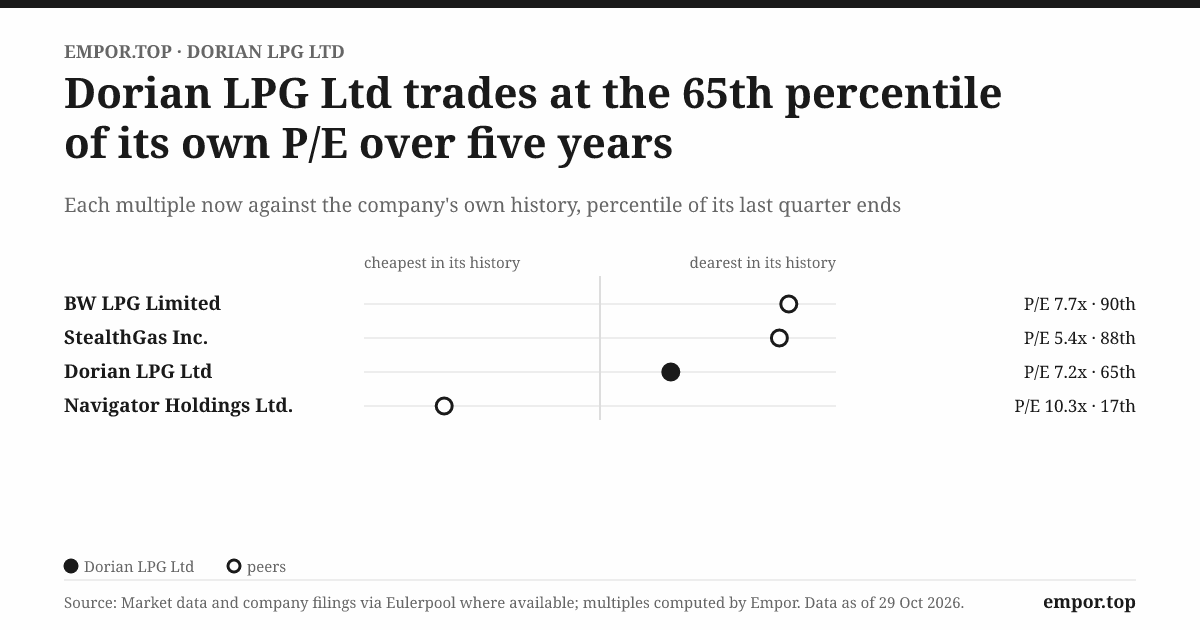
On October 29, 2026, Dorian's shares closed at about $54, roughly 8% below their 52-week high and more than double their 52-week low of about $24. The company was worth about $2.3 billion in the market and about $2.6 billion including debt net of cash.13 At about 7.2 times trailing earnings, the stock looks cheap by the standards of almost any other industry.13
It is not obviously cheap by its own standards. Over the past five years, Dorian's median price-to-earnings ratio has been about 6.2 times. The market is paying a modest premium to Dorian's own history, on earnings that include the strongest quarter in the company's life and a $30 million vessel-sale gain.1 That is the trap of low multiples in cyclical businesses: they are often lowest when earnings are highest, because investors expect the earnings to fall.
The rest of the valuation picture fits that reading. On trailing reported figures, the enterprise value is about 6.1 times EBITDA, the shares trade at about 1.9 times book value, the dividend yield is about 6.2% and the free cash flow yield is about 9.6%.1326 The earnings yield, the inverse of the P/E, is about 13.9%. A buyer at this price is being paid handsomely if current earnings persist, and is exposed if they revert toward the long-run average.
Price to book deserves a second look, because book value in shipping is a strange number. Dorian's ships are carried at their original cost less years of depreciation. But in 2026 it sold eleven-year-old ships for about what they cost new, and booked a $30 million gain on one of them.13 If second-hand values stay at those levels, the fleet is worth more than its book value and 1.9 times book overstates the premium. If they fall, as they did in the last downturn when the whole company was valued at little more than $7 a share, book could prove generous.10
Compare peers carefully. BW LPG, the closest comparator, traded at about 7.0 times earnings and 4.7 times EV/EBITDA in June 2026.27 Navigator Holdings, which owns smaller gas carriers and has infrastructure and other operations, was valued at about 10 times earnings in late October.28 Petredec, a private trader-owner with a similar fleet size to Dorian's, has no public price at all.15 These snapshots come from different dates and different earnings mixes; they describe the neighbourhood rather than proving mispricing. Dorian sits close to BW on earnings, somewhat richer on cash flow, and cheaper than Navigator, whose business is less exposed to VLGC spot rates.
The more revealing comparison with BW is about strategy rather than price. Going into 2026, BW had locked in fixed-rate time charters for about 36% of its 2026 days at an average of about $43,700 a day, and guided that it had fixed 94% of its first-quarter days at about $54,000.15 Dorian, with more than three-quarters of its pool fleet in the spot market, earned $63,615 per available day in the same January-to-March quarter and $75,926 in the next.161
The figures are not strictly comparable, since guidance and reported results are measured differently, but the direction is clear: Dorian chose more exposure to the spike, and the spike paid. The same choice will cost it more on the way down.
The two companies also treat the dividend differently. BW paid out 100% of its shipping net profit for the fourth quarter of 2025, under an explicit payout framework.15 Dorian declares a fixed-looking $1.00 per share and calls it irregular each time.1 BW's approach makes the dividend fall automatically with earnings. Dorian's leaves the decision to the board, which offers flexibility and also leaves shareholders guessing about what happens in a weak quarter.
Where the shelter is, and where it is not
Michael Porter's five forces explain why shipping earns ordinary returns over time, and Dorian is no exception. Rivalry is intense, because 427 ships compete for cargoes and no owner controls more than about a tenth of the fleet.415 The threat of new entry is real, because anyone with capital and a shipyard slot can add a ship; the orderbook of about 36% of the fleet is new entry in action.1
Buyer power is significant: charterers include oil majors, national energy companies and the largest traders, who choose among ships on price, position, age and condition.4 Supplier power is concentrated in a few Korean, Chinese and Japanese yards and in bunker fuel suppliers, and newbuild prices have risen steadily.14 The threat of substitutes is lower: pipelines cannot cross oceans and smaller ships cost more per tonne carried, so long-haul LPG needs VLGCs.
On those forces alone, the only structural shelter is the absence of substitutes, and the industry gives most of that away through fleet growth. Dorian's returns confirm it. Its return on invested capital ranged from below zero in fiscal 2019 to about 20% in fiscal 2024, with a median over twelve years of about 8%.4 Over the last twelve months it was about 22%.4 A through-cycle return of about 8% on a heavily depreciating asset base is respectable for shipping, not exceptional.
Hamilton Helmer's seven powers offer a stricter test of whether any of that can be defended. Scale economies exist in a modest form: a larger pool spreads overhead and positions ships more efficiently, but BW is about twice Dorian's size by owned fleet, so if scale were decisive it would favour the rival.15 Network economies, in which each new customer makes the service better for all others, barely apply. Counter-positioning, in which a newcomer adopts a model incumbents cannot copy, does not apply, because every owner can join a pool or order a dual-fuel ship.
Switching costs are close to zero: a charterer can fix a different ship for the next cargo without penalty, and Dorian discloses no retention data to suggest otherwise.
Branding matters only in the narrow sense of a reputation for safety with oil majors' vetting teams, which is a licence to compete rather than pricing power. There is no cornered resource, no unique terminal or patent. Process power, the hardest-to-copy form of operating excellence, is the only plausible candidate: decades of ship management experience, fuel-saving equipment and a well-run pool may let Dorian capture slightly more of the market rate than average. But the company does not publish peer-relative TCE data that would prove it.
The moat verdict is therefore that Dorian has a relative operating edge, unproven in scale, and no structural power. That is not a criticism; it is the nature of the industry. It means the investment case rests on cycle timing and capital allocation, not on a protected franchise.
The bull case starts with the fleet. Dorian's owned ships are younger than the global average, a fifth of the fleet now runs on low-emission fuels, and its scrubber and dual-fuel ships earn fuel savings that rivals with older vessels cannot match.414
It continues with geography: Dorian's ships are oriented toward American exports, which have become about two-thirds of global seaborne LPG supply, and longer routes to Asia keep ships busy.314 It finishes with the balance sheet: almost $600 million of cash after the summer's ship sales, debt refinanced at 140 basis points over SOFR to 2033 and a management that has shown it can sell ships high and buy stock low.3216
The bear case starts where every shipping bear case starts: rates. A decline in TCE from $76,000 toward the $40,000 the fleet earned a year earlier would cut operating profit by much more than half, while vessel operating costs, chartered-in hire, interest, scheduled debt amortization of about $13 million a quarter and newbuilding instalments continue.13
It continues with supply: an orderbook that grew by about a third between May and August 2026, with BW's own count showing 51 VLGC deliveries due in 2027 alone.16115 It adds concentration: almost every revenue dollar flows through Helios, and the pool receivable has been rising.4 And it ends with capital allocation: a dividend that has exceeded free cash flow over the company's life, a payout of 173% of earnings in a weak year, and four new ships whose returns management has not quantified.419
An activist with a skeptical eye would ask a pointed question. If the dividend is irregular and the cycle is unknowable, why commit around $345 million to ships for 2030, at a time when the orderbook is ballooning and the CEO himself says he does not like what he sees?213 The alternatives are obvious: pay down debt, keep cash for the trough, or buy back stock when it trades below the value of the fleet, as Dorian did so profitably in 2021.6
Management's answer is fleet renewal: Dorian has, in Hadjipateras's words, "a concentration of 2015 kind of built" ships, and the 2015 generation will need replacing in the 2030s.3 That is a reasonable answer. It is also one whose success will be judged by realized cash and returns a decade from now, not by the announcement.
There is no material technology business, adjacent service or hidden asset outside the core shipping economics to provide optionality. Dorian is ships, a pool and a balance sheet. The bull and the bear are looking at the same assets and disagreeing only about the next few years of freight.
What, then, should an owner of an asset like this take from its history?
IX. Playbook: Business & Investing Lessons
Return to the moments that defined Dorian's story. The losses of fiscal 2017 to 2019, with the newest fleet on the water. The $6.96 share price that invited BW's bid. The fiscal 2024 peak, the 2025 fall and the record of 2026. Each of them carries a lesson that belongs to this company and to few others.
The first lesson begins at the Hyundai yard where the Corsair caught fire. The early downturn showed that a modern fleet is a competitive asset only if the freight it earns covers the capital it consumed.7 Dorian's twelve-year median return on invested capital of about 8% is the honest measure of that bargain.4 The line to remember: a newer ship is an advantage only if the freight it earns covers the capital it consumes.
The second lesson lives in the payout ledger. Dorian's payout record includes a 173% earnings payout in fiscal 2025 and dividends well above cumulative free cash flow.419 That cash came from equity raised to build the fleet, borrowing and, in 2024, a share sale.20 For investors, the yield in any single year says little about what the company can sustain through a downturn. The line to remember: a dividend is a decision made in a good quarter; resilience is what remains after the market turns.
The third lesson concerns the commercial structure. Helios diversifies Dorian's charterers but concentrates its revenue and collection exposure in a single channel.4 Founders who build on a pool, a platform or a marketplace often treat the channel as neutral plumbing. It is not; it is a counterparty. The line to remember: a pool can diversify the cargo book and still concentrate the shipowner's dependence.
The fourth lesson belongs to the man who has made every decision since 2013. Hadjipateras's long tenure and voting bloc give Dorian continuity and shipping judgement, and the board is staffed with experienced independent directors.2
But a 76-year-old founder who chairs his own board, with a son as chief operating officer and no disclosed succession plan, leaves shareholders to trust that the next transition will be as well handled as the last decade's trades. More than a third of the votes cast on the equity plan suggest some of them would like that trust to be earned more explicitly.23 The line to remember: founder continuity is not a succession plan.
The fifth lesson is for anyone tempted to buy a shipping stock on its multiple. Dorian's shares fell by about 66% from peak to trough at one point in the past five years, and annual revenue fell 37% in fiscal 2025.19 In businesses where price is set by a global market, the low multiple is a forecast that today's earnings will not last. The line to remember: in shipping, cheap is a description of the earnings, not of the risk.
X. Epilogue
Tonight, Dorian's ships are scattered across the routes that made 2026 its best year. Some are loading in the US Gulf, some are queueing at Panama or rounding the Cape, some are discharging in Asia. The company has already told investors that it fixed almost all of its days for the September quarter at more than $88,000 a day, before any demurrage, the extra payment a charterer owes when it holds a ship longer than agreed.21 On paper, the next set of results should be stronger still.
That quarter will be the first test of the story's central questions. The headline numbers will be high, but the important ones will be quieter. Adjusted earnings without the vessel-sale gains, as the Cobra gain of the June quarter rolls out and whatever the sales of Corsair, Constellation and Clermont add, will show what the fleet earns from freight alone.3 Available days will show how much the smaller owned fleet, after the three completed sales, can still earn, and whether chartered-in ships fill the gap.
The pool balance will show whether earnings are turning into cash. If it rises faster than revenue, or if the company begins to disclose ageing, investors will learn something about collections that the filings have never had to reveal.4
Beyond the next quarter, three dates matter. The first is the IMO's planned vote on its Net-Zero Framework in December 2026, which will shape how much a dual-fuel, ammonia-capable fleet is worth relative to an older conventional one.3 The second is the arrival of the orderbook: dozens of new VLGCs due in 2027, and many more through 2030, which will test whether American exports and long routes can absorb the new ships.151 The third is peace. Every time the Gulf reopens to tankers, Asian buyers can return to shorter voyages, and the tonne-miles that powered the record quarter will begin to shrink.
Through all of that, three movements of cash will need watching together: dividends, debt repayment and shipyard payments. In August the company said it had given notice to buy back two financed ships, Cougar and Cresques, from their Japanese lessors for about $56 million, and it now carries the new Hanwha contracts and the June order into 2029 and 2030.321 If freight rates fall, the board will have to choose between those commitments. That choice, not the record quarter, will reveal whether "irregular" dividends are a flexible policy or a fair-weather one.
The governance chapter will move more slowly. Next year's proxy, the vote on the next equity request and any disclosure about succession will show whether the board has heard the dissent of September 2026.23
If rates hold, cash keeps arriving and the dividends continue alongside the new ships, Dorian will have shown that its capital model can work through a full cycle. If rates fall, receivables stay high and the payout shrinks while shipyard bills arrive, the 2026 boom will look, in hindsight, like the top of a familiar wave. Either way, the outcome will be decided at sea, in the spread between what a VLGC earns and what it costs, which is exactly where it has always been decided.
XI. Outro
Go back to the August morning when Hadjipateras reported Dorian's record quarter, the result of forces no shipowner can schedule.13 Nearly all revenue had come through one pool.4
That is what makes Dorian different from a simple high-yield shipping stock. Its story is not how many ships it owns. It is what those ships earn on a long voyage, what the pool collects on their behalf and what a founder with five decades at sea decides to do with the cash.
Somewhere tonight a Dorian VLGC is ploughing south toward the Cape with a cargo of Texas propane, every extra day at sea a little more money for her owner, the next contract still priced in a market Dorian does not control. Dorian owns the ships, Helios finds much of the work, and the freight cycle writes the next quarter.
References
-
First Quarter Fiscal Year 2027 Financial Results, Exhibit 99.1 — Dorian LPG Ltd., 2026-08-05 ↩↩↩↩↩↩↩↩↩↩↩↩↩↩↩↩↩↩↩↩↩↩↩↩↩↩
-
2026 Annual Meeting Proxy Statement — Dorian LPG Ltd., 2026-07-27 ↩↩↩↩↩↩↩↩↩↩↩↩↩↩↩↩↩↩↩↩↩↩↩↩↩↩
-
Q1 FY2027 earnings call transcript — The Motley Fool, 2026-08-06 ↩↩↩↩↩↩↩↩↩↩↩↩↩↩↩↩↩↩↩↩↩↩↩↩↩↩↩↩↩↩↩↩↩↩↩↩↩↩↩↩
-
Annual report on Form 10-K, FY2026 — Dorian LPG Ltd., 2026-05-27 ↩↩↩↩↩↩↩↩↩↩↩↩↩↩↩↩↩↩↩↩↩↩↩↩↩↩↩↩↩↩↩↩↩↩↩↩↩↩↩↩↩↩↩↩↩↩↩↩↩↩↩↩↩↩↩
-
Final IPO prospectus — Dorian LPG Ltd., 2014-05-08 ↩↩↩↩↩↩↩↩↩↩↩↩↩↩↩↩↩↩↩↩
-
Annual report on Form 10-K, FY2021 — Dorian LPG Ltd., 2021-06-02 ↩↩↩↩↩↩↩↩
-
Annual report on Form 10-K, FY2018 — Dorian LPG Ltd., 2018-06-28 ↩↩↩↩↩↩↩↩↩↩
-
Annual report on Form 10-K, FY2019 — Dorian LPG Ltd., 2019-05-30 ↩↩↩
-
Annual report on Form 10-K, FY2017 — Dorian LPG Ltd., 2017-06-14 ↩
-
BW LPG makes all share offer to acquire Dorian LPG — Marine Log, 2018-05-30 ↩↩↩↩
-
Dorian LPG Confirms Receipt of Revised Unsolicited Proposal from BW LPG, Exhibit 99.1 — Dorian LPG Ltd., 2018-07-09 ↩↩
-
BW LPG: Proposal to Combine with Dorian Withdrawn — Maritime Logistics Professional, 2018-10-08 ↩↩↩
-
Dorian LPG (LPG) Statistics & Valuation — StockAnalysis, 2026-10-29 ↩↩↩↩
-
Q4 FY2026 earnings call transcript — The Motley Fool, 2026-05-20 ↩↩↩↩↩↩↩↩↩↩↩↩↩↩
-
BW LPG Investor Presentation — BW LPG, 2026-03 ↩↩↩↩↩↩↩↩↩↩↩↩↩
-
Fourth Quarter and Fiscal Year 2026 Financial Results — Dorian LPG Ltd., 2026-05-20 ↩↩↩↩↩↩↩↩↩
-
Annual report on Form 10-K, FY2024 — Dorian LPG Ltd., 2024-05-29 ↩↩↩
-
Q2 FY2022 earnings call transcript — The Motley Fool, 2021-11-03 ↩↩
-
Annual report on Form 10-K, FY2025 — Dorian LPG Ltd., 2025-05-29 ↩↩↩↩↩↩↩↩↩↩
-
Pricing of Public Offering of 2,000,000 Common Shares — Dorian LPG Ltd., 2024-06-06 ↩↩↩↩
-
VLGC Newbuilding Contracts, Forward Chartering Estimates and New Credit Facility — Dorian LPG Ltd., 2026-09-04 ↩↩↩↩↩↩↩↩↩↩↩
-
New Credit Facility, Form 8-K — Dorian LPG Ltd., 2026-09-04 ↩
-
2026 Annual Meeting Voting Results, Form 8-K — Dorian LPG Ltd., 2026-09-14 ↩↩↩↩↩
-
Form 4, John C. Hadjipateras share purchase — Dorian LPG Ltd., 2026-01-09 ↩
-
Form 4, Tim Hansen share sale — Dorian LPG Ltd., 2026-09-11 ↩
-
Quarterly report on Form 10-Q, Q1 FY2027 — Dorian LPG Ltd., 2026-08-05 ↩
-
Navigator Holdings Company Profile — StockAnalysis, 2026-10-29 ↩
 LinkedIn
 WhatsApp
 Reddit
 Hacker News
 Email
 Kindle
 RSS Feed
 Spotify
 Apple Podcasts
 Amazon Music
 Audible
 YouTube