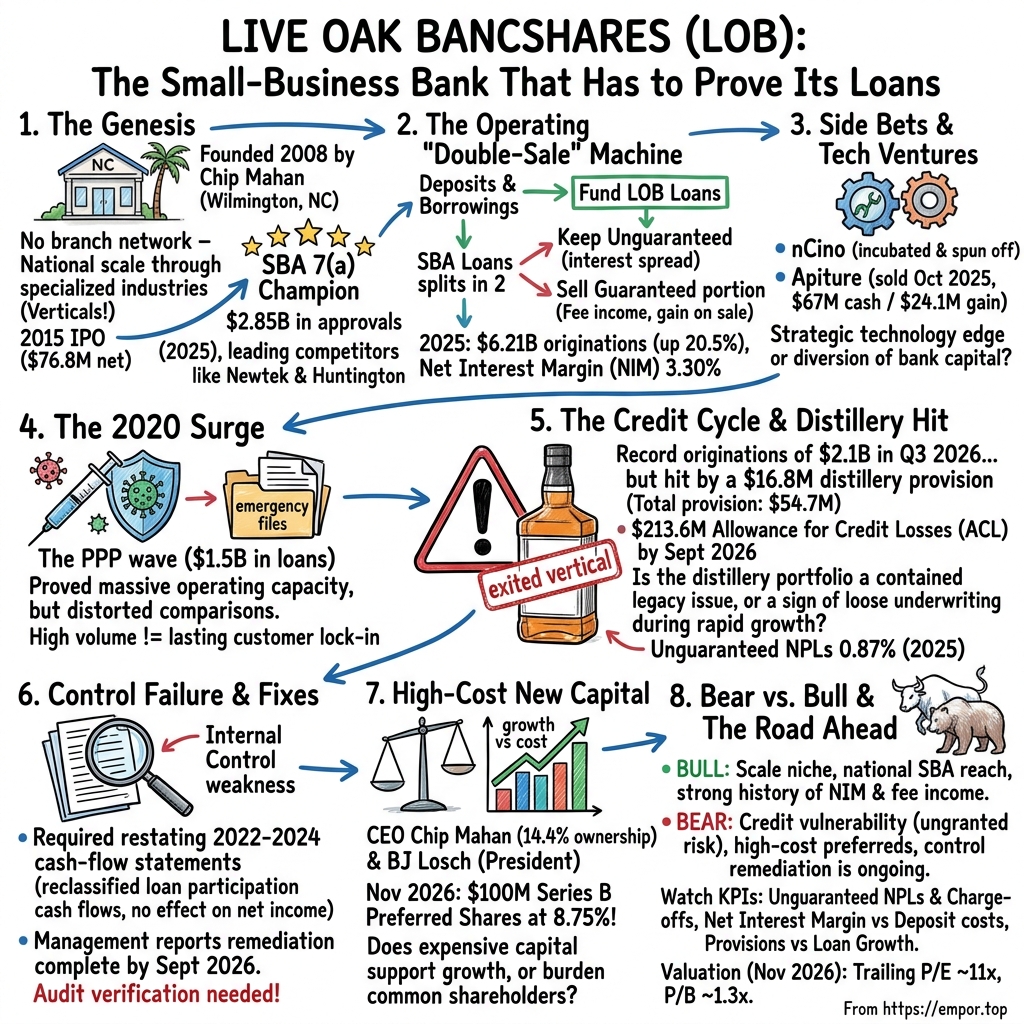
Live Oak Bancshares: The Small-Business Bank That Has to Prove Its Loans
I. A Record Quarter, and a $17 Million Reminder
On October 21, 2026, Live Oak Bancshares published the kind of quarterly number that usually lets a bank's management relax into its conference call. In the third quarter the bank had originated about $2.1 billion of loans, the most it had ever produced in three months.1 For a lender that built its reputation by financing veterinary clinics, pharmacies, self-storage operators, hotels and family-owned franchises across the country, that was a statement of reach. Borrowers kept arriving, and the machine built to serve them kept turning applications into loans faster than at any point in its history.
Then came the other line. Provision for credit losses, the money a bank sets aside today for loans it expects to lose tomorrow, was $54.7 million for the quarter.1 Of that, $16.8 million was tied to a single industry: distilleries, a vertical that Live Oak had already stopped actively lending to back in 2024.2 The bank was still paying for a decision it had reversed two years earlier. Diluted earnings per share came in at $0.52.1 A record quarter of production had been converted into a quarter whose earnings were shaped as much by old loans as by new ones.
That contradiction is the whole story in miniature. Live Oak is a bank whose growth engine is visible, measurable and impressive. Its loan production rises, its deposits rise with it, and its specialized teams keep finding borrowers that larger banks treat as a single undifferentiated category called "small business." But a bank's product is not the loan it makes; it is the loan that gets repaid. Every origination record is a promise about the future, and the provision line is where the future talks back.
The tension makes three questions worth asking over the course of this story. The first is whether vertical specialization, organizing an entire national bank around the specific industries its borrowers work in, gives Live Oak a lasting edge or simply a good way to win contested business. The second is whether growth earns its keep after credit losses, which is a harder test than whether growth happens at all. The third is newer and more uncomfortable: whether management has fully repaired the reporting controls that failed badly enough in 2025 to require restating three years of cash-flow statements and to draw an adverse opinion from the company's auditor on its internal controls.3
On the Q3 call, management leaned into the production story and described the distillery hit as the continuing cost of working out a portfolio the bank had already chosen to leave, with the timeline depending on borrower-specific circumstances and some of those borrowers still paying.4 That framing may prove right. A contained exit, in which a bank identifies a bad vertical early, stops lending and absorbs losses on the remaining book, is what good risk management looks like in practice. But a contained exit and a broader underwriting problem look identical for a while, because both show up first as elevated provisions. The way to tell them apart is to watch what happens outside the troubled vertical, and on that point the third quarter offered an uncomfortable clue: more than two-thirds of the quarter's provision, roughly $38 million, was not attributed to distilleries at all.1 Some of that reflects reserves set aside for the record new lending itself, because accounting rules require a bank to book expected lifetime losses the moment a loan is made. Some of it reflects deterioration elsewhere. The disclosures do not cleanly separate the two.
One piece of housekeeping before the story begins. Live Oak Bancshares, Inc. is the listed holding company, traded on the New York Stock Exchange under the ticker LOB.3 Its main operating subsidiary is Live Oak Banking Company, the chartered bank that makes the loans, takes the deposits and answers to bank regulators. When this story refers to "the bank," it means that operating company; when it refers to shareholders, capital raises or the stock, it means the holding company that owns it. The distinction matters because the holding company is where preferred stock is issued, where ownership sits, and where common shareholders ultimately collect, or fail to collect, what the bank earns.
So the opening scene poses the investor's question plainly. Live Oak can clearly grow. What remains unproven is whether that growth becomes durable common earnings once the credit bill arrives. To understand why the bank was built to grow this way in the first place, the story has to go back to Wilmington, North Carolina, in the worst possible year to start a bank.
 Subscribe on LinkedIn
II. The Bank Built Around Businesses the Giants Overlooked
In 2008, while the American banking system was discovering how much bad credit it had been carrying, Chip Mahan started a new bank in Wilmington, North Carolina.5 The timing looked almost perverse. Banks were failing by the dozen, regulators were wary of new charters, and the idea of building a national lender from a coastal city with no branch network sounded more like a dare than a business plan. Mahan, however, was not a first-time founder testing a theory. He had already helped build Security First Network Bank, widely regarded as the first internet bank, and had run S1 Corporation, the banking-software business that grew out of it.5 He had spent the 1990s arguing that a bank did not need marble lobbies to reach customers. Live Oak was his second attempt to prove that thesis, and this time the target customer was specific.
The founding idea was narrow on purpose. Instead of opening branches and lending to whoever walked in, Live Oak would pick an industry, learn it deeply and lend to it nationwide. The first industry was veterinary medicine.5 A veterinary practice is an unusual small business: its owner is often a clinician rather than a financier, its cash flows depend on patient volume and staffing, and its value lies in equipment, goodwill and the reputation of a particular doctor in a particular town. A community banker in one county might see a handful of veterinary deals in a career. A lender that saw hundreds could learn what a healthy practice looked like, what a failing one looked like, and which numbers on a spreadsheet mattered most. That knowledge, Mahan bet, could be turned into faster decisions, better pricing and lower losses than a generalist could offer.
The second half of the design came from Washington. The Small Business Administration's 7(a) program lets approved lenders make loans to eligible small businesses with a federal guarantee covering part of the exposure.3 The guarantee does not make the loan risk-free for the bank, which still has to find the borrower, underwrite the credit, document the deal, fund it and service it for years. But it changes the economics in two ways. It limits the bank's loss on the guaranteed share if the borrower defaults, subject to the program's rules being followed. And it creates a saleable asset, because investors will buy the guaranteed portion of these loans in a secondary market. A bank that originates efficiently can therefore lend more than its own balance sheet might otherwise comfortably carry, selling part of each loan and keeping the rest.
Put the two ideas together and the shape of Live Oak appears. Specialized teams organized around borrower industries, a national footprint delivered through technology and travel rather than branches, and a funding model that leaned on government guarantees and loan sales. Over time the industry list widened well beyond veterinarians to include healthcare practices, agriculture, hospitality, energy and other verticals, and the bank also began lending outside the SBA program where it believed its industry knowledge justified it.3
The first big test of the model in public came in July 2015, when Live Oak Bancshares went public. It sold 4.8 million shares at $17 each and took in about $76.8 million of net proceeds.6 The prospectus read like a description of a fintech company that happened to hold a bank charter: it emphasized the technology platform, the vertical teams and the company's minority stake in nCino, a cloud banking-software business that had been started inside Live Oak and spun out as a separate company.5 Investors were being sold two things at once, a lender and a builder of banking technology, and that dual identity would follow the company for the next decade.
The bank kept its headquarters in Wilmington and kept growing without a conventional branch network. By the end of 2025 it employed 1,027 full-time staff, along with 13 part-timers and 37 contractors.3 That is a modest headcount for a bank originating more than $6 billion of loans a year, and it is the clearest single number behind the founding bet: a relatively small organization, spread across the country by industry rather than by geography, moving a very large volume of credit. In 2022 the company moved its stock listing from Nasdaq to the New York Stock Exchange, a symbolic graduation from the tech-adjacent exchange where it had debuted.7
It is easy to tell this origin story as a triumph of insight, and much of it was. But the honest version needs one caveat now, before the story goes further. Specialization explains why Live Oak can win deals and learn quickly. It does not, by itself, prove a durable moat. Knowing an industry deeply is valuable right up to the moment the industry itself turns against you, and a concentrated expert can be concentrated in the wrong place. The distillery charge in the opening scene is what that risk looks like in a quarterly report.
So the question becomes mechanical before it becomes strategic. To judge whether specialization makes money, you have to understand exactly how a single Live Oak loan turns into revenue, and why it can leave the bank twice.
III. A Loan Leaves the Bank Twice
Picture a dentist in Ohio who wants to buy the practice where she has worked for six years. The retiring owner wants a fair price, the practice has steady patient flow, and the buyer has clinical skill but limited savings. A Live Oak lender who works only with dental and healthcare practices takes the call, already knowing roughly what such practices earn per chair, how staff turnover affects revenue, and what a sensible purchase price looks like. The loan gets structured under the SBA 7(a) program. Once it closes, the money starts moving along two tracks.
On the first track, Live Oak sells the guaranteed portion of the loan to an investor. The bank books a gain on that sale, because the guaranteed slice, backed by the federal government, commands a premium in the secondary market. Often Live Oak keeps the job of servicing the loan, collecting payments and managing the borrower relationship, and earns a servicing fee for doing so over the life of the loan.3 On the second track, the bank keeps the unguaranteed portion on its own balance sheet, funds it with deposits and earns interest on it for years. That retained piece is where the bank carries the most direct credit risk. If the dentist's practice fails, the guarantee absorbs part of the loss on the guaranteed share, but the unguaranteed slice is Live Oak's problem.
That is why the loan "leaves the bank twice." Part of it leaves immediately, sold to investors, generating an upfront gain. The rest stays, generating spread income, but it eventually leaves too, either repaid on schedule or, in the cases that matter most for this story, worked out through collection and recovery. The economics of the whole company are the sum of millions of these decisions.
The business model has four moving parts, and each one can break independently. Deposits and borrowings fund the retained loans, so the bank pays interest on that funding. Interest income on the loans and securities has to exceed that cost by enough to pay for the origination platform, the servicing staff and the technology. Loan sales create gains and servicing revenue, which depend on how much investors will pay for guaranteed loan portions. And provisions absorb expected credit losses, reducing earnings in advance of the actual defaults. The company itself says it does not typically enter into long-term revenue contracts, and its remaining service obligations are largely short.3 This is a spread-and-origination business. It is not subscription revenue, and nothing about it recurs automatically.
In 2025 the machine ran hot. Loan originations rose 20.5% to $6.21 billion.3 Net interest income, the spread between what the bank earns on assets and what it pays for funding, grew 19.3% to $448.4 million.3 Net interest margin, the spread expressed as a percentage of earning assets, edged up from 3.27% to 3.30%.3 Those three numbers belong together, because they reveal something important about the quality of the growth. A bank can grow loans quickly by underpricing them or by paying up for deposits, and when it does, the margin shrinks. Live Oak grew loans by a fifth while holding its margin roughly steady and nudging it slightly higher. That suggests the growth was not bought simply by cutting prices or overpaying for funding, at least through the end of 2025.
The funding side deserves more attention than it usually gets in stories about specialized lenders, because it is where a fast-growing bank without branches is most exposed. Live Oak gathers deposits nationally, largely online, which means it competes for savers with every other bank and online platform offering a yield. Online deposits can be gathered quickly, but they can also be price-sensitive: a saver who opened an account for a rate can move it for a better one. For the first nine months of 2026, total deposits rose by about $1.78 billion, which was the main financing source for loan growth.2 That inflow is impressive. Whether it is sticky, or whether it will need ever-higher rates to retain, is a question the next phase of the story keeps returning to, because a lender that grows faster than its low-cost funding eventually finds the spread working against it. On the Q3 2026 call, management and analysts spent real time on deposit pricing for exactly this reason.4
Here is a feature of bank accounting that confuses many investors who come from industrial companies. In a manufacturer, operating cash flow running well above net income often signals high-quality earnings. In a bank, cash flow statements are dominated by the bank's own business activity. Loans originated for sale and the proceeds from selling them flow through operating cash flow, while loans held on the balance sheet flow through investing activities, and deposit growth flows through financing. In the first nine months of 2026, Live Oak's consolidated net income was $92.9 million, while operating cash flow was $245.3 million.2 The gap tells you almost nothing about earnings quality. It reflects non-cash items such as the $100.6 million provision, about $21 million of stock compensation and roughly $19 million of depreciation and amortization, plus roughly offsetting flows of about $1 billion each in loans originated for sale and sold.2 For a bank, the useful questions are the ones about spread, credit and capital, not about cash conversion.
So the engine is clear. Live Oak earns money when it originates a lot of loans, sells guaranteed pieces at good prices, funds the rest at a reasonable cost and loses less than it expected on the loans it keeps. Through 2025, the first three conditions were plainly met. The fourth is the one the opening quarter called into question. Before reaching that reckoning, though, the story needs one earlier episode in which the machine ran at a speed no one had seen before, and briefly made its own growth hard to read.
IV. The Pandemic Made the Machine Visible, and Harder to Read
In April 2020, the federal government opened the Paycheck Protection Program, an emergency lending effort designed to keep small businesses paying workers while the economy shut down. The program was administered through the SBA and delivered through private lenders, which meant banks suddenly had to process an extraordinary flood of applications under rules that were being written and revised in real time. For many large banks, PPP was an operational crisis. For Live Oak, it was something closer to a stress test of the machine it had spent twelve years building.
The bank already had what PPP demanded: a national, digital origination platform, deep familiarity with SBA rules and processes, and a culture built around small-business borrowers rather than retail consumers. When the program opened, it pushed volume through at a pace that made its usual numbers look small. For full-year 2020, Live Oak's loan originations reached $4.45 billion, up 122.3% from the prior year.8 At year-end, PPP loans accounted for about $1.50 billion of the balance sheet.9
That headline number is the reason this period requires care. A 122% increase in originations is not a growth rate any investor should extrapolate, because most of it was the temporary product of a government emergency. Strip PPP out and the picture changes. Excluding PPP, Live Oak originated about $2.69 billion of loans in 2020, up 34.3%.8 That is still a strong number, especially in a year when many lenders retrenched. But it is the number that describes the underlying business, and it is roughly a third of the headline growth rate.
Telling the two apart matters because PPP loans were economically unlike Live Oak's core product. They carried government-set terms, a fully guaranteed structure and a path to forgiveness that meant most balances would vanish from the books within a year or two. The fees were real income, and the operational achievement was real. But a PPP loan does not prove that a borrower will return for a practice-acquisition loan, open a checking account or become a profitable long-term relationship. Volume measured how fast the machine could run. It did not measure the lifetime value of what it produced.
There is a consensus version of this period worth checking. In that version, the pandemic proved that Live Oak's technology-first model was superior, and the bank emerged with a structural advantage. The record supports a narrower claim. The pandemic proved that Live Oak could process an enormous volume of SBA-administered loans quickly and accurately, which is a genuine operational strength that mattered in a crisis. It did not show that the bank had won market share it would keep, because the program was temporary and its economics were set by Congress rather than by competition. The more useful evidence came afterward, in whether non-PPP originations continued to grow once the emergency volume rolled off. They did: by 2025 the bank was originating $6.21 billion a year in its ordinary business, more than double the 2020 non-PPP level.3
The pandemic also changed how investors saw Live Oak. In 2020 and 2021 the bank looked like a growth story with a technology halo, and the stock was priced accordingly. That perception would fade as interest rates rose, funding costs climbed and credit costs normalized. A bank that looked like a fintech in a zero-rate world started to look like a bank again once money cost something.
The lasting legacy of PPP for Live Oak may be the operating confidence it created: proof that the platform could scale, and a deeper store of relationships with small-business owners who had seen it perform when their larger banks were overwhelmed. Whether that confidence translated into a durable advantage is a competitive question, not an operational one. Every lender in the SBA market saw the same program and fought for the same borrowers. Which leads to the uncomfortable truth behind Live Oak's leadership position: being the biggest in a niche is not the same as owning it.
V. The SBA Leader Has Rivals, and Borrowers Have Choices
Every year, the SBA's lending statistics produce a league table, and every year Live Oak's name sits at or near the top by dollar volume. In the federal fiscal year 2025, Live Oak reported about $2.85 billion of SBA 7(a) approvals, ahead of roughly $2.10 billion for Newtek and about $1.53 billion for Huntington in one widely circulated lender comparison.10 Live Oak's own investor materials highlight its position as the leading 7(a) lender by dollars.11 On the surface, that is a moat in a sentence: the biggest specialist in a government-backed niche, with a decade-plus head start.
The comparison needs to be read on the same basis before it is admired. These figures are SBA 7(a) approvals, not the whole small-business lending market, which also includes conventional bank loans, equipment finance, credit cards, merchant cash advances, online lenders and the enormous volume of credit that community banks extend to local customers they have known for decades. And dollar leadership is not loan-count leadership. Live Oak's average SBA loan is larger than many competitors' because it often finances business acquisitions, real estate and practice purchases.3 A lender that makes many more small loans can serve more borrowers while producing fewer dollars. So Live Oak leads a defined category on one measure. It does not dominate small-business credit.
The competitive structure is easiest to understand through the five forces that shape any industry's economics. Borrowers have real power, because a business owner seeking a practice-acquisition loan can and often does compare offers from multiple lenders, and SBA loans have standardized structures that make comparison easier. Rivalry is intense: large banks such as Huntington, nonbank SBA specialists such as Newtek, community banks, credit unions, finance companies and fintech platforms all compete for the same borrowers. Funding is contested, because deposits are the bank's main raw material and savers can move money with a few clicks. Substitutes exist in conventional loans, seller financing and private credit. And the program's own rules, set by the SBA and Congress, shape guarantee levels, fees and eligibility in ways that no lender controls. That last force is distinctive: the government is both the source of Live Oak's favorable economics and a party that can change them.
Against those pressures, Live Oak's claimed advantages are three. The first is vertical expertise: lenders who know the borrower's industry well enough to underwrite faster and more accurately than a generalist. The second is national reach without branches, which lets a small team serve borrowers anywhere. The third is the ability to originate and sell guaranteed loan portions at scale, which turns origination skill into fee income and recycles capital. These are credible advantages, and the bank's growth through 2025 is evidence that they work.
The harder test is whether they create lock-in. Here the record is thin, and the thinness is itself informative. At year-end 2025, Live Oak had 75 borrower relationships with retained unguaranteed exposures above $20 million each, totaling about $3.32 billion of retained exposure, of which roughly $2.33 billion had been disbursed.3 That shows the bank is building substantial relationships with larger borrowers, which is a sign of trust in both directions. But the company does not publish a top-ten borrower share, a customer-retention series, repeat-borrower rates or win-loss data against competitors. Without those, it is impossible to say whether borrowers stay with Live Oak because switching is costly, because the bank is genuinely better, or simply because it was the best offer the last time they shopped.
The bank's newer initiatives show both its ambition and the limits of its current position. Live Oak Express, a small-dollar lending product designed to serve borrowers who need smaller loans quickly, produced about $107 million of originations in the third quarter of 2026, according to management on the earnings call.4 That is a meaningful start, but it is about 5% of the bank's $2.1 billion quarterly total. It is a growth initiative inside the core business, not a second engine, and it pushes Live Oak into the part of the market where lenders that specialize in volume and speed are strongest.
The fairest conclusion is that Live Oak is specialized and scaled, but its moat is not yet proven durable. The evidence supports a real edge in underwriting knowledge and origination capacity. It does not support claims of pricing power, because borrowers can shop and margins depend on funding costs that the bank does not control. It does not support claims of an unassailable distribution position, because rivals with large balance sheets and existing customer bases make substantial SBA volumes of their own. The signals that would strengthen the moat case are Live Oak holding or gaining 7(a) share as competitors push harder, stable or rising premiums on guaranteed loan sales, and deposit costs that do not need to rise faster than peers' to fund growth. The signals that would weaken it are the opposite.
There is one more thread in Live Oak's competitive identity that does not fit neatly into the five forces: the company's long habit of building and investing in banking technology outside the bank itself. That habit produced one famous success and a series of smaller bets, and in 2025 it produced a sale that made an otherwise ordinary year look unusually profitable.
VI. The Side Bets: From nCino to the Apiture Sale
In October 2025, a digital-banking software company called Apiture changed hands. The buyer was Computer Services, Inc., a provider of technology to community banks, and among the sellers was Live Oak, which had been connected to Apiture as a strategic technology relationship and equity investor. Live Oak received about $67 million in initial cash proceeds and recognized a pretax gain of roughly $24.1 million.3 For a bank whose common net income that year was $102.8 million, that was not a rounding error.3
The Apiture sale belongs to a longer tradition. Live Oak's founder had built banking software before he built this bank, and the company has repeatedly treated technology as something to own, incubate or invest in rather than simply buy from vendors. The best-known example is nCino, the cloud-based loan-origination and banking-platform company that was started inside Live Oak and became a separate business, with Live Oak holding an equity stake when it went public in 2015.5 nCino later became a separately listed software company in its own right. It is important to keep the two businesses distinct: nCino's revenue, customers and valuation belong to nCino, not to Live Oak's bank. What nCino demonstrates is that Live Oak's leadership could identify a real software opportunity from inside a bank. What it does not demonstrate is that the bank's shareholders should expect a steady stream of such outcomes.
Apiture's history with Live Oak also carried a governance dimension. Apiture was a related party until October 21, 2025, meaning that transactions between the two companies required disclosure because of the ownership and management connections. During 2025, before Apiture ceased to be related, Live Oak paid it about $3.8 million for professional services and received about $187,000 for shared services and rent.3 Those amounts are small, roughly 0.7% of consolidated revenue, and the company does not suggest they were mispriced.3 But they illustrate why investors should keep an eye on the web of relationships among Live Oak, its founder, its directors and the ventures they invest in together. The company and two directors also held carried interest in Canapi Ventures, a fintech venture fund, recognizing about $0.5 million in 2025.3 None of these sums threatens the bank. Together they describe a culture in which the line between operating a bank and investing in the ecosystem around banking has always been porous.
The more material consequence of the Apiture sale is what it did to the shape of 2025 earnings. That year, noninterest income, everything other than spread income, totaled about $129.5 million, while income before taxes was roughly $142.8 million.3 Noninterest income equaled about 91% of pretax income. A simple piece of arithmetic shows why that matters. Take net interest income of $448.4 million, subtract the year's provision and operating expenses, and what remains before noninterest income is only about $13 million. The fee and gain lines, including loan-sale gains, servicing revenue and the equity-method income lifted by the Apiture sale, made the difference between a barely profitable spread business and a solidly profitable bank. That overstates the case somewhat, because the bank's expense base supports the loan-sale and servicing business too; those costs would not disappear if the fees did. But it shows how much the year depended on revenue lines that move with market conditions and one-time events.
Equity-method income associated largely with the Apiture sale rose by about $28.3 million, while other noninterest income fell by about $20.2 million, and the year also included a $9.0 million gain on the sale of an investment portfolio and about $5.5 million of fair-value losses on equity warrant assets.3 These are the fingerprints of a company whose reported earnings include marks, divestitures and venture outcomes alongside its core banking. None of these items is improper. All of them are lumpy.
So was the side-bet strategy good for Live Oak's shareholders? The honest answer is that the disclosures do not allow a full calculation. The Apiture gain is known, but Live Oak does not publish the total capital it invested in Apiture over its life, the full cost of the strategic relationship or a portfolio-level return on its technology investments. It is possible the cumulative record is excellent, with nCino as the anchor. It is also possible that a few large wins mask smaller disappointments. What can be said with confidence is that this activity is not an acquisition-led strategy; there is no defining whole-company purchase in Live Oak's history to judge. The record centers on incubation, minority investments and exits. And the Apiture sale, however profitable, does not establish a repeatable venture-return engine.
That leaves a clean question for the years ahead. Will future growth in Live Oak's earnings come from its loan and deposit franchise, or will it continue to depend on episodic gains from investments? The answer matters more now than in 2025, because the franchise's credit costs started rising just as the gains became harder to repeat, and nowhere did those costs rise more visibly than in a vertical that had once looked like a perfect example of specialized lending.
VII. The Credit Cycle Finds the Distilleries
A craft distillery is a beguiling business to lend to. It has real assets: stills, warehouses, barrels of aging spirits. It has a story that resonates with local customers and tourists. And it has a gap between spending and earning that can stretch for years, because whiskey has to age before it can be sold at full value. In the years before the pandemic, American craft spirits grew rapidly, and a lender that understood the industry's equipment, inventory and distribution could finance founders that generalist banks would not touch. Live Oak built a distillery vertical to do exactly that.
The trouble with an aging business is that it is a bet on future demand. If demand softens, inventory accumulates, prices fall and the barrels that were supposed to pay off the loan become harder to sell. Management said it identified headwinds in the distillery vertical in 2024 and stopped active lending to it then.2 That is the kind of decision a specialized lender is supposed to be able to make: see trouble in an industry before a generalist would, and stop. The problem is that stopping new loans does nothing about the old ones. A bank exiting a vertical still owns every loan already on its books, and it has to work through each one as borrowers struggle, restructure, sell or fail.
By the third quarter of 2026, two years after the bank stopped lending, the distillery book still required a $16.8 million provision.1 Management's description on the call was careful: the timeline depends on borrower-specific circumstances, and some distillery borrowers are still paying.4 Analysts pressed on how much exposure remained and on credit trends more broadly; management did not offer a refreshed provision range for the remainder of the year, and it characterized the growth in classified loans as not reflecting broad-based deterioration.4 That is a reasonable thing for a bank to say. It is also exactly what a bank would say in either version of the story, which is why the numbers matter more than the description.
The numbers are not reassuring by themselves. For the first nine months of 2026, Live Oak's provision for credit losses was $100.6 million, compared with $74.5 million in the same period of 2025.2 Part of that increase reflects growth, because the bank had to reserve for the record volume it was originating. Part reflects distilleries. And part reflects what the company calls other portfolio changes. The allowance for credit losses, the bank's total reserve against expected future losses, stood at $213.6 million at the end of September 2026, up from $192.3 million at the end of 2025.2
To understand Live Oak's credit position, it helps to understand what the government guarantee does and does not do. The guarantee covers the guaranteed portion of eligible loans, subject to the program's terms. If the bank originated and serviced the loan correctly and the borrower defaults, the government absorbs the guaranteed share of the loss. That protection is real and valuable. But it does not cover the unguaranteed share Live Oak keeps, it does not remove the work of servicing, collecting and recovering on a troubled loan, and it depends on the bank having followed the rules. A guarantee is insurance on part of the loan, not a certificate that the loan was a good one.
This is why Live Oak's nonperforming loan figures look alarming at first and more manageable on a second read. At the end of 2025, nonperforming loans and leases totaled about $501.2 million.3 That sounds large for a bank with a loan book of this size. But roughly $399.8 million of that, about four-fifths, was guaranteed by the U.S. government.3 The part sitting more directly with the bank, the unguaranteed nonperforming loans, amounted to about 0.87% of loans held for investment.3 The allowance covered those unguaranteed nonperformers almost twice over.3 On that measure, Live Oak's reserves looked adequate at year-end 2025.
There is an external perspective worth noting, with a caveat attached. No public Moody's, S&P, Fitch or KBRA rating rationale for Live Oak is disclosed in the company's 2025 annual report or its September 2026 quarterly report. Weiss Ratings, a proprietary rating service rather than a nationally recognized statistical rating organization, described Live Oak Banking Company's capitalization and stability as good in August 2026, but rated its asset quality and profitability as fair, citing nonperforming loans at about 12.4% of core capital.12 That is not a public agency rating, and it should not be read as one. But its caution on asset quality points in the same direction as the provision trend.
It helps to separate three words that are often blurred together in bank results. A provision is an estimate: money set aside now for losses the bank expects over the life of its loans. A charge-off is a confession: the moment the bank admits a specific loan will not be repaid and writes it off against the reserve. A classified loan sits in between, a credit that examiners or the bank itself have flagged as weak but that has not yet failed. Think of it as a hospital. Provisions are the beds the hospital prepares, classified loans are the patients in the waiting room, and charge-offs are the patients who did not recover. A bank can raise provisions because it is growing, because it is prudent, or because it already sees patients arriving. Only the flow from the waiting room into charge-offs reveals which. That is why management's assurance that classified-loan growth is not broad-based matters, and also why it cannot be the last word: the waiting room has to empty without too many patients being lost.
The weight of the evidence supports a narrow conclusion. Exiting the distillery vertical was a concrete course correction, the kind specialized lenders claim they can make. But the losses continued for two years after the exit, and in the most recent quarter more than two-thirds of the provision came from somewhere other than distilleries. The record therefore narrows the claim that specialization protects Live Oak from credit problems. Specialization may help the bank spot trouble earlier. It did not prevent the bank from building a book of loans in a vertical that went bad, and it has not yet shown that the damage stayed in that one vertical. Whether deterioration outside distilleries is broadening is the most important open question in the story, and the next disclosures will settle it: full-year 2026 provision and net charge-offs, remaining distillery balances and migration in classified loans across the bank's other industries.
Absorbing losses like these takes capital, and growing through them takes more. In November 2026, Live Oak went to the market for it, and the terms said something about how expensive that capital had become.
VIII. Chip Mahan's Bank, and the Price of New Capital
In early November 2026, Live Oak Bancshares filed a prospectus supplement for a new class of preferred stock. The offering closed on November 12: 4.0 million depositary shares representing interests in Series B preferred stock, with an aggregate liquidation preference of $100 million and a non-cumulative dividend rate of 8.75%.1314 The company said it would use the proceeds for general corporate purposes, including supporting balance-sheet growth and enhancing capital.13
The decision tells a story about both ambition and cost. Live Oak had already issued Series A preferred stock in 2025, raising about $96.3 million of net proceeds.3 Series B doubled down. Preferred stock is attractive to a bank because it counts as regulatory capital without diluting common shareholders' ownership. But it is not free. An 8.75% dividend on $100 million is about $8.75 million a year, paid before common shareholders receive anything. "Non-cumulative" means that if the board skips a dividend, the bank does not owe it later, which protects the bank in a crisis but makes the security riskier for preferred investors, which is part of why the rate is high. For common shareholders, the arithmetic is simple. New lending funded by this capital has to earn more than its funding cost, its credit losses, its operating cost and an 8.75% preferred dividend before it adds anything to their earnings. The gap between consolidated and common earnings is already visible: for the first nine months of 2026, consolidated net income was $92.9 million, while net income available to common shareholders was $86.9 million.21 Series B will widen that gap. Taken together, the two preferred issuances put roughly $200 million of capital ahead of the common stock in about eighteen months, which is a meaningful layer for a company whose annual common earnings were about $103 million in 2025.314 The holding company's other funding sources are modest by comparison: borrowings were about $99.8 million at the end of September 2026, and it had a $100 million unsecured revolving line, undrawn at year-end 2025, running to October 2028 with covenants requiring minimum capital and debt-service coverage.23 Choosing preferred stock over that cheaper line says the bank needed permanent regulatory capital, not just liquidity, which is what a lender growing assets by about 15.7% a year requires.2
The person most exposed to that trade-off is the founder. As of January 31, 2026, Chip Mahan beneficially owned about 14.4% of Live Oak's shares, and directors and executive officers together owned about 22.4%.15 Mahan remains chairman and CEO. In most companies, an ownership stake of that size is strong evidence of alignment: the CEO makes money the same way common shareholders do. His compensation reinforces the point. Mahan's total compensation was about $965,000 in 2025, $845,000 in 2024 and $905,000 in 2023, remarkably low for the CEO of a bank of this size.15 He is not paid like a hired manager; he is paid like an owner whose real economic interest lies in the share price.
But alignment has a complication. Mahan's beneficial ownership includes pledged shares, used as collateral for a personal credit line that had a balance of about $25.9 million at January 31, 2026.15 This is a personal borrowing, not company debt, and it is disclosed as it should be. The governance concern is narrower: pledged shares can create pressure to sell if the stock falls sharply and the lender calls for more collateral. Directors Neil Underwood and William Williams have also pledged shares.15 None of this is unusual among founder-led companies. It is a detail investors should know, because it adds a thread connecting the founder's personal finances to the stock.
The management team around Mahan has changed meaningfully. BJ Losch, a former CFO of Truist, became president, and his compensation shows how the company handled the transition. In 2024 his total compensation was about $13.1 million, almost all of it a $12 million grant-date value award of 250,000 restricted stock units tied to his promotion; in 2025 his total was about $2.8 million.15 Walter Phifer became CFO in January 2024.15 In June 2026, chief accounting officer Wesley Sutherland left, and Phifer took on the role of principal accounting officer on an interim basis while the company searched for a replacement.16 That combination of roles is relevant to the reporting-control story that follows. In October 2026, Renato Derraik, the chief information and digital officer, announced his resignation effective November 6.17 The company did not connect his departure to any change in technology strategy.
Shareholders have shown that they are paying attention. At the 2025 annual meeting, only about 67.1% of votes supported the company's executive compensation in the advisory say-on-pay vote, a weak result that usually prompts boards to engage with investors. By May 2026 support had recovered to 88.2%.1815 The same meeting produced substantial withheld votes against two directors: about 9.0 million shares withheld for William Cameron and about 7.7 million for Yousef Valine.18 Those are not losing votes, but they are signals that some shareholders want more accountability from the board.
The ownership register beyond insiders is institutional. T. Rowe Price, BlackRock and Vanguard were each listed as owning more than 5%, though their reported stakes come from filings of different dates and are not a consistent time series.15 There is no controlling shareholder, but the insider group's combined stake is large enough to be influential in any contested matter.
An activist reading this record would ask a pointed question about capital discipline. Live Oak's history includes an IPO, two preferred issuances, venture investments and incubations, but no buyback program appears in its recent filings and no defining acquisition-led expansion. That is not a criticism in itself; a growing bank that needs capital should not be buying back stock. But it means that the company's capital allocation story is overwhelmingly about growth: raise capital, lend it out, and trust that the loans earn more than they cost. When credit costs rise, that trust gets tested. The fairest verdict is that Mahan's ownership is a genuine alignment strength, and the Series B proceeds give the bank more room to grow. But the new 8.75% claim raises the hurdle for common holders, and whether the founder's alignment produces discipline will be judged by whether incremental lending clears that hurdle after losses. The first evidence will arrive in 2027.
There is a second test of management, quieter than the capital one but just as consequential, because it concerns whether the numbers themselves can be trusted.
IX. The Restatement That Put Reporting on the Story's Critical Path
When Live Oak's auditor signed its report on the 2025 financial statements, it delivered two opinions. On the financial statements themselves, the opinion was unqualified: the auditor concluded the numbers fairly presented the company's financial position. On internal control over financial reporting, the opinion was adverse.3 The company had identified a material weakness in how it accounted for and classified loan-participation activity in the income and cash-flow statements, and as a result it restated its cash-flow statements for 2022, 2023 and 2024.3
A loan participation is a common arrangement in which a bank sells part of a loan to another lender, which then shares in the payments and the risk. For a bank like Live Oak, which sells parts of loans routinely, getting the accounting for these transactions right is not a technicality. It goes to the heart of how cash moves through the business. The weakness involved classification, in other words, which part of the cash-flow statement certain flows belonged in, and how those flows appeared in the income statement. The company did not disclose a restatement of reported net income. That distinction matters: investors were not told that the bank's profits had been wrong. They were told that the controls designed to make sure the numbers were right had failed in a specific area, and that three years of cash-flow presentations had to be corrected.
Why should this matter to an investor if earnings were not restated? Because a bank's financial statements are the primary way outsiders can judge the quality of its loans, its funding and its capital. A material weakness means there was a reasonable possibility that a material misstatement would not be caught in time. In a business whose value depends on trust in reported credit quality, even a classification failure raises the question of what else might be fragile.
The nine-month 2026 cash-flow statement shows why classification errors in this area are easy to make and hard to spot. Net income was $92.9 million, while operating cash flow was $245.3 million; investing cash use included about $1.64 billion net for loan originations and principal collections, and financing included that $1.78 billion deposit increase.2 Those are enormous flows relative to earnings, and moving a few hundred million dollars of loan-participation activity from one category to another can change the picture considerably without touching net income. The lesson is not that operating cash flow tells you something about Live Oak's earnings quality, because for a bank it largely does not. The lesson is that the reporting systems handling these flows have to be precise, and for at least three years they were not.
Management's response has been to redesign and test the controls. In the September 2026 10-Q, it reported that the material weakness had been remediated as of September 30, after enhanced controls over loan-participation activity had operated and been tested.2 That is real progress, and it was reported within the year, which is what investors should want. But a management assertion of remediation is not the same as an auditor's clean opinion. The decisive confirmation will come with the 2026 annual report, when the auditor issues its next opinion on internal control. A clean opinion without another restatement would close the matter. Anything else would reopen it with greater force.
The officer changes of 2026 fit into this story in proportion. The departure of the chief accounting officer in June and the CFO's interim assumption of the principal accounting officer role mean that the person responsible for remediation also carries the accounting function directly while a successor is found.16 That concentration of responsibility is common during searches, but it is worth watching until a permanent chief accounting officer is named. The October departure of the chief information and digital officer is a different matter. It would matter for the story only if management connected it to technology execution or strategy, and it has not done so.17
The reporting failure is now part of Live Oak's history, and its resolution is on the path to the next annual report. With that, every major strand of the investment case is on the table: a scaled franchise, rising credit costs, expensive new capital and a control fix awaiting confirmation. The market has already put a price on that mix.
X. Analysis & Bear vs. Bull Case
On November 20, 2026, Live Oak's shares traded at roughly 11 to 12 times trailing earnings and about 1.3 times book value, well below the highs the stock reached in 2024.19 For a bank whose common earnings rose about a third in 2025, from $77.5 million to $102.8 million, after barely growing from $73.9 million in 2023, that looks like a modest valuation.3 The question is whether the market is discounting a temporary credit hangover or pricing a structurally riskier bank.
A low headline multiple on a lender whose credit costs are rising is not, by itself, evidence of value. Bank earnings are a net figure after provisions, and provisions can move faster than revenue. If the market expects credit costs to keep rising, a multiple of 11 or 12 times today's earnings may be a multiple of much more on tomorrow's. If credit normalizes and the distillery exit finishes, the same multiple may prove cheap. The price-to-book ratio of about 1.3 tells a similar story: investors are paying a premium to the accounting value of the bank's equity, which suggests they still believe the franchise earns more than its cost of capital, but not a large enough premium to suggest confidence that it will compound rapidly. Valuation comparisons against a consistent peer set are beyond what can be fairly stated here, and this story offers no view on what the stock should be worth.
Where the edge holds and where it ends
Start with the bull case, which rests on a real franchise. Live Oak has a scaled national SBA lending business, industry-specialized teams that have been built over nearly two decades, and an established way of earning money from both spread income and loan-sale and servicing revenue. Originations and net interest income grew strongly in 2025 while the margin held. Common net income for the first nine months of 2026 was about $86.9 million, ahead of about $58.7 million in the same period a year earlier, even after higher provisions, and revenue grew from about $405 million to $477 million.1 Deposits grew enough to fund the growth. The bank has fresh preferred capital to support further expansion and a borrowing capacity of nearly $4 billion across eligible facilities.3 In the bull's telling, the distillery problem is the expensive tail of a vertical already exited, and the rest of the book is performing within the range a growing bank should expect.
The bear case is equally concrete. The unguaranteed slices of Live Oak's loans carry real credit risk, and the provision trend shows that risk is rising. The distillery exit has been costly for two years after new lending stopped, and the latest quarter's provision was mostly from elsewhere. Noninterest income can be lumpy: in 2025 it was flattered by a one-time gain, and the spread business alone barely covered provisions and expenses. The new Series B preferred, at 8.75%, ranks ahead of common shareholders and raises their return hurdle. And the control weakness, though reported as remediated, still needs a clean auditor opinion to be put behind the company.
Running the industry's forces through Live Oak's actual economics sharpens both cases. Buyer power is meaningful, because small-business borrowers shop and SBA products are standardized. Supplier power, in a bank, means the power of depositors, and Live Oak's reliance on nationally gathered online deposits makes that power real: if savers demand higher rates, margins compress. The threat of substitutes is moderate, because borrowers can turn to conventional loans, seller financing or nonbank credit. Rivalry is intense and includes large, well-capitalized banks. And regulation, through the SBA and Congress, can alter guarantee levels, fees and eligibility, which makes the government a silent party to the bank's profitability. This is not an industry structure that grants anyone easy pricing power.
Hamilton Helmer's seven powers offer a stricter test of whether Live Oak has a durable advantage. The bank plainly has scale in SBA origination, but scale economies in lending are modest once a platform is built, and larger banks have their own. It has no network effects in any meaningful sense: one borrower's loan does not make the next borrower's more valuable. Switching costs exist mainly during a loan's life, because refinancing an SBA loan is cumbersome, but they do not prevent a borrower from going elsewhere for the next one, and Live Oak publishes no retention data to show they do. Brand is real within certain professional communities such as veterinary and dental practices, but it is unproven as a source of pricing power. Live Oak has no cornered resource, because the SBA program is available to any approved lender. Counter-positioning is the most interesting candidate: a branchless, industry-organized model that a large branch-based bank cannot easily copy without cannibalizing its own structure. That power was more potent in 2010 than it is today, now that digital lending is common. The most plausible source of durable advantage is process power, accumulated underwriting knowledge and operating routines that are hard to replicate. The distillery episode is the strongest disconfirming evidence against that claim, because it shows the process can produce concentrated losses. The verdict is that Live Oak has a narrower advantage than its leadership position suggests: genuine process knowledge and counter-positioning in a contested niche, not a moat that protects returns through a credit cycle.
Why it may win, and why it may not
The case for Live Oak winning from here is that specialized underwriting and repeatable origination economics could support profitable growth if loan pricing, deposit costs and loss performance remain sound. The bank's 2025 results show the engine can grow loans and net interest income together without obviously sacrificing margin. If the distillery losses wind down and the other verticals perform, the provision line would grow more slowly than the loan book, and earnings would compound.
The case against is that too much of the bank's success depends on factors it does not control. SBA rules and secondary-market demand for guaranteed loans are external. Borrowers and depositors shop. Competitors such as Newtek and Huntington have meaningful scale. And vertical concentration, the source of Live Oak's expertise, can also concentrate losses, as distilleries showed. A skeptical long-short investor would focus on the provision trend outside distilleries, the reliance on fee and gain income to make the spread business profitable, the rising cost of preferred capital and the need for a clean control audit.
For investors tracking whether the bull or the bear case is unfolding, three numbers matter most. The first is credit quality on the bank's own exposure: nonperforming unguaranteed loans, which stood at about 0.87% of loans held for investment at the end of 2025, together with net charge-offs; the direction since then has been toward higher provisioning.32 The second is net interest margin read alongside deposit costs; the margin was 3.30% for 2025, up slightly from the year before.3 The third is provision expense relative to loan growth, which rose to $100.6 million for the first nine months of 2026 from $74.5 million a year earlier.2 If those three readings stabilize while originations keep growing, the market's caution will look excessive. If they keep worsening, the low multiple will look like a warning rather than an opportunity.
A few risks sit around these KPIs rather than inside them. The first is policy: because so much of the bank's volume runs through SBA and USDA programs, a change in guarantee percentages, fees or eligibility would change the economics of every loan at once, and the bank cannot hedge that. The second is rates: an online deposit base reprices quickly, so a falling-rate environment helps funding costs while a rising one squeezes them, and floating-rate small-business borrowers feel higher rates as heavier debt service. The third is technology itself. The company explicitly lists artificial intelligence and technology deployment among both its opportunities and its risks.3 Better automated underwriting could make Live Oak faster, but it could also hand generalist lenders and fintechs a cheap version of the industry knowledge that once took Live Oak years to build. Technology expense rose about a quarter in 2025 to roughly $43 million, then held flat in the first nine months of 2026, which suggests the bank is spending to stay ahead rather than coasting.31 And the departure of the chief digital officer in the same autumn leaves that spending without its most recent steward.
The external view adds caution. Weiss's assessment of fair asset quality, cited earlier, is a proprietary view rather than a public agency rating, and should be treated as context, not as an authoritative credit verdict.12 The market-multiple snapshot is also only context, a single dated reading rather than a historical comparison.
The analysis ends where the story began: a growing franchise whose economics will be decided by credit. Which leaves the lessons that Live Oak's story teaches beyond its own stock.
XI. Lessons from a Bank That Chose Its Borrowers
Live Oak's founding wager was that a bank could choose its borrowers by industry rather than by geography, and that knowing a business deeply was worth more than being nearby. Almost two decades later, that wager has produced one of the largest SBA lenders in the United States, a $6.21 billion year of originations in 2025 and a platform that runs from a coastal North Carolina city.3 It has also produced the lessons that only this company could teach.
The first lesson comes from the vertical teams, the lenders who learned what a healthy veterinary practice looked like before anyone else had bothered. Their edge was never the spreadsheet; anyone could build that. It was the context around it, the understanding of what drives a practice's patient flow, staffing and value. Know the borrower's business well enough to see the risk that the spreadsheet misses. Specialization works only when the specialist actually knows more, and it fails the moment the specialist stops asking what the industry itself might do next.
The second lesson comes from the loan sale, the moment when the guaranteed slice leaves the bank and the bank keeps the rest. The SBA program let Live Oak lend more and recycle its capital, and the guarantee covered about four-fifths of the bank's nonperforming loans at the end of 2025.3 But the unguaranteed piece stayed, and so did the work of servicing and recovering every troubled credit. A guarantee can share the loss; it cannot make a bad loan good. For any lender that leans on government backing or securitization, the discipline has to come from the decision to lend, not from the structure that follows.
The third lesson comes from the distilleries. In 2024, Live Oak's leaders saw trouble and stopped lending. Two years later, they were still setting aside millions for loans made before that decision. Stopping new business is a decision. Getting out of the old business is the test. Every bank can announce an exit; only the charge-off record shows whether the exit was early enough.
The fourth lesson comes from the founder who built two banks around technology and paid himself less than a million dollars a year while owning a seventh of the company. Ownership aligns a founder with shareholders, but it does not make every capital decision cheap. An 8.75% preferred dividend is a bet that the next loan will earn more than it costs, and an owner-CEO's conviction is not a substitute for the arithmetic.
Those lessons describe what Live Oak has learned. The next year will show whether it has applied them.
XII. Epilogue
Tonight, Live Oak Bancshares sits between two kinds of record. Its loan production in the third quarter of 2026 was the largest in its history, and its provision for credit losses was the kind of number that makes analysts ask harder questions. It has fresh preferred capital, a reported fix for its reporting controls and a distillery portfolio it is still working through. None of these threads is finished.
The next annual report will be the first decisive moment. It will show full-year 2026 provision and net charge-offs, and with them whether the third quarter's elevated provisioning was a peak or a plateau. If charge-offs stay contained and the provision line grows more slowly than the loan book, the bull case that Live Oak is working through a contained exit gains its strongest evidence. If charge-offs rise outside distilleries, the bear case that growth has made underwriting harder to control gains equal force.
The same report will show how much distillery exposure remains. A shrinking balance, falling through resolutions and recoveries rather than additional write-downs, would suggest the exit is finally nearing its end. A stubborn balance, or migration of classified loans into other verticals such as hospitality or agriculture, would signal that the distillery problem was an early warning rather than an isolated event.
Funding will tell its own story. Investors should watch whether checking accounts and other lower-cost deposits grow fast enough to support the margin, or whether the bank has to pay up for online savings to fund its growth. Net interest margin and deposit costs, read together, will show whether the 2025 balance between growth and spread can survive in 2026 and 2027.
Then comes the auditor. The 2026 annual report will include a new opinion on internal control over financial reporting. A clean opinion, with no further restatement, would close the chapter that began with the adverse 2025 opinion. Anything less would put management credibility back at the center of the story.
And finally, the capital test. Over the coming years, Series B's $100 million will be deployed, and its 8.75% dividend will come due each year the board declares it. The question is whether the earnings generated by that capital exceed its cost. That is the ultimate test of growth: not whether Live Oak gets larger, but whether each additional dollar of lending makes common shareholders richer.
The central questions remain open for reasons the company can answer with future results. The credit cycle has to mature, the new capital has to earn its keep and the remediation has to survive an audit. Until then, Live Oak is a bank that has proven it can grow and has not yet proven that its growth compounds.
XIII. Outro
Return to that third quarter of 2026. Somewhere across the country, a dentist, a veterinarian or a franchise owner closed on a loan, one of about $2.1 billion of loans Live Oak made in three months.1 And in the same quarter, the bank set aside $16.8 million for distilleries it had stopped lending to two years before.1 Those two numbers sit side by side in the same report, and together they describe what makes Live Oak unlike a conventional bank.
A conventional bank knows its borrowers because they live nearby. Live Oak bet that it could know its borrowers because it understood their businesses, wherever they happened to be. That bet built a national bank from Wilmington. The proof of it was never going to be the size of the loan book. It is whether the knowledge holds up when the loans go bad, and whether the bank knows its borrowers well enough to see, before the spreadsheet does, when the model has failed.
References
-
Live Oak Bancshares, Inc. Reports Third Quarter 2026 Results — SEC, 2026-10-21 ↩↩↩↩↩↩↩↩↩↩
-
Live Oak Bancshares, Inc. Q3 2026 Form 10-Q — SEC, 2026-11-05 ↩↩↩↩↩↩↩↩↩↩↩↩↩↩
-
Live Oak Bancshares, Inc. 2025 Form 10-K — SEC, 2026-02-26 ↩↩↩↩↩↩↩↩↩↩↩↩↩↩↩↩↩↩↩↩↩↩↩↩↩↩↩↩↩↩↩↩↩↩↩↩↩
-
Live Oak Bancshares (LOB) Q3 2026 Earnings Call Transcript — The Motley Fool, 2026-10-22 ↩↩↩↩↩
-
Live Oak Bancshares, Inc. Form S-1/A IPO Prospectus Amendment — SEC, 2015-07-17 ↩↩↩↩↩
-
Live Oak Bancshares, Inc. IPO Results Form 8-K — SEC, 2015-07-23 ↩
-
Live Oak Bancshares, Inc. Reports Fourth Quarter 2020 Results — Live Oak Bancshares, 2021-01-27 ↩↩
-
Live Oak Bancshares Q4 2020 Earnings Presentation — Live Oak Bancshares, 2021-01 ↩
-
SBA 7(a) Lender Comparison — Mortgage Banking / Baker Tilly presentation, 2025 ↩
-
Live Oak Bancshares Q3 2025 Earnings Presentation — Live Oak Bancshares, 2025 ↩
-
Live Oak Banking Company Rating Summary — Weiss Ratings, 2026-08 ↩↩
-
Live Oak Bancshares, Inc. Series B Preferred Stock Prospectus Supplement, Form 424B5 — SEC, 2026-11-04 ↩↩
-
Live Oak Bancshares, Inc. Series B Preferred Issuance Form 8-K — SEC, 2026-11-09 ↩↩
-
Live Oak Bancshares, Inc. 2026 Proxy Statement — SEC, 2026-04-02 ↩↩↩↩↩↩↩↩
-
Live Oak Bancshares, Inc. Officer Change Form 8-K — SEC, 2026-06-18 ↩↩
-
Live Oak Bancshares, Inc. Officer Resignation Form 8-K — SEC, 2026-10-14 ↩↩
-
Live Oak Bancshares, Inc. 2026 Annual Meeting Results Form 8-K — SEC, 2026-05-22 ↩↩
-
Live Oak Bancshares Price-to-Book History — Macrotrends, 2026-11-20 ↩
 LinkedIn
 WhatsApp
 Reddit
 Hacker News
 Email
 Kindle
 RSS Feed
 Spotify
 Apple Podcasts
 Amazon Music
 Audible
 YouTube