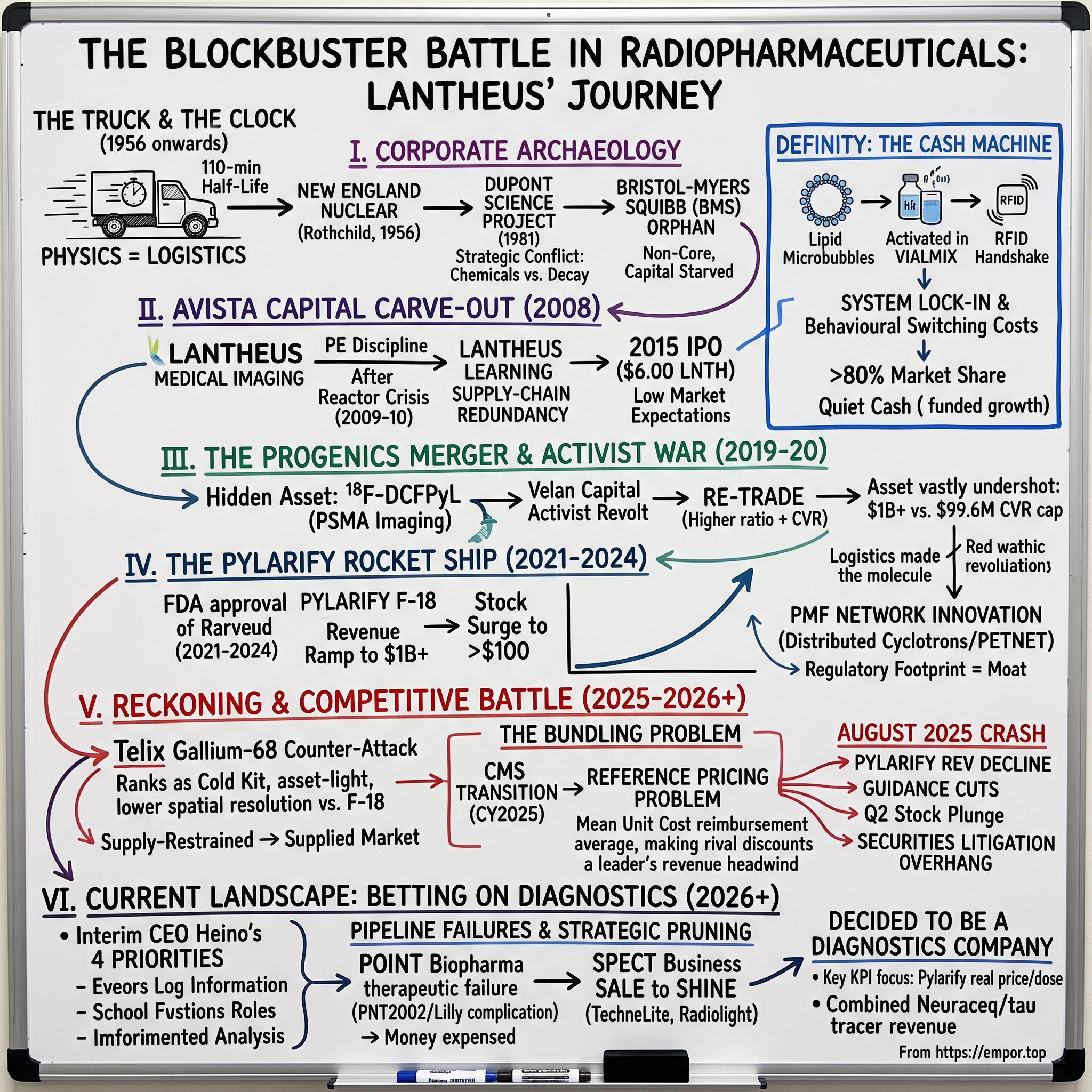
Lantheus Holdings, Inc.: The Blockbuster Battle in Radiopharmaceuticals
I. Introduction & Episode Roadmap (0:00 – 0:10)
There is a truck leaving a warehouse outside Boston at four in the morning. Inside it is a small lead-shielded pig containing a single dose of a drug that is, at that exact moment, worth roughly $3,000 — and which will be worth nothing at all by dinnertime. Not "worth less." Nothing. The molecule inside is decaying as the truck moves. Every 110 minutes, half of it ceases to exist. If the truck hits traffic on I-95, if the patient's scan runs late, if the technologist is on a break, the dose is scrap. There is no inventory. There is no returns policy. There is no second chance.
That truck is the entire business model of Lantheus Holdings.
This is a company that almost nobody outside nuclear medicine had heard of in 2015, when it limped onto the NASDAQ at $6.00 a share.3 Nine years later it was a $100-plus stock and one of the best-performing healthcare equities of the decade, riding a prostate cancer imaging agent called PYLARIFY that went from zero to more than a billion dollars of annual revenue faster than almost any oncology product in history. And then, in a single trading session in August 2025, roughly a third of the company's market value evaporated — not because a drug failed, not because a factory blew up, but because of an obscure change in how Medicare calculates an average.
So the question this story tries to answer is a compound one. How did a discarded corporate stepchild — passed from a chemicals conglomerate to a Big Pharma giant to a private equity firm, each owner treating it as something to be optimised rather than something to be built — become the American leader in one of the most technically demanding corners of medicine? And having gotten there, why did its moat prove so much shallower than the market believed?
The physics problem that is actually a logistics problem. Radiopharmaceuticals are drugs with a radioactive atom bolted onto a targeting molecule. The targeting molecule is a homing device: it finds a specific protein that cancer cells overexpress. The radioactive atom is the payload. If the payload emits a signal a scanner can read, you have a diagnostic — a way to light up every tumour deposit in a patient's body, including ones too small for a CT scan to see. If the payload emits radiation strong enough to kill the cell it's attached to, you have a therapeutic. Use the same targeting molecule for both, and you have what the industry calls theranostics: see it, then treat it, with the same address label.
The trouble is the isotopes. Fluorine-18, the workhorse of modern PET imaging, has a half-life of about 110 minutes. Gallium-68 is worse — roughly 68 minutes. You cannot make these in a plant in Ireland and ship them by sea. You cannot stockpile them for a demand spike. Every single dose is made-to-order, shipped to a named patient at a named appointment time, and races the clock the whole way. The consequence is that in radiopharmaceuticals, manufacturing footprint is market access. A competitor with a better molecule and no local production capacity simply cannot sell to a hospital 400 miles from its nearest cyclotron. This is why, for a decade, investors treated Lantheus's distribution network as a fortress.
The arc. What follows moves through five acts. First, the corporate archaeology: how New England Nuclear became DuPont's science project, then Bristol-Myers Squibb's orphan, then Avista Capital's leveraged carve-out. Second, DEFINITY — an unglamorous ultrasound agent that has quietly thrown off cash for twenty-five years and paid for everything else. Third, the strangest chapter of all: a hostile activist campaign at a target company that forced Lantheus to pay more for the asset that made it, and how that asset still turned out to be a bargain. Fourth, the rocket ship, and the counter-attack from an Australian upstart that solved the logistics puzzle a different way. And fifth, the reckoning of 2025 and 2026 — a reimbursement rule change, a securities class action, an abandoned therapeutic programme, a CEO who left after less than two years, and a company now betting that it can be a great diagnostics business rather than a mediocre therapeutics one.
It begins, as these things often do, with a conglomerate that wanted to be something it wasn't.
 Subscribe on LinkedIn
II. Corporate Origins: From DuPont to Private Equity (0:10 – 0:25)
In 1956, a Boston chemist named Seymour Rothchild started selling radioactively labelled compounds out of what amounted to a garage operation. The company was New England Nuclear, and its products were not drugs — they were research reagents, tagged molecules that let scientists trace biochemical pathways. It was a picks-and-shovels business for the emerging science of using radiation to look at biology rather than merely to burn it.
By the late 1970s, that unglamorous niche had grown into something a conglomerate could notice. DuPont — then in the middle of a strategic conviction that a chemicals company could reinvent itself as a life sciences company — bought New England Nuclear in 1981. On paper the logic was clean: DuPont knew industrial chemistry at scale, radiopharmaceuticals were chemistry at scale, and healthcare carried better margins than nylon. In practice, DuPont spent the next two decades discovering that the two businesses shared almost nothing operationally. Making a polymer means optimising for throughput and shelf life. Making a radiopharmaceutical means optimising for a product that self-destructs.
DuPont eventually consolidated its pharmaceutical ambitions into DuPont Pharmaceuticals, and then, in 2001, sold the whole thing. Bristol-Myers Squibb completed the acquisition on October 1, 2001, paying $7.8 billion in cash.2 BMS wanted one thing above all: Sustiva, an HIV therapeutic with real commercial momentum. The medical imaging division came along in the box.
Why Big Pharma keeps dropping this business. It is worth pausing on why imaging kept failing to hold the attention of its owners, because the same forces still shape Lantheus today. A therapeutic drug is, economically, a licence: you spend enormous money once on R&D and a filing, then print gross margins in the high eighties on a product that ships in a cardboard box at ambient temperature. An imaging agent is a manufacturing and logistics business wearing a pharmaceutical costume. It needs reactors, cyclotrons, hot cells, radiation licences, a fleet, and a dispatch operation. Its gross margins live in the sixties. Its customers are not prescribing physicians reachable by a sales force but hospital nuclear medicine departments and radiopharmacies — a few thousand buying centres with their own procurement logic. And crucially, its revenue per patient is a fraction of a therapeutic's, because a scan is a one-time event and a cancer drug is a monthly annuity.
Inside BMS, the arithmetic was brutal and obvious. Every dollar of capital spent on a hot cell in Massachusetts was a dollar not spent on an oncology Phase 3. So the imaging division became what corporate strategists politely call non-core: adequately run, structurally starved, and permanently on the disposal list.
Enter the private equity carve-out. In January 2008, Avista Capital Partners bought the business for approximately $525 million and relaunched it that March under a new name — Lantheus Medical Imaging.1 It is easy to be cynical about PE carve-outs, and the leverage that came with this one would constrain the company for years. But the structural benefit was real: for the first time since the 1970s, the imaging business had an owner for whom it was the only business. Capital allocation decisions were no longer being made by executives comparing a cyclotron against an immuno-oncology asset. They were being made by people whose returns depended on the cyclotron.
The Avista years were not a triumph. They were a slog: a heavily indebted specialty manufacturer with a legacy portfolio of SPECT products — TechneLite technetium generators, Cardiolite, NEUROLITE — facing generic erosion and, in 2009 and 2010, a genuine crisis when the world's aging research reactors that supply molybdenum-99 went offline more or less simultaneously. What Lantheus learned in those years, out of necessity, was supply-chain redundancy. When your product decays and your raw material comes from four ancient reactors on three continents, reliability is not a nice-to-have. It becomes the thing customers actually buy.
The 2015 IPO — and how little the market expected. Lantheus went public on the NASDAQ under the ticker LNTH in late June 2015. The offering priced at $6.00 per share, below the marketed range, raising net proceeds of roughly $66.7 million.3 That is a rounding error by pharmaceutical standards; the company was, in effect, going public to reduce debt rather than to fund growth. The equity story was straightforward and unexciting: a leveraged legacy imaging business with one good product, some declining ones, and a slow deleveraging path.
The market's assessment was not unreasonable given the information available. What it could not price was the thing sitting inside a small, troubled New York biotech an hour's drive away — a fluorine-18 molecule that nobody, including its owners, had correctly valued.
Before that story, though, comes the product that funded everything. And it involves a machine that shakes a vial.
III. The Definity Cash Machine: System Lock-In & Microbubble Monopolies (0:25 – 0:40)
Picture a cardiologist looking at an echocardiogram of a heart she cannot quite see. The patient is obese, or has emphysema, or has scar tissue from prior surgery, and the ultrasound beam is scattering before it reaches the left ventricle. The images are grey mush. She cannot tell whether the ventricle wall is moving properly, which is the entire point of the test. In the old days, this ended one of two ways: an inconclusive report, or an escalation to a nuclear stress test or cardiac MRI — slower, costlier, and involving either radiation or a magnet.
Instead, she calls for DEFINITY.
What it actually is. DEFINITY is not a dye. It is a vial of lipid-shelled bubbles of perflutren gas, each one smaller than a red blood cell. Injected into a vein, these microbubbles travel to the heart, and because gas reflects ultrasound far more strongly than tissue or blood does, the blood pool suddenly lights up bright white against the dark muscle. The ventricle border snaps into focus. A ten-second injection converts a failed test into a diagnostic one.
The strange part — and the commercially decisive part — is how the bubbles get made. DEFINITY does not arrive ready to use. It arrives as an inert liquid that must be activated by shaking the vial for exactly 45 seconds at a very specific frequency and amplitude. Shake it by hand and you get bubbles of the wrong size distribution, which means unreliable imaging and a safety profile nobody wants to defend. So Lantheus supplies the shaker: a countertop device called VIALMIX, and its successor VIALMIX RFID, which reads a radio-frequency tag on each vial and automatically runs the activation programme matched to that specific product and lot.
Deconstructing the moat. Hamilton Helmer's framework is useful here because DEFINITY's durability is not explained by patents alone.
System lock-in and switching costs. The RFID handshake creates a closed hardware-software-consumable loop. A generic entrant does not merely need to replicate the formulation and clear a regulatory pathway; it needs to solve the activation problem in a way that fits into a workflow already built around Lantheus's device sitting on the counter. Lantheus has protected this deliberately — its FY2025 disclosures note that the VIALMIX RFID use patent is Orange Book-listed with expiry in 2037, alongside additional manufacturing patents running to the same year.4 That is a long runway, though it is worth naming the limitation honestly: patents around a device are not the same as composition-of-matter protection on the drug, and a determined generic with a different activation approach is not logically impossible. The moat here is friction, not physics.
Process power and manufacturing control. For most of its life, DEFINITY was made by a third party — Jubilant HollisterStier remains a significant supplier — which meant Lantheus carried supply risk it did not control. That changed on February 22, 2022, when the FDA approved Lantheus's own isolator-based DEFINITY facility at its North Billerica campus in Massachusetts, a roughly 16,000 square foot plant with the capacity to cover total then-current demand.6 The strategic read is straightforward: dual-sourcing a product with 80%-plus share removes the single most obvious way to lose that share, which is being unable to ship. It also pulls the manufacturing margin in-house.
Brand and workflow habit. Sonographers and cardiac technologists are trained on the DEFINITY protocol. The 45-second activation, the withdrawal technique, the dosing — it is muscle memory across thousands of echo labs. Switching costs in this business are not measured in dollars; they are measured in the retraining hours and protocol revalidation a hospital has to absorb to save a modest amount per vial on a product that is already a small line item. Most departments simply do not bother.
The economics, and what they reveal. DEFINITY generated $330.2 million in 2025, up 3.9% on the prior year, and in the first quarter of 2026 it grew 6.8% year over year to $84.6 million.528 Management stated on the first-quarter 2026 call that the product holds more than 80% market share and that 2026 marks its twenty-fifth year on the market.7
What should an investor take from that? Two things, and they point in different directions. The positive read is genuine: a quarter-century-old product still compounding mid-single-digits, in a category where competitors have re-entered the market after their own supply disruptions, is strong evidence that the lock-in is behavioural and not merely contractual. Products that win purely on price do not hold 80% share for a decade. The more sober read is that DEFINITY is growing at roughly the rate of the underlying echocardiography procedure market. This is a share-defence business, not a share-gain business. It cannot be the growth story; it can only be the funding source.
And that is precisely the role it has played. The cash DEFINITY generated through the late 2010s paid down Avista-era debt, funded the balance sheet capacity for acquisitions, and underwrote a bet on prostate cancer imaging that the company could not otherwise have afforded. Which brings us to the most improbable chapter in this story — one in which Lantheus's greatest asset was handed to it by hedge fund managers who were trying to stop the deal.
IV. The Progenics Merger: The Activist War that Unlocked the Blockbuster (0:40 – 1:05)
Autumn 2019. In Tarrytown, New York, a biotech called Progenics Pharmaceuticals was in the sort of slow-motion crisis that rarely makes headlines. Its lead commercial product, a drug for opioid-induced constipation called RELISTOR, was licensed out and generating royalties rather than growth. Its imaging pipeline had been mismanaged into repeated delays. Its share price had gone essentially nowhere for years. And its board had concluded that the answer was to sell the company.
Buried in that pipeline was a molecule called 18F-DCFPyL.
What Progenics was actually sitting on. To understand why this mattered, understand the clinical problem. Prostate cancer's central diagnostic difficulty is that after initial treatment, a patient's PSA blood level may start rising — proof that cancer is somewhere — while conventional CT and bone scans show nothing at all. The oncologist knows there is disease. She cannot find it. That means she cannot tell whether it is a single treatable spot in a lymph node or widespread metastasis, which are two completely different treatment decisions.
PSMA — prostate-specific membrane antigen — is a protein that sits on the surface of prostate cancer cells in enormous quantities relative to normal tissue. Attach a PET-visible isotope to a molecule that binds PSMA, and the disease that was invisible becomes a constellation of bright spots on a screen. 18F-DCFPyL was exactly that: a fluorine-18-labelled PSMA-targeting agent, originally out of Johns Hopkins, sitting inside a company that could not get it across the finish line.
The first offer, and the revolt. On October 1, 2019, Lantheus and Progenics announced an all-stock merger. The exchange ratio was 0.2502 Lantheus shares per Progenics share — a ratio the proxy materials explicitly describe as having been reverse-engineered to give Progenics holders approximately 35.0% pro forma fully diluted ownership of the combined company.8 That framing is telling. The price was not derived from a valuation of the PSMA asset; it was derived from a target ownership split.
Progenics shareholders were not pleased. Into that anger stepped Velan Capital, a small activist firm that had already been agitating at Progenics before the merger was announced, running a consent solicitation to replace directors.[^9] Velan's argument was elegantly simple: management, having failed to develop the asset, was now selling it for a price that reflected their own failure rather than the asset's potential. The consent campaign delivered its consents to the inspector of elections in early November 2019, and on November 11, 2019, Progenics chief executive Mark Baker resigned. The board was reconstituted with Velan-backed directors, and the new board did what the old one would not: it went back to Lantheus and demanded more.
The re-trade. On February 20, 2020, the two companies announced amended terms.[^10] The exchange ratio rose to 0.31 — moving Progenics holders to roughly 40% of the combined company rather than 35%. And Lantheus added a contingent value right: one CVR per Progenics share, entitling holders to 40% of U.S. net sales of the PSMA agent above $100.0 million in 2022 and above $150.0 million in 2023, subject to a cap.8 The deal closed in June 2020, with Lantheus issuing 26,844,877 shares and 86,630,633 CVRs.4
Now the punchline. The CVR paid out in full. Lantheus disclosed that the aggregate obligation reached $99.6 million — the maximum amount payable — and that it settled the CVRs in full in May 2023.9 Progenics shareholders got every dollar the structure allowed.
And it was still nowhere near enough. The asset they had negotiated so hard over generated $1.06 billion of revenue in 2024 alone.4 The entire re-trade — the extra 5% of the company, the full CVR payout — cost Lantheus less than a single year's revenue from the product in question.
What this episode actually teaches. There is a comfortable narrative here in which activists are heroes and incumbent management are fools, and it is half right. Velan did identify a real mispricing, did force a real repricing, and did deliver a real return to Progenics holders. That is the system working.
But the sharper lesson for investors is about who was wrong and by how much. Both sides of this negotiation — the seller's original board, the seller's activist replacement board, and the buyer — were haggling over a range that the outcome overshot by an order of magnitude. Even the activists, whose entire thesis was that the asset was undervalued, settled for terms that in hindsight look like a rounding error. The reason is instructive: nobody in the room knew whether the commercial infrastructure could be built. The molecule's clinical value was arguable in 2020. Its distributability was not yet demonstrated. That gap — between owning a good molecule and being able to deliver it to a hospital in Boise on a Tuesday morning — was the entire source of the value Lantheus captured.
Which raises the obvious question. How did they build it?
V. The Pylarify Rocket Ship: Flying to $1 Billion (1:05 – 1:25)
The FDA approved PYLARIFY (piflufolastat F 18) in late May 2021 as the first commercially available F-18 PSMA PET imaging agent in the United States.10 Approval, in most of pharma, is the finish line — the moment the sales force deploys and the revenue curve begins. In radiopharmaceuticals, approval is roughly the halfway point of a much harder race, because a drug that expires in a few hours cannot be sold anywhere it cannot be manufactured.
The chemistry, and why it mattered commercially. Two isotopes dominate PSMA imaging, and their differences are not academic.
Fluorine-18 has a half-life of about 110 minutes and emits a relatively low-energy positron. Low positron energy is a proxy for image sharpness: the emitted particle travels a shorter distance before it annihilates and produces the signal the scanner detects, so the reconstructed image resolves smaller lesions. And the longer half-life means a single production run can be split into many patient doses and driven a meaningful distance.
Gallium-68 has a half-life closer to 68 minutes and a higher-energy positron — a somewhat softer image, and a far tighter delivery radius. But gallium has one enormous compensating advantage, which we will come to.
The catch with F-18 is capital. It requires a cyclotron — a particle accelerator, tens of feet across, costing millions of dollars, housed in a concrete vault. You cannot put one in a hospital basement casually. So Lantheus faced a choice that defined the company: build its own cyclotron network, or rent one.
The PMF network. It rented. Rather than deploying billions into accelerators, Lantheus signed long-term manufacturing agreements with existing commercial PET radiopharmacies — the network operated by Siemens' PETNET Solutions, along with Cardinal Health, SOFIE, and PharmaLogic. These sites already had cyclotrons running FDG, the glucose tracer used in routine oncology PET. Lantheus's innovation was to treat them as a distributed manufacturing fleet, each one qualified to produce PYLARIFY under its own FDA approval.
That last clause is the whole moat. In this business, every production site is individually approved as a GMP manufacturing facility. Chief executive Mary Anne Heino described the process on the first-quarter 2026 call in unusually concrete terms: each PMF must be separately approved, and each must run validation batches proving it can consistently replicate the manufacturing process before it can ship a single commercial dose.7 There is no way to shortcut this with money. A competitor with unlimited capital still has to walk each site through the same regulatory sequence, one at a time.
Lantheus went from 21 activated PMF sites at the end of 2021 to 37 by the end of 2022 — an expansion that, in an industry where regulatory filings move at the pace they move, was genuinely unusual.9 Each new site did not add capacity so much as it added geography: a new radius within which same-day delivery became physically possible.
The curve. The revenue trajectory that followed is the reason this company became a hedge fund favourite. PYLARIFY generated $43.4 million in its partial first year of 2021, $527.4 million in 2022, $851.3 million in 2023, and $1.06 billion in 2024.94 The stock followed, running from single digits at the 2015 listing to well above $100 by mid-2024.
What that curve did and did not prove. It is worth being precise about the evidence here, because the market drew a conclusion that turned out to be too strong.
What the ramp genuinely proved: demand was real and urgent. Physicians adopted PSMA PET faster than almost any imaging modality in memory because it answered a question they could not otherwise answer. It also proved Lantheus could execute operationally — building a national just-in-time network for a decaying product, from scratch, in under three years, is a hard thing that most companies would have botched.
What it did not prove, but was widely assumed to: that the network was a durable barrier to entry. The undersupplied early market flattered everyone's economics. When you are the only approved F-18 PSMA agent and demand exceeds capacity, you do not need pricing power in the Helmer sense — you have scarcity, which looks identical on an income statement and is not the same thing at all. Scarcity ends. Pricing power, if you have it, does not.
There was a second, quieter assumption baked into the bull case: that PYLARIFY's premium price was protected by the way Medicare paid for it. That assumption depended on a temporary reimbursement mechanism with a hard expiry date, and it is the hinge on which the whole story eventually turned.
But before the reimbursement change, there was a competitor — one that looked at Lantheus's expensive, beautiful cyclotron fleet and decided to route around it entirely.
VI. The Competitive Counter-Attack: Telix's Gallium-68 Disruption (1:25 – 1:45)
If you wanted to design a counter-positioning attack from a textbook, you would design Telix Pharmaceuticals.
Telix is an Australian company, headquartered in Melbourne, founded by people who had spent careers in radiopharmaceuticals and understood one thing Lantheus's investors did not fully appreciate: the F-18 cyclotron network was not just a moat, it was also a cost structure. Every dose had to be produced in a capital-intensive facility, packaged individually, and driven. That is expensive, and it is inflexible.
Telix's product, Illuccix, took the opposite approach. It is a gallium-68 PSMA agent sold not as a finished dose but as a cold kit — a vial of non-radioactive precursor with a long shelf life that can be shipped by normal courier, stored on a shelf, and reconstituted on demand at a local radiopharmacy using a germanium-68/gallium-68 generator. The generator is roughly the size of a small safe, costs a fraction of a cyclotron, and produces gallium-68 on site for months at a time.
Why this is genuine counter-positioning rather than mere competition. The distinction matters. A competitor who builds a bigger cyclotron network is competing on Lantheus's terms and will lose, because Lantheus started earlier and has more sites. Telix instead adopted a business model that Lantheus structurally could not copy without undermining its own economics. Lantheus had sunk relationship-specific investment into a centralised fleet; Telix's asset-light kit model let local radiopharmacies absorb the last-mile problem. The result was that Telix could reach hospitals in geographies where building a PYLARIFY-qualified PMF made no economic sense, and it could price with far more flexibility because its marginal cost per dose was lower.
The image quality trade-off was real — Lantheus has consistently and correctly pointed to gallium's shorter half-life, lower positron yield and lower spatial resolution.14 But "somewhat better images" is a weak argument to a hospital procurement committee when the alternative is materially cheaper and locally available. Clinical differentiation only commands a premium when the payer is willing to pay for it. Hold that thought.
The scoreboard. Telix reported group revenue of US$803.8 million for FY2025, up 56% year over year, and guided to $950–970 million for FY2026.11 The company had already upgraded its 2025 guidance mid-year on the strength of commercial performance.[^14] One important caveat for anyone modelling this: Telix does not break out Illuccix revenue separately — it reports a "Precision Medicine" segment that includes Illuccix volumes alongside the U.S. launch of a newer agent, Gozellix. Any standalone Illuccix number circulating in the market is an estimate, not a disclosure.
The third player is POSLUMA (flotufolastat F 18) from Blue Earth Diagnostics, a Bracco company — the other F-18 agent, approved in May 2023 and still actively marketed.12 Its role in this story turns out to be larger than its market share, for reasons that become clear in a moment.
The structural shift. What changed between 2021 and 2025 was not really technology. It was the transition from a supply-constrained market to a supplied one. In 2021, a hospital that wanted PSMA PET took what it could get. By 2025, a hospital nuclear medicine department could credibly run a competitive process among three approved agents. That is the moment bargaining power moves down the value chain, and it moves fast.
Lantheus's own language on the second-quarter 2025 call captured the transition precisely, if uncomfortably. President Paul Blanchfield told analysts that even inside contracted accounts — the ones covered by long-term strategic partnership agreements — the company was "increasingly coexisting with Gallium."14 Coexisting is a revealing verb. It means the account was no longer exclusive. It means volume that had been assumed was now contested.
And then a change in a federal payment formula turned a competitive market into a price war.
VII. Regulatory Cliffs, Pricing Pressures, & The Q2 2025 Crash (1:45 – 2:05)
To understand what happened to Lantheus in 2025, you have to understand something genuinely dull: how Medicare pays a hospital for a scan.
The bundling problem. Under Medicare's Hospital Outpatient Prospective Payment System, most diagnostic radiopharmaceuticals were historically packaged — meaning the hospital received a single payment for the PET scan procedure, and the cost of the tracer was assumed to be included in it. The perverse incentive is obvious. If the hospital is paid the same amount whether it uses a $500 agent or a $3,000 agent, then every dollar of premium price comes directly out of the hospital's margin. Under pure packaging, no innovative agent could survive.
The escape hatch was transitional pass-through status: a temporary designation, typically running about three years, under which a new product is paid separately, on top of the procedure payment. TPT is what allowed PYLARIFY to command a premium during its launch years. It is also, by design, temporary — which meant the entire premium pricing structure of the PSMA PET market rested on a clock that everyone could see.
The CMS transition of January 1, 2025. In the CY2025 OPPS final rule, CMS changed the framework: diagnostic radiopharmaceuticals with a per-day cost above $630 became separately payable rather than packaged.13 Superficially this looked like a win — unbundling meant hospitals would no longer eat the full cost of premium agents when pass-through expired.
The devil was in the reference price. The separate payment was set using mean unit cost derived from hospital claims data — an average of what hospitals actually reported paying. And an average, as a pricing mechanism, has a specific and dangerous property: it is a shared number. When Telix and other competitors discounted aggressively, their low prices entered the same claims pool that determined the reimbursement rate. The market average fell. Hospitals then found themselves reimbursed at a rate closer to the average than to PYLARIFY's premium price — and every one of them promptly went back to Lantheus and demanded the difference.
This is the least appreciated mechanism in the whole story, and it deserves its name: reference pricing converts a competitor's discount into your own reimbursement problem. Lantheus could not defend its price by being better. It could only defend its price by convincing hospitals to absorb a gap that the payment formula no longer covered.
August 6, 2025. The reckoning arrived with second-quarter results. PYLARIFY revenue came in at $250.6 million, down 8.3% year over year — the first meaningful decline in the product's history.[^17] Consolidated revenue fell 4.1% to $378.0 million. And full-year guidance was cut hard: revenue to $1.475–1.510 billion from $1.550–1.585 billion, and adjusted EPS to $5.50–5.70 from $6.60–6.70.14 That is not a trim. That is roughly a dollar of earnings per share removed from the year in a single announcement.
The stock fell roughly 29% that day.16
What management said, and how to read it. The second-quarter call is worth studying closely, because it is the clearest available window into how this leadership team handles bad news.
Chief executive Brian Markison opened by naming the mechanism directly: "the confluence of MUC-based reimbursement and aggressive discounting by what had been a somewhat dormant F-18 competitor" had led economically sensitive customers to reconsider.14 That is a notably specific and non-evasive diagnosis, and the identification of an F-18 rival rather than gallium was a genuine surprise to analysts who had spent two years modelling Telix as the threat. Lantheus did not name the competitor; the only other F-18 PSMA agent on the market is Blue Earth's POSLUMA.
Blanchfield then described the decision that defines the whole episode: the company had "made the intentional decision to remain disciplined with our pricing strategy, even at the cost of losing select accounts rather than chase volume and harm the long-term value of our PSMA PET franchise."14
An investor should hold two thoughts about that statement simultaneously. The first is that it is strategically defensible. There is a specific accounting reason walking away can beat discounting in U.S. pharmaceuticals: a deep discount to one account can reset the company's "best price," which cascades into mandatory 340B pricing across a much broader customer base — with a two-quarter reporting lag that makes the damage arrive later and larger. Blanchfield flagged exactly this dynamic as a fourth-quarter headwind.14 Walking away from one bad contract to protect the price floor everywhere else is real discipline, not spin.
The second thought is less flattering. "We chose to lose that business" is also the single most convenient sentence available to a management team that has lost business. It is unfalsifiable from the outside. The way to test it is not to argue about intent but to watch volume: if the strategy is genuine, volumes should keep growing even as revenue falls, because the company is trading price for nothing rather than losing accounts outright. On that test, the disclosure was mixed — U.S. volumes grew 2% year over year in the quarter, which is positive but was, by the company's own admission, well below its expectations and well below a market growing in the mid-to-high teens.14 Lantheus was losing share. The question was how much of that was chosen.
The legal overhang. Shareholders sued. Lantheus disclosed in its third-quarter 2025 Form 10-Q that a putative securities class action, Margolis v. Lantheus Holdings, Inc., et al., had been filed in the U.S. District Court for the Southern District of New York on September 9, 2025, asserting claims under Sections 10(b) and 20(a) of the Exchange Act against the company and certain executives.15 A shareholder derivative action, Jones v. Markison et al., followed in the same court on October 31, 2025.15 Plaintiffs' firms had begun soliciting investors that September.17 The asserted class periods vary between complaints, with one running from November 6, 2024 through August 6, 2025.16
The core allegation is that management overstated PYLARIFY's competitive position and pricing durability while the reimbursement transition was already underway. The stress-test question worth asking is narrower and fairer than the complaint: Lantheus had disclosed the MUC framework as a risk. The debatable point is whether, having flagged the mechanism, management adequately conveyed the magnitude — particularly given that guidance was cut twice in three months, in May and again in August 2025. Two cuts in a quarter is, at minimum, evidence that the internal forecasting model did not capture how fast reference pricing would transmit competitor discounts into Lantheus's own realised price. That is a legitimate criticism of forecasting rigour whether or not it is securities fraud, and the litigation remains unresolved as of this writing.
Meanwhile, a much larger bet was quietly falling apart in the pipeline.
VIII. High-Stakes M&A, Pipeline Failures, & Strategic Pruning (2:05 – 2:25)
Every diagnostics company in radiopharmaceuticals eventually gets seduced by the same idea. You have built a network that can deliver a decaying isotope to a patient's bedside on schedule. You have relationships with every nuclear medicine department in the country. You are using all of that to sell a scan that bills once. Meanwhile Novartis is using the same infrastructure to sell Pluvicto — a lutetium-177 PSMA therapeutic — at six doses per patient and multiples of the revenue.
The temptation is overwhelming, and Lantheus succumbed to it.
The POINT Biopharma deal. In November 2022, Lantheus announced exclusive license agreements with POINT Biopharma covering two assets: PNT2002, a lutetium-177 PSMA therapeutic for metastatic castration-resistant prostate cancer, and PNT2003, a radioequivalent of Lutathera for neuroendocrine tumours.18 The structure was $260 million upfront across both programmes, with substantial development and sales milestones behind it.
Here is an accounting detail that matters enormously for how investors should think about the outcome: the entire $260.0 million upfront was expensed immediately as acquired in-process research and development in the fourth quarter of 2022 rather than capitalised as an intangible asset.4 This is the conservative treatment, and it has a consequence that is easy to misread later. Because the cost was taken through the income statement at the time, there was no balance sheet asset left to impair when the programme subsequently failed. Anyone looking for a large PNT2002 write-down in the 2025 accounts will not find one — not because the money was recovered, but because it was already gone. The loss was real and it was economic; it simply landed four years before the disappointment did.
The Lilly complication. In October 2023, Eli Lilly agreed to acquire POINT Biopharma for $12.50 per share in cash, roughly $1.4 billion, closing in December of that year.21 Lantheus retained its commercialisation rights, but the counterparty dynamic changed completely. Its development partner was no longer a small biotech that needed Lantheus's commercial reach; it was a pharmaceutical giant with its own radioligand ambitions, for whom PNT2002 was one modest asset in a very large portfolio. When two partners have wildly asymmetric stakes in a programme, the smaller partner's urgency rarely wins.
SPLASH. The Phase 3 trial reported topline results in December 2023, and the headline was positive: PNT2002 met its primary endpoint, with median radiographic progression-free survival of 9.5 months versus 6.0 months for patients on an androgen receptor pathway inhibitor — a statistically significant 29% reduction in the risk of progression or death.19 Additional data were presented at ESMO in 2024.20
The problem was overall survival, and the problem was structural rather than scientific. SPLASH allowed patients in the control arm to cross over and receive PNT2002 after their disease progressed. Ethically this is defensible — you do not withhold a drug that just demonstrated benefit from patients who need it. Statistically it is close to fatal for an OS readout, because the control arm is no longer a control arm. If most of the comparison group eventually receives the experimental drug, the survival curves converge for reasons that have nothing to do with whether the drug works.
Lantheus's FY2025 Form 10-K states the outcome flatly: the SPLASH study reached 100% of prespecified overall survival events, the results were comparable to the earlier 46% and 75% readouts, and they "remain confounded by the overwhelming number of patients who crossed over within the study to receive PNT2002." The filing then delivers the verdict: "While we continue to review the available PNT2002 data, we do not currently plan to pursue an NDA or further invest in this asset."4 Trade coverage through late 2025 tracked the same conclusion.[^26] The company's 2025 expense disclosures show the practical consequence — a reduction in sales and marketing spend from "the cessation in 2025 of launch support related to PNT2002."4
Reading the failure honestly. It would be too generous to call this purely bad luck. The trial design carried a known risk that the OS endpoint would be uninterpretable, and the asset was always a fast-follower to Pluvicto rather than a differentiated agent — meaning it needed strong data to win share against an entrenched incumbent, and merely acceptable data would not do. Lantheus paid a substantial upfront sum for a me-too therapeutic in a category where it had no development track record, on the strength of a market opportunity that was real but already occupied. That is a capital allocation judgement, not an act of God.
It would also be too harsh to call it reckless. Radioligand therapy was, in 2022, the hottest area in oncology; the option value was defensible; and $260 million against a company generating hundreds of millions in annual free cash flow was a survivable bet, appropriately expensed. The failure mode worth flagging for the future is subtler: a diagnostics company that keeps buying its way into therapeutics is a company whose management believes its own infrastructure advantage transfers to a domain where the winning skill is clinical development. The evidence for that transfer, so far, is absent.
Pruning the other end. The counterweight came on January 1, 2026, when Lantheus completed the sale of its legacy SPECT business to SHINE Technologies for total consideration of up to $155.0 million — a mix of cash, a convertible installment note, a term note and contingent earnout payments.422 The portfolio went with it: TechneLite, NEUROLITE, Xenon Xe-133 Gas, Cardiolite, the SPECT portion of the North Billerica campus, and related Canadian operations. The definitive agreement had been signed the previous May.
The strategic logic is sound and the financial mechanics are worth spelling out, because they are what makes 2026's numbers confusing. SPECT contributed $111.4 million of 2025 revenue, so the divestiture removed roughly that amount from the comparison base.24 Chief financial officer Bob Marshall walked analysts through the normalisation on the fourth-quarter call: adjusting for the divestiture and a one-time milestone receipt gives a comparable 2025 revenue baseline of $1,424.2 million, against 2026 guidance of $1.40–1.45 billion.24 In other words, headline 2026 revenue guidance implies roughly flat performance, not the decline the unadjusted numbers suggest.
The more important point is margin structure. SPECT was the capital-hungry, low-margin, generic-eroding end of the portfolio — reactor-dependent, capex-heavy, and structurally declining. Exiting it raises consolidated gross margin, cuts maintenance capital expenditure, and frees management attention. Marshall was explicit that the divestiture's margin benefit was intentionally sequenced to offset PYLARIFY's pricing headwind.24 Selling a declining business to fund the defence of a threatened one is not a growth strategy, but it is coherent capital allocation.
What was less coherent was who was running the company.
IX. Current Management, Governance, & Credibility (2:25 – 2:40)
On November 6, 2025 — three months after the crash, and on the same morning the company reported third-quarter results — Lantheus announced that chief executive Brian Markison would retire effective December 31, 2025 and resign from the board, that board chair Mary Anne Heino would become Executive Chair effective November 7 and then chief executive on January 1, 2026, and that president Paul Blanchfield would depart.23
Two of the three executives who had presented the second-quarter results were leaving at once.
The people. Mary Anne Heino is not an outsider parachuting in. She led Lantheus as chief executive from 2015 through 2024 — which is to say, she ran the company through the IPO years, the Progenics acquisition and the entire PYLARIFY build-out. She is, in a meaningful sense, the architect of the asset that is now under pressure. Markison, who succeeded her, had been associated with Lantheus for more than 13 years as a director and executive and agreed to stay on as a strategic advisor through at least March 31, 2026.23
Heino's operating style comes through unmistakably on the calls. She is granular in a way that is unusual for a chief executive — on the first-quarter 2026 call she walked an analyst through the mechanics of PET manufacturing at the level of synthesis boxes and the specific cassettes that PMF sites attach to them to produce different F-18 agents, and estimated that more than 70% of PYLARIFY's current dose volume comes from sites already equipped with high-energy cyclotrons.7 On the fourth-quarter 2025 call, asked about a competitor's head-to-head study, she delivered a detailed methodological critique — no randomisation, imaging sequence not counterbalanced, no truth standard, a detection-rate endpoint that arguably credits false positives, and inadequate statistical power — and then, unprompted later in the same call, corrected an error she had made in describing the study protocol.24 Executives who volunteer corrections against their own argument are not common.
The credibility ledger. Assessing this management team requires separating three different things that get conflated.
Operational execution has been genuinely strong and is supported by evidence rather than assertion. Building a national just-in-time PMF network from scratch, bringing DEFINITY manufacturing in-house, integrating two acquisitions in a single year, and executing a clean divestiture are all hard, verifiable accomplishments.
Forecasting discipline is where the record is poor. Guidance was cut in May 2025 and again in August 2025, then narrowed in November to $1.49–1.51 billion revenue and $5.50–5.65 adjusted EPS.25 A company that misses its own model twice in one quarter did not have a reliable model. That is the substance behind the securities litigation regardless of how the legal question resolves.
Capital allocation is mixed and worth watching closely. The Progenics deal was outstanding. The SPECT divestiture is sensible. The POINT therapeutic bet failed. And the 2025 acquisition programme was aggressive by any standard: Evergreen Theragnostics closed April 1, 2025 for $250 million upfront plus up to $752.5 million in milestones, bringing the OCTEVY neuroendocrine diagnostic;27 Life Molecular Imaging closed July 21, 2025 for $350 million upfront plus up to $400 million in earn-outs, bringing Neuraceq;26 and MK-6240 had come earlier, via the February 2023 acquisition of Cerveau Technologies.[^33] Alongside that, the board authorised a $400 million buyback in August 2025 — announced, notably, on the same call as the guidance cut, and $200 million of it had been used by the end of the first quarter of 2026.147 Cash fell from roughly $695.6 million at mid-2025 to $359.1 million at year-end.1424
Announcing a large buyback on the day you cut guidance is a defensible signal of conviction and also a well-worn technique for cushioning a stock. Both readings are available; the honest position is that it worked as a signal only because the underlying business subsequently stabilised.
A correction to the consensus governance narrative. There is a version of this story circulating in which Sarissa Capital — Alex Denner's activist-oriented healthcare fund — built a threatening position in Lantheus during 2025 and functioned as a shadow presence over the board, and in which the CEO change was the visible result.
The filings do not support it. Sarissa's Lantheus position appears in its 13F holdings as approximately 166,919 shares worth about $12.66 million as of March 31, 2026 — roughly 0.26% of the company, and smaller than the prior quarter's 181,450 shares. No Schedule 13D has been filed on Lantheus by Sarissa, which is the filing that would be required for an activist intent. This is an ordinary, small, passive institutional position that was being trimmed, not a campaign. Investors should discount the activist-overhang framing entirely; the more accurate reading of the leadership change is a board acting on its own after a bad year, which is a different governance signal — arguably a healthier one.
What the interim CEO is actually doing. Heino's stated 2026 priorities, repeated almost verbatim across the fourth-quarter 2025 and first-quarter 2026 calls, are four: defend PSMA PET leadership while transitioning to a reformulated agent; build Neuraceq; advance registrational assets through approval; and allocate capital with discipline while "evaluating value-maximizing alternatives for our radiotherapeutic assets."724 That last phrase is corporate language for finding someone else to fund, partner, or buy the therapeutic pipeline — a full reversal of the 2022 strategy, and the clearest possible statement that Lantheus has decided to be a diagnostics company.
The narrative consistency across those two calls is notable and should be credited: management said the same things in February and May, with the same numbers, and reaffirmed rather than revised guidance after a first quarter that beat expectations. When Jefferies analyst Matt Taylor pushed on whether guidance would have been raised absent the CEO transition, Heino answered without deflecting — that the company was early in the year, sitting immediately in front of a chief executive change, and that holding guidance was the prudent course.7 Marshall added the more revealing version on the same call: "it's right to allow that person to own the balance of the year."7
That is a defensible answer and also a real cost. A company whose interim leadership is deliberately not raising guidance, not pursuing significant M&A, and explicitly leaving room for a successor is a company in a holding pattern. The board reported in May 2026 that the search had narrowed to a small number of candidates.7 Until that appointment lands, strategic optionality is on hold.
X. Playbook: Business & Investing Lessons (2:40 – 2:55)
Strip away the isotopes and the reimbursement codes, and Lantheus offers four transferable lessons — three about how moats work, and one about where value gets created in public markets.
Lesson 1: The razor-and-blade closed loop can outlive the patent. DEFINITY should have been commoditised years ago. The reason it wasn't is that Lantheus made the consumable inseparable from a device it controls, and then embedded that device in a clinical workflow. The RFID handshake is the elegant part — it turns "you should use our activator" into "the vial will not work without it," and the protection runs on device patents into 2037 rather than expiring with the drug's own exclusivity.4
The transferable insight is that in categories facing inevitable generic pressure, the durable defence is often not the molecule but the system around it. Note the limit, though, because this is where the lesson is usually over-applied: system lock-in defends share, it does not create growth. DEFINITY grows at roughly the rate of the procedures it supports. A closed loop is a floor, not an engine.
Lesson 2: Distribution moats are dynamic, not static. For three years, the consensus view of Lantheus was that its regulatory-approved cyclotron network was close to unassailable, and the reasoning was sound: every site needs individual FDA approval, and capital cannot compress regulatory timelines.
The reasoning was sound and the conclusion was wrong, because it assumed the competition would attack along the same axis. Telix did not try to build a bigger cyclotron fleet. It changed the unit of shipment from a finished radioactive dose to a shelf-stable kit, pushing the last mile onto local radiopharmacies who already had the equipment. A moat built on the difficulty of doing something is only a moat while that thing remains necessary.
The generalisable test: before crediting a distribution moat, ask what the moat is actually made of. If it is made of regulatory approvals for a specific method, it protects against imitators and not against substitutes. If it is made of customer relationships and switching costs, it travels better. Lantheus's clearest surviving advantage is arguably the second kind — the sixty-year nuclear medicine customer relationship that lets it introduce four new products to the same buyers — not the first.
Lesson 3: Beware reference pricing. This is the least intuitive lesson and the most valuable. Unbundling looked unambiguously good for premium products: hospitals would no longer eat the cost of expensive agents. But because the separate payment was set by mean unit cost derived from claims, the reimbursement rate became a function of everyone's price, including competitors selling at a discount.13
The mechanism is worth stating in general form, because it recurs across healthcare systems worldwide: when a payer sets reimbursement by reference to an average of observed prices, a market leader's realised price becomes hostage to its competitors' discounting decisions. Rivals do not need to win share to damage you; they only need to transact at low prices in a way the payer observes. Any investor underwriting pricing power in a reimbursed market should ask one question first — who sets the reference, and what goes into it?
Lesson 4: Sometimes the value is created by someone outside the company. The single most valuable asset Lantheus has ever owned came to it because a small activist fund fought a proxy battle at a company Lantheus was trying to buy — and the fight raised the price Lantheus paid.[^9][^10]
There are two readings, and both are true. From Progenics shareholders' side, activism worked exactly as intended: it replaced a board that was selling too cheap and extracted better terms.8 From Lantheus's side, the sobering point is that its transformative asset was not generated internally. Its own R&D produced steady improvement to existing franchises; the billion-dollar molecule was bought.
For investors, the implication is about where to look for surplus. In this industry, small developers repeatedly fail to capture the value of their own science because they cannot fund the commercial infrastructure — and companies with infrastructure repeatedly capture that value cheaply. The screen worth running is not "who has the best pipeline" but "who has the distribution that makes someone else's pipeline worth more."
XI. Analysis: Bull vs. Bear & Key KPIs (2:55 – 3:15)
By July 2026, Lantheus's shares had round-tripped the entire 2025 crash. The market's mood had inverted twice in twelve months, which is usually a sign that the fundamental question is genuinely unresolved rather than that anyone has learned something new.
Here is what the resolution actually depends on.
The bull case, tested against evidence.
Argument one: DEFINITY is a durable cash engine. This one holds up. Twenty-five years on market, more than 80% share, mid-single-digit growth after competitors returned to full supply, patent protection into 2037.74 The falsification test is straightforward — watch for a generic filing or a competitor solving the activation problem differently — but nothing in the current disclosures suggests imminent erosion.
Argument two: Alzheimer's diagnostics become the second growth engine. This is the most interesting piece of the story and the least proven. Neuraceq generated $51.4 million in its partial 2025 and $35.4 million in the first quarter of 2026 alone — 14.3% sequential growth — and management guided to 140–150% inorganic growth for the full year.5724 MK-6240, the tau tracer, carried an FDA action date of August 13, 2026 and is described by the company as the imaging agent used for treatment eligibility in 17 pharma-sponsored Alzheimer's programmes.7
The underlying demand logic is genuinely strong. Amyloid-targeting therapies require confirmation of amyloid pathology before treatment, which makes the scan a gating step rather than an optional one, and guideline changes have pushed diagnostic use earlier into mild cognitive impairment. Heino was also candid about where Neuraceq sits competitively: it is the second-most-used agent in a three-product market, behind Eli Lilly's Amyvid, and she stated plainly that the growth plan "is not a price play" but a matter of expanding manufacturing footprint — from 16 PMF sites at acquisition toward a broader network — and deepening penetration in accounts that already buy PYLARIFY.24 That is a credible, mechanical plan. The unproven part is whether portfolio selling actually converts nuclear medicine customers, since it is the same "leverage our relationships" argument that did not prevent PSMA share loss.
Argument three: PYLARIFY TruVu stabilises the franchise. The FDA approved PYLARIFY TruVu on March 6, 2026, with a phased geographic launch beginning in the fourth quarter of 2026.287 The commercial rationale is almost entirely about reimbursement rather than medicine: TruVu offers the same diagnostic properties with a similar safety and efficacy profile, but as a newly approved product it is eligible for a fresh HCPCS code and a new three-year transitional pass-through period — which would make it, in management's framing, the only F-18 PSMA agent carrying pass-through status once a competitor's expires.24
This deserves scrutiny rather than acceptance. TruVu is a reformulation whose real advantages are manufacturing-side: enhanced stability at higher radioactive concentrations, permitting larger batches and wider delivery radii from high-energy cyclotron sites.7 Those are genuine operating benefits. But the pricing benefit depends entirely on securing pass-through status — an application submitted in mid-2026 whose outcome was not confirmed as of this writing. If it is granted, Lantheus resets the reimbursement clock and buys three years. If it is not, TruVu is a modestly better product entering the same reference-priced market that broke the original. Management has been careful to sequence the launch behind coding and coverage precisely because this is the load-bearing assumption.
The bear case, tested against evidence.
Argument one: the price war continues. PYLARIFY declined 6.5% in 2025 to $989.1 million and a further 6.5% year over year in the first quarter of 2026 to $240.9 million, and guidance assumes an 8–10% full-year decline driven by price erosion partly offset by volume.52824 Marshall told analysts the gross-to-net adjustment would drift from the mid-teens toward the high teens through the year.24 The specific catalyst to watch is the competing F-18 agent losing pass-through status around September 30, 2026 — which management expects may prompt that competitor to use price to defend share.147
Argument two: the pipeline is thinner than the multiple implies. With PNT2002 abandoned and the remaining therapeutic assets explicitly being shopped for "value-maximizing alternatives," Lantheus is a diagnostics company.424 Diagnostics companies generally trade at lower multiples than therapeutics companies, because a scan bills once and a drug bills for years. The near-term catalysts are real — TruVu, OCTEVY (whose FDA action date was extended three months to June 29, 2026), PNT2003, MK-6240 — but management repeatedly warned that none contributes meaningfully to 2026 revenue, with material impact deferred to 2027.724 That is a lot of value sitting in a year that has not happened.
Argument three: leadership discontinuity. Covered above; the practical cost is a company deliberately not making major decisions until a permanent chief executive arrives.
The five forces, briefly. Buyer power has risen sharply and is the dominant force in this story — consolidated health systems, armed with three approved agents and a reference-priced reimbursement rate, now hold real leverage. Rivalry is intense and structurally worse than it looks, because reference pricing means a rival's discount hurts Lantheus even where Lantheus keeps the account. Barriers to entry remain meaningful but are method-specific: high for anyone copying the F-18 unit-dose model, much lower for kit-based approaches, and management flagged two copper-based agents and two additional gallium agents in development that could eventually enter.7 Supplier power is moderate and unusual — the PMF partners are both channel and manufacturing base, and Lantheus does not own the cyclotrons it depends on. Substitution is the quiet long-term risk: blood-based biomarkers in Alzheimer's could route patients around imaging entirely, though Lantheus argues they expand the funnel by pushing patients toward specialist workup.14 That argument is plausible and unproven.
Through the 7 Powers lens. Lantheus credibly holds switching costs and process power in DEFINITY, and scale economies plus cornered resource in its PMF network and nuclear medicine relationships. What it demonstrably lacks in PSMA is counter-positioning — Telix has that — and what it briefly mistook for branding power was, in retrospect, temporary scarcity plus a favourable reimbursement rule. The most defensible remaining asset is the least glamorous one: a sixty-year commercial relationship with essentially every nuclear medicine department in America, which is what makes carrying five products to the same buyer economically sensible. Whether that relationship converts into share, rather than merely into access, is the open question the next two years will answer.
The three KPIs that matter.
First, PYLARIFY net revenue and realised price per dose. Volume growth alone is not the signal; the whole 2025 story was volume rising while price fell. What matters is whether net revenue per dose stops declining. Management stated that net average selling price and volume were stable sequentially in the first quarter of 2026 and that 340B pricing would not reset again in the first half of the year.2824 Watch whether that stability survives a competitor's pass-through expiry.
Second, combined Neuraceq and MK-6240 revenue. This is the direct test of whether diagnostic expansion offsets prostate imaging decline. The specific sub-metric worth tracking is the Neuraceq manufacturing footprint — PMF site count, which stood at 22 as of the first quarter of 2026 — because in this industry geography converts directly into addressable demand.7
Third, where the R&D and acquisition dollars go. R&D is guided to rise to 10–11% of revenue in 2026, anchored by the GRPR diagnostic programme.24 The question is whether Lantheus stays disciplined about being a diagnostics company or drifts back toward buying therapeutic optionality it has not yet proven it can develop. Management has committed to no significant M&A in 2026 beyond portfolio-aligned diagnostic tuck-ins.24 That is a testable promise with a clear falsification condition.
XII. Epilogue & Outro (3:15 – 3:20)
The most instructive thing about Lantheus is how many times it has been someone else's afterthought and survived anyway. A chemicals conglomerate's diversification project. A Big Pharma acquisition's leftover division. A private equity carve-out loaded with debt. A $6 IPO nobody wanted. At every stage, the sophisticated view was that this was a structurally unattractive business — capital-intensive, logistically brutal, margin-poor relative to therapeutics — and at every stage the sophisticated view was directionally right about the economics and completely wrong about the outcome.
What it kept getting wrong was that the difficulty was the asset. Anyone can distribute a pill. Almost nobody can reliably deliver a substance that ceases to exist by mid-afternoon to a named patient in Boise on a Tuesday, and the accumulated institutional knowledge of doing that for sixty years turned out to be worth more than the balance sheet ever showed.
The 2025 crisis did not falsify that. It clarified something narrower and more uncomfortable: operational excellence protects you from operational competitors, and Lantheus's problem was not operational. It was a payment formula that made a rival's discount into Lantheus's own reimbursement ceiling, and a competitor who declined to fight on the terrain where Lantheus was strongest.
So the company now stands at a genuinely undetermined moment. It has voluntarily narrowed itself — out of SPECT, out of radiotherapeutics, into PET diagnostics — which is either admirable focus or a retreat into the part of the value chain with the least pricing power, and honest observers can disagree about which. It has four products awaiting or newly holding approval, a reformulated flagship whose commercial case rests on a reimbursement designation not yet confirmed, an Alzheimer's franchise whose demand drivers are real but whose competitive position is second place, and an interim chief executive explicitly holding the company steady for a successor who had not been named as of mid-2026.
The larger question the next few years will settle is not really about Lantheus. It is whether a focused specialist can hold ground in a field that Novartis and Eli Lilly have now decided is strategic. Radiopharmaceuticals stopped being a backwater somewhere around 2022, and the arrival of large-cap capital changes the physics of competition as surely as any isotope's half-life. Lantheus built the road that made this industry commercially viable in the United States. Whether the company that builds a road gets to charge a toll on it, once the traffic arrives, is a question business history has answered both ways.
References
-
Worldwide Leader in Diagnostic Medicine is Launched as Lantheus Medical Imaging — Avista Capital Partners, 2008-03-18 ↩
-
Bristol-Myers Squibb Completes DuPont Purchase — AuntMinnie, 2001-10-01 ↩
-
Prospectus (Form 424B4), Initial Public Offering — Lantheus Holdings, SEC EDGAR, 2015-06-25 ↩↩
-
Form 10-K for the Fiscal Year Ended December 31, 2025 — Lantheus Holdings, SEC EDGAR, 2026-02-26 ↩↩↩↩↩↩↩↩↩↩↩
-
Lantheus Reports Fourth Quarter and Full Year 2025 Financial Results and Provides Business Update — Lantheus Holdings, GlobeNewswire, 2026-02-26 ↩↩↩
-
Lantheus Receives U.S. FDA Approval of New Manufacturing Facility — Lantheus Holdings, GlobeNewswire, 2022-02-23 ↩
-
Earnings Call Transcript: Lantheus Holdings Beats Q1 2026 Expectations — Investing.com, 2026-05-07 ↩↩↩↩↩↩↩↩↩↩↩↩↩↩↩↩↩
-
Amended and Restated Merger Plan Definitive Proxy Filing (Form DEFM14A) — Lantheus Holdings, SEC EDGAR, 2020-05-11 ↩↩↩
-
Form 10-K for the Fiscal Year Ended December 31, 2023 — Lantheus Holdings, SEC EDGAR, 2024-02-22 ↩↩↩
-
Lantheus Receives U.S. FDA Approval of PYLARIFY (piflufolastat F 18) Injection — Lantheus Holdings, 2021-05-27 ↩
-
FY 2025 Results: Strong Commercial Growth, Focused Pipeline Investment — Telix Pharmaceuticals, 2026 ↩
-
Blue Earth Diagnostics — POSLUMA (flotufolastat F 18) Product Information ↩
-
CY 2025 Hospital Outpatient Prospective Payment System (OPPS) and Medicare ASC Payment System Final Rule Fact Sheet — Centers for Medicare & Medicaid Services, 2024-11-01 ↩↩
-
Earnings Call Transcript: Lantheus Q2 2025 Misses Forecasts, Shares Plunge — Investing.com, 2025-08-06 ↩↩↩↩↩↩↩↩↩↩↩
-
Form 10-Q for the Quarterly Period Ended September 30, 2025 — Lantheus Holdings, SEC EDGAR, 2025-11-06 ↩↩
-
Extended Class Period: Robbins Geller Rudman & Dowd LLP Files Class Action Lawsuit Against Lantheus Holdings, Inc. — PR Newswire, 2025-10 ↩↩
-
Lantheus Holdings, Inc. (LNTH) Investigated for Securities Fraud by Johnson Fistel — Business Wire, 2025-09-11 ↩
-
Lantheus and POINT Biopharma Announce Strategic Collaboration and Exclusive License Agreements for PNT2002 and PNT2003 — Business Wire, 2022-11-14 ↩
-
Lantheus and POINT Biopharma Announce Positive Topline Results from Pivotal SPLASH Trial in Metastatic Castration-Resistant Prostate Cancer — GlobeNewswire, 2023-12-18 ↩
-
Lantheus Presents Results from the Primary Analysis of Phase 3 Pivotal SPLASH Trial During ESMO Congress 2024 — Lantheus Holdings, 2024-09 ↩
-
Eli Lilly to Buy Cancer-Focused Point Biopharma for $1.4 Billion — CNBC, 2023-10-03 ↩
-
Lantheus Announces Closing of SPECT Business Sale to SHINE Technologies — Lantheus Holdings, GlobeNewswire, 2026-01-02 ↩
-
Lantheus Announces Leadership Transition Plan — Lantheus Holdings, GlobeNewswire, 2025-11-06 ↩↩
-
Earnings Call Transcript: Lantheus Holdings Inc Q4 2025 Beats Forecasts but Faces Market Dip — Investing.com, 2026-02-26 ↩↩↩↩↩↩↩↩↩↩↩↩↩↩↩↩
-
Lantheus Reports Third Quarter 2025 Financial Results and Provides Business Update — Lantheus Holdings, GlobeNewswire, 2025-11-06 ↩
-
Lantheus to Acquire Life Molecular Imaging for Upfront Payment of $350 Million — Lantheus Holdings, 2025 ↩
-
Lantheus to Acquire Evergreen Theragnostics for Upfront Payment of $250 Million — Lantheus Holdings, 2025-01-28 ↩
-
Lantheus Reports First Quarter 2026 Financial Results and Provides Business Update — Lantheus Holdings, 2026-05-07 ↩↩↩↩
 LinkedIn
 WhatsApp
 Reddit
 Hacker News
 Email
Email Kindle
 RSS Feed
 Spotify
 Apple Podcasts
 Amazon Music
 Audible
 YouTube