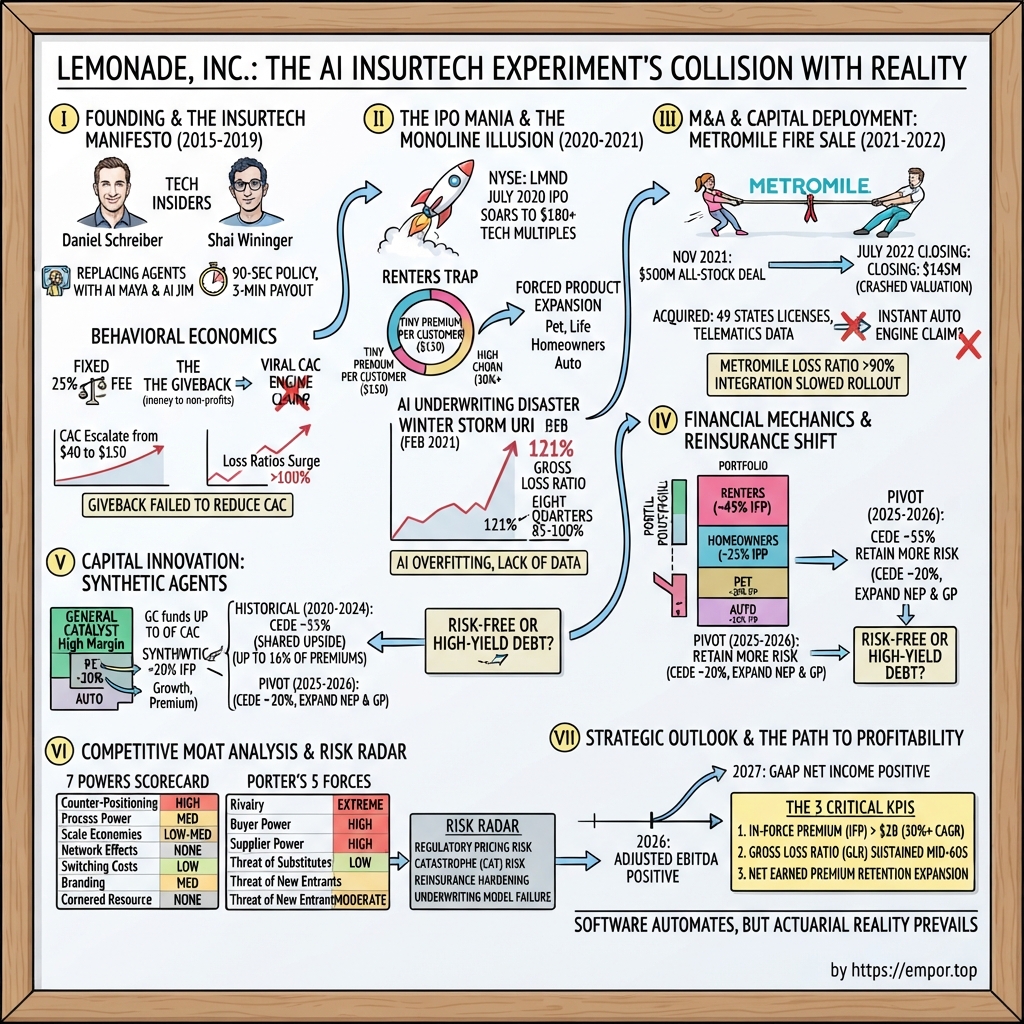
Lemonade, Inc.: The AI Insurtech Experiment's Collision with Reality
I. Introduction & Episode Roadmap
In the summer of 2015, two Israeli technologists founded Lemonade in Tel Aviv with no insurance experience, no regulatory licenses, no actuaries, and no existing book of business. They operated on a single thesis: that the two-hundred-year-old property and casualty insurance industry was structurally constrained by an inherent conflict of interest between carrier and customer, and that automated software could replace traditional distribution and underwriting.
Eleven years later, the company's metrics present a striking contradiction. Lemonade, Inc. ended the second quarter of 2026 with $1.43 billion in in-force premium, representing 32% year-over-year growth — its eleventh consecutive quarter of accelerating growth, an expansion trajectory rarely seen in property and casualty insurance.1 The carrier serves 3.3 million policyholders. Its cost of handling claims, measured by the loss adjustment expense (LAE) ratio, reached a record low of 5% of earned premium, compared to an industry benchmark of roughly 9%.1 Quarterly revenue rose 79% year over year to $294 million, while gross profit increased 76% to a record $113 million.1
Yet the company has never generated a net profit. Lemonade's accumulated deficit stood at $1.46 billion at the end of 2025.2 The insurer recorded net losses of $165.5 million in 2025 and $202.2 million in 2024.2 Management expects — as it has projected since 2022 — that the fourth quarter of 2026 will yield its first positive quarter of adjusted EBITDA, with 2027 marking its first full profitable year on that adjusted metric.4 Notably, that guidance relies on non-GAAP adjustments; executive leadership has not provided a timeline for achieving positive GAAP net income.
That divergence between operational momentum and financial accounting defines the debate surrounding Lemonade. The optimistic thesis views Lemonade as a technology enterprise operating with insurance licenses, arguing that structural efficiency in claims automation, customer service, and digital acquisition is expanding and beginning to compound. The skeptical thesis views Lemonade as a small, geographically concentrated carrier that spent a decade and nearly $1.5 billion relearning fundamental insurance principles, attributing recent margin gains to a relatively mild catastrophe environment, favorable reserve developments, and reinsurance restructuring rather than algorithmic superiority.
Both perspectives are backed by tangible evidence. The purpose of this analysis is to evaluate which of these underlying mechanisms are truly load-bearing for the business model over the long term.
The capital that built the argument
This corporate trajectory was made possible by an exceptionally accommodating era of venture capital financing. Sequoia Capital and the Israeli firm Aleph funded Lemonade before it issued a single policy, while SoftBank led subsequent funding rounds that drove the company's private valuation into multi-billion-dollar territory. The company's July 2020 initial public offering coincided with peak equity valuations for software-driven models. Consequently, Lemonade conducted an extended capital-intensive experiment — longer than almost any historical insurance start-up — supported by external private and public investment.
That venture backing created both strategic advantages and operational vulnerabilities. The primary advantage was capital buffer: Lemonade absorbed early underwriting losses and refined its pricing models while surviving initial missteps, a critical necessity in an industry where underwriting accuracy requires years of claims experience. The key vulnerability, however, is that a decade of capital subsidies conceals whether the underlying unit economics are inherently viable or merely prolonged by remaining cash reserves. As of late June 2026, cash, cash equivalents, and investments totaled approximately $1.2 billion, though roughly $330 million of that capital represented statutory surplus required within regulated insurance subsidiaries and was thus unavailable to fund corporate operations or customer acquisition.1 While the capital runway remains substantial, ongoing operational losses will test the business over the coming three years.
Two vocabularies, one company
Analyzing Lemonade requires avoiding a common analytical pitfall: evaluating the company exclusively through either operational performance or statutory financial results.
Lemonade generates two distinct sets of metrics. The first set — including the loss adjustment expense ratio, premium generated per employee, and claims servicing costs — consists of operational metrics that show clear structural efficiency. The second set — including GAAP net losses, cumulative deficit, and statutory bottom-line results — consists of financial metrics that remain severely depressed. Optimistic analysts focus on the operational metrics, framing ongoing financial losses as a temporary growth phase. Skeptics focus on the GAAP losses, dismissing operational efficiency gains as secondary. Both approaches overlook the central question determining Lemonade's long-term viability: whether its operational cost advantages are sufficiently large and durable to generate GAAP profitability before its capital balance is exhausted.
The analytical roadmap proceeds as follows. It begins with Lemonade's founding model — examining the Giveback mechanism, the initial behavioral-economics hypothesis, and how both evolved under operational pressure. It evaluates the 2020 public listing and the subsequent underwriting performance, establishing a critical test of the company's automated underwriting models. It assesses the Metromile acquisition, analyzing its valuation alongside its multi-year operational integration. It evaluates segment economics, highlighting how the business has shifted beyond its initial renters insurance base. It deconstructs Synthetic Agents, the off-balance-sheet marketing growth facility designed to finance customer acquisition without diluting equity, evaluating its true cost of capital. It audits management execution against historical disclosures and strategic commitments. It analyzes Lemonade's competitive moat using formal strategy frameworks. Finally, it identifies the key financial and operational metrics that will determine whether the business achieves self-sustaining profitability.
 Subscribe on LinkedIn
II. Founding & The "Insurtech" Manifesto (2015–2019)
A story often retold among Lemonade's early investors centers on a moment of fundamental ignorance rather than sudden insight. When Daniel Schreiber and Shai Wininger began pitching the company in 2015, they could not answer basic operational questions about how an insurance company worked — how statutory surplus functioned, how regulatory rate filings were approved, or why carriers purchased reinsurance. Sequoia Capital wrote them a check regardless. The venture firm's rationale, as later recounted, was that the founders were asking fundamental outsider questions: not how to optimize existing operations, but why the industry had been built that way in the first place.
Such an approach can mark either the start of a disruptive enterprise or the beginning of a costly corporate education. In Lemonade's case, it proved to be both, in sequence.
Schreiber brought a background in corporate law and technology marketing. He earned a Bachelor of Laws with First Class Honors from King's College London, practiced corporate law at Herzog, Fox & Neeman in Tel Aviv, and joined the Israeli Bar Association. In 1997, he co-founded internet security firm Alchemedia, leading it until its acquisition by Finjan in 2002. He subsequently spent eight years in marketing leadership at M-Systems and SanDisk, followed by four years as president of wireless charging developer Powermat Technologies.29 Schreiber was a skilled communicator adept at selling complex technical products to skeptical audiences — a capability that proved essential for fundraising, even as critics later questioned the narrative framing.
Wininger served as the primary product architect. He co-founded Fiverr in 2009 and served as its chief technology officer, overseeing engineering, design, and product development to automate transactions in freelancing services. His earlier career included work on industrial analytics platforms, mobile content licensing, and a virtual reality web browser in 1999, alongside five years as a resident faculty member in computer graphics at the Neri Bloomfield Academy in Haifa.29
Neither founder had ever sold an insurance policy, which aligned with their strategic premise. They posited that property and casualty insurance was not fundamentally an underwriting risk business — arguing that risk could be transferred into the global reinsurance market by any capitalized entity — but rather a distribution and administrative business operating on legacy infrastructure and pre-digital incentives.
The conflict at the heart of the business
That core argument centered on a structural conflict of interest inherent to traditional insurance. In a standard carrier model, unpaid claim dollars flow directly to underwriting profit, creating a fundamental tension between carrier and policyholder during the claims process.
Lemonade proposed resolving this friction by charging a flat fee percentage of premium while isolating the remaining claims fund. Any residual funds after claims payouts and reinsurance expenses were earmarked for customer-selected non-profit causes through an annual "Giveback" mechanism. To anchor this model in behavioral science, Lemonade appointed Duke University behavioral economist Dan Ariely — author of Predictably Irrational and The Honest Truth about Dishonesty — as chief behavioral officer in early 2016.8 The theoretical underlying premise was that eliminating adversarial financial incentives would reduce fraudulent claims and lower overall loss costs.
This structural framework attracted rapid venture capital deployment. Sequoia Capital and Israeli venture firm Aleph provided $13 million in a December 2015 seed round before Lemonade had issued a single policy.67 SoftBank led a $120 million funding round in December 2017,9 followed by a $300 million Series D round in April 2019 that included Allianz, GV, and Thrive Capital, valuing the start-up at more than $2 billion.1011
The customer interface relied on automated digital channels. An onboarding chatbot, designated AI Maya, processed policy applications in under two minutes, while an automated claims engine, AI Jim, settled straightforward claims within seconds. Lemonade selected entry-level renters insurance — priced around five dollars per month — as its primary market wedge. Traditional carriers generally deprioritized low-premium renters coverage due to commission costs associated with human agent distribution. By bypassing human agency networks, Lemonade captured market share among younger urban renters.
Falsification test: was the Giveback ever a customer-acquisition moat?
A central element of Lemonade's initial investment thesis was that the Giveback program and Public Benefit Corporation structure would generate organic trust and viral word-of-mouth adoption, establishing a durable customer acquisition cost advantage over legacy carriers reliant on heavy advertising.
However, Lemonade's operational data does not support the existence of a Giveback-driven acquisition moat.
First, consider the financial scale of the donations. Lemonade's 2023 Giveback — its seventh annual distribution — totaled just over $2 million across 58 charities, bringing cumulative donations since 2017 to $8.16 million.12 Relative to a business generating hundreds of millions of dollars in premium during that period, the Giveback represented a small fraction of one percent of premium revenue. A donation of that scale is insufficient to serve as a primary driver of customer acquisition for price-sensitive policyholders.
Second, marketing expenditures reflect a conventional performance-acquisition model rather than organic adoption. If trust-based mechanics drove customer acquisition, marketing spend would decline as a percentage of premium over time. Instead, customer acquisition costs remain the company's largest discretionary expenditure, with quarterly growth spend rising to $64.4 million in the second quarter of 2026, up from $49.7 million a year earlier.1 Lemonade acquires policyholders through competitive digital ad auctions, with executive disclosures framing customer acquisition around real-time channel targeting and capital allocation rather than organic community referrals.3
Third, the academic research supporting the behavioral model faced severe scrutiny. In August 2021, data-forensics blog Data Colada revealed that a prominent 2012 study co-authored by Ariely — which asserted that placing honesty declarations at the top of forms reduced misreporting in auto insurance mileage data — relied on fabricated data. All five co-authors acknowledged the data anomalies and formally requested a retraction, which was published in September 2021.1314 Ariely stated publicly that he was not responsible for data collection or fabrication, confirming that his role had been limited to receiving the dataset.13 While Lemonade was not implicated in the study's irregularities and Ariely had stepped down as chief behavioral officer in 2020, the revelation undermined a key marketing premise: that simple behavioral nudges could systematically suppress fraudulent claims.
Verdict. The evidence does not support the thesis that the Giveback program functions as a structural customer acquisition moat. What remains is a brand positioning strategy: the Giveback and conflict-free fee structure provided Lemonade with a distinct brand identity that attracted media attention and resonated with younger demographics ignored by legacy insurers. However, brand differentiation represents a marketing asset rather than a structural cost advantage. While management notes that approximately $85 million of pet insurance in-force premium originates from cross-sales to existing policyholders without incremental acquisition expense,3 that efficiency stems from product expansion across an existing customer base rather than organic Giveback-driven acquisition.
This distinction became critical in 2020. As public equity markets opened and accelerated digital adoption, public market investors prepared to value Lemonade under the assumption that its acquisition advantages were structural rather than promotional.
III. The IPO Mania & The Monoline Illusion (2020–2021)
On July 2, 2020, Lemonade sold 11 million shares at $29 each, raising $319 million in its initial public offering.[^15]16 The stock opened at $50.06 and closed above $69, rising nearly 140% on its first trading day and reaching a valuation of roughly $3.9 billion despite serving only a few hundred thousand policyholders and operating without GAAP net income.15 By January 2021, amid the height of the pandemic-era technology stock rally, the shares traded above $180.17
That valuation reflected a specific market hypothesis: that Lemonade was fundamentally a software enterprise operating with an insurance license, whose gross margins would eventually mirror high-margin software business models rather than traditional property and casualty carriers.
The monoline problem
The strategic limitation of an entry-level wedge product lies in its revenue ceiling. Renters insurance provided low acquisition friction but modest premium potential. At the close of 2021, Lemonade reported 1.43 million policyholders generating $380.1 million in in-force premium, averaging $266 per customer annually.5 Annual dollar retention—the proportion of premium retained over a twelve-month period—stood at 82% in 2021, indicating that nearly one-fifth of the premium base churned each year.5
In property and casualty insurance, fixed administrative, compliance, and claims-handling overhead does not scale down proportionally with lower premiums. Servicing a $266 policy requires baseline regulatory compliance, billing, and claims infrastructure comparable to servicing a $1,500 policy. While Lemonade's digital automation lowered administrative servicing costs per policy, unit-cost compression did not eliminate fixed operational overhead. Consequently, a monoline renters book required technological efficiency merely to achieve breakeven, while offering limited top-line expansion per customer.
To increase average revenue per policyholder, Lemonade expanded beyond renters insurance. The company introduced pet insurance in 2020, followed by term life through a white-label partnership, an expanded homeowners offering, and the announcement of an auto insurance product line. While each new product increased premium per customer, each also introduced underwriting risks in categories where the carrier had no prior operating history.
Falsification test: did AI underwriting actually beat the actuaries?
A central premise of Lemonade's founding narrative was that machine-learning algorithms analyzing behavioral signals from digital user interactions could price risk and select policyholders more effectively than traditional actuarial tables built over decades. Underwriting performance during 2021 and 2022 provided empirical evidence testing that hypothesis.
In February 2021, Winter Storm Uri caused widespread property damage across Texas, where approximately 20% of Lemonade's total premium was concentrated. The carrier recorded a first-quarter gross loss ratio—claims and claims-handling expenses relative to earned premium—of 121%, causing its stock price to decline 14% upon disclosure.18 Excluding catastrophe losses, the underlying loss ratio was approximately 71%. However, catastrophe absorption represents a core function of property and casualty insurance; geographic concentration left the carrier's financial results vulnerable to single regional weather events.
Underwriting losses extended beyond the severe weather event. Lemonade posted a full-year gross loss ratio of 90% in 2021 and repeated a 90% gross loss ratio in 2022, substantially exceeding management's long-term target in the mid-70s.5 Consistently generating ninety cents in claims payouts per dollar of earned premium prior to operating and acquisition expenses reflected fundamental challenges in risk selection and rate adequacy.
This performance stemmed from structural data limitations. Predictive algorithms depend on historical training data. With a limited operating history, geographic concentration, and newly introduced product categories, Lemonade lacked sufficient historical claims data to model low-probability, high-severity tail events. Established incumbents maintained decades of historical loss data across micro-geographic regions, enabling more accurate catastrophe risk pricing.
In response, Lemonade implemented traditional insurance risk management measures rather than relying solely on algorithmic adjustments. Management submitted state rate increase filings, raised policy deductibles, tightened underwriting eligibility, and non-renewed higher-risk policies—a portfolio rebalancing that contributed to a one-percentage-point decline in annual dollar retention in 2025.4 The carrier also adjusted its geographic exposure. Following these adjustments, the trailing-twelve-month gross loss ratio decreased from 88% in the third quarter of 2023 to 64% by year-end 2025, and reached 61% during the first half of 2026.41
Verdict. The empirical record refutes the strong thesis that automated machine learning provided immediate underwriting superiority over legacy actuaries during 2021 and 2022. However, evidence supports a narrower thesis: Lemonade's digital infrastructure produces a measurable cost advantage in claims administration and operational processing, while its underwriting pricing has improved as loss experience accumulated. The carrier's loss adjustment expense ratio of 5% compares favorably to the industry benchmark of approximately 9%.1 Nevertheless, loss adjustment efficiency remains distinct from baseline claims costs; the long-term stability of Lemonade's underwriting margin remains to be tested through major catastrophe cycles at its current operating scale.
A brand lesson in what "AI-first" costs you
In May 2021, a public relations incident highlighted the regulatory and reputational friction associated with automated claims framing. Lemonade published social media posts stating that its AI algorithms analyzed claim videos for "non-verbal cues" undetected by human adjusters, prompting immediate public backlash over potential bias in claims evaluation.19 Lemonade subsequently deleted the statements, describing the phrasing as inaccurate, and clarified that facial recognition technology was utilized strictly to cross-reference user identities against duplicate claims rather than to evaluate physical demeanor.19 The carrier stated explicitly that its software does not use physical traits or personal attributes to deny claims.20
The episode illustrated the tension between marketing narrative and regulatory compliance within a heavily scrutinized industry. Algorithmic risk selection and claims processing face increasing scrutiny over potential discriminatory bias. In its 2025 annual report, Lemonade formally identified legal exposure to potential class-action litigation alleging bias in data collection or underwriting models, while citing compliance challenges across emerging state AI regulations and a December 2025 federal executive order directing agencies to review state-level AI restrictions.2
By late 2021, facing elevated loss ratios and the structural growth limitations of monoline renters coverage, Lemonade required rapid entry into auto insurance—a product line offering higher premium per policyholder, but one that the carrier lacked the time to develop entirely in-house.
IV. M&A & Capital Deployment: The Metromile Fire Sale
By the autumn of 2021, Lemonade faced a strategic disconnect between product expansion and underwriting performance. Sustaining top-line growth required entering larger premium categories, yet existing underwriting operations remained unprofitable. Entering auto insurance offered higher revenue per policy, but threatened to worsen overall underwriting performance during the initial integration phase.
Auto insurance represents the primary revenue opportunity in personal lines. It is mandatory, generates annual premiums per policy an order of magnitude higher than renters coverage, and yields telematics data—direct measurements of driving behavior—that function as a proprietary underwriting dataset. However, auto insurance is also among the most competitive segments in U.S. financial services, dominated by incumbents such as GEICO and Progressive, whose annual advertising budgets exceed Lemonade's total revenue.
To enter the market effectively, Lemonade required regulatory licenses across 50 states, approved rate filings in each jurisdiction, and extensive historical driving data. Developing these assets organically would have required years of capital expenditure and regulatory processing.
Metromile possessed all three assets. The pay-per-mile auto insurer had gone public via a special purpose acquisition company (SPAC), collected telematics data from hundreds of millions of driven miles, and held licensed insurance entities in 49 states. However, Metromile was also burning capital with an elevated loss ratio. By late 2021, market valuations for insurtech entities were declining rapidly.
The deal, and what the price says
In November 2021, Lemonade agreed to acquire Metromile in an all-stock transaction initially valued at approximately $500 million.21 By the time the transaction closed on July 28, 2022—with Metromile shareholders receiving 0.05263 Lemonade shares for each Metromile share—equity market repricing reduced the effective transaction value to approximately $145 million.22
The transaction structured a notable capital-allocation outcome. For under $145 million in stock consideration, Lemonade acquired an entity holding over $155 million in cash, more than $110 million in in-force auto premium, regulatory licenses in 49 states, and telematics data spanning roughly 500 million driven miles.23 Because Metromile's cash balance exceeded the final equity purchase price, Lemonade effectively acquired a licensed national auto carrier, an existing book of business, and proprietary behavioral data for negative net cash consideration.
However, the valuation mechanics reflected broader equity market movements. The purchase price fell primarily because Lemonade's own equity valuation declined alongside Metromile's during the wider re-rating of technology and insurtech equities throughout 2022.25 An all-stock transaction during a sector-wide contraction transfers valuation declines to the target company's shareholders. While Lemonade executed the transaction without upward price adjustments, the acquisition cost reflected prevailing market contraction as much as structural deal design, with payment made in equity that had itself undergone substantial revaluation.
Post-closing integration was immediate. Lemonade reduced Metromile's workforce by approximately 20% while consolidating the operating infrastructure onto its proprietary software platform.24 Metromile Insurance Company was retained as a regulated operating subsidiary, serving as a named ceding entity on Lemonade's reinsurance agreements.2
Falsification test: did Metromile accelerate Lemonade Car by three to five years?
At announcement, management asserted that acquiring Metromile's regulatory licenses and telematics data would compress Lemonade Car's development timeline by three to five years. Operating results demonstrate that while regulatory access was achieved immediately, commercial expansion experienced a multi-year delay.
Disclosed quarterly data shows Lemonade Car's year-over-year in-force premium growth progressing from 3% in the third quarter of 2024 to 7%, 9%, 22%, 39%, 53%, and reaching 60% by the first quarter of 2026.3 These figures indicate that the auto segment generated minimal expansion for two full years following the acquisition before accelerating. Management subsequently characterized 2025 as a period focused on deliberate product optimization for Lemonade Car, positioning 2026 for broader segment expansion.4
This delay stemmed from structural operational constraints. State-by-state regulatory rate approvals required extended review periods, legacy technology platforms required deprecation, and Metromile's acquired book required substantial repricing. Lemonade Car's trailing-twelve-month gross loss ratio stood at 70% at year-end 2025, following a 23-percentage-point year-over-year reduction, indicating that loss ratios had previously exceeded 90%.4 Consequently, the auto line represented an ongoing drag on consolidated underwriting performance throughout the integration period.
Verdict. The acquisition secured a national auto insurance platform at an advantageous price. However, the initial claim of a three-to-five-year operational acceleration proved overly optimistic. The transaction delivered regulatory licenses and historical data, but required nearly three years of rate adjustments and system integration before generating material top-line expansion. The revised evaluation confirms that Metromile provided a national auto footprint at negative net cash cost, offset by a multi-year integration lag. Sustained validation of the acquisition depends on Lemonade Car maintaining annual premium growth above 40% while preserving gross loss ratios in the low 70s; conversely, underwriting deterioration as newer policy cohorts mature would indicate persistent risk-selection challenges typical of rapid auto insurance expansion.
Initial metrics offer mixed evidence. Lemonade Car achieved 60% year-over-year premium growth in the first quarter of 2026 while reporting a 74% gross loss ratio, with management citing favorable trends across both new business and renewals alongside a diminishing new-business underwriting penalty.3 Colorado, introduced in 2025, expanded to become the carrier's fourth-largest state by auto in-force premium within twelve months.3 During the second-quarter 2026 earnings call, Chief Executive Daniel Schreiber reported observable acceleration and operational improvement within the auto segment.30 The ultimate test of segment viability remains loss-ratio performance through subsequent policy renewal cycles.
The auto expansion includes an experimental pricing initiative. In late 2025, Lemonade introduced telemetry-based pricing for vehicles operating Tesla Full Self-Driving (Supervised), utilizing driving data with customer consent to differentiate autonomous vehicle miles from human-driven miles, pricing autonomous miles at a 50% discount relative to human-driven rates.4 By mid-2026, the offering was available in Colorado and Indiana, where customer conversion rates exceeded the baseline auto product by approximately 70%.3 On the second-quarter 2026 earnings call, Chief Financial Officer Tim Bixby noted encouraging initial trends and lower claims frequency relative to standard auto coverage, while emphasizing that data remains limited due to the early stage of deployment.30 While telemetry-based autonomous pricing represents an innovative framework for shifting vehicle risk, it currently accounts for a negligible fraction of total premium. Operational validation requires converting technical capability into scalable, profitable premium volume over time.
V. Segment-Level Economics & Financial Mechanics
If you formed your mental model of Lemonade in 2021, you would picture a renters insurance company with side businesses. That model is now wrong, and the correction is the single most important thing to understand about the current company.
The company that pitched itself as the insurer for urban millennials in walk-up apartments has quietly become, first and foremost, an insurer of dogs and cats.
Pet ate the company
Pet insurance is Lemonade's largest line of business. It reached $439 million of in-force premium at the end of 2025, growing 55% for the second consecutive year, and crossed $500 million early in the second quarter of 2026 — the first Lemonade product to do so, less than six years from launch.43 Lemonade is now the fourth-largest U.S. pet insurance carrier by written premium and the most-searched pet insurance brand in the country.3
Why pet works for this particular company is worth dwelling on, because it explains the mechanism rather than the outcome. Pet insurance has high claim frequency — dogs eat things, cats fall off things, and owners take them to the vet several times a year. For a conventional carrier, frequency is a cost problem: every claim is a phone call, an adjuster, a file. For Lemonade, frequency is a data faucet. Each claim is a labeled training example, and each claim costs almost nothing to process. Lemonade's cost per pet claim fell from $44 in 2021 to $14 in 2025, and its pet LAE ratio runs around 4%.43
That cost position translates into pricing freedom, and the 2025 comparison is the cleanest evidence Lemonade has produced for its core thesis. Using S&P filings data, the company showed that it took 12% rate in pet during 2025 against an industry average of 27%, and still delivered a gross loss ratio excluding LAE of 66% versus the industry's 68% — while growing in-force premium 55% against an industry average of 17%.3 Less rate, better loss ratio, three times the growth. If that comparison holds up over time, it is the most persuasive single data point in the bull case, because it isolates the mechanism: automation lowers the expense floor, which lets you price competitively without eroding margin, which buys share.
The caveat is that pet is the easiest possible arena for this argument. Claims are small, high-frequency, non-catastrophic, and largely uncorrelated. There is no Winter Storm Uri for golden retrievers. The advantage may be real and still not transfer cleanly to homeowners.
Pet is also not immune to cost inflation. On the second-quarter 2026 call, incoming CFO Nick Stead attributed a modest increase in the pet loss ratio to "an industry-wide vet cost inflationary trend," managed through rate.30 Veterinary cost inflation has been persistent, and pet insurance is not a rate-regulated product in the way homeowners is — which cuts both ways.
The rest of the portfolio
Property — renters and homeowners in the United States, plus contents and liability products in Europe — remains the largest combined block but is no longer the growth story. It is also where the company's tail risk lives. Roughly 45% of Lemonade's gross written premium in 2025 originated from customers in California, New York, and Texas.2 For a carrier writing homeowners, that is a concentrated bet on three of the most catastrophe-exposed and most heavily regulated states in the country.
The January 2025 Los Angeles wildfires demonstrated it: Lemonade incurred net losses of approximately $19.6 million, plus a $6.9 million assessment from the California FAIR Plan that was paid and expensed in the first quarter.2 The company subsequently received regulatory approval to recoup up to half of that assessment over two years beginning in 2026.2 Consolidated gross loss ratio for that quarter was 78%.3 One fire season, one state, sixteen points of loss ratio.
Car is the fastest-growing line at $187 million of in-force premium entering 2026, and Europe is the fastest-growing region — $60 million of in-force premium at the end of 2025, growing 150%, with ten consecutive quarters of triple-digit growth and a trailing gross loss ratio that improved 16 points to 74%.4 Europe is small enough that percentages flatter it, but management makes an interesting structural argument: European regulators permit far faster iteration on pricing and underwriting than U.S. state insurance departments, so the learning loop runs quicker there.4 Lemonade holds a pan-European license permitting it to passport into 30 countries and currently operates in Germany, the Netherlands, France, and the UK, with buildings insurance in the UK and France supported by partnerships with Aviva and BNP Paribas Cardif respectively.2 Life insurance remains a small white-label placement business; policies placed with third-party carriers, on which Lemonade earns recurring commission, represent roughly 4% of total in-force premium.2
In the United States, Lemonade is licensed in all 50 states and Washington, D.C., and actively operating in 41 states plus D.C., covering about 95% of the population.2
The reinsurance restructuring is the biggest financial event of the last two years
Here is where the outline most investors carry in their heads is out of date, and where a large share of Lemonade's headline revenue growth actually comes from.
For years, Lemonade ceded roughly 55% of its premium to a panel of reinsurers — principally Hannover Rück SE, MAPFRE Re, and Swiss Re — under whole-account quota share contracts covering all products and geographies.2 The logic was capital efficiency: a young carrier with volatile results and limited surplus rents someone else's balance sheet, pays for it with a share of the margin, and gets a ceding commission back. It works, and it caps your upside at roughly 45% of your own economics.
That structure has been dismantled in two steps. Effective July 1, 2025, the renewed program with Hannover and MAPFRE cut the effective cession rate from approximately 55% to 20%.2 Effective July 1, 2026, a new twelve-month program reduced it further to approximately 18%, and — importantly — changed character. Rather than a broad proportional cession, the program shifted toward targeted catastrophe protection: up to $40 million of recovery per event, subject to a $100 million aggregate limit, with named-storm cover added for the first time, an exposure explicitly excluded under the prior structure.1
The financial consequence is enormous and easily misread. Lemonade's second-quarter 2026 revenue grew 79% while gross earned premium — the actual measure of business written — grew 32%.1 The 47-point gap is almost entirely the reinsurance change: Lemonade is keeping premium it used to hand away. Anyone modelling 79% as an underlying growth rate is double-counting a one-time structural shift that will annualize out.
The strategic read is more interesting than the accounting. Reducing cession is a statement of confidence: management is retaining risk it previously paid to shed, because it believes its loss ratio is now good enough that the retained margin exceeds the volatility cost. That is a rational trade if the underwriting is genuinely better. It is also, mechanically, a decision to take the catastrophe risk onto Lemonade's own balance sheet, mitigated now by a per-event and aggregate cover that caps recovery at $100 million in a year. A truly severe wildfire or freeze season in California or Texas would now flow through to Lemonade's results far more directly than it would have in 2021. Cash, cash equivalents and investments totaled approximately $1.2 billion at June 30, 2026, of which roughly $330 million was required regulatory surplus at the insurance subsidiaries.1 The cushion is real; it is not infinite.
Retaining more risk raises the stakes on the loss ratio. Growing fast enough to justify it requires cash up front. That is the problem the next section solves — and the solution is the most financially creative thing Lemonade has ever done.
VI. Capital Innovation: Synthetic Agents & Expansion Bets
Of all the industry conventions Lemonade sought to disrupt, the traditional insurance agent was among the most symbolically significant. The agent embodied what the founders viewed as structural friction: a commission-earning intermediary positioned between carrier and policyholder, adding distribution overhead and potential incentive misalignment.
However, eight years into its operations, Lemonade confronted the underlying financial reality that the agency distribution model solved: customer acquisition financing.
The fundamental math of property and casualty distribution creates a structural cash flow mismatch. When an insurer acquires a policyholder, it incurs the acquisition cost upfront — whether through agent commissions or, in Lemonade's case, digital ad auction bids. Premium revenue, by contrast, is collected incrementally in monthly installments over several years. Consequently, a carrier growing at 30% annually consumes cash continuously even when individual customer cohorts are profitable, creating direct tension between top-line expansion and operational liquidity.
Traditional carriers resolved this constraint through the agency model itself, where agents receive recurring commission payments as premiums are collected over time, avoiding large upfront capital outlays by the insurer. By eliminating human agents, Lemonade removed that built-in financing mechanism, requiring direct, day-one cash payments to digital ad platforms.
The structure
To address this liquidity requirement without issuing dilutive equity, Lemonade executed a Customer Investment Agreement in June 2023 with an entity of General Catalyst. Under the arrangement, General Catalyst agreed to advance up to 80% of Lemonade's customer acquisition spend at the start of designated growth periods. In exchange, the facility was repaid directly from premium collections generated by those specific customer cohorts, plus a 16% annual return.262 Upon full repayment of an investment cohort, Lemonade retained all subsequent premium and commission streams. The capital commitment was expanded through subsequent amendments, adding $140 million in January 2024 and an additional $200 million in February 2025 to cover customer acquisition through the 2026 calendar year.2
Management branded this mechanism "Synthetic Agents." The naming reflected its strategic intent: replicating the cash-flow mechanics of a traditional agency network — where a third party finances customer acquisition in exchange for a share of ongoing premiums — without maintaining physical branch offices or permanent commission claims.
Falsification test: is this free money?
The empirical record refutes the notion that Synthetic Agents represents frictionless or low-cost capital. The facility functions as senior, cohort-secured debt, carrying substantial interest charges during its initial three years.
At year-end 2025, Lemonade reported $158.1 million outstanding under the arrangement and recorded $17.3 million in related interest expense for the year — up $11.1 million, or 179%, from 2024.2 This interest expense is classified below the non-GAAP adjusted EBITDA line. Consequently, management's guidance toward achieving positive adjusted EBITDA in the fourth quarter of 2026 relies on a metric that excludes the capital servicing costs incurred to generate that premium growth. While this presentation aligns with standard non-GAAP financial disclosures, comprehensive credit evaluation requires accounting for both operational and financing expenses. In its 2025 Form 10-K, Lemonade explicitly cautioned that there can be no guarantee the financing structure will function as intended.2
The initial 16% return rate reflected venture-style risk pricing. Lemonade paid a mid-teens cost for capital secured directly by policyholder premium streams, despite holding more than $1 billion in corporate cash and investments. While the structure preserved corporate liquidity and avoided equity issuance during a period of depressed market valuations, framing the capital as non-dilutive is accurate only in the literal sense that no new equity shares were issued.
The refinancing is the actual evidence
In June 2026, Lemonade restructured the facility. The company entered a New Business Financing Agreement with Hannover Re (Ireland) DAC, securing up to $250 million in growth capital for the period spanning January 1, 2027 through December 31, 2028.27 The agreement established funding caps of $150 million outstanding in 2027 and $250 million in 2028, financing up to 80% of monthly growth spend with a $20 million limit per customer cohort.27 The return structure was set at the greater of zero or the three-year U.S. Treasury bill rate plus 5.8 percentage points, yielding an effective cost of capital of approximately 9.8% based on prevailing rates — a reduction of more than six percentage points compared to the prior arrangement, as Chief Executive Daniel Schreiber highlighted during the second-quarter earnings call.130
This refinancing provides meaningful empirical data evaluating the performance of Lemonade's customer cohorts. Hannover Re — Lemonade's long-standing lead reinsurer with direct visibility into underlying policy loss experience — agreed to underwrite the acquisition loans at a spread of 580 basis points over Treasuries. Reinsurers price collateral risk strictly; securing lower interest terms suggests that three years of accumulated cohort data demonstrated acceptable underwriting performance, transitioning the capital structure from venture-rate financing toward institutional structured credit.
Two structural caveats remain. First, because the interest rate floats against three-year Treasury yields, the 9.8% cost of capital represents a snapshot rather than a fixed rate. Second, Hannover Re now functions simultaneously as Lemonade's primary reinsurer and a major creditor secured against its customer cohorts, creating a concentrated counterparty relationship across both reinsurance risk transfer and customer acquisition financing.
Verdict. The thesis that Synthetic Agents provides zero-cost, risk-free capital is unsupported; the structure represents senior, cohort-secured growth debt whose financing costs sit outside management's primary adjusted profitability metric. However, the narrower thesis is supported: the instrument effectively replicates agency-style acquisition financing, and its cost of capital declined significantly as historical cohort loss data validated underwriting performance. The primary risk to this model remains potential increases in policyholder churn or loss ratios within funded cohorts, which would delay loan repayment schedules and elevate effective financing costs.
What the money buys
The financing facility funded quarterly growth spend of $54.3 million in the first quarter of 2026 and $64.4 million in the second quarter, compared to $38.1 million and $49.7 million in the corresponding periods of 2025.31 Management reported that internal lifetime-value-to-acquisition-cost models maintained projected returns at or above 3x across this expenditure, even as annual growth spend expanded roughly 200% from the first quarter of 2023.31 Investors should note that these return metrics reflect internal management modeling rather than audited financial results.
A central analytical debate concerns capital allocation efficiency, as growth expenditures have recently expanded faster than in-force premium growth, running counter to expected operating leverage. In its second-quarter 2026 shareholder letter, management attributed this dynamic to an operational baseline effect: growth spend was reduced by half in 2023 when inflation compressed profitable customer acquisition opportunities, and subsequent annual additions of consistent dollar amounts generated a declining percentage growth rate off an expanding baseline.1 Management projected that in-force premium growth will outpace acquisition spend growth beginning in 2027, while noting that acquisition spend would increase sequentially in the third quarter of 2026 to support Lemonade Car and capture seasonal renters demand.1
While management's arithmetic explanation is coherent, it marks the second consecutive year in which the expected efficiency crossover was deferred into a subsequent annual period. When Lemonade reported second-quarter 2026 results on July 29, 2026 — exceeding consensus revenue estimates — the stock declined approximately 15%.32 Equity markets signaled diminishing tolerance for deferred operating leverage despite expanding headline revenue.
VII. Current Management, Corporate Governance & Insider Alignment
When Lemonade reported its second-quarter 2026 financial results on July 29, 2026, the company posted record gross profit and reiterated its long-held profitability guidance, yet its stock fell approximately 15%.32 Disclosed alongside the earnings report was a key leadership transition: the long-standing chief financial officer was stepping down.
Lemonade's executive leadership has maintained notable stability through market cycles, underwriting challenges, and portfolio expansion. Daniel Schreiber has served as Co-Founder, Chief Executive Officer, and Chairman of the Board since June 2015. Shai Wininger has served as Co-Founder and Director since inception, holding roles including Co-CEO, Secretary, Treasurer, and Chief Technology Officer before becoming President.29 Maya Prosor serves as an executive officer alongside Chief Operating Officer John Peters and Chief Corporate Development Officer Adina Eckstein, rounding out the named executive leadership.29
This executive structure reflects a distinct division of responsibility: Schreiber manages strategic narrative, capital market positioning, and corporate vision, while Wininger oversees software architecture, claims automation, and operational performance metrics.
The finance chair changes hands
On July 27, 2026, the board approved a chief financial officer transition: Tim Bixby will step down as CFO effective January 1, 2027, to join the board as a Class III director. Nick Stead, Senior Vice President of Finance, was appointed to succeed Bixby as CFO and principal accounting officer on the same date.28 Stead joined Lemonade in December 2019 as Director of Financial Planning and Analysis, spent a year at the fintech firm Flex, and returned in March 2023, advancing to SVP of Finance in July 2024.28 Schreiber characterized the transition during the earnings call as a planned succession, noting Bixby's move to the board.30
The leadership change introduces two corporate governance considerations. First, appointing a first-time public company CFO to manage financial controls occurs precisely as Lemonade assumes significantly higher retained risk under its restructured reinsurance program. While Stead has regularly addressed loss ratio trajectory and operating leverage on investor calls, the transition presents operational execution risk. Second, an outgoing CFO immediately joining the board of directors diminishes independent board oversight of the finance function previously under his direction.
Ownership and control: correcting a common misconception
Lemonade does not have a dual-class share structure. It maintains a single class of common stock listed on the New York Stock Exchange, with each share entitled to one vote.2 Contrary to a common assumption regarding venture-backed technology enterprises, founders do not hold super-voting shares.
As of April 9, 2026, across 76.8 million shares outstanding, Wininger beneficially owned 5.4% and Schreiber held 3.0%. All twelve executive officers and directors as a group held 12.2% of outstanding shares. Institutional investors represented the largest outside holdings, led by JPMorgan Chase at 5.8% and BlackRock at 5.3%, while early anchor investor SoftBank no longer holds a reportable 5% stake.29
Consequently, founder voting power remains modest despite substantial equity exposure. Governance continuity relies instead on structural corporate defenses. The board of directors is divided into three staggered classes with three-year terms, resulting in only one-third of seats standing for election each year. Furthermore, amending corporate charter or bylaw provisions requires a supermajority vote of two-thirds of outstanding shares.292 These standard anti-takeover mechanisms insulate the board from proxy challenges, creating high barriers for activist investors despite persistent operating losses.
Corporate disclosures contain an additional liquidity detail: 890,167 shares held through Aleph, L.P.—an entity affiliated with director Michael Eisenberg—are pledged as loan collateral.29 While share pledging is a common financing practice among venture sponsors, pledged equity can amplify downward selling pressure during extended share price declines.
The company's independent auditor is Ernst & Young LLP.29 Lemonade reports no pending legal proceedings expected to have a material adverse effect on its financial condition.2
Management credibility: promises versus outcomes
Evaluating management execution requires separating core underwriting performance from operational guidance delivery.
The primary execution failure centers on initial underwriting targets. For several years, management projected a long-term gross loss ratio in the mid-70s while posting loss ratios of 90% in both 2021 and 2022.5 Substantially exceeding target loss ratios over multiple annual periods damaged institutional credibility regarding algorithmic risk pricing.
Conversely, management has demonstrated consistency regarding its adjusted EBITDA timeline. In its fourth-quarter 2025 shareholder letter, management reaffirmed its expectation of positive adjusted EBITDA in the fourth quarter of 2026 and full-year adjusted EBITDA profitability in 2027, noting that it had originally issued this projection in 2022.4 Management has maintained this timeline across multiple macro-economic shifts, confirming guidance during the second quarter of 2026 with an implied fourth-quarter adjusted EBITDA of approximately $8 million.1 Full-year 2026 revenue guidance was increased from $1.187–$1.192 billion in February to $1.214–$1.220 billion in July, while maintaining targets for in-force premium and adjusted EBITDA.41
However, two major caveats temper this guidance record. First, adjusted EBITDA excludes significant cash and non-cash operational costs, including $95 million in projected 2026 stock-based compensation and ongoing growth-facility interest expense.1 Generating near-breakeven adjusted EBITDA alongside nearly $100 million in stock compensation leaves the carrier far removed from GAAP profitability, and executive leadership has not provided a timeline for positive GAAP net income. Second, management's long-term projection at its November 2024 Investor Day—outlining a path from $1 billion to $10 billion in in-force premium—represented an aspirational target rather than binding financial guidance, as no operational timeline was provided.31
Lemonade's management team has established strong execution on controllable operational targets—including expense management, software deployment, and financing structures—while navigating volatile risk selection costs. The carrier's next Investor Day, scheduled for November 17, 2026, in New York City, will provide a key venue to observe whether leadership introduces concrete timelines for GAAP net profitability.14
VIII. Strategic Playbook & Competitive Moat Analysis
Evaluating Lemonade's long-term competitive position requires moving beyond brand messaging to address a central strategic question: if major incumbents like Progressive set out to compete directly across Lemonade's primary product lines, what structural barriers actually protect the start-up?
The 7 Powers, assessed honestly
Counter-positioning remains one of Lemonade's primary strategic advantages, though its protective scope is narrowing. Counter-positioning occurs when a challenger adopts a business model that incumbents cannot mirror without damaging their existing profit pools. Legacy carriers such as Allstate and State Farm rely on networks of exclusive agents who earn recurring commissions; eliminating those agent networks to pursue a fully digital direct model would severely disrupt their core distribution channels. Having built its infrastructure without human agents, Lemonade avoids that channel conflict. However, this protection is far less effective against direct-to-consumer carriers like GEICO and Progressive, which have operated without traditional agent networks for decades. As a result, counter-positioning shields Lemonade against agent-reliant incumbents, but offers little protection against the direct-to-consumer carriers dominating the auto insurance market.
Process power presents the strongest empirical evidence of a compounding operational advantage. Process power represents proprietary institutional know-how that competitors cannot easily replicate even if the underlying concept is understood. For Lemonade, this is demonstrated in the deep automation of its operational architecture. The carrier's loss adjustment expense ratio of 5%—compared to an industry benchmark of roughly 9%—serves as verifiable evidence of operational cost compression. Executive leadership argues that this efficiency extends across the enterprise, noting that the automated systems managing claims handling also power sales, customer service, and underwriting, with claims serving as the primary operational area where regulatory filings mandate public expense disclosure.1 Disclosed metrics support this leverage: Lemonade ended the first quarter of 2026 generating just over $1 million in in-force premium per employee. The company reached that milestone by more than doubling its premium volume while reducing headcount by 6% between late 2022 and early 2026—lowering staff from 1,367 employees managing $625 million in premium to 1,291 employees overseeing $1.33 billion.3 Management contends that this metric places Lemonade at operating efficiency parity with established incumbents such as Progressive, Allstate, GEICO, and Travelers, despite operating at a fraction of their scale.3 Furthermore, quarterly operating expenses excluding growth spend increased only modestly from $87 million in the third quarter of 2022 to $101 million in the fourth quarter of 2025, demonstrating clear operating leverage as premium doubled over that period.4
Scale economies are frequently mischaracterized in property and casualty insurance analysis. Increased scale reduces fixed administrative overhead per policyholder by spreading technology, regulatory, and compliance expenses over a larger premium base. However, scale does not inherently lower baseline loss costs; a severe weather event damaging home roofs imposes identical per-claim repair costs regardless of whether a carrier insures one thousand homes or one hundred thousand in that ZIP code. Instead, scale in insurance provides proprietary risk data. A larger volume of claims interactions generates richer behavioral datasets, enabling more granular risk segmentation. Lemonade's management argues that its scale advantage compounds through this data accumulation, a premise partially supported by its pet insurance performance. Nevertheless, the commercial value of data-driven risk segmentation remains constrained by state-level regulatory approval of underwriting variables.
Network effects are non-existent in this business model. An individual policyholder derives no direct utility or product enhancement from the addition of another policyholder. Assertions suggesting network benefits in insurance typically confuse bilateral network effects with centralized algorithmic learning derived from scale.
Switching costs are structurally minimal across personal lines. Renters and auto insurance policies are widely evaluated on price through online aggregator platforms. Lemonade's onboarding chatbot automatically generates policy cancellation notices to simplify switching from legacy carriers—an operational feature acknowledging that switching friction is low across the industry.2 While the carrier's annual dollar retention rate of 85% reflects steady baseline customer retention, the metric has remained flat to slightly declining over six consecutive quarters.14
Branding provides a moderate strategic asset. Lemonade has established itself as the most-searched pet insurance brand in the United States, commanding the fastest-growing share of organic search queries among domestic pet insurers.34 In consumer insurance, brand equity serves primarily to lower customer acquisition costs by generating direct web traffic and brand recognition rather than relying entirely on paid ad auctions.
Cornered resources remain absent. Standard driving telematics data is widely accessible across the industry, with established programs like Progressive's Snapshot possessing significantly larger historical datasets. Lemonade's prospective opportunity for a proprietary data asset rests in its telemetry-based autonomous vehicle pricing—tracking mileage split between human drivers and automated systems matched against loss experience. However, that capability represents an emerging strategic bet rather than an established, defensible asset.
Evaluating Lemonade across these competitive frameworks reveals a narrower strategic moat than initial public market narratives suggested. The enterprise possesses one eroding advantage in counter-positioning, one demonstrably strengthening advantage in process power, and five powers it lacks entirely. Counter-positioning facilitated Lemonade's initial market entry but offers diminishing protection as major incumbents expand direct digital distribution. Consequently, process power—evidenced by operational cost compression and headcount efficiency—represents the primary load-bearing mechanism capable of compounding over time.
Porter's Five Forces
Rivalry among existing competitors is intense. Lemonade competes directly against established national carriers including Allstate, Farmers, Liberty Mutual, State Farm, GEICO, Progressive, and Travelers in property and auto, alongside specialized carriers like Nationwide, Embrace, and Trupanion in pet insurance—a competitive scope detailed in the company's annual disclosures.2 Incumbents possess superior capital reserves, higher financial strength ratings, and established multi-policy discounting capabilities that Lemonade cannot easily replicate until its auto segment reaches national scale.
Bargaining power of buyers is high, driven directly by low customer switching costs and transparent price comparison channels across consumer lines.
Bargaining power of suppliers is significant, concentrated in global reinsurance panels and cloud infrastructure providers. Lemonade's annual report explicitly notes that any disruption to its Amazon Web Services contract could impair platform operations.2 Additionally, as global reinsurance pricing tightened between 2022 and 2024, Lemonade reduced its cession rate, effectively transferring supplier pricing pressure into retained underwriting risk on its own balance sheet.
Threat of substitute products is low. Property and casualty coverage is structurally anchored by statutory and contractual mandates: auto liability insurance is legally required, homeowners insurance is mandated by mortgage lenders, and renters coverage is frequently required by property managers.
Threat of new entrants is moderate. While statutory capital requirements and state licensing present regulatory barriers, venture financing demonstrated during the 2019–2021 period that new technology-driven carriers can enter the market. The primary emerging entrant threat stems not from venture start-ups, but from major incumbents deploying fully automated technology stacks or big-tech platforms leveraging existing distribution networks.
The constraint that binds everything
Regardless of the sophistication of Lemonade's predictive machine-learning models, proposed premium adjustments cannot be implemented without prior state insurance department approval. Regulatory rate reviews frequently extend over several months, with Lemonade's core markets—California, New York, and Texas—operating under some of the most restrictive rate-filing environments in the United States.2 During periods of elevated claims inflation, carriers face structural rate inadequacy for extended periods while awaiting regulatory authorization. This regulatory lag prolonged Lemonade's underwriting losses during 2021 and 2022, demonstrating a systemic constraint that algorithmic models cannot bypass. Conversely, management highlights European operations as a strategic advantage due to more flexible regulatory frameworks that permit faster pricing iteration.4 To mitigate domestic regulatory friction, management designated the development of an automated pricing engine as one of Lemonade's three primary strategic initiatives for 2026, targeting faster execution of state rate filings.4
IX. Investment Spine: The Core "Why Win / Why Not" & Risk Radar
Why Lemonade wins from here
The expense structure demonstrates structural cost compression verified by regulatory filings. The carrier's loss adjustment expense ratio and its expanding premium generated per employee rely on audited, regulator-mandated reporting rather than unverified corporate assertions.13 Operating at a lower baseline expense floor enables an insurer to achieve profitability at industry-average loss ratios or to underprice competitors and capture market share. The 2025 pet insurance performance — lower rate increases, a superior loss ratio, and three times the growth rate of traditional carriers — provides practical evidence that software automation translates into commercial market share gains.3
The cross-selling model is generating verifiable revenue growth. Since its initial public offering, Lemonade posited that acquiring young renters at low cost and graduating them into pet, homeowners, and auto coverage would expand customer lifetime value without incurring incremental acquisition expenses. That mechanism is now producing tangible metrics: approximately $85 million of pet in-force premium originates from cross-sales to existing policyholders without added acquisition spend, while management estimates that 1.9 million of its 3.3 million policyholders maintain auto policies with external carriers — representing an accessible internal audience.32 Furthermore, new auto business expanded by more than 100% year over year across both direct and cross-sale acquisition channels in the first quarter of 2026.3
Reinsurance restructuring amplifies underwriting gains. By reducing its quota-share cession from 55% to 18%, Lemonade retains a significantly larger portion of its underwriting economics. As a result, each percentage-point improvement in the gross loss ratio generates roughly four times the financial impact on retained gross profit compared to the prior reinsurance structure.
Growth capital costs have declined substantially. The transition of the Synthetic Agents facility from a 16% venture-rate structure to an institutional facility priced at roughly 9.8% lowers interest drag, while financing from lead reinsurer Hannover Re reflects institutional validation of underlying policy cohort performance.27
Why it fails to deliver
Underwriting gains remain untested under higher risk retention. The reduction in the gross loss ratio from 90% to the low 60s coincided with mild weather patterns and favorable prior-period reserve developments. On the second-quarter 2026 earnings call, outgoing CFO Tim Bixby acknowledged that both the homeowners and auto lines benefited from favorable reserve emergence during the quarter.30 Lemonade's 2025 Form 10-K similarly attributed underlying loss ratio improvements to reserve releases resulting from better-than-expected loss emergence in homeowners and auto coverage.2 While reserve releases reflect sound accounting conservatism, they represent non-recurring adjustments that temporarily improve headline loss ratios.
Geographic concentration exposes capital to severe weather events. California, New York, and Texas generate 45% of gross written premium, while catastrophe reinsurance recoveries are capped at $40 million per event and $100 million in aggregate.21 Because Lemonade now retains 82% of its premium risk, a severe wildfire or freeze season — exceeding the $26.5 million net loss and assessment incurred during the January 2025 Los Angeles wildfires — would absorb statutory capital directly rather than transferring the loss to reinsurers.
Auto insurance expansion carries structural seasoning risk. Competitors like Progressive have refined telematics pricing across decades of driving data. Lemonade's auto book remains relatively new, and newly written auto cohorts typically display initial loss ratios that deteriorate over time as delayed bodily injury claims mature and legal expenses accumulate. A 74% gross loss ratio in the auto line during early growth represents an acceptable initial benchmark, but would compress margins if sustained as the portfolio matures.
Non-GAAP earnings metrics conceal substantial operating expenses. Management's guidance toward positive adjusted EBITDA by the fourth quarter of 2026 excludes significant real costs, including $95 million in projected 2026 stock-based compensation against roughly 78 million shares outstanding, alongside growth-facility interest expense.1 Lemonade has not posted a GAAP net profit in eleven years of operation, and executive leadership has provided no timeline for achieving GAAP net income.
Governance structures limit shareholder accountability. The combination of ongoing GAAP losses, a classified board, a combined Chief Executive and Chairman role, an outgoing CFO transitioning directly to the board, total insider equity ownership of 12.2%, and primary guidance relying on non-GAAP metrics creates potential governance friction. While these arrangements comply with corporate regulations, they insulate management from shareholder pressure and complicate activist efforts to demand faster operational accountability.
The risk radar that actually matters
Catastrophe and climate exposure. Catastrophe vulnerability represents the primary operational risk, amplified by the carrier's decision to reduce quota-share reinsurance coverage and retain 82% of written premium.
Regulatory rate approval lag. State regulatory review delays can convert sudden claims inflation into multi-quarter underwriting losses, particularly in high-volume, strictly regulated states like California, New York, and Texas.
Algorithmic pricing regulation and legal exposure. Automated underwriting positions Lemonade directly in the path of emerging state AI governance and potential algorithmic discrimination claims — an exposure itemized in corporate filings that became less predictable following a December 2025 federal executive order directing federal agencies to review state-level AI restrictions.2
Reserve development adequacy. Expanding rapidly into auto and homeowners lines increases the difficulty of accurately estimating long-term loss reserves, particularly when recent reported loss ratios have relied on prior-period reserve releases.
Credit and collection trends. Bad debt expense increased by $11.1 million, or 101%, in 2025, serving as a key indicator of policyholder payment stress within a monthly-billed subscription model.2
Geopolitical and operational continuity. A significant portion of Lemonade's core software engineering team is located in Israel, where employee military reserve call-ups have caused periodic operational disruptions as disclosed in the annual report.2
Counterparty concentration. Reliance on Hannover Re simultaneously as lead catastrophe reinsurer and primary growth-facility lender concentrates balance-sheet exposure with a single financial institution.
X. Strategic Outlook & The 3 Critical KPIs
Where this lands is not a verdict but a well-specified question, and Lemonade has done investors the favor of making the question testable within about six quarters.
The company enters the second half of 2026 guiding to full-year in-force premium of $1,632–$1,639 million, gross earned premium of $1,374–$1,378 million, revenue of $1,214–$1,220 million, and an adjusted EBITDA loss of $47–$51 million — with the fourth quarter carrying approximately $8 million of positive adjusted EBITDA to get there.1 Guidance has been raised on revenue through the year and held on the profitability commitment first articulated in 2022.41 The next Investor Day falls on November 17, 2026 in New York.1
Myth versus reality, in four lines
Before the KPIs, it is worth clearing away the four things most commonly believed about this company that the filings do not support.
Myth: founders control Lemonade through super-voting stock. Reality: there is one class of common stock, one vote per share, and all officers and directors together hold 12.2%.29 Board continuity rests on a classified board and two-thirds amendment thresholds, which is a weaker and more contestable form of protection.
Myth: the reinsurance pivot is ahead of us. Reality: it already happened, in two steps, and it is the single largest driver of reported revenue growth. Anyone treating 79% revenue growth as underlying demand is counting a balance-sheet decision as an operating result.1
Myth: Synthetic Agents is free growth capital from General Catalyst. Reality: it is cohort-secured debt, the original facility carried a 16% return, it cost $17.3 million of interest in 2025 alone, and the counterparty changed to Hannover Re in June 2026.227
Myth: renters insurance is the core business. Reality: pet is the largest line and has been since 2025, and the most persuasive evidence for Lemonade's entire cost thesis comes from a product involving no catastrophe risk whatsoever.43
Three numbers will settle the argument. Not ten.
One: the gross loss ratio, read with prior-period development stripped out. This is the metric that broke the original thesis and the metric that has driven the recovery. It stood at 60% in the second quarter of 2026 and 61% for the first half, against 90% in both 2021 and 2022.15 The improvement is the whole bull case. But part of it came from reserve releases on home and car that management itself identified, and part came from a mild catastrophe period. What matters going forward is whether the ratio holds in the low-to-mid sixties in a year that includes a genuine catastrophe event, without the help of favorable development. That single observation would convert "AI pricing works" from a plausible claim into a demonstrated one — or falsify it.
Two: the crossover between in-force premium growth and growth-spend growth. Management has stated that in-force premium growth will outpace growth spend from 2027, and has named this as the key driver of operating leverage and profitability.1 Everything in the bull case — cross-sell flywheel, brand strength, LTV/CAC discipline, path to GAAP profit — reduces to this one relationship. If premium compounds faster than the money spent to buy it, Lemonade is a compounding business. If it does not, Lemonade is a company renting growth from Google and Hannover Re. The crossover has already been placed a year in the future twice. The 2027 print is the test, and the fourth-quarter 2026 adjusted EBITDA number is the leading indicator.
Three: annual dollar retention. This is the most underrated number in the disclosure pack. It sits at 85%, up one point year over year and flat sequentially for several quarters, having been 86% in both 2022 and 2024.154 The entire graduating-customer thesis — renter becomes pet owner becomes driver becomes homeowner, lifetime value expanding without new acquisition cost — requires this number to rise, because successful cross-selling mechanically increases retained premium per customer. It has not risen. Management has explained the softness partly through deliberate non-renewal of policies failing underwriting criteria, which is a defensible reason.4 But at some point deliberate pruning ends and the flywheel has to show up in the retention line. If premium per customer keeps climbing while annual dollar retention stays pinned at 85%, the cross-sell story is smaller than advertised.
What Lemonade has proven, over eleven years and $1.46 billion of accumulated losses, is that software can genuinely rebuild the cost structure of an insurance operation. A 5% loss adjustment expense ratio against a 9% industry norm, a $14 cost per pet claim, and a doubling of premium on a shrinking headcount are not marketing claims — they are the kind of hard operational evidence that most disruption narratives never produce.
What it has not proven is that software changes the price of risk. The years when Lemonade insisted it did were the years it lost ninety cents on every premium dollar, and the fix, when it came, was rate filings and non-renewals — the same tools the incumbents have used since the nineteenth century. The current version of the company is more honest about this than the 2021 version was: it retains risk deliberately, buys catastrophe protection where volatility is worst, and talks about pricing accuracy improving with data scale rather than about algorithms transcending actuarial science.
There is one disclosure event worth marking on the calendar. The Investor Day on November 17, 2026 is the first since November 2024, and it arrives with the company one quarter away from its long-promised adjusted EBITDA inflection and one year away from the growth-spend crossover. The useful question to bring to it is not whether management repeats the $10 billion in-force premium ambition — they almost certainly will, and it remains a vision without a date attached.31 The useful question is whether they attach a timeline to GAAP net income, and whether they disclose the loss ratio net of prior-period development. A company confident in its underwriting would do both. A company that keeps steering attention to adjusted EBITDA while stock compensation runs at roughly twice the size of the adjusted EBITDA loss it is guiding to is telling investors something too.
That is a smaller and more testable company than the one whose shares traded above $180 in January 2021.17 Whether it is a good one depends on three numbers that will print over the next six quarters.
References
-
Lemonade, Inc. Shareholder Letter Q2 2026 (Form 8-K, Exhibit 99.1) — SEC EDGAR, 2026-07-29 ↩↩↩↩↩↩↩↩↩↩↩↩↩↩↩↩↩↩↩↩↩↩↩↩↩↩↩↩↩↩↩
-
Lemonade, Inc. Form 10-K Annual Report FY2025 — SEC EDGAR, 2026-02-25 ↩↩↩↩↩↩↩↩↩↩↩↩↩↩↩↩↩↩↩↩↩↩↩↩↩↩↩↩↩↩
-
Lemonade, Inc. Shareholder Letter Q1 2026 (Form 8-K, Exhibit 99.1) — SEC EDGAR, 2026-04-29 ↩↩↩↩↩↩↩↩↩↩↩↩↩↩↩↩↩↩↩↩↩
-
Lemonade, Inc. Shareholder Letter Q4 2025 (Form 8-K, Exhibit 99.1) — SEC EDGAR, 2026-02-19 ↩↩↩↩↩↩↩↩↩↩↩↩↩↩↩↩↩↩↩↩↩↩
-
Lemonade, Inc. Form 10-K Annual Report FY2022 — SEC EDGAR, 2023-02-28 ↩↩↩↩↩↩
-
Sequoia Invests $13 Million In A Seed Round For Lemonade, Which Is Looking To Transform Insurance — TechCrunch, 2015-12-08 ↩
-
Entrepreneurs Raise $13 Million to 'Reinvent' U.S. P/C Insurance with Peer-to-Peer Insurer — Insurance Journal, 2015-12-08 ↩
-
Behavioral Economics Guru Dan Ariely Joins Lemonade — PR Newswire, 2016-02-16 ↩
-
Lemonade Announces $120 Million in Funding Led by the SoftBank Group — Business Wire, 2017-12-19 ↩
-
Lemonade picks up $300 million Series D led by SoftBank Group — TechCrunch, 2019-04-11 ↩
-
Insurtech Lemonade Raises $300 Million; SoftBank, Allianz, Alphabet Among Investors — Insurance Journal, 2019-04-11 ↩
-
Lemonade's 2023 Giveback Totals More Than $2 Million, Donating to 58 Charities Selected By Customers — Business Wire, 2023-07-12 ↩
-
Fraudulent data raise questions about superstar honesty researcher — Science (AAAS), 2021-08-24 ↩↩
-
Highly criticized paper on dishonesty retracted — Retraction Watch, 2021-09-14 ↩
-
Lemonade, the online insurer, surges in Wall Street debut — CNN Business, 2020-07-02 ↩
-
Insurtech Lemonade raises $319 million in US IPO above target range — Reuters, 2020-07-01 ↩
-
Lemonade shares slide 14% after Q1 net loss — The Insurer, 2021-05-11 ↩
-
This $5 billion insurance company likes to talk up its AI. Now it's in a mess over it — CNN Business, 2021-05-27 ↩↩
-
Insurance Unicorn Lemonade Backtracks Comments About Its AI After Accusations Of Discrimination — Forbes, 2021-05-26 ↩
-
Insurtech Lemonade to acquire Metromile in $500 million all-stock deal — Reuters, 2021-11-08 ↩
-
Lemonade Completes Acquisition of Metromile — Business Wire, 2022-07-28 ↩
-
Lemonade, Metromile, EIS – "one of the best insurance deals in 2022" — Insurance Business America, 2022 ↩
-
Metromile Layoffs Hit 20% of Staff as Lemonade Closes Acquisition — Insurance Journal, 2022-08-01 ↩
-
Insurtech Valuations Face Harsh Reality Check — Financial Times, 2022-05-15 ↩
-
Lemonade Announces Synthetic Agents Program to Finance Customer Acquisition — Lemonade Investor Relations, 2023-06-27 ↩
-
Lemonade enters into $250m business financing agreement with Hannover Re — Reinsurance News, 2026-06 ↩↩↩↩
-
Lemonade, Inc. Form 8-K, Item 5.02 — CFO Transition — SEC EDGAR, 2026-07-29 ↩↩
-
Lemonade, Inc. Definitive Proxy Statement (DEF 14A) — SEC EDGAR, 2026-04-22 ↩↩↩↩↩↩↩↩↩
-
Lemonade (LMND) Q2 2026 Earnings Call Transcript — The Motley Fool, 2026-08-07 ↩↩↩↩↩↩
-
From $1 Billion to $10 Billion: Lemonade's Investor Day To Focus On The Next 10x — Nasdaq, 2024-11-12 ↩↩
-
Lemonade Q2 2026 slides: AI drives efficiency as stock slides 15% — Investing.com, 2026-07-29 ↩↩
 LinkedIn
 WhatsApp
 Reddit
 Hacker News
 Email
Email Kindle
 RSS Feed
 Spotify
 Apple Podcasts
 Amazon Music
 Audible
 YouTube