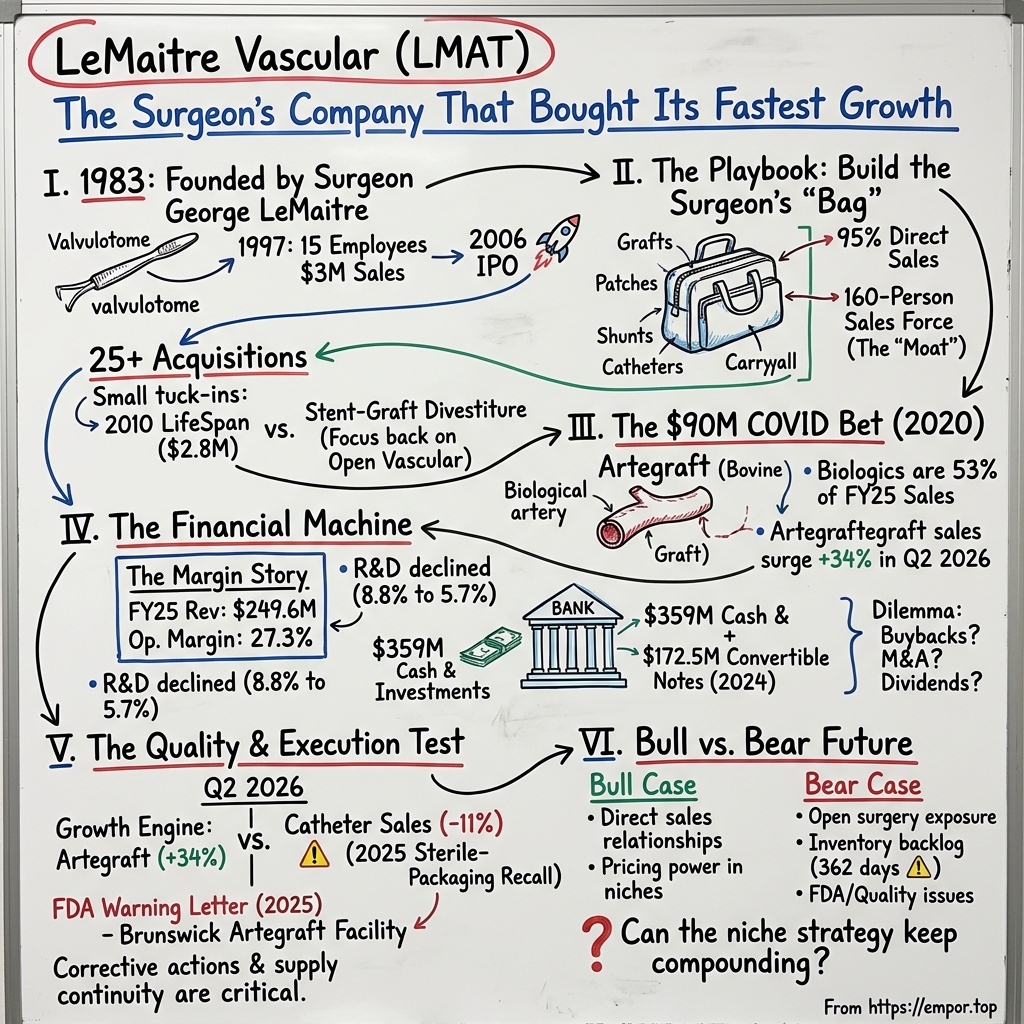
LeMaitre Vascular: The Surgeon’s Company That Bought Its Fastest Growth
I. The Quarter With Two Different Stories
In the spring of 2025, quality engineers at LeMaitre Vascular found something small and unsettling inside a few of their own boxes. On some packaged embolectomy and occlusion catheters, the sterile seal that keeps bacteria away from a device headed into a patient's artery had not closed all the way. Testing found the flaw on roughly one device in a hundred. Nobody had complained and nobody had reported an infection, but the products had already shipped around the world, so on April 10, 2025 the company began pulling every affected lot from every region.1 The cause, an investigation found, was almost comically mundane: shallow dents in the molded plastic trays the company bought for packaging, and a sealing step that did not support the tray well enough where the tube met the tray.1
Then hospitals did something LeMaitre's management later described as odd. They hoarded. With a familiar catheter suddenly in question, purchasing departments around the world bought extra units as replacements arrived, and catheter sales in the second quarter of 2025 swelled.2 A recall, in other words, produced a sales spike. A year later that spike became a hole. When LeMaitre reported its second quarter of 2026, catheter sales were down 11%, because they were being measured against a quarter inflated by panic buying.[^3]
On the same income statement, a different story was racing in the opposite direction. Artegraft, a graft made from the carotid artery of a cow and used mostly to build the vascular access that kidney-failure patients need for dialysis, grew 34% in the quarter.[^3] It now made up about 21% of all company sales.[^3] The founder's son, Chairman and CEO George LeMaitre, put the milestone simply: the company's largest product had become its fastest-growing one.[^3]
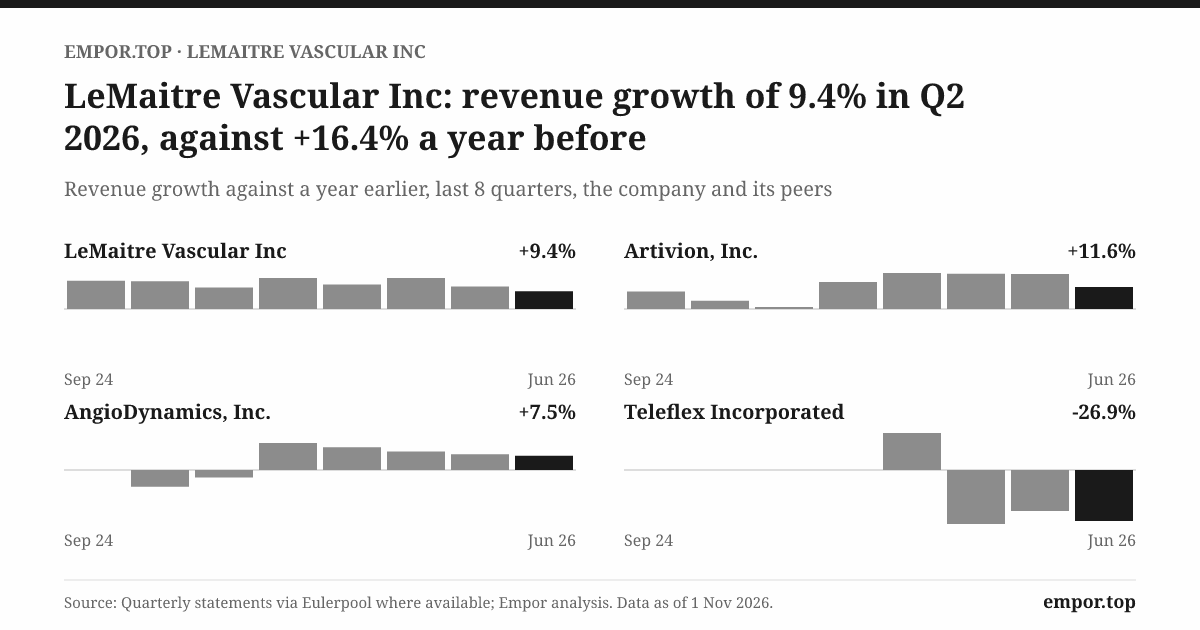
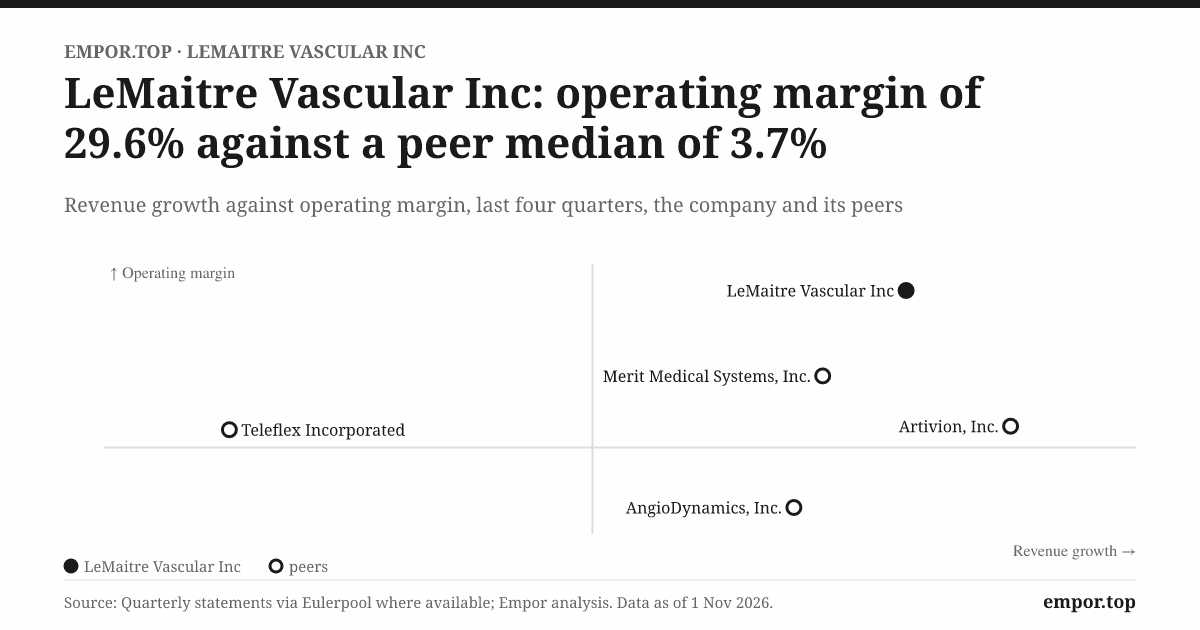
Put the two stories together and the quarter looked healthy but not spotless. Sales reached $70.4 million, up 10% both as reported and organically, which is the company's measure that strips out currency moves and acquisitions.[^3] Gross margin rose to 72.1%, operating income climbed 26% to a record $20.4 million, and operating margin reached 29%.[^3] Strip out catheters and the rest of the portfolio grew 12% organically.2
The number that deserves the most attention, though, is how that 10% was built. Management said 7 points came from price and only 3 from units.2 For a medical-device company, that ratio is a double-edged sword. It shows customers will pay more for LeMaitre's products, which is a sign of a real competitive position. It also shows that most of the growth came from raising prices on products hospitals already buy, not from selling many more of them. Even outside catheters, the split was 7 points of price and 5 of units.2 Price can compound for a long time in a niche nobody else wants to fight over, but it cannot compound forever, and LeMaitre's own annual report warns that it cannot guarantee price increases will continue at the same pace.3
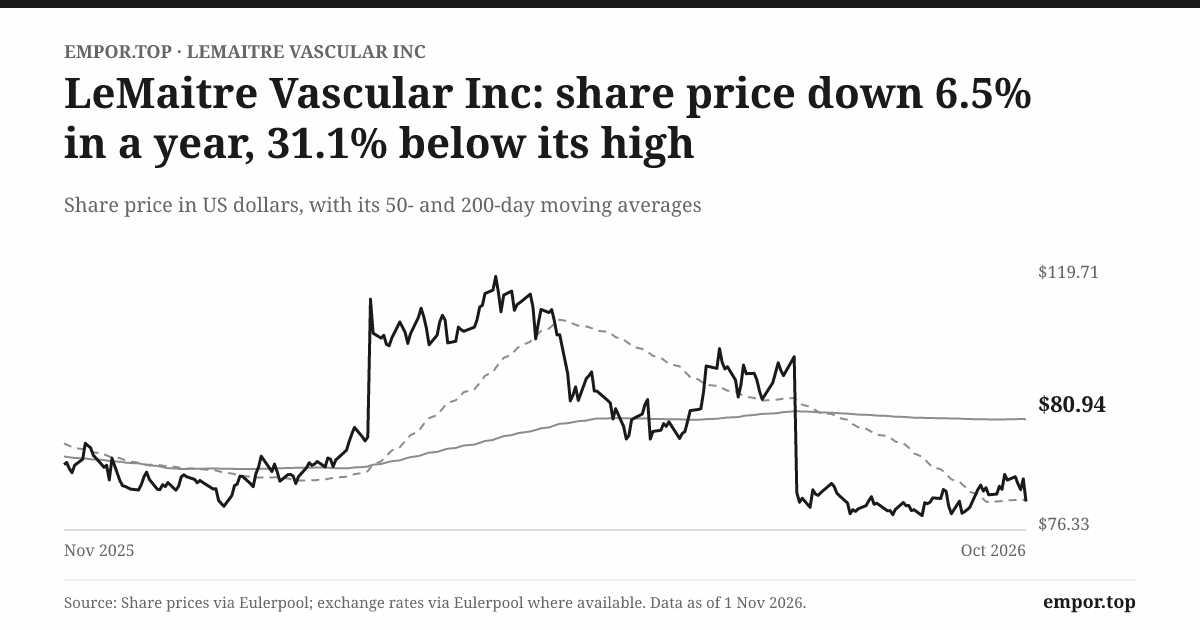
The quarter also contained a miss. LeMaitre came in about $1.1 million below the midpoint of its own sales guidance and blamed three roughly equal causes: a stronger dollar, export orders stuck because of war in the Middle East, and a shortage of donated human heart tissue for its cardiac allograft service.2 It cut its full-year organic growth forecast from 12% to 11% and now expects about $276.3 million of 2026 sales.2[^3] Those are modest disappointments by most standards. Investors treated them as something more. On November 1, 2026, the shares stood at about $81, about 31% below their 52-week high of about $117, giving LeMaitre a market value of about $1.8 billion.[^5]
That brings the episode's stakes into focus. Three questions run through the story. First, is LeMaitre's strategy of owning small, overlooked vascular niches truly durable, or is it a pricing harvest that will eventually run out? Second, is Artegraft, the company's biggest and most expensive acquisition, paying off, and can the New Jersey factory that makes it satisfy the Food and Drug Administration? Third, can a management team that has built up roughly $376 million in cash and securities put that money to work at good returns?[^3]
Scale matters for the answers. LeMaitre sold about $250 million of products and services in 2025.3 It reports a single operating segment, so outsiders see product-line sales but not product-line profits. Its catalogue spans grafts, patches, carotid shunts, catheters, valve cutters, closure clips and a human-tissue cryopreservation service.3 Against the giants of medical technology, it is a speck. Against the vascular surgeon's operating table, it is a familiar name in several drawers.
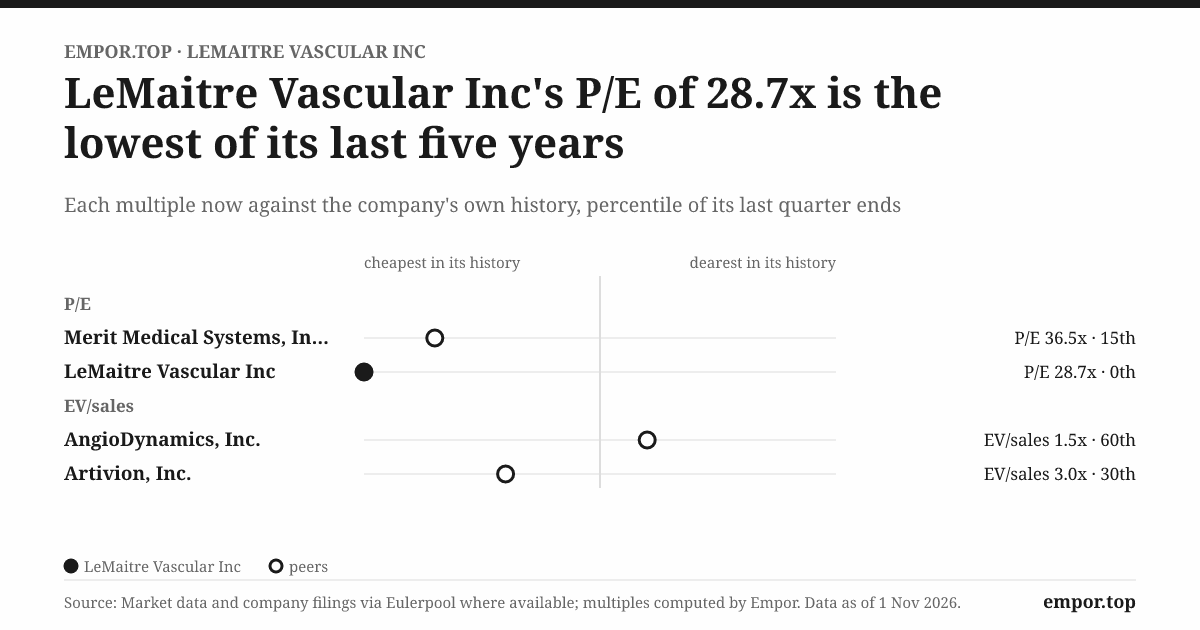
At first glance the valuation looks undemanding for a company growing earnings at double-digit rates. The stock trades at about 28.7 times trailing earnings, well below its own five-year median of about 46.3 times.[^5] The earnings yield, profit divided by price, is about 3.5%.[^5] There is a catch, and it runs through this whole story: a meaningful slice of those earnings now comes from interest on a large treasury portfolio rather than from selling vascular devices. A lower multiple on a company whose earnings increasingly include bond coupons is not the same thing as a bargain.
Three days after this snapshot, on November 4, LeMaitre will report its third quarter.4 Before deciding what that quarter will mean, it helps to go back to the beginning, to a surgeon's practice in Andover, Massachusetts, and a single tool for cutting valves inside a vein.
 Subscribe on LinkedIn
II. A Surgeon Builds a Business Around One Tool
Picture the problem George D. LeMaitre, M.D., faced as a vascular surgeon. A patient's leg artery is choked with disease, and blood can no longer reach the foot. One classic fix is a bypass: take the patient's own saphenous vein, the long vein running up the inside of the leg, and use it as a new pipe around the blockage. Veins, however, have one-way valves in them, built to push blood back toward the heart. Turn a vein into an artery and those valves get in the way. Surgeons needed a way to cut them without tearing the vein.
Dr. LeMaitre designed one. The valvulotome, essentially a valve cutter on a long, thin instrument, could disrupt those valves from inside the vein, which allowed the bypass to be performed through several small incisions rather than one continuous cut from groin to ankle.3 Fewer and smaller incisions meant shorter hospital stays and fewer wound complications, which is the argument the company still makes for the product four decades later.3 In November 1983, the surgeon incorporated a company in Massachusetts to sell it. Its first name was Vascutech; it became LeMaitre Vascular only in 2001.5
For years the company was barely a company. Through the 1980s it sold the valvulotome and nothing else. By 1992 annual sales were about $0.8 million, earned by four employees who shared space with Dr. LeMaitre's private surgical practice.5 That is the honest origin story: not a garage start-up chasing a billion-dollar market, but a doctor's side business with a useful tool.
The turning point came that same year, when the surgeon's son, George W. LeMaitre, joined with a much larger ambition: to build a company serving the broader needs of the vascular surgeon rather than selling one instrument to them.5 That distinction is the seed of everything that followed. A single tool is a product. A company organized around one type of doctor is a channel. The son has run that channel ever since, as chairman, chief executive and, for long stretches, president.5
Growth in the 1990s was slow and self-funded. The company used cash from operations and a nominal amount of bank debt to develop the valvulotome further and build the brand.5 By 1997 it had $3.0 million in sales and 15 employees.5 Then, in 1998, management wrote down the plan that still defines the company. It would build a worldwide direct sales force, acquire complementary vascular devices, and bring manufacturing and assembly in-house.5
Each leg of that plan reinforced the others. A direct sales force is expensive, and a small company cannot afford to send representatives into hospitals carrying a single instrument. Acquisitions solved that by filling the representative's bag with more things the same surgeon buys. In-house manufacturing then let the company squeeze costs out of those acquired products and control their quality and supply. Think of it as a traveling salesperson's logic applied to operating rooms: the trip only pays if there is plenty to sell once you arrive.
The money to execute the plan came from an unusual place. Between 1998 and 2005, LeMaitre raised $16.4 million in equity across a series of rounds, and much of it came from a broad network of vascular surgeons and other industry professionals.5 Those investor-surgeons did more than write checks. According to the company, they helped identify and evaluate acquisitions, improve product development and train the sales force.5 In effect, LeMaitre's customers were also its scouts.
Over the same span the company completed six acquisitions for a combined $14.9 million in cash, assumed debt and stock, including catheters from France, the Pruitt-Inahara carotid shunt from Florida, the AnastoClip vessel closure system and an aortic stent-graft business in Phoenix.5 By 2006 the acquired lines accounted for 64% of total sales.5 The founder's instrument had become the minority of the business before the company ever went public.
The listing came in October 2006. LeMaitre sold 5.5 million shares at $7.00 on the Nasdaq Global Market, raising $38.5 million before fees, with Goldman Sachs leading the underwriters.5 The prospectus said the proceeds would repay debt, fund working capital, hire more salespeople, pay for clinical studies and expand manufacturing and research.5 Twenty years later, George W. LeMaitre is still chairman and chief executive.3
The prospectus also contains an early warning that tends to get forgotten. In July 2006, just before the offering, LeMaitre stopped making and selling the Expedial vascular access graft it had acquired with Credent in 2003, after preliminary clinical data suggested it might not compare favorably with competing devices and European sales fell short of plan.5 So the first acquired graft in the company's history failed. That does not discredit the strategy, but it sets the right expectation: buying products is easy, and making them succeed is the hard part.
So the lasting strategic question was set before the company even listed. Can a focused sales channel and an ever-growing bag of products make a small device company matter to hospitals and surgeons who also buy from some of the largest companies in medicine? The answer would be written in the next decade's acquisitions, some of them shrewd, and at least a couple of them mistakes.
III. The Portfolio Grows by Buying What the Surgeon Already Uses
In November 2010, LeMaitre bought a graft factory in Laguna Hills, California, for less than the price of a nice suburban house in that part of the state. The product was LifeSpan, a synthetic graft made of expanded polytetrafluoroethylene, or ePTFE, the same family of material as the stretchy membrane in waterproof jackets. Surgeons use such grafts to bypass diseased arteries and to create access sites for dialysis.6 The seller was Angiotech Pharmaceuticals, and the net price was $2.8 million.6
What made the deal revealing was not its size but its structure. LifeSpan had been on the market since the mid-1990s, sold in the United States, Europe, Japan, Canada and elsewhere, mostly through Edwards Lifesciences as distributor.6 LeMaitre did not want a brand that someone else would keep selling. It paid Edwards about $0.75 million to hand over the European and Japanese markets in an orderly way, paid roughly $0.5 million for most of Edwards' inventory, took over the trademark, and planned to sell LifeSpan through its own sales force from December 1, 2010.6 The purchase price worked out to 1.8 times Angiotech's recent sales to distributors.6
That ratio is cheap for a reason. When a manufacturer sells to a distributor, it collects a wholesale price, and the distributor keeps the markup to the hospital. By cutting the distributor out, LeMaitre could sell the same graft at the hospital price, capturing the margin a middleman used to take. The company even warned that the deal would cost it about $0.7 million of operating income in 2011 before turning accretive, a candid admission that the transition would be messy.6 Six months later, the board approved closing the California factory and moving production to Burlington, Massachusetts, which would put all of LeMaitre's manufacturing under one roof.7
This is the repeatable LeMaitre move in its purest form, and the company has since run versions of it again and again. It has made 25 acquisitions since its founding and has relocated manufacturing for 22 of them to its Burlington headquarters or shut it down.3 The list reads like a vascular surgeon's supply cabinet: embolectomy catheters to pull clots out of arteries, carotid shunts that keep blood flowing to the brain while a surgeon cleans out a neck artery, polyester grafts, bovine patches, biosynthetic grafts, angioscopes, valve cutters and a human-tissue cryopreservation business called RestoreFlow, bought in 2016.3
The same period that saw LeMaitre consolidate LifeSpan also exposed the limits of buying. In May 2011, LeMaitre announced it would stop making and selling its TAArget and UniFit aortic stent grafts, products that traced back to its 2005 purchase of Endomed.75 The exit came with about $1.1 million in expected non-cash charges, mostly inventory written off.7 On June 30, 2011, the lines were sold to Duke Vascular, and in July the company also ended early its European distribution of Endologix stent grafts, collecting $1.3 million for giving the rights back.8 Chief executive George LeMaitre framed the retreat as focus: the moves would let the company concentrate on its growing open vascular business.8
The numbers behind that decision were not subtle. In the first quarter of 2011, sales of the company's open "vascular" category grew 13% while its "endovascular" category, which included the stent grafts, shrank 12%.9 Stent grafts are the minimally invasive tools that let a doctor reline an artery from inside through a catheter, without opening the abdomen or chest. That market was dominated by much larger companies with heavy clinical and engineering budgets. LeMaitre had tried to compete there and found it could not win profitably.
The consensus story about LeMaitre is that it is a disciplined serial acquirer. The record supports a narrower version. The company has been disciplined about price and integration on small deals, and it has been willing to admit and reverse mistakes, as it did with Expedial in 2006 and the stent grafts in 2011. But those reversals are also evidence that a deal's fit with the surgeon's bag is not enough. Products succeed when LeMaitre can be a leading player in a niche; they struggle when it shows up as a small player in a market that bigger rivals care about. The company says as much in its own annual report: it has done well in lower-rivalry niches like valve cutters, and less well in competitive markets such as polyester grafts, where larger rivals have lower unit costs.3
The second ingredient was distribution, and here the shift over the 2010s was decisive. In 2011 alone, LeMaitre moved to establish direct operations in Spain and Denmark.9 By 2025, about 95% of its sales went directly to hospitals rather than through distributors, and about 95% came from territories where it employs its own representatives.3 The company argues that selling direct builds closer relationships, supports higher prices and gross margins, and removes the risk of losing customers when a distributor changes hands.3 The LifeSpan transaction is the mechanism in miniature: buy a product someone else was distributing, take the distribution margin, and sell it through people the surgeon already knows.
There is also a quieter benefit. A sales representative who walks into a hospital with twenty products can justify the trip even if each product is small. A rival who sells only one competing shunt cannot. Over time, that makes each additional acquisition a little cheaper to sell than the last, because the selling cost is already paid. This is the economic engine of LeMaitre: not a single blockbuster, but the falling marginal cost of adding one more item to a bag that is already being carried.
For investors, the lesson of this era is that acquisition count is a poor scorecard. Twenty-five deals tell you that management likes to buy. They do not tell you which deals created value, because the company does not disclose sales or profit by acquired product line after integration. What can be judged is the pattern: modest prices, manufacturing pulled into Burlington, distributors replaced by direct reps, and a willingness to sell or shut lines that do not fit.
By the end of the 2010s, though, the playbook faced a question of scale. Small tuck-ins bought for one or two times sales could only move the needle so far on a company heading past $100 million in revenue. If LeMaitre wanted its next growth engine, it would have to pay up for something much bigger. In the middle of a pandemic, it did.
IV. The $90 Million Bet on a Bovine Graft
June 2020 was a strange moment to write the biggest check in a company's history. Elective surgery had been cancelled across much of the United States, hospitals were rationing beds, and nobody knew how long the pandemic would last. On June 22, LeMaitre announced it had bought the business and assets of Artegraft, Inc., a small company in North Brunswick, New Jersey.10
The product was strange too, at least to anyone outside a dialysis unit. Artegraft is a blood vessel taken from the neck of a cow, the bovine carotid artery, processed so that the human body will accept it, and implanted mostly in patients with kidney failure.10 Those patients need dialysis several times a week, and dialysis needs a reliable, high-flow connection between an artery and a vein, usually in the arm, that a nurse can puncture over and over. Surgeons can build that connection from the patient's own vein, from a synthetic tube like LifeSpan, or from a biological graft like Artegraft. The pitch for a biologic is that natural tissue may handle repeated needle sticks and the body's healing response differently than plastic does. For LeMaitre, the attraction was less biology than geography: the surgeon who builds dialysis access is very often the same vascular surgeon its representatives already visit.
LeMaitre's president, Dave Roberts, said the deal added to the company's suite of biologic and dialysis-access products for its core customer and predicted that Artegraft would become the largest product line in its U.S. sales bag.10 At the time, Artegraft was sold only in the United States. In the twelve months to May 2020 it generated $15.6 million of trade sales and an estimated $18.6 million at hospital prices, and its unit sales had grown 10% in 2019.10
The price was $90 million. Of that, $72.5 million was paid in cash at closing, including $7.5 million held in escrow, and up to $17.5 million more was promised in earnouts tied to the business's future sales.10 LeMaitre paid with cash on hand and a new $65 million secured credit facility from KeyBank and Truist, made up of a $40 million term loan and a $25 million revolver.10 It also agreed to keep running the New Jersey factory for at least three and a half years and to keep most of Artegraft's staff, including seven sales and marketing people.10 That promise, unusual for a company that likes to drag everything to Burlington, will matter later in this story.
Measured against the trade sales it bought, the maximum price was about 5.8 times revenue. Against the estimated hospital-level sales that LeMaitre could capture by selling direct, it was closer to 4.8 times. Either way, it was a different kind of deal from LifeSpan, which cost 1.8 times its seller's distributor sales a decade earlier.6 The comparison is directional, not a benchmark. LifeSpan was a mature synthetic graft with its own competitive problems; Artegraft was a growing biologic with a specialized factory and a U.S. franchise. LeMaitre also paid in 2020 for growth that had not happened yet. Still, the shift in posture is plain. A company that used to buy tired product lines from distracted owners had paid a growth multiple for a growth asset.
Was it too much? This is where the evidence gets interesting. In the second quarter of 2026, Artegraft accounted for about 21% of LeMaitre's $70.4 million of sales, which works out to nearly $15 million in a single quarter.[^3] Annualize that, and Artegraft is running at roughly $59 million a year, close to four times the trade sales LeMaitre bought. Some of that is price, some is units and some is new geography. Measured against today's run rate, the $90 million maximum price looks like about one and a half years of sales.
The growth story has three parts. The first is the United States, where the product already sold. Grafts were the biggest single contributor to LeMaitre's 2025 growth, adding about $16 million of sales.3 The second is Europe. LeMaitre began reworking Artegraft's manufacturing process in 2022 to win a CE mark, the approval needed to sell under the European Union's stricter Medical Device Regulation, and it received that mark in April 2025.3 On the second-quarter 2026 call, George LeMaitre said international Artegraft sales rose from $2.1 million in the first quarter to $2.8 million in the second, and that the company now expects about $11 million of international Artegraft sales in 2026, up from about $4 million in 2025.2 The third part is the rest of the world: the product was approved in 56 countries by mid-2026, with Vietnam, Morocco and Turkey added during the quarter, a Canadian launch that had been planned for September 2026, and approvals in Korea, Brazil and India expected in 2027.2
European surgeons also turned out to use the graft differently. They use Artegraft for leg bypasses, not just dialysis access, which created demand for the longest 50-centimeter graft. That graft currently ships in a tube only 53 centimeters long, so LeMaitre plans to file for approval of longer packaging in the United States and Europe in the fourth quarter of 2026, with sales of longer grafts possibly starting in the second half of 2027.2 That small detail says something important: international demand is real enough that packaging, not appetite, has become a constraint.
Investors should apply a strict filter to the rest of the pipeline, though. Approvals are not revenue. Fifty-six country approvals sound like a global franchise, yet international Artegraft sales were about $4 million in 2025.2 And one expansion idea has already slowed. LeMaitre hoped to win an additional FDA indication for Artegraft through a project it calls Quick Stick. After a pre-submission filing, management now believes a clinical trial is likely and that the timeline will be "measured in years, not quarters."2 Asked what that meant for resources, the CEO said, "We're not really a clinical trial company historically."2 Japan is similar: management hopes for approval of the dialysis indication by 2029 or 2030 without a trial, but that is a hope, not a filing outcome.2
The economic picture is incomplete because LeMaitre does not report Artegraft's revenue in its annual filings, nor its gross margin or the cost of the sales force devoted to it. Management has said gross-margin gains in 2026 were helped by "growing high-margin Artegraft sales," which suggests the product is more profitable than the company average, but there is no published product profit to test that claim.2 The company also does not disclose how much of the $17.5 million earnout was ultimately paid.
There is a portfolio consequence too. LeMaitre's biologic products, including Artegraft, cow-tissue patches, a sheep-tissue biosynthetic graft and human donor tissue, made up 53% of 2025 sales.3 The annual report says no single product type exceeded 20% of revenue in 2025.3 Six months into 2026, Artegraft alone had crossed that line.[^3] A portfolio once defined by having no single product bigger than one-fifth of sales now depends on one product more than ever.
So the verdict on Artegraft has two halves. The strategic logic has been vindicated: the product fit the surgeon, grew in the United States and found a second life in Europe. Whether it was cheap remains unprovable without product-level profit. And the bet's final grade depends on something no sales chart can show: whether the factory in New Jersey can make the graft to the FDA's satisfaction. Before that test, though, it is worth understanding what actually protects a business like this, and where that protection ends.
V. The Sales Rep’s Bag Is the Moat—and Its Limit
Follow a vascular surgeon through a busy week and LeMaitre turns up in surprising places. On Monday, a carotid endarterectomy: the surgeon opens the neck, clamps the artery and scrapes out the plaque that threatens a stroke, while a temporary shunt keeps blood flowing to the brain and a patch closes the artery afterward. On Wednesday, a leg bypass: a valve cutter prepares the vein, and if a clot appears, an embolectomy catheter pulls it out. On Friday, a dialysis access procedure: a graft connects an artery to a vein in the arm. LeMaitre sells a product for each of those steps.3 In each case the surgeon could choose another brand. What LeMaitre offers is the convenience of one familiar representative, one familiar company and one familiar set of tools across many procedures.
That is the strategy the company calls a "focused call point." It estimates about 80% of its 2025 sales came from devices and tissue used by vascular surgeons.3 At the end of 2025 it had 160 sales representatives and export managers across North America, Europe and Asia-Pacific; by mid-2026 it had 163, with a target of 170 to 180 by year-end.32 Those people, not a patent or a single technology, are the asset investors are really buying.
Product by product, the portfolio has no single giant. Biologic products make up about half of sales, and grafts are the largest category, but shunts, patches, catheters, valve cutters, closure clips and radiopaque tape fill out the bag.3 The company reports only one operating segment, so it is a mistake to think of these as separate businesses with separate profit pools; they share the same representatives, warehouses and Burlington factory. The human-tissue service, RestoreFlow, processes and freezes donated veins, arteries and heart valves for reconstruction surgery.3 It is growing and expanding into Europe, but on the evidence available it is a supporting product line, not yet a second engine.
Why the giants mostly leave it alone
LeMaitre's competitors are some of the biggest names in medicine. The company names Abbott, Baxter, Artivion, Becton Dickinson, Edwards Lifesciences, Getinge, LifeNet Health, Terumo and W. L. Gore as notable larger rivals, and it concedes that many have far greater financial, research, regulatory and sales resources.3 The resource gap is enormous. Abbott reported about $44.3 billion of 2025 sales and Baxter about $11.2 billion, compared with LeMaitre's roughly $250 million.[^13]11 Those totals do not measure market share in carotid shunts or valve cutters; they measure how much firepower a giant could bring if it decided to care.
The point of LeMaitre's strategy is that the giants usually do not care. The company defines a niche as a segment with less than $400 million in annual worldwide revenue, and it argues that larger companies pay less attention to such segments, leaving room for a specialist to win on differentiated features, consistent supply and quality, and to charge more.3 It estimates that the worldwide peripheral vascular device market exceeds $9 billion and that its own products address only about $1 billion of it.3 For a multinational that measures divisions in billions, a $50 million shunt market is a rounding error. For LeMaitre, it is a franchise.
The company says no single company competes against all of LeMaitre's product lines, which makes the company hard to attack head-on.3 Customer power is also fragmented: no hospital accounted for more than 2% of 2025 sales.3 A business with thousands of small buyers rarely faces a single customer that can dictate terms, though group purchasing organizations and national tenders, especially in Europe, still concentrate bargaining power.
The best evidence of a real advantage is price. LeMaitre says its differentiated valve cutters have historically allowed it to raise average selling prices without significant loss of unit share.3 The 2026 numbers show the same pattern across the portfolio.2 A company whose customers accept consistent increases without defecting has something.
Where the protection stops
Now test the claim against the company's own record. The same annual report that celebrates valve cutters admits that LeMaitre has done less well in competitive markets such as polyester grafts, where bigger rivals have lower costs.3 The stent-graft exit of 2011 and the abandoned Expedial graft of 2006 make the same point. LeMaitre's advantage is real in some niches, not across vascular surgery as a whole.
The company also gives no product-level market share, customer retention or competitive win-rate figures. So the moat is inferred from pricing and growth, not measured directly. And price realization cannot keep doing all the work: LeMaitre lists customer tolerance for price increases, hospital buying groups and reimbursement pressure among factors that could stop it.3
The largest structural threat sits in plain sight. More than 95% of LeMaitre's 2025 sales came from devices used in open surgery.3 The company itself says treatment of peripheral vascular disease has shifted from open surgery toward minimally invasive endovascular procedures, in which doctors work through catheters inside the vessel rather than cutting it open.3 As far back as its 2006 prospectus, LeMaitre noted that endovascular procedures had risen from about 25% of U.S. peripheral vascular surgery in 1997 to over 38% in 2003.5 Two decades later, the company still lives mostly in the open-surgery world. That has worked because vascular surgeons perform both kinds of procedures and because open surgery remains essential for many patients. But it means LeMaitre's niche advantage is tied to a type of medicine that is not growing as fast as its replacement.
There is one more limit worth noting: Europe has been a source of growth but also of lower prices. The company says it sometimes offers lower selling prices outside North America and that international expansion could pressure gross margins.3 Management's current answer is something it calls "relocalization": local warehouses and local customer service in each country rather than shipping everything from a central hub in Frankfurt. On the second-quarter call, George LeMaitre said shipping a package from Frankfurt to a hospital in Madrid had cost $55, compared with $5 from a local Madrid warehouse, and that European gross margin had risen by several full percentage points year over year.2 It is an anecdote, not a disclosed segment margin, but it shows the company still finding profit in the unglamorous plumbing of distribution.
The conclusion is narrower than the bull case often claims. LeMaitre has a focused commercial channel and leading positions in selected niches, supported by price increases customers have accepted. It does not publish evidence of a portfolio-wide switching-cost moat, and its own history shows that the advantage disappears when it competes head-on with big companies. The next question is how that advantage, such as it is, has translated into profit, and how much of the recent profit story actually came from the devices at all.
VI. The Margin Story Has Three Authors
In April 2025, while engineers were chasing bad seals on catheter trays, LeMaitre's finance team filed a stack of amended payroll tax forms with the U.S. government. The forms claimed about $6.3 million under the Employee Retention Credit, a pandemic-era program that refunded part of the wages employers paid during 2021.3 Most of the money arrived and was booked during 2025. It was perfectly legitimate, and it was also a one-off gift from the CARES Act landing four years after the wages it reimbursed. It belongs in any honest reading of LeMaitre's best profit year.
On the surface, 2025 was a triumph. Sales grew 14% to $249.6 million, and operating profit rose 30% to about $67.9 million, lifting operating margin to 27.3%.3 Stretch the lens further and the progress looks even more impressive. In 2014, LeMaitre earned about 9 cents of operating profit on each dollar of sales; in 2025, it earned about 27 cents.312 Revenue had more than tripled from about $71 million over the same period.312
The path was not a straight line, which is worth remembering whenever someone calls the margin expansion structural. Operating margin slipped from about 27% in 2018 to about 18% in 2019,13 then fell again from about 24% in 2021 to about 17% in 2022, before climbing back.14 Each setback came while the company was spending on expansion and absorbing acquisitions and inflation, so the long-run trend is upward, but the record shows that LeMaitre's margins can give back several years of gains in a single year.
So who wrote the 2025 margin? Three authors, in different proportions.
The first is the operating business. Gross margin, the share of each sales dollar left after the cost of making the product, rose by 2.9 percentage points to 71.5%.3 The company credited sales price increases and greater manufacturing efficiencies, partly offset by higher shipping and warehousing costs and by a mix shift toward lower-margin products such as allograft tissue processing, sheep-tissue grafts and single-lumen catheters.3 Sales and marketing spending rose 17% to about $54.5 million as the company hired more representatives, and general and administrative costs rose 16%.3 Price, in other words, did a lot of the heavy lifting.
The second author is the tax credit. The Employee Retention Credit added about $2.7 million to gross profit in 2025, worth 1.09 percentage points of gross margin, and reduced sales and marketing expense by about $0.8 million; the company's full-year benefit was about $4.8 million.315 That is a real chunk of a $67.9 million operating profit. Without it, operating profit growth would still have been strong, but noticeably lower, and part of the reported margin gain would vanish. LeMaitre itself presented 2026 growth against "adjusted" 2025 figures that excluded the credit, which is the right comparison.[^3]
The third author does not touch operating profit at all: the treasury. After raising money through convertible notes at the end of 2024, LeMaitre held hundreds of millions of dollars in short-term securities. In 2025 those investments earned about $13.1 million, while interest on the notes cost about $5.2 million.3 After a small other expense, the treasury added about $7.3 million to pretax income of about $75.2 million, roughly a tenth of the total.3 That income is real and was earned by prudent investments in corporate debt, government agency securities and money-market funds.3 But it is not the vascular-device engine, and it will move with interest rates rather than with surgeons' preferences.
There is also a fourth, silent contributor: what the company did not spend. Research and development fell from about $17.0 million in 2023 to about $14.1 million in 2025, from roughly 8.8% of sales to 5.7%.3 At the end of 2025, LeMaitre's full-time workforce included 39 people in research and development, compared with 231 in sales and marketing and 310 in manufacturing and operations.3 The company says research spending includes regulatory, clinical and manufacturing-transfer work, so a smaller budget does not automatically mean fewer new products.3 Yet the Quick Stick setback, with the CEO conceding that LeMaitre is not historically a clinical-trial company, shows what a lean research organization costs when a regulator asks for evidence.2 Cutting research while raising prices lifts margins today; whether it starves the portfolio tomorrow is a question only the next decade's launches can answer.
The 2026 numbers clarified the picture. Second-quarter gross margin was 72.1%, up 2.1 percentage points from a year earlier, and management credited higher selling prices, lower shipping costs and a richer mix, especially more Artegraft.2 Operating expenses rose only 5%, to $30.4 million, because headcount barely moved: 660 employees at the end of June 2026 against 658 a year earlier.2 For the full year, LeMaitre guided to about $76.8 million of operating income, up 19% from adjusted 2025, and a 28% operating margin.2
Management also warned that the second half would look less efficient. George LeMaitre described the company as having been "tight-fisted" in the second half of 2025, in belt-tightening mode, and said hiring sales representatives and opening new warehouses would make 2026 expenses look high by comparison.2 That candor is useful. It tells investors that part of the 2025 margin was a deliberate pause in spending, not a permanent new level.
Put together, the evidence supports a clear but qualified verdict. LeMaitre's operating leverage is real: gross margin has risen, and the company has grown sales far faster than headcount. But the record margin of 2025 had help from a one-time credit and from a squeezed research budget, and net income was flattered by interest income on borrowed money. The next stage of margin expansion has to come from selling more units, not just from charging more for them, and it has to survive a factory in New Jersey that the FDA has been watching closely.
VII. The Fastest-Growing Product Comes With a Quality Test
On March 4, 2025, FDA investigators walked into LeMaitre's plant in North Brunswick, New Jersey, the facility where Artegraft is made. They stayed until April 16.16 Four months later, on August 11, the agency's device center sent a warning letter addressed to George LeMaitre as chairman and CEO.16
Warning letters are public, formal and serious. They are not product bans, but they tell a company, and its customers and investors, that the FDA believes products were made in violation of federal manufacturing rules. In this case, the agency said the Artegraft collagen vascular grafts were "adulterated," a legal term meaning they were made under methods or controls that did not conform to the quality system regulation.16 The letter listed problems with how water used in manufacturing was sampled, how the clean environment was monitored, how the sterilization process was validated, how process parameters were monitored, and how corrective actions were verified and implemented.16 In plain language, the FDA was saying the factory could not adequately prove that its controls against contamination and its sterilization methods worked as intended.
The most striking part of the letter was about reporting. The FDA said LeMaitre had failed to file a required report after initiating a correction or removal.16 According to the agency, grafts from one lot had been made with bovine carotid arteries from a supplier that had not been approved; one graft was implanted in a patient, and the devices were recalled sometime after June 2023, without the report the rules require within 10 working days.16 The letter does not report patient harm, and it should not be read as evidence that one occurred. But it does show a breakdown in the system meant to catch exactly that kind of supplier problem.
This was the factory LeMaitre had promised in 2020 to keep running rather than move to Burlington.10 The company had begun reworking Artegraft's manufacturing process in 2022 to satisfy European regulators, and the CE mark arrived in April 2025, the same month the FDA inspection ended.3 So the product's most important new market opened just as its U.S. regulator was writing up its plant.
It is important to separate this from the catheter recall that opened this story. That recall concerned incomplete sterile seals in packaging for embolectomy and occlusion catheters, traced to dented trays and a sealing-process weakness.1 The warning letter concerned Artegraft and the quality system in New Jersey.16 They are different problems at different sites. What they share is a mechanism investors should understand. A packaging defect interrupts supply and makes customers stockpile, which distorts sales for a year in both directions. A quality-system failure is potentially more serious, because the FDA's tools escalate from letters to fines, injunctions, consent decrees and even suspension of production, and because unresolved findings can delay approvals.3 LeMaitre's own annual report spells out that escalation path.3
What happened next
LeMaitre said it addressed the eight inspection observations and awaited reinspection.3 The FDA returned in June 2026. On the second-quarter call, George LeMaitre said the company believed it had adequately addressed about three-quarters of the 2025 observations, but on June 25 the agency issued an additional set of quality-system observations; the company responded on July 16.2 Management said none of these audits had disrupted its ability to produce, ship or invoice.2
That is a qualified result. By management's account, about a quarter of the 2025 observations remained unaddressed, alongside new findings. Analysts on the call did not press on the FDA, and the prepared remarks moved quickly to good news about tissue sales. The company has not said when it expects the warning letter to be closed. Until the FDA issues a close-out, the risk remains open, and it sits on the product that now drives about a fifth of revenue and much of the gross-margin improvement.
An old lesson in a new factory
The tempting narrative is that LeMaitre's acquisitions always work. The fairer one is that the strategy has produced real portfolio growth, but the company has also abandoned acquired products that did not fit, from Expedial in 2006 to the stent grafts of 2011.57 Artegraft is not in that category; its sales are rising quickly. But the warning letter shows a different kind of acquisition risk. LeMaitre's usual practice of consolidating manufacturing in Burlington gives it direct control of quality. Artegraft, by design, is still made at the acquired plant, and the FDA found the quality culture there wanting.
Management did offer specifics on the call, though mostly about other bottlenecks. On the cardiac allograft shortage, the CEO said the company was moving tissue processing from Illinois to Burlington, removing purchasing limits and using a software tool called Donor IQ to improve tissue sourcing, and said simply, "It's on us."2 That kind of accountability is encouraging. On Artegraft's quality status, the disclosures were thinner: dates, a response and an assurance of uninterrupted supply.
So the forward test is concrete. Artegraft must keep growing while LeMaitre proves to the FDA that its New Jersey factory meets the rules, without supply interruptions and without delays to new approvals such as the longer packaging. If the warning letter is closed, the biggest risk to the Artegraft story fades. If new findings escalate, the company's fastest-growing product becomes its largest vulnerability. Either way, LeMaitre has the financial resources to fix the problem. That raises the final operating question in this story: what is all that cash for?
VIII. A Cash-Rich Company Still Has to Choose
In December 2024, a company that had spent most of its public life with little or no debt borrowed $172.5 million. LeMaitre sold convertible senior notes to institutional investors in a private placement: bonds paying 2.50% a year, maturing on February 1, 2030, that holders can swap for stock if the share price rises far enough.173 The initial conversion price was about $119.73 a share, later adjusted for dividends to about $119.51.3
A convertible note is a hybrid. Think of it as a cheap loan with a lottery ticket attached for the lender. The company gets a low interest rate because the lender gets the right to share in any big rise in the stock. If the shares stay below the conversion price, the company eventually repays the cash. If they soar above it, shareholders are diluted. On November 1, 2026, with the stock at $80.94, the conversion price was about 48% above the market.[^5] The note's dilution threat had receded with the share price. Its interest cost had not.
The odd thing about the financing was that LeMaitre did not obviously need the money. It had generated cash for years. Over the twelve years from 2014 through 2025, it reported about $274 million of net profit and about $342 million of operating cash flow, meaning cash ran about a quarter ahead of accounting profit.312 In 2025 alone, operating cash flow was $81.3 million against net income of $57.7 million, helped by non-cash charges such as depreciation, amortization and stock compensation.3 Free cash flow, what is left after spending on factories and equipment, reached $74.5 million in 2025.3
That cash conversion deserves a footnote of skepticism, not a dismissal. Some of the gap between profit and cash comes from stock compensation, about $7.8 million in 2025, which is a real cost borne by shareholders through dilution even though no cash leaves the company.3 And inventory write-down provisions are a reminder that a company carrying so much inventory sometimes has to throw some of it away. Still, a business that turns more than a dollar of cash for every dollar of profit over a dozen years has earned the right to be called cash-generative.
Where did the money go? Over those twelve years, LeMaitre produced about $296 million of free cash flow and paid about $92 million in dividends, roughly a third.123 It spent on acquisitions, most notably Artegraft. And it kept the rest. Cash and short-term investments grew from about $15 million at the end of 2013 to about $359 million at the end of 2025, a jump of about $344 million that the notes helped finance.123 By June 30, 2026 the figure had climbed to $376.2 million.[^3]
On a narrow credit view, the balance sheet is comfortable. Cash and securities are more than double the notes' principal, the company reports no covenant or refinancing pressure, and the notes do not mature until 2030.3 No ratings agency rationale is needed to see that LeMaitre can meet its obligations. The question is not survival but productivity.
The capital allocation question
Here the activist's challenge writes itself, even though no activist has made it publicly. LeMaitre borrowed at 2.5% and parked the money in short-term securities earning a little more. That positive spread added a few million dollars of pretax income in 2025, but it is not why shareholders own a vascular-device company. Meanwhile, the asset base swelled: the company's sales are now only about 0.4 times its total assets, down from about 0.9 times in 2014, because so much of the balance sheet is cash.312 Measured on capital actually invested in the operating business, returns are high, about 24% after tax in 2025.312 Measured on all the shareholders' equity, much of it sitting in Treasury bills and corporate bonds, they are lower, about 15%.312 The gap between those two numbers is the cost of idle money.
Management has given itself every option. In February 2026, the board authorized buying back up to $100 million of stock through February 18, 2027.[^3] By its August 10-Q, LeMaitre said it had not made any repurchases under the program.17 The shares had fallen substantially by November 1, so if management believed buybacks were a good use of capital, the price had become more attractive, not less. The dividend continued at $0.25 a share each quarter, a yield of about 1.2% at the November price.[^3][^5]
The acquisition channel is the more likely destination, according to management. On the second-quarter call, President Dave Roberts described a "pretty active pipeline," said the company was adding a fourth member to its business-development team, and said its sweet spot was businesses with $15 million to $150 million of revenue, either among roughly two dozen open-vascular businesses large enough to matter or in cardiac surgery, which accounted for about 13% of second-quarter revenue.2 The top end of that range would be a deal several times larger than Artegraft.
Two facts temper the enthusiasm. First, despite a stated acquisition strategy and plenty of money, LeMaitre has not completed a material acquisition since 2020.3 Second, its own annual report warns that acquisition targets in open vascular surgery may be limited, and that deals in adjacent markets such as cardiac surgery may offer fewer synergies and cost more.3 Put plainly, the very niches that protect LeMaitre from big competitors also limit how many good things there are left to buy. The farther LeMaitre strays from the vascular surgeon, the weaker the bag-of-products logic becomes.
For shareholders, the right test is not whether the cash pile gets spent but what each use returns. A buyback at a given price has a calculable return, given the company's earnings. A dividend returns cash directly. An acquisition should be judged against the price paid, the sales growth afterward and whether LeMaitre can integrate the product and win share. Keeping the cash has a return too, now a few percent before tax, which falls if interest rates fall. Six years without a material deal while the balance sheet swelled is the part of the record that a skeptic would underline. The next deployment, whichever form it takes, will show what management thinks those options are worth, and that judgment rests ultimately with the person who has run the company since 1992.
IX. Founder Alignment Meets the Founder’s Boardroom
Every spring, LeMaitre's proxy statement lays out the same arrangement: George W. LeMaitre as chairman of the board, chief executive officer and one of the largest individual shareholders, presiding over the board that sets the chief executive's pay.[^21] It is a familiar arrangement at founder-led companies, and it cuts both ways.
The alignment case is strong. As of March 16, 2026, the CEO beneficially owned about 6.5% of the company, worth well over $100 million at November's share price.[^21][^5] For comparison, the largest institutional holder, BlackRock, owned about 13.6%, and Conestoga Capital Advisors about 6.7%; all directors and executive officers together held about 7.4%.[^21] A chief executive with that much personal wealth tied to the stock has every reason to care about long-term value, and the company's conservative balance sheet and steady dividend increases are consistent with that kind of owner's caution.
The CEO's style is visible on the earnings calls. George LeMaitre speaks in plain, sometimes self-deprecating terms, admits errors ("It's on us"), and loves operational details such as packaging tube lengths and shipping rates from Frankfurt to Madrid.2 He describes LeMaitre as a "no backorder company," a phrase he says he has repeated "a billion times," and he talks about the frustration of sales representatives who complain about the one product they cannot get rather than the 95% that are in ample supply.2 That is a manager whose instincts run to supply, service and the sales force, which is exactly what the company's strategy requires. It also helps explain the limited emphasis on clinical research.
Pay has risen with profits. The CEO's reported compensation was about $3.78 million in 2025, up from $3.24 million in 2024 and $2.22 million in 2023, an increase of about 70% over two years.[^21] Over the same years, net income almost doubled, from about $30.1 million to $57.7 million.[^21]3 The 2025 package included about $2.1 million of stock and option awards and about $0.68 million of cash incentive tied to sales, operating income and net income targets.[^21] Two caveats apply. Reported compensation counts the accounting value of equity grants, not the cash the executive actually received that year. And a bonus tied partly to net income rewards earnings that now include interest on treasury holdings and a one-time tax credit. The proxy does not show adjustments that strip those items out of incentive calculations.
Shareholders mostly approved. At the annual meeting on June 2, 2026, the advisory vote on executive pay received about 96% of the votes cast.18 But the director elections sent a different signal. President Dave Roberts, a long-serving executive standing for re-election to the board, received about 94% support. Director John Roush received about 70%, meaning nearly three in ten votes cast were withheld.18 The company's filing does not explain the protest, and the director still won a clear majority of the votes cast. But it is a meaningful sign of dissatisfaction from a part of the shareholder base, and the right response is to watch whether it recurs, not to dismiss it or exaggerate it.
The board structure deserves the same balanced reading. The proxy lists five of eight directors as independent.[^21] Among the non-independent directors are the CEO, the president and the former chief financial officer, Joseph Pellegrino, who retired as an executive in 2025 but remained on the board.[^21] Dorian LeBlanc joined as CFO in March 2025.[^21] A long-serving executive team, several of whose members have worked together since the IPO era, provides continuity and institutional memory. It also concentrates influence among insiders, which places more weight on the independent directors to challenge capital allocation and quality oversight.
Credibility is ultimately behavior over time, and the record from 2026 is mixed but candid. When the company missed its second-quarter sales guidance by $1.1 million, management did not hide behind generalities. It split the miss into three roughly equal causes, put numbers on them (a euro forecast of $1.17 that turned into $1.14, about $400,000 of Middle Eastern export orders stuck in Burlington, and a cardiac allograft growth curve slowed by supply), and cut its guidance accordingly.2 It also warned in advance that second-half expenses would rise.2 That is a specific explanation, not blame-shifting. The weaker spots are limited detail on the FDA remediation timeline and an unused buyback.
So the governance verdict is that alignment is real and the founder's dual role deserves scrutiny rather than suspicion. The tests ahead are concrete: whether management meets the revised guidance, whether it explains any further misses with the same specificity, and whether it allocates the cash pile in line with the niche strategy it has preached for nearly three decades. Those tests feed directly into the question the market is now asking with its lower multiple: what is this business actually worth?
X. Analysis & Bear vs. Bull Case
Imagine two investors looking at the same LeMaitre chart on November 1, 2026. The stock is well below its 52-week high and its five-year median multiple.[^5] The first investor sees a high-quality niche compounder on sale. The second sees a company whose multiple is finally catching up with the facts. Both can point to evidence.
Start with the long record, because it frames everything. Over the decade from 2015 to 2025, LeMaitre's revenue grew about 12.3% a year and its net profit about 23.3% a year.123 Profits grew roughly twice as fast as sales because margins expanded. That is an excellent record. It is also a record whose last chapter received help from three sources that cannot repeat indefinitely: rising prices, a one-time tax credit and interest income on a large cash pile funded partly by borrowing.
The bull case begins with the channel. LeMaitre has spent almost thirty years building a direct sales force that reaches vascular surgeons in North America, Europe and Asia-Pacific, and 95% of its sales now go directly to hospitals.3 It sells products in niches small enough that giants rarely fight for them, and the evidence of pricing power is in the numbers: about 7 points of second-quarter growth came from price.2 Artegraft shows the playbook can still produce a growth engine, and its international launch is in its early innings, with international sales expected to nearly triple in 2026.2 The company converts profit into cash, has more cash than debt, and has a long record of integrating products into its Burlington factory. And a founder-family chief executive owns a meaningful stake. On this view, a lower multiple for a business that keeps growing earnings at double-digit rates is an opportunity created by a temporary recall comparison, currency and a guidance trim.
The bear case starts with the same numbers and reads them differently. Price is carrying more of the load than units, and the company itself warns it cannot guarantee price increases will continue.32 More than 95% of sales depend on open surgery in a field shifting toward catheter-based procedures.3 The company's largest and fastest-growing product is made at a facility under an FDA warning letter, with additional observations issued in June 2026.216 Research spending has fallen as a share of sales, and an important new Artegraft indication now likely needs a clinical trial the company is not built to run.32 And the balance sheet, while safe, has turned LeMaitre partly into an investment fund: roughly a tenth of 2025 pretax income came from net treasury income, and there has been no material acquisition in six years.3
Working capital adds another caution. LeMaitre holds a lot of inventory. In 2025, inventory amounted to about 362 days of cost of sales, up from about 269 days in 2014, and the cash conversion cycle, the time between paying for materials and collecting from customers, stretched to about 392 days.312 Some of that is deliberate. A "no backorder" company that sells implants in many sizes to surgeons who cannot wait must carry stock, and tissue products and acquired lines add more. Some of it, though, is cash tied up on shelves, with write-down provisions as the periodic reminder. The early 2026 evidence is modestly encouraging: inventory was essentially flat at about $70.5 million between December 2025 and June 2026 while sales grew.17 Receivables were well managed overall at about 49 days of sales, though slow-paying government-supported hospitals in Italy, Spain and France accounted for about $4.4 million of receivables at year-end.123
The forces and the powers
Michael Porter's five forces help sort these facts. Rivalry is moderate in LeMaitre's chosen niches and intense outside them, as the polyester graft and stent-graft experiences show.3 The threat of new entrants is limited by regulation: devices like these need FDA clearance or approval and, in Europe, assessment by notified bodies under the Medical Device Regulation, which takes years and money.3 Buyer power is fragmented, because no hospital accounts for more than 2% of sales, but hospitals can choose alternatives, buying groups aggregate demand and European tenders are formal price competitions.3 Supplier power is generally low because LeMaitre manufactures most products itself, but there are pockets of real dependence: the AndraValvulotome is made by a German supplier, Artegraft depends on qualified sources of bovine arteries, and human donor tissue for the allograft service is constrained, as 2026 showed.3216 The threat of substitutes is the most important force: endovascular procedures can replace open surgery, and synthetic grafts or the patient's own vein can replace biologic grafts.
Hamilton Helmer's seven powers framework asks what lets a company earn persistent returns above its cost of capital. LeMaitre's strongest candidate is process power, a set of hard-to-copy routines: buying small products, moving their manufacturing to Burlington, raising their prices and selling them through a direct force that already visits the right surgeon. There is also a modest scale economy in the sales bag, since each new product rides on an existing selling cost. Counter-positioning may play a role, because giants cannot easily justify focusing on $50 million markets. But the evidence for switching costs is limited to pricing behavior, the company publishes no retention or share data, there are no network effects, and its only cornered resources are product approvals and the Artegraft franchise, which competitors could challenge with other graft materials. The evidence supports a focused commercial process with demonstrated pricing in selected niches, strong enough to earn high returns on operating capital, but does not prove a durable portfolio-wide moat.
What the price assumes
Valuation is where the bull and bear cases meet. The stock trades below its five-year median multiple, but its earnings yield is about 3.5% and its free cash flow yield about 4%.[^5] The enterprise value, after netting cash against the notes, is about 17.5 times EBITDA.[^5] Those figures still assume substantial growth. An investor earning 3.5% from current earnings needs those earnings to grow for many years to justify the price, and about a tenth of current pretax earnings comes from treasury income that would shrink if rates fall or the cash is spent. The five-year median is a reference point from a period of lower interest rates and higher enthusiasm, not a measure of intrinsic value. Comparing LeMaitre's multiple with those of giants such as Abbott or Baxter would also mislead, because their businesses, growth rates and risks are different. A falling multiple, in short, has made the stock less expensive than its own history, but not obviously cheap.
Three measures will tell investors which story is winning. The first is organic unit growth alongside price; in the second quarter, units contributed about 3 points of 10 overall and 5 points of 12 excluding catheters.2 If unit growth rises, the niche strategy is broadening; if price keeps doing most of the work, the harvest thesis gains ground. The second is inventory days and the cash conversion cycle, which stood at about 362 and 392 days, respectively, at year-end 2025 and had trended higher over the decade.312 Improvement without stockouts would show that operational discipline is keeping pace with growth. The third is Artegraft growth alongside its regulatory and supply status: 34% growth in the second quarter, with an FDA warning letter still open.216
The second-quarter call offers a useful reference for testing management's narrative. In prepared remarks, management emphasized Artegraft records, warehouses and margins. In questions, analysts probed the Quick Stick setback, tissue supply, guidance mechanics, the soft Americas region and acquisitions.2 The answers on guidance and supply were specific. The answers on the FDA were less detailed, and the question of whether price can keep doing so much of the work was not directly asked. Those gaps are where the next few quarters will be most revealing.
XI. Playbook: Business & Investing Lessons
Go back to Andover, to a surgeon's practice in the 1980s and an instrument for cutting valves inside a vein. LeMaitre's history since then contains lessons that belong to this company more than to any textbook.
A specialist's problem can become a commercial system. LeMaitre became a business when it expanded beyond its first tool to serve the vascular surgeon. It grew from a small practice-side business into a public company whose acquired products made up most of its sales before listing.5 The lesson for founders is that an invention is a door, not a house. The value lay in everything LeMaitre carried through that door afterward.
Buy for the call point, then prove the price. LifeSpan was a low-priced fit; Artegraft was a costlier growth bet.6710 Fit got LeMaitre into both deals. Whether each one earned its price depended on what came after: integration, quality and commercialization. For acquirers, the lesson is blunt: a product that fits the bag is a hypothesis, not a return.
Distribution is an asset only while it keeps earning its place. LeMaitre's sales force is its moat and its cost. Its effectiveness depends on the procedures those surgeons perform, and more than 95% of sales still come from open surgery.3 A sales force optimized for one way of practicing medicine can become a beautifully efficient way of selling yesterday's procedures.
Growth can hide reinvestment choices. LeMaitre's research budget fell as sales and marketing grew.3 Margins rose; when an important product expansion appeared to require a clinical trial, the company paused to decide whether it could afford one.2 Investors should treat a shrinking research budget the way they treat a deferred maintenance bill: invisible in this year's margin, very visible in a later one.
Cash is a decision, not a conclusion. LeMaitre had built a substantial cash reserve by June 2026.[^3]3 Six years after its last material acquisition, it had made no buyback under the new authorization by August 2026.317 A strong balance sheet creates options; it does not exercise them. The company that converted a surgeon's tool into a public business will be judged next on whether it converts a pile of Treasury-like securities into something that compounds faster than they do.
XII. Epilogue
Tonight, LeMaitre sits in the quiet days between a disappointing stock chart and a results release. On Wednesday, November 4, after the market closes, the company will report its third quarter, and at 5:00 p.m. Eastern its executives will take questions.4 The bar has been set in public. In August, management guided to third-quarter sales of about $67.3 million at the midpoint, up 10% as reported and 11% organically, and to operating income of about $18.1 million.[^3] That operating income figure would be down about 11% from a year earlier on a reported basis, because the third quarter of 2025 contained the tax-credit windfall; on an adjusted basis, management expects about 7% growth.[^3] For the full year, the target is about $276.3 million of sales and $2.89 of diluted earnings per share.[^3]
The headline number will matter less than its composition. If unit growth broadens beyond the 3 to 5 points of the second quarter, the story of a pricing harvest weakens and the story of a growing franchise strengthens. If the catheter line recovers now that the recall comparison has passed, as management predicted, the second-quarter dip will look like the accounting echo it was described as.2 If the dollar, Middle East export delays and cardiac tissue supply again account for a shortfall, investors will learn whether those were temporary explanations or recurring excuses.
Then come the moments after the call. The sales force was supposed to finish 2026 with 170 to 180 representatives, up from 163 at midyear, and the company planned to begin selling directly to Polish hospitals from a Warsaw warehouse in December.2 A larger sales force is only valuable if the new hires produce durable demand; the proof will show up in unit growth over the next year, not in headcount. Filings for longer Artegraft packaging were planned for the fourth quarter, approvals in Korea, Brazil and India were expected in 2027, and an Irish tissue-authority approval was expected in the first half of 2027.2 Each is a step toward the international growth the bulls are counting on, and each is subject to the same rule: an approval is not a sale.
The FDA remains the most consequential unknown. The best outcome would be a close-out of the 2025 warning letter after the agency accepts LeMaitre's responses to its June 2026 observations. The worst would be escalation that interrupts Artegraft supply or delays approvals. Between those lies a long period of uncertainty in which the product keeps growing while the regulatory file stays open. Investors should listen for specifics, not reassurance.
The calendar also contains a capital allocation deadline. The $100 million buyback authorization expires on February 18, 2027 unless the board extends it.[^3] Whether the company uses it, lets it lapse or announces an acquisition from its "pretty active" pipeline will reveal what management thinks its own stock is worth compared with the businesses it could buy.2 And the next proxy season will show whether the dissent against one director in June 2026 was a one-time protest or the start of a trend.18
All of this comes back to the central question of the story. LeMaitre has spent four decades proving that a company can win by being the most attentive supplier to one type of surgeon. The next chapter asks whether that attention can still compound when price increases slow, open surgery shrinks, a key factory is under the FDA's microscope, and a growing pile of cash needs a purpose. The answer will not arrive in one quarter. But November 4 will show which direction it is moving.
XIII. Outro
Return to the surgeon's instrument tray in that busy week: the shunt in the neck, the valve cutter in the leg vein, the cow's artery in the dialysis patient's arm. Many of those tools come from a company in Burlington, Massachusetts, whose total annual sales would be a rounding error at the giants whose products sit beside them on the same tray. LeMaitre's achievement has never been to beat those giants. It has been to show up for the surgeon in places the giants do not bother to visit, with a familiar representative and a product that is in stock.
That is what makes the company unusual. It is not a technology story or a blockbuster story. It is a story of a family and the sales bag it assembled.3 The measure of its success was never how many products it owned. It is whether those products keep earning their place in the surgeon's hands, and whether the people running LeMaitre can turn quality, channel and cash into the next decade of compounding as reliably as they turned a single valve cutter into the last one.
References
-
April 2025 OTW/PIOC/POC Catheter Recall Notice — LeMaitre Vascular, 2025-04-10 ↩↩↩
-
LeMaitre Vascular (LMAT) Q2 2026 Earnings Call Transcript — The Motley Fool, 2026-08-11 ↩↩↩↩↩↩↩↩↩↩↩↩↩↩↩↩↩↩↩↩↩↩↩↩↩↩↩↩↩↩↩↩↩↩↩↩↩↩↩↩↩↩↩↩
-
2025 Form 10-K — U.S. Securities and Exchange Commission, 2026-02-26 ↩↩↩↩↩↩↩↩↩↩↩↩↩↩↩↩↩↩↩↩↩↩↩↩↩↩↩↩↩↩↩↩↩↩↩↩↩↩↩↩↩↩↩↩↩↩↩↩↩↩↩↩↩↩↩↩↩↩↩↩↩↩↩↩↩↩↩↩↩↩↩↩↩↩↩↩↩↩↩↩↩↩
-
LeMaitre Will Announce Third Quarter 2026 Earnings Results on November 4, 2026 — GlobeNewswire via Finviz, 2026-10-12 ↩↩
-
Initial Public Offering Prospectus (Form 424B4) — U.S. Securities and Exchange Commission, 2006-10-19 ↩↩↩↩↩↩↩↩↩↩↩↩↩↩↩↩↩↩
-
LeMaitre Vascular Acquires LifeSpan Vascular Graft, Form 8-K Exhibit 99.1 — U.S. Securities and Exchange Commission, 2010-11-17 ↩↩↩↩↩↩↩↩
-
LeMaitre to Consolidate California Factory; Also Exiting TAArget/Unifit Business — U.S. Securities and Exchange Commission, 2011-05-20 ↩↩↩↩↩
-
LeMaitre Vascular Q2 2011 Financial Results, Form 8-K Exhibit 99.1 — U.S. Securities and Exchange Commission, 2011-07-28 ↩↩
-
LeMaitre Vascular Q1 2011 Financial Results, Form 8-K Exhibit 99.1 — U.S. Securities and Exchange Commission, 2011-04-28 ↩↩
-
LeMaitre Vascular Acquires Artegraft, Form 8-K Exhibit 99.1 — U.S. Securities and Exchange Commission, 2020-06-22 ↩↩↩↩↩↩↩↩↩
-
2014 Form 10-K — U.S. Securities and Exchange Commission, 2015-03-18 ↩↩↩↩↩↩↩↩↩↩↩↩
-
2019 Form 10-K — U.S. Securities and Exchange Commission, 2020-03-12 ↩
-
2022 Form 10-K — U.S. Securities and Exchange Commission, 2023-03-01 ↩
-
Q4 2025 Financial Results — U.S. Securities and Exchange Commission, 2026-02-25 ↩
-
Warning Letter to LeMaitre Vascular, Inc. (MARCS-CMS 713502) — U.S. Food and Drug Administration, 2025-08-11 ↩↩↩↩↩↩↩↩↩↩
-
Q2 2026 Form 10-Q — U.S. Securities and Exchange Commission, 2026-08-05 ↩↩↩↩
-
2026 Annual Meeting Voting Results, Form 8-K — U.S. Securities and Exchange Commission, 2026-06-04 ↩↩↩
 LinkedIn
 WhatsApp
 Reddit
 Hacker News
 Email
 Kindle
 RSS Feed
 Spotify
 Apple Podcasts
 Amazon Music
 Audible
 YouTube